Iran, India seem to be parting ways on long coveted giant gas field
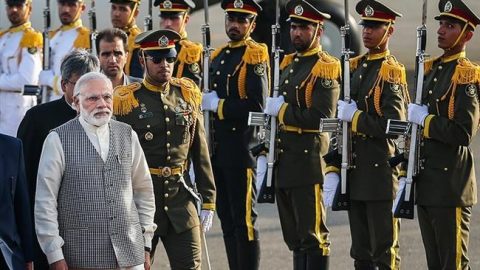
Indian PM Narendra Modi
Press TV – September 5, 2017
Iran’s Ministry of Petroleum says it has started preliminary talks with Russians to develop Farzad B but negotiations also continue with the Indians who have long coveted the giant gas field.
“For the development of the Farzad B field, we are pursuing three separate paths in parallel, but none of the options is definite yet,” director of the integrated planning at the National Iranian Oil Company (NIOC) Karim Zobeidi said on Monday.
The third path is the implementation of a development study plan in cooperation with a foreign consultant and Iran’s Petropars company, the official explained.
Zobeidi said negotiations with the Indians have not achieved satisfactory results but they have not stopped either and that Iran was pursuing preliminary talks with a Russian company as the second path.
“Along these two routes, the study of the development of Farzad A and B and the feasibility of the injection of gas from these fields into Aghajari (oil field) in cooperation with a foreign consultant and Petropars company is in progress,” he added.
Indian companies discovered the Farzad B gas field in Iran in 2008 and have bid several times for the development rights.
The Indians were supposed to develop the field after its exploration, but they stopped their activities after the West intensified sanctions on the Islamic Republic in 2012.
With the lifting of the sanctions, India once again called for the development of Farzad B by ONGC Videsh which is the overseas investment arm of the country’s biggest energy exploration firm.
According to an agreement, the Indians were first to submit a technical plan and then a financial proposal for the development of the field, but Iran did not agree with the other side’s financial proposals.
In the absence of an agreement between Iran and India, the development plan for Farzad B will be put to international tender.
In May, Minister of Petroleum Bijan Zangeneh announced that Iran had signed a basic agreement with Russia’s energy giant Gazprom over the development of Farzad B.
Indians shift attention to Israel
On Monday, Reuters cited India’s Oil Minister Dharmendra Pradhan as saying that state-run Oil and Natural Gas Corp planned to bid for disputed Israeli offshore oil-and-gas exploration blocks.
A high-ranking Indian delegation visited Israel last month to discuss taking part in the tender for blocks in the Mediterranean Sea, the news agency reported.
“We will definitely bid for Israel’s oil-and-gas blocks,” Reuters quoted Pradhan as saying.
New Delhi has deep military ties with Tel Aviv but they reportedly seek to expand their relationship to other sectors such as energy and technology following Prime Minister Narendra Modi’s visit to Israel in July.
According to Reuters, Israeli officials were pleased with the visit by the Indian economic team, while many oil majors have been hesitant to enter the Israeli market, fearing a backlash from oil-rich Arab states.
Lebanon has a long-standing dispute with Israel which stands accused of stealing Arab resources.
Lebanese Parliament Speaker Nabih Berri has said Israel was overtly stealing Lebanon’s underwater oil and gas reserves off the coast of south Lebanon. Hezbollah has warned that it would use force to protect Lebanon’s resources.
The gas discoveries have created a new source of friction between Lebanon and Israel, which have clashed repeatedly.
Lacking in natural resources, Israel has said it had discovered two fields thought to contain about 24 trillion cubic meters of natural gas, enough to make it energy self-sufficient for decades. Lebanese leaders have said the reserves were a “golden opportunity” for Lebanon to service its huge debt and rebuild its economy.
Hassan Nasrallah: Israel is in despair after the defeats of Daesh
Speech by Hezbollah Secretary General Sayed Hassan Nasrallah on 28 August 2017 on the occasion of the Second Liberation, following the complete surrender of the terrorists of Daech and Al-Nosra in Lebanon
Transcript:
[…] We are truly facing a great victory (against Daesh in Lebanon). From there, consider that on May 25, 2000, we expelled the Zionist Occupying (Lebanon) and today we all (the Syrian and Lebanese armies and Islamic Resistance) have expelled the occupying terrorist takfiri. This is one of the fundamental similarities.
On the border, vast and sensitive areas (mountains, hills, strategic positions) were in the hands of the Zionists, and here also, vast expanses, mountains, heights, hills, strategic positions were in the hands of the takfiris. At the border, accross the international border, the Israelis were a permanent threat and that is always the case, and takfiris were a threat at every moment against all of Lebanon, especially against all the Bekaa, not only against Baalbeck-Hermel and border villages.
Lately, everyone knows that they planned there, in the Jurd of Ersal, Daesh was preparing suicide operations and attacks in Zahle and in the surrounding villages, but the intelligence services of the Lebanese army discovered them before the operations were conducted.
Today we face this reality. And maybe it would come to the mind of some to say “ô Sayed [Nasrallah], as regards Israel, it is something very different (from what happens today).” But no, it is a continuation. Day after day, it is shown that these Daesh and takfiri groups have been created by American power and fought to realize the Israeli project. They fought (in the interest of the) Israeli project. And what these takfiri terrorist groups have offered Israel, Israel could never get for decades.
And more dangerously… I do not want to classify these two dangers, because I believe that these terrorist groups are fighting within the American-Israeli project, whether they know it or not. Their leaders know for sure. The fools are the fighters who got fooled by false and superficial slogans. Israel is an occupation and hegemony project. Israel is an occupying project. The United States are a project of hegemony. Daesh and other takfiri groups are an extermination project. The extermination of all that is different (from them): Muslim, Christian, Sabean, Yazdi, everything. That is an extermination project. The extermination of man, of History, of civilization, of society, of all things. And then when our region is destroyed, its armies, its plans, its states, its institutions, its social structure, it will be offered (on a silver platter), primed, cooked to perfection, roasted and stuffed to America and Israel, so that they seize it and impose their conditions on everyone.
And that’s why today, who is shedding tears over the fate of Daesh in Syria, in Qalamoun and in Iraq? Netanyahu and Israeli officials! It is they who mourn (bitterly) and yell sorrowful lamentations! Currently, their problem with the Trump administration is that it committed itself to the eradication of Daesh as a priority, the same administration that recognizes that this is the Obama (and Clinton) administration who created Daesh. This is why no one should come and say that there is a big difference between the Liberation of South(-Lebanon in 2000 against Israel) and this battle (against Daesh) and that the liberation of South ranks first (in importance), and that (the Liberation of our borders) is in 10th place (for example) in any way! (Liberation of southern Lebanon against Israel) is first, (the Liberation of our borders against Daech) comes right away in second place! For it is a continuation of the battle against Israel.
Read Israeli (statements and press). (Unfortunately), the Lebanese and the Arabs do not read much. Read what they say, what they write, especially these days, with the ongoing eradication of Daesh in Iraq, Syria and Lebanon, so that you realize clearly that Daesh is a true Israeli project.
We are indeed facing the Second Liberation (of Lebanon). The date of the First Liberation is May 25, 2000. The date of the Second Liberation, for history, is today (28 August 2017). I do not mean the day (to be selected for an annual commemoration of this event). Today we wrote… Last time, today’s date, August 28, 2017, was empty (of any commemoration) in the calendar. But not for 2018. By the will of God, this day and this month are written by the Lebanese Army, the Syrian army and fighters of the Islamic Resistance in Lebanon. This was written today (in the annals of History): August 28, 2017 is the Day of the Second Liberation, which will be recorded as a glorious day in the history of Lebanon and the history of the region.
Now whether the Lebanese government (led by the pro-Saudi Saad Hariri and his March 14 coalition, facing the movement of March 8, with Hezbollah and its allies) recognizes it or not, that’s their problem, just like what happened on May 25, 2000. The situation was somewhat different at the time, that date was declared a national holiday, then was removed from the calendar at the time of a previous Prime Minister. But then, thanks to God, a head of government redid the occasion of May 25 a day of remembrance.
We now have an opportunity to commemorate: August 28, 2017. I speak only of the historical event that took place on August 28, I do not write the history (and national holidays) myself. But today there is no longer any daeshiste, takfiri, (member of) Al-Nusra Front or (any other terrorist) on the least grain of sand, any mountain or any Lebanese hill. It was on that date (this event occurred). After that, if the government wants to keep that date, or choose August 27, August 25, August 31 or September 3 (for the commemoration), I have no problem. I do not precede anyone, I speak only of the historical event.
On this basis, I wish to conclude with this call (to celebrate this event this Thursday 31st, the day of Arafat, on the eve of Eid-al-Adha): you remember that on May 25, 2000, it is all Lebanon who won, and Lebanon was happy with the victory (against Israel), with the exception of those who had placed their hopes in the Israeli occupation, and there were (a number) in the country, and those who had placed their hopes in the army of Antoine Lahd. So on that day, there was a majority (of Lebanese) happy, and (a minority) of people whose faces were darkened (with bitterness) because their plans had collapsed.
Today… But (in 2000), the happiest people, despite the fact that it was a national day, celebration and victory, were southerners, residents of southern Lebanon and Jabal Amel who were the happiest of all with this victory and this Liberation. The reason is simple: it is because the occupation took place on their mountains, their hills, their cities, it is their sons and daughters who were imprisoned, their peasants and farmer were fired at, and a daily threat was hanging over them. We remember the bombing against Sidon and Nabatiye and children and schoolchildren’s heads torn in the streets. It is quite normal that the people of the South, who are those who have suffered most and have the most sacrificed,were (more) happy on May 25, 2000.
Today, all of Lebanon won, and logically, the vast majority (of the population) is pleased, with the exception of those who have placed their hopes on the Al-Nusra Front, on Daesh and the regional states and world powers that stand behind them. It is understandable that they are angry, saddened and dismayed, and they offer their condolences, it is normal. And a few days ago, 2 or 3 weeks, they have insulted, reviled and slandered us, but let them act as they please. We understand their sadness and pain.
But with certainty, the vast majority of Lebanese are happy because without these (victorious) confrontations for several years to date, Daesh, the Al-Nusra Front and their like could have seized the Bekaa, the North and reached other places in Lebanon and we would have experienced a disaster. See what happened in the country and the societies around us (Syria, Iraq, Libya).
But it is also natural that the happiest people in the Second Liberation are our noble people of the Bekaa. They are the ones whose mountains, Jurds and fields, were attacked with car bombs and suicide bombers, against Hermel, Bekaa and Ras Baalbek, and the whole area was threatened upto all Zahle and the Bekaa, and now that this nightmare disappeared from their mountains, their hills, their Jurds, their homes and their lands, they sure are going to be the happiest of all. For they have suffered more than all, and in this battle, it is among them that there was the most sacrificed (martyrs).
It is true that our brothers, our families and the officers and soldiers of the Lebanese Army came from all regions of Lebanon and fought on this front, but there is no doubt that today in the Bekaa, there are no villages, especially in Baalbek-Hermel, in which are not found one, two or three martyrs, and one, two or three wounded. The Bekaa residents have also shaped this victory by the blood of their loved ones and their children, the apple of their eyes, the best elements among their young men. Not to mention the wounded who are still in the homes and in hospitals. Therefore it is normal that they are happy, congratulate themselves and take pride in this victory which is a national victory in general,but especially a victory for the Bekaa. […]
Translation: http://sayed7asan.blogspot.fr
Syria Approves Qalamoun Ceasefire Agreement between Hezbollah and ISIL Terrorist Group
Al-Manar | August 27, 2017
Syrian authorities approved the ceasefire agreement between Hezbollah and ISIL terrorist group in western Qalamoun in order to evacuate the rest of the takfiri militants from the area, a Syrian military source said.
The source added that preserving the souls of the Syrian army soldiers and allies was behind Syria’s approval.
ISIL Terrorists in Lebanon-Syria Border Outskirts Surrender
After an intensive military campaign launched by the Lebanese and Syrian armies and Hezbollah against ISIL terrorists in Lebanon-Syria border outskirts, a ceasefire was concluded and took into effect on Sunday at 7 a.m. (Local Time).
The takfiri militants of ISIL surrendered and agreed to leave the area after turning in the corpses of two of Hezbollah martyrs and disclosing the fate of the Lebanese Kidnapped servicemen.
The Lebanese Army Guidance declared Sunday morning a cease of fire against ISIL terrorists for more negotiations to reveal the fate of the kidnapped soldiers, according to a communiqué issued by the Army Guidance Directorate Department.
Nine Lebanese servicemen were kidnapped by ISIL terrorists, as well as Nusra Front militants, in 2014 when the takfiri group invaded the northeastern town of Arsal.
Lebanon army discovers US-made weapons cache left by Nusra terrorists

This Photo purportedly shows a discovered weapons cache left behind by Takfiri Jabhat Fateh al-Sham militants in northeastern Lebanon.
Press TV – August 19, 2017
The Lebanese army has discovered a weapons cache left behind by defeated militants from the Jabhat Fateh al-Sham terror group, formerly known as al-Nusra Front, in the northeast of the country.
The Lebanese National News Agency (NNA), citing an unnamed official from Lebanon’s General Directorate of General Security, reported on Friday that a patrol of the intelligence agency had found an ammunition and missile cache in Wadi Hamid Valley east of the border town of Arsal, without providing further details.
However, Reuters quoted an unnamed security source as saying on Friday that the cache contained at least a surface-to air missile (SAM) and a number of US-made TOW anti-tank missiles as well as plenty of other types of shells and rockets.
The following photos of the cache were provided by the security source.


On July 29, commanders of Lebanon’s Hezbollah resistance movement said the group had successfully concluded a week-long military offensive against al-Nusra on the outskirts of Arsal and the adjacent town of Flita in Syria, seizing land in the rugged, mountainous area and killing about 150 terrorists.
In August 2014, the al-Nusra and Daesh Takfiri terrorist groups overran Lebanon’s northeastern border town of Arsal, killing a number of Lebanese forces. They took 30 soldiers hostage, most of whom have been released.
Since then, Hezbollah and the Lebanese military have been defending Lebanon on the country’s northeastern border.
Friday’s development come as the Lebanese army has been targeting Daesh hideouts along the Syrian border over the past several days, regaining more areas from the terror group. It also comes after Syria accused the US and the UK of supplying chemical weapons to terrorists in the country.
Lebanese Hezbollah leader says Israel not able to wage new war on Lebanon
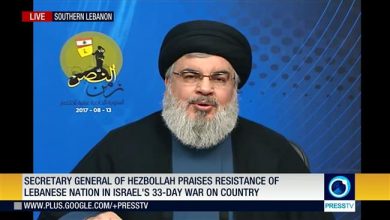
Press TV – August 13, 2017
The Secretary General of the Lebanese Hezbollah movement says Israel is not able to launch a new war on Lebanon, because it knows that Hezbollah is much more powerful than 2006 and any such war would cost Tel Aviv dearly.
Sayyed Hassan Nasrallah made the remarks in a speech on the anniversary of Israel’s defeat in the 33-day military onslaught against Lebanon back in the summer of 2006.
During his speech, Nasrallah noted that the main reason behind the victory of Hezbollah fighters in the war with Israel was their patience, steadfastness, valor and faith.
Stressing the rise in Hezbollah’s power since the war in 2006, Nasrallah noted that the resistance group is ready to counter any further act of aggression, warning that in case of new Israeli aggression, Israel will face a 100 times tougher response than the one its forces saw during the 2006 war.
Nasrallah added that Israeli analysts were still analyzing the results of that war, because it destroyed their self-confidence and they have admitted to their defeat in the summer war in 2006.
Everything that Israelis say about the power of Hezbollah is because of their defeat in summer 2006 war, Nasrallah said.
The Hezbollah chief stated that Israelis wanted to destroy Hezbollah, but after 11 years, they say Hezbollah has become stronger and more powerful and this shows that they have failed to achieve the goals they pursued through 2006 war.
Elsewhere in his speech, Nasrallah explained that Hezbollah only fights outside the Lebanese borders and will not use force in domestic developments of the country.
He added that in return for its victories, Hezbollah does not seek personal, party, or tribal interests, noting that today, the resistance movement is more powerful than ever and the enemy has reached the conclusion that any new aggression against Lebanon will be very costly.
Rejecting any chance of a new Israeli aggression against Lebanon, Nasrallah noted that the time of toying with Lebanon is over and Israelis themselves have owned up to the high cost of such a war and have said that war with Lebanon should not take place.
They wanted to crush the resistance in 2006 war, but they failed to achieve this goal, Nasrallah said.
The Hezbollah chief added that not only Israel, but all those parties which seek to crush Hezbollah at the present time will fail to achieve this goal.
Nasrallah said that due to its inability to wage new war on Lebanon, Israel wants to collectively punish the entire Lebanese nation, and it is putting high pressure on the administration of US President Donald Trump, but they will fail to achieve anything as in the past.
About 1,200 Lebanese, most of them civilians, lost their lives during Israel’s 33-day war on Lebanon back in the summer of 2006.
According to the 629-page Winograd Report by the Israeli regime itself, Hezbollah fighters involved in defending Lebanon against the Israeli war defeated the enemy and Tel Aviv was compelled to withdraw without having achieved any of its objectives.
UN Security Council Resolution 1701, which brokered a ceasefire in the 2006 war, calls on Israel to respect Lebanon’s sovereignty and territorial integrity.
Speaking in an exclusive interview with Lebanon-based Arabic-language al-Manar television network on Jul 14, head of Hezbollah’s Executive Council Sayyed Hashem Safieddine stated that the resistance movement will “surprise” Israel in any future war, relying on its enhanced military capabilities.
Safieddine stressed that Hezbollah has been changing and developing new military capabilities, and Israeli reports on Hezbollah’s weaponry are “inaccurate as the enemy intelligence agencies can never reach veracious data in this context.”
Fateh al-Sham terrorist group releases three Hezbollah captives
Press TV – August 2, 2017
Three members of the Lebanon’s Hezbollah resistance movement have been set free by the Jabhat Fateh al-Sham Takfiri terrorist group in exchange of three of its members.
The Hezbollah fighters arrived in Lebanon late on Tuesday as part of a ceasefire agreement between both parties last week.
The first stage of the ceasefire, brokered by the national police and security force of Lebanon – Internal Security Forces Directorate, took effect on Sunday as both sides exchanged the bodies of fighters killed in clashes between them.
The truce was agreed after Hezbollah fighters dealt a heavy blow to the militants in Lebanon’s rugged Arsal region bordering Syria. At least 150 militants of the Takfiri group were killed in the Hezbollah operation aimed at preventing the spillover of the Syria war.
The ceasefire agreement involves the departure of all militants of the Jabhat Fateh al-Sham group from the region around Arsal along with any of the civilians, living in Arsal’s refugee camps, who wish to leave the border zone with them.
Hezbollah launched a major push on July 21 to clear both sides of Lebanon’s border with Syria of “armed terrorists.”
In August 2014, the Jabhat Fateh al-Sham and Daesh terrorist groups overran Lebanon’s northeastern border town of Arsal , killing a number of Lebanese forces. They took 30 soldiers hostage, most of whom have been released.
Since then, Hezbollah and the Lebanese military have been defending Lebanon on the country’s northeastern border.
Ceasefire takes effect on Lebanese-Syrian border: Reports
Press TV – July 27, 2017
A ceasefire has reportedly taken effect on the Lebanese side of the border with Syria near the town of Arsal, where Hezbollah resistance fighters have been combating Takfiri militants over the past week.
Lebanon-based al-Manar television network and the Lebanese National News Agency (NNA) reported on Thursday that the ceasefire in the Juroud Arsal area came into force at 0300 GMT and halted fighting on all fronts.
The NNA said the truce was part of a deal brokered by Lebanon’s general security agency chief, Major General Abbas Ibrahim.
Under the agreement, the report said, the remaining al-Nusra terrorists would withdraw from the region to Syria’s Idlib Province, parts of which are controlled by Takfiri militants.
It added that Ibrahim was expected to release a statement on the deal later on Thursday.
Hezbollah launched a major push last Friday to clear both sides of Lebanon’s border with Syria from “armed terrorists.” Lebanon’s army has not formally declared its role in the operation, but has shelled terrorist positions in the area.
On Tuesday, the resistance group’s media bureau announced in a statement that its battle to eliminate members of the Takfiri Jabhat Fatah al-Sham – previously known as the Nusra Front – militant group from the Syria-Lebanon border is 85 percent complete.
Hezbollah Secretary General Sayyed Hassan Nasrallah also said Wednesday that the operation to recapture the border area from Nusra was almost complete, and that nearly 100 percent of the territories that used to be controlled by the Takfiri terrorists were now liberated.
In August 2014, Jabhat Fateh al-Sham and Daesh terrorist groups overran Arsal, killing a number of Lebanese forces. They took 30 soldiers hostage, most of whom have been released.
Since then, Hezbollah and the Lebanese military have been defending Lebanon on the country’s northeastern frontier against foreign-backed terrorist groups operating in neighboring Syria.
Hezbollah fighters have fended off several Daesh attacks inside Lebanon. They have also been providing assistance to Syrian army forces to counter the ongoing foreign-sponsored militancy.
The movement has accused Israel of supporting Takfiri terrorists operating in the Middle East.
Israel, which continues to occupy Lebanon’s Shebaa Farms and Syria’s Golan Heights, is widely reported to be offering medical help to Takfiri terrorists injured in Syria. In December 2015, British newspaper the Daily Mail said Israel had saved the lives of more than 2,000 Takfiri militants since 2013.
Canadian court upholds $1.7 billion ruling against Iran
Press TV – July 4, 2017
A Canadian court has accused Iran of supporting terrorism, upholding a previous ruling that requires the Islamic Republic to pay around $1.7 billion in damages to “American victims of terrorism.”
Ontario’s Court of Appeal rejected Iran’s request to reconsider the ruling on Monday night, arguing that doing so would amount to a breach of Canada’s Justice for Victims of Terrorism Act (JVTA).
The JVTA allows victims of terrorism to sue foreign states for damages.
The accusation came despite Iran’s firm response to similar cases in the past, where various American and European courts had taken punitive measures against Tehran over unproven claims of complicity in terror.
The new case was brought by families of American citizens who had been killed in a series of attacks between 1980s and 2002, mostly blamed on Palestinian and Lebanese resistance movements Hamas and Hezbollah.
The families claimed that the Iranian government supported the two organizations and was therefore responsible for their actions.
The complaints were first filed in the US but the claimants turned to Canada after finding out that the Iranian government had more properties and bank accounts there.
A one-story house in Toronto, an industrial building in Ottawa and two bank accounts were among the assets that were sought in the case.
Without offering further elaboration, the court also claimed in its ruling that Iran was seeking to “frustrate” the JVTA’s implementation.
The Iranian government had reportedly told the court that it had immunity in the case. It had also argued that the judgment was against international law and exceeded the maximum damages allowable in Canadian law.
Tehran also argued that the victims had to prove Iran’s role in each attack instead of just repeating the US government’s baseless allegations.
The court said Iran was only immune in terrorism cases that had occurred before January 1985, when Canada’s State Immunity Act was passed.
A recurring trend
Last year, the US Supreme Court ruled that around $2 billion had to be turned over to the American families of the people killed in a 1983 bombing in Beirut and other attacks blamed on Iran.
Likening the act to “highway robbery,” Iran said back then that it would seek reparations.
The trend of the unfair rulings continued in March, when a New York court ordered Iran to pay $7.5 billion in damage to families of victims of the September 11, 2001 attacks and $3 billion to a group of insurers over related claims.
The ruling surprised many since Washington had clearly blamed the attacks on the al-Qaeda terror group and even investigated members of Saudi Arabia’s royal family who had proven ties to the terrorist organization.
Various investigations have revealed that 15 of the 19 plane hijackers involved in the attacks were Saudi nationals and some of them had received large sums of money from Saudi royals.
The ruling lost even more weight in September, after the US Congress passed the Justice Against Sponsors of Terrorism Act (JASTA), clearing the path to sue Saudi Arabia for the tragic death of over 3,000 people.
It was reported in March, however, that a judge in Luxembourg had quietly put a freeze on $1.6 billion in assets belonging to the Central Bank of Iran (CBI) to compensate the 9/11 victims.
The Canadian court’s ruling came days after yet another anti-Iran ruling by a US court, which allowed the American government to seize an Iranian charity’s office tower in New York City over claims that it was used to breach Iran sanctions.
Featured Video
BRITAIN’S WARNING: PREPARE FOR WAR
or go to
Aletho News Archives – Video-Images
From the Archive
How Ukraine Tortured and Slaughtered Donbass
By Kit Klarenberg | Al Mayadeen | July 11, 2024
Almost immediately after the proxy war erupted, ISIS-tier footage of the torture and murder of Russians in Ukrainian custody emerged.
On July 6th, the New York Times published an astonishing investigation: In Ukraine, Killings of Surrendering Russians Divide an American-Led Unit. The article documents in grim detail how Chosen Company, an international volunteer battalion for Kiev, routinely executes Russian prisoners of war. It is the very first mainstream admission that this practice – a brazen breach of the Geneva Conventions, and a grave war crime – is widespread among Ukraine’s fighters, both foreign and homegrown. … continue
Blog Roll
 Aletho News
- Israel Demolishes Home Of Lebanese Journalist Whose Viral Film Exposed Pager Attack
- Record Oil, Empty Tanks: The UAE’s Miracle Recovery
- Burnham tackles Britain’s poverty with aggression in Yemen
- Peace in Ukraine: the easy way – or the hard way
- Trump & the Rrrrussians
- US taxpayer money laundered back through Ukraine – Musk
- Before COVID, an NIH lab chief proposed making a SARS-like bat virus more infectious
- Gates, Bourla on Trial in Netherlands Accused of ‘Great Reset’ Scheme at Vaccine Injury Hearing
- BRITAIN’S WARNING: PREPARE FOR WAR
- “Historic Russia”: The Land Putin Will Not Give Back
- If Americans Knew
- DAILY UPDATE: Latest essential news on Palestine, Israel, & region
- Damning report shows the media must confront its failures on Gaza
- BBC senior broadcaster speaks out on Gaza coverage
- Netanyahu vows vast West Bank invasion in response to 20-minute skirmish that left 2 Israeli soldiers and 2 Palestinian fighters dead
- Tied up and tortured: Israel using US-made electroshock weapons on Palestinian detainees
- The outsourced risk: how newsrooms rely on Gaza’s freelancers without protecting them
- Gaza bakeries forced to shut as Israel blocks flour shipments
- Gaza’s breast cancer patients face a deadly wait for treatment amid Israel’s genocide
- DAILY UPDATE: Latest essential news on Palestine, Israel, & region
- The Israel Lobby’s Changing Fortunes
- No Tricks Zone
- Two New Studies Find Thwaites Glacier Melt Cannot Be Driven By Human Activity Or A Warming Ocean
- E-Cars Reduce CO2 Emissions By Only 41% Compared To Internal Combustion Engine Vehicles
- Predictions Made By Renowned Climate Professor Over Past Decades Have Been Proven To Be Poor
- New Study Suggests Large Regions Of The Pacific Ocean Have Been Cooling For The Last 80 Years
- Germany’s Green Energy Debacle: High Energy Costs Force Kahla Porzellan to Close After 182 Years!
- New Study: 50 Years Of The Most Aggressive ‘Net Zero’ Policies Can Only Affect The Global Climate By 0.03°C
- US September “Heat” Was No Record…Many Records Set Decades Ago
- Latest European Green Energy Debacle; Portugal’s Largest Flagship Solar Park Insolvent!
- Green Energy Debacle: German Expert Professor Fritz Vahrenholt Warns Of Severe Economic And Social Consequences
- Two More Paleo Reconstructions Affirm Meters-Higher Sea Levels Across Ireland, Brazil 7000-6000 Years Ago

