Aletho News

ΑΛΗΘΩΣ

US House awards Gold Medal for war criminal Shimon Peres

Peres-Obama-640x326

Photo – Sultan/thepoliticalforums.com
Aletho News | May 21, 2014

The US House of Representatives on Monday voted to give the Congressional Gold Medal to Israel’s outgoing president, Shimon Peres.

The bill which authorizes the creation of the gold medal and its award to Peres, HR 2939,  is co-sponsored by Rep. Trent Franks (R-AZ) and Rep. Joe Kennedy (D-MA). It touts Peres’ “pivotal role in forging the strong and unbreakable bond between the United States and Israel” and states that “[b]y presenting the Congressional Gold Medal … Congress proclaims its unbreakable bond with Israel and reaffirms its continual support for Israel.”

The following excerpt from an open letter by the Palestinian Campaign for the Academic and Cultural Boycott of Israel recounts Peres’ career, emphasizing a record of war crimes:

On 18 April 1996, when Israel still occupied southern Lebanon, Shimon Peres was Prime Minister. He was in the midst of an election campaign, so he took a decision to do something to change his “dovish” image because doves are not respected in Israel. He launched “Operation Grapes of Wrath” causing 400,000 Lebanese to flee their homes, with almost 800 of them fleeing to a UN base in Qana, South Lebanon.

On 18 April the Israeli army shelled the UN shelter in Qana, killing 102 civilians, mainly women, children and the elderly. Many more were injured. Human Rights Watch, the UN and Amnesty International subsequently disproved the myth that the Israeli army did not deliberately intend to shell the UN base. Shimon Peres said at the time, “In my opinion, everything was done according to clear logic and in a responsible way. I am at peace.”

The Qana massacre led to Shimon Peres being denied the job he coveted at the time: that of UN Secretary-General. He should have been denied it anyway for being the architect of Israel’s nuclear programme — one which remains outside the scrutiny of the world even as Israel bays for the cessation of Iran’s pursuit of nuclear energy for civilian purposes.

Peres is on record for being responsible for other war crimes, from building colonies on occupied Arab land to endorsing a policy of extra-judicial killings, which murders Palestinians and other Arabs without the benefit of a trial or, in fact, any proof other than that provided by Israeli Intelligence, the Shin Bet. He also supports the siege on Gaza, the destruction of its airport, and the elaborate system of checkpoints all across the West Bank. He defends the demolition of Palestinian homes, and he justified the atrocities committed by the Israeli army in its recent war on Lebanon in 2006.

Peres is also on record for defending land gained during war, claiming that Israel has the right to the Golan Heights because it was gained during war.

A Senate version of the bill, co-sponsored by Sen. Michael Bennet (D-CO) and Sen. Kelly Ayotte (R-NH), passed by unanimous consent in March.

May 21, 2014 Posted by | Ethnic Cleansing, Racism, Zionism, War Crimes | , , , | Leave a comment

Is the Special Tribunal for Lebanon covering up the bribery of witnesses?

Al-Akhbar | May 15, 2014

The Special Tribunal for Lebanon (STL) does not miss an opportunity to undermine its credibility and damage its image. This behavior is not restricted to the public prosecutor’s office, but to the trial chamber itself, which is supposed to be keen on implementing justice and presenting a positive image of the tribunal to the public.

The latest development is a decision issued by the tribunal’s First Chamber, which is in charge of trying the defendants in the assassination of former Lebanese Prime Minister Rafik Hariri. The decision stipulated concealing the amount of money that the public prosecutor’s office pays to witnesses under the rubric of “expenses.” On May 9, the tribunal issued a decision granting the prosecution’s office the right to conceal the amount from the defense teams.

The decision came after the defense team for Hussein Oneissi requested that the tribunal order the prosecution’s office to disclose information it has on whether two of the public prosecution’s witnesses or members of their families were paid money from the office itself, from the international investigation committee or from the Lebanese authorities. Oneissi’s defense team argued that the issue is relevant to its defense strategy since it casts doubt on the credibility of some of the witnesses the public prosecutor is going to present to the court. After deliberations, the court decided to keep the matter a secret and not force the public prosecutor to disclose the information.

According to the decision, the tribunal reviewed similar cases in other international courts whereby it became evident that courts cover the expenses and costs of witnesses living in the Netherlands. Besides, some international courts (and national ones, according to the STL’s First Chamber) have developed clear standards under which they pay the “expenses of the witnesses.” It added that some courts pay the witness a monthly stipend in lieu of their salary that they were receiving as compensation for moving to the Hague to testify. The amount is equivalent to the minimum wage that a United Nations employee earns in the country where the witness comes from. The tribunal pointed out that it reviewed the amounts that the prosecution’s office paid as expenses to the witnesses and found them “reasonable.” It added that the defense team did not present proof that the two witnesses received sums beyond what is deemed reasonable. Therefore there is no need to reveal how much was paid as expenses to them.

But neither the prosecution nor the tribunal were able to rule out whether the two witnesses or one of them or members of their families received money from parties other than the prosecution’s office. This will continue to be a point of contention in the future because of how deeply it affects the credibility of the witnesses’ testimonies, especially those that the public prosecution is going to present as witnesses to be relied on to convict the defendants even though their testimonies have changed from one stage of the investigation to another.

In another matter, the public prosecutor gave a bizarre excuse for not giving the defense team of one of the defendant’s documents it requested that include information on students at one of Lebanon’s universities between the years 2004-2005 in addition to information about specific individuals at the same university in 2006. The public prosecution’s office had received this information from the Lebanese authorities which never denied any of the former’s requests. The public prosecutor cited several reasons for turning down the defense team’s request including the claim that this information would enable the defense team to breach the confidentiality of one of its witnesses.

But the most bizarre and most laughable excuse is the public prosecutor’s claim, in his letter to the tribunal on May 9, 2014, that handing over this information to the defense team might “violate the privacy of these students.” Let’s remember that the public prosecution’s office had insisted on getting the Lebanese people’s telecom data, health records, university records, travel records, insurance records and market licenses and – as experience has shown – was unable to protect its records and prevent them from being leaked. This same office is now claiming to care for the privacy of Lebanese students in order to prevent the transfer of information about them to their own colleagues – the defense lawyers – at the tribunal.

May 15, 2014 Posted by | Corruption, Deception | , | Leave a comment

Possible Iranian-Saudi rapprochement to impact region

By Elie Chalhoub | Al-Akhbar | May 14, 2014

Statements by Saudi Foreign Minister Saud al-Faisal on Tuesday point to a significant development in the relationship with Iran. Saudi’s so called “hawk” and Iran’s number one enemy in the kingdom is now welcoming a dialogue with the Islamic Republic. But the implications will not be felt in Tehran or Riyadh, but in Baghdad, Homs, Beirut, and Vienna.

Saudi Arabia’s call for a dialogue with Iran is no small matter, neither in its substance, “to settle differences and make the region safe and prosperous,” or in its timing, regionally, internationally, and in relation to the nuclear issue, or the fact that it was issued by one of the kingdom’s most hawkish members.

Information from Tehran maintains “the Iranian position did not change.” It indicated that, “ever since President Hassan Rouhani reached power, [Iran] declared its openness to dialogue with the Saudis and announced the issue publicly several times.” This included statements during the recent tour of Gulf countries by Iranian Foreign Minister Mohammed Javad Zarif, in which he kept hoping to visit Riyadh. However, “the rejection was also coming from the Saudis, despite all the openness to reconciliation expressed by Iran.”

According to the same sources, several mechanisms were proposed to start a constructive dialogue, following negotiations through Omani mediation. Muscat was later forced to suspend its role after its relations with Saudi Arabia began to falter. However, a few months ago, Kuwait took up the mantle and became the main mediator between the two sides. The sources revealed that one such mechanism was suggested by the Saudis and entailed parallel trust-building steps. They would begin with a meeting between representatives of both countries’ foreign ministers, then between the two actual foreign ministers, and then to ultimately have a visit by Rouhani to Saudi Arabia to meet with King Abdullah.”

The information, which was obtained from circles concerned with relations between Tehran and Riyadh, maintained that the Saudis recently proposed through the Kuwaitis a visit by assistant Iranian foreign minister, Amir Abdel-Lahian, to hold talks. However, “Iran was not satisfied with the suggestion. They believed the atmosphere in Saudi and that surrounding the proposal, its mechanisms, and the position and authority of negotiators from either side would not lead to a serious breakthrough.”

So why did the invitation come now, at this particular time? And what are the motives behind it?

The sources point to the wider picture. “The Iraqi elections show that [Prime Minister] Nouri al-Maliki will have a larger parliamentary bloc than in the previous parliament and it is certain that he will continue through a third term. This is in addition to the latest developments in Homs, which means that the axis supporting [Syrian] President [Bashar] al-Assad now has the upper hand on the ground. There is also the situation in Lebanon, which shows beyond doubt that there will be no presidential elections, without the consent of the axis of resistance. It seems all those factors, including pressure by the US and the push by Kuwait, led the Saudis to take such a step.”

US pressure was manifested in the visit by US Defense Minister Chuck Hagel to Saudi Arabia on Tuesday, meeting with the kingdom’s leadership to discuss the Syrian and Iranian files. Kuwait’s push, on the other hand, will be apparent during the visit by the Kuwaiti Emir to Tehran on June 1. He is expected to discuss bilateral relations, including disagreements concerning the continental shelf. But the essence of the meetings will be relations with the Gulf Cooperation Council (GCC) and the Saudis in particular, in addition to Syria and other matters.

The Saudi foreign minister had announced earlier that the kingdom sent out an invitation to Mohammed Javad Zarifi, “We want to meet with him. Iran is a neighbor with whom we have relations and we will conduct negotiations with Iran.”

Faisal was speaking at a press conference during the First Forum on Economy and Cooperation of Arab Countries with the Central Asian States and the Republic of Azerbaijan. “We will talk to them and if there are disagreements we will settle them in a manner that will satisfy both countries,” he explained. “We also hope that Iran would join the efforts to make the region safe and prosperous and not be part of the problem of a lack of security in the region.”

Saud al-Faisal also expressed the desire to resume contacts between the two countries as expressed by Iran’s president and foreign minister, “We sent out an invitation to the [Iranian] foreign minister to visit Saudi Arabia, but the will to make the visit has not become a reality yet. However, we will meet him anytime he wishes to come.”

Whether by coincidence or planning, Hagel’s visit and Faisal’s call coincided with the final phase of nuclear talks between Iran and the West. But it came at a time when Zarif had just arrived to Vienna to head the delegation to the nuclear talks.

What is certain, however, are the statements by Ali Khamenei on Tuesday and the several signals he gave, which aimed to provide an umbrella to the Vienna negotiations. He emphasized that the US is unable “to do anything rash, militarily or otherwise…We depend on our own powers, strengthening them and focusing our efforts on our own potential, which will defeat plans by the Americans and other powers to force the Iranian people to surrender through exerting pressures.”

Khamenei spoke in front of a large crowd of residents in the Ilam province on the anniversary of Imam Ali bin Abi Taleb’s birth. “The major powers ought to know that the Iranian people will not yield to their ambitions, because it is a living people and its youth are moving and acting in the right direction.”

These clear words are perhaps behind Zarif’s assertions from Vienna that “the difficult part” had only started and the desired deal might be aborted, even in the absence of a consensus on just “2 percent of the topics for discussion.” Iran’s negotiations with the P5+1 groups is entering a new highly sensitive phase, with the drafting of what has become known as the “final agreement.” Tuesday night, Zarif met with the EU Foreign Minister Catherine Ashton, on behalf of the P5+1 countries, over dinner. Actual negotiations will begin on May 14 and will continue until Friday.

Unlike previous sessions, Zarif and Ashton will be heading most of the meetings.

The most contentious issue in this round is the item related to the Arak heavy water reactor, which the West wants closed, and the ability to enrich uranium, which Iran hopes to keep.

The West’s belief that it could reach some kind of nuclear deal is probably due to both sides’ need for an agreement. In addition to building his foreign policy on reaching a settlement with Iran, US President Barack Obama has his hands tied in congressional midterm elections at the end of this year. It has become clear that he needs a foreign victory to ensure the victory of his party, especially after the collapse of his project for the Arab Spring and failing to reach a Palestinian-Israeli settlement or to topple Bashar al-Assad, not to mention his crisis in Ukraine.

Rouhani, on the other hand, seems to be betting on a nuclear deal that would lift the sanctions, and thus improve the economic situation inside Iran, which would give him leverage over his fundamentalist opponents. However, he realized, albeit late, that international sanctions are linked to four files, of which nuclear power is a minor issue. The other three are terrorism, human rights, and the rockets. The sanctions would only be lifted after closing all four files. And even if that happened, Obama has to solve his problems with the US Congress, which still rejects any lifting of sanctions against Iran.

May 14, 2014 Posted by | Ethnic Cleansing, Racism, Zionism | , , , , , , , , | Leave a comment

German forces raid offices of “Hezbollah affiliated” charity

Al-Akhbar | April 8, 2014

German authorities on Tuesday raided the offices of a charity organization that allegedly has ties to Lebanon’s Hezbollah movement, accusing it of raising money for the group.

Around 150 police officers searched premises across six states and confiscated cash, computers and around 40 boxes of files.

Two bank accounts with a total of around 60,000 euros were frozen but no arrests were made, the German interior ministry said.

The ministry said it had outlawed the “Waisenkinderprojekt Libanon” (Orphan Children Project Lebanon) with immediate effect.

“The name of the group masks its actual purpose,” ministry state secretary Emily Haber said in a statement.

She said the organization based in the western city of Essen had raised 3.3 million euros ($4.5 million) in donations between 2007 and 2013 for the Lebanese Shahid Foundation, which supports families of fallen Hezbollah fighters.

Haber claimed the funds were used to recruit fighters “to combat Israel, also with terrorist measures” and compensate the families of suicide bombers.

The statement did not cite its evidence. Hezbollah used to carry out suicide missions against Israeli occupation forces in South Lebanon prior to their retreat in 2000.

The group has not used that tactic since Israel pulled its army from Lebanon 14 year ago.

“Organizations that directly or indirectly from German soil oppose the state of Israel’s right to exist may not seek freedom of association protection,” Interior Minister Thomas de Maiziere said in the statement.

He said the group’s goals violated Germany’s constitution.

The European Union in July last year also listed Hezbollah’s so-called military wing as a “terrorist organization.” But the EU said it would continue to deal with Hezbollah as a political entity.

The German interior ministry said it had put Waisenkinderprojekt Libanon, which has about 80 members, under surveillance since 2009.

(AFP, Al-Akhbar)

April 9, 2014 Posted by | Ethnic Cleansing, Racism, Zionism, Solidarity and Activism, Subjugation - Torture, Wars for Israel | , , , | Leave a comment

German forces raid offices of “Hezbollah affiliated” charity

Al-Akhbar | April 8, 2014

German authorities on Tuesday raided the offices of a charity organization that allegedly has ties to Lebanon’s Hezbollah movement, accusing it of raising money for the group.

Around 150 police officers searched premises across six states and confiscated cash, computers and around 40 boxes of files.

Two bank accounts with a total of around 60,000 euros were frozen but no arrests were made, the German interior ministry said.

The ministry said it had outlawed the “Waisenkinderprojekt Libanon” (Orphan Children Project Lebanon) with immediate effect.

“The name of the group masks its actual purpose,” ministry state secretary Emily Haber said in a statement.

She said the organization based in the western city of Essen had raised 3.3 million euros ($4.5 million) in donations between 2007 and 2013 for the Lebanese Shahid Foundation, which supports families of fallen Hezbollah fighters.

Haber claimed the funds were used to recruit fighters “to combat Israel, also with terrorist measures” and compensate the families of suicide bombers.

The statement did not cite its evidence. Hezbollah used to carry out suicide missions against Israeli occupation forces in South Lebanon prior to their retreat in 2000.

The group has not used that tactic since Israel pulled its army from Lebanon 14 year ago.

“Organizations that directly or indirectly from German soil oppose the state of Israel’s right to exist may not seek freedom of association protection,” Interior Minister Thomas de Maiziere said in the statement.

He said the group’s goals violated Germany’s constitution.

The European Union in July last year also listed Hezbollah’s so-called military wing as a “terrorist organization.” But the EU said it would continue to deal with Hezbollah as a political entity.

The German interior ministry said it had put Waisenkinderprojekt Libanon, which has about 80 members, under surveillance since 2009.

(AFP, Al-Akhbar)

April 8, 2014 Posted by | Ethnic Cleansing, Racism, Zionism, Solidarity and Activism, Subjugation - Torture, Wars for Israel | , , , , | Leave a comment

Nasrallah: Hezbollah’s intervention in Syria was ‘very late’

Excerpts from the latest comments of Hezbollah leader Sayyed Hassan Nasrallah on the Syrian war and the nature of his party’s military intervention in the conflict:

From the beginning as well – you see, the problem that the other (political) group in Lebanon had with us, and (the problem) that governments and regimes in the Arab and Islamic world had, and (the problem that) governments and regimes throughout the world had (with us), on the Syrian issue, is due to our political stance, (and) not our military intervention. Our military intervention came late, and as is said, it occurred after all (sides) intervened, and (after) all sides had come, and (after) all sides had fought. We came very late.

The problem was our political stance. That we got up from the first day, and said that: we are not with this conflict (taking place) in Syria, we are not with the toppling of the regime and the state, we are with reforms, with a political solution, with political dialogue, with achieving legitimate demands being called for by the people, yet we are not with anyone in Syria going out to break, bring down, destroy, and ruin (Syria), and to imposing major strategic choices on (Syria) – and the (real) issue is here, before reforms and demands, the (real) issue is the major strategic choices.

Okay, we took this stance, and there was a large group that was acting (based upon another) stance. What was required from us was that we move along with that stance, that we become a part of it. Because we did not become a part of it, the war became against us as well. So the issue essentially relates to our political stance, and not the military intervention. […]

Okay today, (Turkey), a member of NATO, and a candidate for the European Union, is busy preparing for a regional war and a direct intervention into Syria, with the pretext that there is a tomb for the first grandfather of Bani Othman – of the Ottoman state – and that the ISIL might… maybe they themselves may request the ISIL to demolish it. […]

We said from the beginning, that what will happen in Syria will expose the whole region to the danger of terrorism and takfir. And you said no, the story is not as such, you said the story in Syria is one of reforms, change, democracy, and human rights. And now, what is the situation, which you yourself talk about? You yourselves, after three years… You speak of Syria, (especially) the territory that is controlled by the armed groups, as a threat to the regional states, and as a threat to the states of the world.

Now, after three years, of your funding, and your arming, and your incitement, and your pushing towards military solutions, and your obstruction of political solutions, and your protection of the armed groups, you came to form a terror list, and you placed most of these armed groups on this terror list. Well, what remained anyway? Of course, regardless of our stance towards this list, when you come and say regarding Syria, that the ISIL, al-Nusra, and the Muslim Brotherhood, you come and say these are terrorists, well then, what else remains? Who else remains? […]

And if the takfiri terrorist movement is defeated in Syria, then I say to you, we will all remain. If this axis triumphs in Syria, all the Lebanese will be safeguarded. This axis does not seek revenge, it seeks security, it seeks harmony, it looks for strength, it does not look for revenge. Here, there lies major national choices, let us come and decide.


This video is an English-subtitled excerpt from a speech delivered on 29/03/2014.

Full transcript:

The last issue which I would like to mention and end with, is that today, the whole campaign regarding the issue of the resistance in Lebanon, is focusing on one of my main points, that is, our intervention in Syria. He comes and tells you: ‘you intervened in Syria, so now the national consensus is gone – we already dealt with this (point)’. ‘You intervened in Syria, so now the role of the weapons has changed, they are no longer resistance weapons’. Well, were these arms ‘resistance weapons’ for you to begin with? In any case, all of this is being said.

And this intervention and stance is currently considered the main problem being put forward on a regular basis, from some time till now, and it’s put forward every day. I would like to – because this issue is occupying the country and us all – comment on it a bit in the last section of my speech. From the beginning as well – you see, the problem that the other (political) group in Lebanon had with us, and (the problem) that governments and regimes in the Arab and Islamic world had, and (the problem that) governments and regimes throughout the world had (with us), on the Syrian issue, is due to our political stance, (and) not our military intervention. Our military intervention came late, and as is said, it occurred after all (sides) intervened, and (after) all sides had come, and (after) all sides had fought. We came very late.

The problem was our political stance. That we got up from the first day, and said that: we are not with this conflict (taking place) in Syria, we are not with the toppling of the regime and the state, we are with reforms, with a political solution, with political dialogue, with achieving legitimate demands being called for by the people, yet we are not with anyone in Syria going out to break, bring down, destroy, and ruin (Syria), and to imposing major strategic choices on (Syria) – and the (real) issue is here, before reforms and demands, the (real) issue is the major strategic choices.

Okay, we took this stance, and there was a large group that was acting (based upon another) stance. What was required from us was that we move along with that stance, that we become a part of it. Because we did not become a part of it, the war became against us as well. So the issue essentially relates to our political stance, and not the military intervention. There is something huge going on in the region, come forward and become a part of it, otherwise, prepare yourself for execution. This was the storm that was coming to our region.

What was required is that we all kneel before it, or that we all be lead by it, with it, or that we all humble ourselves before it. Meaning at the very least, that you humble yourself before this storm. We, did not become a part of it, nor did we move along with it, nor did we humble ourselves towards it. Because we considered that this storm poses major strategic and existential threats that concern Syria, Lebanon, and Palestine, and the whole region, and we sufficiently explained this in the past, so we will not repeat it. And so we took a political stance. With time, yes, our stance gradually changed, we went to the battlefield – even if I take a few more minutes. Okay, all the Lebanese know this, we spoke about it in the media, and some sharply criticised us also due to providing such details: the first military intervention, which was (very) limited, meaning a few dozen men from Hezbollah, occurred when the brothers went to the Western Ghouta (region), to the town of Sayyeda Zeinab – peace be upon her. So about one year and half ago, or a bit more. When most of the Western Ghouta area was taken over by the armed groups – not all, most of it, and the armed groups became 200 meters away from the shrine of Sayyeda Zeinab (peace be upon her), and our calculations were that, firstly, due to the religious significance of this shrine, for all Muslims, and secondly, that the destruction of this shrine will lay the foundation for, or ignite sectarian strife in more than one region in the Islamic world, okay, so let us go help, there were Syrian army (forces) over there, and national defence (forces), and the people and residents of the town were defending (as well), we sent a few dozen individuals to help defend (the area). That’s it. Okay, this stance was criticised. Today, there is a very grand state – it considers itself as such – a state within the Atlantic Alliance (NATO), which is working hard to become a part of the European Union, and some consider it as a model, meaning Turkey.

‘The first letter of its name is Turkey’. Okay, Turkey… today, the Turkish government sits and discusses: there is a grave or tomb for the great grandfather of Bani Othman, who, if you now ask all the Islamic people: ‘what is his name?’ – I myself don’t know his name to be honest. I don’t hide this from you, I read (the name), but then I forgot it, and I didn’t manage to get the name again for you. Okay, who knows about him in the Islamic world, what is his significance for the Muslims? What does he signify for the conscience and sentiments of the Muslims, whether they were Shias or Sunnis?

Despite this, it’s okay, it is Turkey’s right to think over whether it should intervene militarily, and to violate the sovereignty of another state, that is the Syrian state, and to make plans e.t.c., because there is a possibility that the ISIL may come to this shrine and blow it up. Okay, why is it right for you to do – since we are speaking (today) about literature, poetry, and grammar – why is it right for you to do (this), and not for us?

We went to defend a shrine that is respected by all Muslims, and to (defend) a personality who is respected and considered holy by all Muslims, because she is the granddaughter of the Prophet of Islam, Muhammad, peace and blessings be upon him & his progeny. Who is (the personality) over whom you’ve come to wage a regional war over? You are coming to wage a regional war. Okay, and in that case there is a genuine threat, whereas in this case there isn’t. And more than this, we did not violate Syrian sovereignty, of course this is nothing new, President Bashar spoke about this issue some time ago, because some people asked him, he said no, the resistance entered Syria with the agreement of the Syrian government. Now someone will tell me, you violated Lebanese sovereignty – there is argument over this.

However, at the very least, we did not violate Syria’s sovereignty. Okay today, a member of NATO, and a candidate for the European Union, is busy preparing for a regional war and a direct intervention into Syria, with the pretext that there is a tomb for the first grandfather of Bani Othman – of the Ottoman state – and that the ISIL might… maybe they themselves may request the ISIL to demolish it. God knows best of course.

Okay. Things gradually moved to Qusayr and what followed Qusayr, and you all know this, until we reached a stage in which it became clear that the conflict in Syria reached a point, as a result of the extent of the international and regional interference, and the mobilisation that brought tens of thousands of fighters from all around the world to Syria, the issue, with all frankness, and we have said this before, and I want to reiterate it, the issue no longer became (limited to) Sayyeda Zeinab and the Lebanese residing on Syrian territory, from that time the issue became related to the resistance, the axis of resistance, the future of the resistance and the political identity of the region, and where we were heading, and we said all of this. Why am I repeating it now, not to fill up time, (rather), to speak of outcomes, and results, at this point. Okay, currently where have we reached, where are we now?

From the beginning we said ‘political solution’. The Arab League got up, wanting to be decisive, wanting to topple the regime: it does not accept a political solution before the departure of President al-Assad and his regime. Okay, after three years, you saw the latest decisions of the Arab Summit, so did we require three years, of war, killings, fighting, destruction, ruin, strife, and tribulations, for the Arabs to speak what they should have spoke from the beginning? And for the Arabs to move forward with that which they should have moved forward with from the beginning?

So now what is required is that we should go see how we can pressure the regime in Syria and President Bashar al-Assad, (because) we want to achieve a political solution, and a real political dialogue, and because Geneva 2 has reached an impasse. Now (you speak this)? Well, you – in the first few months, when it was said to you that dialogue is possible, and that the Syrian leadership is ready to carry out drastic and fundamental reforms, not one of you was prepared to discuss the idea of a political solution or a political dialogue, on the basis of: ‘everything is over, in a few months everything will be over in Syria and the region’. We told you ‘political solution’, and you went to the military solution. Now you have reached what you were being told from the beginning. Of course, this talk is (directed) at the Arabs, at the other (political) group in Lebanon, and at the states that continue to intervene in this conflict.

We said from the beginning, that what will happen in Syria will expose the whole region to the danger of terrorism and takfir. And you said no, the story is not as such, you said the story in Syria is one of reforms, change, democracy, and human rights. And now, what is the situation, which you yourself talk about? You yourselves, after three years… You speak of Syria, (especially) the territory that is controlled by the armed groups, as a threat to the regional states, and as a threat to the states of the world.

Now, after three years, of your funding, and your arming, and your incitement, and your pushing towards military solutions, and your obstruction of political solutions, and your protection of the armed groups, you came to form a terror list, and you placed most of these armed groups on this terror list. Well, what remained anyway? Of course, regardless of our stance towards this list, when you come and say regarding Syria, that the ISIL, al-Nusra, and the Muslim Brotherhood, you come and say these are terrorists, well then, what else remains? Who else remains? In all frankness…

Okay, did the issue require three years, for the region and the world to discover that what is taking place in Syria will lead to this result? And of course, there are some Lebanese who have not discovered this (even) till now. Till now they have not discovered, that what is taking place in Syria is a threat to Lebanon. Well come on, the Americans who are so far away, the French, the Europeans, some of the Gulf states, and the states of North Africa, consider Syria – the territory which is controlled by the armed groups – as a source of danger to their states and security. And this is really the case. Even in calm arenas, where no calls were made for fighting and clashes, and for ‘holy jihad’, (yet) now it has begun, such as in Tunisia.

And unfortunately, some get up in Lebanon and tell you, no, what is taking place in Syria is not a threat to Lebanon. We told you from the beginning, what is taking place in Syria has passed the stage of demands for reforms and democracy, to the (stage of) the (rise and) dominance of the takfiri militant movement, which does not accept anyone alongside it, even from within the takfiiri militant movement, as is occurring between the ISIL and al-Nusra, whereby they both belong to one thought, one sect, one school, one leadership, and one emir, and one political project, and the difference between them is over a small organisational, administrative issue, just like what happens in any party or organisation, that is, whether this person is the leader, or that person is the leader. The whole conflict is (over) whether the leader is Abu Muhammad al-Golani, or Abu Bakr al-Baghdadi.

Who paid the price? Thousands of casualties. Thousands of casualties, widespread destruction, fierce fighting, (merely) over an organisational, administrative disagreement. How can such (groups) live with all the Lebanese, with the rest of the Lebanese, with the rest of the Syrians, with the rest of the neighbouring states and people?

If your brothers, loved ones, dear ones, and allies – we want to term it like that, meaning that we don’t want to say ‘your masters’, (if they) discovered now that this is the reality of the situation, then why are you still delayed? Stubbornness is okay, only if it is not at the expense of Lebanon, and the fate and future of Lebanon.

It was continuously said to us from a year and a half ago, and every day this is said to us, by some political blocs and sides, calling on Hezbollah to leave Syria. I don’t want to sit here and respond. Today, I myself want to call on you: go ahead and change your stance. Revise your stance. Carry out a revision of the stance. Carry out a new (political) reading. I am not going to tell you, come and fight with us in Syria. This is not required. No no, this is not required. And in actual fact, there are people, Lebanese groups from various sects, who proposed to us – and this might be the first time I speak of this – that they come up and fight alongside us, yet we told them there is no need. Do not hold this political and social burden. We’ve already held this burden and we are moving with it.

Those who are insisting every day that the problem in Lebanon is that Hezbollah went to Syria, I say that the problem in Lebanon is that Hezbollah was late in going to Syria, and that the problem in Lebanon is that you are still in your places and you did not go to Syria, rather, if some of you went, you went to the wrong place. Now I’m not going to tell you to go to Syria, nor to fight with us, no, but revise your stance on this issue. Day after day, the correctness and soundness of the decisions we took is being confirmed, and I will also like to say – also perhaps for the first time with such frankness – if the takfiri terrorism is victorious in Syria, I say to all the Lebanese, and to all the political movements and parties, whether from 14th or 8th (of March), or whether in the center, on the right, or on the left, if the takfiri terrorism triumphs in Syria, we will all be eliminated. Not just the party (Hezbollah), nor just the resistance, all of us will be eliminated, we will all be cancelled out. Don’t you see what is happening in Alleppo, Idlib, Raqqa, and in Deir Azzour, and in Fallujah, and in Anbar. Ask, ask about it, but don’t ask the secularists, ask the Islamists, ask the Islamic parties in those areas about what had occurred to them.

And if the takfiri terrorist movement is defeated in Syria, then I say to you, we will all remain. If this axis triumphs in Syria, all the Lebanese will be safeguarded. This axis does not seek revenge, it seeks security, it seeks harmony, it looks for strength, it does not look for revenge. Here, there lies major national choices, let us come and decide.

April 1, 2014 Posted by | Ethnic Cleansing, Racism, Zionism, Video | , , , | Leave a comment

Israeli soldiers breach Lebanese border to retrieve crashed spy plane

Al-Akhbar | February 18, 2014

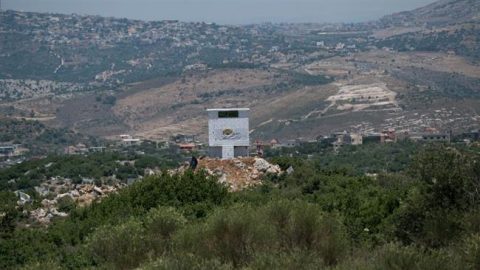
Israeli troops crossed the barrier separating Lebanon from Occupied Palestine on Tuesday, searching for parts of a crashed surveillance plane, the Lebanese National News Agency reported.

The Israelis then fired a shot in the air when a joint patrol by the Lebanese army and UNIFIL passed close by, near the southern Lebanese village of Mays al-Jabal.

The 11 Israeli soldiers were allegedly searching for pieces of an Israeli reconnaissance plane which had crashed inside Lebanon, eyewitnesses told the NNA.

In January, a group of 70 Israeli soldiers also crossed into southern Lebanon to retrieve surveillance equipment, all under the eyes of UNIFIL troops, who are tasked with monitoring breaches at the border.

Israeli drones and warplanes fly over Lebanon on a near-daily basis, violating Lebanese sovereignty despite complaints to the United Nations.

February 18, 2014 Posted by | Ethnic Cleansing, Racism, Zionism, Illegal Occupation, Militarism | , , , | Leave a comment

Lebanon: A new political alliance on the horizon?

Al-Akhbar | February 18, 2014

Yesterday, the leader of the Free Patriotic Movement (FPM) MP Michel Aoun announced that he mediated between Hezbollah’s Secretary General, Hassan Nasrallah, and the leader of the Future Movement (FM), former Prime Minister Saad Hariri, which coincided with the restoration of security and political channels of communication between Hezbollah and the FM.

Is Lebanon witnessing a new political scene based on a five-party alliance in the government that can manage a truce, which would in turn allow the election of a new president?

In 2005, the four-party alliance excluded the FPM which had won an unequivocal majority of the Christian vote in the parliamentary elections. The new alliance includes, in addition to Hezbollah and the Amal Movement, the FM, the FPM’s Change and Reform bloc, the Phalange Party and the Progressive Socialist Party. Based on the sectarian considerations governing Lebanese politics, the sectarian representation in this alliance appears to be complete. This five-party alliance seems to have become a reality, as an increasingly positive environment seeps out little by little.

Aoun announced yesterday that he mediated between Hezbollah and the FM, and specifically between Nasrallah and Hariri. In addition, a step was taken in the same direction yesterday, prior to Aoun’s announcement, when the head of Hezbollah’s Liaison and Coordination Unit, Wafiq Safa, visited the new Justice Minister Ashraf Rifi at his apartment in Achrafieh.

The official goal of the meeting was to offer congratulations to Rifi for his ministerial appointment, but the form the meeting took gives it additional significance. In addition to Rifi and Safa, the meeting was attended by the head of the Internal Security Force’s (ISF) Information Branch, Colonel Imad Othman and director of the ISF Operations Room, Colonel Hussam al-Tannoukhi.

According to political sources, Tannoukhi – who is on good terms with the leaders of both Hezbollah and the FM – arranged the meeting which relaunched the security and political communication back channels between the two sides. This back channel had maintained contact between both parties until Rifi’s retirement and the rising political tension between Hezbollah and the FM.

While at Rifi’s home, Safa called the new interior minister, Nohad al-Machnouk, and congratulated him on his new post. Political sources said that this “positive environment comes as a follow-up to the efforts that resulted in the formation of the new government and can be relied upon to carry the government through future political junctures such as the ministerial statement and the presidential elections.”

In a related matter, Aoun confirmed that he met both Hariri and Nasrallah, explaining: “Whoever wants to conduct mediation to bring disparate parties closer together has to talk to everyone, that is why I met both of them.”

When asked if his willingness to accept Rifi as interior minister during consultations on government formation angered Hezbollah, Aoun replied: “I was not present during the distribution of ministries and I am not the prime minister charged with assigning ministers to the various ministries. There was a difference of opinion between Hezbollah and the FM on this issue. To form the government, we suggested a kind of solution based on exchanging posts.”

Regarding concerns over the ministerial appointments of Machnouk and Rifi, especially since the Interior and Justice ministries could facilitate the work of terrorists and takfiris, Aoun argued “this issue is handled by the judiciary and the government as a whole and does not rely on the authority of one or two ministers.”

Akhbar Al-Yawm News Agency revealed that a family dinner was held Thursday evening at Aoun’s home in Rabieh and it included FPM minister Gibran Bassil and the director of the Future Movement’s presidential office, Nader Hariri. The obstacles that were still facing the formation of the government were overcome at this meeting.

In addition, information emerged in the past few days that Bassil traveled to Saudi Arabia last week where he met Saad Hariri.

February 18, 2014 Posted by | Aletho News | , , , , , , , | Leave a comment

Israel prepares world opinion for high civilian casualties in any future war with Hezbollah

MEMO | January 30, 2014

Israel accused Hezbollah on Wednesday of setting up military bases inside residential buildings and threatened that it would target these bases in any future conflict, even if civilians are killed.

According to Israeli officials, Iran and Syria have supplied more sophisticated missiles to Hezbollah, which defended Lebanon against the technologically superior Israeli military in July 2006.

Israeli newspaper the Jerusalem Post reported that: “The unusually explicit threat by air force chief Major General Amir Eshel appeared to be part of an effort by Israeli officials to prepare world opinion for high civilian casualties in any new confrontation with Hezbollah in Lebanon.”

The newspaper noted that last year Israeli Defence Minister Moshe Ya’alon showed UN Secretary-General Ban Ki-moon an Israeli map of alleged military sites for Hezbollah in villages in southern Lebanon, further suggesting that Israel is threatening a high civilian death toll in any future war.

According to Agence France Presse, during the July 2006 war 1,287 Lebanese died, nearly all civilians, and 4,054 were wounded when Israeli forces intentionally inflicted severe damages to civilian infrastructure, especially in southern Lebanon and in the capital city of Beirut.

Lebanese president, Michel Suleiman, has called the Israeli threats to strike residential and civilian areas in his country “a flagrant violation of human rights principles.”

He added that the Israeli position is “an attempt to spread a sense of instability among the Lebanese citizens, the thing which the enemy wants, as Israel is happy about the turbulence that is taking place in the Arab region.”

January 31, 2014 Posted by | Ethnic Cleansing, Racism, Zionism, Militarism, Timeless or most popular, War Crimes | , , , , | Leave a comment

Outside Forces Seeking Palestinian-Hezbollah Conflict

By Franklin Lamb | Al-Manar | January 23, 2014

Ain el Helweh camp, Lebanon – It isn’t just the Zionist regime still occupying Palestine six decades after the Nakba; one can sense the carnivorous drooling from Tel Aviv to Amman, from Riyadh and the Gulf Kingdoms all the way to Washington DC and beyond—drooling and salivation over their project to promote tensions between the Palestinian Resistance and what is in some respects its historic offspring—Hezbollah.

The hostile forces gathered against the Tehran-Damascus-Hezbollah-Palestine Resistance alliance are reportedly hard at work on yet another scheme to weaken, and possibly destroy, all four. It won’t be easy, but it is a key game plan among those still seeking regime change in Syria.

Even as some of these governments deceptively play down their central goal of regime change in public, they appear to be fantasizing that by building up the Lebanese army—with a pledged $3 billion from Riyadh—that Lebanese troops can be induced to confront Hezbollah and its allies, this in what seems to be a “beat em or bleed em” strategy.

Patrick Cockburn, writing recently in the UK Independent and Counterpunch, gave a digest of anti-Shia hate propaganda being spread by Sunni religious figures, clerics financially backed by, and in some cases based in, Saudi Arabia and the Gulf monarchies. Cockburn noted accurately that what is being painstaking laid is the groundwork for a sectarian civil war engulfing the entire Muslim world.

Efforts to egg on a confrontation between Palestinians and Hezbollah have increased over the past three months in Lebanon’s camps, stemming principally from some of the local Sunni and Christian power centers. Support is being seen for various “militia of the month” groups, those terrorizing the population of the Syrian Arab Republic.

Moreover, the Takfiri Al-Nusra Front leader Abou Mohammed al-Joulani insists his organization is active on Lebanese soil in order to help the Sunnis, including Palestinians, face the “injustice” of Shiite Hezbollah. “Lebanon’s Sunni are requesting that the mujahideen intervene to lift up the injustice they are suffering from at the hands of Hezbollah and similar militias,” he said recently in an interview on Al-Jazeera.

Shiite-populated areas across Lebanon have been the target of terror attacks even before Hezbollah entered the fighting on the side of the Syrian government in May 2013, but those terror attacks have intensified recently. Four car bombings have targeted southern Beirut in recent months, while a number of IED attacks have occurred in Lebanon’s Beqaa Valley.

The head of the Islamic Jihadist Movement in Ain al-Hilweh camp voiced fears on January 8 of a possible armed sectarian confrontation between Hezbollah and Palestinian refugees in Lebanon if the party did not revise its policies at home and in Syria. Sheikh Jamal Khattab told the Daily Star that should fighting erupt between Palestinians and Hezbollah the conflict could be even worse than the “war of the camps” (read: massacres) of the 1980s, when that conflict was not considered particularly sectarian. Today, says Sheikh Khattab, it would be different. Today it would be a Sunni vs. Shia war, with regional and international consequences, given the poisonous sea-change in sectarian relations since the invasion of Iraq in 2003.

In Ain al-Hilweh and other camps, posters of local men killed while fighting alongside Takfiri groups in Syria, or against U.S. troops in Iraq, are tacked up throughout the camp. Lebanese security sources claim that Palestinian Islamist groups in Ain al-Hilweh have all finalized preparations to for a possible conflict with the Hezbollah’s organized and trained “Resistance Brigades.” These organizations include Usbat al-Ansar, Jund al-Sham, Fatah al-Islam, and other Salafist groups, and supporters of the controversial fugitive Sheikh Ahmad al-Assir, and rumors abound that some of these elements are being financed by certain of the six Gulf Cooperation Council states as well as some Lebanese pro-Western March 14 parties. Apparently the consideration among such groups and their sponsors is that conditions in Lebanon are ripe for an expanded war against “Shia infidels,” and reportedly plans are now in place to bring it here, with several groups that are now fighting in Syria pledging to widen the Sunni-Shia war into Lebanon.

For their part, some pro-Hezbollah groups and many Lebanese citizens are suspicious of possible Palestinian involvement in recent terror attacks in Dahiyeh and the recent bombing of the Iranian Embassy. In point of fact, one of the two suicide bombers who attacked the Iranian Embassy on November 17 was Mouin Abu Dahr, a known pro-Palestinian whose mother is a Shiite and his father a Sunni. Ain al-Hilweh of course has also been in the spotlight with the arrest of Majed al-Majed, the leader of the Al-Qaeda-affiliated Abdullah Azzam Brigades. Majed is believed to have lived in the camp since 2012.

Clearly Israel and its new—as well as its longtime—allies seek a Sunni-Shia war, and the sooner the better. Also favored is a continuation of the Syria crisis for the reason that they consider Hezbollah to be squandering some of its best fighters and commanders and well as its weapons stores. Western Diplomats have spoken about US-Israeli hopes that Syria will be Hezbollah’s Achilles heel and Iran’s Vietnam, and Israeli media have commented on views by some officials that Hezbollah has shifted its attention toward Syria and away from the southern front with occupied Palestine.

Time will tell.

Hezbollah maintains it is using only five percent of its capacity to confront Israel, and according to one source close to the Resistance: Hezbollah has self-sufficiency when it comes to the missiles, strategic and non-strategic weapons. All these weapons are quite abundant. Any additional equipment will constitute a negative factor because there is no need for them. All the weapons that are manufactured by Iran or owned by Syria are also available for Hezbollah. The land forces and the Special Forces fighting in Syria have acquired a lot of practical and intelligence related experience and a force of maneuvering on the land. This experience will be used when the war with Israel begins again.

The Sunni and the Shia, just as with the Palestinians and Hezbollah, need each other for many reasons, including confronting growing Islamophobia, anti-Arab hate propaganda, and the deepening and broadening apartheid occupation of Palestine.

All must work to tamp down their differences publicly and privately while endeavoring to neutralize sectarian provocateurs, Sunni as well as Shia—domestic and regional as well as international—provocateurs that today are seeking internecine and sectarian violence in order to weaken both sects, and even all of Islam.

January 23, 2014 Posted by | Mainstream Media, Warmongering | , , , , , , | Leave a comment

Ariel Sharon is Dead: His Crimes will Not be Buried with Him

By James Petras :: 01.22.2014

Introduction

Ariel Sharon was a serial mass murderer, engaged in massacres of unarmed victims in four countries, of all ages and conditions. He was a “hero” for hundreds of thousands of Israeli Jews who settled on land and in houses seized from Palestinians in the West Bank. He was praised by Western leaders at his funeral for his violent, lifelong opposition to Arab nationalist movements throughout the Middle East.

That he was a fanatical upholder of Jewish supremacist policies and practices did not go unnoticed by wealthy Zionist donors in the US. During his tenure as a senior official in numerous Israeli regimes, they contributed hundreds of millions of dollars for Greater Israel and extracted nearly a $100 billion more from the US Treasury. Israeli leaders praise of Sharon as a valiant, brilliant and legendary military leader is echoed in the US mass media and repeated by most Western leaders. He was, in the view of his US adulators, a powerful leader who defied world public opinion in his defense of Israel, who seized Palestinian and Syrian territory and who was willing to strike an independent policy even against Israel’s main benefactors in Europe and North America.

This essay does not simply recount Sharon’s lifelong criminal record. The story we will relate has more to do with (1) the crimes that continue to live after him; (2) the political and military context which allowed him to butcher non-Jewish populations with impunity; (3) the psychological core of Sharonist impudence and arrogance which is so deeply etched in the political psyche of all of Israel’s contemporary leaders.

This paper will critically address several issues regarding the Sharon cult (in Israel and abroad) which presents him as a fearless and successful military leader; a formidable world political statesman, who successfully imposed Israel’s will throughout the Middle East and beyond.

Genocide at the Service of Nationhood

Sharon’s record as a serial genocider is beyond dispute. As early as the ‘founding years’ of Israel in 1947 – 1948 Sharon was commander of the murderous Alexandroni and then the Golani Brigade which murdered, uprooted and terrorized thousands of lifelong Palestinian residents. He later was the commander of Unit 101, an Orwellian Death Squad, which reduced villages to rubble, blowing up homes, where mostly women and children were hiding. In October 1953, Sharon assaulted the Jordanian village of Qibya blowing up forty-five houses and killing sixty-nine civilians, the vast majority women and children. In the early 1950’s Sharon ruled over Palestinian settlements with an iron fist, murdering dissidents, arresting and torturing protestors on a mass scale. On October 29, 1956 Israeli, British and French troops invaded Egypt to seize the Suez Canal and recolonize the country. Colonel Sharon led the 202nd Paratroop Brigade which seized the Mitla Pass and covered himself with gore – murdering all the Egyptian military and civilian prisoners. The Israeli military advance was stopped cold despite its military alliance and supply from Britain and France. US President Eisenhower told the Israelis and their French and English allies to end their aggression and proceeded to cut off all military and economic aid to Israel; shut off IMF funding for England and France’s post WW II bankrupt economies. US Zionists used their leverage in the Democratic party especially over Lyndon Johnson, House Minority Leader, to block Eisenhower’s economic sanctions and to support Israel’s invasion. Eisenhower rejected Zionist pressure and went to the UN Security Council where his armistice and withdrawal proposal was vetoed by France and Britain. Eisenhower then called a special session of the General Assembly where he triumphed by a 12 to 1 margin. France, Britain and Israel were defeated and forced to retreat. No other President before or since Eisenhower ever took a forthright stand against Israeli colonial wars and territorial seizures.

During the Egyptian invasion, Sharon’s military leadership was severely questioned by his Israeli superiors. His troops suffered the highest casualties of any unit because of his order to attack heavily fortified Egyptian emplacements when Israeli air power could have done more with less.

During the so-called Six Day War (June 5 -10, 1967), Israel’s sneak attack on Jordan, Syria and Egypt, resulted in the seizure and occupation of vast areas and the conquest of millions of Palestinians. Sharon’s military achievements included the wholesale massacre of Egyptian prisoners of war. President Lyndon Johnson, totally under the thumb of his Zionist fundraisers, not only supported Israel’s war of aggression but acquiesced in Israel’s bombing of the US intelligence ship the Liberty and the killing and maiming of over 200 US sailors. In the 1973 Yom Kipper War, Sharon and the Israeli high command were on the verge of military defeat by the Egyptian and Syrian armed forces intent on liberating occupied territories, until Kissinger airlifted 22,395 tons of weapons to Israel, including scores of fighter planes, helicopters and transport planes to turn the tide.

From the Yon Kipper debacle onward, Israel never lacked for US military and political backing and diplomatic protection in its military invasions, colonial settlements and air assaults on Arab countries and inhabitants.

Upward Advance: Master of Massacres and Mediocrity

Sharon’s political career was aided by his leading role in massacring Palestinians in Lebanon and in the Occupied Territories. In Lebanon, Sharon slaughtered 2,000 women and children at the Sabra and Shatila refugee camp. He certainly did not rise to political power for his mediocre performance during the Suez crises and Yon Kippur war. In fact, when Sharon faced well-trained and well-armed military forces, as was the case during the Hezbollah war in 2006, he was even less than a mediocre commander. Only against civilians and poorly trained irregulars did he “succeed”. Only where he could murder and dispossess hundreds of thousands of unarmed civilians and settle Israeli Jews was he glorified as the “King of the Jews” by the Israeli settler population.

World leaders praise Sharon because of his power and usefulness in smashing nationalist Arab-dissent. Sharon’s ascent to the Pantheon of world statesman was greased by the western mass media, who to no small extent, sup at the table of his main Zionist benefactors. Sharon’s “legendary history” is media manufactured to fit the requirements of his western Zionist power brokers.

The Context of Sharon’s and Israeli Ascendancy

Israel cannot and does not wield power on the basis of its military capability or performance – it operates on borrowed power. When the US was ruled by a President who rejected Zionist influenced Congressional pressure and used available economic and political leverage, Israel retreated, surrendered captured territory and abided by UN sanctions. In other words, Israel’s war aims and its bellicose behavior, is dependent on the power of the Zionist power configuration in the US to turn Washington in its favor.

The Israeli leaders and most, especially Sharon, learned the lesson of the Eisenhower experience. The key to regional power lies in the capacity of American Zionists to control Washington’s decision-makers. In the blunt language of Sharon, in reply to Shimon Peres on Koi Yisrael radio (October 3, 2001) “Every time we do something, you (Peres) tell me, Americans will do this and that. I want to tell you something very clear. Don’t worry about American pressure on Israel. We the Jewish people control America and the Americans know it”.

In this, his comment on the relations of power between Israel and the United States, Sharon is also providing an insight into his own importance and influence. Sharon the “legendary military leader” is a complete artifact of the real power that the Zionists wield in the US on behalf of Israel.

Sharon is, in a sense, a “cardboard general” who has lost or nearly lost the most important battles in his career – beginning with Suez in 1956, Yom Kippur in 1973 and Lebanon in 2006. Israel has prospered economically and become a major military power largely through over $130 billion dollars transfered from the US Treasury over the past half century; plus tens of billions in favorable trade concessions; plus ‘imports’ of highly trained professionals from the US and Russia (educated by the tax payers of those countries); and more recently billions more in “venture capital” by overseas speculators. In other words, Israel is an artifact of the ‘power of extraction and transfer’ by its overseas acolytes embedded in the US political and economic power structure.

Without the influence and material privileges which have accumulated over four decades, Sharon would have ended his mediocre military career as a crabby second rate politician, barking “blood libels” at his adversaries in the Knesset.

But as circumstances dictated Sharon was not an insignificant figure. His brutal colonial policies reflected the Israel-Jewish political tradition and shaped what has become a dangerous ethno-supremacist ideology, which unfortunately has traversed across borders and entered into the consciousness of many Zionists.

It was one thing to joke, as many of us did in our university days, about the ghetto expression “Is it good for Jews?”. It is another for leaders in positions of power to apply this ethnocentric criteria to American foreign policy, personnel recruitment and professional appointments. That is the real legacy of Ariel Sharon: the legacy of an Israel -centered world built on ideology of ethno-religious supremacy which displays superiority and disdain for non-Jews. For the ethnic supremacists like Sharon, most Americans exist to pay tribute and fight wars for Israel and to keep a tight lip about it.

A Final Word on the Sharon Legacy

Let it be said, here and now, that Sharon’s presumption to speak for “the Jewish people” confused his rabid electoral supporters in Israel and blind adherents among US Zionist leaders, with a growing number of Jews and ex-Jews who detested him and scorn his legacy. His boast that “Jews control America” has dangerous implications, especially in the context of growing popular malaise in these United States. Sharon’s claim that Americans knowingly submit to a foreign tyranny, is very provocative especially if and when Americans begin to wake up— and it will be the majority of Jews, who neither abide by Sharon’s legacy nor share his naked contempt for non-Jews, who will pay a painful price.

The Sharon legacy lives on, among his epigones at the prestigious universities and with the billionaires who bankroll the Democratic Party. Sharon’s Israel First legacy lives on with the government officials who betray the trust of the American people and prostrate themselves before his present-day disciples (Klansmen with yarmulkes), the Avigdor Lieberman’s, Naftali Bennett’s and Netanyahu’s who execute the Sharon legacy of dispossession and assassination of unarmed Palestinian people. Ariel Sharon is dead but his crimes will not be buried. They live on in the policies of the Netanyahu regime but also in the collective memory of humanity in its struggle for freedom and self-determination.

January 22, 2014 Posted by | Ethnic Cleansing, Racism, Zionism, Timeless or most popular, War Crimes | , , , | Leave a comment

Another Terrorist Blast Rocks Dahiyeh’s Haret Hreik

PressTV Videos · January 21, 2014

Two car bombs have gone off in a southern neighborhood of the Lebanese capital, Beirut, killing several people.

The explosions on Tuesday hit the Haret Hriek neighborhood in southern Beirut, which is considered as a stronghold of Lebanon’s resistance movement Hezbollah.

Reports say that at least four people have been killed and another 46 have been injured.

The al-Qaeda-linked Al-Nusra front has claimed responsibility on its twitter page for the bombings.

Hezbollah’s al-Manar television channel said the bombings hit a busy commercial street.

The neighborhood was also targeted by a deadly car bombing on January 2.

January 21, 2014 Posted by | Video, War Crimes | , , , , | Leave a comment