US charges Lebanese businessman with evading sanctions
Press TV – March 24, 2017
US authorities have charged a Lebanese businessman with dodging sanctions imposed against him over his alleged financial support to the Hezbollah resistance movement, the Department of Justice has announced.
The Justice Department said in a statement that Kassim Tajideen pleaded not guilty in a federal court in Washington, DC, on Friday.
The 62-year-old billionaire businessman will remain in prison until his next hearing, which is scheduled to be held in the coming week, according to the statement.
He was arrested on March 12 in Morocco after an international warrant was issued by Interpol’s office in Washington, Reuters reported earlier this week.
American authorities claimed Tajideen operated a big company that did business in commodities across the Middle East and Africa. The United States Treasury Department sanctioned Tajideen in 2009, accusing him of having contributed “tens of millions of dollars” to Hezbollah, leaving him shut out from banks with no legal redress.
Tajideen had rejected the accusation and said the news of sanctions in 2009 was a shock.
“I was surprised, as I’d thought America was democratic,” Tajideen said. “A friend called me at midnight to tell me, and woke me up. The next day I saw my lawyer [in Belgium], although he didn’t know exactly what it would mean.”
America’s Drug Enforcement Agency (DEA) with the help of US Customs and Border Protection led a two-year investigation that resulted in Tajideen’s arrest and indictment, according to the Justice Department.
Raymond Donovan, a DEA special agent, accused Tajideen of acting as a key financier of Hezbollah.
American authorities said Tajideen evaded the Treasury sanctions by restructuring his company and using a complex web of trade names, which allowed him to continue doing business with US companies.
Last year, the US Treasury added two Lebanese men — Mohamad Noureddine and Hamdi Zaher El Dine — to its sanctions blacklist accusing them of laundering money for Hezbollah.
The Treasury claimed that the men had used a network across Asia, Europe, and the Middle East to help Hezbollah.
In 2015, the Barack Obama administration approved a bill which imposed sanctions against banks that do business with Hezbollah.
Washington accuses the resistance movement of condoning terrorism. However, Hezbollah has been involved in fierce fighting against Daesh terrorists in Syria.
Hezbollah was founded in the 1980s following the Israeli invasion and occupation of southern Lebanon.
The movement waged a long resistance campaign against Zionist troops and pushed them out of southern Lebanon in May 2000.
Since then, the group has grown into a powerful military force and has successfully defeated the Zionist regime several times.
Hezbollah has also supported the Syrian army in its fight against the foreign-sponsored terrorists who have been wreaking havoc in the Arab country since March 2011.
Since its inception in 1985, the Islamic resistance movement has been a thorn in the flesh of Israel and its foreign backers, such as the United States.
Israeli minister wants Lebanon ‘sent back to Middle Ages’
Press TV – March 13, 2017
An Israeli minister says “life in Lebanon today is not bad” compared to Syria, adding Tel Aviv should target civilians in a future war with the country and send it “back to the Middle Ages.”
Education Minister Naftali Bennett has said all aspects of life in Lebanon must be targeted in a future war with Hezbollah, because the resistance movement is now an important part of the Lebanese people.
“Today, Hezbollah is embedded in sovereign Lebanon. It is part of the government and, according to the president, also part of its security forces,” Israeli newspaper Haaretz quoted Bennett as saying on Sunday.
The daily referred to statements made a month ago by Lebanon’s President Michel Aoun who ruled out outside pressures to disarm Hezbollah.
“As long as Israel occupies land and covets the natural resources of Lebanon, and as long as the Lebanese military lacks the power to stand up to Israel, [Hezbollah’s] arms are essential,” Aoun said.
“The Lebanese institutions, its infrastructure, airport, power stations, traffic junctions, Lebanese Army bases – they should all be legitimate targets if a war breaks out,” Bennett said.
“Life in Lebanon today is not bad – certainly compared to what’s going on in Syria. Lebanon’s civilians, including the Shia population, will understand that this is what lies in store for them,” he added.
Bennett said heavily targeting civilian infrastructure, along with additional air and ground action by the Israeli troops, will shorten the campaign as it will accelerate international intervention.
“That will lead them to stop it quickly – and we have an interest in the war being as short as possible,” he said.
Bennett’s approach is not new for the Israeli officials. In 2008, the head of the Israeli army’s Northern Command, who currently serves as the army’s chief of staff, Gadi Eisenkot, presented the “Dhahiya doctrine.”
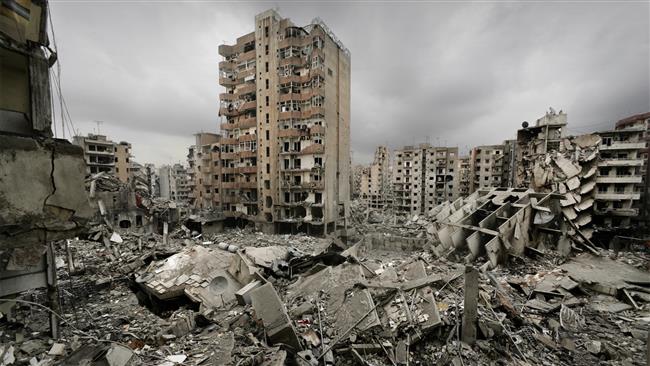
This picture shows the aftermath of Israeli bombing of residential buildings in Dhahiya in southern Beirut in August 2006.
It referred to Israel’s heavy bombardment of the densely-populated Shia quarter in southern Beirut in the 2006 war because buildings in the neighborhood were identified with Hezbollah.
Haaretz said Hezbollah was able to launch more than 1,000 rockets into Israel in a single day of fighting, leaving Tel Aviv with either no or limited solution to confront them.
Bennett said hunting rocket launchers during a war is almost impossible, adding Hezbollah has learned to deploy them in a more sophisticated manner, thus the regime must hit civilian targets.
“If Hezbollah fires missiles at the Israeli home front, this will mean sending Lebanon back to the Middle Ages,” he said.
Bennett served as a reserve officer and commanded an elite unit sent deep into southern Lebanon to find Hezbollah’s rocket-launching squads during the second Israeli war on Lebanon in 2006, which ended after 33 days.
Many Israeli leaders admitted that the war marked a defeat for Tel Aviv, dealing another serious blow to its military’s myth of invincibility.
Last week, Israel’s Minister of Military Affairs Avigdor Lieberman said at a Knesset committee meeting that the Lebanese army was now “a subsidiary unit of Hezbollah.”
Hezbollah fighters are currently helping Syrian troops confront Takfiri terrorists and prevent the conflict from spilling over into Lebanon.
In a series of interviews with Lebanese media last month, President Aoun said Hezbollah operations “complement the actions of the army and do not contradict them.”
“They are a major part of Lebanon’s defense,” he said.
‘Any Israeli Attempt to Undermine Lebanese Sovereignty will Meet an Appropriate Response’
Al-Manar – February 18, 2017
Lebanese President General Michel Aoun deemed on Saturday that “the message content of Israel’s Delegate at the United Nations, Danny Danon, poses a threat to Lebanon,” adding that “the international community ought to pay attention to the possible Israeli hostile intentions against Lebanon.”
Speaking before his interlocutors at Baabda Palace this afternoon, Aoun asserted that “any Israeli attempt to undermine the sovereignty of Lebanon shall be confronted with the appropriate response.”
The President stressed that “Israel must comply with Security Council resolutions before any other, yet it still refuses to implement Resolution #1701 and the transition from the cessation of hostilities to a ceasefire stage, despite the fact that more than 11 years have passed since the release of said Resolution.”
“Israel still occupies Lebanese territories in the northern part of Ghajar, Shebaa Farms and Kfar Shouba Hilltops, while effecting daily violations of the Blue Line and Lebanese sovereignty by air and sea,” Aoun went on to indicate.
“In addition, half a million Palestinians are still forced to stay away from their homeland, hosted by Lebanon in the absence of their right to return to their land and property, which constitutes an act of aggression against Lebanon and its people,” he added.
“This act of aggression falls under the content of Article 51 of the UN Charter, which gives Lebanon and its people the natural right to defend their land,” Aoun underscored.
The President concluded that “Lebanon, which has respected all obligations towards the United Nations and its labor force in the South, views the Israeli message to the United Nations as a blatant attempt to threaten the security and stability enjoyed by the southern towns and villages located within the international area of operations, and therefore, bears full responsibility for any aggression against Lebanon.”
Source: NNA
Canada court ruling violates international law: Iran
Press TV – February 19, 2017
Tehran has rejected a recent ruling issued by Canada’s Ontario Superior Court of Justice against Iran, saying the verdict violates international law.
“This ruling contravenes the basic principles of the legal impunity of governments and their assets, and is unacceptable,” Foreign Ministry spokesman Bahram Qassemi said on Sunday.
Justice Glenn Hainey ruled on February 8 that the Islamic Republic had to pay $300,000 in legal costs to those who claim to be victims of Iranian support for resistance groups.
The plaintiffs had sought compensation in the Ontario court under Canada’s Justice for Victims of Terrorism Act. The verdict has given Iran 30 days to pay the sum.
Qassemi said the Islamic Republic has already conveyed its expression of formal protest to the Canadian government and reserved the right to take political and legal measures in that regard.
In June 2016, the same court ordered $13 million in non-diplomatic Iranian assets to be given to three groups of plaintiffs.
The decision was similar to US Supreme Court’s ruling in April 2016 to hand over $2 billion in Iran’s frozen assets to American families of those killed in the 1983 bombing of US Marine Corps barracks in Beirut and other attacks.
Iran’s President Hassan Rouhani announced at that time that the country had filed a lawsuit against the US with the International Court of Justice (ICJ) – the principal judicial organ of the United Nations.
Earlier this month, Iran’s Presidential Office said in a statement that the lawsuit had been officially put in motion.
Washington’s seizure of Iran’s assets is against the Treaty of Amity, Economic Relations, and Consular Rights which was signed by the two countries in August 1955 – referred to as the 1955 Treaty – and is “still effective,” the statement added.
Rifts among Muslim nations serve Israeli interests: Lebanon PM
Press TV – January 8, 2017
Lebanese Prime Minister Saad Hariri says Muslim nations should close their ranks in the face of Israeli attempts to take advantage of rifts in the Islamic world and the terror threats facing the Middle East.
Hariri made the remarks in a meeting with Alaeddin Boroujerdi, the chairman of the Iranian Parliament’s Committee on National Security and Foreign Policy, in Beirut on Saturday.
He said divisions in the Muslim world, including those among Palestinian factions, besides the terror activities in the region serve the interests of the Israeli regime, urging Muslims to set aside their rifts and focus, instead, on common goals.
Cooperation among Muslim countries can turn the Islamic world into “a large economic hub” and consequently upgrade its status, the premier added.
Hariri further underlined his resolve to reinforce relations between Tehran and Beirut in all areas, especially in economy and trade, calling for measures to remove the obstacles to the expansion of bilateral ties.
In turn, Boroujerdi described his meeting with the Lebanese prime minister as “constructive and positive,” saying they discussed the restoration of security to the region, Lebanon’s National News Agency quoted him as saying.
He further emphasized that the two countries have a common position on the political settlement of the Syria crisis.
“There is no doubt that stability and security in Syria reflect positively on security and stability in Lebanon, in Iran and the region in general. We agreed that the shameful and heinous acts carried out by terrorist Takfiri extremist groups are not related to the Islamic religion in any way,” the senior Iranian lawmaker said.
Touching on the issue of bilateral ties, Boroujerdi said Iran is ready “to build on the bright, positive and constructive political circumstances that have arisen in Lebanon.”
Hariri became prime minister last December, after the Lebanese parliament elected Michel Aoun as president, ending a 29-month-long political stalemate in the country.
UN Demands ‘Israel’ to Pay Lebanon More than $850 Million for 2006 “Oil Slick”
Al-Manar | December 23, 2016
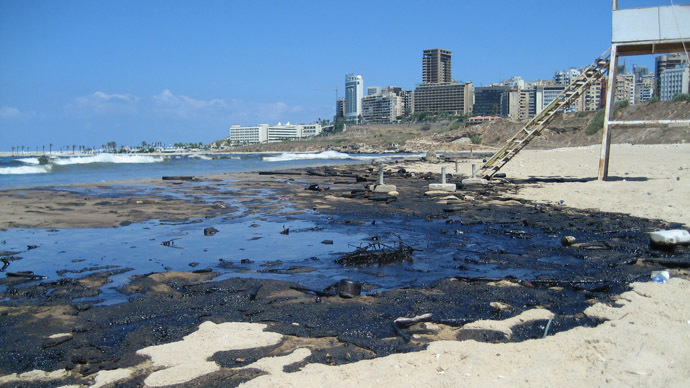
The United Nations General Assembly adopted a resolution titled “Oil slick on Lebanese shores” urging the Zionist entity to pay Lebanon some $850 mn compensation to cover the clean-up cost of an oil spill caused by the Zionist July 2006 war on the country.
The UNGA voted 166 in favor of the non-binding resolution to 8 against (Australia, Canada, the Zionist entity, Marshall Islands, Federated States of Micronesia, Nauru, Palau, United States), with 7 abstentions (Cameroon, Democratic Republic of Congo, Honduras, Papua New Guinea, South Sudan, Tonga, Vanuatu).
Taking into account the 1992 Rio Declaration on Environment and Development, which in principle requires the polluter to pay environmental damage costs, the assembly found the Zionist entity guilty of the July 15, 2006 environmental disaster.
The disaster was caused by a Zionist strike on the oil storage tanks in the direct vicinity of the Jiyeh electric power plant in Lebanon. As a result an oil slick covered the Lebanese coastline entirely, stretching all the way to the Syrian coastline.
By that text, the Assembly considered that the oil slick had heavily polluted the shores of Lebanon with 15,000 tons of oil and partially polluted Syrian shores and consequently had serious implications for the Lebanese economy.
The Assembly decision followed the assessment report by Secretary-General Ban Ki-moon which stipulated the value of damage to be $856.4 million. Now the Assembly is asking the Zionist entity to provide “prompt and adequate compensation.”
The oil slick made by the spill “has had serious implications for livelihoods and the economy of Lebanon,” the resolution read, accounting for inflation of a October 2007 estimate by the United Nations Secretary General that reported the spill caused $729 million in damage.
Lebanon bore the brunt of the spill, but the Syrian coast and other Mediterranean countries suffered as well, the UN said, asking Lebanon to continue clean-up efforts and the international community to increase funding for its environmental restoration.
The resolution noted that the UN chief expressed “grave concern at the lack of any acknowledgment on the part of the government of Israel of its responsibilities vis-a-vis reparations and compensation” to Lebanon and Syria for the oil spill.
Lebanon’s permanent representative to the UN Nawaf Salam hailed the resolution and called it a “major progress.”
“We affirm that Lebanon will continue to mobilize all resources and resort to all legal means to see that this resolution is fully implemented, and that the specified compensation is paid promptly,” he said.
“This resolution also paves the way for further compensation into other areas of damage (health, ecosystem services as habitat, potential groundwater contamination, and marine diversity), that were not considered in the current calculated amount,” Salam added.
For its part, the Zionist mission to the UN rejected the resolution, expressing wonder that it does not cover the environmental damage which occurred in the northern occupied territories following the attack on Lebanon, claiming that the entity launched the July 2006 war on the country as “a consequence.”
The Zionist entity waged a brutal 33-day war on Lebanon in July 2006, killing hundreds of Lebanese people and leaving serious damage to vital infrastructure. The war ended by a UN 1701 resolution which urged the Zionist entity to halt hostilities and withdraw behind the blue line drawn by UN forces after the liberation of most occupied Lebanese southern territories in May 2006.
Israel defends fake Lebanon military buildup map as Hezbollah’s ‘war crime illustration’
RT | December 10, 2016
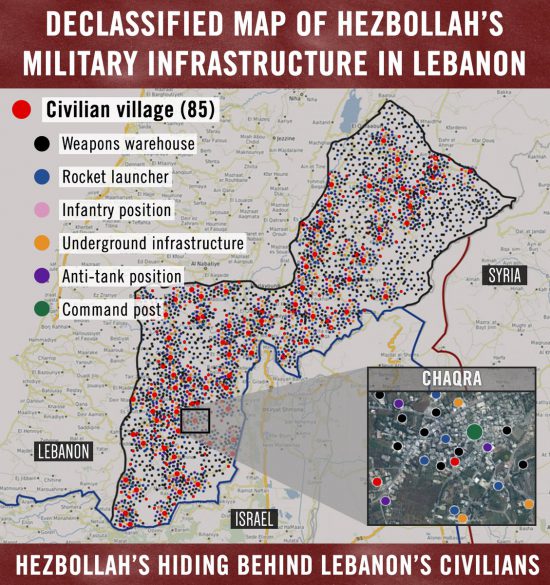
A “declassified” map of an alleged Hezbollah military buildup in southern Lebanon shared by the Israel Defense Forces (IDF) has been exposed by Twitter users as a fake, forcing the IDF to admit the picture was just a “visual illustration” of the militant group’s “war crimes.”
The map titled “Declassified map of Hezbollah’s military infrastructure in Lebanon” was posted on the official IDF Twitter account on Tuesday, highlighting 85 towns and villages in the southern part of the country.
Spots, showing civilian settlements were surrounded by numerous multicolored dots, labeled with names such as “weapon warehouse” or “rocket launcher” and other military facilities.
The tagline of the image said “Hezbollah’s hiding behind Lebanon’s civilians,” while the tweet’s caption was the simple and rather dramatic statement, “this is a war crime.”
Such a level of detail and awareness of alleged Hezbollah activities would be truly impressive, if the map had not turned out to be a fake. Some Twitter users pointed out that it was unlikely the image was a “declassified map,” since its history showed that it had been created using Google Maps via an IDF spokesperson account. The dots, marking the alleged “military buildup,” even featured a repetitive pattern.
IDF later said the map had been an “illustration,” and users simply misinterpreted it as a piece of declassified intelligence. The map’s title, tagline and caption were presumably “illustrative” too.
“The illustration reflects how Hezbollah has positioned its terrorist infrastructure within the civilian arena,” the spokesperson told The Times of Israel.
The map, despite its ”illustrative” nature, has been shown to almost every foreign diplomat visiting Israel, to demonstrate that while Hezbollah participates in the Syrian civil war, it continues preparations for conflict with Israel and hides among civilians located near the border, according to a Channel 2 report.
Israel has attacked targets allegedly linked to Hezbollah in neighboring countries, mainly in Syria. The most recent incident of this kind reportedly happened on Wednesday, when Israeli rockets hit the Mezzeh military airport near Damascus.
Israeli Defense Minister Avigdor Lieberman commented on the issue at a meeting with European Union envoys in Israel Wednesday.
“We are first and foremost making efforts to maintain the security of our citizens and protect our sovereignty, and trying to prevent the smuggling of sophisticated weapons, military equipment and weapons of mass destruction from Syria to Hezbollah,” Lieberman said.
Israeli Prime Minister Benjamin Netanyahu in April also admitted multiple strikes on targets in Syria in order to prevent Hezbollah from obtaining “game-changing” weaponry.
Saudi-Iranian reconciliation is within sight
By M K Bhadrakumar | Indian Punchline | December 2, 2016
A side-effect of Donald Trump’s election as president could be the improvement in Saudi-Iranian ties. Of course, cynics may argue that it is about time the relationship got better, because it can’t get any worse – short of war. But the Trump factor becomes a stimulus in a positive direction.
Broadly, the US policy (which Hillary Clinton would have happily continued) of playing Saudi Arabia against Iran on the one hand and nudging the Arab allies and Israel to form a united regional front under American leadership on the other hand, is ending. It was a hopeless strategy to begin with, and Trump will not waste time in resuscitating it on its death bed.
Egypt’s recent ‘defection’ to the Russian-Iranian camp in the Syrian conflict (which also anticipates the Trump presidency, by the way), lethally wounds the myth of Arab unity against Iran, which Saudis had been fostering. Interestingly, Egyptian foreign minister Sameh Shoukry is in New York where he met Vice President–elect Mike Pence on Thursday to hand over a letter from President Abdel Fatah el-Sisi to Trump. At the same time, Sisi himself is on a visit to the UAE (which is mediating in the Saudi-Egyptian rift.) Egypt anticipates an easing of tensions between Saudi Arabia and Iran and is positioning itself.
For the Saudi regime, a Trump presidency means that it is losing the war in Syria. The blow to Saudi prestige on the Arab Street, regionally and internationally is enormous. But Saudis are preparing for the eventuality of President Bashar al-Assad remaining in power and the Syrian rebels facing the existential choice of surrendering and accepting the fait accompli (or meeting physical extinction.) The secret talks in Ankara, which have now come to light, between the rebel leadership with Russian intelligence and diplomats underscore that Aleppo is about to fall to the government forces and the war is over.
The ending of the war on such terms constitutes a big victory for Iran. This raises the question: Are the Saudis on a course correction themselves? There is growing evidence that this may be so.
First came the election of Michel Aoun as the new President of Lebanon on October 31, ending two years of deadlock. Aoun is very close to Hezbollah. (Iranian FM Mohammad Zarif was the first foreign dignitary to visit Beirut to congratulate Aoun.) Clearly, in the complicated political tug of war in Lebanon, Saudis appear to have simply retrenched, which facilitated Aoun’s election, piloted by Iran and the Hezbollah.
The consolidation in Lebanon and the sight of victory in the Syrian war (plus the incipient signs of a warming up with Egypt) would significantly strengthen Iran’s hand in regional politics. But, strangely, there is no triumphalism in Tehran. In the normal course, Tehran could have called the Saudis ‘losers’, but that is not happening.
Now comes the thunderbolt — OPEC oil production cut deal in Geneva on Wednesday. Admittedly, the oil market is unpredictable, the role of the US shale industry is uncertain and the OPEC deal needs to be firmed up at the December meeting in Moscow between the cartel and non-OPEC oil producers. But the bottom line nonetheless is that the deal is the final product of a big Saudi concession to Iran. Put differently, if the Saudis had dug in and refused to exempt Iran as a special case from the production cut, the deal wouldn’t have come through.
The OPEC deal signifies a tectonic shift in the Saudi-Iranian equations, which is below the radar as of now. It is not only about big money, but also the return of Iran to OPEC’s cockpit — indeed, about OPEC’s future itself. True, the Russians played a forceful role behind the scenes to bridge the gap between Riyadh and Tehran and push them to come closer. True, again, Saudis are in serious financial difficulty and the OPEC deal is expected to bring in more income out of a rise in oil price. However, in the final analysis, the Saudis did accommodate Iran’s demand that a restoration of the pre-sanctions OPEC production quota is its national prerogative and it must be exempted from any production cut. (NBC News gives a riveting account of how it all happened — How Putin, Khamenei, and a Saudi Prince Made the OPEC Deal.)
It is this shift in the Saudi mindset — away from the dogged attitude that Iran must be relentlessly punished even if that were to mean inflicting on itself a few bleeding self-wounds — that catches attention. Again, on Iran’s part too, it is this strangest of strange behaviour – total absence of triumphalism that the Saudis blinked in Geneva – is highly significant.
Simply put, taken together with the happenings in Lebanon, Iran is careering away from anti-Saudi grandstanding and rhetoric. Indeed, a similar roll back is discernible on the Saudi side also lately. (The Asharq al-Awsat newspaper recently replaced its editor-in-chief; Prince Turki bin Faisal has said Trump should not abandon the Iran nuclear deal.)
These are early days, but signs are that there is a thaw in the Saudi-Iranian ties. Given the Middle Eastern political culture, Saudi Arabia and Iran could be moving toward a modus vivendi sooner than one would have expected. Yemen will be the litmus test of a rapprochement.
Gap with Russia disturbing: Israeli official
Press TV – November 17, 2016
A senior Israeli official says Tel Aviv should be concerned about deepening disconnect with Moscow over Russia’s role in the Syria conflict.
Avi Dichter, chairman of Israel’s foreign affairs and military committee and the former head of the Shin Bet intelligence agency, says Russia’s interests in the region by no means coincide with Israel’s.
“The gap between us and them is large and disturbing,” he told Reuters news agency after returning from a visit to Moscow where he held high-level meetings last week.
Dichter said Russia’s views on Iran, Syrian President Bashar al-Assad and the Lebanese group Hezbollah were in sharp contrast to Israel’s and a growing source of potential conflict.
Russia does not view Iran and its allies “according to the level of threat they pose or broadcast towards Israel,” he said.
The Russians, he said, “view Hezbollah positively” and are backing the group’s assistance to the Syrian government in the war against Takfiri and other terrorists.
“Russia thinks and acts as a superpower and as such it often ignores Israeli interest when it doesn’t coincide with the Russian interest,” Dichter said.
Israel is believed to have been assisting militants fighting to topple President Assad in Syria. The Israeli regime’s worries have risen as Takfiri terrorists have suffered major setbacks over the past few months.
Tel Aviv’s main concern is to be able to attack Hezbollah, with which it fought a war in 2006. Over the past two years, Israeli artillery and warplanes have carried out several strikes against alleged weapons convoys in southern Syria that Israel claimed were destined for Hezbollah.
The occupying regime’s freedom of movement in the area is now more restricted because of the presence of Russian jets and advanced anti-aircraft batteries that Moscow has put in place.
With Russia becoming more deeply involved in the Syria conflict, Tel Aviv has sought to keep lines of communication with Moscow open to avoid an accidental confrontation.
Meanwhile, Israeli Prime Minister Benjamin Netanyahu has visited President Vladimir Putin three times this year, apparently in an effort to persuade him to drop Russia’s engagement in Syria.
But Dichter said Russia thinks Assad should stay in power, that Iran is a stabilizing force and that the nuclear deal the word powers struck with Tehran was largely positive.
Featured Video
BRITAIN’S WARNING: PREPARE FOR WAR
or go to
Aletho News Archives – Video-Images
From the Archive
How Ukraine Tortured and Slaughtered Donbass
By Kit Klarenberg | Al Mayadeen | July 11, 2024
Almost immediately after the proxy war erupted, ISIS-tier footage of the torture and murder of Russians in Ukrainian custody emerged.
On July 6th, the New York Times published an astonishing investigation: In Ukraine, Killings of Surrendering Russians Divide an American-Led Unit. The article documents in grim detail how Chosen Company, an international volunteer battalion for Kiev, routinely executes Russian prisoners of war. It is the very first mainstream admission that this practice – a brazen breach of the Geneva Conventions, and a grave war crime – is widespread among Ukraine’s fighters, both foreign and homegrown. … continue
Blog Roll
 Aletho News
- Pentagon designates Chinese cultural centers national security threat
- Israel Demolishes Home Of Lebanese Journalist Whose Viral Film Exposed Pager Attack
- Record Oil, Empty Tanks: The UAE’s Miracle Recovery
- Burnham tackles Britain’s poverty with aggression in Yemen
- Peace in Ukraine: the easy way – or the hard way
- Trump & the Rrrrussians
- US taxpayer money laundered back through Ukraine – Musk
- Before COVID, an NIH lab chief proposed making a SARS-like bat virus more infectious
- Gates, Bourla on Trial in Netherlands Accused of ‘Great Reset’ Scheme at Vaccine Injury Hearing
- BRITAIN’S WARNING: PREPARE FOR WAR
- If Americans Knew
- An error has occurred; the feed is probably down. Try again later.
- No Tricks Zone
- Two New Studies Find Thwaites Glacier Melt Cannot Be Driven By Human Activity Or A Warming Ocean
- E-Cars Reduce CO2 Emissions By Only 41% Compared To Internal Combustion Engine Vehicles
- Predictions Made By Renowned Climate Professor Over Past Decades Have Been Proven To Be Poor
- New Study Suggests Large Regions Of The Pacific Ocean Have Been Cooling For The Last 80 Years
- Germany’s Green Energy Debacle: High Energy Costs Force Kahla Porzellan to Close After 182 Years!
- New Study: 50 Years Of The Most Aggressive ‘Net Zero’ Policies Can Only Affect The Global Climate By 0.03°C
- US September “Heat” Was No Record…Many Records Set Decades Ago
- Latest European Green Energy Debacle; Portugal’s Largest Flagship Solar Park Insolvent!
- Green Energy Debacle: German Expert Professor Fritz Vahrenholt Warns Of Severe Economic And Social Consequences
- Two More Paleo Reconstructions Affirm Meters-Higher Sea Levels Across Ireland, Brazil 7000-6000 Years Ago

