Lebanon lawmakers elect Michel Aoun as president
Press TV – October 31, 2016
Lebanon finally has a new president. Lawmakers have thrown their support behind Michel Aoun, a strong Hezbollah ally, to fill the country’s long-vacant presidency.
The parliament convened at noon (1000 GMT) Monday for the voting session in its 46th attempt to elect a head of state.
Aoun was elected after four rounds of voting during the session.
The 81-year-old Christian leader has won the support of two of his greatest rivals: Samir Geagea, leader of the Christian Lebanese Forces, and ex-prime minister, Saad Hariri.
Earlier on October 20, Hariri, the leader Lebanon’s March 14 Alliance and a close ally of Saudi Arabia, voiced support for Aoun, raising hopes for the settlement of a long-running deadlock on Lebanon’s political stage.
He described his surprise endorsement of Aoun as necessary to “protect Lebanon, protect the (political) system, protect the state and protect the Lebanese people.”
Observers view Aoun’s rise to power as a political victory for Hezbollah, which will greatly diminish the Saudi influence in Lebanon’s political arena. The kingdom has been vigorously lobbying to prevent Lebanon’s presidency from being placed in the hands of Hezbollah’s allies.
Following Hariri’s announcement, Thamer al-Sabhan, the new Saudi minister for Persian Gulf affairs, paid a visit to Beirut for talks on the “political developments in Lebanon and the region.”
Sabhan used to serve as the Saudi ambassador to Iraq until recently, but Baghdad asked Riyadh to replace him after the diplomat failed to heed Iraq’s warnings for his interference in the country’s domestic affairs.
According to some Lebanese political sources, Hariri is expected to be appointed as prime minister for the second time.
Analysts say Aoun and Hariri, 46, face a formidable task to win the cross-party support needed to make a new administration a success.
Aoun, the founder of the Free Patriotic Movement, already had the endorsement of Hezbollah.
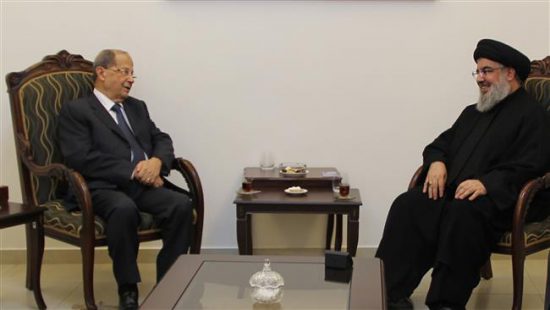
Hezbollah Secretary General Sayyed Hasan Nasrallah (R) receives founder of the Free Patriotic Movement and presidential hopeful Michel Aoun in Beirut, Lebanon, on October 23, 2016.
Last week, Hezbollah Secretary General Sayyed Hassan Nasrallah called upon all Lebanese political parties to join forces and put a favorable end to the 30-month presidential void in the Arab country.
Nasrallah, who was speaking during a meeting with Aoun, stressed the need for concerted efforts in order to direct the upcoming presidential vote in Lebanon toward a good conclusion.
Lebanon has been without a head of state since 2014, when the term of President Michel Suleiman expired.
The Lebanese parliament has repeatedly failed to elect a president due to the lack of quorum.
Under Lebanon’s power-sharing system, the president must be a Christian, the prime minister a Sunni Muslim and the parliament speaker a Shia Muslim.
Hezbollah has accused Saudi Arabia of thwarting political initiatives and blocking the election of a president in Lebanon.
Late last year, Hariri launched an initiative to nominate Suleiman Tony Frangieh, the leader of the Marada Movement.
His proposal, however, failed amid reservations on the part of Lebanon’s main Christian parties as well as Hezbollah.
‘Saudi Sanctions against Hezbollah Have Failed to Weaken the Party’

Deputy chief of Hezbollah’s Executive Council Sheikh Nabil Qawook
Naharnet | October 29, 2016
Deputy chief of Hezbollah’s Executive Council Sheikh Nabil Qawuq stressed on Saturday that the Saudi sanctions against the party have failed to weaken it, the state-run National News Agency reported on Saturday.
“The political developments and field achievements confirm the failure of the Saudi sanctions against Hezbollah, especially since Saudi Arabia wanted to weaken Hezbollah in Lebanon which has only grown stronger at the political, popular and military levels inside Lebanon and regionally,” said Qawuq.
“By renewing sanctions and terrorism ranking against Hezbollah in Lebanon, Saudi Arabia is but reflecting an outrage, despair and disappointment in the face of the Resistance, because the Saudi penalties have changed nothing of Hezbollah’s stances in Syria,” his eminence went on to say.
“Regardless of the pressures, we will not leave our national duty to protect our people and our nation, and we will complete the battle against takfiri terrorism, which has no choice but to be defeated in Syria, and we have no choice but to win.” added Qawuq.
He concluded: “The next phase that Lebanon is approaching will emphasize the strength of the strategic alliance between Hezbollah and Amal movement. Those who were betting on discord and division between the two were disappointed.
“If it was not for the Army, People and Resistance equation which Lebanon renews adherence to at this stage, and without the sacrifices of the Lebanese army and the resistance that has protected Lebanon from being sacked by the ISIL and al-Nusra Front, the Lebanese would not have had the chance to elect a president.”
Only In The World Of American Media Is Syria A Civil War
By Brandon Turbeville | Activist Post | October 13, 2016
To the vast majority of Americans, the Syrian crisis (as well as the state of affairs in Iraq, Libya, Yemen, etc.) is merely a distant blip on a cluttered radar screen. Competing with issues affecting an individual’s daily life like wages, taxes, and free trade, that small portion of the American population who hasn’t completely zoned out of the political and current-events sphere is increasingly overtaken with the necessities of survival. Those who are able to devote enough time to the Syrian crisis are confronted with an unprecedented onslaught of propaganda demonizing the Syrian government and the Syrian president as “killing his own people,” “brutal,” and “genocidal.” The Syrian people are also victims of the propaganda war as being obsessed with religion, divided, and opposed to their government.
As they are presented by the U.S. media, the Syrian people, like most other people across the world are completely dehumanized. In American media, Syrians are not human. They are numbers. 100 died today. 86 died the day before. Syrians are not mothers or sons. They are not fathers or little children, grandparents. They are blips on a screen and data in a spreadsheet. At least, this is how they are presented to an increasingly hardened American public, a nation that is becoming more and more desensitized to death, destruction, and degradation both at home and abroad.
Having recently concluded a trip to the Middle East, I can safely say that the claims made by Western media are the opposite of the truth.
While my visit centered in Lebanon, we had frequent opportunities to talk with ordinary Syrian citizens either visiting Lebanon or fleeing the ravages of the war in their home country. Indeed, Syrians and Syrian refugees were plentiful in Beirut and many would openly speak about the horrors visited upon them by the West’s proxy war and their trials outside Syria.
What is so important about the fact that these Syrians were being interviewed in Lebanon is the unique benefit of talking with someone not living in their home country because one knows with relative certainty that the person speaking has nothing to lose or gain by giving a false perception of the government. After all, one of the frequent accusations leveled by the Western media is that, whenever one speaks to a Syrian actually living in Syria is that they are handicapped by that person’s fear of retribution from the Syrian government. According to this train of thought, if a man criticized Assad in Syria, he might be subject to arrest and then, of course, torture, execution, and “barrel bombs.”
But that is not the case in Lebanon. In Lebanon, even the most vocal anti-Assad Syrian can speak his mind and be safely out of Assad’s reach. Indeed, even out of ear shot by the Syrian government. A Syrian in Lebanon can speak his piece and do so safely in the knowledge that the alleged “brutal dictator” cannot reach him.
That being said, out of all the Syrians I met and spoke to – refugees and visitors, Muslim and Christian, male and female – not one of them supported the “rebels” and all of them – 100% – fully supported their government and Bashar al-Assad. These individuals had nothing but hate for the terrorists and nothing but love for Assad and the Syrian government.
This point needs to be stressed. These individuals were not under threat of a tyrant ready to arrest them if they spoke out against him. They were free of Assad. They could spit on his portrait if they wanted and there is nothing the Syrian government can do to them. Instead, they expressed an incredible amount of pride in their country, their government, and their President.
So, with that in mind, if Assad and the Syrian government are “barrel bombing” their own citizens, committing genocide against the Syrian people, and killing civilians indiscriminately, and if Syrians are free to speak their mind about Assad in Lebanon, why couldn’t I find one Syrian who wanted Assad to “step down” or for terrorists to bring them the “freedom and democracy” the West keeps yapping on about? Perhaps I was looking in the wrong places or perhaps the information coming from Western governments and their media mouthpieces are simply propaganda. Personally, I’ll put my money on the latter.
One striking aspect of Beirut in the context of the Syrian crisis is that one does not necessarily have to seek out the Syrians in order to speak to them. If one only wears a necklace, t-shirt, or bracelet with the Syrian flag, they will come to you. Any indication of solidarity with their country, especially exhibited by a Westerner (even better, an American) and a man who speaks only one word of English will stop whatever he is doing so that he can have a conversation with the foreigner, even if that conversation is done by body language, hand gestures, broken English, interpreters, or Google Translate alone.
Others more skilled in the English language are willing to have long discussions about their experiences, their support for the government, and their hatred for the terrorists infecting their country. They would tell tales of watching people they knew killed in front of them and having lost family or very close friends at the hands of America’s “moderates.” Indeed, in Syria, as well as in the diaspora of the last 5 years, it seems impossible to speak with a single Syrian who has not lost someone close to them.
The sheer magnitude of the crisis is unimaginable in scale, much in the way that the horrors inflicted upon the Syrian people by America’s democracy loving cannibals are beyond the comprehension of most Western audiences. But despite all the bloodshed, loss, and terror perpetrated on Syria by the United States, the Syrian spirit remains and the Syrian people remain some of the kindest, friendliest, and most hospitable people on the face of the earth.
In addition, Syrians remain a seemingly highly informed audience despite the fact that their country has been crippled by warfare for the past five years and that they themselves have been turned into refugees. Knowledge not only of their own situation, but about the players behind it and the developments taking place in Europe and America is common and, while American audiences watch the 24 hours news cycle in utter befuddlement as to the events taking place in Syria, Syrians are profoundly aware of just who is responsible for the crisis their country is facing.
While Americans chalk the crisis up to the “they have been fighting for thousands of years” line or accept the propaganda that Syria is facing a civil war, Syrians know that what they are facing is a proxy war against their government, against their very way of life, and against Russia. Syrians are fully aware of the fact that the terrorists beheading their way across the country are funded by Saudi Arabia, facilitated by Turkey and Israel, and trained by the United States. They are fully aware that there are no “moderates” fighting against the Syrian government and that the United States is responsible for creating the ISIS terror organization it is claiming to fight.
All of this may come as a surprise to Americans but, in Syria, it is well known.
With that in mind, it is an extraordinary thing that Syrians can welcome foreigners visiting their country with such patience and forgiveness. It is truly amazing that Syrian refugees struggling to survive in a foreign country is willing to sit with a citizen of the very country that destroyed his home and killed his family members, smoke hookah with him, and discuss his homeland. It is an unbelievable act of understanding and forgiveness for a man not to judge an American as the enemy and to separate the American people from their government. I was personally struck by the genuine kindness shown to me by people who have been given every legitimate reason to do otherwise.
What the United States is doing to Syria is truly shameful and immoral but, despite the horrors the U.S. and NATO countries have visited upon Syria, the people have refused to give in.
As Mark Twain said,
Damascus has seen all that has ever occurred on earth, and still she lives. She has looked upon the dry bones of a thousand empires, and will see the tombs of a thousand more before she dies.
Judging by the people I met, I am inclined to agree with him.
Brandon Turbeville – article archive here – is the author of seven books, Codex Alimentarius — The End of Health Freedom, 7 Real Conspiracies, Five Sense Solutions and Dispatches From a Dissident, volume 1 and volume 2, The Road to Damascus: The Anglo-American Assault on Syria, and The Difference it Makes: 36 Reasons Why Hillary Clinton Should Never Be President.
US seeks to partition Syria to serve Israel: Nasrallah

Sayyed Hassan Nasrallah, the secretary general of the Lebanese resistance movement, Hezbollah, addresses a ceremony on October 11, 2016 on the occasion of Tasu’a.
Press TV – October 11, 2016
Sayyed Hassan Nasrallah, the secretary general of the Lebanese resistance movement, Hezbollah, has warned of plots by the US, Saudi Arabia and their regional allies to partition Syria in order to serve the Israeli regime’s interests in the Middle East.
The “real goal” of the countries that have neither democracy nor elections was not democracy or elections in Syria, Nasrallah said on Tuesday.
“The goal was for Syria to fall and be fragmented and be ripped apart” in line with Israel’s interests, he added.
Nasrallah made the remarks at the Sayyed al-Shohada Complex in the Lebanese capital, Beirut, on the ninth day of the lunar month of Muharram, Tasu’a, the eve of the martyrdom anniversary of Imam Hussein, the third Shia Imam, and his 72 companions.
He said the Daesh Takfiri militants and al-Qaeda affiliated terrorists of Jabhat Fateh al-Sham, formerly known as al-Nusra, “are being used to serve and achieve US and Israeli goals.”
Nasrallah further noted that the US seeks to concentrate Daesh terrorists in eastern Syria, adding that Washington is allowing and “opening the roads for” Daesh militants to flee from Iraq into Syria.
He cited the recent “deliberate action” by the US to launch airstrikes against Syrian army positions in eastern Syria as an example of Washington’s attempts to boost Daesh in the region, adding, “US raids on Dayr al-Zawr were targeting the Syrian army positions so that the whole area would fall to Daesh.”
The Hezbollah leader said, “All those who are defending Syria defend the Resistance and look forward to a political solution and not to more bloodshed,” but “US, Saudi Arabia and some regional states are demanding crippling conditions to neutralize the political solutions.”
Pointing to a recent abortive truce deal between the US and Russia on Syria, the Hezbollah chief said Washington withdrew from the agreement because it called for the separation of Jabhat Fateh al-Sham from other militant groups and the identification and targeting of Daesh and Jabhat Fateh al-Sham positions.
Nasrallah said the US, Saudi Arabia and their regional allies are obstructing a diplomatic solution to the crisis in Syria and the easing of the sufferings of the Syrian people.
He expressed regret that “more escalation and tensions” is on the horizon in Syria, but called for “perseverance and firm stance” in order to counter the plots of the country’s enemies.
The Hezbollah chief said Syria’s foes sought “a decisive victory within a few weeks” but have faced stiff resistance from the Syrian government and nation and their allies for over five years.
Sana’a carnage major scandal for Saudi Arabia
In another part of his speech, Nasrallah pointed to the recent bloody air raid by Saudi Arabia on a funeral hall in the Yemeni capital of Sana’a and said the strike was a major scandal for Al Saud regime.
Hezbollah leader said some media circles had noted that his remarks on Saudi attack in Sana’a would affect chances of Michel Aoun becoming Lebanon’s next president, which could end a political crisis in the country.
Noting that the demand was tantamount to political blackmail, Nasrallah added, “Even [UN Secretary General] Ban Ki-moon has condemned this strike, although he has always been silent, so how do you want me to remain silent?”
Nasrallah added that the Saudi regime committed a “historic mistake” in Yemen by thinking that it could emerge victorious from the battle within weeks.
The Hezbollah chief condemned the international community’s silence on the bombardment of Yemen by Saudi warplanes and said the world must convince Riyadh that it cannot win this war.
He emphasized that the Sana’a massacre must provide a motive for ending the war in Yemen and added that the Saudi regime has no option but to accept the political solution.
“Saudi Arabia’s insistence on carrying on with the war will not only make it lose Yemen, but will also make it lose itself. The current Saudi leadership is pushing the kingdom to the brink of the abyss,” Nasrallah pointed out, recommending the Saudi rulers to come to their senses.
All parties must preserve Lebanon’s peace and security
The Hezbollah secretary general further stressed the importance of preserving security, stability and civil in Lebanon, describing them as the “pillars of everything,” and adding, “Despite their differences, the Lebanese have managed to preserve security, stability and peace.”
Nasrallah stated that Lebanon has entered a positive political phase during the past few weeks with regard to the presidential election.
“We support and welcome any positive political developments regarding the presidency and we will acknowledge the efforts and courage of anyone who makes efforts in this regard,” Nasrallah pointed out.
He noted that Hezbollah has always pursued a clear stance on Lebanon’s presidential election, adding, “We support every positive political change, which may solve the presidency challenge.”
Hezbollah leader concluded his remarks by stressing the importance of supporting the Lebanese army without any political reservations.
‘World Powers Responsible for Migrant Crisis Must Help Lebanon’

© Sputnik/ Zahraa Al-Amir
Sputnik – 26.09.2016
The international community bears responsibility for what is happening in Syria and should do more to help Lebanon hosting a huge Syrian population, an adviser to the Lebanese Democratic Party (LDP) leader told Sputnik.
“They are giving us nothing absolutely… even though the international community is the one responsible now for what is happening to Syria and in Syria,” Saleem Hamadeh said.
Lebanon, alongside Jordan and Turkey, has been a key destination for thousands of Syrian refugees fleeing the five-year-long war in the country.
According to Hamadeh, Lebanon now hosts around 1,750,000 Syrians, which is a third of its own population.
“I think that international community should give us support in this, financial support and give us direct path on how to deal with this serious issue which will affect the demography of the Lebanese people and our country,” Dr. Hamadeh said.
There are concerns that many Syrians plan to stay in Lebanon after the Syrian crisis has been resolved, the adviser to the LDP president said. The UN relief agency for Palestinian refugees, UNRWA, estimates that Palestinians living in Lebanese refugee camps make up 10 percent of the country’s population.
Ben Gurion’s Plan for Regional Conquest and Israeli Empire
By Richard Silverstein | Tikun Olam | September 1, 2016

Ben Gurion’s 1948 vision of Israeli empire
Odeh Bisharat, one of Haaretz’s few Israeli-Palestinian columnists (Sayeh Kashua is another), published an incisive article on what he calls “the end of the road” for Zionism. But the first paragraph, which comprised a quotation from David Ben Gurion (the full archival passage in Hebrew is here), really opened my eyes. At the first meeting of the Haganah military command after statehood was declared on May 15, 1948, he told the assembled leadership his strategic goals for the coming war. This grandiose vision dispels a long-standing claim by proponents of the Israel-as-victim view, who argue that Israel’s enemies have commenced all the wars against it and that the “Jewish state” has only acted in self-defense:
“We must immediately destroy Ramle and Lod. … We must organize Eliyahu’s brigade to direct it against Jenin in preparation for [conquering] the Jordan Valley. … Maklef needs to receive reinforcements and his role is the conquest of southern Lebanon, through bombing-support against Tyre, Sidon and Beirut. … Yigal Allon must strike Syria from the east and from the north. … We must establish a Christian state whose southern border will be the Litani [River]. We will forge an alliance with it. When we break the strength of the [Jordanian] Legion and bomb Amman we will eliminate Transjordan too, and then Syria falls. And if Egypt still dares to fight, we will bomb Port Said, Alexandria and Cairo.
… That is how we will end the war – and make a reckoning on our forefathers behalf with Egypt, Assyria and Aramea.”
Pro-Israel advocates will chalk this up to the braggadocio of a national leader preparing the troops for battle. He offers them a vision full of victories and maximalist territorial gain. It cheers them for the difficult battle ahead. Defenders may argue that Ben Gurion had to have been realistic enough to know that the new state had little chance of achieving such objectives.
But in my reading of Ben Gurion, there are two separate personalities: one of the pragmatist who accepts half a loaf instead of the whole; the other the ambitious politico-military strategist harboring imperial visions of Israel’s future (including the ethnic cleansing of the Palestinian inhabitants of the new state). But even the pragmatist is only pragmatic in the moment. Ben Gurion makes clear that his pragmatism is only temporary until Israel is in a position to realize its maximalist goals.
The irony here is that it is Israeli advocates who continually claim that conspiring Palestinian militants only accept Israel on an interim basis until they are powerful enough to eradicate it. Therefore, Israel may never trust such enemies and never make peace with them; because a knife in the back is the only future Israel can expect from them. We can see that it is Israel that the Arab states had reason to distrust.
Another bitter irony is the claim by Israel and anti-Iran forces in the U.S. and elsewhere, that Iran has a nefarious plan to spread Shia hegemony throughout the Middle East to Iraq, Syria, Lebanon, and the Gulf region. In truth, Ben Gurion shows that Iran is a piker by comparison. He envisioned a Greater Israel not just from the river (Jordan) to the sea (Mediterranean), but a Davidic imperium spreading its influence from Syria to Egypt. Even those Arab states Israel permitted to remain would be little more than vassals of this new regional Goliath.
Just think how Ben Gurion’s successors implemented most of the strategic vision he proclaimed that day: a Christian state in southern Lebanon; the fall of Syria; Israeli bombardment of Arab capitals in Beirut, Damascus and elsewhere. The only elements of his plan that were unrealized (conquest of Jordan and the pacification of Egypt) weren’t necessary because both states sued for peace.
Today’s radical settlers, with their considerably ‘pared-down’ vision of a pure, racialist Judean state, rid of Palestinians, from the Jordan to the sea are inheritors of Ben Gurion’s legacy.
Bisharat quotes another telling statement from a pre-State Zionist leader who could be describing current Israeli strategy of sabotaging peace negotiations with the Palestinians. This was written in 1937:
“It turns out that we have put out our hand for peace, but took it back right away, when the other side expressed its interest in accepting it. This dangerous game did not help to raise our honor in their eyes as honest people, and the accusation that they blame us for, that we are conducting two-faced politics: On one hand we pretend as if we are asking for an agreement, and on the other hand we only want to gain time – is not baseless.”
This clearly explains Netanyahu’s Bar Ilan speech of 2009 in which he pretends to embrace a two-state solution (under severe pressure from the Bush administration to do so). The few times since when the Israeli leader has trotted out his affirmation of a two-state solution were times when he was under great duress and had to throw a sop to foreign interlocutors like the Obama administration. Clearly, Bibi’s heart is not in it, nor does he believe it.
Casuistry
By Thomas S. Harrington | CounterPunch | August 19, 2016
Casuistry, which one dictionary defines as “specious, deceptive, or oversubtle reasoning, especially in questions of morality” is, rightly or wrongly, inextricably linked to the history of Jesuit order of the Catholic Church. And the rise of the Jesuit order is deeply enmeshed with the Counter-Reformation, a set of measures designed to roll back the spread of Protestantism in Europe during the late 16th and early 17th centuries. The control center of the movement was Spain, the world-striding superpower of that historical moment.
Rightfully fearful that Protestantism’s rejection of long-standing modes of clerical privilege and the Church’s “right” to collect vast sums of money from parishioners would undermine their ability to bully and bribe Italian, French, Dutch and German potentates into compliance with their political demands, the Spanish Monarchy undertook an endless series of military adventures against “heretics” across the Continent in the years between 1530 and 1648. This military thrust was accompanied by a well-organized propaganda campaign in which the highly educated Jesuits priests played a crucial role.
Appearing morally and intellectually reasonable while serving as a convinced advocate for the systematic subjugation of other people and their animating ideals is not a simple task. In the long run it is, in fact, an impossible one. No amount of argument can convince a person or group of persons who see them selves as suffering under the boot of another that their bondage is a good and necessary thing. What such a rhetorical posture can do, for a time at least, is convince the subjects of the hegemonic country of, if not the inherent nobility of their bloody mission, its generally benign nature.
A key, if generally unstated, goal of the 16th and 17th century Jesuits was to insure that the highly problematic matter of Rome’s corruption, and the brutal Imperial designs of the Spanish monarchy that lay behind it, never be allowed to occupy the center zone of what then passed for “public” discourse.
When confronted by the emergent Protestant movements about the clear violations of Christian morality practiced by the Church of Rome, they responded with complex disquisitions on the largely circumstantial nature of all moral reasoning. By constantly parsing the intricacies of how overarching moral rules should, or should not, be applied in each particular circumstance (and teaching others to do the same), they very effectively prevented the emergence within the Church, and by extension in the leadership class of the Spanish Empire, of a frank discussion of the quite real and deeply-felt grievances of their many enemies.
I am reminded of all this when I read or watch the news after every so-called “terrorist” attack against a US or European target. Within minutes of the violence, mainstream journalists, begin intense speculation about what particular ethnic group the assailant came from, how he or she became “radicalized” (as if the desire to kill was akin to some sort of contagious moral flu) and whether the “West’s” latest stand-in for PURE EVIL™ (e.g. Al-Qaeda, ISIS, ISIL) was behind the act.
What will almost never be talked about are the many very good reasons a person from the vast region stretching from Morrocco in the west, to Pakistan in the east, have to be very angry at, and to feel highly vengeful toward, the US, its strategic puppeteer Israel, and their slavishly loyal European compadres like France, Germany and Great Britain.
There is never any talk of that group of august “democracies” long-standing penchant for implanting, then staunchly supporting, ruthless and deeply corrupt regimes in that region.
No talk of the very long Algerian experience of French colonialism, nor the US and French- backed coup of that country’s government in 1992 which led to a civil war that left 200,000 people dead.
No talk of the coup against the legally elected president of Egypt in 2013, nor the cold-blooded massacres carried out by his US-backed successor upon hundreds of that same president’s followers.
No talk of the decision of the US to back elements of ISIS in order to cynically extend a Syrian Civil War that was on its way to peace—albeit an imperfect one—by means of a Syrian government victory by late 2013.
No talk of the planned destruction of Libya in 2011 and its enormous effects on the stability of life in that once wealthy country as well as all of northern Africa.
No talk of the US-Israeli nullification of the results of the Palestinian elections of 2006, Israel’s coldly planned siege of Gaza nor the “shoot-fish-in-a barrel” assaults on that benighted enclave by Israel in 2006, 2008, 2012 and 2014.
No talk of the ongoing Saudi—and therefore US-approved—war on Yemen, nor the ruthless Saudi march on Bahrain in 2011 in which several dozen people died and thousands of democracy activists were tortured and/or carted off to prison.
No talk of the 18-year Israeli—and therefore, US-backed—occupation of Southern Lebanon nor Israel’s 1993, 1996 and 2006 assaults upon that same country.
Oops, I almost forgot. There is no talk of the small matter the calculated US destruction of Iraq, pre-invasion Libya’s rival as the Arab world’s most wealthy and socially progressive state.
But hey, why talk about all that off-putting stuff when you can boil it all down to neat tales of personal ideological contamination, Svengali-like recruiters lurking in mosques, and that old standby, the development of an urgent need to bang virgins in the hereafter.
It seems the media believes that the delicate imperial mind must be left free from understanding the effects of the actions for which it regularly cheers and prays.
The best way to insure this? Casuistry, as the old saying goes, “Pure casuistry”.
Thomas S. Harrington is a professor of Iberian Studies at Trinity College in Hartford, Connecticut and the author of the recently released Livin’ la Vida Barroca: American Culture in a Time of Imperial Orthodoxies.
Featured Video
BRITAIN’S WARNING: PREPARE FOR WAR
or go to
Aletho News Archives – Video-Images
From the Archive
How Ukraine Tortured and Slaughtered Donbass
By Kit Klarenberg | Al Mayadeen | July 11, 2024
Almost immediately after the proxy war erupted, ISIS-tier footage of the torture and murder of Russians in Ukrainian custody emerged.
On July 6th, the New York Times published an astonishing investigation: In Ukraine, Killings of Surrendering Russians Divide an American-Led Unit. The article documents in grim detail how Chosen Company, an international volunteer battalion for Kiev, routinely executes Russian prisoners of war. It is the very first mainstream admission that this practice – a brazen breach of the Geneva Conventions, and a grave war crime – is widespread among Ukraine’s fighters, both foreign and homegrown. … continue
Blog Roll
 Aletho News
- Pentagon designates Chinese cultural centers national security threat
- Israel Demolishes Home Of Lebanese Journalist Whose Viral Film Exposed Pager Attack
- Record Oil, Empty Tanks: The UAE’s Miracle Recovery
- Burnham tackles Britain’s poverty with aggression in Yemen
- Peace in Ukraine: the easy way – or the hard way
- Trump & the Rrrrussians
- US taxpayer money laundered back through Ukraine – Musk
- Before COVID, an NIH lab chief proposed making a SARS-like bat virus more infectious
- Gates, Bourla on Trial in Netherlands Accused of ‘Great Reset’ Scheme at Vaccine Injury Hearing
- BRITAIN’S WARNING: PREPARE FOR WAR
- If Americans Knew
- An error has occurred; the feed is probably down. Try again later.
- No Tricks Zone
- Two New Studies Find Thwaites Glacier Melt Cannot Be Driven By Human Activity Or A Warming Ocean
- E-Cars Reduce CO2 Emissions By Only 41% Compared To Internal Combustion Engine Vehicles
- Predictions Made By Renowned Climate Professor Over Past Decades Have Been Proven To Be Poor
- New Study Suggests Large Regions Of The Pacific Ocean Have Been Cooling For The Last 80 Years
- Germany’s Green Energy Debacle: High Energy Costs Force Kahla Porzellan to Close After 182 Years!
- New Study: 50 Years Of The Most Aggressive ‘Net Zero’ Policies Can Only Affect The Global Climate By 0.03°C
- US September “Heat” Was No Record…Many Records Set Decades Ago
- Latest European Green Energy Debacle; Portugal’s Largest Flagship Solar Park Insolvent!
- Green Energy Debacle: German Expert Professor Fritz Vahrenholt Warns Of Severe Economic And Social Consequences
- Two More Paleo Reconstructions Affirm Meters-Higher Sea Levels Across Ireland, Brazil 7000-6000 Years Ago

