Nasrallah: “America is the mother of terrorism”
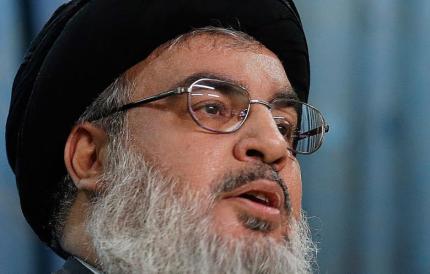
Nasrallah speaks on July 25, 2014, in the southern suburbs of Beirut. (Photo: Al-Akhbar – Haitham Moussawi)
Al-Akhbar | September 23, 2014
Hezbollah leader Hassan Nasrallah on Tuesday said his group could never be a part of an anti-ISIS coalition led by “the source” of all terrorism in the world, the United States.
The international coalition, which began illegal airstrikes in Syria for the first time Tuesday, was created to safeguard the interests of the United States, not to fight terrorism as it claims, Nasrallah said in a televised speech.
“In our opinion, America is the mother of terrorism, the source of terrorism. If there is terrorism anywhere in the world, look at America,” the secretary-general said.
“America provides complete support for the terrorism of the Zionist state. It supports Israel militarily, financially, legally, and even provides it veto in the United Nations Security Council.”
Nasrallah continued: “He who dropped the atomic bomb on the people of Japan, and who killed [relentlessly] in Vietnam and elsewhere, and who stood by [Israeli Prime Minister Benjamin] Netanyahu in the 50 day war on Gaza … is not qualified ethically or morally to present itself as a leader of a coalition to fight terrorism.”
The comments come as the United States and allied Arab dictatorships began launching unauthorized airstrikes against jihadi targets in Syria, drawing rebukes from Damascus’s allies Iran and Russia.
Nasrallah brushed off criticism that his opposition to the coalition translated into support for the Islamic State of Iraq and Syria (ISIS), noting that he has repeatedly denounced the extremists and called for their elimination.
The reality that many of those included in the anti-ISIS coalition have been financing the jihadi militants they are currently fighting in Iraq and Syria forces people of the region to question the motives of their actions, he added, referring to Saudi Arabia and Qatar.
Lebanon is one of 10 Arab countries that has pledged support to the coalition, a membership that Nasrallah said he opposed.
“Never did [US President Barack Obama] say we are coming to defend minorities or Muslims or Christians …,” Nasrallah said.
“So we will not fight in a coalition that serves US interests and not the interests of the people of the region.”
In Nasrallah’s last speech on August 15, he noted that the United States only decided to get involved in the fight against ISIS when the jihadis approached Iraq’s Kurdish region, which is strategically important to the West. … Full article
Israeli spy drone crashes in Lebanon
Al-Akhbar | September 20, 2014
An Israeli spy drone crashed inside Lebanon on Saturday, the Lebanese army and state media reported.
The National News Agency said the remote control plane went down in the Marjayoun district of southeastern Lebanon due to a mechanical malfunction.
It is now being inspected at an army base.
“Today (Saturday) at 10:30 am, an Israeli drone fell at Mazraat Sarde region in Marjayoun while violating the Lebanese [air space],” an army statement read.
Israeli spy drones and fighter jets violate Lebanese airspace on a daily basis.
The Lebanese army issued a statement earlier Saturday saying that a spy drone had entered Lebanese airspace Friday at 10:15 pm and flew around the south for several hours before returning to the occupied territories at 7:00 am.
In February, an Israeli drone crashed on the Blue Line, the UN-demarcated line between Lebanon and occupied Palestine.
Israeli soldiers illegally crossed into Lebanese territory during that incident to retrieve the wreckage.
Israeli aircraft regularly cross into Lebanese airspace, and the border area in southern Lebanon has been the scene of tense standoffs in the past.
The Blue Line was drawn up in 2000 by the UN after Israeli troops withdrew from most of south Lebanon after a 22-year occupation.
Israel still occupies the Shebaa Farms area in southeast Lebanon.
Reported US-Syrian Accord on Air Strikes
By Robert Parry | Consortium News | September 17, 2014
The Obama administration, working through the Russian government, has secured an agreement from the Syrian regime of Bashar al-Assad to permit U.S. airstrikes against Islamic State targets in parts of Syria, according to a source briefed on the secret arrangements.
The reported agreement would clear away one of the chief obstacles to President Barack Obama’s plan to authorize U.S. warplanes to cross into Syria to attack Islamic State forces – the concern that entering Syrian territory might prompt anti-aircraft fire from the Syrian government’s missile batteries.
The usual protocol for the U.S. military – when operating in territory without a government’s permission – is to destroy the air defenses prior to conducting airstrikes so as to protect American pilots and aircraft, as was done with Libya in 2011. However, in other cases, U.S. intelligence agencies have arranged for secret permission from governments for such attacks, creating a public ambiguity usually for the benefit of the foreign leaders while gaining the necessary U.S. military assurances.
In essence, that appears to be what is happening behind the scenes in Syria despite the hostility between the Obama administration and the Assad government. Obama has called for the removal of Assad but the two leaders find themselves on the same side in the fight against the Islamic State terrorists who have battled Assad’s forces while also attacking the U.S.-supported Iraqi government and beheading two American journalists.
In a national address last week, Obama vowed to order U.S. air attacks across Syria’s border without any coordination with the Syrian government, a proposition that Damascus denounced as a violation of its sovereignty. So, in this case, Syria’s behind-the-scenes acquiescence also might provide some politically useful ambiguity for Obama as well as Assad.
Yet, this secret collaboration may go even further and include Syrian government assistance in the targeting of the U.S. attacks, according to the source who spoke on condition of anonymity. That is another feature of U.S. military protocol in conducting air strikes – to have some on-the-ground help in pinpointing the attacks.
As part of its public pronouncements about the future Syrian attacks, the Obama administration sought $500 million to train “vetted” Syrian rebels to handle the targeting tasks inside Syria as well as to carry out military ground attacks. But that approach – while popular on Capitol Hill – could delay any U.S. airstrikes into Syria for months and could possibly negate Assad’s quiet acceptance of the U.S. attacks, since the U.S.-backed rebels share one key goal of the Islamic State, the overthrow of Assad’s relatively secular regime.
Just last month, Obama himself termed the strategy of arming supposedly “moderate” Syrian rebels “a fantasy.” He told the New York Times’ Thomas L. Friedman: “This idea that we could provide some light arms or even more sophisticated arms to what was essentially an opposition made up of former doctors, farmers, pharmacists and so forth, and that they were going to be able to battle not only a well-armed state but also a well-armed state backed by Russia, backed by Iran, a battle-hardened Hezbollah, that was never in the cards.”
Obama’s point would seem to apply at least as much to having the “moderate” rebels face down the ruthless Islamic State jihadists who engage in suicide bombings and slaughter their captives without mercy. But this “fantasy” of the “moderate” rebels has a big following in Congress and on the major U.S. op-ed pages, so Obama has included the $500 million in his war plan despite the risk it poses to Assad’s acquiescence to American air attacks.
Neocon Wish List
Without Assad’s consent, the U.S. airstrikes might require a much wider U.S. bombing campaign to first target Syrian government defenses, a development long sought by Official Washington’s influential neoconservatives who have kept “regime change” in Syria near the top of their international wish list.
For the past several years, the Israeli government also has sought the overthrow of Assad, even at the risk of Islamic extremists gaining power. The Israeli thinking had been that Assad, as an ally of Iran, represented a greater threat to Israel because his government was at the center of the so-called Shiite crescent reaching from Tehran through Damascus to Beirut and southern Lebanon, the base for Hezbollah.
The thinking was that if Assad’s government could be pulled down, Iran and Hezbollah – two of Israel’s principal “enemies” – would be badly damaged. A year ago, then-Israeli Ambassador to the United States Michael Oren articulated this geopolitical position in an interview with the Jerusalem Post.
“The greatest danger to Israel is by the strategic arc that extends from Tehran, to Damascus to Beirut. And we saw the Assad regime as the keystone in that arc,” Oren said. “We always wanted Bashar Assad to go, we always preferred the bad guys who weren’t backed by Iran to the bad guys who were backed by Iran.” He said this was the case even if the other “bad guys” were affiliated with al-Qaeda.
More recently, however, with the al-Qaeda-connected Nusra Front having seized Syrian territory adjacent to the Israeli-occupied Golan Heights – forcing the withdrawal of UN peacekeepers – the balance of Israeli interests may be tipping in favor of preferring Assad to having Islamic extremists possibly penetrating directly into Israeli territory.
Direct attacks on Israel would be a temptation to al-Nusra Front, which is competing for the allegiance of young jihadists with the Islamic State. While the Islamic State, known by the acronyms ISIS or ISIL, has captured the imaginations of many youthful extremists by declaring the creation of a “caliphate” with the goal of driving Western interests from the Middle East, al-Nusra could trump that appeal by actually going on the offensive against one of the jihadists’ principal targets, Israel.
Yet, despite Israel’s apparent rethinking of its priorities, America’s neocons appear focused still on their long-held strategy of using violent “regime change” in the Middle East to eliminate governments that have been major supporters of Lebanon’s Hezbollah and Palestine’s Hamas, i.e. Syria and Iran.
One reason why Obama may have opted for a secretive overture to the Assad regime, using intelligence channels with the Russians as the middlemen, is that otherwise the U.S. neocons and their “liberal interventionist” allies would have howled in protest.
The Russian Hand
Besides the tactical significance of U.S. intelligence agencies arranging Assad’s tacit acceptance of U.S. airstrikes over Syrian territory, the reported arrangement is also significant because of the role of Russian intelligence serving as the intermediary.
That suggests that despite the U.S.-Russian estrangement over the Ukraine crisis, the cooperation between President Obama and Russian President Vladimir Putin has not been extinguished; it has instead just gone further underground.
Last year, this growing behind-the-scenes collaboration between Obama and Putin represented a potential tectonic geopolitical shift in the Middle East. In the short term, their teamwork produced agreements that averted a U.S. military strike against Syria last September (by getting Assad to surrender his chemical weapons arsenal) and struck a tentative deal with Iran to constrain but not eliminate its nuclear program.
In the longer term, by working together to create political solutions to various Mideast crises, the Obama-Putin cooperation threatened to destroy the neocons’ preferred strategy of escalating U.S. military involvement in the region. There was the prospect, too, that the U.S.-Russian tag team might strong-arm Israel into a peace agreement with the Palestinians.
So, starting last September – almost immediately after Putin helped avert a U.S. air war against Syria – key neocons began taking aim at Ukraine as a potential sore point for Putin. A leading neocon, Carl Gershman, president of the U.S.-government-funded National Endowment for Democracy, took to the op-ed pages of the neocon Washington Post to identify Ukraine as “the biggest prize” and explaining how its targeting could undermine Putin’s political standing inside Russia.
“Ukraine’s choice to join Europe will accelerate the demise of the ideology of Russian imperialism that Putin represents,” Gershman wrote. “Russians, too, face a choice, and Putin may find himself on the losing end not just in the near abroad but within Russia itself.” At the time, Gershman’s NED was funding scores of political and media projects inside Ukraine.
By early 2014, American neocons and their “liberal interventionist” pals were conspiring “to midwife” a coup to overthrow Ukraine’s elected President Viktor Yanukovych, according to a phrase used by U.S. Ambassador Geoffrey Pyatt in an intercepted phone conversation with Assistant Secretary of State for European Affairs Victoria Nuland, who was busy handpicking leaders to replace Yanukovych.
A neocon holdover from George W. Bush’s administration, Nuland had been a top aide to Vice President Dick Cheney and is married to prominent neocon Robert Kagan, a co-founder of the Project for a New American Century which prepared the blueprint for the neocon strategy of “regime change” starting with the 2003 U.S.-led invasion of Iraq.
The U.S.-backed coup ousted Yanukovych on Feb. 22 and sparked a bloody civil war, leaving thousands dead, mostly ethnic Russians in eastern Ukraine. But the Gershman-Nuland strategy also drove a deep wedge between Obama and Putin, seeming to destroy the possibility that their peace-seeking collaboration would continue in the Middle East. [See Consortiumnews.com’s “Neocons’ Ukraine-Syria-Iran Gambit.”]
New Hope for ‘Regime Change’
The surprise success of Islamic State terrorists in striking deep inside Iraq during the summer revived neocon hopes that their “regime change” strategy in Syria might also be resurrected. By baiting Obama to react with military force not only in Iraq but across the border in Syria, neocons like Sens. John McCain and Lindsey Graham put the ouster of Assad back in play.
In a New York Times op-ed on Aug. 29, McCain and Graham used vague language about resolving the Syrian civil war, but clearly implied that Assad must go. They wrote that thwarting ISIS “requires an end to the [civil] conflict in Syria, and a political transition there, because the regime of President Bashar al-Assad will never be a reliable partner against ISIS; in fact, it has abetted the rise of ISIS, just as it facilitated the terrorism of ISIS’ predecessor, Al Qaeda in Iraq.”
Though the McCain-Graham depiction of Assad’s relationship to ISIS and al-Qaeda was a distortion at best – in fact, Assad’s army has been the most effective force in pushing back against the Sunni terrorist groups that have come to dominate the Western-backed rebel movement – the op-ed’s underlying point is obvious: a necessary step in the U.S. military operation against ISIS must be “regime change” in Damascus.
That would get the neocons back on their original track of forcing “regime change” in countries seen as hostile to Israel. The first target was Iraq with Syria and Iran always meant to follow. The idea was to deprive Israel’s close-in enemies, Lebanon’s Hezbollah and Palestine’s Hamas, of crucial support. But the neocon vision got knocked off track when Bush’s Iraq War derailed and the American people balked at extending the conflict to Syria and Iran.
Still, the neocons retained their vision even after Bush and Cheney departed. They also remained influential by holding onto key positions inside Official Washington – at think tanks, within major news outlets and even inside the Obama administration. They also built a crucial alliance with “liberal interventionists” who had Obama’s ear. [See Consortiumnews.com’s “The Dangerous Neocon-R2P Alliance.”]
The neocons’ new hope arrived with the public outrage over ISIS’s atrocities. Yet, while pushing to get this new war going, the neocons have downplayed their “regime change” agenda, getting Obama to agree only to extend his anti-ISIS bombing campaign from Iraq into Syria. But it was hard to envision expanding the war into Syria without ousting Assad.
Now, however, if the source’s account is correct regarding Assad’s quiet assent to U.S. airstrikes, Obama may have devised a way around the need to bomb Assad’s military, an maneuver that might again frustrate the neocons’ beloved goal of “regime change.”
~
Investigative reporter Robert Parry broke many of the Iran-Contra stories for The Associated Press and Newsweek in the 1980s. You can buy his new book, America’s Stolen Narrative, either in print here or as an e-book (from Amazon and barnesandnoble.com).
Syrian media slams Arab support for new US war in the region
Al-Akhbar | September 9, 2014
Syrian media accused Arab governments Tuesday of giving Washington prior agreement for military action against jihadists, with one daily calling for Damascus to form an alternative alliance with Moscow and Tehran.
The commentary comes ahead of talks in Saudi Arabia on Thursday between Secretary of State John Kerry and US regional allies on joint action to tackle the threat posed by the Islamic State group in both Syria and Iraq.
“Washington, which used the false pretext of weapons of mass destruction to enter the region militarily in 2003 and draw new geopolitical lines… is returning today under a new false pretext, the fight against terrorism,” said the Al-Baath newspaper.
“The Arabs meanwhile, are absent from every decision and are playing secondary roles,” it added.
The Baath party daily was referring to the US-led invasion of Iraq in 2003 in which notoriously the alleged chemical and biological weapons that were used to justify the overthrow of Saddam Hussein’s regime were never found.
Kerry is set to meet foreign ministers from Egypt, Jordan, Iraq, Lebanon, Turkey and the six Gulf Arab states in Saudi Arabia on Thursday.
The talks are part of US efforts to build a coalition to tackle ISIS, which has seized large tracts of territory in both Syria and Iraq, and carried out abuses including the decapitation of Syrians, Iraqis, Lebanese and two American journalists.
On Sunday, the Arab League pledged to take “necessary measures” to confront ISIS, and said it was ready for “international cooperation on all fronts.”
But Syria, and its ally Iran, will not be present at the talks in Saudi Arabia, and Damascus fears efforts to tackle ISIS will involve air strikes on its territory without its permission.
State-run newspaper Al-Thawra warned: “The United States is setting the stage to bring new wars to the region.
“Its local partners are ready to carry out its orders without even knowing the details of the American plan,” it added.
Government daily Tishrin questioned why Kerry and US Defence Secretary Chuck Hagel were coming to the region “when the Arab League has already given its prior agreement for a new war in the region organized by the United States.”
A newspaper called for the formation of an alternative “Russian-Iranian-Syrian coalition” against the jihadists to that being put together by Washington.
“Western and regional governments are excluding the nations that really want to fight terrorism,” it said, charging that the US-led coalition included nations that “support terrorism financially, military and logistically.”
Damascus considers all rebel groups fighting to overthrow President Bashar al-Assad “terrorists” and has long accused the rebels’ supporters, particularly Qatar, Saudi Arabia and Turkey, of funding “terror.”
Similarly, critics opposed to US involvement in the conflict with ISIS have pointed out that Washington in partnership with its Gulf allies, including Saudi Arabia, played a role in the formation and expansion of extremist groups like ISIS by arming, financing and politically empowering armed opposition groups in Syria.
On Monday, a study by the London-based small-arms research organization Conflict Armament Research revealed that ISIS jihadists appear to be using US military issue arms and weapons supplied to the so-called moderate rebels in Syria by Saudi Arabia.
(AFP, Al-Akhbar)
Israeli forces abduct shepherd, goats from southern Lebanon
Al-Akhbar | July 30, 2014
Israeli occupation forces snuck into Lebanon and abducted a shepherd from the southeastern town of Shebaa at dawn Wednesday, one day after they stole a herd of goats from the same area, state media reported.
Ismail Khalil Nabaa was kidnapped in Shebaa and taken to the nearby occupied Shebaa Farms area.
UNIFIL is working to secure his release, Lebanon’s National News Agency (NNA ) said.
The owners of the kidnapped herd, Mohammed Khalil Nabaa and Khodour Hamdan, said they had escaped an Israeli ambush on Lebanese territory on Tuesday.
The report did not speculate over why Israeli forces kidnapped the goats and shepherd.
MP Qassem Hashem called Nabaa’s kidnapping a violation of national sovereignty and international charters, NNA reported.
“The Zionist enemy continues its aggression, abducts Lebanese shepherds and seizes their flocks. The UNIFIL must fully perform its duty,” the NNA quoted him as saying.
Rockets from Lebanon Land in Israeli Settlement, Zionist Army Retaliates
Al-Manar | July 11, 2014
Twenty five Israeli shells have so far fallen on Kfarshuba outskirts, Halta and Majidiyah causing only material damages, the National News Agency reported.
Zionist army spokesman Lieutenant Colonel Peter Lerner said artillery units had fired a barrage at “suspicious positions” sighted over the border.
This came as unknown persons fired at dawn today two 107mm Katyusha rockets which landed in the area east of Metula settlement on the border with Lebanon. Lebanese army intelligence inspected the area where the rockets were being launched and found two more missiles ready for launching and defused them immediately. Another rocket exploded while still on its launchpad.
The Lebanese army found military gear in Ain Arab, reports also said.
The Army Command issued on Friday the following statement: “Today, between 1:00 and 6:00 in the morning, an unknown party fired three rockets from the area of Marjayoun – Hasbaya towards the occupied Palestinian territory. Afterwards, the army conducted patrols in the area and carried out a wide-scale search operation in which it found two platforms with two rockets set for launching, while the military expert arrived to the scene and worked on disabling the platforms.”
The Zionist army said one projectile fired from Lebanon struck “northern Israel” causing no harm or damages. “One projectile hit an open space near Kfar Yuval, between (northern Israeli towns) Metula and Kiryat Shmona,” a military spokeswoman told Agence France Presse.
The Zionist officials said it was unlikely the rockets were fired by Hezbollah and believed they were fired by a small Palestinian group in solidarity with Gaza.
US blacklists companies accused of Hezbollah ties
Al-Akhbar | July 10, 2014
The United States moved Thursday to blacklist a group of companies it claimed covertly helped Lebanon’s powerful Hezbollah movement acquire components for surveillance drones.
The US Treasury placed sanctions on Beirut-based Stars Group Holding, which it said purchased electronics and other technology via offices in China and Dubai to support Hezbollah’s military operations.
That included the development of unmanned aerial vehicles (UAVs) that the Treasury claimed were used against rebels in Syria and for surveillance of Israeli sites.
The material bought by Stars Group included engines, communications, electronics, and navigation equipment acquired from suppliers in the United States, Canada, Europe and Asia.
It named for sanctions the company, its subsidiaries, its owner, executives Kamel Amhaz and Issam Amhaz, and two Stars Group managers, Ayman Ibrahim and Ali Zeaiter.
The sanctions place a freeze on any of their assets under US jurisdiction and ban Americans from any business with them.
(AFP, Al-Akhbar)
US House awards Gold Medal for war criminal Shimon Peres
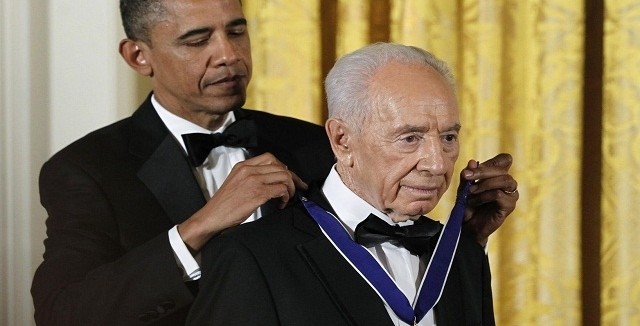
Photo – Sultan/thepoliticalforums.com
Aletho News | May 21, 2014
The US House of Representatives on Monday voted to give the Congressional Gold Medal to Israel’s outgoing president, Shimon Peres.
The bill which authorizes the creation of the gold medal and its award to Peres, HR 2939, is co-sponsored by Rep. Trent Franks (R-AZ) and Rep. Joe Kennedy (D-MA). It touts Peres’ “pivotal role in forging the strong and unbreakable bond between the United States and Israel” and states that “[b]y presenting the Congressional Gold Medal … Congress proclaims its unbreakable bond with Israel and reaffirms its continual support for Israel.”
The following excerpt from an open letter by the Palestinian Campaign for the Academic and Cultural Boycott of Israel recounts Peres’ career, emphasizing a record of war crimes:
On 18 April 1996, when Israel still occupied southern Lebanon, Shimon Peres was Prime Minister. He was in the midst of an election campaign, so he took a decision to do something to change his “dovish” image because doves are not respected in Israel. He launched “Operation Grapes of Wrath” causing 400,000 Lebanese to flee their homes, with almost 800 of them fleeing to a UN base in Qana, South Lebanon.
On 18 April the Israeli army shelled the UN shelter in Qana, killing 102 civilians, mainly women, children and the elderly. Many more were injured. Human Rights Watch, the UN and Amnesty International subsequently disproved the myth that the Israeli army did not deliberately intend to shell the UN base. Shimon Peres said at the time, “In my opinion, everything was done according to clear logic and in a responsible way. I am at peace.”
The Qana massacre led to Shimon Peres being denied the job he coveted at the time: that of UN Secretary-General. He should have been denied it anyway for being the architect of Israel’s nuclear programme — one which remains outside the scrutiny of the world even as Israel bays for the cessation of Iran’s pursuit of nuclear energy for civilian purposes.
Peres is on record for being responsible for other war crimes, from building colonies on occupied Arab land to endorsing a policy of extra-judicial killings, which murders Palestinians and other Arabs without the benefit of a trial or, in fact, any proof other than that provided by Israeli Intelligence, the Shin Bet. He also supports the siege on Gaza, the destruction of its airport, and the elaborate system of checkpoints all across the West Bank. He defends the demolition of Palestinian homes, and he justified the atrocities committed by the Israeli army in its recent war on Lebanon in 2006.
Peres is also on record for defending land gained during war, claiming that Israel has the right to the Golan Heights because it was gained during war.
A Senate version of the bill, co-sponsored by Sen. Michael Bennet (D-CO) and Sen. Kelly Ayotte (R-NH), passed by unanimous consent in March.
Featured Video
BRITAIN’S WARNING: PREPARE FOR WAR
or go to
Aletho News Archives – Video-Images
From the Archives
British weapons and personnel doing much of the killing in Yemen
Press TV – June 18, 2019
A detailed report published by the Guardian newspaper has shown how Britain is massively contributing to Saudi Arabia’s devastating war on Yemen as it suggests that London is not only supplying the bombs that fall on Yemenis, but it provides the personnel and expertise that keep the war going.
The comprehensive report by Arron Merat published on Tuesday showed that Britain was doing much of the killing in Yemen as the country continues to provide Saudi Arabia with everything it needs to turn its southern impoverished neighbor into a graveyard.
“Every day Yemen is hit by British bombs – dropped by British planes that are flown by British-trained pilots and maintained and prepared inside Saudi Arabia by thousands of British contractors,” said Merat in the report. … continue
Blog Roll
 Aletho News
- Pentagon designates Chinese cultural centers national security threat
- Israel Demolishes Home Of Lebanese Journalist Whose Viral Film Exposed Pager Attack
- Record Oil, Empty Tanks: The UAE’s Miracle Recovery
- Burnham tackles Britain’s poverty with aggression in Yemen
- Peace in Ukraine: the easy way – or the hard way
- Trump & the Rrrrussians
- US taxpayer money laundered back through Ukraine – Musk
- Before COVID, an NIH lab chief proposed making a SARS-like bat virus more infectious
- Gates, Bourla on Trial in Netherlands Accused of ‘Great Reset’ Scheme at Vaccine Injury Hearing
- BRITAIN’S WARNING: PREPARE FOR WAR
- If Americans Knew
- An error has occurred; the feed is probably down. Try again later.
- No Tricks Zone
- Sudden Stratospheric Warming, Powerful El Niño Combination May Lead To Extreme Europe Cold, Energy Crisis!
- Two New Studies Find Thwaites Glacier Melt Cannot Be Driven By Human Activity Or A Warming Ocean
- E-Cars Reduce CO2 Emissions By Only 41% Compared To Internal Combustion Engine Vehicles
- Predictions Made By Renowned Climate Professor Over Past Decades Have Been Proven To Be Poor
- New Study Suggests Large Regions Of The Pacific Ocean Have Been Cooling For The Last 80 Years
- Germany’s Green Energy Debacle: High Energy Costs Force Kahla Porzellan to Close After 182 Years!
- New Study: 50 Years Of The Most Aggressive ‘Net Zero’ Policies Can Only Affect The Global Climate By 0.03°C
- US September “Heat” Was No Record…Many Records Set Decades Ago
- Latest European Green Energy Debacle; Portugal’s Largest Flagship Solar Park Insolvent!
- Green Energy Debacle: German Expert Professor Fritz Vahrenholt Warns Of Severe Economic And Social Consequences

