UN General Assembly votes for Israel to compensate Lebanon for 2006 oil spill
Al-Akhbar | December 20, 2014
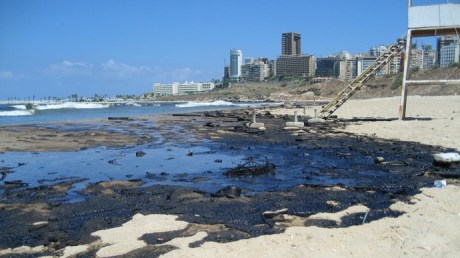
Israel was asked by the UN General Assembly on Friday to compensate Lebanon for $856.4 million in oil spill damages it caused during the July 2006 war.
The non-binding vote, which passed 170-6 with three abstentions, asks Israel to offer “prompt and adequate compensation” to Lebanon and other countries affected by the oil spill’s pollution.
While General Assembly votes are non-binding, they reflect broader international opinion without the possibility of veto by world powers like in the Security Council.
The resolution indicated that UN Secretary General Ban Ki-moon “expressed grave concern at the lack of any acknowledgment on the part of the government of Israel of its responsibilities vis-a-vis reparations and compensation” for the oil spill.
Lebanon’s permanent representative to the UN Nawaf Salam hailed the resolution, the Lebanese National News Agency reported.
“Lebanon considers this to be a major progress,” Salam said. “This resolution also paves the way for further compensation into other areas of damage (health, ecosystem services as habitat, potential groundwater contamination, and marine diversity), that were not considered in the current calculated amount.”
“Furthermore, its adoption asserts the will of the overwhelming majority of the international community to hold countries responsible for their internationally wrongful acts,” he added.
“We affirm that Lebanon will continue to mobilize all resources and resort to all legal means to see that this resolution is fully implemented, and that the specified compensation is paid promptly.”
In a statement, Israel condemned the resolution as “[serving] no purpose other than to contribute to institutionalizing an anti-Israel agenda at the UN,” Israeli media reported.
The oil spill was caused by Israel’s air force when it bombed oil tanks near a coastal Lebanese power plant during its fierce month-long war with Hezbollah resistance fighters.
The attack flooded the Mediterranean coastline with 15,000 tons of oil, according to the United Nations.
The adopted resolution cited $856.4 million (700 million euros) in damages caused by the oil spill, accounting for inflation of a October 2007 estimate by the United Nations Secretary General that reported the spill caused $729 million in damage.
Lebanon bore the brunt of the spill, but the Syrian coast and other Mediterranean countries have suffered as well, the UN said.
The oil slick made by the spill “has had serious implications for livelihoods and the economy of Lebanon,” the resolution said.
The UN asked Lebanon to continue clean-up efforts and the international community to increase funding for its environmental restoration.
The US, Australia, Canada and Israel were among the six states that voted against the UN text.
(AFP, Al-Akhbar)
Berri: Israel is stealing Lebanese gas
Al-Akhbar | December 8, 2014
While political factions are distracted with the upcoming dialogue between Hezbollah and the Future Movement, and the Lebanese government is struggling to resolve the issue of the kidnapped soldiers and counter the threat of terrorist groups on the Syrian border, Israel is stealing Lebanese gas from the deep sea off the Lebanese southern coast, Al-Akhbar reported on Monday.
Parliament speaker Nabih Berri told Al-Akhbar that he received information a few days ago confirming that Israel has started stealing Lebanese gas, expressing his surprise over the government’s lack of interest in the matter.
Berri said “he will personally push the pressing issue early next year,” adding that the Israeli move will force Lebanon to sign two designated decrees that would allow it to start digging for gas and ensure new revenues for the Lebanese economy.
Lebanon is located in the heart of the Levant basin, where seismic surveys indicate the presence of huge oil and gas reserves, but has so far failed to impose itself as a regional player in this area, as neighboring states greedily fight for its resources.
In July 2013, an Israeli company found Karish, a gas field 75 kilometers from the coast of Haifa. The new field is sufficiently close to Lebanon’s maritime borders to allow Israel access to Lebanon’s own reserves. It is evident that Israel is pressing ahead with exploration and production while Lebanon’s own energy plans falter.
At the time, then-Energy and Water Minister Gebran Bassil addressed these concerns in a press conference. “Theoretically…Israel is now able to reach Lebanese gas and that is a very grave situation,” he said.
“We cannot yet say that a disaster has happened, but the new Israeli discovery may indeed lead to one, especially if Lebanon’s efforts continue to be plagued by delays.”
“If Israel drills horizontally in Karish – made possible thanks to US technology – it may be able to reach up to 10 kilometers north into Lebanon’s reservoirs. If Israel drills vertically, it would still be possible for Israel to syphon off Lebanese oil and gas, if the Israeli and Lebanese fields overlap,” Bassil added.
After the discovery of large deposits of oil and gas in the eastern Mediterranean, the main struggle for Lebanon remains with both Cyprus and Israel to prevent encroachment on its maritime boundaries.
Cyprus breached its agreement with Lebanon and signed a deal in 2010 with the Zionist state, which attempted to gobble up 860 square kilometers of Lebanon’s maritime zone.
This incident revealed the need for Lebanon to assert the integrity of its maritime boundaries and to recover all of its Exclusive Economic Zone (EEZ) – currently being disputed by Israel following its agreement with Cyprus.
In theory, there was no dispute over maritime boundaries between Israel and Cyprus. But when the opportunity arose, Israel encroached on Lebanon’s zones as a result of the latter’s failure to quickly ratify its agreement with Cyprus.
The Cypriot-Israeli agreement enabled Israel to foray into Lebanon’s EEZ, although Israel had so far observed the same boundaries adopted by Lebanon in all its operations.
Reports indicate that Israel found a loophole in the agreement between Lebanon and Cyprus which stipulates that the triple point can only be determined through trilateral negotiations.
Since there are no contacts between Lebanon and Israel, the determination of this point is pending negotiations.
Israel’s interpretation of this, however, is that Lebanon has lost 860 square kilometers.
Lebanon managed to recover 500 out of 860 square kilometers of its EEZ according to international community laws, while 360 square kilometers remain effectively under Israeli control.
In November 2013, Israel rejected a proposal for a settlement made by the US administration to resolve the “dispute” between the Zionist state and Lebanon over the boundaries of each side’s EEZ. The proposal concerned the disputed area of Block 9 in the Mediterranean, which Israel claims sovereignty over.
Israel claims that this block – one of the richest areas in terms of commercial gas deposits recently discovered in the Mediterranean – extends into its EEZ.
In September, Director of the Research and Strategic Studies Center General Khaled Hamada said “the expected quantities (of oil and gas) are relatively small, compared to those discovered in the Arabian Gulf, Russia, and the Caspian Sea, but they are enough to make a significant impact on the energy security of Mediterranean countries, and contribute to a lesser extent to Europe’s energy security.”
Hamada pointed out that Israel had already begun commercial gas production, while Cyprus had started exploration in more than one location.
In a conversation with Al-Akhbar, Hamada warned that any further delays in Lebanon’s efforts to implement gas projects would force it to deal with these projects and security arrangements as a fait accompli down the road.
While Lebanon is busy with endless debates, Israel is rushing to put the final touches on its bid to export gas to Europe.
Four years ago, Al-Akhbar published a statement by Israeli Minister Yossi Peled on September 25, 2010 that highlighted the Israeli stance on Lebanon becoming a gas producer country.
Peled, appearing before the Knesset Economic Committee at a special hearing on the oil and gas sector, said that Lebanon had large gas fields similar to the ones Israel had discovered. He cautioned that the Europeans, who were looking for alternatives to Russian gas, had initiated negotiations with Lebanon, saying, “Imagine what it would mean if this country became a gas producer,” something he claimed had equally alarming economic and security implications.
Although Israel managed to pinpoint the challenges it faced, it did predict at the time – and wager on – Lebanon’s complacency. In response to Peled’s warnings in the Knesset, Israeli daily Globes, in a front-page editorial on October 5, 2010, stated:
“Israeli sources who follow events in Lebanon are convinced that, at the current rate of progress, the Lebanese will award the first licenses this year [2010], and will start exploratory drilling within a year. The same sources believe that Lebanon will quickly be able to close the gap between it and Israel, and become a real competitor.
“Past experience shows that Israel has no immediate reason for fear. Lebanon’s natural resources will arouse internal (and external) conflicts no less severe than Israel’s natural resources have provoked here …
“The oil giants will not rush to invest billions in a country where it is not clear who is in control, and where so many other countries openly interfere.”
Israel was proven right. Nothing in Lebanon is exempt from being the object of division and polarization, and thus, obstruction, including the oil and gas sector.
Meanwhile, Turkey is also trying to expand in the eastern basin through northern Cyprus, with a view to reduce its dependence on oil imports from Iran and gas imports from Russia.
Ankara is seeking to build a network of onshore and offshore gas pipelines, to act as an energy transit hub between East and West.
(Al-Akhbar)
Israeli air strike near Damacus – Syrian officials
The BRICS Post | December 7, 2014
A Syrian military statement has accused Israel of launching two air strikes near the capital Damascus.
“This afternoon, the Israeli enemy targeted two safe areas in Damascus province, namely the Dimas area and the Damascus International Airport,” the statement said.
Although the Syrian government did not provide details on damage or loss of life, opposition groups said that a number of explosions were heard near the airport and the town of Dimas.
Earlier, Israeli jets were reported to have crossed into Lebanon.
The Israeli military has not commented on the attacks. But the Syrian News Agency SANA accused Tel Aviv of carrying out air raids to help the opposition fighting the government of President Bashar Al-Assad.
Israel has carried out a number of air raids against Syrian positions since the civil war erupted in February 2011.
In May, Israeli fighter jets were reported to have struck a convoy of trucks allegedly carrying advanced missile components to the Lebanese Hezbollah faction.
The strike, the second in a year, appears to conform to an Israeli policy of preventing the transfer of “game-changing weaponry” from Syria to its allies in Lebanon.
The reported Israeli air strike comes amid fierce fighting between the Syrian Army and the Islamic State of Iraq and Syria (ISIL) for control of the town of Deir Ezzor near the Iraqi border.
1.7 million Syrian refugees facing ‘devastating’ food aid cuts

A Syrian refugee child peers out from his tent in Baiseriyeh in southern Lebanon, July 23, 2013. Al-Akhbar Marwan Bou Haidar
By Eva Shoufi | Al-Akhbar | December 3, 2014
This month Syrian refugees in four host countries, Lebanon, Egypt, Turkey and Jordan will not receive food assistance. The World Food Program (WFP) ran out of funding to help those affected by the Syrian crisis, meaning it can no longer help feed Syrian refugees. Given that donor countries are not providing more funding, refugees are left alone to face deadly cold weather and starvation with catastrophic humanitarian, social and health repercussions.
Suspending food aid to Syrian refugees adds to the tragedy they are already facing. Refugees worry about the rain leaking through their tents and they cannot imagine their conditions getting any worse. What is worse than displacement, homelessness, living in a tent and dying of cold weather?
On Monday, the World Food Program (WFP) announced that it does not have funding for the month of December. As a result, 1.7 million Syrian refugees in four countries – 1.1 million of them in Lebanon – will not receive food aid. Syrian refugees are now afraid they will die of the cold weather and of starvation.
By deciding to suspend funding to the WFP, is the international ‘donor’ community intent on multiplying the misery of Syrians, as if telling the refugees to “die of hunger?” Refugees could die of hunger because donor nations have donor fatigue. They have given a lot in the past three and a half years, and they gave generously. But it seems the message is that the crisis has lasted for too long and that it is not the fault of these generous donors.
According to the WFP’s statement, “Without WFP vouchers, many families will go hungry. For refugees already struggling to survive the harsh winter, the consequences of halting this assistance will be devastating.”Tensions within refugee communities will rise. Striving to secure food is the fiercest, most primal struggle in life. Psychological and financial pressures will increase which will lead to dangerous behavior. The rate of crime, prostitution, begging, child labor, child marriages and diseases might increase. Faced with these dangerous phenomena, feelings of racism within host communities could grow and lead to a destructive path.
The WFP’s statement warned that refugees are “ill-prepared for yet another harsh winter, especially in Lebanon and Jordan, where many children are barefoot and without proper clothing. Many tents are drenched in mud and hygiene conditions are growing extremely precarious.”
Don’t they know that a few days ago, a newborn baby died of cold in Ersal? We learned of her death but we did not learn about the deaths that followed and we do not know if she is truly the first baby to die from the elements. Everyone, including international organizations, knew that babies will die from the cold because tents do not protect against the freezing cold of the hills and mountains. Despite these facts, they did nothing. News of the baby’s death passed without incident. They were too busy trying to find an excuse to justify her death. A problem at birth, lack of oxygen… It really doesn’t matter, the three-day old baby could not bear the freezing wind in the hills of Ersal. International organizations, fearing for the lives of their employees, deserted the town leaving behind children, women and men who cannot withstand the deadly cold or hunger.
Refugees received the unfortunate message on their cell phones. Those who do not have cell phones were informed by partner organizations that this month the accounts on their electronic vouchers will be zero dollars but they did not tell them what to do. The organizations themselves do not know what refugees should now do. WFP spokesperson, Sandy Maroun, said” “The program’s regional office distributes the funding. As we know, there is a big crisis in funding. We’ve been warning against it since October when funding for the program in Lebanon decreased by 33 percent. But we were surprised that there is no funding for this month.”
Children will go to sleep hungry in their cold tents, fathers will return with disappointment stamped on their brows while mothers will cry silently. Shop owners who have signed contracts with the WFP will be negatively impacted as well because their profits will decline. Refugees will not rush on the fifth of the month at 12:00 pm to buy bread, rice and grains. Many Lebanese will realize that the presence of refugees has had a positive economic impact and did not bring economic ruin, as is the common misperception. The Lebanese will experience this reality first-hand but they will not go hungry. The WFP said that $216 million were injected into the Lebanese economy in the past 10 months and $341 million since the beginning of the crisis through the Syrian refugees’ electronic vouchers.
No one knows if halting the funding will go on till next month. Maroun explains, “Funding is provided monthly that’s why we can’t say for sure if there is going to be money for next month except at the end of this month.”
“No organization can secure comprehensive and continuous food assistance to refugees like the WFP, which is considered the largest humanitarian organization in the world fighting hunger,” she added.
The program needs $64 million immediately to be able to provide food assistance to Syrian refugees residing in neighboring countries for the month of December. If funding is provided, the program will immediately resume its aid to refugees who use electronic vouchers. What will happen, however, if funding never materializes? Concerned parties cannot provide a definitive answer: “We hope they will be able to manage.” But hopes and wishes do not mean much. The international community is tired of paying to feed refugees. Donor countries prefer to spend the money on “civil society” and “democracy, transparency and citizenry” projects. Maroun explains: “Funding the program is voluntary and it involves countries, individuals and organizations. It is not based on mandatory and periodic funding even though it falls under the Consolidated Appeal Process (CAP) to respond to the Syrian humanitarian crisis but it is independent of the United Nations High Commissioner for Refugees (UNHCR) funding.”What about UNHCR, the organization charged with “protecting” refugees”? “We don’t have an alternative plan to provide food assistance,” says UNHCR spokesperson, Dana Suleiman, adding that “the crisis is the same for all organizations. They are all worried about the decline in funding. Besides, we play a coordinating role. For this month, there is no decrease or change in UNHCR programs but there are no guarantees for next month.” UNHCR’s last report talked about “food security” as nearly 900,000 refugees have benefited from the electronic voucher system in November. Today, all of these people are without food assistance. The only thing they have is blankets, a fuel voucher and a tent simply because the world does not have enough money to help them.
Lebanon’s war on ‘hashish’ indistinguishable from war on the poor

A cannabis farmer in the Bekaa Valley prays as Lebanese army men come to destroy his harvest. Al-Akhbar/Rameh Hamieh
By Amer Mohsen | Al-Akhbar | November 27, 2014
The cultivation of cannabis is popular in specific areas that have special characteristics like high altitude and sunlight, similar to the Bekaa region. This differential feature of Lebanon, which can revive the Lebanese countryside, has been overcome by the alternative agricultural policies required from abroad. The health risks associated with the use of cannabis are minimal compared to alcohol and tobacco, and compared with the results of the war on cannabis cultivation which only affects the poor segments of society.
A few years ago, Lebanese organizations, including left-wing movements, launched a media campaign warning against cannabis and the risk of its spread among the youth. The intention behind the campaign was noble, but it had several flaws: The first is related to the medical claims that accompanied the campaign – which are similar to the propaganda that was disseminated in America during the forties to scare people away from marijuana – saying that marijuana drives people crazy, makes them jump out of windows, and causes delinquency and crime. The main problem was in the “central-Beiruti” mentality, which led left-wing movements to claim their devotion to the grievances of the poor and the marginalized, and thus sought to combat and criminalize hashish rather than demand its legalization and lifting the ban on its cultivation.
The issue is very clear. There is a disregard – even contempt – by urban activists for the fates of hundreds of thousands of peasants in their country. They support policies and laws that have impoverished large parts of the Lebanese countryside, either because of their focus on “more important” issues (such as the rejection of the [parliamentary] extension and the “revolt against the sectarian system”), or because of a bourgeois view aimed at preserving morality and normalcy. There is no harm in adopting or defending such a view, but not when it is at the expense of the most vulnerable and disadvantaged segments of society. To date, there are no adequate studies on the social and economic deterioration that affected the villages of Bekaa and Hermel after the prohibition of cannabis cultivation in the nineties, and others on the prosperity witnessed in the region and the local development that resulted from it, while the rest of the country – paradoxically – was experiencing the worst stages of the civil war, and so the government left the farmers alone.
From the history of cannabis
In his book about the history of cannabis, Martin Booth (who also published a well-known book about opium) says that the cannabis is one of the oldest plantations that spread in human societies. He refers to one of the three major species of cannabis today, the “cannabis sativa,” whose name in Latin means “cultivated hemp” because it reached us in its hybrid version, which means that Neanderthals cultivated and hybridized it for thousands of years until the original “wild” seed has been lost and we now have the agriculturally-improved species.
The cultivation of cannabis was widespread not only because of its narcotic effect. Archeological excavations have shown that the consumption of cannabis was also part of religious rituals, and that the plant was an economic asset and resource used in the manufacturing of cloth, linen, ropes, and oils. A conspiracy theory popular among supporters of marijuana in the United States claims that the ban on cannabis cultivation is linked to influential circles in the timber industry, who sought to exclude cannabis as a competitive resource in the paper-manufacturing industry.
We also find many references to hashish and cannabis in Arab and Islamic history, which show its spread and recreational use in our countries through the eras, such as in the writings of chronicler Abdel Rahman al-Jabarti (who talked about his meeting with a mosque orator in Cairo, who claimed to be “under the effect of hashish” to justify his lack of focus during the sermon), as well as in the fatwas of Ibn Taymiyyah, where “Sheikh al-Islam” discussed the topic of hashish and ended up outlawing most of its uses. Based on his jurisprudential arguments, it appears that the people at the time used to consume cannabis either through melting it in tea, eating it directly, or cooking it with food (since the United States had not been discovered yet, and tobacco had not yet reached the ancient world). However, the prolonged explanation provided by Ibn Taymiyyah on the topic and his detailed justification of the prohibition show that the scholars of his day did not have a clear or decisive stance on the matter.
Lebanon and the differential feature
To be able to understand the secret behind the special relationship between Lebanon and hashish, and the differential feature that characterizes the Bekaa Valley and its surrounding hills in this regard, we have to know a few basics about the cultivation of this plant. According to Martin Booth, the “quality” of the hashish – i.e., the concentration of the principal psychoactive constituent Tetrahydrocannabinol (THC) in the female plants – is directly linked to two factors: altitude and sunlight. Cannabis needs large amounts of solar radiation during the maturity period so the plant can grow rapidly, and the growth of its genital parts, which contain the active substance, needs infrared (IR) radiation, whose concentration in the sun increases with altitude.
In other words, high-quality cannabis needs high-altitude mountainous areas, which are, at the same time, hot and exposed to the burning sun during the summer, which is rare in the world. For this reason, the cultivation of cannabis is prominent in specific areas that combine the characteristics of altitude and sunlight, like the Atlas Mountains in Morocco, the hills of Afghanistan … and the Lebanese Bekaa. This is a “geographic gift” that cannot be cloned or bought with money. It is limited to a few regions in the world – Booth says that the best and most expensive types of hashish are grown in India, on the foothills of the Himalayas and over-3,000-meter heights, and due to their rarity are preserved in special leather bags. These qualities have made Lebanon’s Bekaa and Hermel a center for cannabis cultivation since ancient times.
The charming town of Yamuna, which lies in a small internal valley in the highlands of Lebanon’s western mountain range, acquired its “market” reputation in the production of cannabis not because of its special soil, or the magic touch of al-Sharif. It is simply due to its high altitude in the barren areas and abundant water sources, which allows the cultivation of cannabis in perfect conditions. If the Hermel heights – which are rain fed areas today – were covered by irrigation projects – as it was supposed to be decades ago – the whole area would have been like Yamuna.
Lebanon’s gold
In the past two decades, new varieties of marijuana were bred in the West, and plantation techniques were developed in closed spaces under controlled lighting and temperature conditions to produce crops in which the concentration of the psychoactive constituent exceeds any product grown in nature.
However, this pattern of agriculture (which supplies the medical and commercial marijuana market in the West) requires the consumption of large amounts of energy for each plant separately. It is also less competitive – in the commercial sense – compared with lands that are, by nature, ideal for the cultivation of cannabis, and have been inherited by farmers over long years. Millions of meters of these lands can be cultivated at a low cost, and by relying solely on the generosity of the sun and the sky.
From here, we conclude that any kind of agriculture is – naturally – ideal for the marginal areas of Lebanon, and some have real differential features on a global level. A quick look at the labor force working in Lebanon, the price of land, and state policies is enough to understand that Lebanon’s competitive commodity – which will eliminate rural poverty and create development in rural areas – is most likely not potatoes or wheat. In addition, a main characteristic of agricultural property in eastern Lebanon is that [owned lands] are relatively small and fragmented. Also, most farmers own their land, which prevents the emergence of feudal and semi-feudal cartels (as in Afghanistan and South America), or huge agricultural companies that would exploit the peasants as laborers and monopolize profits for the benefit of major landowners. A significant part of proceeds from the cultivation of “contraband” plants in the Bekaa traditionally went to farmers.
This question should be raised, while the country that pressured and forced Lebanon to ban the cultivation of cannabis – the United States – has legalized the use of hashish in several states. The governments of the West no longer have a moral or legal excuse to impose such policies on our country. The general direction in the West is heading toward the legalization of cannabis derivatives, or at least not criminalizing it and prosecuting its users. But Lebanon is required to arrest its farmers who are seeking to avoid hunger and migration.
War on the poor
One of the reasons that triggered the wave of marijuana legalization in the West, even for recreational use, is the absence of a convincing medical argument – i.e. a threat to “public safety” – to justify the prohibition of hashish while allowing the sale of other “drugs” like alcohol and tobacco, which are far more dangerous and harmful than marijuana. As Professor As`ad AbuKhalil once wrote, if whiskey was produced by the countries of the South, while hashish was monopolized by the West, wine would be forbidden and frowned upon in Lebanon while ads by hashish companies would have filled the streets.
Science has become clear in this regard. Serious proven tests have shown that the consumption of cannabis may have side effects and can be dangerous for people who suffer from certain neurological problems. Also, heavy consumption can cause addiction and dependency in one out of 10 cases. However, these risks are insignificant compared with those of alcohol and tobacco, or even stress. Tobacco combustion may be the most dangerous thing in a “marijuana cigarette.” During the writing of this article, I consulted with a professor and researcher of Lebanese origin at Harvard Medical School, who graciously provided me with scientific studies and summaries. He expressed his opposition to the criminalization of cannabis cultivation, adding that its advantages in medical use are “very real,” and that the greatest harm results from the war on cultivation, as evidenced by the American experience, since it mainly affects – in Lebanon, as in America – the poorer classes, which do not have a voice in society.
This is one of the issues that will not be of concern to civil society organizations, and will not receive financing from European governments and institutions. However – unlike a lot of campaigns created by these organizations to justify their existence – it is achievable and can change – in the actual direct sense – many people’s lives.
It is possible to imagine a different future for large areas in Lebanon that are marginalized and disadvantaged today, in which farmers will be able to live in dignity and prosperity in their areas, and land and production will have real value.
The people living on the coast may migrate to internal areas, this time, in search of work and opportunities.
Riyadh nips Hezbollah-Future Movement dialogue in the bud
Al-Akhbar | November 21, 2014
Riyadh has ‘red-lighted’ the planned dialogue between Hezbollah and the Future Movement before it even began. The Saudi call for Hezbollah to be put on the list of terrorist organizations made at the United Nations threatens to renew tension between the two sides, following an undeclared truce in the media that did not last for more than a few days.
Is there a fixed Saudi, and consequently Gulf policy, vis-à-vis Lebanon? Are these countries really keen on the stability of this country, as they claim, when they hardly spare any occasion to exacerbate its divisions? These questions and others are being asked after the new Saudi escalation against Hezbollah, which is likely to aggravate the already complex situation in Lebanon and the region.
Saudi Arabia’s ambassador to the United Nations Abdallah al-Mouallimi called on the UN Security Council on Wednesday to place the Resistance Party on the list of terrorist organizations. In a special session on terrorism, Mouallimi called for punishing Hezbollah and other groups including the Abu al Fadl al Abbas Brigade, the League of the Righteous, and other “terrorist organizations fighting in Syria.”
Al-Akhbar learned that as a result of the new Saudi position, contacts will be made with Riyadh over the next few days to contain possible reactions. Well-placed sources warned against negative repercussions from the Saudi move over the ‘preliminary dialogue’ between Hezbollah and the Future Movement.
The sources expressed concern that this could put an end to the de-escalation that begun when Hezbollah Secretary General Sayyed Hassan Nasrallah, speaking during the Shia Muslim commemorations of Ashura, welcomed dialogue with the Future Movement. The sources told Al-Akhbar that the Saudi move, in addition to the sudden re-activation of the Special Tribunal for Lebanon (STL) after a long period of inactivity, by summoning political witnesses, will create tensions in the country, and are indicative of a Saudi veto on dialogue between the Future Movement and Hezbollah.
The sources asked, “How do the Saudis explain their position when barely two months have passed since their ambassador in Beirut Ali Awad Asiri celebrated his country’s National Day surrounded by deputies from Hezbollah? Why has Saudi Arabia made this call two days after the GCC summit, and as the UAE – which is influenced to a large extent by Riyadh’s position – placed a number of organizations on its terror list not including Hezbollah?”
The sources deduced that the Saudi policy is not yet ready to restore its balance in Lebanon and the region. The sources also had questions about Saudi-Israeli ‘intersection’ over trying to smear Hezbollah’s image as a resistance movement and link it to terrorism, something that Tel Aviv has sought for very long.
The sources described Mouallimi’s speech at the UN as a ‘sound bubble’ that will have no results, recalling Nasrallah’s declaration that Hezbollah will be where it has to be in Syria. They said the Saudi UN envoy’s move “demonstrates real disappointment in the ranks of the Saudi leadership over the failure of its project in Syria, with [Saudi]… making random accusations right and left.”
The sources pointed out that the Saudi envoy, in the course of justifying his call, cited the emergence of terror groups like ISIS and others, which he linked to the “practices of the Syrian regime” and the “sectarian policies of some countries,” rather than Saudi and Gulf support for these groups. The sources added, “Saudi Arabia is among the top supporters of terrorist Takfiri groups in Syria, which makes its talk about fighting terrorism lacking in any seriousness.”
The sources then linked the Saudi position to “growing concerns in the ranks of the Saudi leadership over the nuclear negotiations with Iran, and real fear from the possibility of the parties reaching an agreement that would undermine the Saudi leadership’s hopes to step up the siege on Iran.”
The sources ruled out any practical effect of the Saudi position in light of the current balance of power in the international organization, and in light of the responses the Saudi envoy heard regarding his proposal.
Iran’s envoy at the United Nations Gholam Hossein Dehghani had responded to Mouallimi’s call by emphasizing the need to make a distinction between legitimate resistance and terrorism, and the need to support the resistance. He also criticized regional countries for failing to match their words with deeds, and said that few governments in the region have taken the threat seriously, while the rest did not control their borders, did not stop ISIS from recruiting, and did not stop the flow of financial support to these “criminal organizations.”
For his part, Syria’s ambassador to the United Nations Bashar Jaafari accused Saudi Arabia of backing terrorism in the region, denouncing the inconsistencies in its diagnosis of the roots of terrorism. He said that al-Qaeda and its ilk had all grown thanks to Saudi patronage in Afghanistan. Jaafari also said that the carnage in Syria is supported by Saudi Arabia and Qatar, citing the call by 72 Saudi clerics for people to go for “jihad” in Syria, and wondered whether the Saudi government was serious about fighting terrorism.
An Overwhelming Majority of Lebanon’s Christians Believe Hizbullah Protects Their Country
By Anthony F. Shaker | Mittag’s Journal | October 26, 2014
A recent poll by the Beirut Center for Research and Information (BCRI) found that two thirds (62.6%) of Lebanese Christians feel that, contrary to its vilification by members of the NATO alliance, Hizbullah has in fact protected their country from its most determined enemies—Israel, IS (known locally as Da‘ash), and Wahhabi-style terrorist groups linked to the Syria-Iraq conflagration.
The poll revealed also that very few of the respondents prefer UNIFIL to Hizbullah on the front line with the terrorist groups, as some domestic and regional actors have insisted. Nor do they believe the claim that the foreign “coalition” presently targeting IS in Iraq and parts of Syria seeks to “destroy” IS, as President Obama and his allies have declared.
As many as 73.1% dismiss this view entirely, which comes in the wake of endless reports in the mainstream media worldwide and growing evidence regarding Saudi, Turkish, Qatari, Israeli and NATO collaboration with anti-Syrian terrorist fronts and organizations.
Although some have interpreted the survey results as indicative of a “significant increase” in favorable attitudes—at least compared to two similar surveys in June 2013 and February 2014—there is no history of enmity between the Christian and Muslims communities, much less with Shi‘i Muslims.
During a visit to France in 2011, Maronite Patriarch Beshara Boutros Rai defended the government of President Bashar al-Assad and criticized states that had begun supplying arms to the terrorists gathering in Syria. Again in 2013, he said, “There is a plan to destroy the Arab world for political and economic interests and boost interconfessional conflict between Sunnis and Shi’ites. Some Western and East powers are fomenting all these conflicts. We are seeing the total destruction of what Christians managed to build in 1,400 years,” referring to peaceful cohabitation and historically productive relationship with Muslims.
“I have written to the Holy Father twice to describe what is happening,“ he had added. “I appeal again to the Holy Father, who only talks about peace and reconciliation.”
Hizbullah, which solidified the resistance against the Israeli occupation of South Lebanon, began largely in the Shi’a community, but then quickly expanded ties with other communities and organizations across the country. Today, it identifies its primary interests with Lebanon and does not claim to act on behalf of Shi’a Muslims only.
Strictly speaking, Lebanon’s woes are not confessional, even if they fed on endless disputes over confessionally based electoral rules and representation.
That a Wahhabi terrorist claims to speak for “Sunnis” does not by itself make for a Sunni-Shi’a divide. Nor does it define the armed conflicts that have erupted since the West began to sponsor a massive armed campaign to destroy the Syrian government and state. Few people know that this sponsorship dates, not from 2011 (when the terrorist onslaught gained traction), but from the early 1990s, after Syria insisted that Israel declare its intention to return the Golan Heights during the ”peace“ negotiations phase, a demand Israel categorically refused at the time.
The “West” (essentially, the United States, United Kingdom and France) has blacklisted Hizbullah as a “terrorist” organization and for years fought hard to pin the Hariri assassination on it, which many now believe Israel carried out, possibly even at Saudi Arabia’s behest, nearly provoking another civil war.
Hizbullah officials have repeatedly warned that a “terrorist” listing is a “big mistake,” one that will further damage the West’s standing in the region. In fact, this is no longer in doubt, given NATO’s current desperate effort to insinuate itself back into Iraq and to intervene for the first time inside Syria itself. NATO now has no choice but to tolerate Iran’s determined assistance to Iraqi military and security forces. This tolerance naturally must now be extended to Syria, where Hizbullah aims to deal decisively with the terror emanating from the Gulf, Turkey and Israel before it overwhelms Lebanon too.
Clearly, the events surrounding the Syria conflict have thrown deep doubts on Western intentions—and competence—in the Middle East. For some time, these doubts have been seeping into Western policymaking circles, diplomatically around the world, and most tellingly, inside the intelligence communities themselves.
Years ago, under a previous government just before Canada put Hizbullah on the terrorism list, Canadian security analysts and some federal cabinet ministers had cautioned against such a blanket interdiction. The former Liberal government’s decision, it had transpired, was based in the ever-quaint Washington Times, which merely quoted a professor claiming that Hizbullah leader Hassan Nasrallah had issued a worldwide call for “a suicide bombing campaign”and “don’t be shy about it.”
The “professor’s” claim happens to be in keeping with the Mickey Mouse warnings that Israel has for years been dishing out to Western countries about the Lebanese resistance. Yet, suicide bombings then, as now, are the Wahhabi terrorists’ choicest method in asymmetric warfare, not Hizbullah’s.
Developments since then have shrunk Canada’s blacklisting of Hizbullah to insignificance as an issue. This is because Canada has lost most of its diplomatic influence thanks to the deeply ideological character and the arrogant style of Conservative Prime Minister Stephen Harper.
Many Canadians have questioned the wisdom of blacklisting a party with elected members in the Lebanese parliament and government cabinet. This year marks a new watershed: few either in Canada or in the West are sure any more which side they are on according to their government.
To the Christians of Lebanon, such hesitation would have been unthinkable for the fatal consequences it entailed for them and their country.
One can only recall with nostalgia Hillary Clinton’s shrill call with the Friends of Syria: “Mr. Putin, you are on the wrong side of history!”
Dr. Anthony F. Shaker is the editor-in-chief and founder of Mittags Journal and visiting scholar at McGill University; his published works and articles are in classical Islamic philosophy and history, as well as modern politics.
Special Tribunal for Lebanon issues another controversial decision
Al-Akhbar | October 6, 2014
The Special Tribunal for Lebanon (STL) decided on October 3 that it does have jurisdiction to hear cases against legal persons. However, member of tribunal Judge Walid Akoum objected to the decision because it allows for the prosecution of Lebanese political parties.
Old habits die hard and the STL was unable to change its old ways or deviate from the path that the rulers of the United Nations Security Council designed for it. An appeals panel issued a decision so dangerous that it prompted one of the members of the panel, Judge Akoum, to dissent (then sign it). But he did register his reservations, warning: “The present proceedings are already delicate. To this we now add a decision that potentially permits contempt charges to be brought against political parties, Lebanese institutions, associations or any other actors that are recognized as legal persons. In my view, there is no reason to do so.”
Akoum’s statement and the panel’s decision yesterday are in relation to the prosecution of Al-Akhbar newspaper and Al-Jadeed TV as well as the two colleagues, Ibrahim al-Amin and Karma al-Khayat on charges of contempt of court. The charges were brought against them for publishing information about secret witnesses on whose testimonies the prosecution relied to issue indictments.
The STL’s Contempt Judge Nicola Lettieri had issued a decision on July 24 stating that the Tribunal prosecutes individuals, not legal persons (corporations, institutions, political parties, states, entities…), therefore concluding that the STL has no personal jurisdiction to prosecute Al-Jadeed TV. He decided to proceed with the prosecution against Khayat, but not the company for which she works.
Lettieri’s decision constituted a positive development in the Tribunal’s track record of problematic and politicized decisions. However, the appeals panel consisting of the presiding judge, Janet Nosworthy, and members Judge Akoum and Judge Ivana Hrdlickova – Judge Rapporteur – reversed this decision. It expanded, once again, the jurisdiction of the tribunal, reiterating that it is not restricted to the prosecution of individuals accused with assassinating former Lebanese prime minister, Rafik Hariri, but includes the prosecution of legal persons as well.
What Akoum talked about goes beyond the prosecution of Al-Jadeed TV now and Al-Akhbar in the coming weeks and months. It also goes beyond talks of freedom of opinion and expression and of violating Lebanese sovereignty. It primarily has to do with the process of promoting the Tribunal even before the decision to establish it was issued in 2007 by claiming that it will not accuse states, political parties or institutions, rather its authority is restricted to the prosecution of individuals.
The political translation of yesterday’s decision is that the Tribunal can now prosecute Hezbollah and not just certain members within the party.
ISIS attacks Hezbollah at eastern Lebanon checkpoint
Al-Akhbar | October 5, 2014
Clashes took place in eastern Lebanon on Sunday afternoon, as a group of militants attacked a Hezbollah checkpoint, the Lebanese National News Agency reported.
There were conflicting media reports on Sunday evening over the number of wounded and killed in the attack in the outskirts of Britel, in the Baalbek region.
According to the NNA, there were several casualties on the side of the armed militants.
News channel LBCI, which identified the militant gunmen as members of the Islamic State in Iraq and Syria (ISIS) group, said there were injuries on both sides, while radio station Sawt Lubnaan said at least two Hezbollah fighters had been killed.
Sawt Lubnaan also reported that the army had not intervened until late, and that the clashes had relatively subsided by 5:00 pm.
The NNA also reported clashes outside of Yuneen, and the sound of rockets or bombs near some villages east of Baalbek.
IDF chief threatens to ‘knock Lebanon back 70 or 80 years’
MEMO | October 3, 2014
 In an interview published Friday, IDF Chief of Staff Benny Gantz addressed the prospect of a future war with Hezbollah by threatening to “take Lebanon and knock it back 70 or 80 years, in all areas.”
Discussing how the next war would play out, Gantz also stated that it was possible the Israeli army would “need to capture Lebanese territory.”
In a separate interview also published today, Gantz claimed Hezbollah leader Hasan Nasrallah understands that Israel “know[s] to do in Lebanon what we did in Gaza”.
According to the UN, during ‘Operation Protective Edge’ the Israeli military killed around 1,500 civilians, including more than 500 children. More than 11,000 civilians were injured, and some 60,000 housing units destroyed or damaged.
Coalition of the Clueless
By Sharmine Narwani | RT | September 25, 2014
This US-engineered Coalition is in for some surprises. With few common goals, it has thrust itself into battle against the most determined players in the region and beyond.
The airwaves are still heaving with spin two days after US airstrikes against Syria.
Undoubtedly the attacks were timed to occur on the eve of the annual gathering of world leaders at the United Nations, so ‘Coalition’ partners could cluster behind the decision to bomb a sovereign state, uninvited.
The irony, of course, is that they are doing so at the UN – the global political body that pledges to uphold international law, peace and stability, and the sanctity of the nation-state unit.
The goal this week will be to keep the ‘momentum’ on a ‘narrative’ until it sinks in.
On day one, heads of state from Turkey, Jordan, Qatar, the UK and France were paraded onto the podium to drum in the urgency of American strikes against the Islamic State of Iraq and the Levant (ISIL), Jabhat al-Nusra and other militant groups inside Syria.
Every American official – past and present – in the White House rolodex was hooked up to a microphone to deliver canned sound bites and drive home those ‘messages.’ In between, video-game-quality footage of US strikes hitting their targets was aired on the hour; clips of sleek fighter jets refueling midair and the lone Arab female fighter pilot were dropped calculatingly into social media networks.
The global crew of journalists that descends annually on the UN for this star-studded political event, enthused over US President Barak Obama’s ability to forge a coalition that included five Arab Sunni states – Saudi Arabia, Qatar, Jordan, Bahrain and the UAE.
Few mentioned that these partners are a mere fig leaf for Obama, providing his Syria campaign with Arab and Muslim legitimacy where he otherwise would have none. Not that any of these five monarchies enjoy ‘legitimacy’ in their own kingdoms – kings and emirs aren’t elected after all – and two of these Wahhabi states are directly responsible for the growth and proliferation of the Wahhabi-style extremism targeted by US missiles.
Even fewer spent time dissecting the legality of US attacks on Syria or on details of the US ‘mission’ – as in, “what next?”
But with a mission this crippled at the outset, it didn’t take long for an alternative view to peek through the thick media fog.
On the ground in Syria, dead civilians – some of them children killed by US bombs – muddied the perfect script. Confused Syrian rebels – many who had called for foreign intervention to help crush the government of Syrian President Bashar al-Assad – demanded to know how these airstrikes were meant to help them.
Sunni Arabs would be radicalized by these strikes, they warned, as ideologically sympathetic citizens of the Arab coalition states took to their information channels and swore revenge for airstrikes against ISIL and al-Nusra.
The Syrian government, for the most part, remained mute – whether to save face or because they could ‘smell’ the gains coming. Contrary to Washington’s prevailing narrative, privately the story was that the US had informed the Assad government of both the timing and targets of the attacks in advance.
Sources say that the US even provided ‘guarantees’ that no Syrian military or government interests would be targeted. A Reuters exclusive claiming that the US went so far as to provide assurances to Iran, suggests this version is closer to the truth. When US airstrikes against Syria were on the table a year ago, the various parties went through a similar game of footsies. Last September, the Americans backed off – allegedly because of communications from their adversaries that even a single US missile would trigger a warfront against Israel. This time, Washington needed to know that scenario was not going to be activated, and this week they offered the necessary guarantees to ensure it.
Although the Russians and Iranians have publicly lashed out at the illegality of US strikes, they do not seem too worried. Both know – like the Syrian government – that these air attacks could be a net gain for their ‘Axis.’
Firstly, the United States is now doing some useful heavy-lifting for Assad, at no real cost to him. The Syrian armed forces have spent little time on the ISIL threat because their focus has traditionally been on protecting their interests in Aleppo, Damascus, Homs, Hama – and the countryside in these areas – as well as towns and cities around the Lebanese and Jordanian borders. That changed when ISIL staged successful attacks on Mosul and created new geopolitical urgency for Assad’s allies – which triggered some major Syrian strikes against ISIL targets.
But to continue along this path, the Syrians would have to divert energy and resources from key battles, and so the American strikes have provided a convenient solution for the time being.
Secondly, the Syrians have spent three years unsuccessfully pushing their narrative that the terrorism threat they face internally is going to become a regional and global problem. The US campaign is a Godsend in this respect – Obama has managed to get the whole world singing from the same hymn sheet in just two months, including, and this is important, the three states – Saudi Arabia, Qatar and Turkey – most instrumental in financing, weaponizing and assisting ISIL and other extremist militias inside Syria.
Syria, Iran, Russia, Hezbollah and a host of like-minded emerging powers are pleased about this new laser focus on jihadi terror and for the accompanying resource shift to address the problem.
Thirdly, the US has now been placed in the hot seat and will be expected to match words with action. For three years, Washington has overlooked and even encouraged illegal and dangerous behaviors from its regional Sunni allies – all in service of defeating Assad. With all eyes on America and expectations that Obama will fail in his War on Terror just like his predecessors, the US is going to have to pull some impressive tricks from its sleeves.
Ideally, these would include the shutting down of key border crossings (Turkey, Jordan, Lebanon); punishing financiers of terror and inhibiting the flow of funds and assistance from Washington’s regional allies; cutting off key revenue streams; tightening immigration policies to stem the flow of foreign fighters; disrupting communications networks of targeted terrorist groups; broader intelligence sharing with all regional players; and empowering existing armies and allied militias inside the ‘chaos zone’ to lead and execute ground operations.
Thus far, there are signs that some of these things are already happening, with possibly more to come.
Now for the fun part. The Syrians, Iranians and Russians do not fundamentally trust Washington or its intentions. The suspicion is that the US is on another one of its regime-change missions, displaying its usual rogue-state behavior by violating the territorial integrity of a sovereign state under false pretenses, and that it will shortly revert to targeting the Syrian government.
While they can see clear gains from the current level of US intervention – as distasteful as they find it – they are watching carefully as events unfold.
If there is the slightest deviation from the ‘guarantees’ provided by the US, this trio has plenty of room to maneuver. Iran, for one, has dallied with the Americans in both Iraq and Afghanistan and they know how to cause some pain where it counts. The Russians, for that matter, have many playgrounds in which to thwart US ambitions – most urgently in Ukraine and in Afghanistan, from which the US hopes to withdraw billions of dollars’ worth of military equipment by the end of 2014.
All understand that Washington has just assumed a risky public posture and that many, many things can go wrong. The Sunni Arab fig leaf can disappear in a nano-second if domestic pressures mount or revenge attacks take place internally. Information could leak about continued assistance to terrorist militias from one or more of its coalition partners – a huge embarrassment for Washington and its wobbly Coalition. ISIL will almost certainly act against coalition partner soft-targets, like carrying out further kidnappings and executions. Continued airstrikes will almost definitely result in a growing civilian casualty count, turning those ‘hearts and minds’ to stone. Syrian rebels could swiftly turn against the US intervention and radicalize further. Massive displacement caused by airstrikes could exacerbate the humanitarian crisis. And as in all other past US military War-on-Terror adventures, terrorism could thrive and proliferate in quantum leaps.
As Moscow-based political analyst Vladimir Frolov noted to the Washington Post : “The United States has underestimated the complexity of the situation before, so let’s just wait until they run into problems.”
The idea that US military engagement could continue for the long-term is unlikely given the myriad things that can go wrong fast. Obama is going to be reluctant to have his last two years in office defined by the hazardous Syrian conflict – after all, he was to be the president who extracted America from unessential wars.
But the most compelling reason that this Coalition will not pass the first hurdle is that its key members have entirely different ambitions and strategic targets.
Over a decade ago, these US-engineered coalitions were wealthier, less-burdened and shared common goals. Today, many of the coalition members face domestic economic and political uncertainties – and several states are directly responsible for giving rise to ISIL. How can the Coalition fight ISIL and support it, all at once?
What’s missing is a formula, a strategy, a unified worldview that can be equally as determined as the ideological adversary it faces.
Down the road, we will discover that the only coalition able and willing to fight extremism does indeed come from inside the region, but importantly, from within the conflict zone itself: Lebanon, Syria, Iraq and Iran. For starters, they are utterly vested in the outcome of their efforts – and would lead with political solutions alongside military ones. Those elusive boots-on-the-ground that everyone is seeking? They live it. Pit that group against Obama’s Coalition-of-the-Clueless any day and you know which side would win handily.
The question is, can this Coalition stomach a solution it is working so hard to avoid? Will it partner with vital regional players that were foes only a few months ago? It is doubtful. That would require a worldview shift that Washington is still too irrational to embrace.
Follow @snarwani on Twitter
Featured Video
BRITAIN’S WARNING: PREPARE FOR WAR
or go to
Aletho News Archives – Video-Images
From the Archives
British weapons and personnel doing much of the killing in Yemen
Press TV – June 18, 2019
A detailed report published by the Guardian newspaper has shown how Britain is massively contributing to Saudi Arabia’s devastating war on Yemen as it suggests that London is not only supplying the bombs that fall on Yemenis, but it provides the personnel and expertise that keep the war going.
The comprehensive report by Arron Merat published on Tuesday showed that Britain was doing much of the killing in Yemen as the country continues to provide Saudi Arabia with everything it needs to turn its southern impoverished neighbor into a graveyard.
“Every day Yemen is hit by British bombs – dropped by British planes that are flown by British-trained pilots and maintained and prepared inside Saudi Arabia by thousands of British contractors,” said Merat in the report. … continue
Blog Roll
 Aletho News
- Pentagon designates Chinese cultural centers national security threat
- Israel Demolishes Home Of Lebanese Journalist Whose Viral Film Exposed Pager Attack
- Record Oil, Empty Tanks: The UAE’s Miracle Recovery
- Burnham tackles Britain’s poverty with aggression in Yemen
- Peace in Ukraine: the easy way – or the hard way
- Trump & the Rrrrussians
- US taxpayer money laundered back through Ukraine – Musk
- Before COVID, an NIH lab chief proposed making a SARS-like bat virus more infectious
- Gates, Bourla on Trial in Netherlands Accused of ‘Great Reset’ Scheme at Vaccine Injury Hearing
- BRITAIN’S WARNING: PREPARE FOR WAR
- If Americans Knew
- An error has occurred; the feed is probably down. Try again later.
- No Tricks Zone
- Two New Studies Find Thwaites Glacier Melt Cannot Be Driven By Human Activity Or A Warming Ocean
- E-Cars Reduce CO2 Emissions By Only 41% Compared To Internal Combustion Engine Vehicles
- Predictions Made By Renowned Climate Professor Over Past Decades Have Been Proven To Be Poor
- New Study Suggests Large Regions Of The Pacific Ocean Have Been Cooling For The Last 80 Years
- Germany’s Green Energy Debacle: High Energy Costs Force Kahla Porzellan to Close After 182 Years!
- New Study: 50 Years Of The Most Aggressive ‘Net Zero’ Policies Can Only Affect The Global Climate By 0.03°C
- US September “Heat” Was No Record…Many Records Set Decades Ago
- Latest European Green Energy Debacle; Portugal’s Largest Flagship Solar Park Insolvent!
- Green Energy Debacle: German Expert Professor Fritz Vahrenholt Warns Of Severe Economic And Social Consequences
- Two More Paleo Reconstructions Affirm Meters-Higher Sea Levels Across Ireland, Brazil 7000-6000 Years Ago

