UK ran propaganda campaigns in Syria as cover for spying and potential military operations

The British military has several specialised propaganda and information warfare units, the largest of which is the Berkshire-based 77th Brigade
Press TV – February 19, 2020
The extent of the British government’s involvement in sophisticated propaganda campaigns in Syria appears to have been under-estimated.
In an exclusive report, the London-based Middle East Eye (MEE – a news and analysis outlet), has revealed that the UK covertly funded so-called “citizen journalists” inside Syria, often without the knowledge of the individuals affected, thus placing them in harm’s way.
The so-called citizen journalists who had been duped by British government officials were tasked to produce TV footage, radio programmes, social media, posters, magazines and in some cases even children’s comics.
FCO/MoD venture
The project was jointly masterminded by the Foreign and Commonwealth Office (FCO) and the Ministry of Defence (MoD), who used an anthropologist (with a counter-terrorism background) to supervise the operation.
The British military is known to make extensive use of anthropologists to supervise so-called “cultural” projects, which are in most cases barely concealed intelligence operations.
In that context, it is not altogether surprising that front companies run by former British military intelligence officers competed to win lucrative FCO-MoD contracts.
MEE reveals that “nine” companies bid for the contracts, most of which were run by former British “diplomats, intelligence officers and army officers”.
The division of labour between the FCO and the MoD appears to have been fairly simple: the FCO awarded the contracts whilst the MOD managed them, sometimes using serving (as opposed to former) military intelligence officers.
Turkish connection
The successful companies established offices in Istanbul and Reyhanli (Turkey) and Amman (Jordan), and set about employing local Syrians who in turn recruited Syrians inside Syria to act as “citizen journalists”, or more accurately propagandists, and in some cases spies.
People involved in the clandestine British-led operations have described it as a “shady shady business” and an extensive effort to “pump out propaganda, inside Syria and outside”.
For their part, British officials were understandably anxious to keep the operation a secret, forbidding managers and implementers to “speak publicly (to the media or at academic conferences) about their work without the explicit permission of HMG [Her Majesty’s Government]”.
MEE claims that two Syrian “citizen journalists” captured and murdered by militant groups on the suspicion of spying were connected to the British-led information manipulation operation.
In terms of funding, at the peak of the operation in 2015, the project was in receipt of £410,000 per month.
The operations were wound down once it became clear that the Syrian government – and its Iranian and Russian allies – were prevailing in the country’s complex proxy wars.
The real agenda
But chillingly, documents uncovered by MEE appear to indicate that the British government was using the propaganda operations to establish a foothold in Syria in anticipation of a military intervention involving British forces.
According to the core document (laying out the blueprint of the project), the operations should have “the capability to expand back into the strategic as and when the opportunity arises, to help build an effective opposition political-military interface.”
Those familiar with the British military’s idiosyncratic language would readily understand those words to mean that the UK was expecting to deploy a significant military force inside Syria with a view to shaping the country’s political future.
 A failed project
This latest revelation comes in the wake of the suspicious death of the White Helmets founder, James Le Mesurier, in Istanbul last November.
Le Mesurier was a former British military intelligence officer who is alleged to have also acted as an MI6 agent.
The failure of the joint FCO-MoD propaganda project, in addition to the death of Le Mesurier (who is alleged to have been murdered to protect secrets), point to the collapse of Britain’s Syria policy, which for years banked on the flawed assumption that the Syrian government would fall.
Assad likens ‘suicide’ of White Helmets founder to EPSTEIN & other high-profile mystery deaths
RT | November 15, 2019
Syrian President Bashar Assad has scorned the official story of wealthy sex predator Jeffrey Epstein’s apparent suicide, suggesting that people like him, or the late White Helmets founder, knew too much for the rich and powerful.
Epstein “was killed because he knew a lot of vital secrets connected with very important people in the British and American regimes, and possibly in other countries as well,” Assad told Russian channel Rossiya-24 in an interview Thursday.
Assad suggested that the convicted sex offender’s death was analogous to the unusual demise earlier this week of White Helmets founder James Le Mesurier, who allegedly jumped out of a window at his home in Turkey. Turkish police are treating Le Mesurier’s death as suicide.
“They turned into a burden once they had played out their roles. A dire need to do away with them surfaced after they had fulfilled their roles.”
Assad was referring not just to Epstein and Le Mesurier, but also to Al-Qaeda leader Osama bin Laden – originally trained by the CIA to fight the Soviet Union in Afghanistan – and Islamic State (IS, formerly ISIS/ISIL) leader Abu Bakr al-Baghdadi, who spent time in American custody in the notorious Camp Bucca and Abu Ghraib prisons in Iraq. All these “had been killed chiefly because they knew major secrets,” the Syrian leader argued.
While Epstein’s death was officially declared a suicide, celebrity medical examiner Michael Baden threw a wrench into the machine when he declared that the deceased pedophile’s broken hyoid bones likely came from strangulation. Le Mesurier’s death, tentatively ruled a suicide, proved too suspicious for Assad, who believes it is the “work of the secret services.”
“Possibly, the founder of the White Helmets had been working on his memoirs and on the biography of his life, and this was unacceptable. This is an assumption, but a very serious one, since other options don’t sound convincing to me at the moment.”
Le Mesurier was tagged as a “former agent of MI6” by the Russian Foreign Ministry just three days before his death, with “connections to terrorist groups” in Kosovo. His White Helmets group, Assad said, “are naturally part of Al-Qaeda” and have been caught staging “gas attacks” such as the phony event in Douma, used by the US as rationale for a strike on Damascus.
Epstein’s own links with intelligence agencies have been subject to much speculation, especially after Alex Acosta, the former Florida prosecutor who sentenced Epstein to an open-door prison sentence of just 13 months despite allegations he’d trafficked and abused dozens of girls, said he was told to “leave it alone” because Epstein “belonged to intelligence.” Former Israeli military intel officer Ari Ben-Menashe has claimed Epstein worked with Israeli intelligence as well, introduced to the business through his “girlfriend” Ghislaine Maxwell’s father Robert – a known Mossad agent.
The Tale of a ‘Deep State Target’
Daniel Lazare reviews George Papadopoulos’s book about his misadventures with a nest of intelligence agents.
By Daniel Lazare – Consortium News – April 4, 2019
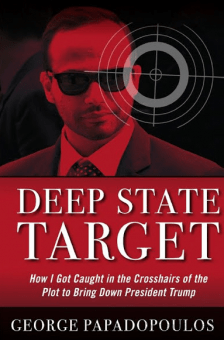 Now that Russian collusion is dead and buried thanks to Special Prosecutor Robert Mueller, the big question is how and why such charges arose. George Papadopoulos’s “Deep State Target: How I Got Caught in the Crosshairs of the Plot to Bring Down President Trump” doesn’t tell the whole story. But this account by one of the crusade’s first victims pulls the covers off a few important aspects.
It describes a lengthy entrapment scheme that began when Papadopoulos told co-workers that presidential candidate Donald Trump was about to appoint him to his foreign-policy advisory team.
The time was March 2016, the place the London Centre of International Law Practice, where Papadopoulos was working as an energy consultant, a job that mainly involves meeting with diplomats and going out for a dinner and drinks. Regarding the LCILP, he recalls it as a “strange operation” where there’s “no actual law practice going on that I can see” and which he later suspects is an intelligence front.
The reaction to his announcement was not good. “You should not be working with Trump,” one of Papadopoulos’s bosses tells him. “He’s a threat to society. He’s a racist. He’s anti-Muslim.”
But the tone changes when another LCILP director insists that he join him for a three-day conference at Link Campus University, a privately owned educational center in Rome. There he is introduced to a well-dressed Maltese academic in his mid-fifties named Joseph Mifsud.
“He asks about my background,” Papadopoulos writes. “He asks if I have Russian contacts. I shake my head. ‘I heard you have connections,’ I say. ‘And that you might be able to help me with the campaign.’”
“Oh yes, absolutely,” Mifsud replies. “Let’s talk tonight. Let’s go to dinner.”
Into the Rabbit Hole
With that, the author enters into a rabbit hole filled with twists and turns in which he found himself in the middle of a deep-state intelligence war over Trump’s alleged Kremlin ties and by the end of which he had served a 12-day sentence in a medium-security federal prison.
In late April, Mifsud takes him to breakfast at a London hotel and informs him that he had just returned from Russia where officials say they have “dirt” on Hillary Clinton. “Emails of Clinton,” Mifsud says. “They have thousands of emails.” Papadopoulos writes it off as idle chitchat by a dubious diplomatic networker whom he has come to see as all talk and no action.
A friend from the Australian embassy introduces him to a top Aussie diplomat named Alexander Downer, who tells him over gin-and-tonics that his foreign-policy ideas are all wet.
A British foreign-ministry official takes him out for still more drinks and grills him about Russia.
Stefan Halper, an old CIA hand turned Cambridge academic, contacts him out of the blue and pesters him about Russia as well.
A mysterious Belorussian-American name Sergei Millian offers him a secret $30,000-a-month PR job but only if he continues working for Trump.
An Israeli-American businessman named Charles Tawil buys him lunch at a steakhouse in Skokie, Ill. Later, in Greece, they go clubbing together in Mykonos, and then Tawil flies Papadopoulos to Israel where he presents him with $10,000 in cash – money that a wary Papadopoulos leaves with a lawyer in Thessaloniki.
While flying back to the U.S. in July 2017, Papadopoulos runs into a squad of FBI agents as he is changing planes. “And then, finally, it dawns on me as they are going through my bags,” he writes. “Charles Tawil and the money. They are looking for $10,000 in undeclared cash! That fucking guy was setting me up.”
“I’ve barely slept in two days,” he goes on after appearing before a judge. “I’m wearing the same shirt that I left Athens in. I smell like garbage. I look like garbage. I’m disoriented – because while I’ve just finally heard the charges, I still don’t really understand any of it.” To his horror, he learns that he is facing 25 years in prison on charges of obstruction of justice and lying to the FBI.
What was going on? Although Papadopoulos doesn’t go into the pre-history, we know from other sources that, by late 2015, intelligence agencies were buzzing over reports that Trump and Russian President Vladimir Putin were reaching out to one another behind the scenes.
Three Mood-Setting Events
Spooks are paranoid by profession, but three recent events had put them particularly on edge. One was the Euromaidan uprising in Kiev in early 2014, which, by driving out an allegedly pro-Russian president, sparked a parallel revolt among Russian speakers in the east. Another was in Syria where U.S. backing of Islamist rebels had prompted Russia to intervene in support of President Bashar al-Assad. The third was on the U.S. campaign trail where Trump was thoroughly shocking foreign-policy “experts” by sounding off against regime change and making friendly noises toward Putin.
“But I think that I would probably get along with him very well,” Trump said of the Russian president in October 2015. When CNN host John Dickerson asked about Russian air assaults, he replied: “And as far as him attacking ISIS, I’m all for it. If he wants to be bombing the hell out of ISIS, which he’s starting to do, if he wants to be bombing ISIS, let him bomb them, John. Let him bomb them. I think we [can] probably work together much more so than right now.”
Intelligence agencies might have conceded that the U.S. was wrong to encourage far-right elements in Kiev and that it was equally mistaken in giving backhanded support to Al Qaeda and ISIS in the Middle East. They might have granted that Trump, for all his reality-TV bluster, had a point. But western intelligence agencies don’t do self-criticism. What they did was blame Putin for messing up their plans for a clean coup in Kiev and an equally neat ouster of Assad and then blamed Trump for arguing in his behalf. From there, it was a very short step to concluding that Trump was not only siding with Putin, but conspiring with him.
Individual intelligence assets went into action to prove this theory correct and, if need be, to invent a conspiracy where none existed. Joseph Mifsud was apparently among them. “Deep State Target” devotes a fair amount of space to his background. Although Mueller’s indictment says Mifsud had “substantial connections to Russian government officials,” a wealth of data indicates the opposite.
‘Only One Master’
Stephan Roh, a Swiss-German lawyer who employed Mifsud as a consultant, writes in a self-published book that he has “only one master: the Western Political, Diplomatic, and Intelligence World, his only home, of which he is still deeply dependent.” Mifsud has been photographed with British Foreign Secretary Boris Johnson and veteran diplomat Claire Smith, a top British intelligence official. Indeed, Mifsud taught a course with Smith for Italian military and law-enforcement personnel at the same Link Campus where he’d met Papadopolous.
Mifsuds’s ties with western intelligence are thus multifarious and deep. The same goes for the other people with whom ran Papadopoulos had contact.
Alexander Downer, the Aussie diplomat with whom he had drinks, turns out to be a director of a London private intelligence firm known as Hakluyt & Co., which counts among its close associates Halper, the Cambridge academic who was ex-CIA, and Sir Richard Dearlove, ex-director of MI6, the British equivalent of the CIA. These two — Dearlove and Halper — ran an intelligence seminar at Cambridge and are also partners in a private venture calling itself “The Cambridge Security Initiative.” (See “Spooks Spooking Themselves,” Consortium News, May 31, 2018.)
Millian, the man who offered Papadopoulos $30,000 a month, turns out to be a source for the notorious Steele Dossier, compiled by ex-MI6 agent Christopher Steele. Steele, in turn, sought counsel at one point from fellow Cambridge man Dearlove on how to spread his findings. According to one of Willian’s buddies, Millian works for the FBI as well.
All of which is enough to get anyone’s conspiratorial juices flowing.
As for Charles Tawil, he arouses Papadopoulos’s fears of an intelligence link once he arrives in Mykonos by boasting of his friendship with Uganda President Yoweri Museveni and then-South African President Jacob Zuma, and declaring of convicted Israeli spy Jonathan Pollard, “it wasn’t our fault he got caught.” In Israel, he brags about helping to wiretap Syrian strong man Hafez al-Assad, father of the current president. “We could have killed him at any time,” he says. Finally, Papadopoulos reveals a private diplomatic cable citing Tawil as a U.S. intelligence asset back in 2006.
Five intelligence assets were thus hounding Papadopoulos at every turn while a sixth was compiling the dossier that would send Russia-gate into overdrive. It added up to the greatest propaganda campaign since the furor over Iraqi weapons of mass destruction, and, like those nonexistent WMDs, turns out to have been manufactured out of thin air.
Full-Court Press
“Deep State Target” is vague about many details and Papadopoulos doesn’t have all the answers about Russia-gate. No one at this point does. But his book leaves little doubt that he was the victim of a full-court press by intelligence assets in and around the FBI, CIA, and MI6.
Like everyone, Mifsud knew about Clinton’s emails – the ones she stored on her private server, not those that Wikileaks would later release – and fed Papadopoulos tidbits about a supposed Russia connection in the hope, no doubt, that he would pass them along to the Trump campaign. When he didn’t, Downer nonetheless reported back to Canberra that Papadopoulos had told him something along those lines. (Papadopoulos does not remember saying any such thing.) Once Canberra told Washington, the FBI investigation, dubbed Crossfire Hurricane, was on.
Halper tried to get him to admit to working with Russia: “It’s great that Russia is helping you and the campaign, right, George? George, you and your campaign are involved in hacking and working with Russia, right? It seems like you are a middleman for Trump and Russia, right? I know you know about the emails.”
Millian sends him an email shortly before the election telling him to “[p]lease be very cautious these last few days. Even to the point of not leaving your food and drinks out of eye sight.”
“Obviously a Greek Orthodox guy like you has close ties to Russia,” Charles Tawil, observes, leaving it to Papadopoulos to fill in the blanks.
Diehard Russia-truthers will point out that, even though the charge that Papadopoulos obstructed justice by misleading the FBI was dropped, Papadopoulos is still a convicted liar who pled guilty to misleading the FBI about the exact timing of his meetings with Mifsud. But he says that he was frightened and nervous and didn’t have his lawyer present and that he didn’t even remember what he had said until he read it in the indictment.
He also says he now regrets taking his then-lawyers’ advice to cop a plea: “There was never any pre-trial discovery. We never saw – or at least I hadn’t seen – the transcript of my interview, so all we had was the prosecutor’s word regarding what I had said. And we caved.” But he was an amateur running out of money while doing battle with a prosecutor with a $25-million budget. He had little choice. Russia-gate was unstoppable – until the collusion theory finally collapsed.
Daniel Lazare is the author of “The Frozen Republic: How the Constitution Is Paralyzing Democracy” (Harcourt Brace, 1996) and other books about American politics. He has written for a wide variety of publications from The Nation to Le Monde diplomatique and blogs about the Constitution and related matters at Daniellazare.com.
Douma “Chemical Attack”: Still Waiting for an Apology
By James O’Neill | OffGuardian | March 13, 2019
On 7th of April 2018 an alleged chemical attack took place in the city of Douma in the Syrian Arab Republic. Dramatic footage of the “victims” was widely broadcast throughout the western mainstream media. Particularly prominent were images of children foaming at the mouth and being hosed down.
The footage for these dramatic depictions was almost entirely sourced from a group known as the White Helmets. They are invariably depicted in the western media as a form of civil defence organisation. They are in fact an arm of Britain’s MI6, trained by the British and financed by the UK and the United States.
The alleged “chemical attack” was used by the US, UK and French governments to make a missile attack upon Syrian targets. The approximately 100 missiles fired destroyed buildings and caused civilian casualties. Many of the missiles failed to reach their target, being either deflected or shot down by Syrian air defences.
Speaking to a press conference on the Sunday following the attacks, the then Australian Prime Minister Malcolm Turnbull made a series of unqualified assertions. He gave his government’s “strong support” for the military action, and urged Russia to exercise its authority to ensure that the chemical weapons were destroyed.
He further called on Russia to use its influence to ensure the “most recent chemical weapons attack is thoroughly investigated.” He blamed the Assad government for the incident and described the military action by the US, UK and France, “targeted, proportionate and responsible.”
He even attempted to link the Douma incident with the Skripal events in Salisbury, England, using both as a stick with which to beat the Russians over the head. Both the timing of and the linking of the two incidents were not a coincidence. They were clearly part of a campaign to discredit Russia, whose intervention in the Syrian war proved a decisive turning point, to the chagrin of the “regime changers” in Washington and London.
As is now almost invariably the case there is a marked distinction between the political rhetoric and the actual situation, both in terms of the relevant international law, and the facts on the ground. That has become glaringly obvious in the Skripal case, as has been well documented elsewhere, by for example, www.theblogmire.com 3 March 2019.
Dealing briefly with the legal situation in the Syrian bombing, there is no such thing as a “targeted, proportionate and responsible” bombing of a sovereign state unless two pre-conditions are met. It must either be in self-defence, if the countries taking the action have themselves been attacked, and that was manifestly not the case; and secondly, in the alternative, it must be an action authorised by the United Nations Security Council. That didn’t happen either.
As in so many of Australia’s military forays around the world, the legal basis for the Syria involvement is notably absent, although in this particular case their role was limited to being cheerleaders on the sidelines. Australia’s participation in the so-called coalition of forces fighting in Syria and allied to the United States, a serial offender against international law, has no legal foundation whatsoever. The Australian government has had legal advice on the matter, and has had such advice since 2014. If it was confident of its legal position, why then does it continue to refuse to release that advice?
The facts on the ground do not support the Turnbull position either. Turnbull criticized Russia for using its Security Council veto to block motions to investigate chemical weapons crimes. In fact, both Russia and Syria asked the Organisation for the Prevention of Criminal Weapons (OPCW) to investigate the Douma incident.
The OPCW fact-finding mission began their investigation on 21 April 2018, two weeks after the alleged attack. Jihadist groups blocked their initial investigation and they were only able to enter the relevant areas with protection provided by the Syrian army and the Russian military police.
An interim report was published on 6 July 2018 in which it concluded, “no organophosphate (sarin) nerve agents or their degradation products were detected in the environmental samples or the plasma samples taken from the alleged casualties.” The use of sarin had been one of the principal accusations against the Syrian government. This interim conclusion received minimal media attention.
The OPCW Final Report of the investigation was released on 1st of March 2019 although one will hunt in vain for an accurate account of that report in the western mainstream media. The reason for the media silence is not difficult to discern. The 0PCW Report effectively destroys the arguments advanced by US President Trump, UK Prime Minister May and Turnbull.
The OPCW’s investigation was hampered in significant ways. The White Helmets and their jihadist allies had either cremated or buried all the deceased “victims” of the alleged chemical attack. Those burial locations were not disclosed to the investigators. No autopsy material was therefore available.
The evidence of the medical staff in attendance at the Douma hospitals at the time began receiving “victims” prior to the timing of the alleged chemical attack. None had symptoms of chemical or nerve agent attack.
The OPCW investigation team carried out a number of analyses from areas said to have been affected by the chemical attack. Again, they found no traces of any banned chemical substances.
They were shown two yellow cylinders claimed to have been responsible for the casualties. Even that “evidence” was compromised as the two cylinders had been moved by the jihadists and were located in two places and in such a manner that they had no probative value.
The OPCW team was unable to say how the cylinders might have been used to release any toxins. Given that no toxic traces could be found anywhere, the likely inference is that the two cylinders were simply stage props.
This inference is reinforced by the fact that the OPCW team did find a further yellow canister similar to the two mentioned above. That canister however, was found in a jihadist workshop that also contained a variety of chemicals and equipment associated with bomb production. Insofar as this finding received any media coverage, it was to suggest that the Syrian government had planted the material. The OPCW made no such suggestion.
What the OPCW team did find were traces of chlorine. Chlorine however, is a common household substance and for that reason it is not on the list of banned chemical weapons. Chlorine would not in any case be likely to cause death, much less the significant casualty figures claimed.
The evidence of the medical professionals interviewed by the OPCW team was that the victims they treated at the hospital were suffering from the effects of dust and smoke inhalation. None had life threatening injuries and none died in hospital.
There was accordingly no basis in fact for the missile attack by the US, UK and France (quite apart from its illegality) and therefore no justification for Turnbull’s unequivocal assertions of Syrian culpability and Russian complicity in a chemical weapons attack upon the civilian population.
Notwithstanding the OPCW’s demolition of the claims made by the US and others, including Turnbull’s ill-advised unequivocal support, the US and mainstream media still refer to Assad’s alleged use of chemical weapons as a reason to justify their continued occupation of Syrian territory.
That occupation itself is a violation of international law. The “debate” within US ruling circles about whether Trump’s original professed desire to leave Syria (since resiled from) should be carried out or not has a surreal tone to it. It never seems to occur to them that they are neither welcome nor legally entitled to be there at all.
Perhaps the final word should go to a senior BBC TV producer, Riam Dilati. On 13 February 2019 he tweeted: “after almost 6 months of investigations I can prove without a doubt that the Douma hospital scene was staged.”

If our own media and politicians could show a similar degree of honesty and integrity, they would be offering Syria and Russia the long overdue apologies to which they are entitled.
That may however, be a long wait.
James O’Neill is a barrister at law and geopolitical analyst. He may be contacted at joneill@qldbar.asn.au.
Fentanyl poisoned the Skripals – back to basics

johnplatinumgoss | March 5, 2019
You have to start at the beginning. In the beginning there was no military-grade nerve-agent even though Russia was being blamed for having planted it. In the beginning there was only fentanyl. Then on the second day God created the secret services and the world did not know good from evil.
Twelve months ago I had the Skripal saga’s chin tied up and was able to lay its body out stone-cold in its coffin. On 7 March 2018 I wrote on Craig Murray’s blog:
“I think . . . that is unlikely that these poor people will recover. If our spooks were involved in any way, and they are handling the investigation, then the Russian ex-spy and his daughter are hardly going to be given a chance to testify as to who did it. What really stinks is that from day one Russia was blamed by our media. That is the same media that have stopped Russian athletes from competing in sporting events with a catalogue of lies and misinformation.Just for your information, because most people do not see facts our media does not want them to see, Russia was 19th in WADA’s own list of doping offences for 2013. Other than China its athletes were tested more than any other country. The USA athletes were tested just over 7,000 times while Russian athletes were tested 12,500 times. Russia has a population of 143m while the USA has a population of 327m. This means per capita Russian athletes were tested four times more often than US athletes.
I think we know what happens next with the slagging off of Russia whoever is culpable.”
The “Blame Russia” meme has been hammered to death. Having invented the Novichok scenario there is no turning back for its inventors. You might have thought after the Christopher Steele “dodgy dossier” our former MI6 officers would have learnt something. Look at the featured image at the top of this blog-piece. Pablo Miller retweeted this in January 2017 mocking President Trump over the fake “golden showers” revelation that Miller himself probably had a hand in writing. It was a costly report that would later be shown to be, what the secret services specialise in – disinformation.
Sadly our “intelligence” services limp on from one blunder to another. It could well be that Sergey Skripal with his contacts in Russia, if he still had any, fed Steele and Miller at Orbis Business Intelligence this nonsense. Unfortunately these blunders may be the reason that we will never hear from the Skripals again.
Ten days after the Skripals ingested fentanyl Stephen Davies wrote the following letter to the Times over that newspaper’s alarmist headline, a headline which was panicking people of Salisbury into thinking they may have been poisoned by a nerve-agent and thus adding unnecessary burdens on an already overworked NHS.
“Sir, Further to your report (“Poison Exposure Leaves Almost 40 Needing Treatment”, Mar 14), may I clarify that no patients have experienced symptoms of nerve-agent poisoning in Salisbury and there have only ever been three patients with significant poisoning. Several people have attended the emergency department with concerns that they may have been exposed. None had symptoms of poisoning and none has needed treatment. Any blood tests performed have shown no abnormality. No member of the public has been contaminated by the agent involved. STEPHEN DAVIES, Consultant in Emergency Medicine, Salisbury NHS Foundation Trust”
Every medic at the hospital, every medic in Wiltshire, every medic in the country who could access the notes knew full well what it was. It was fentanyl. Try interviewing anybody at the hospital and they will not be allowed to speak to you unless it is a designated spokesperson.
On 5 March 2018 the Clinical Services Journal put out the story Response Unit Called As Salisbury Hospital Declares “Major Incident”. It said:
“Emergency personnel arrived to the scene, wearing full-body hazardous materials protective and an incident response unit was on site.
It followed an incident hours earlier in which a man and a woman were exposed to Fentanyl in the city centre. The opoid is 10,000 times stronger than heroin.”
This remained the medical diagnosis till long after the Skripals had gained consciousness. In fact it was not until 26 April that some person or persons unknown made the journal change the second quoted paragraph to:
“It followed an incident hours earlier in which a man and a woman were exposed to a substance in the city centre.”
Wisely, for those who do not believe a word of the government narrative, there was an addendum showing editing history.
“Note: This story was updated on 26 April 2018 to remove suggestion (which was widely speculated and reported at the time of writing) that the substance found was fentanyl.”
Ask a few questions. Why can our media not talk to the Skripals? Where are they imprisoned? Why can they not be visited by relatives? Why is parliament so quiet on the subject? If a military-grade nerve agent was used in Salisbury don’t you think the city would have gone into lockdown? I should hope it would.
If the Skripals are not dead those keeping them imprisoned do not do so in my name. So I urge everyone who cares for their fellow human-beings to go back to the beginning. You will discover that the novichok evil came after the beginning.
Integrity Initiative: The Sinister Chain of Events Leading Up to Salisbury
By Kit Klarenberg – Sputnik – March 4, 2019
In several reports to date, I’ve documented how the Integrity Initiative – the shadowy UK government-funded military intelligence front – and its assorted operatives and media assets systematically shaped news reporting on, and Whitehall’s response to, the apparent poisoning of Sergei Skripal and his daughter Yulia on 4 March 2018.
Now, on the anniversary of that fateful and ever-mystifying day, I’ll attempt to track some of the activities of the Initiative’s parent, the Institute for Statecraft, and other key figures and organizations directly and indirectly connected to the body in the years immediately prior.
Troublingly, the information collected here inevitably represents but a negligible fragment of a much wider clandestine picture. The full extent of the British state’s sinister and long-running secret machinations leading up to the Salisbury incident certainly isn’t ascertainable at this time, and may well never be.
‘Peculiar Struggle’
In July 2014, Institute for Statecraft ‘senior research fellow’ Victor Madeira wrote an article for the organization’s website, Russian Subversion — Haven’t we been here before?. In it, he suggested that far from a “new type of warfare”, the West’s tussle with Russia in the wake of the Maidan coup was “actually only the latest chapter in a 100-year-old playbook the Bolsheviks called active measures”, albeit “modernised to exploit the speed and reach of 21st-century mass/social media”.
After attempting to link various tactics employed by the Soviet Union to the modern day, Madeira somewhat chillingly concludes the piece with a quote from Ronald Lindsay, UK ambassador to Germany, who in February 1927 urged Whitehall to realise they were engaged in a “new kind of war” with the then-burgeoning Soviet Union.
“Anti-subversive measures could not be gradual; they had to be part of a package of ‘economic boycott, breach of diplomatic relations’ as well as ‘propaganda and counter-propaganda, pressure on neutrals.’ He argued a diplomatic breach with Moscow would at least turn ‘the present peculiar struggle into an armed conflict of the old-fashioned sort’ that Great Britain and the West could win,” Madeira records.
A document authored by the academic — who 2010 — 2014 tutored and lectured at Cambridge under former MI6 chief Richard Dearlove — in January 2015 (Russian Federation Sanctions ) makes clear he, and presumably his Institute employers, support Lindsay’s strategy and objectives.
The file sets out a number of “potential levers” for achieving a number of “main aims”, including “peace with Ukraine”, the “return” of Crimea, “behaviour change” and/or “regime change” — for, much to Madeira’s evident chagrin, the wave of sanctions imposed upon Russian individuals and businesses the previous March weren’t having a sufficiently deleterious impact on the Kremlin, or the Russian people.
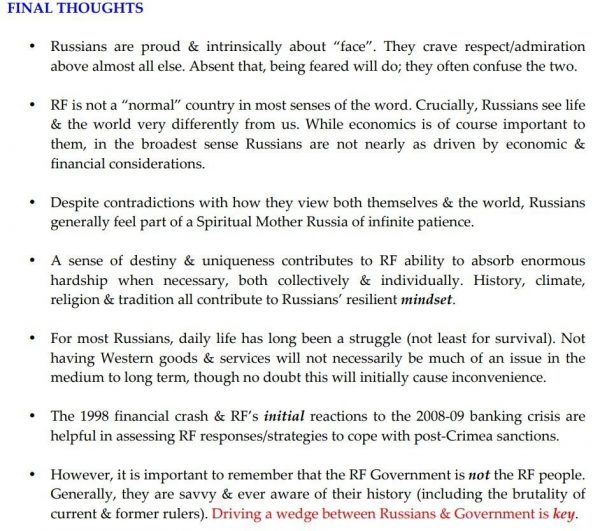
Victor Madeira’s Ruminations on the Russian People
“[Russia] is not a ‘normal’ country in most senses of the word. Crucially, Russians see life and the world very differently from us… Russians are not nearly as driven by economic and financial considerations… For most Russians, daily life has long been a struggle (not least for survival). Not having Western goods and services will not necessarily be much of an issue in the medium to long-term,” he wrote.
Moreover — and perhaps worst of all in Madeira’s mind — President Vladimir Putin — someone who “survived abysmal post-WW2 conditions” and “[believes] nothing the West can do is worse than what [he’s] already endured in life” — remains popular among the Russian public due to “the chaos” of the 1990s, and for having “restored stability, prosperity and pride”.
“Fear of renewed uncertainty and chaos… keeps Russians in check”, he writes — as a result, “driving a wedge between Russians and [their] government is key.”
The bullet-pointed “levers” that make up the bulk of the document span areas including ‘diplomacy’, ‘finance’, ‘security’, ‘technology’, ‘industry’, ‘military’, and even ‘culture’, and include; suspending or expelling Russia from “G8, WTO… and similar organisations”; “[expanding] existing sanctions regimes to anyone helping [Russia] break them”; “[arresting] every known RF agent — not least ‘agents of influence'”; “banning RF delegates” from a variety of international fora, “[advocating the] view RF [is] untrustworthy of hosting [international sporting events]; “[banning] Russian companies from launching IPOs in [the] West”‘; asset freezes and “visa bans” for the “top 100 RF government officials and [their] immediate families”; “[sanctioning] RF media”; and much, much more.
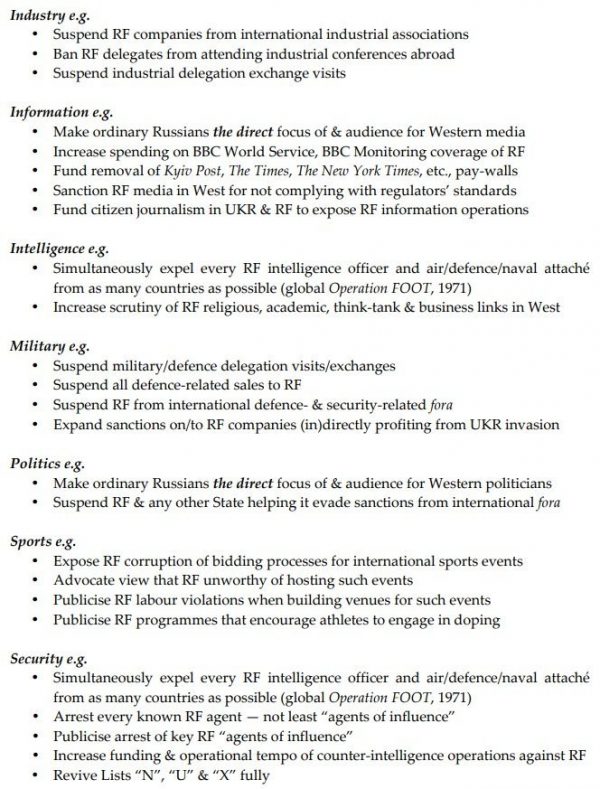
‘Potential Levers’ for Regime Change in Russia Outlined by Victor Madeira
Certain “levers” — such as suspending visits by the Bolshoi and Kirov Ballets to Western countries — are baffling, while others — for instance “repatriating” the children of Russian government studying abroad, or “[increasing] scrutiny” of Russian religious organizations in Western countries — appear wanton and excessive, if not outright barbarous.
However, one of Madeira’s suggestions, about which he was apparently so enthusiastic he mentions it thrice, “simultaneously [expelling] every RF intelligence officer and air/defence/naval attache from as many countries as possible (global ‘Operation Foot’)” — is especially striking.
Operation Foot saw 105 Soviet officials deported from the UK in September 1971 at the behest of then-Prime Minister Edward Heath, the largest expulsion of foreign state personnel by any government in history. Eerily, several mainstream media outlets would reference the historic mass defenestration when Whitehall successfully corralled 26 countries into expelling over 150 Russian diplomatic in response to the Salisbury incident, 27 March 2018.
‘Something Dreadful’
On 12 October 2016, Institute for Statecraft chief Chris Donnelly met with retired senior UK military official General Richard Barrons, Joint Forces Command chief 2013 — 2016. Their discussion was incendiary.
“We have led comfortable lives since the end of the Cold War. Wars have been away matches on our terms, with resources we have chosen to apply. Our institutions are now failing to deliver or being bypassed. Our world system is being challenged, by Russia, China… the power of initiative and decision is ebbing away from the West. [The] US can no longer protect us,” the document’s introduction states.
As 50 percent of the UK’s energy, and 40 percent of the UK’s food, is “from abroad”, the country “has vital interests in having the ability to engage globally, but that engagement will no longer be on our terms alone”. However, while in recent wars “the opposition had no peer capabilities and could pose no military threat” to the UK, the conflicts “have not required the full mobilisation of the military or any motivation of civilian society” and “given us the impression we can afford war at two percent GDP”, despite the UK needing “£7 billion just to our current force up to effectiveness”.
Moreover, “mixed success” in these conflicts is also said to have “left a bad aftertaste” with “no appetite for intervention” among the British public and politicians, and UK armed forces “cannot themselves speak out and say ‘we are broken’… as that would breach the rules of democratic control”.
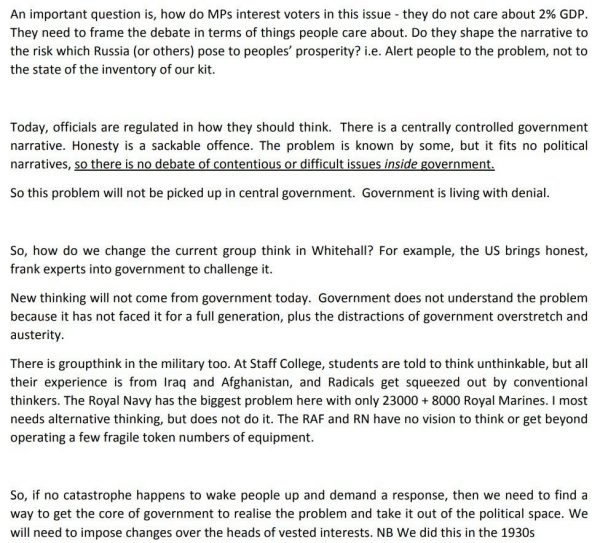
Record of Richard Barrons’ Meeting with Chris Donnelly
Barrons goes on to despair that the subordination of the military to civil servants and ministers in the Ministry of Defence means “the military do not do policy” — a state of affairs he believes must be radically changed, with the armed forces removed from government control and transformed into “an independent body outside politics”.
“Government is living in denial… We need discussion and debate as to how Russia can be managed and deterred. We need to deal with Russia by doing things that are serious… If no catastrophe happens to wake people up and demand a response, then we need to find a way to get the core of government to realise the problem and take [the military] out of the political space. We will need to impose changes over the heads of vested interests… [we] must either generate the debate or wait for something dreadful to happen to shock us into action. We must generate an independent debate outside government… there is not a moment to be lost,” Barrons concludes.
Serious Matters
Barrons’ fears of a loss of US military protection were no doubt widespread within the British establishment — for some time, US Presidential candidate Donald Trump had been questioning the necessity of NATO, advocating a protectionist and insular ‘America first’ agenda in respect of world affairs.
Likewise, Trump’s repeated suggestion of improved relations between Washington and Moscow should he become President were unquestionably unwelcome in many quarters — not least, of course, the offices of the Institute for Statecraft. It’s perhaps unsurprising then the organisation played a pivotal role in kickstarting ‘RussiaGate’.
The month after Donnelly’s meeting with Barrons, and mere weeks after Trump’s shock election victory, Andrew Wood — UK ambassador to Russia 1995 — 2000, and a member of the Institute’s ‘expert team’ — was a delegate at the eighth annual Halifax International Security Forum in Canada. Senator John McCain was also in attendance, and the pair would speak privately on the event’s sidelines about allegations of Trump’s collusion with the Russian state, in particular, the claims of former MI6 operative Christopher Steele, and his ‘Trump-Russia’ dossier.

Andrew Wood’s Institute for Statecraft Staff Profile
How and why McCain and Wood met, and precisely what they discussed, isn’t remotely clear — Wood has offered several wildly divergent accounts of the event since, variously suggesting the meeting was entirely chance and initiated by McCain due to the issue “being very much in the news”, that he approached McCain due to his personal concerns after being shown the dossier by Steele, and that he was actively “instructed” by Steele to relay the dossier’s contents to the Senator, without having actually seen a copy in full.
In any event, as a result of their conversation, the Senator dispatched his aide David Kramer, former assistant secretary of state in the Bush administration, to meet with Steele in London and discuss the dossier’s contents, and arrange for a copy to be sent to Washington. On 9 December, McCain met then-FBI Director James Comey and provided him with the dossier, which Comey then circulated across all US intelligence agencies. It would reach the desk of outgoing President Barack Obama and several senior members of Congress in the first week of January 2017.
This development would be reported 10 January by CNN — the article stated the dossier suggested Russian operatives possessed “compromising personal and financial information” about Trump, but the outlet refrained from publishing specific details of the dossier as they hadn’t been “independently corroborated”.
CNN breaking cover — the dossier had been an “open secret” among US journalists for some time by that point — would provide BuzzFeed News with the ‘public interest’ defense it required to justify publishing the dossier, which it did 11 January, despite acknowledging its contents were “unverified, and potentially unverifiable”, and contained “clear” factual errors.
In the days afterward, the publication was severely criticised by many other media outlets — Washington Post columnist Margaret Sullivan called the dossier “scurrilous allegations dressed up as an intelligence report meant to damage Donald Trump” — and the ethics of publishing unsubstantiated information offered by entirely anonymous sources was hotly debated.
However, these misgivings were quickly silenced, thanks in no small part to a number of esteemed ‘experts’ who vouched for Steele’s credibility in the media — the earliest, most enthusiastic and prominent being none other than Wood himself. He would describe Steele as “very professional and thorough in what he does”, and “a very competent, professional operator” who wouldn’t “make things up”, among other effusive plaudits.
It would take months for Wood to reveal he wasn’t merely ‘familiar’ with Steele, but the pair were in fact long-time friends — and moreover he was an “associate” of Steele’s firm (what form this relationship takes, and whether Wood receives any remuneration from Orbis Intelligence, remains uncertain). Conversely, his association with the Institute for Statecraft has never been acknowledged by the mainstream media, and would never have been known if it wasn’t for the leak of the organization’s internal files in November 2018.
The leak also revealed that in March 2017, the Integrity Initiative submitted a bid for Ministry of Defense funding — among its key performance indicators achieving a “tougher stance in government policy towards Russia”, the publication of “more information in the media on the threat of Russian active measures”, the growth of its cluster network “across Europe” and “greater awareness in all areas of society of the threat posed by Russian active measures to UK’s democratic institutions”.
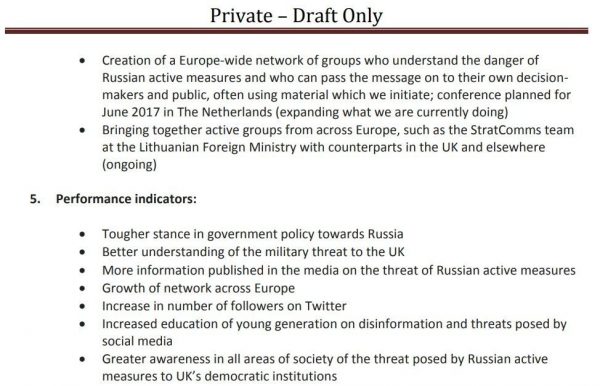
Integrity Initiative Bids for MoD Funding, March 2017
Russ to Judgement
BuzzFeed would again be used as a conduit for virulently anti-Russian propaganda in June, when it published a series of articles — From Russia With Blood – documenting 14 ‘suspicious deaths’ in Britain it claimed were potential or likely assassinations carried out by Russian “security services or mafia groups”, which UK authorities somehow failed to properly investigate.
The investigation caused something of a sensation, landing BuzzFeed in the running for a variety of prestigious journalism awards, including the Pulitzer and Orwell prizes — Investigations Editor Heidi Blake, who led the series, said her team’s work had cemented the outlet as a “major force in global news”.
However, examination of the seven articles offers much reason for scepticism. First and foremost, suggestions of possible Russian involvement in the deaths hinge almost entirely on the accusations of anonymous intelligence sources, without supporting documentation of any kind. In fact, the pieces often contain information directly contradicting the notion a featured individual was even murdered, let alone by Russians.
For instance, the third installment, The Man Who Knew Too Much, delved into the case of Dr. Matthew Puncher, a UK radiation scientist who’d been conducting work at a Russian nuclear facility, and was found stabbed to death in his kitchen in February 2016.
BuzzFeed notes Puncher’s wife Kathryn told investigators her husband tried to hang himself with a computer cable the the week prior, and Detective Constable Rachel Carter, who inspected the scene, told the inquest “there was no sign of a struggle, none of the furniture had been knocked over, and all the blood belonged to Puncher”, and she was “satisfied” he’d committed suicide as “all the information told us he was very depressed and no-one in his family seemed particularly surprised he had taken his own life”.
However, BuzzFeed had other ideas, stating “four American intelligence officials… believe he was assassinated”. Alternatively, a former senior Scotland Yard counter-terror officer unconnected to the case was quoted as suggesting — also anonymously — the Russian state could have given Puncher drugs to “create depression” and precipitate his suicide.
The fourth installment — The Secrets Of The Spy In The Bag — deals with Gareth Williams, the GCHQ codebreaker seconded to MI6 who died in a Pimlico flat owned by the spying agency in August 2010 and is similarly dubious in the extreme.
Williams’ demise is unambiguously mysterious — his decomposing naked body was found in a padlocked sports bag in the bath, although no fingerprints or traces of his DNA were found on the rim of the bathtub, bag, bag’s zip, or padlock, and an inquest ruled his death to be “unnatural and likely to have been criminally mediated”.
Litvinenko’s been in the news a lot the last couple of days, but nothing about MI6 spy Gareth Williams. The Met found it was ‘probably’ a self-inflicted ‘accident’ that he ended up padlocked inside a bag, in a bath, with none of his fingerprints on either. pic.twitter.com/wofSh40rvY
— dan barker (@danbarker) March 12, 2018
Ironically, much of the article’s content raises serious questions about the role of Williams’ employer’s in his death. For instance, BuzzFeed notes he’d been dead for around 10 days by the time his body was found, but astoundingly neither GCHQ nor MI6 had alerted authorities to his absence from work. It would take his sister informing GCHQ Williams was missing at 11:30 am GMT on 23 August for the agency to contact police — albeit five hours later.
The outlet also records how in the ensuing investigation police were prevented from interviewing Williams’ colleagues at MI6, or reviewing relevant documents, and instead forced to rely upon officers from national counter-terrorism force SO15, which took no formal statements from witnesses, and passed on only anonymised briefing notes to their Metropolitan force counterparts.
Conversely, BuzzFeed fails to mention coroner Dr. Fiona Wilcox ruling involvement of SIS staff in Williams’ death was a legitimate line of inquiry for police — instead again relying on the unsubstantiated claims of the anonymous quartet of US intelligence officials that Williams had been tracing international money-laundering routes used by organised crime groups to blame his probable murder on the Kremlin, and/or Russian gangsters.
The eponymous investigation — focusing on the suicide of Scot Young, an associate of oligarch Boris Berezovsky — is perhaps the series’ most puzzling, for more reasons than one. Young — a corrupt tycoon with clear criminal connections — lost all his money on a failed property endeavor, spent time in prison for contempt of court, and suffered a lengthy and costly divorce battle.
Such a litany of crippling personal calamities — and doctors’ appraisal of him as “paranoid, with a manic flavour” with a “complex delusional belief system” — would surely make Young at least a potential candidate for suicide watch, and indeed police concluded he’d taken his own life by throwing himself from his apartment window.
Three of his associates, Paul Castle, Robbie Curtis, and Johnny Elichaoff likewise “experienced dramatic financial [collapses]” in which they lost all their potentially ill-gotten gains, and subsequently took their own lives — Castle and Curtis both jumped in front of oncoming trains, while Elichaoff leaped off the roof of a London shopping centre.
Yet again though, the word of anonymous US intelligence officials is sufficient to perk BuzzFeed’s suspicions about all their deaths, the unnamed operatives saying Russia could have “engineered” their suicides “through manipulation and intimidation tactics”.
The article’s discussion of Berezovsky’s death is likewise suspect and contradictory, quoting Richard Walton, Scotland Yard’s former counter-terror commander, as saying his department investigated the exiled Russian’s death “very thoroughly” and “hadn’t been able to find any evidence of murder”. Fascinatingly though, in seeking to construct a case for Berezovsky being unlawfully killed, BuzzFeed notes business partner, Georgian oligarch Badri Patarkatsishvili, died from an apparent heart attack in 2008. American spy agencies are said to have intelligence suggesting he was murdered, and while predictably none is presented in the article, Patarkatsishvili was provably subject to at least one assassination plot prior to his death — and it certainly wasn’t Russian in origin.In 2007, covert recordings revealed three Georgian national security service officials had plotted to kill ‘Georgia’s Richest Man’ at the behest of then-President Mikheil Saakashvili. In one recording they debate the best means of execution, an official suggesting they use a poisonous substance which will “kill a person two hours after touching it”. “You smear [it] on the door handle,” they say — the precise method by which Sergei and Yulia were contaminated with novichok, according to UK authorities.
Whatever the meaning of that parallel, BuzzFeed’s series is highly significant, for it was fundamental to cementing the notion of frequent Kremlin-directed murders on British soil in the public consciousness in the year prior to Salisbury. Almost inevitably too, it was widely invoked in the immediate wake of the apparent poisoning as evidence, if not proof, of Russian state involvement.
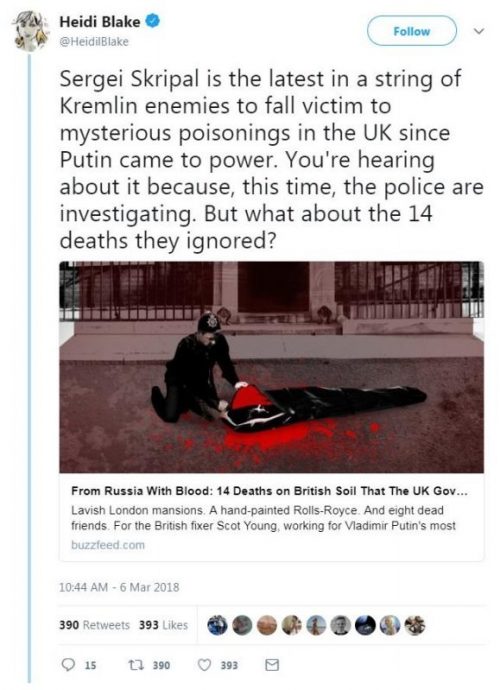
A Tweet by BuzzFeed Investigations Editor Heidi Blake on Skripal, Documented by Integrity Initiative
Among those seeking to connect From Russia With Blood with the attack on the Skripals was none other than BuzzFeed’s Heidi Blake herself. Her Twitter postings on the subject would be documented by the Integrity Initiative in regular roundups of social media activity relating to the incident — and reference to the series was made in an Initiative briefing document (likely circulated to journalists), Russian Lies and the Skripal Case, which called the “evidence” presented by her team’s investigation “compelling”.
So it was on 13 March 2018, nine days after the Salisbury incident, then-Home Secretary Amber Rudd announced British police and MI5 would reinvestigate the numerous ‘suspicious deaths’ detailed by BuzzFeed — a development the outlet reported rather triumphally. However, a mere four months later, Home Secretary Sajid Javid revealed police had determined there was “no basis on which to re-open any of the investigations”. Fittingly, in December an inquest concluded Alexander Perepilichnyy, one of the ‘BuzzFeed 14′, had died of entirely natural causes.
Whatever the truth of the matter, a month prior the Initiative invited Blake to head an hour-long ‘Investigative Masterclass’ at an event the organization convened at London’s Frontline Club — Tackling Tools of Malign Influence.
‘A Good Shepherd’
Also in June 2017, BBC Diplomatic Editor Mark Urban somewhat miraculously began conducting a series of interviews with Sergei Skripal in the latter’s Salisbury home.
“I was intending to write a book about East-West espionage… My intention was to focus the story on a handful of people, using their stories, and the moment these narratives intersected at Vienna airport, during the swap of 2010, as the key to its structure. Skripal was to be one of the central half-dozen or so stories… I was doing this in my own time — there was no contract. The only sense in which this was a ‘book’ in June 2017 was in my own imagination,” Urban claims.
Over the course of their discussions, Skripal would disclose much about his time in the intelligence services, spell as a double-agent for MI6, incarceration in Russia after discovery, and life in Britain post-exile — although his enduring patriotism Urban found particularly notable.
“[Skripal] is… an unashamed Russian nationalist, enthusiastically adopting the Kremlin line in many matters, even while sitting in his MI6-purchased house,” Urban records, “he was adamant, for example, Putin had not surreptitiously introduced Russian troops into east Ukraine, as much of the Western press reported. If regular units had gone in, he insisted, they would have been sitting in Kiev very soon.”
“The problem with the Ukrainians is they are incapable of leadership. They need Russia for that. The Ukrainians are simply sheep who need a good shepherd,” Skripal explained.
Such sentiments may explain why Skripal seemingly remained in regular contact with the Russian embassy after his arrival in the UK. Speaking to the Independent 7 March 2018, former Kremlin official Valery Morozov, an associate of Skripal likewise exiled to the UK, claimed Skripal had meetings with Russian military intelligence officers “every month”.
Strikingly, he also rejected the notion the apparent nerve agent attack had anything to do with the Kremlin.
“Putin can’t be behind this. I know how the Kremlin works, I worked there. Who is Skripal? He is nothing for Putin. Putin doesn’t think about him. There is nobody in Kremlin talking about former intelligence officer [sic] who is nobody. There is no reason for this. It is more dangerous for them for such things to happen,” Morozov cautioned.
Urban would bizarrely fail to reveal having bagged the unprecedentedly fortuitous scoop until three months after the Salisbury incident — an extremely curious delay, perhaps partially explained by his lucrative book deal with publisher Pan Macmillan being announced mere days later.
Yes, I met Sergei Skripal a few times in 2017 while working on a book project. He’s a remarkable man with a dry sense of humour and a great resilience given all he’s been through https://t.co/hfppMtFM0H
— Mark Urban (@MarkUrban01) July 4, 2018
The resultant work, The Skripal Files, was published in October — rather than a history of “East-West espionage”, the project had evolved into an extensive telling of the government’s official narrative on the Salisbury incident, buttressed by discussions of alleged Kremlin assassinations in the UK, and Skripal’s life and career.
However, while widely marketed as the “definitive account” of the affair, the name Pablo Miller doesn’t appear once in the text — an amazing oversight given Miller was Skripal’s MI6 recruiter and handler, and neighbour in Salisbury, rendered all the more perplexing by Miller and Urban once having served in the same tank regiment.
Miller’s connections to the Salisbury incident are unclear, and by design — immediately afterwards he deleted his LinkedIn account, which revealed him to be a Senior Analyst at Christopher Steele’s Orbis Intelligence, and on 7 March Whitehall issued a D-notice blocking mention of him in the mainstream media. Miller also has unclear connections to Integrity Initiative, his name appearing on a list of invitees to an event hosted by the organization, alongside representatives of the BBC, Porton Down, the FCO, the MOD and the US Embassy.
Adding to the intrigue, Initiative operative Dan Kaszeta — a “counterfeit” chemical weapons ‘expert’ who was the very first source to suggest Sergei and Yulia may have been struck by novichok, a mere four days after the Salisbury incident — noted he’d met Urban “several times over the past few years” in a glowing review of The Skripal Files (since removed from the web) he wrote for the organization in December 2018.
In what may just be an intensely spooky coincidence, as 2017 drew to a close British-American TV project Strike Back: Retribution – a spy-drama based on a novel of the same name by ex-SAS soldier Chris Ryan — began airing on Sky One in the UK. The series followed the activities of Section 20, a fictional branch of British Defence Intelligence, which conducts secretive high-risk missions throughout the globe.
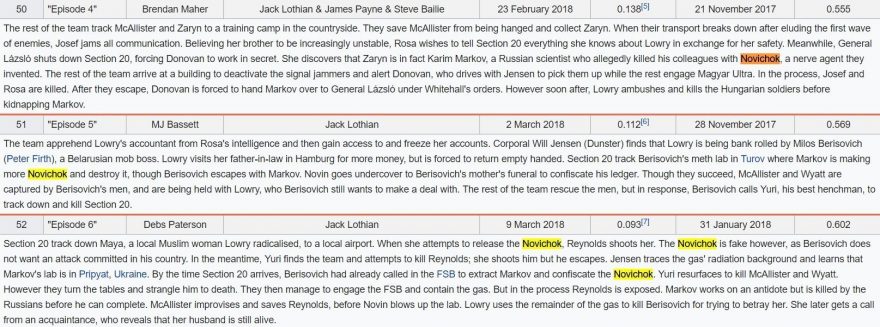
‘Strike Back: Retribution’ Episode Summaries
In episode four, broadcast 21 November, it’s revealed character Ilya Zaryn — who Section 20 rescued from the clutches of a terrorist group — is, in fact, Karim Markov, a Russian scientist who murdered a number of his colleagues with novichok, and is assisting the terrorists in their nefarious schemes.In the next episode, Section 20 locate Zaryn/Markov in a laboratory in Turov, Belarus, where he’s found producing more novichok — but while they manage to destroy the facility and the nerve agent, the dastardly Russian escapes.
In the next, Section 20 track Markov to a lab in Pripyat, Ukraine — but in attempting to contain the nerve agent, Section 20 operative Natalie Reynolds is contaminated. The unit forces Markov to create an antidote, but is killed before he can concoct one — Reynolds’ fellow agent Thomas McAllister manages to improvise and save her, however.
The series would air early the next year in the US on Cinemax — the second episode featuring novichok was transmitted 2 March, two days prior to the Salisbury incident, the third 9 March, five days after.
Expecting the Unexpected
Mainstream hostility towards the Kremlin had been intense ever since 2014, but ‘RussiaGate’ pushed this antipathy into overdrive. Critical, aggressive and paranoid media reports and statements by politicians had become an essentially daily staple by the start of 2018.
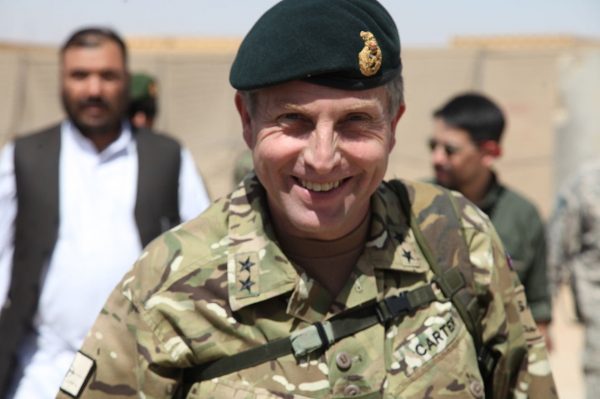
CC0
UK Chief of General Staff Gen. Nick Carter (File)
Nonetheless, on 22 January General Nicholas Carter, UK Chief of General Staff, offered perhaps the most hawkish speech on Russia since the demise of the Soviet Union. Speaking at a Royal United Services Institute event, Carter described the country as the “most complex and capable state-based threat to our country since the end of the Cold War”, and warned hostilities could start “sooner than we expect”, particularly as he — ironically — claimed the Kremlin had “[convinced] ordinary Russians the West is a threat… We have been made to appear as the enemy”.
“If Russia sees itself in decline, and more able now to go to war than in the future, does this encourage them to think of war? Perhaps compare the situation today to 1912 when the Russian Imperial Cabinet assessed that it would be better to fight now, because by 1925 Russia would be too weak in comparison to a modernised Germany; and Japan, of course, drew similar conclusions in 1941. Russia worries, I think, that the West will achieve a technological offset in the next decade,” he cautioned.
Carter said the conflict — which he naturally envisaged being initiated by Russia — would “start with something we don’t expect”.
Not long after the speech, Operation Toxic Dagger was launched — a vast three week effort in which 40 Commando Royal Marines, Public Health England, the Atomic Weapons Establishment and Porton Down’s Defence Science and Technology Laboratory collaborated to prepare Britain’s armed forces for Chemical, Biological, Radiological and Nuclear operations by creating “realistic exercise scenarios based on the latest threat information”.
The endeavour included “company-level attacks and scenarios concerning CBRN vignettes, concluding with a full-scale exercise involving government and industry scientists and more than 300 military personnel”, with a “chemical decontamination area set up not merely to treat ‘polluted’ commandos, but also wounded prisoners”.
It was convened on Salisbury Plain — several of the Royal Marines taking part would be seconded to Operation Morlop, a multi-agency ‘clean-up’ effort launched in Salisbury in the wake of the poisoning of the Skripals, less than a fortnight after Operation Toxic Dagger was completed.
UK spy chiefs up in arms over Trump making public Russiagate surveillance requests – report
RT | November 22, 2018
A recent report alleges that British MI6 operatives fear that releasing the ‘Russiagate’ wiretap warrant on Donald Trump surrogate Carter Page in full will jeopardize intel-gathering and set a dangerous precedent for the future.
British spies have “genuine concerns” that the publication of the unredacted version of the FBI’s request to surveil Page will expose valuable sources, the Telegraph reported on Wednesday, citing interviews with a “dozen” UK and US officials.
The FBI suspected that Donald Trump’s foreign policy adviser, Carter Page, was being recruited by Moscow amid the 2016 US presidential campaign. The agency filed a request to wiretap him under the Foreign Intelligence Surveillance Act (FISA). The request was approved by the court, and later renewed three times, even after Page quit Trump’s team.
Upon assuming the presidency, Trump pressured the Department of Justice to make the FISA request public. The released document was heavily redacted, with entire pages blacked out. It revealed that the FBI’s reasoning to spy on Gates was partially based on the notorious ‘Steele Dossier’, an unverified anti-Trump memo compiled by former MI6 agent Christopher Steele and sponsored by the Hillary Clinton campaign.
Convinced that the FBI “misled” the court, President Trump ordered in September to declassify 21 redacted pages of the wiretap request, then allowed the DOJ to delay the procedure.
In opposition to Trump, people within spy agencies in both Washington and London agree that the complete document should never be released, the Telegraph reported.
“It boils down to the exposure of people”, an unnamed US intelligence official told the paper. “We don’t want to reveal sources and methods.”
His colleague was quoted by the outlet as saying that Britain worries about setting a “precedent” which will discourage people from sharing information in the future.
The paper doesn’t specify whether MI6 had taken concrete steps to prevent the Carter Page FISA application from being released. Trump and his allies suggested that the fact that the document referred to the Steele Dossier indicated that the Trump campaign was surveilled with political motives in minds. Page himself, who denied ties with Moscow, told RT last month that “various political actors” in Washington had “put in a lot of false information” about him.
Some people close to Trump suspect that once the document is released in full, it will not only portray the US secret services in a bad light, but will hurt London as well. Speaking to the Telegraph, an unnamed former top adviser to Trump stated: “You know the Brits are up to their neck.”
“I think that stuff is going to implicate MI5 and MI6 in a bunch of activities they don’t want to be implicated in,” he was quoted as saying.
Christopher Steele’s Russia Intel Sucked, Contradicted CIA Assessment: Solomon
By Tyler Durden – Zero Hedge – 11/21/2018
It turns out that Christopher Steele, the former MI6 spy tasked with creating an opposition research dossier on then-candidate Donald Trump using “Kremlin sources,” actually had terrible intelligence on Russian matters, reports The Hill’s John Solomon.
In a business matter unrelated to the dossier, Steele boasted in a Feb. 8, 2016 email to a potential private-sector client that Russian President Vladimir Putin might be losing his grip on power.
“I also don’t believe any Russian client or associate will admit to a Western business contact that PUTIN has been weakened or is on the way out, as the intel suggests, out of fear of being branded an oppositionist,” Steele cautioned the recipient. “We shall see but I hope you find them informative/useful anyway.” –The Hill
Steele was very hush-hush to the prospective client of his firm, Orbis Business Intelligence, writing “All are sensitive source, of course, and need handling accordingly with anyone Russian or Ukrainian.”
Not only was Steele’s information dead wrong, it flew in the face of CIA intelligence indicating that Putin was in fact gaining power.
… more than two-and-a-half years later, Steele’s intelligence seems debunked in retrospect.
Putin is firmly entrenched in power and, in the summer and fall of 2016, he pulled off one of his most daring feats against the Western world with his meddling in the U.S. presidential election.
Yet, even more alarming at the time was the fact that Steele’s reporting in February 2016 flew in the face of the CIA’s own assessment of Moscow, ironically given that exact same month to Congress in the agency’s annual global threats assessment. –The Hill
On Feb. 9, 2016 – just one day after Steele sent the email, the CIA declared that Putin was pursuing a “more assertive foreign policy approach,” as well as a Western disinformation campaign since his popularity at home was soaring.
“President Vladimir Putin has sustained his popular approval at or near record highs for nearly two years after illegally annexing Crimea,” the CIA reported, suggesting that protests in 2016 over the weakening Russian economy could be tamped down using “repressive tactics.”
In other words, Steele’s Russian intel was crap.
When it came to the wildly salacious and unproven “Trump-Russia dossier,” meanwhile, the icing on this particular cow-pie has to be that Steele’s “Kremlin” sources – described in Vanity Fair as “a senior Russian Foreign Ministry figure” and “a former top level intelligence officer still active in the Kremlin – was instead a former intelligence figure in Washington D.C.
In notes between Steele’s former employer, Glenn Simpson of Fusion GPS, and the former #4 official at the Justice Department, Bruce Ohr, Ohr writes “Much of the collection about the Trump campaign ties to Russia comes from a former Russian intelligence officer (? not entirely clear) who lives in the US,” quoting Simpson.
In other words, Steele’s intelligence was hearsay collected a continent away from Moscow. –The Hill
What makes this particularly troubling is that the FBI relied on Steele’s Trump-Russia dossier, which they struggled to verify, in order to justify surveiling the Trump campaign.
Steele’s correspondence with the business associate is the latest piece of evidence suggesting the former British spy may not have been as well-versed or -sourced in Russian intelligence as he was portrayed when the FBI used his now-infamous anti-Trump dossier to support a request for a Foreign Intelligence Surveillance Act (FISA) warrant against Trump campaign adviser Carter Page.
Both the DOJ’s inspector general and multiple committees in Congress are investigating whether the FBI properly handled the Trump-Russia collusion case or whether it fell prey to political pressure and shoddy investigative work, as congressional Republicans and President Trump himself claim.
The FBI has an obligation to submit only verified information to support a FISA warrant. –The Hill
No wonder Steele is afraid to come to the United States and testify in front of lawmakers!
Britain is More of a Fake State than Anything Else
By Grete Mautner – New Eastern Outlook – 11.10.2018
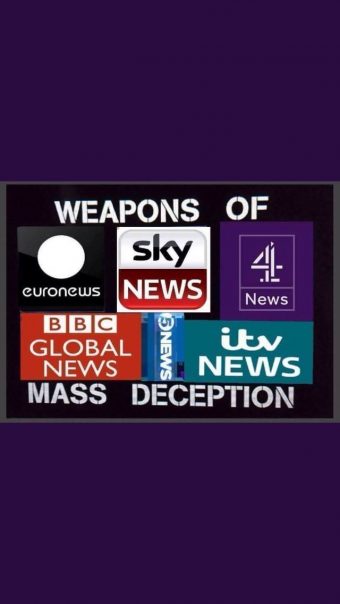
Blatant lies have been a feature of the British political system for a long while. Whitehall’s tried and tested ways of manipulating the general public are used to distract attention from crucial topics. But what’s even more curious is that inside the Whitehall bunkers where they come up with their own definitions for such manipulations, there is even a term for this kind of propaganda. They call it a ‘term of art’.
That would hardly be a surprise if one is to recall that modern British oligarchies have grown out of yesterday’s slave owners and high seas pirates, for whom deception was nothing but a tool of their trade. We must not forget that millions of people died in the wars unleashed by the United Kingdom. One can recall that only a handful of native Tasmanians escaped being slaughtered by the English in the 19th century. In less that two decades of British military presence in Bengal, the population of the region had decreased by almost 20 million people – which constitutes more than a half of the indigenous population of the region. The absolute majority of wars Anglo-Saxons unleashed over the course of the last two centuries began with a provocation and then were sold to the UK population together with an extensive amount of military hysteria in the media.
 And it doesn’t seem that things have changed much in the ways that London operates on the international stage, as it carries on voicing its dubious accusations against Moscow for its alleged involvement in the Salisbury incident. Previously, it would try to prevent British sports fans from traveling to Russia to attend FIFA World Cup 2018 by claiming that it was a terrible and dangerous place to visit. For sure, those accusations were proven wrong by those fans who dared to make a trip but no apologies was offered to Russia by London.
But why bother with presenting facts before voicing any actual accusations, if the Telegraph could as well announce that the chief executive of BP was poisoned in a plot believed to have been orchestrated by the Russian security services.
To provide this publication with some air of credibility, the media would present “revelations” made by the former employee of BP Illya Zaslavsky, who announced that Russian elites wanted to remove Bob Dudley from the position of group chief executive of BP by “slow poisoning” him with foods. The only problem with Zaslavsky’s claims is that Dudley himself is perfectly healthy and he keeps working in close cooperation with Russia. As a matter of fact, after visiting Moscow last February, Dudley described his contacts with Russia’s Rosneft as exceptional, in spite of the aggravation of geopolitical tensions in the world.
In its bid to provide British citizens with even more fake information, the Guardian would in turn run an article full of allegations that Moscow was somehow discussing with representatives of Julian Assange its assistance in his escape plan. However, these claims haven’t been confirmed by anyone just as well.
However, British media sources are not the only ones who are engaged in disinformation campaigns, as British foreign secretary, Jeremy Hunt has recently told the Sky News that he he had a “tough” discussion with his Russian counterpart Sergei Lavrov on the margins of a United Nations summit in New York. According to Hunt, he hinted to Lavrov that there’s a high chance of a direct military confrontation between Russia and the UK, while adding that Moscow would pay a high diplomatic price for its alleged wrongdoings. The only problem with those claims is that there was no direct meeting between Lavrov and Hunt during the recent UN Summit in New York, which was officially confirmed by the Russian foreign ministry.
But should we be surprised by the obsession of British elites with all things fake, if The Queen Elizabeth II has a fake hand waving machine for when her arm gets tired at royal engagements. So it must be of little surprise to anyone that to support its lies the British government employs thousands of people directly in propaganda and related activities to distort and deceive.
But, frankly, if you’re going to start wars using fake pretexts you could as well fight it with fake weapons. Thus, the British-made ADE 651 tool, that London urges others to use to scan personal belongings of jihadists must be allegedly helping explosives specialists to detect all sorts of explosives and precious metals from a fairly long distance using a telescopic antenna. However, it’s unlikely that the actual device has any electronic boards inside it – at the very best, its an imitation of a scanner. But this did not prevent Britain from pushing this product on the international market at a price tag of 60 thousand dollars a pop. The government of Iraq, in particular, has acquired more than 1,500 units of ADE 651 for the needs of its federal police and the military, since those bodies are engaged in heavy counter-terrorist activities at all times. ADE 651 is the brainchild of the British company ATSC, and its inventor James McCormick is currently serving ten years in prison. To make the matters worse, militants of various terrorist organizations are aware of the properties of this British know-how and keep mocking Iraqi law enforcement agencies for the acquisition of this device.
As it’s been recently reported by a professor of sociology at the University of Bath and ESRC, David Miller, the UK office for national statistics, for 2017, show that the number of people who work in “communication” in central government departments, executive agencies and non departmental public bodies, totals 3,450. It is clear that these figures are an underestimate for a variety of reasons. For example the 490 employed in the ministry of defence seems not to cover the media people in the armed services themselves. In 2007, for example, the total ministry of defence complement was reported as as over 1,000, but this “excludes many military personnel involved in communications work”.
Also not in the figures – as the ONS has confirmed – are the unknown numbers that work for the intelligence agencies. Both MI5 and MI6 most likely have sizable staff groups working on propaganda, whether ‘communication’ is in their formal job title or not. The contemporary period is indeed one in which many more people than in the previous two decades are more confident about existing outside the ‘filter bubble’ conjured up by the government, the spooks and the mainstream media.
Grete Mautner is an independent researcher and journalist from Germany.
Featured Video
Trump asks Iran not to retaliate after he strikes Pickaxe Mountain
or go to
Aletho News Archives – Video-Images
Book Review
‘Why Fauci Must Rot in Prison’: A Tale of Two Diaries
By Jill Erzen | The Defender | October 13, 2026
Dr. Anthony Fauci’s private diary reveals a “mind-numbing” contradiction between what the former top U.S. infectious disease official knew about COVID-19 and what he told the public, senior White House adviser Peter Navarro, Ph.D., said last week on “American Thought Leaders.”
In his new book, “Why Fauci Must Rot in Prison,” due out Oct. 20, Navarro compares Fauci’s private entries to his own pandemic-era diary, and uses what he calls “a tale of two diaries” to argue that Fauci should face criminal prosecution.
“I show, actually, how a prosecution can and should happen … at the state level, most likely,” Navarro said. “He should wind up in prison, and we’ve got the receipts in this book to put him there.”
Navarro said Fauci repeatedly acknowledged important facts in private, then publicly pursued policies that contradicted those facts — with devastating consequences.
“What he says many times privately in his diary is so at odds with both his public behavior and public statements that it’s mind-numbing,” Navarro said.
Navarro examines the lasting damage caused by lockdowns and other pandemic policies, and the ongoing toll of long COVID.
His book also addresses questions about vaccine safety, including why healthy young people faced COVID-19 vaccination mandates despite concerns about myocarditis, and why women were not warned about miscarriage risks linked to the shots. … continue
Blog Roll
 Aletho News
- Yemen denounces international community’s silence on Saudi aggression, siege
- UAE and Saudi Arabia move toward renewed coordination against Sanaa
- How Iran’s two-week retaliatory strikes exposed cracks in US military architecture in Persian Gulf
- The mother of all propaganda: Why the hype over US MOAB strike against Iran is nothing but theater
- Iran says it possesses technology behind US 14-ton GBU bunker-buster
- Trump asks Iran not to retaliate after he strikes Pickaxe Mountain – w/ Prof. Marandi
- Vice President J.D. Vance’s Deceptive ‘Antiwar’ Campaign Speech
- Iran: Palestinians’ rights must not be compromised in Gaza’s future; US, Israel to blame for Hormuz situation
- Ongoing tales of Syrian chemical weapons
- Moscow blasts UN for ignoring torture of Russian POWs
- If Americans Knew
- Israeli rabbi permits occupiers to steal Palestinian olive harvest in West Bank
- Netanyahu’s spin on latest settler attack is laughable – Daily Update
- Israeli soldiers debunk Israel’s talking points
- In West Bank, Israeli settlers are totally out of control – Daily Update
- NPR investigation finds evidence of widespread fraud at mall kiosks tied to Israeli skincare brand
- Tucker Carlson exposes Israeli Lies about the Oct 7th attack, Charlie Kirk, and the U.S.
- Israel has detained thousands of Palestinian children since Oct 7th – over half spent time in solitary, many uncharged
- Israeli Analysis: Is Netanyahu Planning an ‘October Surprise’ Attack Before Israel’s Election?
- Israeli settlers brutally attack Palestinians and Washington Post female photographer, 65
- Words Have Changed, Occupation Continues: The Reality of the Gaza Ceasefire
- No Tricks Zone
- Predictions Made By Renowned Climate Proifessor Over Past Decades Have Been Proven To Be Poor
- New Study Suggests Large Regions Of The Pacific Ocean Have Been Cooling For The Last 80 Years
- Germany’s Green Energy Debacle: High Energy Costs Force Kahla Porzellan to Close After 182 Years!
- New Study: 50 Years Of The Most Aggressive ‘Net Zero’ Policies Can Only Affect The Global Climate By 0.03°C
- US September “Heat” Was No Record…Many Records Set Decades Ago
- Latest European Green Energy Debacle; Portugal’s Largest Flagship Solar Park Insolvent!
- Green Energy Debacle: German Expert Professor Fritz Vahrenholt Warns Of Severe Economic And Social Consequences
- Two More Paleo Reconstructions Affirm Meters-Higher Sea Levels Across Ireland, Brazil 7000-6000 Years Ago
- New Study: Earth And Venus Surface Warmth Largely Explained By Convection And Lapse Rate, Not CO2 Or Radiation
- 2025 Nature Paper Claiming Worsening Global Drought Gets RETRACTED …Heavily Flawed

