The goal of Israel’s 1982 invasion of Lebanon was to turn Jordan into Palestine, says Ehud Barack
MEMO | May 4, 2020
The goal of the First Lebanon War was to bring down the Hashemite Kingdom of Jordan and turn the country into Palestine, former Israeli Prime Minister Ehud Barak has said in a shocking admission about the true intention of the Zionist state.
Israelis were told that the objective of the 1982 invasion of Lebanon was to remove forces belonging to the Palestinian Liberation Organisation and end the threat posed by the resistance group to its northern communities. Barack admitted that this was untrue, explaining that the real goal was to use the “pretext of Palestinian terror” to force the PLO back to Jordan where they would take over government from the Hashemite Kingdom.
“The idea was to use the pretext of Palestinian terror, which they (the PLO) were providing us with, to attack them in south Lebanon and turn that into a leverage [Israel can use] and join the Christian (forces) in Beirut,” Barak said in an interview with Maariv, the sister publication of the Jerusalem Post.
“The assumption was that they (the PLO) will have to return to Jordan and unlike what happened in 1970 (when the late King Hussein ordered the forcible expulsion of the PLO) this time they will be ready and take over the government.”
“And in that way Zion is redeemed,” Barak continued. “In Jordan a Palestinian state will be created and the conflict could be resolved.”
Barack suggested that the PLO would have learnt the lessons of Black September – the 1970 conflict with Jordan which led to the expulsion of Palestinians to Lebanon – and stand a better chance of deposing the late King Hussein.
Barack’s admission would suggest that Israel did not achieve any of its war objectives. A second stated goal was to aid Lebanese Christians in order to gain a regional ally. A Christian-dominated Lebanon was seen as a potential ally, supportive of the Jewish state as two minority-countries in the region.
Not only was this hope dashed when the Christian President of Lebanon Bachir Gemayel was assassinated in September 1982, Israel’s image across the world took a tumble for enabling hundreds of Phalangist fighters – Israel’s paramilitary ally in Lebanon – to carry out a massacre in Sabra and Shatila refugee camp.
George Soros Wants You to Believe Russia Is a Danger to World Peace, Turkey’s Erdogan an Angel
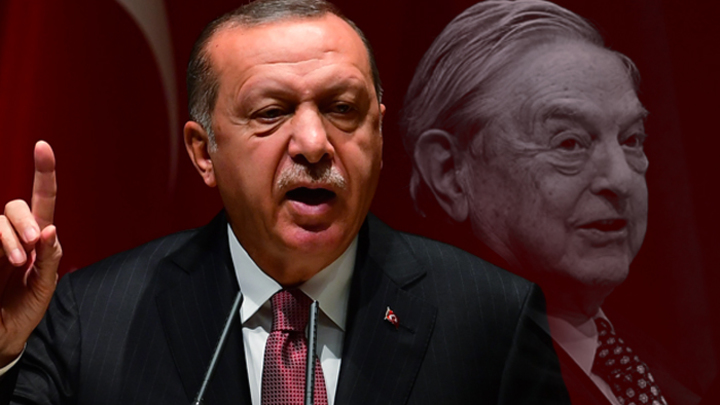
By Philip Giraldi | American Free Press | April 16, 2020
George Soros is a billionaire Hungarian-born investor who is extremely controversial due to his promotion of what he chooses to define as democracy and free-trade movements, primarily conducted through the Open Society Foundations, which he founded and has funded with $32 billion, according to one estimate. He contributed to the campaigns of Barack Obama and Hillary Clinton, which has in part led to conservative politicians in the United States and elsewhere frequently citing Soros when complaining about politically motivated interference in support of a progressive agenda for the United States and also globally. At least they used to do so until Soros’s allies began to fire back with accusations of anti-Semitism, which had the effect of muting the complaints.
Soros moved from Europe to the United States in 1956 and is now an American citizen. The sources of at least some of his wealth are somewhat controversial. He made over $1 billion in 1992 by selling short $10 billion in British pounds sterling, leading to the media dubbing him “the man who broke the bank of England.” He has been accused of similar currency manipulation in both Europe and Asia. In 1999, New York Times economist Paul Krugman was highly critical of Soros’s interference in financial markets, writing, “Nobody who has read a business magazine in the last few years can be unaware that these days there really are investors who not only move money in anticipation of a currency crisis, but actually do their best to trigger that crisis for fun and profit. These new actors on the scene do not yet have a standard name; my proposed term is ‘Soroi.’ ”
Soros was heavily involved with the restructuring of former communist regimes in eastern Europe and had a hand in the so-called Rose Revolution in Georgia in 2003 and the Maidan Revolution in Ukraine in 2014, both of which were supported by the U.S. government. But in March 2017, six conservative U.S. senators sent a letter to then-Secretary of State Rex Tillerson asking him to look into several grants that the State Department and the U.S. Agency for International Development (USAID) had given to groups connected to Soros, most particularly in Macedonia. Soros’s projects are particularly targeted by conservatives and nationalists, as they are transnational in nature, and, indeed, some critics have noted that the well-funded and broadly supported Open Society is the most effective and visible weapon in the arsenal of the progressive dominated globalist movement.
Soros has been linked to a number of theories that see him as a puppet-master pulling the strings on a worldwide conspiracy to control key elements of the world economy as well as leading politicians. His critics are generally conservatives who are opposed to the progressive causes that he promotes. Soros has been in the news recently for his financial support of a Washington-based think tank called the Quincy Institute, which is also funded by the libertarian Koch family. The institute claims to be a non-partisan organization that promotes a “restrained” foreign policy using diplomacy as a means to resolve international disputes rather than threats followed up by warfare, which has become the preferred option for successive U.S. presidents and their administrations.
Soros’s motives in suddenly embracing diplomacy and non-intervention might well be questioned. On March 4, the Financial Times published an op-ed (unfortunately behind a paywall) by Soros entitled “Europe Must Stand With Turkey Over Putin’s War Crimes in Syria.” It had the subtitle “Focusing on the Refugee Crisis Russia Has Created Addresses Symptoms Not the Cause.” In it, he let loose a sharp attack on both the Kremlin and President Vladimir Putin.
The Soros op-ed is full of errors of fact and is basically a call for aggression against Russia. It starts with, “Since the beginning of its intervention in Syria in September 2015, Russia has not only sought to keep in place its most faithful Arab ally, Syrian President Bashar al-Assad. It has also wanted to regain the regional and global influence that it lost since the fall of the Soviet Union.” First of all, Russia did not “intervene” in Syria. It was invited there by the country’s legitimate government to provide assistance against various groups, some of which were linked to al Qaeda and the Islamic State, that were seeking to overthrow President al-Assad.
And apart from Soros, few actual experts on Russia would claim that it is seeking to recreate the “influence” of the Soviet Union. Moscow does not have the resources to do so and has evinced no desire to pursue the sort of global agenda that was characteristic of the Soviet state.
There then follows a complete flight into hyperbole with: “Vladimir Putin has sought to use the turmoil in the Middle East to erase international norms and advances in international humanitarian law made since the second world war. In fact, creating the humanitarian disaster that has turned almost 6 million Syrians into refugees has not been a byproduct of the Russian president’s strategy in Syria. It has been one of his central goals.” None of Soros’s assertions are supported by fact. The U.S. and Israel are the two top flaunters of international norms and law, not Russia, and there is no evidence whatsoever that Moscow sought to create the “humanitarian disaster” in Syria. That was the work of the U.S. and its “allies” in the region who were supporting both separatists and terrorists.
Soros states his belief that “Assad is the most barbarous ruler that the world has seen since Joseph Stalin. When his own people rose up against him, he developed a military strategy designed to inflict the greatest possible harm on his civilian opponents. He deliberately targeted hospitals, schools and kindergartens, trying to kill or maim caregivers. He has used poison gas and chemical attacks over the course of a conflict that has left more than half a million dead.” None of the assertions are true and a lot of the “evidence” comes from propagandists for the terrorist groups, to include the notorious White Helmets. The lies advanced about the use of chemical weapons have recently been exposed.
Soros goes on to describe how Russia has “deliberately targeted” and bombed schools and hospitals, claims that largely derive from sources hostile to al-Assad and Putin that are impossible to check. Soros also asserts that, “The only government that has put up military forces to defend the civilians trapped in Idlib by Mr. Assad and its Russian ally is Turkey.” It is a claim that is perhaps the biggest lie of all, as Ankara is involved in Syria in support of its own completely selfish irredentist objectives and its desire to crush the Kurdish militias operating in the north and east of the country. Back in October, Turkey’s President Recep Erdogan issued an emotional call to Jihad to his supporters, saying, “Inshallah, God has promised us in Syria victory from Allah and an imminent conquest; and give good tidings to the believers. We see it is happening right now.”
The Soros op-ed also included a bit of reminiscence, describing how, “In 2014, I urged Europe to wake up to the threat that Russia was posing to its strategic interests, albeit in a different context and geography. Russia had invaded Ukraine knowing that Europe would seek to avoid any confrontation with Moscow. Yet what is happening in Idlib now is following the same pattern: Europe is evading a confrontation with Russia over its Syria policy when it should be standing up to it . . . with respect to Syria at least, Turkey deserves Europe’s support. Europe should therefore seek to bolster Turkish President Erdogan’s negotiating position. . . . I hope that this would also put Mr. Putin’s war crimes at the center of the European conversation.”
The op-ed is neither conciliatory nor “diplomatic” and is a clear sign that Soros picks his enemies based on ideological considerations that also drive his choices on how to frame his ventures. He is a billionaire who has chosen to use his money to remake the world in an image that he is comfortable with. Unfortunately, there is a lot of that kind of thinking going around—that having lots of money ipso facto equates to some kind of superior wisdom. And the whole process is facilitated by the fact that politicians as well as space on editorial pages of leading newspapers can easily be bought. Soros would have Europe and the United States taking on Russia over what he perceives to be going on in Syria, where they have no genuine interests. It is a formula that we have seen played out repeatedly in the past 20 years and can only lead to disaster.
Netanyahu Is Back Yet Again
Israel will become much bigger
By Philip Giraldi • Unz Review • April 28, 2020
Rahm Emanuel, up until recently the mayor of Chicago and before that a top advisor to the president in the Bill Clinton and Barack Obama White Houses and still earlier a volunteer in the Israeli Army, famously once commented that a good crisis should never be allowed to go to waste. He meant, of course, that a crisis can be exploited to provide cover for other shenanigans involving politicians. It was an observation that was particularly true when one was working for a sexual predator like Bill, who once attacked a “terrorist” pharmaceutical factory in Sudan to divert attention away from the breaking Monica Lewinski scandal.
To be sure, the United States government is focusing its attention on the coronavirus while also using the cover afforded to heighten the pressure on “enemies” near and far. As the coronavirus continues to spread, the Trump White House and Secretary of State Mike Pompeo have increased the ferocity of their sabre rattling, apparently in part to deter Russia, China, Iran and Venezuela. Ironically, of course, none of the countries being intimidated are actually threatening the United States, but we Americans have long since learned that perceptions are more important than facts when it comes to the current occupant of the oval office and his two predecessors.
The latest bit of mendacity coming out of the White House was a presidential tweet targeting the usual punching bag, Iran. Based on an incident that occurred two weeks ago, Trump threatened “I have instructed the United States Navy to shoot down and destroy any and all Iranian gunboats if they harass our ships at sea.” The U.S. Navy ships in question are, one might also observe, in a body of water generally referred to as the Persian Gulf, where they are carrying out maneuvers right off of the Iranian coast. Meanwhile, Iranian flying gunboats have not yet been observed off of New Jersey, but they are probably waiting to be transported to the Eastern Seaboard by those huge trans-oceanic gliders that once upon a time were allegedly being constructed by Saddam Hussein.
Given the cover provided by the virus, it should surprise no one that Israel is also playing the same game. The Jewish state has been continuing its lethal bombings of Syria, with hardly any notice in the international media. In a recent missile attack, nine people were killed near the historic city of Palmyra. Three of the dead were Syrians while six others were presumed to be Lebanese Shi’ites supporting the Damascus government. Israel de facto regards any Shi’ite as an “Iranian” or an “Iranian proxy” and therefore a “terrorist” eligible to be killed on sight.
But the bigger coronavirus story has to do with Israel’s domestic politics. Benjamin Netanyahu and his principle opponent Benny Gantz have come to an agreement to form a national government, ostensibly to deal with the health crisis. The wily Netanyahu, who will continue to be prime minister in the deal, has thereby retained his power over the government while also putting a halt to bids from the judiciary to try and sentence him on corruption charges. As part of the deal with Gantz, Netanyahu will have veto power over the naming of the new government’s attorney general and state prosecutor, guaranteeing the appointment of individuals who will dismiss the charges.
And more will be coming, with the acquiescence of Washington. U.S. elections are little more than six months away and Donald Trump clearly believes that he needs the political support of Netanyahu to energize his rabid Christian Zionist supporters, as well as the cash coming from Jewish oligarchs Sheldon Adelson, Bernard Marcus and Paul Singer. So, it is time to establish a quid pro quo, which will be Israeli government behind the scenes approaches to powerful and wealthy American Jews on behalf of Trump while the White House will look the other way while Israel annexes most of the remaining Palestinian West Bank. Pompeo has welcomed the new Israeli government and has confirmed that the annexation of the Palestinian land will be “ultimately Israel’s decision to make,” which amounts to a green light for Netanyahu to go ahead.
A vote on West Bank annexation will reportedly be taken by the Knesset at the beginning of July followed immediately by steps to incorporate Jewish settlements into Israel proper. According to the Israeli liberal newspaper Haaretz, the planned annexation has raised some concerns among a few liberal American Jewish organizations because it will convince many progressives in the U.S. that Israel has truly become an apartheid state. J Street warned that annexation “would severely imperil Israel’s future as a democratic homeland for the Jewish people, along with the future of the U.S.-Israel relationship” and has even suggested cutting U.S. aid if that step is actually taken. Most other ostensibly liberal groups have adopted the usual Zionist two-step, i.e. condemning the move but not advocating any effective steps to prevent it. And it should also be noted that the largest and most powerful Jewish organizations like the American Israel Public Affairs Committee (AIPAC) and the Zionist Organization of America (ZOA) have not raised any objections at all.
Unaffiliated individual liberal Jews, to include those who consider themselves Zionists, have generally been concerned about the move, though their argument is quite hypocritical, based on their belief that annexation would pari passu destroy any possible two-state solution, damaging both Palestinian rights and “Jewish democracy.” Some have even welcomed the change, noting that it would create a single state de facto which eventually would have to evolve into a modern democracy with equal rights for all. Such thinking is, however, nonsense. Israel under Netanyahu and whichever fascist retread that eventually succeeds him regards itself as a Jewish state and will do whatever it takes to maintain that, even including dispossessing remaining Arabs of their land and possessions, stripping them of their legal status, and forcing them to leave as refugees. That is something that might be referred to as ethnic cleansing, or even genocide.
And those Americans of conscience who are hoping for some change if someone named Joe Biden defeats Trump can also forget about that option. Biden has told the New York Times that “I believe a two-state solution remains the only way to ensure Israel’s long-term security while sustaining its Jewish and democratic identity. It is also the only way to ensure Palestinian dignity and their legitimate interest in national self-determination. And it is a necessary condition to take full advantage of the opening that exists for greater cooperation between Israel and its Arab neighbors. For all these reasons, encouraging a two-state solution remains in the critical interest of the United States.”
Unfortunately, someone should tell Joe that that particular train has already left the station due to the expansion of the Jewish state’s settlements. Nice words from the man who would be president aside, Biden is bound to the Israel Lobby for its political support and the money it provides as tightly as can be and he will fold before AIPAC and company like a cheap suit. He has famously declared that “You don’t have to be a Jew to be a Zionist – I am a Zionist” and “My Name is Joe Biden, and Everybody Knows I Love Israel.” His vice-presidential candidates’ debate with Sarah Palin in 2008 turned embarrassing when he and Palin both engaged in long soliloquys about how much they cherish Israel. Indeed they do. Every politician on the make loves Israel.
Philip M. Giraldi, Ph.D., is Executive Director of the Council for the National Interest, a 501(c)3 tax deductible educational foundation (Federal ID Number #52-1739023) that seeks a more interests-based U.S. foreign policy in the Middle East. Website is councilforthenationalinterest.org, address is P.O. Box 2157, Purcellville VA 20134 and its email is inform@cnionline.org.
US seeking to replace Iraq’s PMU in the western Anbar province bordering Syria: Analyst
Press TV – April 26, 2020
An Iraqi military advisor and analyst has said that the US is seeking to replace Iraq’s Popular Mobilization Units in the western Anbar province bordering Syria with its own forces.
Speaking to Iraq’s al-Maloumah news agency on Sunday, Safa al-A’ssam said that Washington seeks to force the PMU out of the province’s al-Qaim border region by fanning sectarian tensions.
“The plan is to redeploy American forces to the al-Qaim region on the pretext of countering Deash terrorist attacks and filling the security vacuum following a PMU withdrawal,” he added.
The PMU formed shortly after the emergence of the Daesh terrorist group in Iraq in mid-2014.
The group played a major role pushing back and ultimately defeating the terrorist forces which had taken control of a large swathes of the country.
The Iraqi parliament voted to integrate the PMU into the Iraqi military in 2016, effectively placing the force under the command of the prime minister and granting the group a standing similar to that of other branches of Iraqi security forces.
Fazel Jaber, an Iraqi lawmaker affiliated with the Fatah Alliance, has also warned of attempts by certain Iraqi groups to undermine the PMU’s presence in the province despite being deployed under the command of Iraq’s federal government.
He said the attempts to weaken the PMU were led by Washington, which fears the group’s presence.
The PMU has long rejected Washington’s military presence in the country as an obstacle impeding long-lasting security and stability in Iraq.
In January, Washington assassinated the group’s deputy commander, Abu Mahdi al-Muhandis, alongside Iran’s top anti-terror Lieutenant General Qassem Soleimani in the capital city Baghdad.
Iraqi resistance groups have vowed to take up arms against US forces if Washington fails to comply with a parliamentary order calling for the expulsion of US troops following the assassination.
Report says Iran may have replicated Israeli missile downed in Syria
Press TV – April 20, 2020
A Russian aviation news outlet says Iran may have replicated an Israeli missile that was shot down in Syria, citing a video of the test of a new Iranian anti-tank missile.
Avia.Pro reported that the new missile seems to resemble one of the Israeli projectiles that were downed by the Russian electronic warfare system during an attack on Syria,.
The report added that the downed missile was later successfully removed from the country by “Iranian intelligence service”, and was studied and completely copied.
The news outlet shared a video that showed the accuracy of the Iranian copy of the Israeli “Spike” missile in hitting its target.
Avia.Pro quoted experts as saying that Iran may use Israeli missiles against Tel Aviv itself in the near future.
Iranian authorities have repeatedly said that the country’s missile program has not been established for non-conventional purposes and is only meant as part of the country’s deterrence capability.
Iran holds the very first ranking in the field of missile technology among the Middle Eastern countries, according to a commander of the Islamic Revolution Guards Corps (IRGC).
“Today, we rank first in the missile technology at the regional level and are placed among the few global powers in this regard,” Brigadier General Amir Ali Hajizadeh, the commander of the Aerospace Division of the IRGC, said last August.
In June, Major General Hossein Salami, the chief commander of the IRGC, said Iran had managed to change the balance of power in its favor by harnessing the technology required for manufacturing ballistic missiles.
Salami said the Islamic Republic acquired the know-how 12 years ago while trying to prepare its defenses against the United States’ aircraft carriers.
Buying Punishment for “Terrorists”: Washington’s Reward Program Is Largely Ineffective
By Philip Giraldi | American Herald tribune | April 15, 2020
Many people worldwide are aware of the fact that the United States government offers cash rewards to informants who provide information on individuals and groups that it chooses to define as terrorists. The program is referred to as the Rewards for Justice Program (RFJ). It was established in 1984 as part of the Act to Combat International Terrorism and is run by the Department of State’s Diplomatic Security Service (DS). The rewards can be substantial, up to the $25 million that was offered for Osama bin Laden, and they sometimes include resettlement in another country with a new identity for informants whose security is threatened by their cooperation.
The program relies on information provided by local people, referred to on the RFJ website as “tips.” The website itself is accessible in a number of languages and, in its English version, features a headline that promotes its mission as: “Stop a Terrorist Save Lives. The most important reasons to stop a terrorist are all around you. Terrorism kills innocent people in every walk of life. By providing information that prevents a terrorist act, you save lives, protect families, and preserve peace. The United States is offering a reward for information leading to the arrest of persons engaged in terrorism. If you have information that can help, please submit a tip now. Submit a Tip.”
RFJ elaborates its role in very broad terms as “… offering rewards for information that prevents or favorably resolves acts of international terrorism against U.S. persons or property worldwide. Rewards also may be paid for information leading to the arrest or conviction of terrorists attempting, committing, conspiring to commit, or aiding and abetting in the commission of such acts. The Rewards for Justice Program has paid more than $145 million for information that prevented international terrorist attacks or helped bring to justice those involved in prior acts.”
After a slow start in which the program was first called the Counter Terror Rewards Program and then HEROES, by 1997 the site was processing over one million contacts per year. Admittedly, many of the “tips” were little more than bids to obtain cash and resettlement from the American government, but the State Department’s periodic evaluations of the program have considered it to be a success.
Critics note, however, that the reward for bin Laden attracted thousands of calls but no substantive information was obtained. Nor has RFJ been very effective against Islamic radical groups, considered to be its primary target. The website identifies top terrorist targets, but apart from Ramzi Ahmed Yousef, the World Trade Center bomber of 1993 who was also involved in various plots involving airliners in the Philippines, no one important has been identified and arrested through information developed by way of the program. Ramzi was arrested in Pakistan in 1995 after an informant identified him. He is currently in prison in Colorado.
The RFJ program has also claimed several executions of claimed terrorists, to include the killing of two leaders of the Filipino radical group Abu Sayyaf. Many more terrorist leaders, like ISIS head Abu Bakr al-Baghdadi, were killed without any input from RFJ. The relative lack of success against actual militants from groups recognized generally as terrorist, inevitably led to a broadening of the target pool. On December 22, 2011, RFJ offered a $10 million for information leading to Ezedin Abdel Aziz Khalil, the alleged organizer of an al-Qaeda fundraising operation in Iran that sent money to Pakistan and Afghanistan. It was the first listing of what was claimed to be a terrorist financier.
Two major current targets of RFJ are, in fact, financiers and fund-raising mechanisms related to Lebanese Hizballah and the Iranian Revolutionary Guards Corps (IRGC). To include them on the list, the United States declared both organizations to be Foreign Terrorist Groups (FTOs) in 1997 and 2019 respectively. Regarding Hizballah, the RFJ website includes “Rewards for Justice is offering a reward of up to $10 million for information leading to the disruption of the financial mechanisms of Lebanese Hizballah. Terrorist groups such as Hizballah rely on financing and facilitation networks to sustain operations and launch attacks globally. Hizballah earns almost one billion dollars annually through direct financial support from Iran, international businesses and investments, donor networks, corruption, and money laundering activities. The group uses those funds to support its malign activities throughout the world, including: Deployment of its militia members to Syria in support of the Assad dictatorship; alleged operations to conduct surveillance and gather intelligence in the American homeland; and enhanced military capabilities to the point that Hizballah claims to possess precision-guided missiles. These terrorist operations are funded through Hizballah’s international network of financial supporters and activities — financial enablers and infrastructure that form the lifeblood of Hizballah.”
Regarding the IRGC, the RFJ site includes “The U.S. Department of State’s Reward for Justice Program is offering a reward of up to $15 million for information leading to the disruption of the financial mechanisms of Iran’s Islamic Revolutionary Guard Corps (IRGC) and its branches, including the IRGC-Qods Force (IRGC-QF). The IRGC has financed numerous terrorist attacks and activities globally. The IRGC-QF leads Iran’s terrorist operations outside Iran via its proxies, such as Hizballah and Hamas… Since its founding 40 years ago, the IRGC has been involved in terrorist plots and supports terrorism worldwide. The IRGC is responsible for numerous attacks targeting Americans and U.S. facilities, including those that killed U.S. citizens. The IRGC has supported attacks against U.S. and allied troops and diplomatic missions in Iraq and Afghanistan.”
The first thing that strikes the casual reader of the descriptions of the cases made against both Hizballah and the IRGC is that much of the “evidence” is unsubstantiated, fabricated or exaggerated. To be sure, neither group is a friend of the United States or of Israel, but the descriptions of worldwide terror operations is largely made up, particularly the claims about attacks against Americans which have been credibly attributed to ISIS, not to Iranian sources or proxies. That Lebanese Hizballah has been gathering intelligence on the “American homeland,” presumably to stage an attack, is complete nonsense.
To cite only one example of how the RFJ is primarily a vehicle for attacking individuals and groups that the U.S. and Israel do not like, one might cite Muhammad Kawtharani. Informants would be rewarded for information on the “… activities, networks, and associates of Muhammad Kawtharani, a senior Hizballah military commander. This announcement is part of the Department’s standing reward offer for information leading to the disruption of the financial mechanisms of the terrorist organization Lebanese Hizballah. Muhammad Kawtharani is a senior leader of Hizballah’s forces in Iraq and has taken over some of the political coordination of Iran-aligned paramilitary groups formerly organized by Qassim Soleimani after Soleimani’s death in January. In this capacity, he facilitates the actions of groups operating outside the control of the Government of Iraq that have violently suppressed protests, attacked foreign diplomatic missions, and engaged in wide-spread organized criminal activity. As a member of Hizballah’s Political Council, Kawtharani has worked to promote Hizballah’s interests in Iraq, including Hizballah efforts to provide training, funding, political, and logistical support to Iraqi Shi’a insurgent groups.”
Well, RFJ gets Kawtharani’s name right and he is a Hizballah commander, but from that point on the story is pure spin and disinformation. The militia groups that Kawtharani presumably associates with and that have been attacked by U.S. forces are not “outside control of the government,” nor are they “insurgents.” They are, in fact, integrated into the Iraqi army. Nor have attacks on foreign diplomatic missions been demonstrated to be their responsibility as the rage against U.S. presence in Iraq is widespread across sectarian lines. Kawtharani is present in Iraq as a guest of the government in Baghdad, as was Qassim Soleimani before him, largely to assist in the fighting against ISIS. And if he is in Iraq to promote Hizballah interests in that country, why should it surprise anyone? In short, his being featured in RFJ is part of a plan to create a major incentive to kill him, little more. If he committed an actual terrorism crime or act, where is it?
Rewards for Justice is not about justice at all, unless one is promoting vigilante justice, as virtually no one who appears on its site is actually arrested and tried. It is a kill list providing the United States with one more tool to target and eliminate political opponents from countries with which Washington is not at war. As it has now been expanded to include the targeting of organizations and funding mechanisms of groups that are considered hostile, it is a mechanism for widening the hideous global war on terror that has done such terrible damage to American democracy while also killing hundreds of thousands and upending whole countries worldwide.
French Navy flagship & its Only carrier ‘Charles de Gaulle’ cuts Middle East op as Dozens of sailors sicken
RT | April 8, 2020
France’s sole aircraft carrier ‘Charles de Gaulle’ had to suspend its Mediterranean Sea mission and turn back to port shortly after around 40 of its crewmembers were placed under medical observation with suspected Covid-19.
All symptomatic sailors have been “isolated” from the rest of the crew and are being constantly monitored by medical staff, the Defense Ministry said on Wednesday.
“They have symptoms consistent with a possible Covid-19 infection. These first symptoms have appeared recently.”
The illness struck the crew when the nuclear-powered ship was making its way to the Mediterranean Sea to participate in France’s Operation Chammal, directed against Islamist militants in the Middle East. Now, it will return to the southern French port of Toulon, where it had originally planned to dock on April 23.
Last month, the US Navy had to isolate more than 4,000 personnel on board the aircraft carrier ‘USS Theodore Roosevelt’ off Guam, after around 100 of its crew had tested positive for Covid-19.
UAE’s Rapprochement With Syria Aimed Against Turkey
By Paul Antonopoulos | March 31, 2020
In the midst of the coronavirus crisis, Syria’s President Bashar al-Assad and Abu Dhabi’s Crown Prince Mohammed bin Zayed Al-Nahyan, the head of United Arab Emirates (UAE), spoke by phone on Friday in the first such communication since the Syrian War began in 2011. This shows a metamorphosis of alliances and geopolitics in the Middle East and the wider region considering the UAE was one of the main backers of terrorist organizations who fought to remove Assad from power. However, for more than a year, the UAE has been sending signals showing a change in policy towards Syria. The phone call was after a long series of rapprochement that began in late 2018 with the reopening of the Emirati embassy in Damascus.
“I have discussed with the Syrian president… updates on the coronavirus. I assured him of the support of the UAE and its willingness to help the Syrian people,” Prince Mohammed said on Twitter. “Humanitarian solidarity during trying times supersedes all matters, and Syria and her people will not stand alone.”
A diplomatic source close to the case was quoted by the Lebanese daily L’Orient-Le Jour as saying the “Westerners, the Americans and French particularly, were against” a Syrian-Emirati rapprochement. According to the diplomatic source, the UAE is trying to gain favours from Moscow and has already won dozens of contracts, including in armaments, gas and infrastructure, but also with space cooperation. This is part of a broader geostrategic context and the stakes go far beyond Syria and the UAE. Rather, the UAE has acknowledged that Russia has taken a greater interest in the region, in particular in Syria and Libya.
Relations between the Gulf monarchies and the United States, traditional allies, have greatly deteriorated in recent years. The gradual disengagement of American forces from the region, but especially the lack of support from Washington against Turkey, made the monarchies with the exception of Qatar, lose the confidence they once had in the United States. According to the diplomatic source quoted by L’Orient-Le Jour, the UAE is trying to get closer to Beijing and Moscow, and the Crown Prince’s phone call to Assad is evidence of that. The call also comes as relations with Iran softened, especially seen with the many Emirati delegations who visited Iran last year, however this has not softened the UAE’s brutal Yemeni policy. None-the-less, this suggests a change in foreign policy that appeals to Moscow.
It appears then that the UAE’s turn around in its Syria policy serves two purposes: first – to strengthen relations with Russia, second – to form an anti-Turkish bloc.
As Turkey actively pursues the establishment of a neo-Ottoman Empire, the UAE is aggressively undermining the project as it opposes the Muslim Brotherhood, an organization that Turkish President Recep Tayyip Erdoğan has openly supported and backed in Syria, Libya and Egypt. The UAE recognized the Muslim Brotherhood as a terrorist organization in 2014 after the fundamentalist group made plans to infiltrate and destabilize the Gulf country to take control – the main reason for the ever-increasing deterioration in relations between the UAE and Turkey.
Since then, the UAE has been actively countering Turkish influence across the region. As part of its efforts to create an anti-Turkish block, the UAE have strengthened their relations with Saudi Arabia and Egypt. Both Saudi Arabia and Egypt fear being taken over by Muslim Brotherhood rule. However, the UAE’s pursuit of countering Turkey has not been reduced to only the Islamic world.
Greece, considered the “Old Enemy” by the Turks, received 11 tons of medical aid from the UAE on Thursday, with a Greek government press release stating that relations “began as economic cooperation, but thanks to the trust that was developed, it evolved into a strong bond.” This came as a working meeting of the Greece-UAE Broader Strategic Cooperation Forum was held in Athens on February 19 following the Greek Prime Minister Kyriakos Mitsotakis’ visit to UAE. In 2019 and 2020, the UAE and Greece has conducted joint military drills and military heads have been meeting each other often in a clear directive against Turkey.
In Libya, the UAE has not held back in supporting the Libyan National Army in their struggle against the Muslim Brotherhood government in Tripoli, headed by the ethnic Turk Fayez al-Sarraj who has the full backing of Erdoğan. The UAE’s material assistance has been crucial in the success of the Libyan National Army’s battle against Muslim Brotherhood forces, a clear demonstration that the UAE are willing to directly check Turkey’s ambitions to exert its influence and power across the region.
By securing close relations with Greece and directly countering Turkey in Libya, the UAE’s rapprochement with Syria is another step in formulating an anti-Turkish bloc, with itself at the head. While Turkey has acted to strangulate countries who oppose its hegemony in the region, it now appears that it is the UAE who is pressurizing Turkey and isolating it. There is every chance that the UAE will begin sending material aid to Syria that will be crucial in its future battles to expel the Turkish military and their jihadist proxies from Syrian territory. This will once again undermine Turkey’s efforts to dominate Syria and be the main power in the region, a move that Erdoğan would not have expected.
Paul Antonopoulos is a Research Fellow at the Center for Syncretic Studies.
Coronavirus hastens an Arab rapprochement
By M. K. BHADRAKUMAR | Indian Punchline | March 28, 2020
A phone call by the UAE Crown Prince Sheikh Mohamed bin Zayed Al Nahyan to Syrian President Bashar al-Assad on Friday signifies in many ways a major development in regional politics.
The official UAE news agency WAM modestly placed the UAE initiative “within the framework of Sheikh Mohamed’s contacts to follow up the humanitarian conditions in sisterly and friendly countries” in the wake of the coronavirus outbreak in the region.
The agency said the two leader “reviewed precautionary and preventive measures… and the possibility of helping sisterly Syria to fight the virus.” But it added that “Sheikh Mohamed stressed the need for countries to place the humanitarian solidarity over political issues during this common challenge …. [and] affirmed that Syrian – the sisterly Arab country – will not be left alone during these delicate and critical circumstances.”
The report ended by taking note that Assad welcomed the Crown Prince’s “collaborative initiative while praising the UAE humanitarian stance.”
The Syrian news agency SANA succinctly highlighted that the UAE Crown Prince “affirmed that the UAE supports the Syrian people during these extraordinary circumstances, saying that Syria will not remain alone in these critical circumstances.”
Clearly, a serious normalisation process has begun between Abu Dhabi and Damascus and this must be counted as one of the geopolitical fallouts of rampage of coronavirus.
The UAE was one of the main backers of the “regime change” project in Syria and a key promoter of jihadi groups. But a rethink apparently began sometime around late 2016 following the Russian intervention in Syria the previous year, which swung the military balance dramatically in favour of Assad’s government.
The UAE made a course correction once it became apparent that the regime change project had floundered. Its support for the extremist Islamist groups tapered off. Cool realism, which is UAE’s trademark, prevailed. (We see the realism also in the UAE’s disengagement from the Saudi-led war in Yemen.)
Most certainly, President Trump’s detached attitude toward the Syrian conflict would have played its part in the UAE rethink. Among other factors, the UAE’s growing rapport with Russia, involving the two leaderships at a personal level, encouraged the UAE to reassess the Syrian situation from a new perspective. At any rate, the UAE reopened its mission in Damascus in 2018.
Without doubt, one major consideration for the UAE has been the proactive and repeated Turkish military interventions in northern Syria in the period since 2016 starting with Operation Euphrates Shield, which steadily evolved into a Turkish occupation in northern Syria.
The Turkish-Emirati relations have been very poor in the recent years following President Recep Erdogan’s accusation that the UAE had a hand in the 2016 failed coup attempt to overthrow him. Basically, the leitmotif of this discord lies in Erdogan’s kinship with the Muslim Brotherhood, whom the UAE regards as an existential threat.
To be sure, the antipathy toward the Brothers, whom Turkey (and its regional ally Qatar) promotes as the vehicle of the Arab Spring, has been a key factor in the budding UAE-Syria rapprochement — as indeed in the growing rapport between Damascus and Cairo.
Interestingly, Syria finds itself on the same page as the UAE, Egypt, Saudi Arabia and Russia in opposing the Turkish intervention in Libya as well. Recently, the Libyan warlord General Khalifa Haftar’s faction (which opposes the Turkey-backed government in Tripoli) was allowed to take over the Libyan embassy in Damascus.
Indeed, the UAE is playing a long game to isolate Turkey (under Erdogan) in the Middle East by drawing together forces in the region that abhor political Islam — Muslim Brotherhood in particular. How far Russia encourages such an alignment in regional politics is anybody’s guess but it won’t be a surprise, given the difficulties Moscow is currently facing in managing the mercurial personality of Erdogan and a possibility that Russian-Turkish relations could be on a collision course any day over northern Syria if a Turkish-Syrian military confrontation in Idlib erupts.
Interestingly, the UAE Crown Prince’s overture to Assad comes within six weeks of a visit by the director of Russia’s Foreign Intelligence Service, Sergey Naryshkin, a top Kremlin official close to President Vladimir Putin, to Dubai. Tass news agency reported that “that the approaches assessing regional crises and solutions to them (Russia and UAE) are similar or close.”
Interestingly, both Russia and the UAE have direct dealings with the Kurdish separatist groups that operate in Syria and Turkey. No doubt, Russia will view with satisfaction the acceleration of the UAE-Syrian rapprochement. Emirati assistance in Syria’s reconstruction and rehabilitation will come as a big relief to Moscow.
Also, the return of Syria to the Arab family can only enhance Russia’s room for manoeuvre, apart from giving Assad much-needed “strategic depth”. All this helps in the stabilisation of the Syrian situation. Can we expect Syria’s readmission to the Arab League? It’s entirely conceivable.
The bottom line is that the UAE-Syrian normalisation holds the potential to redraw regional alignments. Despite the calamities of the 9-year old conflict, Syria still remains the throbbing heart of Arab nationalism, although, tragically, it came to symbolise in the recent years the deep divisions across the Middle East.
On the ground, besides the tragic loss of lives, Syria has gone through destruction on a colossal scale that would take decades to reverse. Nonetheless, a nascent opportunity arises here for Syria to climb out of the deep divisions and regain its regional standing.
House of Mirrors: Justin Trudeau’s Foreign Policy – Book Review

House of Mirrors, by Yves Engler. (Photo: Book Cover)
By Jim Miles | Palestine Chronicle | March 23, 2020
(House of Mirrors – Justin Trudeau’s Foreign Policy. Yves Engler. RED Publishing, Saskatoon/Black Rose Books, Montreal. 2020)
Some book covers are better than others, and that of Yves Engler’s House of Mirrors is beautifully expressive of the contents of his latest work. It shows a very friendly face and happy smiling Justin Trudeau in an iconic pose that says it all: America first.
This is Engler’s eleventh book exposing the downside of Canadian politics. It covers two main themes, the obvious first one is that of Canada’s involvement in the U.S. imperial-hegemonic demands around the world.
The second, more domestic, is that the Liberal’s and Conservatives, Canada’s two main parties, are essentially the same thing when it comes to foreign policy. Whereas the Conservatives are much more aggressive with their terminology while the Trudeau Liberals couch their words in a fancier more humanistic sounding language, the end results are the same: following the U.S. corporate-industrial-military complex and in certain cases being ahead of that curve.
With that as its underlying theme, Engler covers many topics concerning the Trudeau Liberals. The first long section deals with “The Canadian Monroe Policy” discussing how Canada fits into U.S. initiatives throughout Latin America with the overthrow, attempted overthrows, and manipulations of various organizations (OAS) in order to control the western hemisphere.
While paralleling U.S. interests, in terms of Venezuela, Canada, under Chrystia Freeland’ tutelage, has taken a leading interest with its support of the Lima Group (all sycophantic governments to U.S. corporate interests) against Venezuela.
A long essay on the Middle East, “Loving Monarchies, Hating Palestinians” discusses how Canada relates to the Arab countries, Israel, and the Palestinians. An earlier chapter, “The Sun Never Sets on the Canadian Military”, ties in with this chapter in exploring the numerous military sales and security contacts with Middle Eastern countries.
Large orders of military materials are sent to the likes of Saudi Arabia in support of its war on Yemen. Much information and technological information for security is exchanged between Canada and Israel (fun fact: Canada developed apartheid long before South Africa and Israel). The official position for Palestine is the stillborn two-state peace process while the actual position is more one of asking why the Palestinians do not acquiesce to Israeli demands.
Many other important topics are presented: around the world from China and North Korea through to Freeland’s favorite bogeyman, Russia, and on into Africa (military and mining interests); around the world from its domestic carbon dioxide/environmental policies; another hit on Canada’s mining interests in particular with South America; and the language of “Judge What I Say, Not What I Do”.
It is interesting how often Chrystia Freeland’s name rises in connection with Trudeau’s foreign policy. She is foremost in using the platitude about “international order based on rules” and the “rule of laws”. Whatever the foreign policy, as Foreign Affairs Minister and now as Deputy Prime Minister (a conveniently invented position), she carries considerable sway concerning Russia, Ukraine, Venezuela, Syria and other global hotspots (coronavirus notwithstanding). She inverts the colonial role, making Canada a victim rather than a colonizer and exploiter, “Canada has never been an imperialist power…we’ve been the colony.”
In his conclusion, Engler reprises comments about Canadian banks, the mining industry, Russia, Israel, Iran, the military, and business in general. He summarizes, “corporate Canada is highly international” with “segments… tied to extreme capitalism.” Extreme capitalism being capitalism dominated by and supported by the military-industrial complex with assistance from the financial community and the mainstream media.
As with all of Yves Engler’s books, House of Mirrors is tightly written, with little philosophizing, allowing the information to speak for itself, information that is highly notated and well referenced. The smiling man on the cover, Justin Trudeau, is essentially another true believer in an oligarchic world order (along with Ms. Freeland) supported by an international array of corporate and military liaisons.
– Jim Miles is a Canadian educator and a regular contributor/columnist of opinion pieces and book reviews to Palestine Chronicles. His interest in this topic stems originally from an environmental perspective, which encompasses the militarization and economic subjugation of the global community and its commodification by corporate governance and by the American government.
Pompeo and Netanyahu paved a path to war with Iran, and they’re pushing Trump again
By Gareth Porter | The Grayzone | March 20, 2020
Though it narrowly averted war with Iran this January, the Trump administration is still pushing for all-out military conflict. The architects of the drive to war, Mike Pompeo and Benjamin Netanyahu, have relied on a series of cynical provocations to force Trump’s hand.
The US may escape the most recent conflict with Iran without war, however, a dangerous escalation is just over the horizon. And as before, the key factors driving the belligerence are not outraged Iraqi militia leaders or their allies in Iran, but Trump’s secretary of state, Mike Pompeo, and Israeli Prime Minister Benjamin Netanyahu, who has long sought to draw the US into a military confrontation with Iran.
Throughout the fall of 2019, Netanyahu ordered a series of Israeli strikes against Iranian allies in Iraq and against Lebanese Hezbollah units. He and Pompeo hoped the attacks would provoke a reaction from their targets that could provide a tripwire to outright war with Iran. As could have been expected, corporate US media missed the story, perhaps because it failed to reinforce the universally accepted narrative of a hyper-aggressive Iran emboldened by Trump’s failure to “deter” it following Iran’s shoot-down of a U.S. drone in June, and an alleged Iranian attack on Saudi oil facility in September.
Pompeo and John Bolton set the stage for the tripwire strategy in May 2019 with a statement by national security adviser John Bolton citing “troubling and escalatory indications and warnings,” implying an Iranian threat without providing concrete details. That vague language echoed a previous vow by Bolton that “any attack” by Iran or “proxy” forces “on United States interests or on those of our allies will be met with unrelenting force.”
Then came a campaign of leaks to major news outlet suggesting that Iran was planning attacks on U.S. military personnel. The day after Bolton’s statement, the Wall Street Journal reported that unnamed U.S. officials cited “U.S. intelligence” showing that Iran “drew up plans to target U.S. forces in Iraq and possibly Syria, to orchestrate attacks in the Bab el-Mandeb strait near Yemen through proxies and in the Persian Gulf with its own armed drones…”
The immediate aim of this campaign was to gain Trump’s approval for contingency plans for a possible war with Iran that included the option of sending as many as 120,000 U.S. troops into region. Trump balked at such war-planning, however, complaining privately that Bolton and Pompeo were pushing him into a war with Iran. Following Iran’s shoot-down of the U.S. drone over the Strait of Hormuz on June 20, Pompeo and Bolton suggested the option of killing Maj. Gen. Qassem Soleimani in retaliation. But Trump refused to sign off on the assassination of Iran’s top general unless Iran killed an American first, according to current and former officials.
From that point on, the provocation strategy was focused on trying to trigger an Iranian reaction that would involve a U.S. casualty. That’s when Israeli Prime Minister Benjamin Netanyahu interjected himself and his military as a central player in the drama. From July 19 through August 20, the Israeli army carried out five strikes against Iraqi militias allied with Iran, blowing up four weapons depots and killing as many Shiite militiamen and Iranian offcers, according to press accounts.
The Israeli bombing escalated on August 25, when two strikes on the brigade headquarters of a pro-Iranian militia and on a militia convoy killed the brigade commander and six other militiamen, and a drone strike on Hezbollah’s headquarters in south Beirut blew the windows out of one of Hezbollah’s media offices.
Netanyahu and Pompeo sabotage Trump and Macron’s attempt at diplomacy
Behind those strikes was Netanyahu’s sense of alarm over Trump toying with the idea of seeking negotiations with Iran. Netanyahu had likely learned about Trump’s moves toward detente from Pompeo, who had long been his primary contact in the administration. On August 26, French President Emanuel Macron revealed that he was working to broker a Trump-Rouhani meeting. Netanyahu grumbled about the prospect of U.S.-Iranian talks “several times” with his security cabinet the day before launching the strikes.
Two retired senior Israeli generals, Gen. Amos Yadlin and Gen. Assaf Oron, criticized those strikes for increasing the likelihood of harsh retaliation by Iran or one of its regional partners. The generals complained that Netanyahu’s attacks were “designed to prod [Iran] into a hasty response” and thus end Trump’s flirtation with talking to Iran. That much was obviously true, but Pompeo and Netanyahu also knew that provoking an attack by Iran or one of its allies might cause one or more of the American casualties they sought. And once American blood was spilled, Trump would have no means to resist authorizing a major escalation.
Kataib Hezbollah and other pro-Iran Iraqi militias blamed the United States for the wave of lethal Israeli attacks on their fighters. These militias responded in September by launching a series of rocket attacks on Iraqi government bases where U.S. troops were present. They also struck targets in the vicinity of the U.S. Embassy.
The problem for Netanyahu and Pompeo, however, was that none of those strikes killed an American. What’s more, U.S. intelligence officials knew from NSA monitoring of communications between the IRGC and the militias that Iran had explicitly forbidden direct attacks on US personnel.
Netanyahu was growing impatient. For several days in late October and early November, he met with his national security cabinet to discuss a new Israeli attack to precipitate a possible war with Iran, according to reports by former Israeli Ambassador Michael Oren. Oren hinted at how a war with Iran might start. ‘[P]erhaps Israel miscalculates,” he suggested, “hitting a particularly sensitive target,” which, in his view, could spark “a big war between Israel and Iran.”
But on December 27, before Netanyahu could put such a strategy into action, the situation changed dramatically. A barrage of rockets slammed into an Iraqi base near Kirkuk where U.S. military personnel were stationed, killing a U.S military contractor. Suddenly, Pompeo had the opening he needed. At a meeting the following day, Pompeo led Trump to believe that Iranian “proxies” had attacked the base, and pressed him to “reestablish deterrence” with Iran by carrying out a military response.
In fact, U.S. and Iraqi officials on the spot had reached no such conclusion, and the investigation led by the head of intelligence for the Iraqi federal police at the base was just beginning that same day. But Pompeo and his allies, Defense Secretary Mark Esper and Chairman of Joint Chiefs Gen. Mark A Milley, were not interested in waiting for its conclusion.
A deception brings the US and Iran to the brink of war
The results of a subsequent Iraqi investigation revealed that the rocket barrage had been launched from a Sunni area of Kirkuk with a strong Islamic State presence, and that IS fighters had carried out three attacks not far from the base on Iraqi forces stationed there in the previous ten days. US signals intercepts found no evidence that Iraqi militias had shifted from their policy of avoiding American casualties at all cost.
Kept in the dark by Pompeo about these crucial facts, Trump agreed to launch five airstrikes against Kataib Hezbollah and another pro-Iran militia at five locations in Iraq and Syria that killed 25 militiamen and wounded 51. He may have also agreed in principle to the killing of Soleimani when the opportunity presented itself.
Iran responded to the attacks on its Iraqi militia allies by approving a violent protest at the U.S. Embassy in Baghdad January 31. The demonstrators did not penetrate the embassy building itself and were abruptly halted the same day. But Pompeo managed to persuade Trump to authorize the assassination of Qassem Soleimani, Iran’s second most powerful figure, presumably by hammering on the theme of “reestablishing deterrence” with Iran.
Soleimani was not only the second most powerful man in Iran and the main figure in its foreign policy; he was idolized by millions of the most strongly nationalist citizens of the country. Killing him in a drone strike was an open invitation to the military confrontation Netanyahu and Pompeo so desperately sought.
During the crucial week from December 28 through January 4, while Pompeo was pressing Trump to retaliate against Iran not just once but twice, it was clear that he was coordinating closely with Netanyahu. During that single week, he spoke by phone with Netanyahu on three separate occasions.
What Pompeo and Netanyahu could not have anticipated was that Iran’s missile attack on the U.S. sector of Iraq’s sprawling al-Asad airbase in retaliation would be so precise that it scored direct hits on six U.S. targets without killing a single American. (The US service members were saved in part because the rockets were fired after the Iraqi government had passed on a warning from Iran to prepare for it). Because no American was killed in the strike, Trump again decided against further retaliation.
Towards another provocation
Although Pompeo and Netanyahu failed to ignite a military conflict with Iran, there is good reason to believe that they will try again before both are forced to leave their positions or power.
In an article for the Atlantic last November, former Israeli Ambassador Michael Oren, channeled Netanyahu when he declared it would be “better for conflict [with Iran] to occur during the current [Trump] administration, which can be counted on to provide Israel with the three sources of American assistance it traditionally receives in wartime,” than to “wait until later.”
Oren was not the only Israeli official to suggest that Israeli is likely to go even further in strikes against Iranian and Iranian allies targets in 2020. After listening to Israeli army Chief of Staff Aviv Kochavi speak in late December, Haaretz military correspondent Amos Harel reported that the Israeli army chief conveyed the clear impression that a “more serious confrontation with Iran in the coming year as an almost unquestionable necessity.” His interviews with Israeli military and political figures further indicated that Israel would “intensity its efforts to hit Iran in the northern area.”
Shockingly, Pompeo has exploited the Coronavirus pandemic to impose even harsher sanctions on Iran while intimidating foreign businesses to prevent urgently needed medical supplies from entering the country. The approaching presidential election gives both Pompeo and Netanyahu a powerful reason to plot another strike, or a series of strikes aimed at drawing the US into a potential Israeli confrontation with Iran.
Activists and members of Congress concerned about keeping the US out of war with Iran must be acutely aware of the danger and ready to respond decisively when the provocation occurs.
Featured Video

HE SAVED LIVES. NOW HE FACES PRISON.
or go to
Aletho News Archives – Video-Images
From the Archives
NATO Sanctions and the Coming Global Diesel Fuel Disaster
By F. William Engdahl – New Eastern Outlook – 11.04.2022
Amid the ongoing global inflation crisis, NATO heads of state and mainstream media repeat a mantra that high energy prices are a direct result of Putin’s actions in Ukraine since end of February. The reality is that it is the western sanctions that are responsible. Those sanctions including cutting SWIFT interbank access for key Russian banks and some of the most severe sanctions ever imposed, are hardly having an impact on the military actions in Ukraine. What many overlook is the fact that they are increasingly impacting the economies of the West, especially the EU and USA. A closer look at the state of the global supply of diesel fuel is alarming. But Western sanctions planners at the US Treasury and the EU know fully well what they are doing. And it bodes ill for the world economy.
While most of us rarely think about diesel fuel as anything other than a pollutant, in fact it is essential to the entire world economy in a way few energy sources are. The director general of Fuels Europe, part of the European Petroleum Refiners Association, stated recently, “… there is a clear link between diesel and GDP, because almost everything that goes into and out of a factory goes using diesel.” … continue
Blog Roll
 Aletho News
- Trita Parsi: Middle East Unraveling — Are We on the Path to World War?
- Iran FM meets with US envoy on UN meeting’s sidelines at American side’s insistence: Report
- Qatar PM calls for Gulf security framework with Iran, says war must be ‘wake-up call’
- China condemns US extortion of Iranian airlines, rejects Washington’s ‘illegal’ sanctions threats
- Italy to move military personnel from Taif base after missile strike
- Finland’s Stubb tells European leaders to calm down
- Defeating Russia on battlefield impossible – Fico
- Finland’s Gender Clinic Reversal
- Massachusetts Wants Mental Health Visits, Why Does Government Use ‘Health’ to Enter Our Homes & Families?
- US lawmaker admits American people footing bill for Trump’s failed aggression against Iran
- If Americans Knew
- Sanctions are collective punishment: immoral and self-defeating
- Phosphorus Munitions Fired by Israel Burn Groves, Orchards in Southern Lebanon
- Israel Carries Out New Ceasefire Violations Across Gaza
- AI – Emphasis on the ‘I’: Israel Is Funding AI Chatbot Propaganda
- Israel Blocking Hundreds of Wheelchairs for Injured Children From Entering Gaza
- Israel Is Expanding and Upgrading Compounds for Palestinian Militias in Gaza
- The Palestinian-American Residents of This West Bank Town Are Wondering: Where Is Trump?
- Gaza desperately needs tents, wheelchairs, fuel… and everything else (Israel blocks it all) – Daily Update
- Israeli Attacks in Gaza Kill at Least Seven Palestinians Over Three Days, including Woman and Child
- Trump’s militarization of Washington DC as he pursues Israel’s war against Iran
- No Tricks Zone
- New Study: Earth And Venus Surface Warmth Largely Explained By Convection And Lapse Rate, Not CO2 Or Radiation
- 2025 Nature Paper Claiming Worsening Global Drought Gets RETRACTED …Heavily Flawed
- New Study: ‘Global Drought Shows No Detectable Recent Acceleration Under Climate Warming’
- Economic Masterminds: German Socialists Suggest Taxing Productivity Gains Stemming From Using AI
- The South China Sea Has Not Been Cooperating With The Climate Change Narrative
- Energy Crisis: Germany Enters Heating Season With Historically Low Gas Reserve Fill Levels
- New Study: The Antarctic Ice Sheet Gained Mass From 2020-2024 Due To Staggering Snow And Ice Accumulation
- Study: Ocean Heating Rates From Thousands Of Years Ago ‘Dwarf’ Modern Ocean Heating Rates
- Climate Extremists Target, Attack Large-Scale Power Grid Infrastructure In Germany!
- New Study: Antarctic Ice Melt Has Contributed Less Than 1 Centimeter To Sea Level Rise In The Last 30 Years

