Former Israeli Intel Official Claims Jeffrey Epstein, Ghislaine Maxwell Worked for Israeli Intel
Graphic by Claudio Cabrera
By Whitney Webb – Mint Press News – October 2, 2019
A recent interview given by a former high-ranking official in Israeli military intelligence has claimed that Jeffrey Epstein’s sexual blackmail enterprise was an Israel intelligence operation run for the purpose of entrapping powerful individuals and politicians in the United States and abroad.
Since the apparent death by suicide of Jeffrey Epstein in a Manhattan prison, much has come to light about his depraved activities and methods used to sexually abuse underage girls and entrap the rich and powerful for the purposes of blackmail. Epstein’s ties to intelligence, described in-depth in a recent MintPress investigative series, have continued to receive minimal mainstream media coverage, which has essentially moved on from the Epstein scandal despite the fact that his many co-conspirators remain on the loose.
For those who have examined Epstein’s ties to intelligence, there are clear links to both U.S. intelligence and Israeli intelligence, leaving it somewhat open to debate as to which country’s intelligence apparatus was closest to Epstein and most involved in his blackmail/sex-trafficking activities. A recent interview given by a former high-ranking official in Israeli military intelligence has claimed that Epstein’s sexual blackmail enterprise was an Israel intelligence operation run for the purpose of entrapping powerful individuals and politicians in the United States and abroad.
In an interview with Zev Shalev, former CBS News executive producer and award-winning investigative journalist for Narativ, the former senior executive for Israel’s Directorate of Military Intelligence, Ari Ben-Menashe, claimed not only to have met Jeffrey Epstein and his alleged madam, Ghislaine Maxwell, back in the 1980s, but that both Epstein and Maxwell were already working with Israeli intelligence during that time period.
“They found a niche”
In an interview last week with the independent outlet Narativ, Ben-Menashe, who himself was involved in Iran-Contra arms deals, told his interviewer Zev Shalev that he had been introduced to Jeffrey Epstein by Robert Maxwell in the mid-1980s while Maxwell’s and Ben-Menashe’s involvement with Iran-Contra was ongoing. Ben-Menashe did not specify the year he met Epstein.
Ben-Menashe told Shalev that “he [Maxwell] wanted us to accept him [Epstein] as part of our group …. I’m not denying that we were at the time a group that it was Nick Davies [Foreign Editor of the Maxwell-Owned Daily Mirror], it was Maxwell, it was myself and our team from Israel, we were doing what we were doing.” Past reporting by Seymour Hersh and others revealed that Maxwell, Davies and Ben-Menashe were involved in the transfer and sale of military equipment and weapons from Israel to Iran on behalf of Israeli intelligence during this time period.
He then added that Maxwell had stated during the introduction that “your Israeli bosses have already approved” of Epstein. Shalev later noted that Maxwell “had an extensive network in Israel at the time, which included the then-Prime Minister Ariel Sharon, according to Ben-Menashe.”
Ben-Menashe went on to say that he had “met him [Epstein] a few times in Maxwell’s office, that was it.” He also said he was not aware of Epstein being involved in arms deals for anyone else he knew at the time, but that Maxwell wanted to involve Epstein in the arms transfer in which he, Davies and Ben-Menashe were engaged on Israel’s behalf.
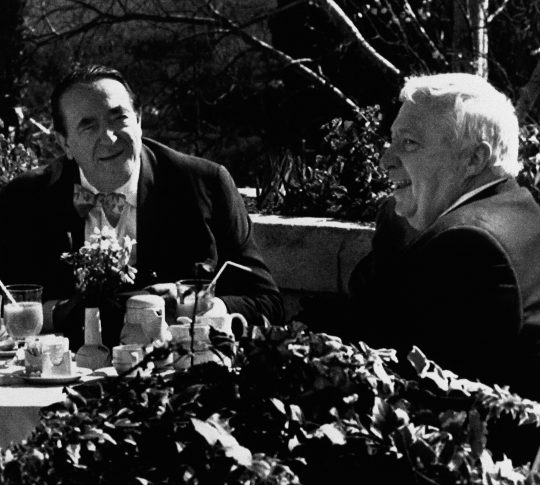
Ariel Sharon (right) meets with Robert Maxwell in Jerusalem on Feb. 20, 1990. Photo | AP
However, as MintPress reported in Part IV of the investigative series “Inside the Jeffrey Epstein Scandal: Too Big to Fail,” Epstein was involved with several arms dealers during this period of time, some of whom were directly involved in Iran-Contra arms deals between Israel and Iran. For instance, after leaving Bear Stearns in 1981, Epstein began working in the realms of shadow finance as a self-described “financial bounty hunter,” where he would both hunt down and hide money for powerful people. One of these powerful individuals was Adnan Khashoggi, a Saudi arms dealer with close ties to both Israeli and U.S. intelligence and one of the main brokers of Iran-Contra arms deals between Israel and Iran. Epstein would later forge a business relationship with a CIA front company involved in another aspect of Iran-Contra, the airline Southern Air Transport, on behalf of Leslie Wexner’s company, The Limited.
During this period, it is also known that Epstein became well acquainted with the British arms dealer Sir Douglas Leese, who collaborated with Khashoggi on at least one British-Saudi arms deal in the 1980s. Leese would later introduce Epstein to Steven Hoffenberg, calling Epstein a “genius” and describing his lack of morals during that introduction. Thus, there are indications that Epstein was involved with Middle Eastern arms deals, including some related to Iran-Contra, during this period. In addition, Epstein would later claim (and then subsequently deny) having worked for the CIA during this period.
After having been introduced to Epstein, Ben-Menashe claimed that neither he nor Davies were impressed with Epstein and considered him “not very competent.” He added that Ghislaine Maxwell had “fallen for” Epstein and that he believed that the romantic relationship between his daughter and Epstein led Robert Maxwell to work to bring the latter into the “family business” — i.e., Maxwell’s dealings with Israeli intelligence. This information is very revealing, given that the narrative, until now at least, has been that Ghislaine Maxwell and Jeffrey Epstein did not meet and begin their relationship until after Robert Maxwell’s death in 1991, after which Ghislaine moved to New York.
Ben-Menashe says that well after the introduction, though again he does not specify what year, Ghislaine Maxwell and Jeffrey Epstein began a sexual blackmail operation with the purpose of extorting U.S. political and public figures on behalf of Israeli military intelligence. He stated:
In this case what really happened, my take on it, in the later thing, is that these guys were seen as agents. They weren’t really competent to do very much. And so they found a niche for themselves — blackmailing American and other political figures.”
He then confirmed, when prompted, that they were blackmailing Americans on behalf of Israeli intelligence.
In response to his statement, Zev Shalev replied, “But, you know, for most people it’s hard for them to think of Israel as being … blackmailing their leaders in the United States, it’s a very …” at which point, Ben-Menashe interrupted and the following exchange took place:
Ari Ben-Menashe: You’re kidding? [laughs]…. It was quite their M.O. Sleeping around is not a crime, it may be embarrassing, but it’s not a crime, but sleeping with underage girls is a crime.
Shalev: It was a crime in 2000 as well, but they let him off that…
Ben-Menashe: And that it is [why] always so he [Epstein] made sure these girls were underage.
In addition, when Shalev asked Ben-Menashe about the relationship between Jeffrey Epstein and former Israeli Prime Minister Ehud Barak, Ben-Menashe stated “After a while, you know, what Mr. Epstein was doing was collecting intelligence on people in the United States. And so if you want to go to the U.S. if you’re a high-profile politician you want to know information about people.” Ben-Menashe subsequently stated that Barak was obtaining compromising information (i.e., blackmail) that Epstein had acquired on powerful people in the United States.
PROMIS, sex, and blackmail
If Robert Maxwell did recruit Epstein and bring him into the “family business” and the world of Israeli intelligence, as Ben-Menashe has claimed, it provides supporting evidence for information provided to MintPress by a former U.S. intelligence official, who chose to remain anonymous in light of the sensitivity of the claim.
This source, who has direct knowledge of the unauthorized use of PROMIS to support covert U.S. and Israeli intelligence projects, told MintPress that “some of the proceeds from the illicit sales of PROMIS were made available to Jeffrey Epstein for use in compromising targets of political blackmail.” As was noted in a Mintpress series on the Epstein scandal, much of Epstein’s funding also came from Ohio billionaire Leslie Wexner, who has documented ties to both organized crime and U.S. and Israeli intelligence.
After the PROMIS software was stolen from its rightful owner and developer, Inslaw Inc., through the collusion of both U.S. and Israeli officials, it was marketed mainly by two men: Earl Brian, a close aide to Ronald Reagan, later U.S. envoy to Iran and close friend of Israeli spymaster Rafi Eitan; and Robert Maxwell. Brian sold the bugged software through his company, Hadron Inc., while Maxwell sold it through an Israeli company he acquired called Degem. Before and following Maxwell’s acquisition of Degem, the company was a known front for Mossad operations and Mossad operatives in Latin America often posed as Degem employees.
With Maxwell — Epstein’s alleged recruiter and father of Epstein’s alleged madam — having been one of the main salespeople involved in selling PROMIS software on behalf of intelligence, he would have been in a key position to furnish Epstein’s nascent sexual blackmail operation with the proceeds from the sale of PROMIS.
This link between Epstein’s sexual blackmail operation and the PROMIS software scandal is notable given that the illicit use of PROMIS by U.S. and Israeli intelligence has been for blackmail purposes on U.S. public figures and politicians, as was described in a recent MintPress report.
Can an ex-spy be trusted?
When dealing in the world of deception and intrigue that defines intelligence operations, it is often difficult to determine whether any individual linked to an intelligence agency is telling the truth. Indeed, in the United States, there are examples of elected intelligence officials committing perjury and lying to Congress on several occasions with no consequences, and of intelligence officials feeding politically motivated and untrue information to agency assets in the media.
So, are Ari Ben-Menashe’s claims regarding Epstein and the Maxwells trustworthy? In addition to the aforementioned, corroborating information for his claims, a review of Ben-Menashe’s post-intelligence career suggests this is the case.
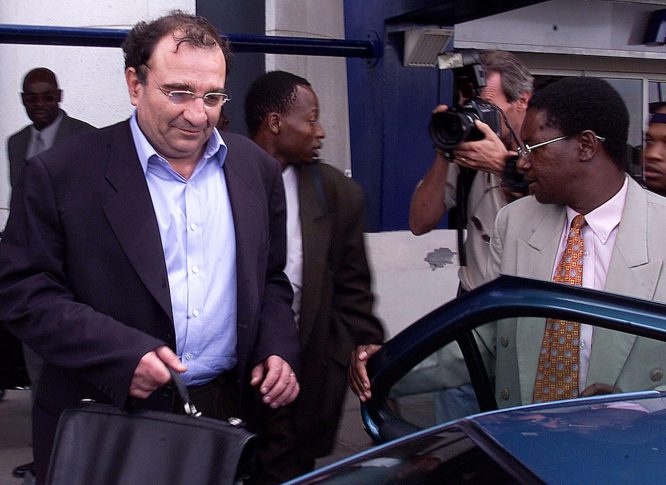
Ari Ben-Menashe arrives at Harare International Airport, in Zimbabwe, Feb. 22, 2002. Photo | AP
Prior to his arrest in November 1989, Ben-Menashe was a high-ranking officer in a special unit of Israeli military intelligence. He would later claim that his arrest for attempting to sell American-made weapons to Iran was politically motivated, as he had threatened to expose what the U.S. government had done with the stolen PROMIS software if the U.S. did not cease providing Saddam Hussein’s Iraq with chemical weapons. Ben-Menashe was later acquitted when a U.S. court determined that his involvement in the attempted sale of military equipment to Iran was done on behalf of the Israeli state.
After his arrest, Ben-Menashe was visited in prison by Robert Parry, the former Newsweek contributor and Associated Press reporter who would later found and run Consortium News until his recent passing last year. Parry remembered that, during that interview, “Ben-Menashe offered me startling new information about the Iran-Contra scandal, which I thought that I knew quite well.”
Israel’s government immediately began to attack Ben-Menashe’s credibility following his interview with Parry, and claimed that Ben-Menashe had never worked for Israeli intelligence. When Parry soon found evidence that Ben-Menashe had indeed served in Israeli military intelligence, Israel’s government was then forced to admit that he had worked for military intelligence, but only as a “low-level translator.” Yet, the documentation Parry had uncovered described Ben-Menashe as having served in “key positions” and performed “complex and sensitive assignments.”
A year later, Ben-Menashe would be interviewed by another journalist, Seymour Hersh. It would be Ben-Menashe who first revealed to Hersh secrets about Israel’s nuclear program and the fact that British media mogul Robert Maxwell was an Israeli spy, revelations that Hersh would not only independently corroborate but include in his book The Samson Option: Israel’s Nuclear Arsenal and American Foreign Policy. Hersh was then sued by Robert Maxwell and the Maxwell-owned Mirror Group for libel. The case was later settled in Hersh’s favor, as the claims Hersh had made were true and not libelous. As a result, the Mirror Group paid Hersh for damages, covered his legal costs, and issued him a formal apology.
After Ben-Menashe’s interviews by Hersh and Parry, Israel’s government was apparently concerned enough about what Ben-Menashe would tell congressional investigators that it attempted to kidnap him and bring him back to Israel to face state charges, much like Israeli intelligence had done to Israel’s nuclear-weapons whistleblower Mordechai Vanunu. The plan was foiled largely thanks to Parry.
Parry, who broke many key stories related to the Iran-Contra scandal in the 1980s and beyond, was tipped off by a U.S. intelligence source about a joint U.S.-Israel plan to have Ben-Menashe be denied entry to the United States on his planned trip to give congressional testimony. Per the plan, Ben-Menashe would be denied entry to the U.S. in Los Angeles and then be deported to Israel, where he would have stood trial for “exposing state secrets.” Parry called Ben-Menashe and convinced him to delay his flight until he secured a guarantee for safe passage from the U.S. government.
Ben-Menashe subsequently gave a sworn statement to the House Judiciary Committee that mostly focused on U.S.-Israel collusion regarding the theft and creation of a “backdoor” into the PROMIS software. Ben-Menashe offered to name names and provide corroborating evidence for several of his claims if he was offered immunity by the committee, which, for whatever reason declined that request.
Prior to the conclusion of the Hersh “libel” trial, which would later uphold Ben-Menashe’s claims regarding Robert Maxwell’s Mossad activities as true, there was a concerted effort in the U.S. press to downplay Ben-Menashe’s credibility. For instance, Newsweek — in an article on Ben-Menashe entitled “One Man, Many Tales” — claimed that “inconsistencies may undermine Ben-Menashe’s testimony in the British courtroom proceedings,” citing inconsistencies from sources in Israel’s government and Israeli intelligence as well as Ben-Menashe’s ex-wife and Israeli journalist Shmuel (or Samuel) Segev, a former IDF colonel. It goes without saying that such sources had much to gain from any effort to discredit Ben-Menashe’s claims.
According to Parry, this media campaign, which employed American journalists with close ties to Israel’s government and intelligence agencies, was very successful “in marginalizing Ben-Menashe by 1993, at least in the eyes of the Washington Establishment.” After a years-long media campaign to discredit Ben-Menashe, “the Israelis seemed to view him as a declining threat, best left alone. He was able to pick up the pieces of his life, creating a second act as an international political consultant and businessman arranging sales of grain.” The effort to marginalize Ben-Menashe has continued well into recent years, with mainstream news outlets still referring to him as a “self-described ex-Israeli spy” — despite the well-documented fact that Ben-Menashe worked for Israeli intelligence — as a means of downplaying his claims regarding his time in Israel’s intelligence service.
After the conclusion of the Hersh libel trial, Ben-Menashe became an international political consultant who “surrounded his far-flung business activities in secrecy and got involved with some controversial international figures, such as Zimbabwe’s leader Robert Mugabe,” and “conducted his international consulting business … in a wide variety of global hotspots, including conflict zones,” according to Parry. In addition to Mugabe, Ben-Menashe has also recently come under fire for his consulting work on behalf of Sudan’s military junta and Venezuelan opposition politician Henri Falcón.
Ben-Menashe has also maintained ties to several different intelligence services and eventually became a controversial whistleblower whose information led to the arrest of the former head of Canada’s Security Intelligence Review Committee, Arthur Porter.
As far as his character is concerned, Parry noted that Ben-Menashe could often be “his own worst enemy” and that, even though Parry considered his information regarding Iran-Contra and PROMIS reliable and noted that much of it was later corroborated, he “often compound[ed] his media problem by treating journalists in a high-handed manner, either due to his suspicions of them or his arrogance.”
Bill Hamilton, the original developer of the PROMIS software and head of Inslaw Inc., also found Ben-Menashe’s claims regarding the illicit use of PROMIS by U.S. and Israeli intelligence agencies to be credible, though he expressed doubts about Ben-Menashe’s character.
Hamilton told MintPress the following about Ben-Menashe:
Ari Ben Menashe was the first source to tell us reliable information about the role of Rafi Eitan and Israeli intelligence vis-a-vis PROMIS but, in the end, of course, he was a clandestine services-type guy whose official duties include the ability and willingness to lie, cheat, and steal.”
A threat revived
While Ben-Menashe may have been viewed as a “declining threat” after the early 1990s, his plans to meet with Robert Parry of Consortium News years later in 2012 to discuss Iran-Contra and other covert dealings of the 1980s appeared to change that. Right before he planned to travel from Canada to the United States to meet with Parry and “finally prove” the truthfulness of his past claims, a fire-bomb was thrown into his Montreal home, destroying it.
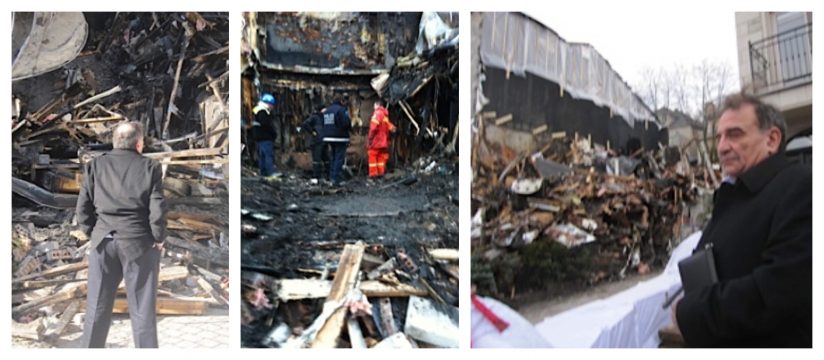
Ari Ben-Menashe surveys the damage to his home after it was mysteriously firebombed. Photos | Robert Parry
Though Canadian media referred to the incendiary device as a “molotov cocktail,” Consortium News reported that “the arson squad’s initial assessment is said to be that the flammable agent was beyond the sort of accelerant used by common criminals,” leading to speculation that the accelerant was military-grade.
Had it not been for the bomb, the origins of which Canadian police failed to determine, Ben-Menashe would have traveled to the U.S. alongside a “senior Israeli intelligence figure” to be interviewed by Parry. The other intelligence-linked individual, according to Parry, “concluded that the attack was meant as a message from Israeli authorities to stay silent about the historical events that he was expected to discuss.”
Though neither Ben-Menashe nor Parry directly blamed Israel’s government for the destruction of Ben-Menashe’s home, Parry noted that the bombing did succeed in “intimidating Ben-Menashe, shutting down possible new disclosures of Israeli misconduct from the other intelligence veteran, and destroying records that would have helped Ben-Menashe prove whatever statements he might make.”
While Ben-Menashe’s post-intelligence associations with controversial governments and individuals have given plenty of fodder to the still thriving media campaign to discredit his claims about covert U.S.-Israel operations in the 1980s, there remain troubling indications that the Israeli government sees his information on decades-old events as a threat.
Now, with the major efforts by powerful Americans and Israelis to distance themselves from Jeffrey Epstein and other figures associated with his depraved sex trafficking operation, Ben-Menashe may soon again find his reputation — and perhaps more — under fire.
Whitney Webb is a MintPress News journalist based in Chile. She has contributed to several independent media outlets including Global Research, EcoWatch, the Ron Paul Institute and 21st Century Wire, among others. She has made several radio and television appearances and is the 2019 winner of the Serena Shim Award for Uncompromised Integrity in Journalism.
Israel and the West Do Not Have the Means to Counter Iranian Technology
By Gilad Atzmon | October 1, 2019
Introduction by GA: The following is a translation of today’s Israel’s News 12 headline article. The article explores the lessons delivered by the recent attack on Saudi oil facilities. Though I, like many other commentators, am not convinced that the attack had anything to do with Iran, the attack showed that Iran’s weaponry is likely superior to the West’s ability to mount an effective defence.
Israeli writer Nir Dvori points out that the attack took place 650 km inside Saudi territory. “It proved measured Power Utilization – Sending two types of weapons that achieved accurate hits.” It also demonstrated superb intelligence capability – “both in identifying and selecting targets and in selecting the attack route and the military.” Apparently, neither the cruise missiles nor the drones were detected and no attempt was made to intercept them before the attack. Which really means that despite the Saudis’ multi- billion dollar investment in Western weaponry and air defense systems, their sky is far from protected.
In the last few years Israel has prioritized its efforts to counter Iran’s ballistic and drone projects. It seems Israel knew what it had to dread. The recent attack on the Saudi oil industry proved that the West has not developed an adequate response to Iranian precision missiles, slow moving cruise missiles or drone technology. This alone explains why, despite Israel’s persistent threats to attack Iran directly, it has been reluctant to do so. Israel knows how vulnerable it is and well understands the possible dramatic consequences of such an attack. Israel knows that although its anti missile system, which cost the American taxpayers billions of dollars, may be somewhat effective against German V2 ballistic technology, its system is ineffective against what Iran has at their disposal.
This helps explain why Israel wants America and NATO to attack Iran on its behalf. It may explain why Israel might consider doing whatever it can to provoke such a conflict- everything from intensive Lobby pressure to possible false flag operations.
Donald Trump seems miraculously to have gathered how volatile the situation is. As a consequence, he exited his prime hawk, John Bolton. Might Trump find himself booted out of his 1600 Pennsylvania Ave as a result of his reluctance to fight Israel’s war against Iran?
The character, uniqueness and success of the Iranian attack – worries Israel and the world
By Nir Dvori
The Iranian attack on Saudi oil facilities was of great significance and is of particular concern [to Israel]. The attack was [the first of its kind] and proved that the Iranians are capable and possess both the knowledge and the ability to hurt and cut [Saudi] oil production by nearly fifty percent. At the same time, the Saudis have already begun to rebuild the buildings damaged by the Iranian bombing
The attack on oil facilities in Saudi Arabia has been a warning for the West and Israel – the effects of this attack are extremely concerning. This [technological] ability that can be used against Israel requires that [Israel] prepare its security system to respond to such a threat. Israeli officials analyzed the outcome of the attack and reached several conclusions : The attack demonstrated both impressive design and execution, the results were painful and cut Saudi oil production by 50%, and likely affected gas production as well.
The attacks were carried out with only two weapon types :The first were 7 Quds cruise missiles driven by a Czech jet engine, 3 of which fell before they reached their target; the second weapons were 18 suicide drones, an Iranian replica of the “Rafi” – an Israeli suicide drone.
The attack was significant on a few levels:
The attack was carried out at a relatively long range – at a distance of 650 km.????
It proved measured Power Utilization – Sending two types of weapons that each achieved accurate hits.
Iran has also demonstrated its intelligence capability – both in identifying and selecting targets and in selecting the attack route and its execution.
Apparently neither the cruise missiles nor the drones were detected and no attempt was made to intercept them before the attack.
Iran’s inability to penetrate the Saudi air defense system, despite the billions of dollars spent and deployed to defend the area, was shown by its failure against the small, slow-moving assault weapons.
Impressive and unprecedented impact accuracy of less than 3 meters. The fragments of the Iranian cruise missiles have been identified as among the derivatives of the 55-KH missiles that Ukraine delivered to Iran in 2001.
The nature of the Iranian attack has embarrassed the Western intelligence community. It turned out that Iran, a country with average technological capabilities, has developed medium and long range missiles that are accurate and effective. This basically undermines the very existence of the regulatory bodies which assumes that denying access to technology can impede, or prevent such technologies being obtained.
The attack is proof of Iran’s operational potential that relies on technological capabilities, intelligence infrastructure and coordination, leading to the conclusion that the Western monopoly on precision-guided armaments has evaporated. The countries of the entire region and Israel have learned a lesson: Discovery and interception systems do not provide a proper countermeasure to new regional threats.
It is necessary to deal with cruise missiles, slow drones and hovercraft. The ranges reached by Iran this time – 650 km – would allow damage to any point in Israel from western Iraq.
How Israel Controls Its Narrative
Potential critics often self-censor
By Philip Giraldi • Unz Review • October 1, 2019
It is interesting to note how the Israel Lobby is able to manage and contain the commentary of groups in America that might normally be critical of Israeli policies vis-à-vis the United States. A recent article by Professor Andrew Bacevich entitled “President Trump, Please End the American Era in the Middle East” is a good example of how self-censorship by authors works. The piece appeared as one of Bacevich’s regular weekly contributions to The American Conservative website under the rubric “Realism and Restraint.”
The article particularly focused on the foreign policy pronouncements of Bret Stephens, the resident neocon who writes for The New York Times. Stephens, per Bacevich, has been urging constant war in the Middle East and worrying lest “we may be witnessing the beginning of the end of the American era in the Middle East.” Bacevich, unlike Stephens, is a genuine foreign policy expert, a realist, an Army veteran, and always quite sensible. He correctly described how “in the Middle East, the military power of the United States has played a large part in exacerbating problems rather than contributing to their solution.”
The overall message is sound, but in this case, it is interesting to note what Bacevich left out rather than what he included. It is easy to understand the “realism” part when he writes and it is sometimes also possible to perceive the “restraint.” He cited Iran seven times as well as Saudi Arabia, but, strangely enough, he never mentioned Israel at all, which a number of commenters on the piece noted. It rather suggests that there is a line that Bacevich is reluctant to cross. The omission is particularly odd as Israel is absolutely central to and might even be described as driving American policy in the Middle East and Bret Stephens, whom Bacevich excoriates, is a notable Israel-firster who once worked as the editor of the Jerusalem Post. Almost everything Stephens writes is basically a promotion of Israel and its interests coupled with a call for the United States to do what it must to attack and destroy the Jewish state’s principal perceived enemy Iran.
The reticence is perhaps understandable as Bacevich is president of a newly organized group called the Quincy Institute for Responsible Statecraft, which I have written about previously, that will have its official launch in November. It claims to promote “ideas that move U.S. foreign policy away from endless war and toward vigorous diplomacy in the pursuit of international peace” and further takes some pride in being non-partisan though bipartisan might be a better description. To be sure, Quincy’s two major donors are the highly controversial George Soros on the globalist left and the equally notorious Koch Foundation on the libertarian-lite right, which leads one to wonder who is ordering the restraint when it comes to Israel. Or is it both of them as neither organization, though very active in foreign policy, has indicated any desire to seriously criticize the many crimes of the Jewish state. I appear to have accurately predicted in my earlier article on Quincy that “… there will inevitably be major issues that Quincy will be afraid to confront, including the significant role played by Israel and its friends in driving America’s interventionist foreign policy.”
Indeed, anyone who wants to be a player in Washington DC has to avoid the Israel hot wire. That it should be so is a tribute to the power of the Jewish lobby coupled with the bulk support and Bible-belt votes of its brain-dead Christian Zionist spear carriers. Congress, once described by Pat Buchanan as “Israeli-occupied territory,” likewise knows whom not to offend lest one be unemployed in the next electoral cycle. That is why criminalizing criticism of Israel or support of a non-violent boycott of the country are regularly introduced in Congress and find themselves with more than one hundred sponsors and co-sponsors. Nearly two dozen such pro-Israel bills are currently at certain points in the legislative process, including one that will enable aggrieved Israelis to sue the Palestinian Authority (PA) in sympathetic U.S. courts for damages, a move that will potentially bankrupt the PA.
And the colleges and universities have not been immune from pressure to conform to the pro-Israel narrative. The White House acting through the Department of Education is functioning as thought police on behalf of the Jewish state. It is currently planning on withholding some federal funding of the University of North Carolina and Duke because their joint Middle Eastern studies program does not meet alleged government standards. The standards involved relate to the fact that the program has had speakers and course content that can be construed as critical of Israel and friendly to Muslims. The message clearly being sent to the schools by the Trump Administration is that if you criticize the Jewish state you will be punished.
The drive to eliminate any pushback against Israeli actions at colleges has been spearheaded by leading Zionist Kenneth L. Marcus, who was appointed the Education Department’s Assistant Secretary of Civil Rights. Marcus, who has worked as a paid pro-Israel activist, has been urging the government to define the BDS movement as anti-Semitic and has used his office to designate any Palestinian advocacy as a violation of Jewish students’ civil rights.
The federal action to enforce educational conformity on Israel is not exactly new as universities have long since been self-censoring, just like Bacevich, normally in response to complaints by Jewish groups. To cite only one example, in 2013, at nominally Catholic Fordham University in New York City, a student group sought to form a Students for Justice in Palestine (SJP) club. Their paperwork advised that their goal was to “build support in the Fordham community among people of all ethnic and religious backgrounds for the promotion of justice, human rights, liberation and self-determination for the indigenous Palestinian people.” The applicants also revealed that they would support the Boycott, Divestment and Sanctions (BDS) movement. Three years later, Fordham’s Dean of Education denied the application because of the support for BDS. The students took Fordham to court and in August of this year, three years later, a New York judge finally struck down the decision as “arbitrary and capricious.”
So it took six years and a lawsuit to enable a group of students to form a club that was admittedly political in nature but non-violent and welcoming of everyone. So much for freedom of speech and association at America’s colleges and universities when they run up against the Israel wall.
What is less observed is how Israel’s message is promoted at the state and local levels. At the state level, anti-BDS legislation is now the rule in 26 states, with some requiring government employees to sign a pledge not to boycott Israel. And the same thing is happening among Boards of Education. Fourteen states now require holocaust education, where students are compelled to read fiction like Eli Wiesel’s “Night” while also consuming the established and standard, largely fabricated, account of what the so-called holocaust was all about. In Virginia, for example, a shadowy group called the Institute for Curriculum Services (ICS), which is actually a “partisan group with backing by state and local Israel advocacy organizations,” is seeking to change the information conveyed by the history and social studies textbooks used in K-12 classrooms across the state. ICS recommended changes include: “1. Emphasizing Arab culpability for crisis initiation leading to military action and failure of peace efforts—and never Israeli culpability, even when it is undisputed historic fact. 2. Replacing the commonly used words of “settlers” with “communities,” “occupation” with “control of,” “wall” with “security fence,” and “militant” with “terrorist.” 3. Referencing Israeli claims such as “Israel annexed East Jerusalem” and the Golan Heights as accepted facts without referencing lack of official recognition by the United Nations and most member nation states.”
The ICS is only one example of the persistent Israel Lobby brainwashing of the American public on behalf of the Jewish state to completely alter the narrative about what is going on in the Middle East. Taken all together, the self-censorship of groups and individuals that wish to remain viable by ignoring the Israel problem, the criminalization of non-violent movements like BDS, and the pressure on universities and schools to conform with positive narratives about Israel means that any genuine understanding of that nation’s war crimes and crimes against humanity will, unfortunately, remain on the margins.
Philip M. Giraldi, Ph.D., is Executive Director of the Council for the National Interest, a 501(c)3 tax deductible educational foundation (Federal ID Number #52-1739023) that seeks a more interests-based U.S. foreign policy in the Middle East. Website is https://councilforthenationalinterest.org, address is P.O. Box 2157, Purcellville VA 20134 and its email is inform@cnionline.org.
Iran nuclear issue at inflection point

French President Emmanuel Macron met Iran’s President Hassan Rouhani at UN Hqs, New York, Sept 24, 2019
By M. K. BHADRAKUMAR | Indian Punchline | September 30, 2019
The unexpected move by the Pentagon to shift the Combined Air and Space Operations Center (CAOC) at al-Udeid Air Base in Qatar to the Shaw Air Force Base in South Carolina 7,000 miles away from the Middle East took place against the backdrop of the gathering storms in the regional environment. It injects a crisis atmosphere into regional politics.
To put the Pentagon move in perspective, in addition to hosting Qatari forces, the base also hosts the 379th Air Expeditionary Wing of the US Air Force. Other US military has been active in the country as well including the US Navy SEALS. The facility is also used by the British Royal Airforce. The al-Udeid Air Base is one of the few US airbases overseas where B-52 bombers, America’s largest warplane can land due to the long runways.
This is not the first time that the US temporarily relocated the CAOC. The last time it happened was 13 years ago. When tensions erupted between Qatar and Saudi Arabia, there was even talk of relocating the Central Command out of Qatar.
However, in the current scenario, the Pentagon move is undoubtedly related to the US’ mounting tensions with Iran. If push came to shove and a full blown US-Iran conflict erupts, the CAOC would be one of Iran’s priority targets. The CAOC is so critical to providing fire power for the US forces operating in the region that the Pentagon cannot take risks. The US commander of the 609th Air and Space Operations Center has been quoted as saying, “Iran has indicated multiple times through multiple sources their intent to attack US forces.”
How serious are the prospects of a US-Iran military conflict? Iran’s President Hassan Rouhani disclosed after his return to Tehran from New York that the two sides came breathtakingly close to a summit meeting on the sidelines of the UN GA in New York last week. Rouhani said,
“They (Americans) had sent messages to almost all European and no-European leaders that they wanted one-to-one negotiations between the two Presidents, but we had rejected it, saying that negotiations had to be done in the framework of P5+1, and they accepted.”
“Of course, 3 out of the 6 countries, that is the Chancellor of Germany, Prime Minister of Britain, and President of France all insisted for the meeting to be held, saying that the US would lift all sanctions. But the problem here is that under sanctions and maximum pressure, even if we want to negotiate with the Americans within the framework of P5+1, nobody can predict about the end and upshot of the negotiation.”
Significantly, last Tuesday, during the UNGA in New York, Saudi Arabia’s Crown Prince Mohammad bin Salman (MbS) also spoke with noticeable restraint in a rare interview with CBS’ ’60 Minutes’. MbS warned, “If the world does not take a strong and firm action to deter Iran, we will see further escalations that will threaten world interests. Oil supplies will be disrupted and oil prices will jump to unimaginably high numbers that we haven’t seen in our lifetimes.” And he went on to stay that a “political and peaceful solution is much better than the military one.”
Importantly, he was categorical that there should be a US-Iranian summit meeting, and added, “this is what we all ask for.” Conventional wisdom is that Saudi Arabia is petrified that the US may engage with Iran directly. But that is apparently not the case.
No doubt, the Russian President Vladimir Putin’s visit to Saudi Arabia in October will be keenly watched. Prior to the Saudi visit, Putin will be meeting Rouhani on the sidelines of the summit meeting of the Eurasian Economic Union (EAEU) in Yerevan on October 1 when the regional situation and the Iran nuclear deal will certainly be on the agenda of discussion.
This is a defining moment in Russian-Iranian relations too, as Iran is about to sign the formal agreement to join a free trade zone with the EAEU, which of course is a prestigious Kremlin project.
Moscow is cautiously optimistic that “Possibly we will achieve some positive solution (on the 2015 nuclear deal) over several months to come, or else the situation will continue to get worse,” to quote Russia’s representative at international organisations in Vienna, Mikhail Ulyanov during a press conference on Friday to highlight that the Iran nuclear issue is approaching an inflection point.
But Iran is potentially inching its way back [?] in the nuclear weapons business, with a fourth step it is expected to take in early November to reduce its commitments under the 2015 deal. A report in the Guardian last week said the European Union has “privately warned Iran that it will be forced to start withdrawing from the nuclear deal in November if Tehran goes ahead with its threat to take new steps away from the deal… The EU told Iran that it would put the issue of Iranian non-compliance into the agreement’s formal dispute mechanism if the next Iranian move away from the deal is significant… Once the deal’s dispute mechanism is triggered, both sides have 30 days to prove significant non-compliance, and if necessary a world-wide sanctions snap-back occurs.”
The Guardian report put across the European dilemma on the following lines: “The difficulty is that Iran says the steps are reversible, but if they learn about building a nuclear bomb, that is irreversible.”
Iran is no longer finding the support it hoped for in Europe and could be susceptible to broad censure. Conversely, the US is getting the opportunity to restore a modicum of credibility with its allies and the international community, which would broaden the pressure on Iran.
On the other hand, a climb-down by Trump is becoming more difficult in the rising tumult of impeachment proceedings. But while he may appear to have boxed himself in, it is still up to him to offer to Iran that resuming compliance with the 2015 agreement would be met with concrete benefits, like the $15 billion bailout package France’s president, Emmanuel Macron, has proposed.
Such a turn to events between now and November cannot be ruled out. After the UNGA, Trump hinted at willingness to negotiate. He said on Friday, “I don’t want military conflict. We’ve offered to talk, we’ve offered to discuss things… I’ve shown great restraint and hope that Iran likewise chooses peace.”
It is within these broad parameters that events may unfold in the coming months. Meanwhile, Pentagon is doing advance planning by shifting the CAOC away from the zone of conflict.
The Epstein Connection to 9-11
Christopher Bollyn – September 10, 2019

Yitzhak Shamir and Benjamin Netanyahu at the Madrid conference, October 1991. Under pressure from the U.S. to reach a peace settlement with the Palestinians, Shamir created “Mega”, a group of rich American Zionists, to support Israel.
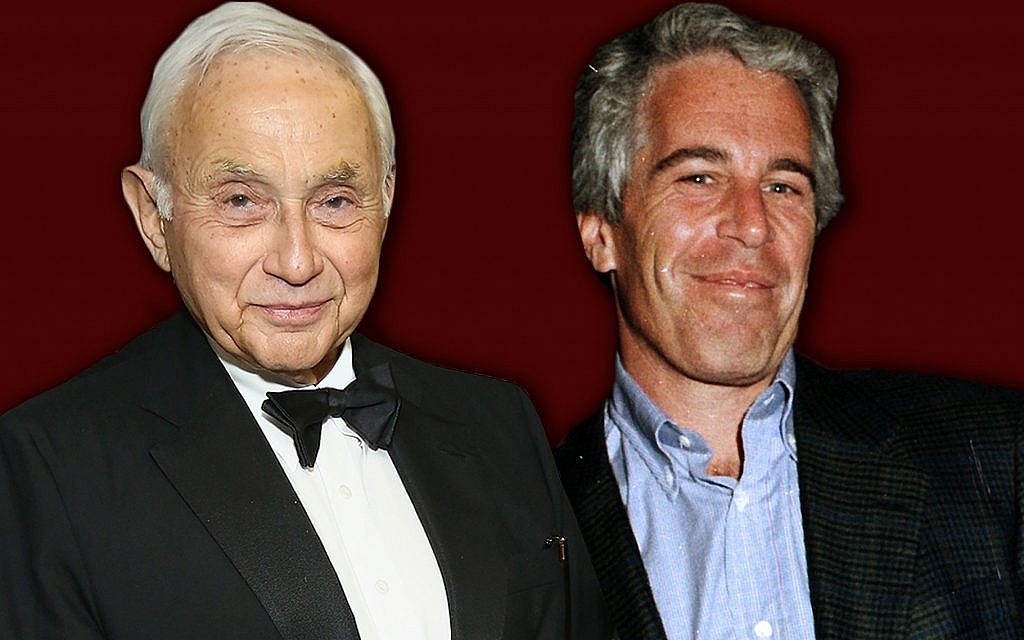
Leslie Wexner, a member of Mega, funded Epstein for years. Was Wexner supporting Epstein to finance a covert Israeli operation?
(Laura E. Adkins/Getty Images via JTA )

Epstein was arrested in July 2019 on federal charges for sex trafficking of minors in Florida and New York. He is reported to have died in his jail cell on August 10, 2019.

Ehud Barak and Jeffrey Epstein have been partners for years. Epstein financed and managed the Wexner Foundation, which gave Barak $2.3 million in 2004, as reported by Israeli journalist Erel Segal. (Source: Revealed: Jeffrey Epstein Entered Partnership Worth Millions With Ehud Barak in 2015, Haaretz )

Michael Chertoff, the former Assistant Attorney General who managed the “non-investigation” of 9-11 (i.e. the cover-up), is on the board of advisors of Ehud Barak’s company, Carbyne, which was funded by Jeffrey Epstein. This connects the criminal network behind 9-11 with the Epstein blackmail operation.
The cover-up is the most essential part of the 9-11 terror atrocity because it is what allows the real masterminds behind the terrorism to attach a false narrative to the crime. The false narrative is designed and prepared in advance to deceive the people and bring public opinion into alignment with the real agenda behind the terror operation.
The most obvious part of the 9-11 agenda was to launch the Global War on Terror, which has become the longest and most expensive war in U.S. history. The fact that the public is not shouting from the rooftops against this costly and fraudulent military campaign is an indication of how successful the 9-11 cover-up has been. Since 9-11, some seven trillion dollars have been wasted on waging wars in the Middle East in which there is no real U.S. interest or benefit to the American people, as President Trump said on April 28, 2018.
The people behind the 9-11 cover-up are clearly part of the criminal network behind the terror atrocity itself. In the Solving 9-11 books I identify many of the key players in the network behind the crime and cover-up. Two of the highest level masterminds involved in the 9-11 cover-up are the former Israeli prime minister and military chief, Ehud Barak, and the former Assistant Attorney General Michael Chertoff.
On 9-11, Ehud Barak was the first person to promote the false narrative by placing the blame for the terror attacks on Osama Bin Laden and calling for a U.S.-led Global War on Terror, which he did from the London studios of the BBC World television network and Rupert Murdoch’s Sky News – all before the towers had fallen on September 11, 2001.
Assistant Attorney General Michael Chertoff was responsible for the federal investigation of 9-11 as head of the criminal division of the Department of Justice. Chertoff’s effort is better described as a “non-investigation” because rather than solving the crime it resulted in the immediate and massive destruction of evidence from the crime scenes where some three thousand people were murdered on 9-11.
The fact that Michael Chertoff now sits on the board of advisors of Ehud Barak’s company, Carbyne, and that Jeffrey Epstein invested millions of dollars into Barak’s enterprise is a solid line connecting the criminal network behind 9-11 with the Epstein sexual blackmail operation.
This is how it works. Epstein’s blackmail operation was designed to control politicians and other agents of influence, which is exactly what is required to maintain a high-level 9-11 cover-up for eighteen years. The fact that Epstein’s racket was supported by Leslie Wexner, a member of the Mega group, is more evidence that Epstein and his partner Ghislaine Maxwell were working for an operation run at the highest level by Israeli intelligence. The Mega group consists of U.S.-based Zionist billionaires dedicated to serving the state of Israel. Mega was established in 1991 during the reign of the former terrorist leader Yitzhak Shamir as Israel’s prime minister.
As Gidi Weitz reported in the Israeli newspaper Haaretz on July 11, 2019:
Revealed: Jeffrey Epstein Entered Partnership Worth Millions With Ehud Barak in 2015
The American billionaire financier Jeffrey Epstein, a registered sex offender who was arrested this week on new sex-trafficking charges involving underage girls, partnered with former Prime Minister Ehud Barak to invest in the former prime minister’s startup.
In 2015 Barak set up a limited partnership, in which he is the sole shareholder. That company invested in Reporty Homeland Security, established in 2014, becoming a major shareholder. Last year Reporty changed its name to Carbyne. The company develops call-handling and identification capabilities for emergency response services.
Barak is the chairman of Carbyne and according to reports by [sic] business media outlets, his personal investment in the company totals millions of dollars in it. Haaretz has learned that Epstein financed a considerable part of the investment, thus becoming a partner in the project.
Sources:
“Ehud Barak, Chairman and Investor,” Carbyne Board of Directors, Carbyne911.com
https://carbyne911.com/team/ehud-barak/
“Secretary Michael Chertoff,” Carbyne Board of Advisors, Carbyne911.com
https://carbyne911.com/team/michael-chetroff/
“Revealed: Jeffrey Epstein Entered Partnership Worth Millions With Ehud Barak in 2015” by Gidi Weitz, July 11, 2019
https://www.haaretz.com/amp/israel-news/.premium-revealed-jeffrey-epstein-entered-million-dollar-partnership-with-ehud-barak-in-2015-1.7493648
To support Bollyn’s research and writing, donate at: http://bollyn.com/donate/ or by PayPal to: bollyn@bollynbooks.com
Trump Frees Himself From Bolton – but Robert O’Brien Will Be Just as Bad
By Philip Giraldi | Strategic Culture Foundation | September 26, 2019
After months of rumors, John Bolton was finally fired from the White House but the post mortem on why it took so long to remove him continues, with the punditry and media trying to understand exactly what happened and why. Perhaps the most complete explanation for what occurred came from President Donald Trump himself shortly after the fact. He said, in some impromptu comments, that his national security advisor had “… made some very big mistakes when he talked about the Libyan model for Kim Jong Un. That was not a good statement to make. You just take a look at what happened with Gadhafi. That was not a good statement to make. And it set us back.”
Trump has a point in that Bolton was clearly suggesting that North Korea get rid of its nuclear weapons in exchange for economic benefits, but it was the wrong example to pick as Libyan leader Moammar Gadhafi gave up his weapons and was then ousted and brutally killed in a rebel uprising that was supported by Washington. The Bolton analogy, which may have been deliberate attempt to sabotage any rapprochement, made impossible any agreement between Kim and Trump as Kim received the message loud and clear that he might suffer the same fate.
More recently, Bolton might have been behind media leaks that scuttled Trump’s plan to meet with Taliban representatives and that also, acting on behalf of Israel, undercut a presidential suggestion that he might meet with Iranian President Hassan Rouhani. Trump summed up his disagreements with Bolton by saying that the National Security Advisor “wasn’t getting along” with other administration officials, adding that “Frankly he wanted to do things — not necessarily tougher than me. John’s known as a tough guy. He’s so tough he got us into Iraq. That’s tough. But he’s somebody that I actually had a very good relationship with, but he wasn’t getting along with people in the administration who I consider very important. And you know John wasn’t in line with what we were doing. And actually in some cases he thought it was too tough, what we were doing. Mr. Tough Guy.”
Trump’s final comment on Bolton was that “I’m sure he’ll do whatever he can do to spin it his way,” a throw-away line that could well set the stage for what comes next. Bolton has many supporters among hardliners in the GOP and the media and will no doubt be inclined to respond to the president in kind, but once the back and forth starts many other factors and relationships will come into play.
After the firing, it was widely believed that Donald Trump might have actually gotten rid of Bolton for all the right reasons, namely that as president he is disinclined to start any new wars and seeks negotiated solutions to existing conflicts, both of which concepts were no doubt regarded as anathema by the National Security Advisor. Unfortunately, that argument runs into problems where rhetoric and deeds disconnect if one considers actual actions undertaken by the president, to include the man that Trump has now named as Bolton’s replacement, Special Presidential Envoy for Hostage Affairs Robert O’Brien.
O’Brien might well have been ranked among the worst possible choices among the names floated in the media for the National Security Advisor position, mostly because he is almost completely lacking in actual experience related to the job. To be sure, he looks more presentable than the wild-eyed and walrus mustachioed Bolton, but Trump has repeatedly been overly deferential towards the bona fides of hardliners like O’Brien who boast of American Exceptionalism. The president will also likely appreciate that the sycophantic O’Brien’s lack of experience will mean that he will be completely deferential to the Chief Executive’s point of view at all times.
Trump’s cabinet choices have been so bad that they have led to musical chairs in nearly all senior positions. The president is to blame for having appointed Bolton, a man he disliked, though admittedly under orders from Israeli-American casino billionaire Sheldon Adelson, and he also did not have to elevate Mike Pompeo first as CIA Director and then as Secretary of State. There is no one around who outdoes Pompeo when it comes to avoiding diplomacy and negotiations while also threatening dire consequences for America’s “enemies.” O’Brien’s hardline credentials are largely indistinguishable from those of Pompeo and Bolton and it is widely believed that his appointment was due to advocacy by the Secretary of State, who is reportedly assembling his national security team.
And it should be observed that Trump’s claimed avoidance of war credentials are pretty thin. Far from fulfilling campaign promises to end the wars he inherited, Donald Trump has continued and even escalated those conflicts. He has withdrawn from agreements with Russia and Iran that enhanced US national security. Drone strikes under Trump have increased dramatically and have exceeded the number occurring during both of Obama’s terms, while new rules of engagement have led to a major increase in civilian casualties from US bombing directed against ISIS and the Taliban. Most recently in Afghanistan, 30 farm workers were killed in a drone strike. Trump is also doubling down on his support for the Saudi genocide against Yemen.
And the president has demonstrated that he is willing to attack countries that do not threaten the US and with which Washington is not at war. He has twice illegally bombed Syria based on phony intelligence and even when he decided at the last minute not to use force, as he did earlier this year with Iran, there was no serious evidence that he was truly seeking dialogue. He is waging “maximum pressure” economic warfare against both Iran and Venezuela, in both of which countries he has called for regime change. He has threatened Russia over Crimea and Ukraine and is in a trade war with China. Transparent regime change policies coupled with willy-nilly imposing of sanctions are destructive, hostile steps that kill people in the targeted countries and make enemies where none previously existed.
America’s new National Security Advisor Robert O’Brien recently featured in a taxpayer funded trip to Stockholm to obtain the release of rapper ASAP Rocky, who had been arrested after getting involved in a fist fight. O’Brien had orders to threaten unspecified retaliation against the Swedish government if it did not accede to White House demands. That exercise in international bullying means that O’Brien is quintessentially Trump’s kind of guy. He has written a book entitled While America Slept: Restoring American Leadership to a World in Crisis, calling on the United States to end any “appeasement and retreat,” and has described the nuclear agreement with Iran, in predictable neocon fashion, as a repeat of 1938, Hitler and Munich. He was Mitt Romney’s foreign policy adviser and is a Mormon, which means he basically lines up alongside the Christian Zionists when it comes to Israel.
The Israel Lobby has predictably welcomed O’Brien. Sandra Parker or Christians United for Israel (CUFI), enthused how “CUFI enjoys a close working relationship with many officials throughout the Trump Administration, and we look forward to working with Ambassador O’Brien on strengthening the US-Israel relationship, confronting the Iranian menace, and curtailing the threat posed by terrorist organizations such as Hamas and Hezbollah.”
Mort Klein President of the Zionist Organization of America observed how “Mr. O’Brien is a great friend of Israel, and is now the top-ranking Mormon in the pro-Israel Trump administration. He is also best friends with ardent Zionist US Ambassador to Germany [Richard] Grenell … And you can’t be a great friend of evangelical Christian Grenell unless you support Israel.”
So, does the firing of John Bolton and replacement by Robert O’Brien mean that there will be a change of direction in US foreign policy? The answer has to be no. Trump might well be maneuvering to avoid a new war as he will be in full 2020 campaign mode and wants to avoid falling into a quagmire, but the basic belligerency of the administration and its strong tilt towards supporting feckless allies like Israel and Saudi Arabia is certain to continue.
Iranian President’s multifaceted UNGA speech, directed at President Trump, falls on deaf ears
By Sarah Abed | September 26, 2019
All eyes this week are on the events taking place at the 74th annual UN General Assembly (UNGA) which kicked off on Monday at UN Headquarters in New York. Hundreds of meetings, speeches, and events are planned to take place with representatives and world leaders from around the world.
In an entirely predictable move to appease the US, a joint statement was issued on Monday, by France, Germany, and the U.K, parroting Washington’s position of blaming Iran for the September 14th missile and drone strikes on Saudi Oil infrastructure.
In the joint statement they wrote, “it is clear for us that Iran bears responsibility for this attack. There is no other plausible explanation.” They reiterated their commitment to the JCPOA but called for new talks on a more comprehensive long-term agreement that deals with nuclear, regional, and missile activities.
In response to the statement, Iran’s Foreign Minister Javad Zarif said that the three nations should muster the will to forge their own path rather than parroting absurd US claims and making requests which are inconsistent with established JCPOA terms. He also stated that there will be no new deal without compliance with the current one.
In reviewing a lot of the side conversations that have been taking place between President Rouhani and other world leaders from France, Germany, the U.K., Switzerland, Sweden, Pakistan, etc. it appears that in the US’s absence these nations seem supportive of Iran’s efforts to keep the JCPOA deal alive. However, threats from Washington to sanction countries that do business with Iran like China, are worrisome and causing them to peddle back.
In a speech given on Wednesday, Iran’s President Hassan Rouhani said, “The Middle East is burning in the flames of war, bloodshed, aggression, occupation and religious and sectarian fanaticism and extremism.” President Rouhani spoke about Iran’s desire to solve and not create problems. He stated the United States was openly violating its responsibilities under the JCPOA and invited the US to come back to the negotiating table if they are willing to end sanctions and threats which violate principles of ethics and international law.
President Rouhani stressed that his proposal is clear they are not interested in war, in threats, in bullying, and want everyone involved to act according to the law and fulfill their obligations. President Rouhani spoke about Iran’s decades-long fight against terrorism and how on the contrary the US has been supporting and arming terrorist groups for decades. He spoke about the US’s involvement in Syria, Yemen, and Israel’s crimes against Palestinians.
Iranian President spoke about the need for the US to pull its troops out of the Middle Eastern region, saying that the ultimate way to achieve peace, security and independence is for the neighboring countries to work things out without foreign interference, which is fueling insecurity rather than bringing peace.
President Rouhani spoke about his new initiative the Coalition of Hope or Hormuz Peace Endeavor (HOPE) which he is proposing at the UNGA and encouraging cooperation in providing collective energy security, freedom of navigations and free flow of oil and other energy resources from and to the countries off the Strait of Hormuz and beyond.
President Rouhani said that this initiative is based on a commitment to UN principles, objectives, mutual respect, mutual interests, dialog, understanding, respect for sovereignty and territorial integrity, peaceful resolution of conflicts and most importantly non-aggression and non-interference in the domestic affairs of each other.
“The issues of the region are too big and important for the United States to deal with. A country that has failed to resolve the issues of Afghanistan, Iraq and Syria, and has been the spearhead of extremism, Talibanism and Daeshism will never be able to resolve more sophisticated issues,” stated Iranian President Rouhani.
On Wednesday, a meeting chaired by the European Union’s top diplomat, Federica Mogherini took place with representatives of those same three European countries along with Russian and Chinese representatives and Iran’s Foreign Minister Mr. Zarif. It was agreed upon that all participants wanted to see the deal fully implemented and that they were determined to continue all efforts to preserve the agreement. Participants were reminded that the agreement was endorsed by the U.N. Security council and that the pact “remains a key element of the global nuclear nonproliferation architecture, and a significant achievement of multilateral diplomacy.”
President Trump’s decision last year to not only unilaterally withdrawal from the JCPOA but also enforce a “maximum pressure campaign” is seen by the Iranian government as “economic terrorism”. Harsh sanctions not only target financial establishments and government officials but the most vulnerable Iranian civilians who as a result are having trouble accessing food and medicine.
Underneath all the grandstanding both nations are not genuinely interested in war. Iran understands Trump’s distaste with the JCPOA being that it was negotiated by former president Barak Obama’s regime. They are willing to make some modifications and give him his own deal even though the previous one took a decade of negotiations, but for that to happen they need relief from crippling sanctions. They need the United States to show a genuine interest in coming back to the negotiating table. We’ve all seen how in the course of a day or a tweet tensions can suddenly flare up.
President Rouhani’s speech was an invitation to President Trump to come to the negotiating table. He outlined what needs to be done and Iran’s willingness and desire to choose peace over war. Washington has expressed similar sentiments at times but has then quickly reverted to rebuking and enforcing stricter sanctions rather than alleviating them. It’s in everyone’s best interest that all parties involved keep a cool head and come to agreeable terms, for the sake of humanity.
Sarah Abed is a political analyst with BRICS.
A Precision Strike on US Credibility – Shattering a US Paradigm
By Alastair Crooke | Strategic Culture Foundation | September 23, 2019
The precision attack on the Saudi ‘jewel in the crown’, crude-processing installation last week, is also a precision assault on Saudi credibility, on the believability of the US security ‘umbrella’, and a humiliation for Trump, and particularly to America’s image as a competent military and intelligence power.
Gulf States will be pursing their lips as they consider now their own vulnerabilities and question their reliance on that US umbrella. Even the Pentagon might be questioning, ‘what then – is the point to CentCom’ in light of what has happened? And above all, Israel will be experiencing a very chill wind sending shivers up the spine: Israelis cannot but be a tad struck in awe at the attack’s precise targeting and technical efficacy. Quite impressive – especially given that Saudi spent $65 billion on weaponry last year, to no good avail.
Facing this humiliation, the US Administration has been ‘blowing smoke’: tossing around red-herrings about the origin and launch of the UAVs and cruise missiles. ‘It can’t be AnsarAllah (the Houthis), because such an operation was sophisticated beyond their capabilities’. Apart from the obvious Orientalism to this assertion (for, if Hizbullah can manufacture smart drones and smart cruise missiles, why shouldn’t the Houthis be able so to do?), do the exact, individual contributions towards the strike on Abqaiq really matter? What is most telling is that the US – with all its massive resources in the Gulf – cannot provide the evidence from whence came these UAVs to Abqaiq.
Actually, the ambiguity about the strike modus operandi represents just another layer to the sophistication of the attack.
The US is ‘blowing smoke’ about launch sites mainly to divert from the very obvious (but embarrassing) fact that the raining down of missiles on Abqaiq, primordially owes to the Saudi war on Yemen (supported unreservedly by Trump). The Houthis have claimed the attack; they say they will demonstrate their weaponry (which certainly in the case of the Houthi Quds 1 cruise missile is no mere copy of the Iranian Soumar missile – see here), and promise to repeat their attacks in the near future.
What the precision strike has done is to shatter the ‘vessel’ of the US posing as somehow ‘guardian’ of the Gulf, and guarantor of the crude oil lifeblood feeding into the veins of a fragile world economy. This to say, it was a precision strike aimed at the prevailing paradigm – and it scored a direct hit. It exposed the hollowness of both claims. Anthony Cordesman writes, “the strikes on Saudi Arabia provide a clear strategic warning that the US era of air supremacy in the Gulf, and the near US monopoly on precision strike capability, is rapidly fading”.
Were the Iranians directly or indirectly involved? Well … it doesn’t really matter. To understand the implications properly, it should be understood as somehow a joint message – coming from a common front (Iran, Syria, Hizbullah, Hash’d a-Shaibi and the Houthis). This was about blasting the wider sanctions crisis to a head: a strategic (missile) popping of the over-inflated ‘balloon’ of the efficacy of US “maximum pressure” tactics. Trump’s ‘sanctioning/tariffing the world’ had to be brought to a head – and be exploded. Russia and China would almost certainly concur, and (quietly) applaud.
There are clear risks to this approach. Will the message be heard correctly in Washington? For, as Gareth Porter points out in a different context, Washington’s ability to comprehend, or to ‘read well’, its ‘enemies’ mind seems to have been somehow lost – out of a failure in Washington to discover any strain of empathy towards ‘otherness’ (either Iranian, Chinese or Russian). So the prospects, probably, are not great. Washington will not ‘get it’, but rather, may double-down, with potentially disastrous consequences. Porter writes:
“The Abqaiq strike is also a dramatic demonstration of Iran’s ability to surprise the United States strategically, [thus] upsetting its political-military plans. Iran has spent the last two decades preparing for an eventual confrontation with the United States, and the result is a new generation of drones and cruise missiles that give Iran the ability to counter far more effectively any US effort to destroy its military assets and to target US bases across the Middle East.
“The United States was apparently taken by surprise when Iran shot down a high-altitude … surveillance drone … Iran’s air defence system has been continually upgraded, beginning with the Russian S-300 system it received in 2016. Iran also just unveiled in 2019 its Bavar-373 air defence system, which it regards as closer to the Russian S-400 system coveted by India and Turkey – than to the S-300 system.
“Then there is Iran’s development of a fleet of military drones, which has prompted one analyst to call Iran a ‘drone superpower’. Its drone accomplishments reportedly include the Shahed-171 “stealth drone” with precision-guided missiles, and the Shahed-129, which it reverse-engineered from the US Sentinel RQ-170 and the MQ-1 Predator” [link added].
Understanding Porter’s message represents the key to comprehending the nature of the ‘Great Shift’ taking place in the region. Robot planes and drones – simply – have changed the calculus of war. The old verities no longer hold – there is no simple US military solution to Iran.
A US attack on Iran will bring only a firm Iranian response – and escalation. A full US invasion – as in the 2003 invasion of Iraq – is no longer within US capabilities.
There is only a political answer. But for now, the US and MbS both, are in a stage of denial: the latter apparently believes that continuing with the partial sale of Aramco might solve his problems (though markets have just re-awoken to geo-political risk to assets, such as Aramco), and Trump seems still to believe that maximum pressure might still come up trumps.
For the rest of us, ‘the political’ is pretty obvious for Saudi Arabia: Accept defeat in Yemen, and with it, its corollary – engaging with Iran and Russia is a sine qua non for achieving any settlement. For sure it will be costly for MbS, both politically and financially. But what is the alternative? Wait upon further Abqaiqs? To be fair, there are reports that the al-Saud understand their situation now to be existential. We shall see.
And for Trump, the lesson surely is clear. The strike on Abqaiq could have been easily worse (with greater interruption to oil supplies). Oil markets and markets more generally have woken up to the geo-political risks to Trump’s maximum pressure tactics. And they are becoming nervous, as world trade falters.
Headlines such as “Stunning weekend attacks take out 50% of Saudi Arabia’s oil output … Can the economy survive a higher oil price…?” may be a bit too alarmist, but they make the point: Supply disruption could easily tip the fragile US and the global economy into recession, were higher prices to be sustained.
No one is more aware of this than President Trump because his re-election chances in 2020 may hinge on whether the US can stay out of recession. Generally speaking, US Presidents who seek a second term are always re-elected, unless they have a recession late in their first term. This happened to Jimmy Carter and George H.W. Bush – both lost re-election bids because of recessions on their watches.
Already both Saudi Arabia and Trump are rowing back from a possible (diversionary) confrontation with Iran (in lieu of addressing the Yemen issue, which remains at the root of Saudi’s difficulties). The question is how long denial over the flaws to the maximum-pressure Iran policy might continue? Up to the elections? Probably yes. Trump has some constituency egos he must stroke – in parallel to avoiding the potentially fatal landmine of recession – if he is to gain a second term. And that means pandering to the Evangelical and AIPAC obsession with Iran as our era’s ‘cosmic evil’ – one positive ‘straw in the wind’ might be the end to the Netanyahu reign (although Gantz is no Iran ‘dove’).
Will More US Troops in Saudi Arabia Make America Great?
By Ron Paul | September 23, 2019
President Trump deserves credit for resisting the war cries from neocons like Sen. Lindsey Graham and Secretary of State Mike Pompeo after last week’s attack on two Saudi oil facilities. Pompeo was eager to blame Iran because he wants war with Iran and anything that can trigger such a war is fine with him. So he put the president in a difficult spot by declaring Iran the culprit: suddenly the president’s options in the media and in Washington were limited to “how to punish Iran.”
A week has now passed since the attack and Pompeo’s rush to judgement has been shown for what it was: war propaganda. That is because there has still been no determination of who launched the attack. Yemen’s Houthis took responsibility right away and Iran denied any involvement. We have seen nothing to this point that contradicts this.
President Trump likely understands that a US war on Iran will be his undoing as president. Who knows, maybe that’s what his closest advisors want. But according to a Gallup poll just last month, only 18 percent of Americans were in favor of military action against Iran. Seventy-eight percent of Americans – including 72 percent of Republicans – want the president to pursue diplomatic efforts over war. Iran has made clear that any attack on its territory will trigger a total war. The Middle East would be engulfed in flames and the US economy would be in the tank. Suddenly we’d see Democrat challengers pretending to be antiwar!
The message to Trump is pretty clear – war with Iran would be deeply unpopular – and it seems clear he understands the message. Just hours after his Secretary of State put the US on war footing with Iran, President Trump was forced to walk back Pompeo’s aggression. When asked about going to war with Iran, President Trump said, “Do I want war? I don’t want war with anybody.”
Unfortunately, with pressure on President Trump to “do something” even as Iran has not been found to have been behind the attack, the president has settled on two measures – one pointless and the other dangerous. On Friday Trump announced yet even more sanctions on Iran, leaving many of us to wonder what is possibly left to sanction. He also announced a deployment of US military forces to Saudi Arabia of a “defensive nature.” Why should the military be sent to “defend” one of the wealthiest and most repressive countries on earth? It is hard to see how putting US servicemembers into harm’s way – into a war zone – to defend Saudi Arabia can in any way make America great again. I believe most Americans would agree.
President Trump should immediately cancel the order to send US troops to Saudi Arabia and should immediately remove what troops are already on Saudi soil. Then the Saudis would understand that they must end their aggression against Yemen.
Attempting to placate the neocons is a fool’s errand, because they are never satisfied even up to and including war. The tide is turning in America – and even in Washington – against Saudi Arabia. After the murder of journalist Jamal Khashoggi and a catastrophic four-year Saudi war on Yemen, no American politician is any longer in the mood to stick his or her neck out to defend Saudi Arabia. President Trump would be wise to use caution: it’s always dangerous sticking one’s neck out when the Saudi government is around.
Copyright © 2019 by RonPaul Institute.
Iran’s Hormuz initiative seeks lasting peace in the Persian Gulf: Rouhani
Press TV – September 23, 2019
Iranian President Hassan Rouhani says the peace initiative that he will soon unveil at the United Nations General Assembly is aimed at establishing long-term peace in the Persian Gulf, something he said is simply not achievable as long as outsiders are present.
Speaking to government officials before heading to New York, Rouhani said Monday morning that his Hormuz Peace Initiative (HOPE) is designed to include all countries of the region and aims to expand cooperation beyond regional security.
“This plan is about collective work within the Persian Gulf region and we want all countries of the region to partake in it,” Rouhani said. “Of course, the plan that will be laid out at the United Nations won’t be just about security, but rather economy and other issues, all in line with security matters.”
The HOPE initiative comes against the backdrop of tensions in the Persian Gulf, where several tankers and commercial vessels have come under suspicious attacks by unknown parties while attempting to cross the strategic Strait of Hormuz.
The United States has blamed the sabotage attacks on Iran, using them as a pretext to build a coalition that would patrol the region.
The US is trying to project the mission as a bid to secure the Persian Gulf, but “the Europeans argue that Washington created the problem in the first place by trying to kill off Iran’s oil exports”, the New York Times wrote last month.
Iran has dismissed the allegations and called the attacks false flag operations, warning regional neighbors to watch out for plots by outsiders to destabilize the region.
Rouhani echoed that stance on Monday, saying any solution to calm tensions must come from within the region and what he called a “coalition of hope.”
“We believe the solution for the region comes from inside the region and those who come from the outside can never bring peace and security,” he said.
Citing America’s military interventions in the Middle East as an example, Rouhani said since entering the region in 2001, the United States has failed to bring back calm to any of the countries that it has deployed forces to.
“I hope we can roll out this plan and tell the world that Iran is looking for lasting peace in the region and is willing to” discuss it with other countries with the UN involved in the process, he said of his HOPE initiative.
‘Aramco oil attack showed US more isolated than ever’
Rouhani also pointed to the September 14 attack on Saudi Arabia’s oil facilities by Yemen’s Houthi Ansarullah movement and the biased reactions that it received from Riyadh’s close allies, specially the United States.
The damage from the retaliatory Yemeni attack was so vast that the kingdom lost more than half of its oil output overnight, causing global oil prices to jump.
American officials, along with their Saudi allies, have since pointed the finger at Iran without any evidence even though the Houthis have on several occasions claimed responsibility for the attack, saying it is only one of their many such strikes in retaliation for the Saudi-led war.
“The Aramco [attack] is the outcome of the aggression that Saudi Arabia, the United Arab Emirates and the Zionist regime have been leading against Yemen,” Rouhani said.
“If they (the Saudis) don’t initiate aggression, they (the Yemenis) won’t hit back and when they do and see the response, it is hard for them to swallow” the retaliation, the Iranian president continued. “Their cruelty is justified in their own eyes.”
‘Americans don’t want us at UN so we must go’
Rouhani, who faced difficulties obtaining the visa for the UN trip, said he felt compelled to partake in this year’s General Assembly, mainly because the administration of President Donald Trump did not want the Iranian delegation there.
The Americans did not seem “to be very eager to have various Iranian delegations at the UN and speaking to the media,” he said. “The Americans should explain why.”
“The fact that they are not that eager shows that it is imperative for us to be at the UN at different levels and speak out, because we have logic and strong arguments while our enemies don’t,” he continued.
Rouhani said this year’s General Assembly was also significant as it came at a time when the US has hit the rock bottom against Iran after the failure of its so-called “maximum pressure” campaign of sanctions.
“We are headed to the UN while the Americans have pushed their sanctions campaign so far that they admit there is nothing left for them to sanction,” the president said, noting that the failures had put Washington in a state of “absolute desperation” against Iran.
Rouhani flew to New York on Monday morning. He is scheduled to give a speech at the 74th UN General Assembly later on Monday and meet with a host of foreign leaders and Iranians living in the US before heading back on Thursday evening.
Iran, We Got to Do Something?
By Larry C Johnson | Sic Semper Tyrannis | September 19, 2019
Like a Japanese Kabuki dance Washington is in the grasp of War theater. Many pundits and members of Congress are filling the airwaves and offering up quotes demanding action. Demanding retaliation. We have to stand up to Iran. Only one little problem, the intel on the attack on the Saudi oil installations remains sketchy and hidden.
If the missiles were fired from Iranian territory then our intel collection certainly captured the launch or tracked the origin of the drones or missiles used in the attack. So where is it? I have heard from reliable sources that the info is being kept behind a highly classified wall and only those with access to this particular compartmented info can see it.
I only see four possibilities:
- The missiles/drones were launched from Iran.
- The missiles/drones were launched from Yemen.
- The missiles/drones were launched from a maritime platform in the Persian Gulf
- The missiles/drones were landed from a country that borders Saudi Arabia, such as Iraq.
Hmmm. I do not believe that if we had solid proof the attack came from Iranian territory that the United States would keep that info behind a Top Secret wall. I also doubt that we would try to hide the fact that the missiles/drones came from Yemen.
What if the missiles/drones came out of Iraq? That is something we would try to keep quiet. Having to admit that our “ally” (Iraq) was the origin of the attack brings with it a whole host of foreign policy problems.
Meanwhile, with scant evidence before the public the drumbeat of hitting Iran remains strong. If this were not so damn dangerous I would be amused by the irony that Trump, who was portrayed by critics as deranged madman who will launch us into a war, is the one trying to exercise caution and restraint.Colonel Lang’s earlier piece warned the President that war with Iran will ensure he is only a one term President. He knows what he is talking about. Unless we are committed to a full war with Iran and defeating the Islamic Republic on the battlefield (set aside a trillion dollars and send 500,000 troops for that effort) we should not launch any kind of air strike–e.g., fixed wing, drones or cruise missiles. The amount of force we would deliver would not cripple Iran’s capabilities.
This much is certain. Iran has the weaponry to strike decisively against Saudi Arabia and other Gulf allies of the Saudis and could severely damage Saudi Arabia’s ability to pump oil and purify water. Taking out the Saudi water supply would be more deadly and damaging than anything Iran could do to the Saudi oil infrastructure.
Then what? The political pressure in the United States to really hit back at Iran would escalate. Are you ready to pay that price? A military strike on Iran also raises the specter of the war spinning out of control and dragging in other countries. It is highly likely that oil exports from the Persian Gulf would be shutdown. That would likely touch off a global economic collapse.
We need to step back and try to define what it is that we are trying to do. Regime change in Iran? Destroy their nuclear program? Weaken Iran’s influence in the Middle East? I do not see how U.S.or Saudi airstrikes on a limited number of sensitive Iranian targets would advance any U.S. interest or objective. I am open to your suggestions and analysis.
I have said nothing about cyberwarfare. I have heard some pundits suggest we should hit Iran on that front. OK. Answer me this–whose economic system is more vulnerable to a cyber attack? The U.S. or Iran? I believe the U.S. has more to lose in such an encounter. Our economic sanctions on Iran have not made them more dependent on computer networks.
And how will Russia, China, Japan, Western Europe and India react. All but Russia rely on oil coming out of the Persian Gulf. What is the worst case for oil disruption? A responsible planner must take that into account in order to ensure the President understands the potential and long lasting ramifications of any “feel” good military strike.
Ever since the Korean War the United States public has been sold the lie that we can fight foreign wars and not have to make any sacrifices or incur any costs at home. What did our 1991 war to oust Iraq from Kuwait accomplish? We got the Iraqis back across the border and then became bogged down in trying to police Iraq for the next decade. How about the 2003 invasion of Iraq? We got rid of Saddam, ignited the ISIS threat and installed Iraqi Shias, who are beholden to Iran, in positions of power. And now we wonder how Iranian influence was able to spread throughout the region. We did that, not the mullahs.
And Afghanistan? I used to wonder how the Brits and the French fought the Hundred Years War. No longer. We seem hell bent on trying to match that record of futile conflict.
Can we defeat Iran and take out the mullahs? Sure, but at what cost? The cost would be enormous and I do not believe the American public are ready to pay the price.
Trump’s Real War Is With the Deep State, not Iran
By Robert Bridge | Strategic Culture Foundation | September 20, 2019
Should we chalk it up to coincidence theory that just days after Trump gives John Bolton the boot as his National Security Adviser, Iran is blamed for an attack on a Saudi oil facility, forcing Washington to forego any hope of peace with Tehran?
One day before Bolton’s abrupt departure from the White House, Trump had reportedly discussed with his security advisers the possibility of easing sanctions on Tehran in an effort to create the “right conditions” for a possible meeting with Iranian President Hassan Rouhani at the United Nations later this month.
“We’ll see what happens,” Trump told reporters last week. “I do believe they’d like to make a deal.”
Now we may never know how things may have turned out because one week later that comment looks like a page torn from ancient history.
On Saturday, Yemen Houthi rebels claimed responsibility for sophisticated drone attacks on the Saudi Aramco oil factory, which is situated deep inside the country, more than 1,000 kilometers away from the Yemen border. If the claims are true, it would mark a serious turning point in the four-year military ‘intervention’, which has seen US- and British-backed Saudi forces take a heavy-handed approach to extricating the rebels from the capital, Sanaa.
Yemeni military spokesman Yahya Sari said the attack involved an “accurate intelligence operation” that was assisted by “honorable and free” men working inside of the Kingdom. That televised confession, however, wasn’t going to stop the United States and its regional allies from believing what they wanted to believe, which was that Iran was solely responsible for the incident.
Secretary of State Mike Pompeo, whose pugilistic presence in the Trump administration makes Bolton’s absence seem almost imperceptible, proclaimed in a tweet that Iran is responsible for launching “an unprecedented attack on the world’s energy supply.”
Pompeo went on to say there was “no evidence the attacks came from Yemen,” while never proving evidence the attack originated from Iran either. In other words, Trump is being pushed into a situation where he has no choice but to fight. Not the best situation for an incumbent president heading into the election season. And it certainly doesn’t help his situation when members of his own party shake the pompoms for war, as Senator Lindsey Graham did when he called for attacks on Iran’s oil refineries.
Thus, in a matter of hours, Trump has gone from being open to the idea of talking to Iran to saying the US is “locked and loaded” and just waiting to “hear from the Kingdom” before the White House takes some kind of action against the suspected perpetrator.
Incidentally, although that ominous tweet certainly got the attention of Iranian officials, it is worth noting that just over two years ago, as the war rhetoric between Pyongyang and Washington was hitting its crescendo, Trump used exactly the same threatening phrase “locked and loaded.” Yet today relations between the two countries have calmed considerably and Trump even went on to become the first US leader to enter North Korea. Was Trump sending a message to Tehran? Will the maverick from Manhattan soon be strolling down the streets of Tehran, shaking hands with imams as he did Kim Jong-un? Nothing would enrage the US deep state more.
With regards to the idea that Iran was behind the attacks on the Saudi oil factory that claim sounds highly dubious. Once again, we are expected to accept the narrative that sovereign states have some sort of suicide wish, and would happily submit to a mortal self-inflicted wound at the most incongruous time (as was the case with Syria, by the way, which, as the media desperately wanted everyone to believe, decided to carry out chemical attacks against the rebels, thereby risking a full-blown attack by the US military and half of NATO).
Indeed, why would Iran, even through the use of proxy forces, risk an attack on Saudi Arabia that could set the entire Middle East alight? The idea becomes all the more preposterous when we remember that just several weeks ago, Iran’s foreign minister, Mohammad Javad Zarif, made a surprise visit to the G7 summit, hosted by France, where world leaders, including US President Donald Trump, were gathered. Trump, alongside French President Emmanuel Macron during a post-summit press conference, agreed to the possibility of meeting with his Iranian counterpart, Hassan Rouhani.
Trump even seemed open to the idea of backing away from current US policy of “maximum pressure” on Tehran, saying he would consider providing Iran with an emergency credit line backed by its oil production.
Why would Tehran risk igniting World War III when the prospect for peace – not to mention financial relief – seems to be near at hand?
The circumstantial evidence points to the fact that Iran, as it has vociferously declared, had nothing to do with the brazen assault on Saudi Arabia. Trump, I would imagine, is probably also very wary of the accusations, spouted by none other than his own Secretary of State, since he is very familiar with such underhanded tactics due to his experience in Syria.
Thus far in his presidency, Donald Trump has been able to avoid full-blown war despite serious efforts by a consortium of concerns to trigger such an event. Despite the hawks he gathers around himself, probably in an effort to “keep his enemies closer,” as Sun Tsu recommended, Trump is clearly not enamored of the battlefield as are so many others in Washington. Trump is a businessman, and sees much more advantage in walking away from a hard-won contract than walking away from an obliterated landscape, the worst imaginable thing for a real estate developer. Nevertheless, it is a nerve-racking experience watching the author of the ‘Art of the Deal’ bluster and bluff his way against rivals right up to precipice of disaster before retreating back again to stable ground.
This strategy keeps the Deep State constantly off guard as to his real intentions, which is not about triggering World War III. How long the Deep State will tolerate such a relative atmosphere of global peace is another question, but they will certainly be doing everything in their power to ensure he does not secure another four years in the White House. And that is the tragic reality of Donald Trump’s real war.
Featured Video
Trita Parsi: Middle East Unraveling — Are We on the Path to World War?
or go to
Aletho News Archives – Video-Images
From the Archives
Why Saudi Ties to 9/11 Mean U.S. Ties to 9/11
By Kevin Ryan | Dig Within | September 27, 2015
Media interest in Saudi Arabian connections to the crimes of 9/11 has centered on calls for the release of the 28 missing pages from the Joint Congressional Inquiry’s report. However, those calls focus on the question of hijacker financing and omit the most interesting links between the 9/11 attacks and Saudi Arabia—links that implicate powerful people in the United States. Here are twenty examples. … continue
Blog Roll
 Aletho News
- Neria Leiter Was A Legitimate Military Target
- Integrity Initiative: UK-funded network framed dissent as Russian disinformation for years
- ‘We don’t seek permission to defend our country’: Snippets from President Pezeshkian’s UNGA address
- NATO chief wants Europeans to fight American wars [for Israel]
- German chemicals giant reveals details of downsizing
- Refaat Al-Areer Was The Canary In The Coal Mine In Israel’s War On The Truth
- Israeli election committee bars candidate from Knesset race over Gaza war opposition
- French-Lebanese man files war crimes complaint over Israeli attacks
- Mahan Air Flight Lands in China Despite US Threat against Iranian Airlines
- US eyes $10bn fund to rebuild war-battered Gulf infrastructure
- If Americans Knew
- Caught on Tape: AIPAC CEO Boasted of Controlling Trump’s National Security Officials
- Why Hamas Attacked Israel in October 2023 – Israeli professor Ilan Pappé
- They see them, then kill them: Israeli quadcopters track, deliberately target civilians in Gaza
- Winter could turn Gaza’s treacherous, war-damaged buildings into deathtraps
- Majority of Democratic Voters Want to Prosecute Both Biden and Trump Administration Officials Over Gaza
- As Gaza languishes, world leaders gather at the UN – Daily Update
- Sanctions are collective punishment: immoral and self-defeating
- Phosphorus Munitions Fired by Israel Burn Groves, Orchards in Southern Lebanon
- Israel Carries Out New Ceasefire Violations Across Gaza
- AI – Emphasis on the ‘I’: Israel Is Funding AI Chatbot Propaganda
- No Tricks Zone
- New Study: Earth And Venus Surface Warmth Largely Explained By Convection And Lapse Rate, Not CO2 Or Radiation
- 2025 Nature Paper Claiming Worsening Global Drought Gets RETRACTED …Heavily Flawed
- New Study: ‘Global Drought Shows No Detectable Recent Acceleration Under Climate Warming’
- Economic Masterminds: German Socialists Suggest Taxing Productivity Gains Stemming From Using AI
- The South China Sea Has Not Been Cooperating With The Climate Change Narrative
- Energy Crisis: Germany Enters Heating Season With Historically Low Gas Reserve Fill Levels
- New Study: The Antarctic Ice Sheet Gained Mass From 2020-2024 Due To Staggering Snow And Ice Accumulation
- Study: Ocean Heating Rates From Thousands Of Years Ago ‘Dwarf’ Modern Ocean Heating Rates
- Climate Extremists Target, Attack Large-Scale Power Grid Infrastructure In Germany!
- New Study: Antarctic Ice Melt Has Contributed Less Than 1 Centimeter To Sea Level Rise In The Last 30 Years

