The PA refusal to participate in the Warsaw Summit doesn’t change its penchant for compromise
By Ramona Wadi | MEMO | March 4, 2019
The Palestinian Authority described last week’s Warsaw Summit as a US-Israeli conspiracy; US Secretary of State Mike Pompeo claimed that the Palestinians are “worse off” because of their absence. This prompted the Secretary General of the Palestine Liberation Organisation to ask if anyone could explain how the people of Palestine are “worse off” by not going to Warsaw.
“Can someone explain this to me?” asked Saed Erekat. “Is the art of negotiations to put the other side in a position where they have nothing to lose?”
Meanwhile, in an opinion piece published yesterday, Erekat penned some notable falsehoods, including this: “Despite the imperialist fantasies of the Trump team, the whole of Palestine remains close in the heart of every Arab, and is not going to fade away.”
The normalisation of relations between Arab countries and Israel was, of course, implicit in the summit and clear for all to see. Did the veteran PLO official not notice that? Why is he squandering Palestine away by stressing its importance to external actors rather than to the Palestinians themselves?
It is not possible to describe the summit as a US-Israeli conspiracy while excluding those countries which did participate — Arab states amongst them — from criticism and scrutiny simply so that you can write an opinion piece replete with statements that do not reflect the politics of the Palestinian Authority. Erekat has claimed that Arab countries will continue to prioritise Palestine, yet there is nothing to substantiate his argument. The Arab Peace Initiative actually includes normalising relations with Israel if the two-state compromise is achieved. It does not demand an end to the colonisation of Palestine; hence, its implementation holds more prospects for Israel than it does for the Palestinians.
The PA’s decision to refrain from participating in Warsaw was not a principled stance but a retaliatory action after the Trump administration implemented measures that exposed its inherent limitations. It is only now that it finds itself verging on political non-existence that the PA is attempting to connect its rhetoric to Palestinian collective memory. However, it is doing so from a compromised existence and framework that jeopardises Palestinian lives. The PA’s decisions which led to further loss of territory and displacement will not be cancelled out just because it is now important, in order to safeguard itself, for it to display a facade of being at one with the Palestinians it has tortured, imprisoned and exploited, while collaborating with the international community over the elusive two-state paradigm.
Refusing to partake in compromise due to not having any other option does not eliminate the PA’s compromised existence. PA leader Mahmoud Abbas stated recently that he will continue security coordination with Israel as it is a “joint agreement to fight terrorism.” If that obligation is eliminated, he insisted, “nothing will remain.” In upholding Israel’s security narrative against legitimate Palestinian resistance, Abbas is extending his “sacred” compromise with Israel and the US.
The PA has no foundation upon which it can differentiate between one compromise and another. Palestinians have not “lost” anything with the PA’s decision to boycott Warsaw. However, this is just one conference that stands out due to US President Donald Trump’s overt support for Israel, as well as Israeli Prime Minister Benjamin Netanyahu’s apparently welcome overtures to Arab states. The damage created by Oslo unravelled any possibilities for Palestinian autonomy and the PA’s insistence on seeking international support while lacking consensus among Palestinians due to marginalising the people from the political process must be counted as a loss, though, and one which the PA is not willing to even attempt to rectify.
US Deploys THAAD Missile System to Israel
Sputnik – 04.03.2019
WASHINGTON – The United States military deployed a Terminal High Altitude Area Defense (THAAD) anti-ballistic missile battery to Israel, European Command (EUCOM) said in a statement on Monday.
“At the direction of the Secretary of Defense, US European Command deployed a THAAD system to Israel in early March,” the statement said.
The move is intended to demonstrate the United States’ ongoing commitment to Israel’s security, the statement added.
As part of the deployment, US service members will work in different locations in Israel to help local military forces align their existing air and missile defence architecture with the THAAD system.
The exercise will allow the US military to incorporate key capabilities stationed in the country and Europe with its partners in the Israeli military, EUCOM said.
The THAAD system, considered one of the most advanced in the world, will be added to the existing Israeli air defence. The latter currently includes the Iron Dome, designed to shoot down short-range rockets and the Arrow system.
Commenting on the exercise, IDF Spokesperson Brig.-Gen. Ronen Manelis specified the US anti-ballistic missile battery would be deployed in the south of the country and that about 200 American servicemen would participate in the drills.
Sayyed Houthi: Arab Media Campaigns against Hezbollah Result of Normalization with ‘Israel’
Al-Manar | March 3, 2019
The leader of the Houthi Ansarullah revolutionary movement, Sayyed Abdul Malik al- Houthi, on Sunday stressed that the Warsaw conference was a mere announcement of normalizing ties between some Arab regimes and the Zionist entity at the expense of the Palestinian cause.
Sayyed Houthi stressed rejection of this normalization, considering that the Zionist occupation in any Arab area targets the entire Umma.
The Zion-American schemes aim at creating a new enemy for the Arabs he said, adding that media campaigns launched by some Arab regimes against Hezbollah and the Palestinian resistance is the direct result of normalizing ties with the Israeli entity.
Stressing that the Zionist entity is directly involved in the aggression on Yemen, Sayyed Al-Houthi reiterated the Yemeni’s support to the major causes of the Umma.
Yemen has been since March 25, 2015 under aggression by the Saudi-led coalition, which also includes UAE, Bahrain, Egypt, Morocco, Jordan, Sudan and Kuwait, in a bid to restore power to fugitive former president Abdrabbuh Mansour Hadi.
Tens of thousands of Yemenis have been injured and martyred in Saudi-led strikes, with the vast majority of them being civilians.
However, the allied forces of the Yemeni Army and popular committees established by Ansarullah revolutionaries have been heroically confronting the aggression with all means.
Palestine: the Middle Eastern Equation with Many Unknowns
By Veniamin Popov – New Eastern Outlook – 03.03.2019
In the middle of February 2019, one of the main Israeli newspapers, Haaretz, published an article, which reported that, according to official Israeli statistics, 6.7 million Jews and 6.7 million Arabs lived in Israeli territories (including the occupied Palestinians lands) at the beginning of 2019.
In the eyes of the opposition forces in Israel, these numbers yet again highlight the intensity of the Arab-Israeli conflict, and underscore the need to resolve this issue as quickly as possible using a two-State solution, described in numerous UN documents. It is worth noting at this point that the nation state of Israel itself was born of the decision made by the United Nations Organization, which over the past 70 years has adopted more than 3,000 resolutions on creating two states, an Arab one and a Jewish one in the former Palestinian territory.
Leftist forces in Israel have consistently supported the idea of demography being a key factor, which should compel the Israeli government to find such means of resolving the conflict that will be acceptable to the Palestinian population. Otherwise Israel will embark on a path towards establishing a system of apartheid to control those who live in the Israeli-occupied territories in Palestine.
Another common argument is that birth rates among Palestinians are higher than those in Israel, hence it will become difficult to maintain a Jewish majority in the state in the future.
The situation in Israel ahead of its upcoming legislative elections is far from simple. For instance, Benjamin Netanyahu was even forced to reschedule his visit to Moscow since his political opponents were making serious efforts to ally together in order to weaken his position. But, at the very beginning of the year it seemed that Netanyahu’s victory was assured.
Accordingly, there has been a lot of talk about the so-called deal of the century, meant to resolve the Middle East situation, that the U.S. President Donald Trump promised to publicize in the next few months.
Based on the already available leaks, Palestinians have already, by and large, rejected this plan, as it does not include any mention of East Jerusalem being the capital of the potential Palestinian state, and it almost completely ignores the refugee problem. According to Palestinian sources, Americans would only like to discuss the issue of approximately 40,000 refugees, who have survived the war in 1948, and do not plan on taking into account the fact that the overall number of refugees has increased to 5 million over these years.
It is common knowledge that Donald Trump’s recognition of Jerusalem as the capital of Israel, and the transfer of the American Embassy to this city have caused outrage in the Muslim world.
In light of these developments, on 14 February 2019, the Jerusalem Post reported that the Al-Aqsa Mosque and the Old City of Jerusalem were “too symbolic, holy and sacred for Muslims to allow their leaders to agree to allow Israel to receive legitimization for their control.”
The world today is becoming more and more interdependent and is widely recognized as multi-focal. Although the United States has a prominent place in the international community, it cannot enforce many of its decisions. Paradoxically, Washington’s allies, even if often not very consistently, yet more and more actively, are attempting to defend their own interests and follow their own policies.
The stance taken by a number of nations towards the UN Relief and Works Agency for Palestine Refugees (UNRWA) is noteworthy in this regard. When Americans refused to make a contribution to support the work of this organization, some Asian and European nations compensated for the lacking funds on request from Palestinians.
However, the USA is still striving to marginalize the Palestinian issue to the sidelines of history, by announcing that the key problem facing the Middle East is the fight against Iran. But, the fact that an attempt to unite Israel and several other Arab nations into an alliance against Tehran at the Middle East conference in Warsaw failed makes it reminiscent of an endeavor to portray wishful thinking as reality as, according to our literary giant, “You cannot hitch a trembling doe and horse up to a single carriage”.
Veniamin Popov, Director of the Center for Partnership of Civilizations at MGIMO (Moscow State Institute of International Relations) of the Russian Ministry of Foreign Affairs, Ambassador Extraordinary and Plenipotentiary.
Mr Bolton’s Long Game Against Iran – Pakistan Becomes Saudi Arabia’s New Client State
By Alastair CROOKE | Strategic Culture Foundation | 25.02.2019
The Wall Street Journal has an article whose very title – Ambitions for an ‘Arab NATO’ Fade, Amid Discord – more or less, says it all. No surprise there at all. Even Antony Zinni, the retired Marine General who was to spearhead the project (but who has now resigned), said it was clear from early on that the idea of creating an “Arab NATO” was too ambitious. “There was no way that anybody was ready to jump into a NATO-type alliance,” he said. “One of the things I tried to do was kill that idea of a Gulf NATO or a Middle East NATO.” Instead, the planning has focused on ‘more realistic expectations’, the WSJ article concludes.
Apparently, “not all Middle Eastern nations working on the proposal, want to make Iran a central focus – a concern that has forced the US to frame the alliance as a broader coalition”, the WSJ recounts. No surprise there either: Gulf preoccupations have turned to a more direct anxiety – which is that Turkey intends to unloose (in association with Qatar) the Muslim Brotherhood – whose leadership is already gathering in Istanbul – against Turkey’s nemesis: Mohammad bin Zaid and the UAE (whom Turkish leadership believes, together with MbS, inspired the recent moves to surround the southern borders of Turkey with a cordon of hostile Kurdish statelets).
Even the Gulf leaders understand that if they want to ‘roll-back’ Turkish influence in the Levant, they cannot be explicitly anti-Iranian. It just not viable in the Levant.
So, Iran then is off the hook? Well, no. Absolutely not. MESA (Middle East Security Alliance) maybe the new bland vehicle for a seemingly gentler Arab NATO, but its covert sub-layer is, under Mr Bolton’s guidance, as fixated on Iran, as was ‘Arab NATO’ at the outset. How would it be otherwise (given Team Trump’s obsession with Iran)?
So, what do we see? Until just recently, Pakistan was ‘on the ropes’ economically. It seemed that it would have to resort to the IMF (yet again), and that it was clear that the proximate IMF experience – if approved – would be extremely painful (Secretary Pompeo, in mid-last year, was saying that the US probably would not support an IMF programme, as some of the IMF grant might be used to repay earlier Chinese loans to Pakistan). The US too had punished Pakistan by severely cutting US financial assistance to the Pakistani military for combatting terrorism. Pakistan, in short, was sliding inevitably towards debt default – with only the Chinese as a possible saviour.
And then, unexpectedly, up pops ‘goldilocks’ in the shape of a visiting MbS, promising a $20 billion investment plan as “first phase” of a profound programme to resuscitate the Pakistani economy. And that is on top of a $3 billion cash bailout, and another $3 billion deferred payment facility for supply of Saudi oil. Fairy godmothers don’t come much better than that. And this benevolence comes in the wake of the $6.2 billion, promised last month, by UAE, to address Pakistan’s balance of payments difficulties.
The US wants something badly – It wants Pakistan urgently to deliver a Taliban ‘peace agreement’ in Afghanistan with the US which allows for US troops to be permanently based there (something that the Taliban not only has consistently refused, but rather, has always put the withdrawal of foreign forces as its top priority).
But two telling events have occurred: The first was on 13 February when a suicide attacker drove an explosives-laden vehicle into a bus that was transporting IRGC troops in the Sistan-Baluchistan province of Iran. Iran’s parliamentary Speaker has said that the attack that killed 27 members of Iran’s elite Islamic Revolutionary Guards Corps (IRGC) was “planned and carried out, from inside Pakistan”. Of course, such a provocative disruption into Iran’s most ethnically sensitive province may mean ‘nothing’, but perhaps the renewed inflow of Gulf money, fertilizing a new crop of Wahhabi madrasa in Pakistan’s Baluch province, may be connected – as IRCG Commander, General Sulemani’s stark warning to Pakistan suggests.
In any event, reports suggest that Pakistan, indeed, is placing now intense pressure on the Afghan Taliban leaders to accede to Washington’s demand for permanent military bases in Afghanistan.
The US, it seems, after earlier chastising Pakistan (for not doing enough to curb the Taliban) has done a major U-turn: Washington is now embracing Pakistan (with Saudi Arabia and UAE writing the cheques). And Washington looks to Pakistan rather, not so much to contain and disrupt the Taliban, but to co-opt it through a ‘peace accord’ into accepting to be another US military ‘hub’ to match America’s revamped military ‘hub’ in Erbil (the Kurdish part of Iraq, which borders the Kurdish provinces of Iran). As a former Indian Ambassador, MK Bhadrakumar explains:
“What the Saudis and Emiratis are expecting as follow-up in the near future is a certain “rebooting” of the traditional Afghan-Islamist ideology of the Taliban and its quintessentially nationalistic “Afghan-centric” outlook with a significant dosage of Wahhabi indoctrination … [so as to] make it possible [to] integrate the Taliban into the global jihadi network and co-habitate it with extremist organisations such as the variants of Islamic State or al-Qaeda … so that geopolitical projects can be undertaken in regions such as Central Asia and the Caucasus or Iran from the Afghan soil, under a comprador Taliban leadership”.
General Votel, the head of Centcom told the US Senate Armed forces Committee on 11 February, “If Pakistan plays a positive role in achieving a settlement to the conflict in Afghanistan, the US will have opportunity and motive to help Pakistan fulfill that role, as peace in the region is the most important mutual priority for the US and Pakistan.” MESA is quietly proceeding, but under the table.
And what of that second, telling occurrence? It is that there are credible reports that ISIS fighters in the Deir a-Zoor area of Syria are being ‘facilitated’ to leave East Syria (reports suggest with significant qualities of gold and gemstones) in a move to Afghanistan.
Iran has long been vulnerable in its Sistan-Baluchistan province to ostensibly, secessionist factions (supported over the years by external states), but Iran is vulnerable, too, from neighbouring Afghanistan. Iran has relations with the Taliban, but it was Islamabad that firstly ‘invented’ (i.e. created) the Deobandi (an orientation of Wahhabism) Taliban, and which traditionally has exercised the primordial influence over this mainly Pashtoon grouping (whilst Iran’s influence rested more with the Tajiks of northern Afghanistan). Saudi Arabia of course, has had a decades long connection with the Pashtoon mujahidin of Afghanistan.
During the Afghan war of the 1980s and later, Afghanistan always was the path for Islamic fundamentalism to reach up into Central Asia. In other words, America’s anxiety to achieve a permanent presence in Afghanistan – plus the arrival of militants from Syria – may somehow link to suggest a second motive to US thinking: the potential to curb Russia and China’s evolution of a Central Asian trading sphere and supply corridor.
Putting this all together, what does this mean? Well, firstly, Mr Bolton was arguing for a US military ‘hub’ in Iraq – to put pressure on Iran – as early as 2003. Now, he has it. US Special Forces, (mostly) withdrawn from Syria, are deploying into this new Iraq military ‘hub’ in order, Trump said, to “watch Iran”. (Trump rather inadvertently ‘let the cat out of the bag’ with that comment).
The detail of the US ‘hub encirclement’ of Iran, however, rather gives the rest of Mr Bolton’s plan away: The ‘hubs’ are positioned precisely adjacent to Sunni, Kurdish, Baluch or other Iranian ethnic minorities (some with a history of insurgency). And why is it that US special forces are being assembled in the Iraqi hub? Well, these are the specialists of ‘train and assist’ programmes. These forces are attached to insurgent groups to ‘train and assist’ them to confront a sitting government. Eventually, such programmes end with safe-zone enclaves that protect American ‘companion forces’ (Bengahazi in Libya was one such example, al-Tanaf in Syria another).
The covert element to the MESA programme, targeting Iran, is ambitious, but it will be supplemented in the next months with new rounds of economic squeeze intended to sever Iran’s oil sales (as waivers expire), and with diplomatic action, aimed at disrupting Iran’s links in Syria, Lebanon and Iraq.
Will it succeed? It may not. The Taliban pointedly cancelled their last scheduled meeting with Pakistani officials at which renewed pressure was expected to be exerted on them to come to an agreement with Washington; the Taliban have a proud history of repulsing foreign occupiers; Iraq has no wish to become ‘pig-in-the middle’ of a new US-Iran struggle; the Iraqi government may withdraw ‘the invitation’ for American forces to remain in Iraq; and Russia (which has its own peace process with the Taliban), would not want to be forced into choosing sides in any escalating conflict between the US, Israel and Iran. Russia and China do not want to see this region disrupted.
More particularly, India will be disconcerted by the sight of the MESA ‘tipping’ toward Pakistan as its preferred ally – the more so as India, likely will view (rightly or wrongly), the 14 February, vehicle-borne, suicide attack in Jammu-Kashmir that resulted in the deaths of 40 Indian police, as signaling the Pakistan military recovering sufficient confidence to pursue their historic territorial dispute with India over Jammu-Kashmir (perhaps the world’s most militarised zone, and the locus of three earlier wars between India and Pakistan). It would make sense now, for India to join with Iran, to avoid its isolation.
But these real political constraints notwithstanding, this patterning of events does suggest a US ‘mood for confrontation’ with Iran is crystalizing in Washington.
Telling Only Part of the Story of Jihad
By Daniel LAZARE | Consortium News | February 21, 2019
A recent CNN report about U.S. military materiel finding its way into Al Qaeda hands in Yemen might have been a valuable addition to Americans’ knowledge of terrorism.
Entitled “Sold to an ally, lost to an enemy,” the 10-minute segment, broadcast on Feb. 4, featured rising CNN star Nima Elbagir cruising past sand-colored “Mine-Resistant Ambush Protected” armored vehicles, or MRAPs, lining a Yemeni highway.
“It’s absolutely incredible,” she says. “And this is not under the control of [Saudi-led] coalition forces. This is in the command of militias, which is expressly forbidden by the arms sales agreements with the U.S.”
“That’s just the tip of the iceberg,” she adds. “CNN was told by coalition sources that a deadlier U.S. weapons system, the TOW missile, was airdropped in 2015 by Saudi Arabia to Yemeni fighters, an air drop that was proudly proclaimed across Saudi backed media channels.” The TOWs were dropped into Al Qaeda-controlled territory, according to CNN. But when Elbagir tries to find out more, the local coalition-backed government chases her and her crew out of town.
U.S.-made TOWs in the hands of Al Qaeda? Elbagir is an effective on-screen presence. But this is an old story, which the cable network has long soft-pedaled.
In the early days of the Syrian War, Western media was reluctant to acknowledge that the forces arrayed against the Assad regime included Al Qaeda. In those days, the opposition was widely portrayed as a belated ripple effect of the Arab Spring pro-democracy uprisings elsewhere in the region.
However, in April-May 2015, right around the time that the Saudis were air-dropping TOWs into Yemen, they were also supplying the same optically-guided, high-tech missiles to pro-Al Qaeda forces in Syria’s northern Idlib province. Rebel leaders were exultant as they drove back Syrian government troops. TOWs “flipped the balance,” one said, while another declared: “I would put the advances down to one word – TOW.”
CNN reported that story very differently. From rebel-held territory, CNN’s Nick Paton Walsh described the missiles as a “possible game-changer … that may finally be wearing down the less popular side of the Shia-Sunni divide.” He conceded it wasn’t all good news: “A major downside for Washington at least, is that the often-victorious rebels, the Nusra Front, are Al Qaeda. But while the winners for now are America’s enemies, the fast-changing ground in Syria may cause to happen what the Obama administration has long sought and preached, and that’s changing the calculus of the Assad regime.”
Foreign Policy, The Washington Post, The Guardian, and The New York Times all reacted the same way, furrowing their brows at the news that Al Qaeda was gaining, but expressing measured relief that Syrian President Bashar al-Assad was at last on the ropes.
But now that Elbagir is sounding the alarm about TOWs in Yemen, CNN would do well to acknowledge that it has been distinctly more blasé in the past about TOWs in the hands of al Qaeda.
The network appears unwilling to go where Washington’s pro-war foreign-policy establishment doesn’t want it to go. Elbagir shouldn’t be shocked to learn that U.S. allies are consorting with Yemeni terrorists.
U.S. History with Holy Warriors
What CNN producers and correspondents either don’t know or fail to mention is that Washington has a long history of supporting jihad. As Ian Johnson notes in “A Mosque in Munich” (2010), the policy was mentioned by President Dwight Eisenhower, who was eager, according to White House memos, “to stress the ‘holy war’ aspect” in his talks with Muslim leaders about the Cold War Communist menace.” [See “How U.S. Allies Aid Al Qaeda in Syria,” Consortium News, Aug. 4, 2015.]
Britain had been involved with Islamists at least as far back as 1925 when it helped establish the Muslim Brotherhood in Egypt, and both the U.S. and Britain worked with Islamists in the 1953 coup in Iran, according to Robert Dreyfus in “Devil’s Game” (2006).
By the 1980s a growing Islamist revolt against a left-leaning, pro-Soviet government in Afghanistan brought U.S. support. In mid-1979, President Jimmy Carter and his national security adviser, Zbigniew Brzezinski, armed the Afghan mujahideen — not at first to drive the Soviets out, but to lure them in. Brzezinski intended to deal Moscow a Vietnam-sized blow, as he put it in a 1998 interview.
Meanwhile, a few months after the U.S. armed the mujahideen, the Saudis were deeply shaken when Islamist extremists seized the Grand Mosque in Mecca and called for the overthrow of the royal family. While Saudi Arabia has been keen to repress jihadism at home, it has been a major supporter of Sunni extremists in the region, particularly to battle the Shi‘ite regime that came to power in Tehran, also in 1979.
Since then, the U.S. has made use of jihad, either directly or indirectly, with the Gulf oil monarchies or Pakistan’s notoriously pro-Islamist Inter-Services Intelligence agency. U.S. backing for the Afghan mujahideen helped turn Osama bin Laden into a hero for some young Saudis and other Sunnis, while the training camp he established in the Afghan countryside drew jihadists from across the region.
U.S. backing for Alija Izetbegovic’s Islamist government in Bosnia-Herzegovina brought al-Qaeda to the Balkans, while U.S.-Saudi support for Islamist militants in the Second Chechen War of 1999-2000 enabled it to establish a base of operations there.
Downplaying Al Qaeda
Just six years after 9/11, according to investigative reporter Seymour Hersh, the U.S. downplayed the fight against Al Qaeda to rein in Iran – a policy, Hersh wrote, that had the effect of “bolstering … Sunni extremist groups that espouse a militant vision of Islam and are hostile to America and sympathetic to Al Qaeda.”
Under Secretary of State Hillary Clinton, policy toward Al-Qaeda turned even more curious. In March 2011, she devoted nearly two weeks to persuading Qatar, the UAE and Jordan to join the air war against Libya’s Muammar Gaddafi, only to stand by and watch as Qatar then poured hundreds of millions of dollars of aid into the hands of Islamist militias that were spreading anarchy from one end of the country to the other. The Obama administration thought of remonstrating with Qatar, but didn’t in the end.
Much the same happened in Syria where, by early 2012, Clinton was organizing a “Friends of Syria” group that soon began channeling military aid to Islamist forces waging war against Christians, Alawites, secularists and others backing Assad. By August 2012, the Defense Intelligence Agency reported that “the Salafist, the Muslim Brotherhood, and AQI [Al Qaeda in Iraq] are the major forces driving the [anti-Assad] insurgency”; that the West, Turkey, and the Gulf states supported it regardless; that the rebels’ goal was to establish “a declared or undeclared Salafist principality in eastern Syria,” and that “this is exactly what the supporting powers want in order to isolate the Syrian regime….”
Biden Speaks Out
Two years after that, Vice President Joe Biden declared at Harvard’s Kennedy School:
“Our allies in the region were our largest problem in Syria… The Saudis, the Emiratis, etc. what were they doing? They were so determined to take down Assad and essentially have a proxy Sunni-Shia war, what did they do? They poured hundreds of millions of dollars and tens of thousands of tons of military weapons into anyone who would fight against Assad, except the people who were being supplied were al Nusra and al Qaeda and the extremist elements of jihadis coming from other parts of the world.” (Quote starts at 53:25.)
The fact that Obama ordered the vice president to apologize to the Saudis, the UAE and Turkey for his comments provided back-handed confirmation that they were true. When TOWs turned up in the hands of pro-Qaeda rebels in Syria the following spring, all a senior administration official would say was: “It’s not something we would refrain from raising with our partners.”
It was obvious that Al Qaeda would be a prime beneficiary of Saudi intervention in Yemen from the start. Tying down the Houthis — “Al Qaeda’s most determined foe,” according to the Times — gave it space to blossom and grow. Where the State Department said it had up to 4,000 members as of 2015, a UN report put its membership at between 6,000 and 7,000 three years later, an increase of 50 to 75 percent or more.
In early 2017, the International Crisis Group found that Al Qaeda was “thriving in an environment of state collapse, growing sectarianism, shifting alliances, security vacuums and a burgeoning war economy.”
In Yemen, Al Qaeda “has regularly fought alongside Saudi-led coalition forces in … Aden and other parts of the south, including Taiz, indirectly obtaining weapons from them,” the ICG added. “… In northern Yemen … the [Saudi-led] coalition has engaged in tacit alliances with AQAP fighters, or at least turned a blind eye to them, as long as they have assisted in attacking the common enemy.”
In May 2016, a PBS documentary showed Al Qaeda members fighting side by side with UAE forces near Taiz. (See “The Secret Behind the Yemen War,” Consortium News, May 7, 2016.)
Last August, an Associated Press investigative team found that the Saudi-led coalition had cut secret deals with Al Qaeda fighters, “paying some to leave key cities and towns and letting others retreat with weapons, equipment, and wads of looted cash.” Saudi-backed militias “actively recruit Al Qaeda militants,” the AP team added, “… because they’re considered exceptional fighters” and also supply them with armored trucks.
If it’s not news that U.S. allies are providing pro-Al Qaeda forces with U.S.-made equipment, why is CNN pretending that it is? One reason is that it feels free to criticize the war and all that goes with it now that the growing human catastrophe in Yemen is turning into a major embarrassment for the U.S. Another is that criticizing the U.S. for failing to rein in its allies earns it points with viewers by making it seem tough and independent, even though the opposite is the case.
Then there’s Trump, with whom CNN has been at war since the moment he was elected. Trump’s Dec. 19 decision to withdraw U.S. troops from Syria thus presented the network with a double win because it allowed it to rail against the pullout as “bizarre” and a “win for Moscow” while complaining at the same time about administration policy in Yemen. Trump is at fault, it seems, when he pulls out and when he stays in.
In either instance, CNN gets to ride the high horse as it blasts away at the chief executive that corporate outlets most love to hate. Maybe Elbagir should have given her exposé a different title: “Why arming homicidal maniacs is bad news in one country but OK in another.”
Pompeo, Pence & the Alienation of Europe
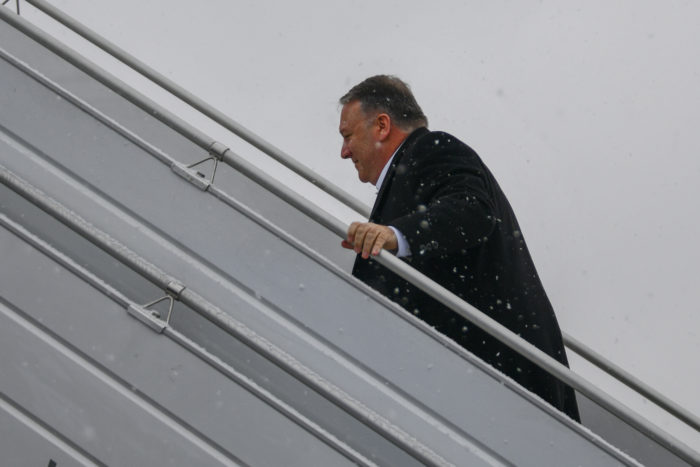
Pompeo leaving Warsaw. (State Department photo by Ron Przysucha)
By Patrick Lawrence | Consortium News | February 19, 2019
What a job Vice President Mike Pence and Secretary of State Mike Pompeo did in Europe last week. If the objective was to worsen an already critical trans–Atlantic rift and further isolate the U.S., they could not have returned to Washington with a better result.
We might have to mark down this foray as among the clumsiest and most abject foreign policy failures since President Donald Trump took office two years ago.
Pence and Pompeo both spoke last Thursday at a U.S.–sponsored gathering in Warsaw supposedly focused on “peace and security in the Middle East.” That turned out to be a euphemism for recruiting the 60–plus nations in attendance into an anti–Iran alliance.
“You can’t achieve peace and stability in the Middle East without confronting Iran,” Pompeo said flatly. The only delegates this idea pleased were Benjamin Netanyahu, the Israeli prime minister, and officials from Gulf Arab nations who share an obsession with subverting the Islamic Republic.
Pence went on to the annual security conference in Munich, where he elaborated further on a few of the Trump administration’s favored themes. Among them: The Europeans should ditch the nuclear accord with Iran, the Europeans should cut off trade with Russia, the Europeans should keep components made by Huawei and other Chinese companies out of their communications networks. The Europeans, in short, should recognize America’s global dominance and do as it does; as if it were still, say, 1954.
It is hard to imagine how an American administration can prove time and again so out of step with 21stcentury realities. How could a vice-president and a secretary of state expect to sell such messages to nations plainly opposed to them?
Pounding the Anti-Iran Theme
Pompeo, who started an “Iran Action Group” after the Trump administration withdrew last year from the 2015 nuclear accord, returned repeatedly to a single theme in his Warsaw presentations. The Iranians, he said, “are a malign influence in Lebanon, in Yemen, and Syria and Iraq. The three H’s—Houthis, Hamas, and Hezbollah—these are real threats.”
Pence ran a mile with this thought. “At the outset of this historic conference,” he said, “leaders from across the region agreed that the greatest threat to peace and security in the Middle East is the Islamic Republic of Iran.” To be noted: all the “leaders from across the region” in attendance were Sunnis, except for Netanyahu. The major European allies, still furious that Washington has withdrawn from the nuclear accord, sent low-level officials and made no speeches.
The European signatories to the Iran accord knew what was coming, surely. While Pence insisted that Britain, France and Germany withdraw from the nuclear pact—“the time has come,” he said—he also criticized the financing mechanism the three set up last month to circumvent the Trump administration’s trade sanctions against Iran. “They call this scheme a ‘special purpose vehicle,’ ” Pence said. “We call it an effort to break American sanctions against Iran’s murderous revolutionary regime.”
There were plenty of European leaders at the security conference last weekend in Munich, where Pence used the occasion to consolidate what is beginning to look like an irreparable escalation of trans–Atlantic alienation. After renewing his attack on the Iran agreement’s European signatories, he shifted criticism to the Nord Stream 2 gas pipeline. Now under construction, this will be the second undersea pipeline connecting Gazprom, the Russian energy company, to Germany and other European markets. Last month the U.S. renewed threats to sanction German companies working on the $11 billion project. “We cannot strengthen the West by becoming dependent on the East,” Pence said at the security conference Saturday.
These and other remarks in Munich were enough to get Angela Merkel out of her chair to deliver an unusually impassioned speech in defense of the nuclear accord, multilateral cooperation and Europe’s extensive economic relations with Russia. “Geo-strategically,” the German chancellor asserted, “Europe can’t have an interest in cutting off all relations with Russia.”
US Primacy V. Europe’s Future
Merkel’s speech goes to the core of what was most fundamentally at issue as Pompeo and Pence blundered through Europe last week. There are three questions to consider.
The most obvious of these is Washington’s continued insistence on U.S. primacy in the face of full-frontal resistance even from longstanding allies. “Since day one, President Trump has restored American leadership on the world stage,” Pence declared in Warsaw. And in Munich: “America is stronger than ever before and America is leading on the world stage once again.” His speeches in both cities are filled with hollow assertions such as these—each one underscoring precisely the opposite point: America is fated to continue isolating itself, a little at a time, so long as its leaders remain lost in such clouds of nostalgia.
The other two questions concern Europe and its future. Depending on how these are resolved, a more distant trans–Atlantic alliance will prove inevitable.
First, Europe must soon come to terms with its position on the western flank of the Euro–Asian landmass. Merkel was right: The European powers cannot realistically pretend that an ever-deepening interdependence with Russia is a choice. There is no choice. China’s Belt and Road Initiative, as it progresses westward, will make this clearer still.
Second, Europe must develop working accommodations with its periphery, meaning the Middle East and North Africa, for the sake of long-term stability in its neighborhood. The mass migrations from Syria, Libya and elsewhere have made this evident in the most tragic fashion possible. It is to Germany’s and France’s credit that they are now negotiating with Turkey and Russia to develop reconstruction plans for Syria that include a comprehensive political settlement.
As they do so, Washington shows no sign of lifting sanctions against Syria that have been in place for more than eight years. It may, indeed, impose new sanctions on companies participating in reconstruction projects. In effect, this could criminalize Syria’s reconstruction—making the nation another case wherein Europe and the U.S. find themselves at cross purposes.
Patrick Lawrence, a correspondent abroad for many years, chiefly for the International Herald Tribune, is a columnist, essayist, author, and lecturer. His most recent book is “Time No Longer: Americans After the American Century” (Yale). Follow him @thefloutist. His web site is http://www.patricklawrence.us.
Israel has starring role in H.R.648, “Consolidated Appropriations Act of 2019”
As Congress tackles urgent issues of reopening government and setting the budget for the country, it takes the time to prioritize a foreign country: H.R.648 contains assurances that Israel will receive $3.8 billion for arms, and funding for refugee resettlement; the bill also includes threats to de-fund the International Atomic Energy Agency (IAEA) and any future state of Palestine–if US demands (dictated by the Israel lobby) are not met.
By Kathryn Shihadah | If Americans Knew | February 15, 2019
News analysis
On January 23, the House of Representatives passed an appropriations act billed to ““reopen the government and pay our federal employees.” But buried inside the bill are diverse financial allotments and perks for a foreign country: Israel.
The legislation contains paragraphs and sections far removed from the shutdown, committing billions of dollars in payments to Israel – without the robust debate that usually accompanies big-ticket spending.
The bill has now been placed on Senate Legislative Calendar.
Its sponsor, Nita Lowey (D-NY), was handpicked to be House Appropriations Committee Chairwoman because of her staunch pro-Israel leanings.
House Speaker Nancy Pelosi (D-CA), who appointed Lowey, asserted, “We have people very well paced to share our values” during a speech at the annual conference of the Israeli-American Council (slogan: “Building a coast-to-coast community with Israel in its heart and Israeliness in its spirit”).
It is not unusual for US legislators to advocate for Israel as soon as a new session begins.
A glance through previous years’ appropriations records indicates that the US Congress has for years included issues related to Israel among the earliest legislation of each session. The Senate’s very first bill of 2019, S.1, “Strengthening America’s Security in the Middle East,” would authorize assistance and weapons transfers to Israel – which the Consolidated Appropriations bill would then authorize Congress to spend.
Lowey’s House bill, which scarcely mentions any other country by name, contains assurances that Israel will receive money for refugee resettlement and arms, as well as threats to de-fund the International Atomic Energy Agency (IAEA) and any future state of Palestine–if US demands (dictated by the Israel lobby) are not met.
Below are the sections of the bill that discuss Israel, followed by an analysis of each:
Israel: Migration and Refugee Assistance (Title III)
The bill text states: “$35 million shall be made available to respond to small-scale emergency humanitarian requirements [throughout the world], and $5 million shall be made available for refugees resettling in Israel.”
The Migration and Refugee Assistance Act was passed in 1962 to deal with unexpected and urgent needs of refugees, displaced persons, conflict victims, and other persons at risk around the globe.
Israel is the only refugee assistance beneficiary named in the bill.
It’s unclear why Israel is to be the recipient of 14% of the US refugee aid, given that Israel is the sixth wealthiest country in the Middle East-Asia-Pacific region, and therefore would appear to be able to shoulder this itself.
Also, it’s unclear why Israel the U.S. would give Israel so much aid for refugee settlement, given Israel’s unfriendly policies toward refugees.
AFRICA: The UN High Commissioner for Refugees (UNHCR) recently reported on Israel’s practice of detain and deport for African refugees: of an estimated 35,000 Eritrean and Sudanese refugees in Israel, the state recognized only eleven as refugees between 2009 and 2018. The rest bear the label “infiltrator,” and face possible expulsion to countries where their safety is questionable at best.
SYRIA: Syria shares a border with Israel; Syrian refugees, the largest single refugee group in the world today. Yet Israel’s former defense minister Avigdor Lieberman has said Israel “will not accept any Syrian refugee to our territory.”
It is also unclear why Israel is to receive U.S. refugee aid when it is the cause of the longest refugee crisis in the world today: Israel prohibits the return of millions of Palestinian refugees families awaiting their UN-mandated right to return, to their land.
Nuclear nonproliferation (Title IV)
The bill text states: “For necessary expenses for nonproliferation, anti-terrorism, de-mining and related programs and activities, $864.55 million, to remain available until September 30, 2020… funds appropriated under this heading may be made available for the IAEA [International Atomic Energy Agency] unless the Secretary of State determines that Israel is being denied its right to participate in the activities of that Agency.”

The IAEA promotes the use of atomic energy for “peace, health, and prosperity throughout the world” and works to prevent its use “to further any military purpose.”
Israel’s association with the IAEA has always been problematic, as Israel insists on a policy of ambiguity regarding its nuclear capabilities. Israel cites its “unique security needs” as justification for its ongoing refusal to either declare itself a Nuclear Weapon State (NWS) or sign the Non-Proliferation Treaty (NPT).
In spite of its silence, Israel’s nuclear arsenal is universally recognized. According to the Arms Control Association, Israel is believed to have at least 80 nuclear warheads; some estimates place the number at 400.
In addition to its unacknowledged nuclear capabilities, Israel practices the “Begin Doctrine,” a policy of counter-proliferation and preemptive strikes.
Arms Export Controls Act (Title IV)
The bill text states: “For necessary expenses for grants to enable the President to carry out the provisions of section 23 of the Arms Export Control Act, $5.9 billion… [for] the provision of assistance to foreign countries and international organizations… [O]f the funds appropriated under this heading, not less than $3.3 billion [55% of the total] shall be available for grants only for Israel which shall be disbursed within 30 days of enactment of this Act… Provided further, That funds appropriated or otherwise made available under this heading shall be nonrepayable…
The Arms Export Control Act was put in place to ensure that weapons the US sent abroad would be used for legitimate self-defense. Some countries, including Israel, enjoy assistance in the form of grants; others receive loans.
Much of the world disagrees strongly with Israel’s claims of self-defense in its strikes against its neighbors (the self-defense assertion also contradict its Begin Doctrine – see above).
This year’s $3.8 billion in aid–well over half of the total budget for the entire world–is a record in US military support of Israel, and occurs in the context of Israel’s numerous breaches of international and humanitarian law, including occupation, collective punishment, settlements and annexations, the Separation Wall, the unresolved refugee crisis, the blockade of Gaza, and infringement of dozens of UN resolutions.
Regarding the above clause, “shall be disbursed within 30 days,” Congressional Research Service (CRS) explains:
Israel gets all of its aid money at the start of each year, rather than in quarterly installments like other countries. This is significant: It means that Israel can start earning interest on the money right away – interest paid by the US since Israel deposits these funds into an interest-bearing account at the New York Federal Reserve Bank. In addition, because the US government operates at a deficit, it must borrow money in order to give it to Israel and then pay interest on it all year. Together these cost US taxpayers more than $100 million every year.
Loan guarantees (Title VII, Section 7033)
The bill text states: “Extension of Loan Guarantees to Israel—Chapter 5 of title I of the Emergency Wartime Supplemental Appropriations Act, 2003 (Public Law 108–11; 117 Stat. 576) is amended under the heading “Loan Guarantees to Israel”— [giving Israel a 4-year extension].
Jewish Virtual Library explains loan guarantees to Israel in simple terms:
Loan guarantees are essentially the explicit agreements between two people – or two nations – that if one defaults on a loan the other is obligated to pay it back… ideally, the United States will never have to pay out even a single dollar.
The United States is accepting responsibility from international creditors for any loans the Israeli government takes out…the U.S. could be hit with up to a $3.8 billion bill, plus interest, if Israel defaults on their loans…
Congressional Research Services (CRS) adds that money borrowed must not be used for military purposes or settlements.
However, as CRS points out, “U.S. officials have noted that proceeds from the issuance of U.S.-guaranteed debt that are used to refinance Israeli government debt free up domestic Israeli funds for other uses.”
Among its domestic expenses, Israel has spent an estimated total of $20 billion on settlements and $15 billion on the occupation. Total US aid to Israel stands at $134.7 billion.
Boycott (Title VII, Section 7035)
The bill text states: [T]he Arab League boycott of Israel…is an impediment to peace in the region and to United States investment…[The boycott] should be immediately and publicly terminated.. all Arab League states should normalize relations with their neighbor Israel; the President and the Secretary of State should continue to vigorously oppose [the boycott – for example by refusing to sell weapons to boycotting countries…and encourage allies to enact anti-boycott laws].
The Boycott, Divest, and Sanctions (BDS) Movement explains its existence in the context of seventy years of Israeli denial of Palestinian rights and noncompliance with international law:
Governments fail to hold Israel to account, while corporations and institutions across the world help Israel to oppress Palestinians. Because those in power refuse to act to stop this injustice, Palestinian civil society has called for a global citizens’ response of solidarity with the Palestinian struggle for freedom, justice, and equality.
The US Senate recently passed a federal anti-boycott bill, S.1, which ACLU Senior Legislative Counsel Kathleen Ruane critiqued:
The bill, Combating BDS Act, encourages states to adopt the very same anti-boycott laws that two federal courts blocked on First Amendment grounds. The legislation, like the unconstitutional state anti-boycott laws it condones, sends a message to Americans that they will be penalized if they dare to disagree with their government.
Palestinian statehood (Title VII, Section 7036)
The bill text states: “None of the funds appropriated under titles III through VI [e.g. global health programs, disaster assistance, economic support funding, peacekeeping operations] of this Act may be provided to support a Palestinian state unless the Secretary of State determines and certifies [that the Palestinian governing body is committed to peaceful coexistence with Israel, fighting terrorism, renouncing belligerency, etc.,]
None of the funds appropriated under the heading “Economic Support Fund” in this Act may be made available for assistance for the Palestinian Authority, if [Palestinians become full members as a state in the UN or any of its agencies – without direct negotiations with Israel, or] Palestinians initiate an International Criminal Court (ICC) judicially authorized investigation, or actively support such an investigation, that subjects Israeli nationals to an investigation for alleged crimes against Palestinians.
Israel has officially stated that no Palestinian state should be created apart from direct negotiations with Israel. It views Palestinian efforts at international legitimacy as an attempt by Palestinians to “force their will on Israel through international pressure [which] harms true peace.”
Most US lawmakers, under the influence of the Israel lobby, have acquiesced to the Israeli position.
While insisting on negotiations, Israel refuses to participate in talks that include democratically elected Hamas, and calls on Palestinian leadership to “say the simple words: ‘Israel is the nation-state of the Jewish people, and it will stay that way.’”
For their part, Palestinians require a stop to the illegal expansion of Israeli settlements on Palestinian land as a prerequisite to peace talks–a requirement that Israel has historically ignored.
Palestinians also point to UN Security Council Resolution 242, in which they were called upon to recognize Israel’s “right to live in peace within secure and recognized boundaries free from threats or acts of force,” which does not obligate them to acknowledge Israel as the nation-state of the Jewish people.
In addition, Palestinians reference the 1993 Letters of Mutual Recognition – in which they recognized the existence of Israel – as sufficient recognition.
These issues have caused a deadlock in any negotiations, prompting Palestinians to seek out statehood through other means.
Regarding the International Criminal Court, US leaders have claimed that Palestinians bringing a case to the ICC is “not productive” and the US “prefers a negotiated peace process between Israel and Palestine.”
No to Palestinian agency in Jerusalem (Title VII, Section 7037)
The bill text states: “None of the funds appropriated under titles II through VI of this Act may be obligated or expended to create in any part of Jerusalem [a venue for conducting official US Government business with the Palestinian Authority or any Palestinian governing entity].
When President Trump, at the behest of donor Sheldon Adelson, announced the movement of the US Embassy to Jerusalem, he signaled recognition of all of Jerusalem as the capital of Israel; Palestinians and most of the world reject this, as East Jerusalem is widely considered occupied, and is the intended capital of a future Palestinian state.
No to “Martyrs’ Fund” (Title VII, Section 7037)
The bill text states: “The Secretary of State shall reduce the amount of assistance made available by this Act…[if a Palestinian governing body pays for] acts of terrorism by individuals who are imprisoned after being fairly tried and convicted for acts of terrorism and by individuals who died committing acts of terrorism…”
Israeli academic Ilan Pappe is one of many who take issue with the notion of a “fair trial” for Palestinians: he describes Israeli military courts as a “humiliating charade” which create the illusion of a fair trial. Pappe insists that the military courtroom houses “a sinister process” and “a bureaucratic self-justification for the system to do what it wants to do.”
Palestinians are prosecuted and judged by Israeli military officials who boast a 99% conviction rate.
The so called “Martyrs’ Fund” or “pay-to-slay” system in the Palestinian territories is actually a fairly typical social safety net, which assists families of Palestinians who are injured or killed in the course of resistance against the Israeli occupation. It also helps to offset the frequent, illegal Israeli practice of demolishing the homes of convicted “terrorists,” a form of collective punishment.
UN Human Rights Council (HRC) (Title VII, Section 7048)
The bill text states: “None of the funds appropriated by this Act may be made available in support of the United Nations Human Rights Council unless the Secretary of State determines…[that the UNHRC] is taking significant steps to remove Israel as a permanent agenda item…”
The UNHRC created a permanent discussion point for Israel on its agenda in 2007, one year after the council was formed. The United States officially opposes “Agenda Item 7: Human rights situation in Palestine and other occupied Arab territories,” claiming it illustrates an anti-Israel bias: “The continued existence of this agenda item is among the largest threats to the credibility of the Council.”
The HRC has consistently supported the Palestinians and cited Israel for abuses dozens of times.
The United States withdrew from the HRC in 2018 in solidarity with Israel; PM Netanyahu praised the move and called the organization “a biased, hostile, anti-Israel organization.” Then-Ambassador to the UN Nikki Haley accused the body of having a “disproportionate focus and unending hostility toward Israel.”
——
H.R.648, “Consolidated Appropriations Act of 2019,” is the spending bill Congress needs to pass in order to extricate the US from its damaging government shutdown and pay federal employees. As Congresswoman Lowey stated, other issues would be addressed at a later date.
But the House has prioritized both monetary and policy issues related to Israel, pledging U.S. taxpayer dollars that address Israel’s interests at the expense of Americans.
Kathryn Shihadah is staff writer for If Americans Knew. She blogs at Palestine Home.
Featured Video
Integrity Initiative: UK-funded network framed dissent as Russian disinformation for years
or go to
Aletho News Archives – Video-Images
From the Archives
Why Saudi Ties to 9/11 Mean U.S. Ties to 9/11
By Kevin Ryan | Dig Within | September 27, 2015
Media interest in Saudi Arabian connections to the crimes of 9/11 has centered on calls for the release of the 28 missing pages from the Joint Congressional Inquiry’s report. However, those calls focus on the question of hijacker financing and omit the most interesting links between the 9/11 attacks and Saudi Arabia—links that implicate powerful people in the United States. Here are twenty examples. … continue
Blog Roll
 Aletho News
- IAEA inspectors cannot return to Iran amid US threats: Russia
- Senate Rejects Iran War Powers Resolution Passed By House
- ‘We did not attack Pakistan with drones’: Afghan sources
- Iraqi Resistance faction links arms to sovereignty, questions US exit
- Cannon fodder no more… South Korea rejects Trump’s pressure to join his criminal war on Iran
- Neria Leiter Was A Legitimate Military Target
- Integrity Initiative: UK-funded network framed dissent as Russian disinformation for years
- ‘We don’t seek permission to defend our country’: Snippets from President Pezeshkian’s UNGA address
- NATO chief wants Europeans to fight American wars [for Israel]
- German chemicals giant reveals details of downsizing
- If Americans Knew
- In UN Speech, Iran’s President Displays Pictures of Children Killed by US, Brings Attention to Israel’s Nuclear Arsenal
- Israel displaces hundreds of Palestinians amid wave of demolitions in West Bank
- Aid, reconstruction, and Israel’s history of obstruction in Gaza
- Trump administration digs an ever-deeper hole of complicity in genocide – Daily Update
- US-Israel $2.8 Billion Arms Deal, 40,000-Bomb Supply Faces New Gaza Complicity Accusations
- Caught on Tape: AIPAC CEO Boasted of Controlling Trump’s National Security Officials
- Why Hamas Attacked Israel in October 2023 – Israeli professor Ilan Pappé
- They see them, then kill them: Israeli quadcopters track, deliberately target civilians in Gaza
- Winter could turn Gaza’s treacherous, war-damaged buildings into deathtraps
- Majority of Democratic Voters Want to Prosecute Both Biden and Trump Administration Officials Over Gaza
- No Tricks Zone
- New Study: Earth And Venus Surface Warmth Largely Explained By Convection And Lapse Rate, Not CO2 Or Radiation
- 2025 Nature Paper Claiming Worsening Global Drought Gets RETRACTED …Heavily Flawed
- New Study: ‘Global Drought Shows No Detectable Recent Acceleration Under Climate Warming’
- Economic Masterminds: German Socialists Suggest Taxing Productivity Gains Stemming From Using AI
- The South China Sea Has Not Been Cooperating With The Climate Change Narrative
- Energy Crisis: Germany Enters Heating Season With Historically Low Gas Reserve Fill Levels
- New Study: The Antarctic Ice Sheet Gained Mass From 2020-2024 Due To Staggering Snow And Ice Accumulation
- Study: Ocean Heating Rates From Thousands Of Years Ago ‘Dwarf’ Modern Ocean Heating Rates
- Climate Extremists Target, Attack Large-Scale Power Grid Infrastructure In Germany!
- New Study: Antarctic Ice Melt Has Contributed Less Than 1 Centimeter To Sea Level Rise In The Last 30 Years

