G7 ‘Unlikely to Support’ US-UK Push to Slap More Sanctions on Russia
Sputnik – April 10, 2017
In an interview with Sputnik, Russian political analyst Alexey Zudin expressed doubt over the G7 countries’ willingness to agree with the UK Foreign Secretary’s latest demand to inflame the sanction war with Russia.
The interview came after The Times reported that during the upcoming G7 foreign ministers’ meeting in Italy, British Foreign Secretary Boris Johnson will urge the G7 member states to tighten sanctions against Russia following the latest developments in Syria.
The newspaper said that “Britain is pushing western nations to impose new sanctions on Russia if it fails to cut ties with President Assad as the conflict over Syria escalates.”
According to The Times, the document was prepared ahead of the G7′ ministerial meeting which kicks off in Lucca, Italy, later on Monday. The newspaper said that Johnson wants the G7 to issue a joint statement after an alleged chemical attack in Syria, according to which Russia should stop supporting Syrian President Bashar Assad and withdraw its troops from Syria.
In case of Moscow’s refusal, new sanctions will follow in addition to those already slapped on Russia in connection with the situation in Ukraine, according to The Times.
Alexey Zudin, of the Moscow-based Institute for Social, Economic and Political Studies think tank, said that this move, initiated by Washington and London, is unlikely to be supported by other G7 countries.
“It is unlikely G7 members will agree to this, at least for now. It seems that the absence of proof [pertaining to the Syria chemical attack] has not put off the main initiator, the US, and its closest ally Britain, which is not the case with other G7 countries who are hardly likely to support the American position,” Zudin said referring to “clear collaboration between Washington and London on the issue.”
According to him, this move is timed to coincide with the visit of US Secretary of State Rex Tillerson to Moscow, which begins on April 11.
“It would be pointless for Tillerson to start his visit with a direct threat to his Russian colleagues, about the US preparing a new package of anti-Russian sanctions, which is why this role was delegated to UK Foreign Secretary Boris Johnson,” Zudin concluded.
Meanwhile, Kremlin spokesman Dmitry Peskov said that Moscow is not aware of any possible new US sanctions against Russia over Syria, as neither President Donald Trump or his administration have made any statements.
“Not knowing what is at issue, and we really do not know what is at issue, it is difficult to talk about any reaction,” Peskov told reporters.
US Ambassador to the United Nations Nikki Haley said on Sunday that Trump and members of his team “have started to have” conversations related to imposing sanctions on Russia and Iran in connection to their support for Damascus.
“Yes, there was a statement by the US ambassador, but we have not heard about any statements to this effect from President Trump or his representatives,” Peskov said.
Last Thursday night, at least five people were killed and seven others injured after the United States launched 59 Tomahawk cruise missiles at the Syrian military airfield in Ash Sha’irat, located about 40 kilometers (25 miles) from the city of Homs.
US President Donald Trump said the attack was a response to the alleged use of chemical weapons in Syria’s Idlib province on Tuesday, which Washington blames on the Syrian government.
Syrian President Assad argued that his government has no chemical weapons left, and never used the stockpile Syria used to maintain.His government handed over this stockpile, which included precursors to the nerve gases sarin and VX as well as hydrogen fluoride, to the Organization for the Prohibition of Chemical Weapons (OPCW), a global chemical weapons watchdog, in 2013 amid international pressure.
All of the weapons were then destroyed by the OPCW, which completed this task in January 2016.
SEE ALSO:
Trump Considering Sanctions Against Russia, Iran for Supporting Syria
New Sanctions Against Russia ‘Part of a Deal Between Trump, US Establishment’
Luring Trump into Mideast Wars
By Daniel Lazare | Consortium News | April 8, 2017
Donald Trump entered military terra incognita on Thursday by launching an illegal Tomahawk missile strike on an air base in eastern Syria. Beyond the clear violation of international law, the practical results are likely to be disastrous, drawing the U.S. deeper into the Syrian quagmire.
But it would be a mistake to focus all the criticism on Trump. Not only are Democrats also at fault, but a good argument could be made that they bear even greater responsibility.
For years, near-total unanimity has reigned on Capitol Hill concerning America’s latest villains du jour, Russia’s Vladimir Putin and Syria’s Bashar al-Assad. Congressmen, senators, think-tank strategists, and op-ed analysts all have agreed that Putin and Assad are the prime enemies of “peace,” by which is meant global American hegemony, and that therefore the U.S. must stop at nothing to weaken or neutralize them or force them to exit the world stage.
Until recently, in fact, just about the only politically significant dissenter was Trump. Accusing reporters of twisting the news at a tumultuous press conference in late February, he told them, “Now tomorrow, you’ll say, ‘Donald Trump wants to get along with Russia, this is terrible.’ It’s not terrible. It’s good.”
But since getting along with Russia was terrible for America’s perpetually bellicose foreign-policy establishment, Official Washington declared war on Trump, building on Hillary Clinton’s charge during the last presidential debate that he was Putin’s “puppet.” It became the conventional wisdom that Trump was a “Siberian candidate” being inserted in the White House by a satanic Kremlin determined to bend freedom-loving Americans to its will.
As Inauguration Day approached, President Obama’s intelligence chiefs pulled out all stops to persuade the public that (a) Russian intelligence had engineered Clinton’s defeat by hacking the Democratic National Committee’s computers and placing thousands of embarrassing emails in the hands of WikiLeaks and that (b) Trump was somehow complicit in the effort.
The campaign was highly effective. The alleged Putin-Trump relationship was a major feature at the anti-Trump protests surrounding his inauguration and the major U.S. news media pounded on the Russia “scandal” daily.
On Feb. 13, barely four weeks after taking office, Trump crumbled under a mounting barrage of political abuse and gave National Security Adviser Michael Flynn the boot after it was revealed that he had talked with Russian Ambassador Sergey Kislyak during the transition, supposedly in violation of the 1799 Logan Act, an absurd piece of ancient legislation that even The New York Times referred to as “a dusty, old law” that should have been repealed generations ago.
Under Media Pressure
A day later, the administration reeled again when the Times charged in a front-page exposé that “members of Donald J. Trump’s 2016 presidential campaign and other Trump associates had repeated contacts with senior Russian intelligence officials in the year before the election.”
The article provided no evidence and no names and said nothing about whether such contacts were knowing or unknowing, i.e., whether they involved a John le Carré-style midnight rendezvous or merely an exchange of pleasantries with someone who may or may not have been connected to the FSB, as Russia’s version of the CIA is known.
In a March 6 article entitled “Pause This Presidency,” Times columnist Charles M. Blow called for little less than a coup d’état: “The American people must immediately demand a cessation of all consequential actions by this ‘president’ until we can be assured that Russian efforts to hack our election … did not also include collusion with or cover-up by anyone involved in the Trump campaign and now administration.”
How “the American people” would demand such a cessation or who would provide such assurances was not specified.
On March 31, CNN quoted an unnamed senior administration official saying that Trump’s hopes of a rapprochement with Russia were fading because he “believes in the current atmosphere – with so much media scrutiny and ongoing probes into Trump-Russia ties and election meddling – that it won’t be possible to ‘make a deal.’”
Thus, Trump found himself increasingly boxed in by hostile forces. But he still tried to fulfill his promise to concentrate on defeating terrorists in Syria and Iraq. On March 30, U.S. Ambassador to the United Nations Nikki Haley announced that the U.S. administration “priority is no longer to sit there and focus on getting Assad out,” but to concentrate on defeating Al Qaeda and ISIS instead.
But the more Trump contemplated his predicament in the following days, the more he realized how untenable it had come. Tuesday’s poison-gas incident in Idlib thus offered a way out regardless of who was actually responsible. The only way for Trump to make peace with the “deep state” in Washington was by waging war on Syria.
Finally, on Thursday, hours before Trump sent a volley of cruise missiles wafting towards Syria, Hillary Clinton taunted him by declaring that America “should take out his [Assad’s] airfields and prevent him from being able to use them to bomb innocent people.” The effect was to all but force Trump to show that he was every bit as macho as the former First Lady.
Frog-Marching Trump
Trump is certainly a fool for going ahead with such an attack in clear contravention of international law and entangling the United States more deeply into the complicated Syrian conflict. But the blame also should go to the people who frog-marched him to the precipice and then all but commanded him to step over the edge.
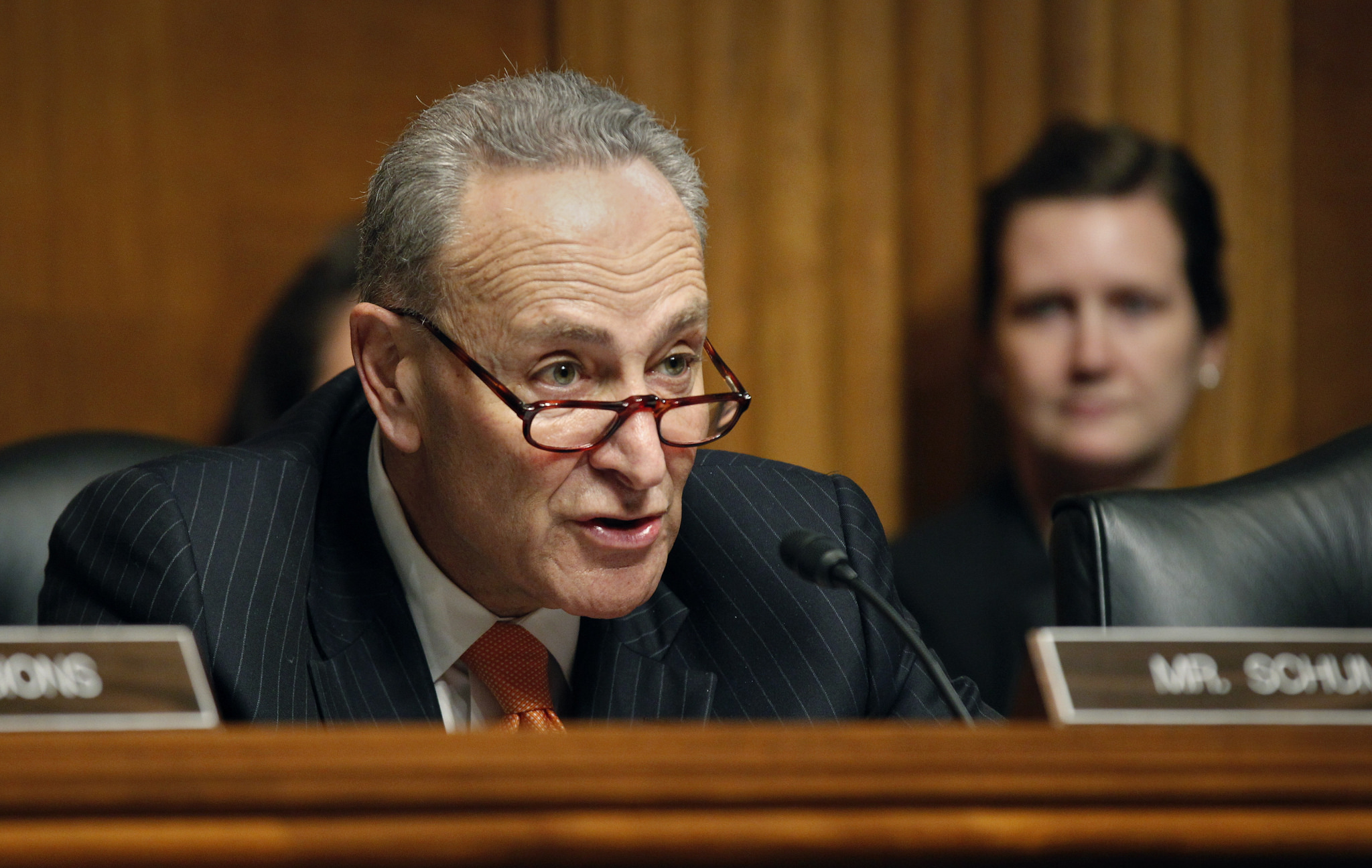
Sen. Charles Schumer, D-New York
Within hours, all the usual suspects were congratulating one of the most scorned U.S. presidents in history for taking the leap.
Senate Minority Leader Chuck Schumer said: “Making sure Assad knows that when he commits such despicable atrocities he will pay a price is the right thing to do.” House Minority Leader Nancy Pelosi described Trump’s missile barrage as “a proportional response to the regime’s use of chemical weapons.”
Republican super-hawks Senators John McCain and Lindsey Graham, previously as anti-administration as any Democrat, issued a joint statement declaring that Trump “deserves the support of the American people,” while liberal heart-throb Sen. Elizabeth Warren also agreed that “the Syrian regime must be held accountable for this horrific act.”
The Guardian, as fiercely anti-Trump as it is anti-Putin and anti-Assad, conceded that “Donald Trump has made his point” and that the next step would be up to Russia. All in all, Trump had never gotten such good press. It’s clear that Official Washington was pleased with Trump’s handiwork and was eager to encourage him to do more.
But the missile barrage was not just an assault on Syria but on reason and good sense, too. Although the Washington Post’s Adam Taylor tried to make it seem that the only critics of the missile barrage are members of the alt-right “known for espousing racist, anti-Semitic and sexist points of view,” the fact is that criticism flowed in from other quarters.
At Alternet, Vijay Prashad pointed out that there were few independent observers in Khan Shaykhun, the farming town where the April 4 incident occurred, to provide an accurate account. Eyewitnesses “with the densest relationship to the armed opposition,” he wrote, “are the first to claim that this attack was done by the government.”
Consortiumnews’ Robert Parry pointed out that rather than dropping the gas themselves, Syrian or Russian warplanes could well have triggered an outbreak by bombing a facility containing “chemicals that the rebels were planning to use in some future attack.” Parry also noted that Al Qaeda, which controls Idlib province, could have “staged the incident to elicit precisely the international outrage directed at Assad as has occurred.”
[Previously, United Nations investigators have received eyewitness testimony from Syrians about rebels staging an alleged chlorine-bomb attack so it would be pinned on the Assad regime.]
Something similar may well have occurred in August 2013, a sarin-gas missile attack on the outskirts of Damascus that killed hundreds and that appears to have been launched from a rebel-controlled area two kilometers away. The two incidents are curiously parallel.
The August 2013 incident, which horrified the world and brought the Obama administration to the brink of its own attack on the Syrian government, occurred just days after a U.N. team had arrived in Damascus to investigate an alleged chemical attack by rebels against Syrian government troops some four months earlier.
It made little sense for the Assad regime to have invited U.N. investigators in and then launch a more horrific chemical-weapons attack just miles from the investigators’ hotel. It would be a bit like someone inviting a police inspector to dinner and then committing a murder in full view.
Not Making Sense
As one independent analysis noted in 2013, the Assad regime would have to have decided to carry out a large-scale attack “despite (a) making steady gains against rebel positions, (b) receiving a direct threat from the US that the use of chemical weapons would trigger intervention, (c) having constantly assured their Russian allies that they will not use such weapons, (d) prior to the attack, only using non-lethal chemicals and only against military targets.”
The Assad government would also have had to decide “to (a) send forces into rebel-held area, where they are exposed to sniper fire from multiple directions, (b) use locally manufactured short-range rockets, instead of any of the long-range high quality chemical weapons in their arsenal, and (c) use low quality sarin.”
All of which seems supremely unlikely, but much of the mainstream U.S. media still treats the 2013 sarin-gas attack as the undeniable case of Assad crossing Obama’s “red line” against using chemical weapons. And the highly dubious 2013 incident is cited as a key reason to believe that Assad has done it again. [Recently, The New York Times has quietly backed off the 2013 claims although not explicitly retracting its earlier reporting blaming the attack on the Assad regime.]
Assad would have possibly even stronger reasons not to deploy sarin gas on April 4, 2017. He would have to make a conscious decision to court world opprobrium at a time when the tide of the war was finally turning in his favor with the liberation of Aleppo last December and with most world leaders having concluded that the Assad regime was here to stay.
To have produced and deployed a sarin bomb would have meant deliberately risking military intervention more than three years after Syria reached an agreement with the United Nations to destroy its entire chemical-weapons stockpile so as to avoid … military intervention.
All of which seems supremely unlikely as well. It would be an act of suicide – and after holding off a combined U.S., Saudi, Qatari, and Turkish assault for half a decade or more, one thing that Assad does not appear to be is suicidal.
Although Secretary of State Rex Tillerson said, “there is no doubt in our mind that the Syrian regime under the leadership of Bashar al-Assad is responsible for this horrific attack,” in reality there is plenty of doubt.
Nevertheless, Trump decided to fire away before the facts were in because the enemy he is most worried about is not the one half a world away in Syria, but the Democratic-neocon alliance in his own backyard. The political warfare in Washington is now generating more agony from real wars in the Middle East.
Trump Likely Manipulated Into Ordering Missile Attacks on Syria
Sputnik – 08.04.2017
WASHINGTON – US President Donald Trump appears to have been psychologically profiled and manipulated into ordering cruise missile airstrikes against Syria, former US Air Force Lieutenant Colonel Karen Kwiatkowski told Sputnik.
On Friday, US senior military officials disclosed declassified intelligence information to lay out reasoning behind the attack on the Syrian military airfield in Ash Sha’irat near Homs late Thursday.
“Trump appears to have been easily manipulated into this response,” Kwiatkowski said on Friday. “It could have not been more effective if President Trump had been psychologically profiled and specifically manipulated into this ‘surprise’ decision.”
Trump’s instinctive response to the first pictures of the use of chemical weapons “would have been easily predictable from a psychological analysis,” Kwiatkowski stated.
Kwiatkowski pointed out that parts of US foreign policy, defense and intelligence community and their supporters in the media had been very concerned over Trump’s long-expressed “America First” foreign policy approach.
“Reported events [on] Tuesday in Idlib served these interests well, and I believe it was an opportunity for these factions to attempt to prolong the wars in the Middle East, and ultimately further entrench their business and political interests,” she observed.
Kwiatkowski noted that Trump had ordered the missile strikes against Syrian military targets without taking action to carefully confirm Damascus had actually delivered the weapons and detonated them.
“Because evidence at the Syrian Air Base in Homs has likely been compromised by the impacts of 59 Tomahawk cruise missiles, the investigation will be even more difficult to conduct,” she remarked.
Kwiatkowski said she was surprised at the eagerness with which the US media joined the call for an attack, given the lack of concrete analysis of what happened in Idlib on Tuesday.
“It is as if the western media, time and time again, receives talking points from various governmental factions and republishes them uncritically and without verification,” she said.
Kwiatkowski expressed the hope that Trump would come to realize his cruise missile order had been premature and that he would revert to his previous efforts to reduce US military involvement across the Middle East.
“I personally believe that the percolation of correct intelligence will soon reach the White House, and US policy will revert back to Trump’s original position in the region, which is military disengagement and real self-determination for people there,” she said.
Some US officials were working to try and protect Islamic State fighters from being captured by Syrian government forces and finding protection for them after all the outrages they had perpetrated, Kwiatkowski warned.
“It seems to me that in Mosul and throughout Syria, IS fighters and leaders who have worked with the US are trying to ensure that they will be protected, and the US may be trying to ensure that many of its former ‘rebel’ colleagues are… provided safe haven out of the countries,” she said.
However, the search for truth about what really happened in the chemical weapons attack at Idlib would continue aggressively, Kwiatkowski concluded.
Trump’s ‘Wag the Dog’ Moment
By Robert Parry | Consortium News | April 7, 2017
Just two days after news broke of an alleged poison-gas attack in northern Syria, President Trump brushed aside advice from some U.S. intelligence analysts doubting the Syrian regime’s guilt and launched a lethal retaliatory missile strike against a Syrian airfield.
Trump immediately won plaudits from Official Washington, especially from neoconservatives who have been trying to wrestle control of his foreign policy away from his nationalist and personal advisers since the days after his surprise victory on Nov. 8.
There is also an internal dispute over the intelligence. On Thursday night, Secretary of State Rex Tillerson said the U.S. intelligence community assessed with a “high degree of confidence” that the Syrian government had dropped a poison gas bomb on civilians in Idlib province.
But a number of intelligence sources have made contradictory assessments, saying the preponderance of evidence suggests that Al Qaeda-affiliated rebels were at fault, either by orchestrating an intentional release of a chemical agent as a provocation or by possessing containers of poison gas that ruptured during a conventional bombing raid.
One intelligence source told me that the most likely scenario was a staged event by the rebels intended to force Trump to reverse a policy, announced only days earlier, that the U.S. government would no longer seek “regime change” in Syria and would focus on attacking the common enemy, Islamic terror groups that represent the core of the rebel forces.
The source said the Trump national security team split between the President’s close personal advisers, such as nationalist firebrand Steve Bannon and son-in-law Jared Kushner, on one side and old-line neocons who have regrouped under National Security Adviser H.R. McMaster, an Army general who was a protégé of neocon favorite Gen. David Petraeus.
White House Infighting
In this telling, the earlier ouster of retired Gen. Michael Flynn as national security adviser and this week’s removal of Bannon from the National Security Council were key steps in the reassertion of neocon influence inside the Trump presidency. The strange personalities and ideological extremism of Flynn and Bannon made their ousters easier, but they were obstacles that the neocons wanted removed.
Though Bannon and Kushner are often presented as rivals, the source said, they shared the belief that Trump should tell the truth about Syria, revealing the Obama administration’s CIA analysis that a fatal sarin gas attack in 2013 was a “false-flag” operation intended to sucker President Obama into fully joining the Syrian war on the side of the rebels — and the intelligence analysts’ similar beliefs about Tuesday’s incident.
Instead, Trump went along with the idea of embracing the initial rush to judgment blaming Assad for the Idlib poison-gas event. The source added that Trump saw Thursday night’s missile assault as a way to change the conversation in Washington, where his administration has been under fierce attack from Democrats claiming that his election resulted from a Russian covert operation.
If changing the narrative was Trump’s goal, it achieved some initial success with several of Trump’s fiercest neocon critics, such as neocon Senators John McCain and Lindsey Graham, praising the missile strike, as did Israeli Prime Minister Benjamin Netanyahu. The neocons and Israel have long sought “regime change” in Damascus even if the ouster of Assad might lead to a victory by Islamic extremists associated with Al Qaeda and/or the Islamic State.
Wagging the Dog
Trump employing a “wag the dog” strategy, in which he highlights his leadership on an international crisis to divert attention from domestic political problems, is reminiscent of President Bill Clinton’s decision to attack Serbia in 1999 as impeachment clouds were building around his sexual relationship with intern Monica Lewinsky.
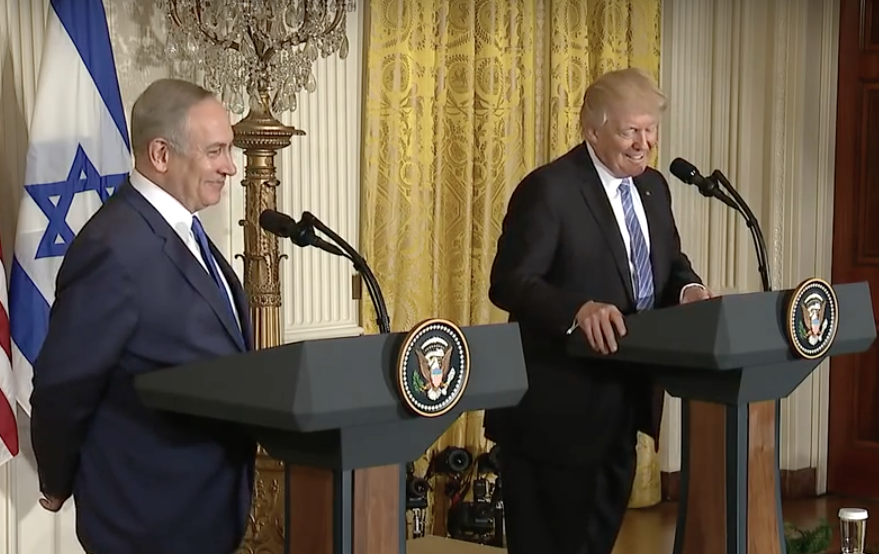
Screen shot from Whitehouse.gov
Trump’s advisers, in briefing the press on Thursday night, went to great lengths to highlight Trump’s compassion toward the victims of the poison gas and his decisiveness in bombing Assad’s military in contrast to Obama’s willingness to allow the intelligence community to conduct a serious review of the evidence surrounding the 2013 sarin-gas case.
Ultimately, Obama listened to his intelligence advisers who told him there was no “slam-dunk” evidence implicating Assad’s regime and he pulled back from a military strike at the last minute – while publicly maintaining the fiction that the U.S. government was certain of Assad’s guilt.
In both cases – 2013 and 2017 – there were strong reasons to doubt Assad’s responsibility. In 2013, he had just invited United Nations inspectors into Syria to investigate cases of alleged rebel use of chemical weapons and thus it made no sense that he would launch a sarin attack in the Damascus suburbs, guaranteeing that the U.N. inspectors would be diverted to that case.
Similarly, now, Assad’s military has gained a decisive advantage over the rebels and he had just scored a major diplomatic victory with the Trump administration’s announcement that the U.S. was no longer seeking “regime change” in Syria. The savvy Assad would know that a chemical weapon attack now would likely result in U.S. retaliation and jeopardize the gains that his military has achieved with Russian and Iranian help.
The counter-argument to this logic – made by The New York Times and other neocon-oriented news outlets – essentially maintains that Assad is a crazed barbarian who was testing out his newfound position of strength by baiting President Trump. Of course, if that were the case, it would have made sense that Assad would have boasted of his act, rather than deny it.
But logic and respect for facts no longer prevail inside Official Washington, nor inside the mainstream U.S. news media.
Intelligence Uprising
Alarm within the U.S. intelligence community about Trump’s hasty decision to attack Syria reverberated from the Middle East back to Washington, where former CIA officer Philip Giraldi reported hearing from his intelligence contacts in the field that they were shocked at how the new poison-gas story was being distorted by Trump and the mainstream U.S. news media.
Giraldi told Scott Horton’s Webcast: “I’m hearing from sources on the ground in the Middle East, people who are intimately familiar with the intelligence that is available who are saying that the essential narrative that we’re all hearing about the Syrian government or the Russians using chemical weapons on innocent civilians is a sham.”
Giraldi said his sources were more in line with an analysis postulating an accidental release of the poison gas after an Al Qaeda arms depot was hit by a Russian airstrike.
“The intelligence confirms pretty much the account that the Russians have been giving … which is that they hit a warehouse where the rebels – now these are rebels that are, of course, connected with Al Qaeda – where the rebels were storing chemicals of their own and it basically caused an explosion that resulted in the casualties. Apparently the intelligence on this is very clear.”
Giraldi said the anger within the intelligence community over the distortion of intelligence to justify Trump’s military retaliation was so great that some covert officers were considering going public.
“People in both the agency [the CIA] and in the military who are aware of the intelligence are freaking out about this because essentially Trump completely misrepresented what he already should have known – but maybe he didn’t – and they’re afraid that this is moving toward a situation that could easily turn into an armed conflict,” Giraldi said before Thursday night’s missile strike. “They are astonished by how this is being played by the administration and by the U.S. media.”
One-Sided Coverage
The mainstream U.S. media has presented the current crisis with the same profound neocon bias that has infected the coverage of Syria and the larger Middle East for decades. For instance, The New York Times on Friday published a lead story by Michael R. Gordon and Michael D. Shear that treated the Syrian government’s responsibility for the poison-gas incident as flat-fact. The lengthy story did not even deign to include the denials from Syria and Russia that they were responsible for any intentional deployment of poison gas.
The article also fit with Trump’s desire that he be portrayed as a decisive and forceful leader. He is depicted as presiding over intense deliberations of war or peace and displaying a deep humanitarianism regarding the poison-gas victims, one of the rare moments when the Times, which has become a reliable neocon propaganda sheet, has written anything favorable about Trump at all.
According to Syrian reports on Friday, the U.S. attack killed 13 people, including five soldiers at the airbase.
Gordon, whose service to the neocon cause is notorious, was the lead author with Judith Miller of the Times’ bogus “aluminum tube” story in 2002 which falsely claimed that Iraqi leader Saddam Hussein was reconstituting a nuclear-weapons program, an article that was then cited by President George W. Bush’s aides as a key argument for invading Iraq in 2003.
Regarding this week’s events, Trump’s desperation to reverse his negative media coverage and the dubious evidence blaming Assad for the Idlib incident could fit with the “Wag the Dog” movie from 1997 in which an embattled president creates a phony foreign crisis in Albania.
In the movie, the White House operation is a cynical psychological operation to convince the American people that innocent Albanian children, including an attractive girl carrying a cat, are in danger when, In reality, the girl was an actor posing before a green screen that allowed scenes of fiery ruins to be inserted as background.
Today, because Trump and his administration are now committed to convincing Americans that Assad really was responsible for Tuesday’s poison-gas tragedy, the prospects for a full and open investigation are effectively ended. We may never know if there is truth to those allegations or whether we are being manipulated by another “wag the dog” psyop.
Investigative reporter Robert Parry broke many of the Iran-Contra stories for The Associated Press and Newsweek in the 1980s.
Russian FM Lavrov’s March 29, 2017 interview with National Interest Magazine
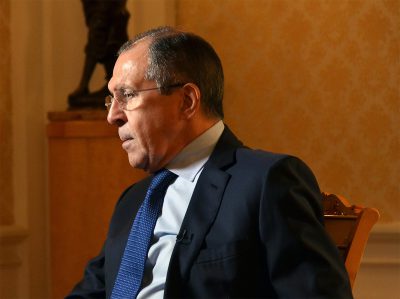
Question: I’d like to start by asking you about your forthcoming meeting with US Secretary of State Rex Tillerson, we’ve read in the press that the two of you may be meeting soon.
Sergey Lavrov: So they say.
Question: Could you perhaps tell us about your expectations and goals in dealing with Secretary Tillerson?
Sergey Lavrov: Well, after the American election, soon after Election Day President Putin and President-elect Trump talked over the phone. It was a good but very general discussion touching upon the key issues in our relations, and of course the key international issues. And they agreed that they would continue being in touch and after the inauguration they talked again, and they reconfirmed the need to look for ways which would be effective in handling international problems. And of course to see what could be done to bring the bilateral relations to normalcy. They also agreed that Mr. Rex Tillerson and I would look into the agenda in some more details, and would also discuss the preparation for the presidential meeting which should take place when both countries, both leaders feel comfortable.
And we met with Rex in mid-February in Bonn on the margins of the G-20 ministerial meeting, and covered quite a lot of the bilateral agenda. I briefed him about the relationship on bilateral issues with the Obama administration, the problems which accumulated during that period. We did not go into the substance of this, I just briefed him so that his team, which is still being assembled, could take a look at these issues and determine what kind of attitude they would have on them. And we discussed Syria, Iran, the Korean Peninsula, the Middle East in general, relations between Russia and the West, it was a very general, but rather substantive discussion, obviously it was the first contact and Mr. Rex Tillerson is just getting into the shoes of his new capacity. We discussed the possibility of personal meeting and have been continuing these discussions. As soon as we finalize them it will be announced.
But my feeling is that from the point of view of personal relationship, we feel quite comfortable. I feel quite comfortable, I believe Rex had the same feeling, and our assistants should work closer but of course this could only be done when the team in the State Department is complete.
Question: Of course. If I could follow up on your answer there, you mentioned bringing normalcy to the U.S.-Russia relationship. What do you think “normal” is?
Sergey Lavrov: “Normal” is to treat your partners with respect, not to try to impose some of your ideas on others without taking into account their own views and their concerns, always to try to listen and to hear, and hopefully not to rely on a superiority complex, which was obviously the case with the Obama administration. They were obsessed with their exceptionality, with their leadership. Actually the founding fathers of the United States, they also spoke of their leadership, and they believed that the American nation was exceptional, but they wanted others just to take the American experience as an example and to follow suit. They never suggested that the United States should impose, including by force, its values on others.
And the Obama administration was clearly different. Actually, long before Ukraine, long before Crimea, in early December 2012, there was an OSCE ministerial meeting in Dublin. And Hillary Clinton was Secretary of State and was the head of the delegation, we had a bilateral meeting with her, she was trying to persuade me on something which was a difficult issue on the agenda, but I recall this situation because in the margins of this ministerial meeting she attended a meeting in the University of Dublin, and she delivered a lecture in which she said something like: “We are trying to figure out effective ways to slow down or prevent the move to re-Sovietize the former Soviet space.” December 2012.
What kind of action she was considering as the move to re-Sovietize the space, I really couldn’t understand. Yes, there were discussions about Ukraine, about Kazakhstan, Belarus and Russia, forming the Customs Union, and if this was the reason, then of course it showed very obviously the real attitude of the Obama administration to what was going on in the former Soviet space and the area of the Commonwealth of Independent States, its obvious desire to take over this geopolitical space around Russia without even caring what Moscow might think.
This was the reason for the crisis in Ukraine, when the U.S. and European Union bluntly told the Ukrainians: either you are with us, or you are with Russia against us. And the very fragile Ukrainian state couldn’t sustain this kind of pressure, and what happened- happened: the coup, and so on and so forth (if you want I can discuss this in some detail later). But my point is that they considered normal that the people in Obama’s team should call the shots anywhere, including around such a big country as the Russian Federation. And this is absolutely abnormal in my view.
At the same time, when we visited Venezuela with our naval ships, they were raising such hell, as if no one could even get closer to what they believe should be their backyard. This mentality is not adequate for the twenty-first century. And we of course notice that President Trump is emphasizing the need to concentrate on U.S. interests. And foreign policy for him is important as long as it serves the United States’ interests, not just some messiah projects doing something just for the sake of showing that you can do it anywhere. It’s irrational, and in this he certainly holds the same position as we do in Moscow, as President Putin does, that we don’t want to meddle in other people’s matters. When the Russian legitimate interests are not, you know involved.
Question: You just mentioned at the end of your statement that the United States shouldn’t meddle in others’ affairs, and obviously many Americans today feel that Russia has meddled in American affairs, in the 2016 election. Your government has denied that. But how do you explain what happened in the United States? Do you feel that Russia had any involvement or any responsibility at all for what transpired?
Sergey Lavrov: I believe that these [are] absolutely groundless accusations – at least I haven’t seen a single fact that this was substantiated. I believe these accusations were used as an instrument in the electoral campaign, which for some reasons seemed to the Democratic Party to be an efficient way to raise support among the American people, playing on their feelings that no one shall meddle with American affairs. This is a Russophobic instrument. It was a very sad situation because we never wanted to be unfriendly with the American people, and apparently the Obama administration, the elite in the Democratic Party, who made every effort during the last couple of years to ruin the very foundation of our relationship, decided that the American people should be brainwashed without any facts, without any proof. We are still ready to discuss any concerns of the United States.
As a matter of fact, in November 2015, long before this hacker thing started, we drew the attention of the U.S. administration to the fact that they kept hunting Russian citizens suspected in cybercrime in third countries, and insisting on them being extradited to the United States, ignoring the treaty on mutual legal assistance which exists between Russia and the United States, and which should be invoked in cases when any party to this treaty has suspicions regarding the citizen of another one. And this was never done.
So what we suggested to them in November 2015, that we also don’t want to see our citizens violating law and using cyberspace for staging all kinds of crimes. So we would be the last one to try to look aside from them. We want them to be investigated and to be disciplined. But since the United States continued to avoid invoking this treaty on legal assistance, we suggested to have a meeting between the Justice Department and the Russian prosecutor-general, specifically at the expert level, on cybercrime. To establish confidential, expert, professional dialogue to exchange information.
They never replied; when we reminded them that there was a request, they orally told us that they were not interested, but in December 2016, more than one year after our request was tabled, they said, “Okay, why don’t we meet?” But this came from Obama administration experts, when they already were on their way out, some technical meeting took place, it was not of any substance but at least they responded to the need to do something about cyberspace.
And of course on cybercrimes the discussions in the United Nations are very telling. When we are leading the debate on negotiating an instrument which would be universal and which would be mandatory for everybody, the U.S. is not really very much eager, and is not very enthusiastic.
Speaking of meddling with others’ matters, there is no proof that Russia was in any way involved either in the United States, or in Germany, or in France, or in the United Kingdom – by the way, I read yesterday that the Swedish prime minister is becoming nervous that they also have elections very soon and that Russia would 100 percent be involved in them. Childish, frankly speaking. You either put some facts on the table or you try to avoid any statements which embarrass you, even if you don’t believe this is the case.
It’s embarrassing to see and to hear what we see and hear in the West, but if you speak of meddling with other countries’ matters, where facts are available—take a look at Iraq. It was a very blunt, illegal intervention, which is now recognized even by Tony Blair, and those who were pathetically saying that they cannot tolerate a dictator in Iraq. Take a look at Libya, which is ruined, and I hope still has a chance to become one piece. Take a look at Syria, take a look at Yemen: this is the result and the examples of what takes place when you intervene and interfere. Yes, I’m sure you can say about Ukraine, you can say about Crimea, but for this you have to really get into the substance of what transpired there.
When the European Union was insisting that President Yanukovych sign an association agreement, including a free-trade zone with zero tariffs on most of the goods and services crossing the border between Ukraine and the European Union, and at that point it was noted that Ukraine already had a free-trade area with Russia, with some different kind of structure, but also with zero tariffs. So if Russia has zero tariffs with Ukraine, Ukraine would have the same with European Union but we have some protection, under the WTO deal with the European Union, so the only thing we said: guys, if you want to do this, we would have to protect our market from the European goods which would certainly go through Ukraine to Russia, trying to use the zero-tariff arrangement. And the only thing suggested, and Yanukovych supported, is to sit down the three—Ukraine, EU and Russia—and to see how this could be handled. Absolutely pragmatic and practical thing. You know what the European Union said? “None of your business.”
Then-President of the European Commission Mr. Jose Manuel Barrosso (my favorite) stated publicly that we don’t meddle with Russia’s trade with China, so don’t meddle with our deal with Ukraine. While the situation is really very different and the free-trade area argument was absolutely ignored. And then Mr. Yanukovych asked for the signature of this deal to be postponed, for him to understand better what will be the consequences—for his industry, for his finances, for his agriculture—if we would have to protect ourselves from potential flow of cheap goods from Europe. That’s so, and then the coup was staged, in spite of the fact that there was a deal between Yanukovych and the opposition, witnessed by Germany, France and Poland.
Next morning, this deal was torn apart under the pretext that Yanukovych disappeared, and therefore all commitments were off. The problem is that he did not leave the country, he was in another city of the country. But my main point is that the deal which they signed with him was not about him; it was about his agreement to go to early elections – and he would have lost these elections – but the deal started by saying, “We agree to create a government of national unity.”
And next morning, when they just tore apart this deal, Mr. Arseniy Yatsenyuk then a leader in Ukraine’s Batkivshchyna party and others who signed the deal with the President, they went to this Maidan, to the protestors, and said, “Congratulations, we just created the government of the winners.” Feel the difference: “government of national unity” and “government of the winners”. Two days later, this parliament, which immediately changed their position, announced that the Russian language is no longer welcome.
A few days later, the so called the Right Sector, the group which was an instrument in the violence in Maidan—they said that Russians have nothing to do in Crimea, because Russians would never honor the heroes of Ukraine, like Bandera and Shukhevych, who were collaborating with Nazis. These kinds of statements led to the people in the east of Ukraine just to say: “guys, you did something unconstitutional, and we don’t believe this is good for us”, so leave us alone, let us understand what is going on in Kiev, but we don’t want any of your new ideas to be imposed on us. We want to use our language, we want to celebrate our holidays, to honor our heroes: these eastern republics never attacked anyone. The government announced the antiterrorist campaign in the east, and they moved the regular army and the so-called voluntary battalions in the east of Ukraine. This is not mentioned by anyone. They are called terrorists—well, they never attacked a person.
And investigations of what actually happened on that day of the coup is going nowhere, the investigation of the murder in Odessa on the second of May, 2014, when dozens of people were burned alive in a trade-union office building, is moving nowhere. Investigation of political murders of journalists and opposition politicians is not moving anywhere. And they basically passed amnesty for all those who were on the part of the opposition during the coup. And they prosecute all those who were on the part of the government.
But even now they want to prosecute Yanukovych in absentia, but one interesting thing maybe for your readers to compare: there was a deal on the twenty-first of February, next morning they said, Yanukovych is not in Kiev, so our conscience is clean and we do what we please, in spite of the commitment to national unity. About the same time there was a coup in Yemen. President Hadi fled to Saudi Arabia. Not to some other city in Yemen, but he fled abroad.
More than two years passed, and the entire progressive international community, led by our Western friends, insists that he must be brought back to Yemen and that the deal which he signed with the opposition must be honored by the opposition. My question is why Ukraine’s situation is treated differently from the situation in Yemen. Is Yemen a more important country? Are the deals which you sign and the need to respect your word and your deals, more sacred in Yemen than in Ukraine? No answer.
Sorry for getting into all these details, but people tend to forget, because they’re being brainwashed every day with very simple phrases like “Russia is aggressor in Ukraine,” “annexation of Crimea” and so on and so forth, instead of laboring your tongues, people should go there. Those who go to Crimea, see for themselves how the people live there, and they understand that all these hysterical voices about violation of human rights, about discrimination vis-à-vis Crimean Tatars, is a lie.
Question: Maybe coming back, just for a moment, to the U.S. election, and setting aside the question of evidence, because your government has its perspective, the U.S. intelligence community has its perspective—I don’t think those differences are likely to be reconciled. Setting that question aside, many Americans believe that Russia did interfere in the election; it’s contributed to a particular political climate in the United States. Do you view that as an obstacle to the U.S.-Russia relationship, and do you believe there is anything that Russia can or should do to try to address these widespread concerns?
Sergey Lavrov: You said a very interesting thing. You used the word “perspective.” You said, “Russia has its own perspective; the American intelligence community has its own perspective.” Perspective is something which many people have. We speak about facts, about proofs. And with all these perspectives, these hearings which sometimes are shown on CNN, on Russian TV, I haven’t heard any, any proof. Except the confirmation that the FBI and the NSA started watching what the Trump team is doing sometime in July. I heard this recently.
And I take this as acceptance by those who were doing this, for whatever reason, and they clearly said that this was not because of the suspicion that he had something to do with Russia but this was a routine process during which they find a trace leading to the Trump headquarters. Fine, this is a fact: they admitted that they started this. So what? If by admitting this they make their perspective regarding Russia a fact, I cannot buy this.
And then you said, they have their own perspective, and that the American people believe Russia had something to do with the American elections. Categories like perspective and belief are not very specific. And we speak about some very serious accusations. I understand that in the West, people who indeed profess Russophobic feelings, and unfortunately they are—they used to be very powerful, they are still very powerful even when they lost the elections: and Russophobic trends are obviously seen even in the Republican camp. You know, it’s very easy to find some external threat and then to put all the blame on this particular external threat.
When in 2014 the Malaysian plane was shot down over Ukraine, two days later I think, in the UN Security Council, when we insisted on adopting a resolution demanding further investigation, the American officials said yes, we believe investigation must be held, but we already know the result.
What about the presumption of innocence? The same happened on Litvinenko, the poor guy who was poisoned in London, when from the very beginning they said, we will have an investigation but we know who did it, and they never made this trial public. And they never accepted the offer of assistance which we were ready to provide. And so on and so forth.
Now, yesterday, this terrible murder of the Russian and Ukrainian citizen, who used to be an MP in Russia, and did not stay in the current parliament, and President Poroshenko two hours after the guy was murdered says that this was a terrorist attack from Russia—who also blew up the munition depot near Kharkov. It was said a few hours later by the president of a democratic country, whom our American and European friends call a beacon of democracy. I thought democracy was about establishing facts when you have suspicions.
And democracy is about division of power, and if the the chief executive takes upon himself the functions of the legal system, of the judicial system, that does not fit with my understanding of how Western democracy works. We’re ready to discuss anything, any facts, I mean. We’re ready to assist in investigations of whatever issues our partners anywhere might have. Whether this is going to be an obstacle to normal relations, I don’t think so. I believe the Russian people, at least if we are asked, I would say no, if it depends on us. I understand that there are some people in the United States who want this to become an obstacle, and who want to tie up the team of President Trump on the Russian issue, and I believe this is very mean policy, but we see that this is taking place.
What can Russia do to help? Unfortunately, not much. We cannot accept the situation, but some absolutely artificial hysterical situation was created by those who severed all of the relationship—who dropped the deal on the Bilateral Presidential Commission between Moscow and Washington with some twenty-plus working groups, a very elaborate mechanism of cooperation—and then after they have done this, after they prevent the new administration from doing away with this absolute stupid situation, to ask us to do something? I don’t think it’s fair.
We said what we did, that we are ready to work with any administration, any president who would be elected by the American people. This was our line throughout the electoral campaign, unlike the acting leaders of most European countries who were saying absolutely biased things, supporting one candidate, unlike those who even bluntly warned against the choice in favor of the Republican candidat, and this somehow is considered normal. But I leave this on the conscience of those who said this and then immediately chickened out and then started praising the wisdom of the U.S. electorate.
We said that we would be ready to come back to the relationship and to develop the relationship with the United States to the extent, and to the depths, to which the administration is ready to go. Whatever is comfortable for our partners, we will support and provide it. We talk on the basis of mutual respect and equality, trying to understand the legitimate interest of each other and to see whether we can find the balance between those interests. We will be ready to cover our part of the way, as President Putin said, but we will not be making any unilateral steps. We offered cooperation on very fair terms, and we will judge by the deeds of course.
Question: Perhaps we can pivot to international affairs. In the United States there’s been discussion of a new Cold War; you, for your part, recently talked about a post-West international order, which as you may imagine is not something that many in the United States and other Western countries would readily embrace. In fact, some may even be strongly inclined to resist the emergence of a post-West order. What do you think a post-West order is, and do you think that it makes confrontation between Russia and the United States, or Russia and the West, inevitable?
Sergey Lavrov: Well first, I don’t believe that we are having another Cold War. Ideologically, we’re not different, we’re not apart. Yes, there are nuances in how the countries in the West and Russia and its neighbors are run. But all in all the basis is democracy, which is elections, basically, and organizing the system, the way you respect the opposition and it’s also market economy. Again with «give and take» you know in some countries the state is much more involved in economy than in others but this happened in France some time ago, in the UK some time ago, so this is all secondary details, I would say. There’s no ideological differences as far as democratic principles and market economy are concerned. Second, these days, unlike the days of the Cold War, we have much clearer common threats, like terrorism, like chaos in the Middle East, like the threat of the proliferation of weapons of mass destruction. This was never the case during the Cold War days, which was a very negative balance with sporadic conflicts in periphery. This time we have global universal threats, not sparing anyone and this is what we witness almost daily, with these terrorist attacks in the Middle East and Europe, there was one in the United States, and so on and so forth.
So this absolutely makes it necessary to reassess where we are and what kind of cooperative structure we need. Post-West system, post-West order: I mentioned this term in Munich at the Munich Security Conference, and I was really surprised that people immediately made me the author, the coiner of this term, because the title of the conference contained “post-West order”—with a question mark, yes. I put the question mark aside for one very simple reason: if we all agree that we cannot defeat terrorism, organized crime, drug trafficking, climate change without a universal coalition, if we all agree that this is the case, and I believe we do, then it would certainly be necessary to recognize that the world is different, compared to the many centuries than when the West was leading with culture, philosophy, military might, economic systems, and so on and so forth.
We all have, China, the whole Asia-Pacific region, which President Obama, by the way, said is the place where the U.S. would be shifting, which in itself means that he was not thinking of the West order but post-West order. And, of course, Latin America, Africa, which is hugely underdeveloped but has the potential with resources and labor, young and vigorous, still untapped. Secretary of State Rex Tillerson just a few days ago in Washington convened a coalition to fight terrorism—sixty-eight countries if I am not wrong, double the number of the countries in the West. This meeting was post-West order, or a manifestation of post-West order. So I don’t believe the Western countries should be really offended or should feel that their contribution to the world civilization has been underestimated—not at all. It’s just the time when no one can do it alone, and that’s how we feel. It’s a polycentric world. Call it multipolar, call it polycentric, call it more democratic—but this is happening. And economic might, financial might and the political influence associated with all this, they’re much more evenly spread.
Question: Let’s zero in on Syria. You mentioned the terrorism issue and certainly the struggle with ISIS is an important focus for the U.S., for Russia. There has been, as I’m sure you’re aware, some skepticism in the United States about Russia’s role in Syria. President Donald Trump, when he was a presidential candidate, certainly referred many times to a desire to work with Russia in Syria. How do you envision the opportunities and constraints on the U.S. and Russia in working together in Syria, and do you have any specific new ideas about how to do that?
Sergey Lavrov: First, when this coalition was created by the Barack Obama administration (the coalition which was convened in Washington just a few days ago) it was understood that out of sixty-some countries only a few would be actually flying air force and hitting the ground. Others were mostly political and moral support, if you wish, solidarity show—which is fine, it’s important these days as well to mobilize the public opinion in as many countries as you can. We were not invited. The Iranians were not invited. Some others were not invited, who I believe should be important partners in this endeavor. But this was motivated by some ideological considerations on the part of the Barack Obama administration. I just don’t want to go into the reason for why they assembled this particular bunch of people.
But what I can attest to is that one year into the creation of this coalition, it was very sporadically using the air force to hit some ISIL positions. They never touched the caravans who were smuggling oil from Syria to Turkey and, in general, they were not really very active. This changed after we responded to the request of President Assad, who represents, by the way, a legitimate government –member of the United Nations. After we joined, President Vladimir Putin and President Barack Obama spoke in New York in September 2015, and President Putin clearly told him that we would be doing this and we were ready to coordinate, and they agreed to have these deconfliction discussions, which did not start soon actually, not through our fault. But when we started working there the U.S.-led coalition became much more active. I don’t want to analyze the reason for this. I’m just saying before we moved there with our air force, the U.S. coalition was very rarely hitting ISIL positions and almost never hitting the positions of Jabhat al-Nusra, which many people believe has been spared just in case at some point they might be needed to topple the regime. And this feeling, this suspicion, is still very much alive these days, when Jabhat al-Nusra already twice changed its name, but it never changed its sponsors who continue to pump money and whatever is necessary for fighting into this structure. And people know this. So when we moved there, at the request of the government, we suggested to the U.S. to coordinate our efforts. They said, “No, we can only go for deconfliction,” and deconfliction procedures were developed and are being applied quite well, but we believed it was a shame that we couldn’t go further, and coordinate targets and what have you. And then my friend, John Kerry, who was very sincere in his desire to overcome the ideological—not ideological, but to overcome some artificial barriers, and to indeed start military coordination—we spent almost from February 2016 to September 2016 when, eventually, we had a deal to separate the armed groups, with whom the U.S. and the allies cooperate, from ISIL and Jabhat al-Nusra, and then to coordinate the targets and basically to strike only those targets which would be acceptable to both Russians and the Americans. Quite a few people really understood the quality of this deal.
I put myself in the shoes of those who were criticizing us for hitting wrong targets. You remember, there was so much criticism. So the deal we reached with Kerry, when none of us could strike unless the other supports, was solving this problem. And the fact that the Pentagon just disavowed what Kerry did, and Obama could not overrule the Pentagon, meant for me only one thing: that he, the president of the United States, Barack Obama, was motivated by the desire to have some revenge on Russia, for whatever reason and for whatever situation, rather than to capitalize over the deal reached between John Kerry and us, to make the war against terror much more efficient in Syria. But let God judge him.
Now, whether we have an opportunity to resume the cooperation: yes we do. Yes, President Donald Trump said that fighting terrorism is his number one international goal, and I believe this is absolutely natural. We will be sharing this approach, I am sure, and it’s also, in this sense, coming back to our first question which we discussed, about intervention in other parts of the world, terrorism is a universal threat. So when you interfere to fight terrorist manifestations, it’s in the interest of your country. It’s another matter that you have to be faithful to international law. And the coalition, of course, led by the United States, was never invited to Syria. We were, Iran was, Hezbollah was. Still, the Syrian government, while complaining that the coalition were there uninvited, they said, “If and since you’re going to coordinate with Russians, with those who fight ISIL and Nusra, we take it as this is what you want, to defeat terrorism, not to do anything else in Syria.” So deconfliction procedures continue to be applied.
You might have heard that the chief of general staff of the Russian Army, General Gerasimov, met with General Dunford.
Question: Twice, I understand.
Sergey Lavrov: Twice, at least, and they talked over the phone. And this is something the military discussed. I assume that if their discussions go beyond deconfliction, I don’t want to speculate, this would be a welcome sign that we can really do what is necessary to bring about the situation when everyone who confronts ISIL and Nusra on the ground acts in coordination. If not under the united command—this, I think is unachievable—but in a coordinated manner.
The Turks have troops on the ground. Iran, Hezbollah are invited by the government. Russian air force with some ground special military police helping keep law and order in the Sunni quarters of Aleppo and Damascus, the military police from Russia is largely composed of Russian Sunnis from the northern Caucasus—Chechens, Ingush and others.
The U.S. Air Force and the coalition air force; U.S. special forces on the ground. Apparently there are French and U.K. special forces on the ground. The military groups who are part of the so-called Free Syrian Army, the military armed groups who are part of the Kurdish detachments—there are so many players: I listed all those who declare that ISIL and Nusra are their enemies. So some harmonization is certainly in order, and we are very much open to it.
When the United States dropped from the deal, which we negotiated with John Kerry, we shifted to look for some other opportunities and we had the deal with Turkey later—which was later supported by Iran—which brought about some kind of cessation of hostilities between the government and a group of armed opposition. And we created, in Astana, a parallel track supportive of the Geneva negotiations concentrating on mechanisms to monitor the cessation of hostilities, to respond to violations, also to build up confidence by exchanging prisoners, and so on and so forth.
It is not welcome by quite a number of external players who try to provoke and encourage the radicals, radical armed groups in Syria, to make trouble and to stage some terrorist attacks. They launched a huge offensive now in the northern part of the Hama province, and they basically coordinate with Jabhat al-Nusra, under its new name. So it’s also a game for influence in Syria, unfortunately, which prevails in the minds of the people who promote such an approach, rather than the need to get united to fight terrorism, and then to have a political deal. It’s the fight for influence on the battleground, and this is unfortunate. We don’t need this now. What we need is to strengthen the cessation of hostilities and to support strongly the political process in Geneva, concentrated on the new constitution, which would be accompanied by a division of power between the government, the opposition, all ethnic groups, then elections and so on and so forth. But all this would be absolutely meaningless if people sacrifice the fight against terror for the sake of their goal, their obsession, with regime change.
Question: In Iran, the Trump administration seems to have signaled an intent to try to enforce the Iran nuclear deal, the JCPOA, more strictly, perhaps to be more assertive in challenging Iran’s regional role. And I’d be curious about your reaction to that and the degree to which Russia could work with, or not work with, the United States on either of those things. Then there is Ukraine. Clearly a very complex problem, the Minsk Process I think to many outside observers really seems to have stalled. Is that process dead? Is there any way to move forward?
Sergey Lavrov: On Iran, the Joint Comprehensive Plan of Action was a product of collective work—it’s a compromise. But the key things were never compromised. It’s a compromise which allows for all of us, with the help of the International Atomic Energy Agency, to be sure that Iran’s nuclear program is going to be peaceful, that all the elements which cause suspicion would be removed, and handled in a way which gives us all certainty and gives us control over the implementation of those arrangements.
I don’t think that the Trump administration is thinking in the same terms as the slogans during the campaign, that Iran is the number one terrorist state; we don’t have a single fact to substantiate this claim. At least when we were facing a huge terrorist threat, when we were under terrorist attack in the 1990s in the northern Caucasus, we detected and discovered dozens and hundreds of foreign terrorist fighters from very close neighborship to Iran, but not from Iran at all. And we know that the political circles in quite a number of countries were really encouraging these terrorist groups to go into the northern Caucasus. Iran had never challenged the sovereignty of the Russian Federation, never used its own links with Muslim groups to provoke radicalism and to create trouble. What we do now with Iran and those that cooperate with us and the Syrian army is fighting terrorists in Syria. Iran is a powerful player on the ground, legitimately invited by the government. Iran has influence over Lebanese Hezbollah, which is also legitimately on the ground. And if we all want, you know, to topple, to defeat terrorists in Syria, there should be some coordination. I have already touched upon this.
The IAEA regularly reports on this Joint Comprehensive Plan of Action implementation. The latest report once again confirmed that there are no violations of the part of Iran, and that the deal is being implemented in line with the commitments of Tehran and all others. It’s another matter that the steps which were promised in return to the implementation, namely sanctions relief, are not being undertaken by all Western participants as fast and as fully as was promised. But that’s another matter.
On the Minsk agreements, I believe that the Ukrainian government and President Poroshenko personally want them dead. They want them dead in a way which would allow them to blame Russia and the people in the east of Ukraine. They certainly encountered huge opposition from the radicals, and the radicals believe that this government is weak enough just to wait it out and to have either early elections or to have another Maidan. The biggest mistake of President Poroshenko, I am convinced, was that after he signed this agreement in February 2015 in Minsk, and he came back with the success, with the support of Germany, France, then the Security Council in New York endorsed this deal, and he should have used this moment to impress upon his parliament, upon the opposition, that this was a good deal supported by the European Union, where he wanted to join.
Instead, he started apologizing in front of his opposition when he got back to Kiev saying, you should not think this is serious, I did not commit myself to anything in the legal way—in the legally binding way—this is not what you read. And so on and so forth. He cornered himself in the situation of an absolutely irresponsible politician who signed one thing and who was saying that this is not what he signed one week later when he came back. The opposition felt that this was his weakness and they started carving out of his position anything which was still reasonable. The fact that every day he is in contact with President Vladimir Putin, they talk over the phone sometimes, they talk on the margins of the meetings of the Normandy Format when the leaders have their meetings; the last one was in October in Berlin last year. But my impression is that he tries to be constructive, to find ways to come back to the Minsk implementation. But the next day he comes back to Kiev or goes abroad, and goes public saying things which are absolutely aggressive and are absolutely unfair.
One very simple example: the Minsk agreement, they provide for preparation for elections on the special status of these territories, the status itself is listed in the deal, and the law on this special status is already adopted by the Rada, but it is not in force. Then amnesty, because you don’t want to have a «witch hunt», and the constitutional confirmation that this special status is permanent. That was all. And after this is done, the Ukrainian government restores full control over the entire Russian-Ukrainian border. They are saying now: no elections, no special status, no constitutional change, no amnesty, until we first take control of the border. But everyone can read the Minsk agreement—it’s only three pages. And it says absolutely clearly that the border transfer is the last step, and everyone understood why when this was negotiated. Because if you just under these circumstances, with all these animosities, with all these so-called voluntary battalions, Azov, Donbass and all the radicals, not reigned in by the government—when you just say, okay, take the border and we trust you that will do everything else, these people would just be victims. They will be suffocated and burned alive like the people in Odessa. So the political guarantees are crucial, and Germany, France and others understood this very well, just like the Americans understood this very well, because we did have parallel track—parallel to the Normandy Format—with the U.S. and we are ready to revive it again.
But one very simple example. October 2015, Paris: the Normandy leaders meet. And there is very specific discussion regarding the law on special status. The logic and sequence of the Minsk agreement is that you first have the special status, and then you have elections. Because people would normally want to know what kind of authority those for whom they are going to vote would have. Poroshenko said, no, we first have to have elections. Then I, Poroshenko, would see whether the people elected are to my liking. And if they are, then, we will give them the special status.
Which is rather weird. But still, we decided just to move forward, we would be ready to have some compromise on this thing, in spite of the fact that it was absolutely clearly spelled out in the Minsk agreement. And then the former foreign minister of Germany, who was participating in the meeting, Frank-Walter Steinmeier, who is now president of Germany, he said, why don’t we have a compromise formula which would mean that the law on the special status is adopted, but it enters into force on the day of elections temporarily, and it would enter into force, full fledged, on the day when the OSCE reports that elections were free and fair, and in line with democratic OSCE standards?
Everyone says okay. Poroshenko says okay. One year later, in October 2016 in Berlin, the same group of people, the leaders with the ministers. And President Putin is saying the formula of Steinmeier is still not embodied in any papers, in the Contact group process, because the Ukrainian government refuses to put in on paper. Poroshenko said, well, but it is not what we agreed, and so on and so forth. And then Putin said, well this is Mr. Steinmeier, ask him about his formula, and he reiterated this formula: temporary entry into force on the day of elections, full entry into force on the day the OSCE confirms they were free and fair. Merkel said the same, Hollande said the same, that this was absolutely what we agreed.
And then Poroshenko said, okay, let’s do it. October 2016 is almost half a year ago. And we are still not able, because of the Ukrainian government opposition in the contact group, to fix this deal on paper. So I can go for a long time on this one, but I am sure that those people who are interested can go and who follow the developments in Ukraine, they understand why we are not at the point of Minsk implementation.
The Ukrainian government wants to provoke the other side to blink first and to say, enough is enough, we drop from the Minsk deal. That’s why the economic blockade, that’s why the prohibition for the banks to serve the population in the east. By the way, in the Minsk agreements, two years ago we discussed the difficulties in banking services for this part of Ukraine and Germany and France committed themselves to organizing mobile banking, and they failed because they could never get cooperation from the Ukrainian authorities.
Well, I leave it to your readers to study what is going on, what is happening in Ukraine, Syria and elsewhere.
http://www.mid.ru/en/foreign_policy/news/-/asset_publisher/cKNonkJE02Bw/content/id/2710445
‘We had him booted out’: Palestinian won’t get top UN post, US envoy Haley tells AIPAC
RT | March 28, 2017
The US won’t allow a Palestinian to secure “one of the highest positions” at the UN, US ambassador to the United Nations Nikki Haley said, explaining why the US had blocked a former Palestinian prime minister’s appointment to lead the UN’s Libya mission.
“So when they decided to try and put a Palestinian [former Palestinian Prime Minister Salam Fayyad] in one of the highest positions that had ever been given at the UN, we said no and we had him booted out,” Haley said at the annual Policy Conference of the American-Israel Public Affairs Committee (AIPAC) on Monday.
“That doesn’t mean he wasn’t a nice man,” she continued, adding “that doesn’t mean he wasn’t good to America.”
Haley added that, until Palestine “comes to the table, until the UN responds the way they’re supposed to, there are no freebies for the Palestinian Authority anymore.”
Haley added that when the UN passed a resolution demanding an end to Israeli settlement building on occupied Palestinian land, “the entire country felt a kick in the gut.”
“Never do we not have the backs of our friends. We don’t have a greater friend than Israel. And to see that happen was not only embarrassing, it was hurtful,” she said.
Haley also criticized a UN report released in March, in which author Richard Falk, a Princeton professor emeritus, describes Israel as an “apartheid state.”
“And a ridiculous report, the Falk Report, came out. I don’t know who the guy is or what he’s about, but he’s got serious problems. Goes and compares Israel to an apartheid state. So the first thing we do is we call the secretary general and say, this is absolutely ridiculous,” she said.
According to the US ambassador to the UN, the days of “Israel-bashing” are over.
“I wear heels. It’s not for a fashion statement,” she said, explaining “it’s because if I see something wrong, we’re going to kick them every single time. So how are we kicking? We’re kicking by… putting everybody on notice, saying that if you have our back – we’re going to have the backs of our friends, but our friends need to have our back too.”
The US blocked Fayyad’s appointment to lead the UN’s political mission in Libya in February, accusing the United Nations of being “unfairly biased” towards the Palestinian Authority.
Fayyad served as a Palestinian prime minister between 2007 and 2013.
Haley also noted that the Trump administration “was disappointed” by UN Secretary-General Antonio Guterres’ intention to appoint Fayyad as the UN’s next special representative to Libya, which was announced in a letter to the Security Council.
“For too long, the UN has been unfairly biased in favor of the Palestinian Authority to the detriment of our allies in Israel,” Haley said.
Her statement was praised by Israel’s UN ambassador, Danny Danon, who stated that “this is the beginning of a new era at the UN, an era where the US stands firmly behind Israel against any and all attempts to harm the Jewish State.”
Palestine is a non-member observer state at the United Nations, and its independence has been recognized by 137 of the 193 UN member nations so far. Back in February, Haley noted that US doesn’t recognize a Palestinian state “or support the signal” that Fayyad’s appointment would have sent within the United Nations.
In 2011, UNESCO voted to admit Palestine as a full member, noting that the decision had been made as “a mark of respect and confidence.”
READ MORE: US backs Israel by blocking ex-Palestinian PM’s appointment to lead UN mission in Libya
AIPAC Is Back In Town!
Hava Nagila, y’all
By Philip Giraldi • Unz Review • March 28, 2017
Spring in Washington would not be complete without the city’s famous cherry blossoms and the annual “Policy Conference” meeting of the American Israel Public Affairs Committee (AIPAC). The 15,000 plus participants began arriving on Sunday and will be here at the Walter E. Washington Convention Center until tomorrow morning, at which point many of them will descend on Congress like a swarm of ravenous locusts to make sure that our Solons on the Potomac are doing what is right by Israel.
AIPAC is the most powerful foreign policy lobby in Washington. It’s annual budget exceeds $77 million plus it has an endowment of $100 million. It has nearly 400 employees and also supports local chapters and initiatives throughout the United States.
What do all those employees do? They mostly lobby Congress and increasingly state legislatures shamelessly on behalf of a foreign country that has little in the way of actual common interests with the United States. When anything happens in the Middle East, AIPAC’s drones get to work, drafting up position papers detailing the Israeli position which are then placed by runners on the desks of every single congressman within a matter of hours. The congressmen, too lazy to engage in any real inquiry into what is going on, rely on the AIPAC research. That is, lamentably, how our system works. And if the congressman ignores the “expert” advice, AIPAC and its friends make sure he or she has a strong, well-funded opponent in the next election, someone who knows how to say “I love Israel” without moving his or her lips.
The current speakers’ list for the 2017 conference includes many of the leading political parasites that have long made the nation’s Capitol a “must miss” destination. I will not attempt to summarize what Michael Pence, Mitch McConnell, Chuck Schumer, Paul Ryan, Nancy Pelosi, Kevin McCarthy, Steny Hoyer and others said on Sunday night and yesterday as it was all basically the same speech, declaring undying love for Israel and the Jewish people and pledging that the United States will always have “Israel’s back,” whatever that is supposed to mean. Twenty-nine congressmen were featured as attendees on the AIPAC website but more than two thirds of the entire Congress is expected to appear for a photo op while muttering something about that apparently vulnerable “back.” Or do they mean backside? Whatever. I won’t name any more of the specific panderers as the reader probably already has a good idea who they are.
And, of course, the redoubtable Professor Alan Dershowitz was also a featured speaker, a wonderful human being who recently told us goyim that Jewish power in this country is both deserved and granted by Jehovah. It is interesting how Jews among themselves boast about their power but if a gentile so much as suggests the same thing it is anti-Semitism.
There were also two certifiable loonies among the speakers, apart from Dershowitz. They were Nikki Haley, America’s stalwart U.N. Ambassador, and Stephen Harper, until recently Prime Minister of Canada. Those who are following Haley’s meteoric career are probably aware that while governor of South Carolina she took the lead on making her state the first in the nation to legislate against the Boycott, Divestment and Sanctions movement (BDS) which supports peaceful pressure on Israel to abandon its apartheid policies when dealing with its own Arab citizens as well as the Palestinians on the West Bank and Gaza. Such legislation is an abrogation of First Amendment rights and will likely prove to be unconstitutional if it ever gets to the Supreme Court, but Haley clearly believed then and believes now that nothing is too good when it comes to Israel. Since going to the U.N., Haley has spoken more about Israel than about any possible American interests, pledging full support and protection for Netanyahu and his government. She blocked the appointment of a well-qualified Palestinian to a senior U.N. position purely because he was Palestinian. Ignorant of nearly everything that goes on in the world outside the U.S., it might be said that she is so horribly inept that she actually makes her ghastly predecessor Samantha Power look good.
Stephen Harper is another certified knee jerker when it comes to Israel. A fundamentalist Christian who believes the second coming of Christ is imminent, while Prime Minister he led what was possibly the world’s most pro-Israeli government. Harper described Israel as a light that “… burns bright, upheld by the universal principles of all civilized nations – freedom, democracy justice.” He has also said “I will defend Israel whatever the cost” to Canada, an interesting proposition for those who might have believed that his duty was to protect his own country and advance its interests. Harper, who has received awards from both Canadian and American Jewish organizations, personally endorsed Israel’s bombing of Lebanon in 2006, calling it “measured” even when Canadian peacekeepers were killed in the bombardment.
Paul Kagame, President of the Republic of Rwanda, also spoke at the conference. Why? I don’t know but it probably has something to do with characteristically liberal American Jews pulling their usual doublespeak trick, trying to pretend that fundamentally racist Israelis are not actually racist by inviting a black man to speak at a pro-Israel conference. I’ll bet he was paid handsomely to do so.
And former British Prime Minister Tony Blair, perhaps suggesting that love for Israel is truly international, spoke and was also probably paid handsomely to do so as he an incorporated brand. Between 2007 and 2015 Blair was the “special envoy” representing (and personally profiting from) the Quartet seeking to bring about a peace agreement between Israel and Palestine. Marwan Bishara explained in The New York Times: “A natural panderer to power, Mr. Blair morphed his complicity with the United States over Iraq into a new complicity with Israel. The assumption that operates is that schmoozing with the powerful is the only way to make a difference. So while Mr. Blair worked to reform the Palestinian Authority’s finances, security and governance, he turned a blind eye as Israel expanded its illegal settlements and tightened its hold on the autonomous territories. In the process, Mr. Blair helped render the Palestinian Authority more, not less, dependent on Israel. Instead of protecting the Palestinians from the Israeli settlers, Palestinian security forces have since been protecting Israeli settlers from Palestinian resentment.” Blair also attacked the Palestinian leadership’s decision to seek United Nations recognition of the Palestinian state, calling it “deeply confrontational.” Bishara dismisses him as “Israel’s puppy.” As I am extremely fond of dogs, I would modify that to read “Israel and now AIPAC’s butt boy.”
The avenging angel Benjamin Netanyahu also addressed the conference by satellite link and yet again described the threat posed by Iran. The satellite visit was somewhat surprising, as he usually likes to drop by in person so he can pick up his annual tribute money from the U.S. Treasury. This year’s Danegeld will be $3.8 billion thanks to President Barack Obama, guaranteed for ten years, and there will be, of course, various supplements as the Israelis discover things that they just need to have to stave off Netanyahu’s wily Persians and fight the rising tide of anti-Semitism. A rising tide, which we have just learned, was carried out by an Israeli Jew who also holds U.S. citizenship, which again leads to the question why so many Israelis are allowed to have American passports even though they live in Israel and serve in the Israeli Army?
And, of course, Persia was an integral part of the conference as it is tough to want to destroy the entire Muslim Middle East without having a really formidable enemy to focus on. Iran fits the bill quite nicely, but speakers were also prone to skewer those terrible Ay-rabs who just do not want peace. And the Israeli’s settlements are not a problem, nosiree! The theme of this year’s gathering was, in fact, “Many voices, one mission,” the mission presumably being the expansion of Israel so it will stretch east to west from the Nile to the River Jordan and north to the Turkish border. The indigenous inhabitants will have to be removed, but as they are mostly terrorists that should be okay with the world community and Donald Trump. And with the 15,000 AIPAC attendees.
The AIPAC gathering is really all about subverting Congress, so it is a good thing that a large majority of Congressmen were attending, making the necessary bowing and scraping that much easier. And they will enjoy it even more when the 15,000 AIPAC loyalists descend on Capitol Hill as the conference ends to make sure that Congress is listening. Democracy in action is great, isn’t it?
Even though I jest about the absurdity of thousands of Americans who appeared to be confused about what country they actually live in gathering to honor a foreign country that has an army that acts like a terrorist group, does not believe in equal rights even for its own citizens and bans visitors who do not accept its more questionable policies, the AIPAC people are not a joke. They are a deadly serious threat to our own democracy and way of life as they have figured out how to use money and the power that money buys to leverage and corrupt the system in such a way as to produce wars and turmoil that have blown back on the United States and made every American citizen both less safe and poorer.
I have written and spoken before how AIPAC is ultimately doomed as Israel and its basic policies towards Arabs and its neighbors are unsustainable both from a human rights and practical point of view. But that does not mean that it is going away any time soon. The Israel Lobby has the U.S. Congress and media by the throat and the Trump administration promises to be completely uncritical in its relationship with Netanyahu and whatever homicidal kleptocrat might be in line to succeed him.
Ms. Haley and her peers in state governments have successfully pushed legislation in a majority of states that punishes anyone who tries to boycott Israeli institutions or products. On university campuses non-violent criticism of Israel is being suppressed. There is also increasing pressure to define any criticism of Israel as anti-Semitism and therefore a hate crime, modeled on similar legislation in Canada, Britain and France. In a number of European countries it is a crime to challenge the standard narrative on “the Holocaust.” Why should that be? You can in much of Europe stand in a town square and say horrible things about your own country but if you criticize the factual basis of one particular “event” that took place in the 1940s you will go to jail.
So hang on to your hats, my fellow Americans. AIPAC is not going away and it will be doing all it can to keep neighboring Syria a cauldron of death and destruction while also calling for war on Iran. And AIPAC as well as the other bits and pieces of the Israel Lobby will have many Quislings in the Congress and U.S. media who will echo whatever they propose, even if it does grave damage to American interests. Meanwhile the billions and billions of dollars will continue to flow from an increasingly straitened United States to a wealthy Israel. At its conference AIPAC announced the latest windfall from America, applauding “… the U.S. House of Representatives for significantly bolstering its support of U.S.-Israel missile defense cooperation in the FY 2017 defense appropriations bill. The House appropriated $600.7 million for U.S.-Israel missile defense programs.” That is on top of everything else Israel gets. Will it ever end? I don’t know.
Featured Video

Death Spikes & Rising Cancer In Our Youth Explained
or go to
Aletho News Archives – Video-Images
From the Archives
Politicians lie
By Mazin Qumsiyeh | Popular Resistance | August 18, 2013
There is no way to say this truth nicely: Politicians lie. That includes Japanese, American, Egyptian, Israeli, and Palestinian politicians! Is there something more common sense than that? Yet, so many citizens around the world believe their own politicians or wistfully acknowledge lies but think it is part of the job needed to run things. They believe even when politicians contradict themselves blatantly. This phenomenon is rather remarkable. It is a dissonance and disconnect from reality that many seem oblivious to. It is very dangerous because it can lead to accepting rationales for going to war. These can be deadly wars that lead to millions of lives lost as happened in what was called World War 1 and WW2. Even when incredible and declassified evidence abound, politicians continue to lie and old mythologies refuse to die. Here are just a few of the countless lies told to us over the past few decades… continue
Blog Roll
 Aletho News
- From Unipolar Universalism to Multipolar Civilizational Distinctiveness
- RSF military group defects, joins Sudanese army: State media
- Ireland goalkeeper refuses to play ‘Israel’ as squad weighs boycott
- China pushes back against US on Cuba, Iran
- Ukrainian Soldiers, Potential Mercenaries: Have Gun, Will Travel!
- Burnham’s UN debut… A masterclass in British disinformation
- Iran flights continue despite US aviation sanctions
- Global Tipping Points Lead the World Into a State of Entropy
- The day-after at the White House: USA and Xi Jinping
- The Geopolitical Balance in the Red Sea: The UAE Being Displaced by New Players
- If Americans Knew
- Deconstructing Netanyahu’s pants-on-fire UN rant – Daily Update
- Trump betrayed voters with his campaign lies and prioritized a foreign country once he took office
- Netanyahu calls Israel’s war in Gaza ‘opposite of genocide’ in UN speech to near-empty hall
- Settler Kidnappings: Torture, Sexual Abuse and Terrorisation of Palestinian Abductees as Israel Deepens Annexation of West Bank
- Gaza winter nears as 162,000 tents become unusable, raising fears of humanitarian crisis
- Netanyahu says, “It’s the opposite of genocide”; UN says Gaza economy is world’s ‘most severe crisis on record’ – Daily Update
- Israel’s US-Backed Assault on Gaza Has Created the ‘World’s Most Severe Economic Crisis on Record’: UN
- ‘Protecting U.S. Citizens’… From Israel
- ‘This is where I live now, the back of a truck’: a day in the life of a grandmother in Gaza
- In UN Speech, Iran’s President Displays Pictures of Children Killed by US, Brings Attention to Israel’s Nuclear Arsenal
- No Tricks Zone
- New Study: Earth And Venus Surface Warmth Largely Explained By Convection And Lapse Rate, Not CO2 Or Radiation
- 2025 Nature Paper Claiming Worsening Global Drought Gets RETRACTED …Heavily Flawed
- New Study: ‘Global Drought Shows No Detectable Recent Acceleration Under Climate Warming’
- Economic Masterminds: German Socialists Suggest Taxing Productivity Gains Stemming From Using AI
- The South China Sea Has Not Been Cooperating With The Climate Change Narrative
- Energy Crisis: Germany Enters Heating Season With Historically Low Gas Reserve Fill Levels
- New Study: The Antarctic Ice Sheet Gained Mass From 2020-2024 Due To Staggering Snow And Ice Accumulation
- Study: Ocean Heating Rates From Thousands Of Years Ago ‘Dwarf’ Modern Ocean Heating Rates
- Climate Extremists Target, Attack Large-Scale Power Grid Infrastructure In Germany!
- New Study: Antarctic Ice Melt Has Contributed Less Than 1 Centimeter To Sea Level Rise In The Last 30 Years

