US Defense Secretary General James Mattis has arrived in Israel for talks expected to focus on Iran and Syria as well the strategic relations between Tel Aviv and Washington.
Mattis arrived in Tel Aviv Thursday afternoon from Cairo on the third leg of a week-long tour of the US allies in the Middle East.
Marking the first time he has visited Israel as the Pentagon chief, Mattis was greeted by an official honor guard at army headquarters in Tel Aviv on Friday morning.
He then met the Israeli minister for military affairs, Avigdor Lieberman, and is scheduled to hold talks with Prime Minister Benjamin Netanyahu and President Reuven Rivlin.
Mattis hopes to hear directly from Israeli leaders their concerns about regional issues, with Iran’s influence topping the list.
‘No doubt Syria has chemical weapons’
The conflict in Syria, where the US and Israel seek to remove President Bashar al-Assad from power, is also on the agenda, according to the prime minister’s office.
Israel was one of the first US allies to salute President Donald Trump for a recent missile strike on a Syrian airbase, where they alleged a suspected chemical attack originated.
Speaking during a press conference with Lieberman on Friday, Mattis said there can be “no doubt” that Syria has retained some chemical weapons and warned President Assad not to use them.
“There can be no doubt in the international community’s mind that Syria has retained chemical weapons in violation of its agreement and its statement that it had removed them all. There is no longer any doubt,” he said.
The US, Israel and Saudi Arabia have been pushing to overthrow the Syrian government through the use of proxy militant forces in the country.
Iran has been lending advisory support to Syria in its battle against the foreign-backed militants, but has avoided direct military involvement in the conflict.
Known as the “Mad Dog,” Mattis has famously said the three gravest threats to US national security were “Iran, Iran, Iran.”
While in Riyadh on Wednesday, the Pentagon chief reiterated the Trump administration’s position that Iran seeks to “destabilize” the region.
He told reporters after meeting with senior Saudi officials that “everywhere you look if there is trouble in the region, you find Iran.”
US-Israeli ties reached a low point over the 2015 nuclear agreement between Iran and world powers, including the United States.
Former President Barack Obama pushed for the agreement, to the dismay of Netanyahu who argued it would only strengthen Iran in the region.
Israeli leaders were emboldened by the election of Donald Trump, who has described the nuclear accord as “the worst deal ever negotiated” and threatened to “rip it up.”
In his latest criticism on Thursday, Trump blasted the deal as “a terrible agreement” that “shouldn’t have been signed,” and accused Iran of “not living up” to its spirit.
April 21, 2017
Posted by aletho |
Ethnic Cleansing, Racism, Zionism, Wars for Israel | Iran, Israel, Middle East, Sanctions against Iran, Syria, United States, Zionism |
Leave a comment
‘War is peace’, ‘Freedom is slavery’, ‘Ignorance is strength’ and ‘Lying is the truth’,
“Nineteen Eighty-Four”, George Orwell
Inside Syria Media Center | April 21, 2017
The statements of some Western politicians about the chemical attack on April 4, which occurred in the Syrian province of Idlib, once again confirm that the modern world is suffering a severe and chronic crisis of political will.
The lack of a clear and independent position on the issue (and also on most global problems) by the governments of Western powers is a serious obstacle in the fight against such threats as terrorism, organized crime, the struggle against hunger, the proliferation of nuclear weapons etc. This raises serious doubts about whether some politicians are competent and whether the opportunity to make the world safer under the leadership of such leaders is real.
UN experts have not yet published any objective conclusions about anybody’s involvement in the alleged use of chemical weapons in the city of Khan Sheikhun, Idlib.
Are diplomats from different countries really getting to the bottom of the truth? An analysis of the statements about the purported chemical attack in Syria makes it possible to give an answer that is close to reality.
The events that took place within a week after the air strike attack on Khan Sheikhun divided the world community into two camps. Some require immediate action, not caring about the truth, while the latter seek to establish the truth.
A list of supporters of Orwell’s Big Brother strategy:
1. The National Coalition for Syrian Revolutionary and Opposition Forces was one of the first which claimed that at least 80 people were killed, and 200 injured as a result of the attack. This armed opposition accused the Syrian Army of the action.
2. U.S. President Donald Trump put the responsibility for the alleged chemical attack in Syria on Syrian President Bashar al-Assad.
3. Turkish Foreign Minister, M. Çavuşoğlu called on all the parties, whose influence on the Syrian government is high, to “immediately stop the barbaric attacks, which grossly violate the truce and are directed against civilians.”
4. British Foreign Minister, Boris Johnson, went much further. Despite the fact that the investigation hadn’t even begun, Johnson stressed that he had personally seen the evidence of use of chemical weapons by the Syrian Army.
5. Canada’s Foreign Affairs Minister, Chrystia Freeland, said that the chemical attack in Khan Shaykhun coincided with other Syrian government actions.
6. France’s Foreign Minister, Jean-Marc Ayrault, also blamed Damascus for the incident in Idlib.
7. Germany’s Foreign Minister Sigmar Gabriel refrained from accusing the Syrian authorities, but expressed fears that in the fight against terrorism, the bid for cooperation with Syrian President Bashar Assad shouldn’t be made.
… This list can easily be continued.
“Blessed are those who hunger and thirst the truth”
1. Staffan de Mistura called on the OPCW to launch an investigation of the chemical attack, and demanded to find those responsible for the attack in Syria’s Idlib. De Mistura also proposed to organize a meeting of the UN Security Council.
2. Even war hawk Frederica Mogherini has condemned Trump’s actions. The head of EU diplomacy, Federica Mogherini, said those who are responsible for using chemical weapons in the Syrian Idlib, should be punished.
3. Shock, but NATO Secretary General, Jens Stoltenberg, called for bringing the perpetrators to justice and refraining from accusations against Bashar Assad.
4. Chinese Foreign Ministry spokeswoman, Hua Chunying, called for an objective and fair investigation.
… Is it easy to continue this list?
Apparently, it does not make sense whether the second camp can establish the truth or not. The will of most of the Western leaders and diplomats is poisoned by political, financial and personal interests.
The Syrian people, who have been suffering from the war, received a slap by the missile strikes from the American destroyers. The process of re-establishing relations with the opposition in Geneva and Astana is again under the threat. The United States implied that they intend to be a leader of the whole world, that only they have the right to name the ‘enemies of democracy’. The situation in the Middle East reminds one of the theory of controlled chaos. So, the strategic goals have been achieved. Who needs to know the truth about the murdered Syrian children in such circumstances?
April 21, 2017
Posted by aletho |
Deception, Fake News, Mainstream Media, Warmongering, Timeless or most popular | Middle East, Syria, United States |
Leave a comment
What would a just U.S. foreign policy look like? This faux bill lays forth a vision regarding one pillar of such a policy: justice for Palestinians.
115th CONGRESS
HR 001948
IN THE SENATE OF THE UNITED STATES
1 June 2017
AN ACT
To express the sense of Congress regarding the United States-Palestine relationship, to direct the President to submit to Congress reports on actions to enhance this relationship, and to assist in the defense of Palestinians everywhere.
1.
Findings
Congress finds the following:
(1)
From 1948 to the spring of 2017, United States Presidents and both houses of Congress, in accordance with their own histories of supporting violence against Natives in North America and beyond, repeatedly prioritized the interests of extremist Zionist lobbies and the U.S. weapons industry over the interests of the Palestinians and the U.S. citizenry.
(2)
The U.S. National Security State boasts a coherent track record of supporting undemocratic regimes, among them: Sisi in Cairo, Abdullah II in Amman, the House of Khalifa in Al-Manama, Al Thani in Doha, Al Nahyan in Abu Dhabi, the House of Saud in Riyadh, and Sultan Qaboos in Muscat. In recent years, the people have risen up in Bahrain, Egypt, Yemen, and elsewhere, only to be crushed by the full might of anti-democracy forces. The response from the U.S. National Security State has been consistent: overt and covert aid to undemocratic regimes via the provision of weaponry, diplomatic support, intelligence, and military training and advisors.
(3)
Israel, which has engaged in ethnic cleansing against the Palestinian people for decades and which continues its sordid history of fomenting instability in the Middle East, is now exploiting regional discord in order to entrench its occupation of Palestine. Israel’s actions violate the United Nations Charter, the Geneva Conventions, and the Universal Declaration of Human Rights.
(4)
Israel has possessed nuclear weapons since the 1960s. It refuses to sign and ratify the Treaty on the Non-Proliferation of Nuclear Weapons. Israel’s possession of nuclear weapons is a destabilizing criminal enterprise.
(5)
Israel is a strategic burden on the United States. Ardent Zionists will insist that Israel provides the U.S. Government with “valuable intelligence.” That is a ruse. When giving “intelligence” to the U.S. Government, Israel always demands more access to U.S. capabilities in return. Furthermore, the “intelligence” that Israel gives the U.S. Government is politicized, designed to steer U.S. foreign policy in a direction consistent with Zionist goals for the Eastern Mediterranean.
(6)
Over the past several decades, with the assistance of the United States Government, Israel has increased its stockpiles of state-of-the-art military weaponry. Israel uses a substantial portion of the U.S. tax dollars it receives – now up to $3.8 billion annually – to purchase weapons from the U.S. war industry. Such weapons include, but are not limited to: Boeing Apache attack helicopters, Raytheon PATRIOT missile systems, General Electric jet engines, Pratt & Whitney turbines, Colt rifles, Rockwell Collins helmets, and Lockheed Martin F-35 aircraft. Israel also boasts a lucrative arms industry of its own. It is now armed to the teeth.
(7)
This status quo is unjust and unsustainable.
2.
Statement of policy
It is now the policy of the United States:
(1) To commit to the security of Palestine.
(2) To void prior lip service regarding the so-called “unbreakable” bond between Washington, D.C., and the Zionist State. The United States Government has ended the lopsided relationship it once had with Israel.
(3) To classify the American Israel Public Affairs Committee as an Agent of a Foreign Power. Counterintelligence operations have been increased against Mossad in New York, Washington, D.C., Los Angeles, and across the United States.
(4) To schedule a national summit featuring leaders from African American, Native American, and Palestinian human rights groups for this summer, 2017. These leaders will chart the way forward. U.S. Congress will learn from them.
(5) To provide the Palestinian people the capabilities necessary to deter and defend themselves against any threats. This includes assistance in tearing down the apartheid wall as well as the oppressive Palestinian Authority’s security apparatus, which Israel has long used to outsource subjugation of the Palestinian people.
(6) To no longer use the United States’ position on the United Nations Security Council to benefit Israel. Henceforth, the U.S. Government will use its position on all international bodies to respect human rights and abide by International Law. Palestinian self-determination is the overriding priority.
(7) To support the Palestinian people’s inherent right to self-defense. It is not terrorism to defend oneself against an occupying, colonizing military force that is armed to the teeth.
(8) To pursue avenues of cooperation with Palestine, emphasizing technology, agriculture, medicine, health, and energy sectors. The U.S. Congress looks forward to engaging in cultural exchanges with representatives from Ramallah, Nablus, Gaza, Hebron and other cities.
(9) To work tirelessly in order to get Israel to lift the barbaric siege of the Gaza Strip, to expedite humanitarian aid to Gaza and the West Bank, and to push Israel to accept Palestinians’ Right of Return in accordance with longstanding principles of International Law.
(10) To demand Israel remove all of its colonists from beyond the 1967 borders, and to assist Palestine with its on-going efforts to forge a peaceful end to Israeli occupation and oppression. The Palestinian people deserve to live free from an occupying power, free from the meddling of any intelligence apparatuses, and free from the scourge of Western weaponry, whether made in Tel Aviv suburbs or the United States of America.
3.
United States actions to assist in the defense of Palestine and protect U.S. interests
It is the sense of Congress that the United States should take the following actions to assist in the defense of Palestine, the termination of Zionism and its inherent racism, and the promotion of human rights in the region:
(1)
End military cooperation with Israel. This includes ending the annual $3.8 billion gift from U.S. taxpayers to the Israeli government, the majority of which is used to purchase weaponry from the U.S. war industry. The U.S. Government will also no longer help Israel develop military technology, including rocket and missile designs. Israel is no longer allowed to make purchases under the Foreign Military Financing program.
(2)
Support the Boycott, Divestment, and Sanctions movement. Provide Palestine with the full resources of the U.S. State Department in order to: encourage boycott of any company that aids or abets Israel’s violation of Palestinian human rights; encourage investment vehicles and financial institutions to divest from Israeli companies that profit from occupation; and expand international, national, regional, and local sanctions across the global community against Israel until it meets its obligations as stipulated by International Law.
(3)
Retrieve and rescind defense articles and defense services from Israel through such mechanisms as appropriate. Weapons include but are not limited to air refueling tankers, armored vehicles, missile defense capabilities, specialized munitions, jet aircraft, stolen nuclear triggers, and satellite technology. This includes retrieval, decommissioning, and disposal of munitions from any and all forward-deployed United States stockpiles located within Israel. The U.S. National Security State will no longer share raw Signals Intelligence (SIGINT) with the Israeli regime.
(4)
Renege on any training and exercises that the Israeli military undertakes within the United States. Israeli military personnel have three duty days to leave U.S. territory.
(5)
Enhance economic cooperation between the United States and Palestine as directed by Palestinian civil society.
Report on progress
(1)
Statement of policy
It is the policy of the United States (A) to force Israel respect International Law and Palestinian human rights; and (B) to impose sanctions on Israel until it conforms to international law and ends its militant behavior as a rogue state.
(2)
Report
Not later than 180 days after the date of the enactment of this Act, the President shall submit to the Committee on Foreign Affairs of the House of Representatives and the Committee on Foreign Relations of the Senate a report on the status of Israel’s relative progress meeting human rights obligations and adhering to the Geneva Conventions. Not later than 180 days after the date of the enactment of this Act, the President shall submit to the appropriate congressional committees a report on the following: (1) Terminating cooperation between the United States and Israel in matters of war, energy, cyber, and other appropriate areas, especially in light of the extensive espionage efforts against U.S. interests and persons conducted by Mossad and Unit 8200; and (2) Taking all financial and diplomatic steps to help Palestine recover from decades of abuse, ethnic cleansing, and colonization at the hands of Zionist extremists.
April 19, 2017
Posted by aletho |
Ethnic Cleansing, Racism, Zionism, Timeless or most popular | Israel, Middle East, Palestine, United States, Zionism |
Leave a comment
Introduction
Ethno-religious (ER) beliefs and practices have been harmless when individuals or groups linked to those practices have limited influence over the state and economy. In contrast, when such groups exercise a disproportionately powerful influence over the state and economy, they dominate and exploit majorities while forming closed self-replicating networks.
Examples of powerful ethno-centric regimes in the 1930’s are well known for their brutality and devastating consequences. These include the white Christians in the US, Germany and the European colonial settlement regimes in Rhodesia, South Africa, India and Indonesia, as well as the Japanese imperialists in Asia.
In the post-colonial or neo-colonial era, ethno-centrism has taken the form of virulent anti-Islamic hysteria resulting in predatory Western regimes embarking on wars and military occupations in the Middle East.
The rise of Judeo-centrism, as an economic and political force, occurred in the last half of the 20th century. The Jewish-Zionist seizure, occupation and ethnic cleansing of historic Palestine and their rising economic and political influence within the United States has created a formidable power bloc with significant implications for world peace.
The rise of Jewish ethnocentrism (JE) has confounded its proponents as well as its adversaries; Zionists and anti-Semites alike are surprised by the scope and depth of JE.
Advocates and adversaries, of all persuasions, conflate the power of what they call ‘the Jews’, for their own purposes. Advocates find proof of ‘Jewish genius’ in every prestigious position and attribute it to their own unique culture, heredity and scholarship, rather than the result of a greater social-cultural context. The anti-Semites, for their part, attribute all the world’s nefarious dealings and diabolic plots to ‘the Jews’. This creates a strange duality of illusions about the exceptionalism of a minority group.
In this paper I will focus on demystifying the myths buttressing the power of contemporary Judeo-centric ideology, belief and organizational influence. There is little point in focusing on anti-Semitism, which has no impact on the economy and the exercise of state power with the possible exception of Saudi Arabia. Even the Saudi Monarchy’s occasional outbursts against Israel do not inhibit it from engaging in large-scale financial transactions with the Jewish banking elite on Wall Street and City of London and from forming covert alliances with Israeli intelligence in order to overthrow secular pro-Palestinian Arab regimes – as has happened in Libya, Iraq and Syria. They have both benefited from the massive ethnic cleansing of the highly educated minority Christian populations of secular Iraq and Syria.
Fake Anti-Semitism: Operational Weapon of the Ethno-Centric Jews
Fake anti-Semitism, as most recently seen in the launching of series of anti-Semitic ‘threats’ by ethno-centric Jews to create hysteria, serves many purposes following the recent rise of populism in Europe and the election of the American President Donald Trump who had promised to withdraw the US from wars in the Middle East. First, it secures widespread support from North American and European regimes, especially when Israel is criticized throughout the world and at the United Nations for its war crimes in occupied Palestine. Widespread fake anti-Semitic attacks divert attention to Judeo-ethno centrists and validate their claims to be the first among the history’s victims. Second, widely publicized ‘fake’ acts of anti-Semitism arouse the ethnocentric foot soldiers and increase rich donor contributions to the illegal Jewish settlements and the Israeli military. Third, ‘fake anti-Semitism’ is used to threaten, repress and outlaw any organizations and individuals who criticize Israel and the influence of Jewish ethnocentric organizations in their home countries.
How many ‘anti-Semitic’ acts are staged is uncertain: On March 23, 2017, an Israeli-American man was arrested in Israel for sending hundreds of fake anti-Semitic threats to Jewish institutions and schools in four European countries and nine US states. Such threats led to the emergency grounding of two US airlines and the panicked evacuation of countless schools and cultural centers. This man used a sophisticated system of cloaking accounts to appear to originate in other countries. Despite his high skills at cyber-terrorism, Israeli authorities preposterously described him as a ‘teenager with a learning disability’. The Israeli-American cyber-terrorist’s arrest made the ‘back-pages’ news in the US for one day while his (and others’) fake threats continued to make international headlines for weeks.
These scores of fake anti-Semitic bomb threats were cited by the major ethnocentric leaders in the US to pressure the US President and hundreds of Congressional leaders, University Presidents, etc. to mindlessly echo their clamor for greater police state investigations against critics of Israel and to offer special ‘protection’ for potential ‘Jewish victims’. Moves to outlaw criticism of Israel as ‘anti-Semitism’ and a ‘hate crime’ increased.
Not surprisingly the leading Jewish organizations never backed down or called on the US government to investigate the source of the fake anti-Semitic threats: that is Israeli-American Zionists, who carry both nations’ passports and can enter and exit with total ease and enjoy immunity from extradition.
It is almost certain that the US FBI had identified the perpetrator of these acts as they uncovered the sophisticated operation based in Israel. The FBI would have demanded Israeli police arrest ‘the culprit’ and shut down the operation. Israeli police staged their own ‘fake’ investigation and concluded that the complex cloaked cyber operations ‘were the work of a shy nineteen year old with dyslexia’ – clearly another example of the Jewish genius. It is more likely that the hundreds of false-anti-Semitic threats were part of an Israeli state operation identified by the FBI who ‘diplomatically’ pressured Tel Aviv to cut out the monkey business. The news report of the lone-wolf teenager in Israel allowed the Israeli intelligence to cover-up their role. Once the Israelis passed off the unbelievable tale of a brilliant, if troubled, young ‘lone wolf’, the entire US mass media buried the story forever. In due time the so-called perpetrator will be released, amply rewarded and his identity recycled. In the meantime the US government, as well as several European governments, was forced to allocate tens of millions of dollars to provide extra security to Jewish institutions in the wake of these fake threats.
Jewish Power: The Top 25 American Multi-Billionaires
In February 2017, Forbes magazine compiled a list of the world’s billionaires, including a country-by-country account. The top five countries with multi-billionaires among its citizens are: the US with 565, China with 319, Germany with 114, India with 101, and Russia with 96. Moreover, since 2016 the net worth of the multi-billionaires grew 18% to $7.67 trillion dollars.
While the US has the greatest number of billionaires, China is fast catching up.
Despite China’s advances, the US remains the center of world capitalism with the greatest concentration of wealth, as well as the greatest and growing inequalities. One reasonably can argue that who controls US wealth controls the world.
‘Jews’ among the Top 25 Multi-Billionaires in the US
A review of the top 10 US multi-billionaires finds four who are identified as ‘Jews’: Mark Zuckerberg with $56 billion, Larry Ellison with $52.2 billion, Michael Bloomberg with $47.5 billion and Sergey Brin $39.4 billion. In other words 40% of the super-richest Americans are ‘Jews’ while 60% are non-Jews. Among the top ten in the US, billionaire Jews with a total of $195.1 billion are collectively less rich than the top billionaire Gentiles who own $282.7 billion.
Of the top 25 multi-billionaires in the US, 11 of the 25 are Jews. In other words ‘the Jews’ represent 44% of the top 25 biggest billionaires – outnumbered by Gentiles but catching up.
Analysis of the ‘Richest Jews’
We place ‘Jews’ in quotation marks because this is a doubtful signifier – more useful to both Zionist fanatics and anti-Semitic polemicists. Most are not ‘practicing’ or are completely disinterested in tribal religions. Nevertheless, half of secular Jews in the US are active supporters of Israel or involved in Fifth Column Israeli ‘front groups’.
In other words, about half of the richest ‘Jews’ do not consider themselves to be religiously or ethnically ‘Jewish’. Super rich Jews are divided regarding their ethnic loyalties between the US and Israel.
Moreover what is murkier, many of the richest so-called ‘Jews’ were born to ‘mixed marriages’. Strictly religious Jews do not recognize the children of such marriages as Jews because their mothers are not Jewish. The omnivorous Zionists, on the other hand, classify all of them as Jews on the basis of their actual or potential contribution to the State of Israel. In other words, the Zionist classification of ‘Jews’ becomes arbitrary, politicized and dependent on organizational affiliation. Religious practice and ethno-cultural purity are less important.
Judeo-Centrism and the Intrinsic Superiority Fallacy
Among the many zealous advocates of the Judeo-centric world, the most tiresome are those who claim they represent the product of superior genetics, culture and heritage – unique and intrinsic to Jews.
For many centuries most Jews were illiterate believers of religious tribal myths, taught by anti-scientific rabbis, who closed off the ghettos from the accomplishments of higher culture and forbade integration or mixed marriages. The high priests punished and expelled any Jews who were influenced by the surrounding Hellenistic, Romanized, Arabic, Renaissance and Rationalist cultures, like the great Spinoza.
In other words, Jews who had rejected Jewish law, the Scriptures and the Torah were expelled as apostates. But these ‘apostates’ were most open to the modern ideas of science. Jews greatly benefited from the emancipatory laws and opportunities following the French Revolution. Under Napoleon, Jews became citizens and were free to advance in science, the arts and finance by attending secular universities away from the primitive, superstitious Rabbi-controlled ghetto ’schools’.
The dramatic growth of intellectual excellence among Jews in the 19th century was a result of their ceasing to be Jews in the traditional closed religious sense. Did they suddenly switch on their ‘genius genes’ or invent a fake history or religion, as the ethno-centrist would have us believe? It seems far more likely that they took great advantage of the opportunities opened to them with major social and political developments in the greater society. As they assimilated and integrated in secular traditions, they ceased to be Jews in the tribal religious sense. Their scientific, medical and financial success came from learning, absorbing and exchanging scientific ideas, high culture and conservative, liberal and socialist ideas with the larger progressive non-Jewish society.
It is no coincidence that ‘great Jewish achievers’ like the totally secular Albert Einstein were educated in German universities by German professors and drew on scientific knowledge by German and non-Jewish scholars. His intellectual development was due to his free association with the great scientists and scholars of Germany and Europe, not closeted away in some ethno-tribal commune.
The Jews who remained embedded in the Polish, Lithuanian and Russian ghettos, under the reign of the leading Rabbis, remained illiterate, poor and backward. Most of the claims of ’superior’ cultural heritage or traditions are the creation of a mythical folk history serving ethno-national supremacists.
The Myth of the Contemporary Genius
The modern ethnocentric ideologues ignore the ‘dilution of Jewishness’ in their celebratory identification with successful ‘Jews’.
Many of the best thinkers, writers, scientists and political leaders were conversos (Christian converts), or integrated European secular nationalists, socialists, monarchists, bankers and professionals.
Some remained ‘reformed Jews’ or later transformed into secular Zionists: nationalists who despised non-Europeans as inferior and couldn’t even conceive of Arab Palestine as their ‘homeland’. It wasn’t until the 20th century that Zionism was in part ‘Judacized’. Early Zionists looked at various locations for a homeland, including Argentina and parts of Africa and Russia.
These ethno-chauvinist ideologues lay claim to all brilliant individuals, no matter how tenuous as examples of ‘Jewish genius’. Even those personally opposed Jewish ethno-religious beliefs and indifferent to tribal loyalties end up being claimed as examples of the ‘Jewish genius’. Once some ‘matrilineal link’ could be found, their success and brilliance was tied to the mystical lineage, no matter how tenuous.
This bizarre practice became even more commonplace following the Jewish military conquest and brutal ethnic cleansing of Palestine, with the military, political and financial backing of non-Jewish Europe and the United States. With myths and inflated ideas of unique virtue and brilliance, Israel was established as a racist apartheid state.
A new militant, ethnocentric Judaism converted Israel and its overseas backers into an ethno-ideological international power with religious trappings, based on the myth of its ‘exceptionalism’.
To maintain this myth, the personal histories of all prominent ‘Israel Firsters’ were sanitized and scrubbed of anti-social and destructive behavior.
All Jewish billionaires were to be portrayed as uniquely philanthropic, while the exploits of Jewish billionaire swindlers (Bernie Madoff, Michael Milken and Ivan Boesky) were not to be mentioned in polite company. The conquests of billionaire pedophile Jeffrey Epstein, rapist-procurer head of the IMF Dominique Strauss-Kahn, Governor Elliot Spitzer, Congressman Anthony Weiner and other similar perverts quietly slithered off the edge of the planet although all had once been hailed as examples of ‘ethnocentric genius’.
Major Jewish political donors to US-UK-French electoral parties were hailed while their work on behalf of Israel was naturally assumed but not discussed. The dizzying shifts between open adulation and selective whitewash served to reinforce the illusion of superiority. Anyone, Jew or Gentile, bold enough to point out the obvious hypocrisy would be immediately censored as ’self-hating’ (Jew) or ‘anti-Semite’ (Gentile).
Return to the Beginning: Judeo-Centric Power
As mentioned above, Jews represent a substantial minority among the top multi-billionaires, but they are still a minority. Below the top level of wealth are the single digit billionaires and triple and double digit multi-millionaires; here the proportion of ‘Jews’ increases. These ‘less-than-super-billionaires’ are among the most active and the biggest financial and political supporters of the ethnocentric ideology and tribal cohesion.
Los Angeles-based Israeli-American billionaire Haim Saban contributed tens of millions of dollars to support of the Jewish state’s occupation of Palestine and brutal colonial land grabbing ’settlers’. His wealth is largely based on his ‘genius’ in pushing culturally vacuous Japanese cartoons (Mighty Morphing Power Rangers) on the nation’s children. He is the primary donor to the Democratic Party pushing Israel’s agenda – his number one priority as an American citizen.
The lesser ‘foot soldiers’ of the Zionist power structure are the millionaires and affluent professionals, dentists, stockbrokers, lawyers, doctors and impresarios. The middle and lower levels of wealth and power are a diverse group – mostly ethno-religious and secular, but very self-identified ethno-Jews. A minority is totally secular or converted to non-Jewish religions (especially Buddhism, Christianity)
Despite the constant drumbeat of ethnocentric identity, an increasing number of young US ‘Jews’ do not identify with Judaism or Israel. Their influence however is minimal.
The wealthy ethno-religious and secular ethnic Jews may or may not constitute a numerical majority but they are the best organized, most political and most adamant in their claims to ’speak for and represent the Jewish community’ as a whole, especially during waves of (fake) ‘anti-Semitism’!
The many former-Jews, anti-tribal Jews and ‘non-Jewish’ Jews are no match for the ethnocentric political apparatus controlled by the chauvinists.
When the tribalists appropriate the glory of a secular non-Jewish Jewish scientist or major ‘prize winner’ they claim his or her tribal affiliation in order to impress the ‘goys’ and to seduce younger more skeptical Jews about the advantages of ethno-chauvinism.
All the high-tech computer and financial billionaires are just assumed by the tribalists to view themselves as ‘Jewish geniuses’ even though they may have learned and borrowed ideas and knowledge from their non-Jewish partners and mentors in Silicon Valley or Wall Street.
Upward mobility within academia, government and business circles is automatically assumed by the tribalists to be a reward for superior merit – ‘Jewish genius’ – rather than nepotism or connections. Tribal networks and ‘understandings’ play a powerful unspoken role in career success and immunity from the consequences of failure, incompetence or dishonesty.
Multi-billionaires and multi-millionaires prospered because they entered established lucrative fields or made highly profitable career choices.
Early on, many powerful Gentile bankers provided entry for talented Jews to succeed. This is despite revisionist history bemoaning the exclusion of US Jews on Wall Street and their degrading denial of membership in select WASP country clubs. These myths of brutal oppression on Wall Street or Long Island yacht clubs have empowered generations of American Jews to assume the role of spokespersons for the oppressed everywhere. The expression ‘crying all the way to the bank’ comes to mind.
By the last quarter of the 20th century and especially in the 21st century, deindustrialization and the shift to financialization in the US economy increased the power and privilege of a disproportionate number of multi-billionaire/millionaire Jews. This seismic shift has coincided with the pervasive impoverishment of the marginalized working class in the former ‘rust belt’ and central parts of the country and the incredible concentration of national wealth at the top 1%. This is a demographic shift and ethno-class apartheid of huge, but unstudied, significance.
The most important political question is not how many Jews are super-wealthy but what proportion of them are influential political donors and active in the Democratic or Republican Parties in order to intervene on behalf of clan, tribe and motherland (Israel). Majorities among Jews are not crucial – most are not politically active. What is decisive is the percentage of all the super-wealthy who are politically active, organized and contribute substantially to influence and control the mass media to promote their ethno-centric ideology and punish critics.
Conclusion
Overt and covert Jewish supremacists have embroidered a fake history and legacy of exceptional intelligence ignoring the context of advanced non-Jewish science and cultures, which preceded and later provided Jews with opportunities for education and wealth.
The danger inherent in all ethno-centric tribes is that they work to dominate majority populations by creating systems of assigning superiority and inferiority. They then use these to justify growing inequalities of wealth, education and political power!
Historically favored minorities tend to overreach and, like the eyeless Sampson, bring down the Temple on everyone. Power corrupts and absolute ethno-chauvinist power corrupts absolutely. Intelligent Jews of principle are abandoning this Temple built on injustice and myths: Over one-third of Israeli Jews would leave Israel now, if they could. Perhaps their disenchantment with the tribal ethnocracy governing Israel is reflected in the desire of many non-Jewish Jews in America for a truly just, non-tribal society.
April 18, 2017
Posted by aletho |
Corruption, Deception, Ethnic Cleansing, Racism, Zionism, Supremacism, Social Darwinism, Timeless or most popular | Israel, Middle East, Palestine, United States, Zionism |
Leave a comment
Thirty-six hours after the pre-dawn cruise-missile strike against Syria’s al-Shayrat airfield, neoconservative hawks, many of whom beat the drums for war in Iraq 14 years ago, are feeling the warm spring breezes of renewal and rejuvenation. Suddenly hopeful that Donald Trump may yet be coming around to their worldview, neoconservatives are full of praise for the action, which they (like many liberal interventionists) insist was long overdue. Not surprisingly, neocons are pressing for more.
The strike, which marked a dramatic reversal by a president who had strongly opposed any similar action by Barack Obama in 2013, coincided with a number of reports that Steve Bannon’s influence on Trump was on the wane amid intensified infighting between Bannon’s “nationalism” and Jared Kushner and Gary Cohn’s “globalism.” The potential eclipse of Bannon has only added to the giddiness of the neocons as they anticipate what might now be possible.
For now, at least, it’s the generals—in the form of National Security Adviser H.R. McMaster and Pentagon chief James “Mad Dog” Mattis—who appear to be masters of the moment both with respect to the decision to strike and the specificity of the target. The principal justification for the strike—to uphold the international ban on chemical weapons as opposed to, say, the broader aim of “regime change”—was also narrowly drawn, reflecting the military’s determination to avoid being drawn into yet another Middle East civil war.
Nonetheless, the neocons, who have rarely met a slippery military slope they weren’t tempted to roll down, embraced wholeheartedly both the strike and its justification. They view it as a first—but absolutely necessary—step toward a new phase of U.S. interventionism of precisely the kind that Bannon and his “nationalist” and Islamophobic allies abhor. The perceived decline in Bannon’s influence gives them an opening that, until this week’s events, they thought was out of reach.
Thus, the dominant theme for neocons in the strike’s aftermath was applause for what they see as an abandonment of Obama’s post-Libya policy of military restraint and, quite possibly, the restoration of Washington’s credibility as the global hegemon newly resolved to impose its will anywhere it sees a threat to its vital interests very broadly defined.
Neocons Exult
Elliott Abrams, a top Mideast aide to Bush who Trump rejected as deputy secretary of state reportedly as a result of Bannon’s opposition, thus exulted in the Weekly Standard over Thursday’s strike with the kind of capitalized flattery that appeared as carefully targeted at Trump’s enormous ego as the most sophisticated cruise missile. No doubt, Abrams still entertains hopes of getting a top post in the administration if Bannon’s declining influence is true.
The president has been chief executive since January 20, but this week he acted also as Commander in Chief. And more: he finally accepted the role of Leader of the Free World.
… And the strike will have far wider effects [beyond Syria]. It was undertaken while Chinese president Xi was with Trump in Florida. Surely this new image of a president willing to act will affect their conversations about North Korea. Vladimir Putin will think again about his relations with the United States, and will realize that the Obama years of passivity are truly over. Allies and friends will be cheered, while enemies will realize times have changed. When next the Iranians consider swarming around an American ship in the Gulf, they may think again.
Bill Kristol—the Standard’s editor-at-large and co-founder and director of the Project for the New American Century (PNAC), which did so much to coordinate with the Bush administration in rallying elite support for the Iraq invasion— declared Abrams’s analysis a “must read” in a tweet issued Friday morning.
Indeed, prominent neocons clearly saw their opportunity after the lethal chemical attack on Khan Sheikhoun in Idlib province Tuesday to press their agenda on the administration.
None other than Paul Wolfowitz, Bush’s deputy defense secretary and a chief architect of the Iraq invasion and disastrous aftermath, suggested in a Wall Street Journal op-ed that statements by Trump’s senior officials suggesting that Washington was reconciled to Assad’s continued rule over the country may have emboldened the Syrian leader to test the limits.
Let us hope Mr. Trump will reassess the impact of recent statements by members of his administration indicating that the U.S. is prepared to live with the Assad regime. The Syrians—and their Russian and Iranian backers—might well have interpreted this as a signal that they could continue terrorizing the population.
Encouraged by Trump’s initial verbal condemnation of the gas attack, Wolfowitz made clear that action was required:
President Trump may have initially believed that he could avoid the fork in the road presented by the Assad regime’s use of chemical weapons in Syria by simply blaming the crime on Barack Obama’s failure to enforce his “red line” four years ago. Fortunately it seems he has reconsidered.
To drive the point home, the Journal editors headlined the op-ed “For Syria, Words Won’t Be Enough: Trump says attacking civilians crosses ‘many lines.’ Will he back it up?”
Meanwhile, the looniest among the neocons, former CIA director James Woolsey—who was one of the first to publicly claim a connection between Saddam Hussein and 9/11—was urging trump to do much, much more than a simple retaliatory strike.
This at least gives us an opportunity to do something that is tied to the Syrian events, and that would be to use force against the Iranian nuclear program … If we want to change the nature of the threat to us in that part of the world, what we have to do is take out the Iranian nuclear program—if we can without hitting any Russian units—and some of the Syrian capability.
Pump Up the Volume
Although most other neocons were not quite so explicit about their fondest desires, they made perfectly clear that Thursday’s cruise-missile strike should only be a first step toward a larger regional strategy designed to roll back Iranian (and Russian) influence (much as PNAC warned after 9/11 that taking out the Taliban in Afghanistan should only be a first step in the war against terror). Writing in the New York Daily News, Fred Kagan of the American Enterprise Institute (AEI) argued that
President Trump’s decision to attack the airfield from which the most recent chemical attack was launched must be the start of a new strategy. It must begin a campaign to drive the Assad regime to compromise. It must be the start of an effort to regain the confidence of Sunni Arabs in Syria and around the world that the U.S. stands with them against all those who would attack them, ISIS and Al Qaeda as well as Iran and its proxies.
Katherine Zimmerman has also echoed this theme of backing the region’s Sunni states. Like both Wolfowitz and Kagan, Zimmerman is based at AEI, the neoconservative think tank that not only led the public campaign for invading Iraq but played a critical role in planning the post-invasion occupation.
The US cruise missile strikes are the first step to restoring America’s credibility within the very population—the Sunni Arabs—that it must win over to secure its strategic interests in the Middle East. The action against the Assad regime starts to chip away at al Qaeda’s narrative that it alone is the defender of the Syrian Sunni. But an isolated response will not achieve systemic effects. It is impossible to defeat al Qaeda and ISIS without the support of the Sunni, and re-establishing America’s credibility will certainly be difficult.
(The irony of AEI’s strong backing for Sunnis throughout the region is particularly rich given its historic role in enhancing the influence of Ahmad Chalabi in the run-up to the Iraq invasion. Once re-installed in Iraq, Chalabi, a Shiite, was the principal driver of the “de-Baathification” that principally victimized Iraqi Sunnis.)
The same message was conveyed Friday by Christopher Griffin, the executive director of the Foreign Policy Initiative (FPI), PNAC’s lineal descendant, in a bulletin entitled “Syria Airstrike Necessary But Insufficient” in which he argued for reviving U.S. efforts to “empower a moderate opposition” to Assad with the larger ambition of diminishing Iran’s influence.
[I]t may now be possible for the U.S. to coordinate a meaningful coalition that brings together its Sunni Arab allies and potential partners within the Syrian opposition. Since 2014, a major constraint on that coordination has been Washington’s insistence on supporting only military operations against ISIS, and not the Assad regime. If American policy is revised, it will create new opportunities to protect the Syrian people from the Assad regime and to legitimize non-extremist alternatives to the ISIS and al Qaeda affiliates in Syria.
… If American pressure can limit Russian support while bringing together a more effective anti-Assad coalition, the United States may be able to isolate Iran and place one of its few allies in the Middle East at risk. The United States should not hesitate to seize such an opportunity.…
Neocon Overlap with Trump
Of course, this is precisely where the neocon agenda overlaps with that of Pentagon chief James Mattis who, of all the members of the Cabinet, seems to enjoy the greatest influence with Trump at the moment. Since serving as chief of the U.S. Central Command (CENTCOM), he has said on numerous occasions that Tehran poses the greatest long-term threat to U.S. interests in the Middle East, although, unlike many neocons, he strongly supports complying with the 2015 nuclear deal, the Joint Comprehensive Plan of Action (JCPOA). Late last month, the current CENTCOM commander, Army Gen. Joseph Votel, repeated that threat assessment and even suggested that he was eager to confront Iran militarily, presumably short of war. “We need to look at opportunities where we can disrupt [Iran] through military means or other means their activities,” he said.
CENTCOM, of course, has always been cozy with – and relied on — the region’s Sunni autocrats, whose seemingly insatiable appetite for sophisticated U.S. weaponry has the added benefit of profiting U.S. arms producers (on whose boards retired brass often serve). With Mattis at the Pentagon, Obama’s notion that Washington can help bring about some kind of equilibrium between the Sunni-led Gulf states to begin stabilizing the region is long gone. Washington’s clear alignment with the Emiratis and Saudis in their own catastrophic Yemen campaign since Trump took power makes that particularly clear. And, with Netanyahu publicly boasting about Israel’s growing security cooperation with the Gulfies, especially with the United Arab Emirates, out of their mutual hostility toward Iran, the convergence between the neocons and the Pentagon, at least insofar as the Middle East is concerned, is growing.
At the same time, however, the military has learned through painful experience, notably in Iraq, that indulging neocon notions such as “regime change” and “nation-building” is the road to perdition. If the neocons want to gain influence with the ascendant powers in the administration—Mattis, McMaster, and the brass—they have to proceed delicately, one step at a time. For example, Kristol’s tweet Saturday afternoon – “Punishing Assad for use of chemical weapons is good. Regime change in Iran is the prize” – is not going to help their cause. Similarly, if you’re looking for slippery slopes, look no further than the advice proffered by Kristol’s partner-in-hegemonism at PNAC and FPI, Bob Kagan, who argued for a slew of follow-up steps in a column entitled “What Must Come Next in Syria” in the Washington Post Sunday.
Griffin was one of about 150 mainly neocon national-security wonks who signed letters insisting that they would never serve in a Trump administration, an act that probably disqualifies him for consideration. Some prominent neocons— including Abrams, Fred Kagan, former Cheney national security adviser John Hannah, former Undersecretary of State Paula Dobriansky, former assistant secretary of state Stephen Rademaker, and Abram’s Mideast aide on the National Security Council Michael Doran, to name a few—decided against signing. Given the scores of senior foreign-policy positions that remain unfilled under Trump, this may be their moment.
Indeed, if Bannon and the “nationalists” are truly in eclipse, even some of those who signed those letters may now be back in consideration.
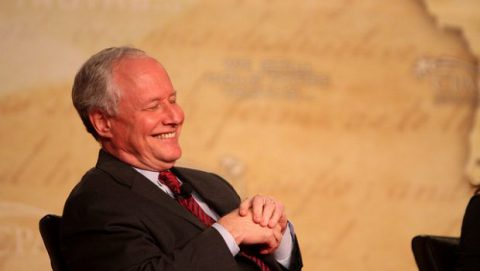
Photo of Bill Kristol by Gage Skidmore via Flickr
April 17, 2017
Posted by aletho |
Mainstream Media, Warmongering, Militarism, Timeless or most popular, Wars for Israel | Foreign Policy Initiative, Middle East, PNAC, Syria, United States, Zionism |
Leave a comment
The United Nations Refugee Agency (UNHCR) warned last week that 20 million people are in danger of starvation because of conflicts and drought.
If you missed this shocking and very important news, then it’s no surprise, as it didn’t receive too many headlines – certainly not in the West. Those have been dominated instead by expressions of faux-outrage from the pro-war political and media Establishment over footage of children in Syria who appeared to have been the victims of a suspected chemical weapons attack, which the US and its allies were very quick to blame, without firm evidence, on Syrian President Bashar Assad.
How do we know that the Establishment concern we saw about child victims of war was insincere? It’s easy. True humanitarians care about all victims equally. The concern of phony humanitarians is only for those who have been killed, or who appear to have been killed, by an ‘Official Enemy’ of the Western elites – like Assad. This ‘outrage’ has to be expressed strongly, and very publicly, in order to build support for the bombing of the ‘Official Enemy’ country, and further the case for regime-change, which helps the arms industry and the 1% get even richer. However, if it’s an ally of the West or Western powers themselves responsible for the atrocities, it’s a very different story. Then it’s a case of: “Don’t mention the war!” Let’s change the subject as quickly as we can! Bellicose ‘liberal interventionists’ become as quiet as church mice.
What made the double standards even more glaring this week is the fact that a large proportion of those facing starvation, as identified by the UNHCR, are in Yemen, which has been bombed by staunch Western ally Saudi Arabia for two years now.
“In Yemen, which is experiencing the world’s largest humanitarian crisis with almost 19 million people in need of humanitarian help, around 17 million people are food insecure,” UNHCR spokesperson Adrian Edwards said.
The very same countries who are directly responsible for the “world’s largest humanitarian crisis” in 2017 are – surprise, surprise! – the ones who have sought to take the moral high ground over Syria. The same neocons and ‘liberal interventionists’ who screech “Something must be done about Assad!” on social media from 6 o’clock in the morning until 11 o’clock at night are quite happy for absolutely nothing to be done to stop the suffering in Yemen.
One man who did try to end the slaughter in the country was Labour leader Jeremy Corbyn- a consistent target of the Endless War lobby. Last October Labour put forward a motion in the British Parliament calling for the UK to suspend its support to Saudi Arabia. The resolution failed because over 100 Labour MPs either didn‘t turn up- or abstained. One of them was Corbyn’s deputy Tom Watson. ‘How can Labour ‘humanitarians’ support Saudi Arabia’? asked Stop the War’s Lindsey German.
Last week Watson broke with Corbyn yet again to issue a statement in favour of Trump’s illegal cruise missile strikes on Syria- saying, without any sense of irony, that they were a ‘a response to a clear violation of international law by the Syrian regime.’
When it comes to humanitarian humbug there’s no difference between right-wing Labour, the Lib Dems and the Tories. Or, in America, between Democrats and Republicans. Vicar’s daughter Theresa May has spent most of the last few days robotically denouncing ‘the Assad regime’-which is battling ISIS and al-Qaeda and protects Syria’s Christian community from religious persecution. Yet just ten days ago the British Prime Minister was defending UK ties to Saudi Arabia on a trip to Riyadh. For all the moral grand-standing by May and Johnson and Trump and Tillerson, the bloodshed and chaos unleashed by the west and its allies in recent decades dwarfs any crimes that could be laid at Assad’s door. In 2015, it was revealed that at least 1.3m people, the vast majority of them Muslims, lost their lives in the US‘s so-called ‘War on Terror’ in just three countries; Iraq, Afghanistan and Pakistan- between 2001 and the end of 2013.
The Body Count death toll as I pointed out in my earlier OpEdge does not include deaths among the 3m refugees from Iraq subjected to privations, nor those killed in Libya and Yemen. But in spite of the mind-boggling numbers involved the victims of US-led military interventions are ’un-people’ who have been airbrushed out of western history.
Only Muslims killed by ‘Official Enemies’ are mourned- and splashed on the front pages of Establishment-friendly newspapers. When it comes to infanticide, the same grotesque double standards are on display. In a 1996 television interview about the impact of sanctions on Iraq, the US Secretary of State Madeline Albright was asked if the death of half a million Iraqi children was a price worth paying. She replied ‘I think this is a very hard choice, but we think the price is worth it’. Just imagine if Putin or Assad had said such a thing! In an interview with David Edwards of Media Lens, Denis Halliday, the former UN Assistant Secretary General- and the co-ordinator of the UN humanitarian oil for food programme – said that the shortage of food and medical supplies in Iraq was the direct responsibility of Washington and London. ’For the British government to say that the quantities involved for vaccinating kids are going to produce weapons of mass destruction, is just nonsense. That’s why I’ve deliberately used the word ‘genocide’ because this is a deliberate policy to destroy the people of Iraq’, Halliday said.
The genocide which preceded the Iraq war is a taboo subject in the west- like the genocide which came after it. Instead, we’re encouraged to focus solely on the ’heinous crimes’ of our ‘Official Enemies’. They- Assad, Gaddafi, Milosevic- are always ‘butchers’- ‘our’ leaders can never be called that- even if they kill millions more and illegally attack, or threaten to attack, different countries every few years.
Back to the UNHCR warning. In South Sudan, 100,00 people face starvation- and a further 1m are on the brink of famine. In northern Nigeria seven million people ‘are now struggling with food insecurity and need help’. The situation is perilous in Somalia too. Getting food supplies to these unfortunate people ought to be the number one priority for genuine humanitarians. But what was the top of the agenda for last week’s G7 meeting? How to get Russia to end its support for Assad!
This is the neocon agenda of the warmongering elites and not of those who really care about humanity. Next time you come across a ‘humanitarian’ saying that toppling Assad and ‘dealing’ with Putin is the most pressing issue, ask them why it’s more important than saving 20 million people close to starvation. They won’t have a satisfactory answer.
April 15, 2017
Posted by aletho |
Mainstream Media, Warmongering, Progressive Hypocrite, Timeless or most popular | Human rights, Libya, Middle East, Saudi Arabia, Syria, United States, Yemen |
Leave a comment
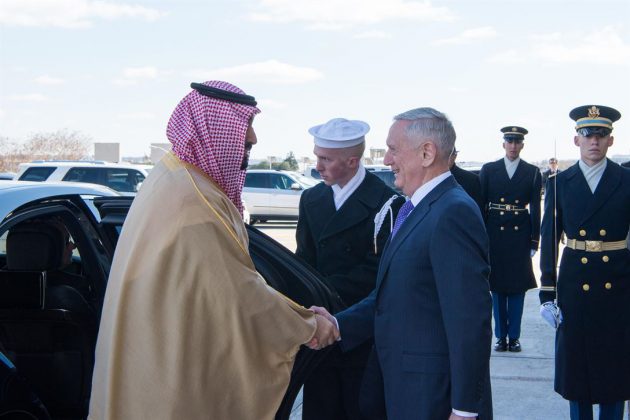
Defense Secretary Mattis welcomes Saudi Deputy Crown Prince and Defense Minister Mohammed bin Salman to the Pentagon, March 16, 2017. (DoD photo by Sgt. Amber I. Smith)
The Trump administration’s growing use of military force in Syria, Iraq, and Yemen has neoconservative hawks rooting for armed confrontation with what they view as the root of all evil in the Middle East: Iran.
Many of these armchair warriors recently cheered President Trump’s decision to take on the Assad regime — and Moscow — by firing 59 Tomahawk cruise missile at a Syrian air base alleged to be the source of a chemical weapons attack. But they urged him to do more.
Weekly Standard editor William Kristol tweeted, “Punishing Assad for use of chemical weapons is good. Regime change in Iran is the prize.”
Kristol co-founded the infamous Project on the New American Century in 1997 to promote American “global hegemony” and “challenge regimes hostile to our interests and values.” It began lobbying for the overthrow of Saddam Hussein as early as 1998, but always kept Iran in its sights as well.
With Saddam dead and Syria’s Assad stripped of much of his power, Iran is now at the center of neocon crosshairs. Kristol linked his recent tweet to a Washington Post column by two stalwart advocates of ousting the mullahs in Tehran: Reuel Gerecht and Ray Takeyh.
Titled “How Trump Can Help Cripple the Iranian Regime,” their article called for putting the nuclear arms deal with Iran at risk in order to “stoke the volcano under Tehran and to challenge the regime.” The centerpiece of their bizarre argument was that the Iranian people would gratefully welcome the United States imposing “crippling sanctions” to destroy their economy in the name of “human rights.”
The authors were vague as to the details, but suggested that Iran’s ruling clerics would quickly succumb to a “popular rebellion” by “Iranian dissidents,” particularly if the United States sent “more American troops [to] both Syria and Iraq” to reinforce its message.
Gerecht, a died-in-the-wool neocon, was a former director of the Project for a New American Century’s Middle East Initiative. In 2001, he wrote, “Only a war against Saddam Hussein will decisively restore the awe that protects American interests abroad and citizens at home.”
In 2002, he further touted a U.S. invasion of Iraq as a way to “provoke riots in Iran — simultaneous uprisings in major cities that would simply be beyond the scope of regime-loyal specialized riot-control units.” Instead, the subsequent U.S. invasion backfired by putting a pro-Iran regime into power in Baghdad.
Iran in the Crosshairs
Today Gerecht is a senior fellow at the Foundation for Defense of Democracies, a neocon think tank dedicated to waging war against “militant Islam,” with a focus on Iran. Heavily funded by gambling magnate Sheldon Adelson, the Foundation was originally created to promote the agenda of hardline Israeli hawks.
The Foundation fought bitterly against the Iran nuclear deal, lest it open the door to a rapprochement between Washington and Tehran. Gerecht in particular demanded that the United States attack Iran rather than pursue diplomacy. “I’ve written about 25,000 words about bombing Iran,” he boasted in 2010. “Even my mom thinks I’ve gone too far.”
Gerecht’s side-kick, Ray Tayekh, is a senior fellow at the Council on Foreign Relations and was (briefly) an Iran adviser to Dennis Ross in Hillary Clinton’s State Department. A fierce critic of the nuclear deal, Tayekh joined the Iran Task Force of the right-wing Jewish Institute for National Security Affairs, which considers itself “the most influential group on the issue of U.S.-Israel military relations.” Tayekh has advocated covert support to Iranian dissidents, as well as to “Kurdish, Baluch, Arab, and other opposition groups fighting the regime.”
Regime change in Iran is the open goal of Prime Minister Netanyahu and other Israeli rightists. That’s why they consistently rejected findings by Israel’s intelligence community about the benefits to Israel’s security from the nuclear deal with Iran. By stoking opposition to the deal among their supporters in Congress, they aimed to kill any chance of cooperation between the United States and Iran.
Sen. Tom Cotton, R-Arkansas, said candidly, “the goal of our policy must be clear: regime change in Iran.”
Today the hardline Israeli/neocon agenda is still being pursued by hawks in Congress, who have introduced bills in both houses to ratchet up economic sanctions against Iran and designate a major branch of the country’s armed forces as a terrorist organization. If enacted — against the wishes of other signatories to the Iran nuclear deal — such measures could put the United States and Iran on a war footing.
Trump’s Team of Hawks
President Trump is unlikely to stand in their way. Ignoring the role of major Arab states in supporting such terrorist groups as al-Qaeda and ISIS, Trump named Iran “the number one terrorist state” and warned during his campaign that if Iranian patrol boats in the Persian Gulf continue to “make gestures that our people — that they shouldn’t be allowed to make, they will be shot out of the water.”
Trump has surrounded himself with anti-Iran hardliners who may be only too eager to give war a chance. His first national security adviser, retired Lt. Gen. Michael Flynn, co-authored a 2016 book with Michael Ledeen, a confidant of Israeli hawks and colleague of Gerecht at the Foundation for Defense of Democracy, on “How We Can Win the Global War Against Radical Islam and Its Allies.” Iran, of course, was their enemy number one.
Even with Flynn’s ouster, plenty of hawks remain. In recent congressional testimony, Army Gen. Joseph Votel, Commander of the U.S. Central Command, called Iran “the greatest long-term threat to stability” in the Middle East. He declared, “We need to look at opportunities where we can disrupt [Iran] through military means or other means their activities.”
Defense Secretary General James Mattis told a conference at the conservative Center for Strategic and International Studies in Washington last year, “Iran is not a nation-state; it’s a revolutionary cause devoted to mayhem.” The New York Times reported that Mattis “was so hawkish on Iran as head of United States Central Command from 2010 to 2013 that the Obama administration cut short his tour.”
Mattis reportedly came close to ordering an act of war against Iran in early February — the boarding of an Iranian ship to look for weapons headed for Houthi rebels in Yemen. Such an incident could escalate rapidly out of control if Iran chose to retaliate against U.S. vessels in the Persian Gulf.
Alternatives to Conflict
The United States has better policy options than continuing to treat Iran as part of the Axis of Evil. A report issued last fall by the National Iranian American Council recommended that Washington build on the success of the Iran nuclear deal by drawing Iran into regional peace settlements, deescalating our military presence in the Persian Gulf, and encouraging Iran and Saudi Arabia to resolve their differences without superpower intervention.
The report echoed the advice of a prominent neocon heretic, Zalmay Khalilzad, former U.S. ambassador to both Afghanistan and Iraq.
“As someone who has negotiated with Iran over the years perhaps more than any other U.S. diplomat,” he observed last year, “I disagree with those who argue that talks with Iran are akin to capitulation. I have seen little evidence that isolation has or will alter Tehran’s behavior in the right direction. Nor do I share the view that it is impossible to negotiate win-win deals with the Iranians.”
Noting Iran’s cooperation with the United States against Al Qaeda after 9/11, and its help brokering political compromises in Afghanistan and Iraq until the Bush administration refused further engagement, Khalilzad wrote, “Under the right conditions, which must include a hard-headed approach and tough actions to check Iran’s ambitions, Washington can benefit from bringing Iran into multilateral forums where the United States and its partners have the opportunity to narrow differences, create rules of the road and solve problems. Moreover, today we have little choice but to engage Iran on these broader issues, because no factor is shaping the order of the Middle East as much as the rivalry between Iran and its Sunni Arab neighbors.”
“If we do not undertake this work,” he warned, “the problems of the region — extremism, terrorism and regional conflict — will continue to bleed over into our part of the world, particularly if the Westphalian state system disintegrates even further into sectarian morass.”
April 15, 2017
Posted by aletho |
Mainstream Media, Warmongering, Militarism, Timeless or most popular, Wars for Israel | Foundation for Defense of Democracies, Iran, Israel, Middle East, PNAC, Saudi Arabia, Sheldon Adelson, Syria, Tom Cotton, United States, Washington Post, William Kristol, Zionism |
Leave a comment
By firing off five dozen Tomahawk missiles at a military airfield, our “America First” president may have plunged us into another Middle East war that his countrymen do not want to fight.
Thus far Bashar Assad seems unintimidated. Brushing off the strikes, he has defiantly gone back to bombing the rebels from the same Shayrat air base that the U.S. missiles hit.
Trump “will not stop here,” warned U.N. Ambassador Nikki Haley on Sunday. “If he needs to do more, he will.”
If Trump fails to back up Haley’s threat, the hawks now cheering him on will begin deriding him as “Donald Obama.”
But if he throbs to the war drums of John McCain, Lindsey Graham and Marco Rubio and orders Syria’s air force destroyed, we could be at war not only with ISIS and al-Qaida, but with Syria, Russia, Iran and Hezbollah.
A Syrian war would consume Trump’s presidency.
Are we ready for that? How would we win such a war without raising a large army and sending it back into the Middle East?
Another problem: Trump’s missile attack was unconstitutional. Assad had not attacked or threatened us, and Congress, which alone has the power to authorize war on Syria, has never done so.
Indeed, Congress denied President Obama that specific authority in 2013.
What was Trump thinking? Here was his strategic rational:
“When you kill innocent children, innocent babies — babies, little babies — with a chemical gas … that crosses many, many lines, beyond a red line. … And I will tell you, that attack on children yesterday had a big impact on me … my attitude toward Syria and Assad has changed very much.”
Two days later, Trump was still emoting: “Beautiful babies were cruelly murdered in this very barbaric attack. No child of God should ever suffer such horror.”
Now, that gas attack was an atrocity, a war crime, and pictures of its tiny victims are heart-rending. But 400,000 people have died in Syria’s civil war, among them thousands of children and infants.
Have they been killed by Assad’s forces? Surely, but also by U.S., Russian, Israeli and Turkish planes and drones — and by Kurds, Iranians, Hezbollah, al-Qaida, ISIS, U.S.-backed rebels and Shiite militia.
Assad is battling insurgents and jihadists who would slaughter his Alawite brethren and the Christians in Syria just as those Copts were massacred in Egypt on Palm Sunday. Why is Assad more responsible for all the deaths in Syria than those fighting to overthrow and kill him?
Are we certain Assad personally ordered a gas attack on civilians?
For it makes no sense. Why would Assad, who is winning the war and had been told America was no longer demanding his removal, order a nerve gas attack on children, certain to ignite America’s rage, for no military gain?
Like the gas attack in 2013, this has the marks of a false flag operation to stampede America into Syria’s civil war.
And as in most wars, the first shots fired receive the loudest cheers. But if the president has thrown in with the neocons and War Party, and we are plunging back into the Mideast maelstrom, Trump should know that many of those who helped to nominate and elect him — to keep us out of unnecessary wars — may not be standing by him.
We have no vital national interest in Syria’s civil war. It is those doing the fighting who have causes they deem worth dying for.
For ISIS, it is the dream of a caliphate. For al-Qaida, it is about driving the Crusaders out of the Dar al Islam. For the Turks, it is, as always, about the Kurds.
For Assad, this war is about his survival and that of his regime. For Putin, it is about Russia remaining a great power and not losing its last naval base in the Med. For Iran, this is about preserving a land bridge to its Shiite ally Hezbollah. For Hezbollah it is about not being cut off from the Shiite world and isolated in Lebanon.
Because all have vital interests in Syria, all have invested more blood in this conflict than have we. And they are not going to give up their gains or goals in Syria and yield to the Americans without a fight.
And if we go to war in Syria, what would we be fighting for?
A New World Order? Democracy? Separation of mosque and state? Diversity? Free speech for Muslim heretics? LGBT rights?
In 2013, a great national coalition came together to compel Congress to deny Barack Obama authority to take us to war in Syria.
We are back at that barricade. An after-Easter battle is shaping up in Congress on the same issue: Is the president authorized to take us into war against Assad and his allies inside Syria?
If, after Afghanistan, Iraq, Libya and Yemen, we do not want America in yet another Mideast war, the time to stop it is before the War Party has us already in it. That time is now.
Copyright 2017 Creators.com.
April 11, 2017
Posted by aletho |
Militarism, Timeless or most popular | Hezbollah, Iran, Middle East, Russia, Syria, Turkiye, United States |
Leave a comment
After slapping Donald Trump around for several months to make him surrender his hopes for a more cooperative relationship with Russia, the neocons and their liberal-interventionist allies are now telling the battered President what he must do next: escalate war in the Middle East and ratchet up tensions with nuclear-armed Russia.
Star neocon Robert Kagan spelled out Trump’s future assignments in a column on Sunday in The Washington Post, starting out by patting the chastened President on the head for his decision to launch 59 Tomahawk missiles at an airstrip in Syria supposedly in retaliation for a chemical weapons attack blamed on the Syrian government (although no serious investigation was even conducted).
Trump earned widespread plaudits for his decisive action and his heart-on-the-sleeve humanitarianism as his voice filled with emotion citing the chemical-weapons deaths on April 4 of “small children and even beautiful little babies.” The U.S. media then helpfully played down reports from Syria that Trump’s April 6 retaliatory missile strike had killed about 15 people, including nine civilians, four of whom were children.
However, for Kagan, the missile strike was only a good start. An advocate for “regime change” in Syria and a co-founder of the Project for the New American Century which pushed for the Iraq War, Kagan praised Trump “for doing what the Obama administration refused to do,” i.e. involve the U.S. military directly in attacks on the Syrian government.
“But,” Kagan added, “Thursday’s action needs to be just the opening salvo in a broader campaign not only to protect the Syrian people from the brutality of the Bashar al-Assad regime but also to reverse the downward spiral of U.S. power and influence in the Middle East and throughout the world. A single missile strike unfortunately cannot undo the damage done by the Obama administration’s policies over the past six years.”
Kagan continued: “Trump was not wrong to blame the dire situation in Syria on President Barack Obama. The world would be a different place today if Obama had carried out his threat to attack Syria when Assad crossed the famous ‘red line’ in the summer of 2013. The bad agreement that then-Secretary of State John F. Kerry struck with Russia not only failed to get rid of Syria’s stock of chemical weapons and allowed the Assad regime to drop barrel bombs and employ widespread torture against civilian men, women and children. It also invited a full-scale Russian intervention in the fall of 2015, which saved the Assad regime from possible collapse.”
A Seasoned Propagandist
Kagan, who cut his teeth in the Reagan administration running a State Department propaganda shop on Central America, has never been particularly interested in nuance or truth, so he wouldn’t care that Obama pulled back from attacking Syria in summer 2013, in part, because his intelligence advisers told him they lacked proof that Assad was responsible for a mysterious sarin attack. (Since then, the evidence has indicated that the attack was likely a provocation by Al Qaeda’s Syrian affiliate with help from Turkish intelligence.)
But groupthinks die hard – and pretty much every Important Person in Official Washington just knows that Assad did carry out that sarin attack, just like they all knew that Iraq’s Saddam Hussein was hiding WMDs in 2003. So, it follows in a kind of twisted logical way that they would build off the fake history regarding the 2013 Syria-sarin case and apply it to the new groupthink that Assad has carried out this latest attack, too. Serious fact-finding investigations are not needed; everyone just “knows.”
But Kagan is already looking ahead. Having pocketed Trump’s capitulation last week on Syria, Kagan has shifted his sights onto the much juicier targets of Russia and Iran.
“Russia has … greatly expanded its military presence in the eastern Mediterranean,” Kagan wrote. “Obama and Kerry spent four years panting after this partnership, but Russia has been a partner the way the mafia is when it presses in on your sporting goods business. Thanks to Obama’s policies, Russia has increasingly supplanted the United States as a major power broker in the region. Even U.S. allies such as Turkey, Egypt and Israel look increasingly to Moscow as a significant regional player.
“Obama’s policies also made possible an unprecedented expansion of Iran’s power and influence. … If you add the devastating impact of massive Syrian refugee flows on European democracies, Obama’s policies have not only allowed the deaths of almost a half-million Syrians but also have significantly weakened America’s global position and the health and coherence of the West.”
Trump’s Probation
Yes, all that was Obama’s fault for not invading Syria with a couple of hundred thousand U.S. troops because that’s what would have been required to achieve Kagan’s “regime change” goal in Syria. And there’s no reason to think that the Syrian invasion would have been any less bloody than the bloody Kagan-advocated invasion of Iraq. But Kagan and the neocons never take responsibility for their various bloodbaths. It’s always someone else’s fault.
And now Kagan is telling Trump that there is still much he must do to earn his way back into the good graces of the neocons.
Kagan continued, “Trump, of course, greatly exacerbated these problems during his campaign, with all the strong rhetoric aimed at allies. Now he has taken an important first step in repairing the damage, but this will not be the end of the story. America’s adversaries are not going to be convinced by one missile strike that the United States is back in the business of projecting power to defend its interests and the world order. …
“The testing of Trump’s resolve actually begins now. If the United States backs down in the face of these challenges, the missile strike, though a worthy action in itself, may end up reinforcing the world’s impression that the United States does not have the stomach for confrontation.”
And confrontation is surely what Kagan has in mind, adding:
“Instead of being a one-time event, the missile strike needs to be the opening move in a comprehensive political, diplomatic and military strategy to rebalance the situation in Syria in America’s favor. That means reviving some of those proposals that Obama rejected over the past four years: a no-fly zone to protect Syrian civilians, the grounding of the Syrian air force, and the effective arming and training of the moderate opposition, all aimed at an eventual political settlement that can bring the Syrian civil war, and therefore the Assad regime, to an end.
“The United States’ commitment to such a course will have to be clear enough to deter the Russians from attempting to disrupt it. This in turn will require moving sufficient military assets to the region so that neither Russia nor Iran will be tempted to escalate the conflict to a crisis, and to be sure that American forces will be ready if they do. …
“Let’s hope that the Trump administration is prepared for the next move. If it is, then there is a real chance of reversing the course of global retreat that Obama began. A strong U.S. response in Syria would make it clear to the likes of Putin, Xi Jinping, Ayatollah Ali Khamenei and Kim Jong Un that the days of American passivity are over.”
On His Knees
To put this message in the crude terms that President Trump might understand, now that the neocons have forced him to his knees, they are demanding that he open his mouth. They will not be satisfied with anything short of a massive U.S. military intervention in the Middle East and a full-scale confrontation with Russia (and perhaps China).
This sort of belligerence is what the neocons and liberal hawks had expected from Hillary Clinton, whom Kagan had endorsed. Some sources claim that a President Hillary Clinton planned to appoint Kagan’s neocon wife, Victoria Nuland, as Secretary of State.
As Assistant Secretary of State for European Affairs under Obama, Nuland oversaw the U.S.-backed putsch that overthrew elected President Viktor Yanukovych in 2014, replacing him with a fiercely anti-Russian regime, the move that touched off civil war in Ukraine and sparked the New Cold War between the U.S. and Russia. [For more on Kagan clan, see Consortiumnews.com’s “A Family Business of Perpetual War.”]
Clinton’s defeat was a stunning setback but the neocons never give up. They are both well-organized and well-funded, dominating Official Washington’s think tanks and media outlets, sharing some power with their junior partners, the liberal interventionists, who differ mostly in the rationales cited for invading other countries. (The neocons mostly talk about global power and democracy promotion, while the liberal hawks emphasize “human rights.”)
In dealing with the narcissistic and insecure Trump, the neocons and liberal hawks conducted what amounted to a clever psychological operation. They rallied mainstream media personalities and Democrats horrified at Trump’s victory. In particular, Democrats and their angry base were looking for any reason to hold out hope for Trump’s impeachment. Hyping alleged Russian “meddling” in the election became the argument of choice.
Night after night, MSNBC and other networks competed in their Russia-bashing to boost ratings among Trump-hating Democrats. Meanwhile, Democratic politicians, such as Rep. Adam Schiff of California, saw the Russia-gate hearings as a ticket to national glory. And professional Democratic strategists could evade their responsibility for running a dismal presidential campaign by shifting the blame to the Russians.
However, besides creating a convenient excuse for Clinton’s defeat, the anti-Russian hysteria blocked Trump and his team from any move that they might try to make regarding avoidance of a costly and dangerous New Cold War. The Russia-hating frenzy reached such extremes that it paralyzed the formulation of any coherent Trump foreign policy.
Now, with the neocons regaining influence on the National Security Council via NSC adviser Gen. H.R. McMaster, a protégé of neocon favorite Gen. David Petraeus, the neocon holding action against the New Détente has shifted into an offensive to expand the hot war in Syria and intensify the Cold War with Russia. As Kagan recognized, Trump’s hasty decision to fire off missiles was a key turning point in the reassertion of neocon/liberal-hawk dominance over U.S. foreign policy.
It’s also suddenly clear how thoroughly liberal Democrats were taken for a ride on the war train by getting them to blame Russia for Hillary Clinton’s defeat. The liberals (and even many progressives) hated Trump so much that they let themselves be used in the service of neocon/liberal-hawk endless war policies. Now, it may be too late to turn the train around.
Investigative reporter Robert Parry broke many of the Iran-Contra stories for The Associated Press and Newsweek in the 1980s.
April 10, 2017
Posted by aletho |
Deception, Fake News, Mainstream Media, Warmongering, Militarism | Iran, Middle East, Robert Kagan, Russia, Syria, United States, Washington Post |
Leave a comment
Hezbollah on Sunday has condemned the awful crimes committed by terrorist ISIL group which targeted churches in Egypt’s Tanta and Alexandria, killing and injuring dozens of innocent civilians.
In a statement released by the party’s Media Relations office, Hezbollah offered condolences to victims’ families, calling for uniting efforts to confront terrorism in the region.
“This continuous and escalating killing carried out by criminal gangs in the name of religion is one of the greatest catastrophes our Ummah (nation) has been witnessing,” the statement read.
Meanwhile, Hezbollah pointed out that such crimes were planned for by major powers and regional countries which have been offering different kinds of support to terrorists, in a bid to sow discord between the region’s peoples who have lived together for centuries.
Furthermore, the Lebanese resistance party stressed that targeting faithful people in churches during Palm Sunday is a savage act which indicates that these groups have no humanity.
This crime “comes as a part of a big scheme to displace Christians from Sinai and other areas across Egypt, Syria, Iraq and Lebanon, paving the way for sectarian and ethnic federalization in favor of the Zionist enemy,” Hezbollah warned.
Meanwhile, Hezbollah voiced support for Egypt and its people, urging all sides to realize the seriousness of the “great conspiracy targeting our Ummah,” and to unite efforts in confronting terrorists along with their regional and international sponsors.
April 10, 2017
Posted by aletho |
Ethnic Cleansing, Racism, Zionism, Timeless or most popular | Egypt, Hezbollah, ISIL, Middle East, Zionism |
Leave a comment
Turkey is, in principle, uniquely placed to call for an independent investigation into the chemical attack in the north-western Syrian province of Idlib on April 4. Idlib borders Turkey and it is well-known that extremist groups (Al-Qaeda affiliates) controlling the province have enjoyed covert support from Turkish intelligence, which has trained them, equipped them and guided them in the past in a joint enterprise with the CIA and the US’ Gulf Arab allies.
Yet, curiously, President Recep Erdogan shies away from demanding an independent inquiry. Instead, he insists, “We have the radar information and we have the forensic reports. Some say Syria does not have chemical weapons. Of course it does. It’s clear which planes dropped it.” Erdogan wants to close the file and move on. He lost no time to extend enthusiastic support for the US missile attack in Syria on April 6 and is beseeching President Donald Trump to revive the “regime change” agenda in Syria. Why such bizarre behavior?
Erdogan’s proactivism in real time has only one explanation – the chemical attack in Idlib was in reality planned with the knowledge of Turkish intelligence. Erdogan has everything to lose if this truth comes out.
Turkey stood to gain by precipitating a situation in Syria that would willy-nilly lead to some form of American intervention. (Indeed, CIA input was the basis of Trump’s decision to order the missile attack in Syria, which of course has severely impacted US-Russia relations.) On the other hand, the Idlib attack was just what suited Trump too to generate a new conversation in Washington that took the heat off him over his alleged links to Russia.
All three protagonists gained out of this cynical game – Erdogan, the “cold warriors” in the CIA and the Russophobes in the Washington establishment, and the beleagured American president himself.
But Erdogan stands most to gain. He overnight hyped up the Syrian situation to burnish his image as the tallest Sunni Islamist leader in Muslim Middle East – Idlib is a Sunni province – just a week ahead of the crucial Turkish referendum on April 16 that votes on the creation of a presidency with executive powers.
Two, Erdogan has brought about a discord between US and Russia, which creates space for Turkey to carry on with its military operations in northern Syria and consolidate its occupation of large tracts of Syrian territory.
Three, Russia and Iran may come under pressure to postpone the planned military offensive on Idlib to liberate the region from al-Qaeda. (Idlib is the only Syrian province remaining still under the control of extremist groups.)
And, four, Erdogan’s persistent demand for creation of “safe zones” inside territory as well as “no-fly zone” – both of which would boost a permanent Turkish military presence inside Syria – has gained a fresh lease of life. Indeed, that would also be the kiss of death for Kurdish ambitions to create an autonomous homeland (“Rojava”) in northern Syria.
Suffice it to say, Turkey’s territorial ambitions over Syria (to reclaim Ottoman territories which it lost in the 1922 settlement) took a leap forward this past week.
An international investigation will help uncover Turkey’s role in the chemical attacks in Idlib. However, alas, the CIA is unlikely to let that happen because what happened in Idlib also happens to be a back-to-back enterprise with Turkish intelligence. Erdogan and the folks in Langley are swimming in the very same river of blood. So long as such cynical games continue, the prospects of Syrian settlement will remain bleak.
Turkish policies threaten regional security in the Middle East as well as Europe. By Erdogan’s reckoning, Europe is inhabited by Nazis, and the Middle East’s future lies with political Islam. Sadly enough, Turkey has once again become the “sick man of Europe”.
Read a chilling Reuters report, here, detailing that the suicide bomber involved in the recent subway terrorist attack in St Petersburg had travelled to Turkey and Syria.
April 10, 2017
Posted by aletho |
Deception, Fake News, Mainstream Media, Warmongering, Timeless or most popular, War Crimes | CIA, Middle East, Syria, Turkiye, United States |
Leave a comment
It seems Donald Trump was caught between the devil and the deep blue sea. If he had not responded to the recent chemical attacks in Syria-whether they were at the behest of Assad or not-he would have been considered as callous, insensitive, and completely at line with the public bogeyman image most of the media enjoys perpetuating.
Then there was the option which he has taken, to fight back, which now paints him as a neo-con warmonger, happy to kowtow to the whims of the Saudis and Wahabists that seeks to encircle the strategic geopolitical land, air and sea mass surrounding Syria and to heighten the game of brinkmanship with Iran that it is set upon.
The move has also put to bed (though probably not for some) the assertion that Trump is Putin’s comrade in arms.
But is Trump striking the right enemy, or just the one Saudi Arabia gleefully wants him to? The investigation team, led by Swedish scientist Dr. Åke Sellström, concludes in particular that the environmental, chemical and medical samples collected [in 2013] provide “clear and convincing evidence” that surface-to-surface rockets containing the chemical weapons including nerve agent Sarin, were used. We know for a fact that it is the rebels (the head chopping moderates) who are using surface to surface rockets, not necessarily just the government.
Then there is the applause meted out by the British government in the wake of these strikes. The British people were misled regarding WMD’s in Iraq and the value of bombing Libya. After those terrible events, there should be a very high level of proof before we become involved in foreign military interventions. Where is the irrefutable proof that chemical weapons were used?
It makes no sense for Assad to use WMD when his forces are clearly winning. With the backing of Russia and Iran, Assad has no need for WMD and gains nothing from their use. However fabricating a chemical attack is of propaganda value to ISIS and other opposition forces.
Trump’s attack will certainly not help innocent Syrian civilians but does enable him to demonstrate his power to both Russia and China. Yet at the same time Trump is doing exactly what Trump said he would do and would even be bullied to do in the wake of moral justifications to act.
Supporters on the right-wing have criticised Trump for the missile strike. There is outrage and confusion. Trump has gone against his campaign pledge not to meddle in Syria. This presidency was elected on an isolationist platform.
66% of voters (2,500 votes cast) on the Alex Jones website are against the missile strike. These are the most vehement, hardcore, gun-toting Trump supporters.
All sides of the political spectrum are having to adjust to this abrupt change in Trump’s foreign policy, and a breach of his election campaign pledge. Just two months into his presidency, Trump’s supporters are beginning to think that Trump is not their man, that he has become the Swamp. A bit late for buyer’s remorse, perhaps.
The attack was reckless only in how it was as the result of a snap judgement, behaving outside international rules and laws. An attack that militarily achieves nothing but only a temporary restrain of Assad from using the alleged “chemical weapons”. For that matter, obviously the threats of the past did not work and this attack (by the way, well communicated in advance to avoid hurting Putin) will be of short effect too. The showing of disrespect to international bodies and alliances weakens any concerted pressure developed countries could make to settle political agreements between the factions and contain the barbarism.
The criminal intent, actions and disastrous results in the Iraq adventure that the US and UK started in 2003 is well known and one can only conclude that global takfiri terrorism was and is profiting massively, as well as the global military industry from this geopolitical piracy.
Believing or stating ‘the west’ has noble intentions and defends humanitarian values is denying all the evidence of the contrary and yet Trump was made to act by a public that demanded blood in the wake of the pictures that emerged.
In this case the bombing by the US of Syrian government targets is an act of war based on propaganda and prejudiced interpretations. The consequences of this kind of behaviour, mostly bringing tactical and strategic profit to global extremists and terrorists, is well known.
The lessons of the past are not learned, ignored, or simply overruled by the same old insane logic that caused Afghanistan to become the birthplace of Al Qaeda and Iraq the birthplace of ISIS and Libya a permanent base of lawlessness and global terrorism.
The near future in the middle east is uncertain. Apart from the measures that Russia and its allies will take, the sectarian divisions will only rage and so well will increased radicalisation. Trump has to be more open about his foreign policy to be able to walk with the least risk in the quagmire of the region and to justify himself to the main religious factions in the Middle East.
The problem we have here are the war scavengers who have supported Hillary Clinton, who said she would bomb all of Syria yesterday. Trump is naive in foreign policy, but a genius in diversion and marketing himself, who saw an opportunity to divert attention from his failures, and move his polls back up. Any military action by the US gets the cheerleaders to come out of their hibernation. That is exactly what is going on now. Trump’s regime has broken both international law and US domestic law/constitution by attacking another country without provocation. There is no authority for him to bomb the Syrian government, but Chuck Schumer and Nancy Pelosi are both supportive of Trump.
The corporate owned, government dictated US media are devotedly supporting the nonsense as well, with little attention being paid to how this single act is jeopardizing, US national security, and prolonging misery of the Syrian people.
April 10, 2017
Posted by aletho |
Mainstream Media, Warmongering, Militarism, Timeless or most popular | Donald Trump, Middle East, Russia, Saudi Arabia, Syria, UK, United States |
Leave a comment

 Aletho News
