Palantir CEO Calls for Draft to Fight the Empire’s Wars
Involuntary servitude is good for business
By Kurt Nimmo | Another Day in the Empire | April 20, 2026
In 2025, Alex Karp, the CEO of government and military tech contractor Palantir, published The New York Times best-seller, The Technological Republic: Hard Power, Soft Belief, and the Future of the West. The Wall Street Journal praised the book as a cri de coeur, a passionate appeal “that takes aim at the tech industry for abandoning its history of helping America and its allies,” while Wired praised the book as a “readable polemic that skewers Silicon Valley for insufficient patriotism.”
On April 18, 2026, Palantir posted twenty-two points to social media summarizing the book. In addition to taking Silicon Valley to task for insufficient patriotism, advocating a role for AI in forever war, and denouncing the “psychologization of modern politics,” the Palantir post on X declares: “National service should be a universal duty. We should, as a society, seriously consider moving away from an all-volunteer force and only fight the next war if everyone shares in the risk and the cost.”
National conscription, a form of involuntary servitude, and the wars it portends, is good for business, especially for corporations within the orbit of the Pentagon, the CIA, and the national security state. Palantir fits comfortably within this amalgamation.
Mass Murder by Artificial Intelligence
Project Maven is an AI-driven battlefield intelligence system designed by the corporation. The Defense Department, now known as the War Department, employed Maven in 2024 for “targeting support” in Iraq, Syria, and Yemen. Maven incorporates the AI model Claude, built by Anthropic.
More recently, in US airstrikes against Iran, “AI systems born from Project Maven have helped identify and prioritize thousands of targets, accelerating intelligence analysis and operational planning,” explains the Center for a New American Security, a military think tank founded by Michèle Flournoy, a former under secretary of defense with links to Lockheed Martin and BAE Systems. She was the principal adviser to the Secretary of Defense in the formulation of national security and defense policy.
Maven was reportedly used to shorten the “kill chain” during Israel’s invasion of Gaza. “I am proud that we are supporting Israel in every way we can,” CEO Karp exclaimed. Following the Gaza al-Aqsa Flood in October, 2023, Palantir “provided Israel with multiple AI-powered data analytics tools for military and intelligence purposes,” notes the American Friends Service Committee. The corporation has a “strategic partnership” with Israel’s Ministry of Defense to assist the Zionist state and its “war effort” against Palestinian resistance to Israeli military occupation, an armed struggle recognized under international law.
“As the genocide in Gaza advances, attention is turning to the companies whose technologies may be facilitating Israel’s daily atrocities, with US-based Palantir Technologies among them,” reports the Business and Human Rights Center. “While the International Criminal Court (ICC) is stepping in to address genocide accusations, the tech barons who design and supply the tools of warfare remain largely unchallenged.”
Another Israeli AI-based targeting system, Lavender, ostensibly developed by the IDF’s Unit 8200, is said to be a Palantir project. Palantir rejected this assertion in a letter sent to Francesca Albanese, the sanctioned United Nations Special Rapporteur on the occupied Palestinian territories. In the letter, Palantir stressed it “stands in solidarity with Israel in response to the horrific attacks on 7 October, 2023. Our work in Israel long predates the 7 October attacks and is in line with our global commitment to U.S. allies and liberal democracies. We proudly support our partners in Israel across a multitude of mission sets, programs, and contexts.”
Israel utilized Palantir in its September 2024 attacks in Lebanon, employing exploding electronic pagers that resulted in numerous fatalities and injuries, writes AFSC’s Investigate. In addition to its collaboration with the Israeli military, Palantir also provides the Gaza Civil-Military Coordination Center with its services. This center is located at the US military compound in Kiryat Gat, which was established in October 2025 to implement the Trump administration’s plan for Gaza. Iran targeted Kiryat Gat in March, 2026.
Maven, incorporating Anthropic’s Claude, was used to target the Shajareh Tayyebeh primary school in Minab, in southern Iran, killing 180 people, mostly young girls. President Trump praised Palantir Technologies, saying the company “has proven to have great war-fighting capabilities and equipment. Just ask our enemies,” apparently including children.
“Creepy CEO” Advocates Involuntary Servitude in “Service to the West”
“Alex Karp, the creepy CEO of creepy defense contractor Palantir, just can’t stop talking about killing people,” Lucas Ropek writes for Gizmodo. “During a recent call with investors, the billionaire let it slip that he doesn’t mind a little bloodshed, just so long as the money keeps pouring in.”
“Palantir is here to disrupt and make the institutions we partner with the very best in the world and, when it’s necessary, to scare enemies and on occasion kill them,” Karp said, with a smile on his face. The CEO added that he was very proud of the work his firm is doing and that he felt it was good for America. “I’m very happy to have you along for the journey,” he said. “We are crushing it. We are dedicating our company to the service of the West, and the United States of America, and we’re super-proud of the role we play, especially in places we can’t talk about.”
For Karp, “service to the West” includes conscription, that is to say involuntary servitude and the possibility of a violent and horrific death for an untold number of men and women drafted to fight the forever wars envisioned by the billionaire elite, including those within the “libertarian” tech sector.
However, forcing an individual against his or her will to kill and possibly be killed for the sake of the state (or foreign states, such as Israel), and in accordance with a “social contract” that demands submission and obedience, is not libertarian. In the case of Palantir, it is more accurately described as “techno-fascism,” an alliance between Silicon Valley and the state. Contrary to libertarian principles advocating against government intervention, leading tech companies frequently advocate for regulations that favor established AI companies benefiting from government funding and contracts.
Palantir, named after the “seeing stones” from J.R.R. Tolkien’s The Lord of the Rings, may be characterized as a “merchant of death,” a term prominent in the 1930s regarding WWI profiteering. Alex Karp may be compared to Basil Zaharoff, a Greek arms dealer and industrialist, one of the wealthiest men of his time. Unlike Zaharoff, Karp is not selling rifles or munitions, he is selling something far worse—the ability, through artificial intelligence, to murder thousands, if not millions of people with the speed and efficiency of computer technology.
Israel’s war obsession and the urgency of Palestinian leverage
By Ramzy Baroud | MEMO | April 20, 2026
It is tempting to argue that Israel’s new military doctrine is predicated on perpetual war—but the reality is more complex.
Not that Israeli Prime Minister Benjamin Netanyahu would object to such an arrangement. On the contrary, his relentless drive for military escalation suggests precisely that. After all, his openly declared quest for a “greater Israel” would require exactly this kind of permanent militarism—endless expansion and sustained regional destruction.
However, Israel cannot sustain an open-ended fight on multiple fronts indefinitely.
Israeli officials boast about fighting on “seven fronts,” but many of these are, in military terms, largely imaginary rather than sustained battlefields.
The real wars, however, are entirely of Israel’s making: from the genocide in Gaza to its unprovoked regional wars.
Still, that fact should not blind us to another reality: in the lead-up to the war on Iran, and in the escalation against Lebanon, there was near-total consensus among Jewish Israelis. An Israel Democracy Institute survey conducted on March 2–3 found that 93% of Jewish Israelis supported the joint US-Israeli attack on Iran. Support cut across all political camps.
The same enthusiasm for war accompanied the Gaza genocide and the various wars and escalations in Lebanon.
Even Yair Lapid—so often and so falsely marketed abroad as a “dove”—fully backed these wars, admitting after the Iran ceasefire that Israel had entered them with “rare consensus” and that he supported them “from the very first moment.”
His repeated criticisms, like those of other Israeli politicians, are not of the war but of Netanyahu’s failure to deliver a strategic outcome.
And this is the crucial distinction. Israelis mostly support the wars, but many no longer trust Netanyahu to translate destruction into strategic victory. By mid-April, 92% of Jewish Israelis gave the army high marks for its management of the Iran war, but only 38% gave high ratings to the government.
In other words, the public still believes in war but increasingly doubts the leadership waging it.
That distinction may not matter much to us, since the outcome remains mass death, devastation, and colonial violence. But in Israel’s own military and strategic calculations, it matters enormously. Its wars have historically followed a familiar model: crush resistance, impose military and political domination, and translate battlefield violence into colonial expansion.
Netanyahu delivered none of that.
This is why the uproar in Israel over the April 16 Lebanon ceasefire has been so fierce, and why the fears surrounding a possible stalemate with Iran run even deeper.
The Lebanon ceasefire clearly did not secure one of Israel’s central declared aims: the disarmament of Hezbollah. Israel kept troops in southern Lebanon, but the agreement halted offensive operations and fell far short of the promised “total victory.”
For many in Israel, any outcome that falls short of total victory is immediately read as defeat. One northern Israeli regional leader, Eyal Shtern, captured that mood with brutal clarity when he reacted to the Lebanon ceasefire by asking how Israel had gone “from absolute victory to total surrender,” in remarks reported by CNN.
That is the real crisis now confronting Israel: not that it has discovered the limits of permanent war, but that it has once again discovered that exterminatory violence does not automatically produce political victory.
While Iran possesses political leverage that could allow for a long-term, or even permanent, truce, Lebanon and Syria remain in a far more vulnerable position. However, no one is in a more precarious condition than the Palestinians, particularly those in Gaza.
Unlike others who retain some political margin and space to maneuver, Palestinians live under Israeli occupation, apartheid, and siege. Gaza, in particular, has been reduced to a sealed enclave of devastation.
Its hermetic siege has produced one of the most horrific humanitarian catastrophes in modern history: an entire population surviving on polluted water, with infrastructure destroyed, food critically scarce, and thousands still buried beneath the rubble.
Aside from their legendary steadfastness—sumud—Palestinians operate under severe constraints in their ability to impose conditions on Israel, particularly as it continues to receive unconditional support from the United States and its Western allies. Yet their resilience, collective action, and enduring presence remain powerful forms of leverage that cannot be easily contained.
Netanyahu—and those who will come after him—will always find in Palestine a space in which war can be waged continuously and at relatively low cost to Israel itself.
Unlike other battlefields, where war becomes politically, militarily, and economically unsustainable, Israel has turned its occupation of Palestine into a permanent battlefield.
Even if Netanyahu, now politically diminished and aging, exits the political scene, the underlying paradigm will remain intact. Future Israeli leaders will continue to wage war on Palestine, not despite its costs, but because of its perceived benefits: it is financially subsidized, colonially advantageous, and politically sustainable within Israel’s current structure.
To break this paradigm, Palestinians must generate leverage—real leverage. This cannot come from futile negotiations or appeals to long-ignored international law. It can only emerge from sustained collective resistance to colonialism, reinforced by meaningful support from Arab and Muslim states and genuine international allies, and amplified by global solidarity capable of exerting real pressure on Israel and, crucially, on its principal benefactors.
For now, Netanyahu continues his wars because he has no answer to his own strategic failures. Here, escalation is not a strength; it is the last refuge of a leadership that cannot deliver victory.
This, however, also reveals something else: Israel is entering a moment of unprecedented vulnerability.
That vulnerability must be exposed—clearly, consistently, and urgently—by all those who seek an end to these senseless wars, an end to the Israeli occupation of Palestine, and a path toward justice that has been denied for far too long.
Israel’s Expansion Means An Unraveling of Middle East Stability
By José Niño | The Libertarian Institute | April 20, 2026
The recent ceasefire between Israel and Iran may have paused the most intense phase of direct military confrontation, but it has done nothing to resolve the deeper questions about Middle Eastern stability that have emerged since October 7, 2023. Behind the temporary calm lies a profound transformation in Israeli strategic thinking, one that has moved from containment to active regional reorganization.
Israel is not a normal democracy that abides by the rule of law or legal restraint. It is very much an expansionist state with bold ambitions and a demonstrated willingness to break international law. The events of the past two years have made this reality impossible to ignore.
The “Greater Israel” project, a term that has carried two primary meanings over the decades, has moved from the ideological fringe into the governing coalition of Israeli politics. In its narrower, post-1967 usage, “Greater Israel” referred to Israeli sovereignty over the West Bank, Gaza Strip, and Golan Heights. In its maximalist, biblicist form, drawn from Genesis 15:18, it invokes the territory stretching “from the river of Egypt unto the great river, the river Euphrates,” a vast area encompassing parts of modern Jordan, Syria, Lebanon, and potentially reaching into Iraq.
Once confined to religious nationalists and settler ideologues, this expansionist vision now sits at the cabinet table. Finance Minister Bezalel Smotrich has called for Israel to “expand to Damascus,” displayed a map showing Jordan as part of Israel at a 2023 speech in Paris, and settler leader Daniella Weiss has publicly stated that “the real borders of Greater Israel are the Euphrates and the Nile.”
Netanyahu’s coalition agreement explicitly declares that “Jewish people have an exclusive and indisputable right to all parts of the Land of Israel” and that “the government will promote and develop settlements in all parts of the Land of Israel.” As Al Jazeera reported in February 2026, figures like Smotrich and Ben Gvir, once regarded as outside the mainstream, “are now in government, reflecting a wider radicalisation within Israeli society itself.”
Perhaps most striking is that this rhetoric is no longer confined to the religious right. Opposition leader Yair Lapid, an ostensibly secular figure, stated in February 2026 that he supports “anything that will allow the Jews a large, broad, strong land,” adding that “the borders are the borders of the Bible.” When even centrist politicians invoke biblical mandates to justify territorial expansion, the ideological transformation becomes undeniable.
The conflict with Hezbollah has catalyzed a significant shift in Israeli policy regarding Lebanon’s territorial integrity. The previous doctrine of containing Hezbollah has given way to explicit calls from senior Israeli officials for the permanent occupation and annexation of territory up to the Litani River, approximately thirty kilometers north of the current border.
Smotrich has repeatedly asserted that the military campaign in Lebanon must result in a “change of Israel’s borders.” On March 23, 2026, he told an Israeli radio program that the campaign “needs to end with a different reality entirely, both with the Hezbollah decision but also with the change of Israel’s borders.” He then declared at a Knesset faction meeting that “the Litani must be our new border with the state of Lebanon, just like the Yellow Line in Gaza and like the buffer zone and peak of the Hermon in Syria,” adding, “I say here definitively, in every room and in every discussion, too.” Al Jazeera reported that these were “the most explicit” statements by a senior Israeli official on seizing Lebanese territory since the current military operations began.
Defense Minister Israel Katz has adopted a complementary posture. He announced at the end of March that the IDF will maintain “security control over the entire area up to the Litani River” and that “hundreds of thousands of residents of southern Lebanon who evacuated northward will not return south of the Litani River until security for the residents of the north is ensured.”
The shift toward annexation is bolstered by the emergence of Uri Tzafon, a movement founded in late March 2024 that advocates for the establishment of Jewish civilian settlements in southern Lebanon. The group, whose name means “awaken, O North” in Hebrew, has organized conferences focused on what it describes as the “occupation of the territory and settlement” of southern Lebanon. Its leaders have invoked conquest, expulsion, and settlement as the necessary sequence for transforming the region.
Senior rabbi Yitzchak Ginsburgh wrote in a public letter that “after the conquest and expulsion of the hostile population, a Jewish settlement must be established, thus completing the victory.” Eliyahu Ben Asher, a founding member of Uri Tzafon, told Jewish Currents that “the Israeli-Lebanese border is a ridiculous colonial border,” building on his earlier assertion that “what is called ‘southern Lebanon’ is really and truly simply the northern Galilee.”
In mid-2024, the group used drones and balloons to drop eviction notices on Lebanese border towns, informing residents that “they are in the Land of Israel, which belongs to the Jewish people, and that they are required to evacuate immediately,” according to a post the group made on its Telegram channel. In February 2026, dozens of Uri Tzafon activists crossed the border fence near the Lebanese town of Yaroun and planted trees inside Lebanese territory in what the group called a “moral and historical step.” The IDF detained two individuals and called the crossing “a serious criminal offense.” By April 2026, Jewish Currents reported that Uri Tzafon’s once-marginal ideas had gained “broad governmental and public support,” with the movement’s leaders now setting their sights on territory beyond the Litani, toward the Zaharani River, another dozen miles deeper into Lebanon.
The pursuit of “Greater Israel” and the annexation of buffer zones draw on a lineage of Israeli strategic thought that advocates for the fragmentation of rival Arab states. This lineage includes the 1982 Yinon Plan, an article published in the Hebrew journal Kivunim (“Directions”) and authored by Oded Yinon, who had served as a senior official in the Israeli Foreign Ministry and as a journalist for The Jerusalem Post. Yinon argued that the borders drawn by colonial powers were inherently unstable and that Israel’s security would be best served by what he called the “dissolution of the military capabilities of Arab states east of Israel.” He specifically proposed that Iraq should be divided into separate Kurdish, Sunni, and Shiite entities, and that Syria and Lebanon should similarly fragment along sectarian lines.
The deterioration of relations between Israel and Turkey represents one of the most significant diplomatic casualties of the post-October 7 era. Israeli leadership has designated Turkey not merely as a problematic partner but as a strategic adversary whose regional ambitions require a coordinated counter-alliance.
Foreign Minister Israel Katz spearheaded this posture with highly personalized and escalatory rhetoric. Following Turkish President Recep Tayyip Erdoğan’s July 28, 2024, speech suggesting that his country might intervene in Israel “just as we entered Karabakh, just as we entered Libya,” Katz responded on X that Erdoğan was “following in the footsteps of Saddam Hussein” and that he “should remember what happened there and how it ended,” posting a photograph of Erdoğan alongside the former Iraqi dictator. Katz also instructed Israeli diplomats to “urgently dialogue with all NATO members” to push for Turkey’s condemnation and expulsion from the alliance, calling Turkey “a country which hosts the Hamas headquarters” and describing it as part of “the Iranian axis of evil.”
Beyond rhetoric, Netanyahu has articulated a vision for a regional counter-alliance. On February 23, 2026, ahead of Indian Prime Minister Narendra Modi’s visit to Israel, Netanyahu announced a proposed “hexagon of alliances” that would include Israel, India, Greece, and Cyprus, along with unnamed Arab, African, and Asian states. He stated that the initiative was designed to counter “the radical axes, both the radical Shia axis, which we have struck very hard, and the emerging radical Sunni axis.” While Netanyahu did not explicitly name Turkey as leading the Sunni axis, Israeli political discourse and analysts have pointed to Turkey under Erdoğan as the primary concern, with former Prime Minister Naftali Bennett recently describing Turkey as “the new Iran.”
The shifts in Israeli rhetoric and doctrine since October 7 have had profound implications for its international standing. The “Greater Israel” rhetoric and the annexation of southern Lebanon have led to what observers describe as a “dark new phase” in Israel’s relations with the international community. Long-standing partners, including the United Kingdom, have suspended trade negotiations and imposed sanctions on individuals involved in the settler movement, citing the strident rhetoric of Israeli ministers as a primary cause.
The military campaign against Iran in early 2026 and the subsequent Iranian retaliation through the closure of the Strait of Hormuz triggered the world’s biggest oil supply disruption since the 1970s. The reclassification of the Strait as a maximum war-risk zone led to insurance premiums surging by over 1,000% contributing to a global fuel crisis and massive volatility in financial markets. Within Israel, the economic damage from the multi-front war has been estimated at over $11.5 billion.
As Israel moves to dismantle the borders of the twentieth century, the resulting shockwaves are rattling both regional alliances and global energy markets. The Jewish state’s transformation into an expansionist power has turned former partners into strategic adversaries, making the recent ceasefire feel like a brief intermission in a much larger drama. In this new Middle East, the map is being redrawn by force, and the cost of that ink is being felt from the Litani River to the Strait of Hormuz.
Why has Israel’s Security Doctrine begun targeting Turkey?
The logic of prevention
By Lorenzo Maria Pacini | Strategic Culture Foundation | April 20, 2026
To understand why Turkey has gradually come to be viewed as a strategic concern for Israel, we must start with a methodological premise: in the Middle East, security doctrines are not formulated solely in response to immediate threats, but primarily in anticipation of future power dynamics. From this perspective, security does not equate to the mere defense of borders, but rather to the ability to prevent the emergence of regional actors capable of limiting Israel’s freedom of action or altering existing strategic balances.
Turkey is today viewed by a segment of the Israeli discourse not simply as a complex neighbor, but as a rising regional power with autonomous ambitions. This development is significant because, within the logic of Israeli security, an actor does not necessarily become a threat only when it displays direct hostility; it can also become one when it acquires sufficient military capabilities, geopolitical influence, and strategic depth to constrain Israel’s operational margin.
Israeli security doctrine has historically been associated with a preventive approach, grounded in the need to neutralize threats before they mature into a fully hostile form. This framework, applied over time to various theaters and adversaries, tends to view the growth in power of other actors as a potential long-term risk, even when it does not yet translate into a direct and immediate threat.
In this context, the issue is not merely what an actor does in the present, but what it might do in the future if it further strengthened its capabilities. For Israel, therefore, strategic analysis includes not only an assessment of intentions but also of potential. This is why attention focuses on states or organizations capable of influencing the regional balance of power, supporting alternative alliances, or limiting Israeli military superiority.
Turkey increasingly fits into this framework because it combines three key elements: a decisive geographical position, a sophisticated military apparatus, and an increasingly assertive foreign policy. Its ability to operate simultaneously in the Levant, the Eastern Mediterranean, the Black Sea, and the Caucasus makes it a geopolitical actor that cannot easily be reduced to a single bilateral dimension.
From Iran to Turkey
For years, Iran has represented the primary paradigm of strategic threat to Israel. However, Turkey’s growing centrality in Israeli discourse does not indicate a straightforward replacement, but rather an extension of the same logic of containment toward another regional actor perceived as capable of building systemic autonomy.
The statement attributed to Naftali Bennett—according to which a “new Turkish threat” is emerging and Israel should act simultaneously against Tehran and Ankara—is significant not so much for its rhetorical value as because it signals the inclusion of Turkey in a security lexicon that until recently was reserved for other regional adversaries. Similarly, the interpretation put forward by Israeli analytical and media circles emphasizes the need not to underestimate Turkey’s potential, especially as Ankara strengthens its military capabilities and consolidates alternative regional partnerships.
The most important shift is therefore conceptual: Turkey is no longer viewed merely for its immediate moves, but as a potential structural factor in the transformation of the regional order. In this light, Israeli-Turkish tensions are not a diplomatic incident, but a reflection of a broader competition for regional hegemony.
The eastern Mediterranean and Syria
One of the main theaters of this rivalry is the Eastern Mediterranean. Here, Israel has progressively strengthened its cooperation with Greece and Cyprus, contributing to the formation of a security axis that also addresses concerns stemming from Turkish activism in the region. The energy issue, control of maritime routes, and the delimitation of exclusive economic zones have transformed the Eastern Mediterranean into a space of strategic competition with high political stakes.
Syria, however, remains the most sensitive issue. Following the collapse of the Assad government in December 2024, the dynamics of influence within the country rapidly shifted, and the overlap between Turkish and Israeli operations has heightened the risk of miscalculation. On the one hand, Ankara has sought to consolidate its presence and prevent the emergence of hostile entities along its southern border; on the other, Israel has pursued the need to preserve freedom of air action and the ability to strike infrastructure deemed hostile.
In this scenario, the problem is not merely the divergence between two states, but the collision between two incompatible security projects. Turkey aims for a strategic depth that allows it to project stability and influence; Israel, by contrast, tends to prefer a fragmented surrounding environment, devoid of powers capable of consolidating to the point of influencing its operational space.
Turkey’s transformation into an object of Israeli strategic attention also depends on its military evolution. The modernization of the Turkish armed forces, the development of missile systems, the extensive use of drones, and the desire to acquire autonomous regional projection capabilities reinforce the perception of Ankara as a revisionist power or, at the very least, as an actor not aligned with Israeli interests.
In terms of perception, the decisive point is that Turkey is no longer viewed merely as a difficult interlocutor or an ambiguous NATO ally, but as a power that could influence the security architecture of the Levant and the Eastern Mediterranean. This explains why Israeli circles speak of a “new Turkish threat” and why political discourse has begun to place Ankara in a category close to the more established one reserved for Iran.
This perception is also fueled by Turkey’s stance on the Palestinian issue and its relations with Islamist or anti-Israeli actors. Strategically, this reinforces the idea that Turkey is not merely a regional mediator but an actor capable of forming alternative coalitions and providing political support to forces hostile to Israel.
Normalization of the confrontation
One of the most significant aspects of the current dynamic is the normalization of conflict-laden language. When a threat is repeatedly invoked by former prime ministers, analysts, the media, and strategic circles, it ceases to be a remote possibility and becomes a mentally viable option in public discourse. This does not mean that conflict is inevitable, but that the discursive and psychological conditions are being established that make a future escalation plausible.
The logic is well-known in the history of international relations: before a clash manifests itself militarily, it takes root in security discourse, in preventive doctrines, and in representations of the adversary. Speaking of a “new threat” or the “need to act simultaneously” on two fronts helps redefine the cognitive framework within which political elites interpret available options.
In this sense, the Turkish case is particularly significant because it signals a shift from diplomatic rivalry to a deeper strategic competition. Turkey is not merely criticized for certain foreign policy decisions; it is increasingly treated as a potential structural obstacle to Israeli security.
The reason why Israeli security doctrine has begun to target Turkey must therefore be sought in a combination of structural factors: Turkish geopolitical autonomy, military buildup, competition in the Eastern Mediterranean, overlapping interests in Syria, and the growing political distance between Ankara and Tel Aviv. The problem, from Israel’s perspective, is not merely what Turkey is today, but what it could become if it succeeds in consolidating a regional sphere of influence consistent with its own interests.
In this context, Israel appears to be applying to Turkey the same preventive logic it has already employed with other actors: to contain at an early stage what might, in the future, reduce Israel’s freedom of action or challenge its strategic superiority. The issue, therefore, is not merely bilateral but concerns the entire Middle Eastern power architecture.
For this reason, interpreting the Israeli-Turkish rivalry as a simple contingent dispute would be misleading. Instead, it must be understood as an expression of a broader transformation of the regional order, in which states with autonomous ambitions and growing capabilities are viewed as potential systemic threats. It is within this logic that Turkey has entered Israel’s strategic radar.
The prospect of an expanded and far more violent war
By Kurt Nimmo | Another Day in the Empire | April 18, 2026
… Earlier this month, Israeli minister Bezalel Smotrich declared an official start to the Greater Israel project. He included Syria, Lebanon, and Palestine in the project. Since the establishment of Israel in 1948, Zionists have strived to weaken neighboring states, dismantle their military capacity, and worked to reshape the balance of power in West Asia. The original plan called for occupying and ethnically cleansing the entirety of Palestine, all of Jordan, south Lebanon, Syria, and Iraq, the Sinai Peninsula in Egypt, and northern Saudi Arabia.
The Nazis had a similar plan during their occupation of Europe in the Second World War. It was called the “Greater Germanic Reich” (Großgermanisches Reich). In the autumn of 1933, Adolf Hitler made plans to annex territories including Bohemia, parts of western Poland, and Austria to Germany. He also aimed to create satellite or puppet states that would lack independent economies or policies. Nazi racial theories classified the Germanic peoples of Europe as part of a racially superior Nordic subset within the broader Aryan race, which they considered to be the sole true bearers of civilized culture.
In Deuteronomy, the Jewish God chooses Israel to be his holy (kadosh) and treasured (segulah) people. Deuteronomy 14:2 states God has chosen the Jews “to be a people for Himself, a special treasure above all the peoples who are on the face of the earth.” According to the Torah, “Eretz Israel” (“Land of Israel” in Hebrew), now defined as “Greater Israel,” was “given” to the “children of Abraham” and serves as the basis for “a merger of religious fundamentalism and modern political ethno-nationalism, whereby ancient texts are used to justify a modern military expansionist state.” In regard to Lebanon, the Zionists believe Greater Israel extends up to the Sidon and Litani rivers.
According to Amichai Friedman, a rabbi in the Israeli Army, “This land is ours, the whole land, including Gaza, including Lebanon,” while Daniella Weiss, a Jewish ethnonationalist and former mayor of Kedumim, called for the “invasion of Lebanon” immediately after the war in Gaza. Lebanon-born Israeli journalist Edy Cohen posted to social media that areas of Lebanon, including Faraya and Kesrouan, will also suffer the fate of Gaza, that is to say ethnic cleansing, massacres, and wholesale theft of land, homes (those not demolished), and infrastructure. … Full article
US Middle East Policy: The Growing Propensity for Genocide
Arab Center Washington DC | April 10, 2026
Professor John Mearsheimer discusses the #IranWar, the #Gaza genocide, and the US policy toward the Middle East.
His remarks were the keynote address for Arab Center’s Eleventh Annual Conference.
John J. Mearsheimer is an American political scientist and international relations scholar who serves as the R. Wendell Harrison Distinguished Service Professor of Political Science at the University of Chicago and is the author of How States Think: The Rationality of Foreign Policy, The Tragedy of Great Power Politics, The Great Delusion: Liberal Dreams and International Realities, and The Israel Lobby and U.S. Foreign Policy, among other works.
Daniel Davis: Iran Reopens the Strait of Hormuz
Glenn Diesen | April 17, 2026
Lt. Col. Daniel Davis is a 4x combat veteran, the recipient of the Ridenhour Prize for Truth-Telling, and is the host of the Daniel Davis Deep Dive YouTube channel. Lt. Col. Davis discusses Iran’s announcement that it is reopening the Strait of Hormuz, yet the US decides to maintain the blockade on Iranian ports. While diplomatic developments are positive, the statements from the US and Iran do not correspond with each other.
Daniel Davis Deep Dive: https://www.youtube.com/@DanielDavisDeepDive/videos
Follow Prof. Glenn Diesen:
- Substack: https://glenndiesen.substack.com/
- X/Twitter: https://x.com/Glenn_Diesen
- Patreon: https://www.patreon.com/glenndiesen
Support the research by Prof. Glenn Diesen:
- PayPal: https://www.paypal.com/paypalme/glenndiesen
- Buy me a Coffee: buymeacoffee.com/gdieseng
- Go Fund Me: https://gofund.me/09ea012f
Israeli General: War with Iran does not serve Israel as global standing erodes over Gaza
MEMO | April 17, 2026
A former Israeli General close to Prime Minister Benjamin Netanyahu has warned of the strategic and political consequences of the ongoing conflict, saying a military confrontation with Iran is not in Israel’s interest.
Major General (res.) Giora Eiland, former head of Israel’s National Security Council, said in remarks reported by Israeli media platform Walla that Israel’s international standing has sharply declined over the past three years, adding that the war in Gaza is the main driver of this deterioration.
He said the prevailing view among political circles in Europe and the United States is that Netanyahu has drawn Washington into an unnecessary confrontation.
Eiland added that these tensions have caused tangible harm to the global economy and threatened its stability, fuelling international public opinion against Israeli policies.
He stressed that the erosion of Israel’s standing is no longer limited to international institutions, but has become “clear and evident” within the United States, Israel’s closest ally.
The collapse is real – Lebanon ceasefire marks a historic strategic defeat
By Ramzy Baroud | MEMO | April 17, 2026
A ceasefire in Lebanon was announced on Thursday by US President Donald Trump, but its reality tells a very different story. The ceasefire was not the product of American diplomacy, nor Israeli strategic calculation. It was imposed—largely as a result of sustained Iranian pressure.
Washington, Tel Aviv, and their allies—including some within Lebanon itself—will continue to deny this reality. Acknowledging Iran’s role would mean admitting that a historic precedent has been set: for the first time, forces opposing the United States and Israel have succeeded in imposing conditions on both.
This is not a minor development. It is a strategic rupture. But it is not the only fundamental shift now underway: Israel’s very approach to war and diplomacy is itself changing.
After failing to secure victory through overwhelming violence, Israel is increasingly relying on coercive diplomacy to impose political outcomes.
Over the past two to three decades, this Israeli strategy has become unmistakably clear: achieving through diplomacy what it has failed to impose on the battlefield.
‘Diplomacy’ as War
Israeli ‘diplomacy’ does not conform to the conventional meaning of the term. It is not negotiation between equals, nor a genuine pursuit of peace. Rather, it is diplomacy fused with violence: assassinations, sieges, blockades, political coercion, and the systematic manipulation of internal divisions within opposing societies. It is diplomacy as an extension of war by other means.
Likewise, Israel’s conception of the ‘battlefield’ is fundamentally different. The deliberate targeting of civilians and civilian infrastructure is not incidental, nor merely ‘collateral damage’; it is central to the strategy itself.
Nowhere is this clearer than in Gaza. Following the ongoing genocide, vast swathes of Gaza have been reduced to rubble, with estimates indicating that around 90 percent of the whole of Gaza has been destroyed. According to the Gaza Ministry of Health, women and children consistently account for roughly 70 percent of all of Gaza’s casualties.
This is not collateral damage. It is the deliberate destruction of a civilian population, an act of genocide that is designed to force mass displacement and remake the political and demographic reality in Israel’s favor.
The same logic extends beyond Gaza. It shapes Israel’s wars in Lebanon against Hezbollah and its broader confrontation with Iran.
The United States, Israel’s principal ally, has historically operated within a similar paradigm. From Vietnam to Iraq, civilian populations, infrastructure, and even the environment itself have borne the brunt of American warfare.
A Faltering Model
It is often argued that Israel turned to ‘diplomacy’ following its forced withdrawal from southern Lebanon in 2000 under resistance pressure. While this moment was pivotal, it was not the beginning.
Earlier precedents exist. The First Intifada (1987–1993) demonstrated that a sustained popular uprising could not be crushed through brute force alone. Despite Israel’s extensive repression, the revolt endured.
It was in this context that the Oslo Accords emerged—not as a genuine peace process, but as a strategic lifeline. Through Oslo, Israel achieved politically what it could not impose militarily: the pacification of the uprising, the institutionalization of Palestinian political fragmentation, and the transformation of the Palestinian Authority into a mechanism for internal control.
Meanwhile, settlement expansion accelerated, and Israel reaped the global legitimacy of appearing as a ‘peace-seeking’ state.
Yet the last two decades have exposed the limits of this model.
From Lebanon in 2006 to repeated wars on Gaza (2008–09, 2012, 2014, 2021, and the ongoing genocide since 2023), Israel has failed to secure decisive strategic victories. Its ongoing confrontations with Hezbollah and Iran further underscore this failure
Not only has Israel been unable to achieve its stated military objectives, but it has also failed to translate overwhelming firepower—even genocide—into lasting political gains.
Some interpret this as a shift toward perpetual war under Prime Minister Benjamin Netanyahu. But this reading is incomplete.
Perpetual War?
Netanyahu understands that these wars cannot be sustained indefinitely. Yet ending them without victory would carry even greater consequences: the collapse of Israel’s deterrence doctrine and, potentially, the unraveling of its broader project of regional dominance.
This dilemma strikes at the heart of Zionist ideology, particularly Ze’ev Jabotinsky’s concept of the ‘Iron Wall’—the belief that overwhelming, unrelenting force would eventually compel indigenous resistance to surrender.
Today, that premise is being tested—and found wanting.
Netanyahu has repeatedly framed current wars as existential, comparable in significance to 1948—the war that resulted in the ethnic cleansing of Palestinians during the Nakba and the establishment of Israel.
Indeed, the parallels are unmistakable: mass displacement, civilian terror, systematic destruction, and unwavering Western backing—once from Britain, now from the United States.
But there is a critical difference: The 1948 war led to the creation of Israel; the current wars are about its survival as an exclusivist settler colonial project.
And herein lies the paradox: the longer these wars continue, the more they expose Israel’s inability to secure decisive outcomes. Yet ending them without victory risks a historic defeat—not only for Netanyahu, but for the ideological foundations of the Israeli state itself.
Israeli society appears to recognize the stakes. Polls throughout 2024 and 2025 have shown overwhelming support among Israeli Jews for continued military campaigns in Gaza and confrontations with Iran and Lebanon.
Public discourse frames this support in terms of ‘security’ and ‘deterrence’. But the underlying reality is deeper: a collective recognition that the long-standing project of military supremacy is faltering.
Having failed to subdue Gaza despite the genocide, Israel is now attempting to achieve through diplomatic maneuvering what it could not secure through war. Proposals for international oversight, stabilization forces, and externally imposed governance structures are all variations of this approach
But these efforts are unlikely to succeed.
Gaza is no longer isolated. The regional dimension of the conflict has expanded, linking Lebanon, Iran, and other actors into a broader, interconnected front.
Balance is Shifting
In Lebanon, Israel has been repeatedly forced toward ceasefire arrangements not out of choice, but because it failed to defeat Hezbollah or break the will of the Lebanese people.
This dynamic extends to Iran. Following the joint aggression on Iran starting February 28, both the United States and Israel were compelled to accept de-escalation frameworks after failing to achieve rapid or decisive outcomes.
The expectation that Iran could be quickly destabilized—replicating the models of Iraq or Libya—proved illusory. Instead, the confrontation revealed the limits of military escalation and forced a return to negotiations.
This is the essence of Israel’s current predicament.
Diplomacy, in this model, is not an alternative to war—it is a pause within it. A temporary tool used to regroup before the next phase of confrontation.
But in Israel’s case, this aggressive ‘diplomacy’ is increasingly becoming the only available tool, precisely because its military strategy has failed to deliver victory.
Lebanon was meant to be the exception—a theater where Israel could isolate and defeat Hezbollah. Instead, it became further evidence of strategic failure.
Efforts to separate the fronts—Gaza, Lebanon, Yemen, Iran—have collapsed. Iran has explicitly linked its diplomatic engagement to developments on other fronts, forcing Israel into a broader strategic entanglement it cannot control.
This marks a profound shift.
The foundational pillars of Israeli strategy—overwhelming force, fragmentation of adversaries, narrative control, and political engineering—are no longer functioning as they once did
Yet Netanyahu continues to project victory, declaring success at regular intervals, invoking deterrence, and framing ongoing wars as strategic achievements.
But these narratives ring hollow.
The reality, increasingly evident to observers across the region and beyond, is that the balance is finally shifting.
For the first time in decades, the trajectory of history is no longer bending in Israel’s favor.
‘New order’ in Strait of Hormuz: IRGC Navy mandates authorization for all vessels
Press TV – April 17, 2026
The Islamic Revolution Guards Corps (IRGC) Navy says a “new order” is now in place over the strategic Strait of Hormuz, outlining strict new regulations for all maritime traffic.
In a statement released on Friday, the IRGC Navy commander announced that all commercial vessels will only be permitted to transit through routes designated by Iran.
The announcement also reaffirmed that military vessel transit through the strategic chokepoint firmly under Iranian control remains strictly prohibited.
According to the IRGC Navy, all transits, commercial or otherwise, will only be allowed with the explicit authorization of the IRGC’s naval forces.
The statement further stated that these transits are being conducted in accordance with the agreement established under the ongoing Iran-US ceasefire and following the implementation of the ceasefire in Lebanon late on Thursday.
The new measures signal Iran’s firm grip over the waterway, through which approximately one-fifth of the world’s oil passes, after the 40-day war of aggression against the Islamic Republic of Iran by the American-Israeli coalition.
Earlier on Friday, following the implementation of a ceasefire in Lebanon, Iran’s Foreign Minister Abbas Araghchi announced the reopening of the strategic Strait of Hormuz to commercial vessels.
“In line with the ceasefire in Lebanon, the passage for all commercial vessels through Strait of Hormuz is declared completely open for the remaining period of ceasefire, on the coordinated route as already announced by Ports and Maritime Organisation of the Islamic Rep. of Iran,” Araghchi wrote on his X handle.
It was followed by foreign ministry spokesperson Esmaeil Baghaei’s remarks, explaining that the foreign minister’s tweet was within the framework of the April 8 ceasefire agreement.
The passage of ships through the Strait of Hormuz, he stressed, will take place along the route designated by Iran and in coordination with Iran’s competent authorities.
The Strait of Hormuz, a strategic waterway nestled between the Persian Gulf and the Gulf of Oman, is a strategically vital waterway that forms the pulse of the global energy economy and, simultaneously, a potent asset for the Islamic Republic to fundamentally reshape the balance of power in the Persian Gulf and around the world.
According to experts, Iran is uniquely positioned to exert absolute control over the northern and most critical part of the strait, with its coastline stretching more than 1,600 kilometers along the Persian Gulf and the Sea of Oman.
The strategic waterway has been in the news since February 28, when the US-Israeli alliance launched an unprovoked aggression against the Islamic Republic, prompting strong retaliation from Iranian armed forces, including the closure of the critical chokepoint to US and allied vessels.
Iran’s Navy Commander Rear Admiral Shahram Irani, in a TV interview, also dismissed US President Donald Trump’s rhetoric of naval blockade, saying no one listens to him.
Trump, he said, has imposed a “naval blockade” on his friends, not on the Islamic Republic of Iran, calling it “banditry and piracy.”
“To this day, we have not allowed US and Israeli aircraft carrier strike groups and marines to enter the Sea of Oman,” Rear Admiral Irani stated.
Persian Gulf oil production can take two years to recover from war: IEA chief
The Cradle | April 17, 2026
It could take up to two years for oil production in West Asia to return to levels from before the start of the US-Israel war on Iran in late February, Fatih Birol, executive director of the International Energy Agency (IEA), told Bloomberg on 17 April.
“There is a general belief that the minute we see the strait open … we come back to the level of production before – which is, in my view, misleading,” Birol stated.
West Asia oil production was disrupted by the US-Israeli bombing campaign, which targeted Iranian oil and energy infrastructure.
Iran retaliated by targeting Gulf oil and gas infrastructure. It also threatened to target ships linked to the “enemy” in the Strait of Hormuz, effectively closing the waterway through which most Gulf oil is exported.
“The recovery will be gradual as damage from the conflict has affected oil fields, refineries, and pipelines across the Persian Gulf,” Birol said.
The IEA chief emphasized that the effective closure of Hormuz has caused world markets to lose hundreds of millions of barrels of crude and refined fuels.
The full resumption of liquefied natural gas (LNG) production could take even longer, with some terminals taking more than two years to repair after suffering damage in attacks, Birol added.
If a resolution to the conflict is not reached soon, energy-importing emerging economies, especially in Asia and Africa, will be hardest hit, Birol warned.
He added that early signs of demand destruction are already visible, including rationing and reduced activity, which could further reduce oil demand moving forward.
Meanwhile, US oil and gas exports have soared since the beginning of the war. Reuters reported on 15 April that the US has nearly become a net crude exporter for the first time since World War II as Asian and European buyers scramble to replace oil supplies lost due to the Iran war.
The difference between US oil imports and exports narrowed to 66,000 barrels per day (bpd) last week, the lowest on record, according to US government data. At the same time, exports reached 5.2 million bpd, the highest in seven months.
Reuters noted, however, that the US is rapidly approaching its maximum export capacity.
Iran has also increased its oil exports amid the conflict, boosting daily loadings and exports to around 2 million barrels over the past three months.
China has stepped up its purchases of Iranian crude by more than 300,000 bpd to a total of 1.6 million bpd.
Since the war began, India has resumed oil purchases from Iran, receiving at least 2 million barrels this month. New Delhi had halted its purchases of Iranian crude in 2019.
Iranian crude has recently been sold to some Chinese buyers at prices even higher than the Brent benchmark, which marks a reversal from before the war, when Iran was forced to sell oil to China at a discount due to US sanctions.
Washington hiding billion-dollar combat losses to Iran’s precision strikes: Report
Press TV – April 17, 2026
Following 40 days of unrelenting US-Israeli aggression, mounting evidence reveals that the US Department of War is deliberately concealing catastrophic, billion-dollar military losses inflicted by highly effective Iranian retaliatory strikes, the Daily Mail reports.
In the latest episode of the Daily Mail’s Photo Evidence, the British paper “scrutinizes new satellite images that reveal how America’s Department of War may not be telling the full truth about the scale of its losses during the Iran war,” it said.
Since the launch of the joint US-Israeli terrorist bombing campaign against Iran, the Islamic Republic has retaliated by targeting American military assets across the Persian Gulf with waves of missile and drone strikes.
As the Mail explains, “Iran’s war strategy has been anything but conventional. Rather than targeting fighter jets or bombers, the IRGC has systematically attempted to blind and cripple America’s command and control layer, launching attacks against radar and air defense systems”.
“It is these costly losses in strategic equipment that the Department of War is not being fully transparent about,” the paper wrote.
Its report “is borne out by looking at the latest EU Sentinel satellite images and cross referencing these with open source flight tracking data, ground photography and pictures issued by Iran’s state media,” the Mail added.
The US Department of War has asked Planet Labs, the world’s largest commercial satellite imagery provider, to withhold all images of the war region, including the bases of ally nations, indefinitely and the company has submissively complied.
According to the Mail, the Prince Sultan Air Base in Saudi Arabia provides an example of this lack of transparency. The Prince Sultan is one of the main bases from which America is fighting its war with Iran. The base is where the US keeps its logistics and support planes.
“On March 27th, we know Iran managed to effectively destroy an AWACS aircraft during an attack on the base. Looking at before and after satellite images, you can see the black roto dome of the aircraft is completely gone and there’s a black scorch mark on the tarmac,” the paper said.
Beyond the loss of the AWACS, evidence shows “how as many as seven KC-135 refueling tankers may have been destroyed or damaged in the March 27 strike,” it added.
Images of the air base’s main apron, released by Iran’s media, which claim three KC-135 tankers were destroyed and four more damaged in the strike, tally with independent EU satellite imagery, the Mail further said.
“In the EU image, you can clearly see a scorch mark on the ground which tallies with where the tankers were in the Iranian image,” it said.
“Looking at one airbase on just one day of the Iran war, it appears probable that the US lost over a billion dollars worth of equipment. The UK’s entire defense budget for 2026 was £62.2 billion,” the paper added.
“America is not being entirely honest with the damage being caused by the war,” said Daily Mail reporter Catherine Barnwell who scrutinized new satellite images.
“It has stopped US satellite companies from publishing imagery which shows us the damage that other sources and photographers on the ground are revealing.
“Officials have given off the record briefings confirming that Prince Sultan Air Base was hit on March 27, but have said nothing about the destruction of the aircraft,” she added.
The loss of just one AWACS plane costs the American taxpayer $724 million.
Furthermore, Iranian state media released images showing that strikes on the base devastated America’s aerial refueling capabilities, effectively destroying or damaging multiple KC-135 Stratotankers. Replacing a single KC-135 with a modern equivalent costs up to $240 million.
According to reports, the US lost at least 39 military aircraft by mid-April, with another 10 damaged. Experts estimate the US suffered at least $1.4 billion worth of combat losses in just the first six days of the fighting.
Iranian air defenses systematically dismantled the myth of US air superiority. Among the most humiliating defeats was the downing of a prized MQ-4C Triton drone in the Persian Gulf. Valued between $200 million and $250 million, it stands as the costliest single US air asset lost.
American stealth technology also proved vulnerable to Iran’s layered defenses. The F-35 Lightning II, marketed as highly survivable and costing $100 million per unit, suffered its first-ever combat loss when it was struck by Iranian ground fire.
Official Iranian tallies confirm the downing of two F-35s, alongside four F-15s (three in Kuwait and one in Tehran), two F-16s (one in central regions and one in the south), and one F-18 in the south. Furthermore, Iranian short-range air defenses successfully shot down over 160 US and Israeli drones during the war.
The US drone fleet suffered massive numerical attrition. By early April, Iranian surface-to-air missiles destroyed 24 MQ-9 Reaper drones—many around Shiraz and Kish Island—resulting in an estimated $720 million loss.
The severe operational pressure on US forces was further highlighted during a disastrous mission in Isfahan. US Special Forces were forced to destroy two of their own MC-130J Commando-II aircraft—costing $120 million each—after failing to take off. They also destroyed four AH-6 Little Bird helicopters, valued at $7.5 million per unit, to prevent them from falling into Iranian hands.
Obtained images reveal the destruction and severe damage inflicted upon strategic US equipment at regional bases, including advanced fighter jets, high-priced drones, and critical logistical facilities.
Satellite imagery from airbases in Jordan, Kuwait, and the UAE exposes the destruction of 3 F-35 stealth fighters, as well as significant damage to B-21 bombers and the American drone fleet.
Further satellite photos from the Port of Fujairah and southern bases show massive infernos consuming huge fuel depots intended to support prolonged US operations. The value of the destroyed fuel alone is estimated at over $800 million.
Looking at just one air base on a single day, it is probable that the US lost over a billion dollars in equipment, exposing a massive gap between the Pentagon’s official narrative and the devastating reality of Iran’s defensive capabilities.
Featured Video
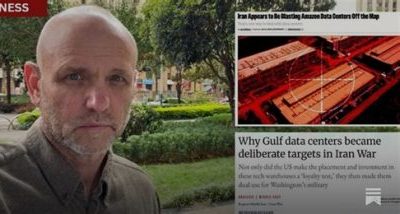
Iran spent $1 million to wipe out $30 billion in data center plans, and take down Amazon in the ME
or go to
Aletho News Archives – Video-Images
From the Archives
A short history of British torture
ICC | December 2005
When the House of Commons was debating how much to increase the time limit for detention without trial the question of torture came up. Officially this was limited to the nice considerations of whether it was all right to send people to places where torture is used and whether Britain can use information collected by the use of torture in other countries. This discussion gave an impression of democratic Britain as the home of civilised behaviour where the very idea of torture is repugnant to our legislators – unlike, say, the US with its secret CIA jails… In reality, the British state has a long history of using and developing a whole range of torture techniques. … continue
Blog Roll
 Aletho News
- Houthis Keep Advancing as the Red Sea Crisis Deepens
- Iran spent $1 million to wipe out $30 billion in data center plans, and take down Amazon in the ME
- Zionist billionaire pressure to silence Macklemore sparks exodus from Ed Sheeran tour
- House Votes to End Iran War for Third Time
- North Korea Slams US Plan for ‘AUKUS 2.0’ with South Korea and Japan
- Prolonging US-Iran Conflict Not Meeting Interests of Int’l Community – China’s Wang Yi
- EU bans former Zelensky aide from parliament
- NATO-backed Kosovo separatist ‘responsible for war crimes’
- US destroying international space law
- SCO Calls for Binding Global Deal to Prevent Arms Race in Space
- If Americans Knew
- U.S. Makes, Israel Takes: The Real Story of U.S.-Israeli Military Cooperation
- Night raids rise in Palestine
- Tucker Carlson interviews Norman Finkelstein about Gaza
- Groups urge Americans to support Van Hollen legislation on Israel’s killing of Americans & Palestinians
- Trump administration plans to send 40,000 tons of bombs to Israel: report
- Sanctions Target Iran’s Government, But Kill Hospitalized 23-Year-Old Woman
- An alternative view on the book “Israel’s Lobby: America in the Grip of a Foreign Power”
- Ed Sheeran’s band Beoga, other opening acts quit tour after Macklemore was dropped over his pro-Palestinian comments
- The assassination attempt on President Trump in Butler and the various Israeli connections to it
- “We Want That the Whole Land Be Jewish”
- No Tricks Zone
- New Study: ‘Global Drought Shows No Detectable Recent Acceleration Under Climate Warming’
- Economic Masterminds: German Socialists Suggest Taxing Productivity Gains Stemming From Using AI
- The South China Sea Has Not Been Cooperating With The Climate Change Narrative
- Energy Crisis: Germany Enters Heating Season With Historically Low Gas Reserve Fill Levels
- New Study: The Antarctic Ice Sheet Gained Mass From 2020-2024 Due To Staggering Snow And Ice Accumulation
- Study: Ocean Heating Rates From Thousands Of Years Ago ‘Dwarf’ Modern Ocean Heating Rates
- Climate Extremists Target, Attack Large-Scale Power Grid Infrastructure In Germany!
- New Study: Antarctic Ice Melt Has Contributed Less Than 1 Centimeter To Sea Level Rise In The Last 30 Years
- Fear Of Debate: Alarmist German Climate Scientist Calls On Mainstream Media To Discredit Skeptic Voices
- End-Of-August Arctic Sea Ice Extent Hasn’t Fallen In 20 Years, Official Data Show!
 Aletho News