‘Iron Dome Proved to Be a Bust’: Iran Strikes Israel in Retaliation for Assassinations
By John Miles – Sputnik – October 2, 2024
Iran launched a significant retaliatory attack against Israel late Tuesday night, ending months of speculation about how or whether the country would strike back after its provocative killing of Hamas leader Ismail Haniyeh in Tehran.
The United States reportedly provided Iran with assurances after the attack against Haniyeh in July that Israel and the US would move constructively towards the establishment of a Palestinian state, ending Israel’s military aggression against its neighbors and Palestinians in the Gaza Strip, where over 42,000 have died according to figures reported by the territory’s health ministry. Tel Aviv’s deadly attack against Hezbollah chief Hassan Nasrallah in Lebanon last week dashed hopes of a cessation of violence as Israel claims it is preparing for a broader invasion of Lebanon.
“I’ve seen the videos and you can see the missiles continue to rain down and hit targets. Israel is imposing a news blackout,” former CIA analyst Larry Johnson said. “They don’t want the knowledge out there about what happened. But Iran made sure that it was not going to hit and run the risk of killing hundreds or thousands of Israeli civilians.”
“They were not going to act like the Israelis,” the analyst claimed. “They really consider themselves, if you will, more humane, more honorable, and by virtue of their action, I think they can make that case.”
Johnson claimed Iran was forced to strike Israel after false assurances from the United States that Israel would cease attacks on its neighbors after its killing of Haniyeh. Iran previously launched a retaliatory attack on Israel in April after Tel Aviv’s bombing of the Iranian embassy in Damascus, Syria killed two Iranian generals. The codename Operation True Promise was announced for the strike.
Iran’s Tuesday attack, dubbed Operation True Promise II, appears significantly more substantial than April’s strike in which the vast majority of Iranian missiles, rockets and drones were intercepted by Israel’s Iron Dome. Iran was reportedly able to successfully strike Israeli military targets Tuesday, including an Israeli air base where multiple US-provided F-35 aircraft were hit. Johnson claimed Israel’s attack against Nasrallah would’ve been launched from an F-35; the fighter jet would be key to any Israeli invasion of Lebanon.
The commentator compared Israel’s Iron Dome to the US Patriot missile system, claiming the US is unable to replenish the defense system rapidly enough to allow Israel to fight a long war of attrition.
“Lockheed Martin… can make about one and a half, one and a quarter [missiles] a day,” said Johnson. “I think Israel’s in a similar situation… [Iran] put Israel on notice, ‘If you launch any further strikes against us in any retaliation, we’re going to hit you harder next time and with more lethality.’ So this right now has a chance to really get out of control.”
“I cannot rule out that Israel is going to try to launch some conventional weapons at Iran, but I think they’re going to be defeated,” Johnson claimed.
“Israel may be tempted to try to use a nuclear device against an Iranian target,” he warned. “If that happens then we’re going to really be into another dimension, and this is going to get very, very serious. It’s already a serious situation, but it will get absolutely dangerous.”
The analyst suggested Israel would not be able to support military engagement against multiple enemies, even with the United States backing it up.
“Israel is not in a position to fight a multi-front war and it does not have the strategic depth to fight wars of attrition. And that’s exactly what it’s got itself into now,” Johnson pointed out. “It’s not going to be able to finish off Hezbollah in a week. It couldn’t even finish off Hamas in 12 months. It’s not going to be able to finish off Syria, finish off the Houthis or finish off Iran… That’s what Israel fails to understand. It does not have the ability to sustain itself in these kinds of operations for an extended period of time.”
“If US ships are involved that are off the coast of Iran, then we’ll see Iran react and they may even end up attacking some US ships,” he continued. “But they’ll certainly retaliate against Israel. Israel is not out of the woods at all, despite all the delusional nonsense that the extreme Zionist supporters are saying when they say, ‘oh, Iran didn’t touch us, Iran didn’t hurt us at all.’ Nonsense.”
The development comes as Democrats attempt to hold onto the White House in November’s presidential election, with former President Donald Trump casting himself as a defender of Israel. Vice President Kamala Harris will attempt to do the same, Johnson claimed, while also trying to prevent a regional conflagration in the Middle East before the election.
“The politics are going to dictate a lot of strategic military decisions, unfortunately,” said Johnson.
Explainer: Which Israeli military and intel bases did Iran hit in ‘Op. True Promise-II’?
By Ivan Kesic – Press TV – October 2, 2024
On Tuesday evening, Iranian armed forces launched a massive retaliatory operation against Israeli-occupied territories using hundreds of ballistic missiles.
According to the Islamic Revolution Guard Corps (IRGC), 90 percent of missiles struck the targets – military and intelligence sites in Tel Aviv and other occupied areas – evading air defense systems.
Among the main targets were the “Tel Nof” airbase near Tel Aviv, the “Nevatim” airbase that houses F-35 warplanes, the “Ramon” airbase, and the “Hatzerim” airbase among others.
Chief of staff of the Iranian armed forces, Major General Mohammad Bagheri, in a statement after the operation offered details and lauded the heroic efforts of the country’s military forces.
“Tonight, the IRGC’s aerospace force took revenge for many Zionist crimes with its heroic operations,” he said, appreciating the seamless coordination between the Islamic Revolution Guard Corps (IRGC), the Iranian army and the ministry of defense in carrying out the successful operation.
Major General Bagheri emphasized that the IRGC chose three locations as primary targets of ‘Operation True Promise II’, specifically the Mossad headquarters, Nevatim Airbase and Hatzerim Airbase.
The first was chosen because the spy center has been found responsible for several assassinations, the second because F-35 jet fighters are stationed there, and the third because it was used to assassinate Hezbollah leader Sayyed Hassan Nasrallah in a devastating attack in Beirut on Friday.
He further underscored that the economic and industrial centers of the Israeli regime and the people in the occupied territories were not targeted in this operation, although this was completely possible.
He added that the IRGC and the armed forces of the Islamic Republic of Iran are ready for any scenario and that in the case of any violation of territorial integrity and sovereignty of Iran, the missile operation will be repeated on a larger scale, and that they will target the entire enemy infrastructure.
Mossad headquarters
Centers linked to the Israeli spy agency Mossad were correctly assumed to be the target of a retaliatory strike in a Press TV website report from mid-August following the assassination of Hamas leader Ismail Haniyeh in an Israeli airstrike in Tehran.
Among one of these mentioned centers was the operational headquarters of military intelligence unit 8200 at the Glilot Mizrah Interchange, located in the north of Tel Aviv, near the city of “Herzliya.”
In this military intelligence complex the collected information is processed and further forwarded to military strategists and other Israeli intelligence agencies, including Mossad.
This location was hit by several Iranian ballistic missiles on Tuesday night, as evidenced not only by official statements but also by private video recordings that appeared on social networks.
At least two such videos, the first taken from a balcony on Arik Einstein Street in Herzliya and the second taken from Route 482 near Ayalon Mall in Bnei Brak, show a direct hit to the compound.
Many videos verified by social media users showed the impact of Iranian strikes at the Mossad headquarters with some even documenting the crater following the attack.
Airbases
Nevatim, Hatzerim and Tel Nof airbases were also correctly identified as potential targets of a retaliatory operation in a Press TV website report from both April and August, with the explanation that the planes that attacked the Iranian consulate in Damascus in April took off from there.
This huge airbase with four runways covers about 50 square kilometers and is located in the Negev desert, 15 km east of Beersheba and 12 km north of Dimona.
It hosts three squadrons of US-made F-35 stealth fighter jets, the 140th, 116th and 117th, as well as C-130 transport aircraft, Boeing 707 tanker aircraft and other reconnaissance aircraft.
At least seven different videos show direct hits from 20 to 30 Iranian ballistic missiles, which caused extensive damage to the base and, according to some sources, destroyed over 20 jet fighters.
A video from Beersheba also showed strikes on Hatzerim air base, with reports of destroyed F-15 jet fighters, and another three direct strikes on Tel Nof air base with secondary explosions, possibly a weapons depot or air defense system.
The attack on Nevatim airbase, according to military analysts, was “one of the heaviest documented so far” as it showed plumes of smoke and fire in dark sky.
Many users posted videos verifying the attack on Nevatim and other Israeli military bases.
Iran’s Foreign Minister on Missile Strike on Israel: Tehran Warned US Not to Interfere
Sputnik – 02.10.2024
TEHRAN – Tehran has sent Sweden a message for Washington saying that Iran’s missile attack on Israel on October 1 was Iran’s right to self-defense, while the Iranian side has separately warned the US not to interfere, Iranian Foreign Minister Abbas Araghchi said on Wednesday.
On Tuesday, Iran launched several hundred ballistic missiles toward Israel in response to the killings of Hezbollah chief Hassan Nasrallah, Hamas political leader Ismail Haniyeh, and senior IRGC commander Abbas Nilforoushan. Iranian President Masoud Pezeshkian said that his government was not seeking a war with Israel but would confront any threat in a resolute manner.
“An exchange of messages does not mean [the existence] of agreements, and before the response [of Iran to Israel’s actions in the region] there was no exchange of messages. After the response, a warning was issued to Sweden to pass it on to the United States, and it was said [in this message] that this [missile attack against Israel] was our right to self-defense, and we have no intention of continuing [the strikes]. We also issued a warning to the United States to step aside and not to interfere,” Araghchi was quoted as saying by the Tasnim news agency.
There is a possibility of conflict in the Middle East, but Tehran believes that the situation in the region will stabilize in the coming days, Iranian Foreign Minister Abbas Araghchi said on Wednesday.
“I see the coming days as bright. The possibility of conflict exists, but our forces are fully prepared. Last night, we only hit military and security targets and, unlike the Israeli side, did not affect the civilian sphere. We believe that we will see a kind of gradual stabilization of the situation in the region in the coming days,” Araghchi was quoted as saying by the Tasnim news agency.
Iran’s armed forces are ready for any possible actions of Israel, Iranian Foreign Minister Abbas Araghchi said on Wednesday.
“Our armed forces are prepared for possible actions by the Israeli regime. If any new steps are taken by the [Israeli] regime and those who support it, they will face a tougher response from Iran,” Araghchi was quoted as saying by the Tasnim news agency.
Possible Escalation Scenarios
Iran has prepared hundreds of missiles that it could use if Israel or the United States decide to strike back, The New York Times reported, citing two members of Iran’s Islamic Revolutionary Guard Corps familiar with the matter.
Iran is ready to launch these missiles from western borders, the newspaper said.
Israel may strike oil production facilities inside Iran and other strategic targets within days in response to Tehran’s massive missile attack and will consider other options, including hitting its nuclear facilities, if Tehran attacks again, the Axios news portal reported, citing Israeli officials.
At the same time, Israel has not yet decided on specific steps to respond to Iran’s missile strike, as it wants to coordinate these measures with the US, the news portal reported.
According to a US official, Washington has made it clear to Israel that it supports its intention to respond to Iran’s shelling, but believes the response must be measured, Axios said.
US warships in the Mediterranean Sea shot down a handful of missiles during Iran’s attack on Israel, The Washington Post reported.
On Tuesday, the IRNA news agency reported that US Navy ships failed to intercept missiles fired by Iran towards Israel.
Flights Cancellation
All flights in Iran have been canceled until Thursday morning in connection with the situation in the Middle East, Jafar Yazerlu, a spokesperson for Iran’s Civil Aviation Organization, said on Wednesday.
On Tuesday, the spokesperson said that Iran had grounded all flights until Wednesday morning over security concerns.
“In order to maintain flight safety and [taking into account] the situation in the region, all flights throughout the country are canceled until 5 a.m. [local time, 01:30 GMT] tomorrow,” Yazerlu was qouted as saying by the Tasnim news agency.
Israel struck with hypersonic missiles – Iran
RT | October 1, 2024
Iran used hypersonic missiles for the first time during its strikes on Israel on Tuesday, the Islamic Revolutionary Guard Corps (IRGC) has announced.
Iran launched several salvos of missiles in what the IRGC called a response to the recent Israeli killings of the heads of Hamas and Hezbollah, as well as an Iranian general who was in Lebanon.
Fattah-2 hypersonic missiles were used in the attack to bypass the Israeli radars, Iranian media reported on Tuesday evening, citing the IRGC.
The Guard claimed that 80-90% of the missiles used in ‘Operation Honest Promise 2’ struck their targets, among which were the Tel Nof air base near Tel Aviv and the Netsarim area near Gaza, where they said “a large number of Israeli tanks” was destroyed.
Iran also claimed to have destroyed a number of Israeli F-35 fighters at the Nevatim air base, located halfway between Beersheba and the Dead Sea.
The Israel Defense Forces estimated the number of incoming missiles at 180 and acknowledged that “a few hits” have been recorded. According to the IDF, the majority of the missiles were successfully intercepted. The only reported casualty on the ground is a Palestinian man, who was killed by a falling missile fragment near Jericho in the West Bank.
Tuesday’s attack was bigger in size and scope than the April strike, the first-ever such attack by Iran, in which scores of ballistic missiles and drones bombarded Israel in reprisal for an airstrike on the Iranian consulate in Damascus.
Hypersonic missiles fly anywhere from five to 25 times the speed of sound. Iran unveiled its first such missile, the Fattah-1, last June. The Fattah-2 version was revealed to the public in November. Neither had been used in combat before.
According to Tehran, the missile attack was the response to the assassination of Ismail Haniyeh, the political leader of the Palestinian militant group Hamas, who was killed in Tehran back in July. Iran also cited the killings of Hezbollah leader Hassan Nasrallah and IRGC Major General Abbas Nilforoshan in Lebanon last week.
Israel has vowed to strike back, while Iran has warned that any further attacks will be met with further force.
Jerusalem Post deletes article claiming Lebanon is part of Israel’s ‘promised land’
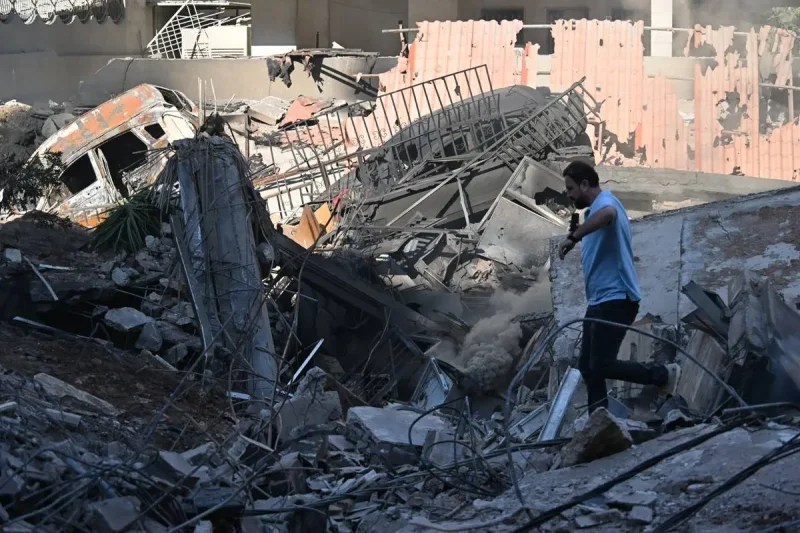
A man walks over debris of the building, where Hezbollah’s Secretary-General Hassan Nasrallah lost his life, after Israeli army’s airstrike, carried out by F-35 fighter jets, in Dahieh, Beirut, Lebanon on September 29, 2024 [Houssam Shbaro – Anadolu Agency]
MEMO | October 1, 2024
The Jerusalem Post has prompted a controversy after publishing then swiftly deleting an article suggesting that Lebanon and several other Middle Eastern countries are part of Israel’s “promised land”.
“Is Lebanon part of Israel’s promised territory?” was published on 25 September, coinciding with Israel’s assault on Lebanon and subsequent ground invasion. The timing and content of the piece have been viewed by critics as evidence of Israel’s expansionist ambitions in the region.
In the now-deleted article, Mark Fish claimed that the land “promised by God” to the “children of Israel” includes parts of modern-day Israel, the West Bank, Gaza, Lebanon, Syria, Jordan, Iraq and even Turkey. Fish cited religious texts to support its claims.
“The Torah provides clear guidelines regarding the areas we were commanded to conquer when taking possession of the land,” he wrote. He elaborated further on the concept of “Greater Israel”, suggesting that the Biblical boundaries stretch “from the ‘River of Egypt’ [interpreted by some as the Nile or a smaller river in Sinai] to the Perat River [Euphrates].”
The Jerusalem Post removed the article following a backlash on social media, with many accusing the newspaper of promoting expansionist ideology under the guise of religious justification. However, the article has been archived and continues to circulate online.
Notably, the author provides Torah-based justifications for holding onto occupied land. He said that “Hashem [God] tells us that we are granted every land we will conquer within the borders mentioned,” suggesting that God has sanctioned territorial expansion and occupation. This is an argument that aligns with a core tenet of Zionist ideology, which often cites Biblical prophecy about God’s promise to the Jews as justification for claiming Palestine and surrounding areas.
“Every place where the sole of your foot will tread shall be yours — from the wilderness and the Lebanon, from the river — the Euphrates River — until the western sea shall be your boundary,” wrote Fish. “This promise from the Creator clearly places the land of Lebanon within the Promised Land of Israel, or what some refer to as ‘the Complete Land of Israel’, or ‘The greater Israel’.”
Critics argue that the publication of such content, especially during another Israeli invasion of Lebanon, serves to legitimise Israel’s ongoing colonisation efforts in the Middle East. They contend that it reflects a broader ideology within certain Israeli circles that seeks to justify territorial expansion based on religious beliefs.
The controversy has reignited debates about the role of Israel’s religious claims to Palestine and the potential consequences of such rhetoric in an already volatile region. Like the early Zionists who concealed their true intention about ethnic cleansing and the complete colonisation of all of Palestine, Israeli leaders tend to avoid commenting on the concept of Greater Israel.
As of the time of writing, the Jerusalem Post had not issued an official statement regarding the publication and subsequent removal of the article.
US deploys thousands of troops to Middle East as tensions rise
Al Mayadeen | October 1, 2024
Deputy Pentagon Press Secretary Sabrina Singh told reporters on Monday said the US is increasing its military presence in the Middle East by deploying a “few thousand” additional troops.
According to a statement, this includes bringing in new units and extending the stay of those already stationed there.
“A certain number of units already deployed to the Middle East region… will be extended and the forces due to rotate into theater to replace them will now instead augment” those that are already there, Singh said.
“These augmented forces include F-16, F-15E, A-10, F-22 fighter aircraft and associated personnel,” Singh added, noting that there will be “an additional few thousand” personnel in the region as a result.
This comes in light of heightened escalations amid the start of “Israel’s” “localized and targeted” aggression of Lebanon.
The latest attacks on US positions in the region include a strike on the US military’s Victoria base near Baghdad Airport, occurring late Monday into Tuesday.
The Yemeni Armed Forces have also struck Israeli military targets earlier today using long-range multi-purpose one-way assault Samad 4 drone.
Meanwhile, Hezbollah continues its operations targeting Israeli movements within the occupied Palestinian territories.
Iran also launched a response to the Israeli assassinations of martyrs Haniyeh, Sayyed Nasrallah, and General Nilforooshian earlier, launching hundreds of rockets toward occupied Palestine.
Heightened escalations
On Monday, US Defense Secretary Lloyd Austin expressed support to Israeli Security Minister Yoav Gallant for “dismantling attack infrastructure” belonging to Hezbollah.
Austin also warned Iran of “serious consequences” should it directly strike “Israel” in retaliation for attacks on the Lebanese Resistance group.
On Tuesday, Hezbollah Political Council member Mahmoud Qomati said in an interview with Al Mayadeen that Hezbollah’s allies “will intervene if the battle expands.”
Qomati warned that southern Lebanon “will become a graveyard for the occupation forces” should they enter, highlighting the Resistance’s vast arsenal of unused weapons and the fighters’ readiness to engage with Israeli forces.
Addressing observers, Qomati said the Resistance was rebuilt immediately following the assassination of Hezbollah Secretary-General Sayyed Hassan Nasrallah.
The legacy of Sayyed Nasrallah is well-maintained, he said, adding, “his trust is in our hands and will remain so with every leader and fighter.”
Qomati also reiterated Hezbollah’s stance, which had been affirmed by the late Secretary-General since the beginning of the Israeli occupation’s war on Gaza, stressing that the party “will not halt its support unless a comprehensive proposal is put forward, including a ceasefire in Gaza.”
Joe Biden Is Responsible for Burning Lebanon
By Daniel Larison | The Libertarian Institute | September 30, 2024
The Joe Biden administration claims to be pushing for a “temporary ceasefire” between Israel and Hezbollah to avert a larger conflict, but this is very late in the day and it is not a serious effort to prevent a new war in Lebanon. It is at best a desperate, last-minute exercise in going through the motions of diplomacy. The administration would like to pretend that it is a passive bystander pleading from the sidelines instead of the chief patron and arms supplier of the main belligerent in the conflict, and it designs its entreaties to be toothless so that Israel can safely ignore them.
The United States has refused to exert any pressure on Prime Minister Benjamin Netanyahu’s government for the last eleven months, and it has continued supplying Israel with weapons no matter how those weapons have been used to commit war crimes against Palestinians. Now American officials say that they don’t want further escalation in Lebanon, but once again the administration won’t back up those words with action. The U.S. could use its leverage to rein Israel in and insist on the de-escalation that the administration says that it wants, but the president has shown that he has no interest in doing that.
The empty Gaza ceasefire negotiations prove as much. The ceasefire talks have become an interminable process designed to lead nowhere. The administration has catered to the Netanyahu government’s preferences at every turn. Each time that Netanyahu adds new deal-breakers or otherwise seeks to derail negotiations with new attacks, the administration has dutifully taken his side and pretended that Hamas is the sole obstacle to securing an agreement. The United States cannot be a credible diplomatic actor in the region when its primary role is acting as Netanyahu’s PR agent.
The Israeli government assumes that the U.S. won’t withhold weapons, diplomatic support, or military protection under any circumstances, and that has encouraged Netanyahu to pursue increasingly aggressive goals. Because the U.S. shields Israel from military reprisals, as it did earlier this year during Iran’s missile and drone strikes, it has given Netanyahu free rein to lash out whenever and wherever he wants. The administration has dressed all of this up as preventing a wider regional war, but the reality is that they have simply delayed the conflagration while making it more likely that it will be even more destructive when it occurs.
The total failure of the administration’s policy is there for all to see. The region is likely facing a new Israeli invasion of Lebanon, and that invasion will have serious destabilizing effects on the wider region. This is the disaster that the United States has claimed to oppose all along, but in practice it has done nothing to stop it. Had the U.S. truly wanted the war in Gaza not to spread, it would have demanded a lasting ceasefire months ago. Had the U.S. wanted to prevent escalation in Lebanon, it would be cutting off arms transfers and pulling back its forces from the region rather than rushing more troops to the Middle East. Instead the United States has done everything that one would expect it to do if it wished to set the region ablaze.
The U.S. is at great risk of being ensnared in this larger war. It is imperative that our country avoid direct involvement in Israel’s conflicts. The U.S. has no vital interests at stake in these fights. The president has no authority to involve American forces directly. It is not the responsibility of the United States to bail out a reckless client state when it gets in over its head. The quickest way to force the Israeli government to deescalate is to deprive it of the support and protection that it takes for granted.
Once the current crisis is over, U.S. foreign policy in the region has to be radically overhauled. To avoid future entanglements in the wars of client states, the U.S. should downgrade its relationships with the Middle Eastern governments that rely heavily on American weapons supplies and protection. The United States has no formal commitments to defend these states, and it should not extend security guarantees to any of them. The U.S. also needs to reduce its military presence in the region to the bare minimum required to secure our embassies. Decades of extensive American military involvement in this part of the world have been ruinous for the countries of the region and for American interests, and it is in the best interests of all concerned for the United States to get out.
Of Cool Heads and Hot Heads

By Philip Kraske • Unz Review • September 29, 2024
Ever more desperate, Israel is working hard to start a world war with the United States on its side. The elimination of Hassan Nasrallah won’t make much difference to Hezbollah’s fight; the new leader will soon step up. But Israel might regret the absence of the cool-headed Nasrallah.
Cool-headedness has actually been the norm this past year, and is among the few hopeful notes on the international scene. Lots of leaders are keeping calm, holding back the factions in their governments that would love to take a crack at the folks thumbing their military noses at them.
China merely tut-tuts about foreign navy ships traversing the Strait of Taiwan, Hezbollah keeps its big missiles in their silos, Iran responds to Israeli attacks with a few half-hearted firecrackers, and Vladimir Putin frowns and issues warning after warning when Ukraine, with Nato help, hits Russian refineries and radar installations. Meanwhile Egypt, Jordan, Iran, Syria, and Turkey — and I’ve probably missed a few — itch to put holes in Israeli runways.
But restraint is the watchword. Unlike before World War One, when governments decided to declare war from one day to the next, countries are looking before they leap. Why? To what do the world’s citizens owe this clear shift to reluctance among national leaders to jump into conflict? It’s often been observed that nuclear weapons have kept the peace among the great powers. Nowadays, however, other elements keep the peace just as well. Here are the three most important ones.
The first is economic. It’s true that capitalist consumerism has atomized the citizenry, but it also keeps people quiet. National leaders figure that the only way to keep everybody fed and employed and hypnotized by Netflix series is to keep the economy running. Take tourism, for example — a labor-intensive industry that absorbs a lot of workers with little formal education. Israel’s has been hammered. Who wants to retrace the steps of Christ in the Holy Land amidst the squall of sirens announcing incoming missiles from Hezbollah? Israel now has to rotate its forces in and out of the military just to keep the economy going. But they’re finally going to throw the Palestinians out, and figure it’s worth the tradeoff.
Other touristy countries have much less to gain. In Turkey, tourism makes up more than ten percent of the economy, and is still growing. In Egypt, it’s 24 percent. Take that away, and the ensuing unrest will topple governments. But their leaders have less to gain from tackling Israel.
The second element is strategic. Just over the last several years, war has turned into a video game of missiles and missile-defenses and drones of all different kinds. As the commentator Alistair Crooke has observed, American aircraft carriers parked in the eastern Mediterranean look like something out of the 1950s. A couple of missiles sent from Crimea would send them to the bottom of the sea in a question of minutes.
Conventional war has all but disappeared. Imagine what would happen to American troop and supply ships traversing the Atlantic. If German U-boats sank nearly three thousand, Russians would sink every one of them, and not from a dank submarine but from a cosy office in Moscow. And crossing the Pacific to attack China would be a suicide mission.
National governments see the destruction wrought by Russian missiles — not its army shelling villages, but the attacks from afar on major cities and infrastructure — and they quickly figure that restraint is the better part of valor.
The third element that makes governments hesitate to get into a fight is that societies are far more fragile than before. Imagine what would happen if the Chinese got mad at the Americans and dropped a few missiles on highway overpasses, which then collapsed highways, between San Diego and San Francisco. Of course, hackers could wreak havoc on just about everything, but if software defenses proved troublesome to them, a couple of missiles — or just bombs placed by hired thugs — on data centers would quickly affect the internet in all kinds of random ways. Well-paid jokers could send drones flying around Atlanta and Chicago airports — or Istanbul’s or Frankfurt’s or Tokyo’s — closing them down. And if some leader were in a bloody frame of mind, he could order the downing of just two commercial airliners, one taking off in Paris and the other in Miami — and watch every flight reservation in the the western hemisphere get canceled in an hour. Citizens of the world’s poorest countries would finally have the last laugh.
In fact, there is a never-declared Mutually Assured Destruction that restrains governments, or quasi-governments like Hezbollah. All to the good, except that conventional war seems to be morphing into terrorism. Now that Israel has opened the Pandora’s box of booby-trapping consumer items, how long will it be before desk lamps — or shoes or avocados — begin to explode in Tel Aviv? Will Kurds need to take apart their Turkish-made earphones? As readers of Unz.com know, attacking China is far more cost-effective through untraceable biological attacks against its people and livestock, and invites no revenge — at least for the moment.
Israel’s attack with pagers and radios, Ukraine’s worthless drone strikes on Moscow apartment buildings, America’s aimless pecking at “terrorists” in Syria and Iraq — these are harbingers of the terrorist world to come.
And as defeat approaches, the losers are bound to raise the ante — especially the Israelis and Ukrainians. As in World War Two, the years of war have corroded their last vestige of ethics, and they know that the Washington elite will ultimately excuse their tactics. The western media would give nothing but dashing accounts of how Zelensky and Netanyahu — harried, exhausted, yet persevering — listened to their advisers, rubbed their necks, and gave the green lights to “limited” chemical or nuclear attacks against advancing enemies. For an excellent example of how flexible, how downright protean, mainstream journalists can be, read New York Times columnist Amanda Taub’s article on the legality of Israel bombing of the Iranian consulate in Damascus: “Israel Bombed an Iranian Embassy Complex. Is That Allowed?” She concludes that it was.
In short, if Hezbollah’s next leader, not so restrained as Nesrallah, unleashes missile hell down the whole length of Israel, Netanyahu and his hard-eyed friends may come to regret finishing him off. Doesn’t history tell the best jokes?
Nasrallah assassination aimed at provoking US-Iran war: Russia’s Lavrov
Press TV – September 29, 2024
Russia’s Foreign Minister Sergey Lavrov says that Israel’s assassination of Hezbollah Secretary-General Sayyed Hassan Nasrallah may have been intended to provoke a war between the United States and Iran.
Lavrov told reporters at a news conference after addressing the UN General Assembly on Saturday that a lot of people believe Israel’s assassination of Nasrallah was aimed at provoking Iran and the US “to unleash a full-blown war in the entire region.”
Killing the Hezbollah leader was “not simply a political assassination. It’s very cynical as an act,” Lavrov said.
“I think – well not even, I think, but a lot of people say – that Israel wants to create the grounds to drag the US directly into this and so to create these grounds, it is trying to provoke Iran,” Lavrov added.
“The Iran leadership, I think, are behaving extremely responsibly. And this is necessary. This is something that we should take due note of.”
Speaking at the UN Security Council meeting on Friday, Lavrov said, “the Middle East is once again on the brink of a big war,” calling for active diplomatic efforts to prevent the “most catastrophic scenario.”
In his UN General Assembly speech, Lavrov condemned the Israeli regime for its “inhumane attack on Lebanon.”
“Another glaring example of terrorist methods as a means of achieving political aims is the inhumane attack on Lebanon that transformed civilian technology into a lethal weapon,” Lavrov said, calling for an immediate international investigation.
‘US knew about Israel’s pager attacks’
Lavrov also told reporters that the US was likely aware of the Israeli regime forces’ plans to launch a “terrorist attack” against Lebanon using communication devices.
He said the complexity of the attack and the leaking of details to Western media indicate Washington’s possible complicity in the terrorist operation.
Last week, thousands of hand-held pagers and walkie-talkies used by Hezbollah members exploded across Lebanon simultaneously, killing dozens and injuring thousands, including many civilians. The attack, widely blamed on Israeli spy agency Mossad, drew international condemnation, with UN Human Rights Commissioner Volker Turk calling it a “shocking” and “unacceptable” act that violates human rights laws.
Tel Aviv has not claimed responsibility for the pager attacks, and its allies have denied any knowledge. However, according to Lavrov, Western media reports regarding the details and preparations “indicate to varying degrees the involvement and, at the very least, awareness of Washington concerning the preparation of that terrorist attack.”
Towards a Greater Middle Eastern War & Defeat in Ukraine
Colonel Douglas Macgregor, interviewed by Professor Glenn Diesen
Video at Odyssee
Glenn Diesen | September 24, 2024
I spoke with Colonel Douglas Macgregor about the deteriorating situation in the Middle East and Ukraine. Colonel Macgregor was a senior advisor to the Secretary of Defence under President Trump, he has written several books on military strategy, and is the CEO of Our Country Our Choice which seeks among other things to challenge the bipartisan support for the militarisation of US foreign policy
The war in Gaza has now spread into Lebanon and can seemingly no longer be contained, which threatens to pull in other actors in the region such as Iran. However, leaders in the region are already facing angry populations for failing to take a more hardline position against Israel and the US. Yemen is already striking ships passing through the Gulf of Aden and the Red Sea, while attacks have also increased on US occupation troops in Syria and Iraq. The US and Israel continue to play good cop / bad cop in which the US provides the weapons and intelligence for the onslaught, while simultaneously complaining they are not able to impose a ceasefire. Israel is in deep trouble as its military exhausts itself and there are no desirable paths to peace, which is why pulling the US into a wider war appears to be the sole solution.
In Ukraine, the situation is also deteriorating quickly as the army suffers from a shortage of manpower, armoured vehicles, ammunition, air defences, aircrafts, and a multitude of other areas. Furthermore, Ukraine’s electric grids are severely damaged, the economy falters, the public grows more unhappy with the aggressive “recruitment” of new soldiers, while political divisions are yet again emerging in Kiev. In the West, there are fewer and fewer weapons to be sent and the US is seemingly reluctant to become directly involved in deep strikes within Russian territory as it will trigger a NATO-Russia war with the possibility of a nuclear exchange. War fatigue is growing throughout the West, with the exception of the UK which remains gung-ho for more war. When the US sabotaged the Minsk agreement and the Istanbul peace agreement, the objective was to use Ukrainians as a proxy to bleed and exhaust Russia to knock it out from the ranks of great powers, and thereafter shift focus to breaking China and thus restoring US global primacy. Instead, we are seeing a Russian victory, a pending unmitigated disaster in the Middle East, while the global majority is constructing a post-American world with BRICS.
We have crossed the point of no return in terms of reaching a peace in Ukraine and the Middle East. The world is heading towards major wars – and the US is approaching this dangerous situation with empty slogans rather than a strategy.
US deploying more troops to West Asia amid Israeli escalation of violence
Press TV – September 23, 2024
The US Department of Defense has decided to deploy more boots to West Asia amid the Israeli escalation of war in the region.
Additional US troops will be deployed to the Middle East in response to a sharp spike in violence between Israel and Hezbollah forces in Lebanon that has raised the risk of a greater regional war, the Pentagon spokesperson said on Monday.
Gen. Pat Ryder announced the new deployment without providing details on how many additional forces would be needed or what they would be tasked to do.
“In light of increased tension in the Middle East and out of an abundance of caution, we are sending a small number of additional US military personnel forward to augment our forces that are already in the region. But for operational security reasons, I’m not going to comment on or provide specifics.”
The United Nations has sounded the alarm, warning that the escalating violence between the Israeli regime forces and the Hezbollah resistance movement in Lebanon was catapulting the Middle East conflict “to another level”.
Prior to the latest escalation of violence, the Pentagon had announced that the approximately 40,000 US troops deployed in the region were “enough to protect Israel.”
In addition to tens of thousands of troops in the Middle East region, the Pentagon has warships, fighter jets, and air defense systems deployed to protect both its forces and the Israeli regime.
Ryder warned of the potential for the Israel-Hezbollah violence to escalate, calling for a diplomatic solution.
“Clearly there is the potential for these tit-for-tat operations between Israel and Hezbollah to escalate and to potentially spiral out of control into a wider regional war, which is why it’s so important that we resolve… the situation through diplomacy,” Ryder said.
Middle East tensions rose sharply after the Israeli assassination of Hamas leader Ismail Haniyeh in Tehran and Hezbollah commander Fuad Shakr in Beirut at the end of July, prompting the Pentagon to begin sending additional US troops to the region. The US military claimed the additional American troops would not be engaged by the Israeli forces for “offensive” operations against Hezbollah.
Pentagon’s announcement comes as fears of a broader regional war grow, with Israel striking hundreds of targets in Lebanon following Israel’s communication devices terror attacks which targeted Hezbollah cadre and civilians with exploding pagers earlier this week. The attacks killed 37 Lebanese and injured thousands more.
World powers have called on the Israeli regime and Hezbollah to pull back from the brink of an all-out war, with the focus of violence shifting sharply in recent days from Israel’s southern front with Gaza to its northern border with Lebanon.
Hezbollah, a powerful political and military force in Lebanon, has exchanged near-daily fire with the Israeli regime forces in support of the defenseless Palestinians in the besieged Gaza Strip.
The Islamic Resistance in Iraq (IRI) and the Ansarallah-led government of Yemen stand alongside Hamas and Hezbollah, targeting US and Israeli positions in the region in an effort to oppose Israel’s genocide of Palestinians in Gaza.
The occupying zionist regime forces launched the genocidal war on helpless Palestinians trapped in Gaza almost a year ago in early October, which has claimed the lives of more than 41,400 people, most of them innocent women and children.
Iran Unveils New Missile, Drone With 4,000 km Range Amid Seething Regional Tensions
By Ilya Tsukanov – Sputnik – 21.09.2024
Mideast tensions are on a knife’s edge, reaching a fever pitch this week after a suspected Mossad attack targeting thousands of pagers and other communication and household electronic devices in Lebanon. The escalation comes as the bloody war in Gaza approaches its one-year anniversary.
Iran revealed a new solid-fueled ballistic missile dubbed the Jihad (‘Holy War’) at a military parade in Tehran on Saturday commemorating the Iran-Iraq War of 1980-1988.
Dubbed the Jihad (lit. ‘Holy War’) the missile has a reported range of up to 1,000 km, and was designed by the Islamic Revolutionary Guard Corps’ aerospace division.
The missile one of nearly two dozen Iranian-made long-range strike weapons appearing at the parade, among them the Kheibar Shekan (‘Castle Buster’ or ‘Fortress Buster’), which was fired at terror targets in Syria earlier this year, and the Khorramshahr, named after the Iranian city of the same name, which has a range up to 2,000 km and has a 1.8 ton warhead.
Also making its debut at Saturday’s parade was the Shahed-136B – the latest modification of Iran’s mainstay piston engine-powered Shahed-136 kamikaze drone. The upgraded drone touts a range of over 4,000 km – enough to reach anywhere in the Middle East and most of continental Europe.
Manufactured by the Iran Aircraft Manufacturing Industrial Company (HESA) and Shahed Aviation Industries, hundreds of base model Shahed-136s were used to keep Israeli, US, French, British and Jordanian aircraft and air defenses busy while Iran slipped missiles past them to strike an aerodrome and intel base in April. The base 200 kg drones are equipped with a 50 kg warhead, and have a 2,500 km range.
The weight and warhead characteristics of the new, upgraded model have yet to be revealed, but based on its appearance, modifications are significant, with the new drone featuring a completely different wing configuration, and more bulbous fuselage.
Iran is a regional superpower in the development, production and fielding of drones, missiles, and other advanced weapons, possessing dozens of indigenous designs developed by local companies. The Islamic Republic’s arms industry was grown from the ground up beginning in the 1980s after its traditional weapons sellers slapped the country with an embargo during Iraq’s US-backed war of aggression, and got a major shot in the arm thanks to Iran’s hard-earned status as one of the top scientific powers in the world.
Featured Video

Bombing Hitler’s Hometown
or go to
Aletho News Archives – Video-Images
From the Archives
‘Conspiracy Theory’ Now Fact: Greater Israel Has Arrived
By Kit Klarenberg | Mint Press News | January 28, 2025
Ever since Tel Aviv’s 1948 creation, much has been said and written about ‘Greater Israel’ – the notion Zionism’s ultimate end goal is the forcible annexation and ethnic cleansing of vast swaths of Arab and Muslim lands for Jewish settlement, based on Biblical claims this territory was promised to Jews by God. The mainstream media typically dismisses this concept as antisemitic conspiracy theory, or at most the fringe fantasy of a minuscule handful of extremist Israelis.
In reality … continue
Blog Roll
 Aletho News
- Yemen joins fight against US, Israel by firing missiles at occupied territories
- Seizing the Kharg: Washington’s path to defeat in the Persian Gulf
- Iran reports 500 US casualties in strikes on covert US military sites
- Pro-Israel terrorist arrested before assassination of pro-Palestinian activist
- Bombing Hitler’s Hometown
- German journalist threatened with homelessness as German court upholds EU sanctions in landmark free speech case
- US Tells Allies That Ukraine-Bound Arms Could be Sent to Middle East
- Organized terrorism: Iran condemns killing of its diplomats in Lebanon
- Why could Gaza enter the regional war?
- Hamas official rejects Mladenov Plan linking disarmament to Gaza reconstruction
- If Americans Knew
- Researchers at Human Rights Watch Resign Over Blocked Report on Palestinian Refugee Return
- Jewish Groups Are Backing a War Americans Don’t Want
- Eric Fingerhut Thinks He’s the President of the Jews
- Top Jewish Philanthropists, Rabbis Urge Israeli President to Take Action Against ‘Jewish Extremists’
- Don’t Be Fooled. Zionist Leaders Have Always Wanted to Control Southern Lebanon
- Israel’s widespread use of torture is a core element of its genocide against the Palestinian people
- In Israel’s War on Iran, Many Middle East US Bases Rendered “All But Uninhabitable”
- ‘Burn the lawn’: Israel pursues ‘Rafah model’ in southern Lebanon
- A genocide here, an amputation there
- Reports: Iran mobilizing 1M fighters, Israel-US run low on ammo, Israeli army faces shortage – Not a ceasefire Day 168
- No Tricks Zone
- Devastating Assessment Of Comirnaty Vaccine By Former Senior Pfizer Europe Toxicologist
- New Study: CO2 Is ‘Effectively Negligible’ As An Explanatory Climate Change Factor Since 2000
- Former Pfizer Toxicologist Dr. Helmut Sterz Tells Bundestag Hearing Pfizer Vaccine Should Have Never Been Approved
- Energy Expert: Germany’s Nuclear Phaseout Was A “500 Billion Euro Mistake”
- New Research: South Australia’s Mid-Holocene Sea Surface Temperatures Were 4°C Warmer Than Today
- Storing Green Energy To Last Germany 10 Days Would Require A 60-Million Tonne Battery
- New Studies: UK Sea Levels Were 4 Meters Higher Than Today During The Mid-Holocene
- Destructive Green New Deal: German Energy And Metal Group Warns Of Drastic Crisis
- New Study Documents A 20-Year Pause In Arctic Sea Ice Decline – Driven By Internal Variability
- Wake-up Call: Survey Shows Majority Of Germans Now Favor Postponing Climate Targets!
 Aletho News