What We Are Not Allowed to Say
By Christine E. Black | OffGuardian | December 3, 2023
Censorship imperils cultures and civilization. When governments and elites prohibit speaking or writing without threats, shaming, or epithets meant to shut down discussion, free thinking dies. People also die.
A censorship industrial complex grew around Covid hysteria, which began as a war on a virus. New full-blown wars, with guns, bombs, tanks, and planes, and thousands dead now explode around us as free speech is lost in wars’ rubble, and propaganda buries truths.
With money and massive influence, private for-profit industries like pharmaceutical companies, capture US agencies, such as the Food and Drug Administration and the Centers for Disease Control, that then bolster industry profits rather than protect public health. Similarly, captured politicians help corporations profit from wars, as Marine Corp Brigadier General Smedley Butler notes in his book, War is a Racket and as Dwight D. Eisenhower warned against in his 1961 Farewell Address. Corporate and government elites get rich from wars based on lies, such as wars in Iraq and Afghanistan – and they sit rich now in retirement.
What truths might we uncover, sifting through wars’ rubble? Children and young people didn’t need Covid shots as they were at little risk from serious illness from Covid, and some countries stopped recommending them. Yet, vaccines are a main source of revenue for pediatricians. A “pandemic of the unvaccinated” never happened though entertainers, highly paid media figures, and politicians viciously maligned those who waited or declined a Covid shot.
Most people contracted Covid anyway, whether they got multiple shots or not. Shots did not prevent transmission. Thousands of Covid vaccine-injured people have been bullied into silence and rendered invisible. These are all statements we have been forbidden from making in the last few years; those who dare utter them faced rancor or ridicule or worse.
Don’t talk about Covid shots, school and business closings, or the many beloved businesses and churches that closed for good because of bureaucratic mandates.
Don’t talk about vaccine injuries or deaths or children’s learning losses or epidemics of addictions; don’t talk about child and teen suicides.
Don’t talk about Robert F. Kennedy Jr’s astute observations that Haiti and Nigeria had the some of the least restrictive Covid policies on earth, had about a one percent Covid vaccine rate, and have had some of the lowest Covid death rates in the world, observations noted in his book, Letter to Liberals.
Don’t talk about how Covid shots may cause Covid, or how Pfizer’s own product literature states that Covid is one of the side effects of the shot. When we talk about these topics, listeners often stiffen and bristle, their eyes may go blank as they dismiss us with pity or contempt before we even complete a spoken paragraph. Now, new disasters and traumas affect the world, and many insist we not talk about them to avoid snarling and insults or worse.
Violence and war exploded in the Middle East recently, and more unutterable statements come to mind. For instance, criticizing the policies of the Israeli government does not equal anti-Semitism. Great Britain, the same colonial power that colonized and divided the African continent and other countries like poker chips among winners, made The Balfour Declaration in 1917 that declared a “home for the Jews” in Palestine, where Palestinians already lived.
Was this presumptuous and elitist for the British to declare?
Is a single, open, and democratic state in Israel with equal rights for all the best solution to the conflicts and violence, as Israeli American writer, activist, and Israeli Defense Force veteran Miko Peled has stated? Peled is the son of an Israeli general and grandson of one of the signers of the Israeli Declaration of Independence. His father was an Israeli war hero turned peace maker. He changed his thinking on Israel; so did Miko Peled. Peled writes his story in his book, The General’s Son and shares his views in talks and interviews, such as this one on the Katie Halper program.
In spite of how propaganda bombards us, we may note as Miko Peled does, that Palestinians are not simply evil barbarians, beheading babies and raping women. Islam is not a religion of fanatics and terrorists, in Palestine, or anywhere else, as the media often portrays it. It is one of the world’s major religions. The word, Islam, means “submission to the will of God.” The Arabic word, “salaam” which means peace, is part of the common greeting among Muslims all over the world.
Spreading peace is a requirement of the faith. Similarly, sharing God’s peace is expected among Christians and Jews.
Christians have been criticized for their views on Israel. An older and much more well-read peace activist friend shared with me that some evangelical Christians who support Israel, stand with Israel, do so because they believe Israel is the final launching pad for the Rapture when Christians will be zapped up to Heaven, and Jewish people will be too if they convert to Christianity. Jewish people who do not will perish.
What do Jewish people think of this scenario? What if they do not want to “accept Jesus,” but simply wish to remain Jewish? It is confusing. Plenty of the world’s worst violence has been committed and continues in the name of or under the cover of religion.
Statements we are not supposed to make call us to make them now. Statements I make above could be wrong. Many may disagree with them. However, censorship kills with its shaming epithets meant to shut down discussion and thought, like the labels “anti-Semitic” or “conspiracy theorist,” “science denier” or “anti-Vaxxer.”
Censorship imperils us when we are forbidden to speak without threats and insults, such as when we were told, “You don’t care if others die of Covid” if we decided not to wear a mask or to move about freely in 2020 and 2021. Similarly, we were told, “You deserve to be excluded from society if you decline a vaccine” even when some of us had natural immunity or didn’t think we needed it. Even worse, some of us were told, “You deserve to die – or lose your job or friends or education — if you don’t comply.”
Many said such horrible things in the last few years.
Slogans and advertising language often replace free speech and obliterate open thought, as they did during the Covid period, as they do during all wars. Should we be wary of sloganeering and pre-packaged language like “wiped off the map,” “Israel’s 9-11,” “rid the world of evil,” “mushroom cloud,” “weapons of mass destruction,” “pandemic of the unvaccinated,” – sloganeering that stops empathy and reflection, closes debate, and whips populations into war frenzies? Should we question slogans and manipulative phrases?
What questions might we ask about slogans like Israel’s “right to exist”? What does that mean? After a suicide bomber killed his niece in Israel years ago, Miko Peled asked questions. He joined dialogue groups of Israelis and Palestinians and changed his thinking.
US military veteran suicides have been at epidemic levels after soldiers returned from multiple deployments in disastrous wars in Iraq and Afghanistan, ignited by sloganeering after 9-11 and the launch of the so-called “war on terror,” which was to “rid the world of evil.” How might those veterans react now, hearing this same kind of language about “Israel’s 9-11”? This past week, I learned of another veteran who committed suicide.
Can we keep our minds opened, our hearts softened to alternative perspectives? During Covid lockdowns, rigid thinking and censorship caused the US to harm its own children relentlessly as their suicides, addictions, developmental delays, learning losses, and despair increased. Children around the world starved, were abused, exploited, and enslaved because of lockdown policies we were forbidden to question. Has an entire generation of young people been harmed?
Free societies do not ban statements and opinions. Free societies permit questions and debate. Statements above may be phrased as questions as well. For instance, do Covid shots work? Have they worked to stop transmission and illness and death? Was discussion of early Covid treatment suppressed, as Dr. Peter McCollough noted early in lockdowns? Are Covid vaccine-injured people silenced? Where may we find their stories?
Should western cultures have shut down in 2020 in an attempt to avoid a single pathogen? By what authority did bureaucrats suspend the US Constitution in 2020 and forbid assembly, speech, protest, group worship, and community gatherings? What were the harms? Who benefitted from lockdowns and Covid shots and how? How much money changed hands? Who wrote the checks and who got paid?
Why are Palestinians fighting? How do we end the violence and build peace? Should the US fund violence in Israel the ways it does? What has life been like in Gaza and the West Bank of Palestine for the last few decades? Could lockdowns have made life there worse?
Israel has been criticized as one of the most repressive countries in the world for Covid restrictions and Covid shot mandates. Protesting Covid policies is a privilege Palestinians in Gaza would not have had. They have lacked basic medicines, clean water, and schools free of bombings for years.
Was the Balfour Declaration a good idea? Conservative Jewish Rabbi Yisroel Dovid Weiss, speaking at a Let the Quran Speak conference, supports Palestinians and criticizes leaders of the state of Israel on religious grounds.
Documentary films like Occupation 101 and Peace, Propaganda, and the Promised Land provoked my thinking when I helped organize public showings of them while working with peace groups. We led discussions of these films along with War Made Easy, a film based on Norman Solomon’s book by the same name, and The Ground Truth, a film about the horrific effects on the eight-ten percent of the population, sent on multiple deployments to fights those wars.
In the last few years, the same US government that sent military members to fight and die in catastrophic wars forced Covid shots on them until refusers struck down the unlawful mandates.
Stories from outsiders and whistleblowers may teach us, stories from former insiders in the military, in industry, in governments. Soldiers sent to fight disastrous wars may have lost limbs or memory or cognitive function from IEDs. They learned and changed and spoke – what we were not allowed to say.
Describing this latest violence as “Israel’s 9-11” is especially dangerous as we recall the unfathomable destruction and carnage that such language unleashed on the world more than twenty years ago with the launch of the so-called “war on terror”.
What did we learn? Outsiders and independent thinkers — who have said what was forbidden — have often changed history. From the so-called “war on terror,” the war on a virus, the current war in Israel and Palestine, perhaps they will now.
Christine E. Black‘s poetry has been published in Antietam Review, 13th Moon, American Journal of Poetry, New Millennium Writings, Nimrod International, Red Rock Review, The Virginia Journal of Education, Friends Journal, The Veteran, Sojourners Magazine, Iris Magazine, English Journal, Amethyst Review, St. Katherine Review, Dappled Things and other publications.
Henry and Hillary – Familiar Bedfellows
By Sheldon Richman | FFF | November 19, 2014
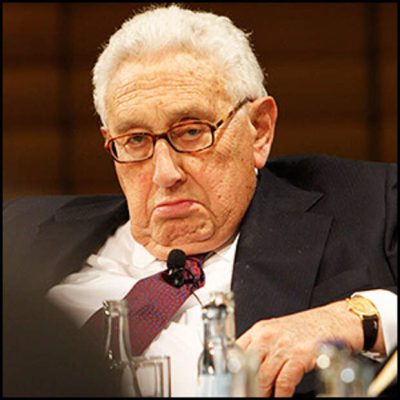
It says a lot about former secretary of state and presumed presidential aspirant Hillary Clinton that she’s a member of the Henry Kissinger Fan Club. Progressives who despised George W. Bush might want to examine any warm, fuzzy feelings they harbor for Clinton.
She has made no effort to hide her admiration for Kissinger and his geopolitical views. Now she lays it all out clearly in a Washington Post review of his latest book, World Order.
Clinton acknowledges differences with Kissinger, but apparently these do not keep her from saying that “his analysis … largely fits with the broad strategy behind the Obama administration’s effort over the past six years to build a global architecture of security and cooperation for the 21st century.”
Beware of politicians and courtiers who issue solemn declarations about building global architectures. To them the rest of us are mere “pieces upon a chess-board.” Security and cooperation are always the announced ends, yet the ostensible beneficiaries usually come to grief. Look where such poseurs have been most active: the Middle East, North Africa, Ukraine. As they say about lawyers, if we didn’t have so-called statesmen, we wouldn’t need them.
If I didn’t know better, I’d suspect some pseudonymous writer of having fun with irony in this review. Behold:
President Obama explained the overarching challenge we faced in his Nobel lecture in December 2009. After World War II, he said, “America led the world in constructing an architecture to keep the peace…”
Keep the peace — if you don’t count the mass atrocity that was the Vietnam War, the U.S.-sponsored Israeli oppression of Palestinians, and various massacres carried out by U.S.-backed “leaders” in such places as Bangladesh (formerly East Pakistan), East Timor, Chile, and elsewhere.
One Henry Kissinger had a hand in all these crimes, by the way. Strangely, Clinton doesn’t mention them. (See Christopher Hitchens’s devastating two-part indictment here and here, later turned into The Trial of Henry Kissinger.)
America, at its best, is a problem-solving nation.
Iraq, Syria, Afghanistan, and Libya are only the latest examples of problems America solved during Madam Secretary’s tenure, building on the glorious successes of George W. Bush’s team. Henry the K is no doubt flattered by the homage.
Kissinger is a friend, and I relied on his counsel when I served as secretary of state. He checked in with me regularly, sharing astute observations about foreign leaders and sending me written reports on his travels.
Now things make sense. That Hillary Clinton thought Kissinger — Henry Kissinger — a worthy advisor is something we should all know as 2016 looms.
What comes through clearly in this new book is a conviction that we, and President Obama, share: a belief in the indispensability of continued American leadership in service of a just and liberal order.
There really is no viable alternative. No other nation can bring together the necessary coalitions and provide the necessary capabilities to meet today’s complex global threats. But this leadership is not a birthright; it is a responsibility that must be assumed with determination and humility by each generation.
It takes chutzpah to write humility even remotely in connection with Kissinger. And if the U.S. empire is indispensable to justice and liberalism — and where are these, exactly? — we are in trouble. The record is not encouraging. Kissingerian “realism” creates global threats.
The things that make us who we are as a nation — our diverse and open society, our devotion to human rights and democratic values — give us a singular advantage in building a future in which the forces of freedom and cooperation prevail over those of division, dictatorship and destruction.
Devotion to human rights and democratic values — as shown in Egypt, where Clinton stuck by another friend, Hosni Mubarak, against a popular uprising. The woman has some friends!
“Any system of world order, to be sustainable, must be accepted as just — not only by leaders, but also by citizens,” he writes.
The suggestion that Kissinger cares what ordinary citizens anywhere think is ridiculous. What he cares about is states, which he puts in one of two categories: those that buckle under to the Indispensable Empire and those that do not.
Henry, er, Hillary in 2016? You might want to rethink that.
Henry Kissinger, America’s most notorious war criminal

Press TV – December 1, 2023
The most notorious and hawkish America’s former top diplomat, known more for his war crimes and export of imperialism than diplomacy, died on Thursday. He was 100.
Henry Kissinger, a key architect of America’s Cold War foreign policy during the presidencies of Richard Nixon and Gerald Ford, breathed his last at his home in Kent, Connecticut.
While in the United States, he is often lauded for bringing about rapprochement with China, around the world, he is known as an infamous war criminal with blood of millions of people on his hands.
It is estimated that the victims of his blatant war crimes number from several hundred thousand to several million, from Argentina, Bangladesh, Cambodia, Chile, Cyprus, East Timor, Palestine, South Africa, to Vietnam.
In 1973, quite scandalously, he was handed a Nobel Peace Prize for negotiating a ceasefire deal in the Vietnam War, although the earlier flare-up and spread of the devastating war to neighboring Cambodia was entirely his handiwork.
In the eight years that he was the US Secretary of State, Kissinger shaped America’s interventionist foreign policy, which later became a benchmark for his successors to export American hegemony and imperialism around the world.
Christopher Hitchens, the author of The Trial of Henry Kissinger, in his 2001 book called for the former top US diplomat to be prosecuted for conspiracy to commit murders, kidnappings and torture across the world.
“The US could either persist in averting their gaze from the egregious impunity enjoyed by a notorious war criminal and lawbreaker, or they can become seized by the exalted standards to which they continually hold everyone else,” wrote Hitchens.
What are Kissinger’s main crimes?
One of his most notorious roles was in Cambodia, where he masterminded the expansion of the Vietnam War through a secret bombing campaign in 1969 and ground invasions by US forces for years.
The US is believed to have rained down more than 540,000 tonnes of bombs in a campaign called Operation Menu that was executed without the backing or knowledge of the US Congress.
The deadly military adventure caused an eight-year civil war between the Cambodian government and the Khmer Rouge regime, which led to the killing of around 275,000–310,000 people and displaced millions of others.
In declassified cables in 1970, Kissinger was heard conveying this message to his deputy Alexander Haig after speaking to Nixon: “He wants a massive bombing campaign in Cambodia… It’s an order, it’s to be done. Anything that flies, on anything that moves. You got that?”
Author and TV personality Anthony Bourdain, after visiting Cambodia, wrote in his 2011 book A Cook’s Tour: “Once you’ve been to Cambodia, you’ll never stop wanting to beat Henry Kissinger to death with your bare hands”.
“Witness what Henry did in Cambodia – the fruits of his genius for statesmanship – and you will never understand why he’s not sitting in the dock at The Hague next to Milošević.”
He also played an instrumental role in the massacre of the East Timorese people by the Indonesian forces in the mid-1970s.
Kissinger and President Ford, during a meeting with the Indonesian dictator Suharto in December 1975, gave him instructions to invade East Timor, which triggered a civil war that left at least 200,000 people dead, according to 2001 declassified documents.
In Chile, Kissinger worked behind the scenes to destabilize and undermine the government of Salvador Allende who was seen as a threat to US hegemony in South America at a time when all other Latin American countries had US-installed military dictatorships.
Less than three years into Allende’s rule, amid skyrocketing inflation and massive strikes that were orchestrated by the CIA, a US-engineered coup led by General Augusto Pinochet toppled the democratically-elected government.
A Chilean government report later revealed that over 40,000 people were killed, tortured, or imprisoned during Pinochet’s murderous regime at the behest of the US government and Kissinger.
In Argentina, Kissinger militarily backed junta leader General Jorge Rafael Videla after he toppled the democratically-elected government of President Isabel Perón in March 1976, according to declassified cables.
These actions led to the Dirty War between 1976 and 1983, where Argentina’s military junta killed between 10,000 and 30,000 people. Many of them were subjected to enforced disappearances.
Kissinger was also involved in Bangladesh, previously known as East Pakistan, where he and Nixon backed the genocide of people by West Pakistan.
Following his death on Thursday, Bangladesh’s Foreign Minister AK Abdul Momen said Kissinger backed the Pakistani military regime during the 1971 war and failed to apologize to the people of Bangladesh for his actions.
Kissinger was also responsible for consolidating the US vassal dictatorship in Iran in the 1970s, which had long-lasting unwanted consequences for Washington.
What role did Kissinger play in Iran?
Kissinger’s political opportunism is particularly evident in the example of relations with Iran, which American diplomacy under his leadership saw, in the words of Leader of the Islamic Revolution Ayatollah Seyyed Ali Khamenei, as a “milking cow.”
In the 1970s, accompanying then-US President Nixon, he traveled to Tehran and initiated massive military deals on the export of arms worth billions of dollars to Iran.
In his eyes, the best solution for Iran was a rigid military dictatorship that would spend massively on American weapons and other expensive products, and at the same time play the role of a US proxy against the regional countries that refused to lean toward Washington.
Such an attitude was formed partly as a consequence of the defeat in the Vietnam War, which is why the American authorities did not like the idea of repeating the same scenario in West Asia, with huge American casualties.
In 1975, when he held the position of Secretary of State and National Security Advisor, Kissinger was the key man in signing a $15 billion deal that included $6.4 billion for the purchase of eight US nuclear reactors.
The Shah’s regime then planned to build a total of twenty nuclear power plants with the import of enriched uranium, for which Washington and its allies showed great enthusiasm, seeing it as a lucrative opportunity for their companies.
These treaties collapsed four years later due to mass popular discontent with the West-backed dictatorship and the success of the Islamic Revolution, the prospect of which Kissinger understandably dreaded.
He was among the loudest proponents of providing asylum to the deposed Shah, arguing that it was America’s “moral obligation.”
On the aggression of the Baathist Iraqi regime on Iran, he said “It’s a pity they both can’t lose.”
Three decades later, when Iran announced the continuation of the development of a civilian nuclear program, this time with its own technology and without multibillion-dollar contracts with American and Western companies, Kissinger turned the tables.
In an opinion piece for the Washington Post in 2005, Kissinger wrote that “for a major oil producer such as Iran, nuclear energy is a wasteful use of resources.”
This radical switch once again confirmed that Americans have an essential problem with the technological prowess and progress of independent countries because they believe only the US has the right to a monopoly of advanced technologies.
In the 2000s, Kissinger became an advocate of American interventionism in West Asia and met regularly with then-US President George W. Bush and Vice President Dick Cheney to advise them on the disastrous invasion of Iraq.
The collapse of American imperial ambitions in Iraq and other countries of the region culminated in his intensified anti-Iranian rhetoric.
In 2014, when Iraq and Syria were under the grip of Takfiri terrorism, he stated that “Iran is a bigger problem than Daesh,” arguing that the latter’s fall would open the door to Tehran’s alleged “imperial agendas.”
In addition to giving unequivocal support to anti-Iranian terrorism, he also strongly opposed the 2015 nuclear agreement between Iran and world powers, clinched during the presidency of Barack Obama.
He maintained the same stance after Obama’s megalomaniac successor Donald Trump scrapped the deal, saying any attempts to reinstall the deal are “extremely dangerous.”
UK escalating tensions across Middle East
By Lucas Leiroz | December 1, 2023
The collective West seems increasingly interested in worsening the crisis in the Middle East. Now, the United Kingdom is sending a new combat ship to the Persian Gulf region with the aim of deterring Iranian and pro-Palestinian forces. Amid growing tensions in the maritime zone of the Middle East, the British measure tends to escalate the crisis significantly.
According to Defense Secretary Grant Shapps, the destroyer HMS Diamond is heading to the Persian Gulf to “strengthen the United Kingdom’s presence” in the Middle East. The ship will join the frigate HMS Lancaster, which has been stationed in the region since last year. For Shapps, improving the UK’s defense capacity in that area is essential to guarantee British interests amid the current conflict situation.
“HMS Diamond is en route to join Operation Kipion, the UK’s maritime presence in the Gulf and the Indian Ocean (…) Recent events have proven how critical the Middle East remains to global security and stability,” he added in a statement (…) From joint efforts to deter escalation, following the onset of the renewed conflict in Israel and Gaza, to now the unlawful and brazen seizure of MV Galaxy Leader by the Houthis in the Red Sea – it is critical that the UK bolsters our presence in the region, to keep Britain and our interests safe from a more volatile and contested world,” he said.
More than that, Shapps also added that the destroyer will help deter regional actors, mainly “Iran and its proxies.” With these words, Shapps clearly refers to Hezbollah and mainly to the Yemeni Houthis, who recently launched a series of naval assaults, making the Israeli maritime presence in the Red Sea unworkable. Furthermore, it has also been stated that sending the ship will contribute to ensuring “freedom of navigation”, which is a common rhetoric of British and American strategists.
“Freedom of navigation” operations are naval military mobilizations carried out in disputed or conflict regions with the excuse of guaranteeing freedom of passage for civilian and merchant ships. Among Western navies, these operations have become commonplace to provoke enemy countries in a “disguised” way. The US constantly promotes such incursions into maritime zones claimed by China in Asia, for example. Now, the UK wants to do something similar in the Middle Eastern region, where military tensions are growing rapidly.
Around fifty large merchant ships pass through the Bab-el-Mandeb Strait daily, while one hundred pass through the Strait of Hormuz. These are extremely busy maritime areas that facilitate the commercial flows of local countries. The problem is that the sea is one of the first areas affected in a war scenario. Pro-Palestinian forces are intercepting Israeli ships reaching the Red Sea through the straits. Soon, it is possible that ships from Western countries will also begin to be attacked, as these states are giving full and unrestricted support to Israel’s military campaign in Gaza.
The UK uses this scenario as a justification for sending warships to the region, but this does not seem to be the correct way to deal with the situation. Instead of “deterring” the Palestinian and Iranian allies, the UK will be provoking them further and contributing to the deterioration of the crisis. The more Western interventionism is being conducted in the Middle Eastern situation, the more tensions will escalate, which is why London is making a serious mistake.
However, it is noteworthy that the British maneuver is inserted in a context of increased naval interventionism by London in several “tense” regions.
For example, in addition to the ship heading to the Gulf, the deployment of an international task force led by the British was also announced. The aim is allegedly to launch patrols from the English Channel to the Baltic Sea. In addition to the UK, countries such as Denmark, Finland, Iceland, the Baltic states, Norway and Sweden are participating in the project. The group is being called the Joint Expeditionary Force (JEF) and, according to Shapps, will “defend our shared critical infrastructure against potential threats”.
As we can see, once again the irresponsible maneuvers of Western countries can lead to serious consequences. In order to supposedly “protect their interests”, these countries implement dangerous escalatory measures that tend to create real problems. Maritime tensions in the Middle East will grow as there is more Western participation in favor of Israel – in the same sense that maritime tensions in Europe will begin to emerge from the moment that the maneuvers of Western countries began to generate security problems for Russia.
Instead of creating false enemies and launching bellicose measures, the best thing for the West to do is to calm tensions and reestablish dialogue for a peaceful solution. But unfortunately this strategic sense no longer seems to exist among Western decision makers.
Lucas Leiroz, journalist, researcher at the Center for Geostrategic Studies, geopolitical consultant.
You can follow Lucas on X (former Twitter) and Telegram.
German president ignored on arrival in Qatar
RT | November 30, 2023
German President Frank-Walter Steinmeier was kept waiting for almost 30 minutes in a plane passenger exit in the searing heat of Doha on Wednesday, before Qatari Foreign Minister Soltan bin Saad Al-Muraikhi finally arrived to receive him, German media have reported.
State outlet Deutsche Welle (DW), accompanying Steinmeier’s delegation, said the official preparations for the president’s arrival in Qatar had appeared to be in place. The red carpet had been rolled out and the guard of honor was ready, but no official was there to welcome the German president as he stood, arms folded, at the top of the ramp. Despite the delay, Steinmeier’s meeting with Qatari Emir Sheikh Tamim bin Hamad Al Thani later proceeded according to schedule, DW reported.
Steinmeier was in the Middle Eastern state to discuss efforts to release the remaining German hostages being held by Hamas, following the Palestinian militant group’s attack on Israel on October 7.
Several German nationals were among the more than 200 hostages taken by Hamas during its assault, which killed more 1,200 people.
Berlin has repeatedly stated that it supports Israel’s right to self-defense amid its devastating response in Gaza, which has claimed more than 16,000 Palestinian lives, according to the enclave’s Health Ministry.
DW suggested that “Wednesday’s apparent snub” could lead some to wonder if it was a response to statements by German Foreign Minister Annalena Baerbock in October.
“We do not accept support for terror,” Baerbock told the ZDF channel, arguing that countries such as Qatar “have a special responsibility to put an end to this terrorism.”
Qatar hosts the office of the Hamas political wing. Its proximity to the Palestinian militant group has made Doha a key figure in the negotiations between Israel and Hamas over the release of hostages.
On Tuesday, CIA Director William Burns and the head of Israel’s Mossad intelligence service, David Barnea, visited Qatar to hold talks with Prime Minister Sheikh Mohammed bin Abdulrahman bin Jassim Al Thani about the extension of a ceasefire in Gaza, as well as the ongoing hostage negotiations.
Russian aircraft for Iran and multipolarity
By Drago Bosnic | November 29, 2023
After months of speculation whether Iran would acquire Russian weapons, particularly advanced fighter jets, on November 28, Deputy Defense Minister of Iran Mehdi Farahi dispelled previous rumors about the deal supposedly falling through and confirmed that Tehran had finally inked the contract to procure Su-35 air superiority/multirole fighters, Yak-130 light fighter/advanced trainer jets and Mi-28 attack helicopters from Russia. The announcement comes amid an enormous increase in the already massive American military presence in the Middle East, which includes everything from carrier strike groups (CSGs) to fighter jets and even strategic bombers. The tensions have escalated significantly in the context of the ongoing Israel-Gaza conflict, prompting Iran to urgently modernize its aging fighter jet fleet.
Speculation about the acquisition has been ongoing since last year, specifically after Egypt withdrew from the deal to buy Russian jets. Cairo’s fear of getting on America’s bad side pushed it to stifle its sovereignty (and security), an opportunity that Tehran took to make a deal that would otherwise take years to finalize. Western sources have been speculating about the Su-35 deal with Iran even before the special military operation (SMO). Rumors about the acquisition continued throughout 2022, followed by speculation about the deal allegedly not going through. However, by September, it became clear that the military cooperation between Moscow and Tehran would include even more than Su-35 fighter jets, particularly after the Yak-130 light fighters/advanced trainers were spotted in Iran.
The Yak-130 can double as both attack jets and advanced trainer aircraft, but their primary role is the latter, meaning they were especially indicative of the deal going through. Namely, the Yak-130 is used as the stepping stone in flight training for pilots preparing to fly the Su-35. Getting advanced fighter jets for the Iranian Air Force (IRIAF) has been a point of contention for decades as the country was under a strict Western arms embargo that prevented any advanced weapons acquisitions. This had its perks, as it forced Tehran to develop a plethora of indigenous industries, including a very robust and highly cost-effective drone production, and now it’s clear that Tehran’s advanced military industry is perfectly capable of going toe to toe with the world’s most powerful countries in terms of developing and deploying unmanned systems.
However, despite these advances that also include a plethora of other weapons, such as surface combatants, transport aircraft and long-range SAM systems (mostly based on Russian designs), Iran is sorely lacking in the manned combat aviation compartment. This is hardly surprising, given that only a handful of countries in the world have fully indigenous aerospace industries. Even Asian giants such as China and India still rely heavily on Russia to acquire top-of-the-line aircraft, although their respective advances in this regard are certainly commendable. By getting the Su-35, Tehran is pushing the capabilities of the IRIAF well into the 21st century. Various reports indicate that at least 24 fighter jets have been ordered to replace the aging F-14 “Tomcats”, while there’s speculation that it would acquire over 60 in follow-up orders.
Almost the same could be said for the Mi-28 attack helicopter. The advanced Russian rotorcraft has very few equivalents abroad and would certainly revolutionize Iranian capabilities. Namely, Tehran currently relies on its ancient Vietnam War-era AH-1 “Super Cobra” attack helicopters which are decades behind technologically, even with the incremental upgrades and overhauls that the Iranian military has been applying. Reports indicate that Iranian forces operating in Syria were impressed by the performance of Iraqi and Russian Mi-28s in both Iraq and Syria, which was a major contributing factor to the decision to acquire them. The superb flight characteristics and armament of this Russian helicopter are rivaled only by the less conventional coaxial rotors-equipped Ka-52 “Alligator”.
It’s important to note that the ongoing procurement is of the utmost importance to the SCO (Shanghai Cooperation Organization) and BRICS+ frameworks. Namely, Iran is already a member of the former, while it’s poised to join the latter in just over a month. With the US escalating tensions in the region, the primary target of which is precisely Tehran, the belligerent thalassocracy is looking to disrupt multiple peace processes in the region. Attacking Iran seems to be a very tempting prospect for Washington DC, as it would effectively “kill two birds with one stone” by making both SCO and BRICS+ look “weak” and unable (or even unwilling) to defend their new members. The US very likely believes this could be a deadly blow to the rapidly emerging multipolar world that will inevitably dismantle the existing “rules-based world order.” By arming Iran, Russia is making sure that any such attack would not only be a costly endeavor, but also a failed one.
Drago Bosnic is an independent geopolitical and military analyst.
Israel’s Greatest Failure: Hamas Stays and More Popular than Ever
By Robert Inlakesh | Covert Geopolitics | November 28, 2023
After repeatedly rejecting a truce with Hamas and labeling the idea “ridiculous”, Israel agreed to a four-day cessation of hostilities in Gaza and a prisoner exchange.
Six weeks of death and destruction, which Israeli and Western leaders declared should have led to the destruction of Hamas, have now bolstered the Palestinian movement’s image throughout the Arab world and beyond.
The four-day truce that was implemented this Friday provided a sigh of relief for those most affected by the war in the Gaza Strip, but has in many ways spelled disaster for the Israeli government. As women and children, held captive by both Hamas and Israel, are being reunited with their families, the threat of further warfare looms.
Although the loved ones of those released are now celebrating, the next steps will be crucial in determining the final outcomes of the 46-day battle that has now been placed on pause. At this time, it appears that the idea that “Hamas must go” is no more than a pipe dream.
On October 27, the United Nations General Assembly passed a resolution to the sound of overwhelming applause, calling for a truce to stop the fighting in the Gaza Strip. Although the non-binding resolution passed with a majority of 120 votes in favour, Israel and the United States outright rejected it.
Tabled by Arab nations, the call for a truce was labeled as a “defense of Nazi terrorists” by Gilad Erdan, Israel’s ambassador to the UN. This came after Hamas released four Israeli civilian hostages without conditions, for what the group said were humanitarian reasons.
Israeli Prime Minister Benjamin Netanyahu and others in his emergency war government, have repeatedly stated their goal of crushing Hamas and allied Palestinian armed groups in Gaza, refusing to negotiate with them.
The six-week-long aerial bombardment of densely populated civilian areas in the besieged Palestinian enclave, which also morphed into a ground war, has claimed over 20,000 lives according to some estimates, but failed to eliminate Hamas.
In fact, Israeli forces have not been able to show a single significant military achievement against the Palestinian armed groups. While Hamas claim to have struck 355 Israeli military vehicles during the past two weeks of fighting, publishing video evidence of dozens of attacks, Israeli forces have failed to assassinate senior leaders of Hamas, to free hostages by force, uncover major tunnel networks, or even publish proof that they have killed a significant number of Hamas fighters on the battlefield.
According to the Calcalist financial newspaper, the Gaza war was estimated early on to cost around $50 billion, roughly 10% of Israel’s GDP. In addition to this, the Israeli military has reportedly suffered losses in intelligence and monitoring equipment along their northern border, due to attacks carried out by the Lebanese group Hezbollah.
Yemen’s Ansarallah also seized a ship in the Red Sea, owned by an Israeli businessman, which has severely impacted trade through the southern port city of Eilat. This is not factoring in the inevitable long-term effects on things like Israel’s tourism sector or investment in its high-tech industry.
On top of this, we have seen immense pressure being placed upon US forces throughout Syria and Iraq, with daily attacks occurring against their military facilities, for the sole purpose of pressuring Washington to force an end to Israel’s attacks on Gaza.
Across the Arab World, the general public is also boycotting Western products on an unprecedented scale, in particular companies like McDonalds that have shown support for the Israeli army.
The blatant double standards of the collective West’s political and economic elites, as well as the establishment media, are also being severely criticized, as the likes of the BBC are feeling the heat for biased reporting on the issue of Palestine-Israel.
Instead of facing the wrath of the whole world and getting crushed, Hamas has not only survived, but is becoming more popular. While US President Joe Biden’s administration provided excuses for Israel’s invasions and bombings of hospitals in the Gaza Strip, claiming that Hamas has maintained a significant presence in places like the recently-raided al-Shifa Hospital, the world has risen in outrage against the atrocities Israel has committed in the Palestinian territory.
UN relief chief, Martin Griffiths, has called the humanitarian catastrophe in Gaza “the worst ever,” and it’s seen as a direct result of the US having drawn “no red lines” for Israel’s behavior in Gaza.
Meanwhile, Hamas scores victory after victory, from a guerilla warfare and political perspective, while its military capabilities appear to have been undiminished so far.
The Qassam Brigades, the armed wing of Hamas, that launched their attack on Israel on October 7, have managed to shift the world’s attention back onto the issue of Palestine, have freed political prisoners held in Israeli detention, while inflicting blow after blow against one of the most powerful military forces in the world.
Since the Kerry Peace Plan, which was a failed initiative set forward under the administration of Barack Obama, the US government has not made any real effort towards creating a viable Palestinian state.
In fact, until October 7, nobody was talking about a Palestinian state, the focus was instead on the issue of Saudi-Israeli normalization. It was clearly the shared belief of the Israeli and US governments that Hamas could be contained with the periodic issuance of Qatari aid grants, while the Palestinian Authority was to be strengthened only to deal with a number of militias that have formed in the West Bank over the past two years.
Today, the whole world is talking about the formation of a Palestinian state. There is also the notion of bringing the Palestinian Authority into power in the Gaza Strip, which would essentially mean the lifting of the 17-year economic blockade that the West has imposed on it. The issue of protecting the status-quo at Al-Aqsa Mosque in Jerusalem is also on the regional agenda in a serious way, while the government of Benjamin Netanyahu veers towards collapse.
If Israel and its Western backers choose to escalate the conflict further instead of finding a peaceful settlement, the war threatens to extend into a broader regional conflict; a threat to the stability of all nations involved. The pursuit of a ceasefire agreement can usher in a new era in the conflict, one in which Hamas will remain.
Peace is in the interests of the entire region, we have seen what the Israeli army has to offer and it has not resulted in the defeat of Palestinian armed groups, it has only scored a blow against civilians in Gaza.
This will be a hard pill for the Western governments to swallow, but the only solution to safeguarding civilian life and securing the release of all prisoners, will be through a peaceful resolution, not through more violence.
Israel has been unable to achieve any meaningful victories against the Palestinian militants.
Robert Inlakesh is a political analyst, journalist and documentary filmmaker currently based in London, UK. He has reported from and lived in the Palestinian territories and currently works with Quds News. Director of ‘Steal of the Century: Trump’s Palestine-Israel Catastrophe’. Follow him on Twitter @falasteen47
The Middle East at an inflection point
BY M. K. BHADRAKUMAR | INDIAN PUNCHLINE | NOVEMBER 28, 2023
It has been a perennial hope and expectation that Israel would abandon the path of repression, colonisation and apartheid as state policies and instead accept a negotiated settlement of the Palestine problem under pressure from its patron, mentor, guide and guardian — the United States. But that proved delusional and the remains of the day is a chronicle of dashed hopes and hypocrisy. The big question today is whether a paradigm shift is possible. That is also the dilemma facing US President Joe Biden at 80.
History shows that while catastrophic events have myriad negative effects, positive effects are also possible, especially in the long term. The French-German reconciliation after two world wars is, perhaps, the finest example in modern history, and it planted the germane seeds of the European integration project. Certainly, the collapse of the Soviet Union gave impetus to the Sino-Russian rapprochement, which morphed into a “no limit” partnership.
However, for such miracles to happen, visionary leadership is needed. Jean Monnet and Konrad Adenauer were indeed political visionaries — and, in a different sort of way, the two consummate pragmatists Boris Yeltsin and Jiang Zemin were as well.
Does it look as if Biden and Benjamin Netanyahu belong to that pantheon? When Biden met with Netanyahu and his war cabinet in Tel Aviv on October 18, he assured them: “I don’t believe you have to be a Jew to be a Zionist, and I am a Zionist.” Therein lies the paradox. For, how could you possibly be an Irish Catholic and a Zionist at the same time? Sinn Féin, which is on course to top Ireland’s next election, is embracing Palestinians and condemning Israel. Of course, there are no surprises here.
Biden is torn between conflicting faiths. Suffice to say, when Biden speaks about a two-state solution, it becomes hard to believe him. On Netanyahu’s part, at least, he doesn’t even feel the need to pay lip service to a two-state solution, after having systematically buried the Oslo Accord and embarked on the journey towards a Jewish theocracy in what was once the state of Israel. Make no mistake, Greater Israel is here to stay and the world opinion regards it as an apartheid state.
There is a great misconception that Biden is under pressure from American opinion on the conflict in Gaza. But the fact of the matter is that support for Israel has all along been rather thin in America and had it not been for the Israel Lobby, it would have probably ceased a long time ago. Curiously, something like one third of American Jews, especially the youth, don’t even care for the Israel Lobby.
That said, it is also a fact that Americans have generally a favourable opinion about Israel. Their problem is really about Israel’s aggressive policies — this is despite the absence of any open media or academic discussion in the US regarding the state repression of Palestinians or the colonisation of West Bank.
A defining moment came when Netanyahu taunted and humiliated President Barack Obama on the Iran nuclear deal by consorting with the Congress against the presidency in an audacious attempt to derail the negotiations with Tehran.
In recent years, Israel’s image has been tarnished in liberal opinion following the ascendance of right-wing forces and the overtones of racist attitudes including among Israeli youth. Indeed, Israel has been an increasingly illiberal country even toward its own citizens. Due to such factors, Americans no longer take an idealised view of Israel as a morally upright country battling for existence.
Meanwhile, there has been a marked erosion of support for Israel within the Democratic Party. But this needs to be put in perspective, for, there has been a countervailing rise in support for Israel among Republicans. Thus, although “bilateral consensus” on Israel is dissipating, paradoxically, the Israel Lobby still wields influence.
That is because the Israel Lobby traditionally didn’t much pay attention to rank and file Americans but instead focused on the power brokers and indeed worked hard to shore up their support. Therefore, it must be understood that what Biden cannot but factor in is that the elites in the Democratic Party establishment remain deeply committed to relations with Israel although the support within the party for Israeli policies may have waned and American opinion finds the bestiality of Israeli conduct in Gaza revolting.
The elites fear that the Lobby will target them if there are any signs of them wavering in their support for Israel. Put differently, the political elites do not place American national interests above their own personal or career interests. Thus, the Israel Lobby always wins on the Palestinian issue and in extracting generous financial support for Israel with no strings attached. Make no mistake that the Lobby will go to any extent to have its way whenever the crunch time comes, such as today.
Biden is hardly in a position to displease or annoy the Israel Lobby on a day of reckoning. So, why is he making big promises to President Abdel Fattah Al-Sisi of Egypt that “under no circumstances will the United States permit the forced relocation of Palestinians from Gaza or the West Bank, or the besiegement of Gaza, or the redrawing of the borders of Gaza”?
The answer is simple: these are fait accompli that have been forced upon the US and Israel by the Arab States in their finest hour of collective security, none of whom is willing to legitimise Israel’s genocide or its roadmap of ethnic cleansing. Didn’t even little Jordan say ‘no’ to Biden?
Biden is making hollow promises. In reality, what matters is that the Israel Lobby will go to extraordinary lengths to protect the emerging Greater Israel. Again, it costs Biden nothing by affirming support for a two-state solution. He knows it will be aeons before such a vision takes life, if at all, and if South Africa’s experience is anything to go by, the journey will be fraught with much bloodshed.
Most important, Biden knows that Israel will not accept a two-state solution as per the Arab Initiative crafted by Saudi Arabia’s King Abdullah, which is a finely balanced matrix of mutual interests with an historical and long term perspective. In an historic speech addressing the Arab League on the day of its adoption, then Crown Prince Abdullah said with great prescience: “In spite of all that has happened and what still may happen, the primary issue in the heart and mind of every person in our Arab Islamic nation is the restoration of legitimate rights in Palestine, Syria and Lebanon.”
The high probability is that Israel will hunker down with the help of its Lobby in the US and would rather prefer to be a Pariah in the world community, to a two-state solution that demands abandonment of the Zionist state built around Greater Israel. The only game changer could be if Biden is willing to make the US force its will on Israel — through coercive means, if necessary.
But that requires the courage of conviction and a rare ingredient in politics — compassion. Biden’s hugely successful half century in public life was almost entirely devoted to realpolitik and there are no traces of conviction or compassion in it. A legacy cannot be built on ephemeral considerations and expediency.
Region ‘let down’ by West’s reaction to Israeli crimes in Gaza: Qatar
Press TV – November 27, 2023
Qatar’s Prime Minister and Foreign Minister Mohammed bin Abdulrahman al-Thani has slammed the West’s support for Israel’s war on the besieged Gaza Strip, warning against the risk of a regional spillover.
“There’s a big disappointment in the region from the West’s reaction… We were expecting from the West the killing of Palestinian people is something to be condemned,” the Financial Times quoted al-Thani as saying on Sunday.
“And what we expect at least is [the West] to step up to the same standards, the same principles that they stood up to with other wars,” al-Thani added.
Noting that the war on Gaza was not treated like other conflicts, Sheikh Mohammed said “calling for a ceasefire after this destruction and killing [in Gaza] and displacement is a duty on everyone.”
Destruction of Hamas ‘not realistic’
Al-Thani emphasized that Israel’s declared aim of eliminating Hamas resistance movement was not realistic.
“At the end of the day, Hamas’s destruction by the continuation of this war will never happen,” he said, calling for a political solution to the conflict.
He stressed that Palestinians in Gaza and the occupied West Bank needed to have a “political horizon” for a viable state of their own and to be able to choose their own leadership, adding “Other than that . . . there won’t be a solution.”
The minister noted that Qatar now focuses on stopping the war. “Our only plan is to stop the war.”
“Talking about the day after as the killing and the massacres is ongoing is just like endorsing this war,” he said.
“The amount of anger and agitation in the Arab population in the region is unprecedented when they see these images, and nobody is stepping up to stop it.”
Al-Thani also warned that the failure to secure an extended ceasefire would risk the war spilling over and destabilizing “the entire region.”
He slammed Western powers for not exerting more pressure on Israel to end the war.
Referring to the underway temporary ceasefire in Gaza, al-Thani said it could be extended if Hamas managed to locate women and children captives who are held in Gaza and secure their release.
“If they get additional women and children, there will be an extension,” he said, adding “We don’t yet have any clear information how many they can find because . . . one of the purposes [of the pause] is they [Hamas] will have time to search for the rest of the missing people.”
Israel launched the war on Gaza on October 7 after the Palestinian resistance movement Hamas waged the surprise Operation Al-Aqsa Storm against the occupying entity in response to the Israeli regime’s decades-long campaign of bloodletting and devastation against Palestinians.
Nearly 15,000 Palestinians, most of them women and children, have been killed in the Israeli strikes.
Why China’s ‘repressed’ Muslims suddenly got dragged back into the light
By Timur Fomenko | RT | November 24, 2023
At the beginning of this week, foreign ministers from a group of Muslim-majority countries, including Saudi Arabia, Jordan, Egypt, the Palestinian National Authority, and Indonesia travelled to China in order to seek support for a ceasefire in the ongoing Gaza war.
The unconditional backing of Israel by the United States and its allies has tanked their credibility across the Islamic world, and Beijing has positioned itself as an advocate of peace when others are not willing to take up that role.
It is curious that within the following few days, a report was released by Human Rights Watch, accusing China of expanding its alleged campaign of closing down and repurposing mosques into regions other than Xinjiang – which had so far been the focus of accusations that Beijing is cracking down on the predominantly Muslim Uyghur minority. Even those allegations had been somewhat on the backburner in the establishment media lately, but the HRW report was quickly picked up and amplified.
Although relations between the US and China have somewhat calmed down, it is obvious that Washington does not want to see Beijing increase its influence in the Muslim world, as that would inevitably come at the expense of American clout. The attempt to draw attention back to China’s alleged repression of its Muslim population, while underreporting Israel’s devastating attack on the (also Muslim) population of Gaza, is an exercise in deflection and part of the ongoing narrative war between China and the US. Be it about Muslims or not, the Xinjiang issue has long been a key component of that struggle for influence.
The Uyghur minority has, since 2018, been a tool of “atrocity propaganda” used to wage public relations offensives against China. It is a means to an end, which often disappears and resurfaces in the media, coinciding with the ebb and flow of anti-Beijing rhetoric coming from the US administration or the State Department. This includes using it to turn public opinion against Beijing in selected countries, including allies, or to manufacture consent for policies aimed at supply chain shifts or “decoupling,” through the accusation of forced labor, especially in the fields of key agricultural goods, polysilicon and solar panels, or to attempt to embarrass China diplomatically at the UN, or to push for boycotting events such as the Winter Olympics.
This is an incredibly opportunistic attitude to something Beijing’s detractors claim is a “genocide.” Since late 2021, the Biden administration has largely ignored the issue and it has fallen off the international agenda, precisely because Washington had gotten the sanctions they wanted from it at the time. However, the Israel-Gaza conflict introduces a new dynamic whereby the US and its allies are dramatically losing face and credibility among Muslim nations because they are backing Israel unconditionally in the wholesale slaughter of Palestinians. From a geopolitical point of view, such a policy pathway is actually strategically disastrous because it alienates the entire Global South, serves as a beacon in projecting US hypocrisy and worse still, directly empowers China as a competitor.
So when you are faced with a situation whereby Beijing is gaining diplomatic capital over your own failures, what do you do? You desperately aim to deflect by trying to draw attention to another issue in the attempt to smear Beijing: Xinjiang and the Uyghurs. Now as it happens, Muslim countries mostly ignore US-led propaganda over the Xinjiang issue, because they see it for what it is and also share a common norm of respect for national sovereignty with Beijing, which is politically beneficial for them. The only Muslim nation who has ever made public comment about it is Türkiye, because Uyghurs are a Turkic ethnic group and the issues is viewed through the lens of Ankara’s Pan-Turk ideology. However, Turkish President Recep Tayyip Erdogan is still likely to ignore the issue, or only involve himself in it based on what he can gain.
On the other hand, the Gulf States, the key US allies in the Middle East, such as Saudi Arabia and the United Arab Emirates, support China’s position, and the Gaza issue is putting them under pressure regarding their relations with the US and the decision to normalize relations with Israel. So suddenly we are seeing a resurgence of Xinjiang material because the US, even if it cannot sway their governments, wants to kindle the anger of Muslim populations about another issue instead and diminish China’s credibility. Although this is less likely in Arab States, it could cause public opinion ruptures in key Asian Islamic countries such as Indonesia and Malaysia, where significant resources were placed by organizations such as the BBC in relaying Xinjiang-related content in their respective languages.
But the question is, will this campaign succeed? It might be worth remembering that Xinjiang is an artificially imposed issue pushed “top-down” by governments and the media, whereas Palestine is a grassroots issue pushing from the bottom up, aspects of which media and politicians endeavor to selectively ignore. China’s heavy-handed management of Uyghurs in Xinjiang is not really a genocide, and it will never rank on the same level of severity as the outright bombardment and mass killing of Palestinians, no matter how hard you try.
Western brands hit hard by boycott campaign against Israeli goods
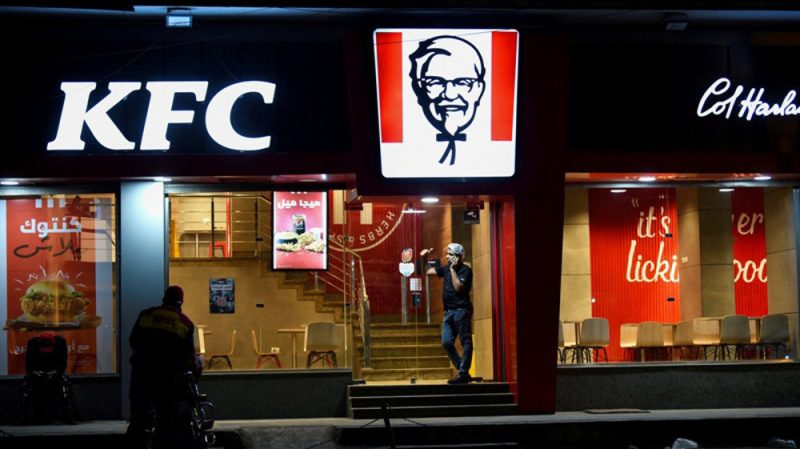
Workers at an empty Kentucky Fried Chicken (KFC) restaurant, November 20, 2023. (Photo by Reuters)
Press TV – November 23, 2023
A boycott campaign against Israeli products over the occupying regime’s war on the Gaza Strip has severely affected Western fast-food giants in several Arab countries, with the move having the potential to spread to other countries across the globe.
Weeks after Israel waged a brutal war on the besieged Gaza Strip, a boycott campaign against Israeli goods started to gain momentum in Egypt, Jordan and Turkey, significantly hitting Western fast-food giants like McDonald’s, Starbucks, and KFC.
The impacted companies are either perceived to have taken pro-Israeli stances in the war or are alleged to have financial ties to Israel or investments there.
According to the Gaza-based health ministry, at least 14,532 Palestinians, including 6,000 children and 3,920 women, have been killed and more than 35,000 others injured by Israeli strikes since October 7, when the Israeli regime launched a full-scale war on the densely-populated enclave.
“I feel that even if I know this will not have a massive impact on the war, then this is the least we can do as citizens of different nations so we don’t feel like our hands are covered in blood,” said 31-year-old Cairo resident Reham Hamed, who is boycotting US fast food chains and some cleaning products.
As the global pressure is mounting on Tel Aviv over its atrocities in the Palestinian sliver, there are signs that the boycott campaign is also spreading in some other Arab countries, including Kuwait and Morocco.
The boycott calls of the protest campaign have already circulated on social media and expanded to include dozens of companies and products, urging shoppers to shift to local alternatives.
In Jordan, citizens who support the protest campaign sometimes enter McDonald’s and Starbucks branches in the country to encourage a few customers to take their business elsewhere.
“No one is buying these products,” said Ahmad Al-Zaro, a cashier at a large supermarket in the capital Amman where customers were choosing local brands instead.
The current boycott campaign could be considered the latest part of the pro-Palestine Boycott, Divestment and Sanctions (BDS) movement against the Israeli regime.
The BDS movement, which is modeled after the anti-apartheid movement in South Africa, was initiated in 2005 by over 170 Palestinian organizations that were pushing for “various forms of boycott against Israel until it meets its obligations under international law.”
Thousands of volunteers worldwide have since joined the BDS movement, which calls for people and groups across the world to cut economic, cultural, and academic ties to Tel Aviv to help promote the Palestinian cause.
The movement has been so successful in causing economic damage to the Tel Aviv regime that pro-Israel groups have labeled it “an existential threat.”
Gaza ‘truce’ won’t halt the regional war
The regional war is here. The Axis of Resistance assesses that the US and Israel intend to prolong the Gaza war indefinitely, and determines that a regional escalation is now unavoidable.
By Hasan Illaik | The Cradle | November 21, 2023
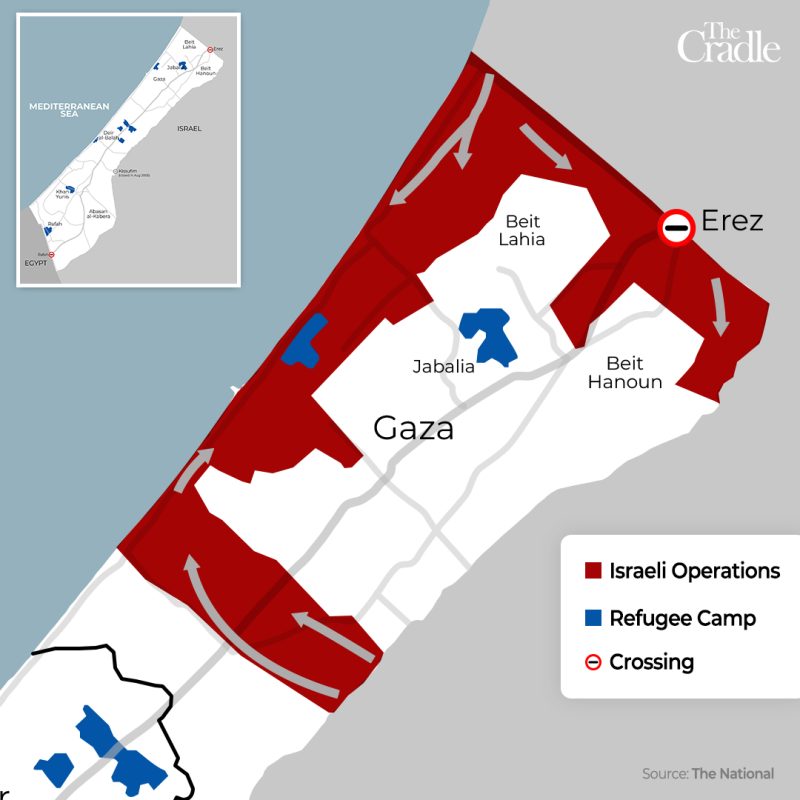
The Israeli military has announced the expansion of its ground operations in the northern Gaza Strip. After seizing territories on Gaza’s coastline, in the western part of the northern strip, Tel Aviv’s actual ground operation is now beginning.
For more than three weeks of its ground offensive, the occupation army has been operating in areas close to the shoreline, in places where tunnels cannot be dug, and, therefore, areas where the Palestinian resistance does not have significant defensive capabilities.
But now, the occupation army is moving eastward from the Gaza coast, allowing the armed resistance to maneuver far more easily and inflict greater losses on the invading soldiers and their armored vehicles – as has become quite evident in recent days.
In short, the ground battle in northern Gaza has only just begun, and is gearing up to get even hotter in the weeks ahead.
The region escalates
In support of the resistance in Gaza, the Yemeni army and Ansarallah fighters seized an Israeli-owned vessel in the Red Sea on 19 November after threatening to target all Israeli ships crossing the Bab al-Mandab Strait.
Over the past week, on Lebanon’s border with Israel, the Lebanese resistance Hezbollah has increased the frequency of its military operations. On 20 November, the occupation army monitored more than 40 attackzjs on its positions, one of which was carried out with four rockets, each with an explosive warhead weighing around 500 kilograms. The salvo destroyed the Israeli ‘Branit’ military barracks near the border with Lebanon. In just the past three days, Hezbollah has carried out an average of 12 military operations against Israeli targets each day.
Simultaneously, Iraqi resistance attacks are continuing against US military bases in Iraq and Syria – over sixty operations to date.
The increased pace of clashes across West Asia is, however, being widely ignored by many of Tel Aviv’s western allies, whose attention has been diverted by ongoing prisoner exchange talks between Israel and the Palestinian resistance, mediated by Qatar and the US. These weeks-long negotiations are being treated as evidence that the next phase will necessarily be a de-escalation in Palestine.
Those expectations have been fanned by a leak that Israel’s cabinet has discussed the imminent demobilization of a number of army reservists. While the Israeli military may indeed demobilize part of the reserve forces it called up after 7 October, this decision is not based on de-escalatory considerations. The more than 300,000 Israeli reservists initially mobilized was far too great for the capacity of the occupation army, which was unable to absorb these personnel into its fronts in Gaza, Lebanon, and the West Bank.
Despite this, many still optimistically cling to the de-escalation narrative. They are further encouraged by official US statements criticizing – albeit in a watered-down manner – Israel’s targeting of Palestinian civilians, and point to the occasional US-Israel divergences over what they call the “post-Hamas phase” in Gaza as further proof that Tel Aviv will have to scale down its war.
But at the current stage of the conflict, these discrepancies and observations are considered totally irrelevant by officials in the region’s Axis of Resistance. They note instead that Washington continues to maintain its pace of arms support for Israel, as it has done since the war’s onset, while sticking to its refusal to entertain any permanent ceasefire.
In addition, the US has reduced neither its level of involvement in the management of military operations in the Gaza Strip, nor its reinforcement of missile defense systems to counter any Yemeni or Iraqi rocket attacks on Israeli positions.
Axis officials believe that conciliatory-sounding US statements, which sometimes suggest that a de-escalation phase is imminent, are nothing but an American “public relations party” to repair a public image heavily damaged by unstinting US support for Israel’s continuing massacre of Palestinians in Gaza.
In slightly shifting its tone, Washington also seeks to mislead the Resistance Axis, hoping that this can forestall an increase in regional tensions and clashes.
From ‘truce’ to regional war
The current prisoner exchange negotiations between Israel and the Palestinian resistance include a five-day “humanitarian” truce. This is not a ceasefire by any means nor an opportunity to draw out a further lull in violence. Those familiar with the reality on the ground in the Gaza Strip confirm that any truce will merely be an opportunity for both sides to reorganize their ranks in preparation for intensified battles in the coming weeks.
They based their observations on the fact that Israel continues to adhere to its initial military goals, modified from the plan to occupy the entire Gaza Strip. Tel Aviv’s objectives today are, first, to occupy the entire north of Gaza; second, to displace all of its inhabitants, more than 800,000 of whom are still living under siege and bombardment.
And third, to continue the besiegement of southern Gaza – exerting military pressure through intensive airstrikes and special operations to force Hamas and other Palestinian resistance factions to surrender.
This plan is fully supported by the US and its western allies, as well as by Arab states that have normalized relations with Israel, notably those farthest from Palestine’s borders.
In light of these realities, the Axis of Resistance is pursuing its own West Asian escalation to pressure its adversaries to deescalate. That bar jumped considerably this week when Yemen’s Ansarallah captured an Israeli-linked ship in regional waterways.
This is a disaster for Tel Aviv, which depends primarily on maritime transportation for its imports and exports. If this becomes a pattern, Israeli-linked ships will be uninsurable, and hiring crews will become impossible. It is also a nightmare scenario for Washington, which wants the Gaza war to continue while its regional position enjoys complete calm.
Indeed, the US is desperate to maintain a regional peace, most of all in Iraq. While the multi-factional Iraqi resistance target US occupation bases inside their country and in Syria, both, the current American response has been tame. US military forces have limited their retaliatory strikes to Syrian territory – and only after informing their Russian counterparts in advance.
Washington has so far avoided striking back in Iraqi territory to avoid drawing a target on its considerable Iraqi interests – commercial, military, political – and also fears triggering the Iraqi resistance to expand operations against US bases in other West Asian states.
No ceasefire ahead
The Resistance Axis’ current assessment of the Gaza war is that both the US and Israel seek a protracted conflict – possibly even an endless war that transforms the Gaza Strip into a permanent battlefield to ensure that Israel no longer faces Palestinian deterrence capabilities.
On the other hand, the Axis continues to pursue all avenues to advance and accelerate a ceasefire in Gaza, including military options. The current “truce” announcement didn’t emerge in a vacuum – it follows painful blows against occupation forces in the Gaza Strip, a sharp escalation of clashes in the occupied West Bank, and a gradual increase in the pace and severity of attacks in the region.
The prisoner exchange truce may be announced at any moment. It will not, however, end the war. The truce is merely a break for the belligerents to prepare for more violent battles ahead, and these will not be limited to Gaza and the Lebanese-Palestinian border.
As 2023 comes to a close, all of West Asia is destined for more tension, battle, and multiple surprises. This scenario can only be eased by the announcement of a Gaza ceasefire and the provision of supplies and staples to its wounded population. It is only Washington that stands in the way, firmly opposing and blocking a ceasefire at every opportunity.
Featured Video

Bombing Hitler’s Hometown
or go to
Aletho News Archives – Video-Images
From the Archives
‘Conspiracy Theory’ Now Fact: Greater Israel Has Arrived
By Kit Klarenberg | Mint Press News | January 28, 2025
Ever since Tel Aviv’s 1948 creation, much has been said and written about ‘Greater Israel’ – the notion Zionism’s ultimate end goal is the forcible annexation and ethnic cleansing of vast swaths of Arab and Muslim lands for Jewish settlement, based on Biblical claims this territory was promised to Jews by God. The mainstream media typically dismisses this concept as antisemitic conspiracy theory, or at most the fringe fantasy of a minuscule handful of extremist Israelis.
In reality … continue
Blog Roll
 Aletho News
- IRGC: Israeli, US universities in region legitimate targets after strikes on Iranian university
- Trump admits Iran hit USS Ford carrier: ‘We ran for our lives’
- Battle for Hungary: EU attacks on Orban are a sign of worse things to come
- Iraqi resistance conducts drone strike on US-run base in Syria
- Failing to Defeat Hezbollah, Israel & US Pressure Syria’s Ahmed al-Sharaa to Join War
- US-Israeli war on Iran drives global fertilizer prices up 40%
- Hezbollah’s Surprise Weapons Redefine Ground Battle with Israel
- Yemen joins fight against US, Israel by firing missiles at occupied territories
- Seizing the Kharg: Washington’s path to defeat in the Persian Gulf
- Iran reports 500 US casualties in strikes on covert US military sites
- If Americans Knew
- Over 300 US service members wounded, majority have brain injuries – Not a ceasefire Day 169
- Researchers at Human Rights Watch Resign Over Blocked Report on Palestinian Refugee Return
- Jewish Groups Are Backing a War Americans Don’t Want
- Eric Fingerhut Thinks He’s the President of the Jews
- Top Jewish Philanthropists, Rabbis Urge Israeli President to Take Action Against ‘Jewish Extremists’
- Don’t Be Fooled. Zionist Leaders Have Always Wanted to Control Southern Lebanon
- Israel’s widespread use of torture is a core element of its genocide against the Palestinian people
- In Israel’s War on Iran, Many Middle East US Bases Rendered “All But Uninhabitable”
- ‘Burn the lawn’: Israel pursues ‘Rafah model’ in southern Lebanon
- A genocide here, an amputation there
- No Tricks Zone
- Devastating Assessment Of Comirnaty Vaccine By Former Senior Pfizer Europe Toxicologist
- New Study: CO2 Is ‘Effectively Negligible’ As An Explanatory Climate Change Factor Since 2000
- Former Pfizer Toxicologist Dr. Helmut Sterz Tells Bundestag Hearing Pfizer Vaccine Should Have Never Been Approved
- Energy Expert: Germany’s Nuclear Phaseout Was A “500 Billion Euro Mistake”
- New Research: South Australia’s Mid-Holocene Sea Surface Temperatures Were 4°C Warmer Than Today
- Storing Green Energy To Last Germany 10 Days Would Require A 60-Million Tonne Battery
- New Studies: UK Sea Levels Were 4 Meters Higher Than Today During The Mid-Holocene
- Destructive Green New Deal: German Energy And Metal Group Warns Of Drastic Crisis
- New Study Documents A 20-Year Pause In Arctic Sea Ice Decline – Driven By Internal Variability
- Wake-up Call: Survey Shows Majority Of Germans Now Favor Postponing Climate Targets!
 Aletho News