IRGC’s veteran military advisor in Syria martyred in Israeli strike
Press TV – December 25, 2023
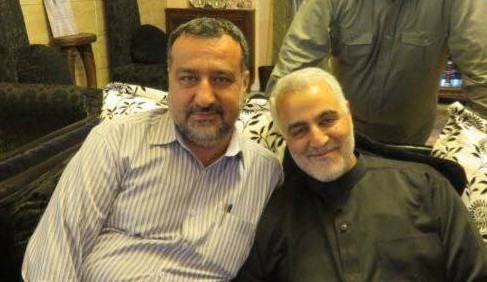
A veteran member of Iran’s Islamic Revolution Guards Corps (IRGC), who was serving as a military advisor in Syria, has been martyred in an Israeli airstrike in the Sayyeda Zeinab neighborhood of Damascus.
The senior IRGC commander, Seyyed Razi Mousavi, was martyred by the Israeli regime on Monday while on an advisory mission, Press TV’s correspondent in Damascus reported.
Mousavi was one of the companions of Iran’s top anti-terror commander, Lieutenant General Qassem Soleimani, who was assassinated by the US in Iraq four years ago.
General Soleimani, commander of the Quds Force of the IRGC, and his Iraqi trenchmate Abu Mahdi al-Muhandis, the second-in-command of Iraq’s Popular Mobilization Units (PMU), were martyred along with their companions in a US drone strike on January 3, 2020.
The Israeli regime has for years targeted what it calls Iran-linked positions in Syria.
In a statement, the IRGC said Mousavi was martyred in a criminal missile attack by the “fake and child-killing Zionist regime” adding that the usurping and savage Israeli regime would undoubtedly pay the price for this crime.
US ‘Builds Trap for Itself’ in Red Sea
By Scott Ritter – Sputnik – 22.12.2023
On December 18, following a tour of the Middle East with stops in Kuwait, Bahrain, Qatar and Israel, US Defense Secretary Lloyd Austin announced the establishment of Operation Prosperity Guardian, under the umbrella of Combined Task Force (CTF) 153, which focuses on security in the Red Sea, to protect maritime shipping.
Back on November 19, Yemen’s Houthi rebels, operating in solidarity with the Palestinians of Gaza, took over an Israeli-linked cargo ship, the Galaxy Leader. The Houthis announced that they would block all shipping transiting the Red Sea toward Israel—in effect establishing a blockade of Israel—until Israel allowed humanitarian aid into Gaza.
The Houthis have subsequently attacked numerous vessels passing through the Bab al-Mandeb Strait, a narrow passageway leading into the Red Sea and further on to the Suez Canal, threatening global trade as major oil and shipping giants, including BP, MSC, Evergreen, OOCL, and Maersk, suspended operations through the Red Sea. The damage to the Israeli economy done by the Houthi blockage is estimated to run into the billions of dollars, and Israel’s Prime Minister Benjamin Netanyahu has threatened to use military force against the Houthis if the United States does not intervene on its behalf.
CTF 153, which has operated under both US and Egyptian command, is tasked with international maritime security and capacity-building efforts in the Red Sea, Bab al-Mandeb, and Gulf of Aden. Its compliment of four ships—three US destroyers (the USS Carney, USS Mason, and USS Thomas Hudner) and the UK Royal Navy guided-missile destroyer HMS Diamond) have all been involved in intercepting Houthi missiles and drones fired against either Israel or merchant shipping operating in the Red Sea.
Austin also ordered Carrier Strike Group 2, consisting of aircraft carrier the USS Dwight D. Eisenhower and three escorts (a cruiser and two destroyers), to join up with CTF 153 as part of Operation Prosperity Guardian. Ohio-class submarine the USS Florida, equipped with 154 Tomahawk cruise missiles, is also operating in the region.
Austin announced that the US and UK would be joined by Bahrain, Canada, France, Italy, the Netherlands, Norway, Seychelles, and Spain as part of Operation Prosperity Guardian. Notable absentees include Arab nations like Egypt and Saudi Arabia. Australia was asked to provide a warship, but offered [13] personnel only.
French Navy guided-missile frigate the FS Languedoc is already operating in the Red Sea and, like its US and UK counterparts, has been involved in the shooting down of Houthi drones and missiles. However, France has stated that the Languedoc will operate under French command, complicating its relationship with CTF 153.
Italy’s Defense Ministry has announced that it will deploy naval frigate the Virginio Fasanto the Red Sea. Its command relationship with CTF 153 remains unclear as of the present time.
The military problem facing CTF 153 is threefold. First, there is a need to establish a barrier defense against the Houthi missile and drone attacks. This will require that the guided missile destroyers and frigates establish a picket line along the eastern channel of the Bab al-Mandeb Straight which will screen shipping from any Houthi attack. Second, CTF 153 will need to engage in aggressive patrolling designed to deter and repel any Houthi efforts to repeat their hijacking of the Galaxy Leader. Lastly, CTF 153 will need to provide mine clearance capabilities to deal with any sea mines that the Houthis may place in the narrow waters of the Bab al-Mandeb.
These missions alone will be taxing, and difficult to accomplish. As things stand, while the CTF 153 ships have shot down dozens of Houthi drones and missiles, scores have gotten through, striking targets in Israel and hitting shipping in the Red Sea. Simply put, CTF 153 doesn’t have enough ships to adequately screen either Israel or maritime shipping from Houthi attack. And given the lack of mine warfare ships in the CTF 153 organization, any deployment of sea mines by the Houthis will effectively close the region from commercial shipping, and threaten military deployments in the area, until demining capability can be deployed.
The only way that Operation Prosperity Guardian could possibly keep the Bab al-Mandeb Straight open is to launch strikes against the Houthi capability of launching missiles and drones in hopes of interdicting them before they can be used. Here the plot thickens—the Houthis have made it clear that if attacked, they will expand the conflict to include Saudi and UAE oil production, threatening global energy supplies. Moreover, targeting mobile missile and drone launchers is no simple task—Saudi Arabia, using US intelligence support to assist in targeting, was unable to prevent the Houthis from launching missiles and drones against Saudi targets during the entirety of its ongoing conflict with the Houthis. The US would likely run into similar problems.
In short, by initiating Operation Prosperity Guardian, the US appears to have built a trap for itself, where it is damned if it doesn’t attack the Houthi (since the Red Sea would remain blocked to all Israeli traffic), and damned if it does (since it wouldn’t be able to stop the Houthi attacks, and such action would likely expand the scope and scale of the conflict to the detriment of US interests.)
Keep in mind that all of this could have been solved with a single phone call from US President Joe Biden to Israeli Prime Minister Benjamin Netanyahu directing Israel to accept a ceasefire and allow humanitarian aid to be sent to the Palestinian residents of Gaza. Instead, the United States is destroying its moral standing in the world by openly facilitating the ongoing slaughter of Palestinian civilians at the hands of the Israel Defense Forces, while simultaneously undermining the credibility of US military deterrence by getting itself mired in a tar baby of its own making.
The deployment of the USS Dwight D. Eisenhower into the Sea of Aden comes on the heels of its brief foray into the Persian Gulf, where it was closely monitored by Iran. The US has also deployed a second carrier battlegroup, consisting of the USS Gerald R. Ford and its six escorts, in the eastern Mediterranean Sea. Meanwhile, the USS Carl Vinson and its five escorts operate just over the horizon, in the South China Sea.
Never in the history of the American Navy have so many carrier battlegroups been moved around the globe with so little impact.
The reality of modern warfare is that small nations and non-state actors such as the Houthis can be armed with modern military weaponry which negates the military impact of multibillion-dollar investments such as the carrier battlegroup. It costs the Houthis tens of thousands of dollars to fire its drones and missiles against Israel and maritime shipping; it costs the US Navy millions of dollars to shoot them down. Moreover, it costs the US navy hundreds of millions of dollars just to keep a carrier battle group deployed and operating, while the Houthis can credibly threaten to sink a carrier using weapons that cost hundreds of thousands of dollars.
The final score card regarding Operation Prosperity Guardian has yet to be written. But the reality is that it will most likely not succeed in its mission of preventing Houthi attacks against either Israel or maritime shipping. This failure goes far beyond the issue of security for the Red Sea. The United States has long maintained that it could guarantee that if Iran ever sought to close the strategic Straight of Hormuz, the US Navy would be able to reopen it in a very short period. Operation Prosperity Guardian puts a lie to that claim. The fact is, the world balance of power has changed dramatically, and legacy systems like the carrier battlegroup are no longer the dominant means of power projection they once were. The US has, in effect, put all its eggs in one basket through its over-reliance upon the carrier battlegroup when it comes to force projection.
The looming failure of Operation Prosperity Guardian exposes the impotence of the US when it comes to being able to accomplish its plans for regional dominance in the Persian Gulf, South Pacific, and Taiwan, and signals a new era where the appearance of an American fleet of the shores of a far way land no longer inspires fear and intimidation. For a nation like the United States, which has premised so much of its foreign and national security on the notion of strength-based deterrence, the revelation that its military power projection capabilities are more bark than bite undermines its credibility as an ally and partner in a world largely defined by conflicts created by, or on behalf of, the United States.
Bahrain jails dissident for blasting Manama’s role in US-led anti-Yemen coalition
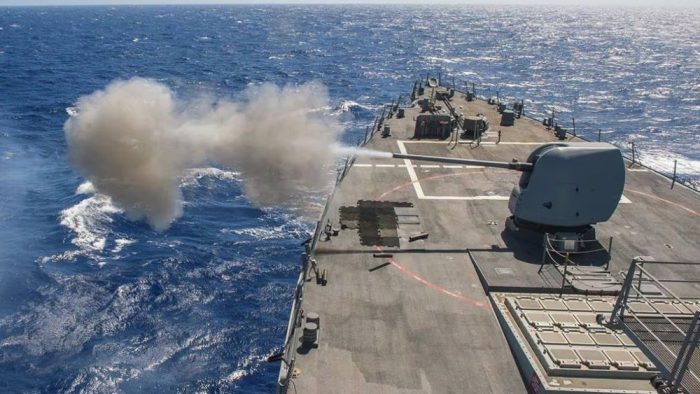
The Arleigh Burke-class guided-missile destroyer USS Cole (DDG 67)
Press TV | December 21, 2023
Bahraini authorities have ordered the seven-day detention of a leading opposition figure after he denounced the Al Khalifah regime’s participation in the US-led coalition against Yemen in the Red Sea.
Bahrain’s office of public prosecution ordered Ebrahim Sharif’s detention pending investigation for “spreading false news during wartime,” his family and lawyer said on Thursday.
Sharif, who heads the Wa’ad organization, in a series of posts criticized authorities in Manama for joining the coalition “without any consideration of the position of the Bahraini people who strongly support our besieged Palestinian people in Gaza.”
He was arrested on Wednesday. When asked about his case, the Bahraini government said “an individual” was being held for “allegedly supporting a proscribed terrorist organization.”
The charge against Sharif, a pro-democracy campaigner, can hold a prison sentence of up to 10 years.
Bahrain is the only state in the Persian Gulf region that has joined the US-led coalition established this week in response to Yemeni attacks on ships bound to the occupied Palestinian territories in the Red Sea.
Sayed Ahmed Alwadaei, advocacy director at the UK-based Bahrain Institute for Rights and Democracy (BIRD), said the Bahraini regime “wants to make an example of Sharif who is not alone in his criticism of Bahrain’s decision to the join the Americans.”
“Failure of the US administration to publicly denounce his arrest and push for his immediate release gives the green light to the Bahrain government to continue his detention,” Alwadaei said.
The Pentagon has announced a military coalition of 10 countries, including Britain and Spain, to counter the Yemeni forces that targeted ships bound for Israel in solidarity with the people of Gaza.
A series of strikes attributed to the Yemeni forces have been conducted in solidarity with the Palestinians in the besieged Gaza Strip. Yemen has already warned it will prevent the passage of all ships in the Red Sea bound to the occupied territories.
The leader of Yemen’s Ansarullah movement said in a televised speech broadcast live Wednesday that the armed forces will not hesitate to target US military warships in the Red Sea if Washington and its allies carry out military strikes against Yemen.
Bahrain’s main opposition group al-Wefaq National Islamic Society recently denounced human rights violations in the country.
Al-Wefaq has denounced Manama’s normalization of relations with Israel as “a crime.”
The opposition party has underlined that the normalization is in flagrant contradiction to Bahrain’s history and Islamic identity.
Bahrain and the Israeli regime established diplomatic relations in 2020 as part of the United States-brokered Abraham Accords.
Last month, the deputy speaker of Bahrain’s National Assembly said members of the legislative body were pressing to reverse the normalization following the regime’s devastating war in Gaza.
Abdulnabi Salman said Bahraini lawmakers were demanding an end to diplomatic relations with Israel.
The Persian Gulf country has witnessed numerous protests ever since the rapprochement.
The United States and Britain refrain from the criticism of human rights violations across Bahrain.
In July, British legislators were pressing the government to provide clear explanations why Bahrain has been removed from its list of human rights priority countries, accusing the government of putting its principles “up for auction” after sealing a billion-pound investment deal with the Persian Gulf state.
How Twitter Aided the Pentagon’s Covert Online Propaganda Campaign
Documents and emails from Twitter detail the extensive secret assistance the social media platform gave to CENTCOM’s influence operations
BY LEE FANG | DECEMBER 20, 2023
One year ago, I published my first investigation based on documents I obtained through the “Twitter Files.” I visited the San Francisco office of the social media company several times and took many notes. Below, I am republishing my initial investigation, which explores the secret assistance that Twitter gave to the Pentagon to assist with a fake account network used to manipulate Arabic-language communities in the Middle East. Twitter claimed that it shut down all state-backed influence operations, yet gave special tools to the U.S. military for its propaganda network.
TWITTER EXECUTIVES HAVE claimed for years that the company makes concerted efforts to detect and thwart government-backed covert propaganda campaigns on its platform.
Behind the scenes, however, the social networking giant provided direct approval and internal protection to the U.S. military’s network of social media accounts and online personas, whitelisting a batch of accounts at the request of the government. The Pentagon has used this network, which includes U.S. government-generated news portals and memes, in an effort to shape opinion in Yemen, Syria, Iraq, Kuwait, and beyond.
The accounts in question started out openly affiliated with the U.S. government. But then the Pentagon appeared to shift tactics and began concealing its affiliation with some of these accounts — a move toward the type of intentional platform manipulation that Twitter has publicly opposed. Though Twitter executives maintained awareness of the accounts, they did not shut them down, but let them remain active for years. Some remain active.
The revelations are buried in the archives of Twitter’s emails and internal tools, to which The Intercept was granted access for a brief period last week alongside a handful of other writers and reporters. Following Elon Musk’s purchase of Twitter, the billionaire started giving access to company documents, saying in a Twitter Space that “the general idea is to surface anything bad Twitter has done in the past.” The files, which included records generated under Musk’s ownership, provide unprecedented, if incomplete, insight into decision-making within a major social media company.
Twitter did not provide unfettered access to company information; rather, for three days last week, they allowed me to make requests without restriction that were then fulfilled on my behalf by an attorney, meaning that the search results may not have been exhaustive. I did not agree to any conditions governing the use of the documents, and I made efforts to authenticate and contextualize the documents through further reporting. The redactions in the embedded documents in this story were done to protect privacy, not Twitter.
THE DIRECT ASSISTANCE Twitter provided to the Pentagon goes back at least five years.
On July 26, 2017, Nathaniel Kahler, at the time an official working with U.S. Central Command — also known as CENTCOM, a division of the Defense Department — emailed a Twitter representative with the company’s public policy team, with a request to approve the verification of one account and “whitelist” a list of Arab-language accounts “we use to amplify certain messages.”
“We’ve got some accounts that are not indexing on hashtags — perhaps they were flagged as bots,” wrote Kahler. “A few of these had built a real following and we hope to salvage.” Kahler added that he was happy to provide more paperwork from his office or SOCOM, the acronym for the U.S. Special Operations Command.
Twitter at the time had built out an expanded abuse detection system aimed in part toward flagging malicious activity related to the Islamic State and other terror organizations operating in the Middle East. As an indirect consequence of these efforts, one former Twitter employee explained, accounts controlled by the military that were frequently engaging with extremist groups were being automatically flagged as spam. The former employee, who was involved with the whitelisting of CENTCOM accounts, spoke under condition of anonymity because they were not authorized to speak publicly.
In his email, Kahler sent a spreadsheet with 52 accounts. He asked for priority service for six of the accounts, including @yemencurrent, an account used to broadcast announcements about U.S. drone strikes in Yemen. Around the same time, @yemencurrent, which has since been deleted, had emphasized that U.S. drone strikes were “accurate” and killed terrorists, not civilians, and promoted the U.S. and Saudi-backed assault on Houthi rebels in that country.
Other accounts on the list were focused on promoting U.S.-supported militias in Syria and anti-Iran messages in Iraq. One account discussed legal issues in Kuwait. Though many accounts remained focused on one topic area, others moved from topic to topic. For instance, @dala2el, one of the CENTCOM accounts, shifted from messaging around drone strikes in Yemen in 2017 to Syrian government-focused communications last year.
On the same day that CENTCOM sent its request, members of Twitter’s site integrity team went into an internal company system used for managing the reach of various users and applied a special exemption tag to the accounts, internal logs show.
One engineer, who asked not to be named because he was not authorized to speak to the media, said that he had never seen this type of tag before, but upon close inspection, said that the effect of the “whitelist” tag essentially gave the accounts the privileges of Twitter verification without a visible blue check. Twitter verification would have bestowed a number of advantages, such as invulnerability to algorithmic bots that flag accounts for spam or abuse, as well as other strikes that lead to decreased visibility or suspension.
KAHLER TOLD TWITTER that the accounts would all be “USG-attributed, Arabic-language accounts tweeting on relevant security issues.” That promise fell short, as many of the accounts subsequently deleted disclosures of affiliation with the U.S. government.
The Internet Archive does not preserve the full history of every account, but we identified several accounts that initially listed themselves as U.S. government accounts in their bios, but, after being whitelisted, shed any disclosure that they were affiliated with the military and posed as ordinary users.
This appears to align with a major report published in August by online security researchers affiliated with the Stanford Internet Observatory, which reported on thousands of accounts that they suspected to be part of a state-backed information operation, many of which used photorealistic human faces generated by artificial intelligence, a practice also known as “deep fakes.”
The researchers connected these accounts with a vast online ecosystem that included “fake news” websites, meme accounts on Telegram and Facebook, and online personalities that echoed Pentagon messages often without disclosure of affiliation with the U.S. military. Some of the accounts accuse Iran of “threatening Iraq’s water security and flooding the country with crystal meth,” while others promoted allegations that Iran was harvesting the organs of Afghan refugees.
The Stanford report did not definitively tie the sham accounts to CENTCOM or provide a complete list of Twitter accounts. But the emails I obtained show that the creation of at least one of these accounts was directly affiliated with the Pentagon.
One of the accounts that Kahler asked to have whitelisted, @mktashif, was identified by the researchers as appearing to use a deep-fake photo to obscure its real identity. Initially, according to the Wayback Machine, @mktashif did disclose that it was a U.S. government account affiliated with CENTCOM, but at some point, this disclosure was deleted and the account’s photo was changed to the one Stanford identified as a deep fake. The new Twitter bio claimed that the account was an unbiased source of opinion and information, and, roughly translated from Arabic, “dedicated to serving Iraqis and Arabs.” The account, before it was suspended last year, routinely tweeted messages denouncing Iran and other U.S. adversaries, including Houthi rebels in Yemen.
Another CENTCOM account, @althughur, which posts anti-Iran and anti-ISIS content focused on an Iraqi audience, changed its Twitter bio from a CENTCOM affiliation to an Arabic phrase that simply reads “Euphrates pulse.”
The former Twitter employee told me that they were surprised to learn of the Defense Department’s shifting tactics. “It sounds like DOD was doing something shady and definitely not in line with what they had presented to us at the time,” they said.
Twitter did not respond to a request for comment.
“It’s deeply concerning if the Pentagon is working to shape public opinion about our military’s role abroad and even worse if private companies are helping to conceal it,” said Erik Sperling, the executive director of Just Foreign Policy, a nonprofit that works toward diplomatic solutions to foreign conflicts.
“Congress and social media companies should investigate and take action to ensure that, at the very least, our citizens are fully informed when their tax money is being spent on putting a positive spin on our endless wars,” Sperling added.
FOR MANY YEARS, Twitter has pledged to shut down all state-backed disinformation and propaganda efforts, never making an explicit exception for the U.S. In 2020, Twitter spokesperson Nick Pickles, in a testimony before the House Intelligence Committee, said that the company was taking aggressive efforts to shut down “coordinated platform manipulation efforts” attributed to government agencies.
“Combatting attempts to interfere in conversations on Twitter remains a top priority for the company, and we continue to invest heavily in our detection, disruption, and transparency efforts related to state-backed information operations. Our goal is to remove bad-faith actors and to advance public understanding of these critical topics,” said Pickles.
In 2018, for instance, Twitter announced the mass suspension of accounts tied to Russian government-linked propaganda efforts. Two years later, the company boasted of shutting down almost 1,000 accounts for association with the Thai military. But rules on platform manipulation, it appears, have not been applied to American military efforts.
The emails obtained by The Intercept show that not only did Twitter whitelist these accounts in 2017 explicitly at the behest of the military, but also that high-level officials at the company discussed the accounts as potentially problematic in the following years.
In the summer of 2020, officials from Facebook reportedly identified fake accounts attributed to CENTCOM’s influence operation on its platform and warned the Pentagon that if Silicon Valley could easily out these accounts as inauthentic, so could foreign adversaries, according to a September report in the Washington Post.
Twitter emails show that during that time in 2020, Facebook and Twitter executives were invited by the Pentagon’s top attorneys to attend classified briefings in a sensitive compartmented information facility, also known as a SCIF, used for highly sensitive meetings.
“Facebook have had a series of 1:1 conversations between their senior legal leadership and DOD’s [general counsel] re: inauthentic activity,” wrote Yoel Roth, then the head of trust and safety at Twitter. “Per FB,” continued Roth, “DOD have indicated a strong desire to work with us to remove the activity — but are now refusing to discuss additional details or steps outside of a classified conversation.”
Stacia Cardille, then an attorney with Twitter, noted in an email to her colleagues that the Pentagon may want to retroactively classify its social media activities “to obfuscate their activity in this space, and that this may represent an overclassification to avoid embarrassment.”
Jim Baker, then the deputy general counsel of Twitter, in the same thread, wrote that the Pentagon appeared to have used “poor tradecraft” in setting up various Twitter accounts, sought to potentially cover its tracks, and was likely seeking a strategy for avoiding public knowledge that the accounts are “linked to each other or to DoD or the USG.” Baker speculated that in the meeting the “DoD might want to give us a timetable for shutting them down in a more prolonged way that will not compromise any ongoing operations or reveal their connections to DoD.”
What was discussed at the classified meetings — which ultimately did take place, according to the Post — was not included in the Twitter emails provided to The Intercept, but many of the fake accounts remained active for at least another year. Some of the accounts on the CENTCOM list remain active even now — like this one, which includes affiliation with CENTCOM, and this one, which does not — while many were swept off the platform in a mass suspension on May 16.
In a separate email sent in May 2020, Lisa Roman, then a vice president of the company in charge of global public policy, emailed William S. Castle, a Pentagon attorney, along with Roth, with an additional list of Defense Department Twitter accounts. “The first tab lists those accounts previously provided to us and the second, associated accounts that Twitter has discovered,” wrote Roman. It’s not clear from this single email what Roman is requesting – she references a phone call preceding the email — but she notes that the second tab of accounts — the ones that had not been explicitly provided to Twitter by the Pentagon — “may violate our Rules.” The attachment included a batch of accounts tweeting in Russian and Arabic about human rights violations committed by ISIS. Many accounts in both tabs were not openly identified as affiliated with the U.S. government.
Twitter executives remained aware of the Defense Department’s special status. This past January, a Twitter executive recirculated the CENTCOM list of Twitter accounts originally whitelisted in 2017. The email simply read “FYI” and was directed to several Twitter officials, including Patrick Conlon, a former Defense Department intelligence analyst then working on the site integrity unit as Twitter’s global threat intelligence lead. Internal records also showed that the accounts that remained from Kahler’s original list are still whitelisted.
Following the mass suspension of many of the accounts this past May, Twitter’s team worked to limit blowback from its involvement in the campaign.
Shortly before publication of the Washington Post story in September, Katie Rosborough, then a communications specialist at Twitter, wrote to alert Twitter lawyers and lobbyists about the upcoming piece. “It’s a story that’s mostly focused on DoD and Facebook; however, there will be a couple lines that reference us alongside Facebook in that we reached out to them [DoD] for a meeting. We don’t think they’ll tie it to anything Mudge-related or name any Twitter employees. We declined to comment,” she wrote. (Mudge is a reference to Peiter Zatko, a Twitter whistleblower who filed a complaint with federal authorities in July, alleging lax security measures and penetration of the company by foreign agents.)
After the Washington Post’s story published, the Twitter team congratulated one another because the story minimized Twitter’s role in the CENTCOM psyop campaign. Instead, the story largely revolved around the Pentagon’s decision to begin a review of its clandestine psychological operations on social media.
“Thanks for doing all that you could to manage this one,” wrote Rebecca Hahn, another former Twitter communications official. “It didn’t seem to get too much traction beyond verge, cnn and wapo editors promoting.”
CENTCOM did not initially provide comment to The Intercept. Following publication of this story, CENTCOM’s media desk referred The Intercept to Brigadier Gen. Pat Ryder’s comments in a September briefing, in which he said that the Pentagon had requested “a review of Department of Defense military information support activities, which is simply meant to be an opportunity for us to assess the current work that’s being done in this arena, and really shouldn’t be interpreted as anything beyond that.”
THE U.S. MILITARY and intelligence community have long pursued a strategy of fabricated online personas and third parties to amplify certain narratives in foreign countries, the idea being that an authentic-looking Persian-language news portal or a local Afghan woman would have greater organic influence than an official Pentagon press release.
Military online propaganda efforts have largely been governed by a 2006 memorandum. The memo notes that the Defense Department’s internet activities should “openly acknowledge U.S. involvement” except in cases when a “Combatant Commander believes that it will not be possible due to operational considerations.” This method of nondisclosure, the memo states, is only authorized for operations in the “Global War on Terrorism, or when specified in other Secretary of Defense execute orders.”
In 2019, lawmakers passed a measure known as Section 1631, a reference to a provision of the National Defense Authorization Act, further legally affirming clandestine psychological operations by the military in a bid to counter online disinformation campaigns by Russia, China, and other foreign adversaries.
In 2008, the U.S. Special Operations Command opened a request for a service to provide “web-based influence products and tools in support of strategic and long-term U.S. Government goals and objectives.” The contract referred to the Trans-Regional Web Initiative, an effort to create online news sites designed to win hearts and minds in the battle to counter Russian influence in Central Asia and global Islamic terrorism. The contract was initially carried out by General Dynamics Information Technology, a subsidiary of the defense contractor General Dynamics, in connection with CENTCOM communication offices in the Washington, D.C., area and in Tampa, Florida.
A program known as “WebOps,” run by a defense contractor known as Colsa Corp., was used to create fictitious online identities designed to counter online recruitment efforts by ISIS and other terrorist networks.
I spoke to a former employee of a contractor — on the condition of anonymity for legal protection — engaged in these online propaganda networks for the Trans-Regional Web Initiative. He described a loose newsroom-style operation, employing former journalists, operating out of a generic suburban office building.
“Generally what happens, at the time when I was there, CENTCOM will develop a list of messaging points that they want us to focus on,” said the contractor. “Basically, they would, we want you to focus on say, counterterrorism and a general framework that we want to talk about.”
From there, he said, supervisors would help craft content that was distributed through a network of CENTCOM-controlled websites and social media accounts. As the contractors created content to support narratives from military command, they were instructed to tag each content item with a specific military objective. Generally, the contractor said, the news items he created were technically factual but always crafted in a way that closely reflected the Pentagon’s goals.
“We had some pressure from CENTCOM to push stories,” he added, while noting that he worked at the sites years ago, before the transition to more covert operations. At the time, “we weren’t doing any of that black-hat stuff.”
US pressures Saudi Arabia to postpone imminent peace deal with Yemen
The Cradle | December 18, 2023
The US is exerting pressure on Saudi Arabia to delay the signing of a peace agreement with Yemen and instead join an expanded maritime protection task force to confront Yemeni attacks against Israeli-linked ships in the Red Sea.
According to a report by Lebanese daily Al-Akhbar, a draft peace deal between Sanaa and Riyadh has been finalized. It could be signed before the end of the year, potentially ending a NATO-backed war that has decimated the Arab world’s poorest country for eight years.
“Saudi Arabia is going through a difficult test between two options […] Either it will emerge from the Yemeni quagmire under a roadmap agreed upon with Sanaa, or it will submit to US dictates and join the international maritime coalition, and this means remaining vulnerable to [western] blackmail,” the Al-Akhbar report details.
Despite the pressure from Washington, the kingdom is reportedly “continuing on the path to peace” and is working to “speed up” the completion of the peace agreements to avoid “further obstruction by the Emiratis or local agents.”
Saudi and Yemeni negotiators have given their final comments on the agreement. The revised version was recently delivered to UN special envoy for Yemen, Hans Grundberg, who has started coordinating an official peace ceremony.
According to Al-Akhbar’s sources in Riyadh and Sanaa, the peace deal includes the complete lifting of a land, sea, and air blockade imposed on Yemen by the Saudi-led coalition, a “consensual mechanism” to pay the salaries of public employees, and the free export of oil from Saudi-controlled regions.
“The ball is in Riyadh’s court, which is under US pressure to delay the signing and enter into a war alliance against Yemen in the Red Sea,” Al-Akhbar highlights, adding that UAE-backed forces are also looking to derail the peace process.
A peace agreement between Saudi Arabia and Yemen would significantly hamper US efforts to deploy an international naval task force to the Red Sea to protect Israel’s maritime trade.
“The force, provisionally entitled Operation Prosperity Guardian, is due to be announced by the defense secretary, Lloyd Austin, when he visits [West Asia],” UK daily The Guardian reported on 17 December.
The US war chief is set to visit Israel later this week to meet with senior officials. According to the British outlet, western officials believe Washington has secured the involvement of Jordan, the UAE, Qatar, Oman, Egypt, and Bahrain.
For the past several weeks, the Yemeni armed forces have been launching attacks on Israeli-linked commercial vessels attempting to cross the Bab al-Mandab Strait south of the Suez Canal.
In response, five of the world’s largest shipping companies have announced a complete cessation of activities in the vital sea route. These are Hong Kong-based OOCL, France’s CMA CGM, the Danish Maersk, the German Hapag-Lloyd, and the Italian-Swiss-owned Mediterranean Shipping Co.
The dangers NATO names and makes
By Radhika Desai | CGTN | November 28, 2023
NATO Secretary-General Jens Stoltenberg stated in his pre-ministerial press conference on the eve of the NATO Foreign Ministers’ meeting in Brussels on November 28 and 29, that the almost 75-year-old organization faces “the most dangerous world in decades.”
However, little that the military alliance does seems designed to diminish those dangers. Instead, by holding out the hope of prevailing in these conflicts, most of which it has been instrumental in causing in carefully selected theaters outside itself, it is exacerbating them.
There is, upper-most on the world’s mind, the six-week-old Israel-Hamas conflict. While U.S. officials routinely invoke the danger that it will spiral out of control into a Middle Eastern war and even a World War III, rather than damping it down, the U.S. and NATO seem hell-bent on stoking it further. They back Israel militarily, financially, and diplomatically (with NATO members routinely vetoing or abstaining from numerous UN Resolutions calling for even a pause in the conflict) so one-sidedly that NATO governments face veritable revolts, not only on the streets but in its own ranks and those of the normally loyal national media.
The U.S. and NATO’s hopes of victory against Middle East countries are vain and hubristic. This is already clear from their failure to win the war in Ukraine. With defeat all but announced, the search for scapegoats is already on in Kyiv. If, after 20 months of war, billions in aid and armaments, boomeranging sanctions and unrelenting propaganda the war could not be won, the addition of new wars can hardly bring victory closer.
Finally, Stoltenberg referred to “growing global competition,” a code word for the aggression towards China into which the U.S. is trying to dragoon its NATO allies. It has, in recent years, entailed the revitalization of the Quad of Japan, Australia, India and the U.S., the launching of the AUKUS alliance between Australia, the United Kingdom and the U.S. and the shift from “Asia Pacific” to “Indo-Pacific” to designate the U.S. concerns and commitments beyond its western sphere with India positioned as a key U.S. and Western ally in the region.
It has also entailed unprecedented explicit mention of Asian objectives in NATO communiques since the Madrid Summit in 2022, and the attendance of leaders and ministers of Japan, the Republic of Korea, Australia and New Zealand as regular guests at NATO meetings and summits.
However, this strategy is far from assured. Quite simply, China’s winning, development- and growth-based diplomacy continues to engage all these countries and even NATO members with considerable success. While enervated and financialized Western economies offer only subjection, political and financial, China’s vibrant economy, productive and technological dynamism and benign international [ism] offer/exert an economic gravity that leaves no country untouched.
There are many reasons why NATO is being too hubristic and vain: It is too used to being the top dog, too many of its governments have invested too much into these wars and potential wars and it needs achievements to celebrate next July, not failures. But, as became clear in U.S. President Joe Biden’s speech a few days ago, when he once again delusionally called his country the “indispensable nation,” he wishes to fight the next election as a war president and then some: with wars on two and possibly three fronts.
Given his abysmal ratings, that is the thin thread on which his victory hangs.
Radhika Desai, a special commentator on current affairs for CGTN, is a professor of political studies at the University of Manitoba in Canada.
Iran ready to further strengthen all-out ties with Kuwait: Foreign minister
Press TV – December 17, 2023
Iranian Foreign Minister Hossein Amir-Abdollahian says Tehran is ready to further improve relations with Kuwait in various fields.
Amir-Abdollahian made the remark in a meeting with new Kuwaiti Emir Sheikh Mishal al-Ahmad al-Jaber al-Sabah in Kuwait City on Sunday.
He offered condolences of the Iranian president and nation to Kuwait over the passing of former Emir Sheikh Nawaf al-Ahmad al-Jaber al-Sabah and congratulated Sheikh Mishal on his appointment as the new Emir of the country.
The top Iranian diplomat reiterated Tehran’s support for Kuwait City.
The new Kuwaiti Emir, for his part, said he has instructed foreign minister and other cabinet members of the government to put the expansion of all-out ties with Iran on their agenda.
Sheikh Nawaf died at the age of 86 on Saturday.
Putin’s Middle East Trip Deals a Blow to Washington
By Salman Rafi Sheikh – New Eastern Outlook – 11.12.2023
Russian President Vladimir Putin’s recent visit to the Middle East – and the 21-gun salute welcome he received there – shows the failure of Washington’s consistent attempts to ‘isolate’ and defeat Russia. The visit also points to the Middle East’s increasing shift away from, and sole reliance on, Washington. Ever since the beginning of the Gaza War on October 7, the Middle East has been keeping contact with China, rather than the US, its first priority. The reason for this is not simply the fact that the US is supporting, militarily and diplomatically, Israel against Palestine, but also because the Middle East is strategically realigning itself with the realities of what is increasingly – and undeniably – a multipolar world. To the extent that the Middle East, a region where the US remained the most dominant extra-regional force for many decades, has made this shift also reflects the ongoing demise of US dominance more generally in the world. To the extent that China and Russia are two major proponents of multipolarity, connect the dots of this anti-US but pro-China and pro-Russia shift.
Putin’s trip to the UAE and Saudi Arabia has many dimensions. One of these dimensions is bilateral. Between 2017-2022, the trade turnover between Russia and the UAE has grown by almost six times. In 2022, the overall trade increased by almost 68% amounting to US$9 billion. The UAE is Russia’s largest trading partner in the Gulf Region, accounting for 55% of Russia’s total trade with the Persian Gulf.
It, therefore, makes sense for Washington to pressure the UAE government to drastically limit their trade ties with Moscow. Earlier in September, several Western officials from the United Kingdom, EU and US visited the UAE to persuade the UAE to review its trade ties with Russia. Western officials have been assuming that, in the wake of the threats of the Israel-Gaza war spreading to other parts of the Middle East, the UAE would go back to its ultimate security guarantor: the US. This would, however, happen only if the UAE has good ties with the US. Good ties, under the present context of the Russia-Ukraine conflict, mean the UAE ending its trade ties with Russia, especially the ones that may have military implications.
The UAE has been resisting these pressures. In fact, its decision to welcome Putin himself means that the UAE is considering an alternative means of protecting itself in the wake of a wider war in the region. It is ensuring Russian (and Chinese support), and it is using this (possible) source of support to send a message to Washington, i.e., multiple options are possible in a multipolar world. The message is quite similar to the message that the Saudis have been giving to the Americans since the beginning of the Russia-Ukraine military conflict.
If the Americans have been doing their best to convince the Saudis to break out of the OPEC+ deal and increase the production of oil to help reduce its prices and consequently help control the inflation in the West, the Saudis have not submitted. In this context, Putin’s visit to Saudi Arabia sought to reinforce the ‘oil alliance’ – which is also a major dimension of Russia-Saudi bilateral ties – at a time when the burden of wars (supporting Ukraine plus Israel) on the West is increasing manifold. For Putin, an appropriate message to the Middle East in particular and the Global South in general is this: the West supports aggression against all states, regardless of whether it is Russia or Palestine, and it expects other states (e.g., the Middle East) to support that aggression.
Russia understands that the West is fighting two wars, and it does not have any narrative to justify them both simultaneously. As even the US-based Carnegie Endowment said in one of its recent reports, “Washington’s pro-Israel stance undermines the legitimacy of the West’s broader reasons for supporting Ukraine in the eyes of many in the Global South. The moral argument against Russia’s invasion of Ukraine now looks like empty words, particularly in Middle East nations”. In this sense, the timing of Putin’s visit was far from coincidental. It aimed to tap into the opportunity to wean powerful states in the Middle East, who are also keen to expand ties with the non-Western world via BRICS, away from the US as much as possible.
Therefore, the purpose of Putin’s visit, as some Western media analysed and sought to trivialise, was not simply to “discuss” the Gaza war. It was part of Moscow’s wider outreach to the Middle East at an appropriate time to reorient the Middle East’s strategic priorities. Soon after coming back, Putin hosted Iran’s president in Moscow to build on the success of his visit and deepen Russia’s foothold in the region, a region that allows Russia to fight the West in the economic field by, for instance, coordinating the production of oil.
Still, the Gaza war was discussed. But that discussion was underpinned by the strategic failure of Washington’s plans to create a new Middle East. The failure of the US in the Middle East becomes yet another opportunity for Moscow to present itself as a potential peace broker rather than, and unlike the US, a troublemaker. If it was simply a war of narratives, Russia (and China) are clearly winning it in the Middle East.
Doha Summit: US Risks Alienating Muslim World by Vetoing Gaza Ceasefire Resolutions
By Ekaterina Blinova – Sputnik – 10.12.2023
A DC think tank has pointed out that Washington could lose influence in the Arab and Muslim world by killing off the UN ceasefire resolutions.
The US was the only country that vetoed a UN Security Council Gaza ceasefire resolution on Friday. The 15-member gathering voted 13-1 in favor of the initiative – with the United Kingdom abstaining.
Israel’s military operation in the strip has already claimed the lives of more than 17,700 people with 70% of them estimated to be women and children, per Gaza’s Ministry of Health.
Judging from the opening remarks at the 21st Doha Forum in Qatar on Sunday, the Arab world is deeply frustrated by Washington’s veto, DC think tank The Quincy Institute of Responsible Statecraft pointed out.
In particular, Foreign Minister of Qatar Sheikh Mohammed bin Abdulrahman Al-Thani said that Washington’s move to kill the resolution exposed the “great gap between East and West… and double standards in the international community.”
He placed emphasis on the necessity to create a new multipolar world order that “respects justice and equality between the people where no people are more powerful than the other.” The Qatari leadership vowed to continue exerting pressure on Tel Aviv and Hamas to implement a new truce despite “narrowing” chances.
Palestine Prime Minister Mohammad Shtayyeh argued that the US gave the “greenest of green lights” to Israel’s brutal methods of waging war in Gaza. Per him, Washington should be held responsible for Israel’s attacks and the loss of Palestinian lives.
For his part, Jordan’s Foreign Minister Ayman Safadi accused Tel Aviv of implementing a policy of expelling Palestinians out of Gaza by military actions.
Addressing the forum, United Nations Secretary-General Antonio Guterres stated that the humanitarian system is currently under threat: “We are facing a severe risk of collapse of the humanitarian system. The situation is fast deteriorating into a catastrophe with potentially irreversible implications for Palestinians as a whole and for peace and security in the region.”
“Last week, I delivered a letter to the President of the UN Security Council invoking Article 99 of the Charter of the UN for the first time since I became Secretary General in 2017,” said Guterres. “I wrote that there is no effective protection of civilians in Gaza. As a matter of fact, during my mandate, the number of civilian casualties in Gaza in such a short period is totally unprecedented.”
Article 99 of the UN Charter states: “The Secretary-General may bring to the attention of the Security Council any matter which in his opinion may threaten the maintenance of international peace and security.”
Meanwhile, DC think tank The Quincy Institute of Responsible Statecraft highlighted that humanitarian advocates repeatedly called the situation in Gaza “unprecedented”, adding that UN agencies are continuing to lose people in the war zone. The United Nations Relief and Works Agency has lost 134 relief workers in Gaza since Tel Aviv’s military operation began.
The Quincy scholars also warn about the growing anti-American sentiment in the Arab world, as Washington is seen as the major obstacle on the way to peace in Gaza due to its repeated vetoes of ceasefire resolutions in the UN.
Khaled Saffuri, executive director of the National Interest Foundation in Washington, told the think tank that he was “struck by the backlash against American brands” during his travels in Kuwait and Qatar over the last week. Per him, Arab customers and restaurants are boycotting Coke, Pepsi, McDonald’s, and Starbucks. Saffuri called Washington’s latest veto in the UNSC “horrible.” “America is losing a lot in the Muslim world,” he told the think tank.
Featured Video

ARE PATIENTS BEING PROPERLY INFORMED ABOUT OZEMPIC?
or go to
Aletho News Archives – Video-Images
New Book
Breast Cancer: Before You Consent
A new Unbekoming paperback
Lies are Unbekoming | September 18, 2026
Peter Gøtzsche reviewed every randomised mammography screening trial ever conducted for the Cochrane Collaboration. Cochrane’s headline is that, assuming a 15% mortality reduction, one woman in 2000 avoids dying of breast cancer over ten years. Ten are overdiagnosed and treated. Two hundred experience false alarms.
But that headline assumes the reduction. When Gøtzsche looked only at the trials with adequate randomisation — the higher-quality ones — the reduction disappeared. No effect on breast cancer mortality. No effect on all-cause mortality.
This is the Cochrane finding, published in the establishment’s own database of systematic reviews.
No woman being asked to consent to a mammogram this week knows it.
That is why the new Unbekoming paperback exists. … continue
Blog Roll
 Aletho News
- ARE PATIENTS BEING PROPERLY INFORMED ABOUT OZEMPIC?
- US lawmaker blocks $2.8 billion weapons sale to Israel: Report
- Yemeni army claims responsibility for strikes on sensitive sites in Saudi capital, Aramco facilities in Yanbu
- Iran Judiciary issues indictments against 159 US, Israeli officials for assassination of Leader, commanders
- Turkiye revokes Iranian bank license under US sanctions campaign
- US-Denmark Agreement on Greenland Is ‘PR Stunt’ Ahead of Midterms
- Araghchi: Military intervention cannot create security; coercion cannot bring peace
- Fraud Squared
- Breast Cancer: Before You Consent
- Iran’s Plan to Shut Down AI in the Persian Gulf
- If Americans Knew
- Inside Gaza’s death trap of collapsing, bombed-out buildings
- The everyday items Israel bans from Gaza every day
- Inside the siege, the ruined buildings of Gaza – Daily Update
- Debunking The Claim That Macklemore Has A “History Of Antisemitism”
- CPJ demands release of arrested Palestinian-US journalist near Bethlehem
- Robert Kraft: The Billionaire Friend of Netanyahu Pulling The Strings Behind the Macklemore/Ed Sheeran Blow Up
- Columbia Administered Fund Gives Big Money to Pro-Israel Groups
- Deportation Case of Palestinian Activist Salah Sarsour Tests First Amendment
- ‘We Will Not Forget’: Palestinians Mark 44 Years since Sabra and Shatila
- Why do we let Zionists decide what we can and can’t say?
- No Tricks Zone
- New Study: ‘Global Drought Shows No Detectable Recent Acceleration Under Climate Warming’
- Economic Masterminds: German Socialists Suggest Taxing Productivity Gains Stemming From Using AI
- The South China Sea Has Not Been Cooperating With The Climate Change Narrative
- Energy Crisis: Germany Enters Heating Season With Historically Low Gas Reserve Fill Levels
- New Study: The Antarctic Ice Sheet Gained Mass From 2020-2024 Due To Staggering Snow And Ice Accumulation
- Study: Ocean Heating Rates From Thousands Of Years Ago ‘Dwarf’ Modern Ocean Heating Rates
- Climate Extremists Target, Attack Large-Scale Power Grid Infrastructure In Germany!
- New Study: Antarctic Ice Melt Has Contributed Less Than 1 Centimeter To Sea Level Rise In The Last 30 Years
- Fear Of Debate: Alarmist German Climate Scientist Calls On Mainstream Media To Discredit Skeptic Voices
- End-Of-August Arctic Sea Ice Extent Hasn’t Fallen In 20 Years, Official Data Show!
 Aletho News