Anti-democracy protests spread to Moldova
Press TV – November 15, 2016
Thousands of Moldovans have protested in the capital Chisinau after a West-leaning politician claimed that a presidential runoff which propelled her pro-Russian rival to victory was “neither free nor fair.”
The protesters gathered in front of Moldova’s Great National Assembly before marching to the Central Electoral Commission where a high number of riot police were deployed.
Final results on Monday showed socialist-backed opposition candidate Igor Dodon won 52.2 percent of the vote against Maia Sandu who had 47.8 percent.
Sandu cried foul, accusing her rival of using “manipulation, lies, dirty money” in his bid to win.
Up to 3,000 mostly young Moldovans then marched to the offices of the Central Election Committee in Chisinau shouting “Down with the Mafia!”
International election observers, however, said “fundamental freedoms were respected,” even though “polarized media coverage, harsh rhetoric detracted from the process.”
The Organization for Security and Cooperation in Europe (OSCE) described its overall assessment of the election as positive but said reports that some voters were unable to vote due to the lack of ballots were “regrettable.”
The 41-year-old Dodon tapped into popular anger over the approximately $1 billion that went missing from Moldovan banks before the 2014 parliamentary elections.
Many Moldovans hope Dodon’s election will rekindle ties with Moscow, which took a hit after the country signed an association agreement with the European Union in 2014.
Russian President Vladimir Putin invited Dodon to visit Moscow and said he looked forward to developing bilateral relations.
The eastern European state of 3.5 million is located on the fault line separating Russia from Europe. Dodon has pledged to pursue closer ties with Russia rather than the European Union.
He argues that the recent gravitation towards the European Union has cost the country its ties with neighboring Russia. Dodon’s policy is backed by many Moldovans who suffered financially from the goods embargo imposed by Russia and a broader economic downturn.
Moldova has been in turmoil since the mysterious disappearance of money from three banks, which sparked huge street protests and the arrest of the former prime minister Vlad Filat.
‘Trump effect’ divides European opinion
By M K Bhadrakumar | Indian Punchline | November 14, 2016
The results of the two presidential elections held on Sunday in Bulgaria and Moldova underscore the winds of change blowing over the western edges of Eurasia. To an extent they can be called the early signs of the ‘Trump effect’. In both elections, ‘pro-Russian’ candidates won convincingly. (here and here)
In both cases, the contestation essentially boiled down to whether Bulgaria and Moldova would be better off casting their lot with the European Union or whether they need to realign with Russia. The answer is clear.
The open-ended quest for EU membership no longer holds attraction for Moldova, whereas, Bulgaria appears to be disheartened with its EU membership. On the other hand, Russia is real and it is next-door. The election results yesterday constitute a blow to the EU’s prestige. Indeed, Moscow’s influence is spreading in Eastern Europe.
This is also a swing to the Left in political terms. There is much discontent with ‘reforms’, rampant corruption, etc. in both countries. The Russophile sentiment is very substantial, and there is eagerness to boost trade with Russia to overcome economic difficulties. Also, the local partisans of the West and EU stand discredited in both countries.
In Moldova, only around 30% of population find EU attractive, while 44% would support their country joining the Moscow-led Eurasian Economic Union. Curiously, 66% of Moldovans trust Vladimir Putin; in comparison, only 22% place trust in Barack Obama’s words.
Against the backdrop of the election victory of Donald Trump in the US, how these trends are going to play out will be interesting to watch. Bulgaria’s president-elect Rumen Radev has called for an end to the EU sanctions against Russia. He argues that Sofia should be pragmatic in its approach to Russia’s annexation of Crimea. (This is notwithstanding Bulgaria’s long history of divided loyalties between Russia and Europe.)
The Obama administration in its lame duck phase will endeavour to pressure the EU to extend the sanctions against Russia for yet another 6-month period beyond December. But will Trump follow Obama’s footfalls when the issue crops up again toward the middle of next year? He is unlikely to show Obama’s messianic zeal to ‘contain’ Russia. That is how the EU consensus on sanctions against Russia can break down because many countries in Europe resent the American pressure and prefer to restore trade and economic ties with Russia.
Interestingly, Trump may get resonance in Old Europe as well. The Labour leader in Britain, Jeremy Corbyn made a stunning call in the weekend for Western leaders to ‘demilitarize’ the border between Eastern Europe and Russia or risk a New Cold War. He said the West didn’t have to pile up forces on Russia’s border. Corbyn told the BBC:
I have many, many criticisms of Putin, of the human rights abuses in Russia, of the militarisation of society. But I do think there has to be a process that we try –demilitarise the border between what are now the NATO states and Russia, so that we drive apart those forces and keep them further apart in order to bring about some kind of accommodation. We can’t descend into a new Cold War.
Corbyn also made a thoughtful suggestion that that the Organisation for Security and Co-operation in Europe, which includes Russia, could replace NATO as a forum for solving issues in the region.
Indeed, some churning has already begun regarding European security even before Trump takes over in the Oval Office. By the way, Czech Prime Minister Bohuslav Sobotka said on Sunday that American statements about possible deployment of a U.S. global missile shield’s radar in the Czech Republic are pure fiction.
He said, “A radar in the Czech territory would mean further escalation in relations with Russia. We need to use the window opening after Donald Trump’s election to have the United States and Russia sit down at one table.” Sobotka pointed out that Eastern Europe’s main security problem today is about putting an end to the war in Syria.
“The United States has considerable influence on the situation in Syria, Russia has considerable influence. So, it is necessary to use this,” he said, adding that Donald Trump can establish more efficient cooperation with Russia on Syria.
However, the fact of the matter is that neither has Trump taken his position yet on NATO nor is it going to be easy for him to seek a separation for America from the western alliance. Simply put, Europe is not ready for a post-NATO future. There is palpable fear in many quarters (both in the US and in Europe) that if the US were to withdraw from Europe, Russia would advance and exercise more assertive behaviour in Eastern Europe.
In an article in the weekend, NATO secretary-general Jens Stoltenberg made an impassioned appeal to Trump that now is not the time for the US to abandon NATO. He pointedly invoked the threat perceptions from “a more assertive” Russia. Read the opinion piece here.
The bottom line is that European opinion stands divided. Britain, France and Hungary refused to attend a contentious EU ministerial meeting last night in Brussels, backed by Germany, to align the bloc’s approach to Trump’s election. The rift within the EU on the US vote stands exposed. The irrepressible British Foreign Secretary Boris Johnson has publicly chided EU politicians to end their ‘whinge-o-rama’ over Trump. (Daily Mail )
Interestingly, the first politician from abroad whom Trump met after the election has been Nigel Farage, the populist Brexit campaigner.
Ukraine’s Ethnic Romanians Demand Autonomy Rights
Sputnik – 21.06.2016
 The assembly of ethnic Romanians living in Ukraine’s Chernivtsi region has called on President Petro Poroshenko to grant them territorial autonomy status, the newspaper Ukrainski Novyni reported, citing the Assembly’s coordinator Dorin Chirtoaca.
According to Chirtoaca, granting autonomous status to ethnic Romanians would help put an end to serious violations of their constitutional rights.
In a statement released on Tuesday the Assembly of the Romanians of Bukovina said that President Poroshenko’s decision to grant autonomous rights to the Crimean Tatars had created a precedent for representatives of all other ethnic groups living in the country.
“We, the Romanians of Bukovina, have special rights to autonomy. Until 1944 Northern Bukovina was part of Romania and our ancestors had spent centuries creating the cultural and material wealth of this territory, while today we are deprived of our fundamental rights and freedoms,” the statement said.
The Assembly’s appeal to the EU, the Parliamentary Assembly of the Council of Europe and other international bodies is meant to draw attention to the systematic violations of the rights of ethnic Romanians in Ukraine.
Northern Bukovina and what is now Moldova became part of the Soviet Union in July 1940 following a Soviet ultimatum to the Romanian government.
NATO pledges to boost military presence in Eastern Europe
Press TV – April 27, 2016
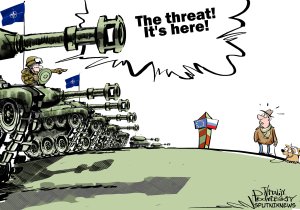 NATO has pledged to expand its military presence in Eastern Europe to protect its partners and allies from potential threats as the US sends two of the world’s most advanced warplanes to Romania.
In a speech at the University of Bucharest in Romania on Tuesday NATO Deputy Secretary-General Alexander Vershbow discussed the main issues the Western alliance is facing.
He said the alliance is struggling with many complex risks apart from the “destabilizing actions” of Russia and “the tide of instability which has swept across the Middle East and North Africa.”
“We are also wrestling with other complex risks and threats to our cyber security, to our energy supplies, and in the case of international terrorism to the safety of the people on our streets,” he said.
Vershbow said NATO is doing everything to respond to these challenges, adding that “the alliance takes a 360 degree approach to deterring threats, to protecting its member nations and if necessary to defending them.”
“That presence will be rotational, multinational, and combat capable. It will thereby send a clear message to any potential aggressor that if they violate NATO’s territory, they will face strong response from the whole alliance; Americans, Europeans and home defense forces,” he said.
The NATO secretary general also said that the organization has “set up a series of small headquarters, including here in Romania, to support planning, training and re-enforcement.”
“We are intensifying our maritime patrols, exploring the need for increased military and exercises, providing support to partners like Ukraine, Georgia and Moldova and encouraging efforts to strengthen energy security,” he said.
US sends F-22 Raptors to Romania
Vershbow’s comments came a day after the US sent two F-22 Raptor fighter jets to Romania as part of the commitment to NATO security.
The fighter jets, which travel at twice the speed of sound, touched down in Romania, close to the Black Sea and Ukraine, the Crimean Peninsula and Russia.
A US statement said the aircraft possess sophisticated sensors which would allow pilots to track, identify, shoot and destroy air-to-air threats without being detected.
The dispatch of the fighter jets, which can also attack surface targets, came two weeks after Russian fighter jets buzzed an American warship in the Baltic Sea.
The Western military alliance has been deploying troops and equipment close to Russia’s borders since it suspended all ties with Moscow in April 2014 after the Crimean Peninsula integrated into the Russian Federation following a referendum.
The United States and its European allies accuse Moscow of destabilizing Ukraine and have imposed a number of sanctions against Russian and pro-Russia figures. Moscow, however, rejects having a hand in the Ukrainian crisis.
This as Moscow has on many occasions slammed the Western military alliance’s expansion near its borders, saying such a move poses a threat to both regional and international peace.
US defense establishment believes Putin must be ‘defeated’
By Bryan MacDonald | RT | March 3, 2016

Russian President Vladimir Putin. © Alexei Druzhinin / Sputnik
Certain people in America’s defense establishment believe that only governments that do Washington’s bidding are “truly legitimate.” Others have ideological reasons to stir up tensions with Russia. This fuels discord and creates an unstable world.
Imagine if a major Russian media outlet carried an article with the headline, “How We Can Defeat Obama.” It’s pretty certain that within minutes various pro-NATO analysts would be all over Twitter labeling it as “hybrid warfare,”“Russian aggression” or even, heaven forbid, “hot war.” Or whatever this month’s agreed catchphrase is.
Let’s take it a step further. Ponder what would happen if the same pundits then realized the author was a recently redundant Russian Defense Department official. Without any doubt, the concern-o-meter would reach the stratosphere. Soon, the topic would be trending on Neocon Twitter. Neocon Twitter, by the way, is different than normal Twitter. In this version, all dissenting voices are blocked.
Last week, Newsweek published Evelyn Farkas, the former US Deputy Assistant Secretary of Defense for Russia/Ukraine/Eurasia (who vacated the post only last October). In her incredibly aggressive op-ed, Farkas explained “How We Can Defeat Putin.” The same Putin who is the popularly elected President of Russia. The world’s second strongest military power.
Farkas is now an employee of the pro-NATO Atlantic Council, which the formerly venerable Newsweek appears to have partnered with. The Atlantic Council is funded by the US State Department, the US Army, the US Air Force, the UAE & Bahraini governments and various other vested interests. None of them are particularly supportive of Russia. On the other hand, most would directly benefit from increased NATO spending.
Throwing Money At NATO
How does Farkas propose “defeating” Putin? By spending more money on NATO, of course. Also, she suggests sending more weapons to Ukraine, Georgia and Moldova. Of course, it was American meddling in the first two that created the current tensions. The latter country is currently enduring a political crisis and mass protests. This is ignored in the western media, because the corrupt incumbent regime is pro-Washington.
Farkas suggests arming the Syrian opposition, the loose coalition that includes the Al-Nusra front, which is part of Al Qaeda, the same folks who attacked New York on September 11, 2001. Not to mention, that such a course of action would destroy the nascent ceasefire in that unfortunate country.
Reading between the lines, Farkas is essentially suggesting that Washington use Ukraine, Moldova, Georgia (and anti-Assad forces in Syria) as pawns against Russia. With no concern for the economic wellbeing, or safety, of the people who live in those countries (or those in Russia). The complicated ethnic situation in those regions also seems to be irrelevant. The only priority is ‘American interests.’ Which are sacrosanct.
The fact that Farkas is the daughter of a Soviet-era Hungarian dissident is very relevant here. Charles Farkas fled Budapest, for America, following the abortive 1956 uprising. That embryonic freedom movement was brutally oppressed by Nikita Khrushchev’s USSR. Thus, it’s understandable that Evelyn has an axe to grind with Russia, even if many of its current leaders weren’t even born at that time.
Indeed, it seems almost certain that Farkas’ rhetoric projects her own deeply embedded distrust of Russia. Naturally, that hasn’t harmed her career. Hawkish anti-Russian views are attractive to the US military industry, which requires a tangible enemy to maintain funding levels. A glance at her biography shows a meteoric rise, which includes top positions at NATO.
The Big Prize
However, Farkas’s perspective outlines all that’s wrong with how the US interacts with the rest of the world today. She’s calling for the defeat of a leader with 80 percent approval ratings, because he doesn’t support US foreign policy objectives. If Putin prevents America taking over the world, he must be removed. It’s Doctor Evil stuff.
This fanatical analyst believes that Russia is a threat to America. However, it’s NATO which has been expanding during the past two decades, while Moscow has taken a defensive, often highly reactionary posture. For example, in Syria, Assad’s forces had the upper hand in Aleppo and would surely have taken the city, but Putin agreed a ceasefire rather than continue the bloodshed there. A real-life expansionist warmonger would have kept the fighting going.
In reality, it’s America which has been aggressive in this century. Illegally invading Iraq, destroying Libya, facilitating the collapse of Yemen and the Syrian Civil War. In Russia’s backyard, Washington has openly fomented uprisings in Georgia and Ukraine, the results of which have subsequently been rejected at the ballot box. The US-backed regimes in Kiev and Tbilisi were both eventually voted out after the “Orange” and “Rose” revolutions. The current ‘Maidan’ administration in Kiev now has lower approval ratings than the democratically elected, if corrupt, government it replaced.
This indicates that they were never popular upheavals to begin with, but rather driven by capital city liberals, without mass backing in the provinces.
The Washington elite believes that it can dictate to Russians about how they should be governed. They also present fringe opposition figures, like Mikhail Khodorkovsky or Garry Kasparov, as realistic alternatives to Putin. In the real world, serious Russia experts know that these characters have almost no support inside the country.
Russia After Putin?
As it happens, should Putin be removed as President, or voluntarily resign, it’s much more likely that his successor would be far more hardline in their attitude to the West. By Russian standards, Putin is a moderate. The vast majority of Russians are far less tolerant of America’s behavior than their President.
Another Neocon obsession is with NATO expansion. Their argument is that countries wish to join the alliance and that it’s not Russia’s business. That fails to take into account how poor these states are. The likes of Montenegro and Albania can choose to use their own meager resources to maintain a military or (https://www.nationalpriorities.org/campaigns/us-military-spending-vs-world/) have their defense spending largely looked after by America. The same America that spends as much on its army as the next nine countries combined.
With NATO, comes money. Lots of it. Dollars are attractive to impoverished nations. Doubtless, if Russia could match US largesse, the situation would probably be very different. Thus, America buys loyalty and these nations become little more than US military bases in Washington’s eyes.
The problem with Farkas’ Newsweek diatribe, and other similarly bellicose American discourse, is how downright dangerous it is. These people believe that any leadership, no matter how popular at home, with an agenda contrary to Washington is invalid and must be removed or defeated. They don’t acknowledge the absurdity that if Russia followed the same logic, there would be an apocalypse. This is because they believe that only the US is allowed to have – and pursue – ‘interests.’
A certain cabal in Washington thinks that only America, and countries that do its bidding are “truly legitimate.” They can only countenance the US agenda, at the expense of all others. This is a recipe for disaster.
Bryan MacDonald is a journalist. He worked in Dublin for many years, for Ireland on Sunday and the Evening Herald. He was also theatre critic of The Daily Mail for a period and a news, features and opinion writer. He now mainly covers Russia.
Another Day, Another Billion for Color Revolutions Near Russia’s Borders
Sputnik – February 13, 2016
Last week, the Obama administration proposed its final, 2017 fiscal year budget proposal to Congress. Among the proposed outlays is a State Department request for nearly a billion dollars to counter “Russian aggression” and “promote democracy” in the former Soviet Union. In other words, Washington thinks the region needs more color revolutions.
On Tuesday, the State Department and USAID held a special joint briefing, laying out a $50.1 billion spending request for 2017, including $953 million in “critical support for Ukraine and surrounding countries in Europe, Eurasia and Central Asia to counter Russian aggression through foreign assistance and public diplomacy.” The funds, officials specified, would go toward “enhancing access to independent, unbiased information; eliminating corruption and supporting rule of law; strengthening civil society; enhancing energy security, supporting financial reforms, trade, and economic diversification; and increasing some defense capabilities” in countries including “Ukraine, Georgia, and Moldova [and] in Central Asia.”
The spending would be separate from the proposed $3.4 billion (up from $789 million in 2016), provided by the so-called “European Reassurance Initiative,” which aims for “a significant reinvestment in the US military presence in Europe after decades of gradual withdrawal” to counter “the growing threat Russia poses to long-term US national security interests in Europe and beyond.”
With most of the Western media basically ignoring the plans and focusing on other aspects of the budget’s whopping $4 trillion in proposed spending, Russian security analysts, naturally, couldn’t let this ‘minor detail’ simply slip by unnoticed, given that the spending proposal is openly oriented against Russia.
Analyzing the State Department’s proposed new spending spree, Svobodnaya Pressa columnist Andrei Ivanov says that the outlays raise as many questions as they answer.
“It’s not difficult to guess what is implied by [the proposed spending for] ‘democratization,'” the journalist noted. “However, several questions arise. Firstly, this year, the State Department has already allocated $117 million ‘to support democracy’ in Ukraine, and $51 million for Moldova and Georgia. But in these countries, so-called color revolutions have already taken place, and the Americans have already almost achieved what they set out to do.””Secondly, it’s unclear what kind of ‘countering of Russian aggression’ the State Department means in relation to Central Asia. Kazakhstan and Kyrgyzstan have long been oriented toward Moscow, and even joined with Russia in the common customs area of the Eurasian Economic Union. Kazakhstan, Kyrgyzstan, and Tajikistan are also part of the Collective Security Treaty Organization’s unified security system. Russia has also signed a series of bilateral cooperation agreements with Uzbekistan.”
The proposed spending, Ivanov notes, “assumes a serious US commitment to pursuing its [geopolitical] goals, which threatens Russia with obvious negative consequences. The question thus arises about the countermeasures our country might take in response.”
“According to experts, on the eve of the coup d’état in Ukraine in 2014, over two thousand non-governmental organizations were created, from training camps for militants to various clubs of political scientists and media workers.”
Unfortunately, the journalist recalls, “Moscow relied more on the agreements reached with Ukrainian elites; the result was disastrous. Today, the question again arises about the need to work actively with the civil society of neighboring states.”
Asked to comment on the State Department’s new spending proposal, Andrei Manoilo, a professor of political science at Moscow State University, expressed a commonly held view among Russian security professionals.
Namely, the professor told the newspaper, “when Washington talks about spreading democracy, and allocates money for this purpose, it is referring to ‘color revolutions’ – the overthrow of undesirable regimes and the drive to bring puppets who mimic democracy to power.”
“Factually, these countries find themselves under American control. Ukraine is a vivid example. Until recently, Georgia too served as a good example, with each department and ministry in the country featuring an advisor and curator from the State Department. In Ukraine, supervision is carried out through the US Embassy, and through officials loyal to Washington, charged with implementing its instructions.”
As for the earmarking funds for countries which have already undergone color revolutions, Manoilo explained that the money “is allocated for the purpose of maintaining the stability of the dependent regime.” This is especially true in Ukraine’s case, he said. It is also meant “to ensure the loyalty of local elites.”
In Georgia’s case, “after Mikheil Saakashvili resigned from his post and was forced to flee the country, the American position weakened somewhat, mainly due to the perceived negativity which the color revolution had brought the country. So here, the US [spends] in order to maintain its influence. It is also possible that the US is considering ensuring the loyalty of Georgian elites by ‘nourishing’ cyclical color revolutions, thus carrying out a rotation of the elite.”
As for Central Asia, the State Department announcement seems to indicate, according to Manoilo, “that color revolutions are planned there as well. The Americans need to see regime change in the countries which, for the most part, are oriented toward Russia. In Central Asia, Moscow has several projects geared toward integration, including the Shanghai Cooperation Organization and the CSTO. Today, the countries in the region face a difficult situation, with disintegratory processes growing among them.”
In Tajikistan, the professor warned, the State Department may attempt to reignite the embers of the country’s civil war, which took place between 1992-1997, taking advantage of disagreements between the country’s north and south. “US NGOs, which operated freely in the country until recently, are taking advantage [of discontent] among both northern and southern elites. It was not until about a year ago that President Emomali Rahmon began to restrict their activities.”In Kyrgyzstan, meanwhile, “the situation has changed little since the last color revolution. The protest mood remains strong. US NGOs and foundations have been working actively with the rural population, which is not very versed in politics, but is easy to agitate to participate in demonstrations against authorities, as the ‘melon’ revolution of 2010 demonstrated.”
In all the countries of Central Asia, Manoilo noted, “there is the strong factor of Islamist radicalism. By and large, only the presence of Russian military bases holds back an Islamist offensive in the region.”
Unfortunately, he says, “practice has shown that when it comes to overthrowing undesirable governments, the State Department easily finds a common language with even the most rabid fundamentalists. It’s sufficient to recall the color revolutions of the so-called Arab Spring. It would not be out of place to presume that the US is preparing their repetition, except this time in the post-Soviet space.”
“In addition to Central Asia, there is the southern Caucasus. Last summer, Armenia saw a rehearsal of a color revolution under non-political slogans – a new technology called the ‘Electro-Maidan’. Armenia is a Russian ally in the South Caucasus, and the US has plans for regime change, using their methods of the so-called ‘democratic transition’.”
Ultimately, Manoilo warns, “by dismantling the political order in Russia’s neighboring countries, the US wants to create a vacuum around our country. Simply put, this indicates a repeat of the Ukrainian scenario. After all, until very recently it was simply impossible to imagine Ukraine as a country which is hostile to Russia.” … Full article
Transdniestria says its relations with Chisinau keep on deteriorating
TASS – November 17, 2015
TIRASPOL – Relations between Moldova and Transdniestria keep on deteriorating, Transdnieastria’s acting Foreign Minister Vitaly Ignatyev said on Tuesday at a meeting with Special Representative of the acting OSCE Chairman-in-Office for the Transdnistrian settlement process Radojko Bogojevic.
“The Moldovan side is seeking to evade contacts with Transdniestria,” he said. “Osipov [Moldova’s negotiator – TASS ] keeps on refusing to take part in talks in the bilateral format citing Moldova’s having no government as a reason. The dynamics of meetings of joint expert groups is very low as well.”
He said the two sides have accumulated a lot of problems in their relations. The most pressing of them, in his words, were Moldova’s and Ukraine’s decision to install joint customs control at the border with Transdniestria and criminal prosecution of Transdniestria’s officials.
Moldova’s acting Deputy Prime Minister Viktor Osipov said on Monday the talks between Moldova and Transdniestria were failing to yield any progress due to a gap in the parties’ positions. “Chisinau invited to discuss political issues, including a future status of unrecognized Transdniestria within Moldova, whereas Tiraspol says a certain atmosphere is needed for that,” he said after talks with Bogojevic. “We consider it as a violation of our earlier agreements. It is inadmissible to lay any conditions for the beginning of talks.”
Bogojevic, for his part, noted that Germany, which takes over presidency in the Organization for Security and Cooperation in Europe (OSCE) in 2016, will be tasked to get Moldova and Transdniestria back at the negotiating table in the 5+2 format. He admitted that despite all the efforts, the Serbian presidency in the OSCE had failed to resume the settlement talks. He said he had arrived in Moldova to prepare an OSCE ministerial meeting due in December and to prepare the ground for Germany’s presidency, which would have to deal with that problem.
Talks in the 5+2 format, involving Moldova and Transdniestria as parties to the conflict, the OSCE as a mediator, Russia and Ukraine as guarantors and the European Union and the United States as observers, have been stuck for the second year. Only two out of five scheduled meetings were held in 2014. Earlier, Transdniestrian leader Yevgeny Shevchuk said that Tiraspol could resume the talks in the extended format only on condition relevant documents were prepared. “I don’t see perspectives for holding a meeting in the 5+2 format unless expert groups prepare solutions that might ease the situation,” he said, adding that Moldova’s policy of pressure and economic sanctions “exerted jointly by Moldova and Ukraine” were hampering the negotiating process.
US Committed to Playing Active Role in Transnistria Dispute Negotiations
Sputnik — 26.08.2015
Washington is committed to be fully engaged in the talks aimed at settling the Transnistria conflict, US Secretary of State John Kerry stated in a statement on Wednesday.
“You may be sure that America will remain unwavering in its support for Moldova’s sovereignty and territorial integrity and will continue to play an active role in the 5+2 negotiations aimed at peacefully resolving the Transnistria dispute,” Kerry said.
Kerry issued his statement on the occasion of Moldova’s National Day. The secretary stressed the US support for Moldova government’s efforts to undertake reforms.
Transnistria, a region with a predominantly Russian and Ukrainian population broke away from the Soviet republic of Moldova in 1990, fearing its government could seek reintegration with neighboring Romania. The initiative triggered Moldova’s offensive on the region in 1992, after which it lost control over the Dniester River’s left bank.
The region is now striving for international recognition, while Moldova offers Transnistria autonomy within a unitary state.
The 5+2 format negotiators include Russia, Moldova, Transnistria, Ukraine, the OSCE and observers from the European Union and the United States.
Six Years After Pro-European Revolution Moldova Is a ‘Captured State’
Sputnik – 11.08.2015
Six years after the so-called “Twitter Revolution” which ousted the ruling communist regime in Moldova and brought pro-Europeans to power, and one year since the ratification of the country’s association agreement with the EU, the country has found itself on the brink of ruin and in the tight grip of the oligarchs, according to a European official.
Six years of pro-European rule in Moldova has done little good for the country. Even though last year it signed and ratified an association agreement with the European Union, “corruption [in Moldova] remains endemic” and the state is “still in the hands of oligarchs, while punishingly low incomes have propelled hundreds of thousands of Moldovans to go abroad in search of a better life,” according to Thorbjorn Jagland, a former prime minister of Norway, who is the current secretary-general of the Council of Europe.
“The value of the Moldovan currency, the leu, has dropped, interest rates have rocketed and a recession looms,” he adds in his article in The New York Times.
The high-ranking politician however suggests that the remedy is “outside financing”.
“If the authorities fail to do what is needed to restore external support — and quickly — the country will face serious economic turmoil. Social programs for the poor and vulnerable will be cut just before the harsh winter months,” he therefore predicts.
“Alongside the urgent measures needed to fix the banks, the government must immediately begin purging corrupt officials from public bodies. As a start, the dozens of judges — some very high-profile — who have been accused of egregiously abusing their power should be investigated. Law enforcement agencies must also do everything they can to arrest the individuals responsible for the massive bank fraud.”
“In order to give people confidence that justice will be served in these cases, murky political interference must be eliminated from the judicial system. Legislation currently before Parliament that would guarantee the impartiality of state prosecutors should be implemented without delay. And to prove that no one is above the law, the current blanket immunity from prosecution enjoyed by members of Parliament should be reduced.”
It yet remains to be seen what reforms Moldova, which the politician calls a “captured state” will introduce in the nearest future.
Ukraine Masses Troops on Border With Transnistria
Sputnik – 28.06.2015
Ukraine continues to mass troops and heavy weapons on the border with Transnistria on the pretext that the self-proclaimed republic may launch a military campaign against Ukraine, Russian media reported on Saturday.
“It looks like the Kiev authorities want to picture themselves as encircled by enemies, ready to attack,” a representative of the Transnistrian KGB told Russia’s Zvezda TV channel.
“That we may have a war here tomorrow is hard to say, but we are not ruling out a Ukrainian provocation either… They could use for this purpose one of their many small private armies which refuse to take any orders from Kiev,” the official added.
On June 22, the deputy foreign minister of the Transnistrian Republic, Vitaly Ignatyev, said that Ukraine was moving its troops towards the borders of the self-proclaimed republic, sandwiched between Ukraine and Moldova.
“The situation here is very bad… Economic production is going down, foreign trade is shrinking, the security situation is equally alarming with our Moldovan partners holding military drills with NATO and the Ukrainian pressure mounting every day,” Ignatyev said.
He also mentioned the curbs Kiev has imposed on the transit of Transnistrian nationals and citizens of Russia, almost 200,000 of whom currently live in Transnistria.
“They haven’t been able to travel to Russia via Ukraine for more than a year now. They have to move across Moldova, but Chisinau is creating problems too, along with economic sanctions,” Ignatyev added.
The newly appointed governor of Ukraine’s Odessa region Mikheil Saakashvili earlier announced plans to reinforce Ukraine’s border with Transnistria.
“We have two major tasks — to reinforce the border and curb corruption. Drug and weapons trafficking across this border means nothing good,” Saakashvili told a news conference in Odessa.
He also blamed the Transnistrian authorities for destabilizing the situation in Ukraine.
Phantom Russian Sub Hunts Gave Birth To NATO’s Viking Bloc
By Andrew KORYBKO | Oriental Review | May 5, 2015
The largely unobservant public had previously been under the impression that the Baltic Sea was a zone of peace and stability, thinking that all the region’s states lived in harmony with one another. This may have been the case prior to 1991, but immediately afterwards, NATO’s expansion into the Baltic basin seriously upset the balance of power, as the incorporation of Poland and the former Soviet Baltic States in 1999 and 2004 attests. Through this manner, NATO was able to surround Kaliningrad and directly push up against part of Russia’s western border.
The military tension remained just below the surface (literally), until Shadow NATO states Sweden and Finland started initiating highly publicized ‘Russian sub’ scares, designed with the sole intent of scaring their publics into formal NATO membership and opening up an additional front in the New Cold War. Taking it further, this is all part of NATO’s new policy of regional blocs, as Brussels hopes to see the formation of a ‘Viking Bloc’ that would apply pressure against Russia in the Arctic. The most dangerous development, however, is with Finland, which is capitalizing off of the sea scare to call up nearly one million reservists (1/5 of the total population) in the event of a “crisis situation”, thereby presenting a dangerous test run in conflict escalation that might be applied all over Europe in the future.
Regional Hysteria
To put everything into focus, it’s best to begin by documenting the latest hysteria stemming from supposed ‘Russian sub’ sightings. Sweden started the trend when it claimed to be hunting a believed-to-be Russian sub back in October, and when nothing came out of the stunt except for a scared public and a couple million dollars spent, Stockholm continued to insist that it had evidence that a foreign sub did trespass through its waters, but curiously kept the details to itself. Be that as it may, it didn’t stop legislators from increasing the defense budget by a whopping $1.18 billion for the period 2016-2020, earmarking an additional $945 million for the future purchase of two subs, and announcing plans to reopen a military base on the Baltic island of Gottland. The ultimate irony is that there was never a ‘Russian sub’ to begin with, and that it was eventually revealed that the whole scandal started over a simple workboat, thus making it seem like Sweden exaggerated the situation simply to push through more defense funding and militarize its society against Russia.
 Being the regional leader that it is, it appears as though Sweden’s spectacle of the phantom Russian sub rubbed off on Finland, which soon after its latest elections began detonating underwater charges against its own suspected ‘Russian sub’. Finnish political analyst Jon Hellevig assessed that this was simply Helsinki’s application of Stockholm’s decades-long tactic of using phantom Russian subs to increase the population’s acceptance of future NATO membership. While Finland isn’t a de-jure member of the alliance, both it and Scandinavian military hegemon Sweden signed a NATO host nation agreement last fall to intensify their relations with the bloc, essentially making them Shadow NATO members in an even deeper capacity than Ukraine has become (the latter of which has been the bone of contention sparking the New Cold War in the first place).
Given such a relationship, it may not even be needed for either state to formally join NATO at this point, since the alliance can already reap the resultant military advantages of their territory in any possible anti-Russian crisis scenario. However, putting the provocative issue up for a referendum vote or making a unilateral government decision in this regard might be a forthcoming tactic towards creating the aforementioned crisis needed to ‘justify’ the indefinite hosting of NATO troops in those countries. It’s quite clear that Sweden is already de-facto participating in NATO, since they just partook in the group’s “Dynamic Mongoose” anti-submarine drills off the Norwegian coast. This would have obviously raised eyebrows among its domestic citizenry had it not been for the earlier ‘Russian sub’ scare that created the social pretext for its acceptance, showing how such false crises can be manipulated by the media for predetermined military gain.
The Viking Bloc
Everything going on in Scandinavia right now, from the phantom ‘Russian sub’ scares to the de-facto NATO-ization of the region’s last formal holdouts, is designed to create the northern component of NATO’s regional bloc strategy. In sum, the alliance is reverting to history and using Polish interwar leader Josef Pilsudski’s Intermarum concept to establish a Baltic-to-Black-Sea coalition of anti-Russian states to which it can more efficiently outsource its military prerogatives, all per the Lead From Behind strategy. The ‘Viking Bloc’ which consists of the Greater Scandinavian states of Sweden, Norway, Denmark, Iceland, and Finland (centered on Sweden, possibly incorporating Estonia and Latvia as well) is envisioned to complement the emerging Commonwealth Bloc of Poland, Lithuania, and Ukraine (centered on Poland), and the forthcoming Black Sea Bloc of Romania, Bulgaria, and Moldova (centered on Romania, possibly even expanded to Georgia).
Focusing more specifically on the characteristics of the Viking Bloc, its members have a maritime identity, so it’s predicted that they’ll focus their activity on the Baltic Sea, North Sea, and Arctic Ocean, accordingly making them all one large naval base. Sweden’s demographic and economic strength makes it the obvious leader amongst the identified members and the control node of its activity, while wealthy Norway can provide the natural resources needed to keep it running. Denmark controls the entrance to and from the Baltic Sea, and together with its colony country of Greenland, Iceland, and Norway, the three can patrol the North Sea and Arctic Ocean in hunting ‘Russian subs’. It’s also not a coincidence that all of these states are members of the Arctic Council, meaning that this dialogue configuration has essentially become one of confrontation between North America & the Viking Bloc on one side and Russia on the other. The odd member out of this naval configuration is Finland (also a member of the Arctic Council), which has recklessly adapted a land-based anti-Russian policy that’s bound to ratchet up tension with its neighbor. One should also note that the Viking Bloc’s members signed a multilateral defense cooperation agreement in April that basically institutionalized the organization as an official regional bloc.
The Finnish Amphibian
The most dangerous sub-bloc strategy being adopted by NATO is its Finnish affiliate’s advance preparation of 900,000 reservists in the event of a “crisis situation”, which obviously could only refer to a military conflict with Russia. The Finnish government is trying to account for all of its former reservists aged 20-60 in order to inform them of what their “crisis situation” role would be, as well as to collect updated information about them. This dramatic movement of anti-Russian initiatives from sea onto land represents an amphibious strategy that’s likely only in its initial test-run phase. NATO wants to gauge Russia’s reaction and monitor its response in order to fine-tune this template for eventually export throughout the bloc as a whole.
The Finnish Amphibian is a very simple strategy. All that the practicing states or regional blocs have to do is report on a phantom ‘Russian sub’ sighting, preferably with as much media paranoia as possible but providing no proof whatsoever, and then use the subsequent buzz to justify the potential mobilization of a massive land-based reservist force. This leads to the militarization of society within the targeted state and initiates a siege mentality that makes its citizens feel as though they’re constantly under some type of Russian attack. None of the accusations have to be proven, let alone even seen by the citizens themselves, so long as the media and supportive political figures repeat the chorus of conflict enough to make it believable. An added touch would be to implement Sweden’s strategy of publicly accusing 1/3 of all Russian diplomats there as being spies, which when coupled with the existing paranoia about phantom ‘Russian subs’, sends the populace’s paranoia into overdrive and all but assures that they’ll support whichever military or surveillance solutions their government or NATO suggests.
Concluding Thoughts
NATO’s northernmost regional fighting group, the Viking Bloc, owes its speedy creation to the utilization of phantom ‘Russian sub’ scare tactics to galvanize support for this new initiative. Greater Scandinavia is rapidly being transformed into one giant NATO naval base that’s meant to confront Russia on the neighboring high seas. As destabilizing as that is, it moves into the realm of flashpoint danger with the fact that Finland is preparing to mobilize 1/5 of its population against Russia, thus presenting an amphibious land-based component to the majority sea-focused strategy. Even worse, the template of using false sea-based scares to ‘justify’ massive land-based mobilizations could likely be applied elsewhere in Europe, thereby serving as an ideal model of militarization all throughout NATO. It’s this hybrid of media-military strategic collaboration that may eventually prove to be more destabilizing than the unveiling of the Viking Bloc itself.
Wolf Pack vs. Bear
By Anne Williamson | LewRockwell | April 16, 2015
Having now had a year’s time to get better acquainted with their new Ukrainian friends and the neighborhood overall, Europeans are losing their taste for economic sanctions on Russia.
Contrary to American assurances, economic warfare against Russia meant to compel the return of Crimea to Ukraine hasn’t worked. Nor did the Ukrainian military’s campaign against the Donbas tame the Russian “aggression” mainstream media shouts about daily. All Europe has achieved to date is tens of billions in lost trade and Russia’s abandonment of the South Stream pipeline.
The Russians were building South Stream to insure the – politely put – “integrity” of gas flows to Europe while in transit across Ukraine, and put an end to the country’s 24-year racket of holding Russia’s energy commerce with Europe hostage by virtue of having inherited a key segment of the Soviet pipeline network. The loss of jobs and transit revenues their participation in the construction and operation of South Stream promised was keenly felt in Hungary, Bulgaria, Serbia, Slovenia, Croatia, Macedonia and Bosnia-Herzegovina. Austria, France, Italy, Cyprus, Luxembourg, the Czech Republic and Germany have all taken serious losses thanks to the trade sanctions as well.
Trade and employment losses coupled with some USD 40 billions more in IMF loans to Kiev, whose proceeds are most likely to be spent – at the US’s insistence – on yet more war, and the growing misery of all the Ukrainian people are typical of the now familiar results of US-organized sedition abroad. However, those results are usually observed in militarily weak, third world nations the US chooses to undermine for whatever reasons, and certainly not on the continent their most loyal and most capable allies occupy.
Besides which, the whole cockamamie story the US has been pushing vis a vis Crimea is falling apart. The fact that one year on there are no Crimean protests and no “Back to Kiev!” grass root committees has undermined the entire premise of the sanctions. Even year long multiple polling by western agencies has shown that large majorities of Crimeans have no regrets concerning the 2014 reunification with their motherland of some 300 years.
In truth, the world owes a debt of gratitude to the Russians. While US State Department operatives busied themselves in Kiev with constructing an interim, post-coup government of fascist stooges and native oligarchs, the Russians’ deft and lightening re-absorption of a willing Crimea took the meat right off the table. The American greenhorns in Kiev were left dumbfounded, and hopping mad.
With the Black Sea port of Sevastopol safely in Russian hands, and the country’s immediate strategic interests secure, there was no need for war. Given time, the Russians know Ukraine as presently constituted will defeat Ukraine, and that not even a Himalaya of dollars and the sacrifices of several generations of Ukrainians will put the country back together again. Default will be Ukraine’s only escape route.
But it is the antics of hyperbolic NATO operatives (Dragoon Ride, a Conga line of armored Stryker vehicles and troops rolling across Europe from the Baltics to central Europe in a “show of force,”) the bloviating of chest-beating US generals (the only way “to turn the tide” is “to start killing Russians”) and the dumb bellicosity of the US Congress for having authorized the export of lethal weaponry to Kiev that finally got the EU leadership looking sideways at one another. Just exactly what has the US gotten them into?
But it was the EU itself who bought, by bits and by pieces, into America’s scheme. The events in Ukraine have left the European Union naked before her own members’ populations, exposed as a highly-bureaucratized system of US vassalage so thoroughly in harness individual nations actually agreed to harm their own economies in pursuit of US policies. There’s a reason for the EU’s acquiescence: The EU and its leadership stands to gain should State Department neoconservatives deliver on their promises. The EU will get bigger and its artificial and suffocating institutions more deeply entrenched.
How so?
The only direction in which the EU can expand is to the East. Ukraine, Moldova, Transdniestr, Armenia and Georgia were all believed ripe for the taking, and each is or was being pursued with EU “association agreements,” which subvert each country to EU dictates while holding the prize of EU membership in abeyance.
Absorbing such contrarily-organized lands is the work of decades. No matter. Their capture alone will enable the ECB to go on an immediate super-binge of vendor financing, which it is believed will conjure up jobs, export profits, and, the ECB (European Central Bank) hopes, a new round of euro-based credit expansion and piratization that will, in the fullness of time, strip the newly “associated” lands and their citizens of their savings and property. Once the fiat money-engineered boom begins to fade, the expectation is that ongoing economic warfare against Russia, directed and policed by the US, will at last bear fruit. Only a small shove and a slight push will be needed to topple and then shatter Russia into bite-sized pieces for the west’s further consumption.
So set upon this course is the US that the White House’s recent offer of a slippery framework to Iran to conclude the Israeli-manufactured dispute over the country’s nuclear enrichment program has the look of arbitrage, indicating there are limits to just how much havoc Washington can create and oversee abroad. Besides, Iran is currently useful in the conflict with the US-created ISIS. With sanctions lifted, the flood of Iranian oil and gas coming to market would further harm Russia’s economic interests while supporting the building of new pipelines to Europe originating in the Middle East and North Africa (under indirect US control) and sparing any further need for US ally Saudi Arabia to continue pumping low-priced oil for which there is insufficient global demand.
As long as Angela Merkel keeps Germany on board, and Germany continues to fund the stagnant EU, the US’s high-tech version of a medieval siege of the Kremlin can proceed.
With new multilateral treaties agreed under cover of tax and banking transparency (FATCA) now in place, the US is well on its way to being able to track in real time every currency unit on the planet that is emitted, earned, deposited, withdrawn, spent, invested, loaned, and borrowed by means of the banks, long seen as a US-engineered globalism’s most effective police force. European governments’ war on cash is meant to insure all commerce will flow through the banks and therefore be recorded. These new surveillance capabilities will be exploited to the maximum in the case of both Russia and hesitant Europeans for the purposes of blackmail, extortion, and control.
In a digital battlescape staffed by the west’s soldiers of finance, winter will not save the Russians.
Another attack strategy the US is about to deploy, drawn not from history but from nature, is that of the wolf pack. Though NATO troops will bedevil Russia’s borders, no western troops will actually set foot on Russian territory prior to the country’s imminent collapse. That would be dangerous, but the more proxy wars and political upheavals the US can stir up along Russia’s periphery while the motherland suffers and declines under the west’s economic blockade, the better.
Necessary and experienced personnel are being appointed and NGOs beefed up in preparation for brewing new crises and rainbow revolutions along Russia’s “soft, underbelly”: the Nagorno-Karabakh enclave, which both Armenia and Azerbaijan claim, in Kyrgyzstan where the south and the north are alienated from one another, in Uzbekistan where control of the Fergana Valley is in dispute with Kyrgyzstan, and in Georgia, which hopes for the return of Ossetia and Abkhazia. Carrots and sticks will miraculously set many a fire.
Keeping those flames under control will seriously tax Russia’s resources.
US objectives include busting up the Collective Security Treaty Organization (CSTO), whose members include Armenia, Belarus, Kazakhstan, Kyrgyzstan, Russia and Tajikistan, the Shanghai Cooperation Organization (SCO), whose members include China, Kazakhstan, Kyrgyzstan, Tajikistan, Uzbekistan, and Russia, and the Eurasian Economic Union (EAEU), whose members – to date – include Armenia, Belarus, Kazakhstan, Kyrgyzstan, and Russia.
However, there are problems with the above scenarios unfolding as planned.
US foreign policy assumes everyone on the planet wants to be an American, or – second best – a recipient of American interest and munificence, a notion which the state has successfully sold only to movie-mad foreign teenagers and naive Americans. Rather than being an advertisement for the benefits of American intervention, the Ukraine America is building might better serve as one for the beneficial avoidance of same through membership in the EAEU.
Russia is hardly new to the protection game. Armenia and Georgia, the first Christian nations on earth, soon found themselves unmoored in a sea of Islam. Each petitioned the Kremlin for inclusion into the empire. They wanted and needed the protection of the “Third Rome,” and they got it. Today Armenia wisely continues to huddle close to Russia, eschewing the opportunity of becoming a battle station in any anti-Azeri US campaign, while a US-enamored Georgia still chafes at the protection the US provides their former proxy, the corrupt Saakashvili regime. Azerbaijan has but to look at Iran to see what misfortune the US is quite willing to hand round. Uzbekistan and Kyrgyzstan have the example of their war torn neighbor, US-occupied Afghanistan, to contemplate.
US foreign policy further assumes that targets will stand still and only stare into the blinding glare of America’s oncoming headlights.
Russia’s abrupt shut down of the South Stream gas pipeline’s construction and the rapid replacement of European entry points and participants with a single exit point in Turkey from which Russian gas will flow to the rest of Europe through Greece along pipes it is now the EU’s responsibility to finance and build has put paid to that assumption. It is not only Russia that has an exploitable “soft underbelly.”
Despite the mainstream media’s shameless dissemination of western governments’ fatuous propaganda, and of what is sure to be an exploding supply of tit for tat, sufficient information is available to anyone who cares to look to determine who is destroying and who is trying to build, who is seeking peaceful co-operation and increasing trade and commerce between nations and who is demanding obedience to its diktat while waving a mailed fist.
To paraphrase Mae West, “Democracy has nothin’ to do with it.”
It is certainly an irony of history, wild and raw, that Vladimir Putin, a man who once described himself as “a pure and utterly successful product of a Soviet patriotic education,” is today seen by an increasing number of alarmed citizens worldwide as liberty’s if not civilization’s best, if inadvertent and imperfect, hope. But those souls should have no illusions. Whatever the Russian president does, he will do for Russia’s sake, not ours.
But if Russia cannot stand, we will all sink together into tyranny or eternity.
Featured Video
More Iran War fallout: Maritime insurance industry shifts from London to China
or go to
Aletho News Archives – Video-Images
From the Archives
The Biggest Threat to Peace in Middle East
By Dr. Elias Akleh* | Sabbah Report | May 24, 2010
A build up of heightened tension in the Middle East is escalating in the last few weeks. American and Israeli postures towards Lebanon, Syria, and Iran have become more threatening. Listening to speeches of political leaders one hears talks only about war not peace. Iranians and Israelis are continuously training hard for a possible showdown. Both sides are conducting extensive war games every month. This led Syrians to claim that Israel is preparing for a soon-to-come another war. The Jordanians also are warning that current stalemate of the peace process is an indication of a war breaking out this summer. The Russian President and his army chief hinted, a few months ago, that the US and Israel were planning for an attack on Iran.
Indeed Iran is, as it has been for last few years, the target of most of the threats and accusations of supporting terrorism. Escalating incitement against Iran the American Defense Department sent last month (April) to Congress a report on Iran’s military claiming Iran could develop intercontinental ballistic missiles capable of reaching the US by 2015.
Ignoring the fact that N. Korea, India, Pakistan, and Israel are proven to have nuclear weapons while Iran does not, the US Secretary of State Hillary Clinton chose in her speech, to the nuclear Non-Proliferation Treaty review conference at the UN, to focus on Iran’s alleged nuclear ambitions putting the whole world at risk as she put it. According to Clinton Iran’s acquisition of nuclear weapons, rather than Israel’s more than 200 nuclear bombs, is destabilizing the Middle East. She called on the world’s nations to rally around US efforts to hold Iran, not other nuclear countries, to account.
The accusation that Usama Bin Laden is living comfortably in Iran had received a boost after the broadcast of a documentary called “Feathered Cocaine”. This echoed the June 2003 claims of the Italian newspaper Corre de la Sierra that Bin Laden was in Iran according to some intelligence report, and according to Richard Miniter’s book “Shadow War”. … continue
Blog Roll
 Aletho News
- More Iran War fallout: Maritime insurance industry shifts from London to China
- US-Israeli aggression on Iran triggers review of GCC countries’ investment pledges to Washington
- Russia slams UK plan to seize tankers suspected of carrying its oil
- Pakistan ramps up food exports to Persian Gulf nations as war deepens food insecurity
- Iran submits response to US plan, sets terms for war’s end: Tasnim
- US vs Iran: Kharg Island Talk — Bluff or Escalation? Ex-Military Officer Weighs In
- Zelensky unnecessarily involves Ukraine in the Middle East crisis
- Turkish tanker blacklisted by Ukraine hit in drone attack – media
- Canada, the U.S., and NATO: the inescapable trap
- Villains of Judea: Leonid Radvinsky
- If Americans Knew
- ‘No Innocent Children’: Far-right Israeli Lawmaker Defends Killing of Palestinian Family
- Mossad’s promises helped Netanyahu convince Trump that Iran could be toppled
- US Arms Control Official Refuses To Comment When Asked If Israel Has Nuclear Weapons
- Veterans warn US landing could be ‘more Gallipoli than Vietnam’
- Israel may be committing war crimes in Lebanon – Not a ceasefire Day 167
- In the West Bank, life is a constant battle – 3 articles
- Jacob Reses, one of the most powerful pro-Israel operatives in Trump’s Washington
- Israeli-US assaults kill or injure 87 children a day – Not a ceasefire Day 166
- ‘Forever live by the sword’: Understanding Israelis’ massive support for Iran war
- UN’s special rapporteur on human rights says Israel is systematically torturing Palestinians
- No Tricks Zone
- Devastating Assessment Of Comirnaty Vaccine By Former Senior Pfizer Europe Toxicologist
- New Study: CO2 Is ‘Effectively Negligible’ As An Explanatory Climate Change Factor Since 2000
- Former Pfizer Toxicologist Dr. Helmut Sterz Tells Bundestag Hearing Pfizer Vaccine Should Have Never Been Approved
- Energy Expert: Germany’s Nuclear Phaseout Was A “500 Billion Euro Mistake”
- New Research: South Australia’s Mid-Holocene Sea Surface Temperatures Were 4°C Warmer Than Today
- Storing Green Energy To Last Germany 10 Days Would Require A 60-Million Tonne Battery
- New Studies: UK Sea Levels Were 4 Meters Higher Than Today During The Mid-Holocene
- Destructive Green New Deal: German Energy And Metal Group Warns Of Drastic Crisis
- New Study Documents A 20-Year Pause In Arctic Sea Ice Decline – Driven By Internal Variability
- Wake-up Call: Survey Shows Majority Of Germans Now Favor Postponing Climate Targets!
 Aletho News