Moldova could be the next target of Western-backed color revolution to pressurize Russia
By Paul Antonopoulos | October 22, 2020
Washington could be organizing a color revolution and mass protests in Moldova like the ones that have already gripped Belarus and Kyrgyzstan. The Moldovan elections are scheduled for November 1 and have eight presidential candidates participating. The main rivals however are current President Igor Dodon, considered “pro-Russian,” and former Prime Minister Maia Sandu, considered “pro-European.”
There is a combination of internal and external factors at play in Moldova, something that has come to typically define the post-Soviet space. There is constant internal instability when considering the breakaway region of Transnistria, weak statehood, many conflicting ideological interest groups, and active attempts to get Moldova into the NATO and EU sphere of influence. This is what makes Moldova at high risk of experiencing a color revolution after the upcoming presidential elections if Dodon is re-elected.
According to polls and local experts, the first round of the presidential election may not determine the winner. Dodon, who aims to bring Moldova closer to Russia via the Eurasian Economic Union, and Sandu, who is considered the country’s main pro-Western politician, will likely compete against each other in the second round of voting. Polls show that Dodon has greater support from citizens, but not enough to win in the first round.
The director of the Russian Intelligence Service, Sergei Naryshkin, warned that the U.S. was preparing a color revolution in Moldova and highlighted that Washington would continue to interfere in the internal affairs of states friendly to Moscow, especially those along Russia’s borders. According to him, a color revolution could occur after the Moldovan presidential elections. The reason is Washington’s dissatisfaction with Dodon as he supports constructive relations with members of the Commonwealth of Independent States, particularly Russia.
The U.S. State Department ordered its embassy in the Moldovan capital of Chisinau to encourage the opposition to organize mass protests to demand an annulment if Dodon is re-elected. According to Russian secret services, U.S. diplomats are also trying to persuade Moldovan security forces not to interfere in possible street protests and to immediately “side with the people.”
Many Moldovan experts also warn of a possible coup attempt. Sandu, who sees the country as part of the EU family and supports the idea of uniting Moldova with Romania, has already accused local authorities of preparing to falsify the election results and called on her supporters to prepare for protests. However, if Dodon is re-elected, it is likely his supporters will not allow the opposition to question the election results. As recently as last week, Dodon talked about preparing for a potential color revolution attempt.
The destabilization of the post-Soviet space has all the signs of a planned and coordinated campaign to pressurize Russia by creating hotspots on or near its borders. The U.S. is the only country in the world that has enough resources and motivation to organize persistent and constant campaigns and has been actively indifferent or encouraging destabilization in countries on or near Russia’s frontiers, whether it be Belarus, Kyrgyzstan, Armenia-Azerbaijan or elsewhere.
This has been a consistent policy since the collapse of the Soviet Union when we consider how the 1990’s was dominated by manufactured coups, rebellions and revolutions in many former Soviet Republics, including Georgia, Ukraine, Kyrgyzstan, Moldova, Armenia and other neighbors or near neighbors of Russia.
Now that the U.S. is on the verge of a presidential election, the State Department and U.S. special services are attempting to weaken Russia and other geopolitical opponents. In other words, destabilization along Russia’s borders is part of a campaign to curb and undermine the country’s economic, political and technological capabilities. Because of Russia’s independent foreign and economic policies, size and resources, the Eurasian country poses a threat to U.S. global domination. It is for this reason that tensions, wars, riots and revolutions are constantly erupting near Russia’s borders, but at the same time Washington persistently points out that its national interest is to ensure peace, democracy and stability in countries that border Russia.
Although Moldova does not directly border Russia, it is a former Soviet Republic that still maintains cordial relations with Moscow. Moldova is a gateway that connects Eastern Europe to the Balkans. A potential Dodon re-election will once again prohibit any EU and NATO advancement towards the border of Russia.
This makes a color revolution against his re-election all the more necessary so that Moldova can potentially be the next country that borders Ukraine to become an EU and/or NATO member state. With another neighbor of Ukraine becoming an EU and/or NATO member, the eventual path of Kiev’s accession into those two organizations will become easier to navigate. This means the largest European country to border Russia, Ukraine, will be even more integrated into a system to pressurize Moscow.
Paul Antonopoulos is an independent geopolitical analyst.
Moldova to move embassy to Jerusalem
MEMO | June 12, 2019
Moldova has announced that it will move its embassy in Israel from Tel Aviv to Jerusalem, a move which would make it the first European country to do so.
The announcement comes against the backdrop of a political crisis in Moldova, a small Eastern European country located between Romania and Ukraine.
The country has been engaged in a power struggle between three parties – the pro-European Union ACUM bloc; the Socialists led by Moldovan President Igor Dodon and backed by Russia; and the Democratic Party run by media tycoon Vladimir Plahotniuc – since it held elections in February.
After months of post-election deadlock, ACUM and the Socialist party agreed to form a government – a move not recognised by the Democratic Party which insists that the previous prime minister, Pavel Filip, remains in charge.
On Sunday, the Democratic Party persuaded the country’s Constitutional Court to briefly suspend President Dodon and install Filip as president for enough time to allow him to issue a decree calling for snap elections in September, US-based magazine Algemeiner explains. While acting as president, Filip announced that Moldova would move its embassy from Tel Aviv to Jerusalem.
In a statement issued yesterday, Filip tied the country’s domestic difficulties to the announcement of the embassy move, as well as the sale of land for the construction of a new US embassy in Moldovan capital Chisinau.
The interim prime minister wrote: “We are in [a] situation [in which we need] to urgently adopt these decisions taking into account the political instability and uncertainty in the country, but also the latest political developments [in which] one of the political parties that constantly blocked these two projects is attempting an illegal takeover of power.”
He continued: “These are two commitments that we have previously undertaken and we want to make sure they will be respected, regardless of what happens after the snap elections.”
Given Moldova’s internal political instability, it is unclear whether the government will be able to follow through on its announcement. If the relocation is undertaken, Moldova will become the first European country to move its Israeli embassy to Jerusalem.
Since US President Donald Trump recognised Jerusalem as Israel’s capital in December 2017 and relocated the US embassy to the Holy City in May 2018, a handful of countries have followed suit. Most of these have been Latin American countries with close ties to the US, including Paraguay and Guatemala.
However, within months of relocating its mission, Paraguay reversed the decision and moved the embassy back to Tel Aviv, citing a desire to support “broad, lasting and just peace” among Israelis and Palestinians.
Brazil – which recently elected pro-Israel politician Jair Bolsonaro as its president – has also toyed with the idea of moving its embassy to Jerusalem. In March, however, Brazil appeared to backtrack on its promise, saying it would instead open a “business office” in Jerusalem.
Likewise Hungary’s right-wing Prime Minister Viktor Orban – who, like Bolsonaro, is considered a close associate of Israeli Prime Minister Benjamin Netanyahu – has said his country will open a “diplomatic office” in Jerusalem, though stopped short of promising a full-service embassy.
Despite Israel encouraging other countries to relocate their embassies to Jerusalem – and announcing it would build a new “embassy complex” which could house nine diplomatic missions for the purpose – the international community has generally opted not to follow President Trump’s controversial move.
UN call to withdraw ‘foreign troops’ from Moldova threatens Transnistria peace process – Moscow
RT | June 23, 2018
A UN resolution calling for withdrawal of “foreign troops” from Moldova might reignite the Transnistrian conflict, Moscow warns. Moldovan President Igor Dodon called the resolution a PR stunt of the democrats ahead of an election.
The resolution, calling for the “complete and unconditional withdrawal of foreign military forces” from Moldova was adopted by the UN General Assembly on Friday. The Moldova-sponsored document received a simple majority, with 63 countries voting for it, 15 against, and 82 abstaining.
Russia condemned the adoption of the resolution as a shortsighted move which could lead to a potential flashpoint between the unrecognized Transnistria Republic and Moldova, undermining the “fragile” reconciliation process.
The resolution targets a small contingent of Russian peacekeepers, which have been stationed in the breakaway region of Transnistria for over two decades. Following the collapse of the Soviet Union, ethnic tensions in Moldova resulted in a brief but intense armed conflict in 1992.
The involvement of Russian troops in the conflict back in 1992 put a stop to the bloodshed, the foreign ministry stated, adding that Russian peacekeepers remain “the guarantor of peace in the region.”
“We perceive this initiative as a blatant propaganda move of some of the political figures in Kishinev, who seek to score political points ahead of the upcoming parliamentary elections by fueling anti-Russian sentiments,” the Russian Foreign Ministry said in a statement.
A similar opinion was expressed by the president of Moldova, Igor Dodon, who criticized the decision of his government to push the resolution through the UN General Assembly.
“The ruling coalition exploits international platforms to reinforce its political standing ahead of the parliamentary elections, which will be held in a couple of months. Such PR stunt of the Democratic Party won’t have any effect in reality,” Dodon said in a Facebook post.
The withdrawal of Russian peacekeepers from the Transnistria region will occur only when the 1992 agreement between the breakaway region and Moldova is fully implemented, and the “two banks of Dniester” reach full reconciliation, Dodon stressed. The president also said that until lasting peace is achieved, the Russian peacekeeping operation, which is “one of the most successful,” should continue.
Russia-US Security Dialogue Looming: Time to Address a Broader Security Agenda
By Alex GORKA | Strategic Culture Foundation | 25.03.2018
A lot of people close to the US president wanted to prevent it at any cost but Donald Trump congratulated President Putin anyway and had a phone conversation with him. The US president said that the two would meet “in the not too distant future.” Preventing an arms race is one issue on the agenda. Donald Trump knew the move would bring forth a tempest but he did it anyway. The president considered the relationship with Moscow to be important enough to defy his numerous opponents. Serbia has already offered to host a summit.
Right after the two presidents’ conversation, the Russian and American chiefs of staff discussed Syria. What’s even more important is that they have agreed to more military-to-military contacts in the future. Why has it suddenly become so important for Washington to launch a dialog on defense issues? The answer was provided by General John E. Hyten, the Commander of US Strategic Command, who admitted in the Senate that the US is defenseless in the face of the threat from hypersonic weapons. This realization came right after Russian President Vladimir Putin revealed his recent information about the new systems capable of hypervelocity flight that are currently being tested and are soon to be operational.
The US is a great military power but it’s not strong enough to force everyone to dance to its tune. Its defense programs suffer from serious shortcomings. The current arms-control system is in crisis. New challenges keep cropping up. They should be incorporated into the international security agenda but that’s not happening.
The looming hypersonic race is a burning issue that still needs to be addressed. It’s a domain in which the US is lagging behind Russia. When the Russian president announced those breakthroughs in military technology, his revelations were met with some skepticism in the West. But the ensuing events proved him right. Vladimir Putin pulled it off, making hotheads come to their senses and realize the need for talks to address the security challenges. Washington needs this dialog more than Moscow does.
So, the Americans’ coveted leadership in military technology has turned out to be a pipe dream. But their furtive steps to bring NATO right to Russia’s doorstep are not. The most interesting things often fall off the radar.
Moldova is planning to phase out its draft in order to have a professional military. This month, Moldova, Georgia, and Ukraine formed an anti-Russia alliance. Moving to an all-volunteer force is in keeping with the political goals of this group and is seen as an important step on the path to NATO membership. That reform is scheduled to begin this fall. This is a very costly endeavor, especially when one is talking about the poorest country in Europe. Chisinau cannot afford it. It will be fully dependent on assistance from Romania and other NATO states.
Moldova’s process of embracing the bloc has accelerated recently. A joint Romanian-Moldovan task force equipped and trained in accordance with NATO standards is on its way. That step was agreed on in February. According to the military cooperation agreement signed by Chisinau and Bucharest in 2012 and ratified by the Moldovan parliament in 2013, Romanian troops and police forces enjoy freedom of movement on Moldovan territory. In other words, a NATO member has a free hand in Moldova, although the region of Transnistria, where Russian peacekeepers are stationed, is part of that country. This is a real hornet’s nest and the problem remains unaddressed.
The fact that Poland has shifted its best military forces, including its most modern tanks, eastward has not gone unnoticed in Russia. The country will receive 70 AGM-158B JASSM-ER long-range air-to-surface missiles from the US by 2020 or a bit earlier. With an operational range of roughly 1,000 km, this stealth weapon boasting a penetrating warhead can hit infrastructure deep inside Russia. One does not have to be a military expert to realize that the JASSM-ER’s prime mission is to knock out Russian Iskander short-range missiles deployed in the Kaliningrad region in a first strike.
The small Polish town of Powidz is to become a NATO hub for the Baltics and Northern Europe. Construction is underway to build a storage facility for a brigade’s worth of military hardware and personnel. The US Aegis Ashore BMD system will be operational in Poland this year. This is a highly destabilizing weapon that will become a target for a first strike by the Russian military.
Nor has Russia forgotten about the 300 US Marines stationed in Norway, or the construction of a sophisticated new radar system known as Globus 3 in the Norwegian Arctic archipelago of Svalbard. This is a violation of international law, as Svalbard was supposed to be demilitarized under a 1925 treaty. The facility there is an element of NATO’s ballistic missile defense (BMD) system. The joint US-Norwegian radar station is viewed by Moscow as a clear provocation. Norway is to be provided with over 50 US F-35 stealth fighters in 2019, enabling it to strike Russian territory. The F-35 is a nuclear-capable plane.
All these moves are being closely watched by the Russian military. Even if new weapons are incorporated into the bilateral arms-control agenda, the efforts to create the potential for a first strike near Russia’s borders are certainly not something Moscow can turn a blind eye toward. This does not create the right environment for a security dialog between Moscow and Washington. Everything is connected.
What Russia and the US really need is not just talks about curbing super weapons, but also negotiations addressing a much broader security agenda.
Statement of Four: West Wages Multi-Front, Multi-Domain Campaign Against Russia
By Peter KORZUN | Strategic Culture Foundation | 19.03.2018
Contain Russia in all spheres, squeeze it out everywhere you can, and ramp up pressure to make it kneel. It’s not a big thing to find a pretext to justify the orchestrated campaign launched by the West to put the relations with Moscow on confrontational footing. It stubbornly keeps on reviving the Cold War. This is a holistic policy with some actions hitting media headlines to focus world public attention on, while some moves are camouflaged and kept out of spotlight.
With so many doubts expressed about Moscow’s complicity in the Salisbury spy poisoning, the leaders of the UK, the US, Germany and France – the big four – made an unprecedented joint statement putting the blame on Russia. They did not find it necessary to wait for investigation results to say Moscow had violated international law and threatened their security. The statement says Russia did not cooperate with Britain. It does not mention the fact that Moscow was ready to meet London halfway but received no requests in line with the provisions of the Chemical Weapons Convention. The only thing Russia can be blamed for is its policy of refusing to communicate in the language of ultimatums.
Everything has suddenly become clear. Russia’s guilt is evident despite the fact that nothing new has been revealed since French President Macron’s spokesman warned the UK on March 14 against “fantasy politics”. The Organization for the Prohibition of Chemical Weapon had not investigated the case but the verdict was handed down. UK PM Theresa May was quite happy about the statement as it showed that the allies “are standing alongside us”.
On March 15, the US introduced new sanctions against Russia to punish it for alleged election meddling and cyberattacks. The announcement came together with the statement of the Big Four. As usual, the move is the result of allegations and claims not based on solid proof and established facts. Senate Minority Leader Chuck Schumer believes it’s still “not enough”. He demands that President Trump introduce more sanctions and publicly denounce Russian President Putin. It’s just the first step, chimed in Senator Mark Warner of the Senate Intelligence Committee. He wondered why it had taken so long.
That’s what is in the spotlight. Now, about the creeping offensive kept out of spotlight to be waged almost clandestinely. Few media have reported about the decision of the Polish government just announced by Defence Minister Mariusz Błaszczak to move “some of the army units” stationed in the west of the country to its eastern borders. The country’s military command system would be reformed because Russia is “unpredictable.”
Meanwhile, Romania is preparing to stage a “maidan” in Moldova to gobble it up. If the plan goes through, this post-Soviet country will become part of NATO and the EU, unleashing a chain reaction in the region considered a sphere of Russia’s influence. A coup is slated for March 24. Extremist groups are expected to capture the parliament building. Moldovan President Igor Dodon had predicted that the attempts to forcibly unify Moldova and Romania would lead to a civil war. The scenario events will most certainly spur separatist sentiments in Transnistria. No doubt, Russia will be blamed for “nefarious activities”, especially if it raises its voice in support of Moldovans’ right to decide their own fate without outside interference.
On March 14, the US announced a diplomatic offensive to squeeze Russia out from the Balkans. Wess Mitchell, Assistant Secretary of State for European and Eurasian Affairs, urged the nations of the region to resolve their disputes with the help of the West. He mentioned the possible expansion of the EU. Mr. Mitchell did not say so openly but there is little doubt it was an attempt to lure Belgrade away from Russia. Serbia is a country of special concern for the US military brass.
NATO has recently accused Moscow of interfering in the internal affairs of the Balkan countries, including information warfare. EU leaders wasted no time to express their concern over Russia’s policy in the region as Theresa May was ringing alarm bells over the Salisbury poisoning case. They are ready to engage Moscow in “information war”.
Making Russia responsible for the situation in Syria’s Eastern Ghouta is another direction of attack. Provocations are being planned to blame the Russia-backed Syria’s government for the use of CW.
The Salisbury poisoning, false flag chemical attacks in Ghouta, “battle for the Balkans”, provocations being prepared in Moldova, Estonia, Estonia, Latvia and Poland abruptly stepping up their fight against the Nord Stream-2 gas project in the Baltic Sea, as well as a lot of other things, are parts of a broader picture. The West is attacking Russia on all fronts and in all domains. There are no clear rules of the road. The pressure will be gradually being ratcheted up till Moscow bows and kneels.
As history teaches, this outcome is unlikely. But the policy may backfire to undermine the Western unity, which is extremely fragile. The West faces multiple threats and challenges; its very foundation is in jeopardy. These are the days when it needs partners more than artificially created enemies adding to the plethora of grave problems it is trying hard to tackle. Today it is wasting resources and effort on waging the well-orchestrated campaign against Moscow instead of coming up with constructive policy of ensuring its security and cohesion.
The West Attacks Russia on the Eve of the Munich Security Conference: Blind to the Truth
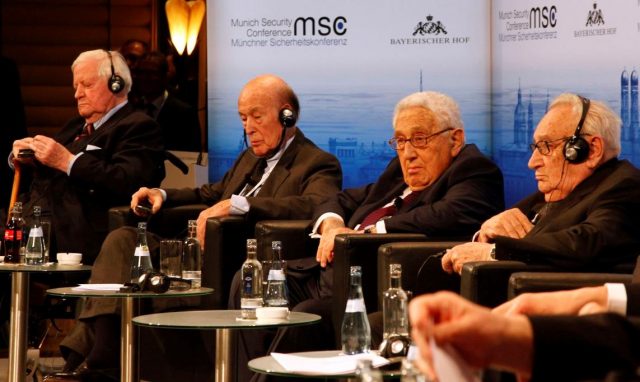
By Alex GORKA | Strategic Culture Foundation | 15.02.2018
So, Russia is the biggest “threat” to European security? And this is what the West, which has done nothing to provoke Moscow, is concerned about? Moscow is to blame for the erosion of arms control, the military deployments in Europe, the close calls during military exercises, and much else that is undermining European security? This view is supported by the recent annual Munich Security Report, titled “To The Brink – And Back?” released on Feb. 8. That paper warns that the security situation will further deteriorate, possibly leading to a military clash.
The annual Munich Security Conference (MSC) will take place on February 16-18. No doubt the participants will paint Russia as a bully who is responsible for each and every thing that is going wrong, while the “innocent” West is calling for restraint and is ready to go to any length to preserve peace on earth.
The West is innocent? Russia is a bully and a threat? This is the right time to look at recent events to see what’s really happening. The US 2019 draft budget released on Feb. 12 asks Congress to approve over $6.3 billion for the US-led NATO European Reassurance Initiative (ERI). In other words, this money is to be spent on a military build-up near Russia’s borders. The ERI was launched in 2014 as a symbolic gesture to assuage East European fears. It has turned into a large-scale deployment that just keeps growing. The cost totaled $3.4 billion in FY 2017, and $4.8 billion in 2018. President Trump’s 2019 budget proposal also envisages $250 million in military aid to Ukraine, which Russia views as an openly provocative move.
The US budget allocates a total of $716 billion for national defense, including $24 billion to modernize its existing arsenal and create new offensive nuclear weapons. For comparison, the Russian 2017 defense budget was roughly $70 billion – about 1/10th of the size of the American appropriations. And the American budget isn’t just paying for weapons. It also includes $661.4 million for broadcasting purposes (the Broadcasting Board of Governors) or, to call a spade a spade, the information war against Russia.
On Feb. 12, a group of Democratic senators introduced a resolution pushing President Donald Trump to authorize new sanctions against Russia, in accordance with the Сountering America’s Adversaries Through Sanctions Act, CAATSA). They are infuriated by what they call the “lack of seriousness shown by the administration in the face of a clear national security threat.”
NATO is quietly beefing up its logistics infrastructure, preparing for a war with Russia. Norway is hosting US Marines, who are deployed near the Norwegian-Russian border. Oslo is to join the NATO missile defense system. The US military presence in Europe has been growing for two years. NATO has recently deployed four battle groups in Poland and the Baltic states and is stepping up its presence in the Black Sea.
There are events that are kept out of the spotlight, but that illustrate how NATO keeps on expanding, in order to undermine Russia’s security and interests. On Feb. 5, Romania, a NATO member, reached an agreement with Moldova to form a joint battalion to familiarize Moldovan military personnel with NATO’s standards. Officially, the unit is to be deployed only under “extraordinary circumstances.” This is the first time that the two countries’ militaries have ever created a joint unit. More than 800 Moldovan officers have undergone military training in Romania. The two countries plan to hold more joint military exercises.
Romania has expressed its strong support of the idea of having Russian peacekeepers withdrawn from Transnistria, with an OSCE mission to take their place. No doubt Bucharest plans to take part in such a mission. Romania has always supported the concept of unification with Moldova. That unification would include Transnistria, where Russian peacekeeping forces are deployed. Once the joint battalion has been created, NATO forces will be facing Russian troops eyeball to eyeball.
The Moldovan government has banned Russian broadcasting. It is striving to integrate with the EU and is sending its military to take part in NATO drills, including in Ukraine. Transnistria favors Russia and wants to join the Moscow-led Eurasian project. Its people reject the idea of integration with Romania. With the Russian peacekeepers gone, the probability of armed conflict will be high.
2018 is the year the NATO Aegis Ashore ballistic missile defense system is to be deployed in Poland. The system can fire Tomahawk surface-to-surface intermediate-range cruise missiles. It constitutes a flagrant violation of the INF Treaty. In the summer of 2018, Poland will host Anaconda 2018 – the largest NATO military exercise since the end of the Cold War. Roughly 100,000 troops, including 20,000 Polish soldiers, 5,000 armored vehicles, 150 fixed-wing and rotary-wing aircraft, and 45 ships will take part in the drills.
One of the issues being discussed at the NATO defense ministers’ meeting (Feb.14-15) is the establishment of two new headquarters – the first upgrade of the command structure since the breakup of the Soviet Union. A command responsible for maritime security will be hosted by the US. A command responsible for ground forces operations in Europe will be set up in Germany. The formal decision is to be made in July at the NATO summit.
The majority of the speakers at the upcoming Munich conference will blame Russia for everything that has gone awry. The “Russia is at it again” approach will prevail. The deployment of Iskander missiles in the Kaliningrad region will be cited as an example of Russian “aggressiveness.” Few speakers will remember who provoked Moscow into taking action to ensure its own security, or the violations of the 1997 NATO-Russia Founding Act banning the deployment of substantial combat forces, or the breach of the INF Treaty that occurred with the positioning of the Aegis Ashore Mk-41 launchers capable of firing intermediate-range missiles. Few will make any attempt to empathize or to brainstorm ideas for finding common ground with Moscow. But hope dies last. In theory, the Munich conference is the right forum for sharing fresh ideas and making new proposals. It would be much more fruitful for NATO and Russia to steer the conversation toward something constructive instead of merely hurling mutual recriminations.
Constitutional Crisis Brews in Moldova as Government Tests President’s Authority
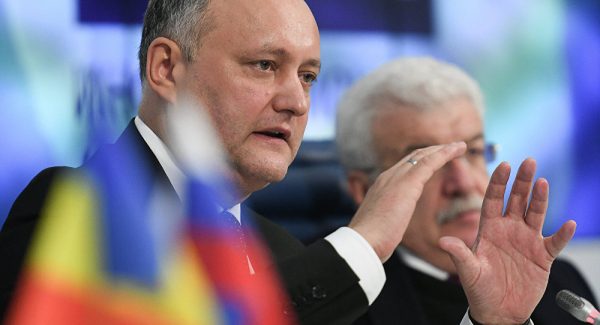
Sputnik – 4 10.09.2017
Moldovan President Igor Dodon is demanding the resignation of Deputy Defense Minister Gheorghe Galbura for defying a presidential order to block the deployment of Moldovan troops to Ukraine to participate in NATO-led military drills. Speaking to Sputnik, regional expert Boris Rozhin warned that the country is on a path to a constitutional crisis.
The Moldovan government approved sending several dozen troops to Ukraine last week, ignoring Dodon’s decree to block the deployment. Dodon described the move as an ‘usurpation of power’ by the cabinet.
Speaking to Radio Sputnik about what’s likely to happen next, Boris Rozhin, an expert at the Center of Military-Political Journalism, said that the Moldovan government will be likely to try to ignore or challenge the president’s demand for Galbura’s resignation.
“This confrontation over sending the military abroad is an indication that the constitutional crisis in Moldova is deepening,” the expert said. “The parliament and the government are refusing to recognize the president’s authority as commander-in-chief to give orders to the country’s armed forces.”
“This issue will be considered at a meeting of the country’s Security Council, and most likely, by the constitutional court, as Dodon’s decision to dismiss the deputy defense minister will either be ignored or contested,” Rozhin added.
The expert believes that this confrontation between the branches of Moldova’s government is likely to continue until the next parliamentary elections, tentatively set for November 2018.
“The confrontation can be resolved through a decision of the constitutional court, which confirms or rejects Dodon’s right to issue orders to the Armed Forces, or deepen further and continue until the next parliamentary elections,” Rozhin said.
“After that, a reformatting of the legislature may take place. At the moment, the ruling establishment does not reflect the alignment of forces in Moldovan society, which has grown tired of the government’s push for European integration, which did not bring the hoped for economic and social improvements for ordinary people.”
As the constitutionally designated commander-in-chief, Dodon vetoed the government’s decision to send 57 National Guard troops to Ukraine for NATO exercises, reminding them that Moldova is a neutral state. Ignoring the president’s order, the contingent left for Ukraine anyway. The president also signed a decree which said that Moldovan military forces would not be allowed to be sent abroad for military exercises, training or any similar events without approval from the president.
The present crisis is not the first public conflict between Dodon and the cabinet o ministers. Earlier, the government asked the UN General Assembly to consider the removal of Russian peacekeeping troops from the breakaway republic of Transnistria. Dodon called the initiative an “empty PR move.” The president and the cabinet have faced off over Russia repeatedly, the government proposing a series of unfriendly gestures, with the president, in turn, saying that he would like to bring the country closer to Moscow.
Dodon, often described by Western political observers as ‘pro-Russian’, won presidential elections in 2016, defeating his pro-West, pro-EU opponent Maia Sandu. Moldova’s parliament and government are dominated by the pro-EU Democratic Party of Moldova, a social democratic party closely associated with oligarch Vladimir Plahotniuc, and a collection of independent MPs.
Commenting on the political situation in the country, political observer Viktor Marakhovsky wrote that it would be more correct to call Dodon ‘pro-Moldovan’ than ‘pro-Russian’, because the pro-EU elites he is up against have effectively “privatized political power in exchange for international grants, figuratively speaking.” Not only do they seek to give up sovereignty to EU structures; some have spearheaded a campaign pushing for Romania’s absorption of Moldova, a campaign actively supported by Bucharest.
Marakhovsky thinks that Dodon’s best hope will be to organize a referendum to ask Moldovans to approve the expansion of the president’s powers, fresh elections and returning the subject of the history of Moldova to the country’s schools, replacing ‘the history of Romania’ subject presently being taught.
Moldova Presses Russia over Transnistria: What Next?
By Alex GORKA | Strategic Culture Foundation | 28.08.2017
The government of Moldova has called on the United Nations to discuss the withdrawal of Russian peacekeepers from the breakaway Transnistria region at the upcoming 72nd session of the General Assembly to open on September 12. A letter from the Permanent Representative of Moldova to the UN, Victor Moraru, was forwarded on August 22, calling the presence of Russian troops in Transnistria «a threat to international peace and security».
The Russian Federation has stationed about 1,200 troops in Transnistria in accordance with the «Agreement on the Principles for a Peaceful Settlement of the Armed Conflict in the Transnistrian Region of the Republic of Moldova» signed on July 21, 1992 by the presidents of Russia and Moldova in the presence of Transnistria’s leader. Transnistria, a largely Russian-speaking region, broke away from Moldova following the collapse of the Soviet Union in 1991. Its relations with Moldova’s central government in Chisinau have been tense ever since. In 1992, a bloody armed conflict sparked, with civilian casualties estimated in hundreds on both sides. The truce ended a war between pro-Russian forces and the Moldovan military.
Besides the peacekeepers, there are also around 800 Russian military personnel who guard ammunition depots near Kolbasna settlement left over from the days of the USSR. Their scrapping and removal started in 2001, but was blocked by Transnistria’s residents in 2004 amid deteriorating relations with Chisinau.
In 2008, NATO’s Parliamentary Assembly adopted a resolution urging Russia to «withdraw its illegal military presence from the Transnistrian region of Moldova in the nearest future». Since 2014, after conflict erupted in Ukraine, Moldova has banned Russian military from crossing its territory and the Russian Aerospace Forces from landing at the airport in Chisinau.
In November 2016, the defense ministers of Moldova and Ukraine concluded an agreement on the organization of a «green corridor» for the withdrawal of Russian troops, together with weapons, from the territory of the Transnistrian Republic. It was perceived by Moscow as a provocative move as neither Russia nor Transnistria had been consulted.
On May 2, the Constitutional Court of Moldova declared unconstitutional the presence of Russian soldiers on the territory of the Transnistrian region of the republic. On July 30, the Government of Moldova called the Russian peacekeepers «a factor in the freezing of the Transnistrian conflict».
In July, Moldova’s parliament adopted a declaration, asking Russia to withdraw its troops from Transnistria. The move came a day after the Moldovan Foreign Ministry warned the military aircraft with Russia’s Deputy Prime Minister Dmitry Rogozin on board was not allowed to land in Chisinau for a visit to mark the 25th anniversary of the Russian peacekeeping mission in Transnistria. Andrei Neguta, the Moldovan ambassador to Russia, was invited to the Ministry of Foreign Affairs. Deputy Foreign Minister Grigory Karasin expressed a firm protest against the Moldovan government’s decision to declare Deputy Prime Minister Dmitry Rogozin a persona non-grata.
The official emphasized that Russia has been consistently working to develop good relations with Moldova in the past few years. In contrast, Chisinau’s irresponsible steps are aimed at deliberately undermining bilateral relations.
Moldova’s President Igor Dodon condemned the declaration on withdrawal of Russian peacekeepers adopted by the parliament, accusing the pro-Western lawmakers of trying to worsen relations with the Russian Federation. He also claimed that such a decision could only come from «outside Moldova», presumably referring to Romania. Romania’s Prime Minister Mihai Tudose and several Romanian ministers were in Chisinau on July 21 – the day the resolution was passed – for a joint government meeting with the Moldovan executive.
The parliamentary resolution was not approved unanimously. «This is a serious violation of common sense. At least allow us to look at it properly», Socialist MP Vlad Batrancea said in parliament. «We believe this is a geopolitical provocation», he added. The lawmakers from the opposition Socialist Party left the parliament’s meeting in protest.
Transnistria’s legislators condemned the declaration, adopted by the Moldovan parliament. The Transnistrian authorities also strongly oppose the Moldova’s plan to withdraw Russian peacekeepers. During 25 years, the peacekeeping mission has been a success. There have been no clashes. After all, nobody else but Moldova insisted on an international peacekeeping force in 1992.
Russia considers Moldova’s letter to the United Nations requesting the withdrawal of Russian peacekeepers from Transnistria as another hostile action. Russia’s ambassador to the United Nations, Vasily Nebenzya, has objected to the Moldovan government’s call for the UN to discuss withdrawing Russian troops at the next month’s General Assembly session. He believes the «sudden move» was «not very friendly», especially in view that Moscow had not been warned in advance of this request. The Russian representative to the UN also said that this initiative of Moldova would not contribute to the 5 + 2 talks on Transnistrian settlement.
There is a very important aspect of the problem to be mentioned here. Chisinau puts forward the argument that the 1999 OSCE Istanbul summit included the commitment by the Russian Federation to withdraw from Transnistria by December 31, 2002. It fails to mention the fact that the agreement was linked to the provisions of the 1990 Treaty on Conventional Armed Forces in Europe (CFE) that limited NATO and Warsaw force disposition in Europe. The treaty was never fully observed by NATO as it kept on expanding. In 2007, Russia suspended its participation in the treaty, and on 10 March 2015, citing NATO’s de facto breach of the CFE, Russia formally announced it was completely halting its participation in it as of the next day. The treaty has become history today, it’s not effective anymore. It’s worth to emphasize that the Istanbul document does not rescind the 1992 truce accord.
There is no doubt that the Moldovan letter is an element of the propaganda war to be used by the West in its effort to paint Russia as an «aggressor». Ukraine will use the opportunity for attacks against Russia.
And now, last but not least. Neither the Moldovan government, excluding the president, nor the parliament has mentioned the need to take into account the opinion of Transnistrian people. After all, they have the right for self-determination. The Moldovan letter to the United Nations includes everything but the right of the Transnistrian people to decide their own fate. Should Russia abandon them?
Is there any guarantee there will be no armed conflict sparked right after the Russian military personnel’s withdrawal? If Russia leaves and innocent people die again, will Moldova take on responsibility? Will it be ready to admit its guilt? Is there any other OSCE member but Russia willing to dispatch peacekeepers to Transnistria and shoulder the expenditure? Is there any progress on finding a solution to the problem through talks? Finally, is Moldova ready to provide answers to all these questions at the United Nations General Assembly’s session in September?
Moldova to Become Foothold for US Military

By Peter KORZUN | Strategic Culture Foundation | 10.08.2017
The former Soviet republic of Moldova may actually become yet another foothold for the US military in Europe. The US Naval Facilities Engineering Command Europe Africa Southwest Asia (NAVFAC EURAFSWA) plans to construct eight training facilities for military operations in urban terrain at the Bulboaca training base in Moldova. The fact that the US Navy Department is involved makes believe the facility will host American Marines.
A total of $1.6 million has already been invested in the renovation of the Bulboaca base located near Tiraspol, the capital of Transnistria or the Transnistrian Moldovan Republic. The largely Russian-speaking region broke away from Moldova following the collapse of the Soviet Union in 1991.
The secession led to an armed conflict that ended in a ceasefire in July 1992. Russian troops were deployed to the conflict zone in accordance with the «Agreement on the Principles for a Peaceful Settlement of the Armed Conflict in the Transnistrian Region of the Republic of Moldova», signed in 1992 by the presidents of Russia and Moldova in the presence of Transnistria’s leader.
Today, 450 Russian servicemen are carrying out the peacekeeping mission in accordance with the decisions of the 1999 Organization for Security and Co-operation in Europe (OSCE) summit. Besides the peacekeepers, Russia holds units of the 1,200-strong Operative Group of the Russian Forces residing in Transnistria. The Transnistrian authorities strongly oppose Moldova’s plan to withdraw Russian peacekeepers, whom they see as guarantors of peace in the region. They point out that the mission has proved to be highly successful. The 25th anniversary since the start of the peacekeeping operation was marked in July.
Since 2005, talks on Transnistrian peace have been held in the so-called «5+2 format», which includes Moldova, Transnistria, the OSCE, Russia, and Ukraine, plus the European Union and the United States in external observers’ roles.
Moldovan President and Supreme Commander-in-Chief of the Armed Forces Igor Dodon stepped in to suspend the implementation of the plans to build a US military facility in Bulboaca, saying the move was not approved by him. The president said he will examine the issue. Meanwhile, the US stopped financing the project.
Anatol Șalaru, acting leader of the Party of National Unity and ex-Defense Minister, said he is going to sue President Dodon for undermining national security as the US suspended the $12, 7 military aid to modernize Moldova’s military through the Foreign Military Financing (FMF) program.
Moldova closely cooperates with the US and NATO. It joined the NATO Partnership for Peace program in 1994 and the Individual Partnership Action Plan in 2006. A NATO liaison office is to open in Chisinau soon.
Since 2016, Moldova has been included in a US regional program to build «more formidable defense capabilities… against aggressive actions by Russia or from other sources». Areas targeted include «border security and air/maritime domain awareness, as well as building stronger institutional oversight» of defense ministries. Last March, Lt. Gen. Ben Hodges, the commander of US Army Europe, said that military engineers would head to Moldova as the US looks «for ways to do more exercises in the southern flank of NATO».
In February, the US donated 41 High Mobility Multipurpose Wheeled Vehicle (HMMWV) and trucks to the Moldovan Army. The military vehicles would be used during national and international exercises. In 2014, the US donated some other 39 HMMWV and 10 trailers for the military vehicles.
On July 24 — August 5, the base hosted the Dragoon Pioneer 2017, joint drills of US and Moldovan troops. Army Maj. Gen. John L. Gronski, Deputy Commanding General for Army National Guard, US Army. Europe, visited Moldova to watch the training event.
In late July, the Moldovan parliament passed a declaration demanding the withdrawal of Russian troops from the territory of the unrecognized Transnistrian Moldovan Republic. The resolution was supported by deputies from the ruling coalition led by the Democratic Party, as well as representatives of Liberals and Liberal Democrats. The lawmakers from the opposition Socialist Party left the meeting in protest. Moldovan President Igor Dodon condemned the parliament’s decision, calling it a provocation.
Moscow expresses concern over the Moldovan policy in Transnistria. Russian military personnel movements are obstructed by Moldavan authorities. In late July, Russian Deputy Prime Minister Dmitry Rogozin was barred by the Moldovan government from flying to Transnistria in a military plane to celebrate the 25th anniversary of Russia’s deployment of peacekeepers there. Russia retaliated by halting imports of Moldovan farm produce, depriving Europe’s poorest country of a key market for its wine, fruit and vegetables. In early August, Moldovan authorities declared Rogozin persona non grata. Actually, the relations had begun to worsen much earlier after the expulsion of five Russian diplomats in May. President Igor Dodon believes that the government embarked on provocations against Russia in order to complicate relations.
Moscow has accused Moldova of undermining their relations and threatening regional stability. The Russian Foreign Ministry’s statement reads: «High-ranking Russian representatives and peacekeepers but also ordinary citizens of both countries have recently become targets of provocations. It seems that Chisinau politicians are trying to get to the forefront of the hysterical and hopeless campaign that has been launched against the Russian Federation». It adds that dangerous actions may have a serious destabilising influence on the general situation in the region and Europe as a whole. Kremlin spokesman Dmitry Peskov said Moldova’s decision to ban Rogozin was «much worse» than even the new tough US economic sanctions on Russia.
The US military presence is expanding everywhere, including areas in the proximity of Russia’s borders, such as Transnistria. This is a very dangerous development to make US forces and Russian peacekeepers watch each other through gun sights. Moscow and Chisinau may have different views and divisions but it does not make them adversaries.
With Russian peacekeepers gone, the situation would exacerbate and a spark would be enough to restart the hostilities – something that has been prevented since 1992. By hosting US-operated facilities on its territory, Moldova, a neutral state, will become a target for a Russian retaliatory strike. Parliamentary elections are expected to be held in Moldova in November 2018. Hopefully, the voters will make the right choice, electing more responsible people to end incessant provocations and adopt a more reasonable foreign policy. If the hopes come true, Russia and Moldova will become friends and good neighbors again.
Chisinau to Negotiate Status of Breakaway Transnistria in Moldova in 2017
Sputnik – 04.02.2017
CHISINAU – Moldova’s Prime Minister Pavel Filip stated that the issue of defining the details of the special legal status of the self-declared republic Transnistria as a part of Moldova will be a top priority in 2017 for Chisinau.
“In 2017, our main interest is to raise the issue … of elaboration of the special legal status of Transnistria as a part of Moldova within the negotiating process,” Filip said following the meeting with Austrian Prime Minister and OSCE Chairperson-in-Office Sebastian Kurz.
Filip stressed that Chisinau opposed federalization and considered it “not a good decision.”
The Moldovan prime minister expressed hope that the negotiations on the Transnistrian settlement would be more consistent and productive, making specific mention of “the intensification of 5+2 format meetings” in 2017.
The Transnistrian conflict began in 1990 when Transnistria, a region with a predominantly ethnic Russian and Ukrainian population, seceded from the Soviet Republic of Moldova, fearing possible reunion with Romania. The separation led to a conflict known as “The Transnistria War” that ended in a ceasefire declared on July 21, 1992. However, the conflict remains unresolved and the breakaway republic continues to be governed by an independent de facto government.
Since 2005, the talks on the conflict have been held in a 5+2 format, where the ‘five’ refers to Transnistria, Moldova, Ukraine, Russia and the OSCE, and the ‘two’ are the EU and US, which act as external observers. The latest round was held on June 2-3, 2016 in Berlin.
Featured Video

EUROPE FEARS RUSSIA’S NEXT MOVE / Ian Proud
or go to
Aletho News Archives – Video-Images
New Book
New Book: No Autoimmunity The Body Doesn’t Attack Itself
Lies are Unbekoming | September 24, 2026
 The label for Humira, once the best-selling drug in the world, lists its risks in plain print. One of them, in the label’s own words, is new “autoimmune” disease.
A drug prescribed for a condition labelled autoimmune carries a warning that it can cause a condition labelled autoimmune. That contradiction sits in every box, on a folded paper almost nobody reads.
My new book starts there.
No Autoimmunity: The Body Doesn’t Attack Itself
For seventy years, “your body is attacking itself, and we don’t know why” has ended the conversation for people diagnosed with multiple sclerosis, lupus, rheumatoid arthritis, Hashimoto’s, Type 1 diabetes, Crohn’s and psoriasis. More than eighty conditions now carry the autoimmune label. The diagnosis comes with a prescription for life. It almost never comes with a question about cause.
This book asks the question and answers it from the framework’s own records: its drug labels, its journals, its regulatory filings, and its own experiments. … continue
Blog Roll
 Aletho News
- New Book: No Autoimmunity The Body Doesn’t Attack Itself
- EUROPE FEARS RUSSIA’S NEXT MOVE / Ian Proud
- Big tech hands in its DSA censorship reports to the EU
- ‘A Big Victory’ – Palestine Chronicle Wins Two-Year Legal Battle
- IAEA inspectors cannot return to Iran amid US threats: Russia
- Senate Rejects Iran War Powers Resolution Passed By House
- ‘We did not attack Pakistan with drones’: Afghan sources
- Iraqi Resistance faction links arms to sovereignty, questions US exit
- Cannon fodder no more… South Korea rejects Trump’s pressure to join his criminal war on Iran
- Neria Leiter Was A Legitimate Military Target
- If Americans Knew
- ‘This is where I live now, the back of a truck’: a day in the life of a grandmother in Gaza
- In UN Speech, Iran’s President Displays Pictures of Children Killed by US, Brings Attention to Israel’s Nuclear Arsenal
- Israel displaces hundreds of Palestinians amid wave of demolitions in West Bank
- Aid, reconstruction, and Israel’s history of obstruction in Gaza
- Trump administration digs an ever-deeper hole of complicity in genocide – Daily Update
- US-Israel $2.8 Billion Arms Deal, 40,000-Bomb Supply Faces New Gaza Complicity Accusations
- Caught on Tape: AIPAC CEO Boasted of Controlling Trump’s National Security Officials
- Why Hamas Attacked Israel in October 2023 – Israeli professor Ilan Pappé
- They see them, then kill them: Israeli quadcopters track, deliberately target civilians in Gaza
- Winter could turn Gaza’s treacherous, war-damaged buildings into deathtraps
- No Tricks Zone
- New Study: Earth And Venus Surface Warmth Largely Explained By Convection And Lapse Rate, Not CO2 Or Radiation
- 2025 Nature Paper Claiming Worsening Global Drought Gets RETRACTED …Heavily Flawed
- New Study: ‘Global Drought Shows No Detectable Recent Acceleration Under Climate Warming’
- Economic Masterminds: German Socialists Suggest Taxing Productivity Gains Stemming From Using AI
- The South China Sea Has Not Been Cooperating With The Climate Change Narrative
- Energy Crisis: Germany Enters Heating Season With Historically Low Gas Reserve Fill Levels
- New Study: The Antarctic Ice Sheet Gained Mass From 2020-2024 Due To Staggering Snow And Ice Accumulation
- Study: Ocean Heating Rates From Thousands Of Years Ago ‘Dwarf’ Modern Ocean Heating Rates
- Climate Extremists Target, Attack Large-Scale Power Grid Infrastructure In Germany!
- New Study: Antarctic Ice Melt Has Contributed Less Than 1 Centimeter To Sea Level Rise In The Last 30 Years

