Chisinau to Negotiate Status of Breakaway Transnistria in Moldova in 2017
Sputnik – 04.02.2017
CHISINAU – Moldova’s Prime Minister Pavel Filip stated that the issue of defining the details of the special legal status of the self-declared republic Transnistria as a part of Moldova will be a top priority in 2017 for Chisinau.
“In 2017, our main interest is to raise the issue … of elaboration of the special legal status of Transnistria as a part of Moldova within the negotiating process,” Filip said following the meeting with Austrian Prime Minister and OSCE Chairperson-in-Office Sebastian Kurz.
Filip stressed that Chisinau opposed federalization and considered it “not a good decision.”
The Moldovan prime minister expressed hope that the negotiations on the Transnistrian settlement would be more consistent and productive, making specific mention of “the intensification of 5+2 format meetings” in 2017.
The Transnistrian conflict began in 1990 when Transnistria, a region with a predominantly ethnic Russian and Ukrainian population, seceded from the Soviet Republic of Moldova, fearing possible reunion with Romania. The separation led to a conflict known as “The Transnistria War” that ended in a ceasefire declared on July 21, 1992. However, the conflict remains unresolved and the breakaway republic continues to be governed by an independent de facto government.
Since 2005, the talks on the conflict have been held in a 5+2 format, where the ‘five’ refers to Transnistria, Moldova, Ukraine, Russia and the OSCE, and the ‘two’ are the EU and US, which act as external observers. The latest round was held on June 2-3, 2016 in Berlin.
Transnistria and Donbass: Historical Parallels and Possible Similar Scenarios for the Future
By Halyna Mokrushyna | CounterPunch | January 13, 2017
On January 4, President Igor Dodon of Moldova met with Vadim Krasnoselskiy, the head of the unrecognized Pridnestrovian Moldavian Republic (Transnistria). The meeting took place in Bendery, on the right bank of Dniester river, on the territory of the Transnistria. It was initiated by the president of Moldova.
Igor Dodon was elected Moldovan president on November 13 on a platform advocating improved relations with Russia.
During the meeting, both sides established a good contact and expressed openness and willingness to compromise. Concrete decisions have been taken to improve relations between Moldova and Transnistria. “Citizens on both sides of the Dniester River (which runs through the territory of Moldova and the right (eastern) border of Transnistria) should see the concrete results during 2017,” stated President of Moldova Igor Dodon .
The president of Transnistria Vadim Krasnoselskiy stressed the importance of compromise with Moldova for people living on both sides. “We must create the conditions so that people are not held hostage to politics, so that decisions taken by politicians are for the benefit of the people. We must respect the people of Moldova and Transnistria and find a compromise in any case”, stated Vadim Krasnoselskiy.
During the meeting, the first in eight years, the presidents of Moldova and Trasnistria discussed a whole range of practical issues that have accumulated in recent years, including problems in education, registration of vehicles, communication, movement of citizens, rail transport, recognition of diplomas and car plates.
At the same time, political issues were not discussed. Recognition of the independence of the Pridnestrovian Moldavian Republic (PMR) by Chisinau remains the main bone of contention between the two republics. Chisinau designates PMR as the Transnistria autonomous territorial unit with special legal status. PMR is not recognized by any country, member of the UN, while the UN itself considers PMR to be part of Moldova.
PMR emerged as a reaction of the mostly Slavic population of this territory to the rise of pro-Romanian nationalism among ethnic Moldovans in the late 1980s, the period of Gorbachev’s perestroika and glasnost in Russia. The most prominent movement formed at that time, the Popular Front of Moldova, formulated three main demands: that Moldovan be declared the only state language, that the Moldovan language switch to use of the Latin alphabet instead of the Cyrillic one, and that Moldovan ethnic identity be recognized as identical to Romanian one. The radical factions of the Popular Front called for minority populations, particularly the Slavs (mainly Russians and Ukrainians) and Gagauz, to leave or be expelled from Moldova.
The Supreme Council of the Moldavian Soviet Socialist Republic followed through on main three demands: on August 31, 1989 it adopted Moldovan as the only official language, while retaining Russian for secondary purposes; it introduced the Latin alphabet; and it declared a shared Moldovan-Romanian linguistic identity. The publicly stated intentions of the Moldovan authorities to bring the country closer to Romania, as well as the ethnocentric rhetoric of the Popular Front, provoked serious concerns of ethnic minorities in the country. Transnistria’s population was predominantly Slav – 60% were Ukrainians and Russians, while less than 40% were ethnic Moldovans. The overall majority of the population, including some ethnic Moldovans, spoke Russian as their mother tongue.
The nationalist Popular Front won the first free parliamentary elections in the Moldavian SSR in the spring of 1990. On 2 September 1990, the Second Congress of the Peoples’ Representatives of Transnistria proclaimed the creation of the Pridnestrovian Moldavian Soviet Socialist Republic. Violence escalated when in October 1990, the Popular Front called for volunteers to form armed militias to stop an autonomy referendum in Gagauzia. In response, volunteer militias were formed in Transnistria.
Limited armed clashes between Transnistrian militia and Moldova started in November of 1990. Volunteers from Russia came to support Transnistrians. In early 1992, the fighting intensified. The former Soviet 14th Guards Army, stationed in Transnistiria, which remained neutral throughout the fighting, entered the conflict in its final stage, swearing allegiance to Transnistrian authorities and opening fire against Moldovan forces. A ceasefire agreement was signed on 21 July 1992 and has held to the present day.
The history of the emergence of the Pridnestrovian Moldavian Republic holds several striking similarities with the current conflict in Ukraine. There, the people of the Donetsk and Lugansk oblasts in eastern Ukraine rebelled against the nationalist rhetoric of the Euromaidan movement and the government brought to power through a coup d’état on February 21-22, 2014. One of the first steps of that government was to abolish the existing law on languages in Ukraine granting Russian a special status in Russian-speaking regions of Ukraine. Ukrainian is the only official language in Ukraine. Changes to the language law in 2013 granted Russian a special status in areas of majority or large minority Russian speakers, but the law was bitterly opposed by Ukrainian nationalists.
Another similarity is the linguistic profiles of Ukraine and Moldova. Like Transnistria, where the majority of population speaks Russian, Donetsk and Lugansk regions are the only regions of Ukraine, where Russian language is spoken by the large majority of the population. Population of these regions of Ukraine has always been close to Russia culturally, as with the population of Transnistria. Russian volunteers poured into Transnistria to help locals to defend their rights against Moldovan nationalism; in the same way 20 years later, Donetsk and Lugansk received the support of volunteers from Russia in their fight against Ukrainian nationalism and against a forceful integration into the European Union by the coup government that came to power in 2014. They wanted closer ties with Russia. However, Russia has not officially recognized the Donetsk and Lugansk People’s Republics, as it has not recognized the Pridnestrovian Moldavian Republic. Russia does provide extensive humanitarian assistance to both entities and maintains extensive economic and cultural relations.
Moldova has not officially recognized Transnistria. But at least it stopped waging war against against the breakaway republic, and it has settled into an uneasy coexistence. The relations between Moldova and Transnistria are often characterized as a “frozen conflict”. All attempts to find a formula for political settlement of the unrecognized status of the PMR between the PMR and Moldova have not produced any result.
Since independence in 1991, Moldova, like Ukraine some 20 years later, set out on a course of economic integration into the European Union. Even the so-called ‘pro-Russian’ Moldovan presidents over the years, such as Vladimir Voronin (2001-2009), followed this course very closely. For example, in 2003, Voronin refused to sign a memorandum proposed by the Russian Federation outlining plans for a unification of Moldova and the PMR into a federal state of Moldova. Voronin stated that since Moldova plans to join European Union, such a plan needed the approval of ‘European structures’, beginning with the Organization for Security and Cooperation in Europe’, and therefore he could not endorse it.
In the current conflict between Kyiv and Donetsk and Lugansk republics, Russian officials have stated on many occasions that the two republics (comprising the historic industrial region called ‘Donbass’) should be granted a large autonomy within a unitary Ukraine, in spite of the evident desire of the populations of the two breakaway republics to desire to integrate into the Russian Federation.
The ceasefire and political-settlement agreement signed in Minsk, Belarus on Feb 12, 2015 (termed ‘Minsk-2’, text here) with the endorsement of France, Germany, and Russia, outline beginning principles of this autonomy, but Kyiv has been stubbornly sabotaging the agreement.
The new president of Moldova, Igor Dodon, is proving himself a wiser and more mature politician compared to Ukrainian leaders, as shown by his visit to the Pridnestrovian Moldovan Republic. He declared that Moldova under his presidency will remain a neutral country, not choosing between European Union or Russia. The population of Moldova, like the population of Ukraine, has always been split in its political and cultural sympathies towards Europe and Russia. Most Moldovans and probably a majority of Ukrainians believe the best way to keep their country safe and whole is by preserving a neutral status between the EU and the Russia-dominated Eurasian Economic Union to the east. Dodon has demonstrated a practical approach of compromise and negotiation in the interests of the population of both Moldova and the PMR.
Kyiv should follow Dodon’s example because it is the only path to peace in Ukraine. Unfortunately, the current political regime in Kyiv is unlikely to do that. The news of Dodon’s meeting with the president of the PMR was not even reported by mainstream Ukrainian media.
The recent call of one of the richest Ukrainian oligarchs, Viktor Pinchuk, to make painful compromises with Russia and implement Minsk-2 and return to a neutral status for Ukraine to reach peace in Donbass, has been repudiated by Poroshenko’s administration. Konstantin Eliseev, the deputy head of the Presidential Administration, stated that Ukraine will never turn away from integration into the European Union and NATO . (See my Dec 31, 2016 article ‘ Prominent member of Ukraine’s elite issues call for peace in Donbass’.)
But to the ongoing consternation of officials of the Kyiv government, full membership of Ukraine in the European Union has always been treated cautiously and even reluctantly by European Union officials. They have used the idea to foment conflict between Ukraine and Russia, which is not the same as supporting and facilitation it, as Ukrainians are today learning.
Ukrainians blindly mistook a loose economic association with Europe as being a step toward an inevitable, full integration into the European Union. They naively hoped that the European Union will solve the economic disaster that the country became following independence in 1991, particularly following the failed ‘Orange Revolution’ of 2005 in which competing interests among the country’s economic elite fought for domination amidst a backdrop of deep, social protest by ordinary Ukrainians.
This blind, naïve hope has brought further economic disaster and civil war in Ukraine. The official Ukrainian propaganda blames Russia for all of the troubles beginning in 2013 and it refuses to recognize Kyiv’s fault in its unleashing of a so-called Anti-Terrorist Operation (complete with its own, catchy acronym—the ‘ATO’) against its own people. Kyiv relied heavily on U.S. support in the conflict with Russia. Now, that support may dwindle if President-elect Donald Trump carries through his various, offhand statements that he is interested in seeking improved relations with Russia.
Kyiv should review its categorical refusal to accommodate Donetsk and Lugansk if it wants to keep Donbass within Ukraine. Otherwise the Donetsk and Lugansk People’s Republics will follow the path of the Pridnestrovian Moldovan Republic in exercising a permanent autonomy. It is a very plausible scenario, given the fact that the conflict in Donbass has been frozen for more than two years and Ukraine continues to punish the two republics with unceasing artillery fire and a punishing economic blockade.
Halyna Mokrushyna is currently enrolled in the PhD program in Sociology at the University of Ottawa and a part-time professor. She holds a doctorate in linguistics and MA degree in communication. Her academic interests include: transitional justice; collective memory; ethnic studies; dissent movement in Ukraine; history of Ukraine; sociological thought. Her doctoral project deals with the memory of Stalinist purges in Ukraine. In the summer of 2013 she travelled to Lviv, Kyiv, Kharkiv and Donetsk to conduct her field research. She is currently working on completing her thesis. She can be reached at halouwins@gmail.com.
Anti-democracy protests spread to Moldova
Press TV – November 15, 2016
Thousands of Moldovans have protested in the capital Chisinau after a West-leaning politician claimed that a presidential runoff which propelled her pro-Russian rival to victory was “neither free nor fair.”
The protesters gathered in front of Moldova’s Great National Assembly before marching to the Central Electoral Commission where a high number of riot police were deployed.
Final results on Monday showed socialist-backed opposition candidate Igor Dodon won 52.2 percent of the vote against Maia Sandu who had 47.8 percent.
Sandu cried foul, accusing her rival of using “manipulation, lies, dirty money” in his bid to win.
Up to 3,000 mostly young Moldovans then marched to the offices of the Central Election Committee in Chisinau shouting “Down with the Mafia!”
International election observers, however, said “fundamental freedoms were respected,” even though “polarized media coverage, harsh rhetoric detracted from the process.”
The Organization for Security and Cooperation in Europe (OSCE) described its overall assessment of the election as positive but said reports that some voters were unable to vote due to the lack of ballots were “regrettable.”
The 41-year-old Dodon tapped into popular anger over the approximately $1 billion that went missing from Moldovan banks before the 2014 parliamentary elections.
Many Moldovans hope Dodon’s election will rekindle ties with Moscow, which took a hit after the country signed an association agreement with the European Union in 2014.
Russian President Vladimir Putin invited Dodon to visit Moscow and said he looked forward to developing bilateral relations.
The eastern European state of 3.5 million is located on the fault line separating Russia from Europe. Dodon has pledged to pursue closer ties with Russia rather than the European Union.
He argues that the recent gravitation towards the European Union has cost the country its ties with neighboring Russia. Dodon’s policy is backed by many Moldovans who suffered financially from the goods embargo imposed by Russia and a broader economic downturn.
Moldova has been in turmoil since the mysterious disappearance of money from three banks, which sparked huge street protests and the arrest of the former prime minister Vlad Filat.
‘Trump effect’ divides European opinion
By M K Bhadrakumar | Indian Punchline | November 14, 2016
The results of the two presidential elections held on Sunday in Bulgaria and Moldova underscore the winds of change blowing over the western edges of Eurasia. To an extent they can be called the early signs of the ‘Trump effect’. In both elections, ‘pro-Russian’ candidates won convincingly. (here and here)
In both cases, the contestation essentially boiled down to whether Bulgaria and Moldova would be better off casting their lot with the European Union or whether they need to realign with Russia. The answer is clear.
The open-ended quest for EU membership no longer holds attraction for Moldova, whereas, Bulgaria appears to be disheartened with its EU membership. On the other hand, Russia is real and it is next-door. The election results yesterday constitute a blow to the EU’s prestige. Indeed, Moscow’s influence is spreading in Eastern Europe.
This is also a swing to the Left in political terms. There is much discontent with ‘reforms’, rampant corruption, etc. in both countries. The Russophile sentiment is very substantial, and there is eagerness to boost trade with Russia to overcome economic difficulties. Also, the local partisans of the West and EU stand discredited in both countries.
In Moldova, only around 30% of population find EU attractive, while 44% would support their country joining the Moscow-led Eurasian Economic Union. Curiously, 66% of Moldovans trust Vladimir Putin; in comparison, only 22% place trust in Barack Obama’s words.
Against the backdrop of the election victory of Donald Trump in the US, how these trends are going to play out will be interesting to watch. Bulgaria’s president-elect Rumen Radev has called for an end to the EU sanctions against Russia. He argues that Sofia should be pragmatic in its approach to Russia’s annexation of Crimea. (This is notwithstanding Bulgaria’s long history of divided loyalties between Russia and Europe.)
The Obama administration in its lame duck phase will endeavour to pressure the EU to extend the sanctions against Russia for yet another 6-month period beyond December. But will Trump follow Obama’s footfalls when the issue crops up again toward the middle of next year? He is unlikely to show Obama’s messianic zeal to ‘contain’ Russia. That is how the EU consensus on sanctions against Russia can break down because many countries in Europe resent the American pressure and prefer to restore trade and economic ties with Russia.
Interestingly, Trump may get resonance in Old Europe as well. The Labour leader in Britain, Jeremy Corbyn made a stunning call in the weekend for Western leaders to ‘demilitarize’ the border between Eastern Europe and Russia or risk a New Cold War. He said the West didn’t have to pile up forces on Russia’s border. Corbyn told the BBC:
I have many, many criticisms of Putin, of the human rights abuses in Russia, of the militarisation of society. But I do think there has to be a process that we try –demilitarise the border between what are now the NATO states and Russia, so that we drive apart those forces and keep them further apart in order to bring about some kind of accommodation. We can’t descend into a new Cold War.
Corbyn also made a thoughtful suggestion that that the Organisation for Security and Co-operation in Europe, which includes Russia, could replace NATO as a forum for solving issues in the region.
Indeed, some churning has already begun regarding European security even before Trump takes over in the Oval Office. By the way, Czech Prime Minister Bohuslav Sobotka said on Sunday that American statements about possible deployment of a U.S. global missile shield’s radar in the Czech Republic are pure fiction.
He said, “A radar in the Czech territory would mean further escalation in relations with Russia. We need to use the window opening after Donald Trump’s election to have the United States and Russia sit down at one table.” Sobotka pointed out that Eastern Europe’s main security problem today is about putting an end to the war in Syria.
“The United States has considerable influence on the situation in Syria, Russia has considerable influence. So, it is necessary to use this,” he said, adding that Donald Trump can establish more efficient cooperation with Russia on Syria.
However, the fact of the matter is that neither has Trump taken his position yet on NATO nor is it going to be easy for him to seek a separation for America from the western alliance. Simply put, Europe is not ready for a post-NATO future. There is palpable fear in many quarters (both in the US and in Europe) that if the US were to withdraw from Europe, Russia would advance and exercise more assertive behaviour in Eastern Europe.
In an article in the weekend, NATO secretary-general Jens Stoltenberg made an impassioned appeal to Trump that now is not the time for the US to abandon NATO. He pointedly invoked the threat perceptions from “a more assertive” Russia. Read the opinion piece here.
The bottom line is that European opinion stands divided. Britain, France and Hungary refused to attend a contentious EU ministerial meeting last night in Brussels, backed by Germany, to align the bloc’s approach to Trump’s election. The rift within the EU on the US vote stands exposed. The irrepressible British Foreign Secretary Boris Johnson has publicly chided EU politicians to end their ‘whinge-o-rama’ over Trump. (Daily Mail )
Interestingly, the first politician from abroad whom Trump met after the election has been Nigel Farage, the populist Brexit campaigner.
Ukraine’s Ethnic Romanians Demand Autonomy Rights
Sputnik – 21.06.2016
 The assembly of ethnic Romanians living in Ukraine’s Chernivtsi region has called on President Petro Poroshenko to grant them territorial autonomy status, the newspaper Ukrainski Novyni reported, citing the Assembly’s coordinator Dorin Chirtoaca.
According to Chirtoaca, granting autonomous status to ethnic Romanians would help put an end to serious violations of their constitutional rights.
In a statement released on Tuesday the Assembly of the Romanians of Bukovina said that President Poroshenko’s decision to grant autonomous rights to the Crimean Tatars had created a precedent for representatives of all other ethnic groups living in the country.
“We, the Romanians of Bukovina, have special rights to autonomy. Until 1944 Northern Bukovina was part of Romania and our ancestors had spent centuries creating the cultural and material wealth of this territory, while today we are deprived of our fundamental rights and freedoms,” the statement said.
The Assembly’s appeal to the EU, the Parliamentary Assembly of the Council of Europe and other international bodies is meant to draw attention to the systematic violations of the rights of ethnic Romanians in Ukraine.
Northern Bukovina and what is now Moldova became part of the Soviet Union in July 1940 following a Soviet ultimatum to the Romanian government.
NATO pledges to boost military presence in Eastern Europe
Press TV – April 27, 2016
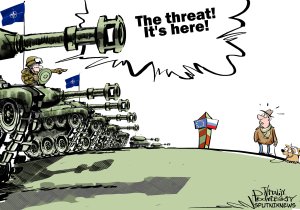 NATO has pledged to expand its military presence in Eastern Europe to protect its partners and allies from potential threats as the US sends two of the world’s most advanced warplanes to Romania.
In a speech at the University of Bucharest in Romania on Tuesday NATO Deputy Secretary-General Alexander Vershbow discussed the main issues the Western alliance is facing.
He said the alliance is struggling with many complex risks apart from the “destabilizing actions” of Russia and “the tide of instability which has swept across the Middle East and North Africa.”
“We are also wrestling with other complex risks and threats to our cyber security, to our energy supplies, and in the case of international terrorism to the safety of the people on our streets,” he said.
Vershbow said NATO is doing everything to respond to these challenges, adding that “the alliance takes a 360 degree approach to deterring threats, to protecting its member nations and if necessary to defending them.”
“That presence will be rotational, multinational, and combat capable. It will thereby send a clear message to any potential aggressor that if they violate NATO’s territory, they will face strong response from the whole alliance; Americans, Europeans and home defense forces,” he said.
The NATO secretary general also said that the organization has “set up a series of small headquarters, including here in Romania, to support planning, training and re-enforcement.”
“We are intensifying our maritime patrols, exploring the need for increased military and exercises, providing support to partners like Ukraine, Georgia and Moldova and encouraging efforts to strengthen energy security,” he said.
US sends F-22 Raptors to Romania
Vershbow’s comments came a day after the US sent two F-22 Raptor fighter jets to Romania as part of the commitment to NATO security.
The fighter jets, which travel at twice the speed of sound, touched down in Romania, close to the Black Sea and Ukraine, the Crimean Peninsula and Russia.
A US statement said the aircraft possess sophisticated sensors which would allow pilots to track, identify, shoot and destroy air-to-air threats without being detected.
The dispatch of the fighter jets, which can also attack surface targets, came two weeks after Russian fighter jets buzzed an American warship in the Baltic Sea.
The Western military alliance has been deploying troops and equipment close to Russia’s borders since it suspended all ties with Moscow in April 2014 after the Crimean Peninsula integrated into the Russian Federation following a referendum.
The United States and its European allies accuse Moscow of destabilizing Ukraine and have imposed a number of sanctions against Russian and pro-Russia figures. Moscow, however, rejects having a hand in the Ukrainian crisis.
This as Moscow has on many occasions slammed the Western military alliance’s expansion near its borders, saying such a move poses a threat to both regional and international peace.
US defense establishment believes Putin must be ‘defeated’
By Bryan MacDonald | RT | March 3, 2016

Russian President Vladimir Putin. © Alexei Druzhinin / Sputnik
Certain people in America’s defense establishment believe that only governments that do Washington’s bidding are “truly legitimate.” Others have ideological reasons to stir up tensions with Russia. This fuels discord and creates an unstable world.
Imagine if a major Russian media outlet carried an article with the headline, “How We Can Defeat Obama.” It’s pretty certain that within minutes various pro-NATO analysts would be all over Twitter labeling it as “hybrid warfare,”“Russian aggression” or even, heaven forbid, “hot war.” Or whatever this month’s agreed catchphrase is.
Let’s take it a step further. Ponder what would happen if the same pundits then realized the author was a recently redundant Russian Defense Department official. Without any doubt, the concern-o-meter would reach the stratosphere. Soon, the topic would be trending on Neocon Twitter. Neocon Twitter, by the way, is different than normal Twitter. In this version, all dissenting voices are blocked.
Last week, Newsweek published Evelyn Farkas, the former US Deputy Assistant Secretary of Defense for Russia/Ukraine/Eurasia (who vacated the post only last October). In her incredibly aggressive op-ed, Farkas explained “How We Can Defeat Putin.” The same Putin who is the popularly elected President of Russia. The world’s second strongest military power.
Farkas is now an employee of the pro-NATO Atlantic Council, which the formerly venerable Newsweek appears to have partnered with. The Atlantic Council is funded by the US State Department, the US Army, the US Air Force, the UAE & Bahraini governments and various other vested interests. None of them are particularly supportive of Russia. On the other hand, most would directly benefit from increased NATO spending.
Throwing Money At NATO
How does Farkas propose “defeating” Putin? By spending more money on NATO, of course. Also, she suggests sending more weapons to Ukraine, Georgia and Moldova. Of course, it was American meddling in the first two that created the current tensions. The latter country is currently enduring a political crisis and mass protests. This is ignored in the western media, because the corrupt incumbent regime is pro-Washington.
Farkas suggests arming the Syrian opposition, the loose coalition that includes the Al-Nusra front, which is part of Al Qaeda, the same folks who attacked New York on September 11, 2001. Not to mention, that such a course of action would destroy the nascent ceasefire in that unfortunate country.
Reading between the lines, Farkas is essentially suggesting that Washington use Ukraine, Moldova, Georgia (and anti-Assad forces in Syria) as pawns against Russia. With no concern for the economic wellbeing, or safety, of the people who live in those countries (or those in Russia). The complicated ethnic situation in those regions also seems to be irrelevant. The only priority is ‘American interests.’ Which are sacrosanct.
The fact that Farkas is the daughter of a Soviet-era Hungarian dissident is very relevant here. Charles Farkas fled Budapest, for America, following the abortive 1956 uprising. That embryonic freedom movement was brutally oppressed by Nikita Khrushchev’s USSR. Thus, it’s understandable that Evelyn has an axe to grind with Russia, even if many of its current leaders weren’t even born at that time.
Indeed, it seems almost certain that Farkas’ rhetoric projects her own deeply embedded distrust of Russia. Naturally, that hasn’t harmed her career. Hawkish anti-Russian views are attractive to the US military industry, which requires a tangible enemy to maintain funding levels. A glance at her biography shows a meteoric rise, which includes top positions at NATO.
The Big Prize
However, Farkas’s perspective outlines all that’s wrong with how the US interacts with the rest of the world today. She’s calling for the defeat of a leader with 80 percent approval ratings, because he doesn’t support US foreign policy objectives. If Putin prevents America taking over the world, he must be removed. It’s Doctor Evil stuff.
This fanatical analyst believes that Russia is a threat to America. However, it’s NATO which has been expanding during the past two decades, while Moscow has taken a defensive, often highly reactionary posture. For example, in Syria, Assad’s forces had the upper hand in Aleppo and would surely have taken the city, but Putin agreed a ceasefire rather than continue the bloodshed there. A real-life expansionist warmonger would have kept the fighting going.
In reality, it’s America which has been aggressive in this century. Illegally invading Iraq, destroying Libya, facilitating the collapse of Yemen and the Syrian Civil War. In Russia’s backyard, Washington has openly fomented uprisings in Georgia and Ukraine, the results of which have subsequently been rejected at the ballot box. The US-backed regimes in Kiev and Tbilisi were both eventually voted out after the “Orange” and “Rose” revolutions. The current ‘Maidan’ administration in Kiev now has lower approval ratings than the democratically elected, if corrupt, government it replaced.
This indicates that they were never popular upheavals to begin with, but rather driven by capital city liberals, without mass backing in the provinces.
The Washington elite believes that it can dictate to Russians about how they should be governed. They also present fringe opposition figures, like Mikhail Khodorkovsky or Garry Kasparov, as realistic alternatives to Putin. In the real world, serious Russia experts know that these characters have almost no support inside the country.
Russia After Putin?
As it happens, should Putin be removed as President, or voluntarily resign, it’s much more likely that his successor would be far more hardline in their attitude to the West. By Russian standards, Putin is a moderate. The vast majority of Russians are far less tolerant of America’s behavior than their President.
Another Neocon obsession is with NATO expansion. Their argument is that countries wish to join the alliance and that it’s not Russia’s business. That fails to take into account how poor these states are. The likes of Montenegro and Albania can choose to use their own meager resources to maintain a military or (https://www.nationalpriorities.org/campaigns/us-military-spending-vs-world/) have their defense spending largely looked after by America. The same America that spends as much on its army as the next nine countries combined.
With NATO, comes money. Lots of it. Dollars are attractive to impoverished nations. Doubtless, if Russia could match US largesse, the situation would probably be very different. Thus, America buys loyalty and these nations become little more than US military bases in Washington’s eyes.
The problem with Farkas’ Newsweek diatribe, and other similarly bellicose American discourse, is how downright dangerous it is. These people believe that any leadership, no matter how popular at home, with an agenda contrary to Washington is invalid and must be removed or defeated. They don’t acknowledge the absurdity that if Russia followed the same logic, there would be an apocalypse. This is because they believe that only the US is allowed to have – and pursue – ‘interests.’
A certain cabal in Washington thinks that only America, and countries that do its bidding are “truly legitimate.” They can only countenance the US agenda, at the expense of all others. This is a recipe for disaster.
Bryan MacDonald is a journalist. He worked in Dublin for many years, for Ireland on Sunday and the Evening Herald. He was also theatre critic of The Daily Mail for a period and a news, features and opinion writer. He now mainly covers Russia.
Another Day, Another Billion for Color Revolutions Near Russia’s Borders
Sputnik – February 13, 2016
Last week, the Obama administration proposed its final, 2017 fiscal year budget proposal to Congress. Among the proposed outlays is a State Department request for nearly a billion dollars to counter “Russian aggression” and “promote democracy” in the former Soviet Union. In other words, Washington thinks the region needs more color revolutions.
On Tuesday, the State Department and USAID held a special joint briefing, laying out a $50.1 billion spending request for 2017, including $953 million in “critical support for Ukraine and surrounding countries in Europe, Eurasia and Central Asia to counter Russian aggression through foreign assistance and public diplomacy.” The funds, officials specified, would go toward “enhancing access to independent, unbiased information; eliminating corruption and supporting rule of law; strengthening civil society; enhancing energy security, supporting financial reforms, trade, and economic diversification; and increasing some defense capabilities” in countries including “Ukraine, Georgia, and Moldova [and] in Central Asia.”
The spending would be separate from the proposed $3.4 billion (up from $789 million in 2016), provided by the so-called “European Reassurance Initiative,” which aims for “a significant reinvestment in the US military presence in Europe after decades of gradual withdrawal” to counter “the growing threat Russia poses to long-term US national security interests in Europe and beyond.”
With most of the Western media basically ignoring the plans and focusing on other aspects of the budget’s whopping $4 trillion in proposed spending, Russian security analysts, naturally, couldn’t let this ‘minor detail’ simply slip by unnoticed, given that the spending proposal is openly oriented against Russia.
Analyzing the State Department’s proposed new spending spree, Svobodnaya Pressa columnist Andrei Ivanov says that the outlays raise as many questions as they answer.
“It’s not difficult to guess what is implied by [the proposed spending for] ‘democratization,'” the journalist noted. “However, several questions arise. Firstly, this year, the State Department has already allocated $117 million ‘to support democracy’ in Ukraine, and $51 million for Moldova and Georgia. But in these countries, so-called color revolutions have already taken place, and the Americans have already almost achieved what they set out to do.””Secondly, it’s unclear what kind of ‘countering of Russian aggression’ the State Department means in relation to Central Asia. Kazakhstan and Kyrgyzstan have long been oriented toward Moscow, and even joined with Russia in the common customs area of the Eurasian Economic Union. Kazakhstan, Kyrgyzstan, and Tajikistan are also part of the Collective Security Treaty Organization’s unified security system. Russia has also signed a series of bilateral cooperation agreements with Uzbekistan.”
The proposed spending, Ivanov notes, “assumes a serious US commitment to pursuing its [geopolitical] goals, which threatens Russia with obvious negative consequences. The question thus arises about the countermeasures our country might take in response.”
“According to experts, on the eve of the coup d’état in Ukraine in 2014, over two thousand non-governmental organizations were created, from training camps for militants to various clubs of political scientists and media workers.”
Unfortunately, the journalist recalls, “Moscow relied more on the agreements reached with Ukrainian elites; the result was disastrous. Today, the question again arises about the need to work actively with the civil society of neighboring states.”
Asked to comment on the State Department’s new spending proposal, Andrei Manoilo, a professor of political science at Moscow State University, expressed a commonly held view among Russian security professionals.
Namely, the professor told the newspaper, “when Washington talks about spreading democracy, and allocates money for this purpose, it is referring to ‘color revolutions’ – the overthrow of undesirable regimes and the drive to bring puppets who mimic democracy to power.”
“Factually, these countries find themselves under American control. Ukraine is a vivid example. Until recently, Georgia too served as a good example, with each department and ministry in the country featuring an advisor and curator from the State Department. In Ukraine, supervision is carried out through the US Embassy, and through officials loyal to Washington, charged with implementing its instructions.”
As for the earmarking funds for countries which have already undergone color revolutions, Manoilo explained that the money “is allocated for the purpose of maintaining the stability of the dependent regime.” This is especially true in Ukraine’s case, he said. It is also meant “to ensure the loyalty of local elites.”
In Georgia’s case, “after Mikheil Saakashvili resigned from his post and was forced to flee the country, the American position weakened somewhat, mainly due to the perceived negativity which the color revolution had brought the country. So here, the US [spends] in order to maintain its influence. It is also possible that the US is considering ensuring the loyalty of Georgian elites by ‘nourishing’ cyclical color revolutions, thus carrying out a rotation of the elite.”
As for Central Asia, the State Department announcement seems to indicate, according to Manoilo, “that color revolutions are planned there as well. The Americans need to see regime change in the countries which, for the most part, are oriented toward Russia. In Central Asia, Moscow has several projects geared toward integration, including the Shanghai Cooperation Organization and the CSTO. Today, the countries in the region face a difficult situation, with disintegratory processes growing among them.”
In Tajikistan, the professor warned, the State Department may attempt to reignite the embers of the country’s civil war, which took place between 1992-1997, taking advantage of disagreements between the country’s north and south. “US NGOs, which operated freely in the country until recently, are taking advantage [of discontent] among both northern and southern elites. It was not until about a year ago that President Emomali Rahmon began to restrict their activities.”In Kyrgyzstan, meanwhile, “the situation has changed little since the last color revolution. The protest mood remains strong. US NGOs and foundations have been working actively with the rural population, which is not very versed in politics, but is easy to agitate to participate in demonstrations against authorities, as the ‘melon’ revolution of 2010 demonstrated.”
In all the countries of Central Asia, Manoilo noted, “there is the strong factor of Islamist radicalism. By and large, only the presence of Russian military bases holds back an Islamist offensive in the region.”
Unfortunately, he says, “practice has shown that when it comes to overthrowing undesirable governments, the State Department easily finds a common language with even the most rabid fundamentalists. It’s sufficient to recall the color revolutions of the so-called Arab Spring. It would not be out of place to presume that the US is preparing their repetition, except this time in the post-Soviet space.”
“In addition to Central Asia, there is the southern Caucasus. Last summer, Armenia saw a rehearsal of a color revolution under non-political slogans – a new technology called the ‘Electro-Maidan’. Armenia is a Russian ally in the South Caucasus, and the US has plans for regime change, using their methods of the so-called ‘democratic transition’.”
Ultimately, Manoilo warns, “by dismantling the political order in Russia’s neighboring countries, the US wants to create a vacuum around our country. Simply put, this indicates a repeat of the Ukrainian scenario. After all, until very recently it was simply impossible to imagine Ukraine as a country which is hostile to Russia.” … Full article
Transdniestria says its relations with Chisinau keep on deteriorating
TASS – November 17, 2015
TIRASPOL – Relations between Moldova and Transdniestria keep on deteriorating, Transdnieastria’s acting Foreign Minister Vitaly Ignatyev said on Tuesday at a meeting with Special Representative of the acting OSCE Chairman-in-Office for the Transdnistrian settlement process Radojko Bogojevic.
“The Moldovan side is seeking to evade contacts with Transdniestria,” he said. “Osipov [Moldova’s negotiator – TASS ] keeps on refusing to take part in talks in the bilateral format citing Moldova’s having no government as a reason. The dynamics of meetings of joint expert groups is very low as well.”
He said the two sides have accumulated a lot of problems in their relations. The most pressing of them, in his words, were Moldova’s and Ukraine’s decision to install joint customs control at the border with Transdniestria and criminal prosecution of Transdniestria’s officials.
Moldova’s acting Deputy Prime Minister Viktor Osipov said on Monday the talks between Moldova and Transdniestria were failing to yield any progress due to a gap in the parties’ positions. “Chisinau invited to discuss political issues, including a future status of unrecognized Transdniestria within Moldova, whereas Tiraspol says a certain atmosphere is needed for that,” he said after talks with Bogojevic. “We consider it as a violation of our earlier agreements. It is inadmissible to lay any conditions for the beginning of talks.”
Bogojevic, for his part, noted that Germany, which takes over presidency in the Organization for Security and Cooperation in Europe (OSCE) in 2016, will be tasked to get Moldova and Transdniestria back at the negotiating table in the 5+2 format. He admitted that despite all the efforts, the Serbian presidency in the OSCE had failed to resume the settlement talks. He said he had arrived in Moldova to prepare an OSCE ministerial meeting due in December and to prepare the ground for Germany’s presidency, which would have to deal with that problem.
Talks in the 5+2 format, involving Moldova and Transdniestria as parties to the conflict, the OSCE as a mediator, Russia and Ukraine as guarantors and the European Union and the United States as observers, have been stuck for the second year. Only two out of five scheduled meetings were held in 2014. Earlier, Transdniestrian leader Yevgeny Shevchuk said that Tiraspol could resume the talks in the extended format only on condition relevant documents were prepared. “I don’t see perspectives for holding a meeting in the 5+2 format unless expert groups prepare solutions that might ease the situation,” he said, adding that Moldova’s policy of pressure and economic sanctions “exerted jointly by Moldova and Ukraine” were hampering the negotiating process.
US Committed to Playing Active Role in Transnistria Dispute Negotiations
Sputnik — 26.08.2015
Washington is committed to be fully engaged in the talks aimed at settling the Transnistria conflict, US Secretary of State John Kerry stated in a statement on Wednesday.
“You may be sure that America will remain unwavering in its support for Moldova’s sovereignty and territorial integrity and will continue to play an active role in the 5+2 negotiations aimed at peacefully resolving the Transnistria dispute,” Kerry said.
Kerry issued his statement on the occasion of Moldova’s National Day. The secretary stressed the US support for Moldova government’s efforts to undertake reforms.
Transnistria, a region with a predominantly Russian and Ukrainian population broke away from the Soviet republic of Moldova in 1990, fearing its government could seek reintegration with neighboring Romania. The initiative triggered Moldova’s offensive on the region in 1992, after which it lost control over the Dniester River’s left bank.
The region is now striving for international recognition, while Moldova offers Transnistria autonomy within a unitary state.
The 5+2 format negotiators include Russia, Moldova, Transnistria, Ukraine, the OSCE and observers from the European Union and the United States.
Six Years After Pro-European Revolution Moldova Is a ‘Captured State’
Sputnik – 11.08.2015
Six years after the so-called “Twitter Revolution” which ousted the ruling communist regime in Moldova and brought pro-Europeans to power, and one year since the ratification of the country’s association agreement with the EU, the country has found itself on the brink of ruin and in the tight grip of the oligarchs, according to a European official.
Six years of pro-European rule in Moldova has done little good for the country. Even though last year it signed and ratified an association agreement with the European Union, “corruption [in Moldova] remains endemic” and the state is “still in the hands of oligarchs, while punishingly low incomes have propelled hundreds of thousands of Moldovans to go abroad in search of a better life,” according to Thorbjorn Jagland, a former prime minister of Norway, who is the current secretary-general of the Council of Europe.
“The value of the Moldovan currency, the leu, has dropped, interest rates have rocketed and a recession looms,” he adds in his article in The New York Times.
The high-ranking politician however suggests that the remedy is “outside financing”.
“If the authorities fail to do what is needed to restore external support — and quickly — the country will face serious economic turmoil. Social programs for the poor and vulnerable will be cut just before the harsh winter months,” he therefore predicts.
“Alongside the urgent measures needed to fix the banks, the government must immediately begin purging corrupt officials from public bodies. As a start, the dozens of judges — some very high-profile — who have been accused of egregiously abusing their power should be investigated. Law enforcement agencies must also do everything they can to arrest the individuals responsible for the massive bank fraud.”
“In order to give people confidence that justice will be served in these cases, murky political interference must be eliminated from the judicial system. Legislation currently before Parliament that would guarantee the impartiality of state prosecutors should be implemented without delay. And to prove that no one is above the law, the current blanket immunity from prosecution enjoyed by members of Parliament should be reduced.”
It yet remains to be seen what reforms Moldova, which the politician calls a “captured state” will introduce in the nearest future.
Ukraine Masses Troops on Border With Transnistria
Sputnik – 28.06.2015
Ukraine continues to mass troops and heavy weapons on the border with Transnistria on the pretext that the self-proclaimed republic may launch a military campaign against Ukraine, Russian media reported on Saturday.
“It looks like the Kiev authorities want to picture themselves as encircled by enemies, ready to attack,” a representative of the Transnistrian KGB told Russia’s Zvezda TV channel.
“That we may have a war here tomorrow is hard to say, but we are not ruling out a Ukrainian provocation either… They could use for this purpose one of their many small private armies which refuse to take any orders from Kiev,” the official added.
On June 22, the deputy foreign minister of the Transnistrian Republic, Vitaly Ignatyev, said that Ukraine was moving its troops towards the borders of the self-proclaimed republic, sandwiched between Ukraine and Moldova.
“The situation here is very bad… Economic production is going down, foreign trade is shrinking, the security situation is equally alarming with our Moldovan partners holding military drills with NATO and the Ukrainian pressure mounting every day,” Ignatyev said.
He also mentioned the curbs Kiev has imposed on the transit of Transnistrian nationals and citizens of Russia, almost 200,000 of whom currently live in Transnistria.
“They haven’t been able to travel to Russia via Ukraine for more than a year now. They have to move across Moldova, but Chisinau is creating problems too, along with economic sanctions,” Ignatyev added.
The newly appointed governor of Ukraine’s Odessa region Mikheil Saakashvili earlier announced plans to reinforce Ukraine’s border with Transnistria.
“We have two major tasks — to reinforce the border and curb corruption. Drug and weapons trafficking across this border means nothing good,” Saakashvili told a news conference in Odessa.
He also blamed the Transnistrian authorities for destabilizing the situation in Ukraine.
Featured Video
Why Hamas Really Attacked Israel on Oct. 7
or go to
Aletho News Archives – Video-Images
From the Archives
Confronting the Threat of Ethnic Bioweapons
By Tony Cartalucci – New Eastern Outlook – 29.11.2017
The United States Air Force’s 59th Medical Wing’s molecular biology branch recently was revealed to have been collecting specifically Russian RNA and synovial (connective) tissue samples, prompting fears in Russia of a possible US directed ethnic-specific bioweapons program. … continue
Blog Roll
 Aletho News
- Oct. 7 Forever Marks The Big Reveal: ‘We See You, Israel, We Revile You, We Reject You!’
- Meet the US generals and admirals advancing Israeli policy
- Israel’s Straw Widow Protocol: The Kill Zones Where Civilians Were Labelled ‘Terrorists’
- Leading Israeli Think Tank Publishes Psychotic Israeli ‘National Security’ Doctrine
- Are the United States and Israel in Decline-and-Fall Mode?
- Why Hamas Really Attacked Israel on Oct. 7
- Declassified UK exposes British man who fought for ‘Israel’ in Gaza
- West’s death cult in a theater near you
- How the Yandex ‘Russian bots’ lie fell apart
- Burnham’s ‘Russia did Brexit’ ruse crumbles
- If Americans Knew
- Israeli settlers attack West Bank center for disabled children, church leader calls for int’l action
- Pulling Out Teeth Just to Live: How Israel Has Devastated Dental Care in Gaza
- Gaza’s “ceasefire” death toll passes 1,500 – Daily Update
- Activists Abused By Israel Return to New Freedom Flotilla Mission
- 60 Minutes won’t tell the full truth about Israeli settler violence
- Nearly 50,000 women, girls killed or severely injured in Gaza since October 2023: UN Women
- ADL is working with AI companies to suppress alleged ‘antisemitism’
- Israeli occupation forces using social media surveillance unit to target hundreds of Palestinians in the West Bank
- Israel’s New – and Terrifying – Security Doctrine
- Israeli Attacks Kill Five in Gaza, Including a four-year-old and a woman
- No Tricks Zone
- New Study Suggests Large Regions Of The Pacific Ocean Have Been Cooling For The Last 80 Years
- Germany’s Green Energy Debacle: High Energy Costs Force Kahla Porzellan to Close After 182 Years!
- New Study: 50 Years Of The Most Aggressive ‘Net Zero’ Policies Can Only Affect The Global Climate By 0.03°C
- US September “Heat” Was No Record…Many Records Set Decades Ago
- Latest European Green Energy Debacle; Portugal’s Largest Flagship Solar Park Insolvent!
- Green Energy Debacle: German Expert Professor Fritz Vahrenholt Warns Of Severe Economic And Social Consequences
- Two More Paleo Reconstructions Affirm Meters-Higher Sea Levels Across Ireland, Brazil 7000-6000 Years Ago
- New Study: Earth And Venus Surface Warmth Largely Explained By Convection And Lapse Rate, Not CO2 Or Radiation
- 2025 Nature Paper Claiming Worsening Global Drought Gets RETRACTED …Heavily Flawed
- New Study: ‘Global Drought Shows No Detectable Recent Acceleration Under Climate Warming’

