NSA Unit Intercepts Computer Shipments for Secret Access Modifications
By Noel Brinkerhoff | AllGov | January 1, 2014
Sophisticated as it is with myriad forms of electronic spying at its disposal, the National Security Agency (NSA) sometimes resorts to old-fashioned, hands-on methods of breaking into someone’s computer system.
In rare instances when the agency can’t hack its way into a network, the NSA employs a special group of “plumbers” to gain access.
These specialists intercept computer shipments ordered by a targeted person and reroute the boxes to secret workshops. There, the packages are opened, and either software or hardware are implanted into the equipment to allow the NSA full access to the system once it’s operational by the target. The packages are then carefully resealed and sent on their way to the unsuspecting customers.
This type of old-school procedure, referred to by NSA as “interdiction,” is considered by the agency to be one of its “most productive operations,” a method that gives the NSA access to computer networks “around the world.”
These interceptions are just one of the many sneaky tasks performed by the NSA’s Office of Tailored Access Operations (TAO), which is also skilled at electronic snooping.
According to NSA documents obtained by the German newspaper Der Spiegel, TAO handles jobs involving counterterrorism, cyber attacks and traditional espionage.
Matthew Aid, a historian who specializes in NSA history, told Spiegel that TAO is “akin to the wunderkind of the US intelligence community,” adding that within the NSA, the unit is known for “getting the ungettable.”
TAO’s work has extended around the globe, reaching more than 250 targets in nearly 90 countries. It has been projected that about 85,000 computers worldwide were infiltrated by NSA specialists as of the end of 2013. Most of the “implants” were accomplished via the Internet by TAO teams.
“Indeed, TAO specialists have directly accessed the protected networks of democratically elected leaders of countries,” Spiegel wrote. “They infiltrated networks of European telecommunications companies and gained access to and read mails sent over Blackberry’s BES email servers, which until then were believed to be securely encrypted.”
The unit’s successes have given the NSA reason to expand its size and locations since first establishing TAO in 1997.
TAO offices now operate out of Wahiawa, Hawaii; Fort Gordon, Georgia; Buckley Air Force Base near Denver, Colorado; Lackland Air Force Base in San Antonio, Texas; and Fort Meade, Maryland (NSA headquarters).
The San Antonio unit alone is expected to grow from 60 to 270 specialists by 2015.
To Learn More:
Inside TAO: Documents Reveal Top NSA Hacking Unit (Der Spiegel)
Shopping for Spy Gear: Catalog Advertises NSA Toolbox (by Jacob Appelbaum, Judith Horchert and Christian Stöcker, Der Spiegel)
Computer Security Firm Accepted $10 Million Payoff to Give NSA Backdoor Access (by Noel Brinkerhoff, AllGov)
NSA Admits Lots Of People Could Have Done What Snowden Did
By Mike Masnick | Techdirt | December 31, 2013
The NSA keeps changing its story about Snowden. Was he brilliant or a nobody? Did he have access to all these documents or did he have to hack into systems? Did he get the important stuff or not? Each time the story seems to be different. A few months ago, you may recall the NSA insisted that Snowden needed to borrow the identities of others to access the documents he had. They also argued that he must have bypassed or deleted log files. However, in an interview, the NSA’s Director of Technology, Lonny Anderson, admits that basically anyone at the NSA with top secret clearance could all access the same stuff and also claims that all the log files were there:
contrary to much of what’s been reported about Snowden’s work at the NSA, it wasn’t his position as a systems administrator and the broad access to networks and databases that came with it that allowed him to steal so many secrets. Rather, Anderson said, “the lion’s share” of the information Snowden obtained was available to him because of his top-secret security clearance — TS/SCI — which allowed him to access so-called sensitive compartmented information.
That’s an important distinction, because it means any number of the thousands of people at the NSA with the same clearance level could have done what Snowden did — not just the smaller number of systems administrators, who have a kind of “super user” access that isn’t granted to all other employees. That helps explain why Anderson couldn’t tell the White House that there were no more Snowdens. Theoretically, there could have been thousands of them.
Of course, who knows if Anderson is telling the truth. Later in the interview he seems to contradict himself — both claiming that Snowden’s activities on the network were tracked (“He was not a ghost. It’s not like he was so stealthy that we didn’t see his activities”) and that Snowden was able to get away with what he did because he was “anonymous” on the network.
“Where I think we were negligent — if we were negligent — where we were is that we allowed him some form of anonymity as he did that. Someone wasn’t watching all of that. So the lesson learned for us is that you’ve got to remove anonymity from the network.”
I guess it’s possible that the actions were tracked without the identification of who it was. Amusingly, you could argue that the NSA had the metadata on Snowden’s actions, but not the actual details of who he was. Oh, the irony.
The one area where Snowden’s sysadmin role apparently did play a part was in being able to get many of those documents off the network without being noticed. Part of his job was, as revealed earlier, to move documents around within the NSA’s network, but his sysadmin status allowed him to download those documents without any alarm bells going off.
What Snowden could do as a systems administrator, as opposed to an employee without those privileges, was to “exfiltrate,” or remove data from the NSA networks, Anderson said. “That, a normal user would not have been able to do.” He acknowledged that the NSA’s information control regime is not currently designed to alert officials when documents are being removed by a systems administrator. That’s going to change, Anderson said. In the future, individuals will also be locked out of the networks if they remove data without authorization.
At this point, it’s difficult to believe anything that the NSA is saying about Snowden, because so much of it seems to contradict what the NSA itself has said in the past. Perhaps that’s just part of the disinformation campaign. Or, perhaps it’s a sign that the NSA still has no clue what happened.
Related article
- The NSA’s Oversharing Problem (arstechnica.com)
NSA’s Personal Propagandist For CBS Officially Takes Counterterrorism Job Everyone Knew He Was Getting
By Mike Masnick | Techdirt | December 30, 2013
When 60 Minutes did its hack PR job for the NSA a few weeks ago, lots of people called out the fact that the reporter who handled the segment, John Miller, wasn’t just a former intelligence official working for the Office of the Director of National Intelligence (which oversees the NSA), but that he was widely rumored to have worked out a deal for a new job for the NYPD, heading up “counterterrorism.” Even though there were multiple reports at the time, including one that claimed it was a “99.44% done deal,” when asked about it, Miller lied. He told a reporter, “you know as much about this as I do.”
That was clearly Miller lying — something that Miller has had an issue with in the past — as the “rumor” is now confirmed and Miller has accepted his job doing “counterterrorism” for the NYPD. And while some might say that doing counterterrorism for a city police force is different than working for national intelligence, that’s only because you’re not familiar with the NYPD, which has set up something of a shadow NSA/CIA to do all sorts of activities not normally associated with a police force.
And, of course, since the press was clearly familiar with Miller’s expected role, it raises serious questions about why 60 Minutes allowed the puff piece to move forward with a seriously conflicted “journalist.” While Miller has lashed out at critics, rather than respond to a single point raised, the brand that comes out worst in all this is clearly CBS and 60 Minutes — which basically let an intelligence official do an entire propaganda piece on the NSA. 60 Minutes used to be about hard hitting journalism. Now, apparently, they think it’s “journalism” to shill for the surveillance state.
NSA collects data from undersea cables

South East Asia–Middle East–Western Europe 4 (SEA-ME-WE 4) optical fiber submarine communications cable
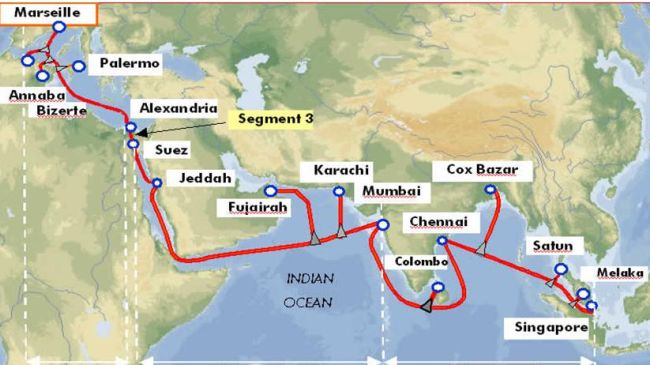
Press TV – December 29, 2013
The US National Security Agency (NSA) has collected sensitive data on key undersea optical fiber telecommunications cables between Europe, North Africa and Asia.
Citing classified documents labeled “top secret” and “not for foreigners”, German news magazine Der Spiegel reported on Sunday that the NSA spied on the so-called “South East Asia-Middle East-West Europe 4” also known as “Sea-Me-We 4” undersea cable system.
The German magazine said NSA specialists had hacked an internal website belonging to the operator consortium to mine documents about technical infrastructure including circuit mapping and network management information. “More operations are planned in the future to collect more information about this and other cable systems.” Spiegel quoted the NSA documents, dating from February, as saying.
According to the website of the project “the South East Asia-Middle East-West Europe 4 project is a next generation submarine cable system linking South East Asia to Europe via the Indian Sub-Continent and Middle East. The project aims to take these regions to the forefront of global communication by significantly increasing the bandwidth and global connectivity of users along its route between Singapore and France.”
Spiegel reports that “Among the companies that hold ownership stakes in it are France Telecom, now known as Orange and still partly government-owned, and Telecom Italia Sparkle.”
In March 2004, a consortium of 16 international telecommunications companies signed construction and maintenance agreements for the new optical fiber submarine cable system linking South East Asia to Europe via the Indian Sub-Continent and Middle East with Terminal Stations in Singapore, Malaysia, Thailand, Bangladesh, India, Sri Lanka, Pakistan, United Arab Emirates, Saudi Arabia, Egypt, Italy, Tunisia, Algeria and France. The contract is being awarded jointly to Alcatel Submarine Networks, France and Fujitsu Ltd., Japan and the estimated project cost is of the order of $500 million.
The submarine cable system is approximately 20,000km long. It consists of the main backbone across the Eastern and Western worlds plus the extension links in various countries. The project seeks to support telephone, internet, multimedia and various broadband data applications.
It seems the method was employed by the NSA’s elite hacking unit (TAO) via incorporating routers and servers from non-NSA networks into its covert network by infecting these networks with “implants” that then allow the government hackers to control the computers remotely.
The document leaked by Der Spiegel proudly says that, on Feb. 13, 2013, TAO “successfully collected network management information for the SEA-Me-We Undersea Cable Systems (SMW-4).” With the help of a “website masquerade operation,” the agency managed to “gain access to the consortium’s management website and collected Layer 2 network information that shows the circuit mapping for significant portions of the network.”
The US government claims that its spying operations that are taking place both at home and abroad are vital for fighting terrorism.
A federal judge ruled Friday that the NSA’s bulk collection of millions of Americans’ telephone and Internet records is legal. US District Judge William Pauley also concluded that the operation is an important part of America’s effort to combat the threat of terrorism.
NSA spies on millions of telephone and Internet records that are routed through American networks on daily basis. According to some estimates, NSA spies on 380 million cellphones in the US.
Prior to Pauley’s ruling, another US District Court Judge, Richard Leon, had described the massive NSA spying program “Almost Orwellian”.
“I cannot imagine a more ‘indiscriminate’ and ‘arbitrary invasion’ than this systematic and high-tech collection and retention of personal data on virtually every single citizen,” Judge Leon wrote.
Is Anything Left of the US Constitution or Privacy Rights?

Vying for a Supreme Court appointment? US District Judge William H. Pauley III ruled that the NSA’s massive spying program is legal.
By Franklin Lamb | Fig Trees and Vineyards | December 28, 2013
The answer to this question is being pondered across America in light of two seemingly contradictory federal court decisions handed down this month from two separate courts, one in Washington, the other in New York.
Since the Bush Administration’s “war of terrorism” was launched, civil liberties advocates have voiced growing alarms about the erosion of Constitutional guarantees. Yet with the disclosures by whistle blower Edward Snowden, concerns about what protections Americans have remaining—protections from governmental intrusions into their privacy as well as home or office invasions by police forces—have rapidly gained new impetus. Because of Snowden’s leaks, legal challenges have been brought against the National Security Agency; without the leaks, no challenge could have been mounted.
Now all of a sudden two US Federal District Courts, with identical powers under the US Constitution, have reached seemingly opposite conclusions on the same legal issue, i.e. the right of the NSA to conduct “metadata” searches and store the information of scores of millions of unknowing Americans. This means, given that appeals have been filed in both cases, that the issue is likely going to be decided by the US Supreme Court.
Civil libertarians were encouraged earlier this month when Federal Judge Richard Leon of the United States District Court for the District of Columbia ruled on December 16 that the NSA’s bulk collection of cell phone data of Americans (everyone you called, when you called them, and where you were when you called them) violates the Fourth Amendment to the Constitution. Calling the data gathering “Orwellian,” Judge Leon reasoned that we now use our smartphones for a wide variety of personal activities in which we have the expectation of privacy, that probably we have more expectation of privacy from cell phones now than we did, say, from a pay phone in the 1980s. And he also noted, crucially, that cell phones today make it possible to determine the caller’s GPS location. “It’s one thing to say that people expect phone companies to occasionally provide information to law enforcement; it is quite another to suggest that our citizens expect all phone companies to operate what is effectively a joint intelligence-gathering operation with the Government,” Leon wrote.

US District Judge Richard Leon
The judge then focused on whether the massive NSA surveillance violates the Fourth Amendment, which guarantees, “the right of the people to be secure in their persons, houses, papers, and effects, against unreasonable searches and seizures, shall not be violated, and no warrants shall issue, but upon probable cause, supported by oath or affirmation, and particularly describing the place to be searched, and the persons or things to be seized.”
He writes:
“The threshold issue that I must address, then, is whether plaintiffs have a reasonable expectation of privacy that is violated when the Government indiscriminately collects their telephony metadata along with the metadata of hundreds of millions of other citizens without any particularized suspicion of wrongdoing, retains all of that metadata for five years, and then queries, analyzes and investigates that data without prior judicial approval of the investigative targets. If they do – and a Fourth Amendment search has thus occurred– then the next step of the analysis will be to determine whether such a search is ‘reasonable.’”
Judge Leon found that the NSA, when demanding citizens’ telephone metadata, is conducting a search, and that it is most likely an unreasonable search under the Fourth Amendment, given there is no specific suspicion of wrongdoing by any individual whose records are demanded.
In his ruling he granted the request for an injunction against the collection of the plaintiffs’ phone data, ordering the government to destroy any of their records that have been gathered. But the judge stayed action on his ruling pending a government appeal, recognizing in his 68-page opinion what he termed as the “significant national security interests at stake in this case and the novelty of the constitutional issues.”
But no sooner had Judge Leon’s decision been published, bringing hope to civil libertarians, than US District Judge William H. Pauley III in New York issued what looks almost like a diametrically antithetical ruling, making for the latest in a contentious debate that has also seen a presidential commission weighing in on certain aspects of NSA spying as well. On December 27, Pauley ruled that the NSA’s collection of vast oceans of data on private phone calls is legal—meaning that in a period of just 11 days the two judges, along with the presidential panel, had reached “the opposite of consensus on every significant question before them, including the intelligence value of the program, the privacy interests at stake and how the Constitution figures in the analysis,” as the New York Times reported it.
The case in New York was brought by the American Civil Liberties Union, which said it would appeal.
Judges Leon and Pauley have starkly differing understandings on how valuable the NSA program is. Echoing arguments made recently by former FBI director Robert S. Mueller III and other senior government officials, Pauley, whose courtroom is not far from where the World Trade Center towers stood, said he believed the program might have caught the 9/11 hijackers had it been in place at the time. “While robust discussions are underway across the nation, in Congress and at the White House, the question for this court is whether the government’s bulk telephony metadata program is lawful,” Pauley wrote. “This court finds it is.”
The finding stands in stark contrast to Leon’s ruling in Washington:
“The government does not cite a single instance in which analysis of the N.S.A.’s bulk metadata collection actually stopped an imminent attack, or otherwise aided the government in achieving any objective that was time-sensitive in nature,” Judge Leon wrote.
What these conflicting decisions leave us in is a profound quandary with respect to the issues raised by Edward Snowden. In a Christmas address that was carried by British Channel 4 and widely aired on the Internet, the former NSA contractor expressed the legitimate concern of all people who value individual liberty and privacy. A child born today, he said, might “never know what it means to have a private moment to themselves, an unrecorded, unanalyzed thought.” He added that people are essentially walking around with a tracking device in their pockets, noting that this disappearance of privacy is important because privacy “is what allows us to determine who we are and who we want to be.”
Washington’s Real Aims in Colombia
Mythmaking in the Washington Post
By Nick Alexandov | CounterPunch | December 27, 2013
Last Sunday’s Washington Post carried a front-page article by Dana Priest, in which she revealed “a CIA covert action program that has helped Colombian forces kill at least two dozen rebel leaders.” Thanks to “a multibillion-dollar black budget”—“not a part of the public $9 billion package of mostly U.S. military aid called Plan Colombia”—as well as “substantial eavesdropping help from the National Security Agency,” the initiative has been successful, in Priest’s assessment, decimating the Revolutionary Armed Forces of Colombia (FARC) guerrillas, as the country’s “vibrant economy” and “swanky Bogota social scene” flourish.
The lengthy piece offers a smorgasbord of propagandistic assertions, pertaining both to Washington’s Colombia policies, and to its foreign conduct in general. For a sampling of the latter, consider one of the core assumptions underlying Priest’s report—namely, that our noble leaders despise drugs. The FARC’s “links with the narcotics trade” and “drug trafficking” motivated U.S. officials to destroy their organization, we’re supposed to believe. True, CIA informants in Burma (1950s), Laos (1970s), and Afghanistan (1980s) exploited their Agency ties “to become major drug lords, expanding local opium production and shipping heroin to international markets, the United States included,” Alfred W. McCoy’s research demonstrates. True, a few decades ago the Office of the United States Trade Representative joined “with the Departments of Commerce and State as well as leaders in Congress” for the purpose of “promoting tobacco use abroad,” the New York Times reported in 1988, quoting health official Judith L. Mackay, who described the resulting “tobacco epidemic” devastating the Philippines, Malaysia, and other countries: “smoking-related illnesses, like cancer and heart disease” had surpassed “communicable diseases as the leading cause of death in parts of Asia.” True, the DEA shut down its Honduran office in June 1983, apparently because agent Thomas Zepeda was too scrupulous, amassing evidence implicating top-level military officials in drug smuggling—an inconvenient finding, given Honduras’ crucial role in Washington’s anti-Sandinista assault, underway at the time.
But these events are not part of History, as the subject has been constructed in U.S. schools. It’s common to read, every year or so, an article in one of the major papers lamenting the fact that “American students are less proficient in their nation’s history than in any other subject,” as Sam Dillon wrote in a 2011 piece for the Times. The charge is no doubt true, as far as it goes: Dillon explained that only a “few high school seniors” tested were “able to identify China as the North Korean ally that fought American troops during the Korean War,” for example. But the accusation is usually leveled to highlight schools’ inadequacies, with little examination of the roles these institutions are meant to serve. And the indictments are hardly novel: in 1915, a Times story on New York City’s public schools complained their graduates “can not spell simple words,” were incapable of finding “cities and States” on a map, and so on. That piece explicitly critiqued graduates’ abilities to function as disciplined wage-earners, and so was more honest than the majority of today’s education coverage. The simple fact is “that the public schools are social institutions dedicated not to meeting the self-perceived needs of their students [e.g., by providing an understanding of how the world works] but to preserving social peace and prosperity within the context of private property and the governmental structures that safeguard it,” David Nasaw concludes in his fascinating history of the subject. Private schools, to be sure, are similar in essential respects. And one result of this schooling is that well-educated journalists can repeat myths about U.S. foreign policy, as their well-educated readers nod in blind assent.
The notion that U.S. officials have a coherent counterdrug policy is, again, one of these myths. In addition to the historical examples of U.S. support for drug traffickers cited above, we can note that the slur “narco-guerrilla,” which Washington uses to imply that the FARC is somehow unique for its involvement in the narcotics trade, ought to be at least supplemented by—if not abandoned in favor of—“narco-paramilitary.” Commentators tend to discuss the paramilitaries and the Colombian state separately, presupposing the former are “rogue” entities—another myth—when it would be better to view them, with Human Rights Watch, as the Colombian Army’s unofficial “Sixth Division,” acting in close conformity with governmental aims. Paramilitary leader Carlos Castaño admitted in March 2000 that some 70% of the armed groups’ funding came from drug trafficking, and U.S. intelligence agencies took no issue with his estimate—and “have consistently reported over a number of years that the paramilitaries are far more heavily involved than the FARC in drug cultivation, refinement and transshipment to the U.S.,” International Security specialist Doug Stokes emphasizes.
When these substances enter our country, they become a key pretext for the skyrocketing incarceration rate, which has more people imprisoned for drug offenses today than were incarcerated for all offenses in 1980, criminologist Randall Shelden has pointed out, with rates of arrest and sentencing durations especially severe for blacks. “Every criminal prohibition has that same touch to it, doesn’t it?” legal historian Charles Whitebread once asked. “It is enacted by US,” he stressed, “and it always regulates the conduct of THEM”—“you know, them criminals, them crazy people, them young people, them minority group members,” he added sardonically. Reviewing the history of marijuana prohibition, Whitebread noted that, at the Marihuana Tax Act hearings in 1937, two men spoke regarding the drug’s medical effects. One was Dr. William C. Woodward, Chief Counsel to the American Medical Association, who explained his organization had found “no evidence that marihuana is a dangerous drug.” “Doctor,” a Congressman complained, “if you can’t say something good about what we are trying to do, why don’t you go home?” The second was a Temple University pharmacologist, “who claimed that he had injected the active ingredient in marihuana into the brains of 300 dogs, and two of those dogs had died.” When one Congressman asked him whether he had experimented on dogs because of some similarity they bore to humans, the pharmacologist professed ignorance: “I wouldn’t know, I am not a dog psychologist.”
That was the extent of the medical basis for outlawing marijuana in the U.S., as threadbare as the anti-drug pretexts of Washington’s Colombia policies. Nearly four years after Plan Colombia’s 1999 announcement, for example, the U.S. General Accounting Office reported that “the Departments of State and Defense [had] still not developed estimates of future program costs, defined their future roles in Colombia, identified a proposed end state, or determined how they plan[ned] to achieve it.” But while efforts to reduce coca cultivation and cocaine production were poorly articulated—and failed consistently—other endeavors met with great success. For example, aerial fumigation displaced some 17,000 people from the Putumayo Department, where the FARC had a major presence, in 2001 alone. The fumigation effectively converted the land from a means of subsistence into a profit source: journalist Garry Leech pointed out that, from 2003-2004, there was “a slew of new contracts signed between multinational companies and the Colombian government,” and the events in Putumayo and elsewhere suggest that Colombia’s herbicide-spraying campaign was never really aimed at illicit crops, typically described as the main target. It seems that if the point were to eradicate, say, coca, the solution would be relatively simple: let coca growers harvest something else. But Plan Colombia has consistently devoted only minimal funding for alternative development schemes, indicating the peasants’ sin isn’t growing coca, but living as subsistence farmers. That kind of activity is an inappropriate use of the land in an oil-rich region, where there are profits to be made.
A Guatemalan peasant made a similar point to author-activist Kevin Danaher, when he visited her country in 1984—shortly after School of the Americas alumnus Ríos Montt had completed his genocidal tear through the countryside. The woman, Danaher writes, “told us that soldiers had come to her home one night and hacked her husband to death, right in front of her and her three children;” the man “was a subversive,” in the military’s eyes, “because he was helping other peasants learn how to raise rabbits as a source of food and money.” Danaher struggled to understand the connection between this effort at self-sufficiency, and the brutal end its advocate met. “Look,” the widow explained, “the plantations down along the coast that grow export crops are owned by generals and rich men who control the government. A big part of their profit comes from the fact that we peasants are so poor we are forced to migrate to the plantations each year and work for miserable wages in order to survive.” Were she and other Guatemalan peasants to become self-reliant, they “would never work on the plantations again”—an indication of the severe threat rabbit-raising posed.
This woman’s remarks indicated who Washington’s real enemy was in Guatemala, and throughout the world. The U.S. government was not opposed merely to “Communists,” real or imagined, during the Cold War, and in Colombia its policies have helped ruin—or end—the lives of millions of destitute individuals beyond the FARC’s top officials. Of course, Sunday’s Post article ignores this fact, portraying the struggle as one between the U.S. government and its Colombian allies on one side, and aggressive guerrillas on the other. But we can expect little else from this mythmaker of record.
CIA secret program helped Colombia kill FARC leaders: Report
Press TV – December 22, 2013
US intelligence agencies have secretly helped the Colombian government kill at least two dozen leaders of the Revolutionary Armed Forces of Colombia (FARC), a report says.
On Saturday, the Washington Post published the report revealing that both the Central Intelligence Agency (CIA) and the National Security Agency (NSA) provided the Colombian government with technology to terminate the rebel leaders.
The report was based on interviews with more than 30 former and current American and Colombian officials, who spoke on condition of anonymity since the program is classified and ongoing, the newspaper said.
According to the report, Washington provided Colombia with Global Positioning System (GPS) equipment that can be used to transform regular munitions into so-called smart bombs.
These explosives can accurately pinpoint specific targets, even if the objects are located in dense jungles.
In addition, the NSA provided “substantial eavesdropping help” to the Colombian government, the report stated.
In one of its operations, Colombian forces killed top FARC commander, Raul Reyes, in March 2008, while he was in a FARC-operated jungle camp in neighboring Ecuador. The newspaper reported that a US-made smart bomb was used in the killing.
Colombian President Juan Manuel Santos commented on the report, telling the newspaper that the CIA has been “of help, providing Colombian forces with “better training and knowledge.” The CIA, however, did not want to give any comments regarding the revelations.
The report also revealed that the multibillion-dollar program was secretly funded on top of the nine billion dollars in aid that the US has openly provided to Colombia, mostly in military assistance. The covert program was authorized by President George W. Bush and has continued under President Barack Obama.
The Colombian government and FARC have been holding peace negotiations since November last year in Cuba.
The two sides have agreed upon the matter of land reform and rural development, while four others issues still remain unsolved, including FARC’s participation in politics.
FARC is Latin America’s oldest insurgent group and has been fighting the government since 1964.
Bogota estimates that 600,000 people have been killed and more than 4.5 million others have been displaced due to the fighting.
GCHQ, NSA Spied On Known Terrorist Haven… UNICEF
By Mike Masnick | Techdirt | December 20, 2013
The latest revelations from the Snowden documents, according to reports in both the NY Times and the Guardian is that the UK’s GCHQ, operating out of a site heavily funded by the NSA, targeted a variety of humanitarian and charitable groups, including the United Nations Children’s Fund, better known as UNICEF. Another target was Médecins du Monde, a well known medical relief group that delivers medicines and medical help to war-torn areas.
The reports also detail spying on various government officials, though, as I’ve said in the past, that kind of stuff isn’t particularly bothersome — as spying on leaders of other countries is typical and expected espionage activity, though it can certainly create some diplomatic awkwardness. Perhaps more interesting is that there’s much more evidence here of economic espionage activity. Among those “targeted” were Joaquin Almunia, the EU commission “competition” boss, who has been investigating anti-trust claims against American companies like Google and Microsoft. The NSA has insisted (and repeated in response to questions from reporters writing the two stories above) that it doesn’t engage in economic espionage — though GCHQ apparently doesn’t have any such restriction, suggesting that the NSA can just hand that kind of activity off to its UK friends, who it funds, and then reap the benefits.
Furthermore, the NSA seems to indicate in its response that while it may not engage in economic espionage in the form of spying on issues and handing that info directly to US companies, it does seem to open up the possibility of engaging in economic espionage to inform US policy makers — meaning it likely gets filtered back to those companies anyway:
“We do not use our foreign intelligence capabilities to steal the trade secrets of foreign companies on behalf of — or give intelligence we collect to — U.S. companies to enhance their international competitiveness or increase their bottom line,” said Vanee Vines, an N.S.A. spokeswoman.
But she added that some economic spying was justified by national security needs. “The intelligence community’s efforts to understand economic systems and policies, and monitor anomalous economic activities, are critical to providing policy makers with the information they need to make informed decisions that are in the best interest of our national security,” Ms. Vines said.
There is some validity in the idea that if there’s going to be some sort of earth-shattering revelation that could have a wider impact on the whole economy, that there’s some value in having intelligence services aware of what’s going on — but it’s a pretty slippery slope from there to simply intercepting direct information that might be helpful for a particular company, and providing them an advantage.
But, going beyond that, targeting groups like UNICEF seems like going way too far. It’s hard to see any legitimate justification for this, unless someone’s going to argue that terrorist groups were somehow co-opting UNICEF, which seems like a huge stretch. To argue that there’s any national security reason to spy on UNICEF seems laughable. It really seems like the NSA and GCHQ were targeting organizations like that because they can.
Brazil ditches Boeing jets, grants $4.5 bln contract to Saab
‘NSA ruined it!’
RT | December 18, 2013
Brazil has rejected a contract for Boeing’s F/A-18 fighter jets in favor of the Swedish Saab’s JAS 39 Gripens. The unexpected move to reject the US bid comes amid the global scandal over the NSA’s involvement in economic espionage activities.
The announcement for the purchase of 36 fighters was made Wednesday by Brazilian Defense Minister Celso Amorim and Air Force Commander Junti Saito. The jets will cost US$4.5 billion, well below the estimated market value of around US$7 billion.
Saito said the development of the fighters will occur in conjunction with Embraer and other unspecified companies.
The 12 Mirage aircraft currently in use by the Brazilian Air Force (FAB) will be retired at the end of this year. They were acquired by Brazil in 2005. As it waits for the new fighters, the FAB will use the F5 style, which will stay viable up to 2025.
During a visit in Brasilia last week, French President Francois Hollande was accompanied by an entourage that included the president of Dassault Group, stirring speculation that the French jet manufacturer had the edge over Saab and Boeing.
Competition over which company would win the right to supply Brazil with the fighter jets began in the late 1990s during Fernando Henrique Cardoso’s administration, continued during Luiz Inácio Lula da Silva’s time in office and into current President Rousseff’s term. A FAB report in 2010 indicated a preference in Saab, though then-President Lula leaned toward the cheaper Dassault jet, Rafale.
Boeing was considered to have the inside track to win the contract earlier this year, yet revelations of intrusive surveillance of global officials’ communications, including those of Brazilian President Dilma Rousseff, by the US government’s National Security Agency led to distrust of the American company.
“The NSA problem ruined it for the Americans,” a Brazilian government source told Reuters.
The Chicago-based Boeing’s bid was rejected because of Saab’s better performance and cost of its aircraft as well as “willingness to transfer technology,” defense minister Celso Amorim said, as cited by Bloomberg.
‘Economic espionage’ fallout
Brazil is currently probing reports released by former NSA contractor Edward Snowden that the spy agency monitored the personal communications of President Rousseff and hacked into government ministries to gather information. Among the institutions targeted by NSA espionage were state oil giant Petrobras and the Ministry of Mines and Energy, contradicting claims by Washington that it did not engage in “economic espionage.”
Rousseff lambasted US spying on her country during the UN General Assembly in September, calling it a “breach of international law.” She further warned that the NSA surveillance, revealed since June, threatened freedom of speech and democracy.
“Meddling in such a manner in the lives and affairs of other countries is a breach of international law and as such it is an affront to the principles that should otherwise govern relations among countries, especially among friendly nations,” Rousseff said.
Just before her address at the UN summit, Rousseff canceled a state visit to Washington, scheduled to take place in October, because of indignation over spying revelations. Rousseff has stated she wants an apology from US President Barack Obama.
Snowden has promised to aid Brazil in a probe into the NSA’s spying program in the country.
“A lot of Brazilian senators have asked me to collaborate with their investigations into suspected crimes against Brazilian citizens,” said Snowden, in an open letter published by Brazilian paper Folha de S.Paulo. Snowden hinted in the letter that he may ask Brazil for asylum.
“The American government will continue to limit my ability to speak out until a country grants me permanent political asylum,” wrote Snowden.
The whistleblower is currently under temporary asylum in Russia. Brazil plans to host a global summit on internet governance in April 2014.
Brazil resident Glenn Greenwald, the former Guardian journalist renowned for publishing Snowden’s leaks, criticized on Wednesday European Union governments’ muted response to the revelations about the NSA’s mass surveillance apparatus. He also contradicted Washington’s claim that no economic espionage is involved amid NSA spying.
“What a lot of this spying is about has nothing to do with terrorism and national security. That is the pretext. It is about diplomatic manipulation and economic advantage.”
Related article
US-Israeli Security Company Selling Mobile Phone Surveillance Products To Agencies Around The World
By Tim Cushing | Techdirt | December 17, 2013
Privacy International, which has done a very thorough job digging into the backgrounds of the many private companies involved in the surveillance “industry” around the world, has just released a promotional document from the American-Israeli Verint, a security company that provides NSA-level cell phone surveillance power to entities around the world.
[A] scaled down version of this system is also being sold by private surveillance contractors to the highest bidder. The company behind it? Israeli-American company Verint. Their Skylock technology claims to have the ability to “Remotely locate GSM and UMTS targets located anywhere in the world at cell level precision”.
The brochure Privacy Int’l obtained doesn’t go into detail as to how it achieves this, but what is shown is both impressive and disturbing.
From a brochure collected this year we have discovered one of the newest additions to Verint’s product line: mobile phone tracking on an international scale. Previously, mobile phone tracking required presence in the particular areas of interest, focusing on the tracking of phones through monitoring Base Stations (Cell Towers) and local networks to pinpoint location. In the past, if a law enforcement agency wanted location data they requested information from the relevant telecommunication firm operating in that specific territory. By way of an example, this would result in the UK not being able to obtain a French mobile phone’s location without help from the French. Now it would appear that Verint have bypassed the territoriality requirement.With this latest news, we know that location tracking has become borderless in the same way as communications surveillance. The ability to do this has likely come from a focus on international phone systems rather than domestic or regional networks which would never reach the worldwide nature of location tracking Verint is advertising.
Some details on Verint’s SKYLOCK offering are available online (under the name ENGAGE). While the brochure seems to indicate this is solely a military product (the brochure cover only lists “Military, Special Forces, Navy, Search and Rescue, Border Control” and the photos contained show only military personnel), the inside notes make it clear these products are available to “law enforcement” as well.
As Privacy Int’l points out, Verint’s offering operates “independently of local service providers,” meaning pretty much every legal obstacle is demolished. What no one knows is going on won’t hurt them. One product is targeted at satellite communications, but even considering that limited scope, it’s still very powerful.
Here’s what ENGAGE/SKYLOCK can do:
– Intercept voice calls and text messages
– Decrypt A5/1 and A5/2 encryptions with an embedded decipher
– Operate undetected leaving no electromagnetic signature
– Selectively downgrade UMTS traffic to GSM
Other ENGAGE products target wireless communications. Verint’s intercept-in-a-box can do all of the following.
– Actively and passively intercept WiFi communications based on: 802.11 a/b/g/n, 2.4Ghz, and 5GHz
– Active interception of mobile handsets, even when not intentionally connected to a WiFi network
– Intercept target communication at a distance with zero packet loss
– Choose from multiple active interception methods to overcome encryption of private communication
– Identify access points and intercept MAC addresses in the area
Verint also gives its purchasers the power to target phones using 3G networks, remotely activate cell phone mics, and block cellular communication.
The capabilities that were presumed to only be in the hands of national intelligence agencies now can be had by nearly anyone who can come up with the money. Powerful cell phone surveillance products are a growth market. Anything that can increase data and communication harvesting while simultaneously eliminating a majority of legal restrictions and oversight practically sells itself.
We may feel this sort of power is OK in the “right hands,” but we don’t get to decide which hands this ends up in. We may believe the NSA should be able to do this sort of thing (overseas, preferably), but that local law enforcement agencies should be forced to jump through warrant and subpoena hoops before tracking locations and intercepting communications. But ultimately it doesn’t matter what we prefer. That call is made by Verint and it’s in the business of selling surveillance products, not protecting the privacy of the world’s citizens.
Related article
- Israeli company to win Indian mass electronic surveillance contract (altahrir.wordpress.com)
Mass Location Tracking: It’s Not Just For the NSA
By Catherine Crump | ACLU | December 12, 2013
Thanks to Edward Snowden we now understand that the NSA runs many dragnet surveillance programs, some of which target Americans. But a story today from Washington, D.C. public radio station WAMU is a reminder that dragnet surveillance is not just a tool of the NSA—the local police use mass surveillance as well.
DC’s Metropolitan Police Department uses cameras to scan vehicle license plates in huge numbers and saves all the data for two years, even though only a tiny fraction—0.01 %—turn out to be associated with any possible wrongdoing.
In 2012, the police in Washington scanned over 204 million license plates. But only 22,655 were associated with some possible wrongdoing (what the chart refers to as “hits”). And a hit isn’t evidence of guilt. It’s evidence your plate was in a database. And your plate may well be in a database because, as we’ve seen in other areas of the country (check out our report on the use of plate readers nationwide), these databases can include people who violated vehicle emissions programs or are driving on suspended or revoked licenses. These people shouldn’t be on the road, but they are also not major offenders.
The key point is this: 99.9 % of the data pertains to people not suspected of wrongdoing. Why should innocent drivers have their movements stored for two full years?
The new report echoes data first unearthed by the ACLU’s local office and revealed two years ago in testimony to local legislators.
This brings us back to the NSA program. What do the NSA and DC Metropolitan Police Department have in common? As we have discussed before, neither appears to be restrained by any sense of proportionality. The data collection is vast, and the gain is either uncertain or negligible. In the NSA’s case, it is storing records about every single phone call each of us makes and keeping it in a database for 5 years, even in the absence of any credible evidence that mass collection is needed to make us safer. (The MPD refused to comment on the plate reader program.)
When it comes to reforming surveillance, it is programs like these that are particularly good targets. While some may be willing to trade privacy for security, here we appear to be giving privacy away and the government either can’t or won’t make the case that we’re getting anything in exchange.
Related articles
Featured Video

Theodore Postol: Iran’s Missiles & Drones Were Underestimated
or go to
Aletho News Archives – Video-Images
From the Archives
What is the Israeli Lobby in Australia Doing in Interfaith Dialogue?
By Ali Kazak | Dissident Voice | October 11, 2015
For years Israel and its lobby around the world have been trying to normalise their relations with Arabs and Muslims without solving the Palestine Question.
One of the methods they resorted to in the last few years is using human rights and community organizations such as interfaith dialogue and Multiculturalism to achieve this objective and to: isolate the Palestinians, marginalise the Palestine question, end Israel’s isolation, and prevent criticism of Israel, knowing that these organisations will be the first to stand against Israel’s violations, racial and religious discrimination.
The group responsible for this task in Australia is The Australia/Israel & Jewish Affairs Council (AIJAC); its Director of International & Community Affairs, Jeremy Jones is in charge of lobbying religious community organizations, specifically Muslims and Christians. Consequently he convened the Faith Communities for Reconciliation, founding participant in the Australian Partnership of Religious Organisations and the Australian National Dialogue of Christians, Muslims & Jews.
AIJAC is a private political propaganda group. It is recognised as the main Israeli lobby in Australia. It coordinates its activities and works intimately with the Israeli embassy in Canberra and different institutions in Israel. It is privately funded by some Jewish businessmen. It monitors closely Australian politicians, the media, ethnic and religious groups, (especially Arabs and Muslims), unions and academics on their stands towards Israel and the Palestine question. … continue
Blog Roll
 Aletho News
- The killing of three Indonesian soldiers in Lebanon should remind Jakarta that Israel does not want peace
- Defeated and delusional: Netanyahu’s remarks reveal $80bn war failure, says analyst
- Iran’s friends are about to make life much more difficult for Israel and the US
- The war of liberation of the Arab and Islamic peoples expands across the Gulf
- Envoy warns UN on Trump’s threat to ‘obliterate’ Iran’s civilian infrastructure
- The Larak Corridor: Iran’s Rial Gate With No US, No Israel, and No Way Around
- ‘Economic terrorism’: Steel facilities hit again in US-Israeli strike
- ‘War Crime’: Iran condemns attacks on Arak, Ardakan nuclear sites
- Two-thirds of Americans want quick end to Iran war even if goals unmet
- Trump to Give “Important Update on Iran” Wednesday in Prime-Time Speech
- If Americans Knew
- Gaza families reunite years after babies evacuated amid Israel’s war
- International Rescue Committee warns Gaza’s children face grave protection risks
- Iran’s Alleged 47-Year War on America: Debunking the 1,050 American Deaths Canard
- Israel wants US to bomb more of Iran’s civilian structures (113,000 is not enough) – Not a ceasefire Day 173
- Ann Coulter Rips Into Fox News for Iran War Coverage
- Joe Kent Urges Americans To Call White House and Congress To Object To Sending Troops Into Iran
- DNC Resolution to Reject AIPAC Funding Puts Democratic Leaders in the Hot Seat
- Swedish foundation to build 400 schools as over 650,000 Gaza children remain without education for 2 years
- Israeli army admits photshopping image of slain Lebanese journalist
- This is how Israel is systematically killing health workers under the cover of war in Lebanon
- No Tricks Zone
- New Study Finds Warming Saves Lives…Cold Temperatures 12 Times More Deadly Than Excess Heat
- German Science Blog Accuses PIK Climate Institute Of Hallucinating Climate Tipping Points
- Devastating Assessment Of Comirnaty Vaccine By Former Senior Pfizer Europe Toxicologist
- New Study: CO2 Is ‘Effectively Negligible’ As An Explanatory Climate Change Factor Since 2000
- Former Pfizer Toxicologist Dr. Helmut Sterz Tells Bundestag Hearing Pfizer Vaccine Should Have Never Been Approved
- Energy Expert: Germany’s Nuclear Phaseout Was A “500 Billion Euro Mistake”
- New Research: South Australia’s Mid-Holocene Sea Surface Temperatures Were 4°C Warmer Than Today
- Storing Green Energy To Last Germany 10 Days Would Require A 60-Million Tonne Battery
- New Studies: UK Sea Levels Were 4 Meters Higher Than Today During The Mid-Holocene
- Destructive Green New Deal: German Energy And Metal Group Warns Of Drastic Crisis
 Aletho News