NATO ‘s Great New Idea: ‘Let’s Start A War With China!’
By Ron Paul | May 8, 2023
NATO’s post-Cold War history is that of an organization far past its “sell-by” date. Desperate for a mission after the end of the Warsaw Pact, NATO in the late 1990s decided that it would become the muscle behind the militarization of “human rights” under the Clinton Administration.
Gone was the “threat of global communism” which was used to justify NATO’s 40-year run, so NATO re-imagined itself as a band of armed Atlanticist superheroes. Wherever there was an “injustice” (as defined by Washington’s neocons), NATO was ready with guns and bombs.
The US military-industrial complex could not have been happier. All the Beltway think tanks they lavishly fund finally hit on a sure winner to keep the money pipeline flowing. It was always about money, not security.
The test run for NATO as human rights superheroes was Yugoslavia in 1999. To everybody but NATO and its neocon handlers in DC and many European capitals, it was a horrific, unjustified disaster. Seventy-eight days of bombing a country that did not threaten NATO left many hundreds of civilians dead, the infrastructure destroyed, and a legacy of uranium-tipped ammunition to poison the landscape for generations to come.
Just last week tennis legend Novak Djokovic recalled what it felt like to flee his grandfather’s home in the middle of the night as NATO bombs fell and destroyed it. What a horror!
Then NATO got behind the overthrow of the Gaddafi government in Libya. The corporate press regurgitated the neocon lies that bombing the country, killing its people, and overthrowing its government would solve all of Libya’s human rights problems. As could be predicted, NATO bombs did not solve Libya’s problems but made everything worse. Chaos, civil war, terrorism, slave markets, crushing poverty – no wonder Hillary Clinton, Obama, and the neocons don’t want to talk about Libya these days.
After a series of failures longer than we have space for here, DC-controlled NATO in 2014 decided to go all-in and target Russia itself for “regime change.” First step was overthrowing the democratically elected Ukrainian government, which Victoria Nuland and the rest of the neocons took care of. Next was the eight years of massive NATO military assistance to Ukraine’s coup government with the intent of fighting Russia. Finally, it was the 2022 rejection of Russia’s request to negotiate a European security agreement that would prevent NATO armies circling its border.
Despite the mainstream media and US government propaganda, NATO has been about as successful in Ukraine as it was in Libya. Hundreds of billions of dollars have been flushed away, with massive corruption documented by journalists like Seymour Hersh and others.
The only difference this time is that NATO’s target – Russia – has nuclear weapons and views this proxy war as vital to its very existence.
So now despite its legacy of failure, NATO has decided to start a conflict with China, perhaps to take attention off its disaster in Ukraine. Last week NATO announced that it will open its first-ever Asia office in Japan. What next, NATO membership for Taiwan? Will Taiwan willingly serve as NATO’s newest “Ukraine” – sacrificing itself to China in the name of blundering NATO’s seemingly endless appetite for conflict?
We can only hope that America will elect a president in 2024 who will finally end NATO’s deadly world tour.
Copyright © 2023 by RonPaul Institute.
China won’t forget NATO’s ‘barbaric’ actions in Yugoslavia
RT | May 8, 2023
Beijing has neither forgotten nor forgiven the May 1999 bombing of its embassy in Belgrade, Chinese Foreign Ministry spokesman Wang Wenbin told reporters on Monday. Wang condemned the US-led bloc for creating conflict while posing as a defensive alliance, urging it to “seriously reflect” on its crimes.
Wang noted that May 7 was the anniversary of the embassy attack, in which three Chinese journalists were killed and 20 diplomatic staff members were injured. “The Chinese people will never forget what they sacrificed to uphold the truth, fairness and justice. Nor will we ever forget this barbaric atrocity committed by US-led NATO,” he told reporters.
While claiming to be a regional defense bloc, NATO has “repeatedly lit the fuse and brought conflicts to places all over the world,” Wang noted, “from Bosnia and Herzegovina to Kosovo, from Iraq to Afghanistan, and from Libya to Syria.”
Having participated in wars that have killed hundreds of thousands and displaced tens of millions, NATO is now “making forays eastward into the Asia-Pacific, instigating bloc confrontation and undermining peace and stability in the region,” the spokesman added. “The US-led NATO needs to seriously reflect on the crimes they’ve committed, abandon the outdated Cold War mentality, stop inciting tensions in the region, and stop sowing division and instability.”
The embassy strike happened six weeks into the NATO air war against Yugoslavia, waged on behalf of ethnic Albanian separatists in Kosovo. Five bombs struck the compound, killing Shao Yunhuan, Xu Xinghu and his wife Zhu Ying. Beijing condemned the bombing as a “barbaric act.”
The US claimed it had struck the embassy by accident, using an “old map” of the Serbian capital. The real target, Washington said, had been the Yugoslav government agency for military procurement, which was almost 500 meters (1,640 feet) away. The strike was carried out by a B-2 stealth bomber, using JDAM bombs that are accurate to within 14 meters (46 feet) of the target. It was the first and only mission during the 78-day campaign that had been planned by the CIA, the agency’s director George Tenet later testified before the US Congress. One CIA agent was reportedly fired and six were reprimanded over the incident.
US President Bill Clinton offered a public apology. Washington later paid a compensation of $28 million to the Chinese government and $4.5 million to the families of the victims.
The NATO-backed war crimes tribunal for the former Yugoslavia cited this, as well as the CIA disciplinary measures, among the reasons for not opening an investigation into the bombing, much less pressing charges.
Odessa Massacre 9 Years On… West’s Shameful Silence
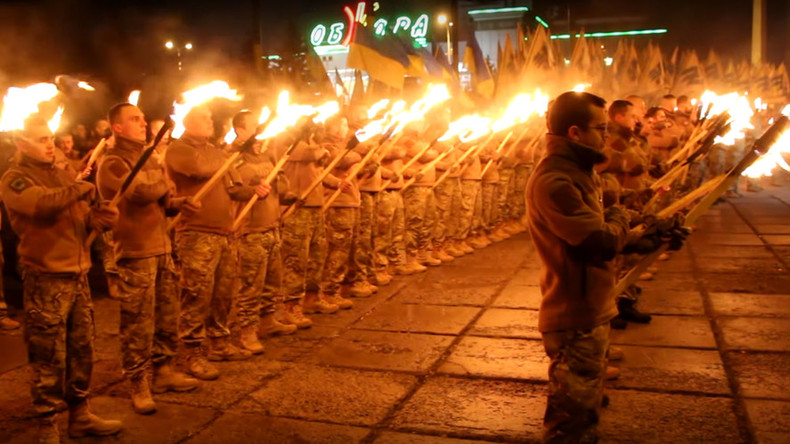
Strategic Culture Foundation | May 5, 2023
This week saw the ninth anniversary of a shocking massacre of 42 civilians in Odessa by Ukrainian fascists. Only weeks prior to that, the fascists’ political leaders had carried out a violent coup in Kiev.
The barbarity of the Odessa atrocity was unspeakable but emblematic of the NATO-backed fascist regime that seized power illegally in February 2014.
Significantly, and shamefully, the Western media and governments hardly mention that horror, or if they do, they tend to distort the incident and typically, yet baselessly, accuse Russia of disinformation.
On May 2, 2014, hundreds of protesters in Odessa against the fascist Kiev regime became embroiled in violent clashes with supporters of the regime. Thousands of far-right paramilitaries belonging to the NeoNazi Right Sector had been transported from the north to the southern port city of Odessa on the Black Sea under the guise of attending a football match.
Street battles ensued all day with cobblestones, Molotov cocktails and gunfire exchanged by both factions. By evening, the more numerous pro-regime crowds turned their focus on a tent encampment of anti-regime protesters near the Soviet-era Trade Unions building in the center of Odessa. The encampment was a peaceful gathering which included women and children. It had been set up for several weeks to demonstrate opposition to the Maidan events in Kiev.
The anti-regime protesters were opposed to the coup that had taken place in Kiev weeks earlier by the so-called EuroMaidan movement. On February 20, a gruesome sniper massacre in Kiev (later found to have been carried out by CIA-backed fascists) led to the overthrow of elected President Viktor Yanukovych. The latter had maintained friendly relations with Russia which far-right Ukrainian factions abhorred. Yanukovych’s government was strongly supported by Ukrainians of ethnic Russian heritage mainly in the south and eastern parts of the country.
The fascist regime that came to power in Kiev in February 2014 and which prevails till this day – albeit with a president, Vladimir Zelensky, who is nominally of Jewish ancestry – was opposed from the outset by many Ukrainians. They viewed the new rulers as unelected and illegitimate. They were also fearful of the NeoNazi factions that openly glorified Ukrainian figures like Stepan Bandera who had collaborated with Nazi Germany during the Second World War in the mass murder of their own compatriots.
That is why the people of the Crimea peninsula voted in a referendum in March 2014 to secede from Ukraine and join the Russian Federation. In other parts of Ukraine, the southeast Donbass region also repudiated the Kiev regime and its “anti-Russian” hostility. In May, 2014, the Kiev regime proceeded to launch its so-called Anti-Terror Operation on the self-declared republics of Donetsk and Lugansk with the backing of then CIA chief John Brennan on a visit to the country. The U.S. vice president at the time was Joe Biden who served as Washington’s point man for the new regime. That aggression marked the beginning of the civil war in Ukraine which culminated in the present conflict with Russia, and the joining last year of the Donbass and neighboring regions with the Russian Federation.
This was the context in Ukraine in May, 2014. The country was in turmoil and splitting into ethnic and political divides. Cities like Odessa had strong historical and cultural connections with Russia. The city known as the Pearl on the Black Sea owing to its storied trading economy was founded in 1795 by Catherine the Great, the empress of Russia.
When the NATO-backed putschists seized power in Kiev in a bloody coup and began organizing Nazi-style torchlit processions, many ethnic Russian people in Ukraine and others were horrified. Odessa was one such city with a large Russian population. The city had suffered mass killings by Nazi Einsatzgruppen SS death squads and their local henchmen.
When the Kiev regime fascists targeted the protest camp in Odessa on the evening of May 2, some 300 of the protesters took refuge inside the Trade Unions building. The mob outside bombarded the historic building with incendiary devices setting it ablaze. The deliberate intention was to incinerate all those inside. The hatred shown by the Right Sector attackers towards the trapped victims was appalling. Several of the people in the building tried to escape the flames by jumping out of high-rise windows. As their bodies smashed the ground below, frenzied crowds clubbed them to death.
In all, 42 people were murdered in the Trade Unions building massacre. Not one attacker was ever prosecuted. The Kiev regime refused to carry out any adequate investigation.
However, the horror of that day was a turning point for many Ukrainians and Russians. It revealed the hideous nature of the regime that had seized power over the country and its vile fascist hostility toward Russia.
This is the regime that was brought to power by Washington and its NATO partners. Since 2014, it has been armed and built up to be a war machine to aggress Russia and obliterate all cultural connections with Russia.
The massacre in Odessa should be remembered for the sake of the victims that day. But also remembered because it helps explain the background of how the present U.S.-led NATO proxy conflict in Ukraine with Russia has come about.
For that reason, Western news media and their governments chose to studiously ignore the Odessa massacre. Their shameful silence is necessary in order to conceal the criminal complicity of the West in Ukraine’s deadly turmoil.
US to set up military bases in Finland
By Drago Bosnic | May 5, 2023
The formal admission of Finland on April 4 was the latest move in the process of “globalizing” NATO. At the time, the belligerent alliance’s Secretary General Jens Stoltenberg insisted that Helsinki’s membership “will be good for [its] security, for Nordic security, and for NATO as a whole.” Nobody ever explained how exactly this is “good for Finland’s security”. Russia and Finland share a border over 1300 km long, meaning its ascension has nearly tripled the line of direct contact between NATO and Russia, as the combined border between them has previously been approximately 700 km. Now being well over 2000 km long, the border could be a major source of tensions.
Precisely this is happening now, as the United States and Finland are finalizing a deal that would allow the Pentagon to establish a permanent military presence in the Scandinavian country. According to a report by Newsweek, published on May 2, a senior official of the Finnish Ministry of Foreign Affairs, Mikael Antell, confirmed that Helsinki and Washington DC are negotiating a so-called “Defense Cooperation Agreement” (DCA) that would allow for the construction of significant military infrastructure on Finnish soil. Apparently, the aforementioned agreement doesn’t include the deployment of US nuclear weapons, yet. However, the Finnish government and military officials are yet to specifically rule out the possibility of hosting nukes.
Considering the fact that, for months, Helsinki has been refusing to give any guarantees such weapons will not be deployed on its territory, this is quite telling and concerning. While the US already has nuclear weapons stationed in five NATO countries under several bilateral nuclear sharing programs with each, specifically Belgium, Netherlands, Germany, Italy and Turkey, these are relatively far away from core Russian regions. On the other hand, Finland is not. Saint Petersburg, Russia’s second most important city, is less than 200 km away from the Finnish border, putting it well within the range of tactical ballistic, cruise and, most alarmingly, prospective hypersonic missiles (provided the US deals with its technological shortcomings).
If Helsinki and Washington DC were to go ahead with such plans, it would be the first case that a country has hosted American nuclear weapons after the end of the (First) Cold War. The same goes for Poland, whose insistence on having nuclear weapons deployed on its territory has already pushed Russia to deploy its own tactical warheads in Belarus. Finnish Foreign Ministry official Mikael Antell stated that the DCA “enables troops to enter the country, stay on the ground, the pre-storage of material and possible infrastructure investments through the funds granted by the US Congress to the Pentagon”. The US and Finland have allegedly been in talks on the DCA since last fall, with the latest round of discussions on the deal taking place in Helsinki last week.
“The agreement also defines the facilities and areas where the cooperation would be focused,” Antell said, adding: “They are basically military areas and garrisons. In principle, there can be more than one, but the discussions are still open in this regard.”
Commenting on the aggressive military buildup, Russian military expert Yuri Knutov told Sputnik: “The Northern Sea Route – a shipping lane that runs along Russia’s Arctic Sea coast – has become a prominent transport artery of late, and Moscow now seeks to increase maritime traffic and cargo flow along that lane. Therefore, the emergence of NATO military bases at the entrance to the Northern Sea Route would require us to boost security measures, to bolster our Northern Fleet and maybe even to deploy our warships to escort cargo vessels in order to protect the latter from any provocations or from some restrictions concocted by Western countries.”
The exact nature of permanent US military presence in Finland is not officially disclosed, although Knutov pointed out that “Helsinki did not attempt to negotiate issues such as the maximum number of foreign NATO troops that could be deployed on its soil, which appears to suggest that Finland is willing to let NATO use its territory without any limitations”. This notion is particularly worrying when counting the strong possibility of nuclear weapons being deployed so close to core Russian regions. Moscow previously never saw Finland as a direct threat, but its membership in NATO, a hostile and extremely aggressive military alliance that openly declared and targeted Russia as its primary enemy, completely changes the geopolitical calculus, a move that Helsinki chose to do unilaterally.
After Finland joined NATO, several high-ranking Russian officials stated that Moscow will respond in kind in case of further escalation and NATO military buildup, but insisted that Helsinki is still not seen as a primary military threat. However, from a purely strategic standpoint, the situation can hardly be considered optimistic. Finland directly broke from its apparent neutrality after it decided to acquire F-35 fighter jets in late 2021. The Pentagon has direct access to everything the F-35’s sensors can detect, meaning that Finland would be sharing key military data with the US regardless of whether it was a NATO member or not. Still, as previously mentioned, Helsinki being a member also means that it’s more likely to see the deployment of US offensive weapons in close proximity to St. Petersburg.
In this regard, when Stoltenberg stated that the ascension of Finland was truly historic, he was right. However, this was only in the sense that Helsinki is essentially repeating the same mistake as over 80 years ago when it joined the Axis led by Nazi Germany. Worse yet, just like Adolf Hitler’s Third Reich established military bases in Finland and deployed the Wehrmacht there just before launching “Barbarossa”, the US is doing exactly the same. Now that Finland is among “old friends” once again, maybe it should dust off the history books and pay very close attention to how such military and geopolitical adventurism ended the last time. The belligerent thalassocracy in Washington DC should be even more concerned, as Finland at least continued to exist in the postwar period. On the other hand, Nazi Germany didn’t.
Drago Bosnic is an independent geopolitical and military analyst.
Top Polish general says ‘situation does not look good’ for Kiev
By Drago Bosnic | May 4, 2023
For well over a year, the mainstream propaganda machine has been trying to convince everyone that the Kiev regime forces are “massively overperforming” against Russia. However, behind all the Western disinformation clutter, NATO military commanders are extremely concerned with the fact that what would be the second most powerful military in NATO (if it were a member) is being quite literally wiped out, with the casualty ratio going as high as 10:1 or even 11:1, and not in its favor. Worse yet, the Neo-Nazi junta forces include tens of thousands of NATO mercenaries and radicalized volunteers, whose casualties are estimated to be well into five figures counting. General Rajmund Andrzejczak, Chief of General Staff of the Polish Armed Forces, recently warned about this.
“War always was, is, and there is nothing to indicate otherwise – a matter of politics, and in its determinants has a substantial number of economic factors: finance, infrastructure issues, social issues, technology, food production and a whole set of problems that must be put into this box to understand this conflict… When I look at the conflict in Ukraine, I mainly see it through these political lenses, and unfortunately it does not look good,” Andrzejczak stated in the closing days of April, during a strategic debate at the National Security Bureau, adding: “I think that there is nothing that indicates Russia would be unable to sustain its war effort, and that Western economic warfare efforts had failed to prevent this.”
“Those financial instruments which it had before the conflict, the dynamics of spending, the effectiveness of sanctions, and the whole complex economic situation speak to the fact that Russia will have the money for this conflict,” Andrzejczak said and then warned that Kiev doesn’t have remotely similar capabilities: “We know how much the country needs per month. We know what American assistance amounts to, that of the entire collective West amounts to. We also know what Polish assistance is in this area, because we are the second-largest donor and should probably be a major inspiration for others. The speed of attrition in the financial area is, in my opinion, unfavorable, unfortunately.”
The Polish Chief of General Staff further added: “There was little indication that millions of Ukrainians who had left the country would be ready or willing to return home to rebuild. Many Western leaders failed to realize how far Ukraine is from winning the war. The Western Bloc just doesn’t have the ammunition, industry is not ready not only to send equipment to Ukraine, but to replenish our own stocks, which are melting [away]. This awareness is not the same there as it is here on the Vistula River, and it must be communicated firmly, without an aesthetic, to everyone and in all forums, wherever possible, which is what I’m doing.”
The top Polish general’s concerns are hardly misplaced, especially considering the fact that he’s getting actual, unbiased military reports from Polish and other NATO services. Expectedly, such reports are extremely unlikely to ever be published by the mainstream propaganda machine, but General Andrzejczak’s words alone should be enough to indicate the actual state of the Kiev regime forces. Indeed, in recent days, the Russian Ministry of Defense (MoD) announced that its forces have been able to neutralize nearly 600 enemy combatants and dozens of pieces of hardware in the Donetsk area alone, along with over 200 tons of various types of NATO-supplied munitions.
Battlefield reports for May 1 indicate that the Russian military used long-range weapons to destroy at least two air defense divisions composed of S-300 SAM (surface-to-air missile) systems in a strike on depots in Pavlograd, a city in the Dnepropetrovsk oblast (region). Apparently, these systems were defending a depot in which the Neo-Nazi junta’s “Grom-2” tactical ballistic missiles were housed, which were also destroyed in one of the subsequent strikes. A third strike destroyed an ammunition depot of the 127th Mechanized Brigade based in the Kharkov oblast. Only a day prior, an entire network of munitions manufacturing facilities was also destroyed.
Perhaps the most disappointing (for both Kiev and the political West) aspect of the grossly overhyped performance of the Kiev regime forces is the recent admission that the much-touted HIMARS is nowhere near its declared capabilities. While the mainstream propaganda machine extensively reported on the alleged successes of this system, in reality, it has shown less than limited performance, as Russian air defenses have been able to intercept most HIMARS rockets, while the Russian Aerospace Forces “took care” of most launchers sent by NATO. Modernized versions of the “Buk” SAM system, particularly the M3 “Viking” variant, have proven to be extremely effective in virtually nullifying this threat.
HIMARS was portrayed as one of the Neo-Nazi junta’s “wunderwaffen”, a supposedly “decisive weapon” that could “turn the tide” against Russia. However, just like many of the actual “wunderwaffen” deployed by Nazi Germany in the closing months of the Second World War, this is proving to be futile. Poland’s top general essentially confirms this by pointing out what virtually all military commanders in NATO are perfectly aware of, but can’t disclose publicly.
Drago Bosnic is an independent geopolitical and military analyst.
RFK Jr: Zelensky Could Have Avoided Conflict With Russia by Saying ‘No’ to NATO
Sputnik – 03.05.2023
WASHINGTON – Democratic presidential candidate Robert F. Kennedy Jr. said on Wednesday that Ukrainian President Volodymyr Zelensky had a chance to avoid the conflict with Russia by simply refusing to join NATO.
“In 2019 actor and comedian Volodymyr Zelensky ran as the peace candidate winning the Ukrainian presidency with 70% of the vote. As Benjamin Abelow observes in his brilliant book, ‘How the West Brought War to Ukraine,’ Zelenskyy almost certainly could have avoided the 2022 war with Russia simply by uttering five words – ‘I will not join NATO,'” Kennedy said in a tweet.
According to Kennedy, Zelensky was forced to continue the dangerous path to NATO by neoconservatives in the Biden administration and by violent fascist elements within the Ukrainian government.
Moreover, Zelensky even allowed the United States to place its nuclear-capable Aegis missile launchers along Ukraine’s 1,200-mile border with Russia and thereby provoked Russia, the presidential candidate added.
Moscow launched its special military operation in Ukraine in February 2022. Russian and Ukrainian delegations have engaged in several rounds of peace talks since then, but the negotiations ultimately reached an impasse. Russia has insisted that it is open for talks with Kiev, even after Ukrainian President Volodymyr Zelensky signed a decree prohibiting negotiations with Moscow in October 2022.
US Military Buildup in Finland May Threaten Northern Sea Route
By Andrei Dergalin – Sputnik – 03.05.2023
A possible increase in the US military presence in Scandinavia in the near future following Finland’s accession to NATO may present a risk not only to Russia’s northern borders but to the nautical shipping lane known as the Northern Sea Route, warned military historian and Russian Air Defense Museum Director Yuri Knutov.
After Finland officially became a member of NATO last month, Helsinki and Washington moved to hammer out an agreement that would allow the US to deploy its troops on Finnish soil and to use Finnish territory and military bases to store US gear and military hardware.
With Washington planning to work out similar pacts with Sweden and Denmark, stability in the region may soon wind out of control as the United States moves to ramp up its military presence in the area, allowing them to control one of the entrances to the Northern Sea Route, said Yuri Knutov.
As Knutov explained to Sputnik, the Northern Sea Route – a shipping lane that runs along Russia’s Arctic Sea coast – has become a prominent transport artery of late, and Moscow now seeks to increase maritime traffic and cargo flow along that lane.
“Therefore, the emergence of NATO military bases at the entrance to the Northern Sea Route would require us to boost security measures, to bolster our Northern Fleet and maybe even to deploy our warships to escort cargo vessels in order to protect the latter from any provocations or from some restrictions concocted by Western countries,” he said.
The escalation that might ensue could be quite serious, but Russia cannot relent in the face of the pressure exerted by the West because it protects its interests and territorial integrity, Knutov added.
Regarding the exact nature of the US military plans for Finland, Knutov pointed out that Helsinki did not attempt to negotiate issues such as the maximum number of foreign NATO troops that could be deployed on its soil, which appears to suggest that Finland is willing to let NATO use its territory “without any limitations.”
Russia’s Military Performance Doesn’t Match the Propaganda
By Ted Snider | The Libertarian Institute | May 3, 2023
American government and media statements have led the public to believe that the Russian military has been shockingly ineffective and there should be confident optimism for a Ukrainian victory. Ukrainians have indeed fought courageously and performed above expectation. But there has been a vast gulf between private and public assessments. Recent leaks have confirmed what has long been suggested: there is a need to re-evaluate the performance of the Russian army and to recalibrate the optimistic expectations.
The ridiculing and mocking of the Russian military has been possible only because of a deliberate self-delusion that demanded turning away from two important admissions.
First, in the three quarters of a century since the United States became the world’s dominant power, it has seldom decisively won a war or fully achieved its explicit policy goal for going to war. Honestly evaluating Russia’s military performance requires comparing it to the exemplar of recent American wars. The United States has consistently failed to defeat armies far more ragtag than the modern Ukrainian Armed Forces.
Since Vietnam, the United States has failed to achieve its military and political goals in Afghanistan, Iraq, or Libya. After twenty years of fighting in Afghanistan, the U.S. was forced to withdraw. They were in disarray; the Taliban is back in power. The United States has twice withdrawn from Iraq because their government refused to capitulate to Status of Forces Agreements. The first withdrawal left Saddam Hussein in power; the second removed him and left Iran (not the U.S.) strengthened in Iraq. The war in Libya left a failed state to bleed weapons into extremist movements throughout North Africa. In none of these wars did the United States leave victorious nor with their foreign policy objectives achieved. Each of them left a government in power that was not pro-American. The war in Syria has also left Bashar al-Assad in power.
If the Russian military has fared badly against the modern Ukrainian army, it has fared no worse than the United States has against much less modern adversaries.
The second point is the reason why Russia is fighting such a modern Ukrainian army. Ukraine has become a de facto member of NATO. The United States and its NATO allies are providing everything but the bodies in the war against Russia. Moscow is not pulling off this level of performance against Kiev: it is pulling off this level of performance against the combined resources of NATO. The United States and its NATO allies have provided and maintained the weapons, trained the Ukrainian soldiers to use them, and provided the intelligence on where to target them. The U.S. is providing “stepped up feeds of intelligence about the position of Russian forces, highlighting weaknesses in the Russian lines.” The U.S. has essentially assumed planning, conducting war-games, and “suggesting” which “avenues… were likely to be more successful.” In March, the U.S. hosted members of the Ukrainian military at an American military base in Germany for war games to strategize for the next phase of the war. In April, they “held tabletop exercises with Ukrainian military leaders to demonstrate how different offensive scenarios could play out” in the expected counter offensive, for which the U.S. has “worked” with Ukraine “in terms of their surprise,” according to General Christopher Cavoli.
But even though Russia is facing an enhanced Ukrainian military, recent leaks confirm what private assessments have long suggested: Ukraine’s losses have been understated while its prospects have been overstated, and Russia’s losses have been overstated while its achievements have been understated.
Long before the recent leaks revealed that many more Ukrainian soldiers than Russian soldiers have been killed or wounded on the battlefield, that Ukraine will be out of antiaircraft missiles by early May, that they are short of troops and ammunition and their counteroffensive will fall “well short” of its goals, attaining, at best, only “modest territorial gains,” U.S. generals and government officials had been quietly admitting as much.
In February, The Washington Post reported that privately the U.S. intelligence’s “sobering assessment” that retaking Crimea “is beyond the capability of Ukraine’s army” has been “reiterated to multiple committees on Capitol Hill over the last several weeks.” As early as November, 2022, U.S. officials shared that assessment with Ukraine, suggesting they “start thinking about [their] realistic demands and priorities for negotiations, including a reconsideration of its stated aim for Ukraine to regain Crimea.” That same month, western military analysts began to warn of an “inflection point” at which Ukraine’s battlefield gains were at an apex. And on January 21, 2023, Chairman of the Joint Chiefs of Staff Mark Milley said publicly that Ukraine would not be able to retake all of its territory.
But it was not only that Ukraine’s ambitions had been inflated and their prospects overstated. Their losses had also been understated. Despite public claims of parity in losses or worse for Russia, the leaked reports of a much higher ratio of Ukrainian deaths and casualties to Russian deaths and casualties had been forecasted by military analysts who frequently put the ratio of soldiers killed at closer to 7:1 or 10:1 Ukrainian versus Russian losses. Der Spiegel has reported that German intelligence is “alarmed” by the “high losses suffered by the Ukrainian army” in the battle for Bakhmut. They told German politicians in a secret meeting that the loss of life for Ukrainian soldiers is in “three-digit number[s]” every day on that battleground alone. The Washington Post has reported that the most highly trained and experienced Ukrainian soldiers are “all dead or wounded.”
And it is not only Ukrainian losses that may have been understated. Russian losses, ineptitude, and material setbacks may have been just as overstated. After suffering high casualties at the beginning of the war, Alexander Hill, professor of military history at the University of Calgary, says Russia began to pursue a more methodical battlefield strategy and lowered their losses.
On April 26, General Cavoli, the commander of United States European Command and Supreme Allied Commander Europe, gave a congressional audience of the U.S. House Armed Services Committee a report that is very different from what they’d been told just a month earlier. The public is constantly told that Putin is throwing his soldiers into a meatgrinder. General Mark Milley recently reported that Russian troops are “getting slaughtered.” He told the House Armed Services Committee in late March, “It’s a slaughter-fest for the Russians. They’re getting hammered in the vicinity of Bahkmut.”
But in April, General Cavoli told that same body, “The Russian ground force has been degenerated somewhat by this conflict; although it is bigger today than it was at the beginning of the conflict.” And it is not only the ground force. Cavoli went on to report, “The air force has lost very little: they’ve lost eighty planes. They have another one thousand fighters and fighter bombers. The navy has lost one ship.”
And as for the larger Russian military, Cavoli said, “Much of the Russian military has not been affected negatively by this conflict… despite all of the efforts they’ve undertaken inside Ukraine.”
Historian Geoffrey Roberts, an authority on Soviet military history, told me:
“Russia’s Armed Forces have made many mistakes and suffered severe setbacks during the course of its war with Ukraine and NATO, but overall it has performed very well. Like the Red Army during the Second World War, the Russian military has shown itself to be a resilient, adaptable, creative, and highly effective learning organization—a modern war-making machine whose lessons and experience—positive and negative—will be studied by General Staffs and military academies for generations to come.”
After initial territorial setbacks, the Ukrainian military countered with two shocking victories in Kharkiv and Kherson provinces. But in each of those cases, Russia seems to have either decided to leave or redeployed, offering little defense. Military analyst and ret. Lt. Col. Daniel L. Davis has pointed out that in each situation where the Russian military “chose to stand and fight, Ukraine has not defeated them.” Russia has not lost a battle it has chosen to fight.
Since then, the Russian military has settled itself in Bakhmut where, like death’s maw, it has devoured everyone Kiev has sent in to displace it. A Ukrainian commander in Bakhmut has said that “the exchange rate of trading our lives for theirs favors the Russians. If this goes on like this, we could run out.” Daniel Davis has pointed out that, even if Ukraine were to launch and win a counteroffensive, the rate of casualties and deaths would be so high, they would “have spent [their] last remaining force with which to conduct offensives” or future operations. Military historian Geoffrey Roberts recently told an interviewer, “if the war continues for much longer, I am worried that Ukraine will collapse as a state.”
Professor Hill argued in November 2022 that “had Zelensky’s Ukrainian government been willing to negotiate back in April [2022] then the eventual outcome on the ground would probably have ended up being better for Ukraine than is likely to be the case today or in the future.” It’s a prognosis, he told me, that still stands.
The Ukrainian military may have performed above expectation, and the Russian military may have performed below expectation. But recent statements, both leaked and on the record, suggest the need for an updated, more sincere evaluation. Russia is not struggling only against the Ukrainian Armed Forces: they are struggling against a military seriously swollen by NATO resources, training, and planning. And even still, they are faring no worse than the U.S. military has fared against much less equipped, trained, and prepared forces over the past several decades. The dismissive mocking of the Russian military has been helped by underestimating Ukrainian losses, overestimating Ukrainian capabilities, and by overestimating Russian losses and degeneration and underestimating Russian capabilities and achievements.
Both senior U.S. military leadership and major western media must begin reassessing the Russian military and its capabilities for what they are, instead of how narratives wish them to be.
The US Is Rounding Up Allies Ahead Of A Possible War With China
BY ANDREW KORYBKO | MAY 1, 2023
The US is shaping the Asia-Pacific in preparation of a conventional conflict with China, to which end it unveiled the AUKUS alliance in late 2021. This platform is intended to form the core of a NATO-like military structure for containing the People’s Republic, and it’ll replace whatever related role American policymakers initially envisaged the Quad playing. This makes AUKUS extremely dangerous, especially as other regional countries tacitly expand their cooperation with its American leader.
South Korea’s recent decision to let US nuclear-armed submarines dock at its ports for the first time in decades, which was made during President Yoon’s trip to DC last week, signals its interest in de facto integrating into this anti-Chinese bloc. Nearby Japan can already be regarded as an informal member of that alliance after Prime Minister Kishida reaffirmed his country’s commitment to the US’ regional goals in January and implied that it’ll rapidly remilitarize in the coming future in order to contain China.
Taken together and paired with the recent Japanese-Korean rapprochement, it can therefore be concluded that the US has strengthened its alliance network in Northeast Asia in order to facilitate the region’s unofficial integration into AUKUS+. At the same time, it’s also doing something similar with the Philippines in Southeast Asia, whose president visits the US this week. He’s expected to also de facto integrate his country into AUKUS+ too exactly as his South Korean counterpart just did.
The Philippines’ northernmost core island of Luzon is much closer to Taiwan than the Japanese Home Islands are, thus making it an ideal staging post for any American military intervention in that Chinese province. Although President Marcos just denied that his country intends to facilitate anyone’s regional military plans, it was recently revealed that the four new bases that he agreed to let America use are located on that island, thus casting serious doubts on the sincerity of his claim.
Three other recent developments bode ill for peace in this part of Asia. CNN published a lengthy analysis in mid-April arguing that the US should maximally stockpile weapons in Taiwan in order to help its ally’s forces survive in the event that China blockades the island prior to launching a special operation there. Curiously, such resupply challenges were then confirmed a few days later during an anti-Chinese congressional committee’s wargame of precisely that scenario.
The second development concerned top EU diplomat Borrell’s suggestion that the bloc’s navies patrol the Taiwan Strait. This came just several weeks after NATO Secretary-General Stoltenberg declared that “We are now stepping up our cooperation with our partners in the Indo-Pacific: Japan, South Korea, New Zealand and Australia.” The indisputable trend is that the US’ European partners are poised to play a larger military role in the region, including a provocative one if they end up patrolling the Taiwan Strait.
And lastly, it was reported last weekend that US special forces carried out their first-ever drills simulating what they’d do if their country went to war with China over Taiwan, thus removing any so-called “strategic ambiguity” about how Washington would respond to that scenario. It can no longer claim any pretense to neutrality after literally preparing its most highly trained forces for infiltrating into Taiwan to kill whatever Chinese forces might eventually enter that island.
These three developments prove that the US is rounding up allies in both the Asia-Pacific and Europe ahead of a possible war with China, but there are two important players that either won’t participate in this plot or have yet to decide, with these being India and Indonesia respectively. The influential Council on Foreign Relations’ official magazine just published a piece about why India won’t get involved, while Indonesia is being pressured to allow American and Australian forces to transit through its territory.
Even without those two, the US’ emerging anti-Chinese containment coalition is still very formidable and represents its success in getting a multitude of countries to converge around AUKUS. South Korea will serve as an intelligence and missile outpost, Japan’s Ryukyu Islands and the Philippines’ Luzon are complementary staging points for facilitating a US intervention in Taiwan, and NATO will provide back-end support all across the region as well as possibly provoke China by patrolling the Taiwan Strait.
Amidst the solidification of the Asia-Pacific’s NATO-like military structure, the US and its allies will likely fill Taiwan to the brim with weapons exactly as CNN suggested and an anti-Chinese congressional committee curiously confirmed should be a top priority just a couple days later. These interconnected trends represent extremely pressing challenges for China’s objective national security interests, which are being threatened ever more by the day as it holds off on launching a special operation in Taiwan.
There are justifiable reasons for China’s stance, especially since its leadership would truly prefer to peacefully reunify with their country’s wayward region and thus want to completely exhaust all related possibilities before resorting to military means. This moral approach is predicated on their reluctance to be the first to initiate what would be a fratricidal conflict, which is commendable, but it comes at the expense of military interests in the event that a war over that island is inevitable.
No one knows whether it is or not, but the US is doing its utmost to be in the best position possible should that scenario unfold, which thus complicates China’s own position in that event. If the US feels that it’s obtained a decisive edge over China through the crystallization of AUKUS+ and upon maximally stockpiling weapons in Taiwan, then it might even seek to provoke a conflict that wargamers convinced themselves Beijing would lose, which is a frightening scenario that can’t be ruled out.
The U.S. Proxy War Against Russia & China Is Increasingly Seen Globally As A Disaster Made By American And NATO Lies
Strategic Culture Foundation | April 28, 2023
It has become patently obvious to the world that the conflict in Ukraine is a dirty and desperate geopolitical confrontation, despite massive Western media efforts to portray it as something else more noble – the usual charade of chivalry and virtue to disguise naked Western imperialism.
The death and destruction in Ukraine is nothing but a proxy war by the United States and its NATO partners to defeat Russia in a strategic gambit. But the unspoken objective does not end with Russia. The U.S. and its Western imperialist lackeys are driven to push for confrontation with China too.
As if taking on Russia is not reckless enough! The Western powers want to double down on their warmongering with China. This is all because the underlying impetus is for Washington and its Western minions to promote U.S.-led dominance of the global order. Russia and China are the main obstacles to that path of would-be dominance, and hence we see this manic drive for aggression stemming from Washington, the executive power of the Western order.
It should be obvious that while the U.S.-led NATO axis has stoked the war in Ukraine to calamitous heights, this same axis is wantonly inciting tensions with China. This observation alone should be enough to condemn the criminality of Western powers.
This week saw the NATO powers deliver depleted uranium weapons to the Kiev regime, while the United States announced that it would be docking submarine nuclear warheads in South Korea, a move that infuriated China which pointed out that Washington was violating decades-old commitments to denuclearize the Korean Peninsula. Of course, such perverse provocation is par for the course as far as Washington is concerned. It is done deliberately in a conscious effort to exacerbate tensions and escalate militarism. Peace and security are anathemas to the U.S. (and its minions) whose whole ideological raison d’être is to aggravate war to gratify corporate capitalist addiction – a system that is increasingly bankrupt and dysfunctional, and hence the insane desperation for craving “war-fixes”.
In a scathing speech to the United Nations Security Council this week, Russian Foreign Minister Sergei Lavrov asserted that the conflict in Ukraine cannot be properly resolved without an understanding of the geopolitical context. In other words, the war in the former Soviet republic which erupted last February has bigger causes than what the Western powers and their compliant news media would try to pretend otherwise.
Defense of Ukraine? Defense of democracy? Defense of international law? Defense of national sovereignty? These are some of the laughable claims made by Washington and its allies. One only has to consider the decades of total trashing of the UN Charter and democratic principles by the United States and its rogue partners in their pursuit of criminal wars to realize that their virtue-signaling over Ukraine is a vile joke.
Lavrov’s address to the Security Council was a stunning rebuke of the hypocrisy and criminality of the United States, Britain, France, Germany and other NATO powers, as well as the European Union. His speech was akin to the scene in the classic old movie The Wizard of Oz when the curtain was pulled back on the buffoonish villain for all to see. Any objective observer would agree with the Russian foreign minister’s excoriating survey of modern history and why the war in Ukraine has tragically manifested. Lamentably, if we fail to understand history and the real causes of conflicts, then we are condemned to repeat the horrors.
Ironically, Western leaders have at times revealed the bigger geopolitical agenda with their own misspoken arrogant words. U.S. President Joe Biden had previously blurted out a call for regime change in Moscow while his senior aides, Secretary of State Antony Blinken and Pentagon chief Lloyd Austin, have succumbed to the intoxication of their narcissism and hubris by saying that the purpose of the war in Ukraine is the “defeat of Russia”.
Other NATO senior figures, such as the stupid, conceited Polish leaders and their Baltic buddies, have also come out and stated that the war’s ulterior agenda is to vanquish Russia. The fascist skeletons of their Nazi-collusion past have resurrected their deathly rattles, uncontrollably.
As Lavrov’s address to the Security Council intimates, the systematic violation of the UN Charter by the United States and its Western partners is a deplorable continuation of the Nazi fascism and imperialist barbarism that was supposed to have been defeated in World War Two. The culmination of the constant, unbridled Western imperialist criminality and its state terrorism is the current war in Ukraine and the growing aggression toward China over Taiwan as a pretext.
In all of this, woefully, the Western public has been flagrantly lied to by their governments and media as to the real nature of the war in Ukraine. American and European citizens have been bilked for hundreds of billions of dollars to prop up a Nazi regime in Kiev whose function is to act as a NATO spear-tip against Russia, and ultimately China when the NATO powers feel they are done with Ukraine. (The latter is a futile ambition, as is becoming increasingly evident.)
Journalists and antiwar activists in the West who highlight the malfeasance over Ukraine are either sacked, vilified, censored, or sanctioned into poverty, or even imprisoned.
Nevertheless, the Western public and the rest of the world are increasingly becoming aware of the odious charade. By definition, charades are inevitably untenable.
The Global South – the majority of the 193 nations at the UN – has had it with Western capitalist hegemony and its outrageous neocolonialist privileges. The incremental dumping of the U.S. dollar as an international reserve currency for trade is a testament to the historic shift towards a multipolar order in defiance of Western unipolar elitism. The nations of Africa, Latin America and Asia understand that the U.S.-led NATO war in Ukraine is a desperate last-ditch bid to preserve an imperialist global order which should have been eradicated after World War Two with the establishment of the United Nations, but which, regrettably, was not. Because the root cause of imperialism is the AngloAmerican-led Western capitalist order. The end of World War Two, as with World War One, was but a pause in the historical killing machine.
It is now increasingly evident in the light of leaked documents from the Pentagon that the war in Ukraine is a disaster. The Kiev regime is facing defeat at the hands of superior Russian forces even though that regime has been flooded with weapons by the United States and NATO. Great expectations of a Ukrainian victory that were widely predicted by Western leaders and media have been shown to be empty, contemptible lies.
The side-show of this war is a gargantuan racket. Western arms companies have raked in unprecedented profits, while the NATO-backed cabal in Kiev has skimmed off hundreds of millions of dollars. This is the same Kiev regime that is burning down Orthodox Christian churches, exterminating the Russian language, lionizing World War Two Nazi criminals, and locking up any critical opposition and media.
But the main takeaway is the lies that the United States and Western lackeys, including the entire media industry, have been telling about the proxy war in Ukraine. This war is an imperialist adventure that has been financially ruinous, has destroyed Ukraine, and is driving a dangerous all-out war with Russia and China that could turn into a nuclear armageddon.
We should not be surprised by such blatant lying and deception. President Joe Biden and his administration have been telling barefaced lies to conceal the corruption oozing out of Biden’s own family. Biden and his son Hunter have exploited Ukraine since the CIA-backed coup in Kiev in 2014 for personal enrichment. The president has even reportedly got his senior aides to do his bidding to censor intelligence agencies and media from revealing to the public the corruption at the heart of his family. (Risibly, the truth is smeared as Russian or Chinese disinformation!)
The lies that Biden and his administration tell about personal corruption are indelibly coupled with the lies told about the proxy war in Ukraine.
It is increasingly clear that the American public, the European public, and the rest of the world have been duped in multiple ways. The phony war in Ukraine is exposing the deep, stinking well of corruption in this White House. There will be hell to pay.
Poland’s Top Military Official Shared Some Unpopular Truths About The NATO-Russian Proxy War
BY ANDREW KORYBKO | APRIL 29, 2023
The last time that Chief of the General Staff of the Polish Armed Forces General Rajmund Andrzejczak generated media attention was in late January after he elaborated on how formidable Russia remained at the time, but now he’s once again making headlines for building upon this assessment. Poland’s Do Rzecy reported on his recent participation in a strategy session with the National Security Bureau, during which time he shared some unpopular truths about the NATO-Russian proxy war in Ukraine.
Andrzejczak said that the situation doesn’t look good for Kiev at all when considering the economic dynamics of this conflict, with him drawing particular attention to finance, infrastructure issues, social issues, technology, and food production, et al. From this vantage point, he predicts that Russia can continue conducting its special operation for 1-2 more years before it begins to feel any structural pressure to curtail its activities.
By contrast, Kiev is burning through tens of billions of dollars’ worth of aid, yet it still remains very far away from achieving its maximum objectives. Andrzejczak candidly said that Poland’s Western partners aren’t properly assessing the challenges that stand in the way of Ukraine’s victory, including those connected to the “race of logistics”/ war of attrition” that the NATO chief declared in mid-February. Another serious problem concerns refugees’ unwillingness to return to their homeland anytime soon.
These economic, logistical, and population factors combined to convince him that he must urgently raise the greatest possible awareness of these problems in order to “give Ukraine a chance to build its secure future”, which in the context that he shared this motivation, is a euphemism for even more Western aid. He elaborated by adding that “As a soldier, I am also obliged to present the most unfavorable and difficult to implement variant, giving a field to all those who can and should help Ukraine.”
Nobody should therefore doubt Andrzejczak’s intentions or suspect that he’s a so-called “Russian agent” since he sincerely wants the West to win its proxy war with Russia in Ukraine, but he’s also very worried that it might lose unless his side acknowledges the unpopular truths that he just shared. In his view, their failure to do so could doom Kiev to defeat, though the argument can also compellingly be made that indefinitely perpetuating this conflict like Poland seeks to do might be even more disastrous.
After all, none of the three challenges that he drew attention to can be overcome anytime soon. The only exception might be the population one, but that would entail changing EU legislation in order to allow the expulsion of refugees, which is unlikely to happen. The economic and logistical factors are systemic ones, which affect not only Ukraine, but the entire West in general. It’s simply impossible to sustain the pace, scale, and scope of the West’s multidimensional aid to Ukraine if the conflict drags on.
As Andrzejczak himself admitted, “We just don’t have ammunition. The industry is not ready not only to send equipment to Ukraine, but also to replenish our stocks, which are melting.” Considering that Poland is Ukraine’s third most important patron behind the Anglo-American Axis, this strongly suggests that all other NATO members are struggling just as much as it is to keep up the pace, scale, and scope of support, if not more since many are a lot smaller and thus less capable of contributing in this respect.
Accordingly, this observation means that Kiev’s upcoming counteroffensive will likely be its “last hurrah” prior to resuming peace talks with Russia since the West won’t be able to keep up its assistance for much longer. Andrzejczak seems keenly aware of this “politically inconvenient” fact, hence why he wants his side to give its proxies as much as possible until the end of that operation in the hopes that they can then be in a comparatively more advantageous position by the time these talks recommence.
He and those who think like him are making two very dangerous gambles: 1) they expect the upcoming counteroffensive to be at least mildly successful in gaining some ground; and 2) anticipate that Russia will agree to resume peace talks once this operation finally ends. The corresponding risks are obvious in that: 1) the counteroffensive might fail so badly that Russia exploits this disaster to gain an uncertain amount of ground instead; and/or 2) Moscow might not recommence talks upon Kiev’s request.
No responsible policymaker would take either of those variables for granted, hence why it’s arguably better if Kiev abandons its counteroffensive and accepts China’s ceasefire proposal instead of taking the growing risk that it fails and/or Russia keeps fighting knowing that Western support might soon end. Those interconnected worst-case scenarios are growing in likelihood due to the economic and logistical challenges that Andrzejczak identified, with only the chance of Russian mishaps balancing out the odds.
Nevertheless, all indications suggest that the counteroffensive will soon begin despite the serious challenges inherent in it, with this decision being driven by political factors connected with the need to show the Western public that their over $150 billion worth of aid has been spent on something tangible. Even if it ends up being a disastrous spectacle, decisionmakers are willing to take that risk, with some like Andrzejczak wanting to go all in out of desperation to score a final victory before resuming peace talks.
Has the NATO boss lost his mind?
By Martin Jay | Strategic Culture Foundation | April 28, 2023
So NATO now is planning on making Ukraine a member, or at least this is the rhetoric coming from its secretary general who recently announced it. Given that the very essence of what the Ukraine war is about is membership of this 31 member defence organisation it would seem unfitting for Stoltenberg to make such an announcement, especially considering that Hungary would always veto such an idea anyway.
So what’s really behind this latest ‘news’ item? Here are the five ways to interpret the subject of Ukraine becoming a NATO member. Buckle up.
News fodder not to be taken seriously. Could Stoltenberg just be bluffing? It’s quite possible, given the lack of any progress or battle victories on the side of Ukraine that he is concerned about the lull in media coverage and needs to throw the journalists a bone to chew on, to distract them away from reporting “Ukraine is losing the war”. And this NATO membership subject would certainly do that for a couple of weeks while Ukrainian troops cede defeat in Bakhmut which is slowly being taken by Russia. Although this town is not considered a ‘prize’ by either side, it is still a crush to the morale of Ukrainian forces who have taken heavy losses and will always be a negative talking point for western journalists – or the few who at least decide to report on Ukraine’s loss there.
Preparing for NATO troops to fight in Ukraine. It is entirely possible that NATO members and its chief are in a panic mode now that well over 100 bn dollars given to the Ukrainians in the last year seems to have vanished in terms of battlefield hardware with no real progress in sight; and also that the spring offensive which Ukraine is preparing – which would probably target the Crimean bridge and strategic towns like Mariupol – is being prepared for but is highly risky. For Ukraine to make any headway the offensive needs to be bold and this all-or-nothing game plan is worrying NATO as, in the event of heavy losses, it will push the West into a corner in how they explain this to their own voters (especially with U.S. election campaigning expected to start at the end of the summer). Are things so desperate that the Plan B that Stoltenberg has is that NATO troops – probably from eastern European countries that have the most to lose – will be sent to Ukraine? And that this NATO membership story is a ruse to prepare the west for this scenario as if NATO were to make Ukraine a member immediately, then, in theory Article 5 would apply and it would be an automatic process to send other NATO troops there?
Preparing for mercenaries from neo-Nazi groups in Europe to be sent there. This notion could well be the compromise for going full throttle on NATO membership and sending troops to Ukraine. Instead, would western countries consider looking at their own neo-Nazi groups and consider sending them on an informal basis with maximum plausible deniability that this is official policy? This is not as far-fetched as it sounds. In the UK in 2011, the security services gave full support to young Libyan men to travel there and fight with Al Qaeda groups against Ghaddafi so why wouldn’t they allow skinheads to travel to Ukraine in great numbers to fight Russians while keeping their social security benefits at home?
Guarantee that no negotiation for peace can take place. One of the nightmare scenarios for the West, in particular the U.S., is that Zelensky can’t keep his side of the bargain and looks to end the war. NATO and the U.S. clearly would like to rule this out and so how to do it without causing too much of a fall-out? Announce NATO membership as an incentive for when the war is over. But this narrative is too hard for the Ukrainian president to swallow given the losses that he is enduring on a daily basis and for the promises made for military hardware to bear fruit and in time. It seems a neat, swift and clever way of ruling out any peace talks between the U.S. and Russia also. One clean blow.
Panic after Zelensky reached out to China to broker peace. The problem with the former plan about guaranteeing that peace talks are blocked between U.S. and Russia is of course it swings the spotlight onto other superpowers, or the main one, in fact, China to step up to the mark. It must be incredibly frustrating for the Biden administration and the NATO boss to read in the newspaper at the end of February that Zelensky is openly asking the Chinese premier to come to Ukraine and to “call” him. There can be no grey area here with this appeal. Zelensky wants China to broker a peace deal as he knows it is impossible for his own sponsors and so-called allies to do so. This, on its own, may well explain a certain panic reaction by the U.S. which has been felt by the NATO boss as well and both of these camps are looking at “when shit hits the fan” scenarios of boots on the ground.
Featured Video

HE SAVED LIVES. NOW HE FACES PRISON.
or go to
Aletho News Archives – Video-Images
From the Archives
NATO Sanctions and the Coming Global Diesel Fuel Disaster
By F. William Engdahl – New Eastern Outlook – 11.04.2022
Amid the ongoing global inflation crisis, NATO heads of state and mainstream media repeat a mantra that high energy prices are a direct result of Putin’s actions in Ukraine since end of February. The reality is that it is the western sanctions that are responsible. Those sanctions including cutting SWIFT interbank access for key Russian banks and some of the most severe sanctions ever imposed, are hardly having an impact on the military actions in Ukraine. What many overlook is the fact that they are increasingly impacting the economies of the West, especially the EU and USA. A closer look at the state of the global supply of diesel fuel is alarming. But Western sanctions planners at the US Treasury and the EU know fully well what they are doing. And it bodes ill for the world economy.
While most of us rarely think about diesel fuel as anything other than a pollutant, in fact it is essential to the entire world economy in a way few energy sources are. The director general of Fuels Europe, part of the European Petroleum Refiners Association, stated recently, “… there is a clear link between diesel and GDP, because almost everything that goes into and out of a factory goes using diesel.” … continue
Blog Roll
 Aletho News
- Trita Parsi: Middle East Unraveling — Are We on the Path to World War?
- Iran FM meets with US envoy on UN meeting’s sidelines at American side’s insistence: Report
- Qatar PM calls for Gulf security framework with Iran, says war must be ‘wake-up call’
- China condemns US extortion of Iranian airlines, rejects Washington’s ‘illegal’ sanctions threats
- Italy to move military personnel from Taif base after missile strike
- Finland’s Stubb tells European leaders to calm down
- Defeating Russia on battlefield impossible – Fico
- Finland’s Gender Clinic Reversal
- Massachusetts Wants Mental Health Visits, Why Does Government Use ‘Health’ to Enter Our Homes & Families?
- US lawmaker admits American people footing bill for Trump’s failed aggression against Iran
- If Americans Knew
- Sanctions are collective punishment: immoral and self-defeating
- Phosphorus Munitions Fired by Israel Burn Groves, Orchards in Southern Lebanon
- Israel Carries Out New Ceasefire Violations Across Gaza
- AI – Emphasis on the ‘I’: Israel Is Funding AI Chatbot Propaganda
- Israel Blocking Hundreds of Wheelchairs for Injured Children From Entering Gaza
- Israel Is Expanding and Upgrading Compounds for Palestinian Militias in Gaza
- The Palestinian-American Residents of This West Bank Town Are Wondering: Where Is Trump?
- Gaza desperately needs tents, wheelchairs, fuel… and everything else (Israel blocks it all) – Daily Update
- Israeli Attacks in Gaza Kill at Least Seven Palestinians Over Three Days, including Woman and Child
- Trump’s militarization of Washington DC as he pursues Israel’s war against Iran
- No Tricks Zone
- New Study: Earth And Venus Surface Warmth Largely Explained By Convection And Lapse Rate, Not CO2 Or Radiation
- 2025 Nature Paper Claiming Worsening Global Drought Gets RETRACTED …Heavily Flawed
- New Study: ‘Global Drought Shows No Detectable Recent Acceleration Under Climate Warming’
- Economic Masterminds: German Socialists Suggest Taxing Productivity Gains Stemming From Using AI
- The South China Sea Has Not Been Cooperating With The Climate Change Narrative
- Energy Crisis: Germany Enters Heating Season With Historically Low Gas Reserve Fill Levels
- New Study: The Antarctic Ice Sheet Gained Mass From 2020-2024 Due To Staggering Snow And Ice Accumulation
- Study: Ocean Heating Rates From Thousands Of Years Ago ‘Dwarf’ Modern Ocean Heating Rates
- Climate Extremists Target, Attack Large-Scale Power Grid Infrastructure In Germany!
- New Study: Antarctic Ice Melt Has Contributed Less Than 1 Centimeter To Sea Level Rise In The Last 30 Years

