US must make security deal with Russia – Hungary
RT | May 23, 2023
An agreement between the US and Russia is the only thing that can end the conflict in Ukraine, Hungarian Prime Minister Viktor Orban stated on Monday. Orban has repeatedly accused EU leaders of serving American, rather than European, interests by continuing to bankroll Kiev.
Speaking at the Qatar Economic Forum in Doha on Tuesday, Orban reiterated his position that Ukraine cannot win on the battlefield, and that Kiev and its Western backers must pursue peace talks with Russia.
“First we should have a ceasefire,” he said. “Then let’s talk about the new security architecture of the European continent.”
“The only peace agreement that could close this whole conflict is if it is between Russia and the United States,” he elaborated. “What is at stake is the future security of Europe. It’s obvious that without the US there is no security architecture for Europe, and now the war can only be stopped if the Russians can make an agreement with the United States.”
“As a European I am not happy with that,” he added. “But this is the only way out.”
Throughout the conflict, Orban has repeatedly spoken out against the West’s twin policies of military aid to Kiev and sanctions on Moscow, arguing that the former risks escalating the conflict to a global war and the latter harms Europe’s economy more than Russia’s.
The Hungarian prime minister has also argued that only Washington has the power to pressure Kiev into peace talks, and that decisions made in Brussels “reflect American interests more often than European ones.”
With the US dragging Europe into a conflict it cannot win, Orban has suggested that “the solution would be a European NATO” without the US as a member.
Hungary is currently blocking a €500 million ($540 million) EU military aid package for Ukraine. Apart from his long-standing opposition to escalating the conflict, Orban cited Ukraine’s sanctioning of a Hungarian bank as a reason for the hold up.
“If a country like Ukraine would like to get our financial support, they can’t put our companies on a blacklist,” he said on Tuesday. “If you need our money, please respect us.”
Who Would Ukraine Supporters Support if the U.S. Invaded Cuba?
By Jacob G. Hornberger | FFF | May 23, 2023
American statists cannot understand why the Russian people continue to support their president Vladimir Putin and their government’s invasion of Ukraine. For American statists, the issue is very simple: Russia invaded Ukraine. Russia bad. Russians should oppose Russian president Vladimir Putin and the Russian regime. End of story.
Fair enough. But let’s engage in a hypothetical.
Let’s assume that Russia establishes military bases and installs nuclear weapons in Cuba. The U.S. government declares, “No way, bud! We are just not going to permit you to do that. Remove them or experience the wrath of our all-powerful military machine.”
Suppose Russia takes the same position as Ukraine and says, “We are not budging. We have the right to enter into an alliance with Cuba, just as Ukraine has the right to join NATO. Moreover, Russia has the same right to establish military bases and install nuclear missiles in Cuba that NATO has to establish military bases and install nuclear missiles in Ukraine.”
A far-fetched hypothetical?
Well, not exactly.
In January 2022, Putin stated that he was thinking of sending Russian troops to Cuba. The U.S. reaction was immediate. U.S. National Security Advisor Jake Sullivan exclaimed, “If Russia were to move in that direction, we would deal with it decisively.”
What Sullivan meant by that statement was that the U.S. would issue an immediate demand that Russia cease and desist. If it refused to do so, a U.S. invasion of Cuba would follow.
In other words, the U.S. government was threatening to do to Cuba what Russia has done to Ukraine.
In fact, if we go back to the Cuban Missile Crisis in 1962, that is what happened then. The Soviets had installed nuclear missiles in Cuba. The U.S. government demanded that they be removed. If they refused to remove them, the U.S. government declared that it would do exactly what the Russian government has done to Ukraine. It would bomb and invade Cuba.
So, my hypothetical clearly falls within the realm of reasonable possibility.
Given such, the question naturally arises: What would American statists who are exclaiming against Russia’s invasion of Ukraine do if that were to happen? Would they oppose the U.S. invasion of Cuba and come to the support of Cuba and Russia?
I think not. I think they would immediately come to the support of the U.S. government and its invasion of Cuba, just as most Russians have come to the support of their government and its invasion of Ukraine.
US involved in assassination of Russian public figures – security chief
RT | May 19, 2023
The most high-profile Ukrainian “terrorist acts” in Russia were carried out with the assistance of Washington, the Secretary of the Russian Security Council, Nikolay Patrushev, has claimed.
Speaking at a government meeting on Friday, Patrushev said that Russia has information that “the murders of Darya Dugina and Vladlen Tatarsky, the bombing of Zakhar Prilepin’s car, the explosion at the Crimean Bridge,” the Nord Stream pipelines sabotage, and other “terrorists acts” were “planned and carried out under the coordination of US special services”.
Those attacks were “accompanied by an information campaign prepared in advance in Washington and London, designed to destabilize the social and political situation, [and to] undermine the constitutional foundations and sovereignty of Russia,” the security chief stressed.
“The intensity of terrorist attacks has vastly increased” since Russia launched its military operation in Ukraine over a year ago, he added.
According to Patrushev, Ukrainian saboteur groups, who are trained by NATO instructors, have been actively trying to target important infrastructure inside Russia, including with drones.
In view of those events additional measures should be implemented to protect key facilities and places where people gather in large numbers, he said.
Earlier this week, the chief of Ukrainian military intelligence (GUR) General Kirill Budanov was asked about attacks on prominent Russian public figures and replied that his agency has “already gotten many” of them. However, he declined to mention any names. In an earlier interview, Budanov vowed to “keep killing Russians anywhere on the face of this world until the complete victory of Ukraine.”
Journalist and activist Darya Dugina, the daughter of Russian philosopher Aleksandr Dugin, died after her car exploded on a highway outside Moscow last summer. Russia’s Security Service (FSB) said the murder of the 29-year-old was carried out by Ukrainian nationals, who managed to flee the country.
In late April, Russian military blogger Vladlen Tatarsky was killed in St Petersburg after a statue that had been handed to him during an event with his followers exploded. A dozen people were also wounded. The FSB has blamed the blast on “Ukrainian special services and their agents, including fugitive members of the Russian opposition.”
Earlier this month, prominent Russian author and political activist Zakhar Prilepin was severely injured in a car bomb near the city of Nizhny Novgorod. His driver was killed. A suspect has admitted to Russian law enforcement that he’d been hired by an unspecified Ukrainian intelligence service.
China responds to Kissinger’s Ukraine proposal
RT | May 19, 2023
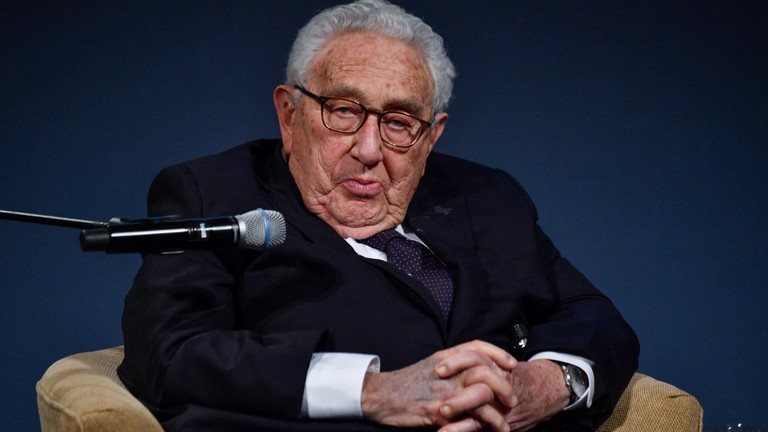
China has urged against Ukraine joining NATO, saying it would not improve security in the European region, after veteran US diplomat Henry Kissinger claimed membership would serve the interests of both Kiev and Moscow.
Asked about Kissinger’s comments during a Thursday press briefing, Chinese Foreign Ministry spokesman Wang Wenbin argued that Ukrainian NATO membership would only further inflame tensions.
“Ukraine should not become the frontier in a major power confrontation,” he said, adding that “to strengthen or even expand military groups is not a viable way to ensure the security of a region. One country’s security should not be achieved at the expense of the security of other countries.”
In an interview with the Economist published on Wednesday, Kissinger said European powers were pursuing a “madly dangerous” strategy by keeping Kiev out of the US-led military bloc, insisting Ukraine must not “become a solitary state just looking out for itself.” He claimed NATO membership would not only benefit Ukraine, but Russia as well.
“If I talked to [Russian President Vladimir] Putin, I would tell him that he, too, is safer with Ukraine in NATO,” the 99-year-old added, saying the move would prevent Kiev from making rash “national decisions on territorial claims.”
The Chinese spokesman went on to state that a “durable European security architecture” could only be created through dialogue. During a visit to Ukraine this week, special envoy Li Hui met with Ukrainian President Vladimir Zelensky, Foreign Minister Dmitry Kuleba and other senior officials to discuss Beijing’s views on a diplomatic resolution to the conflict.
Beijing unveiled a 12-point roadmap for peace in February which urged both Moscow and Kiev to resume direct negotiations. President Putin later said the Chinese plan was “in tune” with Russia’s position and hoped the proposal could serve as the basis for a future political settlement.
Western powers have dismissed the 12-point plan, with the European Union’s foreign policy chief Josep Borrell dubbing it “wishful thinking,” while the top advisor to Ukrainian President Vladimir Zelensky argued that it heavily favors Russia.
Direct Turkish-brokered talks between the two sides broke down in the spring of 2022. Since then, President Zelensky has ruled out any direct talks with Russia as long as Putin remains in power, and Moscow has rejected the terms for negotiations put forward by Kiev. Among other things, Ukraine’s proposal calls for Russia to withdraw its forces from all territories within Ukraine’s 1991 borders, to pay reparations, and to submit to war crime tribunals. Moscow has rejected the plan as “unacceptable,” pointing out that it ignores the reality on the ground and merely shows Kiev’s unwillingness to resolve the crisis through talks.
Netherlands signs $305m deal for arms from Israel’s Elbit Systems
Tested on Palestinians
 MEMO | May 18, 2023
Israel and the Netherlands signed a five-year arms’ deal worth $305 million, Israel’s Defence Ministry announced yesterday.
Israel’s Elbit Systems, a company which sells weapons to the Israeli military used in attacks on Palestinians, will supply 20 PULS artillery systems, including ammunition as well as training and support services.
The deal was signed by the International Defence Cooperation Directorate at Israel’s Ministry of Defence (SIBAT) General Yair Kulas in the Netherlands with his Dutch counterpart, Commander of the Royal Netherlands Army General Martin Wijnen.
“It is an honour for me to lead the first government-to-government defence contract with the Netherlands for the PULS long-range precise rocket artillery system,” said Kulas. “This significant event symbolises the strategic relationship between our countries and constitutes an opportunity to strengthen our partnership based on mutual values and morals.”
According to the Times of Israel, there have been previous Israeli arms and defence equipment sales to the Dutch nation, but those were considered to be private deals by various companies and not government-to-government contracts.
Moreover, the arms deal is one of the largest agreements signed between Israel and a European country in recent years.
Bezhalel Machlis, president and CEO of Elbit, added in a statement: “The acquisition of Elbit Systems’ PULS solution will enhance the Royal Netherlands Army’s ability to provide effective indirect fire support. It will also provide interoperability with NATO customers that have acquired these systems.”
The End of Bakhmut
The Ukrainians are organizing to pull out
By Stephan Bryen | Weapons and Strategy | May 16, 2023
Ukraine is close to retreating from Bakhmut. This could happen anytime now, but it has to happen fast enough before exit routes are closed down. Predictions on a timetable vary, but the Ukrainians should evacuate Bakhmut no later than the weekend, provided they can.
There are still a couple of roads open to exit the city, secured in part by Ukrainian army attacks on the flanks of the city. But these roadways and fields will not stay available if the Wagner forces pour in fast.
In the last night the Wagner forces stormed and took the two most fortified and defensible parts of the Citadel area of the city, pushing the Ukrainians back into the last part of the Citadel which is mainly low rise buildings. These will be hard to hold. There is also fighting around a portion of the city’s northwestern sector where the Ukrainians are holding out at the Children’s Hospital (long since evacuated of patients). The purpose of the Ukrainian force is to hold this area to keep the road open out of the city in that direction and to divert Wagner forces from taking over the entire Citadel too quickly.

Commander in Chief Valery Zaluzhny with Colonel General Aleksandr Syrskyi (left)
The Ukrainians could negotiate a safe withdrawal with the Russians, but it is unlikely that Zelensky will allow that to happen. Furthermore, the so-called leaks about Prigozhin’s communications with Ukrainian intelligence, which he has heatedly denied, makes it almost impossible for the Wagner’s to make any deals with their Ukrainian enemies.
The battle for Bakhmut is Zelensky’s battle, because he demanded that his army stay there and fight, even after his commanders told him it was too costly and not worth taking needless losses. The battle has raged for eight or nine months and, to a degree, has caused big losses on both sides. Recently his top commanders have put out statements that the fight was worth it. It is likely Zelensky demanded these statements of support.
The big question is, what is next. The Russians could use their forces to move toward Chasiv Yar and push the Ukrainian army back toward the Dnieper river. The Dnieper is absolutely strategic for Ukraine, and if the Russians can reach its banks, Ukraine will be cut in half. The Ukrainians have to be careful in mounting their planned but not yet executed great offensive, because if they leave their back door open, the Russians have sufficient forces to handle an offensive and to move on toward Chasiv Yar and beyond. There is a danger the Ukrainian army could be trapped from the north and the south and be unable to gain a breakthrough that could justify trying an offensive aimed at the Kherson region, or the Zaporizhzhia region, or even Crimea.
The US and NATO response is to stuff Ukraine with tons of modern weapons, some of which the Russians are blowing up before they ever get near a battlefield. But manpower remains Ukraine’s Achilles’s heel. It is becoming more and more difficult for Ukraine to recruit soldiers, or dragoon young men into service. This will only multiply when the full impact of the Bakhmut defeat is known to the Ukrainian public.
The Ukrainian army leadership also is in doubt. Its top leader. General Valery Zaluzhny seemingly has disappeared, and so too has General Alexander Syrskyi, Commander of the Ukrainian ground forces. There are plenty of rumors and no answers. One of them is that Zelensky went on his European tour while the military opposition was eliminated. Another is that these two generals were involved in corruption and were caught. A third rumor is that both were killed in a missile strike. If the planned offensive is delayed because the army’s leaders have been killed, for whatever reason, then Zelensky will face overbearing problems.
A key problem understanding the war in Ukraine is the reliability of sources of information and the fact that both sides specialize in disinformation and fake news. Having said that, the information coming from Bakhmut so far is confirmed. The rumors about the fate of Ukraine’s generals are not confirmed.
Japan to open NATO liaison office in new provocation against China and Russia
By Ahmed Adel | May 15, 2023
Japanese Foreign Minister Yoshimasa Hayashi announced that his country is considering opening a NATO liaison office, demonstrating that Tokyo is deepening its ties with the US and becoming more hostile to China and Russia. Tokyo’s rapprochement with NATO would strengthen the anti-China/Russia alliance and advance the US plans to create a NATO-styled organisation in the Far East.
“We are already in discussions, but no details (have been) finalised yet,” Hayashi said on May 10.
He specifically referenced Russia’s special military operation in Ukraine as something with repercussions far beyond Europe’s borders that made Japan rethink regional security.
“The reason why we are discussing about this is that since the aggression by Russia to Ukraine, the world (has) become more unstable,” he claimed. “Something happening in East Europe is not only confined to the issue in East Europe, and that affects directly the situation here in the Pacific. That’s why a cooperation between us in East Asia and NATO (is) becoming … increasingly important.”
However, the foreign minister failed to explain how events in Ukraine affect those in East Asia. Rather, Hayashi is using this as a weak justification for why Japan is militarising, which directly relates to Tokyo’s claims against sovereign seas and territories belonging to China and Russia.
The opening of a NATO office in Japan does not mean that the country will join the Alliance, but it does open a path for Japan to become a member of an expanded AUKUS (Australia-United Kingdom-United States). This, in turn, will require Tokyo to strengthen its contacts with NATO.
It is recalled that NATO Secretary General, Jens Stoltenberg, went to Japan and South Korea in January 2023 to lay the groundwork for strengthened ties. This is one of the reasons why Tokyo is already involved in conflicts that are not directly related to the region, despite some of the mental gymnastics it procures to create a justification.
The Japanese government is also providing $5.5 billion in aid to Ukraine, which can be seen as a step forward for the country to join AUKUS and confirms Tokyo’s intentions to strengthen its relationship with NATO. However, NATO will not officially expand to include Japan because members of the Alliance, such as Hungary, do not always align their position for the sake of serving US interests.
At the same time, France, at least in rhetoric, is seeking a degree of autonomy from the US. French President Emmanuel Macron said on April 9 that Europe needs to limit its dependence on the US.
In this way, the expansion of NATO to Asia is not likely since this initiative could lead to a further weakening of unity within the military alliance. The Americans are aware of this, and for this reason, they are working on a separate Eastern bloc to strengthen relations between NATO and Japan, most likely through the AUKUS format.
Suppose the AUKUS bloc includes Japan and intends to become the equivalent of NATO in Asia, with which the Western military alliance will cooperate closely; it would be a significant step in pressuring China and Russia since Japan’s technological and military potential exceeds that of many European countries.
It must be borne in mind that Tokyo’s rapprochement with NATO would reinforce the anti-Chinese/Russian ideology prevailing in the West. However, Tokyo’s actions come at a time when many countries in Asia and even some in Europe do not fully agree with this course of action.
The opening of the NATO office in Japan clearly indicates that the US plans to create a so-called “NATO of the Far East” and is making concrete steps towards this goal.
It cannot be overlooked that Japan’s reestablishment of overly friendly relations with South Korea attests to these plans, mainly as they have unexpectedly gone to a new qualitative level in a single leap. The President of South Korea has already visited Japan, and there are plans for Japanese Prime Minister Fumio Kishida to visit South Korea soon, as well as their impending G7 summit meeting in Hiroshima. This has occurred in recent times despite Tokyo and Seoul being embroiled for many years in mutual accusations on various historical occasions.
The leaders of both East Asian countries now hold a distinctly pro-American stance. If the opening of a NATO liaison office in Tokyo is successful, it can be expected that one will open in Seoul too, especially since the country’s leadership has taken on a provocative position against Beijing and Moscow, including the drawing of red lines concerning the war in Ukraine.
Ahmed Adel is a Cairo-based geopolitics and political economy researcher.
Russia issues warning over Arctic Council
RT | May 14, 2023
Russia could terminate its membership in the Arctic Council if Western member states discriminate against it, the country’s Foreign Ministry has warned. Nikolay Korchunov, ambassador-at-large and Moscow’s senior representative in the organization, noted that the group’s role and effectiveness have diminished of late due to the policies being pursued by the Western powers.
In an interview with Russia’s TASS media outlet published on Sunday, Korchunov said that should Norway, which became the Council’s chair on Thursday, choose not to invite Russia to take part in its activities, this would constitute a violation of Russia’s rights.
“In this case, the continuation of our country’s participation in this organization’s activities will hardly be possible,” the diplomat clarified.
Following the start of Russia’s military campaign against Ukraine last February, the other members of the intergovernmental body, which includes Canada, Denmark, Finland, Iceland, Sweden, and the US, effectively cut all contact with Moscow and froze over a hundred joint projects.
In his interview, Korchunov warned that Western countries’ growing insistence on confrontation and the pursuit of their own interests at the expense of the interests of other nations in the Arctic could potentially lead to escalation.
He cited NATO’s “expansion” in the region, which has seen ever more military drills held there recently.
The official also noted the Council’s weakening role and waning effectiveness, adding that Russia is engaging “in active dialogue in various formats with other countries and organizations.” Korchunov pointed out that Moscow would be working with constructive partners.
He also revealed Moscow’s plans to put Arctic issues on the agenda of other international entities, citing interest among members of BRICS and the Shanghai Cooperation Organisation (SCO).
Among Russia’s priorities in the region is the development of the northern shipping routes connecting Asian economic powerhouses with European markets, Korchunov stressed.
Speaking to RT in early April, Russia’s minister responsible for developing the Arctic, Aleksey Chekunkov lamented that “one-sided unfriendly actions” by the other members of the Arctic Council and lack of cooperation could “destabilize the Arctic” and lead to chaos.
Berlin offers Kiev largest-yet military package
RT | May 13, 2023
Germany announced a further €2.7 billion ($3 billion) in military aid to Kiev on Saturday, its largest weapons donation since Russia began its military operation in Ukraine last year.
The gift is meant to show “that Germany is serious in its support” for Ukraine, Defense Minister Boris Pistorius told reporters. “Germany will provide all the help it can, as long as it takes,” he vowed.
The package includes 30 Leopard 1 A5 tanks, 20 Marder armored personnel carriers, over 100 combat vehicles, 18 self-propelled Howitzers, 200 reconnaissance drones, four IRIS-T SLM anti-aircraft systems, and ammunition. Germany’s own military is not yet equipped with the IRIS-T systems.
Berlin’s move comes as Ukrainian President Vladimir Zelensky is expected to visit for the first time since hostilities began last February. Germany reportedly wants to make a good impression after its initial reluctance to join fellow NATO members in supplying the Ukrainian military with lethal weapons out of concern it would be drawn into the conflict ruffled feathers in Kiev.
Zelensky’s visit takes place amid growing public discontent with the status quo. A YouGov poll published on Friday revealed more than half of Germans opposed NATO membership for Ukraine, while 55% want Kiev and Moscow to negotiate a peace deal as soon as possible. Several German celebrities have recently addressed Chancellor Olaf Scholz with open letters urging his government to stop sending weapons to Ukraine and instead push for a ceasefire.
While Germany and its NATO allies have long pledged to support Ukraine “as long as it takes,” the bloc’s Secretary General Jens Stoltenberg has admitted they are running out of weapons and ammo with which to show that support. In October it was revealed that Germany’s ammunition stockpiles would last for just two days of combat, far below the 30-day threshold theoretically required for NATO countries, though Berlin is far from alone in running on empty.
UK Shipment of Long Range Cruise Missiles to Ukraine Radically Changes the Conflict
By Gilbert Doctorow | May 12, 2023
Americans have taken umbrage at the now commonplace habit of Russian media personalities to speak of “Anglo-Saxons” as the principal opponents, or enemies if you will, of their country. In Russia the term is meant to include the USA. Given the high percentage of Blacks, Hispanics and Orientals in the U.S. population, there is some substance to American objections. However, as regards the British, they have not a leg to stand on: they are Anglo-Saxons like it or not. And by their behavior towards Russia right to the present day, they have well earned the intense dislike bordering on hatred that a large swathe of influential Russians feel towards them.
First you had Boris Johnson, who ruined the nearly agreed peace accord between Russia and Ukraine back in March 2022. Boris threatened to put a stop to Western assistance to Kiev if Zalensky took the draft treaty through to signature. Zelensky then backed out of the negotiations and went all out for war.
Now we have Prime Minister Sunak sending long range cruise missiles to Ukraine supposedly to help them succeed with their counteroffensive and recapture lost territory from the Russians. The missiles are to be fitted onto existing Ukrainian Soviet era jets and have a 250 km range. This will theoretically enable Ukrainian forces based in Kharkov or Zaporozhie to deliver highly destructive warheads to anywhere in Crimea, for example.
Yes, you may say, but the Ukrainians already have been making daily drone attacks on Sevastopol. However, the new missiles will be far more deadly and less easy for air defense to bring down because of the inherent advantages of their speed, very low altitude and variable flight paths.
The new weapons are potentially a game changer in a way that the Leopard or Abrams tanks that have attracted so much public attention over recent months are not.
Why a game changer? Because with each incrementally more powerful artillery or tank delivered to Ukraine the Russians could say they only meant that Russia would have to push the Ukrainian border back that much further to keep Russian territories safe from attack. But there is no way for the Russians to push back the line of confrontation with Ukraine 250 km in the short term. That might be possible in a matter of months if not years. But in the meantime the missiles could do vast damage in purely Russian territories and create enormous numbers of casualties among both civilians and military.
I can easily imagine the popular reaction in Russia of a Ukrainian rocket attack on Sevastopol that killed, say 400 civilians. There would be a great public uproar and it is hard to see how the Kremlin could avoid responding with its own devastating counter blow. But counter blow against whom? Against the Ukrainians or against those truly responsible for the atrocity, namely the British? Here is where the current strong dislike for “Anglo-Saxons” in Russia may come into play. It comes on top of the recent Russian outrage over delivery of depleted uranium artillery shells to Ukraine by Britain.
In effect, by delivering these weapons to Ukraine Britain is wrecking the hitherto generally accepted notion that the war between Russia and Ukraine will be decided on the battlefield. That is precisely how the EU’s foreign policy and security chief Borrell put it more than half a year ago. Instead the outcome in Ukraine may now be decided by a war between Russia and Britain. This is a war that Britain is as likely to lose as the ongoing war being fought by Ukraine. And what comes after that? A full NATO-Russia war? A nuclear war?
The dangers have now been vastly raised by Mr. Sunak’s ill-conceived decision on arms shipments to Ukraine. It would be a positive step towards their own survival if EU authorities took cognizance of this British idiocy and brought their British colleagues to their senses.
©Gilbert Doctorow, 2023
NATO’s Planned Liaison Office In Japan Will Accelerate The Expansion Of AUKUS+
BY ANDREW KORYBKO | MAY 11, 2023
“The US Is Rounding Up Allies Ahead Of A Possible War With China”, which the former plans to fight via the emerging alliance system that can be described as AUKUS+ if it unfolds. This refers to that regional group’s function as the core of a larger anti-Chinese network that informally includes Japan, New Zealand, the Philippines, and South Korea. NATO will also obviously play a role too, with that bloc building upon its Secretary-General’s related statement of intent by opening a liaison office in Japan.
Foreign Minister Yoshimasa Hayashi told CNN that this development is supposedly due to the Ukrainian Conflict making the entire world less stable, but the reality is that this is part of a preplanned move to more effectively coordinate the containment of China. It would have happened on a different pretext had that aforementioned conflict’s latest phase not broken out last year, but that event provided a convenient excuse for speeding up their plans and disguising them as anti-Russian instead.
NATO’s liaison office in Japan will serve as that alliance’s first official outpost in the Asia-Pacific, thus enabling it to more directly organize AUKUS+’s expansion. Assembling that regional dimension of this emerging system is important in and of itself, but the European one is indispensable for maximally pressuring China. It’s therefore expected that more countries from the continent will soon dispatch vessels to the region as part of the joint operations that the liaison office will organize.
This is precisely what EU foreign policy chief Josep Borrell had in mind when suggesting late last month that member states should patrol the Taiwan Strait. Since practically every EU member is also part of NATO, this de facto amounts to that alliance doing this, which is dangerous due to the risk of this provoking an incident with China that could prompt the implementation of Article 5. That’s probably the point though, namely to create a crisis that can justify the further acceleration of AUKUS+’s expansion.
Nothing good is therefore expected to come from the opening of NATO’s planned liaison office in Japan. This development will only destabilize the Asia-Pacific, put additional pressure on China, and thus take the chance that whatever incident transpires as a result is incapable of being contained. It’s an irresponsible risk, but NATO has convinced itself that it’s worth taking in order to speed up its regional hegemonic plans.
NATO Airborne Units Arrive in Estonia for Swift Response-23 Drill
Sputnik – 09.05.2023
The US-led Swift Response military exercise has been launched in Estonia to increase interoperability and practice deployment of local and NATO armed forces in the country, the Estonian Defense Forces said on Tuesday.
“Almost 1,500 soldiers from Poland, the US, Czech Republic, the UK, Latvia and Estonia are taking part in the drills. Nearly 600 paratroopers from Poland, the UK and the Czech Republic will parachute to Nurmsi airfield as part of a large-scale airborne operation. The active stage of the drills will end in Estonia on May 14,” the military said.
The troops will stage various airborne operations to practice fast deployment and immediate task performance during the drills, Estonian Staff Commander at the exercise Colonel Viktor Kalnitski said.
“For the Estonian Defense Forces’ part, it is important for us to perfect comprehensive support of allies reception and to coordinate and arrange various aerial and land operations,” Kalnitski said in the statement.
Swift Response-23 is comprised of three airborne operations, held by the European and US armed forces in Estonia, Spain and Greece.
On Monday, US Air Force command in Europe said that a squadron of tactical stealth fighters F-22 Raptor had been deployed from Poland to Estonia’s Amari air base to “deter aggression over Baltic skies.”
Featured Video

HE SAVED LIVES. NOW HE FACES PRISON.
or go to
Aletho News Archives – Video-Images
From the Archives
NATO Sanctions and the Coming Global Diesel Fuel Disaster
By F. William Engdahl – New Eastern Outlook – 11.04.2022
Amid the ongoing global inflation crisis, NATO heads of state and mainstream media repeat a mantra that high energy prices are a direct result of Putin’s actions in Ukraine since end of February. The reality is that it is the western sanctions that are responsible. Those sanctions including cutting SWIFT interbank access for key Russian banks and some of the most severe sanctions ever imposed, are hardly having an impact on the military actions in Ukraine. What many overlook is the fact that they are increasingly impacting the economies of the West, especially the EU and USA. A closer look at the state of the global supply of diesel fuel is alarming. But Western sanctions planners at the US Treasury and the EU know fully well what they are doing. And it bodes ill for the world economy.
While most of us rarely think about diesel fuel as anything other than a pollutant, in fact it is essential to the entire world economy in a way few energy sources are. The director general of Fuels Europe, part of the European Petroleum Refiners Association, stated recently, “… there is a clear link between diesel and GDP, because almost everything that goes into and out of a factory goes using diesel.” … continue
Blog Roll
 Aletho News
- Trita Parsi: Middle East Unraveling — Are We on the Path to World War?
- Iran FM meets with US envoy on UN meeting’s sidelines at American side’s insistence: Report
- Qatar PM calls for Gulf security framework with Iran, says war must be ‘wake-up call’
- China condemns US extortion of Iranian airlines, rejects Washington’s ‘illegal’ sanctions threats
- Italy to move military personnel from Taif base after missile strike
- Finland’s Stubb tells European leaders to calm down
- Defeating Russia on battlefield impossible – Fico
- Finland’s Gender Clinic Reversal
- Massachusetts Wants Mental Health Visits, Why Does Government Use ‘Health’ to Enter Our Homes & Families?
- US lawmaker admits American people footing bill for Trump’s failed aggression against Iran
- If Americans Knew
- Sanctions are collective punishment: immoral and self-defeating
- Phosphorus Munitions Fired by Israel Burn Groves, Orchards in Southern Lebanon
- Israel Carries Out New Ceasefire Violations Across Gaza
- AI – Emphasis on the ‘I’: Israel Is Funding AI Chatbot Propaganda
- Israel Blocking Hundreds of Wheelchairs for Injured Children From Entering Gaza
- Israel Is Expanding and Upgrading Compounds for Palestinian Militias in Gaza
- The Palestinian-American Residents of This West Bank Town Are Wondering: Where Is Trump?
- Gaza desperately needs tents, wheelchairs, fuel… and everything else (Israel blocks it all) – Daily Update
- Israeli Attacks in Gaza Kill at Least Seven Palestinians Over Three Days, including Woman and Child
- Trump’s militarization of Washington DC as he pursues Israel’s war against Iran
- No Tricks Zone
- New Study: Earth And Venus Surface Warmth Largely Explained By Convection And Lapse Rate, Not CO2 Or Radiation
- 2025 Nature Paper Claiming Worsening Global Drought Gets RETRACTED …Heavily Flawed
- New Study: ‘Global Drought Shows No Detectable Recent Acceleration Under Climate Warming’
- Economic Masterminds: German Socialists Suggest Taxing Productivity Gains Stemming From Using AI
- The South China Sea Has Not Been Cooperating With The Climate Change Narrative
- Energy Crisis: Germany Enters Heating Season With Historically Low Gas Reserve Fill Levels
- New Study: The Antarctic Ice Sheet Gained Mass From 2020-2024 Due To Staggering Snow And Ice Accumulation
- Study: Ocean Heating Rates From Thousands Of Years Ago ‘Dwarf’ Modern Ocean Heating Rates
- Climate Extremists Target, Attack Large-Scale Power Grid Infrastructure In Germany!
- New Study: Antarctic Ice Melt Has Contributed Less Than 1 Centimeter To Sea Level Rise In The Last 30 Years

