Scott Ritter Hiding the Dominant Minority Behind Geopolitics?
Peace Activists Forced to Hide the Jewish Geopolitical Dots?
By Geurt de Wit | Ruling Elite Studies | January 18, 2026
Introduction
All political scientists and historians agree that some minorities have historically been able to dominate their host nations. Notable modern examples include the Spanish in South America, overseas Chinese in Southeast Asia, and Tutsis in Central Africa. Sometimes host nations rise against a dominant minority, as seen in Southeast Asia, where local populations have implemented various quotas and measures—such as Malaysia’s Bumiputera policies—to curb the economic and social influence of the ethnic Chinese community.
Jews
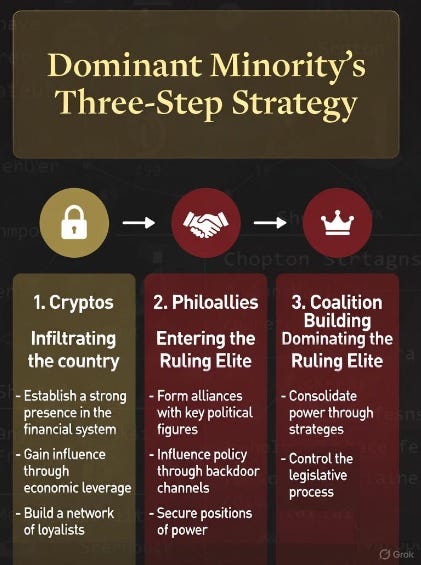
There is another significant example of a dominant minority, yet naming it remains a taboo: the Jewish elite in the West. This group exerts influence through economic and media power, a “Culture of Critique,” and its maneuvers within the geopolitical “Great Game”. U.S. foreign policy, for instance, appears heavily influenced by Jewish Zionists, compelling even the supposedly “America First” Trump administration to adopt “Israel First” policies. While parts of the peace movement have begun to note the Jewish role in fomenting conflicts also beyond the Middle East, many activists still fail to see the broader connections. The conflicts in Ukraine and Taiwan are directly linked to the crisis in the Middle East.
The reason is simple: Jewish led neoconservative and neoliberal forces aligned with Israel seek to weaken Russia and China, both of which support Iran and the Shia “Axis of Resistance” in the Middle East. Consequently, the West attempts to encircle Russia and China with military bases and hostile alliances while undermining their economies through sanctions and high tariffs to facilitate regime change.
This is nothing new. For centuries, Jews have viewed Russia and China as “antisemitic” for opposing Jewish attempts to become a dominant minority within their borders. Historically, this has manifested as a prolonged struggle. Jewish elite dynasties like the Rothschilds, Sassoons and Kadooreis, for example, pushed Western empires to subjugate China during its “Century of Humiliation.” Similarly, they managed to organize various wars against Russia including the first Crimean War in the 1850’s and then later the Jewish led Bolshevik and Oligarch takeovers in the 1920’s and 90’s. The present Ukraine War is just the latest in a series of conflicts and wars between Jews and Russia going back a millennium.
The obvious Jewish role in geopolitics and various wars has always been known to political scientists and historians. It is also common knowledge in many parts of the world such as in Eastern Europe, China and the Arab world. However, in America the Jewish dominant minority has achieved such power that both academia and media now avoid the subject entirely. Only occasionally does the American public hear about it through random outbursts, such as Mel Gibson’s criticism of the Jewish role in instigating wars.
Putin and Xi
Under the leadership of Vladimir Putin and Xi Jinping, Russia and China have regained their independence and power. Their geopolitical support for the Axis of Resistance has drawn the ire of Zionist Jews running Great Game geopolitics, while their nationalist anti-liberal policies have alienated liberal Jewish factions running the Culture of Critique movements. As a result, the Jewish dominated Western academia and media has totally demonized both nations, while Jewish led neoconservatives and neoliberals push for their encirclement and the targeting of their global allies.
The influence of Jewish dominant minority behind these conflicts remains such a taboo that even peace activists often ignore it. This gives Zionists a carte blanche to pursue military and cultural wars, regime change operations and proxy wars aimed at isolating Russia and China. By refusing to “connect the dots,” Western peace activists effectively allow this dominant minority to continue pushing for perpetual war.
Scott Ritter
In recent years, the peace movement has been bolstered by former UN weapons inspector Scott Ritter. A prolific advocate, Ritter has tirelessly warned against the dangers of nuclear war, organized demonstrations and personally lobbied Congress. Despite his background as a leftist philosemitic Democrat, he has significantly influenced the Republican “MAGA” movement toward anti-war policies.
Ritter has gained a massive following as a commentator on the Ukraine War. However, during the conflict’s first year, he remained silent on the Jewish and even Israeli connection, blaming only the CIA, MI6 and the U.S. and British governments. In this, he was joined by libertarian figures like Andrew Napolitano and Lew Rockwell, who focus on American “Primacists” rather than identifying a dominant minority.
Traditionally, both leftists and libertarians have avoided identifying the Jewish dominant minority to avoid being labeled as antisemitic. It was only during the recent genocide in Gaza that Ritter began to explicitly critique Israel’s geopolitical role, though he has yet to identify the dominant minority or even connect these dots to the broader global landscape.
Silent Peace Activists
Some suggest that platform policies, such as those on YouTube, drive this reticence. Peace activists like Andrew Napolitano, Alexander Mercouris, and Danny Haiphong reach hundreds of thousands of viewers daily through their Youtube channels. Openly discussing Jewish dominant minority and connecting Jewish geopolitical dots could lead to deplatforming and lost revenue. However, this doesn’t fully explain the silence, as they could simultaneously use alternative platforms like Rumble, X or Locals—a strategy successfully employed by the famous anti-Zionist, Candace Owens. Unsurprisingly she has been branded an “anti-Semite” by many Jewish organizations.

Alexander Mercouris
Another explanation is ideological. Many activists from leftist or libertarian backgrounds may instinctively view the concept of a “dominant minority” as inherently racist. The most dramatic example of this is the leftist peace activist and popular YouTube commentator Alexander Mercouris, who for years was oblivious to the Jewish connection. However, a few months ago, due to audience feedback, he admitted on his channel that he had never even thought about a possible connection between the Ukraine War and the Middle East Crises.
Afterward, he has not talked about the subject anymore, though he does seem to increasingly speak in code. For example, he repeatedly emphasizes that his channel will be shut down if he analyzes the Epstein case too deeply. At the same time, he seems to spell “Epstein” in the Jewish-German way, making Epstein’s ethnic background clearer. Mercouris also has the revealing habit of always following the arch-neocon warmonger Lindsey Graham’s name with the name Richard Blumenthal, possibly hinting that Graham is influenced by him and other Jews to a significant extent.
The third explanation for not openly noticing the dominant minority is that many prominent peace activists hope to attract the support of wealthy, anti-Zionist Jewish donors to finance the movement, a development that has yet to materialize.
Debanking
Certainly, the fourth and most important explanation is fear. Leading peace activists face tremendous pressure from various sides. Ironically, this pressure appears stronger in America than in Europe, despite stricter official censorship in Europe. However, Europeans benefit from strong employment and social security protections against firings and debanking. In America, people’s lives are more precarious and heavily dependent on high incomes, making it easier to intimidate them with threats to their reputation, job, income, or even bank accounts. The American media rarely discusses this, but hundreds of politically incorrect individuals have been debanked—not only in Canada but also in the U.S. Scott Ritter has now joined their ranks.
In the above video Scott Ritter recalls his days as a highly connected American intelligence operative, working closely with the CIA, Israelis, and even the White House. He emphasizes that he was once the “Golden Boy” of intelligence, privy to “everything.” Clearly, he must be aware of America’s dominant minority and their potential to ignite a nuclear war. Yet, despite recent escalations in Eastern Europe and the Middle East, Ritter in this video claims that the main problem is America itself, with Trump as a “prisoner of the CIA”—not the Mossad, Israel, or even the Zionists.
The next day, however, Ritter appeared in an interview with Andrew Napolitano. He admitted that after being debanked, he fell into depression and briefly felt hopeless, especially as his wife had grown weary of the persecution that had affected their entire family for decades. At that point, Napolitano played a clip of Jonathan Greenblatt, the Jewish ADL’s chairman, boasting about the organization’s role in training American police and officials. This ignited Ritter, who then openly declared that Zionists are running the American government.
Trump’s chess moves
At the same time, Ritter suggested there might still be hope. He noted that many parts of the government resent Zionist dominance, and even Donald Trump could be among them. That wouldn’t be surprising, given Trump’s ego—he can’t be pleased with how Netanyahu and many other Jews publicly humiliate him. Being Israel’s bitch cannot be fun.
It could even be that Trump is deliberately undermining American influence abroad through his erratic behavior, bullying threats, and tariffs. After all, U.S. foreign policy is thoroughly dominated by Zionists, so disrupting the entire system might be the only way to halt it. For instance, threatening to annex Greenland would certainly fracture or weaken NATO, making it harder for EU NATO countries to sustain their warmongering. Perhaps Trump truly seeks peace through a “Fortress America” approach, dividing the world among American, Russian and Chinese spheres of influence. Maybe he’s really playing four-dimensional chess, with method to his madness. Of course, the alternative is that he’s simply a madman. As Scott Ritter admits, he doesn’t know—and neither does anyone else. Probably not even Trump himself.
People worldwide are deeply divided over Donald Trump. Some view him as a mastermind playing four-dimensional chess to save the world, while others see him as a narcissistic bumbler who sows chaos wherever he goes. So, which perspective aligns more closely with the truth? We do not know but let’s first assume that Donald Trump is a rational player in do…
Conclusion
Many in the peace movement believe that concealing the Jewish dominant minority and obscuring its role in numerous wars is essential for peace. However, this strategy may backfire, giving that minority a free hand to escalate proxy conflicts and try again and again to push the world toward “limited” nuclear war.
People often demand perfection from their heroes, which is counterproductive. No one is a superman—not even Scott Ritter. Of course, he must consider his family. Of course, he has been reticent about exposing Jewish power. The same applies to all other peace activists. But gradually, things are changing on both the left and right. They are beginning to point out the man and group behind the curtain.
In any case, peace activists perform invaluable work and deserve unwavering support. After all, they do what they humanly can. Without them—especially Scott Ritter—a nuclear war might already have begun.
France Escalates Warmongering by Expanding Intelligence Support for Ukraine
Sputnik – 16.01.2026
While last year, Ukraine was overwhelmingly dependent on American intelligence, today “two-thirds of those capabilities are provided by France,” revealed French President Emmanuel Macron speaking to BFMTV.
France has readily stepped in to make sure the West’s proxy war doesn’t lose steam — even if the US hesitates.
Last November, reports indicated that US officials had warned the Zelensky regime that intelligence support could be halted if Ukraine rejected Donald Trump’s proposed peace framework.
While Western leaders talk relentlessly about “peace,” in reality France and its allies in the so-called Coalition of the Willing are doubling down on escalation, doing everything to keep the conflict kept alive.
In the event of a ceasefire, Europe’s hawks are planning ‘military hubs’ in Ukraine – even though Russia has repeatedly emphasized any NATO troop presence there is unacceptable and would be viewed as a direct threat.
Why Washington will take Greenland
By Timofey Bordachev | RT | January 14, 2026
American political culture is drifting openly toward the annexation of Greenland. This may sound surreal to European ears, but it is not an exotic idea in Washington. It follows a logic that is deeply rooted in how the US historically became a great power and how it still proves its strength today.
The United States rose through territorial expansion at the expense of weaker neighbors. It seized land from those who could not defend it. There is no serious reason to assume that this instinct has disappeared. The only reliable guarantee of borders is the ability to fight for them. And history shows something very simple: the US does not attack those who can resist.
Modern world politics suggests that Western Europe is no longer among those who can resist.
That is why, from Washington’s point of view, the real question is not whether Greenland will eventually be absorbed into direct American control, but when. Western European states, and Denmark specifically, are among the least dangerous targets imaginable. They are harmless not only militarily, but psychologically: they are unlikely to respond in any serious way.
In American strategic culture, refusing to exploit such an insignificant position would contradict the fundamentals of foreign policy thinking. The conclusion becomes unavoidable: the annexation of Greenland, peacefully or by force, is inevitable.
Over the past few days we have seen an escalating series of statements and initiatives from American representatives. They range from internet “teasers” and political provocation to official remarks and even draft bills in Congress. The overall message is clear: Greenland should fall under direct US control. And just as importantly, the discussion itself is meant to create an impression in Europe, and in the wider world, that the outcome is pre-determined.
Western European politicians have responded with predictable panic.
Germany, for instance, has proposed a joint NATO mission called Arctic Sentry. The initiative is absurd, but revealing. It is Berlin’s attempt to respond to claims from the American president and others that Greenland is threatened by Russia and China, and that the island is supposedly defenseless. Direct consultations between senior German and American diplomats are reportedly scheduled in the coming days.
But it is difficult to imagine Washington taking Germany’s proposal seriously, because the issue is not about deterring mythical threats from Moscow or Beijing. It is about Washington’s own intentions.
The German idea draws inspiration from NATO’s Baltic Sea operation Baltic Guardian, which has been running for several years. But the Baltic Sea has little to do with American military or economic interests. Even the least intelligent member of the Finnish parliament should be able to understand this. That is precisely why NATO and Western Europe are free to play their games there.
Greenland is different.
Any attempt to frame Greenland as a NATO matter only exposes the alliance as a theater production, performing threats in order to justify foreign policy rituals. These Europeans are accustomed to imitating danger and imitating response. They appear to believe they can do it again.
It is unlikely to work.
Meanwhile, most of the world views this spectacle with indifference. Russia, China, India and many others see the Greenland drama primarily as another lesson in how relations inside the so-called “collective West” are structured. It is simply a more visible version of what has always been there.
There is nothing new in the fact that Americans are prepared to violate norms, including international law. The difference is that this time they are openly testing these norms against their own allies.
From Russia’s perspective, the situation does not pose a direct threat to our interests. The US can deploy weapons in Greenland even today. Its presence does not fundamentally change the military situation in the Arctic, nor does it threaten shipping along the Northern Sea Route. The US still lacks a serious fleet of military icebreakers, and it remains unclear when – or whether – it will acquire one.
China, too, is essentially indifferent to Greenland becoming American property. Greenland does not threaten China’s trade in the Arctic because the only real issue of interest to Beijing is the Northern Sea Route. And the US military presence on the island does not materially affect Chinese security interests.
On the contrary, in the context of Taiwan, Beijing watches with curiosity as the Americans undermine their own empire’s ideological foundations, including the principles of international law. Once the balance of power settles, it is always possible to return to old norms. Or indeed to codify new ones.
But for Western Europe, Washington’s aggressive noise around Greenland feels like the death sentence for what remained of the half-continent’s relevance.
For decades, its politicians considered themselves a “special” element of global affairs. Not fully sovereign perhaps, but privileged. They were happy to violate the sovereignty of other states across the world, insisting that this was humanitarianism, democracy, civilization. Yet they never seriously imagined the same logic could be applied to them.
The entire content of what Western Europeans loudly call “transatlantic solidarity” or a “community of values” lies precisely in this exceptional status. Their part of Europe’s role was to serve as a morally decorated extension of American power, a satellite that believes it is a partner.
Now it is the US itself that is delivering a potentially fatal blow to that illusion.
Even if the annexation of Greenland is postponed, watered down, or delayed by unforeseen complications, the fact that it is being discussed seriously is already catastrophic for Western European political legitimacy. It undermines what remains of their credibility in the eyes of their own citizens and the rest of the world.
Every state must justify its existence.
Russia’s legitimacy rests on the ability to repel external threats and pursue an independent foreign policy. China justifies itself through organization, stability and prosperity for its citizens. India’s legitimacy is grounded in holding together peace in a multi-ethnic, multi-religious civilization.
In every case, legitimacy is tied to the state’s ability to influence the most important aspects of people’s lives. Not to mention being able to rely on internal resources to do so.
But modern Western European states justify themselves differently. They justify their actions to their citizens through the idea of exceptional status, the right to look down on other countries and civilizations. If Americans can simply deprive the EU of territory, then they become equal to countries like Venezuela or Iraq: states which Washington attacks with impunity.
This is why Greenland matters more than Greenland.
Western European politicians still do not understand the main point. The US wants Greenland, of course, because it is valuable Arctic territory. Geography that matters in a changing world. Direct control over territory is often preferable to indirect use through allies.
But the deepest motive is more psychological and political: Washington wants to act as it sees fit.
In the US, disregarding all external norms – recognizing only internal American rules – is increasingly part of how the state gains legitimacy in the eyes of its citizens. The ability to seize something from a weaker neighbor becomes proof that such a state is not only strong, but necessary.
Donald Trump was elected precisely because he promised to restore American statehood. Greenland will not be the only issue where this restoration expresses itself.
In other words: Greenland is not a dispute about the Arctic. It is a demonstration of how American power is validated, and a demonstration that Western Europe is no longer protected by the very system it helped to build.
Timofey Bordachev, Program Director of the Valdai Club
The Ukraine Snare Still Beckons
By Ted Galen Carpenter | The Libertarian Institute | January 14, 2026
Despite the widespread expectation that President Donald Trump would end Washington’s entanglement in NATO’s proxy war using Ukraine against Russia, it is increasingly evident that the fundamental features of U.S. policy remain unaltered. Trump personally has sent an array of mixed signals about his intentions. Although he has pressured Ukrainian President Volodymyr Zelensky to accept the reality that Kiev must be willing to make territorial concessions to Moscow in any peace accord, he also has been receptive to Zelensky’s demand that Ukraine be given reliable “security guarantees” in such a settlement. Indeed, during the recent summit meeting between the two leaders, the main point of disagreement appeared to be that Zelensky wanted a commitment lasting fifty years, whereas Trump was prepared to offer only fifteen years.
Not only is Kiev insisting on a firm, detailed guarantee of protection, but also Ukraine’s European supporters in NATO are doing so. Worse, Trump seemed to sign onto a new 20-point “peace plan” being pushed by Zelensky and his European backers. Only Russia’s curt rejection of the scheme has so far prevented it from further consideration.
A potentially deadly snare lies in wait for the United States which our leaders must avoid at all costs. Throughout the years of the Ukraine crisis, most attention has focused on Kiev’s desire for formal membership in NATO and Russia’s repeated refusal to tolerate that option. Indeed, the principal cause of the current war was the clash between Russia and NATO regarding that issue.
However, the substantive issue has never been merely the prospect of Ukraine’s formal membership in NATO. Instead, the real threat to Russia’s security, from Moscow’s viewpoint, has been NATO’s attempt to turn Ukraine into a significant military asset for the alliance. It matters little whether that development occurs because of Kiev’s official membership in NATO or because of new, separate Western security guarantees.
Indeed, the ties would not have to be all that formal to constitute a dangerous provocation toward Moscow. Several NATO governments have repeatedly engaged in loose talk about sending their troops as “peacekeeping personnel” to Ukraine to enforce a settlement. Indeed, some of those countries appear willing to incur such a risky commitment to implement a mere “truce” between the feuding parties. Both Great Britain and France have stated that they intend to establish “military hubs” across Ukraine with their forces. In one of his more reckless, irresponsible moments, President Trump expressed his willingness to consider having the United States “backstop” such European efforts.
Washington must emphatically reject any attempted ploys of that nature. Even a paper security guarantee to Kiev would put any and all guarantor powers at risk. A decision to deploy so-called peacekeeping forces would be even worse. The Kremlin has made it emphatically clear that the presence of any troops by a NATO member in Ukraine is intolerable. Moscow likely would view a troop presence by NATO’s European contingent, much less the United States, as an existential threat to Russia’s security.
It would be folly for U.S. policymakers to rely excessively on the language contained in the North Atlantic Treaty to limit the danger of an undesirable military entanglement. Article 5 obliges NATO signatories to regard an act of aggression against any NATO member state as an attack against them all. The actual language regarding the obligation under Article 5, though, is so vague as to be meaningless, if a member seeks to evade taking serious action. The provision merely requires allies to render (undefined) assistance to the victim of aggression. Crucially, there is no commitment to launch military strikes against the alleged aggressor or to send troops into combat to aid the beleaguered ally. Merely providing logistical aid could fulfill a member’s obligation. The NATO countries that have sent weaponry or provided targeting and other intelligence data to Ukraine have easily met or exceeded any implied Article 5 obligation, even if Kiev had been a member of the alliance.
But in the real world, multiple NATO governments would seek to inflate the U.S. commitment under Article 5 to deepen Washington’s entanglement in the Alliance’s proxy war against Moscow. A pervasive myth persists in America and the rest of the world that the United States has an official treaty obligation to go to war if another NATO country comes under attack. Giving Ukraine a security guarantee would consolidate and strengthen that myth. In other words, U.S. leaders would find themselves under enormous pressure to launch a direct military intervention to support NATO peacekeepers in Ukraine regardless of the actual language contained in Article 5.
That is why any NATO troop presence in Ukraine, or any official security guarantee to Kiev, would be so dangerous. Given the enormous political and military pressures that would be coming from Kiev’s fan club throughout the West, it is highly improbable that U.S. leaders could avoid an armed clash with Russian forces merely by citing the limited, conditional language in Article 5. Legalistic quibbling is not the way events proceed when raw, wartime emotions are in play.
Trump administration officials need to spurn proposals for any alliance security guarantee to Ukraine, much less a deployment of NATO peacekeepers. Washington must emphatically reject schemes that would include a U.S. military presence of any size or nature in Ukraine. President Trump’s casual musings about supporting a NATO peacekeeping contingent not only are irresponsible, but also constitute a betrayal of his political supporters in the last election. They believed that their candidate was committed to extricating the United States from an unnecessary and debilitating geopolitical venture. Unfortunately, Donald Trump appears to be on course to disappoint advocates of a more prudent U.S. foreign policy yet again.
The Coalition of the Willing has achieved nothing
By Ian Proud | Strategic Culture Foundation | January 11, 2026
The war in Ukraine happened because western nations insisted that Ukraine be allowed to join NATO but were never willing to fight to guarantee that right.
That reality has never changed. This week’s latest Summit of the Coalition of the Willing has confirmed that it will not change any time soon.
The only countries that appear remotely willing to deploy troops to Ukraine in a vague and most certainly limited way are the British and French.
Both would need parliamentary approval which can’t be guaranteed. Reform Leader Nigel Farage has already come out to say that he wouldn’t back a vote to deploy British troops to Ukraine because we simply don’t have enough men or equipment. And even though Keir Starmer has the parliamentary numbers to pass any future vote on deploying British troops, it would almost certainly damage his already catastrophic polling numbers.
Macron is clinging on to his political life and would probably face a tougher tussle to get his parliament to approve the French sending their troops to Ukraine, potentially leaving the UK on its own.
In any case, it is completely obvious that Russia won’t agree to any deployment in Ukraine by NATO troops. This shows once again that western leaders have learned absolutely nothing over the past decade. It will never be possible to insist that Russia sues for peace under terms which is has long made clear are unacceptable at a time when it was winning on the battlefield, and European nations refuse to fight with their own troops.
Hawkish British journalist Edward Lucas, with whom I disagree on most things, summed it up well in an opinion in the Times newspaper when he said:
We are promising forces we do not have, to enforce a ceasefire that does not exist, under a plan that has yet to be drawn up, endorsed by a superpower (read the U.S.) that is no longer our ally, to deter an adversary that has far greater willpower than we do.
President Putin has shown an absolute determination not to back down until his core aims, namely to prevent NATO expansion, are achieved. And as I have said many times, the west can’t win a war by committee.
All of these pointless Coalition of the Willing meetings happen in circumstances where Europe refuses to talk to Russia upon whom an end to the war depends. Peace will only break out after Ukraine and Russia sign a deal, and the west appears deliberately to be doing everything possible to ensure that Russia never signs.
Instead, we entertain Zelensky with hugs and handshakes, reassuring him that we will do anything he wants for as long as he needs, only to offer insufficient help all of the time.
And, as Zelensky is in any case unelected, not likely to win elections in Ukraine as and when they happen, overseeing a corrupt regime that is adopting increasingly repressive tactics to keep a losing war going, it is not in his interest to see the war end anyway.
His calculus continues to be that, if he clings on for long enough, the west will finally be dragged into a direct war with Russia. So, he’s happy to drag out an endless cycle of death by committee in which European leaders never agree to give him exactly what he wants and he uses that as a pretext not to settle.
Zelensky went on from Paris to Cyprus where, among other things, he has been pushing for more sanctions against Russia. At no point since 2014 have sanctions looked remotely likely to work against Russia, for reasons I have outlined many times.
The European Commission is now planning its twentieth round of sanctions to coincide with the fourth anniversary of the war on 24 February 2026. So with peace talks ongoing, Ursula von der Leyen and Kaja Kallas as always are doing their bit to ensure that nothing gets agreed.
None of this brings the war any closer to an end nor does it provide any security guarantees to Ukraine. As always, the biggest security guarantee should be the offer by European allies to intervene militarily in Ukraine should Russia decide to reinvade after any future peace deal.
But that was not agreed in Paris. Instead, the Paris Declaration said, ‘we agreed to finalise binding commitments setting out our approach to support Ukraine in the case of a future armed attack by Russia. These may include, military capabilities, intelligence and so on.’
In diplomatic parlance, agreeing to ‘finalise commitments that may include’ basically means that nothing has been agreed.
The declaration also said:
We stand ready to commit to a system of politically and legally binding guarantees. However, the final communique gave individual countries opt outs from those guarantees by saying that any guarantees would be, ‘in accordance with our respective legal and constitutional arrangements’.
So, again, in diplomatic parlance, what this means is that some coalition members may be able to opt out of the security guarantees if they decide that their domestic framework does not allow for such an arrangement, thinking here in particular of Hungary, Italy and Spain, for example.
What the declaration does achieve is to commit European nations to paying Ukraine to maintain an army of 800,000 personnel after the war ends which, by the way, is significantly higher than the total number of armed forces personnel of Germany, France and Britain combined.
Even though these are Ukrainian troops, not European, Russia will undoubtedly see EU funding of a large Ukrainian army on its border as a form of NATO lite. Which, of course, Zelensky would welcome.
So the process of holding near weekly Coalition of the Willing summits is entirely pointless, though perhaps that is the point. Since 2022, western leaders have been completely unable to say no to Zelensky, either through guilt or stupidity, or both.
Yet at some point, if only for their own political survival, Starmer and others will have to politely decline to offer more support and make it clear to Zelensky that he has no choice but to sue for peace. To me, at least, the European offer to Zelensky follows these lines:
Ukraine cannot join NATO (sorry we lied to you about that) but you can join the European Union and we will help you make the reforms you need to do so.
You will get significant investment when the war ends that boosts your economy. As your people return home, we believe Ukraine has potential to grow quickly and reconstruct.
However, it may still be many years before you receive EU subsidies on the level of other European Members, and you possibly may not receive them at all.
And you will have to become financially sustainable, including meeting the EU’s fiscal deficit like other EU member states.
I’m afraid that means that you won’t be able to maintain an army of 800,000 people at Europe’s expense (sorry we reassured you that you could).
But, as a European Union member you would have a security guarantee by virtue of your membership of this community, even though only Macron’s France has said it would send you troops (je m’excuse).
You should also be aware that Europe sees benefit in a normalised economic relationship with Russia, that includes purchasing cheap Russian energy. We can’t go on buying massively expensive U.S. LNG just to avoid hurting your feelings.
Sanctions may have been a policy or war, but they won’t be a policy of peace, and you will need to accept that we will drop them too.
We have now reached the limit of the financial support that we can provide to you so we have reached the point of now or never in your signing a peace deal.
That requires you to make hard choices about de facto recognition of land on the lines of the peace deal that the U.S. is trying right now to finalise with Russia.
Without that, he will simply continue this charade of endless pointless Summits and the war will drag Europe even further into the mire.
That’s a lot to take in and we’ve already apologised enough as it is. Look, we lied to you okay, but everyone makes mistakes.
Somehow, though, I predict the Europeans will continue to drift in circles. I wonder where the next Coalition of the Willing Summit will be? I hope it’s soon, as Zelensky might actually have to spend some time inside of Ukraine if there’s a delay. And he likes it in Europe as it’s the only place where everyone seems to love him.
Larry Johnson: End of Negotiations & Launch of Oreshnik
Glenn Diesen | January 10, 2026
Larry Johnson is a former intelligence analyst at the CIA who also worked at the US State Department’s Office of Counterterrorism. Johnson discusses provocations, end of negotiations and launch of the Oreshnink.
Follow Prof. Glenn Diesen:
- Substack: https://glenndiesen.substack.com/
- X/Twitter: https://x.com/Glenn_Diesen
- Patreon: https://www.patreon.com/glenndiesen
Support the research by Prof. Glenn Diesen:
- PayPal: https://www.paypal.com/paypalme/glenndiesen
- Buy me a Coffee: buymeacoffee.com/gdieseng
- Go Fund Me: https://gofund.me/09ea012f
- Books by Prof. Glenn Diesen
UK and France unveil troop commitments for Ukraine
RT | January 7, 2026
The leaders of the UK and France have announced that they’ve agreed to deploy forces in Ukraine if Kiev reaches a peace deal with Russia, despite Moscow categorically ruling out the presence of NATO forces in the country under any pretext.
The agreement was unveiled on Tuesday at a meeting of the so-called ‘coalition of the willing’ group in Paris. UK Prime Minister Keir Starmer said the three countries had signed a “Declaration of Intent” on deploying forces “in the event of a peace deal.” He called the agreement “a vital part of our iron-cast commitment,” while asserting it would create a legal framework for British, French, and partner forces to operate on Ukrainian soil.
Starmer said that “following a ceasefire,” Britain and France would establish “military hubs” throughout Ukraine and build protected facilities for weapons and equipment, while also joining US-led monitoring of the truce.
French President Emmanuel Macron described the proposed contingent as a non-combat force consisting of “potentially thousands” of troops, while stressing they would be stationed “a long way behind the contact line.”
However, neither Starmer, nor Macron, nor Ukrainian leader Vladimir Zelensky cited exact troop numbers, deployment locations, or timelines.
Meanwhile, Zelensky claimed Ukraine had had “very substantive discussions” with the American team on the issue. “America is ready to work on this,” he said, adding that the sides have made progress on documents concerning security guarantees.
US envoy Steve Witkoff, who also attended the Paris talks, did not confirm a US commitment to deploy troops, but spoke of tough “security protocols” meant to deter attacks on Ukraine.
Russia has repeatedly opposed foreign troop presence in Ukraine, warning that these forces would be treated as “legitimate targets.” Moscow has also said that Ukraine’s ambition to join NATO and host the military alliance’s troops was one of the key reasons for the conflict in the country
Targeting Putin and New Year celebrations… Western war psychosis in desperation mode
Strategic Culture Foundation | January 2, 2026
Earlier this week, in the early hours of December 29, Russia claimed that the NATO proxy regime had launched a large-scale drone attack aiming to assassinate President Vladimir Putin. Western political leaders and news media immediately vilified Russia for “lying” and “fabricating” the allegations as a pretext to derail diplomatic efforts for a peaceful end to the conflict.
A few days later, however, the proof was in to show who the real cynics and psychopaths are.
On New Year’s Eve, as the world was welcoming a New Year, the NATO armed and intelligence-equipped regime deliberately attacked families gathered in the Black Sea coastal village of Khorly in Kherson to hear the midnight chimes. Three drones murdered 24 civilians and injured more than 50 people after a hotel and cafe were hit with incendiary explosives. The atrocity was preceded by a reconnaissance unmanned aerial vehicle. There can be no doubt that this was a deliberate act of mass murder.
Hours later, on New Year’s Day, also in the Kherson region, a family car was hit by a drone, killing a five-year-old boy and seriously wounding his mother and grandparents.
There were no condemnations from Western political leaders. The Western news media hardly reported the atrocities, and the few media outlets that did report used whitewashing headlines such as “Russia says Ukrainian drone strike kills 24 in occupied Ukraine as tensions grow amid peace talks.”
The NeoNazi regime has been deliberately murdering Russian civilians for four years with American and European weapons, intelligence, and complicity. Before the conflict erupted in February 2022, the CIA-installed regime was killing ethnic Russian people in the Donbass.
Ukrainian civilians have also been killed by the Russian military during the conflict. The cardinal difference is that Russian forces do not target civilians.
The mass murder on New Year’s Eve was not random. It is a repeated vile war crime that has been witnessed against multiple Russian communities in Belgorod, Bryansk, Crimea, Donetsk, Lugansk, and elsewhere.
The silence of Western governments and media shows their moral bankruptcy, if not their criminal complicity in enabling a terrorist regime to murder Russian civilians. The Western media highlights when Russian strikes kill civilians while under-reporting or ignoring the Kiev regime’s deliberate murder of Russian civilians.
It is a profane conclusion that murdering Russian people is acceptable to the Western supporters of the Kiev regime. No expense or weaponry is spared in arming the regime. Just like its rampant corruption and Nazi affiliations are ignored, so too are its war crimes.
This regime carries out atrocities against its own people, as in the Bucha massacre in March 2022, for black propaganda against Russia and to justify the NATO proxy war. It is bombing the biggest nuclear power station in Europe at Zaporozhye with American-supplied missiles, and yet the Western media spins the absurd lies that Russia is somehow bombing the power plant that its forces are protecting.
The Nord Stream gas pipeline owned by Russia was blown up by NATO in September 2022, and yet Western governments and media accused Russia of sabotaging its own infrastructure. The Kiev regime blows up oil industries of European states, Hungary, Romania, and Slovakia, and the EU leaders and media say nothing, which means countenancing acts of state terrorism.
The sick, malevolent logic of the U.S.-led NATO war machine is evident. It wanted this war with Russia for decades. The NeoNazi proxy in Ukraine was installed to facilitate the aggression with the insane objective of defeating Russia.
Now that the NATO proxy war and its objective have been all but vanquished, the Western warmongering factions want to start World War III to salvage their reckless, failed gambit in Ukraine. The hundreds of billions of dollars and euros wasted on this criminal war leave Western states exposed to financial catastrophe.
Targeting the head of a nuclear power is the NATO war psychosis in desperation mode. Murdering families celebrating the New Year is depraved beyond words. But it shows how desperate the warmongers have become.
American and European politicians have Russian blood on their hands. Russia should not trust any proffered negotiations as genuine. It is not feasible to talk or reason with Russophobic psychopaths.
U.S. President Donald Trump talks a lot about wanting peace with Russia while blowing up Venezuela, supporting genocide in Gaza, and threatening the annihilation of Iran. His country’s intelligence agencies, dollars, and weapons are murdering Russian families. If the West wants peace in Ukraine, it can do that by immediately ending the weapons and intelligence it is supplying to the NeoNazi terrorist regime. Until then, Russia reserves the right to destroy the NATO war machine.
It is customary to wish readers a Happy New Year. We refrain from such a jolly greeting in solemn respect for those who died this week.
Stanislav Krapivnik: Massive Escalation – Attack on Putin’s Residence
Glenn Diesen | December 30, 2026
Stanislav Krapivnik is a former US Army officer, supply chain exec and military-political expert, now based in Russia. He was born in Lugansk during the Soviet times, migrated to the US as a child and served in the US army. Krapivnik discusses the attack on Putin’s residence.
Follow Prof. Glenn Diesen:
Substack: https://glenndiesen.substack.com/
X/Twitter: https://x.com/Glenn_Diesen
Patreon: / glenndiesen
Support the research by Prof. Glenn Diesen:
PayPal: https://www.paypal.com/paypalme/glenn…
Go Fund Me: https://gofund.me/09ea012f
Dayton At 30: US Betrayal Old And New
By Kit Klarenberg | Global Delinquents | December 30, 2025
December 12th marked the 30th anniversary of the Dayton Accords’ signing, which ended the Bosnian civil war after three-and-a-half years of brutal fighting. While consistently hailed in the mainstream as a US diplomatic triumph, the agreement imposed a discriminatory and unlawful constitution upon Sarajevo enshrining division between the country’s three main ethnicities – Bosniaks, Croats, and Serbs – and a Byzantine political system, while carving the country into two separate ‘entities’. Bosnia has constantly teetered on collapse ever-after, sustained purely by prolonged NATO and UN occupation.
Moreover, the Dayton Accords represented a rank betrayal of Washington’s Bosniak allies. In the conflict’s leadup, the US consistently encouraged them – led by President Alija Izetbegobic – to reject peace talks. After the war’s eruption, he was emboldened to keep fighting and spurn negotiations, strung along with effusive public support from US officials, and covert military assistance. Come Dayton, the Bosniaks were forced to accept a far worse settlement than any previously proffered. Parallels with the Ukraine proxy war are ineluctable.
The Bosnian conflict’s greatest tragedy is it could’ve been avoided not only without a shot being fired, but no territorial carve-up or ethnic partition of any kind. In the years before its April 1992 outbreak, numerous attempts were made to reach an equitable settlement negating any prospect of war. In summer 1991, as Yugoslavia was beginning to rapidly disintegrate, representatives of Izetbegovic met with Bosnian Serb leaders in Belgrade, to discuss the then-republic’s future.
The two sides hammered out a simple but ingenious plan. Bosnia would be a sovereign, autonomous, undivided state, in confederation with Serbia and Montenegro. Bosniak-majority territory within Serbia would also be ceded to Sarajevo’s administration. The agreement emphasised the necessity of the republic’s diverse population “living together in freedom and full equality.” Bosnia would remain part of Yugoslavia, albeit under a revised federal system, in which the country’s constituent parts were essentially independent, and “completely equal”.
Serb leader Slobodan Milosevic not only agreed to the plan, but further proposed Izetbegovic be the new Yugoslavia’s first federal President for a five year term, invested with the power to appoint military leaders and diplomats, and serve as the country’s head of state. Izetbegovic’s representatives signed off on the agreement, before returning to Sarajevo. Initially, the Bosniak leader was on board. However, according to numerous sources, Izetbegovic withheld his formal endorsement pending a planned trip to the US.
Upon his return, Izetbegovic rejected the deal. This was neither the first nor last blatant example of Stateside officials torpedoing fruitful peace efforts before, and during, the war. The conflict itself was triggered by the personal interventions of Warren Zimmermann, US ambassador to Yugoslavia. Echoes of Boris Johnson’s April 2022 sabotage of peace talks between Russia and Ukraine are palpable. In early 1992, in a desperate final bid to prevent conflict, the EU drew up the “Lisbon Agreement”.
Under its terms, Bosnia would be an independent country completely separate from Yugoslavia, divided into “cantons” dominated by whichever ethnic/religious community was most populous locally. Bosniaks and Serbs were allocated 43% of the state’s territory each, and Croats the remainder. The three were to share power nationally, with a weak central government. It was signed by leaders of the republic’s ethnic groups in March that year.
However, Izetbegovic was concerned the plan partitioned Bosnia into distinct entities, with the prospect its Croat and Serb components could secede thereafter. He voiced these concerns to Zimmerman, who told him, “if he didn’t like it, why sign it?” With that blessing – and prospect of US recognition of an independent Bosnia, and economic and military support – Izetbegovic withdrew his signature, sparking war. Zimmermann later reflected, “the Lisbon Agreement wasn’t bad at all.” Indeed, it was considerably better than the future Dayton Accords, for all concerned.
‘Military Situation’
Bill Clinton made the Bosnian conflict a core plank of his 1992 Presidential election campaign. Attacking incumbent George H. W. Bush for inaction on the crisis, Clinton proposed a variety of aggressive policies, including arming the Bosniaks to the teeth, and outright US military intervention in the form of airstrikes. Expectation was high Washington’s approach to Bosnia would become considerably more belligerent immediately upon Clinton’s inauguration, if he won the vote.
Clinton’s rhetoric shocked the Bush administration, which branded his warlike pledges “reckless”. Little did the public know, this perspective was entirely in line with US intelligence thinking. A vast trove of declassified files related to the Bosnian war show the CIA and other spying agencies were steadfastly opposed to greater US involvement from the conflict’s earliest stages. After Clinton’s victory, the US National Intelligence Council produced a comprehensive explainer guide for his transition team on the civil war.
The document laid out all manner of issues associated with different strategies Clinton had mulled on the campaign trail. For example, US intelligence assessed how, “even with additional weapons,” Bosnian government forces “could not substantially alter the military situation.” Increasing arms deliveries would produce “greater casualties but no resolution of the conflict,” and “attempting to reclaim all of the territory the Bosnian Serbs now occupy would require massive Western military intervention,” including a ground invasion.
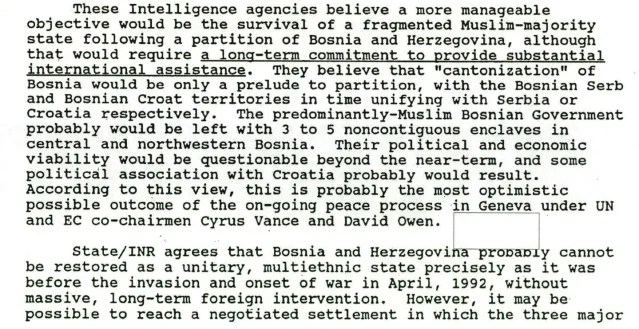
Overall, US intelligence believed “the most optimistic possible outcome” was preserving a “fragmented Muslim-majority state following a partition of Bosnia.” This was the exact substance of a peace plan then-under consideration, drawn up by European Community and UN negotiators David Owen and Cyrus Vance. Records of a secret February 1993 meeting between senior US government, intelligence and military officials show attendees were determined to covertly wreck the Vance-Owen plan – which granted Bosnian Serbs 43% of the country – while remaining ostensibly committed to its implementation.
One means by which Washington ensured Vance-Owen failed was by consistently refusing to publicly rule out military action, while secretly funnelling vast arms shipments – in breach of a UN embargo – and foreign fighters to Sarajevo. US intelligence repeatedly warned the White House such actions steeply increased the Bosnian government’s expectations of subsequent Western military intervention on their side. This meant Sarajevo would be resistant to consider let alone accept peace agreements, even when badly losing the conflict.
US military intervention finally did come, in the form of NATO’s Operation Deliberate Force, an 11-day saturation bombing of Bosnian Serb territory conducted over August/September 1995. This finally set the stage for the Dayton talks, which commenced November 1st that year, after all sides agreed to “basic principles” underpinning negotiations. Bosniak representatives had every reason to expect the US to unflinchingly fight their corner – but they were in for a nasty surprise.
‘Moral Position’
From the Dayton talks’ inception, it was clear Washington harboured little favouritism towards the Bosniaks. After two weeks, no progress had been made, despite Serb delegate Slobodan Milosevic being eager to make significant concessions. The US also offered Sarajevo numerous inducements, including a controversial program to arm and train Bosniak forces over subsequent years. Central to Izetbegovic’s intransigence was the US-endorsed peace agreement splitting Bosnia into two ‘entities’, with a Serb-majority internal republic – Republika Srpska – governing 49% of the country.
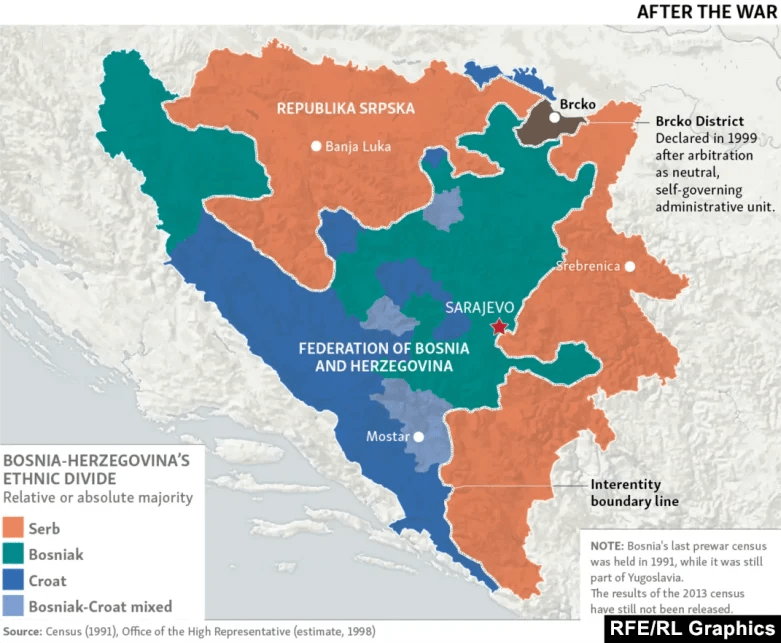
In other words, Dayton handed the Bosnian Serbs more territory than any prior proposed peace settlement, while effectively entrenching the very partition that influenced Izetbegovic’s resistance to the Lisbon Agreement, and produced all-out war. His opposition to the Accords was nonetheless battered down by the blunt-force threat of all-out US betrayal if he refused to acquiesce. On November 15th, a series of “talking points” were provided to Clinton’s National Security Advisor Tony Lake, in advance of a personal meeting with Izetbegovic.
Lake was instructed to spell out dire “consequences” the Bosniaks would suffer, if they failed to sign off on the US-dictated peace plan. He would relay how Clinton understood Izetbegovic was in an “extremely difficult” position, but the US President was “disappointed… Dayton has failed to produce agreement” after so much talk. “If we are successful at Dayton, the President will help you make [the] case that peace achieved at Dayton was just,” Lake was directed to say. He would add:
“Territorial proposals are not perfect, but…likely best deal possible. More fighting will be costly with no guaranteed results. Time for peace…Many in [the] US could use failure in Dayton as [an] excuse to disengage from peace process and abandon [the] moral position we have defended to this point.”
If Izetbegovic’s government was “unwilling to complete [a] peace agreement that Serbs can accept” endorsed by Washington, Lake would threaten there would be “no US forces on the ground, NATO implementation, and economic aid and reconstruction package.” Furthermore, US Congress would not approve, and the Clinton administration would not request, the “equip and train” program for Bosniak forces. UN peacekeepers would also “withdraw” from the country, meaning “Bosnia could find itself without any form of military support from the West.”

“Much at stake for you [and] Bosnia,” Lake’s talking points for Izetbegovic concluded. “Encourage you to think carefully about Dayton… a very good result is within reach; do not let it slip away.” Successfully coerced, Izetbegovic and his team signed the Accords. Dayton’s terms have been a sore source of contention for Bosniaks ever since. Veteran Bosnian politician Haris Silajdzic, a key Izetbegovic acolyte and Bosniak President 2006 – 2010, has dedicated much of his political career to invalidating them.
In a secret March 2007 discussion with the US embassy in Sarajevo, Silajdzic ranted, “we had to sign Dayton with a gun at our heads.” Fast forward to today, and Kiev stares down a similar barrel. Washington pressures Volodymyr Zelensky to accept peace at all costs. This could include major territorial concessions, among other hitherto unthinkable compromises. If only Kiev had implemented the Minsk Accords – and learned the obvious lessons of the Bosnian war – this invidious position could’ve been avoided entirely.
Ukraine Takes Part in NATO War Games, Further Integrating Into Collective Defense Architecture
By Kyle Anzalone | The Libertarian Institute | December 28, 2025
Ukrainian representatives participated in NATO war games simulating the alliance’s response to an attack.
According to a NATO press release, 1,500 soldiers and civilians from multiple European countries participated in the Loyal Dolos 2025 drills that were conducted at the beginning of the month.
On Sunday, the General Staff of the Armed Forces posted on Facebook that Ukrainian officials participated in Loyal Dolos. “Ukraine is becoming part of the collective defense architecture of NATO. Ukrainian JATEC experts have, for the first time, joined the work of the mechanisms of Article 5 of the NATO Treaty on the training LOYAL DOLOS 2025,” the post explained.
Senior National Representative of Ukraine in JATEC, director of Implementation of the programs of the Joint Center NATO-Ukraine Colonel Valery Vyshnivsky said, “The participation of Ukrainian JATEC experts in the LOYAL DOLOS 2025, which is one of the key elements of NATO’s preparation according to Article 5 of the North Atlantic Treaty, has strategic significance for us, as for the first time Ukrainian representatives have been involved in the work of the Alliance’s collective security mechanisms.”
Kiev’s military ties to NATO countries are one of the primary reasons Russian President Vladimir Putin ordered the invasion of Ukraine in 2022. The Kremlin has demanded that Kiev agree to neutrality as a condition for ending the war.
President Zelensky recently announced that Ukraine would agree to stop seeking formal membership in the North Atlantic Alliance if members of the bloc agreed to bilateral agreements with Kiev that are similar to NATO’s Article 5. Article 5 is considered the mutual defense pact in the NATO charter.
That Ukraine is continuing its integration into NATO suggests that Kiev is still seeking to become an informal member of the bloc.
Featured Video

Racist Seinfeld Dances for Joy as Bibi Unveils His New Map
or go to
Aletho News Archives – Video-Images
TV Drama Review
Japanese drama projects Japan’s wartime atrocities onto Chinese characters

Global Times | October 25, 2026
By portraying Chinese characters as perpetrators of ruthless violence while casting Japanese Self-Defense Forces (SDF) intelligence operatives as defenders, the season 2 of the Japanese drama Vivant has recently drawn criticism from Chinese netizens, who argue that its depiction turns historical reality on its head while ignoring Japan’s wartime atrocities.
The TBS drama series – a spy suspense story in which an alleged unofficial intelligence unit of the SDF operates across the globe — has attracted a passionate fanbase. Its currently airing season 2 opened with a household rating of 18.8 percent, the highest for a TV drama this year, according toa commentary article by Japanese media Toyo Keizai.
What draws attention is the portrayal of the enemies in the series, the article noted. Scenes in which the Chinese organization subjects kidnapped members of the SDF unit to brutal torture are repeated with unrelenting intensity.
It is rare for Japanese TV dramas to explicitly portray a real-life country as the enemy, the article noted.
Japanese Prime Minister Sanae Takaichi also made a reference to the drama, saying that she has been recording Vivant and hopes to binge-watch it over the year-end and New Year holidays, according to Japanese media outlets.
China’s CCTV News report on Sunday revealed that the drama features scenes in which Chinese personnel cut off the fingers of and stab Japanese intelligence operatives in the abdomen. Such acts bear striking similarities to the torture inflicted on Chinese nationals by invading Japanese troops during the World War II.
The drama distorts the truth by attributing these atrocities to modern Chinese characters. Beneath the surface, it subtly glorifies Japan’s cross-border overseas operations, blurs the functional boundaries of the SDF and implicitly promotes an expansionist narrative, per CCTV News. … continue
Blog Roll
 Aletho News
- EU facing trillion-euro debt hole while seeking more cash for Kiev
- How US, Europe, Persian Gulf states exhausted missile stockpiles, splurged billions to defend Israel
- Up in arms… Koreans reject U.S. empire’s plan to make South Korea the next Ukraine
- Iran, Turkey, Pakistan, Saudi Arabia could advance region-led security framework in Tehran: FM spox
- Netizens condemn Japanese drama for projecting Japan’s wartime atrocities onto Chinese characters
- Racist Seinfeld Dances for Joy as Bibi Unveils His New Map
- A West Bank War for Netanyahu’s Election Campaign, Could It Backfire?
- Yemen denounces European Parliament’s ‘hypocritical’ push to blacklist Ansarullah
- Qalibaf: UAE’s UN bid aims to ‘clear the runway’ for ‘Greater Israel’, whitewash genocide
- Pakistan reopens Iran border after boosting security: Report
- If Americans Knew
- An error has occurred; the feed is probably down. Try again later.
- No Tricks Zone
- Sudden Stratospheric Warming, Powerful El Niño Combination May Lead To Extreme Europe Cold, Energy Crisis!
- Two New Studies Find Thwaites Glacier Melt Cannot Be Driven By Human Activity Or A Warming Ocean
- E-Cars Reduce CO2 Emissions By Only 41% Compared To Internal Combustion Engine Vehicles
- Predictions Made By Renowned Climate Professor Over Past Decades Have Been Proven To Be Poor
- New Study Suggests Large Regions Of The Pacific Ocean Have Been Cooling For The Last 80 Years
- Germany’s Green Energy Debacle: High Energy Costs Force Kahla Porzellan to Close After 182 Years!
- New Study: 50 Years Of The Most Aggressive ‘Net Zero’ Policies Can Only Affect The Global Climate By 0.03°C
- US September “Heat” Was No Record…Many Records Set Decades Ago
- Latest European Green Energy Debacle; Portugal’s Largest Flagship Solar Park Insolvent!
- Green Energy Debacle: German Expert Professor Fritz Vahrenholt Warns Of Severe Economic And Social Consequences

