U.S. Officials Are Lying Too on Ukraine
By Jacob G. Hornberger | FFF | February 17, 2022
U.S. officials are declaring unequivocally that Russian officials were lying when Russia stated that it was withdrawing troops from the Russia-Ukraine border. U.S officials say that it’s the exact opposite — that Russia is actually bringing more troops to the border.
Russian officials might well be lying about Russian troop movements. It certainly shouldn’t surprise anyone, especially if Russia is in fact going to actually invade the country.
Unfortunately, however, the Russians wouldn’t be the only ones lying about what is going on with Ukraine. So are U.S. officials. But of course that shouldn’t surprise anyone either, given that lying has always been a foundation stone of the U.S. national-security establishment, at least when “national security” is at stake.
As Russia has made clear, its objective is to prevent Ukraine from becoming a member of NATO. If Ukraine becomes a member of NATO, that would enable the Pentagon and the CIA to install U.S. missiles, tanks, and troops along Russia’s border. That’s precisely what Russia opposes, in much the same way that U.S. officials would (and did) oppose Russian missiles, troops, and weaponry in Cuba.
In other words, if the U.S. provided assurances to Russia that Ukraine would not become a NATO member, the crisis would be over and Russian troops would be withdrawn. But the problem is that the Pentagon and the CIA do not want to give Russia that assurance. They are insistent on making Ukraine a member of NATO, an old Cold War dinosaur bureaucratic entity, so that they can station their missiles, troops, and tanks on Russia’s border.
U.S. officials claim that Russia has nothing to worry about because, they say, the U.S. government is a peace-loving, non-aggressive regime. That’s a lie. In fact, the U.S. government is the most aggressive regime on the planet. Just ask the people of Iraq and Afghanistan, two countries against which the U.S. government waged wars of aggression and killed and injured hundreds of thousands of people in the process.
During the Cold War, Poland was aligned with the Soviet Union as a member of the Warsaw Pact. After the ostensible end of the Cold War, the U.S. absorbed Poland into NATO, thereby enabling the Pentagon and the CIA to station missiles, troops, and tanks closer to Russia’s border, which is precisely what they want to do in Ukraine.
In fact, as the New York Times reported yesterday, the Pentagon has installed missiles near the Polish village of Redzikowo, which is only about 100 miles from Russian territory. U.S. officials say that those missiles are situated there to protect Eastern Europe from Iran. That’s just another lie and a ridiculous one at that. Iran is no more a threat to Eastern Europe than Paraguay is. The fact that U.S. officials feel the need to lie about why their missiles are in Poland would obviously concern anyone in Russia.
Today, the Pentagon is sending thousands of U.S. troops into Romania and Poland, which gives everyone a very good picture of what would happen if Ukraine were absorbed into NATO. As soon as U.S. officials stoked any new crisis with Russia, there is no doubt that the Pentagon would do what they are doing today in Romania and Poland — they would be rushing thousands of troops into Ukraine along with missiles, tanks, other weaponry being positioned on Russia’s border.
In fact, it is a virtual certainty that if NATO absorbs Ukraine, the Pentagon will expand its worldwide system of permanent military bases to Ukraine. It’s not difficult to imagine a string of sprawling military bases in Ukraine, along with the bars, brothels, corruption, pollution, and violent crimes that inevitably come with them.
As with anything that pertains to the Pentagon and the CIA, the mainstream press is playing its standard deferential and supportive role in the Ukraine crisis, blinding themselves from seeing the critical role that the U.S. national-security establishment has played in producing this crisis. It’s that blindness that then causes the mainstream press to continue endorsing ever-increasing budgets, power, and influence for the national-security establishment and its army of well-heeled “defense” contractors.
The only way out of this statist and highly dangerous morass is for the American people to come to the realization of what a horrific mistake it was to convert the U.S. government to a national-security state after World War II, which thereby enabled the Pentagon, the CIA, and the NSA to wage their Cold War racket and, later, their global war-on-terrorism racket. If Americans were to come to that realization, we could then have our founding constitutional system of a limited-government republic back and no more perpetual foreign-policy crises.
Moscow responds after US ‘cherry picked’ from Russia’s security proposals
RT | February 17, 2022
The US has “failed to provide a constructive answer” to all the key elements of Russia’s proposals on security guarantees, Russia’s Ministry of Foreign Affairs said in an official response to Washington on Thursday. The 10-page document was handed over in Moscow to American ambassador John Sullivan.
Washington has “cherry picked” some “convenient” topics out of a set of “indivisible” proposals and has further “twisted” them to create security advantages for the US and its allies, the ministry said, in an assessment of America’s security proposals. Such actions “raise doubts” as to the US’ willingness to improve European security, the Russian diplomats have added.
“Our ‘red lines’; our key security interests and Russia’s sovereign right to defend them are still being ignored,” the ministry said, adding that Moscow would have to respond with “military and technical measures.”
Russia also blasted ongoing Western media reports and officials’ statements about the supposedly planned invasion of Ukraine, saying the only purpose of such an information campaign is to “exert pressure” on Moscow and “discredit” Russia’s security proposals.
“No ‘Russian invasion’ into Ukraine the US and its allies have been talking about since autumn has taken place or is planned,” the ministry has said, adding that Moscow cannot be blamed for the rising tensions in Europe.
The Ukrainian conflict has been caused by solely internal reasons, Russia maintains, adding that Moscow has nothing to do with it. De-escalation of the situation around the embattled nation can only be achieved through Kiev fulfilling its part of the Minsk agreements and the US and NATO stopping arms supplies to Ukraine, ceasing joint drills with the Ukrainian Armed Forces and pulling out all Western instructors from its territory, the statement said.
The US ultimatums demanding Russia withdraw its troops from the “certain areas on its own territory” and threats of sanctions are “unacceptable” and only “undermine the prospects of reaching some real agreements,” the Russian Foreign Ministry said.
“Russian Armed Forces deployed to Russia’s territory do not affect and cannot affect fundamental US interests,” the statement pointed out, adding that “there are no [Russian] forces on the territory of Ukraine.”
Moscow also accused the US of circumventing the 1990 Treaty on Conventional Armed Forces in Europe regulating the limits on and deployment of conventional military equipment in Europe, as well as the 1997 Russia-NATO ‘Founding Act’ on mutual relations. Washington and its allies have expanded their military infrastructure further to the east by deploying troops to the territory of the bloc’s new members after 1997, the foreign ministry said, calling such a situation “unacceptable.”
Russia “insists on the withdrawal of the US troops and equipment deployed in Central and Eastern Europe as well as in the Baltic States,” the statement said. Moscow has also demanded that the US withdraw its nuclear weapons deployed to the territory of its non-nuclear allies in Europe, as well as all the relevant rapid deployment infrastructure.
The very existence of nuclear weapons on their territory as well as NATO drills used to teach the troops of these nations to use nuclear arms violate the Non-Proliferation Treaty, Russia believes.
However, Moscow also sees some potential common ground for future negotiations with the US and NATO. Russia has particularly welcomed the US proposal on mutual verification and transparency measures, involving inspections of the US missile defense systems Aegis Ashore in Poland and Romania, as well as at relevant facilities in the European part of Russia’s territory.
Moscow also “sees a potential for future agreements” on mitigating the risks stemming from heavy-bomber sorties near the national borders of Russia, the US and its allies. The Russian Foreign Ministry welcomed “the US readiness” to discuss similar measures to prevent open-sea and neutral airspace incidents. Still, “this work cannot be a substitute for resolution of the key issues raised by Russia,” the statement cautioned.
US war hysteria over Ukraine won’t gel
BY M. K. BHADRAKUMAR | INDIAN PUNCHLINE | FEBRUARY 12, 2022
The two takeaways out of the French President Emmanuel Macron’s visit to Moscow and his six-hour long talks with President Vladimir Putin have been the assurance held out by the latter that Russian forces would not ramp up the crisis near Ukraine’s borders — “there would be no deterioration or escalation” — and second, an agreement that Russia would pull troops out of Belarus at the end of exercises taking place currently near Ukraine’s northern borders.
The very fact of the French side putting such sensitive details in the public domain suggests that Moscow sees nothing wrong in it. Moscow has simply clarified that the redeployment of troops out of Belarus is not to be construed as any “deal” with France.
The paradox is, instead of working on these crucial assurances from Moscow, Washington has since chosen to travel in the opposite direction with the White House orchestrating a war hysteria through last week. President Biden and his advisor Jake Sullivan have conjured up an apocalyptic scenario.
The White House claims it has intelligence but dodges details. All we have are some satellite imagery from Max (which works for US intelligence). The patchy details have led to Biden speculating about a world war!
Meanwhile, the Biden Administration is creating diplomatic synergy out of the war hysteria. On Friday, Secretary of State Antony Blinken made an audacious bid to hustle the US’ QUAD partners to endorse Washington’s allegations of Russia’s “aggression” — although the group has nothing to do with European security issues.
Again on Friday, Biden with a stroke of his pen effectively commandeered the foreign reserves of Afghanistan to the tune of 7 billion-plus dollars. According to the New York Times, “It is highly unusual for the United States government to commandeer a foreign country’s assets on domestic soil.”
But Biden is getting away with such high-handed behaviour that might be deemed illegal or immoral or cynical when the Beltway is caught up in a frenzy over an incoming war with Russia! To be sure, all through Friday, the White House strove to keep the headlines on “Russian aggression.” Biden held a videoconference with the European allies while Sullivan networked with the EU bureaucrats in Brussels to coordinate on “preparations to impose massive consequences and severe economic costs on Russia should it choose military escalation.”
Sullivan also gave a press briefing at the White House to highlight that “we are in the window when an invasion [by Russia] could begin at any time should Vladimir Putin decide to order it. I will not comment on the details of our intelligence information. But I do want to be clear: It could begin during the Olympics.”
So, that’s it. Sullivan’s latest version is that Russia may invade Ukraine before Feb. 20. The timeline has been tweaked, as the prognosis a week ago was that such an invasion was “imminent” — and still earlier, that it would happen no sooner than deep frost set in so that tank manoeuvring on Ukrainian terrain would become feasible!
Yet, isn’t it amazing that at such a tumultuous time in modern history when Biden visualises a potential world war, he sent away his state secretary on a 6-day tour of Asia-Pacific? In fact, at the moment, Blinken is shuttling somewhere in the tropics — between Suva (Fiji) and Honolulu (Hawaii)!
What do we make out of this charade of war hysteria? Three things can be said. First, the US feels a constant need to rally European allies who are sceptical about the Russia bogey, and the war hysteria helps. Second, Washington is overtly keen to sever Russia’s relations with European countries where energy cooperation is a template — especially, the Nord Stream 2 gas pipeline.
Three, most important, the war hysteria provides the alibi to step up US deployments in Eastern Europe and the Baltics. The size of the NATO deployment on Russia’s western borders already stands at 175,000 troops! Advanced weapons have been deployed too. (Eight nuclear-capable heavy B-52 members are deployed to a forward base in the UK.) Over and above, US has established an air bridge to ferry weapons to Ukraine. As of Friday, more than 15 military flights landed in Ukraine with 1200 tonnes of materials.
Quite obviously, this war hysteria cannot be sustained indefinitely. Something has to give way. Now, the big question is: What if Russia doesn’t invade Ukraine, as Putin reportedly assured Macron as recently as Monday?
Evidently, the US predicament is two-fold: While war hysteria helps to rally the European allies, Washington also cannot afford to let the Europeans dominate the dialogue track with Moscow lest it create a dynamics of its own. Washington has a trust deficit with Macron who is a passionate advocate of European initiatives on European security issues.
Macron is on record that Europe’s security cannot be assured without Russia’s security! Equally, there is panic in the Beltway that German Chancellor Olaf Scholz is also heading for Moscow on Tuesday. And, Macron is expected to have a call with Putin today! Curiously, Biden decided that he too should have a call with Putin later today!
Above all, the UK too has entered the diplomatic fray. All indications are that Defence Secretary Ben Wallace’s talks with his Russian counterpart Sergei Shoigu in Moscow on Friday were substantive. (Interestingly, the UK Chief of Staff Admiral Sir Tony Radakin who accompanied Wallace separately met with his Russian counterpart General Valery Gerasimov.)
Wallace described his talks as “frank and constructive.” The MOD readout in London was couched in a restrained tone as if UK is impervious to Biden and Sullivan’s war hysteria. Importantly, it highlighted Shoigu’s assurance to Wallace that Russia will not invade Ukraine.
Notably, the Russian readout too sought to put the accent on “urgent measures to ensure security guarantees” to Russia. It said, “Army General S. K. Shoigu pointed out that the military and political situation in Europe had worsened considerably due to tension whipped up around Ukraine and NATO’s military presence near the Russian borders.”
How far this pantomime on the diplomatic stage continues is unclear. There is the lurking danger that extreme nationalist forces who call the shots in Kiev, egged on by Washington, may feel emboldened to create new facts on the ground in Donbass. This was precisely how the Georgian war had erupted in 2008.
Indeed, a new level of criticality has appeared lately in Donbass with large scale mobilisation by Ukrainian forces and reports of western mercenaries in the guise of military advisors. The US intentions remain unclear.
A conflict in Donbass will put the Kremlin in dilemma. If Russia intervenes in Donbass to keep at bay the rampaging radical Ukrainian nationalist forces, Washington will certainly use it as alibi to impose harsh sanctions to isolate Russia and severely damage Moscow’s ties with European countries.
On the contrary, Russia will have no option but to intervene, as hundreds of thousands of Russian passport holders live in Donbass. (Some put the figure around 700,000.) The radical neo-Nazi Ukrainian nationalists are known to be notoriously anti-Russian and all sorts of atrocities — even genocide — may take place.
The likelihood of conflict erupting in Donbass remains high. Biden may get a splendid opportunity to salvage his reputation after the debacle in Afghanistan. He has an eye, for sure, on the mid-term elections in November and the bipartisan consensus supportive of a tough line on “Putin’s Russia” also helps.
Fundamentally, the US has no intentions of giving Russia the security guarantee it needs. For, NATO’s eastward expansion and encirclement of Russia happens to be Washington’s core agenda. And, since 2014, that agenda has been so far advanced that there is no turning point now. It must be carried forward to its logical conclusion.
The Washington elites realise that the US lacks the capability to take on China and Russia simultaneously. A paradigm shift is needed. In the US calculus, forcing Putin to abdicate after a humiliating retreat over Ukraine and a severe weakening of Russian military power only can bring about the strategic rollback of Russia’s resurgence and its alliance with China.
It is, therefore, an imperative first step on the pathway to an eventual epochal confrontation with China, which poses a formidable challenge to America’s global hegemony in the 21st century.
Hungary not willing to host NATO troops amid Ukrainian crisis
By Lucas Leiroz | February 10, 2022
Another European country appears to be taking different paths from NATO’s central plans. In a recent official statement, the Hungarian foreign minister stated that his country will not allow the arrival of more NATO troops on its territory. The case demonstrates further evidence of the crisis in the legitimacy of the anti-Russian discourse of the Western alliance, which is increasingly convincing fewer people.
Peter Szijjarto, Hungarian foreign minister, during an interview to Euronews on February 9, stated that Hungary is unwilling to receive NATO troops on its territory in the midst of the current Ukrainian crisis. For him, the Hungarian armed forces are sufficiently well prepared and equipped to deal with any threat of war in the region, so there is no need to import more foreign troops.
These were some of his words: “No, we have not agreed to that and we will not agree because we have already NATO’s troops on the territory of the country, which is the Hungarian army and the Hungarian armed forces, [they] are in the proper shape to guarantee the security of the country. So we don’t need additional troops on the territory of Hungary”. Szijjarto also commented that the current Ukrainian situation recalls the Cold War times, which were “many decades where we [the Hungarian people] suffered (…) That’s why we don’t want these times to come back. We ask, we urge the international community to do its best in order to avoid the Cold War to return, avoid even the psyche of the Cold War to return because we learned it from history, unfortunately have very clearly, that whenever there is an East-West conflict , the countries of Central Europe lose and we don’t want to be losers anymore”.
In addition to ruling out the possibility of receiving troops and taking a stance against a “new cold war”, the minister also expressed skepticism about the efficiency of the implementation of coercive measures against Moscow: “If you look at the sanctions themselves, it’s a failure. They don’t work out. They are unsuccessful. Trade between Germany and the Russian Federation has increased since the sanctions have been in place. (…) We have to invest in diplomacy, we have to invest in dialogue. That’s why we urge the Russian Federation and our Western allies, the big countries, the strong countries, not to give up hope of peaceful settlement, to the contrary, to talk to each other because once again, I want to underline that for us, rather small Central European countries, it can be extremely dangerous if violent action take place”.
Szijjarto’s speech comes as a Hungarian response to recent American pressure for all European countries to accept that new NATO troops are deployed on their territories. Earlier, US Defense Department spokesman John Kirby said Washington would send a new group of troops to Europe, including a squad of about 1,000 men to Romania, a country that borders Hungary and already has more than 900 American soldiers installed. On February 8, the first soldiers of the new American squadron for Romania arrived in Bucharest, which increased pressure during this week for Budapest to give a definitive answer on the reception of the troops, but the Hungarian government seems really willing not to follow the trends in neighboring nations.
In fact, this kind of attitude is being taken simply because Budapest no longer believes in the existence of a Russian invasion plan. And it is very likely that other European governments will soon abandon this narrative as well. This is a natural consequence of the recent events. NATO has been talking about such an invasion for a long time, but it never happened and is unlikely to happen, so there is no reason to accept that European countries are passively filled with thousands of American soldiers. There is no threat to justify this.
Furthermore, regarding the opinion against sanctions and in favor of bilateral dialogue, we can see that the Hungarian government is forming a solid pro-diplomacy stance. This position is a consequence of the friendly ties that Viktor Orban has been trying to develop in recent times – which is why he suffers so much criticism within the European Union. In early February, the prime minister visited Moscow and spoke with Putin on various strategic topics in bilateral relations, including security issues in Europe, gas trade, among others. In the West, Orban’s attitude has been seen with criticism due to the moment of tensions, but it was an opportunity to make it clear that the Hungarian position is anti-war, anti-sanctions and pro-diplomacy one. Now, Szijjarto’s words corroborate this thesis.
It is possible that it will take time, but at some point other European countries will start to take the same attitude as Hungary. There is no possibility that the narrative about “Russian invasion” will endure, considering that it is unsubstantiated and fallacious. If there is no threat of war, there will be no reason for these governments to want their territories occupied by foreign troops and this will inevitably generate a NATO retreat in Europe.
Lucas Leiroz is a researcher in Social Sciences at the Rural Federal University of Rio de Janeiro; geopolitical consultant.
US military can now use air bases in EU state bordering Ukraine
RT | February 9, 2022
Slovakia’s parliament has approved a polarizing defense treaty under which the US will use the country’s Malacky-Kuchyna and Sliac air bases for 10 years and pay Bratislava $100 million to modernize them. After a round of loud debates on Wednesday, 79 members of the 150-seat Slovakian legislature backed the agreement, while 60 voted against it.
The deal, signed by US Secretary of State Antony Blinken and Slovakian Defense Minister Jaroslav Nad on February 3, still has to be ratified by the Central European country’s president, Zuzana Caputova, who apparently supports it.
Several political parties have fiercely opposed the agreement, while thousands protested the deal with Washington outside the parliament building in Slovakia’s capital on Tuesday.
Thanking his colleagues for their vote, Minister Nad said: “I’m extremely proud that, despite the pressure from trolls, the fabricated pressure on social media, and organized protests, the members of the [ruling] coalition have realized what is important for the Slovak Republic and the next generations.”
The US and Slovakia are military allies through the North Atlantic Treaty Organization (NATO). The agreement with the US was signed amid the ongoing standoff between the Western military bloc and Russia over Ukraine and the bloc’s expansion in Eastern Europe.
Former Slovak prime minister Robert Fico, whose left-wing SMER-SD party opposes the agreement, promised to collect signatures in order to put the “treasonous” deal up for a referendum. “I believe the citizens of the Slovak Republic will say no to the agreement,” Fico said. “We have handed over our airspace and airports [to be] under the control of the US.”
China’s support is a game changer for Russia
BY M. K. BHADRAKUMAR | INDIAN PUNCHLINE | FEBRUARY 6, 2022
During the visit by President Vladimir Putin to Beijing on Friday, the world attention was focused on how far China would go in support of Russia in the latter’s standoff with the US and NATO. From the joint statement issued after the visit, China has given fulsome support to Russia, endorsing Moscow’s demand for security guarantee and its opposition to NATO expansion, the two core issues.
Russia never expected or sought any Chinese intervention in any military confrontation with the western alliance. Russia has the capability to safeguard its sovereignty.
The Chinese support to Russia at the present juncture can still manifest in a variety of ways. Aside China’s backing at the UN Security Council, what really matters most for Moscow would be the myriad ways in which Beijing can mitigate the effect of any harsh western sanctions against by way of transfer of technology, trade, investments, etc. Conceivably, Putin and Xi Jinping have reached an understanding.
Already, a significant step has been taken in this direction during Putin’s visit with the agreement on new Russian oil and gas deals with China worth an estimated $117.5 billion, and China promising to ramp up Russia’s Far East exports. A new 30-year contract to supply 10 billion cubic meters (bcm) per year to China from Russia’s Far East was signed.
Separately, Russian oil giant Rosneft signed a deal with China’s CNPC to supply 100 million tonnes of oil through Kazakhstan over 10 years, effectively extending an existing deal, which is worth an estimated $80bn. The construction of the Power of Siberia 2 gas pipeline to China with a massive capacity of 50 bcm annually is also under discussion.
No doubt, Russia is seriously diversifying its markets for oil and gas exports. This will create space for Moscow to negotiate with its European partners. The new deal with Beijing will not necessitate diversion of Russia’s gas exports to Europe, as they are linked to the gas reserves from the Pacific island of Sakhalin, whereas Russia’s European pipeline network sources gas from the Siberian fields.
The ball is in now entirely in the European court — whether to continue to source assured energy supplies from Russia at such incredibly low prices or punish itself by forgoing that option.
While sanctions may inflict some dislocation initially necessitating readjustments, Moscow will cope with it, as past experience shows. With around $640 billion in foreign exchange reserves, Moscow could persevere longer than the Europeans in the energy market.
The big question is about Putin’s decisions regarding the dangerous situation on Russia’s western borders. The short answer is that Putin will not be browbeaten by the Biden Administration’s threat of sanctions.
China does not consider that a full scale invasion of Ukraine is in the Russian calculus but it neatly sidesteps the issue, nonetheless. Putin acts very cautiously, and almost always is reactive. Be it in Chechnya, Georgia, Syria or Ukraine itself, that has been the pattern. Of course, it is a different matter that in all these instances, Putin acted decisively to make sure his objectives were realised.
In the situation surrounding Ukraine, the Biden Administration is forcing Putin’s hands. The latest US and NATO troop reinforcements to Russia’s neighbours—particularly to the Baltic states, in close proximity to St. Petersburg — were completely unwarranted and can only be seen as a calculated act of provocation when there has so far been no evidence of an adequate justification for a major Russian military operation.
Yet, there could be a method in this madness, given the real possibility of risky military operations in Donbass by an emboldened Ukrainian military or even worse, by the nationalist battalions in that region (to whom NATO has secretly provided a large influx of arms in recent weeks.)
In the event of any attack on Donbass, make no mistake, Russian intervention is guaranteed. The legislation under consideration with the Duma in Moscow currently factors in precisely such a contingency. It calls upon the Russian government to recognise the independence of Donetsk and Luhansk and, secondly, authorises the government to provide with new weapons to these two “people’s republics.”
A plausible scenario could be that Russia will patiently wait for the Ukrainian provocation. That is, it all boils down to a question of resolve. For Russia, the stakes are exceedingly high and its staying power is far greater than that of its Western adversaries.
There is a big element of brinkmanship here. What is happening in Europe at the moment has turned out to be a huge distraction for the US and as time passes, the Biden Administration would rue that its Indo-Pacific strategy is faltering and it is bogged down. The likelihood of Russia backing off is zero.
Evidently, the North Korean missile testing is already putting enormous strain on the US’ alliance system in the Far East. Unlike Ukraine, the US’ security interests are directly affected. Yet, on Friday, a US-drafted statement condemning Pyongyang crash-landed.
Ironically, China called on the US to be more flexible in its dealings with North Korea and joined six other member countries (including Russia and India) in refusing to sign the joint statement.
China’s ambassador to the UN, Zhang Jun later told reporters, “If they do want to see some new breakthrough, they should show more sincerity and flexibility. They should come up with more attractive and more practical, more flexible approaches, policies and actions and accommodating the concerns of the DPRK.”
This is where the US is facing the new reality that its Cold War mentality to isolate China in the Asia-Pacific region and Russia in Europe will not work.
The solidarity between China and Russia reflected in Friday’s joint statement goes far beyond the immediate crisis in Ukraine or the tensions over Taiwan and has an epochal significance heralding a new era in international relations based on a pluralistic world order where the role of the US will no longer be exclusive or defining.
Russia and China have a broad consensus today on almost all core issues related to global strategic stability, which is unprecedented in modern history.
The joint statement mentions the US not less than five times while highlighting the common stance of China and Russia on several key regional and global issues, including the expansion of NATO, the US-led ideological clique in the name of democracy, the US’ Indo-Pacific strategy, AUKUS, etc.
Xi told Putin he is willing to work with him to plan a blueprint and guide the direction of China-Russia ties under the new historical conditions. China has lent support to the fundamental principle of the indivisibility of security that Russia is upholding. In these circumstances, if the US with its zero-sum mindset thinks it can defeat Russia through sanctions, it is being delusional.
Stonewalling the Russian demands is not going to be feasible, either. The challenge facing the Biden Administration will be how to preserve its credibility, especially in the European eyes. For, if Russia is compelled to act militarily to defend its non-negotiable core interests, as it will be at some point, a dangerous escalation may happen.
Is the US ready for an open-ended conflict with Russia? Are its allies game for it? Can they afford it? Will their domestic opinion allow it — war with a thermonuclear nuclear power in Europe to defend ill-defined notions?
A far more judicious course would be to seek a diplomatic formula that takes into account all of these self-evident realities and negotiate some kind of a document that guarantees Russia’s legitimate security needs.
America’s Putin Psychosis
By Scott Ritter | Consortium News | February 2, 2022
The war of words between Russia and the United States over Ukraine escalated further on Tuesday as Russian President Vladimir Putin responded for the first time to the U.S. written reply to Russia’s demands for security guarantees that were expressed in the form of a pair of draft treaties submitted by Moscow to the U.S. and NATO in December.
“It is already clear…that the fundamental Russian concerns were ignored. We did not see an adequate consideration of our three key requirements,” Putin said at a press conference that followed his meeting with Hungarian Prime Minister Viktor Orban in Moscow.
Putin said the U.S. had failed to give “adequate consideration of our three key demands regarding NATO expansion, the renunciation of the deployment of strike weapons systems near Russian borders, and the return of the [NATO] bloc’s military infrastructure in Europe to the state of 1997, when the Russia-NATO founding act was signed.”
He detailed what he alleged was NATO’s long history of deception, re-emphasizing the 1990 verbal commitment by former U.S. Secretary of State James Baker that NATO would not expand “an inch” eastward. “They said one thing, they did another,” Putin said. “As people say, they screwed us over, well they simply deceived us.”
With some 130,000 Russian troops deployed in the western and southern military districts bordering Ukraine, and another 30,000 assembling in neighboring Belarus, U.S. policy makers are scrambling to figure out what Russia’s next move might be, a choice most U.S. policy makers believe boils down to diplomacy or war.
Rather than examine the situation from the perspective of Russian national security interests, however, these officials have placed the fate of European peace and security in the hands of a single individual: Vladimir Vladimirovich Putin.
Interests of an Entire Nation
In a recent article in The Atlantic, Tom Nichols opines that “no one really knows why Putin is doing this—or whether he really intends to do it at all. It is unlikely that his own inner circle even has a good read on its boss.”
Even the president of the United States, Joe Biden, professed a sense of frustration at not knowing what Putin’s objectives are vis-à-vis Ukraine. “I’ll be completely honest with you,” Biden said last month, “it is a little bit like reading tea leaves” when it came to predicting Putin’s next move.
The fact that the U.S. president is at a loss when assessing Russia’s next move regarding Ukraine should send a shiver up the spines of all concerned Americans. One of the main reasons for this confusion lies in the emphasis Biden placed on the importance of only what Putin was thinking, as opposed what the legitimate national security interests of Russia were.
This problem is not unique to the present circumstance, but rather is part and parcel of a national obsession with Putin the man that obviates the reality that Russia is a country whose interests are greater than any single individual, no matter how long serving or powerful.
The problem with focusing on an individual as the embodiment of a nation is that one is trying to solve the wrong problem. Russia’s ongoing issues with Ukraine are larger than Vladimir Putin, and as such, far more complex in defining national goals and policy boundaries. You can’t solve a problem unless you first accurately define the problem; by tying the problem of Ukraine to one man, American policy makers are, in effect, dealing with the wrong problem.
This disconnect from reality is further exacerbated when, as is the case with the majority of so-called “Russian experts” prevalent in America today, one seeks to play amateur psychiatrist by getting into the mind of the Russian leader.
Take, for example, Michael McFaul, the architect of Barack Obama’s infamous policy “reset” with Russia (a little-disguised effort designed to squeeze Putin out of power and replace him with the ostensibly more compliant Dmitry Medvedev). The title of his policy memoir, From Cold War to Hot Peace: An American Ambassador in Putin’s Russia says it all. If you think you have the ability to define the character of an entire nation through the persona of a single named individual, you should be able to provide some insight into the thinking of that person.
But as McFaul himself admitted recently on MSNBC, “I want to state categorically that I don’t know what Putin wants. I don’t know what he’s decided. President Biden doesn’t know. The director of the CIA [William Burns] doesn’t know. I don’t think Sergei Lavrov knows, the foreign minister.”
A moment of honest humility? No; McFaul continues: “And from my experience dealing with Putin in negotiations, I don’t think he has made his own decision yet. I think that he likes this uncertainty. He likes that we’re all talking about, you know, negotiating with ourselves, making counter proposals. He likes to watch that.”
McFaul, by his own admission, doesn’t know what Putin wants, but he freely opines about what Putin thinks and likes. I would respectfully suggest that if you know a person well enough to publicly pontificate on their thoughts and desires, then you probably know what they want.
Perception Over Reality
McFaul honestly stated that he doesn’t know what Putin wants; the rest is simply speculative drivel motivated not by any genuine intellectually-based curiosity about Russia and the man who serves as its president, but rather the need to feed the American mainstream media’s appetite for a narrative that doesn’t challenge that of a White House that sets the tone and content of what passes for news based upon domestic political imperatives as opposed to global geopolitical reality.
Perception is everything; facts mean nothing. This is the Biden administration’s mantra. One only need look to Biden’s July 23, 2021, telephone conversation with then-Afghan President Ashraf Ghani. “I need not tell you the perception around the world and in parts of Afghanistan, I believe, is that things aren’t going well in terms of the fight against the Taliban,” Biden told the beleaguered Afghan leader. “And there’s a need, whether it is true or not, there is a need to project a different picture.”
The fact that U.S. presidential administrations, as a matter of course, manufacture a fact-free narrative designed to mislead a domestic American audience should not come as a shock to anyone who has studied the sickening intersection of public and foreign policy in the United States since the end of the Second World War.
In this vein, one of the central themes that is being woven into the Ukraine narrative is the frenetic nature of decision making by Vladimir Putin.
McFaul described Russia’s seizure of the Crimean Peninsula in 2014 as an impulsive move by Putin, not something long planned, but put into effect only after the 2014 U.S.-backed coup in Kiev. This line of thinking was endemic in the Obama White House where McFaul served. Journalist Susan Glasser, a long-time critic of Putin, quotes an unnamed “top Obama official” in her 2014 article for Politico, “Putin on the Couch.’
“I hear people say we were naïve about Putin and that the president didn’t understand Putin,” the official said. “No. We had a very sober, very steely-eyed realist assessment of Putin.”
But then the “top official” proved they did not. “It comes down to a debate going on in his own head,” the official noted. “He does impulsive, or dare I say irrational, things. I don’t think he’s the realist grand strategist that some people admiringly ascribe to him.”
Glasser ran with the theme, quoting David Remnick, the editor of The New Yorker and Pulitzer Prize winning author of Lenin’s Tomb, who, speaking about Putin and Crimea, declared, “I think he has improvised, acted rashly and foolishly, even on his own terms.”
Stephen Sestanovich, the U.S. ambassador-at-large to the former Soviet Union from 1997 to 2001, continued this line of analysis, noting Putin’s “bad judgment, emotional decision-making, petty score-settling with little care for long-term consequences,” before concluding “But it’s vintage Putin.”
Even when fellow travelers like Fiona Hill, who doubled as the top Kremlinologist for both George W. Bush and Donald Trump, and Andrea Kendall-Taylor, a former C.I.A. analyst who served as a deputy national intelligence officer for Russia and Eurasia under Barack Obama, come together for a pragmatic assessment of Russia, they are colored by their collective Putin-centric approach to all things Russia.
Hill, the author of Mr. Putin: Operative in the Kremlin, recently observed that, “With Putin it’s always important to expect the unexpected. He makes sure that he has a range of options for action and different ways of leveraging a situation to exploit weakness. If all our attention is on Ukraine, then his next move might be somewhere else to throw us off balance and see how we react.”
Kendall-Taylor, whose assessments on Putin and Russia were regularly briefed to President Obama, testified before Congress in 2019 that, “Although Putin’s actions in Crimea and Syria were designed to advance a number of key Russian goals, it is also likely that Putin’s lack of domestic constraints increased the level of risk he was willing to accept in pursuit of those goals.”
These two seasoned Russian hands, both highly influential in terms of advising senior American policy makers, from the president on down, both continue the narrative of Putin as an impulsive, risk-taking gambler, who makes spur of the moment decisions based upon personal intuition.
They, like all the other so-called Russian experts, are wrong.
How Policy Is Made in Russia
The fact is, any Russian expert worth their salt knows what Russia’s goals and objectives vis-à-vis Ukraine are because the Russians told us back in 2008. One of the few genuine Russian experts in a position to influence policy, C.I.A. Director William Burns, put it all down in writing in a February 2008 cable entitled, simply enough, “Nyet means Nyet: Russia’s NATO Enlargement Redlines.” He wrote it while serving as the U.S. ambassador to Russia during the administration of President George W. Bush.
Burns, reporting on the Russian reaction to the 2008 NATO summit where the idea of membership for Ukraine was floated, noted that the Russian Foreign Ministry had declared that “a radical new expansion of NATO may bring about a serious political-military shift that will inevitably affect the security interests of Russia.”
The Russians highlighted that when it came to Ukraine, Russia was bound by bilateral obligations set forth in the 1997 Treaty on Friendship, Cooperation and Partnership in which both parties undertook to “refrain from participation in or support of any actions capable of prejudicing the security of the other side.” Ukraine’s ‘likely integration into NATO,” the Russian Foreign Ministry declared, “would seriously complicate the many-sided Russian-Ukrainian relations,” and that Russia would “have to take appropriate measures.”
Burns gave the Bush administration the Russian playbook of consequences should NATO seek to move forward on membership for Ukraine. This information was known to McFaul, Hill, Kendall-Taylor, and all the other so-called “Russian experts,” yet they failed to address it (further reinforcing Putin’s claims that “fundamental Russian concerns were ignored”).
The concept that Putin would act “impulsively” in 2014 to a problem outlined concisely and accurately in 2008 by the Russian Ministry of Foreign Affairs likewise shows an absolute disregard for, or ignorance of, how policy is made in Russia today.
There is no doubt that Putin is a very powerful president wielding strong executive powers. But he is not a dictator, nor is Russia set up to be ruled by a dictator.
Russian policy is made by professional bureaucrat-specialists resident in the extremely dense permanent Russian bureaucracy. These bureaucrats, part of the Russian civil servant class, are responsible for turning policy guidance into detailed implementation plans from which the resources needed for implementation are assigned, along with a timeline for completion of the task.
These implementation plans cut across ministries and are designed to consider all foreseeable variables. In short, Russian policy is the by-product of a process which represents the coordinated effort of a vast bureaucracy—the exact opposite of the individual “impulsivity” ascribed by McFaul, Hill, Kendall-Taylor, and others to Putin.
The plan implemented by Russia regarding Crimea in 2014 was born of the Russian concerns expressed in 2008, and were not the knee-jerk reactions of an impulsive, risk-taking Russian President. The same can be said for the situation unfolding in Ukraine today. The fact that Biden and his national security advisors are locked on to Putin as the personification of all things Russia is indicative of a fundamental misunderstanding of how Russia works or — worse — a deliberate campaign of perception management intended to deceive the American public about the complexities and realities of U.S. policy objectives.
Getting it wrong when it comes to defining policy-making reality in Russia today goes well beyond simply formulating bad policy, which is then incompetently implemented. The United States is ceding the initiative to Russia and its president. At the end of the day, one would be hard pressed to make a case where the executive decision-making powers of Vladimir Putin far exceed those of his American counterpart.
The Russians, however, have a two-fold advantage over the United States in terms of policy implementation. First and foremost, they are dealing with an executive who has been at the helm of the Russian ship for two decades; Putin is unmatched when it comes to knowledge of his system of government, and how to make it work. Even someone like Biden, with his four-plus decades of government experience, operates like a rookie during his first few years in office, if for no other reason than he is, in fact, a rookie.
A U.S. presidential administration in its first term is, literally, starting from scratch. True, there is a standing American civil service (some call it part of the “deep state”) which provides a modicum of operational consistency from administration to administration, but the critical leadership for every administration is provided by the political appointees. As opposed to Russia’s twin decades of consistent policy formulation and implementation, the United States has witnessed during the same time frame four changes of administrations, each one with a radically different approach toward governance than its predecessor.
A Manufactured Narrative
The only consistency between administrations is the need to manufacture narratives used to placate a domestic constituency about policies linked to national defense and, by extension, the defense industry. Here, the demonization of Russia has played a large role in defining U.S. defense needs and, by extension, the acquisition of weapons.
No administration has trusted the American public to engage in a fact-based national dialogue about the “threat” posed by Russia and, by extension, the continued need for NATO. The main reason for this is, if the facts were presented clearly, no American could possibly support the continuation of NATO and, therefore, would not support the elevation of Russia as a threat worthy of hundreds of billions of our taxpayer dollars.
In this way, the United States can produce a class of partisan “experts” on Russia whose only claim to real expertise is the ability to conform to a narrative designed to further a lie, as opposed to seeking the truth. Gone are the days when masters of Russian studies, such as the former U.S. Ambassador to the Soviet Union, Jack Matlock, held sway.
Even when the U.S. produced a qualified Russian expert in academia, such as the late Steven Cohen, the mainstream media negated his true expertise by either drowning out his message in a sea of Russophobic propaganda spewed by his opposite numbers, or just simply ignoring him. Instead, we get the Michael McFaul’s, Fiona Hill’s, and Andrea Kendall-Taylor’s—academics whose sole claim to relevance is their collective embrace of Putin as the personification of all that ails Russia in the world today.
America’s dependence on this inferior class of ersatz Russian expertise has created a congenital defect in American national security decision making that is best expressed as a variation of John Boyd’s OODA Loop. Boyd, a renowned fighter pilot, claimed he could shoot down any opposing fighter within forty seconds from a position of disadvantage employing a decision-making cycle he called the “OODA Loop” (for Observe, Orient, Decide, Act).
In short, by executing one’s decision-making cycle faster than an opponent, one “got inside” the decision-making cycle of the enemy, forcing them to react to you, and thereby guaranteeing their demise.
The OODA Loop has been adapted by various non-pilot organizations and entities, from the U.S. Marines to business, as a model to improve operational efficiency. While neither the Russian Foreign Ministry nor the U.S. State Department have embraced the theory, it can be used as a vehicle of comparative analysis when assessing the effectiveness of the respective policy formulation and implementation cycles.
Three Phases
From the standpoint of observing, the fundamental tennet is to collect data using all possible resources. From the Russian perspective, when it comes to Ukraine and NATO, Russia has been focused on NATO policy, both expressed and implemented, when it comes to its eastward expansion, and the applicability of such expansion to Ukraine. The data collected by Russia is fact-based, and singularly focused on the problem at hand, which is the potential threat posed to Russia by Ukrainian membership in NATO.
The U.S., however, with its Putin-centric approach, focuses on the person of the Russian president, without any attempt to match observed actions with anything resembling actual policy. The data collected is of the tabloid variety, focusing on posturing, mannerisms, and photo opportunities.
While Putin does provide a plethora of data in the form of speeches and extended press question and answer sessions, the analysis conducted from these opportunities rarely goes deeper than turning the Russian president’s presentation into a cartoon-like depiction of evil.
The next phase, orientation, is guided by the data collected during the observation phase. Here, the Russians can zoom in on the U.S./NATO centers of gravity, so to speak — that which makes the trans-Atlantic alliance work, and that which could cause problems.
Here, Russia has predicted possible policy options that could be pursued by NATO in response to a wide variety of policy stimuli from Russia and gamed out each to find a range of actions and reaction possibilities that best suit Russian policy objectives.
The U.S., however, continues to focus on Putin, producing material in book, article, and television formats which attack the character of the Russian president while denigrating Russia as a nation (“Russia is nothing more than a gas station masquerading as a country” seems to be a popular jibe.)
By creating a false narrative built around the absolute nature of Putin’s quasi-dictatorial state, the Americans have lulled themselves into a false sense of complacency premised on the notion of Putin’s impulsivity which, by its very nature, cannot be predicted, and as such cannot be deterred through preventive measures.
The third phase, decision, is paramount. Here, the Russians, having gathered data, assessed its value, and formulated policy options derived from the same, pick the option that best suits their policy objectives. They are in control of the timetable, and as such, can allocate resources sufficient to the task.
The Americans, by comparison, remain engaged in the business of demeaning the Russians and their president in products designed for domestic consumption and, as such, virtually useless in the realm of reality.
The final phase, action, is where the proverbial rubber meets the road. Here the Russians have initiated a process which not only has them operating at a time and place of their choosing, but also to have positioned themselves to immediately begin the next OODA Loop cycle by having the appropriate sensors in place to collect data regarding any potential American reaction so that new decision options can be rapidly prepared and acted on.
The Americans, meanwhile, are alerted to a potential crisis only through the actions of the Russians. The Americans initiate their own observation process, but their collection mechanism, so firmly rooted in the persona of Putin, is oblivious to the complexity and layering of the Russian action.
Russia, armed with the luxury of time and initiative, can isolate American actions as they take place, beginning a process of action-reaction which Russia controls.
In short, if the current diplomatic engagement taking place between the U.S. and Russia over Ukraine were a dog fight, the Americans would be shot down by the Russians inside of forty seconds, guaranteed.
Russia isn’t simply operating inside the American decision-making cycle—they control it.
Propagandized Conformity
While the ultimate responsibility for bad policy rests with the senior policy maker — the U.S. president — there is no doubt that successive presidential administrations have been poorly served by the current crop of American Kremlinologists, personified by McFaul, Hill, Kendall-Taylor, and others, who made Putin bashing the standard for what passed for Russian studies.
In short, so long as your world view of Russia conformed with the Putin bashers, you were welcomed into the club; if, however, one opted to take a more nuanced, fact-based approach to Russian studies that went beyond the persona of the Russian president, and explored the complexity of post-Cold War Russia, the powers that be in government, academia and media would relegate you to the trash bin of relevancy.
Every American citizen should realize that they have been poorly served by these slavish servants of propagandized conformity, and the potential consequence of their collective failure — war — stares us all in the face.
If we can emerge from these difficult times intact, it will only be because the Russians—not Biden—picked a policy path that possessed a viable diplomatic offramp.
And if we are so fortunate, then the practitioners of this Putin psychosis —the McFaul’s, Hill’s, Kendall-Taylor’s, and others of their ilk — should be singled out for their respective role in bringing America to such a place policy-wise and treated accordingly — no more sinecures, no more access, no more credibility.
Scott Ritter is a former U.S. Marine Corps intelligence officer who served in the former Soviet Union implementing arms control treaties, in the Persian Gulf during Operation Desert Storm, and in Iraq overseeing the disarmament of WMD.
How the West plays innocent over NATO expansion
The seeds of the current crisis were sown several decades ago, when Washington decided to double-deal with Moscow
By Professor Alfred de Zayas | RT | January 30, 2022
The current and rapidly escalating tensions between the US and Russia over Ukraine have dominated international headlines and moved stock markets in recent weeks. In reality, they have their roots in a series of NATO actions and omissions following the demise of the Soviet Union in 1989/91. On the Russian side, there is a widespread perception that Moscow was misled by both Washington and NATO, a pervasive malaise about a breach of trust, and a violation of a ‘gentleman’s agreement’ on fundamental issues of national security.
While the US protests that it never gave assurances to Gorbachev that NATO would not expand eastwards, declassified documents prove otherwise. But even in the absence of declassified documents and contemporary statements by political leaders in 1989/91, including Secretary of State James Baker and German Foreign Minister Hans-Dietrich Genscher (which can be confirmed on YouTube), it is all too obvious that there is a festering wound caused by NATO’s eastward expansion over the past 30 years, which has undoubtedly negatively impacted Russia’s sense of security. No country likes to be encircled, and common sense should tell us that maybe we should not be provoking another nuclear power. At the very least, NATO’s provocations are unwise; at worst, they could spell apocalypse.
We in the West play innocent, and retreat into ‘positivism’, asserting that there was no signed treaty commitment, that the assurances were not written in stone. Yet realpolitik tells us that if one side breaks its word or is perceived as having double-crossed the other, if it acts in a manner contrary to the spirit of an agreement and to the overriding principle of good faith (bona fide), there will be political consequences.
 It seems, however, that we in the West have become so used to what I would call a ‘culture of cheating’, that we react in a surprised fashion when another country does not simply accept that we cheated them in the past, and that, notwithstanding this breach of trust, they should accept the ‘new normal’ and resume ‘business as usual’ as if nothing had happened. Our leaders in the US, UK and EU contend that they have a clean conscience and refuse to consider the fact that the other side does feel uncomfortable about having been taken for a ride. A rational person, a fortiori a statesman, would pause and try to defuse the ‘misunderstanding’. Yet the US culture of cheating has become so second nature to us that we do not even realise when we are cheating someone else, and we seem incapable of understanding that denying our actions and reneging on our words adds insult to injury.
The culture of cheating is in the family of the doctrine of ‘exceptionalism’. We self-righteously claim the right to cheat others, but do not accept that others can cheat us. Quod licet Iovi non licet bovi (that which Jupiter can do is not permitted for the bovines). This constitutes a kind of predator behaviour that neither religion nor civilisation has succeeded in eradicating. We mount false-flag operations and accuse the other side of the same. The CIA and M15 have been caught red-handed on so many occasions, yet no one seems to be asking whether, in the long run, such conduct is counter-productive, whether our credibility is shot.
Perhaps one explanation for this kind of behaviour is that we have elevated the culture of cheating to a kind of secular virtue – equivalent to cunning, daring and boldness. It is seen as a positive attribute when a leader is ‘craftier’ and ‘sneakier’ than his/her rival. The name of the game is to score points in an atmosphere of perpetual competition where there are no rules. Our geopolitical competitors are just that – rivals – and there is no interest whatsoever in fraternising with adversaries. Co-operation is somehow perceived as ‘weak’, as ‘un-American’. ‘Dirty tricks’ are not seen as dishonest but as clever, even patriotic, because they are intended to advance the economic and political interests of our country. In a way, ‘dirty tricks’ are perceived in a positive light, as artful, ingenious, adventurous, even visionary. This curious approach to reality is facilitated by a compliant and complicit corporate media that does not call our bluff and, instead, disseminates ‘fake news’ and suppresses dissenting views. Unless an individual has the presence of mind to do his/her own research and to access other sources of information, he/she is caught in the propaganda web.
The US government has practised this culture of cheating in its international relations for over 200 years, particularly in its dealings with the First Nations of the continent, who were lied to over and over, and whose lands and resources were shamelessly stolen. As Martin Luther King Jr. wrote in ‘Why We Can’t Wait’, “Our nation was born in genocide”. How many ‘Indian’ treaties were broken, again and again? And when the Sioux, Cree and Navajo protested, we massacred them. See the studies of the United Nations’ Sub-Commission on the Promotion and Protection of Human Rights. This ‘culture of cheating’ is documented countless times in connection with the Monroe Doctrine and US relations with Mexico, Latin America, Hawaii, the Philippines and so on.
One of the elements that is totally missing from the Ukraine debate is the right of self-determination of peoples. Undoubtedly the Russians in Ukraine are not just a minority, but constitute a ‘people’, and, as such, the Russians in Donetsk, Lugansk and Crimea possess the right of self-determination enshrined in the UN Charter and in Article 1 common to the International Covenants on Civil and Political Rights (ICCPR) and on Economic, Social and Cultural Rights. Until the deliberately anti-Russian coup d’état of February 2014, the Ukrainians and Russian-Ukrainians had lived side by side in relative harmony. The Maidan brought with it Russophobic elements that have since been exacerbated by systematic war propaganda and incitement to hatred, both of which are prohibited by Article 20 of the ICCPR. Thus, it is not certain whether the Russians in the Donbass feel safe enough to want to continue living with Ukrainians who have been and are being incited to hate them. Back in March and June 1994, I monitored the parliamentary and presidential elections in Ukraine as a representative of the UN Secretary-General. I travelled around the country. There was no doubt that the Russian speakers had a profound sense of Russian identity.
There would be no conflict in Ukraine today – although both Kiev and Moscow deny an invasion is imminent – if Barack Obama, Under Secretary of State for Political AffairsVictoria Nuland and several European leaders had not destabilised the democratically elected government of Viktor Yanukovich and organised a vulgar coup to install Western puppets. Bottom line: Western interference in the internal affairs of other states can backfire, and the culture of cheating and deceit that we continue to practise renders it impossible to reach sustainable solutions. The UN Charter, the only mandate underpinning the existing ‘rules-based international order’, has the necessary mechanisms to resolve our differences on the basis of the principles of sovereign equality of states and the self-determination of peoples.
Professor Alfred de Zayas is an international law expert at the Geneva School of Diplomacy who served as a UN Independent Expert on International Order from 2012-18.
US Asks Hungary To Host Troops Aimed At Russia, Despite Long Snubbing Orbán
Suddenly Washington wants something from Hungary, after seeking to isolate and humiliate Budapest…
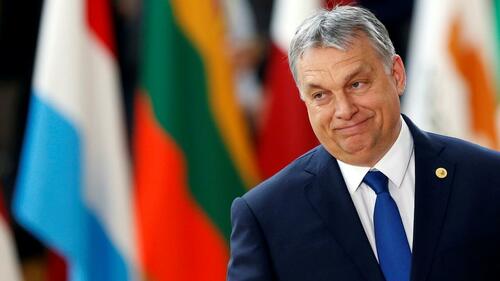
Viktor Orbán via Reuters
By Tyler Durden | Zero Hedge | January 28, 2022
It’s been revealed that the United States approached Hungary this week to ask the country to host a temporary troop deployment related to the Russia-Ukraine crisis. Hungarian Foreign Minister Peter Szijjarto “received an American request about temporary deployment of troops” – CNN reports.
Hungary’s Defense Ministry is said to be discussing the formal request; however, given the tense US administration relationship with the Viktor Orbán government since Biden took office – centered on seeking to isolate the conservative prime minister known for his unapologetic ‘Hungary first’ policies – the prospect remains highly unlikely. This comes as Biden announced Friday that he’ll be sending a small number of American forces to Eastern Europe: “I’ll be moving troops to eastern Europe in the NATO countries in the near term.” He qualified in the remarks reporters at Joint Base Andrews after returning from Pittsburg that this will be “not too many” troops.
A mere less than two months ago, Biden tried to humiliate Hungary’s “human rights backsliding” leader:
On Thursday and Friday, U.S. President Joe Biden will gather leaders from over 100 countries to a virtual “Summit for Democracy.” He invited rule-of-law troublemaker Poland. He invited Serbia, despite some questionable democratic credentials. He invited every EU member but one.
That one was Hungary.
CNN further reports that Romania and Bulgaria are also mulling the acceptance of additional US deployments. Both eastern European NATO countries are typically much more amenable to US security requests, and Romania already provocatively hosts coastal defense missiles on the Black Sea.
Among the security guarantees Russia is currently seeking from Washington and Brussels is precisely that NATO forces leave Bulgaria and Romania.
Thus when it comes to Hungary, from the point of view of officials in Budapest they are unlikely to want to see their country thrust into the middle of the tense escalating Russia vs. West standoff.
“The deployments would number approximately 1,000 personnel to each country and would be similar to the forward battle groups currently stationed in the Baltic States and Poland,” CNN notes of the numbers under initial discussion – though without doubt this would be ramped up in the instance of any potential Russian incursion into Ukraine.
Meanwhile, in a Russian media interview FM Sergey Lavrov said Friday “If it’s up to the Russian Federation, there will be no war. We do not want wars. But we won’t allow the West to grossly ignore our interests, either,” according to Sputnik.
Featured Video

AIDS Inc. by Gary Null (2007)
or go to
Aletho News Archives – Video-Images
From the Archives
Clash of Civilization, Iran Part II
By Jamal Kanj – Intifada-Palestine.com – January 14, 2011
Israel’s survival kit is: perpetuate conflict, insecurity to rationalize collective hate and finally playing victim.
Devoid of conflict, Israel implodes internally; without hate, Zionism loses its justification; and playing eternal victim to continue blackmailing the West. Absence of this holy trinity, Israel ceases to exist.
From its inception, the house of Zion has mastered exploiting adversarial powers to advance Israel’s cause. For instance, their influence over the Democratic Party in the US began with President Truman’s bid for 2nd term election in 1948.
Responding to strong opposition from Secretary of State General George Marshall and Department experts urging against recognition of Israel, President Truman replied: “I’m sorry gentlemen but I have to answer to hundreds of thousands [Jewish voters] who are anxious for the success of Zionism. I do not have hundreds of thousands of [voting] Arabs among my constituents”
Zionists influence over liberal American politics was matched with the doctrinal school of Conservative theoreticians aligning the Republican Party’s platform with Israel’s objectives. The Neoconservative Zionists, coined Zioncons, invented the “Clash of Civilization” concept to fight Israel’s wars. … continue
Blog Roll
 Aletho News
- 12 Things Your Psychiatrist Was Trained Not to Tell You
- From Unipolar Universalism to Multipolar Civilizational Distinctiveness
- RSF military group defects, joins Sudanese army: State media
- Ireland goalkeeper refuses to play ‘Israel’ as squad weighs boycott
- China pushes back against US on Cuba, Iran
- Ukrainian Soldiers, Potential Mercenaries: Have Gun, Will Travel!
- Burnham’s UN debut… A masterclass in British disinformation
- Iran flights continue despite US aviation sanctions
- Global Tipping Points Lead the World Into a State of Entropy
- The day-after at the White House: USA and Xi Jinping
- If Americans Knew
- Israel forces Gazans to live in constant peril – Daily Update
- Deconstructing Netanyahu’s pants-on-fire UN rant – Daily Update
- Trump betrayed voters with his campaign lies and prioritized a foreign country once he took office
- Netanyahu calls Israel’s war in Gaza ‘opposite of genocide’ in UN speech to near-empty hall
- Settler Kidnappings: Torture, Sexual Abuse and Terrorisation of Palestinian Abductees as Israel Deepens Annexation of West Bank
- Gaza winter nears as 162,000 tents become unusable, raising fears of humanitarian crisis
- Netanyahu says, “It’s the opposite of genocide”; UN says Gaza economy is world’s ‘most severe crisis on record’ – Daily Update
- Israel’s US-Backed Assault on Gaza Has Created the ‘World’s Most Severe Economic Crisis on Record’: UN
- ‘Protecting U.S. Citizens’… From Israel
- ‘This is where I live now, the back of a truck’: a day in the life of a grandmother in Gaza
- No Tricks Zone
- New Study: Earth And Venus Surface Warmth Largely Explained By Convection And Lapse Rate, Not CO2 Or Radiation
- 2025 Nature Paper Claiming Worsening Global Drought Gets RETRACTED …Heavily Flawed
- New Study: ‘Global Drought Shows No Detectable Recent Acceleration Under Climate Warming’
- Economic Masterminds: German Socialists Suggest Taxing Productivity Gains Stemming From Using AI
- The South China Sea Has Not Been Cooperating With The Climate Change Narrative
- Energy Crisis: Germany Enters Heating Season With Historically Low Gas Reserve Fill Levels
- New Study: The Antarctic Ice Sheet Gained Mass From 2020-2024 Due To Staggering Snow And Ice Accumulation
- Study: Ocean Heating Rates From Thousands Of Years Ago ‘Dwarf’ Modern Ocean Heating Rates
- Climate Extremists Target, Attack Large-Scale Power Grid Infrastructure In Germany!
- New Study: Antarctic Ice Melt Has Contributed Less Than 1 Centimeter To Sea Level Rise In The Last 30 Years

