The two-decade-long dispute on the statute of the Caspian Sea, the world largest water reserve, came to an end last Sunday when five littoral states (Russia, Iran, Turkmenistan, Kazakhstan and Azerbaijan) agreed to give it a special legal status – it is now neither a sea, nor a lake. Before the final agreement became public, the BBC wrote that all littoral states will have the freedom of access beyond their territorial waters, but natural resources will be divided up. Russia, for its part, has guaranteed a military presence in the entire basin and won’t accept any NATO forces in the Caspian.
Russian energy companies can explore the Caspian’s 50 billion barrels of oil and its 8.4 trillion cubic meters of natural gas reserves, Turkmenistan can finally start considering linking its gas to the Turkish-Azeri joint project TANAP through a trans-Caspian pipeline, while Iran has gained increased energy supplies for its largest cities in the north of the country (Tehran, Tabriz, and Mashhad) – however, Iran has also put itself under the shadow of Russian ships. This controversy makes one wonder to what degree U.S. sanctions made Iran vulnerable enough to accept what it has always avoided – and how much these U.S. sanctions actually served NATO’s interests.
If the seabed, rich in oil and gas, is divided this means more wealth and energy for the region. From 1970 until the dissolution of the Soviet Union (USSR) in 1991, the Caspian Sea was divided into subsectors for Azerbaijan, Russia, Kazakhstan and Turkmenistan – all constituent republics of the USSR. The division was implemented on the basis of the internationally-accepted median line.
After the dissolution of the Soviet Union, the new order required new regulations. The question was over whether the Caspian was a sea or a lake? If it was treated as a sea, then it would have to be covered by international maritime law, namely the United Nations Law of the Sea. But if it is defined as a lake, then it could be divided equally between all five countries. The so-called “lake or sea” dispute revolved over the sovereignty of states, but also touched on some key global issues – exploiting oil and gas reserves in the Caspian Basin, freedom of access, the right to build beyond territorial waters, access to fishing and (last but not least) managing maritime pollution.
The IEA concluded in World Energy Outlook (WEO) 2017 that offshore energy has a promising future. More than a quarter of today’s oil and gas supply is produced offshore, and integrated offshore thinking will extend this beyond traditional sources onwards to renewables and more. Caspian offshore hydrocarbon reserves are around 50 billion barrels of oil equivalent (equivalent to one third of Iraq’s total oil reserves) and 8.4 trillion cubic meters of gas (almost equivalent to the U.S.’ entire proven gas reserves). As if these quantities were not themselves enough to rebalance Eurasian energy demand equations, the agreement will also allow Turkmenistan to build the Trans-Caspian pipeline, connecting Turkmenistan’s resources to the Azeri-Turkish joint project TANAP, and onwards to Europe – this could easily become a counter-balance factor to the growing LNG business in Europe.
Even though we still don’t have firm and total details on the agreement, Iran seems to have gained much less than its neighbors, as it has shortest border on the Caspian. From an energy perspective, Iran would be a natural market for the Caspian basin’s oil and gas, as Iran’s major cities (Tehran, Tabriz, and Mashhad) are closer to the Caspian than they are to Iran’s major oil and gas fields. Purchasing energy from the Caspian would also allow Iran to export more of its own oil and gas, making the country a transit route from the Caspian basin to world markets. For instance, for Turkmenistan (who would like to sell gas to Pakistan) Iran provides a convenient geography. Iran could earn fees for swap arrangements or for providing a transit route and justify its trade with Turkey and Turkmenistan as the swap deal is allowed under the Iran-Libya Sanctions Act (ILSA, or the D’Amato Act).
If the surface water will be in common usage, all littoral states will have access beyond their territorial waters. In practical terms, this represents an increasingly engaged Russian presence in the Basin. It also reduces any room for a NATO presence, as it seems to be understood that only the five littoral states will have a right to military presence in the Caspian. Considering the fact that Russia has already used its warships in the Caspian to launch missile attacks on targets within Syria, this increased Russian presence could potentially turn into a security threat for Iran.
Many questions can now be asked on what Tehran might have received in the swap but one piece of evidence for what might have pushed Iran into agreement in its vulnerable position in the face of increased U.S. sanctions. Given that the result of those sanctions seems to be Iran agreeing to a Caspian deal that allows Russia to place warships on its borders, remove NATO from the Caspian basin equation, and increase non-Western based energy supplies (themselves either directly or indirectly within Russia’s sphere of geopolitical influence) it makes one wonder whose interests those sanctions actually served?
August 14, 2018
Posted by aletho |
Economics | Azerbaijan, Iran, Kazakhstan, NATO, Russia, Turkmenistan |
Leave a comment
This is not at all comforting: during a week that’s witnessed Alex Jones’ social media accounts taken down by Facebook, Apple, Spotify and Google, and what appears to be a growing crackdown against alternative media figures including several prominent Libertarians, notably the Ron Paul Institute director, and the Scott Horton Show, who found their Twitter accounts suspended — we learn that the Atlantic Council is directly advising Facebook on identifying and removing “foreign interference” on the popular platform.
While the initiative was initially revealed last May through an official Facebook media release, more details of the controversial think tank’s role have been revealed.
Supposedly the whole partnership is aimed at bringing more objectivity and neutrality to the process of rooting out fake accounts that pose the threat of being operated by nefarious foreign states.
And yet as a new Reuters report confirms, Facebook is now itself a top donor to the Atlantic Council, alongside Western governments, Gulf autocratic regimes, NATO, various branches of the US military, and a number of major defense contractors and corporations.

What’s more is that the team of four total individuals running the Atlantic Council’s Digital Forensic Research Lab (DFR Lab) is headed by a former National Security Council advisor for the last four years of the Obama administration, Graham Brookie, who is also its founder.
Apparently the group’s work has already been instrumental in Facebook taking action against over two dozen “suspicious pages” flagged potential foreign actors such as Russia. According to Reuters:
Facebook is using the group to enhance its investigations of foreign interference. Last week, the company said it took down 32 suspicious pages and accounts that purported to be run by leftists and minority activists. While some U.S. officials said they were likely the work of Russian agents, Facebook said it did not know for sure.
This is indeed the shocking key phrase included in the report:“Facebook said it did not know for sure.” And yet the accounts were removed anyway.
The Facebook-Atlantic Council alliance reportedly springs from the social media giant’s finding itself desperate for outside “neutral” help after a swell of public criticism, mostly issuing from congressional leaders and prominent media pundits, for supposedly allowing Russian propaganda accounts to operate ahead of the 2016 elections.
And in perhaps the most chilling line of the entire report, Reuters says, “But the lab and Atlantic Council bring geopolitical expertise and allow Facebook to distance itself from sensitive pronouncements.” This is ostensibly to defuse any potential conflict of interest arising as Facebook seems a bigger presence in emerging foreign markets.
Facebook’s chief security officer Alex Stamos recently told reporters, “Companies like ours don’t have the necessary information to evaluate the relationship between political motivations that we infer about an adversary and the political goals of a nation-state.” He explained further that Facebook would collect suspicious digital evidence and submit it to “researchers and authorities”.
Since at least May when the relationship was first announced, the DFR Lab has been key to this process of verifying what constitutes foreign interference or nefarious state propaganda.
But here’s the kicker. Reuters writes of the DFR Lab’s funding in the following:
Facebook donated an undisclosed amount to the lab in May that was enough, said Graham Brookie, who runs the lab, to vault the company to the top of the Atlantic Council’s donor list, alongside the British government.
Facebook employees said privately over the past several months that Chief Executive Mark Zuckerberg wants to outsource many of the most sensitive political decisions, leaving fact-checking to media groups and geopolitics to think tanks.
Facebook has defended the process as part of ensuring that it remains politically neutral, yet clearly the Atlantic Council itself is hardly neutral, as a quick perusal of its top donors indicates.

Among the DFR Labs partners include UK-based Bellingcat, which has in the past claimed “proof” that Assad gassed civilians based on analyzing YouTube videos and Google Earth. And top donors include various branches of the US military, Gulf sates like the UAE, and notably, NATO.
The Atlantic Council has frequently called for things like increased military engagement in Syria, militarily confronting the “Russian threat” in Eastern Europe, and now is advocating for Ukraine and Georgia to be allowed entry into NATO while calling for general territorial expansion of the Western military alliance.
Further it has advocated on behalf of one of its previous funders, Turkish dictator Recep Tayyip Erdoğan and gave a “Distinguished International Leadership” award to George W. Bush, to name but a few actions of the think tank that has been given authorization to flag citizens’ Facebook pages for possible foreign influence and propaganda.
Quite disturbingly, this is Mark Zuckerberg’s outside “geopolitical expertise” he’s been seeking.
August 8, 2018
Posted by aletho |
Civil Liberties, Fake News, Full Spectrum Dominance, Mainstream Media, Warmongering | Atlantic Council, Facebook, Human rights, NATO, United States |
Leave a comment
Armenia’s new Prime Minister has targeted Moscow’s confidantes in a corruption crackdown and angered the Kremlin by making overtures to NATO
No two “color revolutions” have been the same, although the anatomy may bear similarity. This explains why Russia continues to face a problem in calibrating its response to emerging revolutionary tides in its backyard.
Russia fumbled in Georgia (2003) and Ukraine (2004 and 2014), but digested the ‘color revolutions’ in Kyrgyzstan in 2005 and 2010. Of course, circumstances were different: Kyrgyzstan is a landlocked country.
The Moscow elite’s eternal dilemma has been that, when the defining moment came, the West invariably injected geopolitics into color revolutions in the post-Soviet space in a concerted strategy to encircle Russia with an arc of hostile states.
In this complex backdrop of historical uncertainty, Russia is unsure whether it made an error of judgment apropos the “Velvet Revolution” in Armenia, which shot a 42-year-old former journalist and previously uninspiring opposition politician, Nikol Pashinyan, to power. After a meteoric three-week rise he became prime minister in May.
The Velvet Revolution bore traits of a color revolution – although traces of outside interference were indistinguishable. Even as Pashinyan rode the revolutionary wave, Moscow chose not to cast aspersions on his stated agenda, that cleaning up the Augean stables in his country was his sole objective and his mission had no foreign-policy overtones.
Moscow’s approach probably ended up helping him climb the ladders of power, with the entrenched ruling party in Armenia meekly stepping aside to make way for him as the new prime minister.
Pashinyan pledges loyalty
Moscow appeared to accept at face value Pashinyan’s pledges of fealty. President Vladimir Putin was the first foreign leader to congratulate Pashinyan on May 8 when the ruling party elected him as the new head of government in a parliamentary vote.
Putin said: “I hope that your performance as the head of government will contribute to efforts to further strengthen friendly, allied relations between our countries, partnership within the Commonwealth of Independent States, the Eurasian Economic Union and the Collective Security Treaty Organization.”
Pashinyan nicely played along. Indeed, his first face-to-face with Putin in Sochi, only six days later on the sidelines of the summit meeting of the Eurasian Economic Union (EEU), had an effusive tone.
Pashinyan thanked Putin for what he called Moscow’s “balanced position” during the color revolution and reassured the Kremlin of the immutability of the Armenian-Russian “strategic alliance”.
In the presence of reporters, he told Putin that “the strategic alliance relations between Armenia and Russia” required “no discussion” and “there is a consensus on this issue in Armenia. I think that nobody in our country has or will cast doubt on the strategic importance of Armenian-Russian relations.”
Russia maintains a military base in Armenia.
Putin wished him success and said he hoped that bilateral ties “will develop just as steadily as they have up to now.” Putin added that Russia “views Armenia as our closest partner and ally in the region” on both economic and security issues.”
Moscow confidantes targeted
One week into the Velvet Revolution, it all seemed as if the Russian-Armenian alliance couldn’t be in better shape. But then, the sky began getting overcast and a stillness began descending in the air.
On May 10, Pashinyan began what appeared as a shake-up of the administration. It quickly snowballed into a veritable purge aimed at systemic change. He also launched a crackdown on public corruption, which has since made him a cult figure.
In a matter of three months his administration caught up with the two ex-presidents, Robert Kocharyan and Serzh Sargsyan, and the influential mayor of Yerevan Taron Margaryan, who were all Moscow’s confidantes in Yerevan.
Then, on July 27, Pashinyan struck hard by implicating the incumbent Secretary-General of the Collective Security Treaty Organization (CSTO) Yuri Khachaturov on charges dating back to his past assignment as Chief of the General Staff of Armenia under Sargsyan. The general is presently based in Moscow as the head of the Russia-led alliance.
That was when Moscow sat up.
On July 31, Foreign Minister Sergei Lavrov said Moscow was “concerned” that Armenia’s new leadership was making politically motivated moves against former leaders. Lavrov said: “The events of the last few days… contradict the recent declarations of the new Armenian leadership that it was not planning to pursue its predecessors on political grounds.”
Lavrov added: “Moscow, as an ally of Yerevan, has always had an interest in the stability of the Armenian state, and therefore what is happening there must be of concern to us.”
He disclosed that Moscow had repeatedly raised its concerns with Yerevan and expected a “constructive” response. These remarks amount to a rebuke.
NATO outreach spurs Russian warning
Meanwhile, what probably rung alarm bells in Moscow was that Pashinyan also began making overtures to the North Atlantic Treaty Organization (NATO). On the sidelines of the alliance’s summit on July 12 in Brussels, to which he was invited, Pashinyan said: “It would be very useful if NATO will send a strong message to Azerbaijan that any attempt to solve the Nagorno-Karabakh conflict using force will meet a strong reaction from the international community.”
In effect, he invited the Western alliance to get involved in the Southern Caucasus, which Russia traditionally regards as its sphere of influence.
While in Brussels, Pashinyan met the leaders of Germany, France, Canada among others, apart from a having a brief conversation with US President Donald Trump. Importantly, he began stressing the centrality of NATO as a forum for Armenia’s interactions with Georgia.
On August 2, the influential Moscow daily Kommersant wrote that Pashinyan’s moves had “driven a wedge into Moscow’s relations with Yerevan and may set the two countries at loggerheads even more”. The daily noted, citing Russian security officials, that the charges laid against CSTO Secretary General Khachaturov caused “outrage” in Moscow, because it “deals a blow to the image of the Russian-led military and political bloc”. It hinted at Western interference.
Equally, Moscow has taken exception to Armenia’s participation in the NATO exercises currently underway in Georgia. (Armenia is a member of the CSTO.)
In a hard-hitting statement on Friday, Russian Foreign Ministry spokesperson Maria Zakharova said the NATO exercise in Georgia aimed to “project power pressure, chiefly over South Ossetia, Abkhazia and Russia” and can only result in an “escalation of tensions.” Zakharova regretted that “Georgia’s neighboring countries are involved in these drills on various pretexts.”
On Monday, Russian Prime Minister Dmitry Medvedev said Georgia’s accession to NATO may trigger “a terrible conflict” and lead to catastrophic consequences. He closely echoed Putin’s stern warning last month: “We will respond proportionally to aggressive moves that pose a direct threat to Russia. Our [NATO] counterparts who bet on rising tensions, are trying to bring, say, Ukraine and Georgia into the alliance’s military orbit but they should think about the possible consequences of such an irresponsible policy.”
Clearly, Moscow’s preference would have been that Pashinyan pragmatically keeps Armenia in Russia’s orbit – and NATO out of the Caucasus. But the Velvet Revolution has mutated and Moscow’s dismal experience is that in such defining moments, environmental pressures cause changes to the genetic structure of color revolutions, resulting in variant DNA forms.
August 8, 2018
Posted by aletho |
Aletho News | Armenia, NATO, Nikol Pashinyan, Russia |
Leave a comment
Spanish fighter jets taking part in a NATO Air policing mission over Estonia have been temporarily suspended from completing their duties, after one of the pilots erroneously fired an armed missile during a training flight.
A group of two Spanish Eurofighter Typhoon 2000 jets and two French Mirage 2000 jets were taking part in a training exercise over southwestern Estonia on Tuesday when one of the Spanish planes accidentally launched an air-to-air missile, the Spanish Defense Ministry said in a statement, adding that the projectile “did not hit any aircraft.”
All the jets then safely returned to their Saiuliai air base in Lithuania, the ministry said, adding that it has opened an investigation into the incident. Meanwhile, the Estonian authorities decided to ban the Spanish aircraft from taking part in the air policing missions over its territory for a while.
“I have ordered a suspension of all military sorties [by the Spanish jets] until the situation is resolved,” the Estonian Defense Minister Juri Luik said, as cited by the national ERR broadcaster. He added that “the NATO air mission will continue, though.” ERR reports that the Portuguese Air Force will take Spain’s place as part of the mission for the time being.
“The most important thing is to ensure safety and find out what happened, together with our allies,” Luik said, commenting on his decision. The missile fired by the jet should have self-destructed but apparently failed to do so.
The projectile in question is an AMRAAM-type air-to-air missile with a firing range of 100 kilometers that carries a warhead fitted with explosives of up to 10 kilograms. It was last located some 40 kilometers north of Estonia’s city of Tartu, where it might have landed on the ground, according to Estonian media.
The Estonian Air Force launched a search operation on Tuesday evening. The authorities also asked the locals to be wary and notify the military or the emergency services in case they find the missile or its parts.
The Estonian Prime Minister Juri Ratas called the incident “horrible” and “regrettable.” However, he nevertheless praised the NATO mission as a “very important and necessary part of ensuring Estonia’s security.”
August 7, 2018
Posted by aletho |
Militarism | NATO |
Leave a comment
A fortnight after the Helsinki summit on July 16, US-Russia relations are set to take a turn for the worse. In an unprecedented move, White House fielded a joint media briefing by America’s top national security team on Thursday to highlight that Russia is continuing to make pervasive attempts to interfere in the upcoming mid-term elections in the US in November.
One of the top security czars who gave the briefing, National Intelligence Agency director Dan Coats said starkly, “We acknowledge the threat, it is real, it is continuing, and we’re doing everything we can to have a legitimate election. It is pervasive, it is ongoing, with the intent to … drive a wedge and undermine our democratic values.” Importantly, Coats alleged that the Kremlin was involved in the meddling effort which reached into the Kremlin itself.
He said, “Russia has used numerous ways in which they want to influence, through media, social media, through bots, through actors that they hire, through proxies – all of the above, and potentially more. We also know the Russians tried to hack into and steal information from candidates and government officials alike.” (Transcript)
The briefing served three purposes: one, to reject the denials of meddling that Russian President Vladimir Putin maade to President Trump at Helsinki; two, to neutralize the public criticism in the US that Trump has not been unequivocal on the issue; and, three, to give warning to Moscow.
The briefing coincided with a ‘bipartisan’ legislation that was introduced into the US Congress on Thursday to impose stiff new sanctions on Russia and combat cyber crime. The bill includes restrictions on new Russian sovereign debt transactions, energy and oil projects and Russian uranium imports, and new sanctions on Russian political figures and oligarchs. Interestingly, the proposed legislation underscores strong support for the North Atlantic Treaty Organization and expressly forbids the Administration from taking the US out of the alliance without two-thirds of the US Senate voting in favor of any such effort.
The senators who tabled the legislation said in a statement that the proposed new sanctions would target “political figures, oligarchs, and family members and other persons that facilitate illicit and corrupt activities, directly or indirectly, on behalf of Vladimir Putin.” According to some reports, the bill would also require a report to be assembled on the personal net worth and assets of Putin. Quite obviously, Putin himself is in the crosshairs.
Putin’s spirited defence of Trump at their joint press conference in Helsinki on the Russia collusion inquiry has provoked this furious backlash from America’s political class. In such a backdrop, another summit between Trump and Putin in a near future seems highly improbable. A visit by Putin to the White House in the autumn is simply out of the question. The US-Russia ties will remain very tense, too.
On the other hand, in a deceptive show of flexibility that will be keenly noted in New Delhi, US Congress has approved a legislation empowering the president to waive penalties against countries that buy weapons from Russia – provided, of course, Washington is convinced that such countries are seeking closer ties with the US. The US Defence Secretary James Mattis had pleaded with the US Congress for such Russia-sanction-waiver authority that would help countries such as India, which had traditional defence relations with Russia but are now trying to “pull away from the Russian orbit,” (as he put it.)
Evidently, the legislation on waivers is a self-serving move, enabling US arms manufacturers to continue to expand business opportunities in the Indian market. Under the new legislation, the president must nonetheless certify that India is both reducing arms imports from Russia and is expanding defense cooperation with the US, thereby making itself eligible for the waiver from sanctions. In effect, it becomes a tool for Washington to insert itself into the India-Russia defence cooperation as an interested party and to incrementally leverage Indian decisions with a view to atrophy the longstanding cooperation.
Clearly, the US interference in the India-Russia relationship is poised to intensify in the period ahead. If the proposed new sanctions “bill from hell” (tabled on Thursday) gets passed by the US Congress, which is to be expected, energy cooperation between India and Russia will also come under the American scanner. There is a strong business dimension to these US moves insofar as arms exports and energy cooperation also happen to be two thrust areas of export to India. Simply put, Washington hopes to roll back India’s defence and energy cooperation with Russia and seize the resultant business opportunities to boost its own exports to the Indian market.
In strategic terms, the US intention is to undermine the so-called “special privileged strategic partnership” between Russia and India, which would in turn erode the latter’s strategic autonomy and incrementally draw India into the American orbit as an ally.
August 3, 2018
Posted by aletho |
Economics, Mainstream Media, Warmongering | India, NATO, Russia, United States |
Leave a comment
The frequency with which US President Donald Trump holds out threats to other countries is such that he is no longer being taken seriously. The list of countries threatened by Trump so far includes North Korea, Germany, Canada, China, Venezuela, Pakistan, Syria, Iran and Turkey.
In all fairness, Trump makes no distinction between enemies, adversaries, friends or allies. Turkey, a NATO ally, holds a record of sorts as the country most threatened by the Trump administration. In separate tweets on Thursday, Trump and Vice-President Mike Pence gave an ultimatum to Turkey that unless Andrew Brunson, an American evangelical pastor of a small Protestant church in western Turkey, is released from detention immediately, Ankara should be “prepared to face the consequences” in the form of “significant sanctions.”
For the benefit of the uninitiated, Brunson who has been living in Turkey for 23 years was arrested in the aftermath of the failed 2016 coup attempt to overthrow Erdogan, charged with spying and involvement in the failed coup. The Turkish government had probably hoped for a tradeoff – Brunson in exchange for the Islamist preacher Fetullah Gulen who is living in Pennsylvania whom Ankara regards as having masterminded the 2016 coup attempt to overthrow Erdogan. Ankara has been pressing Gulen’s extradition and Washington has been stonewalling. It’s a complicated case history, since Gulen has had links in the past with the CIA.
Turkey has shrugged off the latest threat from Trump and Pence. However, for Trump, Christian groups form a core constituency politically, and taking a tough stance on the high-profile Brunson case has endeared him to those groups. Dr. Ronnie Floyd, former president of the Southern Baptist Convention, recently made the following remark in praise of the White House effort: “I thank God we have an administration that cherishes the freedom of religion as our founders hoped we would.”
Trump’s latest threat puts Erdogan in a fix because releasing Brunson without a reciprocal move on Gulen’s extradition means a loss of face. Erdogan is acutely conscious of his strongman-image. He must be wondering whether Trump is serious about the ultimatum on Brunson’s release. Brinkmanship comes naturally to Trump. Indeed, with Trump one really doesn’t know what happens next.
But Erdogan can be more than a match for Trump in the ‘art of the deal’. At a meeting today with Russian President Vladimir Putin on the sidelines of the BRICS summit in South Africa, Erdogan added disdainfully that Trump’s real grouse in giving such an ultimatum yesterday could be that Turkey has drawn close to Russia in the recent times. That is a spin, of course. But then, Erdogan is also hoping to extract a big concession from Putin – deferment of the planned military operation to liberate the northwestern Syrian province of Idlib on the Turkish border from Ankara’s proxy groups. Turkey is keen to retain Idlib as its zone of influence.
Does Putin feel impressed that US-Turkish ties are deteriorating? There are no easy answers here. Nonetheless, Erdogan sees no harm in playing Trump against Putin. After all, who knows, Putin may hold back on the assault to liberate Idlib…
Yet, the chances are that this time around, Trump probably intends to carry out his ultimatum to impose sanctions on Turkey. The point is, US patience with Turkey seems to be wearing thin. Turkey is no longer a ‘swing’ state in the US’ Middle East strategies, given the poor state of Turkish-Israeli relations, Erdogan’s ‘pivot to Russia’ and the overall trust deficit in Turkish-American relationship. Erdogan snubbed the US threat of sanctions and upheld his decision to purchase S-400 missile defence system from Russia. Last week, Erdogan bluntly rejected the demarche by Washington that Turkey should cut back its oil imports from Iran.
July 29, 2018
Posted by aletho |
Economics, Militarism | Andrew Brunson, CIA, Fetullah Gulen, Idlib, NATO, Sanctions against Iran, Turkiye, United States |
Leave a comment
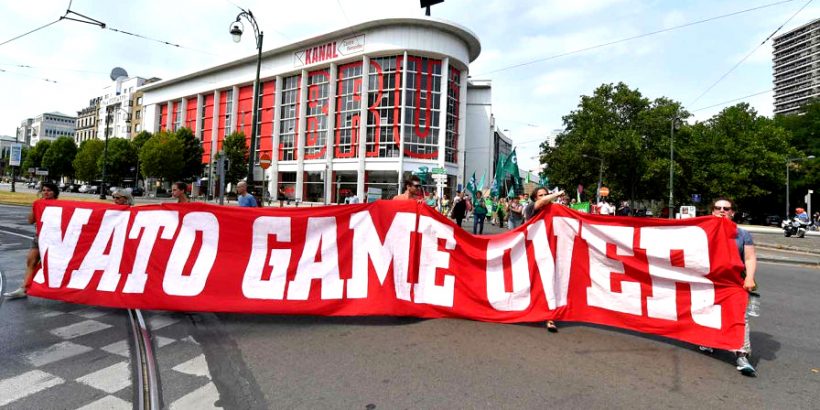
Claims that US President Donald Trump is undermining the North Atlantic Treaty Organization (NATO) by criticizing some of its members and having a cordial meeting with Russian President Vladimir Putin have sent establishment media into a frenzy to sanctify NATO as a force for peace and democracy.
A Guardian editorial (7/10/18) asserted:
The NATO alliance has helped mold the modern world and ushered in a democratic, liberal world order characterized by open trade and open societies, which after the collapse of the Soviet Union needed only to be lightly defended. This in turn contributed greatly to American peace and prosperity.
Note that “American peace” is a phrase used to describe a state that is currently bombing one country or another every 12 minutes, while US “prosperity” takes the form of spending $716 billion on the war machine annually while 40 million Americans live in poverty, giving the country a child poverty rate of 21 percent as well as the worst child mortality rate among rich nations.
A New York Times editorial (7/8/18) said that since World War II, the alliance has been “the anchor of an American-led and American-financed peace that fostered Western prosperity and prevented new world wars.” According to the paper, NATO has
linked America and Europe not just in a mutual defense pledge but in advancing democratic governance, the rule of law, civil and human rights, and an increasingly open international economy.
The Times argued that, while the alliance’s original purpose was allegedly to respond to a hypothetical Soviet attack, NATO “found a new purpose” after the fall of the USSR, “defending Muslims in the Balkans, and after 9/11, helping the United States fight terrorists in Afghanistan, Iraq, Africa and elsewhere.”
What the Times called “defending Muslims in the Balkans” was actually NATO’s invasion of Yugoslavia, an important tool in the dismantling of that country, which only under the most curious of definitions could be described as an act of “peace” or an exemplar of “the rule of law,” since the attack was illegal. Likewise, in “fight[ing] terrorists in Afghanistan,” NATO has hardly shown itself to be an agent of “peace” in a war that’s gone on for almost 17 years, during which NATO members have demonstrated their regard for “civil and human rights” by killing thousands of Afghan civilians and supporting torturers.While NATO’s occupation has yet to usher in an “open societ[y]” or democracy in Afghanistan, the alliance’s presence has coincided with the birth of ISIS in the country. Rather than embodying “peace” or “human rights,” the 2003 invasion and subsequent occupation of Iraq, which NATO took part in by way of a “training mission,” entailed torture, the killing hundreds of thousands of civilians, the use of chemical weapons, and rates of infant mortality, cancer and leukemia higher than those reported in Hiroshima and Nagasaki. Then in the Iraqi theatre of the war ostensibly aimed at ISIS, NATO demonstrated these values and helped “fight terrorists” as part of a coalition that killed thousands of civilians.
The Times’ vague reference to “fight[ing] terrorists in… Africa” notwithstanding, none of the articles discussed above or below mentioned Libya, the site of NATO’s most recent full-scale war. Yet it’s fair to say that the seemingly endless war and social collapse in Libya that have followed NATO’s attack, as well as the “hell” of beheadings, rape, and slave markets that resulted from it, aren’t features of “open societies” characterized by “peace,” “democratic” politics and “the rule of law, civil and human rights.” One struggles, in fact, to come up with a single example where such things were the goal of a NATO intervention, let alone its outcome.
Advocating Aggression
Canonizing NATO involves not only erasing its innumerable crimes but also advocating the bolstering of the organization, which would both increase the threat of war and divert resources from socially necessary goods like healthcare, housing, education, ameliorating poverty and inequality…
A Washington Post editorial (7/7/18) said:
There is considerable good news to celebrate: [NATO] has substantially beefed up defenses of its eastern flank, facing Russia; it is recommitting to vital missions in Afghanistan and Iraq; and every one of its members is increasing defense spending—the biggest buildup by US allies in 25 years. The summit is due to adopt an ambitious new plan that would allow NATO to deploy 30 battalions, 30 squadrons of planes and 30 ships within 30 days—a resource that could considerably bolster the ability of the United States to respond to crises.
The Times editorial claimed that, “faced with” an unspecified “Russian threat”—the existence of which the editorial offers no evidence for, but refers to twice—“a firm and convincing commitment to a strong NATO” is important. Thus the paper implicitly endorsed NATO’s
establishing two new military commands, expanding cyberwarfare and counterterrorism efforts, and approving a new plan to speed the reinforcement of troops and equipment to Poland and the Baltic States to deter Russian aggression.
None of this coverage addressed NATO’s threats to Russia and how these shape Russian actions. Though NATO leaders promised Soviet leader Mikhail Gorbachev in 1990 that NATO would not expand “one inch eastward” toward Russia, the alliance has since grown quite a few inches eastward by adding to its ranks Poland, Hungary, the Czech Republic, Bulgaria, Estonia, Latvia, Lithuania, Romania, Slovakia, Slovenia, Albania, Croatia and Montenegro.
As Benjamin Schwarz pointed out in The Nation (7/11/18), the US has “interfered in the pre- and post-coup political machinations in Ukraine,” and “NATO has signaled that its expansion into Ukraine is a question of when, not if.” He went on to note:
And now that NATO has created an enemy [in Russia], it justifies its [own] intensifying provocative actions—the massive annual military exercises since 2010 in Poland, Lithuania, and, on Russia’s very doorstep, in Latvia and Estonia; the creation of a permanent US Army headquarters in Poland; a new Pentagon-devised plan for a prolonged war with Russia; the US ambassador to NATO’s explicit identification of “Russia and the malign activities of Russia” as NATO’s “major” target—by declaring that they are nothing more than a necessary reaction to Russian hostility and the need, as the New York Times editorial board declared this week, to “contain” the Russian “threat.” And what, according to the Pentagon’s 2018 National Defense Strategy, makes the Russians a threat? Nothing less than that their aim—which is as unproven as it would be understandable—is “to shatter” NATO, the military pact arrayed against them.
Since 2016, NATO has had 4,000 troops in Poland, Lithuania, Latvia and Estonia.
Thus, when the Post said NATO’s military buildup “could considerably bolster the ability of the United States to respond to crises,” it should have added that NATO is a driving force in creating these crises in the first place. These media accounts suggest, however, that NATO has an unlimited right to build up its forces near Russian territory, while any Russian response to that is entirely illegitimate.
Therein lies the meta level of the absurdity of this panic about Trump being anti-NATO. By insisting that US allies in the organization pay in more heavily, he’s actually calling for NATO to be built up. In February, the Trump administration released its Nuclear Posture Review, which authorized developing and deploying so-called “low-yield” nuclear weapons to “deter” Russia in case it’s not already deterred by America’s massive nuclear arsenal.
The problem isn’t, as the media suggests, that Trump is weakening NATO; the problem is that he’s strengthening it.
Gregory Shupak teaches media studies at the University of Guelph-Humber in Toronto. His book, The Wrong Story: Palestine, Israel and the Media, is published by OR Books.
July 26, 2018
Posted by aletho |
Mainstream Media, Warmongering, Militarism | NATO, United States |
Leave a comment
Senators Lindsey Graham (R-South Carolina) and Bob Menendez (D-New Jersey) are working on a draft law that would impose sanctions on Russian sovereign debt and demand Senate approval for US quitting NATO, among other things.
The two senators announced on Tuesday they will be introducing the new sanctions law “to ensure the maximum impact on the Kremlin’s campaign against our democracy and the rules-based international order.”
The US must make it clear it will “not waver in our rejection of [Russian President Vladimir Putin’s] effort to erode western democracy as a strategic imperative for Russia’s future,” Graham and Menendez said.
Although the bill is still being drafted, Graham and Menendez said it would include increased sanctions on Russian energy and financial sectors, “oligarchs and parastatal entities” and on sovereign debt as well as sanctions against “cyber actors in Russia.”
It will also establish a National Center to Respond to Russian Threats and a sanctions coordinator office at the State Department, demand reports on implementing the Countering America’s Adversaries Through Sanctions Act (CAATSA), and authorize financial aid to “bolster democratic institutions across Europe to defend against Russian interference.”
Last, but not least, the bill would impose a Senate approval requirement for US withdrawal from NATO.
Graham is an outspoken foreign policy hawk and long-time wingman of the Russia-obsessed Senator John McCain (R-Arizona). Last week, he called for the World Cup soccer ball, presented as a gift to President Donald Trump by his Russian counterpart at the summit in Helsinki, Finland to be examined for surveillance devices.
As the ranking member on the Senate Foreign Relations Committee, Menendez is a powerful voice among the Democrats, who continue blaming Russia for the outcome of the 2016 US presidential election.
It is unclear how much support the Graham-Menendez bill will get in the Senate. However, CAATSA was approved 98-2 last year.
Just last week, the Senate voted 98-0 on a nonbinding resolution expressing the sense that the “United States should refuse to make available any current or former diplomat, civil servant, political appointee, law enforcement official or member of the Armed Forces of the United States for questioning by the government or Vladimir Putin,” in response to false reports that former US ambassador to Russia Michael McFaul would be “handed over” to Moscow.
July 24, 2018
Posted by aletho |
Economics, Russophobia | Bob Menendez, CAATSA, Lindsey Graham, NATO, Russia, United States |
Leave a comment
Russian President Vladimir Putin has expressed his strong opposition to the expansion of the North Atlantic Treaty Organization (NATO) eastward, warning the US-led military alliance against unspecified consequences in case it seeks to forge closer ties with Ukraine and Georgia.
Addressing a meeting of Russian ambassadors and envoys in Moscow on Thursday, Putin said there was a need to rebuild trust in Europe, and that NATO’s attempts concerning deployment of military contingents and infrastructure near Russia’s western frontiers were not acceptable.
“We will respond appropriately to such aggressive steps, which pose a direct threat to Russia,” the Russian leader said.
He added, “Our colleagues, who are trying to aggravate the situation, seeking to include, among others, Ukraine and Georgia in the orbit of the alliance, should think about the possible consequences of such an irresponsible policy.”
Putin said he had discussed the matter with his US counterpart Donald Trump at a summit in the Finnish capital of Helsinki on Monday.
Russia and Georgia fought a war in August 2008 over the breakaway Georgian region of South Ossetia. Moscow continues to garrison troops there and to support another breakaway region, Abkhazia.
The strategic Black Sea peninsula of Crimea declared independence from Ukraine on March 17, 2014 and formally applied to become part of Russia following a referendum, in which 96.8 percent of participants voted in favor of the move.
After Crimea rejoined Russia, an armed conflict broke out in eastern Ukraine when Kiev launched military operations to quell pro-Russia sentiments there. Kiev accuses Moscow of involvement in the conflict. Russia, in return, has denied the charge.
The US and its Western allies have imposed several rounds of sanctions against Russia over its reunification with Crimea and the Ukrainian crisis, which has killed about 10,000 people since it began in 2014.
German soldiers attend a ceremony to welcome the German battalion being deployed to Lithuania as part of NATO deterrence measures against Russia in Rukla, Lithuania, on February 7, 2017. (Photo by Reuters)
Earlier this year, a senior member of the Italian Five Star Movement (M5S) and vice president of the European Parliament told Russia’s Sputnik news agency that the presence of NATO troops close to Russia’s borders contributes to an arms race, and maintains an atmosphere of mistrust between Moscow and the alliance.
Massimo Castaldo also called for the easing of tensions between NATO and Moscow.
“I think that we should bet on the gradual easing of tension, including with the help of signals that we send as NATO, hoping to restore useful and constructive relations [with Russia],” Castaldo pointed out.
July 20, 2018
Posted by aletho |
Militarism | Italy, NATO, Russia |
Leave a comment
NOTE: Because “NATO” these days is little more than a box of spare parts out of which Washington assembles “coalitions of the willing”, it’s easier for me to write “NATO” than “Washington plus/minus these or those minions”.
Home Secretary Sajid Javid has called on Russia to explain “exactly what has gone on” after two people were exposed to the Novichok nerve agent in Wiltshire. (BBC)
The Russian state could put this wrong right. They could tell us what happened. What they did. And fill in some of the significant gaps that we are trying to pursue. We have said they can come and tell us what happened. I’m waiting for the phone call from the Russian state. The offer is there. They are the ones who could fill in all the clues to keep people safe. (UK security minister Ben Wallace)
Leaving aside their egregious flouting of the elemental principle of English justice, note that they’re uttering this logical idiocy: Russia must have done it because it hasn’t proved it didn’t. Note also, in Javid’s speech, the amusing suggestion that Russia keeps changing its story; but to fit into the official British story “novichok” must be an instantly lethal slow acting poison which dissipates quickly but lasts for months.
This is an attempt to manipulate our perception of reality. In a previous essay I discussed NATO’s projection of its own actions onto Russia. In this piece I want to discuss another psychological manipulation – gaslighting.
The expression comes from the movie Gaslight in which the villain manipulates her reality to convince his wife that she is insane. Doubt the official Skripal story and it is you – you “Russian troll” – who is imagining things. Only Russian trolls would question Litvinenko’s deathbed accusation written in perfect English handed to us by a Berezovskiy flunky; or the shootdown of MH17; or the invasion of Ukraine; or the cyber attack on Estonia. Only a Russian troll would observe that the fabulously expensive NATO intelligence agencies apparently get their information from Bellingcat. Argumentum ad trollem is everywhere: count the troll accusations here or admire the clever anticipatory use of the technique there.
This is classic gaslighting – I’m telling the truth, you’re the crazy one.
We may illustrate the eleven signs of “gaslighting” given in Psychiatry Today by Stephanie A. Sarkis with recent events.
They tell blatant lies.
The Skripals were poisoned by an incredibly deadly nerve agent that left them with no visible symptoms for hours but not so deadly that it killed them; at least not at Easter; nor the policeman; a nerve agent that could only have been made in Russia although its recipe was published in the open media; that poison having been administered on a doorknob that each had to have touched at the exact same minute that no one else touched; a nerve agent so deadly that they only bothered to clean up the sites 51 days later. And so on: a different story every day. But your mind must be controlled by Putin if you smell a falsehood at any point. And, now we have it all over again: apparently the fiendishly clever Russian assassins smeared the doorknob and then, rather than getting out of town ASAP, sauntered over into a park to toss the container. (Remember the fiendishly clever Russian assassins who spread polonium everywhere?)
And, speaking of proven, long term, repeating liars: remember when accusing the British government of complicity in torture renditions was a conspiracy theory? Well, it turns out the conspiracy was by the other side. “Conspiracy Theorist” is the perfect gaslighting accusation, by the way: you’re the crazy one.
They deny they ever said something, even though you have proof.
The Skripal case gives a perfect illustration: here’s the UK Foreign Secretary saying Porton Down told him it was Russian (“absolutely categorical”) And here’s the UK Foreign Office disappearing the statement: We never said Porton Down confirmed the origin. It’s rare to get such a quick exposure of a lie, so it’s useful to have this example. Here is an obvious fake from Bellingcat. Already the Douma story is being re-polished now that the OPCW has said no organophosphates.
Most of the time it takes years to reveal the lie: gaslighters know the details will be forgotten while the impression remains. 64 years later we learn the “conspiracy theorists” were right about the CIA/UK involvement in the Iran coup. It’s rather amazing how many people still believe the proven liars this time around.
They use what is near and dear to you as ammunition.
Russians cheat at the sports you follow, scatter nerve agents and radioactive material in places you could be in, sneak into the voting booth with you, blow up airplanes you might be on and tear up the “very fabric of our democracy.” Your favourite actor tells you “we are at war with Russia“.
And the children! The boy on the beach. The boy in the ambulance. Bana from Aleppo. Miraculous recoveries. Dramatic rescues with camera! Dead children speaking. And finally, the little girl, Trump and the Time cover.
If it’s a child, they’re gaslighting you.
They wear you down over time.
Skripal story fading? How about a CW attack in Syria? No? Back to MH17: same story with one new obviously suspicious detail. Pussy Riot is forgotten and Pavlenskiy an embarrassment, but “Russian bear in Moscow World Cup parade video sparks PETA outrage“! This is what is known as a Gish Gallop: the gaslighter makes 47 assertions, while you’re thinking about the first, he makes 20 more: in former times it was recognised by the the folk saying that “a fool can ask more questions than ten wise men can answer”. But the fools quickly come up with more: dead dogs in Russia: without tuk-tuks, with tuk-tuks; your choice.
You are worn down by ten new fake outrages every month: all expressed in simplistic terms. How much context is stuffed into this imbecilic headline? The Plot Against Europe: Putin, Hungary and Russia’s New Iron Curtain. How many thousand words, how many hours to discuss it intelligently? Too late! Time for “Trump and Putin’s Too-Friendly Summit” (NYT 28 June). Forget that! “Sexism at Russia World Cup the worst in history as female fans and broadcasters are harassed“. (Telegraph 30 June). Gone! “We already gave Syria to Putin, so what’s left for Trump to say?” (WaPo 5 July) Stop wondering! “Amesbury poisoning: Here’s what we know about the novichok victims” (Sky News 6 July). No! Trumputin again! “Will Trump Be Meeting With His Counterpart — Or His Handler?” (NY Mag 8 July). Gish Gallop. The sheer volume of easily-made accusations forces two conclusions: they’re right and you’re wrong (smoke: fire) or, more simply, eventually you – you crazy one! – give up.
Their actions do not match their words.
They bomb hospitals on purpose, we bomb them by accident. Discussed further here but the essence of the point is that
it would be physically impossible for Russia to be more destructive than NATO is.
If you want a single word to summarize American war-making in this last decade and a half, I would suggest rubble.
They throw in positive reinforcement to confuse you.
There are direct rewards of course: cue Udo Ulfkotte; many benefits to swimming with the stream; swimming the other way, not so many. It’s only after they retire that British generals question the story, the cynic observes. German generals too. Maybe even US generals.
But for the rest of us, NATO bathes us in gush: “NATO’s Enduring Mission – Defending Values, Together“. Together, our values: we – you and I – have the good values. NATO loves to praise itself “the Alliance also contributes to peace and stability through crisis management operations and partnerships.” Remember Libya? “A model intervention” said the NATO GenSek of the time. Here is the view on the ground. Most of the “migrants” tearing Europe apart are fleeing the destruction of NATO’s wars. NATO backs (plus/minus minions) the intervention in Mali, a country destabilised by its destruction of Libya. Cue the positive reinforcement: “Projecting Stability: an agenda for action“. In NATOland the gaslight burns bright: “Nato chief: Vladimir Putin ‘weaponising’ refugee crisis to ‘break’ Europe“. NATO keeps pouring butterscotch sauce on the rubble: “NATO is based on some core values – democracy, the rule of law, individual liberty” (25 June).
All I can say, over and over again, is Libya. NATO destroyed Libya, weird as it was, killed Qaddafi, weird as he was, and smugly congratulated itself: “NATO’s Victory in Libya: The Right Way to Run an Intervention“. Ubi solitudinum faciunt pacem appelant. But should that thought occur to you, you’re part of “Russia’s secret plan to destroy EU and NATO“.
They know confusion weakens people.
Remember PropOrNot? Sites that do not agree with the Establishment are Russian bots! Authenticated experts! 100% reliable! The WaPo published the list; when under attack even from proponents of the Putindunnit hysteria, it feebly backtracked: it “does not itself vouch for the validity”. Vermont power grid hack? WaPo fell for that one too. Confusion from the endless Gish Gallop about Putin: in December 2015 I compiled a number: Aspergers, pychopath, slouching and on and on and on.
You may be confused but the gaslighter isn’t: Russia’s to blame for whatever-it-was!
They project.
NATO projects all the time and this headline from the NYT is classic: “Russia’s Military Drills Near NATO Border Raise Fears of Aggression“. I discuss NATO’s projection here.
They try to align people against you.
NATO exerts a continual pressure for unanimity. Again, the Skripal story is a good example: London accused Russia and, “in solidarity“, Russian diplomats were expelled all over the world. Allies took its word for it. Now the doubts: in Germany especially. Sanctions must be imposed on Russia because we must be in solidarity with Kiev. “Solidarity” on migrants. “Solidarity” is perhaps the greatest virtue in NATOland. We will hear more pleas for solidarity as NATO dies: when mere “solidarity” is the only reason left; there’s no reason left.
They tell you or others that you are crazy.
It also must be said that when elected officials — including members of Congress — and media platforms amplify propaganda disseminated by Russian trolls, they are aiding the Russians in their efforts.
The goal is to undermine democracy. So you want America to look unstable and Americans not to trust each other.
How Russian Trolls Won American Hearts andMinds
An “existential threat posed by digitally accelerated disinformation“. So no forgiveness to you, crazy Putin trolls. And don’t dare doubt that American democracy is so feeble that it can be directed by a few Facebook ads. Never forget that NATO’s opponents are crazy: Putin is a “madman“; Qaddafi was “crazy“; Saddam Hussein “insane“; Milosevic “rabid“. Only crazy people would defend crazy people.
They tell you everyone else is a liar.
Honest people don’t have to tell you they’re trustworthy, and neither, once upon a time, did the BBC. The Atlantic Council smoothly moves from “Why Is the Kremlin So Fixated on Phantom Fascists?” in May 2017 to “Ukraine’s Got a Real Problem with Far-Right Violence (And No, RT Didn’t Write This Headline)” in June 2018. But it still calls Russia the liar: “Why the Kremlin’s Lies Stick” (May 2018). The Atlantic Council hopes you’re dumb enough not to notice that Russia hasn’t changed its line but the gaslighters have. (Remember O’Brien and two plus two?)
Russian Federation is not the USSR.
I said it the last time: the USSR did lots of things in its time – influencing, fiddling elections, fake news, gaslighting and so on. But, in those days the Communist Party was the “leading and guiding force” but today it’s the opposition. Things have changed in Moscow, but NATO rolls on.
Some hope, though.
While many people are still taken in by the gaslighters, there are hopeful signs. Once upon a time Internet versions of the mass media allowed comments. Gradually, one by one, they shut down their comments sections because of “trolls”, “fake news” and offended “standards” but really because of disagreement. Perhaps the most famous case is that of the Guardian : an entire website, has been created by people whose comments were rejected because they violated “community standards”. I always read the comments in the Daily Mail, especially the best rated, and on the Skripal stories, the comments are very sceptical indeed of the official story. For example.
This is rather encouraging: for gaslighting really to work, the gaslighter either has to be in such a position of power that he can completely control the victim’s surroundings or in such a position of authority that the victim cannot imagine doubting what he says. Those days are gone.
July 17, 2018
Posted by aletho |
Deception, Fake News, Mainstream Media, Warmongering, Timeless or most popular | NATO, UK, United States |
Leave a comment
I just did a live Sputnik International radio interview about the Trump-Putin summit in Helsinki. This is the essence of my answers.
Trump is the USA and the USA mainly wants two things from Russia.
First, it wants Russia’s credibility. In the words of Trump: “I really think the world wants to see us get along.”
USA world credibility has crashed after Iraq-Afghanistan-Libya. The USA is known to abandon its allies and to work for gain even at the price of making long-term enemies.
The USA is habituated to being the most powerful and the most powerful can afford to make enemies. But the world is changing. The new multipolarity is accompanied by greater risks if the USA insists on maintaining the same degree of dominance.
In the words of Trump “We have a world to run”. This means the USA can gain much from collaboration with Russia. But, as usual, this does not mean that Russia can draw benefit from any such collaboration, only avoid some otherwise imposed punishment (sanctions, blockades, military pressures).
Second, the USA desperately “needs” to prevent democratization of effective weapons that can defend against its military intimidation and destruction campaigns.
The USA needs to prevent the emerging nations that it traditionally exploits by military force and intimidation from acquiring air-defence systems, ballistic missiles capable of retaliation, and weapons that can target large ships such as aircraft carriers. Aircraft carriers are the main hardware of USA military projection.
North Korea, Iran and Russia itself represent possible vectors of the said democratization of military technology. An example is seen in Yemen, where ground-to-air defence missiles are transformed into ground-to-ground retaliatory missiles. If Yemen had secured better such technologies, it would be defending itself more effectively.
The same is true for Gaza. Increased military technology would allow proper defence and a balance that could produce negotiation rather than bulldozer displacement policies and genocidal destruction campaigns.
The USA and Israel are terrified at such prospects. Israel’s approach would be all-out USA-backed war against Iran. The USA approach is to threaten war but extract collaboration from Russia to control and prevent military advancement of the nations the USA wants to control, which resist its bribes and threats.
In all of this, the USA (the elite faction supporting Trump) has come to understand that it must revitalize the domestic USA and its middle-class, that a strong empire cannot have an empty core. Trump will do anything to achieve this, including ruffle allies and break long-standing agreements.
The USA wants a strong NATO that it controls. It wants more commitment from NATO members. That was Trump’s main message. It needs NATO to legitimize any “needed” military destruction campaigns in Africa, the Middle East and Asia. And it is prepared to use these strong NATO-club ties to extract relative advantages to re-build its domestic economy.
NATO is about: securing Europe against trade and co-development with Russia, legitimizing criminal wars of aggression in the service of the empire, and projecting power into Africa, the Middle East and Asia, for the benefit of the NATO-club members but mostly the USA. It also forces Russia to spend enormous resources on defence.
This is what Trump is doing with NATO, which has nothing to do with pleasing Putin.
Election interference, whether true or not, is just an ancillary USA domestic matter. Everyone knows it’s bullshit. Putin did not write the Clinton emails. Democracies claim to want “transparency”.
Crimea is also a non-issue. Crimea folks overwhelmingly wanted incorporation into Russia, following the Ukrainian meltdown and military violence. Everybody knows that. Compare Russia’s actions in Crimea to the NATO mass-crime that is Libya. There is no comparison.
Finally, whether our goodiness brains allow us to see it or not, from a geopolitical perspective, Trump is the “progressive” here that wants domestic development rather than solely all-out hawkish globalism irrespective of domestic hollowness. He also wants to negotiate with Russia to limit Iran rather than risk long-term world and USA consequences from a large-scale regional war, which the Clintonite crazies say they want.
Two related prior articles are:1 and2
July 17, 2018
Posted by aletho |
Militarism | NATO, Russia, United States |
Leave a comment
Finally, on Monday, July 16, 2018, the Helsinki Summit bringing together Russian President Vladimir Putin and US President Donald Trump took place, despite shrill demands that it be stopped, canceled, or turned into a platform for more aggression. “President Trump should cancel his meeting with Vladimir Putin until Russia takes demonstrable and transparent steps to prove that they won’t interfere in future elections. Glad-handing with Vladimir Putin on the heels of these indictments would be an insult to our democracy,” Senate Minority Leader Chuck Schumer said. Yet there could never be any “proof” of someone not doing something in the future, and to implement the conditions for this specific case would require turning off all the electricity in Russia and seizing all computers everywhere on its territory. It is thus plainly an absurd, irrational, and unrealistic statement that is meant to satisfy partisan emotional needs. As a recipe for international relations, it would be a disaster of a policy. In a desperate effort to maintain the interests vested in the new Cold War, Democrats tried to elbow their way into the summit, to no avail. In the US today, “resistance” means continuing, even escalating, the fabricated Cold War against Russia—resistance has become the catchy buzzword for what Eisenhower called the military-industrial complex, updated to include billionaire tycoons funding “social movements” operating as part of “civil society”.
Thus days before the event, President Trump pointed critically at the shrill media and Democrats for firing up the new Cold War:
“Heading to Helsinki, Finland – looking forward to meeting with President Putin tomorrow. Unfortunately, no matter how well I do at the Summit, if I was given the great city of Moscow as retribution for all of the sins and evils committed by Russia… … over the years, I would return to criticism that it wasn’t good enough – that I should have gotten Saint Petersburg in addition! Much of our news media is indeed the enemy of the people and all the Dems… … know how to do is resist and obstruct! This is why there is such hatred and dissension in our country – but at some point, it will heal!” (Twitter 1, Twitter 2, Twitter 3).
What united all of the US media, from Fox News to CNN and right across to MSNBC, was the dominance of the America-the-innocent-victim narrative. Joining them was an established band of encrusted “neocons” such as Senator John McCain who asserted, in the usual evidence-free fashion of the kind that brought the US to Iraq, that Putin was guilty of “ongoing aggression towards the United States”. The “no blame” narrative (that permanently shields Americans from the consequences of their actions) was joined by the insistence that the secret police and espionage agencies should just be believed, without doubt, and that such agencies should have primacy over democratically elected representatives. Funny that this is what should issue from the same mouths that claim to warn us against “fascism”.
However, in an amazing press conference featuring Putin and Trump at the close of the summit, virtually everything the Democrats, their neocon associates, the media, and the military-intelligence establishment did not want to hear, is what they were instead forced to hear. Allegations of “collusion” between Trump and Russia faced thorough embarrassment as utter idiocy. Putin tossed back allegations of Russian interference in US elections, and essentially laughed at the bogus “assessment” that has been treated as if it were sacrosanct truth in the US media, such that Trump was expected to perform an auto da fé in front of the new Cold War media’s Grand Inquisition. There was no hint of Russia withdrawing from Syria (there at the Syrian government’s request)—though Trump reiterated the near total defeat of ISIS that had been achieved, which also eliminates the US’ rationale for its illegal intervention in Syria. Russia refused to accept that Crimea did not legally, peacefully, and democratically choose to join Russia, to which it belonged for the majority of its history. On these and other issues, it was as if a stake had been driven through the heart of the new Cold War. Of course, it was also just a beginning, and not an end. In an interview with Fox News’ Chris Wallace, Putin said that the Helsinki Summit was simply “a good start” to ending a revived Cold War that significantly endangered the world. Trump also said that US-Russia relations had reached a disastrously low point, without precedent, and that had ended with the Helsinki Summit. This was an important diplomatic breakthrough, and a legitimate success. Then how was it turned into a moment of infamy in the US? Just how deep is the addiction to empire?
Misunderstanding the Previews
Any student of international relations will know that such summits leave as little room as possible to spontaneity and chance. Instead, they are preceded by officials meeting and corresponding behind the scenes, in planning the event weeks and months in advance. They collaborate in drafting an agenda, and preparing the process of formulating and articulating what could become points of agreement, to be ironed out when the leaders meet in person. That was true of the Helsinki Summit as it was true of the Singapore Summit, as it has been true of all other major summits in the last three centuries of international diplomacy. The notion that Donald Trump would somehow be “winging” this and that the meeting could produce a “surprise” is something entertained by either those who do not know better, or those who pretend to be ignorant. The fact of months of preparation was confirmed by Vladimir Putin himself, at the opening of his interview with Chris Wallace of Fox News on the evening of the summit, July 16. Unfortunately the media completely missed the significance of these statements.
As such, what Trump did in the lead up to the summit was to begin to widen the path for his point of departure. Speaking of trade relationships with “allies,” days before the Helsinki Summit Trump stated: “Sometimes our friends, when it comes to trade, are treating us worse than the enemies”. A day before the Helsinki Summit, Trump told a journalist that, “I think we have a lot of foes. I think the European Union is a foe, what they do to us in trade. Now, you wouldn’t think of the European Union, but they’re a foe”.
Trump’s European counterparts seemed to understand what was coming too: some officials confessed that, as the NATO gathering approached, they were “scared shitless” by Trump. Leon Panetta claimed that the Europeans were “scared to death” that Trump would seriously act on his “America First” strategy. Being “absolutely worried” seemed justified, as NATO members had no good arguments for maintaining NATO and for perpetuating what some astute analyses saw as an obsolete and abusive relationship. On his way to the NATO gathering in Belgium, President Trump said this about the alliance and how it benefited allies: “Frankly it helps them a lot more than it helps us”. The divisions dominating NATO, since Trump took office, were now apparent to anyone willing to pay some attention.
Predictably, The Economist voiced the outcry of liberal imperialist elites for the waning NATO alliance, astonishingly touting it as an anchor for democracy—this, despite all evidence to the contrary, particularly NATO’s disastrous intervention in Libya, and the corrupt and rigged elections which it supervised in Afghanistan. The argument one could not credibly make, is the one about NATO as a support system for democracy. Moreover, the manner in which NATO is upheld, against the wishes of citizens in its member states, who are tired of NATO’s incessant war agenda, and the way NATO leaders try to delegitimize democratically-elected leaders, blasts more holes into the democracy illusion advanced by NATO’s elitist apologists. Indeed, democracy is in decline even among NATO members themselves, albeit according to some questionable analyses. Either way, democracy is the last argument one should ever make in defense of NATO, and is easily one of the worst arguments. As for the notion that the military is the supreme guardian and supervisor of democracy, that is better left with the likes of General Augusto Pinochet and other legitimate “fascists”.
The really significant moment, misinterpreted and misunderstood in every article I have read, concerned Trump’s comments on Germany. Trump expressed acute condemnation of Germany, going as far as calling it a “captive” of Russia, in language evocative of Russiagate conspiracy theories. For those who would use Russiagate conspiracy theories against Trump, provoking a new Cold War, Trump seized on their contrived fears and turned them against the fear-mongers. Some argued, with considerable merit, that NATO itself has helped to cause a new Cold War. Trump’s harangue against Germany’s agreement to be connected via a gas pipeline to Russia, pointed to the German government’s hypocrisy—in demanding the US remain committed to the defense of Germany, presumably against Russia, while doing business with Russia. Implausibly, the German response was that the two matters were separate. Seizing on this contradiction, and using it for his own purposes, Trump himself said this: “I am meeting with President Putin next week and getting along—let me tell you, getting along with Russia and getting along with China and getting along with other countries is a good thing. It’s not a bad thing. It’s a good thing”. Indeed, Trump later altered his message, saying the pipeline deal would not be so bad, if NATO states improved their relations with Russia—which seems to have been his larger point, one that both undermined the new Cold War and NATO’s very own reason for being. As for why Trump is doing all of this, right now, so far the lone genius in the story who has correctly discerned the forces producing the pattern, is the eccentric and entertaining Max Keiser.
How Trump used the new Cold War and its Russiagate conspiracy theory rhetoric against its own purveyors, calling out their hypocrisy and then attaching a price to it, seems to have been missed in most analyses. It was a particularly deft move, similar to his holding neoliberals hostage to their own free trade rhetoric (while they practiced less-than-free trade). In this as in other instances, Trump proved to be more clever than many of his professional critics.
What cannot be said, with any justification, is that “nobody saw this coming”. Trump’s messaging has been consistent in recent weeks and months, taking aim at the European Union, at NATO, at Canada (now a “national security threat”), and even at the UK over Brexit as in his “explosive” interview with The Sun. Finally, Trump also denounced the “foolishness” that prevailed in the US around Russia (as displayed in the reactions in the next section):
“Our relationship with Russia has NEVER been worse thanks to many years of U.S. foolishness and stupidity and now, the Rigged Witch Hunt!”—Donald J. Trump: @realDonaldTrump
Taken together, all of these positions are united by their divergence from the status quo ante, the neoliberals’ dream of a New World Order, of a “transatlanticism” that married Europe and the US in an imperial alliance that sought to command, and thus exploit, the rest of the planet. In the US, it repaired the apparent belief among neoliberals of the right and left that the political system is one where the FBI/CIA rule at the top, and the President is second.
The Alarmists: Addicted to Imperialism
The US’ foreign policy establishment, and specifically the military-industrial-complex, had been alarmed at least since 2016 that Trump, in seeking to improve relations with Russia, would yank the rug out from underneath their lucrative anti-Russia scare-mongering. True to form, just three days before Trump would meet with Putin and in an obvious attempt to “pressure” Trump, Deputy Attorney General Rod Rosenstein issued an indictment alleging 12 Russian operatives had attempted to interfere with the US election of 2016. Not facing a realistic prospect that these 12 individuals would ever appear in a US court, the alleged evidence against them would never be tested—the easiest indictment to make, as Glenn Greenwald put it. Under the rules of due process, it also means such operatives were innocent, simply because they had yet to be proven guilty. One can also wonder, if one wants to pretend being naïve, whether the US would ever fork over its intelligence agents if they were indicted by a foreign state.
Of course an onslaught of alarmist, anti-Russia and anti-Trump hyperbole vented from the US media once more, as if oblivious not only to popular distrust of the same media, but the incredible fatigue over everything constantly being likened to Pearl Harbor. Absurdly irrational contradictions continued—the Russians apparently stole DNC emails, and then spread “fake news”…except both of those statements cannot be true at the same time. Either the news was fake, or the emails were real and thus dissemination of their contents was real. Clearly Rosenstein, with the aid of the FBI’s Bob Mueller, was intent on destabilizing Trump’s government and specifically its authority to conduct foreign policy, employing a transparently cheap political stunt that casts Mueller in the worst possible light. (The move backfired somewhat: almost immediately it was announced that Rosenstein would face impeachment, while Trump pointed out that the alleged Russian interference occurred under Obama, which did nothing to stop it.) The indictment also came just one day after a scandalous performance by the FBI’s Peter Strzok in front of cameras in an open Congressional hearing, revealing the level of corruption, bigotry and bias permeating the highest levels of the FBI. Strzok successfully caricatured himself as the classic fascist secret policeman. Meanwhile, Rosenstein’s opportunistic and futile indictment not only failed to present any new information, it left out a great deal about how Republicans were also allegedly targeted.
If the Democrats and the media only suggested opposition to Donald Trump’s summit with Kim Jong-un a month before, they both came out openly against any meeting with Vladimir Putin. In the two days leading up to the event, there were shrill demands that the meeting be canceled outright. As such, the Democrats and their media were sealing their fate as the party of imperialism, the party of the Cold War, and the party of the past. Their denunciations of diplomacy served as a reminder of why they deserved to lose the 2016 elections.
Witness the reactions that came from Democrats:
“Every single day, I find myself asking: what do the Russians have on @realDonaldTrump personally, financially, & politically? The answer to that question is that only thing that explains his behavior & his refusal to stand up to Putin.”—Nancy Pelosi: @NancyPelosi
“In the entire history of our country, Americans have never seen a president of the United States support an American adversary the way @realDonaldTrump has supported President Putin.”—Senator Chuck Schumer: @SenSchumer
“Donald Trump’s press conference performance in Helsinki rises to & exceeds the threshold of ‘high crimes & misdemeanors.’ It was nothing short of treasonous. Not only were Trump’s comments imbecilic, he is wholly in the pocket of Putin. Republican Patriots: Where are you???”—John Brennan, CIA Director under Obama: @JohnBrennan
“For the President to side with Putin over his own intelligence officials and blame the United States for Russia’s attack on our democracy is a complete disgrace.”—Senator Mark Warner, in just one message among a torrent of similar denunciations: @MarkWarner
“Once again, @realDonaldTrump takes to the international stage to embarrass America, undermine our institutions, weaken our alliances, & embrace a dictator. Russia interfered in our elections & attacked our democracy. Putin must be held accountable – not rewarded. Disgraceful.”—Elizabeth Warren: @SenWarren
“Today is a good day for Putin and the oligarchs in Russia. It is a bad day for people in the United States and all over the world who believe in democracy and who are trying to understand what world our idiot president lives in.”—Bernie Sanders: @SenSanders
Also, here are some reactions from liberal imperialist Republicans:
“Today’s press conference in #Helsinki was one of the most disgraceful performances by an American president in memory.”—Senator John McCain: @SenJohnMcCain
“I never thought I would see the day when our American President would stand on the stage with the Russian President and place blame on the United States for Russian aggression. This is shameful.”—Senator Jeff Flake: @JeffFlake
“Missed opportunity by President Trump to firmly hold Russia accountable for 2016 meddling and deliver a strong warning regarding future elections. This answer by President Trump will be seen by Russia as a sign of weakness and create far more problems than it solves.”—Senator Lindsey Graham: @LindseyGrahamSC
“President Trump must clarify his statements in Helsinki on our intelligence system and Putin. It is the most serious mistake of his presidency and must be corrected—-immediately.”—Former House Speaker Newt Gingrich: @newtgingrich
The Reactionary Resistance and its Struggle with Reality
Most of the Republicans quoted above are “never Trump” has beens, on their way out of electoral politics because they became so unpopular with constituents, or are no longer involved in elections. The never Trumpers are boiling at their collective failure, having been driven from the Republican Party and thus no longer in a position to dictate its agenda. Like other exiles the US has hosted, they are determined to carry out regime change from another shore.
As for the Democrats, and specifically Bernie Sanders, we have known for years that Sanders is the perfect example of a “progressive” who is an imperialist half-head. Bernie Sanders, whose greatest political acts of courage these days involve pushing for a higher wage for Walmart workers, was already on the record as a supporter of NATO and taking an aggressive stance toward Russia. Had the imperial left seen its dream of a Sanders presidency come true, we already know that it would have just been more of the same. On NATO Sanders himself stated in the Democratic debate in Wisconsin on February 11, 2016:
“Russia’s aggressive actions in the Crimea and Ukraine have brought about a situation where President Obama and NATO—correctly, I believe—are saying we’re going to beef up our troop level in that part of the world to tell Putin that his aggressiveness is not going to go unmatched. We have to work with NATO to protect Eastern Europe against any kind of Russian aggression”.
But what did these people seriously expect of Donald Trump? Did they imagine that President Trump would essentially invalidate his own electoral victory, stripping it of all legitimacy, by affirming that the “Russian collusion” stories were what they are patently not, i.e., serious, credible, evidence-based, truthful representations of reality? Apparently the “logic” at work among his critics is that if Trump fails to agree that his election was the result of a Russian conspiracy, then that means he is the agent of a Russian conspiracy.
Otherwise Trump’s “failures” at Helsinki appear to have been that, (a) he was critical of American spies and secret police, and, (b) that he was diplomatic toward Putin. By criticizing American agencies, Trump diminished the American claim to perpetual victimhood. The US is in the grips of a generalized fever, ruled by a panic that privileges “victims” and which constructs victims everywhere one looks. Trump thus challenged the prevailing fiction that America was without any blame—and here Trump was making a major break with his own narratives. His critics denounced the “moral equivalency” implicit in his remarks at the Helsinki press conference, which is a familiar complaint of American exceptionalists who have long been trained in the arts of hypocrisy and decontextualized self-representation.
Speaking of hypocrisy, Trump’s Democratic critics persisted in their failure to explain what their “reset” with Russia would have looked like, if the little that Trump did so offended them. What exactly did Obama mean in 2012 by his otherwise clever retort to the hawkish Mitt Romney, “the 1980s called and they want their foreign policy back”? Worse yet is the glaring contradiction between opposing an economic Cold War with China, played out on the field of trade, while proposing to escalate a Cold War with Russia. What sort of globalism is that? “Globalization has transformed American universities into a front line for espionage,” argues Daniel Golden, author of the recently published book, Spy Schools. However, The New York Times, having energetically fanned the flames of anti-Russian hysteria and xenophobic paranoia, it now accuses the Trump administration of doing just that, only with reference to China and Chinese researchers on US campuses who may soon face tighter restrictions in gaining access. What media elites obfuscate, of course, is that deglobalization is increasingly a fact. Whether the favourite target is Russia (for Democrats) or China (for Trump’s Republicans), either way the logic, means, and outcomes are the same: diminished international cooperation at the heart of the globalist ethos.
On the other hand, whether they admit it or not, the Democrats (and the EU) are fully on Russia’s side in defending the Iran nuclear agreement, which Russia upholds and which Trump abrogated. How do the Democrats explain this rather strange overlap in interests? Are they secretly colluding with the Kremlin to support Tehran? Would not the Uranium One deal exposed by the New York Times be further evidence of such collusion? When one lowers the threshold for rational thought, the way critics of Trump have done, then any old crazy talk should suddenly sound plausible.
Trump’s critics also expected him to shame and berate Putin, escalating tensions to the breaking point, in what would have been an unprecedented scene of personal aggression on the diplomatic stage. Yet recall how utterly charming and amiable Vice President Richard M. Nixon, an arch anti-communist, was when he publicly met with Soviet Premier Nikita Khrushchev during the famous “kitchen debate”. Trump was hectored for merely shaking hands with Kim Jong-un, taken as a sure sign that he “loves dictators”. The question then becomes: with a domestic opposition so ostensibly debased and pathological, who wouldn’t love foreign dictators instead?
Demonizing Russia: Inventing Fictions to Boost Faith in a Defunct World Order
In an interview with Larry King, Russia’s Foreign Minister, Sergei Lavrov, outlined the issues of importance to Russia—these ranged from a strong critique of the West’s humanitarian imperialism, to its double-standards on the popular referendum in Crimea that saw its Russian majority choose to join Russia (there was no “invasion”), to the continued threat of NATO expansion. Lavrov specifically cited NATO as an “atavism of Cold War times” and criticized the “inertia of Cold War thinking” that dominates the West. As for the much touted “rules based international order,” Lavrov correctly pointed out that it was built on Western double-standards that allowed the US to flout international law with impunity and live by a separate set of norms. Separately, the Kremlin spokesperson, Dmitri Peskov, pointed out that it was not Russia that was responsible for initiating the deterioration in relations, and that the US seemed to particularly resent that Russia would not simply bend to its will like a dependent puppet state. In advance of the summit, Peskov made some very reasonable and basic observations on the need for peaceful cooperation, while each state should safeguard the interests of its own citizens. There was nothing here indicative of the fabled Russian “aggression” that seems to preoccupy the shrill, imperialist “resistance” in the US.
But then rational, critical, independent-minded thought is not allowed. We are instead plunged into a free fall to new depths of distortion, exaggeration, and outright invention.
Thus in the US media and political circles (the two being virtually indistinguishable), it has become a matter of fact that “Russia invaded Crimea”. Do they mean like the US invaded Iraq? Fine. Then it should be a very simple matter for the reader to find us photographs and videos of Russian columns pouring into Crimea, seizing buildings, and engaged in gunfire. Also, remind us of the body count resulting from Russia’s “invasion”. The actual reality is that Russia neither invaded nor annexed Crimea, not if words are to have any meaning at all. Acceptance of the notion that Russia invaded Crimea indicates that one is already prepared to accept any sort of fabrication as if it were fact. Nothing has apparently been learned from the great WMDs myth of 2003, except how to repeat it and amplify it. This involves a deeply perverse commitment, and there is no point railing against “alternative facts” when all you do is recite alternatives to facts.
And what exactly is “the solution” to Crimea? Is it about forcing the majority of Crimeans to subjugate themselves to rule by a government that has resolutely persecuted Russian communities within its borders? What sort of idea of justice is this exactly? Let us not forget how that government came into being in Ukraine, which was through a Western-backed coup and violence in the streets, and which has also witnessed the rise to power of actual neo-Nazis.
Then there is the assertion and easy acceptance of the fabrication that Russia aided “the Syrian regime” in its “chemical weapons” attacks on civilians. What chemical attacks? Has the reader noticed the almost total silence in the media about the facts actually found on the ground? After the US, France, and the UK used a “chemical attack” as a justification for attacking Syria, Western media largely ignored the facts that were revealed by the Organization for the Prohibition of Chemical Weapons, tasked by the UN to conduct an investigation. In a July report, the OPCW stated that it had found “no organophosphorous nerve agents or their degradation products were detected in the environmental samples or in the plasma samples taken from alleged casualties”. That it called the casualties “alleged,” meant it also found none. No nerve agents, no casualties. Again, let me ask: what chemical attacks? Like the Iraq WMD myth, once again Western governments and media perpetrated egregious lies against their own citizens, to justify acts of unlawful military aggression. How many more times do we need to repeat this before you finally learn the lesson? This is a very serious question, because what is being challenged here is your human capacity to learn, and to remember what you learned.
We are also told that Russians subverted US elections. If it had been true, how would you have been able to spot their subversion among all the other subversion? Here I am referring to the persistent subversion of American politics by giant corporations and oligarchic financiers, and of the pervasive influence of the military-industrial complex, to the point that US elections risked degenerating into mere demonstration elections staged by the corporate imperial state, not to mention an impressive array of foreign donors (recall the Clinton Foundation). Logically, the only way one can “subvert” something that is already corrupted, is by fixing it.
Repeatedly we have been instructed that all of the US’ intelligence agencies concluded that there was significant Russian interference in the US elections of 2016. First, it would be useful to consult the resources on Russiagate compiled on Fabius Maximus. Second, it is important to remember that: “The intelligence community as a whole has not been tasked to make a judgment and some key members of that community did not participate in the report that is routinely cited as ‘proof’ of ‘Russian interference’,” as explained in careful detail by Jack Matlock, a veteran of government service with experience on national security matters at the highest levels. Next, remember that US media such as the New York Times have been forced to withdraw statements that all of the US intelligence agencies reached these so-called conclusions about Russian interference, not to mention all of the other “fake news” actually produced by CNN, The Washington Post and others on Russiagate. Third, recall that veterans of US intelligence agencies openly challenged claims that Russians hacked the emails of the DNC. Even this short list should, in the mind of any reasonable adult, provoke at least some misgivings.
Finally, in what became an all too obvious and predictable pattern, shortly before Donald Trump was to finally meet with Vladimir Putin—worrying the globalists and interventionist establishment—another chemical hoax emerged, this time involving a random couple being poisoned not far from the site of the Skirpal attack in the UK. The only thing that was apparent about this attack, according even to The Guardian which usually lusts after anti-Russia conspiracy theories, is that “someone is out to embarrass Vladmir Putin”:
“all we can see are the devious tools of the new international politics. We see the rush to judgment at the bidding of the news agenda. We see murders and terrorist incidents hijacked for political gain or military advantage. Ministers plunge into Cobra bunkers. Social media and false news are weaponised. So too are sporting events”.
That Vladimir Putin should publicly assert, as he did on July 16, that the Russian state has no compromising information about Donald Trump, should have put an end to that story. Why? Simply because if in the future the Russian government should purport to have any such information, it will have been contradicted and thus invalidated by Putin’s prior statement. There is no point in having compromising information, if you challenge its very existence at the outset. Case closed.
Yet, we are instructed that Russia is “untrustworthy”. What makes it so unworthy of trust? The real problem about Russia is twofold. One is that Russia has been cynically exploited by Americans which have used Russia as a cheap political football in their domestic conflicts. The second problem is that Russia is the kind of state that does not immediately bend its knee to Western demands. What Americans describe as “trustworthy” is exactly what describes a puppet, an instrument that bends to the American will. It is thus not terribly flattering to have an American call you a “trusted partner”.
What especially irks Americans in the foreign policy establishment is that Vladimir Putin is an obviously brilliant statesman, and that Russian diplomats have bested their Western counterparts for decades, both in their expertise and professionalism, and in their deep appreciation of international law, sovereignty, and self-determination. These are all qualities to be detested.
In the interview with Wallace, Putin provided a short list of Russian complaints, that rarely get aired by the US media: NATO’s relentless expansion eastward, even after the Cold War had ended, and in violation of promises to Russia in return for its agreement to allow the reunification of Germany. Added to this is the US’ unilateral withdrawal from the ABM Treaty. Then added to that was the US and European intervention in Yugoslavia, participating in its illegal breakup, and then backing a coup in Ukraine. While freaking out about some emails and Facebook ads, compare it to that list and see which side weighs more.
That Putin should end his interview with Wallace by pointing how US sanctions on Russia have backfired, producing only opportunity for the US’ competitors, is not a simple demonstration of his concern for Americans. It is a reminder to the viewer of just how stupid we have become.
A Bad Day? For Whom?
Probably the single most important achievement for Donald Trump arising from the Helsinki Summit, is that he forced fellow Americans to begin to debate what was previously treated as unquestionable, to debate that faith which has been masked as “facts” and which are used to create a sacred aura around the upholders of empire. Trump’s supporters will be divided between those who supported Trump while they thought they could use him, and his genuine supporters who elected him because of the principles he advanced in the 2016 campaign.
We can look forward to some interesting and embarrassing contradictions. Fox News has a privileged relationship with Donald Trump, but also an ambiguous and contradictory one that contains a lot of latent conflict (hopefully an intelligent study by a calm media analysis scholar will eventually bring this out better). Emblematic of this privilege, Fox News monopolized all of the key interviews arising from the summit: Chris Wallace was granted an exclusive interview with Vladimir Putin; at the same time that was happening, Sean Hannity was interviewing Donald Trump; thirdly, this was to to be followed up by Tucker Carlson’s interview with Trump, to be aired on July 17. Sean Hannity, who until now has been an unquestioning supporter of President Trump, never expressing even the mildest of reservations, is also a close friend of Newt Gingrich who appears frequently on Hannity’s show. Gingrich condemned Trump’s statements in Helsinki. Hannity was apparently unaware of this when he scorched all of Trump’s Republican critics. Hannity’s “Opening Monologue” for July 16, just hours after the summit ended, seemed to show someone who was unable or unwilling to digest what had just happened. Hannity was full of contradictions; he continued, like a broken record, to repeat content that is now many months old; and he praised Trump, but in the way that a neoconservative would, touting Trump’s “toughness” on Russia and belligerence toward Iran, North Korea, etc. Meanwhile, people commenting under Fox News’ reports on the summit are for the most part firmly in support of Trump’s stance at the summit, condemning the neocon elites ousted from the Republican Party. Fox, for its part, has largely tilted against Trump—they risk bringing the relationship with Trump back to what it was in late 2015, when Trump’s arch enemy in the media was not CNN, but Fox News. How some have forgotten already. Trump went as far as boycotting and then upstaging a Fox News Republican primary debate. Since Fox decided to repair relations with Trump, it has tried to use him as an instrument: knowing they have his ear, their commentary has consistently pushed the old neoliberal imperialist orthodoxy, trying to preserve the interests of the status quo ante, while reducing Trump’s ascendancy from a structural shift to a mere partisan switch. All of Fox’s contributors, virtually without a single exception, all presumed to advise Trump from a distance, to treat the meeting with Putin as something like a boxing match and to make sure to bloody Putin’s face. Fox failed. It is actually worth relishing how solidly and totally they have been ignored.
Trump is definitely not a politician, or he would not show this much courage. Seemingly aware of this himself, Trump’s opening comments at the joint press conference with Putin at the summit indicated as much, saying: “I would rather take a political risk in pursuit of peace, than to risk peace in pursuit of politics”. By politics he clearly meant partisan status and security.
What was especially significant about the Helsinki Summit was not so much anything either Vladimir Putin or Donald Trump said, as much as the hyperbole of knee-jerk reactions—excessive even by American standards—involving a growing, collective, high-pitched scream coming especially from displaced liberal imperialist elites who have still not come to grips with their loss of the US presidency. Witnessing the reactions to the press conference that closed the summit afforded a special, rich, and just pleasure to those of us who just a few years ago saw today’s screamers pompously preside over the razing of Iraq, the military colonization of Afghanistan, the destruction of Libya, and the dismantling of Syria, all while cheerfully preaching the virtues of a neoliberal world “order” that saw the biggest wealth transfer ever recorded in human history. What they did not steal abroad they robbed at home. It was about time that they had (another) bad day.
And it was indeed a very bad day—a bad day for the conspiracy theories pushed by the Democrats, their neoconservative bed partners, and the corporate media who are the instruments of power. It was also a bad day for the interests vested in the way things were before, who had poured hundreds of millions of dollars into the failed campaign of their would-be stewardess, Hillary Clinton. And, it was an especially bad day for orthodox, imperialist reactionaries who in the US gesture as progressives and garb themselves as “the resistance”. These are the same forces that would claim monopoly ownership over “respectability,” “reason,” and “decency,” assuming in turn that the rest of us suffer from a collective amnesia as deep as our generous credulity. If one could rewind and replay a day, then July 16, 2018, was the day worth recording.
To better understand what happened at Helsinki, it is useful to follow the trail of tears to its sources. What took a big blow were the interests of self-styled “transatlanticists,” the elites of a transnational capitalist class that has ardently preached the virtuous necessity of neoliberal empire. This is the class, with all its “responsibility to protect,” its “humanitarian intervention,” and its projects of regime change. We are speaking here of the stalwarts of failure, the abiding defenders of the New World Order which has collapsed in front of their eyes. Keeping this in mind, one sees the pattern that joins the seemingly disparate dots that have dared, in the face of their popular repudiation at the polls, to condemn Trump for moving toward what he promised.
How the imperial national security state will let this stand, is to be seen.
July 17, 2018
Posted by aletho |
Fake News, Mainstream Media, Warmongering, Progressive Hypocrite, Russophobia | Donald Trump, NATO, New York Times, Russia, United States |
Leave a comment