NATO is an accessory to the crime of forced displacement in Libya
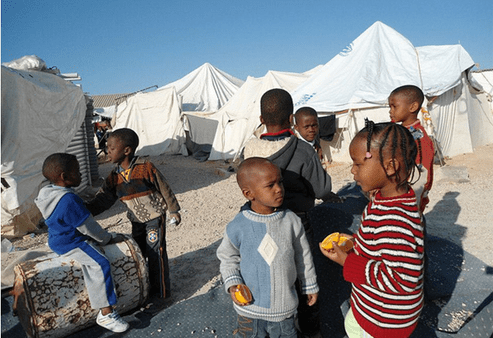
Libya Tawerghan refugees (Tawergha Foundation)
By Mustafa Fetouri | MEMO | September 5, 2018
Tawergha is a small Libyan coastal town roughly 300 kilometres east of the capital Tripoli. Its estimated that 40,000 of its inhabitants are black Libyans who have lived there for hundreds of years and never had any problem integrating into the rest of the country and were never discriminated against. They are as Libyan as any other citizen in any part of the country. Historically, their ancestors are believed to be part of the salve trade from sub-Saharan Africa.
Before 2011 the town used to be just like any other Libyan town; it benefited from free education, free health care, public services, government subsidised housing, infrastructure, businesses and above all security. The town was famous for its handcrafts of clay and handmade home furniture and used to be a hub for trade as it sits on the highway junction that connects the south, east and west of Libya. No one discriminated against the town and its inhabitants, and Libya’s successive governments, since independence in 1951, always considered Tawerghans as Libyans.
All that changed in August 2011 when the NATO supported rebels of armed militias, including terrorist groups, toppled the Gaddafi regime and in the final days of the civil war forced whoever remained in the town to flee at gun point and never allowed them to return.
Since then an estimated 40,000 inhabitants, the entire population of Tawergha, have been living as refugees in dozens of camps scattered around Libya with little hope of peaceful return any time soon. At one point roughly 2,000 people of 355 families lived in a make shift camp on the airport highway just south of the capital Tripoli. When I visited the camp the people I spoke to only wished for one thing – to be allowed to go back to their town and be left alone to live in whatever remained of their homes. It is true that most people of Tawergha cherish the late Gaddafi but the overwhelming majority took no part in the civil war of 2011 at all. One elderly person told me that he remembers how Gaddafi used to stop his convoy at Tawergha and chat with people every time he passed by as he shuttled between Tripoli and Sirte, his hometown.
In August 2011, hundreds of Tawerghan young men were jailed and an unknown number still missing with little information available to their families. International rights groups, including Amnesty International and Human Rights Watch, have published well documented reports of what happened in August 2011 and how Tawerghans were forced into internal exile inside Libya.
Libya’s successive governments since 2011 have so far failed miserably to tackle the tragedy either, because the militias, who dominated all governments, do not want to provide practical arrangements to help people return to their homes.
In the early days of the war in 2011 the regime was accused of using paid black African mercenaries to fight the NATO supported rebels but like many other wild accusations it turned out to be part of a propaganda campaign to further demonise the regime. Since Tawerghans are black skinned Libyans it was easy to portray them as mercenaries making them legitimate targets by the rebels even after they fled their town. The whole town was destroyed and its entire buildings, including schools and mosques, were deliberately and extensively damaged. Today, Tawargha is not only a ghost town but an open landfill as nearby Misrata militias deliberately make the town uninhabitable again.
Between 2012 and 2014 it was almost a taboo to talk about Tawergha openly inside Libya but the atmosphere relaxed in later years as it became apparent that the so-called revolution is no more than a disaster for Libya as whole, not just for Tawergha.
So why are Tawerghans still displaced after so many years and who could be held responsible for their misery? The primary responsibility for this crime rests with militias and politicians of the city of Misrata which is less than 30 kilometres west of Tawergha and whose militias took the initiative in forcing the civilian population out in 2011. They still refuse to allow them to go back in peaceful manner despite agreements worked out between the two sides between 2015 and June 2018.
In justifying their criminal position Misrata militias claim that people from Tawergha committed heinous crimes, including mass rape, within Misrata itself during the war. However no proof has been produced to support such a claim and not a single judiciary proceeding has ever been initiated against any person from Tawergha based on such allegations.
Misrata recently accepted a deal whereby it allows Tawerghans to return home but only if, among other conditions, the Government of National Accord (GNA) agree to compensate Misrata for the suffering it claims to have endured during the 2011 war, despite the fact that Tawerghans are not collectively responsible for whatever crimes claimed to have been committed.
According to the latest deal, signed last June between the local councils of both Misrata and Tawergha with the help of the GNA, Misrata accepted the return of civilians to Tawergha while receiving an undisclosed sum thought be worth millions of US dollars in compensation. The deal was hailed as a good step on the long road to national reconciliation in war shattered Libya. However, three months later and the number of returnees is far smaller than expected.
Marbuk Eswasi, an activist from Tawergha and director of a local charity named Patience, told me that no more than 100 people have actually returned and all of them live in a school yard as their homes are uninhabitable. He also pointed out that over 90 per cent of homes and business in town are damaged beyond repair and have to be rebuilt if they are ever to be used again.
Some observers also believe that NATO is partially responsible for this humanitarian disaster and is an accessory to such crime against humanity. They say, had it not been for the huge military help provided by NATO to the rebels they would not have been able to win the war and eventually displace thousands of civilians.
Others think that Misrata will never allow the return of the Tawerghan to live next to them simply because the accusations against Tawerghans for being mercenaries for the former Gaddafi regime is still widely believed as an important source of legitimacy for the entire so-called revolution of Libya in 2011, however false it has been proved.
Ambassador Kurt Volker: US to Drastically Expand Military Assistance to Ukraine
By Peter KORZUN | Strategic Culture Foundation | 03.09.2018
Washington is upping the ante in Ukraine. Kurt Volker, US Special Representative for Ukraine Negotiations, said in an interview with the Guardian published on September 1 that “Washington is ready to expand arms supplies to Ukraine in order to build up the country’s naval and air defense forces in the face of continuing Russian support for eastern separatists.” According to him, the Trump administration was “absolutely” prepared to go further in supplying lethal weaponry to Ukrainian forces than the anti-tank missiles it delivered in April. “They need lethal assistance,” he emphasized. Mr. Volker explained that “[t]hey need to rebuild a navy and they have very limited air capability as well. I think we’ll have to look at air defense.” The diplomat believes Ukraine needs unmanned aerial vehicles, counter-battery radar systems, and anti-sniper systems. The issue of lethal arms purchases has been discussed at the highest level.
The National Defense Authorization Act for Fiscal Year 2019 allocated $250m in military assistance to Ukraine, including lethal arms. The US has delivered Javelin anti-tank missile systems to Kiev but this time the ambassador talked about an incomparably larger deal. Former President Barack Obama had been unconvinced that granting Ukraine lethal defensive weapons would be the right decision, in view of the widespread corruption there. This policy has changed under President Trump, who — among other things — approved deliveries of anti-tank missiles to Kiev last December.
Ukraine has officially requested US air-defense systems. According to Valeriy Chaly, Ukraine’s ambassador to the United States, the Ukrainian military wants to purchase at least three air-defense systems. The cost of the deal is expected to exceed $2 billion, or about $750 million apiece. The system in question was not specified, but it’s generally believed to be the Patriot.
Volker’s statement was made at a time of rising tensions in the Sea of Azov, which is legally shared by Ukraine and Russia. It is connected to the Black Sea through the Kerch Strait. The rhetoric has heated up and ships have been placed under arrest as this territorial dispute turns the area into a flashpoint. Russia has slammed the US for backing Ukraine’s violations of international law in the area. According to a 2003 treaty, the Sea of Azov is a jointly controlled territory that both countries are allowed to use freely.
The US military already runs a maritime operations center located within Ukraine’s Ochakov naval base. The facility is an operational-level warfare command-and-control organization that is designed to deliver flexible maritime support throughout the full range of military operations. Hundreds of US and Canadian military instructors are training Ukrainian personnel at the Yavorov firing range.
NATO has granted Ukraine the status of an aspirant country — a step that is openly provocative toward Russia. Macedonia, Georgia, and Bosnia-Herzegovina are also aspirant nations. Last year, Ukraine’s parliament adopted a resolution recognizing full membership in NATO as a foreign policy goal. In 2008, NATO agreed that Ukraine along with Georgia should become full-fledged members. In March, Ukraine, Moldova, and Georgia announced the formation of an alliance to oppose Russia.
The US is to render substantial military assistance to a country with an economy in the doldrums, reforms that have foundered, a democracy that is in question, and corruption that is widespread. It will be no surprise if those weapons fall into the wrong hands and are used against the US military somewhere outside of Europe. It was the US State Department itself that issued a report this year slamming Ukraine’s human-rights record. The UN human-rights commissioner tells the same story. So do human-rights monitors all over the world.
By supplying the weapons that Special Representative Volker talked about in his interview, the US will become an accomplice to a conflict that has nothing to do with its national security or interests. The situation in the Donbas is being used by Kiev to distract public attention from the country’s worsening domestic problems. But to Washington Ukraine’s government is the apple of its eye, “a bastard but it’s our bastard” that is ready to do what it’s told.
The move is provocative and it may have consequences. For instance, Russia could supply the self-proclaimed republics in eastern Ukraine with up-to-date weapons systems in quantities sufficient to deter any military action on the part of Kiev. Once the Minsk accords are no longer functional and cannot command obedience, Moscow could recognize those republics as independent states that are eligible for military cooperation agreements, which would include stationing military bases on their soil. If their governments invited the Russian armed forces to be deployed inside their borders, it would be quite natural to agree to those requests. No international law would be breached. In a nutshell, if the US crosses that red line, Russia will act accordingly. Nobody seems to want a war raging in Ukraine, but that’s what the US weapons supplies would promote, egging the Ukrainian government on to seek a military solution. And what if it loses? Washington would be to blame for such a scenario. By the way, is it a coincidence that Mr. Volker’s interview appeared just as Alexander Zakharchenko, the leader of the Donetsk self-proclaimed republic, was assassinated? Just asking.
US: NATO Think Tank Continues Pre-Election Interference
By Rick Rozoff | Ron Paul Institute | August 29, 2018
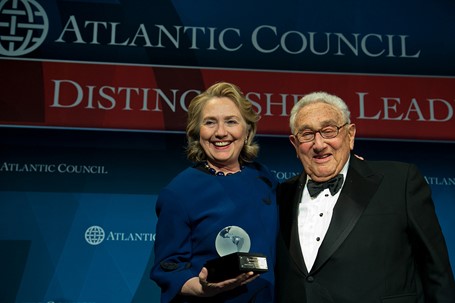
On August 24 what is in effect the social media warfare division of the Atlantic Council published an article accusing the Russian television and print news outlet RT of running a one-sided attack against the Democratic Party and several leaders thereof ahead of this November’s politically pivotal Senate and House of Representatives elections. (Thirty-five Senate seats and all 435 House seats are being contested.)
The Atlantic Council, until recently kept comparatively in the shadows for obvious reasons, is a think tank that has more than any other organization effected the transition of the North Atlantic Treaty Organization from a seeming Cold War relic with the break-up of the Warsaw Pact and the dissolution of the Soviet Union in 1991 to the world’s only and history’s first international military network with 70 members and partners on six continents currently. All thirteen new full member states are in Eastern and Central Europe; four of them border Russia.
Three months ago it began collaborating with Facebook to police and censor that and (presumably) soon after other social media companies which in recent decades have become the major sources of information and communication for the seven billion citizens of the planet. No modest undertaking.
This is by way of follow up to a Directive on Social Media issued four years ago by NATO’s Supreme Headquarters Allied Powers Europe (SHAPE), the bloc’s military command in Europe (which also oversees activities in Israel and until the activation of U.S. Africa Command ten years ago almost all of Africa).
Excerpts from that directive include:
One key challenge is the need to keep informed regarding social media ‘discussions’ on NATO and global security matters in order to maintain situational awareness. Key vulnerabilities include security concerns and the ease by which information can be transmitted globally using social media tools.
It also addresses use of social media for what it calls “operations,” which frequently is a euphemism for bombings, missile attacks and all-out war. Witness Operation Allied Force (Yugoslavia 1999), Operation Unified Protector (Libya 2011), NATO Training Mission-Iraq (starting in 2004), International Security Assistance Force/Operation Resolute Force (Afghanistan from 2001 to the present) and Operation Atlantic Resolve (aimed at Russia since 2015).
The recent article on the website of the Atlantic Council was the creation of the think tank/planning body’s Atlantic Council’s Digital Forensic Research Lab, which, employing the sort of puerile humor one has come to expect from NATOites, describes its mission under the heading of Digital Sherlocks (after the Arthur Conan Doyle detective):
The Atlantic Council’s Digital Forensic Research Lab is building the world’s leading hub of digital forensic analysts tracking events in governance, technology, security, and where each intersect as they occur.
It accuses the Russian news outlet of menacing, egregious, Cold War-era enormities like…unbalanced coverage. That animal, of course, is not known in the US corporate media.
To wit: “This unbalanced coverage was so systematic that it appeared to constitute an editorial policy of attacking the Democrats while boosting the Republicans. While editorial bias can be seen in many commercial US outlets, RT is neither commercial, nor a US outlet.”
And: “Its one-sided midterm coverage strongly suggests that the Kremlin is still attempting to influence American elections through editorial bias in its highest-profile English language media outlet to date – RT – which gets approximately 15,000,000 visits from American readers every month.”
Indeed RT is not an American outlet. In fact all of its features on YouTube have under them the small-case letter i in a circle followed by “RT Is funded in whole or in part by the Russian government,” with a Wikipedia link.
The Atlantic Council item is transparently biased itself, as RT routinely runs news critical of members of both major US political parties.
The author of the piece focuses attention on November’s elections (“attempting to influence American elections through editorial bias,” above), yet he bemoans allegedly less-than-kind portrayals of Hillary Clinton (whose first name is consistently spelled Hilary), who last heard is not at the moment running for public office.
To illustrate how the Atlantic Council and its loyal minions (members routinely move in and out of the State Department, Defense Department, National Security Council, White House, etc.) reverse the threat that exists in relation to Russia, see this from a recent article on its site on the occasion of the tenth anniversary of Georgia’s invasion of South Ossetia and the resultant war with Russia:
Exactly ten years ago, Russian forces attacked Georgia, bringing to a violent end a nearly two-decade long advance of a Europe whole and free. In the wake of NATO’s failure to agree on how to advance the membership aspirations of Georgia and Ukraine at its Bucharest Summit months earlier, Moscow acted to block those prospects with its invasion. Moscow’s actions in Georgia ten years ago previewed its far deadlier attacks on Ukraine, which continue today.
Ten years on, the NATO Summit in Brussels July 11-12 offers the prospect of reversing the shortcomings of Bucharest and restoring momentum to NATO’s Open Door policy.
That is, bring Georgia and Ukraine into NATO as full member states and court a US-Russia war with all that would entail.
The homepage of the site features a tribute to John MaCain with these words of his on the occasion of receiving its annual Freedom Award in 2011 with which he adds Belarus to the list:
I also want to pay tribute to my fellow honorees here tonight for the contribution they have made to the success of freedom – from here in Poland, to neighboring Belarus, to farther away in Egypt. These champions of liberty are the defenders, supporters, and authors of peaceful democratic revolutions – both those that have been successfully made and those, as in Belarus, that have yet to come, but surely will….
It’s more than American elections that the Atlantic Council and its social media partners intend to influence.
Social Media Giants Enter NATO Service
By Rick Rozoff | Ron Paul Institute | August 28, 2018
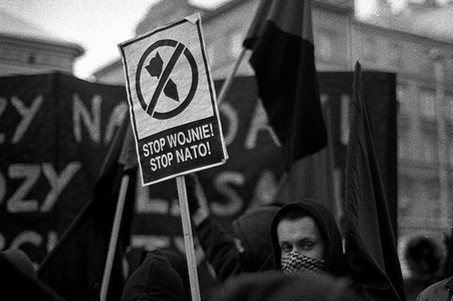
On August 22 Facebook and its CEO Mark Zuckerberg announced that they had arbitrarily removed 652 accounts, groups and pages allegedly linked to Russia and Iran for “coordinated inauthentic behavior,” by which we’re safe in assuming is meant political information inconvenient for the US power structure and its “Euro-Atlantic” elite allies in Europe and elsewhere.
The purpose pursued and the criteria employed are both explicitly political, focusing especially on federal elections. Facebook boasted of recent successes in this regard in France and Mexico.
There are historically-decisive Senate and Congressional elections this November 6th in the US.
At the beginning of this month several major conservative and libertarian Facebook, YouTube and other social media accounts were closed by the above and other parties in a heavy-handed, coordinated manner. The sites and individuals banned are ones that have urged cooperation between the US and Russia and warned against worsening political and potential military conflict between the world’s two major nuclear powers.
What connects the two unprecedented social media purges is an agreement reached in May of this year between Facebook and the Atlantic Council.
The Atlantic Council of the United States was established in 1961 by former Secretaries of State Dean Acheson and Christian Herter to bolster support for NATO. Atlantic Councils were set up in other member states for the same purpose, and at the present time they now number more than 40 in NATO and Partnership for Peace countries. The name is derivative of North Atlantic Council, the highest governing body of NATO.
Due to its efforts, NATO has grown from 16 to 29 members since the end of the Cold War and in addition has recruited at least forty military partners throughout the world. With Colombia joining its Partners Across the Globe program earlier this year, NATO now has members and partners on all inhabited continents.
The partnership between Facebook and the Atlantic Council was described by the Atlantic Council’s president and CEO Fred Kempe as follows:
This partnership will help our security, policy and product teams get real-time insights and updates on emerging threats and disinformation campaigns from around the world. It will also increase the number of ‘eyes and ears’ we have working to spot potential abuse on our service – enabling us to more effectively identify gaps in our systems, preempt obstacles, and ensure that Facebook plays a positive role during elections all around the world.
The collaboration, like NATO and Facebook themselves, are not only avowedly political but unabashedly global in scale.
In the interim Facebook has announced it’s hired “additional third-party reviewers” for the purpose advancing the aforesaid political censorship and furtherance of NATO’s international agenda.
Failing such methods, there are also those proposed by then-president presumptive Hillary Clinton two years ago: “As president, I will make it clear that the United States will treat cyberattacks just like any other attack. We will be ready with serious political, economic and military responses.”
Reactivated US 2nd fleet returns to North Atlantic ‘ready to fight’… guess who?
RT | August 25, 2018
Just seven years after shutting down operations, the US 2nd Fleet has been officially reactivated, with its admiral seeking to turn it into a menacing force “ready to fight” any “bad actor” it may sail into in the North Atlantic.
Fearing that “some bad actors” on the world stage “threaten the very birthright freedoms that we hold sacred” and are looking to “undermine and rewrite” the US-established world order, Vice Adm. Andrew Lewis, promised to “build a fleet that is ready to fight” along a stretch that extends from the East Coast of the US all the way to the Barents Sea, just off the coast of Norway and Russia, near the Arctic Circle.
“We are going to aggressively and quickly rebuild this command into an operational warfighting organization,” Lewis announced, as he took charge of the Second Fleet at the establishment ceremony at Naval Station Norfolk, Virginia.
The fleet, which previously had 126 ships and submarines in service, will once again “help to maintain America’s maritime superiority,” chief of Naval Operations Adm. John Richardson noted on Friday. “A new Second Fleet increases our strategic flexibility to respond – from the Eastern Seaboard to the Barents Sea.”
Today, the @USNavy established #US2ndFleet with Vice Adm. Andrew “Woody” Lewis assuming command aboard @CVN77_GHWB. #ReadyToFight
ℹ️ https://t.co/stV8660tGEpic.twitter.com/SjmXM2Dv8B
— U.S. 2nd Fleet (@US2ndFleet) August 25, 2018
After the fleet was disestablished in 2011 to save costs during the Obama administration’s proposed “reset” with Russia, most of its personnel, warships and responsibilities were transferred into Fleet Forces Command.
While it has yet to be announced which hardware will be transferred back under its command, at one point the Second Fleet had more than 90,000 personnel assembled between carrier strike groups (CSG) and amphibious ready groups (ARG). The fleet’s Aegis-capable ships also projected the American maritime ballistic missile defense capabilities overseas.
Over the past few years, especially after the outbreak of ‘Russiagate’ with the arrival of the Trump administration, the US and its allies have been increasingly accusing Russia of aggressive posturing and of threatening neighbors, slowly and gradually increasing their own military capabilities along its borders under this pretext.
Moscow insists that it has been forced to reform its military and develop new weapons systems, following US disregard for Kremlin concerns when Washington unilaterally withdrew from the ABM treaty in 2002. Russia continues to treat the global anti-missile system, including sites in Alaska, Romania, and Poland, as well as the Aegis-capable ships, as a potential national security threat that undermines mutual deterrence and power parity – and may lower the threshold of nuclear weapons use by giving Washington a false sense of invincibility.
Meanwhile, the reactivated 2nd Fleet will now once again sail close to the Arctic where Russia, compared to the US, has much more territorial waters and thus strategically invested interests, including utilization of the region’s rich natural resources. The country is also conducting infrastructure projects along the Northern Sea Route and has built a number of military outposts to seal the northern frontier that was left virtually defenseless after the fall of the Soviet Union.
READ MORE:
US ABM shield in Europe may lead to sudden nuclear attack on Russia, Moscow says
‘Our build-up is defensive, Russia’s aggressive,’ says NATO after Putin’s remark – but is that fair?
RT | August 22, 2018
NATO claims its military buildup in Eastern Europe is justified as it deters Russia’s superior might. Yet, any Russian activity is overshadowed by the US-led bloc’s huge border drills, supposedly held to ‘counter’ Moscow’s moves.
“NATO’s actions are defensive, proportionate and fully in line with our international commitments,” the alliance’s spokeswoman Oana Lungescu told Reuters, commenting on NATO military activities. She further added that the troops deployed by the Alliance to Eastern Europe “cannot compare to the divisions deployed by Russia” on its western borders.
The rant was provoked by the words of Russian President Vladimir Putin, who rebuked NATO for building up its military infrastructure right on Russia’s doorstep. “We do not deploy our military contingents away from our borders and close to the NATO states, it is the NATO infrastructure that advances to our own borders,” Putin told journalists in Sochi.
It was the way this statement was put that apparently made NATO officials so angry that they even de facto claimed that their forces are no match to those of Russia. The comparison is not exactly true, as facts show that NATO’s buildup and military activities near Russian territory actually overshadow the Russian activity.
Less than a week ago, German media reported that Berlin sent as many as 8,000 soldiers and some 100 tanks to Norway in preparation for yet another NATO drill, this time dubbed Trident Juncture 2018 and scheduled for October-November. According to the Alliance, the exercise, which will focus on repelling an aggression of some unfriendly state as part of a collective defense scenario under Article 5 of the NATO treaty, will involve as many as 40,000 participants from more than 30 countries – more than any Russian military exercise conducted in recent years.
The “scariest” Russian war games, dubbed Zapad-2017, which even sparked media-fueled fears that it was a cover for an “invasion” of neighboring countries, involved only 12,700 troops, 70 military aircraft, 10 ships and some 680 ground vehicles. Almost immediately after those drills Poland hosted what it called “national” Dragon 17 exercises, involving contingents from the US, the UK, Germany, Lithuania, Latvia, Slovakia, Italy, Bulgaria, Romania, Georgia and Ukraine. Notably, the number of troops involved in Dragon 17 exceeded those of the Zapad-2017 contingent, with some 17,000 personnel and 3,500 hardware pieces involved.
The US-led bloc continues to intensify its military exercises in Eastern Europe. In less than three months, NATO conducted two major drills in the vicinity of Russian borders. In June, more than 18,000 soldiers from 19 countries took part in the two-week ‘Saber Strike’ exercise, held in Poland and the Baltic States. The drills were said to practice the deployment of military convoys to defend NATO’s eastern flank.
On August 20, Latvia hosted the biggest war games ever staged on its territory since the Baltic State gained independence. Some 10,000 troops from more than a dozen NATO countries are participating in the drills that will end on September 2. However, the military bloc continues to repeat its mantra that all those drills right on Russia’s doorstep are in no way aimed at “provoking” Russia.
As if that was not enough, NATO also beefed up its military contingent in Eastern Europe. In her statement to Reuters, Lungescu only mentioned “4,000 troops to the eastern part of the Alliance to deter any possible aggression” as if those troops were the only ones NATO recently sent to the region. She forgot to note that the US will soon double the number of its Marines stationed in Norway. Also left out were the missile defense installations in Poland and Romania that are equipped with Lockheed Martin Aegis Ashore systems, which are technically capable of carrying both interceptor missiles and Tomahawk missiles.
In October 2017, the US also sent a new mechanized brigade to Poland, effectively increasing the overall strength of its military group in the Eastern European state to the level of a mechanized division. The Russian Defense Ministry spokesman, Major General Igor Konashenkov, said at that time that the equipment of another US brigade, which had previously been stationed there “remained in place.”
He added that such a situation gives the US an opportunity to easily redeploy its trained military personnel from its German Rammstein base to Poland within just two hours. According to the Russian Defense Ministry, NATO has tripled its military presence on Russia’s western borders over the past five years, forcing Moscow to respond.
Meanwhile, Russia has not deployed any significant military forces to its western borders in recent years, except for the stationing of Iskander-M tactical missile systems in its western exclave of Kaliningrad in early 2018. However, it is Russia that NATO and the West so desperately seek to portray as a source of instability in the region. Moscow has repeatedly warned that increased NATO presence on its doorstep effectively contributes nothing to regional security and, to the contrary, undermines stability in Europe.
What’s Left of Russiagate — Are We Down to the 1,000 Paid Trolls?
Mark F. McCarty | Way of the Bern | July 19, 2017
Those who pay attention to what is going on — as opposed to passively consuming the obsessions of MSM — know that the Clinton-related material published by Wikileaks emerged from leaks, not hacks. Assange has stated in no uncertain terms that the Russian government was not responsible for providing the material Wikileaks published, and his friend Craig Murray — a whistleblower hero who exposed the torture practiced by the government of Uzbekistan while he was British ambassador there — indicates that he has direct knowledge that the DNC and Podesta Wikileaks releases derived from leaks, not hacks. In fact, he met with one of the people involved in September of last year in Washington D.C.
https://consortiumnews.com/2016/12/18/a-spy-coup-in-america/
And Wikileaks has just tweeted an audio recording of Seymour Hersh in which he indicates that, according to an FBI source he considers “unbelievably accurate and careful, he’s a very high-level guy”, there is an FBI report indicating that the FBI examined Seth’s computer and determined that Seth was the Wikileaks DNC source. Whether or not Hersh’s source is correct — Hersh has not published this info, and refuses to be interviewed on it — it is not conceivable, at least to those of us who appreciate Wikileaks’ integrity, that Wikileaks would have tweeted this if Seth weren’t their source.
https://twitter.com/wikileaks/status/892510925244203008
Now, just in time for the anniversary of Seth Rich’s death, forensic analyses — by the pseudonymous ‘Forensicator” — have clarified that the “Guccifer 2.0” releases of DNC material in September 2016 resulted from local downloads, via thumbdrive or LAN, of DNC computer files, rather than hacks from a distant location such as Russia or Romania — contrary to the assertions of our intelligence community; the rate of data transfer, as of mid-2016, was far too great for a remote hack to be responsible.* Indeed, the rate was precisely what one would expect if the download had occurred via USB2.0 memory stick, and cyberexpert/journalist Adam Carter has argued that the downloaded files displayed “FAT filesystem anomalies” likewise pointing to a memory stick download. Moreover, time stamps reveal that this data transfer occurred on the East Coast.
Of no less importance is the fact that the metadata of some of the released Guccifer 2.0 files (those released on June 15th) had been intentionally altered to leave clues that Russian hackers may have accessed the material, in a clear effort to falsely implicate Russians in the hacking of those files. The clear implication is that someone affiliated with the Clinton campaign or DNC created the persona of Guccifer 2.0 to trick our gullible intelligence agencies into concluding that Russian hacks had been responsible not only for the Guccifer 2.0 releases, but for the WIkileaks releases as well — thereby devaluing them in the eyes of the American public. “Guccifer 2.0”, of course, topped off the scam by claiming he was the Wikileaks source.
https://consortiumnews.com/2017/07/24/intel-vets-challenge-russia-hack-evidence/
https://theforensicator.wordpress.com/guccifer-2-ngp-van-metadata-analysis/
https://www.thenation.com/article/a-new-report-raises-big-questions-about-last-years-dnc-hack/
As Veteran Intelligence Professionals for Sanity have emphasized, the timeline of Guccifer 2.0’s first appearance is curious. On June 12, Wikileaks announced that it would soon be releasing Clinton-related emails. On June 14, the DNC announces that it has been hacked. On June 15, the DNC cybercontractor Crowdstrike announced that it had found malware on the DNC computer which they suspect originated from Russia, and, in seeming coordination, Guccifer 2.0 proclaimed that he was the hacker who supplied Wikileaks with its Clinton material — posting documents that had had “Russian fingerprints” implanted in their metadata. (And why would a hacker genuinely working for the Russian government go out of his way to advertise himself?) Then the main trove of DNC material subsequently released by Guccifer 2.0 on his website was downloaded locally from DNC computers on July 5th — five days before Seth Rich was murdered by hitmen. These facts are consistent with the thesis that the DNC, or someone affiliated with the DNC, hoaxed our intelligence services to blame the Wikileaks releases on Russia. Could they then have gotten rid of someone who could have spoiled this narrative?
Possible collusion between Crowdstrike and Guccifer 2.0 is suggested by the fact that, in their June 14th announcement, the DNC indicated — presumably based on claims by Crowdstrike — that the hacker had targeted Trump Opposition Research. This was indeed one of the documents that Guccifer 2.0 released the following day. Adam Carter refers to the Crowdstrike claim about Trump Opposition Research being targeted as “specious”, as they “never demonstrated or explained” how they could have known this. Carter concludes that this likely indicates collusion between Crowdstrike and Guccifer 2.0, and suggests that perhaps the persona of Guccifer 2.0 was created by someone at Crowdstrike. (And it hardly seems likely that Crowdstrike would have concocted such a scam without the knowledge and encouragement of top officials at the DNC. Though this brings up an interesting alternative possibility — could Debbie Wasserman-Schultz and her felonious IT specialist Imran Awan have conceived and executed Guccifer 2.0? It’s not clear whether Awan has the requisite measure of sophistication.) Another peculiarity is this: if Guccifer 2.0 was employed by the Russian government to damage Hillary and help Trump, why would one of the first documents he released be Trump Opposition Research?!
Furthermore, Carter’s analysis of the times of G2.0’s tweets and blog publications points to someone in the U.S. rather than Russia — unless he was bizarrely nocturnal.
http://g-2.space/g2tweettimes/
Carter also discusses linguistic research which demonstrates that, in his communications, Guccifer 2.0 makes a very amateurish effort to impersonate a native Russian attempting to speak English, being very inconsistent in his linguistic errors. His overall impression of Guccifer 2.0 is encapsulated in this description: “A donkey in a bear costume”. In his latest update, Carter notes: “The only language expert willing to be cited without being anonymous was professor M.J. Connolly from Boston College and he stated that Guccifer 2.0 lacked any traits he would expect to see from a Russian communicating in English!”
Here is another reason to suspect that Crowdstrike was behind Guccifer 2.0. The “Russian fingerprints” added to the June 15th releases of Guccifer 2.0 consisted of the name “Felix Edmundovich”, written in the Cyrillic alphabet. This is clearly a reference to the founder of the Soviet secret police (OGPU), Felix Edmundovich Dzerzhinsky.
(https://en.wikipedia.org/wiki/Felix_Dzerzhinsky)
How many American computer geeks would know the name of the founder of OGPU? One American who likely would is Shawn Henry, co-founder and President of Crowdstrike, who previously worked under Robert Mueller (!) as the FBI’s assistant director for counterintelligence.
In an interview with a journalist from Motherboard/Vice News, Guccifer 2.0 described the technique he used to hack the DNC servers. Carter points out that the cybersecurity firm ThreatConnect has analyzed this claim, and found it to be technically impossible. It is unclear whether Guccifer 2.0 has any hacking skills whatever.
Here’s a great new video about the Guccifer 2.0 affair by “Panda Bear” that I strongly recommend:
https://www.youtube.com/watch?v=5ZNAbPNKCKk&t=0s
For clarity, it’s important to note that, contrary to the assertions of some enthusiastic commentators, the forensic findings of Forensicator and Adam Carter pertain only to the releases of Guccifer 2.0, cannot prove that the DNC server was not hacked, and have no clear relevance to the DNC emails released by Wikileaks or the activities of Seth Rich. These issues must be addressed with other lines of evidence. What these forensic analyses do strongly point to is that people affiliated with the DNC consciously hoaxed our intelligence community to try to paint Hillary as a victim of Russian perfidy, with Wikileaks as their devious accomplice. And they also reveal that, in pointing to Guccifer 2.0 as the source for the DNC Wikileaks releases, our “intelligence community” has once again demonstrated its gross and criminal incompetence.
There were also files taken from the Democratic Congressional Campaign Committee that were published prior to the election on Guccifer 2.0’s own website. (Is the DCCC collaborating with the DNC in this scam?) This episode has received little attention, and in any case, if the goal of the Russian government was to impede Clinton’s election, why would they care about the DCCC? Who believes Russia would want to elect more Republicans? In any case, if Guccifer 2.0 was indeed the source of these leaks, they weren’t hacked by Russians, so let’s move on.
Finally, there is DC Leaks, which, beginning in July of last year has released purloined info on a diverse range of targets, including the former commander of NATO, Senators McCain and Graham, the Soros Foundation, and personal info of 200 Democratic lawmakers. This has received little media commentary, possibly because it is hard to see how this effort was an attempt to influence the election. Nonetheless, the cybersecurity firm ThreatConnect claims that DC Leaks is a front for the hacker group Fancy Bear, which they claim is linked to Russian intelligence. They also think that Guccifer 2.0 is involved. Sounds a lot like the analyses that linked the Guccifer 2.0 and Wikileaks releases to Russian intelligence — and we’ve seen how credible those analyses were.
https://en.wikipedia.org/wiki/DCLeaks
Then there was the NSA document leaked by Reality Winner, in which it is “assessed” that Russians at the behest of the Kremlin targeted a number of local government operations in spearphishing operations just prior to the election. Scott Ritter has carefully analyzed the NSA document and demonstrated that the NSA agents responsible had nothing but speculation to link these spearphishing attacks to the Russian government.
Recent claims that Russia tried to hack into 21 state electoral databases prior to the election have been skewered by Gareth Porter, who shows that, in the only one of these attacks that was successful, the perpetrators merely extracted personal information saleable to criminal networks, without making any effort to alter electoral data. Evidently the work of cybercriminals, not Russian government operatives.
http://original.antiwar.com/porter/2017/07/03/foisting-blame-cyber-hacking-russia/
The Department of Homeland Security is now posting retractions of these claims:
And cyberexpert Jeffrey Carr has determined that the criminals involved were English speakers.
Alleged claims from our intelligence agencies that Russia was responsible for election interference in Germany and France have been debunked by the intelligence agencies in those countries:
https://caucus99percent.com/content/are-russian-hackers-under-your-bed
Last month, CNN reported that “Russian hackers had breached Qatar’s state news agency and planted a fake news report that contributed to a crisis among the US’ closest Gulf allies, according to US officials briefed on the investigation…. US officials say the Russian goal appears to be to cause rifts among the US and its allies.”
http://www.cnn.com/2017/06/06/politics/russian-hackers-planted-fake-news-qatar-crisis/index.html
But now, as reported by WaPo, US officials have concluded that the UAE had arranged this hacking to demonize Qatar:
http://www.reuters.com/article/us-usa-qatar-report-idUSKBN1A200H
(The story on CNN, of course, is that UAE denies this: http://edition.cnn.com/2017/07/17/middleeast/uae-qatar-report/index.html. Cue the laughter: http://www.zerohedge.com/news/2017-07-16/cnn-caught-faking-news-again-us-intel-accuses-uae-not-russia-orchestrating-qatari-ha).
But What About all that “Evidence”?
But what about all the “evidence” our intelligence agencies have for Russia’s nefarious election interference?
Official claims in this regard began with the release of this joint statement by DHS and ODNI on Oct. 17 of last year:
“The U.S. Intelligence Community (USIC) is confident that the Russian Government directed the recent compromises of e-mails from US persons and institutions, including from US political organizations. The recent disclosures of alleged hacked e-mails on sites like DCLeaks.com and WikiLeaks and by the Guccifer 2.0 online persona are consistent with the methods and motivations of Russian-directed efforts. These thefts and disclosures are intended to interfere with the US election process. Such activity is not new to Moscow — the Russians have used similar tactics and techniques across Europe and Eurasia, for example, to influence public opinion there. We believe, based on the scope and sensitivity of these efforts, that only Russia’s senior-most officials could have authorized these activities.”
Note how James Clapper, with the backing of Jeh Johnson of DHS, imperiously represented his views as those of “The U.S. Intelligence Community”. Hillary Clinton subsequently seized on this to make the hyperbolic self-serving claim that “17 intelligence agencies” had reached this conclusion — a claim that was echoed by our servile MSM until it recently was retracted by the New York Times.
The supposedly definitive statement of our intelligence agencies on alleged Russian election interference was an Intelligence Community Assessment (ICA), a de-classified summary of which was released on Jan. 6th. As subsequently admitted by Clapper in congressional testimony, this assessment was not a formal National Intelligence Estimate, which would have required the participation of all intelligence agencies and would have included any dissenting opinions, but rather represented the opinions of a couple dozen intelligence operatives hand-picked (likely by Clapper, Director of National Intelligence, and John Brennan of the CIA) from the CIA, NSA, and FBI.
It is useful to understand these things about Clapper: He played a key role in convincing the nation that Saddam had ample stores of WMDs before our Iraq invasion. When these WMDs failed to appear, he stated that Saddam had had them shipped to Syria just prior to the invasion (subsequently debunked). He lied under oath before Congress and the nation regarding surveillance of American citizens by the NSA. And in a recent interview with Chuck Todd, he revealed himself to be a near-psychotic Russiaphobe, claiming that Russians were virtually “genetically programmed” to foment chaos for us.
So what do you think is going to be the outcome when a psychotic Russophobe is allowed to hand-pick the members of an intelligence panel intended to evaluate alleged Russian meddling? As acclaimed investigative journalist Robert Parry noted:
“Yet, as any intelligence expert will tell you, if you “hand-pick” the analysts, you are really hand-picking the conclusion. For instance, if the analysts were known to be hard-liners on Russia or supporters of Hillary Clinton, they could be expected to deliver the one-sided report that they did.”
https://consortiumnews.com/2017/05/23/new-cracks-in-russia-gate-assessment/
As to the unclassified report itself, the most cogent observation is that it provides no hard evidence whatever to back up its conclusion that Russian operatives had interfered in our election on the orders of Vladimir Putin. Rather hilariously, over half of its length is devoted to splenetic venting about the Russia-sponsored TV network RT, which nefariously had featured Third Party political debates and criticisms of fracking — and of course the seditious ravings of that evident Kremlin puppet Larry King. If RT constitutes vile and unacceptable election interference, what have we been doing with Voice of America for decades?
Most tellingly, the declassified ICA barely mentions Wikileaks, and provides no clue as to how it was concluded that Wikileaks received its Clinton-related emails from Russian sources. The key point of the Russiagate narrative is not just that Russians were hacking the DNC and John Podesta, but that, at the behest of the Russian government, they were transferring their booty to Wikileaks for release to the public. In his congressional testimony, Clapper seemed to admit that the link between Russia and Wikileaks was speculative:
https://www.youtube.com/watch?v=e2AbrMEmD9k
It is hard to escape the conclusion that our intelligence agencies have no hard evidence whatever that Wikileaks received its Clinton-related emails from sources commissioned by the Russian government. And of course Assange, who presumably knows how he got the material he himself published — and has far greater credibility than Clapper could ever have — vehemently denies this.
In the run-up to the Iraq invasion, our intelligence agencies at least deigned to convey to us some “evidence” that Saddam did indeed still have WMDs. In the present instance, they are effectively just saying “Trust us”. In the context of the fact that our intelligence agencies used wholly bogus evidence to propel us into an Iraq involvement that led to the death, maiming, or exile of literally millions of people in Iraq — not to mention thousands of American deaths and casualties, and catastrophic expense — anyone in our government or our media who is willing to just “trust” a hand-picked cabal of intelligence agents on an issue that may foment a new Cold War with the second-leading nuclear power, is engaging in gross criminal negligence.
The credibility of the report’s conclusions can be judged by this key passage:
“We assess with high confidence that Russian military intelligence … used the Guccifer 2.0 persona and DCLeaks.com to release US victim data obtained in cyber operations publicly and in exclusives to media outlets and relayed material to WikiLeaks.”
https://www.dni.gov/files/documents/ICA_2017_01.pdf
As we have seen, “Guccifer 2.0” is someone on the East Coast, with local access to the DNC computers, who is doing a rather half-assed job of appearing to be Russian — “A donkey in a bear costume”. So much for their “high confidence”.
In formulating its ICA, the panel relied on the conclusions of a private cyber company, Crowdstrike, with respect to alleged hacking of the DNC server, because the DNC had repeatedly refused to turn their server over to the FBI — and the FBI had failed to subpoena it. Crowdstrike was recruited for this purpose by the Clinton campaign, and had previous associations with Hillary Clinton. Its founders are affiliated with the Atlantic Council, a think tank known for its virulently anti-Russia stances. Its previous effort to incriminate Russia in a hacking attack has been shown to be wholly erroneous.
As to the “logic” which Crowdstrike employed to impute hacking of the DNC to Russian intelligence, it appears to have been puerile. Here are the comments of Scott Ritter:
“CrowdStrike claimed that the presence of the X-Agent malware was a clear ‘signature’ of a hacking group — APT 28, or Fancy Bear — previously identified by German intelligence as being affiliated with the GRU, Russian military intelligence…. The CrowdStrike data is unconvincing. First and foremost, the German intelligence report it cites does not make an ironclad claim that APT 28 is, in fact, the GRU. In fact, the Germans only ‘assumed’ that GRU conducts cyberattacks. They made no claims that they knew for certain that any Russians, let alone the GRU, were responsible for the 2015 cyberattack on the German Parliament, which CrowdStrike cites as proof of GRU involvement. Second, the malware in question is available on the open market, making it virtually impossible to make any attribution at all simply by looking at similarities in ‘tools and techniques.’ Virtually anyone could have acquired these tools and used them in a manner similar to how they were employed against both the German Parliament and the DNC…. The presence of open-source tools is, in itself, a clear indicator that Russian intelligence was not involved.”
Cyberexpert Jeremy Carr fully agrees:
“It is both foolish and baseless to claim, as Crowdstrike does, that X-Agent is used solely by the Russian government when the source code is there for anyone to find and use at will.
Once malware is deployed, it is no longer under the control of the hacker who deployed it or the developer who created it. It can be reverse-engineered, copied, modified, shared and redeployed again and again by anyone. In other words — malware deployed is malware enjoyed!
If the White House had unclassified evidence that tied officials in the Russian government to the DNC attack, they would have presented it by now. The fact that they didn’t means either that the evidence doesn’t exist or that it is classified.
If it’s classified, an independent commission should review it because this entire assignment of blame against the Russian government is looking more and more like a domestic political operation run by the White House that relied heavily on questionable intelligence generated by a for-profit cybersecurity firm with a vested interest in selling “attribution-as-a-service”
https://medium.com/@jeffreycarr/fbi-dhs-joint-analysis-report-a-fatally-flawed-effort-b6a98fafe2fa.
More recently, he has stated:
“There is not now and never has been a single piece of technical evidence produced that connects the malware used in the DNC attack to the GRU, FSB or any agency of the Russian government.”
https://consortiumnews.com/2017/08/18/russia-gates-evidentiary-void/
Indeed, he is so irate regarding the impact on international affairs of the flawed logic employed by Crowdstrike that he demands an investigation of them:
“I think there should be commission that reviews the technical evidence which is being sold to the US government by and for profit by the cyber security companies like Crowdstrike. I think this deserves a deeper investigation, because based upon invalid assumptions and lack of proof they have created an international strain in international relations between the US and Russia,” said Carr.
https://www.rt.com/op-edge/372888-investigate-russian-hacking-contractor/
If you had a friend who was trying to solve a murder, and he told you: “We know that the victim was killed with a gun, and the Mafia uses guns, so we know that the Mafia killed him,” you would rightly conclude that your friend was a bit half-witted. Yet Crowdstrike, using quite analogous “logic”, while throwing around technical terms that are obscure to people who aren’t cyberexperts, receives awed respect from MSM journalists.
A further indication of the intellectual acumen of Crowdstrike is their response to a reporter from the Washington Times when they were asked to comment on the blockbuster VIPS report on Guccifer 2.0.:
“‘We find the argument unsubstantiated and inaccurate, based on a fundamental flaw,’ a company spokesman said.
The CrowdStrike spokesman said that by July 5 all malware had been removed from the DNC network and thus the hackers copied files that were already in their own systems.”
http://www.washingtontimes.com/news/2017/jul/27/with-robert-mueller-fbi-gets-second-chance-to-insp/
Uh, precisely how would the existence or nonexistence of hacking malware on a computer influence one’s ability to download data on a thumbdrive?!!
Here’s another oddity about Crowdstrike: As of May 5th, they had installed their supposedly state-of-the-art anti-hacking program Falcon on this server — and yet the latest of the DNC emails which Wikileaks released was created on May 25th.
Steve McIntire writes:
“There were no fewer than 14409 emails in the Wikileaks archive dating after Crowdstrike’s installation of its security software. In fact, more emails were hacked after Crowdstrike’s discovery on May 6 than before. Whatever actions were taken by Crowdstrike on May 6, they did nothing to stem the exfiltration of emails from the DNC.”
https://climateaudit.org/2017/09/02/email-dates-in-the-wikileaks-dnc-archive/
Of course, there is nothing at all odd about this if the Wikileaks emails stemmed from a leak.
However, Crowdstrike has subsequently characterized its installation of Falcon as a measure to monitor ongoing hacking. Alperovitch of Crowdstrike has referred to Falcon as “monitoring software”:
Allegedly, Crowdstrike took definitive measures to cleanse the DNC servers and institute new passwords on the weekend of June 10–12. Are we expected to believe that they just monitored ongoing hacking for a month while doing nothing to stop it? Here’s an analogy: You are informed that a gang rape is in progress. Instead of immediately sending the police, you send photographers (apparently without film).
However, Crowdstrike’s own promotional literature refers to Falcon as software for preventing hacking:
https://web.archive.org/web/20160428142131/https://www.crowdstrike.com/products/
So is Crowdstrike throwing its own top-of-the-line product under the bus to maintain the credibility of the claim that hackers provided Wikileaks with the DNC emails?
Cyberexpert Adam Carter suspects that Crowdstrike might have been involved in creating the Guccifer 2.0 fraud. The purposely tainted Guccifer 2.0 releases, in conjunction with Crowdstrike’s conclusion that Russian agents had hacked the DNC, could have readily led unsuspecting intelligence agents to indict the Russians.
Oh, and guess who the DCCC hired to investigate its breach?
Another key difficulty with the ICA has been raised by William Binney, a co-founder of the NSA’s SIGINT Automation Research Center. He indicates that if the DNC had been hacked, the NSA would know precisely when this had happened, and where the data had gone:
“Because NSA can trace exactly where and how any “hacked” emails from the Democratic National Committee or other servers were routed through the network, it is puzzling why NSA cannot produce hard evidence implicating the Russian government and WikiLeaks. Unless we are dealing with a leak from an insider, not a hack, as other reporting suggests. From a technical perspective alone, we are convinced that this is what happened.”
https://consortiumnews.com/2017/01/06/the-dubious-case-on-russian-hacking/
Intriguingly, it was the NSA which indicated that they were only “moderately confident” about the ICA’s conclusion.
And finally, there’s the intriguing detail that the declassified ICA contains a preamble indicating that the “assessments” it provides are not necessarily equivalent to “facts”. In other words, they are “best guesses”. Ray McGovern has pointed out that, in spyspeak, “assess” effectively means “guess”. So those trumpeting the “proven” election interference by Russia are relying on the guesses of a couple of dozen people hand-selected by the virulent Russophobe James Clapper.
Getting back to the issue of whether Seth Rich was the source of the DNC Wikileaks releases: In one corner we have Julian Assange and Craig Murray, who have sacrificed their freedom and their career (respectively) for their insistence on spreading (inconvenient) truth. Nothing ever released by Wikileaks has been found to be fraudulent. Assange states without qualification that the Russian government was not responsible for his DNC releases, Murray states bluntly that both the DNC and Podesta emails Wikileaks releases resulted from internal leaks, not hacks (having met personally with one of the sources), and Assange, both by direct statements and by re-tweeting key reports, is implying as strongly as he can without saying so directly that Seth is a Wikileaks source. Assange and Murray have direct knowledge of their DNC source if anyone does. Celebrated journalist Sy Hersh indicates that an anonymous FBI source he values highly indicates he has seen an FBI analysis of Seth’s computer which concludes that Seth provided the DNC material to Wikileaks via a drop box. And — for what it’s worth (which might not be much, but we’ll see) — Kim Dotcom also claims to have evidence that Seth was a Wikileaks source. (He states that he cannot come forward with this evidence without getting an immunity deal, because otherwise he could be subject to legal sanctions for participating in the leaking.)
In the other corner, we have committed Russophobes James Clapper, John Brennan, and a group of hand-picked acolytes who assess (guess) that Russian hackers — including Guccifer 2.0 — were the Wikileaks source. They obviously have no direct knowledge in this regard, and they have made this assessment despite the fact that no federal agency has been allowed to analyze the DNC server; the private company which made the assessment which they rely on likewise has a strong political bias. They also provide no clue whatever as to how they have concluded that the alleged hacks were transferred to Wikileaks. Their declassified ICA has been ridiculed by independent cyberexperts for failing to provide any hard evidence whatever. Their conclusion that Guccifer 2.0 is a Russian hacker is an evident farce. Clapper is notorious for his misjudgments prior to and following the Iraq invasion, and also perjured himself under oath to Congress. Both Clapper and Brennan have strong motivation to slam Russia.
And yet virtually all of our MSM and political class accept as a matter of course the conclusions of the ICA, and ridicule as a “conspiracy theorist” anyone who even broaches the possibility that Seth could be the Wikileaks source. Of course, these are the same people whose sycophantic credulity enabled the grossly criminal and catastrophic Iraq invasion — so why be surprised?
Topping it all off, of course, is that the key crime that the Russians are alleged to have committed — a crime that has been likened to an “act of war” by some over-the-top commentators — was to provide the American public with true facts regarding the ways in which the DNC, in violation of its charter, leaned over backwards to favor Hillary Clinton over her rivals in the 2016 primary — and also finally gave us access to Hillary’s Wall Street speeches in which she helpfully clarified that she had two sets of views — those for the public, and those for her donors, who clearly were the ones that really mattered. (Of course, it’s not as though percipient observers didn’t know these things already.) Isn’t it the role of our MSM to be providing such “interference”?
Craig Murray has summed much of this up in a recent excellent essay:
https://www.craigmurray.org.uk/archives/2017/07/stink-without-secret/
And the fabulous Caitlin Johnstone has assembled a voluminous summary of pertinent facts on Russiagate here:
https://medium.com/@caityjohnstone/the-index-of-russiagate-debunkery-f5b6f4101dd0
But the Russian Trolls!
But wait — there’s still the 1,000 Russian trolls, paid by the Kremlin to spread “fake news”TM to the gullible American public. As far as I know, the only source for this is a statement by Sen. Mark Warner of the Intelligence Committee, referring to unspecified “reports”:
Hillary embellished this narrative at a recent sit-down comedy performance at the 2017 Code Conference — for which she received rave reviews:
http://www.dailymail.co.uk/news/article-4560344/Hillary-Trump-colluded-Russia-create-fake-news.html
http://observer.com/2017/06/hillary-clinton-insults-voters-fake-news-russia-election-involvement/
After repeating her by-then-debunked lie about the “17 intelligence agencies”, she focused on the Russian trolls and bots who had helped to tank her campaign:
“So the Russians… could not have known best how to weaponize that information unless they had been guided. Guided by Americans and guided by people who had polling and data information.”
Her implication was of course that the people providing this guidance were the Trump campaign. And apparently this guidance was so astute that, according to Warner, the trolls targeted the rust-belt states that Hillary gave short shrift to. According to tweeter Maple Cocaine — “Pretty big indictment of the Hillary campaign when the fucking Kremlin knew to campaign in Wisconsin but she didn’t.”
Of course, it’s hard to see how, with tens of millions of Americans active on social media, a thousand or so Russian trolls could have had a significant impact — how many of those pestilential buggers did David Brock employ on Hill’s behalf? — but who needs logic.
A rather hilarious variation on this theme is the claim that Russian troll armies were actually writing the “fake news” stories that denigrated Hillary during the campaign:
“The House and Senate Intelligence Committees are looking into the rash of anti-Clinton fake news that originated in Russia and was spread online by Trump supporters in advance of last year’s election.”
http://secondnexus.com/politics-and-economics/investigators-fake-news-now-center-trump-russia-probe/
Apparently, Russian fabulists are supposed to have dreamed up Pizzagate, the neurological problems which Hillary is hiding, the lengthy lists of Clinton opponents who have died mysteriously, Clinton’s raving fits and abuse of Secret Service agents, and just about every story denigratory to Clinton that the MSM won’t touch. Should we give our fellow Americans so little credit for perceptiveness and creative imagination? This has now truly degenerated to the level of farce.
And note the title of this story: Investigators: “Fake News Now at Center of Trump Russia Probe”. Which suggests that at that point we really ARE down to the 1,000 Russian trolls.
I can see the scenario now: “Vladimir Vladimirovich, what are your suggestions for this week’s troll assault?” “Our young friend Donald Donaldovich informs me that Wisconsin, especially the Milwaukee area, could be a fertile ground for the Pizzagate fantasy that Kuryakin dreamed up last month. Give that a try.”
Robert Parry notes: “As for the relatively small number of willfully produced ‘fake news’ stories, none appear to have traced back to Russia despite extensive efforts by the mainstream U.S. media to make the connection. When the U.S. mainstream media has tracked down a source of ‘fake news’, it has turned out to be some young entrepreneur trying to make some money by getting lots of clicks.”
Rather hilariously, Parry discusses a fake news website created by an unemployed Georgian student in Tbilisi who was trying “to make money by promoting pro-Trump stories. The owner of the website, 22-year-old Beqa Latsabidse, said he had initially tried to push stories favorable to Hillary Clinton but that proved unprofitable so he switched to publishing anti-Clinton and pro-Trump articles whether true or not.”
https://consortiumnews.com/2017/07/28/the-dawn-of-an-orwellian-future/
A vastly hyped claim that a variety of fake accounts, presumed to be associated with the Internet Research Agency of St. Petersburg, had spent a total of about $100K over 2 years to purchase about 3,000 ads on Facebook (annual revenue $27 billion) to promote Trump’s election, allegedly at the behest of the Russian government, has devolved into farce, as Facebook acknowledged that “The vast majority of ads run by these accounts didn’t specifically reference the U.S. presidential election or voting for a particular candidate.” Yet Sen. Warner gravely assures us that this may just be “the tip of an iceberg”.
I will rapidly skip over the “Trump campaign colluded with the Russians” fantasy because it surpasseth understanding how the Russians would need the permission or guidance of Trump if they did indeed intend to interfere. And yet this has been the chief obsession of our MSM for lo these many months.
This narrative got its start when, in light of claims by intelligence experts that Russia, China, and other nations had very likely hacked Hillary’s private server during her tenure as Secretary of State — and the fact that Hillary’s crew had managed to bleach-bit out of existence tens of thousands of Hillary’s “personal” emails then under court subpoena (with no legal consequences) — Trump joked that Russia should hand over those deleted emails to us to expedite our legal process. The Clinton campaign, echoed by the MSM, chose to interpret this as a treasonous request that Russia hack Hillary’s server — an interpretation that was particularly absurd in light of the fact that Hillary’s SOS server had been offline for many months.
The latest variant on this theme is consternation over a meeting Trump Jr. had with a Russian lawyer whom he was informed had dirt on Clinton which the Russian government was eager to spread. Alas, the lawyer had no such dirt, she denies that she is affiliated with the Russian government or is acting at their direction, and the email which proposed this meeting was from a British music promoter whose credentials as a Kremlinologist are a mite suspect. Moreover, the MSM breathlessly pushing this revelation have neglected to mention that friends of the Clinton campaign paid money to Russian sources — via “piss dossier” entrepreneur Christopher Steele — to invent imaginative slanders of Trump, which, incredibly, were appended to the classified version of the ICA by Clapper.
https://consortiumnews.com/2017/07/10/forgetting-the-dirty-dossier-on-trump/
It seems to me that that is the documented Russian interference in the election.
And now it is alleged that the music promoter who lied to Trump Jr. when setting up the meeting, as well as the Russian lawyer who attended, are associates of GPS Fusion, the company which concocted the Trump “piss dossier”. Sheer coincidence?
Michael Tracey has detected a pattern to the seemingly endless wave of evanescent pseudo-scandals regarding Trump campaign contacts with Russians that have consumed MSM discourse for months:
Even if we were to presume that the Russian government did interfere in our recent election, the fact that millions of Americans immediately jumped to the conclusion that Trump and his associates had treasonously acted as co-conspirators in these efforts — in the absence of any evidence, simply because Hillary had suggested it — does not speak well of the intellectual integrity or even sanity of the American public.
But we’re still left with the issue of the 1,000 paid Russian trolls. Surely Clapper can provide us with the names and addresses of these demons — they seem to be in Russia, or Macedonia, or somewhere else sinister; and we want to see the receipts for their payments. Come on James, this is all you’ve got left — you’d better not blow this.**
And by the way, WHERE THE HELL IS MY PAYMENT, VLAD?!
A Personal Coda
So why I am so hellbent on driving a stake through the heart of the Russiagate hoax?
Here’s my perspective. Russia and the Russian people are not our enemies. Our true enemies are the people who are trying to brainwash us into despising and fearing the Russians.
Watch this speech by Bernie delivered to Congress a quarter century ago.
https://www.youtube.com/watch?v=RDOycQrRXUU
Bernie recognized that the collapse of the Soviet Union was our chance to turn away from our catastrophically expensive militarism, and to devote more of our attention and finances to meeting the real needs of the American people. And that goal is still a worthy one.
Russia is not threatening to invade the Baltics or re-establish the Soviet empire — such an aspiration would be totally insane. With respect to Ukraine, the reason there was a Ukrainian civil war is that, after Yanukovich had negotiated a deal with the EU to hold accelerated elections, after which he would step down — a deal which Putin wholly endorsed — neo-Nazi troops stormed the Kiev government buildings, establishing a coup government which the US immediately recognized — thereby rendering moot the Yanukovich/EU deal that would have prevented civil war. After the coup government quickly dropped official recognition of the Russian language, and neo-Nazi gangs burned to death dozens of Russophiles in Odessa, eastern Ukraine rose up in revolt. (What do you think would happen in fly-over America if a coup in Washington DC installed Hillary as President?) Russia helped to make sure their Russian-speaking compatriots in east Ukraine had enough arms to defend themselves from the battalions sent to crush them.
In Crimea, which had been part of the Russian empire for nearly 200 years and where nearly everyone grows up speaking Russian, the duly elected Crimean parliament held a referendum in which the people overwhelmingly endorsed rejoining Russia. The Crimean parliament then petitioned Russia for reunification, which the Russian government gladly assented to. (However, they did not agree to annex any of eastern Ukraine proper). Russia never invaded Crimea, because tens of thousands of Russian troops were already stationed there under a longstanding agreement with Ukraine; Crimea hosts Sevastopol, Russia’s only southern port. Most Americans don’t know, because MSM has never told them, that Khrushchev inexplicably gave Crimea to the Ukrainian SSR in the 1950s without asking the permission of the Crimean people. Most Crimeans consider themselves Russians, a minority are native Tatars (whom Stalin oppressed and exiled) — almost none consider themselves Ukrainian. And the Crimeans appreciate that Russia has a relatively stable economy, whereas Ukraine is now a basket case.
And with respect to Syria, the Russians are acting legally in response to a legitimate request from the Syrian government; they are trying to prevent Syria from being overrun by the psychotic jihadi hordes who have infiltrated Syria and are armed and funded by the CIA, the Saudis, and other bad actors. Only a very small percentage of the so-called “rebels” are actually Syrian. Our MSM have brainwashed the American people on this issue as well as on so much else.
In fact, it is WE who have antagonized Russia. We have completely welshed on the promise we gave Gorbachev that, in return for East Germany being allowed to unite with West Germany and join NATO, we wouldn’t move NATO “a single inch” to the east. Instead, since Bill Clinton’s administration we have expanded NATO steadily to the east, until it is on Russia’s doorstep. The desire of the neocons to now incorporate Ukraine into NATO is a bridge too far for Russia — they will only accept so much humiliation. And Russia sees our ringing of their country with ABMs — under the transparently phony pretext of protecting Europe from nonexistent Iranian nuclear missiles — as an effort to establish first strike capacity. This terrifies the Russians — and should terrify us too, because who knows what the Strangeloves in our Deep State are capable of.
And we in recent years are largely responsible for a string of catastrophic, illegal wars, motivated by capitalist venality and justified with lies, that have devastated much of the Middle East and North Africa. Russia as well as other nations have decried these wars as illegal, but their concerns have fallen on deaf ears.
So tell me what is so terrible about Russia, another capitalist nation that would like to do good business with us, and which reached out to help us after 9/11? Okay, so they have some growing up to do when it comes to gay rights, but 50 years ago we were very backward on that issue too. We should respond by showing them a good example. If their political system is still somewhat authoritarian — that’s their problem to cope with, not ours; it’s not as though our effective plutocracy is ideal. And we are in official alliance with some countries that are grossly authoritarian and horrific on human rights.
And perhaps we should remember and appreciate the fact that it was the incredible heroism and sacrifice of the Russian people that was primarily responsible for the allied victory over Hitler in WWII.
Consider also the treasures of music and literature with which Russia has gifted world civilization.
As to the Russian people themselves, check out these flash mob videos:
https://www.youtube.com/watch?v=oacelnX3VSQ
N.B.: Irving Berlin was a Russian émigré.
https://www.youtube.com/watch?v=jwsAEK7xQDY
These are the people we’re supposed to fear?!
The reason the Deep State needs us to hate Russia is so that we will continue to plow tons of money into the massive boondoggle of NATO — which should have dissolved after the Warsaw pact was dissolved. And hatred and fear is absolutely great for arms sales. Plus Israel wants us to hate Russia because Russia is allied with nations that oppose the land grab of Greater Israel. None of this has anything to do with the real needs of the American people — except for those engaged in weapons production.
The real danger of a new Cold War is not only the massive diversionary expense, but the fact that it greatly increases the risk for a catastrophic nuclear exchange to be triggered accidentally — an exchange that potentially could wipe out not only human civilization, but much of life on earth, owing to nuclear winter. Such accidents nearly occurred several times during the previous Cold War. As long as both we and the Russians have massive nuclear arsenals, it’s very smart indeed for us to get along well with them. Caitlin Johnstone has discoursed eloquently on this point.
What is especially galling about Russiagate to me is that fact that it is the Democrats that are driving this hysteria. Traditionally, during the Cold War, it was the Democrats who were less hawkish — now the situation is flipped on its head, thanks to the fact that Trump’s common sense tells him that getting along with Russia is smart. (God knows I’m no fan of the unqualified buffoon Trump, but his instincts on Russia are on target. Whether the neo-cons whom he inexplicably has appointed to his administration allow him to make any progress on this score remains to be seen.)
Here’s an idea — how about we take to heart Rodney King’s admonition — “Why can’t we all get along?” Step back and realize that, in many ways we really do have a wonderful world. We can enjoy Thai cuisine, Russian and German symphonies, fine French wines, fuel-efficient Japanese cars, American jazz and popular music, world soccer, Italian opera, the range of American sports, English drama, Chinese art, Jamaican reggae — the fusion of all the world’s great cultures can give us a very rich life. With a few notable but rather paltry exceptions like the jihadi psychotics of ISIS, the peoples of the world are eager to get along with each other and collaborate in making the world better for all of us. They are eager to cooperate in minimizing the damage done by global warming, to establish trade deals that protect the interests not only of plutocrats, but of workers, consumers, and the environment, to enjoy the cultural riches which each society can bring to the table. We need to minimize the scourge of war by returning to the principles of international law — which our own great Eleanor Roosevelt helped to establish. The baseless hysteria of Russiagate has no place in such a world — nor does the neo-con-fueled obsession of the US to dominate all other nations by force of arms. Let’s get our act together America, and join the rest of the world in mutual respect and appreciation. Let’s fight our wars on soccer fields, basketball courts, and in Olympic stadia. Let’s just be cool.
— — — — — — — — — — — — — — — — — — — — — — — — — — — — — — —
*With respect to the Guccifer 2.0 data transfer event discussed here, Scott Ritter has pointed out that forensic analysis cannot prove that the computer from which these data were transferred was a DNC computer; in other words it is theoretically possible that the data involved had been transferred from the DNC earlier, and that the transfer analyzed reflected subsequent transfer of these data from one storage device to another. If this rather dubious (but possible) scenario were true, it would evidently negate the importance of the data transfer speed. However, the conclusion stands that this transfer occurred on the East Coast of the US, and hence did not involve Russian hackers. If we assume that Russian hackers had accessed this data at an earlier date, why would this data subsequently be transferred between two devices on the US East Coast, prior to its ultimate publication? And the counterargument that Guccifer 2.0 might have altered time zone settings on his computer to mask Russian involvement, is impossible to square with the fact that, in June, he was falsifying clues to point to Russia.
The intelligence agencies’ claim that Guccifer 2.0 is a Russian hacker lacks any credibility whatever.
**On the heels of Robert Mueller’s indictment of 13 Russians for “election meddling” — which occasioned a barrage of outraged bloviating from our MSM, likening the Russian action to “an act of war” — the highly astute German political analyst who goes by the nom de plume “Moon of Alabama” has decisively clarified our understanding of the Russian trolls:
The trolls affiliated with Internet Research Agency created dozens of web pages catering to specific points of view or interests, often associated with certain assumed personas; they drove viewers to these pages with provocative ads or social postings; and they made money by selling ad space on the pages. This perfectly explains why the content posted by the trolls was so chaotic in focus: they were trying to harvest eyes from as many market segments as possible, to meet the needs of every potential client. This diversity of focus has been interpreted as “sowing chaos” — as opposed to “stimulating interest in public affairs” — in line with the dictates of Deep State Russophobia.
There is no evidence — or claim in the Mueller indictment — that the activities of the Internet Research Agency were directed or funded by the Russian government.
The indictment pinpoints 13 Facebook ads placed by the trolls — out of some 3,000 total — which bashed Hillary or supported Trump; the placement of these ads did indeed break the law because it is not legal for foreigners to buy ads advocating for or against candidates during an election. If these ads were purchased for the average price the trolls paid for Facebook ads, they would have cost about $500. The other ad purchases (leaving out of consideration ads boosting Hillary or denigrating Trump which the indictment may purposely have failed to mention, so as to sustain its phony narrative) were legal, as were the trolls’ other social media posts. So the MSM currently expects us to believe that about $500 in online ads placed by Russians not affiliated with the Russian government are, in the words of some pundits, a second Pearl Harbor.
And it is important to note that these 13 electioneering ads represented a miniscule fraction of the trolls’ online postings. There is zero reason to believe that swinging the election to Trump was a key goal of the trolls, as the VP for advertising at Facebook admits:
https://twitter.com/robjective/status/964680122950234112
So Mueller has hilariously misconstrued a profit-seeking troll farm as a felonious foreign influence campaign. (Or at least that is what he affects to believe.)
So at this point, 7 month after the first draft of this essay, with the Russian troll issue at last put to rest, it seems clear that there never was any there there — that Russiagate is a hoax and paranoid fantasy from first to last. No, Russia did not provide Assange with the DNC/Podesta emails — it was a leak, not a hack. No, the Russian government did not try to hack into US voter rolls — cybercriminals were seeking saleable personal info. No, the Russian government did not employ an army of internet trolls to sway the election — a profit-seeking private Russian troll farm was creating a chaotic range of web personas to sell online advertising. These interpretations are by far the most rational based on the information at hand. The reason why Trump is convinced that Putin is convinced that Russia did not interfere is that — Russia did not interfere.
A straightforward corollary is that suspicions that the Trump campaign assisted or promised to reward the Russian government for its non-existent interference, are farcical. The now-20-month-long investigation of the Trump campaign for its non-collusion was necessarily motivated and driven by lies and paranoid fantasies, and entailed gross violations of the 4th Amendment right to privacy. The fomenters of this witch hunt must be criminally scanctioned, as a warning to those in our Deep State who might be tempted to victimize others in this way.
Those that knowingly hoaxed the public to create the interference narrative, and those in the Deep State and MSM who propagated the narrative publicly out of careerism, with a total lack of intellectual integrity, making no effort at rational analysis of the facts at hand, I view as war criminals.

Note: Published originally on the Way of the Bern subreddit.
Mark McCarty is a biomedical theoretician/applied nutritionist who occasionally dabbles in political writing when he becomes sufficiently appalled and terrified.
Assessing US Marines Deployment to Norway: No Big Deal or Serious Threat to Russia?
By Arkady SAVITSKY | Strategic Culture Foundation | 17.08.2018
Norway has abandoned its traditional policy of “no foreign forces on our national soil.” On Aug. 15, the Norwegian defense ministry reported that the US will more than double (from 330 to more than 700) the number of Marines stationed in that country, in line with plans first outlined in June. The deployments to Norway are expected to last at least five years, compared with the former posting that ran for six months after the initial contingent arrived in 2017 and was then extended last June. A new military base at Setermoen will accommodate the US personnel this fall. The United States has expressed interest in building infrastructure to host up to four US fighter jets at a base 65 kilometers south of Oslo, as part of the European Reassurance Initiative (ERI).
The reinforcement comes ahead of a large-scale exercise dubbed Trident Juncture 18 — the biggest NATO maneuver in decades, involving 40,000 soldiers, 130 aircraft, and 70 vessels from more than 30 nations. That training event will be held from October to November in central and eastern Norway, the North Atlantic, and the Baltic Sea. Iceland, Sweden, and Finland will also take part.
According to the Norwegian government, the sole purpose of the American military presence is for training, there is no escalation involved in this whatsoever, and Russia has nothing to worry about. Foreign Minister Ine Eriksen Soereide previously told reporters that this decision did not constitute the establishment of a permanent US base in Norway and was not targeted at Russia.
Moscow issued a warning about the consequences such a move will entail. Are Russia’s concerns justified? After all, 700 soldiers are not a big deal for such a large country. They’ll finish their training, pick up some skiing skills, and leave. Is there really anything to worry about? Perhaps a more in-depth examination can provide an answer to this question.
The US Marines Corps is a service designed mainly for offensive operations. They are training to fight Russia under certain weather conditions. Once it has begun, such training becomes a routine part of the operational cycle. Whether you call it rotational or permanent, they’ll be there for years, ready to attack. It’s not just a few hundred servicemen, it’s an expeditionary force. They are in Norway to make sure that everything is in place to ensure a rapid reinforcement in order to launch offensive operations that include air support right upon arrival.
The cooperation between the US and Norway includes the exchange of intelligence, the purchase of weapons — including 52 F-35 aircraft and five Boeing P-8 Poseidon maritime patrol aircraft (MPA) — the use of Norwegian air bases, and the storage of military equipment in line with the Marine Corps Prepositioning Program-Norway (MCPP-N), which has been in effect since 2005. Actually, that project is a revival of a Cold War program that was launched in 1981 to preposition military equipment. Norway pays half of the program costs. Since 2014, it has been adjusted to meet the needs of the US Marine Corps. Their stockpiles have enough gear, vehicles, and ammunition to equip a force of more than 4,600 troops. According to the plans, there should be enough equipment and ammunition stored up to sustain a Marine Expeditionary Brigade (MEB) during combat. A MAB can consist of 8,000 to 16,000 Marines, or even more.
And it’s not just Norway. In May, US Marines from the 4th Tank Battalion withdrew tanks and weapons from storage caves in Norway to bring them to Finland during the Arrow 18 training exercise. That equipment was used in their maneuvers alongside the Finnish army. The US Marines in Norway could also be transported to Sweden. Such a scenario played out during the Swedish Aurora 17 exercise. As one can see, the Marines’ deployment in Norway is essential for providing US forces access from northern Scandinavia to the Baltic theater of operations.
Norway is part of an intelligence and missile-defense effort. The high-powered radar Globus 3 in Vardo is an example. The radar in Svalbard (above the Arctic Circle) is installed in violation of a 1925 treaty, which states that Svalbard has a demilitarized status. It can be used for missile-defense purposes. The US Poseidon MPA from Andøya monitor Russian submarine movements. In June, the US, UK, and Norway agreed to create a trilateral coalition on the basis of those planes that will conduct joint operations in the North Atlantic near Russia’s Northern Fleet naval bases.
The F-35 Lightnings purchased from the US are to be based in Ørland in southern Norway. They are nuclear-capable planes. The training provided by the American military to the Norwegian pilots is a violation of the 1968 Non-Proliferation Treaty (NPT) , which prohibits the transfer of nuclear weapons from nuclear-weapon states to other states. According to the treaty, non-nuclear-weapon states are not to receive nuclear weapons. Russia will never be sure the Norwegian F-35s aren’t carrying nuclear weapons.
The setting is important. The transformation of Norway into the tip of the knife for an attack on Russia is taking place amidst the speedy militarization of other Scandinavian countries, the Baltic states, and Poland. According to the Russian Defense Ministry, NATO has tripled its military presence on Russia’s western borders over the past five years, forcing Moscow to take retaliatory steps. The Norwegian government’s decision to extend and expand the Marines’ presence is part of NATO’s vigorous war preparations, making Norway a state on the front lines and the prime target for the Russian military.
Italy’s NATO Racket… A Bridge Too Far
By Finian CUNNINGHAM | Strategic Culture Foundation | 16.08.2018
The catastrophic bridge collapse in Italy this week has prompted a public outcry over the country’s crumbling infrastructure and how it is putting lives at risk. But the question the public in Italy and across Europe should be asking is: why are their governments spending extra tens of billions of dollars on NATO militarism, while neglecting vital civilian infrastructure?
When the iconic Morandi motorway viaduct came crashing down this week over the city of Genoa – with a death toll so far of 39 people – the consensus among Italian news media and members of the public is that the bridge was a disaster waiting to happen.
Nearly 200 meters of the motorway flyover section spanning a river, houses and an industrial area collapsed while dozens of cars and trucks were passing. Shocked witnesses described the scene as “apocalyptic” as vehicles plunged 40 meters along with concrete and iron girding to the ground below.
Lack of due maintenance has been blamed for why the bridge collapsed. Weather conditions at the time were reportedly torrential rain storms and lightning. But those conditions can hardly explain why a whole motorway viaduct wobbled and crashed.
The Morandi Bridge was built 51 years ago in 1967. Two years ago, an engineering professor from Genoa University warned that the viaduct needed to be totally replaced as its structure had seriously deteriorated. There seems little doubt that the disaster could have been avoided if proper action had been taken by the authorities rather than carrying out piecemeal repair jobs over the years.
Italian media reports say the latest is the fifth bridge collapse in the country over the past five years, as cited by the BBC.
Now the Italian government is calling for a nationwide survey of roads, tunnels, bridges and viaducts to assess public safety amid fears that other infrastructure facilities are prone to deadly failure.
What should be a matter of urgent public demand is why Italy is increasing its national spending on military upgrades and procurements instead of civilian amenities. As with all European members of the NATO alliance, Italy is being pressured by the United States to ramp up its military expenditure. US President Donald Trump has made the NATO budget a priority, haranguing European states to increase their military spending to a level of 2 per cent of Gross Domestic Product (GDP). Trump has even since doubled that figure to 4 per cent.
Washington’s demand on European allies predates Trump. At a NATO summit in 2015, when Barack Obama was president, all members of the military alliance then acceded to US pressure for greater allocation of budgets to hit the 2 per cent target. The alleged threat of Russian aggression has been cited over and over as the main reason for boosting NATO.
Figures show that Italy, as with other European countries, has sharply increased its annual military spending every year since the 2015 summit. The upward trend reverses a decade-long decline. Currently, Italy spends about $28 billion annually on military. That equates to only about 1.15 per cent of GDP, way below the US-demanded target of 2 per cent of GDP.
But the disturbing thing is that Italy’s defense minister Elisabetta Trenta reportedly gave assurances to Trump’s national security advisor John Bolton that her government was committed to hitting its NATO target in the coming years. On current figures that translates roughly into a doubling of Italy’s annual military budget.
Meanwhile, the Italian public have had to endure years of economic austerity from cutbacks in social spending and civilian infrastructure.
Rome’s new coalition government comprising the League and Five Star Movement has called for a reversal in austerity policies and has vowed to increase public investment. Its leaders, like deputy prime minister Matteo Salvini, have also at times expressed a lukewarm view of NATO.
After this week’s bridge disaster, the populist coalition government has renewed its calls for more investment in public services.
Nevertheless, why then is Italy’s defense minister giving assurances that the country will adhere to Washington’s demands for increasing its NATO budget? Minister Trenta, who belongs to the Five Star Movement, says her government remains committed to buying up to 90 units of the US new-generation F35 fighter jet.
Aggregate figures show that Italy spent nearly $300 billion over the past decade on military. The previous decade’s outlay was even higher in constant dollar terms, before the financial crash in 2008. And yet the Italian government – despite its populist appeal – is planning to allocate even more resources to military over the coming years in order to meet Washington’s ultimatum for the NATO 2 per cent of GDP target. A target figure that seems wholly arbitrary and abhorrent in the light of so many urgent social needs and neglected public infrastructure.
If Italian motorway bridges are collapsing now, the future for public safety looks even bleaker when more of the country’s economy is diverted to satisfy US-led NATO demands.
Moreover, this dilemma is not confined to Italy. All European members of NATO are being railroaded by Washington to significantly expand their military budgets. President Trump has lambasted European states as “free loaders” cadging off “American protection”. Trump has singled out Germany for harassment to boost its military budget. After all the hectoring, the Europeans seem to be responding too. At the annual NATO summit held last month in Brussels, the Norwegian secretary-general Jens Stoltenberg boasted that non-US members had increased their national military budgets by an aggregate $40 billion in one year alone.
A cruel irony is that last year NATO planners complained that Europe’s infrastructure of roads, tunnels and bridges needed significant upgrades to facilitate mass-transport of military forces in case of a war with Russia. The implication was that European governments would have to increase their national spending on civilian transport networks specifically to facilitate NATO military requirements.
That is tantamount to a parasite craving for more blood from its host. Already European infrastructure is in disrepair largely because of economic austerity enforced by disproportionate spending on NATO militarism. At a time when public need for social investment is acute, European governments are obeying orders from Washington to plough more financial resources into subsidizing the American military-industrial complex. All this madcap, irrational expenditure is supposedly to keep European citizens safe from Russian threats.
All too evidently, however, the biggest threat to European citizens is the way Washington and its NATO racket is bleeding Europe of financial resources – resources which instead should be spent on building safe roads, bridges and other infrastructure.
US-Turkish alliance reaches the point of no return
The sense of indignation among Turks should not be underestimated, which makes this an exceptional rupture
By M.K. Bhadrakumar | Asia Times | August 15, 2018
The Turkish lira fell 22% on Friday before recovering to 17% on the backdrop of the Trump administration’s announcement to double the tariffs on imports of Turkish steel and aluminum.
The tariffs affect Turkish exports worth more than $1 billion in trade with the United States.
The US was the top destination for Turkish steel exports in 2017. Turkey came in sixth place among the countries the US imported steel from last year, while the share of Turkish steel was 7% of total US steel imports.
More to the point, President Trump brazenly hinted that this was a political decision and he tauntingly noted that he also kept an eye on the Turkish lira’s exchange rate.
Trump tweeted: “I have just authorized a doubling of Tariffs on Steel and Aluminum with respect to Turkey as their currency, the Turkish Lira, slides rapidly downward against our very strong Dollar! Aluminum will now be 20% and Steel 50%. Our relations with Turkey are not good at this time!”
Trump’s tweet has been the proximate cause of the market mayhem hitting the Turkish lira. This comes on top of foreign investors pulling back money in recent months from the Turkish market even as the US Federal Reserve raised interest rates and cut back on asset holdings from quantitative easing. Unsurprisingly, the dollar has sharply increased in value and the lira has lost value and Turkish bond yields have risen.
Turkey traditionally resorted to external borrowing in foreign currency to bridge current account deficits. External funds were lured to the Turkish economy due to the higher yields, fueling growth in the Turkish economy, especially in the construction sector.
With the pullback of money from the Turkish market in recent months, Turkish companies and banks, which took out loans in dollars or euros, are staring at a potential crisis in repaying their debts. In sum, the currency exchange rate volatility is turning into a debt and liquidity crisis.
The financial crisis means that many Turkish companies may have to file for bankruptcy, which will hit the banks. Meanwhile, a cycle is forming as investor confidence dips despite Turkish President Recep Tayyip Erdogan’s economic policy of low interest rates.
At such moments, psychological factors inevitably play a big part. Indeed, the Trump administration increasingly prefers to wage economic wars than deploying military force to exert “maximum pressure” in pursuit of foreign policy objectives. Russia, China, Venezuela, Iran, etc are glaring examples. Turkey now joins the rogues’ gallery.
Erdogan too has become a marked man due to his independent foreign policies that are undermining American regional strategies. Trump’s tweet virtually brags about his pressure tactic. Trump’s agenda is unmistakably to bring Erdogan down on his knees.
Turkey’s ruling Justice and Development Party traditionally drew support from the “bazaar” and the so-called “Anatolian Tigers,” who form Erdogan’s core constituency and are the worst affected in this crisis.
The intervention by credit agencies Merrill Lynch and Standard & Poor’s at critical junctures to rubbish Turkey’s credit rating was an early warning of an impending economic conflict.
Erdogan’s dilemma is two-fold. He could approach the International Monetary Fund for a bail-out, which is what Wall Street and Trump expect him to do. But if he does that, Turkish policies will be subject to tight US scrutiny. And Erdogan will not capitulate.
The alternative is that Erdogan takes help from elsewhere. In an op-ed in the New York Times last week, Erdogan sternly warned Trump: “Before it is too late, Washington must give up the misguided notion that our relationship can be asymmetrical and come to terms with the fact that Turkey has alternatives. Failure to reverse this trend of unilateralism and disrespect will require us to start looking for new friends and allies.”
However, Trump has now snubbed him by promptly doubling the tariffs on Turkish steel and aluminum. Erdogan is furious. He said on Sunday: “I declare that we have seen your plot and we are challenging it. There is no economic reason for the present [currency plunge] situation. This a plot to force Turkey to surrender in every field from finance to politics, to make Turkey and its people kneel down.”
The sense of indignation among Turks should not be underestimated, which makes this an exceptional rupture in what has been all along a problematic relationship through the past seven decades. Erdogan on Tuesday said he would enforce an embargo on all American electronic products – including the iPhone famously used to FaceTime CNN Turk the fateful night of the failed coup attempt two years ago.
Alienating Turkey to this extent will be a risky foreign-policy venture on Trump’s part. The US cannot have an effective Middle East policy while antagonizing both Turkey and Iran.
The wider regional geopolitical ramifications are yet to sink in. Turkey is a “swing” state and its policies cast shadows on several regions – from the Balkans, Caucasus and Central Asia to the Middle East and North Africa and the Mediterranean.
Iran has vastly gained in strategic depth. Tehran has expressed strong solidarity with Erdogan. A special envoy from Tehran visited Ankara and met with Erdogan on the weekend. Erdogan expressed a desire for an early meeting with Iranian President Hassan Rouhani.
Statements from Berlin and Rome already convey a growing sense of exasperation over Trump’s unwarranted sanctions against Turkey. In tackling the migrant or refugee crisis, Erdogan is a crucial partner for the EU. Turkey also has a Customs Union agreement with the EU.
The astonishing part is that all this is unfolding at a time when the US and NATO are raring to redraw the strategic map of the Black Sea to challenge Russia and when the US military presence in Iraq and Syria is facing growing local opposition.
Erdogan said on Sunday that Turkey is considering other markets and political alternatives to its “strategic partnership” with Washington. No doubt, China will be the big winner. China prioritizes Turkey as a key partner in its Belt and Road Initiative.
Trump is seriously underestimating the potency of Turkish nationalism, which is rising to a crescendo. In his Art of the Deal, nationalism has no place – business goes to the highest bidder. The Turkish opinion is hardening that the US was behind the 2016 July failed coup attempt in a concerted strategy to take control of Turkish policies, and the “economic war” is its latest manifestation.
‘Dismantling global security’: Russian lawmakers dismiss US claims of Open Skies violations
RT | August 14, 2018
High-ranking members of the Russian parliament have stated that Washington’s refusal to cooperate with Moscow on the Open Skies Treaty is based on unfounded charges as Russia has always stuck to its obligations.
“The United States’ accusations in our address are completely unfounded. Russia is acting strictly in accordance with the existing agreements and their terms – the same applies to the treaty on destruction of chemical weapons,” Senator Yevgeniy Serebrennikov said in comments to RIA Novosti.
The senator reacted to the recent news that the US National Defense Authorization Act (NDAA) for 2019, signed by President Donald Trump on Monday, contained a ban on using any funds appropriated by it “to modify any United States aircraft for purposes of implementing the Open Skies Treaty” in response to alleged previous violations of this treaty by Russia.
The head of the Russian Upper House Committee for International Relations, Senator Konstantin Kosachev, said that the US move to freeze its participation in the Open Skies Treaty must be scrutinized by the treaty’s consultative commission. He added that the treaty allowed any of its signatories to deny other participants a particular inspection and also to exit it completely, but had no provisions for a freeze of cooperation between any two of its members.
“Therefore, in my opinion, the US decision contradicts its obligations fixed in the treaty and this must be considered by the Consultative Commission,” Kosachev was quoted as saying by TASS.
Russia’s Deputy Foreign Minister Sergey Ryabkov said that Washington’s move to freeze cooperation with Russia on the Open Skies Treaty was an example of unilateral actions that were unacceptable for civilized dialogue between nations.
“Apart from the extremely high military budget, de-facto the record high $719 billion, the new act contains a number of provisions that boil down to an attempt to impose on other nations the decisions of some well-known problems in the sphere of arms control. They should be regulated by talks and a common search for an acceptable solution at the negotiations table,” the diplomat was quoted as saying by Interfax on Tuesday.
“We are constantly urging the US side to act like this, but unfortunately instead of some constructive replies we only witness new manifestations of the course aimed at dismantling the global security architecture and the existing system of agreements in the field of arms control,” he added.
The Open Skies Treaty was signed in 1992 and became one of the measures to build confidence in post-Cold War Europe. The parties to the treaty regularly conduct reconnaissance flights over each other’s territory to openly collect information on each other’s military forces and activities.
Previously, the United States has accused Russia of violating the terms of the Open Skies Treaty by placing restrictions on overflights of its westernmost exclave of Kaliningrad. Russia’s Foreign Ministry argued that Moscow had complied with all its obligations under all international agreements including the Open Skies Treaty.
Featured Video

AIDS Inc. by Gary Null (2007)
or go to
Aletho News Archives – Video-Images
From the Archives
Fanatical Followers of the Covid Regime: A Jim Jones-Style Cult?
By Professor Roger Watson and Dr. Niall McCrae | The Daily Sceptic | November 15, 2021
As scholars at leading British universities over recent decades, we witnessed the replacement of critical thinking and debate by narrative: facts are discrimination and scientific method is imperialism; truth, instead, is derived from ‘progressive’ values. This educational trend may be a major contributory factor to the ease in which society has been inculcated to the Covid ‘new normal’ of masking, testing, and repeated doses of vaccines for a disease of similar risk to severe influenza.
One doesn’t need much critical reasoning to observe the flawed logic of some vaccination enthusiasts, such as people who respond to experiencing any side effects, however debilitating, by saying “at least I know it’s working”, or, after contracting the disease despite their promised inoculation (over 90% effective, according to initial drug company claims), “I’d have been worse off without the jab.” … continue
Blog Roll
 Aletho News
- Merck Virologists Admitted to Falsely Certifying Vaccine Efficacy
- Mandatory Folic Acid for every man, woman & child
- Pro-Palestine protesters arrested outside UK’s ruling Labour Conference in Liverpool
- Mauritius denies landing permit to flight from Israel, forcing cancellation: Tour operator
- Israeli finance minister calls for genocidal war on West Bank, annexation of south Lebanon
- 12 Things Your Psychiatrist Was Trained Not to Tell You
- From Unipolar Universalism to Multipolar Civilizational Distinctiveness
- RSF military group defects, joins Sudanese army: State media
- Ireland goalkeeper refuses to play ‘Israel’ as squad weighs boycott
- China pushes back against US on Cuba, Iran
- If Americans Knew
- Israel forces Gazans to live in constant peril – Daily Update
- Deconstructing Netanyahu’s pants-on-fire UN rant – Daily Update
- Trump betrayed voters with his campaign lies and prioritized a foreign country once he took office
- Netanyahu calls Israel’s war in Gaza ‘opposite of genocide’ in UN speech to near-empty hall
- Settler Kidnappings: Torture, Sexual Abuse and Terrorisation of Palestinian Abductees as Israel Deepens Annexation of West Bank
- Gaza winter nears as 162,000 tents become unusable, raising fears of humanitarian crisis
- Netanyahu says, “It’s the opposite of genocide”; UN says Gaza economy is world’s ‘most severe crisis on record’ – Daily Update
- Israel’s US-Backed Assault on Gaza Has Created the ‘World’s Most Severe Economic Crisis on Record’: UN
- ‘Protecting U.S. Citizens’… From Israel
- ‘This is where I live now, the back of a truck’: a day in the life of a grandmother in Gaza
- No Tricks Zone
- New Study: Earth And Venus Surface Warmth Largely Explained By Convection And Lapse Rate, Not CO2 Or Radiation
- 2025 Nature Paper Claiming Worsening Global Drought Gets RETRACTED …Heavily Flawed
- New Study: ‘Global Drought Shows No Detectable Recent Acceleration Under Climate Warming’
- Economic Masterminds: German Socialists Suggest Taxing Productivity Gains Stemming From Using AI
- The South China Sea Has Not Been Cooperating With The Climate Change Narrative
- Energy Crisis: Germany Enters Heating Season With Historically Low Gas Reserve Fill Levels
- New Study: The Antarctic Ice Sheet Gained Mass From 2020-2024 Due To Staggering Snow And Ice Accumulation
- Study: Ocean Heating Rates From Thousands Of Years Ago ‘Dwarf’ Modern Ocean Heating Rates
- Climate Extremists Target, Attack Large-Scale Power Grid Infrastructure In Germany!
- New Study: Antarctic Ice Melt Has Contributed Less Than 1 Centimeter To Sea Level Rise In The Last 30 Years

