US ready for direct talks with Afghan Taliban: Top commander
Press TV – July 16, 2018
The United States has expressed readiness to initiate direct talks with the Taliban in an attempt to end a 17-year-old war in Afghanistan, a significant shift in American policy in the conflict-ridden country.
General John Nicholson, the top commander of US forces in Afghanistan, made the announcement on Monday, saying the move was intended to bring the Afghan government and the militants closer and culminate in formal peace negotiations to end the long-running war.
“Our Secretary of State, Mr. (Mike) Pompeo, has said that, we, the United States, are ready to talk to the Taliban and discuss the role of international forces,” Nicholson said. “We hope that they realize this and that this will help to move the peace process forward.”
Earlier, the New York Times reported that President Donald Trump’s administration had ordered diplomats to seek direct talks with the Taliban in a bid to jump-start peace negotiations.
Reaffirming Nicholson’s comments, US officials said the talks would start without any preconditions and that the future of US and NATO forces would be discussed.
Taliban’s five-year rule over at least three quarters of Afghanistan came to an end when the US and its allies invaded the Asian country on October 7, 2001 as part of Washington’s so-called war on terror. The offensive removed the Taliban regime from power, but ever since, the group has been involved in widespread militancy, killing thousands of civilians as well as Afghan and American forces and displacing tens of thousands of people across the country.
Back in February, Afghan President Ashraf Ghani called on the Taliban to join peace talks “without preconditions.”
Speaking at a peace conference in Kabul, Ghani proposed measures, including a ceasefire and prisoner swaps.
In return, Ghani said the Taliban would need to recognize the Afghan government and respect the rule of law.
The Taliban have repeatedly declared that they would not enter talks until US-led foreign troops left the country.
NATO Wants to Use Turkish Territory to Encircle Iran – Turkish Analysts
Sputnik – 15.07.2018
It is the Kurdish YPG forces and their US sponsors, not the Syrian army, that pose the main threat to Turkey’s southern borders, Turkish political analysts told Sputnik when commenting on the parts of a NATO declaration directly pertaining to their country.
In a statement released on Wednesday following its summit in Brussels, NATO vows to protect Turkey’s southern border.
The statement also says that NATO “continues to monitor and assess the ballistic missile threat from Syria,” and that “tailored assurance measures for Turkey to respond to the growing security challenges from the south contribute to the security of the Alliance as a whole, and will be fully implemented.”
“We have increased the strength of the NATO Response Force, and the Very High Readiness Joint Task Force (VJTF) is ready to deploy on short notice,” the statement adds.
In an interview with Sputnik, Hasan Unal, a foreign relations expert at Atylym University in Ankara, criticized the vague notion of “threat” mentioned in the declaration, adding that the main threat to Turkey comes from Kurdish YPG forces and their “sponsors in the US.”
“There is no threat to southern Turkey coming from the Syrian army. The missiles launched at our territory from Syria came from territories controlled either by Daesh or militants of the Kurdistan Workers Party even before the start of the Turkish military operation in Afrin. This means that the biggest threat to Turkey in the south comes from the Kurdish units and their US supporters. Turkey should have rejected such a vague description of this threat contained in the NATO summit’s declaration,” he said.
He added that by approving the declaration’s provisions, Turkey finds itself in the position of a country which supports NATO’s plans of encircling and pressuring Iran.
Cahit Armagan Dilek, a political scientist and the head of the university “Turkey in the 21st Century,” pointed to the declaration’s openly anti-Turkish slant, aimed at “encircling Iran and bringing pressure to bear on it by using Turkish territories and the introduction of an additional military contingent into Turkey.”
“In future, we may see NATO forces deploying along our southern border with Syria. It looks like NATO and Turkey look differently at what a ’terrorist threat’ is all about. The declaration says that at least three missiles fired at Turkey from Syria had actually been launched by the Syrian army and Iran. In the final account, the ‘terrorist threat,’ as it is termed in the NATO declaration, may transform into an ‘Iranian threat,’” the expert noted.
Dr. Dilek said that the Rapid Response task force that NATO plans to deploy, ostensibly to ensure Turkey’s security in the south, may in fact target Iran.
He added that to consolidate its positions in the region, NATO could deploy its forces east of the Euphrates and use them as a buffer between Turkey and YPG units.
READ MORE: Turkey’s Presidential Candidate Says NATO Fails to Ensure Nation’s Security
“Some of the NATO forces may be stationed to the west of the Euphrates, inside Turkey. With the Syrian army poised to advance on Idlib in August, the local jihadists may move towards Turkey and Afrin, thus destabilizing the situation in the region. In this case, NATO is likely to offer us help. However, we should also bear in mind the fact that the NATO forces deployed inside Turkey may be used against Iran. Turkey should take its time before it agrees to let foreign forces in, because we have absolutely no idea exactly when these forces will move out,” he explained.
He mentioned NATO’s naval forces deployed in the Aegean Sea as part of an EU-Turkish agreement on refugees in order to stem the tide of Syrian refugees fleeing to Europe.
“If, in addition to this, we have NATO land forces coming in, we may eventually have problems sending them back. We have a similar situation with the Incirlik base. But this time there may be more foreign troops stationed on our territory. Before the start of Operation Euphrates Shield, the Americans kept saying they needed 30,000 soldiers to secure the border between the [Syrian cities of] Jarabulus and Azaz,” Dr. Dilek noted.
Evidence Will Probably Never Be Produced in Indictments of ‘Russian Agents’
By Joe Lauria | Consortium News | July 14, 2018
Charges against 12 Russian intelligence agents for allegedly hacking emails from the Democratic Party during the 2016 presidential election were announced by the U.S. Justice Department on Friday at the very moment President Donald Trump was meeting Queen Elizabeth II at Windsor Castle and just days before a summit between Trump and Russian President Vladimir Putin in Helsinki.
A central claim of Russia-gate has been that the Russian government with help from the Trump campaign stole emails from the Democratic Party and the Hillary Clinton campaign and then gave those emails to WikiLeaks for publication to damage Clinton’s quest for the White House.
Until Friday however, the investigation into the allegations had produced no formal indictment of Russian government interference in the election. Like previous U.S. government accusations against Russia for alleged election meddling, the indictment makes assertions without providing evidence. Under U.S. law, indictments are not considered evidence. And it is highly unlikely that the government will ever have to produce any evidence in court.
Friday’s indictments do not include any charges against Trump campaign members for allegedly colluding with the Russian government to carry out the hacks. That has been at the core of allegations swirling in U.S. media for two years. If the alleged co-conspirators “known” to the DOJ were on the Trump team, the indictments do not say. There is only a hint that “unknown” persons might be.
In announcing the indictments at a press conference Friday, Deputy Attorney General Rod Rosenstein said: “The conspirators corresponded with several Americans during the course of the conspiracy through the internet. There’s no allegation in this indictment that the Americans knew they were corresponding with Russian intelligence officers.”
The indictment alleges that Russian agents, posing as Guccifer 2.0, communicated on Aug. 15, 2016 with “a person who was in regular contact with senior members” of the Trump campaign, mostly like advisor Roger Stone, who has spoken about communicating with Guccifer 2.0. The indictment says Guccifer offered to “help u anyhow,” apparently indicating that Stone did want Guccifer 2.0’s help.
Clinging to ‘Collusion’
The lack of evidence that the Trump campaign was colluding with Russia has never stopped Democrats and their media outlets from believing unnamed U.S. intelligence sources for two years about such collusion. “Collusion” is the title of a best-selling book about the supposed Trump-Russia conspiracy to steal the election, but such a charge is not to be found.
The indictment excluding collusion also undermines the so-called Steele dossier, a work of opposition research paid for by the DNC and Clinton campaign masquerading as an intelligence document because it was compiled by a former MI6 agent. The memos falsely claimed, it turns out, that Trump’s people started colluding with Russia years before he became a candidate.
But even after Friday’s indictments failed to charge anyone from Trump’s team, the Democratic media continued to insist there was collusion. A New York Times story, headlined, “Trump Invited the Russians to Hack Clinton. Were They Listening?,” said Russia may have absurdly responded to Trump’s call at 10:30 a.m. on July 27, 2016 to hack Clinton’s private email server because it was “on or about” that day that Russia allegedly first made an attempt to hack Clinton’s personal emails, according to the indictment, which makes no connection between the two events.
If Russia is indeed guilty of remotely hacking the emails it would have had no evident need of assistance from anyone on the Trump team, let alone a public call from Trump on national TV to commence the operation.
Instead of Trump operatives, the indictments name 12 Russians, allegedly agents from the GRU, the Russian military intelligence agency. The agents “knowingly and intentionally conspired with each other, and with persons known and unknown to the Grand Jury (collectively the ‘Conspirators’), to gain unauthorized access (to ‘hack’) into the computers of U.S. persons and entities involved in the 2016 U.S. presidential election, steal documents from those computers, and stage releases of the stolen documents to interfere with the 2016 U.S. presidential election,” the 29-page indictment says.
“Starting in at least March 2016, the Conspirators used a variety of means to hack the email accounts of volunteers and employees of the U.S. presidential campaign of Hillary Clinton (the ‘Clinton Campaign’), including the email account of the Clinton Campaign’s chairman,” the indictment says.
Obvious Timing
The timing of the announcement was clearly intended to embarrass Trump as he was meeting the Queen and to undermine his upcoming meeting with Putin on July 16. The indictments may also have been meant to embarrass Russia two days before the World Cup final to be held in Moscow.
Pressure was immediately brought on Trump to cancel the summit in light of the indictments, which may have been the main aim in the timing of their announcement. “Glad-handing with Vladimir Putin on the heels of these indictments would be an insult to our democracy,” Senator Chuck Schumer (D-NY) said in a statement less than an hour after the indictments were announced. “President Trump should cancel his meeting with Vladimir Putin until Russia takes demonstrable and transparent steps to prove that they won’t interfere in future elections,” Schumer said.
With no apparent irony, The New York Times reported, “The timing of the indictment … added a jolt of tension to the already freighted atmosphere surrounding Mr. Trump’s meeting with Mr. Putin. It is all but certain to feed into the conspiratorial views held by the president and some of his allies that Mr. Mueller’s prosecutors are determined to undermine Mr. Trump’s designs for a rapprochement with Russia.”
Russia Denies
The Russian government on Friday strongly denied the charges. In a statement, the Foreign Ministry called the indictments “a shameful farce” that was not backed up by any evidence. “Obviously, the goal of this ‘mud-slinging’ is to spoil the atmosphere before the Russian-American summit,” the statement said.
The Ministry added that the 12 named Russians were not agents of the GRU.
“When you dig into this indictment … there are huge problems, starting with how in the world did they identify 12 Russian intelligence officers with the GRU,” said former CIA analyst Larry Johnson in an interview with Consortium News. Johnson pointed out that the U.S. Defense Intelligence Agency was not allowed to take part in the January 2017 Intelligence Community Assessment on alleged interference by the GRU. Only hand-picked analysts from the FBI, the NSA and the CIA were involved.
“The experts in the intelligence community on the GRU … is the Defense Intelligence Agency and they were not allowed to clear on that document,” Johnson said.
“When you look at the level of detail about what [the indictment is] claiming, there is no other public source of information on this ,and it was not obtained through U.S. law enforcement submitting warrants and getting affidavits to conduct research in Russia, so it’s clearly intelligence information from the NSA, most likely,” Johnson said.
CrowdStrike’s Role
The indictment makes clear the evidence of an alleged hack of the DNC and DCCC computers did not come from the FBI, which was never given access to the computers by the DNC, but instead from the private firm CrowdStrike, which was hired by the DNC. It is referred to as Company 1 in the indictment.
“Despite the Conspirators’ efforts to hide their activity, beginning in or around May 2016, both the DCCC and DNC became aware that they had been hacked and hired a security company (“Company 1”) to identify the extent of the intrusions,” the indictment says.
The indictment doesn’t mention it, but within a day, CrowdStrike claimed to find Russian “fingerprints” in the metadata of a DNC opposition research document, which had been revealed by DCLeaks, showing Cyrillic letters and the name of the first Soviet intelligence chief. That supposedly implicated Russia in the hack.
CrowdStrike claimed the alleged Russian intelligence operation was extremely sophisticated and skilled in concealing its external penetration of the server. But CrowdStrike’s conclusion about Russian “fingerprints” resulted from clues that would have been left behind by extremely sloppy or amateur hackers–or inserted intentionally to implicate the Russians.
One of CrowdStrike’s founders has ties to the anti-Russian Atlantic Council raising questions of political bias. And the software it used to determine Russia’s alleged involvement in the DNC hack, was later proved to be faulty in a high-profile case in Ukraine, reported by the Voice of America.
The indictment then is based at least partially on evidence produced by an interested private company, rather than the FBI.
Evidence Likely Never to be Seen
Other apparent sources for information in the indictment are intelligence agencies, which normally create hurdles in a criminal prosecution.
“In this indictment there is detail after detail whose only source could be intelligence, yet you don’t use intelligence in documents like this because if these defendants decide to challenge this in court, it opens the U.S. to having to expose sources and methods,” Johnson said.
If the U.S. invoked the states secret privilege so that classified evidence could not be revealed in court a conviction before a civilian jury would be jeopardized.
Such a trial is extremely unlikely however. That makes the indictment essentially a political and not a legal document because it is almost inconceivable that the U.S. government will have to present any evidence in court to back up its charges. This is simply because of the extreme unlikelihood that arrests of Russians living in Russia will ever be made.
In this way it is similar to the indictment earlier this year of the Internet Research Agency of St. Petersburg, Russia, a private click bait company that was alleged to have interfered in the 2016 election by buying social media ads and staging political rallies for both Clinton and Trump. It seemed that no evidence would ever have to back up the indictment because there would never be arrests in the case.
But Special Counsel Robert Mueller was stunned when lawyers for the internet company showed up in Washington demanding discovery in the case. That caused Mueller to scramble and demand a delay in the first hearing, which was rejected by a federal judge. Mueller is now battling to keep so-called sensitive material out of court.
In both the IRA case and Friday’s indictments, the extremely remote possibility of convictions were not what Mueller was apparently after, but rather the public perception of Russia’s guilt resulting from fevered media coverage of what are after all only accusations, presented as though it is established fact. Once that impression is settled into the public consciousness, Mueller’s mission would appear to be accomplished.
For instance, the Times routinely dispenses with the adjective “alleged” and reports the matter as though it is already established fact. It called Friday’s indictments, which are only unproven charges, as “the most detailed accusation by the American government to date of the [not alleged] Russian government’s interference in the 2016 election, and it includes a litany of [not alleged] brazen Russian subterfuge operations meant to foment chaos in the months before Election Day.”
GRU Named as WikiLeak’s Source
The indictment claims that GRU agents, posing as Guccifer 2.0, (who says he is a Romanian hacker) stole the Democratic documents and later emailed them to WikiLeaks, named as “Organization 1.” No charges were brought against WikiLeaks on Friday.
“After failed attempts to transfer the stolen documents starting in late June 2016, on or about July 14, 2016, the Conspirators, posing as Guccifer 2.0, sent Organization 1 an email with an attachment titled ‘wk dnc linkl.txt.gpg,’” the indictment says. “The Conspirators explained to Organization 1 that the encrypted file contained instructions on how to access an online archive of stolen DNC documents. On or about July 18, 2016, Organization 1 confirmed it had ‘the 1Gb or so archive’ and would make a release of the stolen documents ‘this week.’”
WikiLeaks founder and editor Julian Assange, who is in exile in the Ecuador embassy in London, has long denied that he got the emails from any government. Instead Assange has suggested that his source was a disgruntled Democratic Party worker, Seth Rich, whose murder on the streets of Washington in July 2016 has never been solved.
On Friday, WikiLeaks did not repeat the denial that a government was its source. Instead it tweeted: “Interesting timing choice by DoJ today (right before Trump-Putin meet), announcing indictments against 12 alleged Russian intelligence officers for allegedly releasing info through DCLeaks and Guccifer 2.0.”
Assange has had all communication with the outside world shut off by the Ecuadorian government two months ago.
Since the indictments were announced, WikiLeaks has not addressed the charge that GRU agents, posing as Guccifer 2.0, were its source. WikiLeaks’ policy is to refuse to disclose any information about its sources. WikiLeaks’ denial that the Russian government gave them the emails could be based on its belief that Guccifer 2.0 was who he said he was, and not what the U.S. indictments allege.
Those indictments claim that the Russian military intelligence agents adopted the personas of both Guccifer 2.0 and DCLeaks to publish the Democratic Party documents online, before the Russian agents, posing as Guccifer 2.0, allegedly supplied WikiLeaks.
The emails, which the indictment does not say are untrue, damaged the Clinton campaign. They revealed, for instance, that the campaign and the Democratic Party worked to deny the nomination to Clinton’s Democratic Party primary challenger Bernie Sanders.
The indictments also say that the Russian agents purchased the use of a computer server in Arizona, using bitcoin to hide their financial transactions. The Arizona server was used to receive the hacked emails from the servers of the Democratic Party and the chairman of Clinton’s campaign, the indictment alleges. If true it would mean the transfer of the emails within the United States, rather than overseas, presumably to Russia.
Some members of the Veterans’ Intelligence Professionals for Sanity argue that metadata evidence points to a local download from the Democratic computers, in other words a leak, rather than a hack. They write the NSA would have evidence of a hack and, unlike this indictment, could make the evidence public: “Given NSA’s extensive trace capability, we conclude that DNC and HRC servers alleged to have been hacked were, in fact, not hacked. The evidence that should be there is absent; otherwise, it would surely be brought forward, since this could be done without any danger to sources and methods.”
That argument was either ignored or dismissed by Mueller’s team.
The Geopolitical Context
It is not only allies of Trump, as the Times thinks, who believe the timing of the indictments, indeed the entire Russia-gate scandal, is intended to prevent Trump from pursuing detente with nuclear-armed Russia. Trump said of the indictments that, “I think that really hurts our country and it really hurts our relationship with Russia. I think that we would have a chance to have a very good relationship with Russia and a very good chance — a very good relationship with President Putin.”
There certainly appear to be powerful forces in the U.S. that want to stop that.
After the collapse of the Soviet Union in 1991, Wall Street rushed in behind Boris Yeltsin and Russian oligarchs to asset strip virtually the entire country, impoverishing the population. Amid widespread accounts of this grotesque corruption, Washington intervened in Russian politics to help get Yeltsin re-elected in 1996. The political rise of Vladimir Putin after Yeltsin resigned on New Year’s Eve 1999 reversed this course, restoring Russian sovereignty over its economy and politics.
That inflamed American hawks whose desire is to install another Yeltsin-like figure and resume U.S. exploitation of Russia’s vast natural and financial resources. To advance that cause, U.S. presidents have supported the eastward expansion of NATO and have deployed 30,000 troops on Russia’s border.
In 2014, the Obama administration helped orchestrate a coup that toppled the elected government of Ukraine and installed a fiercely anti-Russian regime. The U.S. also undertook the risky policy of aiding jihadists to overthrow a secular Russian ally in Syria. The consequences have brought the world closer to nuclear annihilation than at any time since the Cuban missile crisis in 1962.
In this context, the Democratic Party-led Russia-gate appears to have been used not only to explain away Clinton’s defeat but to stop Trump — possibly via impeachment or by inflicting severe political damage — because he talks about cooperation with Russia.
Joe Lauria is editor-in-chief of Consortium News and a former correspondent for The Wall Street Journal, Boston Globe, Sunday Times of London and numerous other newspapers. He can be reached at joelauria@consortiumnews.com and followed on Twitter @unjoe .
NATO Is the Model Entangling Alliance
By Jacob G. Hornberger | FFF | July 13, 2018
Suppose I had an unlimited power of attorney to sign your name as a co-signer on any loan I made with the bank. Every time I went to the bank and borrowed money, I could legally obligate you to pay my loan if I defaulted.
How would you like that? My hunch is that you wouldn’t be too excited about that arrangement.
That is precisely the authority that NATO has over the American people, only the obligation is much worse than a financial one. The obligation involves killing and dying. That is, NATO has the authority to obligate young Americans, both men and women, to kill and die for whatever overseas regime that NATO decides to admit as a member of the organization.
How does NATO work? If another nation attacks any member of NATO, the United States is automatically bound to come to its defense.
That is not the type of system on which the United States was founded when the U.S. Constitution called the federal government into existence. The founding principle was that it would be up to Congress to decide whether the country would, in fact, go to war against another nation. There would be nothing automatic about it. If Congress declared war, then it would be the president’s responsibility to wage war. But if Congress failed to declare war, the government could not legally go to war.
Unfortunately, the Constitution did not limit war to the defense of the United States. That means that if Congress decided to declare war against, say, Uruguay, simply because they didn’t like that country’s ruler, there was nothing in the Constitution that would preclude such a war.
However, as a practical matter, a founding principle was that the United States did not involve itself in wars in faraway countries. That foreign policy of “non-interventionism” was encapsulated in John Quincy Adams’s Fourth of July address in 1821, where he observed that America does not go abroad in “search of monsters to destroy.”
U.S. membership in NATO nullifies those founding principles. NATO now decides when the United States goes to war and, equally important, decides which countries the American people are obligated to defend. No congressional declaration of war is required. If, say, Russia were to invade Latvia, the American people, thanks to NATO’s decision to admit Latvia as a member, would be automatically bound to go to war against Russia.
NATO is a blank, signed check which the American people have handed to NATO bureaucrats, a check by which they have obligated the lives of American youth and America’s money in the defense of some faraway nation that NATO has decided to admit as a member.
Of course, it’s easy for people to say, “Jacob, this doesn’t really involve my children, my siblings, or me. We have a professional army.”
But let’s not forget something: Mandatory draft registration. The Pentagon requires every man to register for the draft when he reaches the age of 18. That’s not just some esoteric exercise. It is a very real, practical device that enables the Pentagon to seize millions of young men, if necessary, to wage a NATO war (or any other war that the Pentagon deems is important to get involved in).
Moreover, even though young American women are not forced to register for the draft, there is no doubt that they are as subject to being drafted to go fight, kill, and die in the defense of Latvia, Montenegro, Turkey, and every other member of NATO as young American men are.
Isn’t it amazing that Americans would object to granting someone a power of attorney to obligate them on loans but have no reservations about giving the president, the Pentagon, and NATO bureaucrats the unfettered power to seize their children, spouses, brothers and sisters, and even themselves and the authority to force them to kill and die in the defense of faraway nations, some of which, by the way, are quite autocratic and dictatorial?
Of course, it hasn’t always been that way. George Washington, the father of our country and the first U.S. president, declared “It is our true policy to steer clear of permanent alliance with any portion of the foreign world.” Thomas Jefferson, the author of the Declaration of Independence and America’s third president, echoed Washington’s sentiments: “Peace, commerce, and honest friendship with all nations — entangling alliances with none.”
NATO is a Con Game
By Raúl Ilargi Meijer | The Automatic Earth | July 11, 2018
Okay, well, Trump did it again. Antagonizing allies. This time it was Germany that took the main hit, over the fact that it pays Russia billions of dollars for oil and gas while relying on the US for its defense … against Russia. And yes, that is a strange situation. But it’s by no means the only angle to the story. There are many more.
For one thing, The US has by far the largest military industry. So it makes a lot of money off the billions already spent by NATO partners on weaponry. Of course Raytheon, Boeing et al would like to see them spend more. But once they would have done that, they would clamor for even more after.
At some point one must ask how much should really be spent. How much is enough, how much is necessary. The military-industrial complex (MIC) has every reason to make the threat posed by ‘enemies’ as big as they possibly can. So knowing that, we must take media reports on this threat with tons of salt.
And that is not easy. Because the MIC has great influence in politics and the media. But we can turn to some numbers. According to GlobalFirePower, the US in 2018 will spend $647 billion on its military, while Russia is to spend a full $600 billion less, at $47 billion. And the US Senate has already voted in a $82 billion boost recently.
There are other numbers out there that suggest Russia spends $60 billion, but even then. If Moscow spends just 10% of the US, and much less than that once all NATO members’ expenditure is included, how much of a threat can Russia realistically be to NATO?
Sure, I’ve said it before, Russia makes weapons to defend itself, while America makes them to make money, which makes the latter much less efficient, but it should be glaringly obvious that the Russia threat is being blown out of all proportions.
Problem with that is that European nations for some reason love playing the threat card as much as America does. After all, Britain, France and Germany have major weapons manufacturers, too. So they’re all stuck. The Baltic nations clamor for more US protection, so does Sweden, Merkel re-focused on Putin just days ago, the game must go on.
Another way to look at this is to note that UD GDP in 2017 according to the IMF was $19.3 trillion, while Russia’s was $1.5 trillion. NATO members Germany France, Britain, Italy and France all have substantially higher GDP than Russia as well. European Union GDP was $17.3 trillion in 2017.
If this economically weak Russia were really such a threat to NATO, they would be using their funds so much better and smarter than anyone else, we’d all better start waving white flags right now. And seek their help, because that sort of efficiency, in both economics and defense, would seem to be exactly what we need in our debt-ridden nations.
The solution to the problems Trump indicated this morning is not for Germany et al to spend more on NATO and their military in general, but for the US to spend less. Much less. Because the Russian threat is a hoax that serves the interests of the MIC, the politicians and the media.
And because America has much better purposes to spend its money on. And because we would all be a lot safer if this absurd theater were closed. To reiterate: developments in weapons technology, for instance hypersonic rocket systems make most other weapons systems obsolete. Which is obviously a big threat to the MIC.
Russia attacking NATO makes as much sense as NATO attacking Russia: none whatsoever. Unwinnable. Russia attacking Germany and other European countries, which buy its oil and gas, makes no sense because it would then lose those revenues. From that point of view, European dependence on Russian energy is even a peacemaker, because it benefits both sides.
Can any of the Russiagate things be true? Of course, Russia has ‘bad’ elements seeking to influence matters abroad. Just like the US does, and France, Britain, Germany, finish the list and color the pictures. How about the UK poisoning stories? That’s a really wild one. Russia had no reason to poison a long-lost double spy they themselves let go free years ago, not at a time when a successful World Cup beckoned.
342 diplomats expelled and risking the honored tradition of exchanging spies and double agents from time to time. Not in Moscow’s interest at all. Britain, though, had, and has, much to gain from the case. As long as its people, and its allies, remain gullible enough to swallow the poisoned narrative. Clue: both poisonings, if they are real, occurred mere miles from Porton Down, Britain’s main chemical weapons lab.
And c’mon, if Putin wants his country strong and independent, the last thing he would do is to risk his oil and gas contracts with Europe. They’re simply too important, economically and politically. Trump may want some of that action for the US, understandably, but for now US LNG can’t compete with Russian pipelines. Simple as that.
Let’s hope Trump and Putin can talk sense in 5 days. There’s a lot hanging on it. Let’s hope Trump gets his head out of NATO’s and the US and EU Deep State’s asses in time. There’s no America First or Make America Great Again to be found in those dark places. It’s time to clear the air and talk. America should always talk to Russia.
Funny thing is, the more sanctions are declared on Russia, the stronger it becomes, because it has to learn and adapt to self-sufficiency. Want to weaken Russia? Make it depend on your trade with it, as opposed to cut off that trade. Well, too late now, they won’t trust another western voice anymore for many years. And we’re too weak to fight them. Not that we should want to anyway.
We’re all captive to people who want us to believe we’re still stuck in the last century, because that is their over-luxurious meal ticket. But it’s all imaginary, it’s an entirely made-up narrative. NATO is a con game.
Saudi Arabia and UAE Return to Afghanistan
By Melkulangara BHADRAKUMAR | Strategic Culture Foundation | 10.07.2018
The 17-year old Afghan war is entering a new phase, as the Pentagon co-opts as allies the two Gulf Arab states that used to be the Taliban regime’s friend, guide and philosopher in the 1990s – Saudi Arabia and the United Arab Emirates. It’s a double whammy for Pentagon – sheikhs usually carry moneybags, and secondly, the exasperating war is getting outsourced.
A conference of the ulema (religious scholars) drawn from 30 Muslim countries is taking place in the holy cities of Mecca and Medina on July 9-10. The host is notionally the secretary-general of the Organization of Islamic Conference (OIC), who is not known to act except at the bidding of Saudi Arabia.
The agenda is to issue a fatwa effectively de-legitimizing the Taliban’s ‘jihad’, sowing seeds of ideological disarray amongst the insurgents and encouraging defection from their ranks. The tantalizing idea to hold such conferences in various Muslim countries was an American brainwave, which took shape during the visit by US Defence Secretary James Mattis to Riyadh in February when he sought a proactive Saudi role in Afghanistan after a prolonged period of absence since 2001.
Mattis reached an understanding with Saudi Crown Prince Mohammed bin Salman during the latter’s visit to the US in end-March. Alongside, Washington hosted a meeting in March of top security officials of the US, Saudi Arabia, the UAE and Afghanistan to draw up a coordinated strategy whereby NATO will also be inducting Emirati military contingents to join the operations against the Taliban. Kabul has duly given formal approval.
Prima facie, all this is packaged as a new resolve on the part of the two Gulf Arab regimes to fight international terrorism. This is the first time that the Emiratis will be wading into the killing fields of the Hindu Kush. It is a poignant moment since Saudi Arabia and the UAE were the only two countries (other than Pakistan) to recognize the Taliban regime in the 1990s.
Curiously, this time around, their compass is reset to counter the Taliban’s expansion in Afghanistan. But appearances can be deceptive in the Hindu Kush. A deep American game plan could be unfolding with multiple objectives in view.
The US commanders cannot be unaware that if the stalemate in the war cannot be broken and sooner rather than later, a clamor will begin in Washington to disengage from the futile war and withdraw troops.
But then, they visualize open-ended military presence and preservation of the bases in Afghanistan as imperative for the US’ global strategies.
Hence the innovative approach to try to fragment the Taliban and buy off the reconcilable elements through the Saudis and Emiratis. The Saudi imprimatur is useful, given the prestige of the office of the Custodian of Holy Places. The UAE is already a battle-scarred veteran of hybrid wars.
Of course, there are sub-plots. It is a masterstroke that the OIC stamp is put to de-legitimize the Taliban’s ‘jihad’. This will put Pakistan in some quandary, but that is also the US intention. The Taliban has reacted strongly to the conference in Mecca and Medina, branding it as another “absolute anti-Islamic” plot by Washington, which has not only mooted this idea but also handled “logistical support and implementation”.
A Taliban statement on July 7 said, “The US wants through these conferences to find justification for their military occupation, legitimize their stooge Kabul Administration and thus weaken the Jihadic resistance of Afghan Muslim nation being put up against them. But, Americans and their allies should understand that as they have failed in fighting, political sphere and in the field of propaganda, likewise, Allah, the Almighty will stymie this scheme of invaders as well.”
It will be interesting to see how the Emirati special forces hunt down Taliban fighters under NATO supervision. On a broader plane, though, the Gulf regimes’ formal partnership with the NATO’s war carries much symbolism.
The disconcerting part of this new American enterprise is that the very same Gulf states, which have been responsible for fuelling the Syrian conflict, are being cast in a revamped role in a new theatre where the Islamic State of Khorasan is steadily expanding its presence. Ironically, Afghanistan is beckoning both the fighters who were defeated in Syria and their mentors for new adventures.
No doubt, Washington hopes to pit the two Gulf Arab regimes against Pakistan with a view to pressure the latter to cave in to the American demand to bring the Taliban to the negotiating table. Although the kinship between the Saudi regime and Pakistani ulema is deep-rooted, there is only scant representation from Pakistan at the conference in Saudi Arabia. On July 5, Pakistani foreign ministry spokesman rejected the US call that Pakistan should take “sustained and decisive action” to bring the Taliban to peace talks.
Equally, it is in US interest to trigger a vicious proxy war on Afghan soil between these two Sunni Arab states and Iran, which fits in perfectly with Washington’s containment strategy against Tehran. The Islamic State’s Afghan wilayat, known as the Islamic State in Khorasan, is an enigma wrapped in mystery. But that may not remain so for long if Iran enters the fray.
NATO has been notably passive toward the vanquished IS fighters from Syria regrouping in Afghanistan. There have been accusations that NATO’s remarkable passivity reflected a deliberate policy to justify its long-term occupation of Afghanistan. All in all, therefore, the return of Saudi Arabia and the UAE in a newfound role to weaken the Taliban looks an ominous development for regional security and stability.
NATO’s Dead?
If so, who killed it: Obama, Putin, Or Trump?
By Andrew Korbyko – InfoRoss – 06.07.2018
NATO, as the world knew it, is dead, and the organization’s demise is attributable to the combination of President Putin’s deft diplomacy in advancing the Russian-Turkish rapprochement and his American counterpart’s revolutionary reconceptualization of the very essence of the alliance, both of which wouldn’t have been possible had it not been for Obama.
NATO, as it was previously conceived of for decades, is dead, and while it might be reborn in a different format sometime in the future, its previous model has exhausted its purpose and is entering into the dustbin of history. The organization still officially exists, but everything about it is changing to the point where it might soon become unrecognizable. The consistently anti-Russian driving force behind the bloc has been decisively neutralized by President Putin’s deft diplomacy in winning over its second-largest military member, Turkey, as Russia’s newest strategic partner, while Trump’s revolutionary reconceptualization of the alliance as an equal collection of states combating the asymmetrical security challenges of terrorism and illegal migration will fundamentally transform what it means to be a NATO member.
The Shadow Of Obama
Before going through the post-mortem in detail, it’s worthwhile to describe how Obama’s shadow hangs heavy in the sense that he orchestrated the three greatest mistakes that inadvertently led to NATO’s demise. The 2011 NATO War on Libya has the chance of being seen in hindsight as the final flash of a fast- fading star, with its “shock-and-awe” destruction of the former Jamahiriya going down in history as perhaps the last real instance of the bloc’s members working in coordination with one another to conventionally wage war against a targeted state. The self-congratulatory pomp that followed this brief military campaign has since been proven to have been premature because of the country’s ongoing civil war and role as a transit state for facilitating the flood of hundreds of thousands of migrants into Europe, which sparked its own crisis that has since led to the rise of EuroRealist populists in the continent.
In addition, the Libyan model of Hybrid War destabilization was also applied to Syria, albeit minus the final conventional warfare form, and this exacerbated the Migrant Crisis to the point of no return in guaranteeing the inevitable rise of right-wing politicians in Europe. Taken together, the Wars on Libya and Syria, waged in different manners but nevertheless following the same neo-imperialist regime change form, generated unprecedented humanitarian blowback to the point of triggering far-reaching political changes in NATO’s EU members, making many of them reconsider the official anti-Russian purpose of the bloc when it could be better put to use in defending the organization’s southern shores from swarms of migrants. For as “constructive” of an idea as this may have been, it led to deep divisions within the EU itself between the pro-migrant Western countries, the anti-migrant Central & Eastern European ones, and the anti-Russian Baltic States, Poland, and Romania.
While these intra-NATO disagreements were percolating, Obama made another massive mistake in giving the greenlight for the failed pro-American coup attempt against Turkish President Erdogan in the summer of 2016, and the blowback from this sloppy operation was almost instantaneous in making the bloc’s second-largest military deeply suspicious of US intentions from then on out. Although Turkey had hitherto been mostly focused on facilitating American strategic objectives in the Mideast (which for the most part were disadvantageous to Russia’s long-term regional vision), its unchanging geopolitical position as an irreplaceable part of NATO’s anti-Russian “containment” policy was thought to have retained a consistent function that had been taken completely for granted up until that point. That was a huge error, as will be seen, because President Putin’s deft diplomacy succeeded in its judo-like maneuver to flip Turkey from an enemy into a partner.
Putin’s Judo
Taking advantage of President Erdogan’s understandable distrust of what he had presumed was his country’s closest ally, President Putin reached out to extend his support for the embattled Turkish leader in demonstrating which of the two Great Powers really had Ankara’s best interests in mind. It shouldn’t be forgotten that unconfirmed reports also alleged that Russian intelligence might have tipped President Erdogan off right before a fighter jet flown by one of the coup conspirators was set to bomb his residence, therefore saving his life and sealing a new bond of friendship between both countries. It might never be known whether that actually happened or not, but in any case, the Russian-Turkish rapprochement that followed soon thereafter was swift and even saw Moscow passively accepting Ankara’s limited “Euphrates Shield” incursion into northern Syria later that summer, something that would have been utterly unthinkable just a few months prior.
The revival of the Turkish Stream pipeline project and a related agreement on nuclear energy cooperation served as physical testimonies to the strength of the Russian-Turkish Strategic Partnership, which went one dramatic step much further in officially including a military dimension per Ankara’s desire to buy Moscow’s state-of-the-art S-400 air & missile defense system despite Washington’s threats to sanction it if the deal goes through. In the course of less than two years, President Putin’s deft diplomacy flipped the tables on the previous US-Turkish Strategic Partnership by replacing America with Russia and totally changing the overall dynamics of Mideast geopolitics. The de-facto removal of NATO’s second-largest military force from the organization, which is essentially the true state of affairs at the moment given Ankara’s planned S-400 military cooperation with Moscow and Washington’s CAATSA sanction threats, dealt a heavy blow to the bloc from which it has yet to recover.
Decades’ worth of strategic planning that went into using Turkey as a bulwark against the spread of Russian influence towards the Mediterranean are now worthless after Ankara has for all intents and purposes turned its back on the bloc out of protest of the US’ role in the failed summer 2016 coup attempt. The organization can no longer count on the cornerstone of its Mideast, Black Sea, and Eastern Mediterranean policies, and this has inevitably led to the alliance having to reinvent itself. As it happened, this took place concurrent with the rapid politicization of the Migrant Crisis and its resultant intra-NATO/-EU disputes about how best to respond to this civilizational challenge, further exacerbating divisions within the West and making Turkey’s “defection” (brought about through President Putin’s masterful diplomacy) all the more impactful of a destabilizing move for the already confused alliance.
Trump’s Turnaround
The last and most powerful factor that contributed to the death of NATO was Trump himself, who decided to turn everything around and reorient the bloc from its official anti-Russian purpose by transforming it into something entirely different. It’s true that some of the anti-Russian functions will still remain because of the Baltic States, Poland, and Romania’s membership as “frontline states”, but Trump’s vision is to use NATO as a platform for responding more to asymmetrical security threats such as terrorism and illegal immigration instead of conventional ones like Russia was portrayed as being since the organization’s inception. Words are one thing, but transforming them through action is another, and it’s here where Trump is “walking the walk” much more than “talking the talk” like his predecessors did in visibly pressuring his “allies” to contribute their required 2% of GDP towards defense like they were always supposed to do to begin with.
Trump, being the successful businessman that he is, can’t fathom why the US should subsidize the EU’s “socialist welfare states” especially given that the “foreboding challenge” of a “Soviet invasion” no longer makes that necessary like it may have once. Seeing world affairs from an economic perspective and therefore perceiving the EU to be America’s rival in this respect, Trump knows that the best way to “level the playing field” and “get a better deal” is to put pressure on America’s military underlings by compelling them to pay more for defense in order to advance their interests in a reconceptualized NATO, with this being coordinated alongside the US’ campaign to get the EU to lift its anti-American tariffs. The knock-on effect of this “double whammy” could hit the Europeans’ economic growth and possibly compel them into “cutting a deal’ of some sort for relief, one which can only be speculated upon at this time but which would undoubtedly strengthen American influence.
Far from representing the “united” West that NATO did during the Old Cold War and the brief period of unipolarity that followed, the New Cold War has seen the bloc weakened from within because of the blowback caused by Obama’s disastrous Wars on Libya & Syria as well as the failed pro-American coup attempt against President Erdogan in summer 2016.
President Putin skillfully exploited the latter in rapidly turning Turkey into a close partner and convincing it that its future interests are best served by keeping the bloc at arm’s length, while Trump dealt the deathblow against the alliance for his own reasons mainly having to do with a different view on contemporary security challenges and his economically driven vision of foreign affairs. While the shell of NATO still exists, its functional capacities are now divided into different regional blocs mostly constituting the new anti-migrant European Intervention Force in Western Europe and the remaining anti-Russian forces in the East, though Turkey’s de-facto “defection” means that the organization will never be the same as before.
NATO wary about summit with Trump days before he meets Putin
Obama’s posturing of Russia as ‘the enemy’ after its assistance to Ukraine and Crimea means little to Trump; a warming of US/Russia ties could force NATO to rethink its entire outlook
By M.K. Bhadrakumar | Asia Times | July 9, 2018
The summit meeting of the North Atlantic Treaty Organization this week – on Wednesday and Thursday – is a landmark event. It will be the first summit the alliance hosts in its new $1.2-billion headquarters in Haren district in Brussels. It ought to be a happy get-together. However, the event is becoming a somber occasion.
The blame for this is being put squarely on the shoulders of President Donald Trump, who has questioned whether the US’ European allies spend 2% of their GDP on defense and making that a key issue of his security and defense agenda. The American think-tank German Marshall Fund of the United States said in a report last Thursday: “The big question is how the showdown will play out around the table when Trump raises the issue.”
The think tank made an astonishing allegation: “Even greater damage could be done at the Trump-Putin meeting four days later [in Helsinki on July 16]. Among European Allies, but also in a staunchly Russia-critical U.S. Congress, suspicion about why the President wanted to meet with his [Russian] counterpart now is rampant. Observers are fearful that the notoriously unpredictable and diplomatically idiosyncratic Trump might sell out NATO security interests by agreeing to some deal with Putin … Should such fears prove justified, expect the European security architecture to become seriously unhinged, maybe to a historic degree.”
The old warhorse fears Trump could sell them out. Simply put, the US’ NATO allies are horrified at the prospect of an easing of tensions between Russia and the West. And there is a congruence between them and forces arrayed against Trump in US politics today. A profound contradiction has arisen.
Unless this contradiction is resolved, the western alliance cannot continue turbo-charged on the path that was set at its historic summit in Wales in 2014 under Barack Obama’s watch when it formally cast Russia as the “enemy” and embarked on hostile military posturing along Russia’s border regions in a wide arc stretching from the Baltics to the Mediterranean.
NATO expansion broke vow to Gorbachev
NATO members at the Wales summit claimed they were reacting to Russia annexing Crimea and Moscow’s intervention in eastern Ukraine in 2014. But in reality it was fast-forwarding an agenda that can be traced to back to the Clinton presidency – 1994, to be exact. When Bill Clinton ordered in 1994 the expansion of the alliance into the former territories of the Warsaw Pact, he jettisoned solemn Western assurances held out to the former Soviet leader Mikhail Gorbachev that NATO would not expand even by an inch following the reunification of Germany.
American diplomat George Kennan had warned then and there that it was an epochal mistake that would alienate Russia forever, but Clinton’s intention was to keep America in Europe and keep Russians out. By March 1999, Hungary, Poland and the Czech Republic had signed up; and over the next five years, NATO incorporated a further seven states – Bulgaria, Estonia, Latvia, Lithuania, Romania, Slovakia and Slovenia. Then in 2009, Croatia and Albania joined, and in June 2017 Montenegro followed. Indeed, NATO had to commission Madeline Albright for a project to provide an intellectual construct to the NATO enlargement.
Again, the petard of a “Russian threat” was raised at NATO’s 2014 summit but the plain truth is that the crisis in Ukraine was caused by clumsy Western meddling with the aim of turning that country into a military adversary of Russia through a half-baked offer of EU and NATO membership.
The US Assistant Secretary of State in the Obama administration, Victoria Nuland, has admitted that since 1991, Washington had spent upwards of $5 billion on “pro-democracy initiatives” in Ukraine.
Putin scoffs at ‘Russia threat’
On the ground, NATO enjoys vast military superiority over Russia. Putin has scoffed at the talk of a Russian threat to NATO members being “the type of thing that only a crazy person thinks, and only when dreaming”. Suffice to say, without an honest introspection by NATO of how it reached the present point on the so-called “Russia threat”, the alliance is in a cul-de-sac. It has nothing to do with Trump.
Where Trump really differs from Clinton or Barack Obama is that he is a political outsider. Not being an Establishment figure, unlike his two predecessors, he sees that NATO’s real predicament is that it is all dressed up with nowhere to go. As Trump sees it, the alliance’s contrived posturing of a war footing imposes a set of financial and military burdens on the US, which is unacceptable.
Trump framed the paradigm at a rally in Montana on Wednesday: “And I said, ‘You know, Angela, I can’t guarantee it, but we’re protecting you and it means a lot more to you than protecting us ’cause I don’t know how much protection we get by protecting you.” And, if Trump constructively engages with Putin, NATO’s anti-Russia animus becomes unsustainable and the alliance loses its purpose.
Plan to counter a Russian attack
Curiously, the summit in Brussels next week – just four days before the Helsinki summit – is slated to formalize a “30-30-30-30” NATO plan to counter a Russian attack – 30 land battalions, 30 air fighter squadrons and 30 ships to be kept in readiness for deployment within 30 days of being put on alert. Poland is pushing for a new US military base on its soil and the Baltic States have also requested a permanent stationing of American troops.
Meanwhile, there are growing divergences among the NATO allies in regard to threat perception. The Baltic States, Poland and Romania see Russia as a national security threat and foreign policy challenge. But for France or Germany, Russia doesn’t pose any such threat and although they disapprove of aspects of Russian policies, they also underscore the importance of a productive relationship with Russia.
The countries of southern Europe – Hungary, the Balkans, Greece, Italy, etc – are outright disinterested in sanctioning against Russia and keenly seeking opportunities of cooperation. As for Turkey, it has become Russia’s strategic partner. Even for the US, selective engagement with Moscow has been a necessity during the Clinton and Obama administrations. Clearly, shoring up Euro-Atlantic solidarity on the Russia question is becoming difficult. And a confrontational approach toward Russia as a default position becomes illogical.
It is not that Trump fails to see NATO’s political significance. It is rather that he sees the alliance for what it is – old fraying knots tying the US to its Cold War-era allies at such heavy cost without commensurate benefit. He feels that the US is being taken advantage of by free riders. Basically, Trump has never been caught up in NATO’s existential need for Russia to be the enemy from the east.
Germans concerned about Trump
Senior German officials have openly complained that NATO states were not included in the planning for the Trump-Putin summit at Helsinki. Peter Beyer, trans-Atlantic coordinator for Chancellor Angela Merkel’s ruling coalition, told the Funke Mediengruppe newspaper chain on Saturday: “There are great concerns in the alliance about what agreements Trump and Putin could reach.” That sentiment echoes Trump’s political adversaries and the large corpus of Russophobes in the US.
This is the first time in a half-century after Dwight Eisenhower, that the US has a president who is convinced of the imperatives of cooperative – even friendly – relations with Russia. Eisenhower failed to push through the planned May 1960 summit with Nikita Khrushchev following the controversial U-2 affair and the Soviet arrest of spy pilot Gary Powers.
When he vacated the presidency, he was an embittered man warning starkly in his farewell speech against the machinations of his country’s “military-industrial complex”. Where the war hero of the beaches of Normandy failed, can Trump succeed? Unlike Eisenhower, Trump also has to tackle the curious line-up between the US’ NATO allies and his enemies in Washington. That makes the Brussels summit a momentous run-in for Trump.
German officials join UK and US establishment worried how Trump-Putin summit will affect NATO
RT | July 7, 2018
German politicians are nervous over the meeting between Donald Trump and Vladimir Putin, fearing the US president could take actions that are not in line with NATO, echoing concerns across the channel and the Atlantic.
Ahead of the meeting on July 16 in Helsinki, several German officials expressed their worry in interviews with newspapers throughout the country. The transatlantic coordinator for Chancellor Angela Merkel’s ruling coalition, Peter Beyer, told the Funke Mediengruppe newspapers that “there are great concerns in the alliance about what agreements Trump and Putin could reach” during the summit, and he lamented that NATO member states had not been included in the planning.
He said that Trump would let Putin “put one over on him” during the meeting in Helsinki, using the US president’s recent meeting with North Korean leader Kim Jong-un as justification for his rather frank comment.
“Kim has only made promises thus far. We don’t know if he has stopped enriching uranium. Only Trump has billed the summit as such as a success,” said Beyer, a member of Merkel’s Christian Democrats Union (CDU).
Beyer isn’t alone when it comes to concerns surrounding the meeting and the apparent belief that the two leaders can’t simply meet in the same way that other world leaders meet every day – and the same way German Chancellor Angela Merkel has met with both Trump and Putin on numerous occasions.
Christian Lindner, the head of Germany’s Free Democrats, told Deutschlandfunk in an interview that he did not trust Trump, and that his actions in the areas of trade and security were not in Washington’s long-term interest.
“He is too volatile…within 24 hours, Mr. Trump can change his position by 180 degrees,” Christian Lindner, the head of the Free Democrats, told Deutschlandfunk. He called for Europe, as the world’s largest single economic zone, to take a united stance and act as a counterweight to Trump and Putin. The EU is currently in loggerheads with the US over tariffs on aluminum, steel and other goods.
And then there’s Wolfgang Ischinger, the head of the Munich Security Conference and a former German envoy to Washington, who expressed concern that Trump might refuse to sign a communique at next week’s NATO summit in Brussels. “It cannot be ruled out,” he told Die Welt in a clear reference to Trump refusing to sign the document from G7 meeting in June.
Amid all this scaremongering, Merkel herself said in a Saturday video address that Germany “would like to have reasonable relations with Russia. That is why we will always have discussions in the NATO-Russia Council.” She expressed her support for NATO in the next breath, saying it is needed in the 21st century “as a guarantor of our transatlantic alliance,” and stating that it “must show determination to defend itself.”
The comments come as Trump continues to pressure NATO states to pay their fair share towards the alliance, as Washington currently accounts for more than two-thirds of all defense spending by NATO members. It is one of only six countries to meet the two percent GDP quota.
A page out of Britain’s book
The comments by German officials come less than two weeks after The Times reported that the UK also fears that Trump will undermine NATO by striking a “peace deal” with Putin during the meeting. It cited cabinet ministers who are worried that the Russian president could persuade Trump to downgrade US military commitments in Europe, thus compromising NATO countries’ defense against so-called “Russian aggression.”
Alexander Bartosh, a military expert and former Russian diplomat, told RT that such concerns would come as no surprise, as the UK “has been one of the most active supporters of a hard line towards Russia.” He added that the UK feels “a certain loss of its weight in Europe and tries to turn Russia into a kind of boogeyman, seeing the ‘Russian threat’ as a unifying factor for nations, looking for closer ties with London.”
Bartosh also noted that the meeting between the two leaders will merely include trying to find a “unifying agenda for the US and Russia because the relations of the two countries affect not only their own well-being, but international security as a whole… none of the sides will be aiming to undermine the integrity of NATO.”
Trouble on the homefront
It’s not just Europe that fears what could happen in the meeting between Trump and Putin. Even former CIA director John Brennan told MSNBC last week that Trump “is not sophisticated enough” to deal with Moscow.
“I must tell you the Russians will feign sincerity better than anyone I’ve ever dealt with in my life. So I would be very careful about being swept in and I think Mr. Trump is not sophisticated enough, unfortunately, to deal with these foreign leaders in a manner that is going to protect US national security interests. I think he’s naive in these issues,” he said.
In fact, many within the US establishment dread the possibility of the summit succeeding, political analyst and media and government affairs specialist Jim Jatras wrote in an op-ed for RT.
Jatras noted that Trump’s desire to actually get along with Russia sounded alarms long before he won the 2016 election. “US reconciliation with Russia would yank the rug out from under the phony justifications for spending hundreds of billions of dollars annually to counter a ‘threat’ that ceased to exist over a quarter century ago,” he wrote.
Journalist Neil Clark voiced a similar point in his own op-ed for RT, stating that a successful summit simply won’t do, because Russia “must always be regarded as the enemy – unless of course it does absolutely everything the West demands of it.” And while he noted that positive moves between Moscow and Washington would be celebrated by ordinary folks, he stated that defense industry lobbyists wouldn’t be nearly as enthused.
Read more:
Featured Video
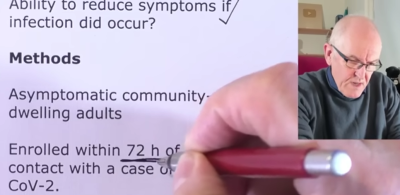
New positive ivermectin evidence
or go to
Aletho News Archives – Video-Images
From the Archives
Fanatical Followers of the Covid Regime: A Jim Jones-Style Cult?
By Professor Roger Watson and Dr. Niall McCrae | The Daily Sceptic | November 15, 2021
As scholars at leading British universities over recent decades, we witnessed the replacement of critical thinking and debate by narrative: facts are discrimination and scientific method is imperialism; truth, instead, is derived from ‘progressive’ values. This educational trend may be a major contributory factor to the ease in which society has been inculcated to the Covid ‘new normal’ of masking, testing, and repeated doses of vaccines for a disease of similar risk to severe influenza.
One doesn’t need much critical reasoning to observe the flawed logic of some vaccination enthusiasts, such as people who respond to experiencing any side effects, however debilitating, by saying “at least I know it’s working”, or, after contracting the disease despite their promised inoculation (over 90% effective, according to initial drug company claims), “I’d have been worse off without the jab.” … continue
Blog Roll
 Aletho News
- New positive ivermectin evidence
- Met Office Caught Fabricating Daily Temperature Record Claims
- Merck Virologists Admitted to Falsely Certifying Vaccine Efficacy
- Mandatory Folic Acid for every man, woman & child
- Pro-Palestine protesters arrested outside UK’s ruling Labour Conference in Liverpool
- Mauritius denies landing permit to flight from Israel, forcing cancellation: Tour operator
- Israeli finance minister calls for genocidal war on West Bank, annexation of south Lebanon
- 12 Things Your Psychiatrist Was Trained Not to Tell You
- From Unipolar Universalism to Multipolar Civilizational Distinctiveness
- RSF military group defects, joins Sudanese army: State media
- If Americans Knew
- Israel forces Gazans to live in constant peril – Daily Update
- Deconstructing Netanyahu’s pants-on-fire UN rant – Daily Update
- Trump betrayed voters with his campaign lies and prioritized a foreign country once he took office
- Netanyahu calls Israel’s war in Gaza ‘opposite of genocide’ in UN speech to near-empty hall
- Settler Kidnappings: Torture, Sexual Abuse and Terrorisation of Palestinian Abductees as Israel Deepens Annexation of West Bank
- Gaza winter nears as 162,000 tents become unusable, raising fears of humanitarian crisis
- Netanyahu says, “It’s the opposite of genocide”; UN says Gaza economy is world’s ‘most severe crisis on record’ – Daily Update
- Israel’s US-Backed Assault on Gaza Has Created the ‘World’s Most Severe Economic Crisis on Record’: UN
- ‘Protecting U.S. Citizens’… From Israel
- ‘This is where I live now, the back of a truck’: a day in the life of a grandmother in Gaza
- No Tricks Zone
- New Study: Earth And Venus Surface Warmth Largely Explained By Convection And Lapse Rate, Not CO2 Or Radiation
- 2025 Nature Paper Claiming Worsening Global Drought Gets RETRACTED …Heavily Flawed
- New Study: ‘Global Drought Shows No Detectable Recent Acceleration Under Climate Warming’
- Economic Masterminds: German Socialists Suggest Taxing Productivity Gains Stemming From Using AI
- The South China Sea Has Not Been Cooperating With The Climate Change Narrative
- Energy Crisis: Germany Enters Heating Season With Historically Low Gas Reserve Fill Levels
- New Study: The Antarctic Ice Sheet Gained Mass From 2020-2024 Due To Staggering Snow And Ice Accumulation
- Study: Ocean Heating Rates From Thousands Of Years Ago ‘Dwarf’ Modern Ocean Heating Rates
- Climate Extremists Target, Attack Large-Scale Power Grid Infrastructure In Germany!
- New Study: Antarctic Ice Melt Has Contributed Less Than 1 Centimeter To Sea Level Rise In The Last 30 Years

