NATO Reportedly Alarmed Over Future ‘Uncoordinated’ Trump-Putin Agreements
Sputnik – 07.07.2018
Ahead of the upcoming Trump-Putin summit, some NATO officials reportedly voiced concerns that the bloc’s member states were not included in the planning of the Helsinki meeting.
“There are great concerns in the alliance about what agreements Trump and Putin could reach,” Peter Beyer, transatlantic coordinator for German Chancellor Angela Merkel’s coalition, told Funke Mediengruppe.
US President Donald Trump earlier said that he expected to have a productive meeting with his Russian counterpart Vladimir Putin in Helsinki on July 16, suggesting that they might “even end up having a good relationship.”
According to The Washington Post, citing anonymous US and European officials, Trump’s closest aides and “alarmed allies” fear that the US president might agree on concessions on a number of issues during his meeting with Putin, such as recognizing Crimea as part of Russia or the situation in Ukraine.
“The president thinks he can be friends with Putin. I don’t know why, or why he would want to be,” the outlet cited former national security adviser Herbert McMaster.
The newspaper then highlighted that the Trump administration had sent mixed signals in the days leading up to a NATO summit that will take place before the upcoming Trump-Putin meeting.
According to The Washington Post, Trump’s relations with his allies have been “corrosive” compared to his more “conciliatory approach” with Putin, even though the current US administration had imposed sanctions on Moscow and expelled Russian diplomats in solidarity with its European partners on the Skripal case.
The outlet then reported that President Trump invited his Russian counterpart to the White House twice – in November and in March – which was at odds with his aides’ advice, who allegedly told him that “the chances of progress on substantive issues was slim.”
The Washington Post also speculated that some White House officials were concerned that President Putin, who has had several phone conversations with Trump, would take advantage of his American counterpart’s “inexperience and lack of detailed knowledge about issues while stoking Trump’s grievances.”
In last month’s interview with Fox News, Trump said that the two heads of state could, in theory, work out the Syria and Ukraine issues over dinner. He also reiterated that he wanted Russia to be reinstated to G7: “whether you like it or not and it may not be politically correct, but we have a world to run.”
Earlier this week, US Ambassador to Russia Jon Huntsman revealed that Trump viewed the forthcoming summit in Helsinki as a step that would help ease tensions between the two countries.
Moscow and Washington are now preparing for the first full-fledged summit between US President Donald Trump and Russian President Vladimir Putin on July 16 in the capital of Finland, Helsinki.
No Trump, No Clinton, No NATO
By Craig Murray | July 7, 2018
Marina Hyde’s vicious and spiteful attack on Susan Sarandon and the Green Party points to the real danger of anti-Trump protest next week being hijacked by the neo-con warmonger franchise. The idea that those of us who do not want arch warmonger Clinton in power are therefore supporters of Trump is intellectually risible and politically dishonest.
Yesterday the OPCW reported that, contrary to US and UK assertions in the UN security council, there was no nerve agent attack on jihadist-held Douma by the Syrian government, precisely as Robert Fisk was execrated by the entire media establishment for pointing out. The OPCW did find some traces of chlorine compounds, but chlorine is a very commonly used element and you have traces of it all over your house. The US wants your chicken chlorinated. The OPCW said it was “Not clear” if the chlorine was weaponised, and it is plain to me from a career in diplomacy that the almost incidental mention is a diplomatic sop to the UK, US and France, which are important members of the OPCW.
Trump’s reaction to yet more lying claims by the UK government funded White Helmets and Syrian Observatory, a reaction of missile strikes on alleged Syrian facilities producing the non-existent nerve agent, was foolish. May’s leap for British participation was unwise, and the usual queue of Blairites who stood up as always in Parliament to support any bombing action, stand yet again exposed as evil tools of the military industrial complex.
Hillary Clinton, true to form, wanted more aggressive military action than was undertaken by Trump. Hillary has been itching to destroy Syria as she destroyed Libya. Libya was very much Hillary’s war and – almost unreported by the mainstream media – NATO bombers carried out almost 14,000 bombing sorties on Libya and devastated entire cities.
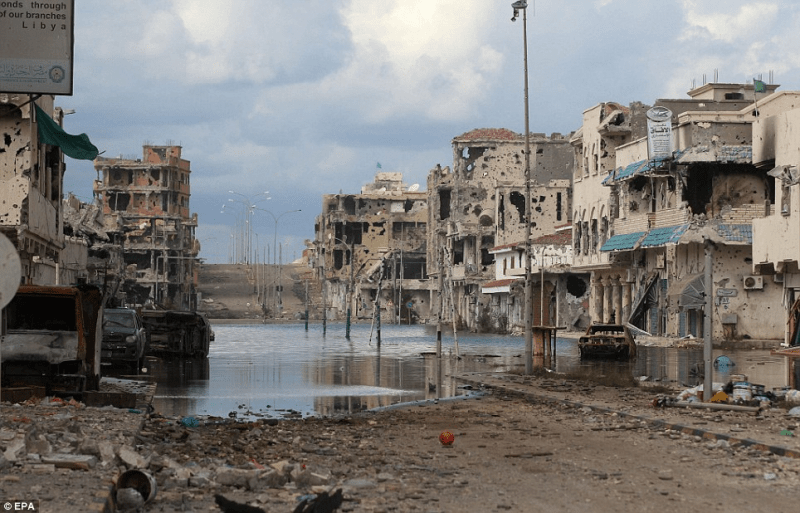
Sirte, Libya, after NATO bombing
The destruction of Libya’s government and infrastructure directly caused the Mediterranean boat migrant crisis, which has poisoned the politics of much of the European Union.
Donald Trump has not started any major war. He has been more restrained in military action than any US President since Jimmy Carter. My own view is (and of course it is impossible to know for sure) that, had Hillary been in power, Syria would already have been totally destroyed, the Cold War with Russia would be at mankind threatening levels, and nuclear tension with North Korea would be escalating.
“He hasn’t destroyed mankind yet” is faint praise for anyone. Being less of an existential danger to mankind than Hillary Clinton is a level achieved by virtually the entire population of the planet. I am not supporting Trump. I am condemning Clinton. I too, like Susan Sarandon, would have voted for Jill Stein were I an American.
So do protest against Trump. But do so under the banner No Trump! No Clinton! No NATO! And if any Clintonite or Blairite gets up to address you, tell them very loudly where to get off. I remember the hijacking of the Make Poverty History campaign by Brown, Darling and Campbell on behalf of their banker friends. Don’t let that happen again.
Or here is an even better idea.
Escape the Trump visit completely. Rather than stand penned in and shouting slogans at a police van parked right in front of you, turn your back on all of that and come join me at the Doune the Rabbit Hole Festival from 13 to 15 July. As our regulars know, this blog has been intimately connected with running the Festival from the start. This year is much bigger, with the Levellers, Akala, Atari Teenage Riot, Peatbog Faeries, and literally scores of other bands, and a great array of other festival activities too, including for kids, who come free and get free drinks.
DTRH has no sponsorship, no advertising, no government money and no rip-offs – beer and cider from £3.50 a pint at the bars. It is very much an alternative lifestyle gathering, and I find spiritual renewal there in the glorious Stirlingshire countryside. (I know that sounds corny, but I do). Tickets are £90 for full weekend including camping, which I think makes it the cheapest festival on this level around. Or you can buy a cheaper day ticket and drop in just for the day. If tickets are too expensive or you fancy a different kind of fun, you can volunteer, including to come and work with me in the bar, though there are a whole range of other tasks to be done if you don’t fancy that. Volunteers get in free and get fed in return for one six hour shift a day.
I really do hope I will see some of you there – it looks set to be a glorious weekend. Forget stress, forget Trump and hang out with nice people!
US establishment in hysterics that Trump-Putin summit might succeed
RT | July 6, 2018
There are many reasons the bipartisan US establishment hates Trump. His heresies from neoliberal orthodoxies on immigration and trade are prominent. But top among them is his oft-stated intention to improve relations with Russia.
That’s fighting words for the Deep State and its mainstream media arm, for which demonizing Russia and its president Vladimir Putin is an obsession.
The fact that Donald Trump made his intention to get along with Moscow a priority during his 2016 campaign, both against his Republican primary rivals and Hillary Clinton (who has compared Putin to Hitler) was cause for alarm. This is because far more than even the frightening prospect that the 70-year state of war on the Korean Peninsula might end, US reconciliation with Russia would yank the rug out from under the phony justifications for spending hundreds of billions of dollars annually to counter a “threat” that ceased to exist over a quarter century ago. Absent hostility to Russia that money has no reason to keep sustaining the power, privilege, and prosperity of a horde of moochers and profiteers, both at home and abroad.
That’s why when it was reported soon after his January 2017 inauguration that Trump was seeking to open dialogue with the Kremlin and set an early summit with Putin there was a hysterical counteraction. As described just over a year ago by conservative columnist and former presidential candidate Patrick Buchanan:
Trump planned a swift lifting of sanctions on Russia after inauguration and a summit meeting with Vladimir Putin to prevent a second Cold War. The State Department was tasked with working out the details. Instead, says Daniel Fried, the coordinator for sanctions policy, he received ‘panicky’ calls of ‘Please, my God, can you stop this?’. Operatives at State, disloyal to the president and hostile to the Russia policy on which he had been elected, collaborated with elements in Congress to sabotage any detente. They succeeded.
“It would have been a win-win for Moscow,” said Tom Malinowski of State, who boasted last week of his role in blocking a rapprochement with Russia. State employees sabotaged one of the principal policies for which Americans had voted, and they substituted their own.
Back then, constitutional government and the rule of law took a back seat to bureaucratic obstructionism, atop months of a phony “Russian collusion” story that even anti-Russian Republican Congressmen are now calling to “finish the hell up.” But now, in the aftermath of the successful Singapore summit and with the collusion narrative looking ever more threadbare, Trump is back on track. The summit with Putin will finally take place on July 16 in Helsinki, Finland, the site of earlier meetings between American and Russian leaders.
Today the assaults on Trump are no less frenzied than a year ago, but they seem to pack less of a punch with the critics’ glum awareness that, aside from some extraordinary provocation, little can be done to stop the summit from taking place. The Beltway Swamp’s flagship bulletin board Washington Post accused Trump of “kowtowing” to Putin by merely agreeing to meet with him. Trump’s one-on-one with the “autocrat” Putin will be a “meeting of kindred spirits,” warned the conceited New York Times. Putin has “devoured” Trump grumbled über-Russophobe Ralph Peters on CNN. Trump wants to “Finlandize” the US moaned Max Boot. Officials in the United Kingdom, a key culprit in ginning up “Russiagate” in the first place, are particularly scared that – horror! – there could be a “peace deal” between Trump and Putin.
Major worries are voiced by useless freeloader countries we call “allies,” whose governments fret that the US will become “less reliable” – to their rulers’ interests of course, not to those of the American people. This specifically means the members of NATO, whose summit Trump will attend prior to Helsinki. As former US ambassador to Moscow and to NATO Alexander Vershbow suggests, “allies are wondering whether they will be in for nothing more than a tongue lashing by President Trump over insufficient defense spending, further inflaming transatlantic divisions over trade, the Iran deal, and other issues.”
Indeed, Trump’s hammering on the NATO deadbeats’ treating the US as a “piggy bank” that will no longer be at their disposal exposes the biggest fraud at the heart of the long-obsolete alliance: there is no threat of Russian military “aggression” and they all know it. If these countries really thought they were in danger of invasion from Russia (and not from Third World migrants, regarding which NATO is totally worthless) they wouldn’t need Trump to nag them about spending, they’d commit more money because they knew they had to. The proof is in noting which NATO member, after the US, consistently spends the largest GDP share on its military: Greece. Is that because the penniless Greeks are terrified of Russia? No, they’re afraid of a genuine threat from their fellow NATO “ally,” Turkey.
In the absence of an actual military menace from the east, NATO advocates are scrambling to come up with ever more imaginative justifications. As described by one member of Latvia’s parliament on the website of the Atlantic Council, a leading Washington establishment think tank, the real Russian threat comes from “hybrid warfare, with an increased focus on asymmetric and nontraditional military capabilities, has made it considerably more difficult for NATO to counter destabilization efforts, information operations, cyber-attacks, disinformation, propaganda, and psychological operations.” Yeah sure, maybe Trump will fall for that! Anything to save the Atlantic Council’s $30 million budget provided by a Who’s Who of US government agencies, NATO and Gulf Arab governments, and military contractor firms.
However, it should not be thought that the US and NATO establishment’s hostility to Russia is entirely venal. There is also a strong ideological component. Whereas during the first Cold War much of the western establishment, especially on the Left, felt an affinity for the materialist goals of communism (if not its methods), Russia’s reemergence under Putin as a conservative country in which national traditions and the Orthodox Church are respected has led to a bitter sense of betrayal. That makes Putin, as articulated by Hillary Clinton, leader of the worldwide “authoritarian, white-supremacist, and xenophobic movement” who is “emboldening right-wing nationalists, separatists, racists, and even neo-Nazis.” No Soviet leader, not even Joseph Stalin, was ever portrayed in such diabolical fashion in US media and government circles the way Putin is.
It is no coincidence that Trump himself is vilified in the same dire Hitlerian terms once reserved for foreign targets of regime change like Slobodan Milosevic, Saddam Hussein, and Muammar Gaddafi. Together with the rising elements of anti-establishmentism in Europe, most recently in the installation of a patriotic Lega/Five-Star government in Rome, the post-modern, neo-liberal elite on both sides of the Atlantic feels its dominance slipping away.
For some Democratic partisans and Never-Trump neo-conservative Republicans, horror at improved US-Russia relations competes with the loathing of Trump personally. But for other Americans, both supporters of the President and people who find him objectionable, the summit should not be seen as a litmus test about their attitudes toward the current occupant of the White House. Rather, the issue is what the summit can mean for Americans’ safety and security – and perhaps our very survival.
Claims of Russian collusion and attitudes toward Trump have obscured the fact that Russia is the only country on the planet with a nuclear establishment on a par with ours. Even during the worst periods of the first Cold War with the USSR, US administrations of both parties kept in mind that a minimum of mutual respect and open communication was not just prudent, it was literally a matter of life and death – for the American people and for the world.
During the past few years as we have entered what has been called a second Cold War, this time with post-communist Russia, the seriousness with which the US used to regard the old Soviet Union has been lacking. The bipartisan foreign policy consensus became a closed, incestuous loop in which Republicans and Democrats vied for who could be most strident in their anti-Russian attitudes: let’s poke the bear and see if he growls!
NATO expansion right in Russia’s face became an end in itself, continuing with induction of Montenegro in 2017, plans to welcome Macedonia (or “North Macedonia” or whatever other silly name is concocted to appease Hellenic pride) – even Ukraine, Georgia, and Bosnia-Herzegovina remain formally on track for joining.
Color revolutions and disastrous wars of regime change toppled Moscow-friendly governments, justified as supposed “democracy promotion.” Risk of confrontation between US and Russian military personnel – studiously avoided during Cold War 1 – takes place with reckless glee in Russia’s Black and Baltic Seas littorals, in Ukraine, and especially in Syria, where earlier this year American forces reportedly slaughtered many Russian contractors – to the delight of some of those now warning darkly against the Trump-Putin meeting. Perhaps most dangerously, the painfully constructed complex of arms control agreements has atrophied as both sides build up stocks of new hypersonic, cyber, and space weapons.
It is perhaps beyond the power of either Trump or Putin to reverse this dangerous trend with one stroke, but maybe they can at least make a start in arresting it. The usual suspects warn of failure, but their real worry is that the summit might be a success. Let’s hope their worst nightmare comes true and peace breaks out.
Jim Jatras is a Washington, DC-based attorney, political analyst, and media & government affairs specialist.
Read more:
Trump-Putin Summit Flushes Out the Russophobes
Strategic Culture Foundation | July 6, 2018
Any reasonable person would have to welcome the summit between US President Donald Trump and Russian President Vladimir Putin to be held on July 16 in Helsinki.
However, what is most telling is the crescendo of scurrilous attempts purveyed by Western news media to spoil the forthcoming meeting. Trump’s political enemies in the US are almost apoplectic that he is willing to engage in a cordial, constructive fashion with the Russian leader.
The anti-Russia tropes are being dredged up to denigrate Putin and by extension Trump for holding the conference. Trump is being lambasted for daring to engage with an alleged “autocrat” who allegedly “annexed Crimea”, who has allegedly aided and abetted a “dictator” in Syria, and who allegedly ordered Kremlin agents to “interfere in US elections.”
On the latter accusation of electoral interference, a recent analysis piece by Jack Matlock, the former US ambassador to the Soviet Union, is both welcome and highly instructive. Matlock, who is a veteran of assessing top-secret files, makes a withering assessment that the so-called US intelligence claims of Russian interference in the 2016 presidential elections was “politically motivated.” The respected diplomat debunks the “intelligence” and subsequent media mantra as cooked up like the earlier shameful scam over Iraq’s weapons of mass destruction. In short, fabricated.
The list of alleged Russian malfeasance has expanded like elastic in recent years. But as Russia’s Foreign Minister Sergei Lavrov cogently pointed out in a recent British media interview not one of these attenuated claims has ever produced substantiating evidence.
One suspects that the strange case this week of an English man and woman being allegedly poisoned with a nerve agent is a contrived timely reminder of the Skripal poisoning affair which happened in Salisbury four months ago. As with all Western media campaigns attempting to smear Russia, the alleged poison cases rely on pejorative innuendo and assertions, spun by a dutiful and derelict news media.
Plausibly, the timing of the latest “story” of an alleged Soviet-made chemical weapon being deployed in Britain is a convenient excuse to further undermine the forthcoming Trump-Putin summit.
Next week also sees a major NATO summit in Brussels during which delegates are to dwell – as they ever tediously do – on alleged Russian aggression. The strange case of poisoning this week in England – which the authorities there have used to once again implicate Russian involvement – will no doubt lend added animus to the NATO agenda.
Trump’s political opponents in the US have been bolstered by pro-Atlanticists in Europe who are claiming that his meeting with Putin “makes Europeans very nervous”, to quote former Swedish premier Carl Bildt writing in the Washington Post.
That’s a sweeping claim. More precisely, the people Trump is making nervous are elitist European politicians like Carl Bildt who have made lucrative careers from being cheerleaders for NATO’s military expansion on Russia’s borders. It is a fair assumption that most ordinary citizens of the European Union – some 500 million – are glad to see the leaders of the world’s two biggest nuclear powers open a long-overdue dialogue to reduce fearful tensions and to try to repair badly damaged relations between East and West.
One talking point doing the rounds in Western media is to compare unfavorably Trump’s meeting with Putin to his earlier summit last month with North Korea’s Kim Jong-Un. Trump’s detractors in the US and in Europe are claiming that he gave too many easy concessions to Kim over denuclearization of the Korean Peninsula. There has been a steady US media campaign – citing anonymous US intel sources – claiming that North Korea is cheating Trump over its promises.
That theme is being applied to Trump’s gathering with Putin in Helsinki. Assorted Russophobic talking heads like former US ambassador Michael McFaul are asserting that Trump will be played and hoodwinked by the wily Putin, as he allegedly was too by Kim Jong-Un. These cynics seem to be more content with conflict and even war, rather than attempts for peace-making.
Such negative views are nothing but cynical opportunism by vested powerful interests among militarists, NATO expansionists, and their European acolytes to derail the Trump-Putin summit, or at least to severely limit the American president’s efforts at engaging normally with Russia.
The two leaders have much to discuss in an effort to begin resolving highly dangerous global security risks. They include settling the conflict in Ukraine and Syria, and trying to de-escalate tensions over the buildup of NATO forces along Russia’s Western flank. Let fester, these issues could ignite into a wider, disastrous conflict between the two nuclear superpowers.
Surely, it is urgently needed for Trump and Putin to engage in direct talks to mitigate the worst tensions since the end of the Cold War more than a quarter-century ago. Since Trump took office nearly 18 months ago, he has met with President Putin only on two fleeting occasions at multilateral forums. It is long overdue that the two leaders should meet in a full summit for in-depth, face-to-face negotiations. To Trump’s credit, he doing just that, despite the naysayers and fantasists claiming “Russian influence” over the American president.
Instead of welcoming this engagement as an important step towards securing world peace, an array of powerful interests both in the US and Europe are trying their best to sabotage the high-level crucial talks.
The Russophobes and their perverse warmongering predilections are being flushed out for the whole world to see, and to condemn as reprehensible, irresponsible wreckers of global peace.
Losing Military Supremacy: The Myopia of American Strategic Planning by Andrei Martyanov
The Saker • Unz Review • July 5, 2018

The fact that the US is facing a profound crisis, possibly the worst one in its history, is accepted by most observers, except maybe the most delusional ones. Most Americans definitely know that. In fact, if there is one thing upon which both those who supported Trump and those who hate him with a passion can agree on, it would be that his election is a clear proof of a profound crisis (I would argue that the election of Obama before also had, as one of its main causes, the very same systemic crisis). When speaking of this crisis, most people will mention the deindustrialization, the drop in real income, the lack of well-paid jobs, healthcare, crime, immigration, pollution, education, and a myriad of other contributing factors. But of all the aspects of the “American dream”, the single most resilient one has been the myth of the US military as “the finest fighting force in history”. In this new book, Andrei Martyanov not only comprehensively debunks this myth, he explains step by step how this myth was created and why it is collapsing now. This is no small feat, especially in a relatively short book (225 pages) which is very well written and accessible to everyone, not just military specialists.
Martyanov takes a systematic and step-by-step approach: first, he defines military power, then he explains where the myth of US military superiority came from and how the US rewriting of the history of WWII resulted in a complete misunderstanding, especially at the top political levels, of the nature of modern warfare. He then discusses the role ideology and the Cold War played in further exacerbating the detachment of US leaders from reality. Finally, he demonstrates how a combination of delusional narcissism and outright corruption resulted in a US military capable of wasting truly phenomenal sums of money on “defense” while at the same time resulting in an actual force unable to win a war against anything but a weak and defenseless enemy.
That is not to say that the US military has not fought in many wars and won. It did, but in the words of Martyanov:
Surely when America fought against a third-rate adversary it was possible to rain death from the skies, and then roll over its forces, if any remained by that time, with very little difficulty and casualties. That will work in the future too against that type of adversary—similar in size and flimsiness of Iraqi Forces circa 2003. But Ledeen’s Doctrine had one major flaw—one adult cannot continue to go around the sandbox constantly fighting children and pretend to be good at fighting adults.
The main problem for the US today is that there are very few of those third-rate adversaries left out there and that those who the US is trying to bring to submission now are either near-peer or even peer adversaries. Martyanov specifically lists the factors which make that kind of adversary so different from those the US fought in the past:
- Modern adversaries have command, control, communications, computers, intelligence, surveillance and reconnaissance capabilities equal to or better than the US ones.
- Modern adversaries have electronic warfare capabilities equal to or better than the US ones
- Modern adversaries have weapon systems equal to or better than the US ones.
- Modern adversaries have air defenses which greatly limit the effectiveness of US airpower.
- Modern adversaries have long-range subsonic, supersonic and hypersonic cruise missiles which present a huge threat to the USN, bases, staging areas and even the entire US mainland.
In the book, all these points are substantiated with numerous and specific examples which I am not repeating here for the sake of brevity.
One could be forgiven for not being aware of any of these facts, at least if one considers the kind of nonsense written by the US corporate media or, for that matter, by the so-called “experts” (another interesting topic Martyanov discusses in some detail). Still, one can live in an imaginary world only as long as reality does not come crashing in, be it in the form of criminally overpriced and useless weapon systems or in the form of painful military defeats. The current hysteria about Russia as the Evil Mordor which is the culprit for everything and anything bad (real or imaginary) happening to the US is mostly due to the fact that Russia, in total contradiction to all the “expert” opinions, not only did not crash or turn into a “gas station masquerading as a country” with her economy “in tatters”, but succeeded in developing a military which, for a small fraction of the US military budget, whose armed forces are in reality far more capable than the US forces.
I realize that this last statement is quite literally “unthinkable” for many Americans and I submit that the very fact that this is so literally unthinkable greatly contributed to making this possible in the first place: when you are so damn sure that by some kind of miracle of history, or God’s will, or Manifest Destiny or any other supernatural reason, you are inherently and by definition superior and generally “better” than everybody else you are putting yourself in great danger of being defeated. This is as true for Israel as it is for the US. I would also add that in the course of the West’s history this “crashing in of reality” in the comfy world of narcissistic delusion often came in the form of a Russian soldier defeating the putatively much superior master race of the day (from the Crusaders to the Nazis). Hence the loathing which western ruling elites always had for everything Russian.
In this book, Martyanov explains why, in spite of the absolutely catastrophic 1990s, the Russians succeeded in developing a modern and highly capable combat force in a record time. There are two main reasons for this: first, unlike their US counterparts, Russian weapons are designed to kill, not to make money and, second, Russians understand warfare because they understand what war really is. This latest argument might look circular, but it is not: Russians are all acutely aware of what war really means and, crucially, they are actually willing to make personal sacrifices to either avoid or, at least, win wars. In contrast, Americans have no experience of real warfare (that is warfare in defense of their own land, family and friends) at all. For Americans warfare is killing the other guy in his own country, preferably from afar or above, while making a ton of money in the process. For Russians, warfare is simply about surviving at any and all cost. The difference couldn’t be greater.
The difference in weapons systems acquisition is also simple: since US wars never really put the people of the US at risk, the consequences of developing under-performing weapons systems were never catastrophic. The profits made, however, were immense. Hence the kind of criminally overpriced and useless weapons system like the F-35, the Littoral Combat Ship or, of course, the fantastically expensive and no less fantastically vulnerable aircraft carriers. The Russian force planners had very different priorities: not only did they fully realize that the failure to produce an excellently performing weapons system could result in their country being devastated and occupied (not to mention their families and themselves either enslaved or killed), they also realized that they could never match the Pentagon in terms of spending. So what they did was to design comparatively much cheaper weapons systems which could destroy or render useless the output of the multi-trillion dollar US military-industrial complex. This is how Russian missiles made the entire US ABM program and the US carrier-centric Navy pretty much obsolete as well as how Russian air defenses turned putatively “invisible” US aircraft into targets or how Russian diesel-electric submarines are threatening US nuclear attack subs. All that at a tiny fraction of what the US taxpayer spends on “defense”. Here again, Martyanov gives plenty of detailed examples.
Martyanov’s book will deeply irritate and even outrage those for whom the US narcissistic culture of axiomatic superiority has become an integral part of their identity. But for everybody else this book is an absolute must-have because the future of our entire planet is at stake here: the question is not whether the US Empire is collapsing, but what the consequences of this collapse will be for our planet. Right now, the US military has turned into a “hollow force” which simply cannot perform its mission, especially since that mission is, as defined by US politicians, the control of the entire planet. There is a huge discrepancy between the perceived and the actual capabilities of the US military and the only way to bridge this gap is, of course, nuclear weapons. This is why the last chapter in the book is entitled “The Threat of a Massive American Military Miscalculation”. In this chapter, Martyanov names the real enemy of both the Russian and the American people – the US political elites and, especially, the Neocons: they are destroying the US as a country and they are putting all of mankind at risk of nuclear annihilation.
The above summary does not do justice to Martyanov’s truly seminal book. I can only say that I consider this book an absolutely indispensable “must read” for every person in the US who loves his/her country and for every person who believes that wars, especially nuclear ones, must be avoided at all costs. Just like many others (I think of Paul Craig Roberts), Martyanov is warning us that “the day of reckoning is upon us” and that the risks of war are very real, even if for most of us such an event is also unthinkable. Those in the US who consider themselves patriots should read this book with special attention, not only because it correctly identifies the main threat to the US, but also because it explains in detail what circumstances have resulted in the current crisis. Waving (mostly Chinese made) US flags is simply not an option anymore, neither is looking away and pretending that none of this is real. Martyanov’s book will also be especially interesting to those in the US armed forces who are observing the tremendous decline of US military power from inside. Who better than a former Soviet officer could not only explain, but also understand the mechanisms which have made such a decline possible?
You can also get both versions of the book (paper & electronic) here: http://claritypress.com/Martyanov.html
The book is also available on Amazon as a pre-order here: https://www.amazon.com/Losing-Military-Supremacy-American-Strategic/dp/0998694754/
It is scheduled to become available on September 1st.
German Protesters Fed Up With US Wars Blockade Ramstein Air Base
Sputnik – 02.07.2018
About 2,500 people gathered outside the largest US base in Germany over the weekend as the Trump administration considered a possible US withdrawal from the country.
Sputnik Deutschland contributor Marcel Joppa was on the scene for Saturday’s protest, joining people of all ages including seniors as old as 80 years old, who endured the summer heat and faced down the police to show their discontent with US military operations launched from German soil.
Organized by the “Stop Air Base Ramstein” civil group, the protest was attended by several politicians, most notably Sara Wagenknecht, the leader of The Left Party faction in the Bundestag.
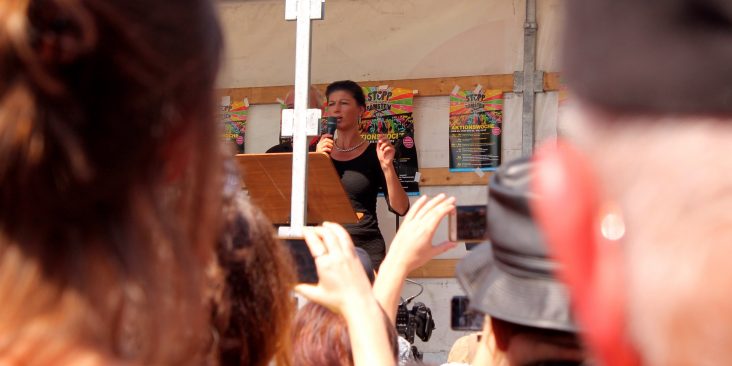
Addressing the crowd, Wagenknecht spoke out on the issue of drone warfare, “which although not written about much in the big press continues to take place.”
“Kill orders are arranged at the touch of a button. These are just outrageous crimes! And it is unacceptable that they be supported here, from German soil, in any way!” the politician stressed.
Pointing out that the bombings of Iraq and Afghanistan were carried out from German territory, Wagenknecht argued that there shouldn’t be a single German region where the Germany Constitution, which does not allow wars of aggression or extraterritorial killings by drones, does not apply.
“What is happening here is a case for our counterintelligence bodies, if they are to do their jobs properly,” the politician said. “There are over 1,000 US military bases around the world, and none of them exist to ensure the security of those countries,” she added.
Demanding that Berlin pursue a more independent foreign policy, Wagenknecht criticized Chancellor Angela Merkel, accusing her of being too submissive to the US.
The protesters were also addressed by writer and peace activist Eugen Drewermann, who reminded them that the US had bombed seven predominantly Muslim countries since 2001.
“We are involved in these actions, and we are partly responsible. We must finally reject this policy. We Germans have every reason to press the brake, with all our might, to correct old mistakes,” he said.
Unfortunately, Drewermann noted, NATO had always viewed Russia as an enemy, emphasizing the immense disparity in the number of military bases the two countries operate internationally.
Several dozen protesters set off for the front of the central entrance to the air base, where they sat down on the asphalt and blocked traffic. The police soon sounded a warning that the protest would be broken up and that those who resisted would be detained. Participants began singing songs and shouting slogans, including “For international solidarity!” and “Why are we doing this? For the sake of our children!”
About a dozen people have been detained, including an elderly American couple.
Saturday’s protests came on the heels of reports of a US Department of Defense study on the consequences of a major drawdown of US forces in Germany. The study was initiated after President Trump expressed his interest in the pullout at a meeting with military officials earlier this year, according to officials speaking to The Washington Post. Trump was reportedly taken aback by the cost of maintaining the estimated 35,000 active-duty troops stationed in the European country.
The US has maintained a presence in Germany since the end of World War II. During the Cold War, the US presence was justified as necessary to deter the Soviet Union, which had troops in East Germany. The Soviet Union collapsed in 1991, and the last of the former Soviet contingent was withdrawn in 1994, but the US bases remained, even during a period of unprecedentedly warm relations between Moscow and Washington in the 1990s and most of the 2000s.
The Trump-Putin Peace, Trade and Friendship Talks
By Brian CLOUGHLEY | Strategic Culture Foundation | 02.07.2018
News that a meeting has been arranged between Presidents Trump and Putin on 16 July was greeted with displeasure in many sectors of the western world, and especially by the military-industrial complex, the cabal of war-profiteering US and European oligarchs whose interests lie solely in maintaining their lucrative arms manufacturing empires. Trade is most important to them — but peace and friendship come way down their page of priorities, because it is enmity and distrust that lead to lucrative sales of weapons.
UK newspapers reacted predictably to the news, with the right wing Daily Mail stating “Fears are mounting that Donald Trump wants a ‘peace deal’ with Vladimir Putin that could fatally undermine NATO. Ministers are becoming increasingly alarmed that the US president could offer the Russian president deep concessions such as withdrawing forces from Europe.”
The Times of London recorded that “One [UK government] minister told the Times : ‘What we’re nervous of is some kind of Putin-Trump ‘peace deal’ suddenly being announced. We could see Trump and Putin saying, Why do we have all this military hardware in Europe? and agreeing to jointly remove that. ‘It’s hard to be against peace, but would it be real peace?’”
Yes, it would be real peace, because what Russia wants is amicable relations and trade. Trade with the US and the EU and China and every country that wants to trade — including, most importantly, the Baltic States that have been encouraged by the Pentagon-Brussels NATO High Command to imagine that Russia is poised to invade them.
The US defence secretary, General James Mattis, told Estonia’s minister of defence that “Russia is trying to change international borders by force” and at meetings in May with Lithuania’s president and Baltic defence ministers “reassured US allies in the Baltic states of Lithuania, Latvia and Estonia of American solidarity with them and of US determination to defend Baltic and other NATO territory against any aggression.”
Of all the absurd concoctions swinging round the Western propaganda world at the moment, the notion that Russia wants to invade Estonia, Latvia or Lithuania is probably the least believable and most laughable. The Russian government fully realises that such action would inevitably result in wider conflict; and that there could be escalation to a shattering nuclear war. Even if it didn’t result in global catastrophe, the occupation of any one of these countries by Russian forces would be cripplingly costly in every way and simply doesn’t make sense.
In the context of the impending US-Russia presidential talks, not a single Western media outlet mentioned that, as detailed in the 2018 World Report of the Stockholm International Peace Research Institute (SIPRI), “In 2017 the USA spent more on its military [$610 billion] than the next seven highest-spending countries combined… at $66.3 billion, Russia’s military spending in 2017 was 20 per cent lower than in 2016.”
It would be awkward and indeed embarrassing for the Western media to give prominence to SIPRI’s indisputable statement that in 2016 “NATO’s collective military expenditure rose to $881 billion” while “European NATO members spent $254 billion in 2016 — over 3 times more than Russia.”
Russia is reducing its expenditure on defence while the US-NATO military alliance, as noted by Radio Free Europe, agreed on 7 June to “reinforce NATO’s presence in a potential European crisis with the deployment of 30 troop battalions, 30 squadrons of aircraft, and 30 warships within 30 days — the so-called ‘Four 30s’ plan.” This, said the Secretary General of the US-NATO military alliance, Jens Stoltenberg, presumably with a straight face, is not “about setting up or deploying new forces — it is about boosting the readiness of existing forces across each and every ally.”
Then the BBC reported that Stoltenberg had put the best face he could on the unwelcome news of reduced tension and possible friendship. He said that “dialogue is a sign of strength… We don’t want a new Cold War, we don’t want to isolate Russia, we want to strive for a better relationship with Russia.” This is the man who declared in March 2018 that the US-NATO military grouping is increasing its numbers of confrontational deployments. He is proud of the fact that at the end of 2017 there were more than 23,000 troops involved in NATO operations, an increase of over 5,000 since 2014. This is a most peculiar way of striving for a “better relationship” with Russia, whose borders and shores are constantly menaced by NATO’s attack and electronic warfare aircraft, missile-equipped ships and tank-heavy troop manoeuvres.
In June, immediately before the start of the World Cup football tournament in Russia the US-NATO alliance (plus Israel) conducted a two-week military exercise in Estonia, Latvia, Lithuania and Poland. 18,000 troops took part in the manoeuvres which, according to the Pentagon’s HQ in Europe, were “not a provocation of Russia.” At the very time that citizens of countless countries were preparing to travel to Russia to enjoy a major sporting jamboree, the Pentagon-Brussels pressure group did its best to confront the country whose defence budget is one third of Europe’s and a tenth of America’s and whose President declared that his overwhelming priority is reduction of poverty and “the well-being of the people and the prosperity of Russian families.”
It is deeply ironical that while the US-NATO military fandangos were in full swing in the Baltic States, it was reported that “Russia on Wednesday [6 June] successfully launched its Soyuz MS-09 spacecraft carrying three crew members to the International Space Station (ISS)…” The spacecraft carried three astronauts : Serena Aunon-Chancellor of the US, Germany’s Alexander Gerst and Russia’s Sergei Prokopyev,
The spacecraft zoomed away in international harmony two days before US Senator Ben Sasse grouched that “Putin is not our friend and he is not the president’s buddy. He is a thug using Soviet-style aggression to wage a shadow war against America, and our leaders should act like it.” With that sort of attitude, widespread in the Congress, it’s going to be difficult to realise Trump’s desire to “get along with Russia” which he observes would be “good for the world, it’s good for us, it’s good for everybody.”
Trump is the most erratic president the US has ever known. He ricochets from malevolent tweeting to spiteful speeches, and is now distrusted by almost every foreign leader of stature. It is difficult to disagree with the opinion of Iran’s foreign minister that he is “impulsive and illogical” but — and it is a very big ‘but’ — at the moment he presents the best chance for rapprochement and amity with Russia. The fact that Washington’s warmongers so violently oppose his forthcoming talks with President Putin is evidence enough that he is on the right track. Let’s hope that President Putin can keep him on the rails that lead to peace, trade and friendship.
The New York Times Squares off with the Truth, Again
By Michael Howard | American Herald Tribune | July 1, 2018
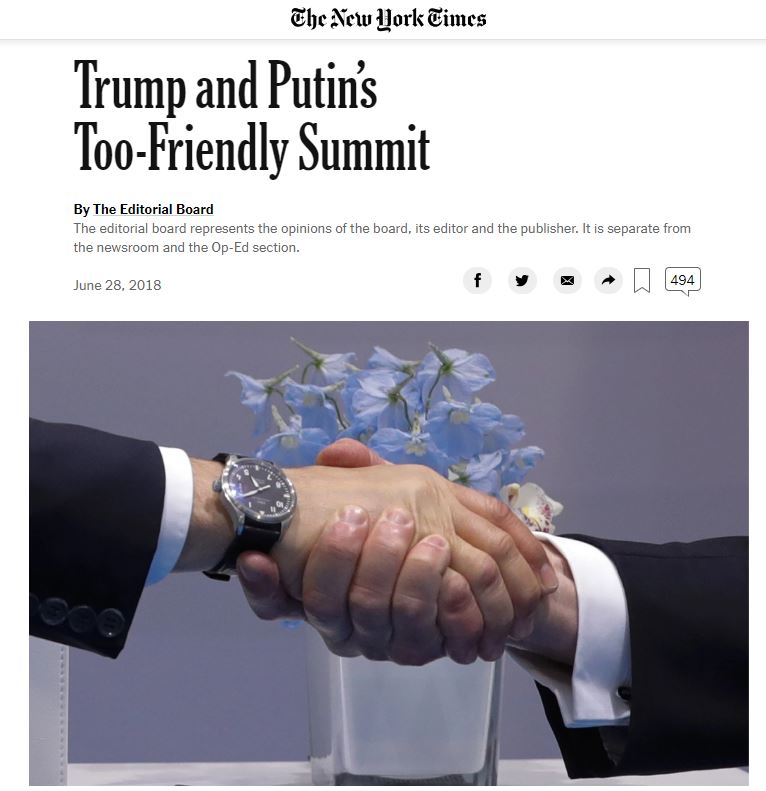
Whenever I’m having a rough day and need a pick-me-up, I turn to The New York Times’ editorial page. It’s always a gas to see how far the empire’s leading propaganda outfit is prepared to go in its mission to pull the wool over we the people’s gullible little eyes. The good editors have come through for me again with their latest entry, “Trump and Putin’s Too-Friendly Summit.” (Original title: “Trump and Putin: Best Frenemies for Life”). No doubt the original headline was deemed rather too impish for such a serious newspaper—it might, for instance, have alerted readers to the fact that the editorial’s content is not to be taken very seriously—and so was understandably jettisoned.
“One would think,” the editors write, “that the president of the United States would let Mr. Putin know that he faces a united front of Mr. Trump and his fellow NATO leaders, with whom he would have met days before the [Putin] summit in Helsinki.” Alas, during said meeting Trump reportedly remarked that “NATO is as bad as NAFTA”—the “free trade” agreement that has succeeded in decimating most of the manufacturing jobs spared by the automation wrecking ball. In other words, Trump does not necessarily think it’s a good idea to encircle Russia with a hostile military alliance whose existence, according to geopolitical expert Richard Sakwa, is “justified by the need to manage the security threats provoked by its enlargement.” (If you haven’t read Professor Sakwa’s comprehensive study of the Ukrainian crisis, Frontline Ukraine, put it at the top of your summer reading list.)
One notes the Turgidsonian delight with which the Times reminds us that, should push come to shove, we’ve got those Russki bastards outgunned. Of course, gullibles like you and I are to pay no mind to the fact that such a confrontation (a military one, for the Times brought up NATO) would almost certainly involve a nuclear exchange, rendering the disparity in manpower that so excites the Times totally meaningless. No, what’s important is that NATO has twenty-nine member states and counting, while the Warsaw Pact was dissolved twenty-seven years ago: ergo, unless he wants the old mailed fist, Putin had better ask “how high?” when we tell him to jump. One would be hard-pressed to come up with a more delusional assessment of where things stand.
In case any of its readers have been living under rocks (not so bad an idea in this day and age), the Times made sure to stress just how sinister “the Russian autocrat” is. To that end they touch upon, with signature glibness, “Mr. Putin’s seizure of Crimea and attack on Ukraine.” Later, the “attack on Ukraine” is upgraded to “the Ukraine invasion”—a charge dealt with most eloquently here. Omitted as a matter of course is Crimea’s complicated history, the issue of the Sevastopol naval bases, as well as numerous uncontroversial polls showing that the overwhelming majority of Crimeans (of whom an overwhelming majority are ethnic Russians) support “Mr. Putin’s seizure.”
According to Forbes, a February 2015 survey by German polling firm GfK asked of the Crimean population: “Do you endorse Russia’s annexation of Crimea?” Eighty-two percent responded: “yes, definitely.” On the other hand, a whopping two percent responded: “no.” Seems plain enough. But hold the phone, says the New Cold Warrior, we can’t rule out the possibility that GfK is actually an arm of Putin’s Federal Security Service. Can you prove it isn’t? Didn’t think so.
Failing that, I think I recall reading something somewhere about an international principle called … what was it again? … “self-determination.” That’s it. Something to do with the bloody dismemberment of a certain former country in the Balkans in the nineties, spearheaded by our very own Uncle Sam. It’ll come back to me.
Deployed next by our great pandering Paper of Record are the increasingly monotonous claims that Moscow “interfered in the 2016 election to put [Trump] in office and is continuing to undermine American democracy.” If only we had a democracy to undermine, then this never-ending soap opera might have a little more going for it. Having, wisely, I think, adopted a wake-me-up-when-it’s-over attitude to “Russia-gate,” I’m simply not up to speed on the latest pseudo-bombshell reports that, on account of their utter want of journalistic merit, wind up being heavily redacted or retracted altogether. The whole scene has become too farcical for my taste. That said, I encourage still-interested parties to read the various counter narratives that fail to penetrate the mass media’s filters. This, for example.
But the board’s main concern in all this is that, according to them, Trump is “intent on eroding institutions that undergird democracy and peace.” To clarify, they’re referring to NATO again, or what they call “allied security.” It’s an obsession with these people. So let’s look at it a moment. I’ll give you a few well-known (but poorly understood) examples of NATO’s philanthropic work over the decades, since the Times forgot to include them in its editorial: namely, the illegal bombing of Yugoslavia, the illegal invasion and occupation of Afghanistan, and the illegal “humanitarian” intervention in Libya. After I’m finished writing this, I must write the Times to notify them that they printed a typo: they obviously meant to write “undermine,” not “undergird.”
It boils down to this: NATO is good because it’s us. Trump is bad because he’s ambivalent about NATO. If Trump succeeds in “eroding” NATO, the beneficiary is Putin, “whose goal is to fracture the West and assert Russian influence in places where Americans and Europeans have played big roles, like the Middle East …” Given the outcomes of those “big roles” (9/11, the destruction of whole countries, ISIS, a flourishing slave trade, a migrant crisis of biblical proportions, mass famine, the tragedy of Gaza, the death of the two-state solution, the list goes on), it’s hard to imagine Putin, or anyone else, for that matter, doing any worse. So here’s a modest proposal: Washington sells its empire to Moscow and gets out of the world domination business for good. God knows we need the money. Unfortunately, Putin is no more interested in ruling over a global empire than we are in relinquishing one. (Fun fact: on defense, the US outspends Russia by about $540 billion.)
As Sakwa explains, “Putin’s challenge is not to the system of international politics but only to what he considers its skewed and selective operation in favor of the Atlantic system.”
“The Russian autocrat” has been, for a long time, crystal clear on this point. Far from harboring Washington-style fantasies of imperial glory, his is a vision of a multipolar world order in which the leading powers engage in serious diplomacy and coordinate their efforts to address the major economic, security and environmental issues confronting us all. Then there’s Trump: “But our destiny, beyond the Earth, is not only a matter of national identity, but a matter of national security. It is not enough to merely have an American presence in space. We must have American dominance in space.” (Emphasis mine.) Between insane rhetoric like that and NATO’s incessant (and equally insane) provocations along Russia’s western front, I think it’s fair to say Putin has shown an admirable degree of composure.
In their final flurry, the Times editors make some big-sounding statements about the need to prevent another nuclear arms race, duly omitting that the US is on track to spend more than $1 trillion over the next three decades modernizing and diversifying its nuclear arsenal (and no, we can’t pin this one on Trump). Then, flailing now, punching wide, they managed to project responsibility for the breakdown of the flawed Intermediate-Range Nuclear Forces Treaty squarely onto Russia, duly omitting that the US, by continuing to install provocative missile defense systems across Eastern Europe, is in constant violation of the treaty. Inconvenient truths, I regret to say, are still truths; and lies by omission are still lies.
But let us not stray from the bottom line: Russia is the threat. Russia is the threat. Russia is the threat. If you say it enough times you might start to believe it—and then, and only then, can you count yourself among the good upright citizens of this great indispensable nation.
Macron Embraces Liberal Authoritarianism by Attempting to Force French Children Into The Military
By Adam Garrie | EurasiaFuture | June 28, 2018
Emmanuel Macron was the first modern French President not to experience compulsory military service as prior to his eighteenth birthday, the French government abolished conscription. However, after benefiting from the fact that France is a country facing no traditional military threats, Macron has now put forward formal proposals which would force all 16 year old French girls and boys to serve in the military.
Macron’s proposals not only defy the pan-European trend of ending compulsory service but they also defy logic. It is well known that especially in the age of high-tech warfare, conscripted armies are simply not as efficient nor as effective as those comprised of volunteers. Countries that maintain compulsory military service are generally those that face major existential threats from traditional armed forces, countries with small populations or nations that simply have not got around to modifying old rules. In any case, many of the countries that still do enforce some kind of compulsory service are reducing the amount of years or months required while also offering a variety of exemptions.
Furthermore, while most countries that still conscript young people only begin the process when one has turned 18 and while furthermore, they generally only ever draft males – Macron has set the bar at the age of 16 and will require both males and females to forcibly join the armed forces if he gets his way.
Macron’s proposals represent a massive step backwards for the French people. France is a country that has enjoyed all the benefits of pan-European peace while its volunteer armed forces continue to inflect suffering upon the developing world along with their other NATO allies. There can be no justification for conscription during a time of unparalleled peace, but Macron has other things in mind.
While liberalism used to connote an idea of relaxed governmental controls on everything from the economy to public morality, today’s liberalism is increasingly embracing an atmosphere of classic authoritarianism which is used to enforce not patriotic nor moral values, but contemporary ultra-liberal ones. In other words, liberalism has pivoted from “do as you will do – no matter the consequences” to “do as we say or else be severely punished for not embracing our particular liberal set of social values”.
Macron’s attempt to militarise society by targeting children is the next logical progression of such a barbaric modus operandi and what is more worrying is that other liberal authoritarians in Europe may follow Macron in throwing away Europe’s peace by turning it into a needlessly more militarised region.
Without a doubt, the biggest problem that contemporary Europe faces is the migration crisis that was itself caused by Angela Merkel forcing a pan-EU open door policy down the throats of ordinary people who never got to have a formal say in the matter. As France has been one of the countries to most readily embrace Merkel’s open door policy, Macron bears his share of responsibility for the present crisis.
Macron has implied that his conscription policy is an attempt to use military service to create social solidarity where at present there is a great deal of discord. However, by militarising the youth, all it will do is propagate an atmosphere of violence that can only be tackled by tough policing when combined with an end to open door policies for economic migrants posing as refugees.
The problems in French society are due to a combination of lax enforcement of current drug laws, poor policing techniques against the proliferation of gangs, terror cells and weapons and an attitude of so-called political correctness which disallows police from following basic lines of logic in cracking down on criminal activities in society.
All Macron’s conscription plans will do is create more anger and violence among ordinary citizens who at the moment simply want professional police to do their job without the constraints they are currently under. Furthermore, Macron’s plan seeks to shift the blame for the migrant crisis onto an invisible foreign threat that a bulked-up, partially conscripted French military will now prepare to fight. This weapon of mass distraction seeks to point the finger at any given “foreign menace” as the cause of the current breakdown in French society when in reality it was France’s and the EU’s own policies which sowed the seeds of the current atmosphere of widespread discontent.
Macron’s liberal authoritarianism will simply punish French children for literally no reason at all, while simultaneously providing himself an excuse to deflect from the blame he has earned by his refusal to wake up to reality regarding Europe’s migrant crisis.
If there was ever a reason for French men and women to take to the streets and protest their government, this certainly is among the most important.
Colombian President-elect will not recognise Venezuela’s government, says to withdraw from UNASUR
Venezuelanalysis | June 21, 2018
Colombian President-elect Ivan Duque has vowed to not send an ambassador to Caracas upon assuming the presidency, claiming not to recognise the Venezuelan government in heated statements less than two weeks after his electoral victory.
“We can’t accept having links with a government which we consider to be illegitimate,” declared the winner of the June 17 election. Duque obtained 54 percent of the vote amid a 53 percent participation.
The president-elect, who will take power on August 7, also characterized Venezuelan President Nicolas Maduro as a “dictator,” alleging the existence of government-sponsored “drug trafficking structures.”
Similarly, Duque criticised Venezuela’s recent May 20 elections, which he considers to have been “openly manipulated.”
Venezuela’s May 20 presidential elections were declared free and fair by numerous international accompaniment missions who observed the process in the Caribbean nation.
By contrast, Colombia’s recent balloting has drawn significant criticism, with Colombia’s Immediate Reception for the Electoral Transparency Unit (URIEL) registering 1,239 complaints on the day of voting, 51 percent of which referred to “pressure and threats” to voters.
Duque is considered a hard-line politician of the right wing Democratic Centre center who is extremely close to party head and ex-Colombian President Alvaro Uribe, both in his rejection to the Colombian peace process and in the aggressive tone taken in relation to Caracas.
However, unlike Uribe, who stated days after his presidency was over that an invasion to Venezuela had been on the table, Duque has calmed concerns over a possible military encounter between NATO member Colombia and Venezuela, saying that he will not “assume a warlike attitude towards Venezuela.”
Nonetheless, the new Colombian president has threatened to denounce his Venezuelan counterpart at the UN Security Council. Duque has also promised to withdraw from regional body UNASUR for its “complicity” with Venezuela.
The tense relations between Colombia and Venezuela since 1999 have not stopped the abundant, migration between the two populations. It is estimated that more than five million Colombians entered Venezuela fleeing the civil war and government persecution. Likewise, recent data suggests that more than one million Venezuelans have crossed into Colombia in the past two years.
Trump-Putin summit should be welcomed, not feared
By Neil Clark | RT | June 22, 2018
The news that Donald Trump and Vladimir Putin are preparing to meet in Europe next month has been causing consternation among those keen to keep the temperature of the new ‘Cold War’ close to freezing point.
But these voices should be ignored, as a summit is just what is needed at the present time.
“Meeting jaw to jaw is better than war,” Winston Churchill famously observed. Which sane person, desirous of world peace, could possibly disagree with the sentiment?
Yet, it seems that some people in the corridors of power in the West and in neocon think-tanks are seriously alarmed by the prospect of the presidents of the US and Russia getting together for a tete-a-tete and possibly defusing current tensions.
The London Times has cited Whitehall sources who told the paper how worried they were about a Trump-Putin get-together. “It would be a highly negative thing to do,” one unnamed insider said. “Everyone is perturbed by what is going on, and is fearing for the future of the [Atlantic] alliance,” said another.
Meanwhile, in the New Yorker, Susan B. Glasser informs us that many Russia ‘experts’ are worried that Putin “is intent upon securing major concessions from Trump.” She also cites George W. Bush’s former ambassador to Russia, Alexander Vershbow, who lambasted the idea of a meeting as a “bonding session with another dictator.”
“Get ready for another lavish televised love-fest, this time between Trump and Putin,” warns Anne Applebaum. The Washington Post columnist fears there will be a ‘trade.’ “We stop holding military exercises in Europe. In exchange, we allow Russia to keep Crimea.”
“Also,” she adds, “we will throw in Alaska.”
If we go back to the early 1970s, we’d find Applebaum’s predecessors equally concerned that President Nixon – another Republican president loathed by liberals – was keen on a rapprochement with the Soviet Union. In fact, a review of the diplomatic moves made by Nixon and the opposition he faced from uber-hawks inside America is highly instructive.
On May 22, 1972, Nixon became the first serving US president to set foot inside the Kremlin. Four days later, the president and his Soviet counterpart Leonid Brezhnev signed SALT 1 (the Strategic Arms Limitation Talks), described by Jeremy Isaacs and Taylor Downing in their book ‘Cold War’ as “an event of considerable significance.”
“After 25 years of hostility, the Soviet Union and the United States had agreed to curb spiraling arms-race costs, and reduce the risks of nuclear war,” they wrote.
Who couldn’t be happy about this? Senator Henry Jackson – aka the ‘Senator from Boeing’ – for one. As the New York Times explained in 1988.
SALT 1 was an executive agreement, not a treaty, so it could not be blocked by the Senate. “So Jackson pushed through a resolution that set stiff terms for any future treaties, demanding, among other things, that they produce rough numerical equality,” it wrote.
Jackson also opposed the agreement on Security and Cooperation in Europe, signed in Helsinki on August 1, 1975, commonly regarded as ‘detente’s high point.’
“As if to symbolize this new spirit of goodwill, the American Apollo and the Soviet Soyuz spacecraft docked together in outer space, 140 miles above Earth. For two days, the astronauts of rival systems carried out joint experiments while orbiting Earth. Detente had replaced decades of confrontation,” note Isaacs and Downing.
And remember, all this had happened under Republican presidents (Nixon and Ford).
Fast forward to today, and it’s the disciples of ‘Scoop’ Jackson who once again seem terrified that a meeting between Trump and Putin will lead to a new ‘spirit of goodwill’ between East and West.
That would never do, as Russia must always be regarded as the enemy – unless of course it does absolutely everything the West demands of it.
Trump and Putin could be a re-run of Nixon and Brezhnev. They could start to talk about arms limitation. They could start to talk about new security and co-operation arrangements. They could embrace each other warmly and declare that the US and Russia would never go to war with each other.
Of course, if such positive moves were made, people across the world would be delighted, as they were in 1972 and 1975. But defense industry lobbyists won’t be.
In ’Fog,’ a 1969 episode of the classic UK television series ‘The Avengers,’ members of the world disarmament committee meet in London, and are bumped off one by one by a mysterious ‘Gaslight Ghoul.’ We’re led to believe that the guilty party is an old-fashioned, politically incorrect ‘Empire loyalist’ Sir Geoffrey Armstrong but in fact (Plot Spoiler Alert), it’s the more ‘progressive’ Mark Travers. And his motive? He has an armaments business. He profits from wars and conflicts. That’s why the very idea of the great powers co-operating is anathema to him.
Mark is able to ‘disguise’ himself as a good guy because he doesn’t espouse the reactionary ‘Colonel Blimp’ views of Sir Geoffrey. Sound familiar?
Any US presidents who have worked for arms limitation and better relations with the Kremlin have faced fierce opposition, even if they’ve been former hawks themselves.
In 1975, Ronald Reagan opposed Helsinki, saying “All Americans should be against it.” He stepped up the arms race when he became president in 1981 and referred to the Soviet Union as ‘the evil empire.’ But in 1984, at the time when the pop group Frankie Goes to Hollywood were warning us of the dangers of nuclear Armageddon with their smash hit ‘Two Tribes,’ Reagan changed course quite dramatically. The president’s ambitious goal was a world without nuclear weapons. The hawks in the US and Britain were alarmed over this volte face. On November 19, 1985 Reagan met new Soviet leader Mikhail Gorbachev for the first time.
“They got on famously – even better when alone together,” Isaacs and Downing record. Just over two years later, the two men signed a historic arms-control agreement in the White House.
But it could have been even more extensive. At the Reykjavik summit in October 1986, Reagan said he was willing to eliminate all nuclear weapons within 10 years. The Star Wars (SDI) defense programme proved the sticking point – but in Downing Street there was enormous relief that a deal was not struck – wedded to concerns that nuclear disarmament might still happen at a future date.
“My own reaction when I heard how far the Americans had been prepared to go was as if there had been an earthquake beneath my feet,” British Prime Minister Margaret Thatcher later wrote. “I supported the idea of a 50-percent direction in strategic ballistic missiles over five years, but the president’s proposals to eliminate them all together after 10 years was a different matter… Somehow I had to get the Americans back onto the firm ground of a credible policy of nuclear deterrence. I arranged to fly to the United States to see President Reagan.”
The ‘Iron Lady’ went to Camp David and persuaded Reagan to take what she saw as a firmer line. A statement was released which declared: “The president reaffirmed the United States’ intention to proceed with its strategic modernization program, including Trident. He also confirmed his full support for the arrangements made to modernize Britain’s independent nuclear deterrent, with Trident.”
“I had reason to be well pleased,” wrote Thatcher.
Then, as now, it was Britain urging the US to maintain a tough stance towards Moscow. That’s worth remembering whenever you hear someone say that London always acts as Washington’s poodle – because sometimes it’s the UK government that’s the more hawkish.
Thatcher believed that Europe would have been ‘dangerously exposed’ if Reagan’s disarmament plans had been accepted. Today, we hear similar fears being expressed over a Trump-Putin summit. The future of NATO, we’re told, could be threatened. Yet significantly, NATO chief Jens Stoltenberg is not among the voices articulating this concern. Speaking in London this week, the former Norwegian PM dismissed fears that a meeting between Trump and Putin would undermine Western security.
“To meet President Putin is not in any way contradictory to NATO policies… Several NATO leaders have met Putin… We do not want a new Cold War. We do not want a new arms race. We want to talk to Russia,” Stoltenberg said.
The NATO chief’s diplomatic statements are a blow to those who don’t want any meaningful dialogue between East and West. But they will be welcomed by all those who want to see the US and its allies move towards a new era of detente with Moscow, which could only be for the benefit of the entire world.
Featured Video
New positive ivermectin evidence
or go to
Aletho News Archives – Video-Images
From the Archives
Fanatical Followers of the Covid Regime: A Jim Jones-Style Cult?
By Professor Roger Watson and Dr. Niall McCrae | The Daily Sceptic | November 15, 2021
As scholars at leading British universities over recent decades, we witnessed the replacement of critical thinking and debate by narrative: facts are discrimination and scientific method is imperialism; truth, instead, is derived from ‘progressive’ values. This educational trend may be a major contributory factor to the ease in which society has been inculcated to the Covid ‘new normal’ of masking, testing, and repeated doses of vaccines for a disease of similar risk to severe influenza.
One doesn’t need much critical reasoning to observe the flawed logic of some vaccination enthusiasts, such as people who respond to experiencing any side effects, however debilitating, by saying “at least I know it’s working”, or, after contracting the disease despite their promised inoculation (over 90% effective, according to initial drug company claims), “I’d have been worse off without the jab.” … continue
Blog Roll
 Aletho News
- Arctic Scare Stories Melt Away
- Wrong, Euronews: Climate Change Has Not Created a Food, Energy, and Economic “Meta-Crisis”
- New positive ivermectin evidence
- Met Office Caught Fabricating Daily Temperature Record Claims
- Merck Virologists Admitted to Falsely Certifying Vaccine Efficacy
- Mandatory Folic Acid for every man, woman & child
- Pro-Palestine protesters arrested outside UK’s ruling Labour Conference in Liverpool
- Mauritius denies landing permit to flight from Israel, forcing cancellation: Tour operator
- Israeli finance minister calls for genocidal war on West Bank, annexation of south Lebanon
- 12 Things Your Psychiatrist Was Trained Not to Tell You
- If Americans Knew
- Israel forces Gazans to live in constant peril – Daily Update
- Deconstructing Netanyahu’s pants-on-fire UN rant – Daily Update
- Trump betrayed voters with his campaign lies and prioritized a foreign country once he took office
- Netanyahu calls Israel’s war in Gaza ‘opposite of genocide’ in UN speech to near-empty hall
- Settler Kidnappings: Torture, Sexual Abuse and Terrorisation of Palestinian Abductees as Israel Deepens Annexation of West Bank
- Gaza winter nears as 162,000 tents become unusable, raising fears of humanitarian crisis
- Netanyahu says, “It’s the opposite of genocide”; UN says Gaza economy is world’s ‘most severe crisis on record’ – Daily Update
- Israel’s US-Backed Assault on Gaza Has Created the ‘World’s Most Severe Economic Crisis on Record’: UN
- ‘Protecting U.S. Citizens’… From Israel
- ‘This is where I live now, the back of a truck’: a day in the life of a grandmother in Gaza
- No Tricks Zone
- New Study: Earth And Venus Surface Warmth Largely Explained By Convection And Lapse Rate, Not CO2 Or Radiation
- 2025 Nature Paper Claiming Worsening Global Drought Gets RETRACTED …Heavily Flawed
- New Study: ‘Global Drought Shows No Detectable Recent Acceleration Under Climate Warming’
- Economic Masterminds: German Socialists Suggest Taxing Productivity Gains Stemming From Using AI
- The South China Sea Has Not Been Cooperating With The Climate Change Narrative
- Energy Crisis: Germany Enters Heating Season With Historically Low Gas Reserve Fill Levels
- New Study: The Antarctic Ice Sheet Gained Mass From 2020-2024 Due To Staggering Snow And Ice Accumulation
- Study: Ocean Heating Rates From Thousands Of Years Ago ‘Dwarf’ Modern Ocean Heating Rates
- Climate Extremists Target, Attack Large-Scale Power Grid Infrastructure In Germany!
- New Study: Antarctic Ice Melt Has Contributed Less Than 1 Centimeter To Sea Level Rise In The Last 30 Years

