Theresa May to push EU members to up NATO spending
RT | February 3, 2017
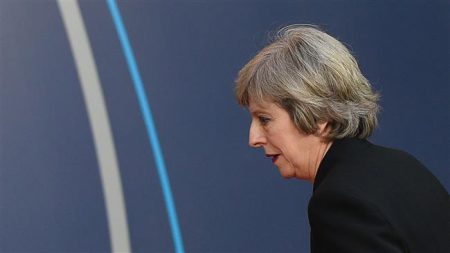
UK Prime Minister Theresa May will use the upcoming EU summit in Malta to demand Europe strengthen its commitment to NATO and spend more on defence.
May is expected to conduct a series of one-on-one meetings with EU leaders, including Germany’s Angela Merkel and Spain’s Mariano Rajoy, in order to secure “new, positive and constructive” relationships with the Union.
The prime minister, however, is not expected to attend the part of the talks in which Brexit will be discussed. Instead, she is using the summit as an opportunity to press the EU’s NATO members to fulfil their defence expenditure requirements.
According to a 2016 NATO report, only five of its 28 members actually reached the required defence spending limit of two percent. The list of those failing to spend enough includes Germany, France, and Spain.
Britain’s push for Europe to open its wallet comes after a meeting between Theresa May and US President Donald Trump last Friday.
At a joint press conference, May agreed with Trump that NATO spending should be “fairly shared” among its members.
Trump has in the past criticised NATO as being “obsolete” and “costing too much money.”
The president has also suggested that the US may not come to the assistance of NATO members who do not satisfy the two percent requirement.
May, however insisted she had received a “100 percent” commitment to NATO from the Trump administration. She also promised to “encourage fellow European leaders” to comply with their obligations.
It remains unclear how Britain will convince EU leaders to increase defence spending, as relations with Brussels have been significantly affected by Brexit. One possible way might be to emphasise the threat to European security that is supposedly posed by Russia.
Earlier this week, UK Defence Secretary Michael Fallon urged other NATO states to fulfil defence spending targets in order to effectively counter alleged Russian attempts to destabilise the continent.
Fallon has accused Russia of “becoming a strategic competitor to the West” and mounting a sophisticated information and cyber campaign against various NATO members.
Moscow has categorically denied these allegations, describing them as “baseless” and a “witch hunt.”
Read more:
UK minister accuses Russia of MH17 downing & ‘testing’ NATO, Moscow says claims ‘baseless’
RT | February 3, 2017
When British Defense Secretary Michael Fallon was asked to deliver a speech on ‘Russian resurgence’, he seized the opportunity to accuse Moscow of “annexing” Crimea, shooting down MH17 over Ukraine, and “testing” NATO. Russia calls the claims baseless.
Fallon’s speech at St. Andrews University on Thursday began kindly enough, speaking about the UK’s “renewed interest in Russian scientific and artistic achievement.”
However, the talk quickly changed course, with Fallon changing the focus to Russia’s so-called “military resurgence.”
Referring to the reunification of Crimea and Russia following a referendum in 2014, Fallon claimed the situation actually amounted to Russia illegally annexing the territory.
“Russia did not allow Ukraine to decide its own destiny like any other sovereign country,” he said. “Instead, under the guise of ambiguous and deniable instruments it annexed Crimea.”
Fallon’s anti-Russia rhetoric didn’t stop there. He went on to cite an inquiry by the Dutch-led Joint-investigative Team (JIT) which claims the MH17 tragedy was caused by a “Russian-provided missile.” He said that despite the finding, Moscow continues to deny its role in the tragedy.
Fallon failed to mention, however, that there are numerous issues surrounding that report, including the fact that the Dutch apparently couldn’t read raw radar data provided by Russia, yet failed to ask Moscow for help to decode it.
The discrepancies surrounding the inquiry have led to Major General Aleksandr Tazekhulakhov, the former deputy head of the Russian Army Air Defense, to accuse the Netherlands of trying to keep Moscow out of the investigation, likely in “yet another attempt to put the blame on Russia for something…”
The next phase of Fallon’s speech transitioned from Ukraine to Syria, in which he accused Russia of targeting the Syrian opposition in Aleppo “with little regard for innocent lives,” claiming that 80 percent of its strikes targeted non-Islamic State (IS, formerly ISIS/ISIL) targets.
However, Fallon seemed to conveniently forget that the US-led coalition in Syria – which includes the UK – just last month admitted to “unintentionally” killing at least 188 civilians in Syria and Iraq since 2014.
And while Fallon accused Russia of targeting civilians in Aleppo, he failed to mention a hospital set up by Russia in the city, despite the facility being hailed by the World Health Organization (WHO) last month.
“The WHO, same as the Syrian people – we’re very grateful to the Russians, the EMERCOM [Agency for Support and Coordination of Russian Participation in International Humanitarian Operations] gave a hospital to be used in the Jibreen [refugee] camp. The hospital provided by the Russian people has provided several hundred consultations and has been given by the Russian people to the Syrian people for the use by the central health authorities in Aleppo,” the WHO’s Elizabeth Hoff told RT.
Any typical bashing of Russia by the UK wouldn’t be complete without claims that Moscow is trying to “test” NATO, and Fallon didn’t disappoint.
“Russia is clearly testing NATO and the West,” Fallon said, accusing Moscow of “seeking to expand its sphere of influence, destabilize countries, and weaken the alliance.”
“It is undermining national security for many allies and the international rules-based system,” he continued.
Fallon was apparently in no mood to present a balanced argument during his speech, failing to mention NATO’s build-up of troops near Russia’s borders, or Moscow’s concern that NATO is compromising its national security.
The speech also included a healthy dose of the usual Western rhetoric, including allegations that Russia influenced the US presidential election by hacking into Democratic National Committee (DNC).
There was a touch of irony towards the end of Fallon’s speech, in which he said “we need to understand Russia better,” but then went on to accuse it of “reckless military activity” and “misinformation.”
“Russia could again become the partner the West always wished for…” he concluded.
However, based on Fallon’s speech, it seems Russia will only be a ‘partner’ to the UK and the West if it panders to their every wish.
Moscow responded to Fallon’s speech on Friday, calling his statements “baseless.”
“We express regret for this hostile stance of the minister. We are sure that such allegations are baseless,” Kremlin spokesman Dmitry Peskov told reporters, as quoted by Reuters.
Read more:
Crimea & Minsk Agreements: What the British media fails to mention
Ukraine Sabotages Trump’s Russia Detente
By Jonathan Marshall | Consortium News | February 1, 2017
Less than two weeks into office, President Trump faces one of the first big tests of his non-confrontational policy toward Russia. As new fighting erupts in Eastern Ukraine, the Kiev regime and its U.S. supporters are predictably demanding a showdown with Vladimir Putin.
Initial evidence suggests, however, that the latest flare-up in this nearly three-year-old conflict was precipitated by Kiev, possibly in the hope of forcing just such a confrontation between Washington and Moscow. It’s looking more and more like a rerun of a disastrous stunt pulled by the government of Georgia in 2008, which triggered a clash with Russia with the expectation that the George W. Bush administration would come to its rescue and bring Georgia into the NATO alliance.
After months of relative quiet, the fighting in Ukraine erupted on Jan. 28 around the city of Avdiivka, a now-decrepit industrial center. Eight pro-government fighters and five separatists apparently died in the first two days of hostilities. Meanwhile, residents of the city are struggling to survive heavy shelling and sub-zero weather with no heating.
Perennial critics of Russia were quick to blame Moscow for the renewed bloodshed. “We call on Russia to stop the violence (and), honor the cease-fire,” declared a State Department official.
The Washington Post’s reliably neo-conservative editorial page suggested that Russia felt liberated to unleash rocket and artillery barrages after Putin spoke with Trump by phone, with the goal of wrecking a meeting between Ukrainian President Petro Poroshenko and German Chancellor Angela Merkel.
The Russian onslaught “look(s) a lot like a test of whether the new president will yield to pressure from Moscow,” the Post declared, as if this were Czechoslovakia, 1938, all over again.
Poroshenko was quick to take advantage of the clash by asking, rhetorically, “Who would dare talk about lifting the sanctions in such circumstances?” Just last month, Austria’s foreign minister called for an easing of sanctions on Russia in return for “any positive development” in Ukraine. President Trump has been noncommittal about sanctions in the face of full-throated demands by congressional hawks in both parties to keep them in place.
Who’s to Blame?
The jury is still out on who provoked the latest violence, but Radio Free Europe/Radio Liberty, established by the U.S. government to broadcast propaganda during the height of the Cold War, reported Monday:
“Frustrated by the stalemate in this 33-month war of attrition, concerned that Western support is waning, and sensing that U.S. President Donald Trump could cut Kyiv out of any peace negotiations as he tries to improve fraught relations with Moscow, Ukrainian forces anxious to show their newfound strength have gone on what many here are calling a ‘creeping offensive.’
“Observers say the Ukrainians appear to be trying to create new facts on the ground . . . In doing so, the pro-Kyiv troops have sparked bloody clashes with their enemy, which has reportedly made advances of its own — or tried to — in recent weeks.”
A senior member of Europe’s Special Monitoring Mission to Ukraine warned, “The direct result of forward moves is escalation in tension, which often turns to violence.” How right he was.
It’s hard to see what Putin gains from new fighting, at a time when Trump faces an army of skeptics at home for his go-easy-on-Russia strategy. Poroshenko has everything to gain, on the other hand, by pressing Americans and West Europeans to reaffirm their support for his government, which took power after a 2014 coup that ousted elected President Viktor Yanukovych, who was strongly supported in eastern Ukraine and Crimea.
The Georgia Playbook
The situation is reminiscent of the August 2008 conflict between Russia and its neighbor on the Black Sea, Georgia. A bloody clash between the two countries’ armed forces in the tiny enclave of South Ossetia prompted a blast of militant rhetoric from American hawks.
Vice President Richard Cheney declared, “Russian aggression must not go unanswered.” Richard Holbrooke, who would become a senior adviser to the future President Obama, said, “Moscow’s behavior poses a direct challenge to European and international order.”
It may have been significant that the Georgian president’s paid U.S. lobbyist was also presidential candidate John McCain’s chief foreign policy adviser. As one analyst commented at the time, “McCain’s swift and belligerent response to the Soviet actions in Georgia has bolstered his shaky standing with the right-wing of the Republican Party. . . . Since the crisis erupted, McCain has focused like a laser on Georgia, to great effect. According to a Quinnipiac University National Poll released on August 19 he has gained four points on Obama since their last poll in mid-July and leads his rival by a two to one margin as the candidate best qualified to deal with Russia.”
Yet when the smoke settled, it turned out that Georgia, not Russia, had started the war by launching an artillery barrage against South Ossetia’s capital city. It was a ploy by Georgia’s President Mikheil Saakashvili to drag the West into supporting his campaign to take over the enclave.
The independent International Crisis Group had warned in 2007 that Georgia’s risky strategy of provoking “frequent security incidents could degenerate into greater violence.”
A year later, following the brief war with Russia, an ICG investigation reported authoritatively that it began with a “disastrous miscalculation by Georgian leadership,” who “launched a large-scale military offensive” into the Russian-occupied enclave, killing dozens of civilians and causing severe damage to South Ossetia’s capital from artillery barrages.
The report also criticized “Russia’s disproportionate counter-attack,” which it deemed a response to “the decade-long eastward expansion of the NATO alliance” and other grievances.
Putting blame aside, the ICG report observed that “The Russia-Georgia conflict has transformed the contemporary geopolitical world, with large consequences for peace and security in Europe and beyond.” Indeed, it marked one of the greatest setbacks in post-Cold War relations between Moscow and the West until the 2014 Ukraine crisis.
If the 2017 Ukraine crisis gets out of hand, the consequences for peace and security may be just as great or greater. It will be informative to see whether President Trump and his national security team get the straight facts before capitulating to the interventionists who want to see U.S.-Russian relations remain strained and volatile.
Referendum on NATO Accession Would Mean Kiev Surrendering Donbass – DPR
Sputnik – 02.02.2017
DONETSK – A referendum on Ukraine’s accession to NATO would mean Kiev’s ultimate renunciation of Donbass as the region is against joining the alliance, self-proclaimed Donetsk People’s Republic (DPR) leader Alexander Zakharchenko said Thursday.
In a recent interview with German daily Berliner Morgenpost, Ukrainian President Petro Poroshenko said he intended to hold a referendum on the country’s accession to NATO.
“An attempt to hold a referendum on Ukraine’s accession to NATO means Kiev is ultimately surrendering Donbass. First, because Donbass will not be able to participate in the referendum… Second, we have repeatedly said that one of the most important demands of Donbass is that Donbass calls for friendly and allied relations with Russia and, therefore, against NATO,” Zakharchenko told Sputnik.
In December 2014, Ukraine canceled its non-aligned status, confirming its intention to join NATO. Poroshenko said a referendum on NATO membership would be held by 2020, after all NATO requirements have been met.
German Academics Pen Open Letter Slamming Western Interpretation of Syria Crisis
Sputnik – 28.01.2017
In contrast to the West, which has been intent on destroying Syria and other Middle Eastern countries, Russia and Iran are playing a constructive role in preventing the overthrow of Assad and the formation of a fundamentalist Sunni government in the country, a group of German academics have written in an open letter.
A group of German university professors have penned a joint statement criticizing the mainstream media’s portrayal of the roles of Russia and Iran in regulation of the Syrian conflict, Sputnik Deutschland reported.
Called “a statement on the Syrian war,” the declaration was written by the scientific advisory board of the German branch of Attac, an international organization that campaigns for alternatives to globalization.
“Russia and Iran exhausted all the possibilities for a diplomatic and peaceful solution to the conflict; (although) such an attempt seemed be futile at first, they have for the time being ended military attacks and the war in Aleppo. Therefore, we think the attacks on Russia in the mainstream media are absurd,” they wrote.
The statement, written by 14 German university professors, recalls a 2011 interview with former NATO Secretary-General Wesley Clark, who revealed that just weeks after 9/11, the US had plans to not only invade Iraq, but five countries in the Middle East.
The Pentagon published a memo describing “how we’re going to take out seven countries in five years, starting with Iraq and then Syria, Lebanon, Libya, Somalia, Sudan and then finishing off (with) Iran,” Clark revealed.
With that aim in mind, the US has been preparing the conditions for regime change in Syria since 2005, including a media propaganda campaign against the Assad government.
The US also co-operated with Saudi Arabia, Qatar and Israel in the training and funding of an army of Sunni jihadists who were supposed to overthrow the governments in Damascus and then Tehran, as investigative journalist Seymour Hersh reported in 2007.
The researchers agree with the assessment of Professor Gunter Meyer, director of the Center for Research on the Arab World (CERAW) at the University of Mainz, who told Germany’s Heute news program last month that the US bears the “main responsibility” for the Syrian crisis, and that Russia’s operation in support of the Syrian government has thwarted the US plan to overthrow the Syrian government.
“The West, in particular the USA, has provided the rebel jihadists with weapons and also partially trained them. The equipment, personnel and logistics were mainly handled by Turkey, while the financial support came mainly from Saudi Arabia and Qatar. Saudi Arabia has helped Salafist extremists to establish a radical Islamist government in Syria. Here the conquest of Aleppo in 2012 was an important step for the jihadists,” Meyer said.
“Without the military intervention of Russia in September 2015, not only would Aleppo have been completely conquered by the jihadists, but the Assad regime would also have collapsed long ago. The Assad opponents under the leadership of the US would have achieved their goal of the regime change. However, the strongest military forces would have seized power, and this would be Islamic extremists such as the al-Nusra Front, which is part of the Al-Qaeda network, and the Islamic State (Daesh), which is being combated by the international alliance under US leadership. Putin can say to people like the Israeli politicians who declared that a terrorist regime is better than Assad, that he prevented that.”
The evacuation of Aleppo was completed in December after Turkey and Russia brokered a ceasefire deal between government forces and the rebels who had controlled parts of the city since 2012.
The researchers wrote that the efforts of Moscow and Tehran to reach a diplomatic settlement to the conflict in Syria are in contrast to the “regime change” philosophy of the West, where politicians and the media have failed to acknowledge their crucial involvement.”
A few days after the evacuation of Aleppo was declared to have ended, Russia, Turkey and Iran held a meeting where they offered a guarantee that from now on the Syrian conflict would be resolved through diplomatic channels and negotiations.”
“Here, too, we must realize with bitterness that not one Western politician has taken Vladimir Putin, Hassan Rouhani and Recep Tayyip Erdogan at their word and accepted their guarantee as important and constructive. Western politicians do not seem to be able to react to these kinds of peaceful political signals.”
Unfortunately, some civilians lost their lives in the course of the anti-terror operation in Aleppo. However, the Western media failed to provide any sense of balance to their coverage.
“It must be remembered that 40,000 Iraqi civilians — at least four times as many as in Aleppo — have died since August 2014 at the hands of the US-led coalition alone, of whom 15,000 were in the region of Mosul. Since 1980 the US has attacked, occupied or bombed 14 Muslim countries,” the academics wrote.
“We find it very disturbing that the Western media, including the signatories of the anti-Russian declaration, don’t say anything about the fatal US policy of regime change in the Middle East, let alone criticize it. So-called ‘failed states’ are the obvious result of this policy, which are breeding grounds for the further spread of terrorism and the main reason for persistent flows of refugees. We ask, how blind do you really have to be to overlook a reality that is so difficult to deny?”
Karl Rove’s Prophecy

Karl Rove. Credit: Jay Godwin/Wikimedia Commons
Karel van Wolferen • Unz Review • January 23, 2017
In a famous exchange between a high official at the court of George W. Bush and journalist Ron Suskind, the official – later acknowledged to have been Karl Rove – takes the journalist to task for working in “the reality-based community.” He defined that as believing “that solutions emerge from your judicious study of discernible reality.” Rove then asserted that this was no longer the way in which the world worked:
We’re an empire now, and when we act, we create our own reality. And while you’re studying that reality – judiciously, as you will – we’ll act again, creating other new realities, which you can study too, and that’s how things will sort out. We’re history’s actors . . . and you, all of you, will be left to just study what we do. (Ron Suskind, NYTimes Magazine, Oct. 17, 2004).
This declaration became popular as an illustration of the hubris of the Bush-Cheney government. But we could also see it as fulfilled prophecy. Fulfilled in a manner that no journalist at that time would have deemed possible. Yes, the neoconservatives brought disrepute upon themselves because of the disaster in Iraq. Sure, opposition to the reality Rove had helped create in that devastated country became a first rung on the ladder that could lead to the presidency, as it did for Barack Obama. But the neocons stayed put in the State Department and other positions closely linked to the Obama White House, where they became allies with the liberal hawks in continuing ‘spreading democracy’ by overthrowing regimes. America’s mainstream news and opinion purveyors, without demurring, accommodated the architects of reality production overseen by Dick Cheney.
This did not end when Obama became president, but in fact with seemingly ever greater eagerness they gradually made the CIA/neocon-neoliberal created reality appear unshakably substantial in the minds of most newspaper readers and among TV audiences in the Atlantic basin. This was most obvious when attention moved to an imagined existential threat posed by Russia supposedly aimed at the political and ‘Enlightenment’ achievements of the West. Neoconservatives and liberal hawks bent America’s foreign-policy entirely to their ultimate purpose of eliminating a Vladimir Putin who had decided not to dance to Washington’s tune so that he might save the Russian state, which had been disintegrating under his predecessor and Wall Street’s robber barons.
With President Obama as a mere spectator, the neocon/liberals could – without being ridiculed – pass off as a popular revolution the coup d’état they fomented in the Ukraine. And because of an unquestioned Atlanticist faith, which holds that without the policies of the United States the world cannot be safe for people of the Atlantic basin, the European elites that determine policy or comment on it joined their American counterparts in endorsing that reality.
As blind vassals the Europeans have adopted Washington’s enemies as their own. Hence the ease with which the European Union member states could be roped into a system of baseless economic sanctions against Russia, much to the detriment of their own economic interests. Layers upon layers of anti-Russian propaganda have piled up to bamboozle a largely unsuspecting public on both sides of the Ocean.
In the Netherlands, from where I have been watching all this, Putin was held personally responsible in much of the media for the shooting down of a Malaysian airliner flying over the Ukraine, which killed 298 people. No serious investigation was undertaken. The presentation of ‘almost definitive’ findings by the joint investigation team under Dutch leadership has neither included clues supplied by jet fighter cannon holes in the wrecked fuselage nor eyewitness stories, which would make the government in Kiev the prime suspect. Moscow’s challenging the integrity of the investigation, whose agreed-upon rules included publication of findings only if Kiev agreed with them, were met with great indignation by the Dutch Foreign and Prime Ministers.
As the fighting in Syria reached a phase when contradictions in the official Washington/NATO story demanded a stepping back for a fresh look, editors were forced into contortions to make sure that the baddies stayed bad, and that no matter how cruel and murderously they went about their occupation in Aleppo and elsewhere, the jihadi groups fighting to overthrow the secular Assad government in Damascus remained strictly labeled as moderate dissidents worthy of Western support, and the Russians as violators of Western values. Architects of an official reality that diverges widely from the facts you thought you knew must rely on faits accompli they achieve through military or police violence and intimidation, in combination with a fitting interpretation or a news blackout delivered by mainstream media.
These conditions have been widely obtained in the Atlantic basin through a gradual loss of political accountability at top levels, and through government agencies protected by venerated secrecy that are allowed to live lives of their own. As a result American and European populations have been dropped into a fantasy world, one under constant threat from terrorists and an evil dictator in Moscow. For Americans the never ending war waged by their own government, which leaves them with no choice but to condone mass murder, is supposedly necessary to keep them safe. For Europeans, at least those in the northern half, the numerous NATO tanks rolling up to the border of the Russian Federation and the massing of troops in that area are an extra guarantee, on top of the missiles that were already there, that Vladimir Putin will restrain his urges to grab a European country or two. On a smaller scale, when every May 4th the 1940-45 war dead are remembered in the Netherlands, we must now include the fallen in Afghanistan as if they were a sacrifice to defend us against the Taliban threat from behind the Hindu Kush.
Ever since the start of this millennium there has been a chain of realities as prophesied by Karl Rove, enhanced by terrorist attacks, which may or may not have been the work of actual terrorists, but whose reality is not questioned without risking one’s reputation. The geopolitical picture that they have helped build in most minds appears fairly consistent if one can keep one’s curiosity on a leash and one’s sense of contradiction sufficiently blunt. After all, the details of the official reality are filled in and smoothed out all the time by crafty campaigns produced in the PR world, with assistance from think tanks and academia.
But the question does reappear in one’s thoughts: do the politically prominent and the well-positioned editors, especially those known for having once possessed skeptical minds, actually believe it all? Do those members of the cabinet or parliament, who can get hot under their collar as they decry the latest revelation about one or other outrage committed by Putin, take seriously what they’re saying? Not all of them are believers, I know that from off the record conversations. But there appears to be a marked difference between the elite in government, in the media, in prominent social positions, and ordinary people who in these recent times of anguish about populism are sometimes referred to as uneducated. Quite a few among the latter appear to think that something fishy is going on. This could be because in my experience the alert ones have educated themselves, something that is not generally understood by commentators who have made their way through the bureaucracy of standard higher education.
A disadvantage of being part of the elite is that you must stick to the accepted story. If you deviate from it, and have your thoughts run rather far away from it, which is quite inevitable once you begin with your deviation, you can no longer be trusted by those around you. If you are a journalist and depend for your income on a mainstream newspaper or are hired by a TV company, you run the risk of losing your job if you do not engage in self-censorship.
Consequently, publications that used to be rightly known as quality newspapers have turned into unreadable rags. The newspaper that was my employer for a couple of decades used to be edited on the premise that its correspondents rather than authorities were always correct in what they were saying. Today greater loyalty to the reality created in Washington and Langley cannot be imagined. For much of northern Europe the official story that originates in the United States is amplified by the BBC and other once reliable purveyors of news and opinion like the Guardian, the Financial Times and the (always less reliable) Economist.
Repetition lends an ever greater aura of truth to the nonsense that is relentlessly repeated on the pages of once serious publications. Detailed analyses of developments understood through strings of false clues give the fictions ever more weight in learned heads and debates in parliament. At the time of writing, the grave concern spread across the opinion pages on my side of the Atlantic is about how Putin’s meddling in upcoming European elections can be prevented.
The realities Rove predicted have infantilized parliamentary debates, current affairs discussion and lecture events, and anything of a supposedly serious nature on TV. These now conform to comic book simplicities of evil, heroes and baddies. They have produced a multitude of editorials with facts upside-down. They force even those who advise against provoking Moscow to include a remark or two about Putin being a murderer or tyrant, lest they could be mistaken for traitors to Enlightenment values or even as Russian puppets, as I have been. Layers of unreality have incapacitated learned and serious people to think clearly about the world and how it came to be that way.
How could Rove’s predictions so totally materialize? There’s a simple answer: ‘they’ got away with momentous lies at an early stage. The more authorities lie successfully the more they are likely to lie again in a big way to serve the purposes of earlier lies. The ‘they’ stands for those individuals and groups in the power system who operate beyond legal limits as a hydra-headed entity, whose coordination depends on the project, campaign, mission, or operation at hand. Those with much power got away with excessive extralegal use of it since the beginning of this century because systems of holding the powerful to account have crumbled on both sides of the Atlantic. Hence, potential opposition to what the reality architects were doing dwindled to almost nothing. At the same time, people whose job or personal inclination leads them to ferret out truth were made to feel guilty for pursuing it.
The best way, I think, to make sense of how this works is to study it as a type of intimidation. Sticking to the official story because you have to may not be quite as bad as forced religious conversion with a gun pointed at your head, but it belongs to the same category. It begins with the triggering of odd feelings of guilt. At least that is how I remember it. Living in Tokyo, I had just read Mark Lane’s Rush To Judgment, the first major demolishing in book form of the Warren Report on the murder of John F. Kennedy, when I became aware that I had begun to belong to an undesirable category of people who were taking the existence of conspiracies seriously. We all owe thanks to writers of Internet-based samizdat literature who’ve recently reminded us that the pejorative use of the conspiracy label stems from one of the greatest misinformation successes of the CIA begun in 1967.
So the campaign to make journalists feel guilty for their embarrassing questions dates from before Dick Cheney and Rove and Bush. But it has only reached a heavy duty phase after the moment that I see as having triggered the triumph of political untruth.
We have experienced massive systemic intimidation since 9/11. For the wider public we have the absurdities of airport security – initially evidenced by mountains of nail-clippers – reminding everyone of the arbitrary coercive potential that rests with the authorities. Every time people are made to take off their belts and shoes – to stick only to the least inane instances – they are reminded: yes, we can do this to you! Half of Boston or all of France can be placed under undeclared martial law to tell people: yes, we have you under full control! For journalists unexamined guilt feelings still play a major role. The serious ones feel guilty for wanting to ask disturbing questions, and so they reaffirm that they still belong to ‘sane’ humanity rather than the segment with extraterrestrials in flying saucers in its belief system. But there is a confused interaction with another guilty feeling of not having pursued unanswered questions. Its remedy appears to be a doubling down on the official story. Why throw in fairly common lines like “I have no time for truthers” unless you feel that this is where the shoe pinches?
You will have noticed a fairly common response when the 9/11 massacre enters a discussion. Smart people will say that they “will not go there”, which brings to mind the “here be dragons” warning on uncharted bits of medieval maps. That response is not stupid. It hints at an understanding that there is no way back once you enter that realm. There is simply no denying that if you accept the essential conclusions of the official 9/11 report you must also concede that laws of nature stopped working on that particular day. And, true enough, if you do go there and bear witness publicly to what you see, you may well be devoured; your career in many government positions, the media and even academia is likely to come to an end.
So, for the time being we are stuck with a considerable chunk of terra incognita relating to recognized political knowledge; which is an indispensable knowledge if you want to get current world affairs and the American role in it into proper perspective.
Mapping the motives of those who decide “not to go there” may be a way to begin breaking through this disastrous deadlock. Holding onto your job is an honorable motivation when you have a family to maintain. The career motivation is not something to scorn. There is also an entirely reasonable expectation that once you go there you lose your voice publicly to address very important social abuse and political misdeeds. I think it is not difficult to detect authors active on internet samizdat sites who have that foremost in mind. Another possible reason for not going there is the more familiar one, akin to the denial that one has a dreadful disease. Also possible is an honorable position of wishing to preserve social order in the face of a prospect of very dramatic political upheaval caused by revelations about a crime so huge that hardly anything in America’s history can be compared to it. Where could such a thing end – civil war? Martial law?
What I find more difficult to stomach is the position of someone who is worshiped by what used to be the left, and who has been guiding that class of politically interested Americans as to where they can and cannot go. Noam Chomsky does not merely keep quiet about it, but mocks students who raise logical questions prompted by their curiosity, thereby discouraging a whole generation studying at universities and active in civil rights causes. One can only hope that this overrated analyst of the establishment, who helps keep the most embarrassing questions out of the public sphere, trips over the contradictions and preposterousness of his own judgments and crumples in full view of his audience.
The triumph of political untruth has brought into being a vast system of political intimidation. Remember then that the intimidater does not really care what you believe or not, but impresses you with the fact that you have no choice. That is the essence of the exercise of brute power. With false flag events the circumstantial evidence sometimes appears quite transparently false and, indeed could be interpreted as having been purposeful. Consider the finding of passports or identity papers accidentally left by terrorists, or their almost always having been known to and suspected by the police? What of their death through police shooting before they can be interrogated? Could these be taunting signals of ultimate power to a doubting public: Now you! Dare contradict us! Are the persons killed by the police the same who committed the crime? Follow-up questions once considered perfectly normal and necessary by news media editors are conspicuous by their absence.
How can anyone quarrel with Rove’s prophecy. He told Suskind that we will forever be studying newly created realities. This is what the mainstream media continue to do. His words made it very clear: you have no choice!
A question that will be in the minds of perhaps many as they consider the newly sworn in president of the United States, who like John F. Kennedy appears to have understood that “Intelligence” leads a dangerously uncontrolled life of its own: At what point will he give in to the powers of an invisible government, as he is made to reckon that he also has no choice?
Karel van Wolferen is a Dutch journalist and retired professor at the University of Amsterdam. Since 1969, he has published over twenty books on public policy issues, which have been translated into eleven languages and sold over a million copies worldwide. As a foreign correspondent for NRC Handelsblad , one of Holland’s leading newspapers, he received the highest Dutch award for journalism, and over the years his articles have appeared in The New York Times , The Washington Post , The New Republic , The National Interest , Le Monde , and numerous other newspapers and magazines.
Some 1,000 People Participated in Anti-NATO Protest in Northeastern Italy
Sputnik – 22.01.2017
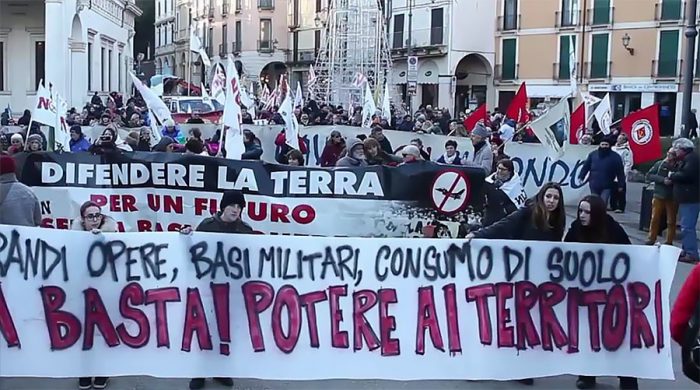
VICENZA – About 1,000 protesters participated on Saturday in a demonstration against NATO bases and major infrastructure projects of the local authorities, such as construction of a motorway and a railway for high-speed trains, in the city of Vicenza, located in northeastern Italy.
According to a RIA Novosti correspondent, the march was headed by the No Dal Molin Movement, opposing a US airbase located in the north of the city. The protesters carried a huge banner, saying “Protection of land for the future without military bases.”
“Until the people do not mobilize, until they put pressure on the government to expel the US military from our territory, politicians will do nothing as they are not interested in it. Politicians should be forced to give us an answer, and now they do not want to do this at the moment,” one of the march’s organizers Francesco Pavin told RIA Novosti.
The demonstration was sanctioned by local authorities and was accompanied by a police escort.
There are a total of four NATO bases in the Vicenza area.
During his presidential campaign, US President Donald Trump repeatedly stated that the United States should decrease the support of other NATO member states and protect only those members of the alliance, who “fulfill their obligations” in respect to Washington.
Mainstream British Press Propaganda Ramps Up Dangerous War Rhetoric
By Graham Vanbergen | TruePublica | January 18, 2017
The British press are in full hysteria propaganda mode when it comes to demonising our new greatest threat on planet earth; not climate change, a global pandemic, international terrorism, or America’s new foe in the South China Sea – but Russia.
The Telegraph 31/12/16: “Systemic, relentless, predatory’ Russian cyber threat to US power grid exposed as malware found on major electricity company computer.”
The Independent 13/12/16: “Highly probable Russian interfered with Brexit referendum.”
The Express 15/01/17: “Russians forcing RAF to abort missions in Syria by ‘hacking into’ their systems”
The Guardian 14/01/17: “Senior British politicians ‘targeted by Kremlin’ for smear campaigns”
In all of these newspaper reports, and there are plenty more of them, not a single scrap of actual evidence other than hearsay is published. In the case of the Express story, it’s allegations are backed up with the statement “It is entirely feasible that Russia has targeted Tornadoes and Typhoons in this way,” said air defence expert Justin Bronk, of the Royal United Services Institute think-tank.” This is not evidence.
In the case of the Telegraph, this fairy-tail has been 100% debunked as pure propaganda and the original report from the Washington Post ended with a full-on apology by its editor. The Telegraph has printed no such amendment or apology for its totally fictitious article.
The Guardian’s headline is pure misinformation as it’s sole point of evidence is an MP (Chris Bryant), explaining that incumbent Foreign Office ministers could not speak out on the (Russian hacking) issue because of security connotations, and said: “Any minister who goes into the Foreign Office and has responsibility for Russia, they [Moscow] will be, in any shape or form, trying to put together information about them.” As if to strengthen the ‘evidence’, Bryant says he is “absolutely certain that Boris Johnson, Liam Fox, Alan Duncan who has the Russia brief, and [Brexit secretary] David Davis will have been absolutely looked at.” This is not evidence.
The funny thing is this; the story may be true and quite probably is, but so what.
In October 2015, Britain’s own spy agency confirmed it was spying on Britain’s MP’s and at the time was given court immunity when challenged. It determined that MPs’ communications were not protected from surveillance by intelligence agencies. This case came about because Green Party MP Caroline Lucas, Baroness Jenny Jones and former MP George Galloway, [observed] that revelations from Edward Snowden, showed MPs’ communications were being spied on by GCHQ despite laws protecting them.
Around the same time we learn that a well known paedophile ran a lodge set up by GCHQ for its spies to monitor important political ‘targets’ ie our own MP’s and other public figures.
Back in 1983 Margaret Thatcher used Britain’s latest and most advanced surveillance system named ‘Echelon’ (Read: ECHELON – The Start of Britain’s Modern Day Spying Operations) to Spy on Government Ministers’. It was an American design and the first major state surveillance system using satellite and IT systems to spy worldwide. Indeed Echelon was originally created in the 1960s to monitor the military and diplomatic communications of the Soviet Union and its Eastern Bloc allies throughout the Cold War by Britain and America. All of this data being shared with America, a foreign government.
America’s NSA monitored the phone conversations of 35 world leaders in another Snowden leak three years ago. Germany’s Spiegel reported in 2014 that “Documents show Britain’s GCHQ signals intelligence agency has targeted European, German and Israeli politicians for surveillance.” So distrustful of the British that Chancellor Merkel announced a counter-espionage offensive designed to curb mass surveillance conducted by the US NSA and its British counterpart, GCHQ. Today it is reported by IntelNews that the “discord between British and German intelligence services, which began at the same time in 2014, allegedly persists and now constitutes the “biggest rift between the secret services” of the two countries “since World War II”.
Just six months ago we found out that “GCHQ and NSA routinely spy on UK politicians’ e-mails” that included privileged correspondence between parliamentarians and their constituents and before that, internal MI5, MI6 and GCHQ documents reveal routine interception of legally privileged communications. The information obtained was exploited unlawfully to be used by the agencies in the fighting of court cases in which they themselves were involved.
Amazingly, we recently find out just last week that Israeli embassy staff, quite likely Mossad operatives – “are working with senior political activists and politicians in the Conservative and Labour parties to subvert their own parties from within, and skew British foreign policy so that it benefits Israeli, rather than British interests.” And yet, there has been little comment in the British press about foreign infiltration of government minsters by Israel.
If Russia were not spying on our MP’s, they would be the only ones not at it. No-one trusts anyone. Spying is old news and fully expected. We are ALL being spied on nowadays.
The British press are complicit in their reckless rhetoric designed to instill fear into the population with dangerous propaganda that could easily lead to tensions becoming so dangerous that a real ‘hot war’ starts. Whilst America is shielded by continental Europe and the Atlantic ocean, Britain could be used as a pawn to be sacrificed on the international chess-game of winner-takes-all. We have no ‘special-relationship’, there never has been one, and an irresponsible press being a mouthpiece that ramps up the stress between the US/NATO and Russia is absolutely against the interests and national security of Britain.
As Laurence Krauss’s (chair of the board of sponsors of The Bulletin of the Atomic Scientists, and is on the board of the Federation of American Scientists) article last October alarmingly points out – “Trump has said he would consider using nuclear weapons against ISIS and suggested that it would be good for the world if Japan, South Korea, and Saudi Arabia acquired them.” Trump could be one seriously dangerous individual for world peace – who knows!
So much for Trump but as Krauss goes on to say that “In general, during the Obama presidency, we have only deepened our dangerous embrace of nuclear weapons. At the moment, around a thousand nuclear weapons are still on a hair-trigger alert; as they were during the Cold War, they are ready to be launched in minutes in response to a warning of imminent attack.”
Who in their right mind would support this lunacy?
France’s Self-Inflicted Refugee Crisis
By Ulson Gunnar – New Eastern Outlook – 22.01.2017
Following rhetoric regarding Europe’s refugee crisis, one might assume the refugees, through no fault of Europe’s governments, suddenly began appearing by the thousands at Europe’s borders. However, this simply is not true.
Before the 2011 wave of US-European engineered uprisings across the Middle East and North Africa (MENA) transformed into Western military interventions, geopolitical analysts warned that overthrowing the governments in nations like Libya and Syria, and Western interventions in nations like Mali and the Ivory Coast, would lead to predicable regional chaos that would manifest itself in both expanding terrorism across the European and MENA region, as well as a flood of refugees from destabilized, war-racked nations.
Libya in particular, was singled out as a nation, if destabilized, that would transform into a springboard for refugees not only fleeing chaos in Libya itself, but fleeing a variety of socioeconomic and military threats across the continent. Libya has served for decades as a safe haven for African refugees due to its relative stability and economic prosperity as well as the Libyan government’s policy of accepting and integrating African refugees within the Libyan population.
Because of NATO’s 2011 military intervention and the disintegration of Libya as a functioning nation state, refugees who would have otherwise settled in Libya are now left with no choice but to continue onward to Europe.
For France in particular, its politics have gravitated around what is essentially a false debate between those welcoming refugees and those opposed to their presence.
Absent from this false debate is any talk of French culpability for its military operations abroad which, along with the actions of the US and other NATO members, directly resulted in the current European refugee crisis.
France claims that its presence across Africa aims at fighting Al Qaeda. According to RAND Corporation commentary titled, “Mali’s Persistent Jihadist Problem,” it’s reported that:
Four years ago, French forces intervened in Mali, successfully averting an al Qaeda-backed thrust toward the capital of Bamako. The French operation went a long way toward reducing the threat that multiple jihadist groups posed to this West Africa nation. The situation in Mali today remains tenuous, however, and the last 18 months have seen a gradual erosion of France’s impressive, initial gains.
And of course, a French military presence in Mali will do nothing to stem Al Qaeda’s activities if the source of Al Qaeda’s weapons and financial support is not addressed. In order to do this, France and its American and European allies would need to isolate and impose serious sanctions on Saudi Arabia and Qatar, two nations which exist as the premier state sponsors of not only Al Qaeda, but a myriad of terrorist organizations sowing chaos worldwide.
Paradoxically, instead of seeking such sanctions, the French government instead sells the Saudi and Qatari governments billions of dollars worth of weaponry, proudly filling in any temporary gaps in the flow of weapons from the West as each nation attempts to posture as “concerned” about Saudi and Qatari human rights abuses and war crimes (and perhaps even state sponsorship of terrorism) only to gradually return to pre-sanction levels after public attention wanes.
The National Interest in an article titled, “France: Saudi Arabia’s New Arms Dealer,” would note:
France has waged a robust diplomatic engagement with Saudi Arabia for years. In June, Saudi Deputy Crown Prince Mohammed bin Salman visited France to sign deals worth $12 billion, which included $500 million for 23 Airbus H145 helicopters. Saudi and French officials also agreed to pursue feasibility studies to build two nuclear reactors in the kingdom. The remaining money will involve direct investment negotiated between Saudi and French officials.
The article would also note that Saudi Arabia’s junior partner in the state sponsorship of global terror, Qatar, would also benefit from French weapon deals:
Hollande’s address was delivered one day after he was in Doha, where he signed a $7 billion deal that included the sale of 24 French Rafale fighter jets to Qatar, along with the training of Qatari intelligence officers.
In order to truly fight terrorism, a nation must deal with it at its very source. Since France is not only ignoring the source of Al Qaeda’s military, financial and political strength, but is regularly bolstering it with billions in weapons deals, it is safe to say that whatever reason France is involved across MENA, it is not to “defeat” Al Qaeda.
The refugee crisis that has resulted from the chaos that both Western forces and terrorists funded and armed by the West’s closest regional allies, Saudi Arabia and Qatar, is a crisis that is entirely self-inflicted. The rhetoric surrounding the crisis, on both sides, ignoring this fundamental reality, exposes the manufactured and manipulative nature of French government and opposition agendas.
The chaos across MENA is so significant, and terrorism so deeply rooted in both Western and their Arab allies’ geopolitical equations that even a complete reversal of this destructive policy will leave years if not decades of social unrest in the wake of the current refugee crisis.
But for anyone genuinely committed to solving this ongoing crisis, they must start with the US, European, and Gulf monarchies’ culpability, and resist blaming the refugees or those manipulated into reacting negatively to them. While abuses carried out by refugees or locals are equally intolerable, those responsible for the conflicts and for manipulating both sides of this crisis are equally to blame.
Until that blame is properly and proportionately placed, and the root of the crisis addressed, it will only linger and cause further damage to regional and global security.
Ukraine May Have a New President in Waiting, But He’s Another Oligarch
Sputnik | January 21, 2017
In December, Ukrainian billionaire Victor Pinchuk wrote an explosive op-ed in The Wall Street Journal, laying out how Ukraine can end its conflict with Russia. Pinchuk’s plan is simple: Kiev must close its eyes on Crimea, proceed with elections in Donbass, and forget NATO. Unfortunately, elites in Kiev see his ideas as nothing less than treasonous.
Pinchuk’s appeal, published in the opinion pages of the WSJ on December 29, laid out his vision on how the new administration in Washington can try to sort out the mess in Kiev in the interests of improving relations with Moscow.
Kiev, the billionaire steel magnate wrote, must be willing to compromise, including making a genuine effort to end the civil war that’s being waged in the country’s east. Ukrainian authorities must accept local elections in the breakaway territories, and live up to their commitments under the Minsk agreements, as must Russia, the oligarch added. Crimea, he said, “must not get in the way of a deal that ends the war in the east on an equitable basis.”
Kiev sent the Ukrainian army to deal with unrest in eastern Ukraine in April 2014, after protesters refused to recognize the legitimacy of authorities who came to power in the February 2014 coup d’état. In March 2014, Crimean authorities organized a referendum, asking the peninsula’s residents if they wanted Crimea to rejoin Russia. A whopping 96% voted ‘yes’, and Moscow soon accepted the peninsula’s request.Pinchuk also made proposals on other, related fronts, suggesting that Ukraine “should consider temporarily eliminating EU membership from our stated goals for the near future.” As for NATO membership, he stressed that Kiev should “accept that Ukraine will not join NATO in the near- or midterm.” For now, he said, the country should choose neutrality. He even hinted that Kiev would be “ready to accept an incremental rollback of sanctions on Russia” if that helps to restore peace, unity and security to the country.
Pinchuk’s ideas didn’t include anything radically outside the reigning political orthodoxy in Ukraine. He didn’t propose recognizing Crimea as part of Russia, and maintained that Moscow was to blame for “initiating” the conflict in the east.
Nevertheless, as expected, the billionaire’s op-ed caused uproar both in the Ukrainian media and in political circles. Ukrainian President Petro Poroshenko thundered that Kiev would never compromise on Russian ‘aggression’, and stressed that he would never abandon plans to join NATO and integrate into the EU. Pundits called the op-ed “An offer to surrender,” condemned Pinchuk’s “tone of appeasement” and defiantly proclaimed that Ukrainians would never accept his peace proposals.
Eventually, Pinchuk was even forced to apologize for publishing the article, blaming heavy editing and WSJ’s provocative headline, which read ‘Ukraine Must Make Painful Compromises for Peace With Russia.’So what was actually behind this political storm in a teacup? According to Radio Sputnik contributor Daria Cherednik, Kiev was mistaken to see Pinchuk’s op-ed a “treacherous blow to the back,” since the jab was actually “direct, open, and frontal – right in the stomach.”
With the publication of the editorial, Cherednik wrote, “all Poroshenko’s horses and all of his men were suddenly alarmed overnight, since the throne under the king had clearly started to wobble.” In fact, she added, not only was the throne wobbling, “but a contender has appeared for the king’s seat. At least that’s how it appeared to the Ukrainian president himself, and to his entourage saw things,” accusing Pinchuk of “filing down the throne’s legs.”
Pinchuk, the journalist recalled, has long been a notable figure in Ukraine’s circles of power. He’s married to the daughter of former President Leonid Kuchma, and is valued at $1.5 billion, making him the third richest person in Ukraine. “But most importantly,” Cherednik added, “he hasn’t been tainted in any political scandal.”Pinchuk “even managed to help finance Hillary Clinton’s election campaign without creating problems with Donald Trump,” the journalist wrote. The oligarch had indeed used the Victor Pinchuk Foundation to make millions of dollars in contributions to the Clinton Foundation, but also paid $150,000 to the Trump Foundation in exchange for a speech by then-candidate Trump in September 2015.
The billionaire’s op-ed in the WSJ was perceived as a stab in the back for obvious reasons, Cherednik stressed. “How else could the current Ukrainian establishment perceive Pinchuk after such ‘seditious speeches’? It would be one thing if he presented his ideas on some local television channel, something that could be cast off as insane and forgotten. But he published his thoughts in an American newspaper. What if the White House reads the article (it surely has) and thinks that Victor Pinchuk is a reasonable figure who’s able to negotiate, and therefore a very suitable candidate for the presidency?”
Kiev certainly didn’t appreciate Pinchuk’s “creative” approach, Cherednik suggested. “Poroshenko and his staff even refused to participate in the traditional breakfast organized by the businessman in Davos on Thursday. And that’s a shame. David Cameron and Henry Kissinger decided that this would be quite a worthy event and did not reject the invitation.” Ultimately, the journalist noted, President Poroshenko was left “standing outside the door at Davos salivating, not just because of the lost opportunities for a delicious meal, but also for the lost company.”
Featured Video
Prof Seyed Marandi: Will the US Collapse the Global Economy?
or go to
Aletho News Archives – Video-Images
From the Archives
The toxic legacy of nuclear weapons testing serves as a stark warning of the danger these weapons pose
By Scott Ritter | RT | March 11, 2021
Millions of people suffer and die from the effects of radiation exposure from decades of nuclear weapons testing. Their experience should give serious pause to those who continue to embrace the viability of a nuclear deterrent. … continue
Blog Roll
 Aletho News
- 13-18 DAYS: The PRACTICAL DIESEL BUFFER… Does It Preclude Bombing Iran?
- Prof Seyed Marandi: WILL the US COLLAPSE the GLOBAL ECONOMY?
- Larry Sanger Said Wikipedia Punishes Dissent. Then It Banned Him.
- How Darializa Avila Chevalier Is Different From Other Elected Progressives
- Israel Declares 464 Dunams in Sinjil as “State Land”
- Strait of Hormuz as strategic red line: Why Iran must confront Oman’s corridor plan and Trump’s threats
- House to vote on proposal ending $3.3bln in military aid to ‘Israel’
- Mission unaccomplished – Part I: America failed to achieve every war objective against Iran
- Iranian Victory – Gulf States Creating ‘Regional Security Framework’ With Iran
- IRGC Navy rejects new Strait of Hormuz shipping routes
- If Americans Knew
- Gaza ceasefire talks back to square one as Israel changes the rules – Daily Update
- The NDAA Proposed Merger of the U.S. and Israeli Military is Strategically Unwise and Inherently Unconstitutional
- Victories by Pro-Palestinian Democrats Show the Party’s Shift on Israel
- Massie moves to strike $3.3B in Israel military aid from the budget
- How Jeffrey Epstein’s Israeli Network Shaped Congo’s Deadly Mineral Trade
- Gaza officials warn of ‘silent famine’ as aid deliveries fall far below planned levels
- Wheat harvest becomes act of defiance as West Bank farmers race to outrun Israeli settler attacks
- The ICC must investigate Israel’s genocidal use of sexual violence
- The Myth of Israeli Self-Sufficiency
- Internal Documents Show Trump’s “Board of Peace“ Moving to Crush Palestinian Self-Determination
- No Tricks Zone
- 2025 Study: Cloud Effects Reduce Downwelling Longwave Radiation, Overriding The CO2 Impact
- 3 New Studies Find Increasing Trends In Solar Radiation Since The 1980s – Easily Explaining Warming
- THE TRANSCEIVER PARADOX: Why Organoid Intelligence (OI) Could Become Our Ultimate Alien Predator
- German Wind Turbines Face Regulatory Shutdown Due To Excessive Noise
- New Study: Chile’s Relative Sea Level Was 3.2 Meters Higher Than Today During The Mid-Holocene
- Beyond The Pitch: Why FIFA’s World Cup Is One Of Humanity’s Best Investments
- Climate Alarmists Now Using Natural Phenomena To Support Their Claims
- New Study: Significant CO2 Fluxes From Non-Volcanic Sources Are Largely Neglected In Carbon Budgets
- Women Climate Scientists Being Harassed, Insulted By Skeptics, Claims Berkeley Earth Researcher
- Germany’s Longterm Spring Climate Data Show “No Climate Trend”
 Aletho News
