Reports surfacing in the British media of a Russian plot to kill Montenegro’s former prime minister Milo Djukanovic should be seen for the cynical ploy they are. To give just the smallest bit of defense to these British publications – yes, it is true Djukanovic is making these allegations. Is there any substance or proof to these allegations? No. The UK media has shown it is as politicized as its American mainstream counterparts like CNN by publishing such fake news.
Good reason to doubt these baseless charges starts from the fact that they come from Djukanovic, who has a stupendous reputation for corruption and is trying to move forward desperately with NATO accession for Montenegro which has stalled in the U.S. Senate for about two months. At this point if he were to say the sky is blue, it would be reason to disbelieve him and look for an ulterior motive.
Djukanovic transparently is throwing this red meat on the table in the context of hysteria that is going on in Washington concerning allegations of Moscow’s hacking the American election (“the Russians did it!”) and the open attack by the “deep state,” by elements of the intelligence community with their leaks, and by the mainstream media that just claimed the scalp of general Mike Flynn, President Donald Trump’s former National Security Adviser. Besides criminally seeking to overthrow the constitutionally elected government – as they have imposed “regime change” on other countries – they want to do anything they can to block any rapprochement from the Trump administration with Moscow.
Djukanovic has very artfully inserted himself into this narrative. His message is simple: you can’t let the Russians win. Nothing else matters. He is trying to use “the Russians are coming” meme as a way to jumpstart Montenegro’s stalled NATO bid. Let’s remember the debate in Washington isn’t about letting Montenegro into NATO because having it as an ally makes American more secure. Montenegro obviously does nothing for our defense. The question is whether the NATO door will remain open, particularly for Georgia and Ukraine.
It seems no one cares to ask why America should be allied with a nation that doesn’t particularly want to be allied with us. According to opinion polls, it is far from clear that most Montenegrins want to be in NATO and aligned to us in the first place. Most recent polls indicate a slight plurality in the “against” camp despite relentless government propaganda and the braying of Soros-controlled media. A recent survey indicated that some 84% of Montenegrins want a vote on the matter. Even a solid majority of NATO supporters favor a referendum. Djukanovic won’t hold a referendum because he knows he would lose it.
Djukanovic’s ploy is well timed. It both feeds and feeds off of the anti-Russian frenzy, which is the basis of what former Congressman Denis Kucinich has called an attempted coup to bring down the Trump administration. Calls are openly heard for “patriots” in the intelligence services to overthrow Trump for the “good of the country.”
It is uncertain whether Djukanovic will successfully ride the wave of Russophobia to get Montenegro into NATO. What is certain is that America is on the edge of turning into a banana republic. Trump has very little time to strike back, hard. One way for him to show who’s boss is to turn thumbs down on Djukanovic and his trickery.
February 26, 2017
Posted by aletho |
Fake News, Mainstream Media, Warmongering | Montenegro, NATO, United States |
Leave a comment
Opponents of the Trump administration have generally accepted as fact the common theme across mainstream media that aides to Donald Trump were involved in some kind of illicit communications with the Russian government that has compromised the independence of the administration from Russian influence.
But close analysis of the entire series of leaks reveals something else that is equally sinister in its implications: an unprecedented campaign by Obama administration intelligence officials, relying on innuendo rather than evidence, to exert pressure on Trump to abandon any idea of ending the New Cold War and to boost the campaign to impeach Trump.
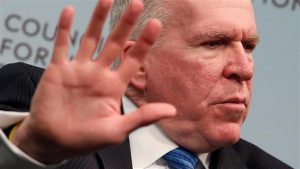 A brazen and unprecedented intervention in domestic U.S. politics by the intelligence community established the basic premise of the cascade of leaks about alleged Trump aides’ shady dealing with Russia. Led by CIA Director John Brennan, the CIA, FBI and NSA issued a 25-page assessment on Jan. 6 asserting for the first time that Russia had sought to help Trump win the election.
Brennan had circulated a CIA memo concluding that Russia had favored Trump and had told CIA staff that he had met separately with Director of National Intelligence James Clapper and FBI Director James Comey and that they had agreed on the “scope, nature and intent of Russian interference in our presidential election.”
In the end, however, Clapper refused to associate himself with the document and the NSA, which agreed to do so, was only willing to express “moderate confidence” in the judgment that the Kremlin had sought to help Trump in the election. In intelligence community parlance, that meant that the NSA considered the idea the Kremlin was working to elect Trump was merely plausible, not actually supported by reliable evidence.
In fact, the intelligence community had not even obtained evidence that Russia was behind the publication by Wikileaks of the e-mails Democratic National Committee, much less that it had done so with the intention of electing Trump. Clapper had testified before Congress in mid-November and again in December that the intelligence community did not know who had provided the e-mails to WikiLeaks and when they were provided.
The claim – by Brennan with the support of Comey – that Russia had “aspired” to help Trump’s election prospects was not a normal intelligence community assessment but an extraordinary exercise of power by Brennan, Comey and NSA Director Mike Rogers.
Brennan and his allies were not merely providing a professional assessment of the election, as was revealed by their embrace of the the dubious dossier compiled by a private intelligence firm hired by one of Trump’s Republican opponents and later by the Clinton campaign for the specific purpose of finding evidence of illicit links between Trump and the Putin regime.
Salacious Gossip
When the three intelligence agencies gave the classified version of their report to senior administration officials in January they appended a two-page summary of the juiciest bits from that dossier – including claims that Russian intelligence had compromising information about Trump’s personal behavior while visiting Russia. The dossier was sent, along with the assessment that Russia was seeking to help Trump get elected, to senior administration officials as well as selected Congressional leaders.
Among the claims in the private intelligence dossier that was summarized for policymakers was the allegation of a deal between the Trump campaign and the Putin government involving full Trump knowledge of the Russian election help and a Trump pledge – months before the election – to sideline the Ukraine issue once in office. The allegation – devoid of any verifiable information – came entirely from an unidentified “Russian emigre” claiming to be a Trump insider, without any evidence provided of the source’s actual relationship to the Trump camp or of his credibility as a source.
After the story of the two-page summary leaked to the press, Clapper publicly expressed “profound dismay” about the leak and said the intelligence community “has not made any judgment that the information in this document is reliable,” nor did it rely on it any way for our conclusions.”
One would expect that acknowledgment to be followed by an admission that he should not have circulated it outside the intelligence community at all. But instead Clapper then justified having passed on the summary as providing policymakers with “the fullest possible picture of any matters that might affect national security.”
By that time, U.S. intelligence agencies had been in possession of the material in the dossier for several months. It was their job to verify the information before bringing it to the attention of policymakers.
A former U.S. intelligence official with decades of experience dealing with the CIA as well other intelligence agencies, who insisted on anonymity because he still has dealings with U.S. government agencies, told this writer that he had never heard of the intelligence agencies making public unverified information on a U.S. citizen.
“The CIA has never played such a open political role,” he said.
The CIA has often tilted its intelligence assessment related to a potential adversary in the direction desired by the White House or the Pentagon and the Joint Chiefs of Staff, but this is the first time that such a slanted report impinges not only on domestic politics but is directed at the President himself.
The egregious triple abuse of the power in publishing a highly partisan opinion on Russia and Trump’s election, appending raw and unverified private allegations impugning Trump’s loyalty and then leaking that fact to the media begs the question of motive. Brennan, who initiated the whole effort, was clearly determined to warn Trump not to reverse the policy toward Russia to which the CIA and other national security organizations were firmly committed.
A few days after the leak of the two-page summary, Brennan publicly warned Trump about his policy toward Russia. In an interview on Fox News, he said, “I think Mr. Trump has to understand that absolving Russia of various actions that it’s taken in the past number of years is a road that he, I think, needs to be very, very careful about moving down.”
Graham Fuller, who was a CIA operations officer for 20 years and was also National Intelligence Officer for the Middle East for four years in the Reagan administration, observed in an e-mail, that Brennan, Clapper and Comey “might legitimately fear Trump as a loose cannon on the national scene,” but they are also “dismayed at any prospect that the official narrative against Russia could start falling apart under Trump, and want to maintain the image of constant and dangerous Russian intervention into affairs of state.”
Flynn in the Bull’s Eye
As Trump’s National Security Adviser, Michael Flynn presented an easy target for a campaign to portray the Trump team as being in Putin’s pocket. He had already drawn heavy criticism not only by attending a Moscow event celebrating the Russian television RT in 2016 but sitting next to Putin and accepting a fee for speaking at the event. More importantly, however, Flynn had argued that the United States and Russia could and should cooperate in their common interest of defeating Islamic State militants.
That idea was anathema to the Pentagon and the CIA. Obama’s Defense Secretary Ashton Carter had attacked Secretary of State John Kerry’s negotiating a Syrian ceasefire that included a provision for coordination of efforts against Islamic State. The official investigation of the U.S. attack on Syrian forces on Sept. 17 turned up evidence that CENTCOM had deliberately targeted the Syrian military sites with the intention of sabotaging the ceasefire agreement.
The campaign to bring down Flynn began with a leak from a “senior U.S. government official” to Washington Post columnist David Ignatius about the now-famous phone conversation between Flynn and Russian Ambassador Sergei Kislyak on Dec. 29. In his column on the leak, Ignatius avoided making any explicit claim about the conversation. Instead, he asked “What did Flynn say, and did it undercut the U.S. sanctions?”
And referring to the Logan Act, the 1799 law forbidding a private citizen from communicating with a foreign government to influence a “dispute” with the United States, Ignatius asked, “Was its spirit violated?”
The implications of the coy revelation of the Flynn conversation with Kislyak were far-reaching. Any interception of a communication by the NSA or the FBI has always been considered one of the most highly classified secrets in the U.S. intelligence universe of secrets. And officers have long been under orders to protect the name of any American involved in any such intercepted communication at all costs.
But the senior official who leaked the story of Flynn-Kislyak conversation to Ignatius – obviously for a domestic political purpose – did not feel bound by any such rule. That leak was the first move in a concerted campaign of using such leaks to suggest that Flynn had discussed the Obama administration’s sanctions with Kislyak in an effort to undermine Obama administration policy.
The revelation brought a series of articles about denials by the Trump transition team, including Vice President-elect Mike Pence, that Flynn had, in fact, discussed sanctions with Kislyak and continued suspicions that Trump’s aides were covering up the truth. But the day after Trump was inaugurated, the Post itself reported that the FBI had begun in late December go back over all communications between Flynn and Russian officials and “had not found evidence of wrongdoing or illicit ties to the Russian government….”
Two weeks later, however, the Post reversed its coverage of the issue, publishing a story citing “nine current and former officials, who were in senior positions at multiple agencies at the time of the calls,” as saying that Flynn had “discussed sanctions” with Kislyak.
The story said Flynn’s conversation with Kislyak was “interpreted by some senior U.S. officials as an inappropriate and potentially illegal signal to the Kremlin that it could expect a reprieve from sanctions that were being imposed by the Obama administration in late December to punish Russia for its alleged interference in the 2016 election.”
The Post did not refer to its own previous reporting of the FBI’s unambiguous view contradicting that claim, which suggested strongly that the FBI was trying to head off a plan by Brennan and Clapper to target Flynn. But it did include a crucial caveat on the phrase “discussed sanctions” that few readers would have noticed. It revealed that the phrase was actually an “interpretation” of the language that Flynn had used. In other words, what Flynn actually said was not necessarily a literal reference to sanctions at all.
Only a few days later, the Post reported a new development: Flynn had been interviewed by the FBI on Jan. 24 – four days after Trump’s inauguration – and had denied that he discussed sanctions in the conversation. But prosecutors were not planning to charge Flynn with lying, according to several officials, in part because they believed he would be able to “parse the definition of the word ‘sanctions’.” That implied that the exchange was actually focused not on sanctions per se but on the expulsion of the Russian diplomats.
Just hours before his resignation on Feb. 13, Flynn claimed in an interview with the Daily Caller that he had indeed referred only to the expulsion of the Russian diplomats.
“It wasn’t about sanctions. It was about the 35 guys who were thrown out,” Flynn said. “It was basically, ‘Look, I know this happened. We’ll review everything.’ I never said anything such as, ‘We’re going to review sanctions,’ or anything like that.”
The Russian Blackmail Ploy
Even as the story of the Flynn’s alleged transgression in the conversation with the Russian Ambassador was becoming a political crisis for Donald Trump, yet another leaked story surfaced that appeared to reveal a shocking new level of the Trump administration’s weakness toward Russia.
The Post reported on Feb. 13 that Acting Attorney General Sally Yates, an Obama holdover, had decided in late January – after discussions with Brennan, Clapper and FBI Director James Comey in the last days of the Obama administration – to inform the White House Counsel Donald McGahn in late January that Flynn had lied to other Trump administration officials – including Vice President Mike Pence – in denying that he discussed sanctions with Kislyak. The Post cited “current and former officials” as the sources.
That story, repeated and amplified by many other news media, led to Flynn’s downfall later that same day. But like all of the other related leaks, the story revealed more about the aims of the leakers than about links between Trump’s team and Russia.
The centerpiece of the new leak was that the former Obama administration officials named in the story had feared that “Flynn put himself in a compromising position” in regard to his account of the conversation with Kislyak to Trump members of the Trump transition.
Yates had told the White House that Flynn might be vulnerable to Russian blackmail because of the discrepancies between his conversation with the Ambassador and his story to Pence, according to the Post story.
But once again the impression created by the leak was very different from the reality behind it. The idea that Flynn had exposed himself to a potential Russian blackmail threat by failing to tell Pence exactly what had transpired in the conversation was fanciful in the extreme.
Even assuming that Flynn had flatly lied to Pence about what he had said in the meeting – which was evidently not the case – it would not have given the Russians something to hold over Flynn, first because it was already revealed publicly and second, because the Russian interest was to cooperate with the new administration.
The ex-Obama administration leakers were obviously citing that clumsy (and preposterous) argument as an excuse to intervene in the internal affairs of the new administration. The Post’s sources also claimed that “Pence had a right to know that he had been misled….” True or not, it was, of course, none of their business.
Pity for Pence
The professed concern of the Intelligence Community and Justice Department officials that Pence deserved the full story from Flynn was obviously based on political considerations, not some legal principle. Pence was a known supporter of the New Cold War with Russia, so the tender concern for Pence not being treated nicely coincided with a strategy of dividing the new administration along the lines of policy toward Russia.
All indications are that Trump and other insiders knew from the beginning exactly what Flynn had actually said in the conversation, but that Flynn had given Pence a flat denial about discussing sanctions without further details.
On Feb. 13, when Trump was still trying to save Flynn, the National Security Adviser apologized to Pence for “inadvertently” having failed to give him a complete account, including his reference to the expulsion of the Russian diplomats. But that was not enough to save Flynn’s job.
The divide-and-conquer strategy, which led to Flynn’s ouster, was made effective because the leakers had already created a political atmosphere of great suspicion about Flynn and the Trump White House as having had illicit dealings with the Russians. The normally pugnacious Trump chose not to respond to the campaign of leaks with a detailed, concerted defense. Instead, he sacrificed Flynn before the end of the very day the Flynn “blackmail” story was published.
But Trump appears to have underestimated the ambitions of the leakers. The campaign against Flynn had been calculated in part to weaken the Trump administration and ensure that the new administration would not dare to reverse the hardline policy of constant pressure on Putin’s Russia.
Many in Washington’s political elite celebrated the fall of Flynn as a turning point in the struggle to maintain the existing policy orientation toward Russia. The day after Flynn was fired the Post’s national political correspondent, James Hohmann, wrote that the Flynn “imbroglio” would now make it “politically untenable for Trump to scale back sanctions to Moscow” because the “political blowback from hawkish Republicans in Congress would be too intense….”
But the ultimate target of the campaign was Trump himself. As neoconservative journalist Eli Lake put it, “Flynn is only the appetizer. Trump is the entree.”
Susan Hennessey, a well-connected former lawyer in the National Security Agency’s Office of General Counsel who writes the Lawfare blog at the Brookings Institution, agreed. “Trump may think Flynn is the sacrificial lamb,” she told The Guardian, “but the reality is that he is the first domino. To the extent the administration believes Flynn’s resignation will make the Russia story go away, they are mistaken.”
The Phony “Constant Contacts” Story
No sooner had Flynn’s firing been announced than the next phase of the campaign of leaks over Trump and Russia began. On Feb. 14, CNN and the New York Times published slight variants of the same apparently scandalous story of numerous contacts between multiple members of the Trump camp with the Russian at the very time the Russians were allegedly acting to influence the election.
There was little subtlety in how mainstream media outlets made their point. CNN’s headline was, “Trump aides were in constant touch with senior Russian officials during campaign.” The Times headline was even more sensational: “Trump Campaign Aides Had Repeated Contacts with Russian Intelligence.”
But the attentive reader would soon discover that the stories did not reflect those headlines. In the very first paragraph of the CNN story, those “senior Russian officials” became “Russians known to U.S. intelligence,” meaning that it included a wide range Russians who are not officials at all but known or suspected intelligence operatives in business and other sectors of society monitored by U.S. intelligence. A Trump associate dealing with such individuals would have no idea, of course, that they are working for Russian intelligence.
The Times story, on the other hand, referred to the Russians with whom Trump aides were said to be in contact last year as “senior Russian intelligence officials,” apparently glossing over a crucial distinction that sources had made to CNN between intelligence officials and Russians being monitored by U.S. intelligence.
But the Times story acknowledged that the Russian contacts also included government officials who were not intelligence officials and that the contacts had been made not only by Trump campaign officials but also associates of Trump who had done business in Russia. It further acknowledged it was “not unusual” for American business to come in contact with foreign intelligence officials, sometimes unwittingly in Russia and Ukraine, where “spy services are deeply embedded in society.”
Even more important, however, the Times story made it clear that the intelligence community was seeking evidence that Trump’s aides or associates were colluding with the Russians on the alleged Russian effort to influence the election, but that it had found no evidence of any such collusion. CNN failed to report that crucial element of the story.
The headlines and lead paragraphs of both stories, therefore, should have conveyed the real story: that the intelligence community had sought evidence of collusion by Trump aides with Russia but had not found it several months after reviewing the intercepted conversations and other intelligence.
Unwitting Allies of the War Complex?
Former CIA Director Brennan and other former Obama administration intelligence officials have used their power to lead a large part of the public to believe that Trump had conducted suspicious contacts with Russian officials without having the slightest evidence to support the contention that such contacts represent a serious threat to the integrity of the U.S. political process.
Many people who oppose Trump for other valid reasons have seized on the shaky Russian accusations because they represent the best possibility for ousting Trump from power. But ignoring the motives and the dishonesty behind the campaign of leaks has far-reaching political implications. Not only does it help to establish a precedent for U.S. intelligence agencies to intervene in domestic politics, as happens in authoritarian regimes all over the world, it also strengthens the hand of the military and intelligence bureaucracies who are determined to maintain the New Cold War with Russia.
Those war bureaucracies view the conflict with Russia as key to the continuation of higher levels of military spending and the more aggressive NATO policy in Europe that has already generated a gusher of arms sales that benefits the Pentagon and its self-dealing officials.
Progressives in the anti-Trump movement are in danger of becoming an unwitting ally of those military and intelligence bureaucracies despite the fundamental conflict between their economic and political interests and the desires of people who care about peace, social justice and the environment.
February 25, 2017
Posted by aletho |
Deception, Fake News, Mainstream Media, Warmongering | CIA, CNN, Donald Trump, John Brennan, Michael Flynn, NATO, New York Times, NSA, United States, Washington Post |
Leave a comment
Russia is being blamed for interfering in elections across the globe, from the US, Britain, Germany to Estonia and others. Now the tiny Balkan state of Montenegro has jumped on the bandwagon, with an even more reckless version of the ‘Russia-did-it’ trope.
This week Montenegro’s state prosecutor concluded Russian state agents were not only trying to subvert elections, but the alleged plot also involved the attempted assassination of the former prime minister, to prevent it becoming a member of NATO.
With suspiciously good timing, the far-fetched story was given dubious credibility by Britain’s Telegraph newspaper. The day before the Montenegrin prosecutor made the announcement, the Telegraph published an article in which anonymous “Whitehall sources” issued the same claims of a Russian-sponsored coup attempt in Montenegro during the country’s parliamentary elections last October.
The fact the Telegraph is a well-worn conduit for British military intelligence disinformation is relevant.
Moscow lambasted the accusations as “absurd.” Kremlin spokesman Dmitry Peskov said the claims were “irresponsible,” having been leveled without any supporting evidence.
Russian Foreign Minister Sergey Lavrov noted the Montenegro scenario of alleged Russian interference “is just another one in a series of groundless assertions blaming our country for carrying out cyberattacks against the entire West, interfering in election campaigns in the bulk of Western countries, as well as allegations pointing to the Trump administration’s ties with Russian secret services, among other things”.
“Not one iota of evidence has been brought forward about these groundless accusations,” added Lavrov.
The Montenegrin authorities are indeed just the latest to finger Russia as a convenient scapegoat to distract from what appears to be their own internal political problems.
The canard was perhaps given away when Montenegro’s Foreign Minister Srdjan Darmanovic commented this week: “In today’s world, such interference is not specific only for Montenegro.” The minister is clearly trying to wrap Montenegro up in the same cloth of victimhood claimed by others who are impugning Russian malfeasance.
More plausibly, the real story here is Montenegro’s controversial plans to join the US-led NATO military alliance. NATO’s civilian chief Jens Stoltenberg formally invited the country to become the 29th member of the Alliance last May.
However, that move which has been pushed by former premier Milo Djukanovic and his ruling party is widely opposed among Montenegro’s population of 620,000, with polls showing public opinion edging against membership. This public opposition partly stems from the recent history of NATO bombing former Yugoslavia and the subsequent break-up of the state which led to Montenegro’s independence in 2006.
To be sure, Russia is staunchly against Montenegro joining NATO, viewing it as another provocative eastward expansion of the military pact toward its borders. Moscow is supportive of Montenegrin political parties opposed to NATO membership but denies any underhand interference in the country’s internal affairs.
The supposed plot by Moscow to overthrow the Montenegrin government in last year’s parliamentary elections to scuttle plans to join NATO is much more likely to be a ruse by the authorities to drum up anti-Russian public sentiment – with the aim of promoting its pro-NATO cause.
What Russia is accused of hatching in Montenegro – an armed takeover of parliament and trying to assassinate the premier – is so outlandish it can hardly be taken seriously. But the far-fetched allegations are being swept along in the slipstream of a much bigger propaganda drive in the West to blame Russia for everything.
German news outlet Deutsche Welle published an article last week with the headline: “Is Moscow meddling in everything?” It goes on to ask with insinuating tone: “Does Putin decide who wins elections in the West? Many believe that he cost Clinton the US presidency; now Macron is next [in] France, and then Merkel will be in the line of fire.”
In the US, the Senate Intelligence Committee is stepping up its probe into allegations Russian cyber hackers helped Donald Trump win the presidential election on November 8. No evidence has ever been provided by US intelligence agencies to support these claims. But the allegations have taken on a life of their own, becoming coined as “fact” in the media and among Republican and Democratic politicians alike.
In Britain, parliamentarians have retrospectively cited the unproven Russian “influence campaign” for Trump to claim that Russian interference was a factor in why Britons voted unexpectedly in the referendum last June to leave the European Union.
According to American intelligence claims reported last month, Russia has interfered in the electoral process of several other European countries, including Austria, Germany, France, Bulgaria, Estonia, and Poland, as well as Ukraine.
This is in spite of the findings by German intelligence which concluded that there was no evidence that Russia hackers had targeted the country.
In the torrid climate of fake news and “fact-free” narratives, arguably the most egregious exemplar of this are the repeated claims of Russian interference in other nations’ elections. Western news media and governments have abdicated any modicum of responsible conduct to push this inflammatory narrative.
In recent days, French Foreign Minister Jean-Marc Ayrault issued a warning to Russia after he accused Moscow of interfering in the country’s forthcoming presidential elections. France’s top diplomat apparently based his condemnation against Russia on partisan claims made by presidential contender Emmanuel Macron that his campaign was being targeted by Russia. Macron claims his team’s computers were being attacked by hackers. Again, no evidence was provided. He also pointed to an unfavorable article in Russian news outlet Sputnik as grounds for claiming the Kremlin was out to spoil his campaign.
As in the heyday of the Cold War, and its countless Red Scare stories to keep Western populations cowering in fear, Russia has again emerged as the ultimate scapegoat.
Western states are wobbling from a lack of authority perceived by the public in governing institutions. Decades of economic and social inequality and overseas illegal wars have eroded the legitimacy of established political parties and mechanisms of governance. Western countries are groaning from discontent toward elitist, effete rulers.
The rise of populist figures, including Donald Trump in the US and anti-EU, anti-NATO parties in Europe, is symptomatic of this historical movement of mass protest.
Rather than the establishment parties and institutions, including the mainstream media, accepting that there is a popular revolt underway against a corrupt system, the convenient “explanation” is to blame the decline on Russia. The old Western order is falling apart it seems, from its own internal decay and misrule. But unable to face the truth, the ruling parties and system are desperately looking for a culprit. Russia and its alleged fiendish designs to destroy the Western order is the convenient scapegoat.
The propaganda delirium of blaming Russia for everything has become so fevered that even Montenegro’s ruling clique is emboldened to come up with the preposterous claim that Moscow is trying to assassinate its leaders.
This bandwagon of blaming Russia is prone to its wheels coming off – so ridiculous is it. But there’s also a danger that the anti-Russia vehicle pushed too far could explode into a full-scale war between NATO powers and Russia.
READ MORE:
‘Fake news recycling’: Russian Embassy calls out UK media over ‘Montenegro coup plot’ report
February 21, 2017
Posted by aletho |
Fake News, Mainstream Media, Warmongering | NATO, Russia, The Telegraph |
Leave a comment
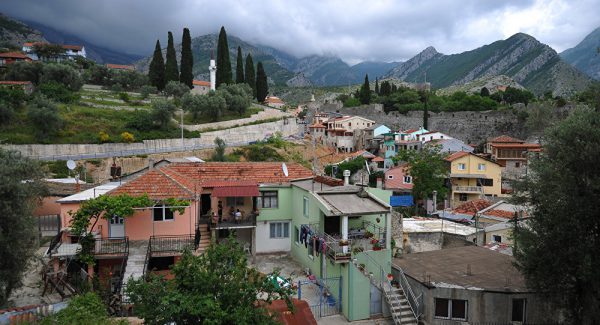
© Sputnik/ Ramil Sitdikov
As the hysteria over the wholly fictional links between the Trump administration and Russia continues unabated, claims have been circulating about a supposed Russian plot to overthrow the government of Montenegro so as to prevent that country from joining NATO.
To say that the ‘evidence’ for this is thin would be an understatement. The best summary is in the Guardian :
Montenegrin police arrested a group of Serbian nationals on the eve of the 16 October vote and two Russian suspects are wanted over the alleged plot to seize parliament and assassinate former president and prime minister Milo Đukanović.
Montenegrin authorities had previously said the conspiracy was orchestrated by “Russian nationalists” but special prosecutor Milivoje Katnić went a step further on Sunday evening, suggesting that Russian authorities were involved.
“So far we have had evidence that Russian nationalist structures were behind [the plot], but now also that Russian state bodies were involved at a certain level,” Katnić told local media. “The organs of the Russian state must investigate which bodies are involved and open a criminal trial over these acts.”
A spokesman for the Russian president, Vladimir, Putin, dismissed the allegations. “These (are) absurd accusations … We do not interfere in the internal affairs of other countries, including Montenegro,” Dmitry Peskov said on Monday.
According to Katnić, a key witness, Aleksandar Sinđelić, a nationalist Serb, was invited to Moscow by Eduard Sismakov, a member of “Russian military structures”, to be cleared for the mission. Sismakov, using the alias Shirakov, “asked him to work first to prevent Montenegro from entering Nato. That is the sole motivation of these structures,” Katnić said. Montenegrin prosecutors suspect 25 people, mostly Serbs, of links to the alleged coup, and are searching for two Russians, including Sismakov, who is believed to be the main organiser.
In other words the entire weight of the claim of Russian involvement in the supposed coup rests on the supposed connection between the plotters and an individual identified as “Eduard Sismakov”. As to who Eduard Sismakov is, he has been identified by the BBC as a former deputy military attache to Poland.
It is just about conceivable that some fiery people in this small but proud Balkan Slav country with its tradition of friendship towards Russia might have come up with some crackbrained plan to overthrow the government in order to prevent it joining NATO. Given the long history of close contacts between Montenegro and Russia it is also just possible that they might have met with some people in Russia and got support from them. To construct from these facts a wild theory of a Russian plot to overthrow the government of Montenegro is however little short of absurd. Yet as leaks from the usual ‘anonymous officials’ to the Daily Telegraph show, the British government is trying to give credence to the whole affair.
It is barely conceivable that anyone in any senior position in Moscow would seriously contemplate the idea of a coup in Montenegro. Though the Russians would obviously prefer that Montenegro did not join NATO, the country is too small and too distant from Russia for this to be a serious issue for them. It beggars belief that anyone in authority in Moscow would take the totally reckless and irresponsible step of ordering a coup in a traditionally friendly country in order to prevent something which for Russia ultimately does not matter.
Moreover for the Russians to plan a coup in another country would be for them an extraordinary step to say the least. Whilst the US has a long history of organising or backing coups in foreign states going all the way back to the coup in Iran in 1953, the Russians have not played any role in any coup in Europe since the Czech coup of 1948. Nor have they engaged in much coup making elsewhere. The coup in Afghanistan in 1978 which they were once widely believed to have organised is now known to have caught them by surprise.
Given their traditional aversion to organising coups in other countries – and their lack of know-how in how to do it – it is scarcely conceivable that the Russians would attempt such a thing in Montenegro where the benefits are small and the risks are so obviously great.
In Montenegro itself the government’s plan to join NATO has come in for a great deal of criticism, and there are reports that the opposition to the government is claiming that the whole coup plot is a fiction fabricated by the government in order to discredit it.
I do not know whether that is true or not. However it is altogether more likely than the farfetched claims about Russian involvement in the plot which the Montenegro authorities are making.
February 21, 2017
Posted by aletho |
Deception, Fake News, Mainstream Media, Warmongering | Montenegro, NATO, Russia |
Leave a comment
The Libyan people are still suffering because Western powers continue to fuel the ongoing conflict there, the cousin of slain leader Muammar Gaddafi has said on the sixth anniversary of the Arab Spring, adding that the West should apologize and leave Libya alone.
“It is clear to everyone what is now happening in Libya: total destruction, people fleeing their homes, mass hunger. Our country has descended into total darkness, and our people are enduring suffering,” Ahmed Gaddaf al-Dam, the cousin of late Libyan leader Muammar Gaddafi, told RT in an exclusive interview.
“On this anniversary of the Arab Spring, we must demand an apology to all Libyans – those whose homes were destroyed, those who were humiliated. On their behalf, I demand that the UN Security Council and the leading world powers apologize for what happened in 2011.”
Friday marked six years since the start of the Arab Spring, a wave of violent and non-violent protests that engulfed the Middle East and North Africa.
The civil unrest that broke out in Libya on this revolutionary tide came after the US-backed bombing campaign of the country toppled its long-time leader Gaddafi.
The nation has since been torn apart by fighting between different armed gangs and factions seeking control, including terrorist group Islamic State (IS, formerly ISIS/ISIL), as well as two rival governments – the internationally-recognized government in Tobruk (GNA) and the Tripoli-based General National Congress (GNC) formed by Islamists. The two bodies agreed to form a unity government under an agreement proposed by the UN in December 2015, yet there still are numerous stumbling blocks which the sides have so far failed to overcome.
Gaddaf al-Dam stresses that the conflict was stirred up by the West, and that it should be held accountable.
“The war, the destruction of Libya, all that, in their own words, was a mistake. [The West] recognized that they caused the overthrow of a revolutionary regime in Libya. All of them, first of all, should apologize and correct all that they’d done. But the suffering Libyan people, living in basements, forced to flee their homes, see nothing of the sort six years on. No one even talks about it today. What is happening in Libya is a crime from all points of view,” Gaddaf al-Dam said.
He believes the international community was not only wrong to interfere in Libya in the first place, but must now stop its meddling to let Libya deal with the crisis itself.
“Unfortunately, the international community is still trying to manage the conflict in Libya – and doesn’t want to step aside. We are caught in a swamp. Every day there are meetings, in Tunisia, in Geneva… How much more of this? We are not children,” he stated, noting that the conflict in his view can only be solved through negotiations between representatives of all rival factions in Libya – including those who are now in prison, like Gaddafi’s son and former prominent political figure Saif al-Islam – and without foreign intervention.
Despite his calls to the West to let Libya manage the conflict on its own, Gaddaf al-Dam says the international community does not really want the crisis to end, seeing the war in Libya as only a part of the West’s bigger plot to destabilize all the Muslim states of the Middle East and North Africa.
“Ever since the 1980s Muammar Gaddafi warned of an existing conspiracy of Western countries against Libya. In fact, the plot was directed not only against Libya, but against all Muslim states. The implementation of this plan began with Afghanistan. Then came the destruction of Iraq, Syria, Yemen, Libya […]
“This hell, which was organized by Western countries in the region, aims to split the countries, and it is not only about Libya. […] Gaddafi in this regard was not an astrologist – he had the information and facts on his desk. He knew the history and was a revolutionary figure who tried to carry the values and principles of the 1969 revolution through the years. The aim of the revolution was to unite the Muslim Ummah [religious community] and the entire African continent, but as Gaddafi knew about [the West’s] plot and fought with it, he was killed,” Gaddaf al-Dam said.
The Libyan revolution of 1969, known as the al-Fateh Revolution or the 1st September Revolution, was a military coup that led to the overthrow of King Idris. It was carried out by the Free Officers Movement, a group of rebel military officers led by Colonel Gaddafi.
February 21, 2017
Posted by aletho |
Timeless or most popular, War Crimes, Wars for Israel | Afghanistan, Iraq, Libya, Middle East, NATO, Syria, United States |
Leave a comment
As Democrats compete to become the new War Party – pushing for a dangerous confrontation with nuclear-armed Russia – some constituents are objecting, as Mike Madden did in a letter to Sen. Amy Klobuchar.
Dear Senator Klobuchar, I write with concern over statements you have made recently regarding Russia. These statements have been made both at home and abroad, and they involve two issues; the alleged Russian hack of the presidential election and Russia’s actions in the aftermath of the February 22, 2014 coup in Kiev.
U.S. intelligence services allege that President Vladimir Putin ordered an influence campaign to denigrate Hillary Clinton and help elect Donald Trump. The campaign is purported to include the production of fake news, cyber-trolling, and propaganda from Russian state-owned media. It is also alleged that Russia hacked the email accounts of the Democratic National Committee and Clinton campaign chair John Podesta, subsequently providing the emails to WikiLeaks.
Despite calls from many quarters, the intelligence services have not provided the public with any proof. Instead, Americans are expected to blindly trust these services with a long history of failure. Additionally, the former Director of National Intelligence, James Clapper, and the former Director of the Central Intelligence Agency, John Brennan, have both been known to lie to the public and to Congress, Mr. Clapper doing so under oath.
Meanwhile, WikiLeaks founder Julian Assange maintains the emails did not come from Russia (or any other state actor) and his organization has an unblemished record of revealing accurate information in the public interest that would otherwise remain hidden. While responsible journalists continue to use the word ‘alleged’ to describe the accusations, Republicans with an ax to grind against Russia, and Democrats wishing to distract from their own failings in the campaign, refer to them as fact. Indeed, on the ‘Amy in the News’ page of your own website, Jordain Carney of The Hill refers to the Russian meddling as “alleged”.
A congressional commission to investigate the alleged Russian hacking is not necessary. Even if all the allegations are true, they are altogether common occurrences, and they certainly don’t rise to the level of “an act of aggression”, “an existential threat to our way of life”, or “an attack on the American people” as various Democratic officials have characterized them. Republican Senator John McCain went full monty and called the alleged meddling “an act of war”.
Joining War Hawks
It is of concern that you would join Senator McCain and the equally belligerent Senator Lindsey Graham on a tour of Russian provocation through the Baltics, Ukraine, Georgia, and Montenegro. The announcement of your trip (December 28, 2016) on the ‘News Releases’ page of your website renewed the unproven claim of “Russian interference in our recent election”. It also claimed that the countries you were visiting were facing “Russian aggression” and that “Russia illegally annexed Crimea”.
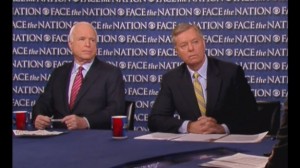
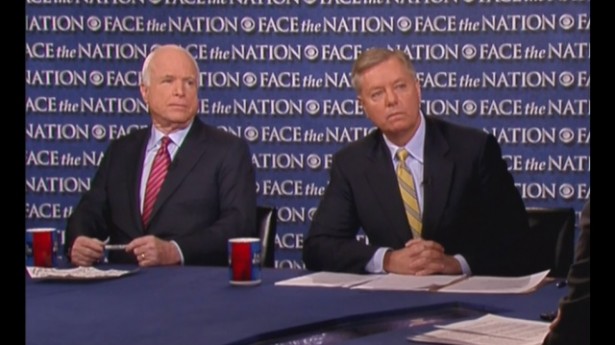
Sen. John McCain and Sen. Lindsey Graham
It is unfortunate that these claims have become truisms by sheer repetition rather than careful examination of the facts. Russia has not invaded eastern Ukraine. There are no regular units of the Russian military in the breakaway provinces, nor has Russia launched any air strikes from its territory. It has sent weapons and other provisions to the Ukrainian forces seeking autonomy from Kiev, and there are most certainly Russian volunteers operating in Ukraine.
However regrettable, it must be remembered that the unrest was precipitated by the February 22, 2014 overthrow of the democratically elected president Viktor Yanukovych which, speaking of meddling, was assisted by U.S. State Department, other American government agencies, and one Senator John McCain. The subsequent military and paramilitary operations launched by the coup government against the People’s Republics of Donetsk and Luhansk were described by President Putin as “uncontrolled crime” spreading into the south and east of the country. In American parlance, both the interim coup government in Kiev and the current government of President Petro Poroshenko have engaged in “killing their own people”.
Ignoring the Details
If Russia’s actions are to be considered “aggression” or an “invasion”, one must find a whole new word to describe what the United States did to Iraq in 2003. If, like your colleague Senator McCain, you hold the annexation of Crimea to be illegal under the 1994 Budapest Memorandum, I urge a closer look.
On February 21, 2014, an agreement brokered by the European Union was signed between President Yanukovych and the leaders of three major opposition parties. The agreement contained terms for a cessation of violence, immediate power sharing, and new elections. Smelling blood in the water, the opposition in Maidan Square did not withdraw from the streets or surrender their illegal weapons as agreed, but instead went on the offensive. Yanukovych, under threat to his life, fled Kiev along with many others in his Party of Regions.
Nor did the opposition party leaders honor the agreement. The next day, they moved to impeach Yanukovych, however they failed to meet several requirements of the Ukrainian Constitution. They failed to indict the president, conduct an investigation, and have that investigation certified by the Constitutional Court of Ukraine. Instead, they moved directly to a vote on impeachment and, even on that count, they failed to obtain the required three-fourths majority vote. So, even though the Budapest Memorandum did offer assurances of Ukrainian security and territorial integrity in exchange for surrender of Soviet-era nuclear weapons on its soil, the sovereign government of Ukraine had fallen in a violent unconstitutional putsch.
Yanukovych remained its legitimate president-in-exile and he, along with the prime minister of the Autonomous Republic of Crimea, requested Russian intervention on the peninsula to provide security and protect the human rights of ethnic Russians threatened by the new coup government and neo-Nazi elements within it.
One can now see how real that threat was by looking to eastern Ukraine where the Ukrainian military and neo-Nazi paramilitaries such as the Azov Battallion, have moved with force against the defenders of the Donbass region whose people seek autonomy from a government in Kiev that they do not recognize. Approximately 10,000 people have died in the Donbass War, whereas only six people were killed during the period of annexation (February 23-March19, 2014) in Crimea.
While the Donbass War drags on, Crimea remains stable today. The popular referendum conducted on March 16, 2014 lent legitimacy to the subsequent annexation. Official results claimed 82% turnout with 96% of voters favoring reunification with Russia. Independent polling conducted in the early weeks of March 2014 found 70-77% of all Crimeans favored reunification. Six years prior to the crisis in 2008, a poll found that 63% favored reunification. Even though many ethnic Ukranians and Tatars boycotted the election, rejoining Russia was clearly the will of the majority of Crimean people.
President Putin, characterizing the situation in Ukraine as a revolution, claimed that Russia had no agreements with the new state and therefore no obligations under the Budapest Memorandum. He also cited Chapter I: Article 1 of the United Nations Charter, which calls for respect for the principle of self-determination of peoples. The 1975 Helsinki Accords, which affirmed post-World War II borders, also allowed for the change of national boundaries by peaceful internal means.
The Kosovo Precedent
It is also useful to consider parallel occurrences in Kosovo. In 1998 ethnic cleansing by Serbian troops and paramilitaries led to a NATO intervention without U.N. authorization. There is little question that the move was illegal, but legitimacy was claimed due to the urgent humanitarian need. Ten years later, Kosovo would declare independence from Serbia and the disputed matter would end up before the International Court of Justice. In 2009 the United States provided the Court with a statement on Kosovo that read in part: “Declarations of independence may, and often do, violate domestic legislation. However, this does not make them violations of international law.”
The United States should accept the Russian annexation of Crimea both as a pragmatic matter, and one of principle. In 1990, during negotiations for the re-unification of Germany, the United States promised that there would be no eastward expansion of NATO. That promise has now been broken three times and eleven new nations have been added to the alliance. Ukraine has also entered in partnership with NATO, and at various times, full membership has been discussed. Russia has consistently expressed its disapproval. According to your website, an objective of your trip was “to reinforce support for NATO”. If this weren’t provocative enough, your three-senator delegation went to a front-line military outpost in Shirokino, Ukraine to incite an escalation to the Donbass War. Senator Graham told the assembled soldiers “Your fight is our fight, 2017 will be the year of offense”. The leader of your delegation, Senator McCain, said “I am convinced you will win and we will do everything we can to provide you with what you need to win”.
After the speeches were given, you are seen in a video of the New Year’s Eve event accepting what appears to be a gift from one of the uniformed soldiers. With all of the furor over former National Security Advisor Michael Flynn’s resignation, and possible violation of the Logan Act, for discussing alleviation of sanctions with a Russian ambassador, this appears to be a far more serious offense. Not only did your delegation advocate for a foreign policy that was not aligned with that of acting President Obama, it was also contrary to President-elect Trump’s approach to the region. And the results of your advocacy have the potential to be far more deadly than the mere alleviation of sanctions.
Sincerely, Mike Madden St. Paul, Minnesota
February 20, 2017
Posted by aletho |
Deception, Fake News, Mainstream Media, Warmongering, Progressive Hypocrite | Amy Klobuchar, CIA, John McCain, Lindsey Graham, NATO, Russia, Ukraine, United States |
Leave a comment
The INF Treaty was a major breakthrough to halt and reverse the Cold War-era nuclear arms race in Europe. There are growing signs that the treaty is in jeopardy. A possible US unilateral withdrawal and failure to resolve the compliance dispute could impede efforts to save the arms control regime from being eroded.
On February 16, Senator Tom Cotton (R-Arkansas), along with Senators Ron Johnson (R-Wisconsin) and Marco Rubio (R-Florida) introduced the Intermediate-Range Forces Treaty (INF) Preservation Act, legislation that would allow the United States to develop new intermediate-range missiles. Congressmen Ted Poe (R-Texas) and Mike Rogers (R-Alabama) introduced companion legislation in the House of Representatives.
Accusations of Russia violating the INF Treaty, not backed up by any evidence, were used as a pretext for introducing the measure. For instance, the New York Times has recently published report saying that Russia «has secretly deployed» a new nuclear-capable intermediate-range cruise missile, the SSC-8, in apparent violation of the 1987 treaty. «This legislation will give President Trump the tools he needs to show our friends and adversaries alike that ‘peace through strength’ is back», said Mike Rogers.
The INF Treaty is a key agreement between the United States and the Soviet Union which put a seal on the Cold War era. It eliminated all nuclear and conventional ground-launched ballistic and cruise missiles with intermediate ranges, defined as between 500-5,500 kilometers (3000-3400 miles).
If the bill becomes a law, it won’t add to US or NATO security. America has real interest in preserving the treaty in force. It has sound reasons for doing so. One of them is that US NATO allies greatly value the INF and want it to remain effective. A US withdrawal would raise concern on their part.
With no hard evidence of non-compliance produced, the US will be held responsible by international community for ending the treaty. If Washington possessed facts to substantiate the claim that Moscow is in violation of the treaty, it would have been provided them a long time ago.
The bill says the US is to «develop» new systems. But even if a decision were taken to return obsolete Pershing-2s and long-range Tomahawks, it would take time and effort. On its part, Russia can easily increase the range of existing Iskander missiles.
Developing new US systems would impose a new burden on an already stretched defense budget. Funding a new expensive program would draw funds from other accounts, such as new conventional weapons, the upgrade of strategic nuclear forces, the ballistic missile defense (BMD), you name it. Today, the US national debt is about $20 trillion and the clock is ticking.
Even if the provision of the bill is carried out and a new intermediate range system is in place, the US will face a tall order in finding an ally willing to host it and become a target for a pre-emptive strike by Russian armed forces. Such deployments would be viewed as extremely provocative to Moscow.
Even in the 1980s it was a close thing. Those days the plans to deploy INF forces met fierce domestic political and public opposition. A controversial decision would tear NATO apart at the time the US and its European allies don’t see eye to eye on many issues.
The same applies to deployment plans in the Pacific. Japan would worry about deteriorating the relationship with Russia and China. South Korea would fear such a deployment might disrupt its improving relations with China.
The times have changed. Today, Russia possesses cutting edge S-400 aid defense systems capable of countering not only ballistic but also cruise missiles with an operational range of 3,000−3,500 km (1,864-2,174 mi).
The Russian military is gearing up to test the first prototypes of its next-generation S-500 Prometey air and missile defense system. The weapon has no analogues in the world. S-500 is the fifth generation system capable of destroying intercontinental ballistic missiles and spacecraft, hypersonic cruise missiles and airplanes at speeds of higher than Mach 5. Its response time is only 3-4 seconds, just think about it! It can detect and simultaneously attack up to ten ballistic missile warheads out at 600 km flying at speeds of twenty-three thousand feet per second. The system can engage targets at altitudes of about 125 miles, including incoming ballistic missiles in space at ranges as great as 400 miles. Evidently, Russia has the means to counter the threat. It puts into doubt the effectiveness of any future intermediate range weapon the US would develop in accordance with legislation in question.
The end of INF treaty would provoke other states into an arms race the US cannot control.
The bill is introduced at the time the world is facing the most serious and comprehensive crisis in the fifty-year history of nuclear arms control. Since pulling out from the 1972 ABM Treaty, the US has been taking one step after another to undermine the arms control regime that has served as a pillar of international security for dozens of years. Now the US Congress is on the brink of unleashing an arms race with dire consequences for America itself.
Does it all make sense? Russia has recently announced its goal to shift from nuclear to conventional deterrence to make the world safer.
The recent initiative Germany, supported by leading the leading European partners, provides a new chance to address the problems of European security. With so many controversial issues on the agenda, Helsinki-2 would be the right way to launch discussions on creating a security regime from Lisbon to Vladivostok – something Moscow proposed a few years ago.
There are opportunities to seize and turn the tide as arms control is unraveling. Instead, a group of US lawmakers has introduced legislation to quash all hopes for a better world. Never before has the arms control regime been threatened so much. Voting for the bill means shooting yourself in the foot. The US will undermine its own security and create huge problems to overcome.
Hopefully, there will be enough sober-minded members of Congress to prevent the measure from becoming a law.
February 19, 2017
Posted by aletho |
Militarism | NATO, New York Times, Russia, United States |
Leave a comment
As if the 2016 U.S. presidential election campaign hadn’t been horrendous enough, here comes another one: in France.
The system in France is very different, with multiple candidates in two rounds, most of them highly articulate, who often even discuss real issues. Free television time reduces the influence of big money. The first round on April 23 will select the two finalists for the May 7 runoff, allowing for much greater choice than in the United States.
But monkey see, monkey do, and the mainstream political class wants to mimic the ways of the Empire, even echoing the theme that dominated the 2016 show across the Atlantic: the evil Russians are messing with our wonderful democracy.
The aping of the U.S. system began with “primaries” held by the two main governing parties which obviously aspire to establish themselves as the equivalent of American Democrats and Republicans in a two-party system. The right-wing party of former president Nicolas Sarkozy has already renamed itself Les Républicains and the so-called Socialist Party leaders are just waiting for the proper occasion to call themselves Les Démocrates. But as things are going, neither one of them may come out ahead this time.
Given the nearly universal disaffection with the outgoing Socialist Party government of President François Hollande, the Republicans were long seen as the natural favorites to defeat Marine LePen, who is shown by all polls to top the first round. With such promising prospects, the Republican primary brought out more than twice as many volunteer voters (they must pay a small sum and claim allegiance to the party’s “values” in order to vote) as the Socialists. Sarkozy was eliminated, but more surprising, so was the favorite, the reliable establishment team player, Bordeaux mayor Alain Juppé, who had been leading in the polls and in media editorials.
Fillon’s Family Values
In a surprise show of widespread public disenchantment with the political scene, Republican voters gave landside victory to former prime minister François Fillon, a practicing Catholic with an ultra-neoliberal domestic policy: lower taxes for corporations, drastic cuts in social welfare, even health health insurance benefits – accelerating what previous governments have been doing but more openly. Less conventionally, Fillon strongly condemns the current anti Russian policy. Fillon also deviates from the Socialist government’s single-minded commitment to overthrowing Assad by showing sympathy for embattled Christians in Syria and their protector, which happens to be the Assad government.
Fillon has the respectable look, as the French say, of a person who could take communion without first going to confession. As a campaign theme he credibly stressed his virtuous capacity to oppose corruption.
Oops! On January 25, the semi-satirical weekly Le Canard Enchainé fired the opening shots of an ongoing media campaign designed to undo the image of Mister Clean, revealing that his British wife, Penelope, had been paid a generous salary for working as his assistant. As Penelope was known for staying home and raising their children in the countryside, the existence of that work is in serious doubt. Fillon also paid his son a lawyer’s fee for unspecified tasks and his daughter for supposedly assisting him write a book. In a sense, these allegations prove the strength of the conservative candidate’s family values. But his ratings have fallen and he faces possible criminal charges for fraud.
The scandal is real, but the timing is suspect. The facts are many years old, and the moment of their revelation is well calculated to ensure his defeat. Moreover, the very day after the Canard’s revelations, prosecutors hastily opened an inquiry. In comparison with all the undisclosed dirty work and unsolved blood crimes committed by those in control of the French State over the years, especially during its foreign wars, enriching one’s own family may seem relatively minor. But that is not the way the public sees it.
Cui bono?
It is widely assumed that despite National Front candidate Marine LePen’s constant lead in the polls, whoever comes in second will win the runoff because the established political class and the media will rally around the cry to “save the Republic!” Fear of the National Front as “a threat to the Republic” has become a sort of protection racket for the established parties, since it stigmatizes as unacceptable a large swath of opposition to themselves. In the past, both main parties have sneakily connived to strengthen the National Front in order to take votes away from their adversary.
Thus, bringing down Fillon increases the chances that the candidate of the now thoroughly discredited Socialist Party may find himself in the magic second position after all, as the knight to slay the LePen dragon. But who exactly is the Socialist candidate? That is not so clear. There is the official Socialist Party candidate, Benoît Hamon. But the independent spin-off from the Hollande administration, Emmanuel Macron, “neither right nor left”, is gathering support from the right of the Socialist Party as well as from most of the neo-liberal globalist elite.
Macron is scheduled to be the winner. But first, a glance at his opposition on the left. With his ratings in the single digits, François Hollande very reluctantly gave in to entreaties from his colleagues to avoid the humiliation of running for a second term and losing badly. The badly attended Socialist Party primary was expected to select the fiercely pro-Israel prime minister Manuel Valls. Or if not, on his left, Arnaud Montebourg, a sort of Warren Beatty of French politics, famous for his romantic liaisons and his advocacy of re-industrialization of France.
Again, surprise. The winner was a colorless, little-known party hack named Benoît Hamon, who rode the wave of popular discontent to appear as a leftist critic and alternative to a Socialist government which sold out all Holland’s promises to combat “finance” and assaulted the rights of the working class instead. Hamon spiced up his claim to be “on the left” by coming up with a gimmick that is fashionable elsewhere in Europe but a novelty in French political discourse: the “universal basic income”. The idea of giving every citizen an equal handout can sound appealing to young people having trouble finding a job. But this idea, which originated with Milton Friedman and other apostles of unleashed financial capitalism, is actually a trap. The project assumes that unemployment is permanent, in contrast to projects to create jobs or share work. It would be financed by replacing a whole range of existing social allocations, in the name of “getting rid of bureaucracy” and “freedom of consumption”. The project would complete the disempowerment of the working class as a political force, destroying the shared social capital represented by public services, and splitting the dependent classes between paid workers and idle consumers.
There is scant chance that the universal income is about to become a serious item on the French political agenda. For the moment, Hamon’s claim to radicality serves to lure voters away from the independent left-wing candidate Jean-Luc Mélenchon. Both are vying for support from greens and militants of the French Communist Party, which has lost all capacity to define its own positions.
The Divided Left
An impressive orator, Mélenchon gained prominence in 2005 as a leading opponent of the proposed European Constitution, which was decisively rejected by the French in a referendum, but was nevertheless adopted under a new name by the French national assembly. Like so many leftists in France, Mélenchon has a Trotskyist background (the Posadists, more attuned to Third World revolutions than their rivals) before joining the Socialist Party, which he left in 2008 to found the Parti de Gauche. He has sporadically wooed the rudderless Communist Party to join him as the Front de Gauche (the Left Front) and has declared himself its candidate for President on a new independent ticket called La France insoumise – roughly translated as “Insubordinate France”. Mélenchon is combative with France’s docile media, as he defends such unorthodox positions as praise of Chavez and rejection of France’s current Russophobic foreign policy. Unlike the conventional Hamon, who follows the Socialist party line, Mélenchon wants France to leave both the euro and NATO.
There are only two really strong personalities in this lineup: Mélenchon on the left and his adversary of choice, Marine LePen, on the right. In the past, their rivalry in local elections has kept both from winning even though she came out ahead. Their positions on foreign policy are hard to distinguish from each other: criticism of the European Union, desire to leave NATO, good relations with Russia.
Since both deviate from the establishment line, both are denounced as “populists” – a term that is coming to mean anyone who pays more attention to what ordinary people want than to what the Establishment dictates.
On domestic social policy, on preservation of social services and workers’ rights, Marine is well to the left of Fillon. But the stigma attached to the National Front as the “far right” remains, even though, with her close advisor Florian Philippot, she has ditched her father, Jean-Marie, and adjusted the party line to appeal to working class voters. The main relic of the old National Front is her hostility to immigration, which now centers on fear of Islamic terrorists. The terrorist killings in Paris and Nice have made these positions more popular than they used to be. In her effort to overcome her father’s reputation as anti-Semitic, Marine LePen has done her best to woo the Jewish community, helped by her rejection of “ostentatious” Islam, going so far as to call for a ban on wearing an ordinary Muslim headscarf in public.
A runoff between Mélenchon and LePen would be an encounter between a revived left and a revived right, a real change from the political orthodoxy that has alienated much of the electorate. That could make politics exciting again. At a time when popular discontent with “the system” is rising, it has been suggested (by Elizabeth Lévy’s maverick monthly Le Causeur) that the anti-system Mélenchon might actually have the best chance of winning working class votes away from the anti-system LePen.
Manufacturing Consent
But the pro-European Union, pro-NATO, neoliberal Establishment is at work to keep that from happening. On every possible magazine cover or talk show, the media have shown their allegiance to a “New! Improved!” middle of the road candidate who is being sold to the public like a consumer product. At his rallies, carefully coached young volunteers situated in view of the cameras greet his every vague generalization with wild cheers, waving flags, and chanting “Macron President!!!” before going off to the discotèque party offered as their reward. Macron is the closest thing to a robot ever presented as a serious candidate for President. That is, he is an artificial creation designed by experts for a particular task.
Emmanuel Macron, 39, was a successful investment banker who earned millions working for the Rothschild bank. Ten years ago, in 2007, age 29, the clever young economist was invited into the big time by Jacques Attali, an immensely influential guru, whose advice since the 1980s has been central in wedding the Socialist Party to pro-capitalist, neoliberal globalism. Attali incorporated him into his private think tank, the Commission for Stimulating Economic Growth, which helped draft the “300 Proposals to Change France” presented to President Sarkozy a year later as a blueprint for government. Sarkozy failed to enact them all, for fear of labor revolts, but the supposedly “left” Socialists are able to get away with more drastic anti-labor measures, thanks to their softer discourse.
The soft discourse was illustrated by presidential candidate François Hollande in 2012 when he aroused enthusiasm by declaring to a rally: “My real enemy is the world of finance!”. The left cheered and voted for him. Meanwhile, as a precaution, Hollande secretly dispatched Macron to London to reassure the City’s financial elite that it was all just electoral talk.
After his election, Hollande brought Macron onto his staff. From there he was given a newly created super-modern sounding government post as minister of Economy, Industry and Digital affairs in 2014. With all the bland charm of a department store mannequin, Macron upstaged his irascible colleague, prime minister Manuel Valls, in the silent rivalry to succeed their boss, President Hollande. Macron won the affection of big business by making his anti-labor reforms look young and clean and “progressive”. In fact, he pretty much followed the Attali agenda.
The theme is “competitiveness”. In a globalized world, a country must attract investment capital in order to compete, and for that it is necessary to lower labor costs. A classic way to do that is to encourage immigration. With the rise of identity politics, the left is better than the right in justifying massive immigration on moral grounds, as a humanitarian measure. That is one reason that the Democratic Party in the United States and the Socialist Party in France have become the political partners of neoliberal globalism. Together, they have changed the outlook of the official left from structural measures promoting economic equality to moral measures promoting equality of minorities with the majority.
Just last year, Macron founded (or had founded for him) his political movement entitled “En marche!” (Let’s go!) characterized by meetings with young groupies wearing Macron t-shirts. In three months he felt the call to lead the nation and announced his candidacy for President.
Many personalities are jumping the marooned Socialist ship and going over to Macron, whose strong political resemblance to Hillary Clinton suggests that his is the way to create a French Democratic Party on the U.S. model. Hillary may have lost but she remains the NATOland favorite. And indeed, U.S. media coverage confirms this notion. A glance at the ecstatic puff piece by Robert Zaretsky in Foreign Policy magazine hailing “the English-speaking, German-loving, French politician Europe has been waiting for” leaves no doubt that Macron is the darling of the trans-Atlantic globalizing elite.
At this moment, Macron is second only to Marine LePen in the polls, which also show him defeating her by a landslide in the final round. However, his carefully manufactured appeal is vulnerable to greater public information about his close ties to the economic elite.
Blame the Russians
For that eventuality, there is a preventive strike, imported directly from the United States. It’s the fault of the Russians!
What have the Russians done that is so terrible? Mainly, they have made it clear that they have a preference for friends rather than enemies as heads of foreign governments. Nothing so extraordinary about that. Russian news media criticize, or interview people who criticize, candidates hostile to Moscow. Nothing extraordinary about that either.
As an example of this shocking interference, which allegedly threatens to undermine the French Republic and Western values, the Russian news agency Sputnik interviewed a Republican member of the French parliament, Nicolas Dhuicq, who dared say that Macron might be “an agent of the American financial system”. That is pretty obvious. But the resulting outcry skipped over that detail to accuse Russian state media of “starting to circulate rumors that Macron had a gay extramarital affair” (The EU Observer, February 13, 2017). In fact this alleged “sexual slur” had been circulating primarily in gay circles in Paris, for whom the scandal, if any, is not Macron’s alleged sexual orientation but the fact that he denies it. The former mayor of Paris, Bertrand Delanoe, was openly gay, Marine Le Pen’s second in command Florian Philippot is gay, in France being gay is no big deal.
Macron is supported by a “very wealthy gay lobby”, Dhuicq is quoted as saying. Everyone knows who that is: Pierre Bergé, the rich and influential business manager of Yves Saint Laurent, personification of radical chic, who strongly supports surrogate gestation, which is indeed a controversial issue in France, the real controversy underlying the failed opposition to gay marriage.
The Deep State rises to the surface
The amazing adoption in France of the American anti-Russian campaign is indicative of a titanic struggle for control of the narrative – the version of international reality consumed by the masses of people who have no means to undertake their own investigations. Control of the narrative is the critical core of what Washington describes as its “soft power”. The hard power can wage wars and overthrow governments. The soft power explains to bystanders why that was the right thing to do. The United States can get away with literally everything so long as it can tell the story to its own advantage, without the risk of being credibly contradicted. Concerning sensitive points in the world, whether Iraq, or Libya, or Ukraine, control of the narrative is basically exercised by the partnership between intelligence agencies and the media. Intelligence services write the story, and the mass corporate media tell it.
Together, the anonymous sources of the “deep state” and the mass corporate media have become accustomed to controlling the narrative told to the public. They don’t want to give that power up. And they certainly don’t want to see it challenged by outsiders – notably by Russian media that tell a different story.
That is one reason for the extraordinary campaign going on to denounce Russian and other alternative media as sources of “false news”, in order to discredit rival sources. The very existence of the Russian international television news channel RT aroused immediate hostility: how dare the Russians intrude on our version of reality! How dare they have their own point of view! Hillary Clinton warned against RT when she was Secretary of State and her successor John Kerry denounced it as a “propaganda bullhorn”. What we say is truth, what they say can only be propaganda.
The denunciation of Russian media and alleged Russian “interference in our elections” is a major invention of the Clinton campaign, which has gone on to infect public discourse in Western Europe. This accusation is a very obvious example of double standards, or projection, since U.S. spying on everybody, including it allies, and interference in foreign elections are notorious.
The campaign denouncing “fake news” originating in Moscow is in full swing in both France and Germany as elections approach. It is this accusation that is the functional interference in the campaign, not Russian media. The accusation that Marine Le Pen is “the candidate of Moscow” is not only meant to work against her, but is also preparation for the efforts to instigate some variety of “color revolution” should she happen to win the May 7 election. CIA interference in foreign elections is far from limited to contentious news reports.
In the absence of any genuine Russian threat to Europe, claims that Russian media are “interfering in our democracy” serve to brand Russia as an aggressive enemy and thereby justify the huge NATO military buildup in Northeastern Europe, which is reviving German militarism and directing national wealth into the arms industry.
In some ways, the French election is an extension of the American one, where the deep state lost its preferred candidate, but not its power. The same forces are at work here, backing Macron as the French Hillary, but ready to stigmatize any opponent as a tool of Moscow.
What has been happening over the past months has confirmed the existence of a Deep State that is not only national but trans-Atlantic, aspiring to be global. The anti-Russian campaign is a revelation. It reveals to many people that there really is a Deep State, a trans-Atlantic orchestra that plays the same tune without any visible conductor. The term “Deep State” is suddenly popping up even in mainstream discourse, as a reality than cannot be denied, even if it is hard to define precisely. Instead of the Military Industrial Complex, we should perhaps call it the Military Industrial Intelligence Military Media Complex, or MIIMMC. Its power is enormous, but acknowledging that it exists is the first step toward working to free ourselves from its grip.
Diana Johnstone is the author of Fools’ Crusade: Yugoslavia, NATO, and Western Delusions. Her new book is Queen of Chaos: the Misadventures of Hillary Clinton. She can be reached at diana.johnstone@wanadoo.fr
February 18, 2017
Posted by aletho |
Deception, Fake News, Full Spectrum Dominance, Mainstream Media, Warmongering, Timeless or most popular | CIA, Emmanuel Macron, European Union, France, Marine LePen, Mélenchon, NATO, United States |
Leave a comment
Russian Foreign Minister Sergei Lavrov called Saturday for an end to a world order dominated by the West and said Moscow wanted to establish a “pragmatic” relationship with the United States.
 Lavrov was speaking at the Munich Security Conference shortly after US Vice President Mike Pence told the audience Washington remained “unwavering” in its commitment to the US-led NATO military alliance as it faced a more assertive Russia.
Lavrov said that the time when the West called the shots was over and, dismissing NATO as a relic of the Cold War, added: “I hope that (the world) will choose a democratic world order — a post-West one — in which each country is defined by its sovereignty.”
Lavrov said Moscow wanted to build relations with Washington which would be “pragmatic with mutual respect and acknowledgement of our responsibility for global stability.”
The two countries had never been in direct conflict, he said, noting that they were actually close neighbors across the Baring Straits.
Russia wanted to see a “common space of good neighbour relations from Vancouver to Vladivostok,” he added.
Pence was in Europe along with Secretary of State Rex Tillerson and defense chief James Mattis as part of efforts to reassure allies rattled by President Donald Trump’s “America First” stance and his calls for improved ties with Russia despite the continuing crisis in Ukraine.
February 18, 2017
Posted by aletho |
Timeless or most popular | NATO, Russia, United States |
Leave a comment
Israeli defense contractors have generated more than $1 billion in revenues since 2010 for assisting with the F-35 Joint Strike Fighter program, the most expensive weapons program in history.
The Israeli Defense Ministry reported Sunday that 2016 was a banner year for F-35 partners. Contracts tied to production of the F-35 shot up 33 percent last year for a total of $258 million in new deals for Israeli companies. Since Israel inked a deal to buy 19 F-35 fighters in 2010, Israeli firms have won more than $1 billion in ‘buy-back contracts.’
“The scope of industrial cooperation between [Lockheed Martin] and Israeli industry, in just the last year, shows the immense potential inherent in this arrangement for the Israeli economy,” Col. Avi Dadon, deputy director of purchasing at the Ministry of Defense, noted.
A bulk of the new revenues stemmed from the F-35 virtual reality helmets. Elbit Systems and Rockwell Collins scored a $206 million contract for headgear production.
Like the F-35 project as a whole, the F-35 helmets have faced their share of struggles. The 4.5-pound helmets are reported to cause neck problems for pilots. What’s more, the visor has been seen to pop off the heads of pilots during take-off. Since the helmets are critical for pilots to visualize flight, mission, and target information, this essentially leaves pilots blind. In a separate incident, Tom Briggs of the US Navy described the helmets as being comparable to “looking through a dirty window” due to a green glow in the display area.
Meanwhile, Italian officials have complained recently that Lockheed Martin and the US are not following through on jet maintenance contracts. Guido Crosetto, head of Italy’s aerospace and defense industry association said Washington has not “honored promises” made when Italy joined the list of US allies to buy the F-35s.
Back in 2002, Italy was told that it would receive contracts for maintenance work worth 65 percent of the $1 billion Rome invested to buy 90 joint strike fighters, Italian media outlets reported. Italian firms currently have contracts valued less than 20 percent of its initial investment, the official added. Instead, contracts went to places like the UK, the Netherlands and Australia “because the competition favored large companies,” Crosetto said.
February 15, 2017
Posted by aletho |
Economics, Ethnic Cleansing, Racism, Zionism, Militarism, Timeless or most popular | Elbit Systems, F-35, Italy, Lockheed Martin, NATO, United States, Zionism |
Leave a comment
John McCain, a hawkish US Senator known for his anti-Russia position, has called for boosting US deterrent posture in Europe after reports emerged alleging Moscow has secretly deployed nuclear-tipped ground-launched cruise missiles in violation of the 1987 Intermediate-Range Nuclear Forces (INF) Treaty.
The administration of President Donald Trump must immediately respond to Russia’s alleged deployment of nuclear-tipped ground-launched cruise missiles, McCain said in a press release.
The news comes as US media reported that Russia deployed ground-based nuclear cruise missiles in violation of the 1987 Intermediate-Range Nuclear Forces (INF) Treaty.
The Pentagon supported the review of alleged the INF Treaty violations.
The treaty prohibits the development, deployment or testing of ground-launched ballistic or cruise missiles with ranges between 300 and 3,400 miles. It was implemented by 1991 with inspections carrying on until 2001.
“Russia’s treaty violation requires a meaningful response,” McCain stated in the release on Tuesday. “In light of the most recent developments, it is time for the new administration to take immediate action to enhance our deterrent posture in Europe and protect our allies.”
McCain claimed Russia’s violation of the INF treaty is a significant threat to US forces in Europe and its NATO allies, the release stated.
The United States should continue to modernize its nuclear forces and ensure NATO’s nuclear deterrence forces are prepared to counter Russian nuclear doctrine, which calls for the first use of nuclear weapons, McCain added.
Russia has rejected the accusations, and said that the United States deploying its Europe-based missile defense system violates the INF treaty.
RT | February 15, 2017
Top Russian officials have rejected accusations that Moscow violated an arms control treaty by deploying cruise missiles, saying that the people spreading the rumors were targeting the possible thaw in Russia-US relations.
Kremlin press secretary Dmitry Peskov said on Tuesday that Russia was observing all its international obligations and that none of its partners had accused Moscow of breaching any treaties.
“Russia has been and remains committed to its international commitments, including to the treaty in question,” Peskov told reporters. “Nobody has formally accused Russia of violating the treaty,” he said.
The comments came after US media reported that unnamed officials in the Trump administration had allegedly accused Moscow of deploying ground-launched cruise missiles in violation of the 1987 Intermediate-Range Nuclear Forces (INF) Treaty.
The head of the Russian upper house Committee for International Relations, Senator Konstantin Kosachev, said on Tuesday that such media leaks were part of a wider information war being waged against Russia and everyone who supported the normalization of Russia-US relations.
“The main objective of this campaign is to prevent the new president [Trump] from making a U-turn over the Atlantic, I mean, to prevent him from reconsidering the transatlantic policies of the United States that are set at establishing the monopolar model of the world order,” the senator told reporters.
He added that in his opinion those behind the strategy were sure that US politicians and the general public must be kept in a state of constant fear from an imagined external threat. … Full article
February 15, 2017
Posted by aletho |
Aletho News | INF treaty, John McCain, NATO, Russia, United States |
Leave a comment
NATO’s latest attack on freedom of thought was unquestioningly embraced by mainstream media – in unwitting service of “fake news.”
During the 2016 US Presidential election, the term “fake news” escaped the media bubble to become the buzzword of the year. Intended as the “proper” media’s expository and damning attack on dodgy sources that attract attention with shocking yet untrue headlines, it quickly morphed into a shorthand for anything and everything that went against the establishment’s narrow range of approved narratives. Clinton – good, Russia – evil, that sort of thing.
The media that cried “fake news”
Missing the irony entirely, the mainstream press then got terribly aggrieved when the “fake news” label was thrown right back at them by none other than President Trump for that exact same reason.
Who could have ever imagined that when a term built entirely around the concept of empirical, intellectual rigor repeatedly lent itself to a politicized narrative agenda unsupported by facts, it would lose all credibility, and eventually – all meaning?
However, as we know, the establishment takes a while to catch up to the real world. Last weekend, NATO’s old hawks, apparently left unawares that labeling dissent as “disinformation” doesn’t automatically make it so, decided to summarily write off all objections to its policies, actions and talking points with one foolproof refutation: any criticism of NATO is a fake because NATO says it is.
Myth-building alliance
The military club’s latest PR wheeze is a lengthy web page listing what it calls “the facts” of NATO-Russia relations.
In reality, these are NATO’s value-based interpretations of its own agenda – in other words, the alliance’s opinion of itself. But this framework of NATO’s opinion being equated to fact by default delegitimizes any point of view to the contrary, any dissent, disagreement or objection.
In this particular instance, the primary focus of such objectionable objections is Russia. Most of the 32 listed “myths” have something to do with NATO being perceived as a threat (to Russia, but not only) and having committed some kinds of bad acts (many of which had nothing to do with Russia). Russia is, nevertheless, blamed for generating and promoting all of those “myths.”
NATO’s basic counterargument amounts to “Russians are wrong to think and feel how they do.” Or, more specifically, “Russians are not allowed to think or say NATO is a threat to them despite our military creep eastwards and deployment of soldiers on their borders and missiles in their near abroad.”
The listicle regurgitates other familiar talking points, such as “NATO membership is not imposed on countries. Each sovereign country has the right to choose for itself whether it joins any treaty or alliance” – in the same week that a Gallup poll showed how more people in Ukraine and Moldova regard the group as a threat rather than as protection.
These are two countries that NATO has courted for many years. In the Gallup survey, we also see that 64 percent of Serbians believe NATO is a threat and only 6 percent believe it offers protection.
But in its PR push, NATO rejects the notion that its “enlargement in the Balkans is destabilizing” and goes off on a tangent about how “countries in the region have played a significant role in NATO’s operations in Afghanistan and Kosovo, providing training to the Afghan forces.”
NATO & friends
Over the past weekend many editors took part in enthusiastically promoting this black vs. white, ‘myth vs. facts’ story put out by NATO. Dozens of journalists took the Organization’s proclamations as inarguable truth largely without caveats, due diligence or any critical analysis
The team at Reuters particularly outdid itself by ramping up the rhetoric with colorful comments from NATO’s spokesperson and de rigueur invocation of RT and Sputnik. It also failed to provide any balancing perspective, apparently because “The Kremlin, the Russian government, RT, Sputnik, and Life could not immediately be reached for comment.”
Immediately. On 32 “myth charges” at once. On a Saturday night. Oh how much time and scrutiny were afforded for the evaluation of 32 complex geopolitical issues by a news platform of enormous capacity…
Speaking of myths, RT’s Press Office did not receive any queries from Reuters on the matter.
Then again, Reuters doesn’t seem to be generous with the ‘right of reply.’
On fire
Reuters’ commitment to the criticism of the Russian media leans heavily on baseless allegations that RT has spread “false stories,” yet the only references are a single example of a report from July 2016 “about a fire raging at a NATO base in Izmir, claiming it was a deliberate sabotage after the failed coup in Turkey.”
But the author fails to mention that (a) there was an evidence of a large-scale fire in the area, with evidence presented not just across social media (with photos and videos) but many news media outlets, including CNN Turk; (b) this was a fast-breaking, developing story and (c) RT immediately included a comment from the NATO spokesperson as soon as it was supplied.
Indeed, the second sentence of the article reads “NATO spokesperson Oana Lungescu has denied the reports of a fire “in or near” territories hosting NATO facilities in Turkey, adding that its HQ “is fully operational,” and prominently displayed a tweet from Lungescu.
This hardly seems like an inspired “fake news”-promoting effort.
Truth in the news
And this brings us back to the whole “fake news” thing. Surely, this zero-sum coverage of NATO’s role in Europe, which ignores or dismisses the worries of millions of the continent’s citizens and several governments is worthy of being at the very least examined as misleading?
The same rigorous test should be applied to the mainstream media’s tendency to act as an unquestioning promotional vehicle for US/Alliance’s military interests, accepting NATO statements at face value. Especially when such claims play like an echo of those about “Iraq’s weapons of mass destruction” and “Aleppo’s last hospital,” which seemed to vanish and reappear practically every week last year.
With every news cycle, it becomes increasingly evident the mainstream media seems to believe “fake news” is totally terrible, unless it is about Russia when it becomes totally acceptable. And that every claim needs to be rigorously fact-checked unless it is made by the “good guys,” like NATO. And the good guys, in turn, are free to slap a “fake news” label on any actor or argument they don’t like. But really, mostly, Russia.
This is exactly how we have arrived at a point where supposedly respectable outlets have created a world where Vladimir Putin has managed to become the richest man in the world (Washington Post ), who controls Donald Trump (Huffington Post ) and masterminded his election victory (Vanity Fair ) despite battling Aspergers (USA Today ), and cancer (The Week ), and also traveling through time.
At this rate, if the term “fake news” loses all meaning in the next few months, if not weeks, the mainstream media will have no one but itself to blame.
February 15, 2017
Posted by aletho |
Deception, Fake News, Mainstream Media, Warmongering, Timeless or most popular | NATO, Reuters |
Leave a comment