‘Aggressive Plans’ Behind US Repeatedly Accusing Russia of Violating INF Treaty
Sputnik | March 12, 2017
On Wednesday, the United States once again accused Russia of violating the Intermediate Nuclear Forces (INF) Treaty, an allegation repeatedly denied by Moscow.
Speaking in Congress, a senior US general said that Russia has allegedly deployed prohibited cruise missiles with a range of 500-5,000 kilometers.
“We believe that the Russians have deployed a land-based cruise missile that violates the spirit and intent of the Intermediate Nuclear Forces Treaty,” Gen. Paul Selva, the vice chairman of the Joint Chiefs of Staff, told the House Armed Services Committee.
The general added that by deploying prohibited missiles, Moscow poses a threat to “NATO and to facilities within the NATO area of responsibility.”
Earlier, the US had accused Russia of developing a ground-based analogue of the Kalibr-NK cruise missile and concealing the capabilities of the Iskander tactical missile system.
In mid-February, American senators also submitted legislation to toughen Washington’s stance on the INF Treaty, presuming funds for active defense measures and a retaliation strike. Moreover, the proposed bill would also enable transfer of INF missile systems to US allies.
Commenting on the allegations, Viktor Ozerov, the chairman of the Russian upper house of parliament’s defense committee, said that Russia has not violated the agreement.
“Russia strictly observes the agreement signed by Mikhail Gorbachev in 1987, despite the fact that, according to our evaluations, the agreement was not in the interests of the USSR and then Russia. In particular, it should be taken into account that the US has deployed missile systems and missile defenses in several European countries,” Ozerov said.
Aggressive Trend
Moscow and Washington have occasionally exchanged accusations of violating the INF Treaty. From time to time, Washington’s claims sound absurd; for example, calling to expand the treaty to include the RS-26 Yars-M mobile missile system, which possesses an operational range of 6,000-11,000 km.
The system, which has nothing to do with short-range and medium-range missiles, is expected to enter service with the Russian Strategic Forces in 2017. The missile is believed to be imperceptible for existing and advanced missile defenses.
“Probably, the US is concerned with its own exposure to a retaliation strike by the Russian Strategic Forces, rather than the security of its European allies. As a result, Washington has been engaged in complicated maneuvers, including inflating the mythical ‘Russian threat,’ strengthening NATO, expanding it to the east and accusing Russia of violating the INF Treaty. At the same time, the US continues to deploy its missiles across Europe,” Russian journalist and political commentator Alexander Khrolenko wrote in a piece for RIA Novosti.
According to the author, all of the above further contribute to the familiar American trend of resolving “geopolitical tensions by force” bypassing international law and the UN Security Council.
“However, there cannot be ‘shock and awe’ for Russia efficiently countering the pressure from the US and NATO. Probably, Washington’s allegations against Moscow [over INF Treaty violations] are only a façade for aggressive plans,” Khrolenko suggested.
Compromise
The Intermediate-Range Nuclear Forces Treaty is an indefinite agreement signed between the US and the Soviet Union in 1987. It came into effect on June 1, 1988.
The treaty prohibited the production, testing and deployment of ground-based ballistic and cruise missiles, with ranges of 500-1,000 km (short-range) and 1,000-5,000 (medium-range). It also banned all launchers and ground-based missiles with a range of 500-5,500 km.
By summer 1991, the USSR eliminated 1,846 missiles systems, while the US – 846 systems.
A longtime standoff between Washington and Moscow in the mid-1970s resulted in the creation of advanced missile target seekers, including laser and infrared systems. They guaranteed an unprecedented accuracy of a missile strike. In 1974, the US codified its limited nuclear war doctrine in the national nuclear strategy and began upgrading its forward bases’ missile defense system for European allies.
In 1977, Moscow responded with upgrading its arsenal of heavy intercontinental ballistic missiles with scattering warheads and deployed RSD-10 medium-range missiles to the Western border.In 1983, the NATO Council decided to deploy 572 Pershing II missiles to Europe. The missile had a flight time to the target of 6-8 minutes.
Finally, a compromise was reached in 1987 between the US and the USSR, after years of negotiations.
What’s Next?
The deployment of US Mk-41 launchers to Poland and Romania was a major violation of the INF Treaty. Those systems can be used for launching Tomahawk medium-range missiles.
Currently, the guidance system of the Pershing II is used in the Hera target missile, which can be qualified as a ground-based medium-range ballistic missile. The Pentagon continues missile defense tests and intensifies the development of heavy attack drones and cruise missiles.
“The US says that the modernization of its nuclear triad is not aimed at a new arms race. However, such efforts should have a practical goal. And if they are directed against Moscow the US should consider the modernization of Russia’s nuclear potential,” Khrolenko concluded.
See also:
Washington Assessing Security Consequences of Russia’s INF Treaty Violation – State Dep’t
US Accuses Russia of INF Treaty Violation to Exert Pressure on Trump – Lawmaker
McCain Calls for ‘Meaningful’ Response to Russia’s Alleged INF Treaty Violations
Moscow: Deployment of US Missile Base in Romania Undermines INF Agreements
Why is the Trudeau Government Escalating its Belligerence Towards Russia?
By Yves Engler | Dissident Voice | March 7, 2017
Yesterday it was confirmed that 200 Canadian troops would remain in the Ukraine for at least two more years. This “training” mission in the Ukraine is on top of two hundred troops in Poland, a naval frigate in the Mediterranean and Black Sea and a half dozen CF-18 fighter jets on their way to locations near Russia’s border. Alongside Britain, Germany and the US, Canada will soon lead a NATO battle group supposed to defend Eastern Europe from Moscow. About 450 Canadian troops are headed to Latvia while the three other NATO countries lead missions in Poland, Lithuania and Estonia.
From the Russian point of view it must certainly look like NATO is massing troops at its border.
Canada’s military buildup in Eastern Europe is the direct outgrowth of a coup in Kiev. In 2014 the right-wing nationalist EuroMaidan movement ousted Viktor Yanukovych who was oscillating between the European Union and Russia. The US-backed coup divided the Ukraine politically, geographically and linguistically (Russian is the mother tongue of 30% of Ukrainians).
While we hear a great deal about Russia’s nefarious influence in the Ukraine, there’s little attention given to Canada’s role in stoking tensions there. In July 2015 the Canadian Press reported that opposition protesters were camped in the Canadian Embassy for a week during the February 2014 rebellion against Yanukovich. “Canada’s embassy in Kyiv was used as a haven for several days by anti-government protesters during the uprising that toppled the regime of former president Viktor Yanukovych,” the story noted.
Since the mid-2000s Ottawa has actively supported opponents of Russia in the Ukraine. Federal government documents from 2007 explain that Ottawa was trying to be “a visible and effective partner of the United States in Russia, Ukraine and zones of instability in Eastern Europe.” During a visit to the Ukraine that year, Foreign Minister Peter MacKay said Canada would help provide a “counterbalance” to Russia. “There are outside pressures [on Ukraine], from Russia most notably. … We want to make sure they feel the support that is there for them in the international community.” As part of Canada’s “counterbalance” to Russia, MacKay announced $16 million in aid to support “democratic reform” in the Ukraine.
Ottawa played a part in Ukraine’s “Orange Revolution”. In “Agent Orange: Our secret role in Ukraine” Globe and Mail reporter Mark MacKinnon detailed how Canada funded a leading civil society opposition group and promised Ukraine’s lead electoral commissioner Canadian citizenship if he did “the right thing”. Ottawa also paid for 500 Canadians of Ukrainian descent to observe the 2004-05 elections. “[Canadian ambassador to the Ukraine, Andrew Robinson] began to organize secret monthly meetings of western ambassadors, presiding over what he called ‘donor coordination’ sessions among 20 countries interested in seeing Mr. [presidential candidate Viktor] Yushchenko succeed. Eventually, he acted as the group’s spokesman and became a prominent critic of the Kuchma government’s heavy-handed media control. Canada also invested in a controversial exit poll, carried out on election day by Ukraine’s Razumkov Centre and other groups that contradicted the official results showing Mr. Yanukovich [winning].”
For Washington and Ottawa the Ukraine is a proxy to weaken Russia, which blocked western plans to topple the Assad regime in Syria. As part of this campaign, 1,000 Canadian military personnel, a naval vessel and fighter jets will soon be on Russia’s border.
Where will this lead? A new cold war against a capitalist Russia? Or a much hotter war involving direct confrontation between Canadian and Russian troops?
What would the US response be to Russian troops massed on its border? The last time Russian missiles came within 90 miles of American soil, the world came very close to nuclear war.
Canada is participating in a “game” of brinksmanship that could end very badly.
Yves Engler is the author of A Propaganda System: How Canada’s Government, Corporations, Media and Academia Sell War and Canada in Africa: 300 years of aid and exploitation.
Official Washington Hails an Anti-Russia Hawk
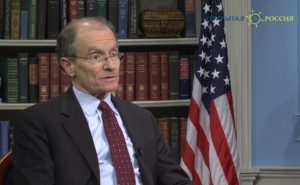
U.S. Ambassador Daniel Fried, who recently retired as the State Department’s coordinator for sanctions policy.
By James W Carden | Consortium News | March 7, 2017
It’s probably safe to wager that few people outside of Washington, and perhaps even quite a few people inside it, have ever heard of Ambassador Daniel Fried — at least not until very recently.
The longtime Ambassador, a 40-year veteran of the U.S. State Department, recently made headlines in Time, Newsweek, Reuters, Politico and NPR for a farewell speech he made to his State Department colleagues during which he took a parting shot at President Trump for the latter’s widely assumed (but yet to be acted upon) desire to come to an accommodation with Russia.
Fried’s address won praise from Establishment figures like former Deputy Secretary of State Antony Blinken (a “powerful defense of liberal international order”), Atlantic Council executive Damon Wilson ( a “clarion call for the U.S. to believe in itself and lead [a] liberal order”) and New York Times columnist Roger Cohen (“a superb summation of everything worth fighting for to keep this planet fit for human habitation”).
Why all the excitement? Well for one, Frieds’s farewell hit the many of Establishment’s erogenous zones:
–NATO expansion as an unalloyed good: NATO and the E.U. – grew to embrace 100 million liberated Europeans… this great achievement is now under assault by Russia
–Realists just don’t “get it”: George Kennan didn’t think much of what he termed America’s moralistic-legalistic tradition. But this foreign policy exceptionalism was the heart of our Grand Strategy through two World Wars, the Cold War and the post-1989 era, and it was crowned with success.
–And then there is Fried’s tendentious (and among neoconservatives and liberal interventionists widely shared) rendering of history and his puzzling conflation of the world situations as they obtained in 1940 and as it obtains currently, in 2017: In 1940, Germany offered Britain a sphere of influence deal: German recognition of the British Empire in exchange for London’s recognition of Germany dominance of continental Europe. Churchill didn’t take the deal then; we should not take similar deals now.
While there can be little doubt that Fried served loyally, with distinction and was in all likelihood an exemplary functionary of the U.S. foreign policy apparatus, what else explains the outpouring of praise for Fried?
Part of it of course is that in Washington, you get points for longevity regardless of your record. Recall the encomiums heaped upon Andrew Marshall a couple years ago when Marshall, who spent his career as the Pentagon’s chief policy hand, retired after four decades in 2015.
The Washington Post reverentially called Marshall “the Pentagon’s Yoda”; The Economist praised him as “the quiet American”; and that year a flattering book was released about Marshall entitled The Last Warrior: Andrew Marshall and the Shaping of Modern American Defense Strategy. In a review of the book, Notre Dame political scientist Michael Desch tartly noted that “at the end of the day, Marshall was not a saint but rather a public official who served too long and whose record was more mixed than his incense burners are prepared to admit.”
#Resistance to Trump
Another reason for the current praise for Fried’s address is that it combined two of the essential ingredients of the #Resistance that is currently so in vogue in today’s Washington: opposition to Trump and hostility to Russia – never mind whether the policy implications of such a stance are necessary or wise.
Days after he retired, Fried sat down with another tried-and-true Russia critic, former Moscow correspondent for The Washington Post Susan Glasser, and said that in his opinion, “Russia despises the West. And it is doing what it can to weaken the West.” Trump should not, said Fried, “be so desperate to rub up against a Russia which is busy trying to do us in all over the world.”
That Fried’s carries these opinions on Russia is unsurprising; a look at his career in the Foreign Service shows a diplomat who took the most hawkish positions possible regarding Russia in the post-Cold War period. Fried was a vocal champion of NATO enlargement, arguing, as U.S. Ambassador to Poland in January 1998 that “NATO membership had a stabilizing effect on Western Europe’s ‘ethnic rivalries’ and the prospect of membership in ‘the West’ has strengthened political moderates and weakened nationalists throughout Central Europe, to U.S. benefit.”
This assessment looks rather less than prescient in light of the recent rise in ethno-nationalist regimes in Poland, Hungary and, of course, Ukraine.
As U.S. Assistant Secretary for Europe under George W Bush, Fried declared that Russia’s defense of the ethnic Russian enclave of South Ossetia against the neoconservative puppet government of Mikheil Saakashvili was “not the sign of a strong nation. It is the sign of a weak one.”
Russia, said Fried, anticipating many of the same talking points we hear today, told the Washington Post in August 2008, “Russia is going to have to come to terms with the reality; it can either integrate with the world or it can be a self-isolated bully. But it can’t be both.”
Fried was one of the lead architects of U.S. sanctions against Russia in the aftermath of the Ukraine crisis and Crimean annexation. Having served as the State Department’s coordinator of sanctions policy, he recently argued that “without the sanctions the situation might well be much worse. And if you don’t think it can be worse then I think you just lack imagination. The Russians could have driven deeper into Ukraine and they could have tried to seize Mariupol or driven on land all the way to Crimea or attack Harkhiv. The sanctions may have stopped the Russians from going further.”
This summation is, to put it mildly, open to question, given that there is little evidence that the Russians even want the small part of Donetsk and Luhansk that they currently help to subsidize and support.
In the end, in judging the supposed wisdom of Fried’s recent fusillades against Trump and Russia we might look to the record of the man rather than his rhetoric.
James W Carden is a contributing writer for The Nation and editor of The American Committee for East-West Accord’s eastwestaccord.com. He previously served as an advisor on Russia to the Special Representative for Global Inter-governmental Affairs at the US State Department.
(Photo from YouTube)
Drastic Changes in the Middle East Happen Unbelievably Fast
By Peter KORZUN | Strategic Culture Foundation | 04.03.2017
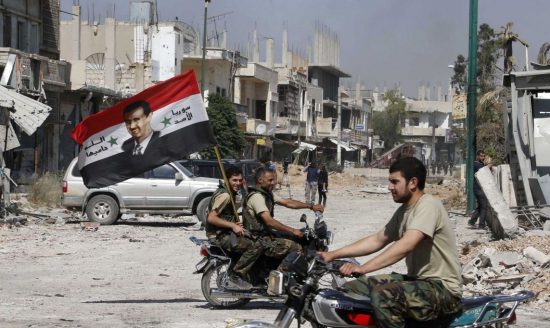
The situation in the Middle East is changing at an incredible speed. The things unbelievable yesterday, become reality today. Each of the events becomes part of a bigger picture, with the region gradually moving away from abyss to become a better place.
On March 1, Iraqi forces were reported to have taken control of the last major road out of western Mosul, preventing Islamic State (IS) militants from fleeing the city. The route leads to Tal Afar, another IS stronghold that is 40 km further west. They have since driven militants from the international airport, a military base, a power station and a number of residential areas. IS fighters began to flee. Total control over the city by Iraqi forces seems to be a matter of a few days, maybe hours.
Being almost defeated in Iraq, the IS has nowhere else to go but Syria – the country where they have just suffered a defeat, with Palmyra retaken by Syria’s government forces. Russia’s support has been crucial in the Syrian army’s push. Raqqa, the last remaining stronghold of the IS, will be the place of the final battle the extremist group is doomed to lose as many influential actors want it to be wiped away from the earth.
Turkey has announced its intent to launch an offensive to retake Raqqa but only after taking control of Manbij, the town held by the Kurds-dominated Syria Democratic Forces (SDF). The parties were in for a fight to benefit the IS and other terror groups. The US was at a loss as to how to prevent a clash between the NATO ally and the Kurds – the force it relies on in the fight against the IS. That’s when Moscow stepped in to avoid the worst, using its unique position as a mediator. It managed to do what nobody thought was possible. The military council in Manbij said on March 2 it will hand over areas west of the flashpoint town to Syrian government troops, after an agreement brokered by Russia.
Now the town is in Arab hands and Turkey has no reason to attack it. Syria and Turkey are not at war.
The United States had promised Turkey that Kurdish forces would withdraw from Manbij to the east of the Euphrates, but it never happened. Now Russia did what America had failed to do.
As a result of Russia’s effective mediation, Turkey can double down on its plans to advance to Raqqa, while Syria’s government has greatly strengthened its position. Turkey’s President Erdogan has just said he is ready to fight the IS together with Russia. He is coming to Moscow on March 9. It means no clash between Turkey and Syria will take place.
Many things are changing for the Syrian government and it has been going on for some time. It’s not a coincidence that voices get louder, calling for inviting Syrian President Assad to the March 29 Arab Summit in Amman – five years after Syria was expelled from the 22-member organization. Russia, Jordan and Egypt are applying efforts to reconcile the Arab community with the Syrian government. Last month, Egypt’s parliamentary committee for Arab affairs called for the return of Syria to the Arab League. This would signify the reconciliation between Saudi Arabia which backed the Syrian rebels – something unthinkable some time ago.
In 2015, then US President Obama predicted Russia would get stuck in Syria’s quagmire. He appears to have been wrong. Thanks to Russia’s involvement, one can see the light at the end of the tunnel to make the quagmire a thing of the past.
Moscow can facilitate the process of Iran joining with Arab states in the effort to reach agreement on Syria, bringing it to some mutual understanding with Saudi Arabia. Not much has been reported about some recent events of special significance. Iranian President Hassan Rouhani visited Kuwait and Oman on February 15. Saudi Arabian Foreign Minister Adel Al-Jubeir made a trip to Iraq on February 25, to be received by Iraqi Prime Minister Haider Al-Abadi. The trend is visible – Shia and Sunni are on speaking terms again and they are discussing something very important. It would have sounded incredible a short time ago but these are the facts.
All these events and emerging trends are taking place against the background of the ongoing UN-brokered Geneva talks on peaceful settlement in Syria. Here too we have an unexpected turn of events – the Syrian opposition seeks to meet with Russian officials!
According to Paul Vallely, a retired US Army Major General and senior military analyst for Fox News, Russia-US consultations on Syria are to start in two months after the presidents hold a summit. He said Russia is to play a key part in any scenario.
The recent days have literally shaken the Middle East. So many unexpected things happen to push things forward. Right in front of our eyes the impossible becomes possible.
As said before, Moscow is in a unique position to act as an intermediary and it plays its role aptly to achieve tangible results. If the current trend continues in the same direction, leading to the desired outcome, Russia’s effort will go down in history as an extraordinary achievement of military success combined with effective diplomacy.
New Cold War tensions are easing
By M K Bhadrakumar | Indian Punchline | March 3, 2017
After a 3-year interlude, NATO and Russia resumed contact at the military level today. Back in April 2014, in the immediate aftermath of the ‘regime change’ in Ukraine, the NATO Council had made a decision to freeze relations with Russia. The Russian Defence Ministry announced today that Chief of Russia’s General Staff General Valery Gerasimov had a phone conversation with the Chairman of the NATO Military Committee General Petr Pavel. The announcement in Moscow said, inter alia,
- The Chief of Russia’s General Staff drew his interlocutor’s attention to the existing concerns related to the considerable build-up of the North Atlantic alliance’s military activity near Russian borders and the deployment of the system of the NATO united forces’ forward stationing… The sides confirmed the need of mutual steps aimed at reducing tension and stabilizing the situation in Europe. Army General Gerasimov and General Pavel agreed on continuing such contacts.
Such a major NATO decision – resumption of ties with the Russian military top brass – could only have been possible with a green light or prior clearance from Washington. Simply put, the Donald Trump administration is chipping away at the Barack Obama administration’s policy to “isolate” Russia. Trump’s speech at the US Congress on Tuesday eschewed any reference to Russia. This was also a break from Obama’s diatribes against Russia in his final address to the Congress last year. (See my piece Trump Can Be Good for World Peace — If Only He’s His Way.)
Interestingly, the Russian Foreign Ministry announced on Thursday that German Foreign Minister Sigmar Gabriel will visit Moscow on March 9 and that the agenda will have “a focus on multilateral efforts to resolve the Ukraine and Syria crises and normalise the situation in Libya.”
Three days back, on February 28, Russian Deputy Foreign Minister Sergei Ryabkov hinted at a meeting between President Vladimir Putin and President Trump. In Ryabkov’s words,
- There is no understanding yet on the date and the place of holding such a meeting but practical preparations for it have been launched and there is mutual understanding with the U.S. side on this score. Naturally, at this initial stage of a dialog with the new administration, it is difficult to make a conclusion about how work will proceed further on specific issues. The forecasts for a perspective will become possible when we see Washington’s practical actions.
Meanwhile, in an unbelievable twist of fate, Russia and the US find themselves on the same side in northern Syria in an effort to restrain Turkey from precipitating a “war within the war” in Syria. (See my blog Turkish army to march deeper into Syria – alone and defiant.) The Syrian Kurdish militia (which is the US’ ally in northern Syria) has struck a deal with the Syrian government forces to block the Turkish troops from advancing toward Manjib. (To jog memory, Manjib was captured from the ISIS in a joint operation between the US Special Forces and the Kurdish militia last August.) And, curiously, Russia mediated the deal today between the Kurdish militia and the Syrian army. (TASS ) .
So, what do we have here? Turkey is planning to go for the jugular veins of the Kurdish militia who are in control of Manjib, knowing full well that the latter is backed to the hilt by the US Central Command and that US forces are on the ground with the militia. As a Reuters analysis put it, Turkey and the US are apparently on a “collision course”. And at this point, Russia steps in and gets the Syrian government to take charge from the Kurdish militia over the western approaches to Manjib to block the advancing Turkish forces.
Suffice it to say, it is difficult to believe that there have been no contacts between the US and Russian militaries at the operational level as regards the dangerous situation developing around Manjib. When the Kremlin spokesman Dmitry Peskov was asked earlier today about contacts between Russia and US on the Syrian crisis, he said, “There have been no substantial contacts.”
On February 28, Pentagon submitted to the White House its report on the strategy to fight the ISIS. A Moscow analyst on security issues Andrei Akulov has given a positive evaluation, visualizing the possibility of Russian-American cooperation and coordination in the fight against terrorism. The picture that emerges from a briefing given by the top US commander in Iraq Lt. General Stephen Townsend on Wednesday via a teleconference from Baghdad is also that
- US is unlikely to deploy a large number of troops in Syria;
- US will continue to regard the Kurdish militia as an indispensable ally in Syria;
- US military will not recommend any fundamental shift in strategy in Syria – namely, fighting “by, with and through our (US’) local partners”;
- Kurdish militia will have a significant role in the forthcoming operation to liberate Raqqa, ISIS’ de-facto capital in eastern Syria; and,
- US does not agree with Turkey’s perception that the Syrian Kurds pose a threat to its national security.
The transcript of Lt. Gen. Townsend’s teleconference is here. The big question is whether there could be prospects of US-Russia military cooperation in Syria. In a remark in mid-February, Defence Secretary James Mattis had ruled out such a possibility. But things can change. The resumption of high-level military contact today between the NATO and Russia signals that an overall easing of tensions in the West’s ties with Russia can be expected. Today’s phone call could be the harbinger of changes in the air. Let us call it the “Trump effect”.
Against this backdrop. German FM Gabriel’s talks in Moscow coming on Thursday assume importance. For the benefit of the uninitiated, Gabriel was a protégé of late Egon Bahr, the famous German SPD politician who is regarded as the creator of the so-called Ostpolitik – the foreign policy of détente with the former USSR and other Warsaw Pact member countries in general, beginning in 1969, which was promoted by the then Chancellor Willy Brandt.
A Confession on Meeting a Russian
By David Swanson | Consortium News | March 3, 2017
It was August 2014. Our secret and nefarious meeting had to be disguised as a public event. So, the Russian Ambassador to the United States, Sergey Ivanovich Kislyak, spoke at the University of Virginia, in an event organized by the Center for Politics, which no doubt has video of the proceedings and was of course in on the conspiracy.
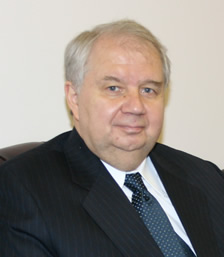
Russia’s Ambassador to the U.S. Sergey Kislyak
Kislyak was once ambassador to Belgium and to NATO. He served an eight-course Russian dinner for select guests prior to the public forum in an underground lair deep inside Observatory Hill.
Kislyak spoke to a packed auditorium at UVA and took, I think, well over an hour of questions. He spoke frankly, and the questions he was asked by students, professors, and other participants were polite and for the most part far more intelligent than he would have been asked on, for example, Meet the Press.
He told the audience that Russia had known there were no WMDs in Iraq, and had known that attacking Iraq would bring “great difficulties” to that country. “And look what is happening today,” he said. He made the same comment about Libya. He spoke of the U.S. and Russia working together to successfully remove chemical weapons from the Syrian government. But he warned against attacking Syria now.
There will be no new Cold War, Kislyak said, but there is now a greater divide in some ways than during the Cold War. Back then, he said, the U.S. Congress sent delegations over to meet with legislators, and the Supreme Court likewise. Now there is no contact. It’s easy in the U.S. to be anti-Russian, he said, and hard to defend Russia. He complained about U.S. economic sanctions against Russia intended to “suffocate” Russian agriculture.
Asked about “annexing” Crimea, Kislyak rejected that characterization, pointed to the armed overthrow of the Ukrainian government and insisted that Kiev must stop bombing its own people and instead talk about federalism within Ukraine.
There were remarkably few questions put to the ambassador that seemed informed by U.S. television “news.” One was from a politics professor who insisted that Kislyak assign blame to Russia over Ukraine. Kislyak didn’t.
Swanson’s ‘Contact’
I always sit in the back, thinking I might leave, but Kislyak was only taking questions from the front. So I moved up and was finally called on for the last question of the evening. For an hour and a half, Kislyak had addressed war and peace and Russian-U.S. relations, but he’d never blamed the U.S. for anything in Ukraine any more than Russia. No one had uttered the word “NATO.”
So I pointed out the then upcoming NATO protests. I recalled the history of Russia being told that NATO would not expand eastward. I asked Kislyak whether NATO ought to be disbanded.
The ambassador said that he had been the first Russian to “present his credentials” to NATO, and that he had “overestimated” NATO’s ability to work with Russia. He’d been disappointed by NATO actions in Serbia, he said, and Libya, by the expansion eastward, by NATO pressure on Ukraine and Poland, and by the pretense that Russia might be about to attack Poland.
“We were promised,” Kislyak said, that NATO would not expand eastward at all upon the reunification of Germany. “And now look.” NATO has declared that Ukraine and Georgia will join NATO, Kislyak pointed out, and NATO says this even while a majority of the people in Ukraine say they’re opposed.
The ambassador used the word “disappointed” a few times.
“We’ll have to take measures to assure our defense,” he said, “but we would have preferred to build on a situation with decreased presence and decreased readiness.”
Wouldn’t we all. I mean, all of us who aren’t interested in risking World War III as long as it can gin up a pretense that Hillary Clinton lost because of Russian evil.
Russia, NATO military chiefs in first high-level contact since 2014
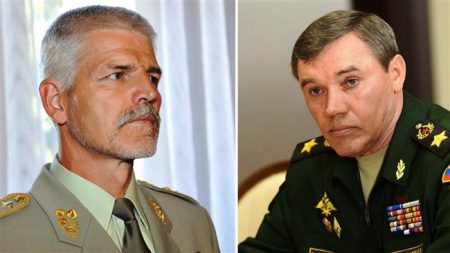
File photo shows Chief of Russia’s General Staff Valery Gerasimov (R) and Chairman of the NATO Military Committee General Petr Pavel
Press TV – March 3, 2017
In the first high-level contact after NATO unilaterally froze ties with Moscow over the crisis in Ukraine, military chiefs from Russia and the Western alliance have held a phone conversation.
“This is the first high-level military contact after the NATO Council made a decision on the freeze of relations with Russia,” Russia’s Defense Ministry said on Friday.
It also said the chief of Russia’s General Staff, First Deputy Defense Minister Army General Valery Gerasimov, had held the telephone talk with NATO’s chairman of military committee, General Petr Pavel.
The two sides, the Russian Defense Ministry said, exchanged opinions about current security issues.
The Russian side also relayed Moscow’s security concerns regarding NATO’s “considerable” buildup of military activity near Russian borders.
NATO’s headquarters in Brussels, Belgium, confirmed the phone conversation. It said “active military to military lines of communications are in the mutual interest of NATO and Russia.”
The NATO headquarters added that the frozen communication lines would “remain open,” without giving any details about what was discussed during the latest talks.
NATO severed ties with Moscow in 2014, after Crimea in eastern Ukraine rejoined the Russian Federation following a historic referendum. Since then, NATO has been deploying weapons and equipment close to Russia’s borders.
In early January, the US military began the deployment of hundreds of combat vehicles such as tanks and artillery guns along with 3,500 troops to Germany.
In mid-February, Russia’s President Vladimir Putin accused NATO of trying to embroil Moscow in confrontation by constant provocative actions.
NATO “has been expanding as it did before but now they seem to have found new serious reason to justify the bloc’s expansion and have sped up the process of deploying conventional and strategic weapons beyond the member states’ borders,” the Russian president said at a board meeting of the Federal Security Service (FSB).
Russia’s Defense Ministry said that during the phone conversation both military leaders agreed to make efforts to reduce tensions. “The sides confirmed the need of mutual steps aimed at reducing tension and stabilizing the situation in Europe.”
“The two generals agreed that they would remain in contact,” the ministry added.
Sweden reintroduces military conscription, citing alleged Russian threat
Press TV – March 3, 2017
Sweden has decided to reintroduce mandatory military service for both men and women next year, citing what it says is a military threat from Russia.
The Swedish Defense Ministry said on Thursday that thousands of male and female youths will be conscripted and selected for military training in a program starting in 2018. The decision has also been backed by the parliament.
Sweden, a member state of the European Union (EU), had ended compulsory military service in 2010.
Defense Minister Peter Hultqvist cited alleged Russian military buildup near the Baltic region and Moscow’s alleged involvement in the Ukrainian conflict as reasons for the decision. “We have more exercise activities in our neighborhood. So we have decided to build a stronger national defense,” he said.
The government will call up 4,000 men and women for military training per year in 2018 and 2019.
Back in December last year, Sweden’s Civil Contingency Agency asked local authorities across the country to improve security measures to face a possible military attack. The measures included maintaining and upgrading underground bunkers as emergency bases of operation.
According to a letter from the Agency, municipalities around the country were called to “increase their ability to resist an armed attack against Sweden from a qualified opponent.”
Sweden is not a member of NATO but cooperates closely with it.
NATO, which has suspended all ties with Russia since April 2014, has deployed thousands of its troops as well as military hardware near Russian borders. Russia has previously warned that it would take measures to respond to the increased activities near its borders.
NATO’s scaremongering about ‘Russia threat’ to Baltic States ‘is all about money’
RT | March 2, 2017
The US security establishment is trying to justify its existence, says Daniel McAdams of the Ron Paul Peace Institute, commenting on a new report which lists how NATO can help the Baltic States counter Russian ‘hybrid warfare.’
The American global policy think-tank, the RAND Corporation, published a report that claims NATO should do more to counter the potential Russian threat and strengthen the Baltic countries’ forces. The US government-funded body issued a report titled “Hybrid Warfare in the Baltics: Threats and Potential Responses.”
The document raises concern over “Russian use of “hybrid warfare” best understood as covert or deniable activities, supported by conventional or nuclear forces, to influence the domestic politics of target countries.”
The author of the report, Andrew Radin claims “these tactics are of particular concern in the Baltic countries of Estonia and Latvia, which have significant Russian-speaking minorities.” He warns that there is concern Russia will seek to use these minorities to gain influence in the region, “use covert action to seize territory, use subversion to justify a conventional attack, or otherwise use deniable or covert means to gain influence in the Baltics and undermine the EU and NATO.”
RT discussed the report with McAdams and asked him why potential “Russian aggression” is in the spotlight again. Is there a real threat?
In his view, what we are seeing is just another example of the national security establishment in the US “having to justify its existence.”
“The report itself outlines many things that NATO has to do to help the Baltics. The Baltics are absolutely irrelevant to the security of NATO. Their only relevance is geographic. They are close to Russia. Therefore, NATO can hold exercises on Russia’s border to provoke Russia. As far as the Baltics, look at Latvia, for example, if it is so concerned about Russian warfare or hybrid warfare, why do they spend 0.9 percent of their GDP on defense? They are clearly not worried. It really is just a ploy to get more free things from NATO. And for NATO to keep itself alive after it should have been shut down,” McAdams said.
In his opinion, “hybrid warfare” – the report refers to – is a term used when there’s no evidence that Russia has done anything wrong.
It was hybrid warfare when Russia “invaded Ukraine.” And that is just because we didn’t see any Russian military in Ukraine. It was hybrid warfare with “the little green men” in Crimea. Well, those little green men in Crimea were already there legally as part of the leased base in Sevastopol. All of these things are made up, it’s part of NATO’s ongoing aggression toward Russia, provocation of Russia and it is desperate to keep itself alive, to keep its budgets rising,” the analyst said. “And sadly, unfortunately, we are seeing that the US president who was rightly critical of NATO, calling it outdated, said in his recent speech to Congress that he loves NATO and thinks it’s great. So, unfortunately, it looks like it is going to be propped up for a while longer. And yes, it is about money,” he added.
Trump Retreats on Detente with Russia
By Gilbert Doctorow | Consortium News | March 1, 2017
Donald Trump’s speech on Tuesday to a joint session of Congress was a reasonably well-crafted and well-delivered exercise in communicating his case to the nation. The President opened with a description of the flurry of executive orders in his first 30 days in office, implementing promises made during the electoral campaign.
He then went on to describe the contours of legislation that his administration will send to Congress, starting with the budget and its scrapping of the cap on military spending, which is to enjoy a 10 percent rise in appropriations while domestic and other government spending is slashed. Then there was a review of his plans to repeal and replace Obamacare and a preview of his proposals for cutting taxes and regulations with the goal of creating more well-paying jobs.
In an emotional highpoint, Trump drew attention to the widow of a Special Forces soldier killed in a raid inside Yemen. He also presented a more compassionate – less combative – tone, calling on Democrats and Republicans to put aside their differences and work together. His 60-minute address was interrupted 93 times by applause, often standing ovations from Republicans but also some applause from the Democratic side, too.
Trump seemed to bask in the enthusiastic show of support, although such State of the Union speeches typically draw the same sort of surface adulation, with the members from the party in power cheering robustly and those from the other side offering sparser shows of support. Still, the televised images contrasted with the portrayal from the mainstream U.S. news media of an embattled leader caught in a Watergate-like scandal over supposedly illicit contacts with Russia, a narrative Trump mistakenly fed with the hasty firing of National Security Adviser Michael Flynn on Feb. 13 during a media frenzy about Flynn talking with the Russian ambassador during the transition.
Flynn became the target of elements inside the U.S. government and the press who opposed Trump’s plans for détente with Russia. Those anti-détente forces are now flexing their muscles, with U.S. Ambassador to the United Nations Nikki Haley sounding much like her hawkish predecessor Samantha Power, insisting that the United States will not recognize Russia’s takeover of Crimea and then, this week, co-sponsoring a resolution in the U.N. Security Council condemning the Assad regime in Syria for allegedly using chemical weapons, a move that provoked angry protests and a veto from Russia’s envoy.
Meanwhile, Vice President Mike Pence, Secretary of State Rex Tillerson and Defense Secretary James Mattis carried messages to Europe reaffirming the U.S. commitment to NATO allies and blaming Russia for the failure of the Minsk Accords to resolve the crisis in Ukraine (although a major obstacle was created by the Ukrainian government when it insisted that ethnic Russian rebels in the Donbass region effectively surrender before other steps would be taken). The U.S. statements could have been delivered by neoconservative and liberal-interventionist diplomats from the past several U.S. administrations.
Only the last five minutes of Trump’s address to Congress dealt with foreign relations. And his own words were consonant with what his cabinet officers had been saying. Trump’s campaign opinions about NATO’s obsolescence had disappeared. Russia was not mentioned by name once in the speech, while America’s allies in NATO and in the Pacific were reassured that “America is ready to lead.” That statement was a rare instance when the entire congressional audience rose to its feet in applause.
Back on His Words
Those who had feared that Trump’s populism and “America First” rhetoric spelled isolationism were reassured that “Our foreign policy calls for a direct, robust and meaningful engagement with the world.”
In fact, in the entire speech, there were only a few lines toward the end that might give heart to those who hoped that Trump might pursue a dramatically new foreign policy that drew back from America’s vast network of military bases and the tendency to intervene in other countries’ affairs.
Though sounding not unlike boiler-plate language that Presidents George W. Bush and Barack Obama might have used, those words did contain the possible seeds of a less warlike strategy. Trump said: “America is willing to find new friends and to forge new partnerships where shared interests align. We want harmony and stability, not war and conflict. America is friends today with former enemies. We want peace, wherever peace can be found. America is friends today with former enemies. Some of our closest allies decades ago fought on the opposite side of these terrible, terrible wars.”
Depending on the strength of one’s powers of self-delusion, those last words might be construed as a hint: just wait, allow me to get my footing and establish my popularity in Congress and in the broad public and I will come back and deliver on my détente aspirations.
But it is an inescapable reality that the firing of Flynn and Trump’s retreat from his foreign policy intentions were precipitated by the powerful collusion between the intelligence services, particularly the CIA, and the mainstream media with a clear intent to either neuter Trump by forcing a policy reversal on Russia détente or remove him through some form of impeachment. The phoniness of the McCarthyite charges of Russian connections used to smear Trump and his entourage has been well explained in recent articles by Professor Stephen Cohen in The Nation and by Gareth Porter at Consortiumnews.com.
Those with a more conspiratorial turn of mind have long spoken of the Deep State, which ensures continuity of policy whatever the results of U.S. elections with this subterranean power residing largely in the intelligence services, especially the CIA and FBI, in the Pentagon, and in the State Department.
State is said to have been purged in its policy-making “seventh floor” during the week of Secretary Tillerson’s European travels. But the text that was placed before the inexperienced Ambassador Haley for delivery in the Security Council shows that not all the old actors have been sent packing. Any purge of the CIA and Pentagon has not even begun.
The ability of neocons and hardliners at the Pentagon to sabotage presidential policy was demonstrated last September when a promising collaboration between Secretary of State John Kerry and Russian Foreign Minister Sergey Lavrov over a cease-fire in Syria was torn to shreds by an “accidental” attack by U.S. and Allied fighter jets on a Syrian government outpost at Deir ez-Zor that killed nearly 100 Syrian soldiers.
If these recalcitrant Cold Warriors in America’s “power ministries” remain untouched, they will be in a position to create provocations at any time of their choosing to override Trump’s planned détente policies. To do so would be child’s play, given the close proximity of U.S. and Russian forces in Ukraine, in Syria, in the Baltic States, on the Baltic Sea and on the Black Sea.
Given the poor state of relations and the minimal trust between Russia and the U.S.-led West, any accident in these areas could quickly escalate. And then we might see the side of Donald Trump’s personality that his Democratic opponents warned us about, his short temper and alpha-male nature which could bring us into an armed clash the outcome of which is unforeseeable but surely not good.
There is another troubling issue for those who hoped Trump would rein in military spending to finance his promised domestic infrastructure investments. Instead, Trump has focused on expanding military spending even more, financed by cuts in domestic spending. There has not been a word to suggest he is considering restructuring the $600 billion military appropriations, for example by cutting the military bases abroad, which are configured to support precisely the global hegemony and American imperialism that he has denounced.
What is at issue is not only the tens of billions of dollars in savings that would come from slashing this overseas base structure but also removing an American presence from countries where it only serves to foster anti-Americanism and to embroil us either in defending hated regimes or intervening in regional conflicts where we have no vital interests.
Without restructuring and reducing the gargantuan network of foreign military bases, the U.S. will be condemned to a never-ending succession of wars abroad and the entire plan of investment in America is doomed to failure. These are not issues that allow for tactical retreats but rather must be addressed head-on. But who will explain this to a headstrong President with the fawning applause of Congress ringing in his ears?
Gilbert Doctorow is a Brussels-based political analyst. His latest book, Does Russia Have a Future? was published in August 2015.
Germany to help Baltic states establish Russian-language media
Press TV – February 28, 2017
Germany plans to help Estonia, Latvia, and Lithuania establish Russian-language media outlets to counter the “disinformation” allegedly being spread by Russian channels broadcasting in the region.
The plan was announced by German Foreign Ministry spokesman Martin Schaefer, RT reported on Tuesday.
The announcement came ahead of German Foreign Minister Sigmar Gabriel’s trip to the Baltic states and Sweden, which is due to take place this week.
“During his trip, Mr. Gabriel will also employ what we already started last year in the Baltic states, which is — as we say in new German — handling Russian ‘fake news’ together with appropriate partners,” Schaefer said on Monday.
He added that the main goal of the initiative was to launch Russian-language radio and TV channels, which will be “attractive to Russian speakers living in the three Baltic states” in order to produce news “in a different way” from the Russian media.
The United States, too, recently announced plans to launch a Russian-language television news channel. The US has long accused Russian media of propagating “fake news.” Such allegations have also been leveled by European governments, which are concerned about alleged Russian attempts to influence their elections in much the same way as the US has said Moscow influenced its recent presidential vote.
Western ties with Russia have plummeted significantly in recent years, particularly following Crimea’s separation from Ukraine and reunification with the Russian Federation after a referendum not authorized by Kiev.
Military build-ups close to the Russian borders, including in the Baltic countries, have also been a major source of tension.
US in Deep Turmoil as Trump Confronts the Establishment
By Salman Rafi Sheikh | New Eastern Outlook | 28.02.2017
With the departure of the Trump’s national security adviser, political crisis in the US has only depended and is likely to exacerbate into a full-fledged struggle for power and control between Trump and what some call ‘deep-state.’ While Donald Trump is an elected president of the United States of America, he doesn’t seem to be able to exercise power in actual terms. This is evident from the way a so-called ‘pro-Russian’ adviser has been forced to resign. Following this resignation an intense debate has emerged in the US, leading a considerable number of people, 48 per cent according to a recent poll, to reject the way Trump has performed in the first month of his presidency. Already Trump has retracted on Crimea. Accordingly, he is in no hurry to engage Russia in Syria nor does he consider NATO to be “obsolete.” In the same vain, his U-turn towards China is something that nobody could foresee during his election campaign. As of now, a great deal of Trump’s election rhetoric is dead and lies buried deep inside the rubric of deep structures of power, marking the very first instance of its sort when an American president has found himself deeply at odds with the system. And, there is no certainty that he can or may overcome this tussle and emerge as the American ‘knight in shining armour.’
While this may or may not happen, a lot of questions about Trump’s ability to steer the course of American foreign and domestic policies have emerged following Flynn’s resignation and with it the so-called crisis of legitimacy has deepened, leaving minimum to no space for Trump to freely determine the course of American policy making.
The crisis, or the power struggle, has deepened to an extent where an American elected president has been forced to publicly blame American intelligence agencies for feeding the media with information against him and claimed that today’s America was `just like Russia’.
The Russophobia campaign is, indeed, being fed to the American public and the declining support for Trump is more a direct result of this spread of false information than an outcome of actual ‘bad performance.’
The media leaks have already led to Michael Flynn’s resignation. The Washington Post has recently reported that Flynn had “discussed sanctions” with a Russian official during the transition period, although Flynn had assured Vice President Mike Pence that this did not happen.
In turn, The New York Times noted on February 14, 2017, that other officials of the Trump administration and his election campaign have had contacts with Russian intelligence agents as well.
Flynn’s departure just three weeks after Trump’s inauguration as president has allowed the media to claim that the White House was in total disarray.
The media’s propagandist claim has certainly irked Trump who went to his favourite medium of communication, Twitter, to fire off a series of tweets, attacking the media as well as the intelligence agencies. In at least two tweets, Trump named the agencies the Federal Bureau of Investigations (FBI) and National Security Agency (NSA) that he said were `running a campaign against him’.
`The real scandal here is that classified information is illegally given out by `intelligence’ like candy. ‘Very un-American’, he tweeted. `Information is being illegally given to the failing New York Times and Washington Post by the intelligence community.
The crisis that has thus ensued and which is being fanned out by the mainstream US media is asking for changes in the policies, particularly towards Russia about Crimea and co-operation in Syria, that Trump had advocated during his election campaign.
We have already seen that some of it has already changed. What this retraction implies, in political terms, is that the establishment has also shown that it has the ability and the grit to undermine Trump if he were to deviate from their script—a script that is premised on the existence of an enemy (Russia) and which the establishment and the deep-state can use to protect, enhance and materialize its own political and economic interests in both domestic and global political and economic arenas.
The “Russophobia” based containment of Donald Trump is, however, not going to remain exclusive to the US’ domestic political circles. On the contrary, it is likely to, and already has, expanded into international political arena and is going to define and shape Trump’s relations with the US’ European allies, who in turn are neither comfortable with Trump’s foreign policy nor are going to allow him to retract the US-NATO security system (read: NATO is no longer “obsolete”).
Interestingly enough, this ‘trans-Atlantic Russophobia’ is being transformed into a new Cold War. The NATO defence ministers have been recently been discussing the presence of their fleets in the Black Sea in a closed summit in Brusells. Clearly, the western bloc on the whole loathes Trump, creating an unprecedented disequilibrium within the Western alliance wherein Trump leads the alliance, but the partners do not know how far he is to be taken seriously due to his inability to control things (read: establishment’s course of action is more appealing to the NATO allies for its anti-Russia, pro-sanctions commitments).
The Trump administration has lost, by losing Flynn, its authority and the ability to guide the American public to its vision. On the contrary, the media-establishment nexus has hijacked Donald Trump’s own vision, forcing him to forget his election rhetoric promises and come out in the open to fight for his political survival through social media.
Just as Trump’s confrontation with the American establishment is causing unease in the domestic and European political arena, Trump’s fight with the establishment is being equally fought in both domestic and European arenas. Whereas Trump has resorted to twitter to fight back against a sustained media campaign, in the European arena he has hit back by re-casting doubts over the US’ commitment to NATO.
That is to say, while he no doubt has willy-nilly accepted NATO as the “bedrock” of American security, Mattis’ remarks at NATO defence ministers’ meeting show that the crisis is not yet over and that it will remain unsettled unless the dust of the tussle between Trump and American establishment remains in the air—something that may not happen overnight—and unless the all-powerful American establishment succeeds in modifying Trump into a typical Neo-Con hawk.
Salman Rafi Sheikh, research-analyst of International Relations and Pakistan’s foreign and domestic affairs.
Featured Video
New positive ivermectin evidence
or go to
Aletho News Archives – Video-Images
From the Archives
Fanatical Followers of the Covid Regime: A Jim Jones-Style Cult?
By Professor Roger Watson and Dr. Niall McCrae | The Daily Sceptic | November 15, 2021
As scholars at leading British universities over recent decades, we witnessed the replacement of critical thinking and debate by narrative: facts are discrimination and scientific method is imperialism; truth, instead, is derived from ‘progressive’ values. This educational trend may be a major contributory factor to the ease in which society has been inculcated to the Covid ‘new normal’ of masking, testing, and repeated doses of vaccines for a disease of similar risk to severe influenza.
One doesn’t need much critical reasoning to observe the flawed logic of some vaccination enthusiasts, such as people who respond to experiencing any side effects, however debilitating, by saying “at least I know it’s working”, or, after contracting the disease despite their promised inoculation (over 90% effective, according to initial drug company claims), “I’d have been worse off without the jab.” … continue
Blog Roll
 Aletho News
- EU Council Advances Chat Control 2.0 Scanning Proposal
- Ex-Greek MEP files complaint against Israeli spyware firm over alleged Pegasus surveillance
- Troubling ideas throughout the Torah, Talmud, Mishneh Torah and Tanya
- ‘Grave, alarming’: Iran mission on Trump’s UNGA ‘annihilation’ threats
- Najaf airport to reopen to Iranian flights within 24 hours: Ambassador
- From ‘How Will This End For Iran’ to ‘When America Walks Away’: A tale of two Economist covers
- Tehran blasts ‘baseless’ speculation linking Iran to alleged bomb plot at UK air base
- The Rise And… Rise Of ‘Color Revolutions’
- The Coming GOP Bloodbath?
- Arctic Scare Stories Melt Away
- If Americans Knew
- Netanyahu Asked UAE Leader to Deny Report on Oct. 7 Warning in Secret Visit, Sources Say
- CNN Chief Int’l Correspondent Clarissa Ward on Journalists in Gaza
- Democratic Party Consultants Surround Troy Jackson with Pro-Israel Donors
- Christian Leader Responds To Netanyahu’s Claims Regarding Palestinian Christians
- In Gaza, ‘Whoever Survives the Bombing Won’t Survive the Rubble’
- Israel kills more Palestinians, amid push to resettle Gaza – Daily Update
- Israel forces Gazans to live in constant peril – Daily Update
- Deconstructing Netanyahu’s pants-on-fire UN rant – Daily Update
- Trump betrayed voters with his campaign lies and prioritized a foreign country once he took office
- Netanyahu calls Israel’s war in Gaza ‘opposite of genocide’ in UN speech to near-empty hall
- No Tricks Zone
- New Study: Earth And Venus Surface Warmth Largely Explained By Convection And Lapse Rate, Not CO2 Or Radiation
- 2025 Nature Paper Claiming Worsening Global Drought Gets RETRACTED …Heavily Flawed
- New Study: ‘Global Drought Shows No Detectable Recent Acceleration Under Climate Warming’
- Economic Masterminds: German Socialists Suggest Taxing Productivity Gains Stemming From Using AI
- The South China Sea Has Not Been Cooperating With The Climate Change Narrative
- Energy Crisis: Germany Enters Heating Season With Historically Low Gas Reserve Fill Levels
- New Study: The Antarctic Ice Sheet Gained Mass From 2020-2024 Due To Staggering Snow And Ice Accumulation
- Study: Ocean Heating Rates From Thousands Of Years Ago ‘Dwarf’ Modern Ocean Heating Rates
- Climate Extremists Target, Attack Large-Scale Power Grid Infrastructure In Germany!
- New Study: Antarctic Ice Melt Has Contributed Less Than 1 Centimeter To Sea Level Rise In The Last 30 Years

