NATO accuses Russia of fake news, while hysterically warning of WWIII
By Finian Cunningham | RT | February 14, 2017
News media organizations in NATO member countries have no qualms about repeating unfounded, reckless claims of an imminent invasion of Europe by the Russian military, even threatening to ignite World War Three.
Yet when it comes to Russian media presenting valid alternative perspectives on a range of international issues, the Western alliance chokes up with accusations of Russian “fake news.”
“NATO says it sees a sharp rise in fake Russian news since the seizure of Crimea,” reported Reuters recently, ignorant of the fact that its own headline was itself purveying fake news.
Such ignorance is rampant among Western media and symptomatic of massive group-think demonizing Russia.
For a start, Russia did not seize Crimea, as is routinely stated in Western media as if fact. The people of the Crimean Peninsula voted in a legally constituted referendum in March 2014 to join Russia’s jurisdiction. But Reuters in the above headline uses the words “seizure of Crimea” without any qualification as if the historic referendum to join Russia was airbrushed out of history.
This is just one example of the daily distortion about Russian relations that is perpetrated in the Western media. If any side is guilty of peddling fake news, it is the Western news media of the NATO military alliance. And on an industrial scale.
For instance, earlier this month, CNN’s Christiane Amanpour conducted an interview with Marine Le Pen, the French leader of the Front National. Amanpour was aghast when Le Pen expressed the view that Russia did not annex Crimea and that the Maidan protests in Kiev in February 2014 were a coup d’état against an elected government. Amanpour’s shocked demeanor was understandable because she has on countless occasions asserted the opposite, as well as claiming Russia has “invaded Ukraine.” In each case, it can be argued the CNN celebrity journalist is wrong in her assertions about Russia-Ukraine relations, which means that she and her cable news employer are guilty of habitually churning out fake news.
Another instance of casual fake news presented as professional journalism was the BBC program GMT presented by Stephen Sackur on 3 February. Sackur, like Amanpour, is another celebrity journalist with preening self-importance. His program was reporting on the surge in violence in eastern Ukraine. Specifically, the report aired by the BBC implicated pro-Russian rebels in Donetsk region for shelling the town of Avdeevka. The insinuation was that Russia was stoking the violence. But only days before, the BBC broadcast video footage showing tanks belonging to the Kiev regime’s military taking up positions near homes in Avdeevka – in violation of the Minsk ceasefire.
Furthermore, the BBC’s Sackur then ran an interview with Kiev’s former prime minister, Arseniy Yatsenyuk, in which he was permitted to spout claims purporting as facts without ever being challenged. Those claims included: “Russian aggression in Ukraine” and “Russia shot down the Malaysian MH17 civilian airliner in July 2014 over eastern Ukraine.”
Again, the point here is just how casually, and routinely Western mainstream media commit acts of fake news, which are presented as if fact by their “star journalists.”
Whatever Russian news media are accused of regarding fake news it is incomparable to the massive, systematic scale of fabrications and distortions churned out by the news media in NATO member countries.
NATO claims that it has listed over 30 “myths” the Russian news media have published. Unhelpfully, the NATO list does not provide links to original Russian news articles where the alleged myths are said to have been published. But a cursory reading of the list quickly shows that the so-called myths are nothing more “offensive” than Russian counter-arguments or what may be deemed as counter-perspective. Is NATO saying that to have a different point of view is somehow illegitimate?
For example, NATO counts Russian “fake news” to include claims that:
NATO tried to “drag” Ukraine into its membership;
NATO provoked the Maidan protests;
NATO is trying to encircle Russia;
NATO’s operation in Afghanistan was a failure;
NATO’s operation in Libya was illegitimate;
These points and more besides are not falsifications or baseless propaganda. They are serious contentions that can be substantiated with documented facts and legal argument as well as maps of proliferating NATO military bases on Russia’s borders.
Indeed, such perspectives completely confound the stereotype views that are promulgated on a daily basis by the Western media. But that in no way qualifies the contrarian Russian view as “fake.” Moreover, one can say that such views presented by Russian media are vital to proper public interest and understanding.
It is an astounding reflection of Western hubris and indoctrination that NATO members’ news media have published the following news stories which are patently false or turn reality on its head.
For instance, Russian and Syrian forces were allegedly committing wholesale slaughter of civilians in the city of Aleppo. For weeks the Western news media were screaming about the alleged massacre, only for the Syrian city to be eventually liberated from Western-backed illegally armed militants, including proscribed terrorist groups. No such civilian massacre occurred, and Western media have not bothered since to visit Aleppo to report on the return to normal civilian life thanks to the liberation by Russian and Syrian forces.
Another instance of rampant fake news carried in Western media is that Russian hackers subverted the US presidential election to get Donald Trump into the White House. No proof of these tendentious claims has ever been presented.
Yet the same claims are now being aired over alleged Russian interference in European elections – even though German state intelligence recently reported there was no evidence of interference.
Let’s put the issue into perspective. Over the past year, British news media have published story after story claiming Russia was about to invade Europe and start World War III.
The Daily Express ran three such stories in June, July, and September.
It wasn’t just throw away tabloids that indulged in such reckless scaremongering. The supposedly more serious Independent ran at least two stories in May and September citing top military officials claiming that nuclear war could break out in 48 hours with Russia because of the latter’s “secret” invasion plans.
In November, the Guardian and other British news outlets, including the Daily Mail, Daily Telegraph, BBC, and Sky, echoed the view of MI5 chief Sir Ian Parker that “Russia is a growing threat to the UK.”
If British media reports were to be believed, then Europe and the whole northern hemisphere should have gone up in nuclear smoke several months ago.
Dealing in false news by NATO members’ media, as exemplified above, is not just wildly erroneous and unethical. It is illustrative of an orchestrated propaganda campaign to demonize Russia and recklessly create an atmosphere for global war.
In this context, to accuse Russian news media of “fake news” is a flagrant inversion of reality.
That NATO chiefs, Western governments, and the dutiful news media can get away with making such accusations is a disturbing sign of collective indoctrination. The irony of Western self-declared “free and independent” politicians and media behaving like an army of robots marching to war while accusing Russia of fake news is too much for words.
Ships from 4 NATO countries conduct naval drills in Black Sea
RT | February 13, 2017
Ships from four NATO member states – Canada, Spain, Romania, and Bulgaria – have taken part in PASSEX 2017, a joint military exercise in the Black Sea.
The exercise features “tactical maneuvering, air defense, repelling asymmetric attacks from an enemy above water, delivery of cargo by helicopter, and other maneuvers,” TASS reports, citing a statement from the Bulgarian Ministry of Defense press service.
According to military authorities, two frigates from the NATO Permanent On Call Joint Maritime Battle Force – Canadian Navy frigate St. John’s and Spanish Navy frigate Almirante Juan de Borbón, a frigate from Romania, Bulgarian corvette Reshitelni, and a special unit of Bulgarian Naval intelligence – have entered the port of Varna, Bulgaria to take part in the PASSEX 2017 drills.
The Canadian and Spanish vessels participated before in the Romanian-led Sea Shield 2017 exercise in the Black Sea, Bulgarian military website Pan.bg reported. The Sea Shield drills took place February 1-10. The naval drills involved 16 warships and 10 warplanes. The exercises were held in the eastern part of the Black Sea, not far from the Russian border.
Russian Defense Minister Sergey Shoigu said Moscow was keeping an eye on the Sea Shield drills: “At present, we are watching and monitoring everything that is happening there.”
“We hope that the exercise will be conducted in the safest possible environment, without any challenges to Russia. In any case, we are ready to take on these challenges,” he added.
On January 31, US and Polish soldiers, alongside newly delivered American military hardware, also conducted joint drills in what has been described as the biggest US deployment in Europe since the end of the Cold War.
Moscow has repeatedly voiced concerns over NATO’s military activity by its border.
“These actions threaten our interests, our security,” Russian President Vladimir Putin’s spokesman Dmitry Peskov said earlier this month. “Especially as it concerns a third party building up its military presence near our borders.”
In response, Russia stationed its most modern weaponry and armaments in its western regions, including the exclave of Kaliningrad, which shares a border with Poland and Lithuania, and is carrying out large-scale military drills on its home soil.
Elsa Rassbach, of the War Resisters International German affiliate and Code Pink, told RT that NATO’s war games and rotational deployments negatively affect the overall security situation in Europe.
“I think they have a very negative impact, in particular actually, in those countries that are nearer to the Russian border. Any error, many things could happen that could lead out of these exercises to a real conflict. But the security of all of Europe is threatened, and this is one reason why so many people in Germany are hopeful that there will be peace made with Russia and are very fearful that a war could develop out these kinds of exercises, which seems to indicate a willingness to go to war by the US and NATO, unfortunately.”
Nearly 70 percent of Russians currently view NATO as a threat, a new survey from Gallup has showed. It is the highest number recorded since 2008.
Eastern European countries that see NATO as a source of protection are mostly members of the alliance. In Poland, 62 percent see NATO as their protector. Estonia, with 52 percent backing NATO, is hosting 800 NATO personnel, while Romania, where 50 percent approve of NATO, is expected to receive several Royal Air Force Typhoon jets in 2017.
Read more:
Italian Populists Lead Parliamentary Push to Alter NATO Ties
Sputnik – February 12, 2017
Italy’s Five Star Movement party has proposed a way of altering how the country participates in NATO, party member Manlio Di Stefano told Sputnik Italy.
In an interview with Sputnik Italy, Manlio Di Stefano, a parliamentary deputy from the country’s populist Five Star Movement, said that the party has proposed a bill which would alter the way in which Italy participates in NATO. The interview came amid the Italian government efforts to prevent the country’s parliament from altering Italy’s relationship with NATO.
In 2008, 600,000 people signed a petition to review Rome’s stance on the alliance, but the government still refuses to heed their demands.
Di Stefano said that the Five Star Movement’s proposal urges the parliament to once again vote on all decisions related to the use of military bases or transportation of weapons within Italy.
“We want all this regulated by parliament, not just the government alone. It is very important to move in this direction in order to ensure the protection of the environment and the health of citizens, first of all in areas where a NATO contingent is based. They include Sardinia, Sicily, Dal Molin base, Camp Darby and others,” he said.
Apart from risks related to health and the environment, there is also a nuclear threat, Di Stefano said, adding that many non-NATO members have already sent their response systems to the Aviano and Ghedi bases, where 90 nuclear bombs are deployed.
“It seems obvious that Russia may also have a similar response system aimed at Italy, and I think that it is normal. But we do not need these risks. Even one B61-12 bomb dropped on our territory will be enough to destroy the whole country,” he added.
Di Stefano said that it’s necessary to clarify that Italy withdrawing from NATO is out of question because it could “destabilize the entire European system.”
“We only call for a change in the format of our participation in NATO, and it is quite another thing. Article 12 of the North Atlantic Treaty Organization stipulates that any NATO member can demand the review of the contract,” he said.
He added that the Five Star Movement’s bill would “normalize the decision-making procedures, as well as to introduce a vote on these decisions.”
Late last month, about 1,000 protesters participated in a demonstration against NATO bases in the Italian city of Vicenza.
“We are standing against the continued existence of the Dal Molin NATO base, we want to use the territory for the construction of the so-called Peace Park,” one of the organizers said.
The march was headed by the No Dal Molin Movement, which opposes US airbases located in the north of the city. The protesters carried a huge banner, saying “Protection of land for a future without military bases.”
The demonstration was sanctioned by local authorities and was accompanied by a police escort. Italy has been a member of NATO since April 4, 1949.
Italy’s attitude toward NATO airbases soured in 1998, when a US Marine Corps prowler aircraft clipped the cable of a cable car at a ski resort in the Italian Alps, resulting in 20 deaths. Although Italian prosecutors initially demanded that the four crew members stand trial for involuntary manslaughter and negligent homicide in Italy, an Italian court recognized that NATO treaties gave jurisdiction to US military courts.
The four were acquitted after a brief trial in North Carolina, according to The Independent, outraging the European public.
See also:
How Italy Became a ‘US, NATO Military Laboratory’
Italy ‘No Longer Sovereign State, It is on NATO’s, US’ Tight Military Leash’
Exercise Sea Shield-2017: NATO Provokes Russia in Black Sea Before Defense Ministers’ Meeting
By Alex GORKA | Strategic Culture Foundation | 10.02.2017
Russian President Vladimir Putin has ordered snap drills to be held by the Aerospace Forces and other branches to evaluate its preparedness against potential aggression. The exercise started on February 7.
Some Western media have accused Moscow of preparing to start an aggression. In reality, the action is taken in response to NATO and Ukraine’s provocative activities in the Black Sea. 16 warships, a submarine and 10 warplanes along with some 2,800 troops from Ukraine, Romania, Turkey, Bulgaria, Greece, Spain, Canada, and the US are taking part in exercise ‘Sea Shield 2017’ scheduled to run between February 1 and 11 in the proximity of Russian borders.
HMS Diamond of the UK Royal Navy is sent to participate in the event. It’s a rather symbolic move. This is the first time since the Cold War that a British naval vessel entered the waters of the Black Sea. According to British Defense Minister Michael Fallon, this is the way that the British government confirms its support of Ukraine – a hostile act towards Russia. After the NATO exercise, the ship will visit Odessa to hold bilateral drills with Ukraine. The destroyer has 60 Special Boat Service and Royal Marine commandos on board. It’s logical to expect amphibious landing to be part of the exercise.
According to the Daily Mail, HMS Diamond will lead a NATO task force and help protect 650 British troops who are involved in secret exercises in Ukraine. There is ground to believe that something is cooking up.
NATO defense ministers will meet February 15-16 in Brussels to discuss a package of measures aimed at bolstering military presence in the Black Sea. The proposals on two basic elements for the maritime component – a strengthened training framework and a coordination body for the Black Sea that reports to the specialized NATO command – are expected to be submitted for consideration.
The organization plans to build NATO’s Black Sea presence on land around a Romanian-led multinational framework brigade in the process of formation. Nations who have pledged to contribute include Canada, Germany, the Netherlands, Poland, Turkey and the United States. The unit is intended to facilitate the deployment of reinforcements. Georgia and Ukraine will be fully involved in the plans.
Romania calls for a regular trilateral format of joint naval exercises in the Black Sea, along with Turkey and Bulgaria, with the eventual participation of non-littoral NATO members.
The UK, Canada and Poland will send aircraft to be based in the Romanian southeastern Mihail Kogalniceanu air base. Romania, Bulgaria and Turkey are also expected to come forward with a plan to increase naval and air patrols. Romania and Bulgaria will host aircraft designed to carry out surveillance missions.
Last September, US and Bulgarian aircraft launched joint regular patrols in the Black Sea. The patrolling mission greatly increases the risk of an accident, especially with the Russian S-400 long range systems stationed in Crimea. Russian aircraft deployed in the Northern Caucasus and Rostov region are capable of controlling the whole Black Sea. President Putin has already warned NATO about the consequences such policy would lead to.
There has been a surge in airspace violations and instances where aircraft are scrambled to intercept foreign jets amid a sharp rise in tensions in the region. For instance, Sea Shield-2017 exercise started with an incident. Ukraine accused Russia of firing at its An-26 cargo aircraft on a training flight. The plane flew provocatively low over an oil rig. A security guard gave flash signals from a signal pistol to prevent the plane from crashing into the drilling tower.
Non-Black Sea NATO members cannot stay in the Black Sea more than 21 days, according to the Montreux Convention. NATO has three members with Black Sea ports in Romania, Bulgaria and Turkey, as well as two more aspiring members in Ukraine and Georgia.
Bulgarian, Romanian, Ukrainian and Georgian navies have limited capabilities. It brings to the fore the possibility of major NATO sea powers handing over some of their own warships to them. The ships could be reflagged to beef up permanent naval capabilities in the theater. US warships frequent the Black Sea to provide NATO with long-range first strike capability.
Romania hosts a ballistic missile defense (BMD) site believed to be capable of launching long-range surface-to-surface cruise missiles in what constitutes a violation of INF Treaty. Aegis Ashore uses the naval Mk-41 launching system capable of firing such weapons. Located near Caracal in south central Romania, Aegis Ashore is part of the second phase of the so-called «European Phased Adaptive Approach» (EPAA) to an overall NATO missile defense architecture.
Bulgaria also plays a prominent role in NATO’s plans to bolster the bloc’s military presence in the region. This year, Novo Selo, a US military base in Bulgaria, is expected to host more American and NATO troops. The first of three six-month rotations of about 150 US Marines, part of the Black Sea Rotational Force, is due at Novo Selo in September. US Army soldiers come to Bulgaria for training on a rotational basis. Under the 2006 defense cooperation agreement, the United States has access to three Bulgarian military bases.
The US plans to deploy up to 2,500 troops at Novo Selo; the base can hold as many as 5,000 during joint-nation exercises with NATO allies. The facility’s construction is almost finished; the plans are on the way to upgrade the training ranges this year. The upgrade includes adding a helicopter landing zone and an air operations building. The base is expected to host US heavy tanks. A NATO maintenance support area is to be built in Sliven or Plovdiv.
For the US, the Black Sea is a remote region where it has no interest. It’s different for Bulgaria as 80 percent of Bulgarian exports and imports transit the Black Sea and tourism contributes heavily to the country’s economy, increased maritime militarization could have a widespread negative economic impact in case of accidents or clashes.
Nothing justifies the whipping up of tensions by NATO in the Black Sea region. Too provocative and too dangerous. An incident may spark a fire. The INCSEA agreement appears to be dead as the events in the Baltic Sea demonstrate.
While the Islamic State poses a threat to the very existence of NATO members, the alliance is engaged in provocations to intimidate Russia – its natural ally in the fight against the common enemy. Does it meet the interests of the alliance members? It would stand NATO defense chiefs in good stead if they asked themselves this question at the February 15-16 meeting.
How We Were Misled About Syria: Channel 4 News
By Tim Hayward | February 6, 2017
Difficulties faced news organisations attempting to cover events in the war in Syria, particularly in the eastern part of Aleppo when under siege. Western journalists had stopped even trying to enter that area for fear of being kidnapped, or worse, at the hands of one or other of the armed factions holding the area. International relief agencies and NGO’s were not to be found on the ground either, for the same reasons.
This is one of the two main problems for media coverage of Syria that Eva Bartlett highlighted at a UN press conference in November 2016 when talking about her first hand experience of conditions in Aleppo.[1] Asked by a journalist from a mainstream publication why she seemed to be challenging ‘all these absolutely documentable facts that we’ve seen from the ground’, she pointed out that he was referring to a hearsay narrative, not facts, because ‘sources on the ground? You don’t have them.’
Channel 4 News editor Ben de Pear had earlier in 2016 grappled with this problem, of “safe access denied to objective independent journalists from outside”, and had devised a strategy for circumventing it. He commissioned coverage from a Syrian woman called Wa’ad Alkateab who could move safely in the opposition-held area. She went on to make a series of films – Inside Aleppo – that, thanks to the prominence Channel 4 gave them, became influential in forming public opinion about the circumstances in Aleppo.
This neat side-stepping of the first problem, however, put Channel 4’s coverage at risk of succumbing to the second problem highlighted by Eva Bartlett: any testimony coming out of opposition-held areas has to be considered compromised. For we have to assume that whatever is reported from the opposition-held area is only what those with the guns will permit. So the presumption must be that information coming out is unlikely to be the whole truth and may contain untruths.
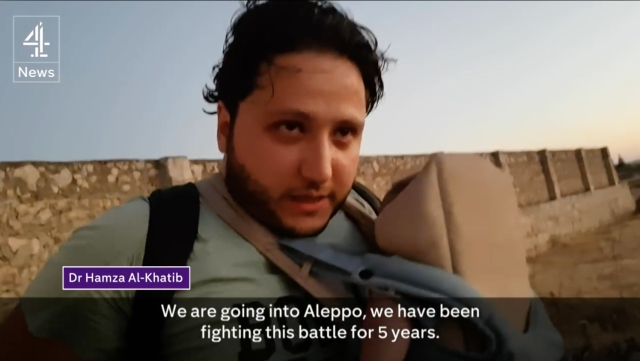
For some reason, this presumption – which follows from the most basic principles of credible journalism – seems at times to have been suspended by Channel 4 News in its coverage of Syria. It entered no caveats about the reports and tended to treat their content – without corroboration or independent evidence – as if it had come from verified sources.[2] Channel 4 was thus knowingly complicit in promoting a narrative that was necessarily one-sided.
To take just one obvious example of partiality: Alkateab’s films prominently feature the medical facility where her husband Hamza Al-Khatib played a central role, and we hear repeatedly how the Syrian government and its Russian allies are bombing areas with civilians including the children they treat. What we would never know from these films is that there are many more hospitals in the larger part of Aleppo treating children and other civilians who are victims of rockets and mortars launched into residential areas by fighters from the opposition enclave in the eastern part.[3] These, moreover, can be corroborated.[4]
It should go without saying that a single individual will always have their own limited perspective; an individual with a strong ideological commitment who is deeply embedded with oppositional militants must be assumed to be partial. (The commitment may be sincere and held with good intention but this does not diminish the questions about its partiality.)

This may be why people at Channel 4 responded in a particularly defensive manner to the simple moral force of Eva Bartlett’s cautionary words. They engaged in a rather disingenuous attempt to discredit her. An article published on their website, that merely took issue with one incidental in Bartlett’s account, was promoted by Channel 4 people – from John Snow and Ben de Pear down – as if it had disposed of her critique of mainstream coverage in Syria.[5] The article in fact made no comment on her main points.
Two major claims Bartlett had made – that there were no independent news sources on the ground in Aleppo and that any sources used there should be regarded as compromised – were incontrovertibly true. The factual truth of the first was clearly acknowledged by Channel 4 itself, as we noted. The truth of the second is of a normative kind that would be accepted by any decent journalist under the circumstances prevailing in Aleppo.
What is really at issue, therefore, if we assume agreement about the basic standards of reputable journalism, is whether anyone has an effective reply to her main substantive argument about coverage of the war in Syria, namely, that it involves the promotion of a narrative that lacks a basis in verifiable fact. Bartlett claims that the mainstream media have systematically occluded an entire side of the Syrian story, and they have done so in a way that supports the interests of the NATO and Gulf states that were pressing for ‘regime change’ in Syria; in doing this, they have supported the visitation of a devastating war upon the Syrian people that has been unnecessary and unjustified. The mainstream media are thereby complicit in an egregious contravention of the laws of war and human morality.
Channel 4’s defensiveness on the subject indicates that they saw the charge applied to them as a part of the mainstream consensus. But if they were going to answer it, why did they not play what should have been their strongest card? If Bartlett’s claim is that people on the ground contest the mainstream narrative, why not appeal to contrary testimony from the ground that supports it? They have the Alkateab videos, after all, and these repeatedly show people injured or bereaved by bombings. The thing is, what those videos show is something that is not in dispute: people are being killed by war, and it is difficult to run medical facilities in conditions of war. By contriving to suggest that Bartlett is denying this, which she is obviously not, they evade the real challenge.
In fact, a major evasiveness is at the heart of the series Inside Aleppo. If we bear in mind that the films are shot in an area of the town that is being besieged by the Syrian army and the Russian air force, then we realise this is because there is considerable military resistance being put up. Yet in the Alkateab films there is an eerie silence about the military forces on the ground around them. Although in the film of the couple and their baby entering Aleppo we catch sight of one of their companions carrying an AK47, the rest of the time we see nobody onscreen bearing any arms. Nor do we hear anything about any of the score or so of armed brigades, dominated by the militias of Al Nusra (Al Qaeda in Syria) that are controlling the town and holding at bay the combined military might of Syria and Russia. We do not even hear anything explicit about the so-called ‘moderate opposition’ that the mainstream media refer to.

As it happens, though, Channel 4 did make one film showing the ‘moderate opposition’ at work. It was billed as giving ‘a glimpse into why Syrian and Russian forces have so far been unable to re-take the whole of Aleppo.’[6] Up Close with the Rebels (released in October 2016) features an example of so-called ‘moderate rebels’ in action. In his voiceover, Krishnan Guru-Murthy introduces the action as “one small but famous victory, as rebels fought back against the forces of Bashar Al-Assad”. With this vicarious sharing of their glory, the Channel 4 man is in no doubt about who they are: they are “Islamist fighters”, he tells us, noting also that “many civilians in West Aleppo are frightened of these rebel fighters”, which would not be surprising given that they are “launching rockets into the western side of the city”. “This group is well equipped”, he adds, “paid for and supplied by Gulf States, mainly Qatar.”
I think we need to pause here. It appears that the film thereby illustrates, point by point, exactly what Bartlett has said about the anti-government forces being foreign-funded terrorists that the ordinary citizens of Syria want to be protected from. Guru-Murthy appears to be corroborating Bartlett’s account as against that promoted by Channel 4.
The manner of the reporting, though, is truly strange. It involves glorifying in the victory of jihadi terrorists while admitting that ordinary civilians in the greater part of Aleppo are in fear of these fighters. I literally cannot imagine what was going through the head of Guru-Murthy as he was saying all this out loud. Nor can I imagine how exactly he thinks the ordinary civilians trapped in the eastern part of Aleppo felt towards these and all the other fighters ruling their lives. After all, he and his colleagues dared not even set foot there.
Still, worse is to come. It relates to a story that shocked the world, in July 2016, when from Aleppo came news – and footage – of a group of Islamists severing the head off a twelve-year old boy with a small knife.[7] That group was Nour Al-Din Al-Zinki, and several of the men directly involved are clearly recognizable in photos that circulated the globe.
One of the men involved in decapitating the twelve-year-old features centre stage in Channel 4’s film.
That, then, is what you find if you actually get up close with the rebels. Channel 4, on being apprised that ordinary observant members of the public apparently knew, or cared, more about the people they were working with than its own news team did, hastily withdrew the video from its website. (I say hastily, as to my knowledge Channel 4 has issued neither apology nor explanation for sending out a news report and then retracting it after people may have relied on it.) The film remains readily accessible elsewhere on the internet – as does the harrowing footage of the decapitation.
The films by Alkateab remain on Channel 4’s catalogue, and it is to be noted that she was not responsible for the Nour Al-Din Al-Zinki footage. But a friend of hers was. Abdul Kader Habak was driving the car that brought Waad and her family into Aleppo. He, like her husband, is interviewed in her film. They presumably all enjoy the same protection.
I make no claim to know which individuals belong to which groups, armed or otherwise, in the ‘rebel-held’ area, but anyone curious enough to look at their public facebook and twitter feeds will see that Wa’ad and Hamza are passionately committed to the anti-government cause. They even use their own baby as a symbol of their struggle. None of this necessarily means their testimony is untrue. But Channel 4 was surprisingly uncritical in its showcasing of the material.[8]

The truth or otherwise of stories from Channel 4’s sources in eastern Aleppo was to be put to the test in the final days of the siege. These saw intense tweeting from the rebels, and retweeting of it by the Channel 4 news team. ‘Massacre was imminent’, and eastern Aleppo was about to ‘fall’ to the merciless forces of the Syrian ‘regime’. These would probably be the ‘last messages’ before government forces ‘annihilated’ them in #holocaustaleppo. Channel 4 bought into this fully, even featuring a filmed ‘letter’ by Wa’ad which starts “Maybe this will be my last letter to you and the world…”.[9]
In the event, those same people would soon be tweeting again from Turkey or other rebel-held parts of Syria. Meanwhile, according to the kinds of observer that regard Eva Bartlett with respect – and according also to the copious footage showing it – the majority of the population of eastern Aleppo, reunited with the western part, celebrated their liberation, welcoming the Syrian army, and the Russians that followed with their sappers to clear buildings of mines and booby-traps left behind by the ‘moderate rebels’.
As the liberated city has started to rebuild and function again, the Western media have gone silent. Channel 4 no longer talks much about Aleppo. But if the news bandwagon may have moved on, real lives have been lost or changed forever as a result of a war that was unjustified and unnecessary. The rest of us must try and learn from such awful chains of events as led to the unspeakable carnage and displacement in Syria.
Most of us know nothing about Syria except what we can glean from the media – either mainstream news outlets or independent investigators on social media. We are not in a position to check facts as such. Yet we can assess the credibility of testimony, even if only by ascertaining whether it is internally consistent rather than self-contradictory. A fully self-consistent story is not guaranteed to correspond to the true facts, of course, but one that is internally inconsistent cannot be the whole or unalloyed truth.
An account of the circumstances in Aleppo, that was internally consistent during the siege, and vindicated by subsequent events, was provided by those few witnesses from the West who were on the ground. The testimony of Eva Bartlett is consistent with that of a number of other independent observers with first hand experience in Syria at this historic moment who show sides to the story closed off by the mainstream media. They include US Congresswoman Tulsi Gabbard, filmmaker Carla Ortiz, journalist Vanessa Beeley, peace campaigner Jan Oberg, and Virginia State Senator Richard Black.
These individuals, have in varying degrees and ways been vilified, patronised or ignored by mainstream outlets – deploying the low tactics of those who cannot win an argument by means of reason or evidence. But why should news agencies even be in the business of making an argument? What exactly is the social role and purpose of the press?
I have chosen to focus on Channel 4, of all the news outlets that promoted the orthodox narrative, for several reasons. Channel 4 has a better reputation among much of the public than some other news outlets: it is thought to have high journalistic standards, and since it also has a public service remit, people tend to expect its coverage to exhibit investigative integrity and objectivity. Yet with regard to its coverage of Syria, not merely did Channel 4 disappoint those expectations, it went the extra mile to reinforce a misleading narrative by commissioning a partisan filmmaker to produce its flagship series of programmes on the war in Syria.
In my opinion, the Channel 4 News team owe a collective apology to Eva Bartlett for suggesting she was discredited when the truth was quite otherwise. I also think that Channel 4 owe us, the public, a commitment to do better than this in future. As for what Channel 4 owes to the people of Syria? The harms of this war can never be made good. Harms of future wars may yet be mitigated or even avoided, and I believe the one thing Channel 4 can and should do is join the side of truth with those who are seeking ways to break up the monolithic deceptions that our communications are increasingly being submerged in.

[1] Eva Bartlett speaking to United Nations Press Conference 9 December 2016: full version; short version featuring the claims discussed here.
[2] “During the summer we made a conscious decision to try and report what was happening in Syria, and particularly in Aleppo, on a daily basis. One person, Wa’ad al Kateab, has made this possible.” Ben de Pear, Channel 4 News, October 2016 http://insidealeppo.com/ It was never made especially clear in Channel 4 news reports on Aleppo how much they relied on this one source, and references to reports on the ground – while unattributed – were also often in the plural. Something to note, however, is that there was not necessarily a plurality of viewpoints coming out of the Aleppo Media Centre, which was the one functioning agency on the ground in eastern Aleppo. Other journalists used and referred to by channel four include Abdul Kader Habak (the cameraman on Up Close With The Rebels) and ‘a photographer for Reuters’ who I presume would be Abdalrhman Ismail, both of whom appear to move freely among militants. So while Wa’ad was possibly not the only source, there was still no meaningful corroboration since all sources accessed by Channel 4 should most safely be assumed to have been compromised in similar ways. Quite generally, Chanel 4 have tended to treat anti-government claims as true whereas they always voice scepticism in relation to claims on the other side, even on those rare occasions where they air them (as in Thomson example below) or the occasional interview, as with Jon Snow’s shameful haranguing of the Aleppo parliamentarian Fares Shehabi on 30 November 2016 https://www.channel4.com/news/aleppo-syrian-mp-fares-shehabi.
[3] For background and useful sources on this see Vanessa Beeley. ‘Channel 4 Joins CNN in Normalising Terrorism, Then Removes Their Own Video’, 21st Century Wire, 9 October 2016.
[4] Corroboration includes that of the Aleppo Medical Association. For background on the real situation of medical facilities across the whole of Aleppo, which is entirely occluded in the Channel 4 films, see for instance: Tim Anderson, ‘The Aleppo Hospital’ Smokescreen: Covering up Al Qaeda Massacres in Syria, Once Again’, Global Research, 9 May 2016; Eva Bartlett, ‘Western corporate media ‘disappears’ over 1.5 million Syrians and 4,000 doctors’ SOTT 14 August 2016; Vanessa Beeley, ‘Journey To Aleppo Part II: The Syria Civil Defense & Aleppo Medical Association Are Real Syrians Helping Real Syrians’, Mint Press News, 27 September 2016.
[5] All Channel 4 in reality even attempted to debunk was an aside by Bartlett about how the White Helmets, in staging some of their videos, sometimes used the same actor more than once. Their article goes to great lengths to show there is reasonable doubt about that matter.
Channel 4 were not dishonest about the limited nature of their piece in its title: ‘Eva Bartlett’s Claims About Syrian Children’. The promotion of it by all the colleagues on the news team, however, presented it as a definitive ‘fact check’ or ‘debunking’ of Bartlett. And that is how it went out into the wider world. Representative – and influential – was the tweet of famous Channel 4 anchor Jon Snow on 21 December 2016 linking to an altered title ‘FactCheck: Eva Bartlett’s Syria Claims’, which transforms the narrowly appropriate original one into one that implies a more comprehensive ‘debunking’. He tweets: ‘Even Syria’s children are caught up in lies and propaganda: A remarkable fact check puts the record straight’. All the piece actually does is show there to be reasonable doubt about Bartlett’s claim that the White Helmets publicity featured some children on more than one occasion. Doubt on this score does not even affect her claim that some of the videos were staged (since staging can be done with different actors each time, obviously). On this more substantial claim, the Channel 4 piece does not say much, but it does seek to show that at least one of the White Helmets filmed rescues was genuine. While not disputing that some of their rescues will have been genuine, I would just note that the reasons Channel 4 give would not establish the case for the example they look at. They say this: ‘The long sequence in which rescuers [are shown] painstakingly clearing rubble away from around the girl suggests that it would have been difficult to fake this footage. Someone would have had to have buried a screaming child up to their chest in rubble and carefully assembled a large amount of heavy wreckage around and on top of her – an extraordinary logistical challenge and an extraordinary collective act of child abuse.’
Certainly, it would be an extraordinary collective act of child abuse. As for the logistical challenge, however, it is no more difficult to place some rubble around and above the child than it is to then pick it off. Of course, we ordinary people will recoil at the very thought of seeing this as simply a logistical challenge, because it is such an ‘extraordinary collective act of child abuse’. But we are not terrorists or obliged to work with them. It cannot be a rebuttal of Bartlett’s claims that the White Helmets are embedded with terrorists to show that for her claims to be credible they would have to act in ways that are consistent with terrorist acts. The problem of how children are used, abused and even weaponised by armed groups in the pay of NATO AND Gulf states is a very real one. That the White Helmets are paid from those sources is a matter of public record; that some of them bear arms is illustrated by various videos, including Channel 4’s own documentary Up Close With The Rebels, where, at 2:27, one of the jihadis is clearly seen sporting a jersey with white helmets logo.
Among the various dishonest tactics carefully used in connection with the attempt to discredit and isolate Bartlett is the use of this kind of statement: ‘Supporters of the Assad regime have variously accused the White Helmets of being puppets of western powers, peddlers of faked footage or even terrorist fighters posing as humanitarian workers, all of which the organisation vigorously denies.’ The fact is, anyone who studies the evidence now widely available in the public domain can reasonably infer that the White Helmets are indeed a tool of the western powers, that they have indeed issued faked footage, and that some of them do have demonstrable terrorist affiliations. One can infer these things without have any view at all about Assad. The Channel 4 piece flirts with dishonesty by implying that scepticism about the White Helmets is the preserve of dupes of Assad.
[6] ‘Published on 4 Oct 2016, 20:08 ‘This report, filmed by Syrian cameraman Abdul Kader Habak, gives a glimpse into why Syrian and Russian forces have so far been unable to re-take the whole of Aleppo.’ http://newsvideo.su/video/5313805
[7] http://www.dailymail.co.uk/news/article-3697770/US-backed-Nour-al-Din-al-Zenki-behead-boy-accused-al-Quds-spy-Assad.html
[8] I am not the first to criticize Channel 4’s coverage of Aleppo. As well as Vanessa Beeley’s piece cited in n3, see also Daniel Margrain, ‘Syria: the Western media’s unending propaganda war’, Scisco Media 5 December 2016.
[9] https://www.youtube.com/watch?v=H4H9xia3Mis&t=292s. Channel 4 cites ‘multiple reports of summary executions of civilians’ 13 Dec 2016 (https://www.channel4.com/news/inside-aleppo-latest-from-source-in-the-city), which presumably come from the same ‘activists on the ground’ that Jon Snow uncritically relays statements from in this item – https://www.channel4.com/news/aleppo-have-we-reached-the-endgame. In the same item, Alex Thomson includes an interview run by Russian TV where civilians leaving the east call the militias in charge there “animals from hell” who had prevented them having food and tried to stop them leaving (https://www.channel4.com/news/aleppo-have-we-reached-the-endgame). In response to this, Thomson comments from his studio, ‘blaming the rebels may well be genuine, but it could also save your life.’ What? This gratuitous comment he permits himself is given no substantiation. So an identifiable individual manifestly suffering on the screen in front of him is treated as an object of scepticism and insinuation while unidentified activist sources can come out with any tales they choose and these are treated as tantamount to fact.
There is a certain amount of misdirection in the editing too. While referring to unattributed ‘reports’, Channel 4 would run stock footage (unlabelled as such) showing for instance the White Helmets on the ground – as in this one: https://www.channel4.com/news/east-aleppo-bombardment-continues-with-dozens-reported-dead – but they were in reality keeping a very low profile in those days. Misleading interviews, too, as in this one – https://www.channel4.com/news/the-latest-from-aleppo – with a ‘teacher’ who also featured as one of the ‘last days’ webcam publicists, and who later (in February 2017) is writing on Facebook that ‘it is not easy to leave five years of fighting for freedom … The Evil has won a battle but I hope we will get the Freedom in the final stage.’
A particularly egregious practice at Channel 4 is to permit themselves to claim to know Syrian government plans and strategies. Channel 4 is prepared to report on the basis of unspecified sources about ‘what appears to be a deliberate strategy by the Russians to block the evacuation of medical staff from what remains of eastern Aleppo’ (https://www.channel4.com/news/inside-aleppo-latest-from-source-in-the-city) This echoes earlier claims, as in the report that asserted the Syrian government had a plan to make life too unbearable for civilians to stay in Aleppo (https://youtu.be/U7Y_46OE35QS). Such claims are not only preposterous but also implicitly reinforce a disputed claim that it is not the armed militias who are keeping the ordinary population trapped in the area they still hold. This poor journalistic practice seems to be somewhat engrained. We find as recently as 20th January 2017 in the Press Gazette : ‘Channel 4 News editor Ben de Pear told Press Gazette : “Waad and her family really were on the last bus to get out of Aleppo and we know that they and the other doctors and activists and journalists in the city were the number one target of the Assad Regime.”’ http://www.pressgazette.co.uk/channel-4-news-filmmaker-waad-al-kateab-safe-in-turkey-after-escaping-aleppo-siege-on-last-bus-out/ The claim is preposterous in more ways than are worth analysing, but the only question I’d trouble to ask is how de Pear thinks he knows this.
Theresa May to push EU members to up NATO spending
RT | February 3, 2017
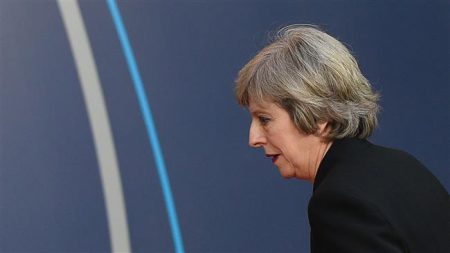
UK Prime Minister Theresa May will use the upcoming EU summit in Malta to demand Europe strengthen its commitment to NATO and spend more on defence.
May is expected to conduct a series of one-on-one meetings with EU leaders, including Germany’s Angela Merkel and Spain’s Mariano Rajoy, in order to secure “new, positive and constructive” relationships with the Union.
The prime minister, however, is not expected to attend the part of the talks in which Brexit will be discussed. Instead, she is using the summit as an opportunity to press the EU’s NATO members to fulfil their defence expenditure requirements.
According to a 2016 NATO report, only five of its 28 members actually reached the required defence spending limit of two percent. The list of those failing to spend enough includes Germany, France, and Spain.
Britain’s push for Europe to open its wallet comes after a meeting between Theresa May and US President Donald Trump last Friday.
At a joint press conference, May agreed with Trump that NATO spending should be “fairly shared” among its members.
Trump has in the past criticised NATO as being “obsolete” and “costing too much money.”
The president has also suggested that the US may not come to the assistance of NATO members who do not satisfy the two percent requirement.
May, however insisted she had received a “100 percent” commitment to NATO from the Trump administration. She also promised to “encourage fellow European leaders” to comply with their obligations.
It remains unclear how Britain will convince EU leaders to increase defence spending, as relations with Brussels have been significantly affected by Brexit. One possible way might be to emphasise the threat to European security that is supposedly posed by Russia.
Earlier this week, UK Defence Secretary Michael Fallon urged other NATO states to fulfil defence spending targets in order to effectively counter alleged Russian attempts to destabilise the continent.
Fallon has accused Russia of “becoming a strategic competitor to the West” and mounting a sophisticated information and cyber campaign against various NATO members.
Moscow has categorically denied these allegations, describing them as “baseless” and a “witch hunt.”
Read more:
UK minister accuses Russia of MH17 downing & ‘testing’ NATO, Moscow says claims ‘baseless’
RT | February 3, 2017
When British Defense Secretary Michael Fallon was asked to deliver a speech on ‘Russian resurgence’, he seized the opportunity to accuse Moscow of “annexing” Crimea, shooting down MH17 over Ukraine, and “testing” NATO. Russia calls the claims baseless.
Fallon’s speech at St. Andrews University on Thursday began kindly enough, speaking about the UK’s “renewed interest in Russian scientific and artistic achievement.”
However, the talk quickly changed course, with Fallon changing the focus to Russia’s so-called “military resurgence.”
Referring to the reunification of Crimea and Russia following a referendum in 2014, Fallon claimed the situation actually amounted to Russia illegally annexing the territory.
“Russia did not allow Ukraine to decide its own destiny like any other sovereign country,” he said. “Instead, under the guise of ambiguous and deniable instruments it annexed Crimea.”
Fallon’s anti-Russia rhetoric didn’t stop there. He went on to cite an inquiry by the Dutch-led Joint-investigative Team (JIT) which claims the MH17 tragedy was caused by a “Russian-provided missile.” He said that despite the finding, Moscow continues to deny its role in the tragedy.
Fallon failed to mention, however, that there are numerous issues surrounding that report, including the fact that the Dutch apparently couldn’t read raw radar data provided by Russia, yet failed to ask Moscow for help to decode it.
The discrepancies surrounding the inquiry have led to Major General Aleksandr Tazekhulakhov, the former deputy head of the Russian Army Air Defense, to accuse the Netherlands of trying to keep Moscow out of the investigation, likely in “yet another attempt to put the blame on Russia for something…”
The next phase of Fallon’s speech transitioned from Ukraine to Syria, in which he accused Russia of targeting the Syrian opposition in Aleppo “with little regard for innocent lives,” claiming that 80 percent of its strikes targeted non-Islamic State (IS, formerly ISIS/ISIL) targets.
However, Fallon seemed to conveniently forget that the US-led coalition in Syria – which includes the UK – just last month admitted to “unintentionally” killing at least 188 civilians in Syria and Iraq since 2014.
And while Fallon accused Russia of targeting civilians in Aleppo, he failed to mention a hospital set up by Russia in the city, despite the facility being hailed by the World Health Organization (WHO) last month.
“The WHO, same as the Syrian people – we’re very grateful to the Russians, the EMERCOM [Agency for Support and Coordination of Russian Participation in International Humanitarian Operations] gave a hospital to be used in the Jibreen [refugee] camp. The hospital provided by the Russian people has provided several hundred consultations and has been given by the Russian people to the Syrian people for the use by the central health authorities in Aleppo,” the WHO’s Elizabeth Hoff told RT.
Any typical bashing of Russia by the UK wouldn’t be complete without claims that Moscow is trying to “test” NATO, and Fallon didn’t disappoint.
“Russia is clearly testing NATO and the West,” Fallon said, accusing Moscow of “seeking to expand its sphere of influence, destabilize countries, and weaken the alliance.”
“It is undermining national security for many allies and the international rules-based system,” he continued.
Fallon was apparently in no mood to present a balanced argument during his speech, failing to mention NATO’s build-up of troops near Russia’s borders, or Moscow’s concern that NATO is compromising its national security.
The speech also included a healthy dose of the usual Western rhetoric, including allegations that Russia influenced the US presidential election by hacking into Democratic National Committee (DNC).
There was a touch of irony towards the end of Fallon’s speech, in which he said “we need to understand Russia better,” but then went on to accuse it of “reckless military activity” and “misinformation.”
“Russia could again become the partner the West always wished for…” he concluded.
However, based on Fallon’s speech, it seems Russia will only be a ‘partner’ to the UK and the West if it panders to their every wish.
Moscow responded to Fallon’s speech on Friday, calling his statements “baseless.”
“We express regret for this hostile stance of the minister. We are sure that such allegations are baseless,” Kremlin spokesman Dmitry Peskov told reporters, as quoted by Reuters.
Read more:
Crimea & Minsk Agreements: What the British media fails to mention
Ukraine Sabotages Trump’s Russia Detente
By Jonathan Marshall | Consortium News | February 1, 2017
Less than two weeks into office, President Trump faces one of the first big tests of his non-confrontational policy toward Russia. As new fighting erupts in Eastern Ukraine, the Kiev regime and its U.S. supporters are predictably demanding a showdown with Vladimir Putin.
Initial evidence suggests, however, that the latest flare-up in this nearly three-year-old conflict was precipitated by Kiev, possibly in the hope of forcing just such a confrontation between Washington and Moscow. It’s looking more and more like a rerun of a disastrous stunt pulled by the government of Georgia in 2008, which triggered a clash with Russia with the expectation that the George W. Bush administration would come to its rescue and bring Georgia into the NATO alliance.
After months of relative quiet, the fighting in Ukraine erupted on Jan. 28 around the city of Avdiivka, a now-decrepit industrial center. Eight pro-government fighters and five separatists apparently died in the first two days of hostilities. Meanwhile, residents of the city are struggling to survive heavy shelling and sub-zero weather with no heating.
Perennial critics of Russia were quick to blame Moscow for the renewed bloodshed. “We call on Russia to stop the violence (and), honor the cease-fire,” declared a State Department official.
The Washington Post’s reliably neo-conservative editorial page suggested that Russia felt liberated to unleash rocket and artillery barrages after Putin spoke with Trump by phone, with the goal of wrecking a meeting between Ukrainian President Petro Poroshenko and German Chancellor Angela Merkel.
The Russian onslaught “look(s) a lot like a test of whether the new president will yield to pressure from Moscow,” the Post declared, as if this were Czechoslovakia, 1938, all over again.
Poroshenko was quick to take advantage of the clash by asking, rhetorically, “Who would dare talk about lifting the sanctions in such circumstances?” Just last month, Austria’s foreign minister called for an easing of sanctions on Russia in return for “any positive development” in Ukraine. President Trump has been noncommittal about sanctions in the face of full-throated demands by congressional hawks in both parties to keep them in place.
Who’s to Blame?
The jury is still out on who provoked the latest violence, but Radio Free Europe/Radio Liberty, established by the U.S. government to broadcast propaganda during the height of the Cold War, reported Monday:
“Frustrated by the stalemate in this 33-month war of attrition, concerned that Western support is waning, and sensing that U.S. President Donald Trump could cut Kyiv out of any peace negotiations as he tries to improve fraught relations with Moscow, Ukrainian forces anxious to show their newfound strength have gone on what many here are calling a ‘creeping offensive.’
“Observers say the Ukrainians appear to be trying to create new facts on the ground . . . In doing so, the pro-Kyiv troops have sparked bloody clashes with their enemy, which has reportedly made advances of its own — or tried to — in recent weeks.”
A senior member of Europe’s Special Monitoring Mission to Ukraine warned, “The direct result of forward moves is escalation in tension, which often turns to violence.” How right he was.
It’s hard to see what Putin gains from new fighting, at a time when Trump faces an army of skeptics at home for his go-easy-on-Russia strategy. Poroshenko has everything to gain, on the other hand, by pressing Americans and West Europeans to reaffirm their support for his government, which took power after a 2014 coup that ousted elected President Viktor Yanukovych, who was strongly supported in eastern Ukraine and Crimea.
The Georgia Playbook
The situation is reminiscent of the August 2008 conflict between Russia and its neighbor on the Black Sea, Georgia. A bloody clash between the two countries’ armed forces in the tiny enclave of South Ossetia prompted a blast of militant rhetoric from American hawks.
Vice President Richard Cheney declared, “Russian aggression must not go unanswered.” Richard Holbrooke, who would become a senior adviser to the future President Obama, said, “Moscow’s behavior poses a direct challenge to European and international order.”
It may have been significant that the Georgian president’s paid U.S. lobbyist was also presidential candidate John McCain’s chief foreign policy adviser. As one analyst commented at the time, “McCain’s swift and belligerent response to the Soviet actions in Georgia has bolstered his shaky standing with the right-wing of the Republican Party. . . . Since the crisis erupted, McCain has focused like a laser on Georgia, to great effect. According to a Quinnipiac University National Poll released on August 19 he has gained four points on Obama since their last poll in mid-July and leads his rival by a two to one margin as the candidate best qualified to deal with Russia.”
Yet when the smoke settled, it turned out that Georgia, not Russia, had started the war by launching an artillery barrage against South Ossetia’s capital city. It was a ploy by Georgia’s President Mikheil Saakashvili to drag the West into supporting his campaign to take over the enclave.
The independent International Crisis Group had warned in 2007 that Georgia’s risky strategy of provoking “frequent security incidents could degenerate into greater violence.”
A year later, following the brief war with Russia, an ICG investigation reported authoritatively that it began with a “disastrous miscalculation by Georgian leadership,” who “launched a large-scale military offensive” into the Russian-occupied enclave, killing dozens of civilians and causing severe damage to South Ossetia’s capital from artillery barrages.
The report also criticized “Russia’s disproportionate counter-attack,” which it deemed a response to “the decade-long eastward expansion of the NATO alliance” and other grievances.
Putting blame aside, the ICG report observed that “The Russia-Georgia conflict has transformed the contemporary geopolitical world, with large consequences for peace and security in Europe and beyond.” Indeed, it marked one of the greatest setbacks in post-Cold War relations between Moscow and the West until the 2014 Ukraine crisis.
If the 2017 Ukraine crisis gets out of hand, the consequences for peace and security may be just as great or greater. It will be informative to see whether President Trump and his national security team get the straight facts before capitulating to the interventionists who want to see U.S.-Russian relations remain strained and volatile.
Featured Video
New positive ivermectin evidence
or go to
Aletho News Archives – Video-Images
From the Archives
Fanatical Followers of the Covid Regime: A Jim Jones-Style Cult?
By Professor Roger Watson and Dr. Niall McCrae | The Daily Sceptic | November 15, 2021
As scholars at leading British universities over recent decades, we witnessed the replacement of critical thinking and debate by narrative: facts are discrimination and scientific method is imperialism; truth, instead, is derived from ‘progressive’ values. This educational trend may be a major contributory factor to the ease in which society has been inculcated to the Covid ‘new normal’ of masking, testing, and repeated doses of vaccines for a disease of similar risk to severe influenza.
One doesn’t need much critical reasoning to observe the flawed logic of some vaccination enthusiasts, such as people who respond to experiencing any side effects, however debilitating, by saying “at least I know it’s working”, or, after contracting the disease despite their promised inoculation (over 90% effective, according to initial drug company claims), “I’d have been worse off without the jab.” … continue
Blog Roll
 Aletho News
- EU Council Advances Chat Control 2.0 Scanning Proposal
- Ex-Greek MEP files complaint against Israeli spyware firm over alleged Pegasus surveillance
- Troubling ideas throughout the Torah, Talmud, Mishneh Torah and Tanya
- ‘Grave, alarming’: Iran mission on Trump’s UNGA ‘annihilation’ threats
- Najaf airport to reopen to Iranian flights within 24 hours: Ambassador
- From ‘How Will This End For Iran’ to ‘When America Walks Away’: A tale of two Economist covers
- Tehran blasts ‘baseless’ speculation linking Iran to alleged bomb plot at UK air base
- The Rise And… Rise Of ‘Color Revolutions’
- The Coming GOP Bloodbath?
- Arctic Scare Stories Melt Away
- If Americans Knew
- Netanyahu Asked UAE Leader to Deny Report on Oct. 7 Warning in Secret Visit, Sources Say
- CNN Chief Int’l Correspondent Clarissa Ward on Journalists in Gaza
- Democratic Party Consultants Surround Troy Jackson with Pro-Israel Donors
- Christian Leader Responds To Netanyahu’s Claims Regarding Palestinian Christians
- In Gaza, ‘Whoever Survives the Bombing Won’t Survive the Rubble’
- Israel kills more Palestinians, amid push to resettle Gaza – Daily Update
- Israel forces Gazans to live in constant peril – Daily Update
- Deconstructing Netanyahu’s pants-on-fire UN rant – Daily Update
- Trump betrayed voters with his campaign lies and prioritized a foreign country once he took office
- Netanyahu calls Israel’s war in Gaza ‘opposite of genocide’ in UN speech to near-empty hall
- No Tricks Zone
- New Study: Earth And Venus Surface Warmth Largely Explained By Convection And Lapse Rate, Not CO2 Or Radiation
- 2025 Nature Paper Claiming Worsening Global Drought Gets RETRACTED …Heavily Flawed
- New Study: ‘Global Drought Shows No Detectable Recent Acceleration Under Climate Warming’
- Economic Masterminds: German Socialists Suggest Taxing Productivity Gains Stemming From Using AI
- The South China Sea Has Not Been Cooperating With The Climate Change Narrative
- Energy Crisis: Germany Enters Heating Season With Historically Low Gas Reserve Fill Levels
- New Study: The Antarctic Ice Sheet Gained Mass From 2020-2024 Due To Staggering Snow And Ice Accumulation
- Study: Ocean Heating Rates From Thousands Of Years Ago ‘Dwarf’ Modern Ocean Heating Rates
- Climate Extremists Target, Attack Large-Scale Power Grid Infrastructure In Germany!
- New Study: Antarctic Ice Melt Has Contributed Less Than 1 Centimeter To Sea Level Rise In The Last 30 Years

