By Brandon Turbeville | Activist Post | July 22, 2016
While the United States attempts to back away from its association with terrorist group Nour al-Din al-Zinki, the “moderate” terrorist organization whose members recently videotaped themselves beheading a young boy and discussing whether or not to boil his body afterwards, previous reports coming the from the mainstream media reveal that Obama, Kerry, Clinton and crew will not be able to cover their tracks so easily this time around. That is, if they even care to.
This is because reports coming from Business Insider in 2015 reveal that the United States had indeed supported and armed Nour al-Din al-Zinki in the lead up to the heinous act. What’s even more damning, however, is the fact that the group was considered one of the U.S. “vetted” organizations, a designation that was touted as a sure way to avoid arming “extremist” terrorists like ISIS or al-Qaeda.
The lie of vetting and “moderation” is now thoroughly debunked if, for no other reason, than the public beheading of a child.
But there is more! Not only has the United States “vetted,” endorsed, and armed Nour al-Din al-Zinki, it has armed them with TOW missiles, a type of guided missile that is capable of piercing and damaging tanks, armored personnel carriers, and other forms of vehicles found on the battlefield. These missiles are especially dangerous for a number of reasons including the fact that they can be used from a considerable distance.
As Jeremy Bender wrote for Business Insider in his article, “These CIA-Vetted Syrian Rebel Groups Fighting Assad Are Russia’s Primary Targets,”
Since 2013, the CIA has been training and equipping various moderate rebel elements in the Syrian civil war in an effort to undermine the regime of Syrian President Bashar al-Assad and force him to the negotiating table.
Among the range of munitions and supplies that the CIA has funneled to the various brigades of the Free Syrian Army and other moderate groups through Saudi Arabia, Jordan, and Turkey are TOW anti-tank missiles.
. . . . . .
These weapons have helped decimate Syrian armour and pushed a recent regime offensive against rebel-held territory to a standstill in reported “tank massacres.”
For instance, on October 8, a Syrian armoured offensive suffered massive casualties as, rebels armed “with US-made TOW missiles … [and] other guided rockets … caused the destruction … of over 15 armoured cars, vehicles, and tanks,” according to the Syrian Observatory of Human Rights.
What is striking is just how many CIA-vetted groups now exist throughout Syria receiving TOWs.
According to Syrian observer Hasan Mustafas, no fewer than 42 vetted groups now receive TOWs from a Saudi supply originally provided by the US. These weapons are funneled into Syria through Military Operations Command (MOC) posts in Turkey and Jordan that are co-operated by Western and local intelligence agencies.
The various groups are well documented due to the nature of TOW provisions. Saudi Arabia can not deliver the US-supplied TOWs without prior CIA approval. Additionally, Mustafas notes, the various vetted groups must apply to receive the TOWs. They are then provided with small batches of arms.
Bender provides a list of the groups who received the TOW missiles but, among them, is the name of Nour al-Din al-Zinki, the child beheading and carcass boiling “moderate” rebels that allegedly representing freedom and democracy.
Still, State Department Spokesman Mark Toner is only stating that the beheading of the boy might only cause the United States to “pause” and reflect upon its relationship with the group, meaning arming and supporting it.
At the end of the day, the horrific atrocity that was committed by Nour al-Din al-Zinki was really nothing more than several more pints in a massive ocean of blood created by the United States, Israel, the GCC, and NATO. Still, it stands as yet another example of why this treacherous and immoral war against Syria must be ended immediately.
The list of terrorist organizations “vetted” and provided with TOW missiles as reported by Business Insider is as follows:
13th Division (Forqat 13)
101st Division Infantry (Forqat 101 Masha’a)
Knights of Justice Brigade (Liwa’ Fursan al-Haqq)
Falcons of the Mountain Brigade (Liwa’ Suqour al-Jabal)
Grouping of the Falcons of Al-Ghab (Tajamuu Suqour al-Ghab)
1st Coastal Division (Forqat Awwal al-Sahli)
Gathering of Dignity (Tajammu al-Izza’)
Central Division (Al-Forqat al-Wasti)
46th Division (Forqat 46)
Sultan Murad Brigade (Liwa’ Sultan Murad)
Nour al-Din al-Zenki Movement, (Harakat Nour al-Din al-Zenki)
Mujahideen Army/Army of Holy Warriors (Jaish al-Mujahideen)
Revolutionaries of al-Sham Brigades (Kata’eb Thuwar al-Sham)
1st Regiment (Al-Fauj al-Awwal)
Ahmed al-Abdo Martyrs’ Force (Quwwat al-Shaheed Ahmad al-Abdo)
Al-Rahman Legion (Faylaq al-Rahman)
Martyrs of Islam Brigade (Liwa’ Shuhadah al-Islam)
Yarmouk Army (Jaish al-Yarmouk)
Lions of Sunnah Division (Forqat Usood al-Sunnah)
the 18th March Division (Forqat 18 Adhar)
Southern Tawhid Brigade (Liwa’ Tawhid al-Junoub)
Hamza Division (Forqat al-Hamza)
1st Artillery Regiment (Al-Fauj al-Awwal Madfa’a)
Syria Revolutionaries Front — Southern Sector (Jabhat Thuwar Souriya)
The First Corps (Faylaq al-Awwal)
The Dawn of Unity Division (Forqat Fajr al-Tawhid)
Salah al-Din Division (Forqat Salah al-Din)
Omari Brigades (Tajammu Alwiyat al-Omari)
Unity Battalions of Horan Brigade (Liwa’ Tawhid Kata’eb Horan)
Youth of Sunnah Brigade (Liwa’ Shabbab al-Sunnah)
Moataz Billah Brigade (Liwa’ Moataz Billah)
Sword of al-Sham Brigades (Alwiyat Saif al-Sham)
Dawn of Islam Division (Forqat Fajr al-Islam)
Supporters of Sunnah Brigade (Liwa’ Ansar al-Sunnah)
Horan Column Division (Forqat Amoud Horan)
Emigrants and Supporters Brigade (Liwa’ Muhajireen wal Ansar)
Military Council in Quneitra and the Golan
United Sham Front (Jabhat al-Sham Muwahidda)
69th Special Forces Division (Forqat 69 Quwwat al-Khassa)
11th Special Forces Division (Forqat 11 Quwwat al-Khassa)
Partisans of Islam Front (Jabhat Ansar al-Islam)
Al-Furqan Brigades (Alwiyat al-Furqan)
July 25, 2016
Posted by aletho |
Militarism, War Crimes | al-Qaeda, Central Intelligence Agency, CIA, ISIS, Israel, Jordan, Middle East, NATO, Saudi Arabia, Syria, United States |
Leave a comment
The failed coup in Turkey last week was a political and geopolitical earthquake as it has the potential to fundamentally alter the Middle East, NATO, and potentially the balance of power globally. But while the implications of the recent developments are clear, what actually took place on the night/morning of July 15 – July 16 is still somewhat shrouded in mystery. But why is that? Why are the connections for the most part not being made by Western pundits and journalists alike?
Here again we run into the controlled corporate media apparatus, one which is dominated by the very same interests that dominate the governments of the US and EU, and its incredible power to misinform. As the great Michael Parenti famously wrote, “[The media’s] job is not to inform but disinform, not to advance democratic discourse but to dilute and mute it. Their task is to give every appearance of being conscientiously concerned about events of the day, saying so much while meaning so little, offering so many calories with so few nutrients.”
Nowhere is Parenti’s contention more true than with the coup in Turkey. For while the media has certainly reported the allegations from President Erdogan and his government of the hidden hand of US-based billionaire Fetullah Gulen, almost none of the major media outlets have done the necessary investigation to uncover the real significance of Gulen and his movement. Specifically, and almost as if by magic, there is virtually no mention of Gulen’s longstanding ties to the CIA, his penetration of the various institutions of the Turkish state, nor is there any serious investigation into the financial networks and connections leading from Gulen to nearly every corner of the Islamic (and non-Islamic) world.
And while Gulen, along with many neocons in the US, have been propagating the narrative that President Erdogan and his forces themselves staged the coup in order to justify the ongoing crackdown on political rivals, secularists, and other anti-Erdogan forces, the media by and large has not connected the events in Turkey to their larger geopolitical significance, one which should shed some light on what may have happened. And, in a further dereliction of duty, the media has also mostly ignored the absolutely critical likelihood of the involvement of US-NATO intelligence.
History as a Guide
From Iran in 1953 to Chile in 1973 and countless other countries, the CIA and its intelligence agency cousins in NATO have been involved in myriad coups similar to the one that took place in Turkey last week. However, one would be remiss in not noting the striking similarities between the 2016 coup in Turkey and the one that took place on September 12, 1980.
Throughout the mid to late 1970s Turkey saw a major upsurge of terrorism and violence, much of which was attributed to fascist formations such as the Grey Wolves, along with other groups. However, what is now known is that much of the violence took the form of provocations which many experts allege were orchestrated by CIA-affiliated individuals and networks.
Perhaps the most significant of these was Paul Henze, a man who spent decades as an intelligence coordinator in Ethiopia, Turkey, and elsewhere throughout the Cold War. As Daniele Ganser noted in his book NATO’s Secret Armies: Operation GLADIO and Terrorism in Western Europe, “A right wing extremist on trial later plausibly argued that the massacres and terrors of the 1970s had been a strategy to bring [coup leader General] Evren and the military right to power: ‘The massacres were a provocation by the [Turkish intelligence agency] MIT. With the provocations by the MIT and the CIA the ground was prepared for the September 12 coup.’” (p. 239)
But of course, these actions did not take place in a vacuum; there were intelligence operators in place who facilitated the events that took place. As renowned author and media critic Edward Herman and co-author Frank Brodhead wrote in their 1986 book The Rise and Fall of the Bulgarian Connection :
“Paul Henze began his long CIA career under Defense Department cover as a “foreign affairs adviser” in 1950. Two years later, he began a six-year hitch as a policy adviser to Radio Free Europe (RFE) in Munich, West Germany. By 1969, Henze was CIA chief of station in Ethiopia, and he served as station chief in Turkey from 1974 through 1977. When Zbigniew Brzezinski assembled his National Security Council team for President Jimmy Carter, Henze was hired as the CIA’s representative to the NSC office in the White House.”
Considering the intimate connection between Henze and Brzezinski, it is not hard to see that Henze was essentially involved in the same global operation as Brzezinski, namely the weaponization of terrorism for strategic gain against the Soviet Union. And while Brzezinski famously masterminded the creation of the mujahideen in Afghanistan, Henze already had achieved similar results in Turkey, organizing right wing forces for the purposes of destabilization. In his book, Gansler cites counter-terrorism scholar and expert on GLADIO operations Selhattin Celik, who wrote in 1999 that:
“[When US President Jimmy Carter] heard about [the 1980 coup in Turkey] he called Paul Henze, former Chief of the CIA station in Turkey who had left Ankara shortly before the coup to become a security adviser to President Carter in Washington on the Turkey desk of the CIA… Carter told Henze what the latter already knew: ‘Your people have just made a coup!’ The President was right. Paul Henze, the day after the coup, had triumphantly declared to his CIA colleagues in Washington: ‘Our boys have done it!”
Celik bluntly referred to Henze as “the chief architect of the September 12, 1980 coup.” It’s not hard to see why. From having been on the ground in the early to mid-1970s, to then becoming a coordinator in Washington while being the point person on Turkey for the National Security Council under Brzezinski, Henze was clearly instrumental. As Gansler notes, according to Celik, “Brzezinski supported the position of Henze. During a discussion in the National Security Council of the situation in Iran where in 1979 Khomeiny [sic] had seized power Brzezinski expressed his view that ‘for Turkey as for Brazil a military government would be the best solution.’”
While none of this should come as a surprise to anyone remotely familiar with how US intelligence operated in the Cold War, perhaps the depth of the connections between US intelligence, its NATO cousins, and the Turkish military and deep state represent something of an epiphany. As Turkish politician and social activist Ertugrul Kurkcu wrote in Covert Action Quarterly in 1997:
The close ties between the Turkish, US military, and intelligence circles, along with US concerns over Turkey’s military cooperation, have been major obstacles in Turkey’s path to broader democracy. [Turkish politician and journalist Fikri] Saglar charges that US interest in Turkish affairs is not confined to official NATO relations and trade ties. He points to the notorious message by the CIA’s then-Turkey Station Chief Paul Henze in Ankara to his colleagues in Washington the day after the 1980 coup “Our boys have done it!” Henze crowed. Saglar concludes that foreign intelligence organizations including the CIA, have coopted collaborators from among the extreme-right and exploited them for their particular interests.
In effect, what the 1980 coup demonstrates more than anything is that the Turkish military, as well as the far right fascist terror gangs such as the Grey Wolves, are in various ways assets of the US, and under the thumb of US intelligence. To be sure, one could quibble about the degree to which they are entirely assets, proxies, or simply longtime collaborators, but this distinction is of minor importance. What matters is that the historical record clearly indicates collusion between the Turkish military and deep state and the CIA.
But this is all ancient history, right? Surely these networks and connections have eroded over time, and what happened in 1980 is of only secondary significance to the internal politics of Turkey and the ongoing struggles for power. Well, yes… but on second thought, maybe not.
Who’s Who on the Turkish Chessboard?
In trying to provide analysis of what just took place in Turkey, one must have some understanding of the political factions vying for power in Turkey. They can roughly be broken down into three camps, though there is often overlap between the groups.
The first faction is that of President Erdogan and his Justice and Development Party (AKP). Erdogan and the AKP come from the “moderate Islamist” milieu of the Muslim Brotherhood, having spent years fighting against the militantly secular Turkish military and state order. As Dr. Essam al-Erian, a Muslim Brotherhood leader, explained in 2007, “the Muslim Brotherhood is an Islamic group that has a close relationship with all moderate Islamists, the most prominent of which is the Justice and Development Party.”
This point is of critical importance because it connects Erdogan and his political machine to a much broader international network active throughout the Middle East and North Africa. It further provides an explanation as to Erdogan’s seeming fanaticism over the war in Syria and the removal of President Bashar al-Assad whose father crushed the Syrian Muslim Brotherhood in 1982, as well as his unwavering support for former Egyptian President Morsi, the Muslim Brotherhood leader deposed by current President Sisi.
The second faction is that of the Kemalists, with its power generally residing in the military and elements of the deep state. They see themselves as the custodians of the legacy of Mustafa Kemal Ataturk, the founder of the Republic of Turkey. The Kemalists are deeply connected to major capitalist interests in the country, and have a long history of collaboration with the US and NATO. As noted above, the Turkish military has long-standing ties to the CIA and NATO intelligence, and has long been understood as one of the most reliable US-NATO partners.
The third political faction of note is that of Turkish billionaire Fetullah Gulen whose global network of schools has made him into one of the single most powerful individuals in the region, though he runs his network from the comfort of his Pennsylvania estate. Not only has the Gulen network made significant inroads penetrating nearly every state institution in Turkey, it is also hugely influential in the US, both in terms of long-standing ties to US intelligence, and perhaps equally important, its massive lobbying and influence-peddling apparatus. Indeed, in 2010 six major Turkish-American federations with ties to the Gulen movement joined together to create the Assembly of Turkic American Federations (ATAF), a non-profit organization that has become one of the more prominent lobbying groups in Washington dealing with Turkish and Turkic peoples issues.
It is essential to remember that although it is known that last week’s coup was carried out by elements of the military, it is unclear exactly which faction they were representing, or if it was a combination of two. But here it is useful to examine the recent history of the Gulen network (known as Hizmet) and its penetration of state institutions in order to assess what potential role it may have played in the coup.
Connecting the Dots: Fetullah Gulen and CIA Fingerprints on Turkey Coup?
While it is easy to point the finger at the CIA and US-NATO intelligence for anything that happens anywhere in the world – the Empire’s reach is truly global – one must be cautious not to simply assert US culpability without properly drawing out the tangible connections. And in this case, that is doubly true. However, it is here that Gulen’s significance really comes into play, for it is his far-reaching network of contacts, surrogates, and proxies that have penetrated nearly every significant state institution.
Long before last week’s failed coup, analysts had been making the connection between Gulen, infiltration of the Turkish state, and the CIA. As political analyst Osman Softic wrote in 2014:
“Given that the Hizmet sympathizers skilfully [sic] infiltrated some of the most sensitive structures of the state such as the police, intelligence, judiciary and public prosecution, it is quite plausible that this movement may have served as a convenient mechanism for destabilization and even overthrow of the Erdoğan government, by much more powerful and sinister international actors… Gülen himself may have become a convenient pawn in their attempt to destabilize Turkey.”
The allegation that Gulen agents have penetrated all throughout the Turkish state is nothing new. In fact, such assertions have dogged Gulen and the Hizmet movement for at least the last two decades. But it is the connection to US intelligence and the elite circles of US foreign policy that truly completes the picture.
Enter Graham Fuller, former Vice Chairman of the CIA’s National Intelligence Council, whose links to Gulen’s movement run deep. Fuller has gone so far as to defend Gulen on Huffington Post in recent days in an article entitled The Gulen Movement Is Not a Cult — It’s One of the Most Encouraging Faces of Islam Today in which he admits – he had no choice as it is well documented – that he wrote a letter in support of Gulen’s green card application to the US in 2006. Although his rhetoric attempts to distort the nature of, and reason behind, his support for Gulen, Fuller does imply that Hizmet represents a social movement aligned with, and amenable to, US interests, one which could be used as a potent weapon in a critical NATO ally.
Fuller fails to note that he doesn’t simply have a passing connection with the Gulen movement, but that he has attended numerous Gulenist functions including large events, such as those organized by the Turquoise Council for Americans and Eurasians, a reputed Gulenist umbrella organization run by Kemal Oksuz (a.k.a. Kevin Oksuz), a prominent member of the Gulen network.
In addition to Fuller, infamous former CIA operative and US Ambassador to Turkey, Morton Abramowitz, also wrote a letter backing Gulen as he sought sanctuary in the US. Interestingly, Abramowitz was also the co-author, along with fellow neocons Eric Edelman and Blaise Misztal, of a fiery January 2014 op-ed in the Washington Post that all but demanded that the US topple Erdogan’s government. Yes, chin-scratchingly interesting.
So, let’s see if we got it all down. Gulen leads a multi-billion dollar business empire and charter/private school network with global reach. He is directly connected to two of the most notorious CIA operatives in the recent history of US-Turkish relations. He has a political lobbying network whose tentacles stretch from Washington to Central Asia. Oh, and by the way, according to former Turkish intelligence chief Osman Nuri Gundes, Gulen’s network of schools in the Central Asian nations of Kyrgyzstan and Uzbekistan provided the cover for at least 130 CIA agents in the mid to late 90s.
Now let’s add to that equation the fact that the RAND corporation, one of the most influential think tanks within US policy circles, suggested in a detailed 2004 report entitled Civil Democratic Islam: Partners, Resources, and Strategies that US policy should:
“Support the modernists first, enhancing their vision of Islam over that of the traditionalists by providing them with a broad platform to articulate and disseminate their views. They, not the traditionalists, should be cultivated and publicly presented as the face of contemporary Islam… Support the secularists on a case-by-case basis.”
It would seem that, more than a decade ago, and at a time when Gulen and Erdogan were still friendly, their organizations still allied, that US policy was to push Gulen and the moderate Islamist elements that he and Erdogan represented. It seems quite likely that the falling out between Erdogan and Gulen had less to do with personal issues and egos (though that undoubtedly played a part) than it did with policy and loyalty.
The Geopolitics and Strategy of the Failed Coup
Despite his commendable service to US imperialism in Syria, including hosting both terrorist and Syrian expatriate proxies of the US, Erdogan has clearly upset the apple cart with Washington. Perhaps his most egregious crime came just recently when he issued an apology for the November 2015 downing of a Russian jet. But, of course, it wasn’t the apology itself that set off official Washington, it was the reorientation of Turkish foreign policy away from the US, NATO, and Europe, and towards Russia, China, and the emerging non-western power bloc. This was his grave sin. And it wasn’t the first time, though undoubtedly Washington wanted to make sure it would be his last.
One must recall that Erdogan has a nasty habit of making deals with US adversaries, including the signing of the massive Turk Stream pipeline deal, the decision to purchase missile systems from China (which Erdogan later reneged on), the signing of a lucrative nuclear energy deal with Russia, and many others. In short, for Washington, Erdogan proved to be an unreliable ally at best, and a dangerous political manipulator at worst. So, as with so many leaders who came to be seen that way by the US political elites, he had to go. And Gulen’s network would come in handy.
Perhaps one of the most striking aspects of the events of the failed coup was the use of the NATO base at Incirlik. As the Los Angeles Times noted:
“Turkish officials said the organizers of the uprising were given crucial aid from officers at Incirlik Air Base, a facility that hosts most of the 2,500 U.S. military personnel stationed in Turkey and is a key base for the U.S.-led coalition’s ongoing air campaign to defeat the Islamic State militant group in neighboring Iraq and Syria… official media reported the arrest of the top Turkish military official at Incirlik, Gen. Bekir Ercan Van. Van was among 10 soldiers arrested at the base, part of an operation Turkish officials say provided air-to-air refueling for F-16 fighter jets… [which] were a crucial part of the coup attempt, used to intimidate government supporters in the streets.”
The implications of this information should not be understated. While it is entirely possible that the story was concocted by Erdogan’s people in order to carry out a purge of top military officials perhaps seen as disloyal to Erdogan or much too loyal to secular Kemalists, it is also plausible that the Turkish government’s narrative is correct.
Were that to be the case, then the obvious implication would be that Incirlik was a base of operations for the coup, the locus of Turkish military power behind the coup, and US intelligence and military behind them. Considering the centrality of Incirlik to NATO operations in the Middle East, it is not unreasonable to assume that aside from just military personnel, Incirlik is a node in the global CIA network. In fact, considering that the base is home to both US drones conducting operations in the Syria-Iraq theater, as well as a hub of the US “extraordinary rendition” program, it almost goes without saying that Incirlik houses significant CIA assets.
Seen from this perspective then, Incirlik was obviously pivotal to the failed coup plot, and has since become essential to Erdogan’s purging of his rivals from the ranks of the military. Moreover, it was long a bone of contention between Ankara and Washington, with Erdogan’s government wanting to assert more control over the base than Washington was prepared to allow. In many ways, Incirlik became the nexus of a tectonic shift in Turkish politics, and in the geopolitics of the region.
Ultimately, the failed 2016 coup in Turkey will have lasting ramifications that will impact the years and decades ahead. With Turkey now clearly breaking with the US-NATO-EU axis, it is rather predictable that it will seek to not only mend fences with both Russia and China, but to place itself into the non-western camp typified by BRICS, the Shanghai Cooperation Organization, China’s One Belt One Road strategy, the Asian Infrastructure Investment Bank, etc.
The failure of the coup is clearly a failure for the US and its allies who see in Erdogan an adversary, not a partner. For his part, Erdogan has much criminal behavior to answer for. From his illegal fomenting of war in Syria, to the purges and arbitrary detentions ongoing in Turkey today, to the attacks on secular institutions and human rights, Erdogan has a rap sheet a mile long. But of course sharing a bed with criminal regimes has never been a problem for Washington.
No, the problem has been, and will continue to be, that Erdogan doesn’t play by the rules; rules set forth by the US. And with this US-backed coup, he will only get stronger. Surely, many sleepless nights lay ahead for the strategic planners in Washington.
July 23, 2016
Posted by aletho |
Deception, False Flag Terrorism, Timeless or most popular | AKP, Central Intelligence Agency, CIA, Fetullah Gulen, Grey Wolves, Middle East, Morton Abramowitz, Muslim Brotherhood, NATO, Turkiye, United States |
Leave a comment
What emerges on the sixth day of the failed coup attempt in Turkey is that three inflection points could be in play in the Turkish-American relations in the coming days and weeks. They are:
- The functioning of the Incirlik Air Base on the Syrian border;
- Extradition of Islamist cleric Fetullah Gulen from the US; and,
- The massive purge of ‘Gulenists’ that is under way in Turkey.
Each of them is going to be trickier to negotiate than the other two and, yet, all three are also inter-related.
The power supply for Incirlik has been suspended since Friday and a back-up generator is barely enabling the US facilities there to support flight operations and around 2700 stationed in that NATO base. It’s an untenable situation. The US Defence Secretary Ashton Carter telephoned his Turkish counterpart Fikri Isik on Tuesday evening to stress the importance of operations at the Incirlik to the counter-ISIS campaign.
But on his part, Isik regretted his inability to attend the counter-ISIS defence ministerial that Carter was hosting in Washington on Wednesday. Turkey was represented only at ambassadorial level at Wednesday’s conference which was attended by the defence ministers of some 30 countries, NATO, and top Pentagon officials to discuss “the next plays in the campaign that will culminate in the collapse of ISIL’s control over Mosul and Raqqa”. (Pentagon)
The detention of the commander at Incirlik Gen. Bekir Ercan Van and his subordinates underscores the sensitivities involved here. Gen. Van resisted arrest and had apparently sought political asylum in the US before being led away by the Turkish security.
Interestingly, in an interview with Al Jazeera on Wednesday, President Recep Erdogan said some of those who have been detained have started confessing and that there might have been foreign involvement. Erdogan warned that it would be a “big mistake” if the US decided not to extradite Gulen.
The official Turkish position will be that there is no linkage between continued access of US forces to Incirlik and Gulen’s extradition, but, clearly, that is not the state of play here. The Turks know that Incirlik provides the most efficient base for conducting the US operations in Syria.
However, Washington is not likely to extradite Gulen to Turkey, while Erdogan has staked his prestige on that issue. It seems as of now no wriggle room really exists here – unless some face-saving formula can be found such as the US revoking Gulen’s ‘green card’ and/or persuading him to leave for a third country.
The point is, Gulen has been a ‘strategic asset’ of the US intelligence for two or three decades and if Turkish security agencies interrogate him, that may cause even more damage to the Turkish-American relationship and even, perhaps, complicate the US’ relations with third countries where Gulen’s extensive network might have functioned or are still functioning as the CIA’s front organizations. (Sputnik )
Meanwhile, what role, if any, that Israel might have played in the coup attempt also remains a mystery. Israel is keeping pin-drop silence, but would certainly know that Gen. Akin Ozturk, former chief of air force, who has confessed his leadership role in the attempted coup, used to be the Turkish military attaché in Tel Aviv at one time. (Algemeiner )
By the way, these are the exact words Erdogan used in the interview on Wednesday with Al Jazeera:
- Other states could be behind this coup attempt. Gulenists have a ‘supreme intelligence,’ which could have plotted all this. The time will come for all these links to be revealed.
Erdogan explicitly hinted at the involvement of more than one country in the coup attempt.
Israel is mighty upset with Erdogan over his close ties with Hamas. Equally, Israel favors the creation of a Kurdistan state that could provide a base for its intelligence in a highly strategic region neighboring Iran. There is congruence on this issue between Israel and the US. The Turks have long suspected the US intentions in Iraq and Syria. (Read a fascinating interview with a retired Turkish admiral titled Goal Reached? Military Coup Attempt Disempowers Turkish Armed Forces.)
The plot really thickens if the opinion piece in the Saudi establishment daily Asharq Al-Awsat yesterday is read keeping in view the recent establishment of a Saudi consulate in Erbil in the Kurdish region of northern Iraq. (The daily, incidentally, is owned by Prince Faisal, son of King Salman.) The article all but warns Erdogan that he may be overthrown if he pushes for Gulen’s extradition from the US, and that he risks the West’s wrath if he proceeds with the crackdown on ‘Gulenists’. (Asharq al-Sharq )
Now, on whose side are the Saudis playing in this great game? For a quick answer, read a stunning statement by a top Israeli national security expert, here, recently.
Make no mistake, the US and its European allies are certain to pile pressure on Erdogan to fall in line. The standoff can become a showdown as time passes — and even take an ugly turn. The stakes are very very high for the western alliance system and the US’ regional strategies. This is where Erdogan’s crackdown on ‘Gulenists’ will be grabbed by the West as an alibi to isolate him.
Simply put, the US cannot let go of Turkey. Sans Turkey, NATO gets badly weakened in the entire southern tier – Balkans, Black Sea, Caucasus, Caspian, Southern Russia and Central Asia, Middle East and Eastern Mediterranean – and the US’ containment strategy against Russia will be doomed.
Beyond that, from the limited perspective of the Syrian conflict also, whatever chance the US and its allies (Israel, Saudi Arabia, etc) still would have to put in motion a viable ‘Plan B’ to counter the Russian-Iranian axis would critically depend on Turkey remaining a partner and willing to pursue an interventionist role.
July 22, 2016
Posted by aletho |
Militarism | Central Intelligence Agency, CIA, Israel, NATO, Russia, Turkiye, United States, Zionism |
Leave a comment
By John Chuckman | Aletho News | July 21, 2016
Events in Turkey just become stranger with each passing day.
We now have Middle Eastern and Persian sources, cited by Russian and German papers, that Russia’s security agencies overheard helicopter radio transmissions by the coup participants, and President Putin warned Erdogan about what was happening, likely saving his skin.
If true, this would help explain the apparent ineptness of the coup forces. My first hypothesis explaining this ineptness plus other peculiarities of the coup was that the plotters were unwittingly working in a dark operation run by Turkish security forces, intended to make them fail while flushing them out and giving Erdogan a free hand.
This possibility of Russian advance warning put together with Erdogan’s own belief that the coup originated in America should yield some serious geopolitical shifts in the region.
We could have an even stronger rapprochement between Turkey and Russia than was already underway, a rapprochement, by the way, which could well have helped tip the United States into giving a wink and a nod (and of course, as always, some cash) to Turkish rebel forces.
But that would not be the only reason for America’s supporting a coup. The truth is, from the American point of view, Erdogan’s erratic behavior – shooting down a Russian war plane, firing artillery into Syria at American Kurdish allies, blackmailing Europe over large numbers of refugees resident in Turkish camps, and still other matters – over the last few years has added uncertainty and potential instability to a strategically important region.
Even if the United States were not involved in the coup, although right now Turkey’s government appears to believe firmly that it was, Putin’s warning would add a powerful positive element to Russian-Turkish relations.
Just as America’s failure to warn Erdogan adds a new negative element to Turkish-American relations. After all, no one is better equipped for international communication interception than the NSA. If the United States were not involved, why didn’t it warn Erdogan? Either way, the outcome is negative for Turkish-American relations.
One of the strongest suggestions for American involvement is the fact that Turkish jets, for bombing and fuel supplies, took off from the İncirlik Airbase during the coup. This airbase is Turkish, but has many Americans resident, including some high-level ones since there is not only a sizable air force stationed there but an estimated fifty thermonuclear bombs. The Turkish commander, Gen. Bekir Ercan Van, was in daily contact with the Americans and sought asylum in the United States before he was arrested by Turkey.
If it is true that Putin warned Erdogan, this would also be the second time Putin has blunted the success of a major American-inspired coup, as he very much did in Ukraine.
Seems as though poor old America, for all its grossly swollen and over-paid security services, just cannot run a good coup anymore.
Putin is disliked by Washington’s establishment precisely because he successfully blunted a huge and costly operation in Ukraine, so disliked that NATO has been pushed dangerously into something resembling the terrifying preparations for Hitler’s Operation Barbarossa in Eastern Europe, 1941.
And, of course, Putin also has thwarted the American effort to overthrow President Assad with paid and supplied proxy forces of mercenaries and religious maniacs. Interestingly, Erdogan has been a key player there. French intelligence has just estimated that even now about a hundred thugs cross the border from Turkey into Syria each week.
If Putin has now also stopped a Turkish adventure, the hissing in Washington will likely become much louder.
A new relationship between Turkey and Russia offers a lot of possibilities, none of them favorable from America’s point of view, the restart of the Turkish Stream natural gas project being just one.
And if Europe speaks up or acts too strongly against Erdogan’s counter-coup measures, there’s always the possibility of a new release of refugees from Turkish camps, something which could genuinely destabilize the EU after so many other recent woes. And smooth control of the EU has been one of America’s chief policy objectives for years.
Of course, we should remember that Churchill’s famous quote originally applied to Russia in the days of Stalin. It does not apply to contemporary Russia, and Putin’s deft moves have made some of America’s clumsy efforts at re-ordering the world rather make it resemble Stalin in international affairs.
July 21, 2016
Posted by aletho |
Deception, Militarism, Timeless or most popular | European Union, National Security Agency, NATO, Russia, Syria, Turkiye, United States |
Leave a comment
Iraq war criminals deserve to be prosecuted. Britain’s Chilcot report is only the most recent example of a worthy cause needing to be addressed. But in 1979, long before false intelligence was used to justify the Iraq war, a heinous war crime was committed against Afghanistan by President’s Carter’s National Security Advisor Zbigniew Brzezinski.
It’s not just Brzezinski who is culpable. It was the Washington bureaucracy that enabled Brzezinski to activate his Machiavellian plot of intentionally drawing the Soviets into his “Afghan Trap.”
How the Washington bureaucracy enabled Brzezinski’s scheme and why it’s still important today
Once the Soviets took Brzezinski’s bait and crossed the border into Afghanistan on December 27, 1979 the fates of both countries were doomed. As if in a trance, a complacent bureaucracy turned a blind eye to the lack of proof of the American claims that the Soviet invasion was a step towards world domination. Within days the beltway became a cheering squad, enabling Brzezinski to fulfill his imperial dream of giving the Soviets their own “Vietnam.” The bureaucracy’s motivation was simple. Brzezinski was winning the only game in town, the Cold War against the “Evil Empire.” The fact that Brzezinski’s deceitful plot could lead to the death of Afghanistan as a sovereign state did not concern Washington’s elites, either from the right or the left. Predictably, Afghans’ lives have been turned into an endless nightmare that festers to this day. Not only is Brzezinski’s scheme continuing to undermine Afghanistan’s sovereignty, his Russophobia also drives NATO’s unjustified aggression towards Russia today!
How Brzezinski activated his Russophobic Imperial Dream that now dominates Washington
In 1977 when Brzezinski stepped into the Oval office as National Security Advisor to President Jimmy Carter, his Russophobia was a well-known fact from Washington to Moscow. It was no surprise that he was not content with the American moderates’ pragmatic Cold War acceptance of coexistence with the Soviet state. The Polish born Brzezinski represented the ascendency of a radical new breed of compulsive xenophobic Eastern European intellectual bent on holding Soviet/American policy hostage to their pre-World War II world view. According to Brzezinski biographer Patrick Vaughan, Brzezinski rejected the very legitimacy of the Soviet Union itself, calling it “a cauldron of conquered nationalities brutally consolidated over centuries of Russian expansion.”
Racism is not a basis for a rational foreign policy
A phobia is defined as an extreme or irrational fear. Therefore it is reasonable to define a Russophobe as one who has an irrational fear of Russians. Simply put, a Russophobe hates Russians for being Russian! That’s called racism, pure and simple, not the basis of creating rational foreign policy. The Beltway should have demanded that a well-known Russophobe like Brzezinski back his claims with proof that the Soviet invasion of Afghanistan was the first step to taking over the world. Instead, the Washington Bureaucracy dined out on his fantasy and we have been living with the consequences ever since.
The Bureaucracy knows Brzezinski has always been a Russophobe
Paul Warnke, President Carter’s SALT II negotiator put Brzezinski’s racial bias this way in an interview we conducted with him in 1993. “It was almost an ethnic thing with Zbig, basically that inbred Polish attitude toward the Russians. And that of course that was what frustrated the Carter Administration. [Secretary of State] Vance felt very much the way that I did. Brzezinski felt the opposite. And Carter couldn’t decide which one of them he was going to follow. So it adds up to a recipe for indecision.” Warnke went on to say that he believed the Soviets would never have invaded Afghanistan in the first place if Carter had not fallen victim to Brzezinski’s irrational attitude toward détente and his undermining of SALT II. In our own research into the causes of the Soviet invasion we did prove Warnke’s assumption that there would have been no invasion without Brzezinski’s willful use of entrapment.
At a conference conducted by the Nobel Institute in 1995, a high-level group of former US and Soviet officials faced off over the question: Why did the Soviets invade Afghanistan? Former National Security Council staff member Dr. Gary Sick established that the US had assigned Afghanistan to the Soviet sphere of influence years before the invasion. So why did the US choose an ideologically-biased position when there were any number of verifiable fact-based explanations for why the Soviets invaded? To former CIA Director Stansfield Turner, responsibility could only be located in the personality of one specific individual. “Brzezinski’s name comes up here every five minutes; but nobody has as yet mentioned that he is a Pole.” Turner said. “[T]he fact that Brzezinski is a Pole, it seems to me was terribly important.” What Turner was suggesting in 1995 was that Brzezinski’s well-known Russophobia led him to take unjustifiable advantage of a Soviet miscalculation.
The conference revealed that “self-fulfilling prophecies,” “a dubious deductive apparatus,” and “decisions that provoked as often as they deterred” provided the operating system for more than a decade of Cold War policy under Presidents Carter and Reagan. Numerous scholars pondered Brzezinski’s decision-making process before, during and after the Soviet invasion. Dr. Carol Saivetz of Harvard University testified, “Whether or not Zbig was from Poland or from someplace else, he had a world view, and he tended to interpret events as they unfolded in light of it. To some extent, his fears became self-fulfilling prophecies… Nobody looked at Afghanistan and what was happening there all by itself.”
But it wasn’t until the 1998 Nouvel Observateur interview that Brzezinski boasted that he had provoked the invasion, by getting Carter to authorize a presidential finding to intentionally suck the Soviets in, six months before Moscow considered invading. Yet, despite Brzezinski’s admission, Washington’s entire political spectrum continued to embrace his original false narrative, that the Soviets were embarked on world conquest.
Brzezinski’s Russophobia is still the basis of U.S. foreign policy towards Russia
For Brzezinski, getting the Soviets to invade Afghanistan was an opportunity to shift Washington toward an unrelenting hard line against the Soviet Union. By using deceit combined with covert action, he created the conditions needed to provoke a Soviet defensive response, which he then used as evidence of Soviet expansion. However, after Brzezinski’s exaggerations and outright lies about Soviet intentions became accepted, they found a home in America’s imagination and never left. US foreign policy, since that time, has operated in a delusion of triumphalism, provoking international incidents and then capitalizing on the chaos.
Brzezinski’s current status as the almost mystical “wise elder” of American foreign policy should be viewed with extreme caution given the means by which he achieved it. Today, the legacy of Brzezinski’s Russophobic ideological agenda continues through many acolytes including his two sons, as they carry on the Brzezinski lineage by aggressively pushing beltway polices towards dangerous confrontations with Russia. Tragically, Brzezinski’s legacy also lives on in the failed state of Afghanistan as the hated Taliban are poised to take over again. While all this horror is happening to the Afghan people, NATO forces are using Brzezinski’s homeland of Poland to push provocatively against Russia’s border.
The role that Brzezinski played, as well as those officials who enabled him to cause the death of Afghanistan while intentionally triggering the rise of Islamic extremism, must be examined. Building to a trial, even in absentia, will begin the desperately needed process of breaking the trance-like hold Brzezinski’s Russophobia still has on Washington’s foreign policy that is denying its core role in creating Islamic extremism and driving America to the brink of nuclear war with Russia.
No matter whom the next president is, if we are to save America, this forty year old crime against Afghanistan must first be made right.
July 21, 2016
Posted by aletho |
Deception, Mainstream Media, Warmongering, Militarism, Timeless or most popular | Afghanistan, NATO, Russia, United States |
Leave a comment
Russian President Vladimir Putin did on Sunday what no major western leader from the NATO member countries cared to do when he telephoned his Turkish counterpart Recep Erdogan to convey his sympathy, goodwill and best wishes for the latter’s success in restoring constitutional order and stability as soon as possible after the attempted coup Friday night.
The US Secretary of State John Kerry instead made an overnight air dash to Brussels to have a breakfast meeting on Monday with the EU foreign ministers to discuss a unified stance on the crisis in Turkey. The French Foreign Minister Jean-Marc Ayrault was in an angry mood ahead of the breakfast, saying “questions” have arisen as to whether Turkey is any longer a “viable” ally. He voiced “suspicions” over Turkey’s intentions and insisted that European backing for Erdogan against the coup was not a “blank cheque” for him to suppress his opponents.
The US has expressed displeasure regarding the Turkish allegations of an American hand in the failed coup. Indeed, the Turkish allegation has no precedent in NATO’s 67-year old history – of one member plotting regime change in another member country through violent means. Clearly, US and Turkey are on a collision course over the extradition of the Islamist preacher Fethullah Gulen living in exile in Pennsylvania whom the Turkish government has named as the key plotter behind the coup. Turkish Prime Minister Binali Yildirim has warned that Ankara will regard the US as an “enemy” if it harbored Gulen. The dramatic developments expose the cracks appearing in the western alliance system. (See the commentary in the Russian news agency Sputnik entitled NATO R.I.P (1949-2016): Will Turkey-US Rift Over Gulen Destroy Alliance?)
Interestingly, the senior Turkish army officials detained so far include the following:
- Commander of the Incirlik air base (and 10 of his subordinates) where NATO forces are located and 90 percent of the US’ tactical nuclear weapons in Europe are stored;
- Army Commander in charge of the border with Syria and Iraq;
- Corps Commander who commands the NATO contingency force based in Istanbul; and,
- Former military attaches in Israel and Kuwait.
Most certainly, the needle of suspicion points toward the Americans having had some knowledge of the coup beforehand. Two F-16 aircraft and two ‘tankers’ to provide mid-air refuelling for them and used in the coup attempt actually took off from Incirlik.
Of course, Ankara has been wary of the US and France establishing military bases in northern Syria with the support of local Kurdish tribes, which it suspected would be a stepping stone leading to the creation of a ‘Kurdistan’. (The advisor on foreign affairs to Iran’s supreme leader, Ali Akbar Velayati, who is an influential figure in Tehran alleged on Sunday that the US is attempting to create a Kurdistan state carved out of neighboring countries with Kurdish population, which will be a “second Israel” in the Middle East to serve Washington’s regional interests.)
Today, the famous Saudi whistleblower known as ‘Mujtahid’ has come out with a sensational disclosure that the UAE played a role in the coup and had kept Saudi Arabia in the loop. Also, the deposed ruler of Qatar Hamad bin Khalifa Al-Thani (who is a close friend of Erdogan) has alleged that the US, another Western country (presumably France) had staged the coup and that Saudi Arabia was involved in it. (here and here) Meanwhile, word has leaked to the media that in a closed-door briefing to the Iranian parliament on Sunday, Foreign Minister Mohammad Zarif hinted at Saudi and Qatari involvement in the coup.
Putin’s phone call to Erdogan suggests the possibility that Russian and Turkish intelligence are keeping in touch. The two leaders have agreed to meet shortly.
The timing of the coup attempt – following the failure of the US push to establish a NATO presence in the Black Sea and in the wake of the Russian-Turkish rapprochement – becomes significant. Equally, the signs of shift in Turkey’s interventionist policies in Syria would have unnerved the US and its regional allies.
Israel, Saudi Arabia and Qatar have a great deal to lose if Turkey establishes ties with Syria, which is on the cards. Thus, stopping Erdogan on his tracks has become an urgent imperative for these countries. The spectre of the Syrian government regaining control over the country’s territory haunts Israel, which has been hoping that a weakened and fragmented Syria would work to its advantage to permanently annex the occupied territories in the Golan Heights. Again, Turkey’s abandonment of the ‘regime change’ agenda in Syria means a geopolitical victory for Iran. On the contrary, a triumphant and battle-hardened Hezbollah next door means that its vast superiority in conventional military strength will be rendered even more irrelevant in countering the resistance movement. Significantly, Israel is keeping stony silence.
Will the US and its regional allies simply throw in the towel or will they bide their time to make a renewed bid to depose Erdogan? That is the big question. Erdogan’s popularity is soaring sky-high today within Turkey. He can be trusted to complete the ‘vetting’ process to purge the Gulenists ensconced in the state apparatus and the armed forces. The meeting of the High Military Council due in August to decide on the retirement, promotions and transfers of the military top brass gives Erdogan the free hand to remove the Gulenists.
M. K. Bhadrakumar is the former career diplomat in the Indian Foreign Service.
July 20, 2016
Posted by aletho |
Timeless or most popular, Wars for Israel | France, Israel, Middle East, NATO, Saudi Arabia, Syria, Turkiye, United States |
Leave a comment
It is surprising that the reaction of the NATO member states to a coup attempt in Turkey was rather modest, Afshin Rattansi, an RT contributor and the host of RT’s Going Underground said, adding that some years ago they would have rushed to aid their ally.
RT:This coup has given Erdogan a perfect chance to tighten his grip on alleged enemies within the army. What could this lead to?
Afshin Rattansi: Yes, very worrying to hear. But possible reintroduction of the death penalty and thousands are being arrested. We have got to remember that the CIA backed the coup in 1980, 36 years ago – half a million people were arrested. We can’t be sure whether it is going to be that number this time round. It’s interesting that the Prime Minister so quickly blamed the Gulen movement. Now, who is this movement? The cleric lives in the US. Well, that is the movement that reportedly funds the Hillary Clinton campaign. Certainly there will be people in Ankara not wishing for a Clinton presidency anytime soon given that so many supporters right now are being arrested. There are ties here that show how complex the events of the past 12 hours are.
RT:How would it impact relations with the EU? Would the union now discuss the membership of a country that is weighing bringing back the death penalty?
AR: As we hear in London during the referendum debate, it was repeatedly told to the British people that there is no chance whatsoever Turkish accession to the EU – that was before the referendum. So Britain does not really have a say in that today. But I think obviously critical to the whole situation in the past few hours is the Incirlik Air Base. Turkey is a NATO country. Astonishing that just a couple of years ago we would have expected NATO nations to have come to the aid of the Erdogan government, which was elected in November. This time? Nothing.
Also astonishing is John Kerry in Moscow looking to evaluate the situation, not [offering] immediate support for this linchpin of NATO supremacy, as they see it in terms of world security – this critical country in terms of their domination of the Middle East. Well, the reason why they are not going to be joining the EU any time soon is the flip-flopping of Erdogan.
He went from being a hero of the Arab world, when he championed the cause of Palestinians, [then] suddenly he switched to being – along with Britain and the US – pro-the overthrow of the secular government of Syria and supporting de facto ISIS/ISIL/DAESH and al-Qaeda linked groups.
RT: As you said, Turkey is an ally of the US in the region. But today it is saying it doesn’t want to be friends with the country that allegedly protects its enemy, Fethullah Gulen, who has actually denied being a part of this plot. The man is in self-imposed exile in America. Can Ankara afford such aggressive rhetoric against Washington?
AR: We know very well in this country [the UK] that one intelligence side doesn’t know what the other is doing – when I’m thinking of MI5 and MI6. So it has to be noted that while Erdogan has been supporting Anglo-American policy in destabilizing Syria, just in the past few days, and I think that is what a lot of analysts and observers have noted, sudden rapprochement with Russia – Turkey shot down a Russian aircraft, there have been very frosty relation between the two countries – just in the past few days sudden rapprochement; rapprochements with China and then revelations of back channels with President Assad himself – the man that Britain and the US have been trying to overthrow now for five or six years. Coincidence that suddenly there is a coup; maybe there are forces within the US that were expecting this.
It is no surprise that there would be great instability in Turkey. It is not just Erdogan’s foreign policies, it is the brutal economic policies he has. But let’s not forget: Ever since this CIA-backed coup of 1980, the economic policies of Turkey have been determined by big multinationals, by big powerful forces to the detriment of millions of working-class Turks.
RT: Is Erdogan capable of getting complete control over all of the military in the country? There is huge discontent in the military, isn’t there?
AR: In NATO nations, militaries just as in Britain, as in Turkey, are not controlled by sovereign governments after all – it is up to NATO command, which is answerable to Washington as to what the military does, which is why in the initial reports of the military coup attempt one wondered immediately by the American connections to these military forces in the US, which is presumably what President Erdogan is alluding to as regards the future relations between Ankara and Washington.
See also:
July 16, 2016
Posted by aletho |
Timeless or most popular | Central Intelligence Agency, CIA, European Union, NATO, Turkiye, United States |
Leave a comment
Recently, General Petr Pavel, Chairman of the NATO Military Committee, admitted that,
“It is not the aim of NATO to create a military barrier against broad-scale Russian aggression, because such aggression is not on the agenda and no intelligence assessment suggests such a thing.”
Decoded, this means that intelligence reports indicate that Russia is not a threat to the West.
Since Russian aggression is not a threat, then increased NATO deployments to encircle Russia are a threat — to Russia.
Decoded again: We are the bad guys, Russia is not.
But this hasn’t stopped Canada’s Prime Minister, Justin Trudeau, from confirming, according to CBC news, that
“Canada will send a battle group of soldiers to Latvia by early 2017 as part of a NATO plan to counter fears of Russian aggression in eastern Europe.”
So, Canada’s decision to provoke Russia is based on groundless fears.
Since reasonable foreign policy decisions are few and far between, Canadians might want to pay heed to a recent observation made by Paul Craig Roberts:
“ … only an absolute idiot could think that three or four thousand troops constitutes a defense against the Russian Army. In June 1941 Operation Barbarossa hit Russia with an invasion of four million troops, the majority German component of which were probably the most highly trained and disciplined troops in military history, excepting only the Spartans. By the time that the Americans and British got around to the Normandy invasion, the Russian Army had chewed up the Wehrmacht. There were only a few divisions at 40% strength to resist the Normandy invasion. By the time the Russian Army got to Berlin, the German resistance consisted of armed children.”
Decoded? We’re idiots.
Our now broad-based idiocy is based on the fact that we are being fed a constant diet of lies, and stories, and toxic myths.
The fake Russian threat is consistent with the fake terrorist threat. It is very well documented, with sustainable, Western-based evidence, for example, that NATO and its allies support terrorism. The terrorists currently invading Syria are Western proxies/”strategic assets”, employed to effect illegal regime change.
It is also well documented that the illegal Western sanctions besieging Syria are impacting the legitimate, secular, pluralist, democratic government of Syria, and liberated areas, not the foreign terrorist- plagued areas that are replenished from surrounding NATO countries, especially Turkey.
So, the “Russian threat” is fake; there never was a “Syria threat” (except that Syria insists on its sovereignty and territorial integrity); and the “terrorist threat” is a hoax, because we support the terrorists.
The “humanitarian bombing” strategy is also a hoax, because ISIS territory expands when the U.S illegally bombs Syria.
Basically, everything we’re hearing is fake. The government, and Soros et al.–funded “non- government organizations” (NGOs) – are fake, not only because they aren’t “non-governmental”, but also because they’re embedded with the terrorist invaders.
The fakery of the news stories is doubly protected by laws embedded in the National Defense Authorization Act which blur the lines between reality and spectacle. The author writes,
“According to an amendment to the 2013 National Defense Authorization Act (NDAA), the House Bill H.R 5736 (now law), the federal government of the United States can now legally propagandize the domestic public.
Arguably, this makes staged theatrical presentations, featuring crisis-actors, and purporting to be ‘reality’, legal. “
And, as if that isn’t enough, Don North writes in “US/NATO Embrace Psy-ops and Info-War” that,
“As reflected in a recent NATO conference in Latvia and in the Pentagon’s new ‘Law of War’ manual, the U.S. government has come to view the control and manipulation of information as a ‘soft power’ weapon, merging psychological operations, propaganda and public affairs under the catch phrase ‘strategic communications.’ “
We can also reasonably assume that much of the terrorism afflicting the West is also fake, in the sense that it is synthetic/false flag terrorism. This doesn’t mean that innocent people aren’t being killed — thousands were murdered during the 911 false flag — but it does mean that deep state operatives are likely orchestrating much of the domestic terrorism with a view to blaming “ISIS”, advancing imperial war plans, and institutionalizing domestic police state legislation that protects the neo-con war criminals responsible for the mass-murdering barbarity.
Seemingly, all of these “Gladio-style” crimes demonstrate the dirty hand of intelligence operatives – who should be the first suspects — but rarely are.
All of this fakery provides cover for imperial conquest and the advancement of a predatory economic model called “neoliberalism”. The name itself is fraudulent, because it isn’t new, and it isn’t “liberal”. It’s a predatory economic model of bailed-out, deregulated, parasitical privatization schemes that preys on the commons, the people, and protects the transnational oligarch criminals who capture legislative bodies, and advance transnational corporate empowerment faux “deals” (deceptively labeled “free trade”).
Spectacle and deceit is everything, since democracy, justice for all, and freedom, are incompatible with this predatory system.
We are being trained and brainwashed to willingly accept, even embrace, our enslavement.
Syrians are at the forefront of those who are effectively opposing this globalized, unipolar model of enslavement, poverty, and barbarity. Those who are currently being demonized – Syria, Russia, Iran, Hezbollah and their allies – are paying with their blood, but they are fighting for all of us, and for our freedoms.
As Canadians, we should be opposing our country’s foreign policy idiocy, and we should be supporting the heroics of Syria and its allies. Warmongers have successfully managed our perceptions to view Syria, Russia, and Iran etc. as “threats” or “enemies”, but beneath the lies and deceptions, evidence demonstrates that they are neither.
July 16, 2016
Posted by aletho |
Deception, False Flag Terrorism | Canada, ISIS, NATO, Syria |
Leave a comment
Canadians who hoped the federal election last October 19 would usher in change to the aggressive, foreign policy of the defeated Conservative government are wondering what happened to their wishes. The transition in imperialist foreign policy from the Harper Conservatives to the Justin Trudeau-led Liberals has been utterly seamless, if not predictable.
In the Middle East, Canada’s support to ‘regime change’ in Syria stands. The Liberals stirred controversy during the election when they promised to end Canada’s participation in the U.S.-led military intervention in northern Iraq. But surprise: while the Liberals did carry out a promised withdrawal of the six fighter jets that weren’t doing much anyway in the skies over Syria and Iraq, they ended up tripling the presence of Canadian soldiers on the ground in Iraq, to approximately 200.
And the new government made unpleasant waves when it upheld the export permit approval by the Conservatives for the U.S. arms manufacturer General Dynamics to sell $15 billion worth of the armoured personnel transport vehicles it manufactures in London, Ontario to the dictatorship in Saudi Arabia.
Sabre rattling by the new-same-old government in Ottawa has been expressed most fully during and after the NATO summit meeting held in Warsaw, Poland on July 8 and 9.
Canada and the NATO war summit meeting in Warsaw, Poland
The NATO summit approved a final communiqué which places the military alliance on a collision course with Russia. The communiqué voices NATO’s determination to escalate its threats against Russia, using the pretexts of an alleged “annexation” of Crimea by Russia and military intervention by it in eastern Ukraine.[1]
Clause five of the 138 clauses in the communiqué reads:
Russia’s aggressive actions, including provocative military activities in the periphery of NATO territory and its demonstrated willingness to attain political goals by the threat and use of force, are a source of regional instability, fundamentally challenge the Alliance, have damaged Euro-Atlantic security, and threaten our long-standing goal of a Europe whole, free, and at peace.
Clause ten details the alleged transgressions of Russia:
Russia’s destabilising actions and policies include: the ongoing illegal and illegitimate annexation of Crimea, which we do not and will not recognise and which we call on Russia to reverse; the violation of sovereign borders by force; the deliberate destabilisation of eastern Ukraine; large-scale snap exercises contrary to the spirit of the Vienna Document, and provocative military activities near NATO borders, including in the Baltic and Black Sea regions and the Eastern Mediterranean; its irresponsible and aggressive nuclear rhetoric, military concept and underlying posture; and its repeated violations of NATO Allied airspace. In addition, Russia’s military intervention, significant military presence and support for the regime in Syria, and its use of its military presence in the Black Sea to project power into the Eastern Mediterranean have posed further risks and challenges for the security of Allies and others.[2]
Ottawa announced at the summit it will send hundreds of additional soldiers to eastern Europe to join the latest NATO provocation: it will lead one of the four, new, proto-combat brigades being established by NATO in countries bordering Russia. Canada will land some 450 troops in Latvia.
Ottawa is also re-equipping its entire army, including its soon-to-be Latvia force on the Russian border, with anti-tank missiles.
Canada’s voice has been one of the loudest amidst NATO’s anti-Russia rhetoric as first the Conservatives, now the Liberals pander to the extremist minority among the estimated 1.2 million Canadians of Ukrainian origin. That pandering was on full display in Ukraine when Prime Minister Justin Trudeau paid a visit to the country immediately following the NATO summit.
Ongoing intervention in Ukraine
The Latvia intervention adds to Canada’s existing military presence in Ukraine. Since last year, Canadian, British and U.S. soldiers began an intervention into the country consisting, in the first instance, of training the Ukrainian army and extremist paramilitaries at the so-called International Peacekeeping and Security Center in western Ukraine. Canada has 200 troops in the country.
The military training is designed to improve Ukraine’s capacity to wage the civil war it launched against the populations of the Donbass region in the east of the country in April 2014. There, the large majority of the population rejected a violent seizure of power by a right-wing coalition of conservatives, extreme-rightists and neo-Nazis in February 2014. When the new regime in Kyiv sent soldiers and extremist paramilitaries to eastern Ukraine to quash civil resistance against the ‘Maidan coup’, self-defense forces were hastily thrown up and military conflict ensued.
Prime Minister Trudeau visited the military training center on July 11. His media entourage reported a disturbing insight into what the foreign soldiers are up to there. A July 13 article by the Canadian Press‘ Lee Berthiaume wrote:
Trudeau flew into Lviv in western Ukraine before driving to a nearby military base for a first-hand look at the work of 200 Canadian soldiers who have been training the Ukrainian army since last summer.
From a distance, Trudeau, his son Xavier and defence chief Gen. Jonathan Vance watched through binoculars as a Soviet-era armoured personnel carrier led a group of Canadian and Ukrainian soldiers toward a wooden building. The air shook as the vehicle’s cannon fired several bursts in quick succession.
The troops then moved away from the vehicle and spread out in a line facing the building. Four Canadians followed close behind as the eight Ukrainians slowly closed on the building while firing their rifles before placing an explosive inside and setting it off.
The exercise was the type of attack those Ukrainian soldiers could soon be conducting on their own in the east of their country, where the army has been fighting Russian-backed separatists for more than two years.
Trudeau’s son Xavier is nine years old. It’s not known what the “building” in the training exercise represents in real life. Ukraine’s ‘Anti-Terrorist Operation’ in the east heavily targets residential neighbourhoods. In addition to houses and apartment buildings, schools, daycare centers and even medical centers have been struck by Ukrainian tank and other artillery shelling. The ongoing reports of the Donetsk International News Agency document the havoc. (Latest report, dated July 11, is here).
Effective anti-aircraft defense on the rebel side is the only reason why Ukraine has not employed fighter aircraft against its nominal citizens, as NATO-member Turkey is doing in its civil war against the Kurdish population in the east of that country.
Earlier the same day, Trudeau addressed Canadian soldiers about their work in Ukraine. He said, “It has been a long time since Canada had to defend our valour and defend our territory. But we need to continue to work with those who are fighting for democracy and their territorial integrity.”
Trudeau voiced the usual NATO stories about Russia’s actions in the region since the Maidan coup. “Russia has not been a positive partner,” he told his hosts in Ukraine, speaking of the situation in eastern Ukraine. “It has not been moving appropriately on things like ceasefires and international observers.”
While in Ukraine, Trudeau also signed a “free trade” agreement with Ukraine. The agreement is unlikely to change much in the small amount of trade between the two countries. According to the Canadian government, Canada exported some $210 million in goods to Ukraine in 2015, including pharmaceuticals, fish and seafood and coking coal. Ukraine sent to Canada some $67 million the same year, including fertilizers, iron and steel and anthracite coal.
Meanwhile, Canadian Foreign Affairs Minister Stéphane Dion trundled off to Latvia following the Warsaw summit to voice his own harsh language. He told a press conference in Riga, “A neighboring country [Russia] chooses to throw its weight around and cause trouble and international instability. Latvia and Canada, together with our NATO allies, answer the call both for strong deterrence and strong dialogue [sic].
“We will stay strong as long as the relationship has not been changed for something positive – as long as Russia is a troublemaker in the region we need to be strong together and Canada will be part of it.”
Dion said Ukraine, too, has been “confronted directly with aggression from our shared neighbour.”
What about the Minsk-2 ceasefire?
As with its NATO partners, Canada’s government tells lies when it comes to the ongoing violations by Kyiv of the ceasefire agreement for eastern Ukraine that was signed in Belarus on February 12, 2015.
Ukraine has failed to live up to all of the 13 clauses of Minsk-2. This was noted (though understated) in the aforementioned Canadian Press report when it said, “[Trudeau] called Russia’s recent actions in the region “illegitimate” and “illegal”, and voiced strong support for NATO members in Eastern Europe as well as Ukraine, despite rampant corruption in Ukraine and its failure to implement parts [sic] of a peace deal with Russia and the rebels.”
Ukraine continues its military attacks against Donetsk and Lugansk (the two former provinces of Ukraine which make up the historic region called Donbass). It does not recognize the elected authorities of the people’s republics of Donetsk and Lugansk, and so no progress has been made on a political settlement, including a regional election. Prisoner exchanges have been very partial. And so on. (Text of Minsk-2 ceasefire here.)
Canada, the U.S. and the rest of NATO have nothing to say about Ukraine’s dereliction of duty with the ceasefire. On the contrary, they accuse Russia of failing to live up to the agreement, even though Russia, with France and Germany, is but a guarantor, not a signatory, of the agreement. As the Russian government has patiently explained for the past 18 months, only the Ukrainian government and the rebel side against which it is fighting can and should decide what happens on Ukrainian soil.
The criticism of Russia by Canada is carefully orchestrated to shield the true state of affairs. In 2014, following the Maidan coup, Russia stood by the people in Crimea and then in Donbass who rose up to oppose the coup. This is what has infuriated the NATO countries. According to their script, Russia is supposed to act like the other countries of the region and meekly accept NATO diktats. In this case, Russia was supposed to stand aside and allow an illegal, right-wing regime in Kyiv to wage a violent campaign against civil dissent opposing the new regime’s pro-Europe, anti-Russia and pro-austerity course to proceed. Oh, and Russia was supposed to meekly give up its historic, centuries old naval base in Crimea and turn the keys over to NATO.
The NATO powers are not used to defiance. They don’t like the “bad” example that Russia’s defiance sets for people or countries in Europe who may wish to battle EU-dictated austerity and violations of national sovereignty, as, for example, the people in Greece and, more recently, in Britain are trying to do.
The other large, longstanding factor at play in eastern Europe is the historic, U.S.-led drive by NATO to weaken and dismantle first the Soviet Union and now the Russia Federation. Events in Ukraine and Crimea have given the U.S., its allies and pliant media new propaganda ammunition to bamboozle world opinion and renew the post-WW2, not-so-cold-anymore war.
Media and Parliamentary opposition in Canada join the pro-war chorus
The obfuscation over Minsk-2 and the dangerous, ‘new cold war’ backdrop rely on a compliant mainstream media to dissuade questioning if not opposition by ordinary citizens. As in the U.S. and Europe, mainstream media in Canada does little or nothing to accurately inform the public of the true state of affairs in Ukraine and Crimea and the broader region. Instead, it is increasingly parroting whatever line emanates from NATO country capitals while adding its own unique stamp to the mix.
The national daily Globe and Mail editorialized on July 13 in favour of the Liberal’s latest moves. It wrote, ” The risk of a new cold war, let alone a third world war in Eastern Europe, is small, but Russia’s illegal annexation of Crimea, and its thinly disguised subversion of order in eastern Ukraine, shows how willing President Vladimir Putin is to make serious mischief…
“The risk of leaving a whole set of countries [the Baltic region] virtually undefended would be most unacceptable.”[3]
The same compliance goes for Canadian Parliamentarians. A case in point is an op-ed commentary by Thomas Mulcair published on July 12 in the Toronto Star, Canada’s largest-circulation daily newspaper.
Mulcair is the leader of Canada’s social democratic party, the New Democratic Party, the third largest party in Parliament. He writes in the Star, “There can be no doubt Russia poses a significant threat to the people of Eastern Europe. In March, the United Nations estimated that at least 9,160 civilians have died in Ukraine since Russia’s annexation of Crimea in 2014.” Note the writer’s named starting date of the tragic deaths of thousands in eastern Ukraine: not the launching of Ukraine’s civil war (‘Anti-Terrorist Operation’) in April-May 2014 but the Crimea referendum in March.
Mulcair writes further, “Russian President Vladimir Putin has shown himself to be a volatile leader, not above searching for any pretext to escalate into violence.”
The op-ed expresses some unease with the decision of Canada to join and head up one of NATO’s projected combat brigades. Parliament has not been consulted, Mulcair complains. And he worries, “If military buildup becomes our only way of communicating with Russians, there is a real risk that falling into a permanent deterrence mode will lead to escalation and the re-emergence of a dangerous Cold War-style deadlock.”
But the headline to the commentary summarizes the essence. It reads, ‘Military-only response to Russia is dangerous’. In other words, a military posture against Russia is needed, yes, and so are additional measures. To wit, Mulcair says Canada should extend its sanctions against Russia’s economy. He urges adoption of a version of the ‘Magnitsky Act’ which was adopted in the United States in 2012 and which extended the freezing of assets and banning of travel by Russian political and business leaders. The law is named after Sergei Magnitsky, a Russian accountant working in the financial industry who died while in prison in Russia in 2009.
Evidently, Mulcair has not viewed the new documentary film exposing the propaganda campaign behind the U.S. law. The film is titled ‘The Magnitsky Act. Behind the Scenes’. The Russian filmmaker began his documentary quest by presenting the accepted story of Magnitsky as a fighter against endemic corruption and favouritism in the Russian government. But along the way, he discovered a very different view of events in which the Russian government happened to be battling, not coddling, corruption, in this case by going after a set of foreign and Russian businessmen who had hired Magnitsky to manage their books.
Mulcair concludes his commentary with a repeat that it is “the Russian threat” which is at fault for escalating tensions in eastern Europe and that more than military means alone are needed to meet the “threat”.
Such is the state of official political opposition in Canada today on the Ukraine file, where ‘opposition member of Parliament’ means ‘compliant member of Parliament’.
Oppose war and militarism
Since last year’s election in Canada, the language coming out of Ottawa with respect to Russia has shifted ever so slightly. Stéphane Dion has been speaking of the need for “dialogue” with Russia. But nothing with respect to policy has changed. Canada is stepping up its military intervention in Ukraine and eastern Europe. It maintains the U.S. and EU-led sanctions targeting Russia’s political leaders and business men and women. It still calls Crimea’s referendum vote in 2014 to rejoin the Russia Federation a Russian “annexation”. It still accuses Russia of conducting a military intervention into eastern Ukraine.
The larger danger in all of NATO’s war posturing is the threat of nuclear war. Three of the countries ganging up against Russia are nuclear powers–the United States, France and Britain. Each of them are busily renewing and improving their nuclear arsenals, led by the estimated trillion dollars which the U.S. is slated to spend on new nuclear arms technologies, which it hopes might provide it with a cherished, first-strike nuclear capacity.
Progressive social and political forces in Canada that should be opposing the war posturing in eastern Europe have been largely silent. That’s because they have dug themselves into a hole during the past two and a half years by ignoring events in and around the Maidan coup in Ukraine or, worse, by buying into the NATO rhetoric of ‘aggressive Russia’ and ‘imperialist Russia’. Ignorance and prejudice about Russia, rather than factual analysis, rules the day.
As Canadians begin to rebuild an antiwar movement out of the ashes of the old, three key demands should come to the fore. One is to end the sanctions, threats and outright attacks by NATO and Ukraine against Russia, Crimea and eastern Ukraine. Two is to demand that the government in Kyiv implement the terms of the ceasefire agreement it signed in Minsk in February 2015.
Thirdly and fourthly, it is high time to renew two historic demands of the peace and antiwar movements over the decades which, sadly, have a new urgency:
Abolish nuclear weapons!
Canada out of the NATO alliance!
Notes:
[1] On March 16, 2014, the people of Crimea voted overwhelmingly to secede from Ukraine and rejoin the Russian Federation. The vote was conducted by the elected, autonomous assembly of Crimea. The March 2014 referendum was prompted by the violent overthrow one month earlier of the elected president of Ukraine. Victor Yanukovych had received the large majority of votes in Crimea in Ukraine’s 2010 presidential election.
Crimea was annexed to then-Soviet Ukraine in 1954 by a decision of the government of the USSR in order to facilitate post-WW2 reconstruction. But the Crimean people were given no vote on the matter.
[2] Clause ten of the NATO communiqué introduces a novel concept into international diplomacy: not only do nation states and countries (or parts thereof) have “borders”; apparently, self-proclaimed military alliances have borders, too. Clause ten of the NATO communiqué refers to “NATO borders [sic], including in the Baltic and Black Sea regions and the Eastern Mediterranean”.
[3] With one exception–the Toronto Star–the entirety of Canada’s print mainstream media supported the re-election of Stephen Harper’s Conservatives in the October 19, 2015 election.
July 15, 2016
Posted by aletho |
Militarism, Timeless or most popular | Canada, European Union, NATO, Thomas Mulcair, Ukraine |
Leave a comment
Denmark has decided to spare its former Prime Minister Anders Fogh Rasmussen the embarrassment his British colleague Tony Blair experienced for involving his country in the war in Iraq by keeping vital documents away from the public eye.
Unlike the United Kingdom, which last week published the Chilcot Report, which unleashed strong criticism of Tony Blair’s Iraqi venture, Denmark decided to block a secret note regarding the 2003 Iraq War from public access, obviously with the intention of shielding its former Prime Minister and NATO Secretary General Anders Fogh Rasmussen from similar scrutiny.
Whereas a batch of documents, including communications between Blair and former US President George W. Bush, were made available for public download after the publication of the Chilcot Report, a similar 14-year old document written by Rasmussen amid preparations for the US-led invasion of Iraq will be kept under wraps, Jyllands-Posten reported.
According to Denmark’s parliamentary ombudsman, Danish law prohibits the publication of such material, which was described as “potentially damaging for other countries.” Therefore, the document will be kept classified in accordance with the controversial 2013 Freedom of Information Law.
The debated document relates to a meeting between Rasmussen and then-US Deputy Secretary of Defense Paul Wolfowitz in 2002, which is widely believed to have pushed Denmark into the US-led campaign to oust former Iraqi President Saddam Hussein.
Remarkably, Copenhagen opposes the very idea of shedding light on Denmark’s involvement in the bloody war, which threw Iraq into chaos and left millions dead as the nation was turned into a battleground. In 2015, Prime Minister Lars Løkke Rasmussen controversially cancelled a government inquiry into the Iraq War shortly after taking office.
A number of opposition politicians have been calling for the document to be made public, despite the perpetual blockade by the government. The background for Denmark’s military involvement in the wars in Kosovo, Iraq and Afghanistan should be examined through an independent investigation, the Red-Green Alliance stated. According to party spokesperson Eva Flyvholm, Denmark should investigate this painful period to be able to learn from its mistakes and look forward, the Danish newspaper Extra Bladet reported.
Denmark has been a loyal NATO associate ever since it joined the alliance as a founding member. Over the past decades, Danish soldiers fought in the former Yugoslavia, Iraq and Libya. Anders Fogh Rasmussen was Danish Prime Minister from 2001 to 2009, whereupon he went on to become NATO Secretary General and remained in office until October 2014.
July 15, 2016
Posted by aletho |
Deception, Timeless or most popular, War Crimes | Afghanistan, Anders Fogh Rasmussen, Denmark, Iraq, Iraq War, Libya, NATO, Paul Wolfowitz |
Leave a comment
If Luke Harding’s wild-eyed narcissism was less in tune with the current western agenda then his editors at the Guardian might be taking him aside and quietly suggesting counselling and medication. But things being as they are, his narratives of battling Demon Russia and its Empire of Evil tend to make the front page, however rabidly insane, libellously mendacious or simply cringeworthy they may be.
But yesterday the Guardian unleashed this:
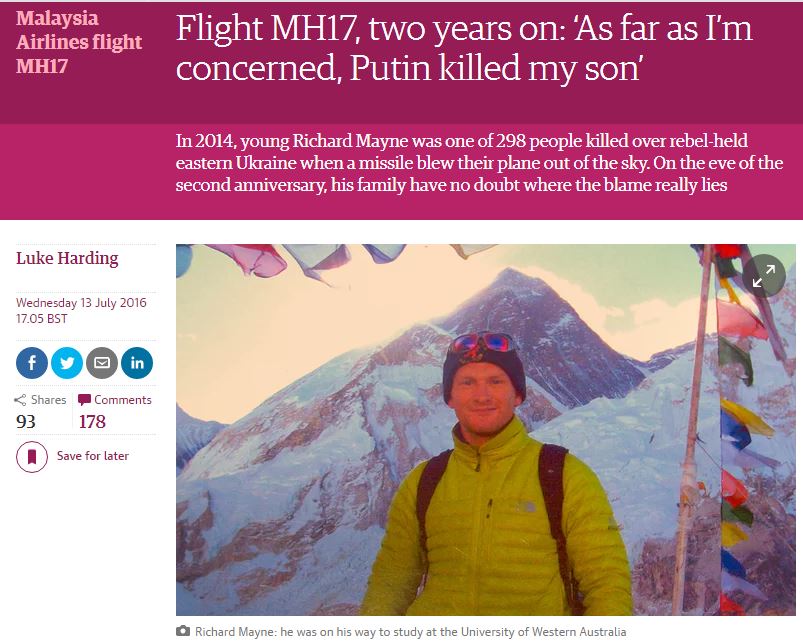
Absorb the headline and the intent behind it. Something of a tour de force of moral bankruptcy even for the team that brought you the Polonium story. We don’t just get racism, warmongering and towering falsehoods here. No – we can also experience the exploitation of 20 year old Richard Mayne’s short life and tragic death and his family’s pain! So sit back and enjoy as Harding rushes in where the sane and ethical might fear to tread, boldly turning one family’s unspeakable tragedy into grist for his own Putin-hate mill.
You see, happily for Luke and the pro-war agenda, Richard was killed on board MH17, and his parents blame Vladimir Putin…
Amid their grief, the Maynes came to a grim conclusion: Richard had been murdered. The man whom they believe murdered him is Vladimir Putin. It was Putin, they believe, who gave orders for the Russian military to cross the border, setting in train a series of consequences, including the shooting down of MH17 and 10,000 dead in the conflict.
Let’s be crystal clear at this point. No one can blame this family for their anger. They’re desperate and grief-stricken and need someone to be punished for the crime that took their son. The fact Putin is their target is an understandable human response, and no one could condemn them.
But even in a world of wall-to-wall media deception there’s something freshly disgusting in the way this piece weaves saccharine “sympathy” for the tragically bereaved into a simplistic narrative of polarity and hatred, likely to produce nothing but more death, and more grieving families like the Maynes.
Here are just a few examples, starting with the least egregious:
In the previous week, the Russian defence ministry had provided the rebels with an array of heavy weaponry: tanks, artillery pieces and mortars. Plus undercover soldiers disguised as “volunteers”.
If Harding had prefaced this claim with “it’s rumoured” or “it has been claimed” he would be doing something closer to journalism. And if he also mentioned the counter-claims that NATO is supplying the Kiev government with weapons, or the evidence for NATO-backed mercenaries fighting for the Kiev government, or the claims of the Kiev government’s war crimes against its own people (including the use of white phosphorous, which is banned under UN rulings), there’d be something approaching balance here.
But of course none of this has any direct evidential bearing on the fate of MH17 anyway, since tanks, artillery pieces and mortars were not in any way involved in shooting down that plane. Harding is merely trying to evade the facts and plant a perception of guilt by associated ideas. But it gets a lot worse.
The Buk arrived after Ukrainian war planes started bombing rebel positions and government troops were taking back territory. Suddenly, Ukrainian military aircraft were being blown from the sky.
Note how he completely elides the fact that a Dutch Intelligence report stated only the UAF had the operational capacity to shoot down a jet liner at 20,000+ feet, and the only Ukrainian planes “blown from the skies” were taken down at comparatively low altitudes by ManPads or “light” anti-aircraft guns not BUK. If his sentence ran something like: “unverified claims have been made that a BUK arrived some time before July 17, but the only planes known to have been downed by the rebels before or after this date were brought down using portable Manpads or light SAMs”, it would be broadly definable as honest.
And then we get this:
Certainly, Russia has done everything it can to cover up the crime. The Kremlin used its UN security council veto to stop an international investigation similar to that carried out following the Pan Am Lockerbie bombing.
Getting into his stride, Luke abandons implications and guilt by juxtaposition in favour of his old standby – the outright lie. Let’s take a moment to appreciate how completely unfazed he is by the total absence of evidence anywhere that Russia covered up anything, or by the small detail that Russia did not veto an “international investigation”, at all but in fact supported UN Resolution 2166 that called for “efforts to establish a full, thorough and independent international investigation into the incident in accordance with international civil aviation guidelines”. What does Luke think the Dutch Safety Board international investigation was if not – well, an international investigation? Is he not aware Russia supported it and supplied it with evidence?
We can be charitable and assume Harding means the proposal for a UN tribunal. Russia did veto that, it’s true, because – it argued – this was unprecedented and also premature to begin a second international investigation while the first was still underway. But this is not the same thing at all as vetoing an “international enquiry,” and Harding is surely aware of that. His narrative here amounts to a total reversal of known and established facts.
But he ain’t done yet…
Last October, a Dutch safety board report confirmed that a Buk missile launched from rebel-controlled territory hit MH17…
Is Luke trying to make us think the DSB directly blamed the “rebels” for shooting down MH17? Because to the unwary it might read as if that is what they did. But of course it isn’t, and Luke knows it. The DSB report concluded a BUK was probably responsible for the destruction of MH17 (though this is by no means conclusive), but it did not say which side had fired the missile because it could not pin down the probable launch area in a narrow enough corridor to make such a statement feasible. The claim of “rebel-conrolled territory” is word-fog designed to create the illusion of accusation where none exists.
The Buk’s crew appear to have fired on MH17 by mistake. At 5.50pm Moscow time, their leader Igor Strelkov, a veteran Russian intelligence officer, tweeted that his men had shot down another Ukrainian transport – or “bird”, as he put it.
All we need to do is note the weasel-words “appear to.” Another Harding trademark. They translate as “I want you to believe it but I have no evidence whatsoever that anything even remotely resembling this actually happened”. Admire also how he breezes right past the fact the DPR denied this tweet, and the account it emanated from, had anything to do with Strelkov at all.
You don’t have to believe it, Luke, but you do have to report it, particularly when you are building your story around the need of a bereaved family for justice.
I could go on. I could talk about Harding’s complete elision of the numerous uncertainties and controversies still surrounding almost every aspect of the incident in favour of a groundless certitude. His refusal to acknowledge the fact there is still no agreement over what shot MH17 out of the sky, never mind who (was it a BUK, as the corporate media claim, not a BUK, an SU-25, definitely NOT an SU-25, or something else again?). Or his absolute refusal to even acknowledge the fact the UAF is known to have had over 20 working BUK, while the rebels are only rumoured to have had one. Or the virtual impossibility of an untrained amateur crew being able to use one “acquired” BUK to take down anything. Or the Russian satellite data, all but ignored by western media, that seems to suggest very strange shenanigans immediately prior to the take-down of the plane. Or the numerous questions and accusations hanging over the DSB’s final report.
But you probably get the picture. The depth of the lie here and the fragility of their control over their own narrative is evidenced BTL. The comments were opened for less than three hours and at close the final page looked like this:
Other comments were simply airbrushed away in totality (we’ve all experienced that). One reader even tells us his account of 18 months standing was permanently disabled simply because he pointed out that Eliot Higgins’ work has been described as “propaganda.” Harding, of course, is known to fear the comments section and is rumoured to police it ferociously, demanding the instant banning of anyone who critiques him.
But however much he silences his critics BTL, the question still remains – what is Harding doing here? And, even if we accept he’s too lost in his narcissistic persecution complex to understand concepts of right and wrong or truth and fiction, what is the Guardian’s excuse? The Mayne family, like so many others, are looking for answers and solutions, not lies and propaganda. They want to know who killed their son. Who really, actually killed their son. because it’s the only thing they can do for him any more; the only act of caring and protection left available to them. And for that they need and deserve more than being used as the unwitting attack dogs for undeclared and lunatic agendas. They deserve the respect of honesty and full and truthful disclosure.
If they’d been given that would they still be blaming Vladimir Putin? Or would their anger be directed against other – possibly more deserving – targets, such as the media that has lied and continues to lie in the service of obscuring truth and promoting war?
I can’t tell and wouldn’t presume to dictate. But if one of my children had died so abominably I hope I would find someone willing to help me find the culprits rather than use me as a poster child for their own personal hate campaign.
July 15, 2016
Posted by aletho |
Mainstream Media, Warmongering | Luke Harding, MH17, NATO, Russia, The Guardian, Ukraine |
Leave a comment
In his book 2017: War with Russia published a few months ago, former deputy commander of NATO Sir Alexander Richard Shirreff predicts that to prevent NATO expansion Russia will annex eastern Ukraine and invade the Baltic state of Latvia in May 2017. Most dismiss the book as sensationalist fantasy, but it draws attention to the fact that NATO is in fact aggressively expanding, and holding large-scale war games in Romania, Lithuania, and Poland, and Russia is truly concerned.
Why Latvia? Shirreff is not alone in trying to depict Latvia and the other Baltic states (Estonia and Lithuania) as immanently threatened by Russia. The stoking of Baltic fears of such are a principle justification for NATO expansion.
The argument begins with the assertion that Vladimir Putin (conflated with Russia itself, as though he were an absolute leader, a second Stalin) wants to revive the Soviet Union. His occasional comment that the collapse of the USSR was a “catastrophe” is repeatedly cited, totally out of context, as proof of this expansionist impulse. It continues with the observation that there has been tension between Russia and the Baltic states since their independence in 1991. And while Russia has never threatened the Baltic states with invasion or re-incorporation, the fear mongers like to conjure up Sir Richard’s World War III scenario.
So it’s not difficult to understand why NATO, in its largest war games since the end of the Cold War, would choose Poland, which borders both Russia (the Kaliningrad enclave) and Lithuania, as their setting. Dubbed Anaconda-2016, the ten-day exercise involves 31,000 troops from 24 countries including non-NATO members Kosovo, Macedonia and Finland. Germany, whose foreign minister Frank-Walter Steinmeier has actually criticized the exercise as “saber-rattling and warmongering,” has sent 400 military engineers but no combat troops.
This follows the June announcement that NATO would deploy four multinational battalions (about 4000 troops) in the Baltic states and Poland to “bolster their defenses against Russia.” The idea is that Russian actions in Georgia in 2008 and in Ukraine since 2014 show that Russia poses a grave threat to European security.
It doesn’t actually. Its military budget is one-twelfth of NATO’s. It has no motive. Russia has responded to the unrelenting expansion of NATO to encompass it with stern words and defensive military measures but calm and ongoing appeals for cooperation with nations it (despite everything) continues to refer to as “our partners.”
But since the Baltics have become the focus of (supposed) NATO-Russian contestation, let’s look at what the problem is all about.
The three states were part of the Russian Empire under the tsars from the 18th century up to the Bolshevik Revolution of 1917. While most of the component parts of that empire soon became Soviet Socialist Republics (such as Georgia, Armenia, Ukraine, Kazakhstan, Uzbekistan etc.), others, including Poland, Finland and the Baltic states gained their independence at that time.
But in Estonia, Latvia and Lithuania, there remained large ethnic Russian, and Russian-speaking minorities, as there are today. In 1940 the Soviet army invaded these countries and incorporated them into the USSR. This was part of a strategy to avoid German invasion through the signing of the “Ribbentrop-Molotov Pact” that also meant the temporary division of Poland. (We can criticize this, as I surely do, but that’s the history.) A year later the Nazis invaded the Baltic republics and the Soviet Union as a whole. But the Soviets won the war, and the Baltics remained Soviet up to 1991.
The Baltic states, never truly happy campers in the Soviet Union, initiated the breakup of the country when, from June 1987, protests in Latvia and Estonia led to demands for secession, which the USSR recognized in September 1991. These demands for independence were generally supported by ethnic Russians in the republics. They no doubt expected that they would retain their longstanding linguistic rights.
(This issue of language rights is a huge problem in the former Soviet republics, including especially Ukraine. But it is little understood nor appreciated by U.S.opinion-makers, especially U.S. State Department officials and their media echo chamber.)
Today the Baltic republics have a population of a little over six million, including about one million ethnic Russians. The Russian figure has declined by about one-third since 1991. It is currently lowest in Lithuania (6 to 14%), and 24-30% in the other states.
The restoration of independence produced a wave of nationalist sentiment that included an attack on existing rights of ethnic Russians, distinguished from the others less by looks than by language. As recently as May 2016 a survey co-conducted by the Estonian and Latvian governments found that 89% of ethnic Latvians and 84% of ethnic Estonians are unhappy with this presence and want the Russians to “move back to Russia,” although many are from families who have lived in these countries for centuries.
In Latvia, the State Language Law (passed in 2000) requires that documents to local and national government, and to local and national state public enterprises, be submitted in Latvian only, as the sole national language. (Earlier they could be submitted in Russian, or even English or German.) Aside from being perceived by the minority as an attack on their own culture and identity, this requirement imposes hardships especially for older citizens who have never mastered the “national” language. A similar situation pertains in Estonia. Protests not only by Russia but by other countries have resulted in rulings against Latvia by the European Court of Human Rights and the UN Human Rights Committee.
Moscow sees itself as the protector of ethnic Russians from Ukraine to the Baltics. This should not be so hard to understand. But that does not mean that Moscow—however annoyed it is by NATO expansion to its borders—has plans to invade its neighbors and spark a general conflagration. NATO in 2013 had 3,370,000 service members in 2013, to Russia’s 766,000 troops. NATO expenditures in 2015 were $892 billion on defense in 2015, compared to Russia’s $70 billion.
The idea that Russia poses a threat to any NATO nation is as plausible as the notion that Saddam Hussein threatened the world with weapons of mass destruction. Or that Libya’s Gadhafy was preparing a genocidal campaign against his own people. Or that Iran plans to use nukes to wipe Israel off the map. These are all examples of the Big Lie.
Wait, some will ask, what about Georgia? Didn’t Russia invade and divide that country? Yes, it did, in defense of South Ossetia, which had resisted inclusion in the Republic of Georgia formed in 1991, fearing its ultranationalist leadership. South Ossetia, inhabited by an Iranian people, had been included as an autonomous oblast in the Georgian Soviet Republic but as the Soviet Union dissolve sought unity with Russia. So did Abkhazia. These two “breakaway republics” had been involved in a “frozen conflict” with Georgia until real war broke out in August 2008, producing a Russian invasion of Georgia and Russia’s recognition of South Ossetia as well as Abkhazia as independent states.
One can see this as tit-for-tat for the U.S. dismemberment of Serbia in 1999 and subsequent recognition of Kosovo as an independent state in February 2008. This act in plain violation of international law, condemned by U.S. allies such as Greece, Romania and Spain, was explained by U.S. Secretary of State Condoleezza Rice as a sui generis case. Well then, that 1999 NATO war on Serbia has led to more sui generis cases, hasn’t it?
And what about Ukraine? The limited moves Russia has taken there have been in direct response of the U.S.-led effort to incorporate Ukraine into NATO, most notably in backing the pro-NATO (and neo-fascist) forces who pulled off the coup of February 22, 2014. Any support Russia has offered to ethnic Russians in the Donbass opposed to the ultranationalist (and dysfunctional) new regime in Kiev hardly constitute an “invasion.”
It’s all about NATO. Unfortunately, the U.S. masses don’t even know what NATO is, or how it’s expanding. It is rarely mentioned in the mainstream press; its existence is never problematized, or discussed in U.S. political debates (except when Trump says the U.S.’s NATO allies are getting a “free ride”); the fact that its dissolution is not subject to questioning is all very depressing.
But wait, I must correct myself. Stephen Kinzer, a senior fellow at the Watson Institute for International Studies at Brown University, got an op-ed published in the Boston Globe a few days ago, entitled “Is NATO Necessary?” Without calling for its outright abolition, he declares, “We need less NATO, not more.”
But the next day the newspaper website included (as if by way of apology) an op-ed by Nicholas Burns, Undersecretary of State for Political Affairs in the George W. Bush administration and now professor of the practice of diplomacy and international politics at Harvard’s Kennedy School of Government. It’s entitled, “Why NATO is vital for American interests.”
Burns adduces four reasons for NATO’s continuing necessity.
“The first is Vladimir Putin’s aggression — his division of Georgia and Ukraine, his annexation of Crimea, his threats to the Baltic states, and his military’s harassment of US forces in international airspace and international waters.” (In other words, Russia’s restrained response to NATO’s provocations is reasons for NATO to continue, as a provocateur. And what “threats” of Putin can Burns cite? There have been none.)
“The second challenge is a dramatically weakening and potentially fractured European Union, now exacerbated by the possible departure of the United Kingdom.” (In other words, as the contradictions within European capitalism intensify, the U.S. must keep its camp together as—if nothing else—an anti-Russian alliance. What logic is this, other than fascist logic?)
“The third is the tsunami of violence spreading from the Levant and North Africa into Europe itself.” (In other words, when NATO actions result in so much pain in Libya and Afghanistan, and U.S.-led wars to so much chaos in Iraq and Syria that a million people flood into Europe, destabilizing European unity on the question of migration policy, the U.S. needs to be there somehow using the military alliance to hold it all together.)
“The fourth is uncertain and sometimes seemingly unconfident European and American leadership in the face of these combined challenges.”
(In other words, the U.S. needs to instill confidence by taking such actions as the invasion of Iraq that Burns supported as a State Department official, and the Libya slaughter he supported as a Boston Globe op-ed writer.)
Strength. Power. Confidence.
Burns and Gen. Jim Jones (former National Security Advisor for Pres. Obama) “believe NATO should station military forces “on a permanent basis in Poland, the Baltic states, the Black Sea region, and the Arctic,” and that the “US should extend lethal military assistance to Ukraine so that it can defend itself.” As though it has been attacked.
His final point is “that our most complex challenge may come from within the NATO countries themselves. Our strongest link is that we are all democracies. But, many of us, including the United States, are confronting a wave of isolationist sentiment and ugly extremism in our domestic political debates. NATO will need strong, unflinching American leadership to cope with these challenges.”
This conclusion is of course a reference to Donald Trump and his “extremism” in daring to—-among his many inchoate and clueless pronouncements—opine that the U.S. is protecting Europe for NATO, but spending too much money on it, and Germany should do more for Ukraine. It seems a statement in favor of that Iron Lady Hillary, who was so unflinching in her support of the Iraq War, and the Libya regime change, and who is hot to trot to bomb government buildings in Damascus.
Gary Leupp is Professor of History at Tufts University, and holds a secondary appointment in the Department of Religion. He can be reached at: gleupp@tufts.edu
July 14, 2016
Posted by aletho |
Book Review, Mainstream Media, Warmongering, Timeless or most popular | Estonia, Latvia, Lithuania, NATO, Russia |
Leave a comment





