Scottish Nationalism & the Yinon Plan
By Barbara McKenzie | July 13, 2016
The Scottish National Party, under Alex Salmond, has long been associated with opposition to illegal and immoral wars. Salmond was one of the few MPs who opposed the bombing of Serbia, and campaigned actively against the invasion of Iraq, subsequently supporting Plaid Cymru’s Adam Price in his attempt to impeach Tony Blair. Like Jeremy Corbyn he has been responding to the publication of the Chilcot report; like Jeremy Corbyn he is calling for Blair to be charged with war crimes.
What exactly is the position of the Scottish National Party with regard to global peace and justice?
The foremost objective of the Scottish National Party is Scottish independence. Beyond that, it has been obliged to position itself as the centre-left party of Scotland, there being scarcely room on the right along with Labour and the Tories, and espouses certain left-wing causes such as the question of upgrading Britain’s nuclear missile system, Trident. However a commitment to Scottish independence and opposition to nuclear weapons do not in themselves add up to an ethical view on global affairs.
Despite Salmond’s stance on Iraq, the SNP, with Salmond as party leader, voted with the Government and Labour Opposition to bomb Libya in 2011. It should be noted that both Jeremy Corbyn and John McDonnell voted against the motion, along with 11 other MPs. The reasons given for their No vote are varied and convincing. That of Caroline Lucas, Green MP for Brighton Pavilion, went : ’Given the West’s colonial past, its history of adventurism and support for dictatorship in the region, its failure to enforce UN resolutions in Palestine and the legacy of the invasion of Iraq in 2003, I think its motives in Libya will always be in doubt.’ Quite so.
The SNP clearly did not see it that way. As Steve James puts it:
Since coming to power in Edinburgh in 2007, the [SNP] has repeatedly made clear it is willing to support British military actions, particularly if a UN flag is flying over the slaughter of the day—including in Libya. […] The SNP has repeatedly made clear that they support NATO, the European Union, a struggle against Russia, and increased spending on frigates, fast jets and long-range reconnaissance aircraft.
The SNP’s line on Syria could be seen as being consistent with its position on Iraq, in that it opposed the overt bombing of the country (ostensibly ISIS in Syria) in December, 2015. When talking to the press after the vote was passed Salmond made a lot of sense (as he usually does), pointing out the lack of a proper strategy to deal with Islamic State.
However the elephant present in the chamber when the bombing of Syria was debated was the UK government’s known support for the extremist militants fighting the legitimate government in Syria, see here and here. Neither Salmond’s statement on the ‘bomb Syria’ vote nor Nicola Sturgeon’s contain any proposal for the obvious moral alternative, to stop supporting armed extremists, mostly imported, and instead help the Syrian people fight these terrorists. There is nothing said by either politician to suggest that the SNP does not support in principle the proxy war on Syria and enforced regime change.
It is obvious to all and sundry that there is a gross contradiction between the West’s claims to see terrorism and the growth of ISIS as a major threat, while in real terms prioritising the overthrow of the Syrian government who is actually fighting them on the ground. By not pressing the UK government and the EU to actually help the Syrian people fight jihadi extremists, instead of providing those same extremists with moral and material support, the SNP has shown itself to be just as compromised as the Labor and Conservative parties.
The Yinon Plan
Many active users of social media who follow global events will be familiar with General Wesley Clark’s revelation in 2007 about the US plan, after having already invaded Afghanistan, to take out 7 further countries in 5 years. It was made known to Wesley Clark a couple of weeks after 9/11 that the US planned to invade Iraq, Syria, Lebanon, Libya, Somalia, Sudan and finally Iran.
Likewise, many people will be familiar with Oded Yinon’s ‘Strategy for Israel in the Nineteen Eighties’, a proposal to further Israel’s interests by destabilising the whole of the Middle East. The plan operates on two essential premises. To survive, Israel must 1) become an imperial regional power, and 2) must effect the division of the whole area into small states by the dissolution of all existing Arab states.
The objectives of the proposal articulated by Wesley Clark clearly further those of the second premise of the Yinon Plan. Furthermore, leaked documents (such as Clinton’s emails) confirm that Israel’s interests are paramount for US foreign policy. The same documents show that the decision to take out Syria had been made at least by 2006, but probably much earlier.
Given the catastrophic progression of wars from Afghanistan, Iraq, Libya to Syria, all strongly promoted and either actively waged or heavily sponsored by the West, Israel and their ally Saudi Arabia, there is no moral or intellectual justification for seeing these wars as anything but a cold-blooded plan to destabilise the greater Middle East and fulfill the Yinon plan.
There is little in the actions of the SNP (and many of their supporters) to suggest that they do not support in principle this path of destruction. Nicola Sturgeon declared her unequivocal support for the Israel lobby by putting on a blue nose to celebrate Yom Ha’atzmaut, which translates as something like ‘Destroy Palestine Day’.

Support for Israel, and for the Israel-backed programme of regime change in the Middle East, is a thread that runs through the Scottish independence movement.
The main Scottish ‘leftist’ pro-independence blogs, while they probably opposed the Iraq war, have abandoned any pretense at a moral perspective when it comes to global affairs. Rev. Stuart Campbell, the editor of Wings over Scotland and a strong supporter of the SNP, has wisely avoided commenting on issues such as the Syria conflict, focusing on what he knows best, i.e. Scottish affairs. However Campbell forms a mutual admiration society with one Stephen Daisley, a journalist with STV News who has been termed a ‘hate-filled and crazed right-winger’ by ex-UK ambassador Craig Murray. Daisley authored a quite extraordinary article attacking those who criticise Israel, which fully justifies Murray’s categorisation, offering such objective analysis as, ‘Why deny the Holocaust when you can throw it back in the Jews’ faces by fictionalising Gaza as a concentration camp? Why hurl rocks at a Jew in the street when you can hurl endless vexatious UN resolutions at Israel?’
Daisley’s article was published 24 August 2015. On the same day Wings over Scotland tweeted (not, I hasten to add, in reference to Daisley’s article, but also not for the first time)

Daisley promoted Wings over Scotland’s crowd fundraiser in February 2015, while until late last year his blog was listed among the suggested links on Wings over Scotland’s Home Page.
The other major pro-indy blog, Bella Caledonia, which has been praised by such notable Scots as Irvine Welsh, has come out strongly in support for enforced regime change in Syria, posting, for example, an article What is to be Done about Syria by determined propagandist for the ‘revolution’, Mohammed Idrees Ahmed. To be fair to Scotland, the article attracted a number of negative (or appalled) comments, but editor Mike Small responded to criticism by digging himself into an ever deeper hole, and disappointed readers were left in no doubt of his support for illicit regime change in Syria.
Who’s next?
It is widely assumed that the next country in the sights of the NATO/Israel alliance will be Iran (although with all the recent sabre-rattling about Russia, one could be forgiven for thinking that country may be next in the firing line). It has also been widely assumed that the progression to war on Iran, either through direct military intervention or via a bogus revolution on the Syria model, is impeded by the failure so far to achieve a resolution in Syria that satisfies the NATO/Israel alliance, and that the ‘West’ will not move its attentions to Syria until the Syrian situation is resolved.
Quite how long Iran is safe from the predatory NATO/Israel alliance is hard to say. But those wanting to move against Iran sooner rather than later met in Paris on 9-10 July 2016, at a rally called Free Iran: Our Pledge Regime Change. This is an annual event convened by the People’s Mujahedeen of Iran (PMOI), more commonly known as the Mujahedeen-e-Khalq or MEK, which was until 2012 on the US prescribed terrorist list. Daniel Larison in the hardly left-wing American Conservative described MEK in less than glowing terms.
… the MEK is probably best-known for its role fighting on the side of Saddam Hussein in the Iran-Iraq war against their own country. That is one of the chief reasons why the group is still loathed by almost all Iranians in Iran and around the world. The idea that this group speaks for dissident Iranians is nonsensical and insulting to the latter, and the fantasy that such an abusive, totalitarian cult has any interest in the freedom of Iranians is laughable even by Washington’s low standards.
The touted 100,000 participants included a number of politicians and other dignitaries such Prince Turki al-Faisal, ex-intelligence chief from Saudi Arabia, who talked of the importance of overthrowing an oppressive regime, but obviously could not go too deeply into the question of human rights, and Newt Gingrich, a potential running mate for Donald Trump.
It is well known that the MEK has close ties with pro-Israel lobby groups, so perhaps it should not surprise that convenor Maryam Rajavi paid a special tribute to Elie Wiesel, who won a Nobel Prize for his book on his holocaust experience. Now Elie Wiesel is considered by all except the most hardened Zionists as a fraud and a hypocrite, and certainly nothing like the great messenger for humanity described by Rajavi. Again, it is difficult to see such concern for the priorities of the Israel lobby resonating with the people of Iran.
The sentiments of the conference are also supported by a number of Anglican bishops. This episcopal empathy with Iranian Christians might inspire more conviction if the same had been shown for Syrian Christians. However a Google search for such an outpouring of compassion found only an article in the very unlikely Spectator, asking that Cameron Should Listen to Syrian Bishops Not the Anglican Ones. My search for “UK Bishops grateful to Hezbollah for protecting Syrian Christians” was no more successful.
Very proud to be sharing a platform with such august company as Prince Turki al-Faisal and Newt Gingrich were three MPs from the Scottish National Party:

Despite all these years of bloody war in the greater Middle East, the implications of attending a conference dedicated to regime change were clearly lost on the SNP representatives.

The PMOI/MEK have an unsavoury reputation as terrorists and manipulators. The rally itself was a blatant display of hypocrisy of the highest order, with participants giving standing ovations to Turki al-Faisal of the Kingdom of Saudi Arabia, as he lectured on oppressive regimes. His hostess Maryam Rajavi, who aspired to ‘win the hearts and minds of the Iranian diaspora’, stood on the same platform as al-Faisal and spoke of Iran as the source of terrorism and extremism, completely disregarding the fact that Iran (unlike Saudi Arabia) support no terrorist groups, but the legitimate government of Syria. Participation in such an event does the organisations that the delegates represent no favours.
Anyone who puts too much trust in the integrity and consistency of politicians is headed for disappointment. But for the Scottish National Party to allow three of its MPS to be associated with an organisation and event of such ill repute is an exceptional display of poor judgement, quite apart from what this says about the party’s values.
It is likely that when the decision is made to go for Iran, the NATO/Israel alliance will go for the more deniable ‘revolution’ option, though they will be hoping for more credible partners than the MEK. The chances of such an organisation ever managing to acquire credibility as an Iranian opposition within Iran are minimal. However the case of Syria has shown that as long as their governments are not actually invading or bombing, the British and American publics are quite happy to put up with blatant hypocrisy and hardly less blatant support for murderous extremists.
Whatever method is chosen to wipe out Iran, we needn’t look to the Scottish National Party to stand in the way.
NATO Reaffirms Its Bogus Russia Narrative
By Robert Parry | Consortium News | July 11, 2016
It’s unnerving to realize that the NATO alliance – bristling with an unprecedented array of weapons including a vast nuclear arsenal – has lost its collective mind. Perhaps it’s more reassuring to think that NATO simply feels compelled to publicly embrace its deceptive “strategic communications” so gullible Western citizens will be kept believing its lies are truth.
But here were the leaders of major Western “democracies” lining up to endorse a Warsaw Summit Communiqué condemning “Russia’s aggressive actions” while knowing that these claims were unsupported by their own intelligence agencies.
The leaders – at least the key ones – know that there is no credible intelligence that Russian President Vladimir Putin provoked the Ukraine crisis in 2014 or that he has any plans to invade the Baltic states, despite the fact that nearly every “important person” in Official Washington and other Western capitals declares the opposite of this to be reality.
But there have been a few moments when the truth has surfaced. For instance, in the days leading up to the just-completed NATO summit in Warsaw, General Petr Pavel, chairman of the NATO Military Committee, divulged that the deployment of NATO military battalions in the Baltic states was a political, rather than military, act.
“It is not the aim of NATO to create a military barrier against broad-scale Russian aggression, because such aggression is not on the agenda and no intelligence assessment suggests such a thing,” Pavel told a news conference.
What Pavel blurted out was what I have been told by intelligence sources over the past two-plus years – that the endless drumbeat of Western media reports about “Russian aggression” results from a clever demonization campaign against Putin and a classic Washington “group think” rather than from a careful intelligence analysis.
Ironically, however, just days after the release of the British Chilcot report documenting how a similar propaganda campaign led the world into the disastrous Iraq War – with its deadly consequences still reverberating through a destabilized Mideast and into an unnerved Europe – NATO reenacts the basic failure of that earlier catastrophe, except now upping the ante into a confrontation with nuclear-armed Russia.
The Warsaw communiqué – signed by leaders including President Barack Obama, German Chancellor Angela Merkel, French President Francois Hollande and British Prime Minister David Cameron – ignores the reality of what happened in Ukraine in late 2013 and early 2014 and thus generates an inside-out narrative.
Instead of reprising the West’s vacuous propaganda themes, Obama and the other leaders could have done something novel and told the truth, but that apparently is outside their operating capabilities. So they all signed on to the dangerous lie.
What Really Happened
The real narrative based on actual facts would have acknowledged that it was the West, not Russia, that instigated the Ukraine crisis by engineering the violent overthrow of elected President Viktor Yanukovych and the imposition of a new Western-oriented regime hostile to Moscow and Ukraine’s ethnic Russians.
In late 2013, it was the European Union that was pushing an economic association agreement with Ukraine, which included the International Monetary Fund’s demands for imposing harsh austerity on Ukraine’s already suffering population. Political and propaganda support for the E.U. plan was financed, in part, by the U.S. government through such agencies as the National Endowment for Democracy and the U.S. Agency for International Development.
When Yanukovych recoiled at the IMF’s terms and opted for a more generous $15 billion aid package from Putin, the U.S. government threw its public support behind mass demonstrations aimed at overthrowing Yanukovych and replacing him with a new regime that would sign the E.U. agreement and accept the IMF’s demands.
As the crisis deepened in early 2014, Putin was focused on the Sochi Winter Olympics, particularly the threat of terrorist attacks on the games. No evidence has been presented that Putin was secretly trying to foment the Ukraine crisis. Indeed, all the evidence is that Putin was trying to protect the status quo, support the elected president and avert a worse crisis.
It would be insane to suggest that Putin somehow orchestrated the E.U.’s destabilizing attempt to pull Ukraine into the association agreement, that he then stage-managed the anti-Yanukovych violence of the Maidan protests, that he collaborated with neo-Nazi and other ultra-nationalist militias to kill Ukrainian police and chase Yanukovych from Kiev, and that he then arranged for Yanukovych to be replaced by a wildly anti-Russian regime – all while pretending to do the opposite of all these things.
In the real world, the narrative was quite different: Moscow supported Yanukovych’s efforts to reach a political compromise, including a European-brokered agreement for early elections and reduced presidential powers. Yet, despite those concessions, neo-Nazi militias surged to the front of the U.S.-backed protests on Feb. 22, 2014, forcing Yanukovych and many of his officials to run for their lives. The U.S. State Department quickly recognized the coup regime as “legitimate” as did other NATO allies.
On a personal note, I am sometimes criticized by conspiracy theorists for not accepting their fact-free claims about nefarious schemes supposedly dreamed up by U.S. officials, but frankly as baseless as some of those wacky stories can be, they sound sensible when compared with the West’s loony conspiracy theory about Putin choreographing the Ukraine coup.
Yet, that baseless conspiracy theory roped in supposedly serious thinkers, such as New York Times columnist Paul Krugman, who conjured up the notion that Putin stirred up this trouble so he could pull off a land grab and/or distract Russians from their economic problems.
“Delusions of easy winnings still happen,” Krugman wrote in a 2014 column. “It’s only a guess, but it seems likely that Vladimir Putin thought that he could overthrow Ukraine’s government, or at least seize a large chunk of its territory, on the cheap, a bit of deniable aid to the rebels, and it would fall into his lap. …
“Recently Justin Fox of the Harvard Business Review suggested that the roots of the Ukraine crisis may lie in the faltering performance of the Russian economy. As he noted, Mr. Putin’s hold on power partly reflects a long run of rapid economic growth. But Russian growth has been sputtering, and you could argue that the Putin regime needed a distraction.”
Midwifing This Thing
Or, rather than “a guess,” Krugman could have looked at the actual facts, such as the work of neocon Assistant Secretary of State for European Affairs Victoria Nuland conspiring to organize a coup that would put her hand-picked Ukrainians in charge of Russia’s neighbor. Several weeks before the putsch, Nuland was caught plotting the “regime change” in an intercepted phone call with U.S. Ambassador to Ukraine Geoffrey Pyatt.
Regarding who should replace Yanukovych, Nuland’s choice was Arseniy “Yats is the guy” Yatsenyuk. The phone call went on to muse about how they could “glue this thing” and “midwife this thing.” After the coup was glued or midwifed on Feb. 22, 2014, Yatsenyuk emerged as the new prime minister and then shepherded through the IMF austerity plan.
Since the coup regime in Kiev also took provocative steps against the ethnic Russians, such as the parliament voting to ban Russian as an official language and allowing neo-Nazi extremists to slaughter anti-coup protesters, ethnic Russian resistance arose in the east and south. That shouldn’t have been much of a surprise since eastern Ukraine had been Yanukovych’s political base and stood to lose the most from Ukraine’s economic orientation toward Europe and reduced economic ties to Russia.
Yet, instead of recognizing the understandable concerns of the eastern Ukrainians, the Western media portrayed the ethnic Russians as simply Putin’s pawns with no minds of their own. The U.S.-backed regime in Kiev launched what was called an “Anti-Terrorist Operation” against them, spearheaded by the neo-Nazi militias.
In Crimea – another area heavily populated with ethnic Russians and with a long history of association with Russia – voters opted by 96 percent in a referendum to secede from Ukraine and rejoin Russia, a process supported by Russian troops stationed in Crimea under a prior agreement with Ukraine’s government.
There was no Russian “invasion,” as The New York Times and other mainstream U.S. news outlets claimed. The Russian troops were already in Crimea assigned to Russia’s historic Black Sea naval base at Sevastopol. Putin agreed to Crimea’s annexation partly out of fear that the naval base would otherwise fall into NATO’s hands and pose a strategic threat to Russia.
But the key point regarding the crazy Western conspiracy theory about Putin provoking the crisis so he could seize territory or distract Russians from economic troubles is that Putin only annexed Crimea because of the ouster of Yanukovych and the installation of a Russia-hating regime in Kiev. If Yanukovych had not been overthrown, there is no reason to think that Putin would have done anything regarding Crimea or Ukraine.
Yet, once the false narrative got rolling, there was no stopping it. The New York Times, The Washington Post and other leading Western publications played the same role that they did during the run-up to the Iraq invasion, accepting the U.S. government’s propaganda as fact and marginalizing the few independent journalists who dared go against the grain.
Though Obama, Merkel and other key leaders know how deceptive the Western propaganda has been, they have become captives to their governments’ own lies. For them to deviate substantially from the Official Story would open them to harsh criticism from the powerful neoconservatives and their allied media outlets.
Even a slight contradiction to NATO’s “strategic communications” brought down harsh criticism on German Foreign Minister Frank-Walter Steinmeier after he said: “What we shouldn’t do now is inflame the situation further through saber-rattling and warmongering. … Whoever believes that a symbolic tank parade on the alliance’s eastern border will bring security is mistaken.”
Excoriating Russia
So, at the Warsaw conference, the false NATO narrative had to be reaffirmed — and it was. The communiqué declared, “Russia’s aggressive actions, including provocative military activities in the periphery of NATO territory and its demonstrated willingness to attain political goals by the threat and use of force, are a source of regional instability, fundamentally challenge the Alliance, have damaged Euro-Atlantic security, and threaten our long-standing goal of a Europe whole, free, and at peace. …
“Russia’s destabilising actions and policies include: the ongoing illegal and illegitimate annexation of Crimea, which we do not and will not recognise and which we call on Russia to reverse; the violation of sovereign borders by force; the deliberate destabilisation of eastern Ukraine; large-scale snap exercises contrary to the spirit of the Vienna Document, and provocative military activities near NATO borders, including in the Baltic and Black Sea regions and the Eastern Mediterranean; its irresponsible and aggressive nuclear rhetoric, military concept and underlying posture; and its repeated violations of NATO Allied airspace.
“In addition, Russia’s military intervention, significant military presence and support for the regime in Syria, and its use of its military presence in the Black Sea to project power into the Eastern Mediterranean have posed further risks and challenges for the security of Allies and others.”
In the up-is-down world that NATO and other Western agencies now inhabit, Russia’s military maneuvers within it own borders in reaction to NATO maneuvers along Russia’s borders are “provocative.” So, too, is Russia’s support for the internationally recognized government of Syria, which is under attack from Islamic terrorists and other armed rebels supported by the West’s Mideast allies, including Saudi Arabia, Qatar and NATO member Turkey.
In other words, it is entirely all right for NATO and its members to invade countries at will, including Iraq, Libya and Syria, and subvert others as happened in Ukraine and is still happening in Syria. But it is impermissible for any government outside of NATO to respond or even defend itself. To do so amounts to a provocation against NATO – and such hypocrisy is accepted by the West’s mainstream news media as the way that the world was meant to be.
And those of us who dare point out the lies and double standards must be “Moscow stooges,” just as those of us who dared question the Iraq WMD tales were dismissed as “Saddam apologists” in 2003.
Investigative reporter Robert Parry broke many of the Iran-Contra stories for The Associated Press and Newsweek in the 1980s. You can buy his latest book, America’s Stolen Narrative, either in print here or as an e-book (from Amazon and barnesandnoble.com).
Iran rejects NATO claims on missile work
Press TV – July 11, 2016
The Iranian Foreign Ministry has dismissed a recent NATO communiqué concerning the Islamic Republic’s missile program as “a repetition of past baseless allegations.”
NATO, in a statement released on June 9, expressed “serious concern over the development of Iran’s ballistic missile program and continuing missile tests,” claiming that they “are inconsistent with UNSCR 2231.”
Resolution 2231 was adopted on July 20, 2015 to endorse a nuclear deal between Iran and six world powers — known as the Joint Comprehensive Plan of Action (JCPOA) — and puts no limits on Iran in terms of missile activities. The resolution merely “calls upon” Iran not to undertake any activity related to missiles “designed to be capable of” delivering nuclear weapons.
Iran says it is involved in no such missile work and has no such weapons.
“Not only does not Iran’s missile program have anything to do with the JCPOA…, but also, as reiterated numerous times, it is not in breach of Resolution 2231, either,” said Iranian Foreign Ministry Spokesman Bahram Qassemi on Monday in reaction to the NATO statement.
“As declared repetitively, our country’s missile capabilities merely fall within the framework of the Islamic Republic of Iran’s legitimate defense program, and [the missiles] are by no means designed to carry nuclear warheads,” he added.
Iran and the five permanent members of the UN Security Council — the United States, Britain, France, Russia and China — plus Germany struck the JCPOA on July 2015 and started implementing it on January 16 this year.
Under the deal, Iran agreed to limit its nuclear program and provide enhanced access to international atomic monitors in return for the termination of all nuclear-related sanctions imposed by the United States, the United Nations (UN) and the European Union (EU) against the country.
James Petras: Imperialism Cannot Be Trusted to Abide by Its Agreements

Fars News Agency – July 9, 2016
Dr. James Petras who has been alongside three outstanding leaders of the world – Chile’s late Salvador Allende, Venezuela’s late Hugo Chavez and Greece’s late Andreas Papandreou – as an advisor warns that the United States and other imperialist powers should never be trusted.
The following is a transcript of a recorded interview with professor James Petras by Marwa Osman.
Q: How do you assess the influence of Zionism in setting the agenda for Western governments?
A: I think Zionism has become a very important influence on western, European and US diplomacy, particularly to the Middle East and in particular any questions relating to Israel’s foreign policy. In the US I think it is extremely important. Zionism has set the agenda for the US, it has helped elect officials, it has intimidated critics, it has received enormous funds from the US government and in general we can say that Israel dominates the US policy in the Middle East. The Zionists played a very important role in organizing the invasion of Iraq, they were involved with the war in Afghanistan, they are currently involved in the war inside of Syria, and they have deep positions within the state department and within the Pentagon. In the Pentagon, they have been very prominent in encouraging the US to escalate its wars and destroy the Muslim population in that region. In the treasury department, Israeli Zionists have been influential in imposing sanctions against Iran and I think the agreement was made between Iran and the US despite the pressure from the Zionists and they continue to harass any policy which would implement the Iran-US agreement, that is, what would facilitate trade and investment. So in general, England, France and the United States are very much influenced by Zionist policy regarding the Islamic countries and I think this is a major hindrance to any accommodation and understanding that would lessen the prospect of war and focus attention on the role that Israel plays along with Saudi Arabia as an enemy of the Islamic people and of the population as a whole.
Q: How do you think Zionists have managed to keep such an influence away from the public’s eye and basically away from the media?
A: I think that Zionist influence in the media is enormous. If you look at the major television networks bearing common that Zionists are in the leading positions like CBS, NBS, CNN, New York Times, Washington Post and the Wall Street Journal are very much controlled and influenced by owners and writers tied to Israeli interests. The Financial Times is also no exception to that and that has played a major role in influencing the public opinion and beyond that we have the fact that many Zionists have penetrated the government and they are simply a lobby pressuring the Congress and that plays a role also. Zionists contribute over 60% of the funding of the Democratic Party and about 35 to 40% of Republican Party funding so they influence the government directly and they influence the media and they influence the congress and the electoral process. All of this is accompanied by ferocious attacks on critics of Israel. We have seen many writers and academics who have lost jobs in medical and other professions who have criticized Israel and have been subject to harassment and some have even suffered violent threats against their lives and certainly against their employment.
Q: What are the highlights of your first hand observations during the years you served as an advisor to Andreas Papandreou? Have things changed for the better now?
A: Things are much worse now. When I was in the government back in 1982 till 1985, we implemented a policy much more balanced, criticizing the Israeli aggression against the Palestinians. We saw the Palestinian President at the time, Yasser Arafat, who visited Papandreou and they exchanged similar ideas on the Liberation of Palestine. Papandreou did not pursue his radical commitments that he made in the campaign but he did implement many reforms dealing with women’s rights, with expanding the health programs and the higher education programs. In other words he was an effective social reformer but he did not pursue the maximum agenda which was to withdraw from NATO and from the European Union although he threatened to but it was mainly a bluff. So one can say that in comparison to the current period, Papandreou was certainly much more of a reformer much more effective developing an independent foreign policy than the current governments of Greece. It’s a shame to say that Greece is going backwards rather than at least standing with the independent programs of the past.
Q: Why did the US decide to overthrow the government of President Salvador Allende? Can you depict the depth of US involvement in toppling Chilean government based on your own observations?
A: A number of things that I think are very crucial. One was when the Allende government was democratically elected it proceeded to nationalize the major industries like the copper industry, banks and some of the major industrial plants or turn them into worker represented institutions. So the first objective for Washington, particularly Henry Kissinger, was to undermine the independent economic policy of Chile. The second thing is that Chile served as a democratic alternative in Latin America, an independent foreign policy with good relationships with all of the progressive governments including Cuba and Washington did not want an example in Latin America of a democratically elected socialist government with an independent foreign policy with a critical stance on imperialist wars overseas including the war against China, the US support for the Shah etc. So I think Allende and the socialist government in Chile was overthrown through Washington’s direct involvement with financial aid, with pressures within the Chilean military to eliminate democratically oriented generals and also to pay for certain strikes particularly in the transport industry with the truck owners who were paid very substantial amounts by US CIA officials to paralyze the economy. I was an advisor to the government of Allende at the foreign ministry and I attempted to inform them on the role that Washington was playing in sabotaging the Chilean autonomy in the military. The problem was that the US had a great influence on the military and the military that was allied with the US was not purged and the democratic military officials eventually were ousted and that allowed the coup to move forward.
Q: Comparing the governance model of Allende with Chavez, you believe the reason for Chavez’ success was his structural renewal of the Venezuelan political system while Allende failed to meet its necessity. Do you think this is the reason behind the failure of the uprisings in some Arab countries, while the same fact served as a main factor for the victory of Iran’s 1979 Islamic Revolution?
A: I think both in the case of Imam Khomeini and Chavez, they moved very directly to eliminate the potential of the coup forces in the military. Imam Khomeini got rid of the generals and conspirators of the Shah within the military and therefore eliminated the possibility of intrigues and a military coup. Chavez did the same thing. When he was elected the first thing he did was to evoke a new constitutional assembly and a new constitution was formed and Chavez was very influential in the recruitment and promotion of democratically constitutionally oriented military officials so when Washington promoted the coup against Chavez it was defeated. They only captured a small minority of the military and unlike Allende who believed that the military was a democratic force not taking account of the long term ties to the United States under the previous right wing government. I think that the changes in the military and in the constitution were crucial to the advancement in Iran and Venezuela by making the military and civilian electoral processes work hand in hand. There are many other reasons for the failure of the uprisings in different Arab governments. They failed to mobilize the masses, they relied on simple maneuvers in parliament and elections. They didn’t attempt to organize an independent military that would be nationalistic anti-imperialist. Many of those so called progressive Arab governments were themselves very corrupt and thought they could make deals with the United Sates and I think ultimately fooled themselves and left their countries vulnerable to military coups, US interventions etc. It is hard to believe that if 1 million Arab fighters were recruited in Iraq, they couldn’t have prevented an invasion but Saddam Hussein was too much manipulated by Washington thinking that he could make deals with Washington against Iran and other adversaries with other Persian Gulf countries and he was wrong.
Q: How did you see the mindset of President Papandreou, President Salvador Allende of Chile, and President Hugo Chavez in their fight against US dictatorship?
A: Well I think Papandreou was committed to winning the vote and the only way to win the public vote was by taking public opinion. Greece had suffered a military dictatorship like the Shah of Iran. In the early 60s and late 70s Greece had been under right wing governments which hindered Greece’s independence in its foreign policy. They prejudiced Greece’s living standards and in that sense Papandreou was able to understand the dynamics of civil society and to win an election. Now the problem with Papandreou was that he thought he could work within the capitalist system, he thought he could modify capitalism to make it more responsive, he thought he could work with the European Union and NATO and bring them in a more progressive direction and so while he pursued reforms he misread the natures of the limitations imposed by the structure. So on the one hand he would take positions but would take right turns. So it was a very paradoxical situation; I know I used to visit Papandreou to advise him on policies and he would take notes on paper of what I would suggest as an independent anti-imperialist policy and I thought I was having a major influence but when I left the office his secretary told me that I was followed by the US ambassador, so he was playing both sides by using a lot of my advice and criticism on the one hand to make speeches in parliament and on the other hand make practical decisions aligned with his conferences with the US embassy. Now with Chavez, it was a much different story. Chavez was much more committed, honest and in tune with the people. I was in many meetings with President Chavez, I spoke with him in the Sorbonne in Paris where we shared a platform. He was very much committed to fighting imperialism and he was the only major president in the west that opposed the war on terrorism. He said it shouldn’t be a war on terrorism, it should be a war on poverty and misery that create violent confrontation. For opposing Washington’s policies in the Middle East he became a target. Now I think President Chavez was a brilliant political and social analyst but I think he made mistakes by depending too much on the oil industry and social programs when he should have diversified the economy by focusing on being less dependent on oil and more on developing Venezuela as a diversified economy and one that was capable of being more self-sufficient. Allende was a contradiction in the sense that he was very democratic, very socialist but had weak understanding of the military basis, of popular basis for sustaining the government. He believed that every government would respect democracy and of course he was very naive. Washington never paid any attention. They used democracy as a tool to destroy the government. They exploited the weaknesses of the electoral process, they destroyed the independent military and carried out the coup which led to about 15 years of dictatorship and a reversal in all the major changes in agriculture reform, national ownership of the media and resources etc. So I think one has to have a more comprehensive look. You cannot trust imperialism to abide by its agreements.
Q: Are there any interesting memories during the years as their advisor to recall?
A: A lot of it depends on the issues. I once went swimming with Papandreou and when we were swimming I saw that there were people in scuba suits and I asked him why these people were swimming around and he said these are my bodyguards because we received intelligence information that the Mossad may try to assassinate the President Papandreou while we were swimming. So I found that amusing that the president of a country engaged in a vacation with me and at the time took the concern and right to defend himself even under water. Now with President Chavez, I was very impressed by his capacity to not only to engage in serious discussions but also had a very bright kind of a touch with the people. When we finished a major meeting he met with different admirers and audiences and some of them were from his region of the country and President Chavez engaged in a song contest with some of them. I was amused by the fact that Chavez knew the popular songs that corresponded to the audience that attended him in the informal session. And finally with president Salvador Allende, I remember my first meeting with him and it was in the middle of the Vietnam war and I was part of the anti-war movement and I had just come from the United States and I asked President Allende if he could give a statement and he immediately sat down and taped a rousing speech in defense of the Vietnamese and against US imperialism. I was very respectful because he was at that time playing a leading role in the government and taking the time to engage in international solidarity with the American people’s struggle against the war. And clearly Allende distinguished between the progressive American people and the imperialist government in Washington.
Russia Pushes Back on NATO Expansion
By Natylie Baldwin | Consortium News | July 9, 2016
Can Russian President Vladimir Putin turn the tables on NATO and the European Union in the Balkan states that are not yet members of the Atlanticist project? According to Filip Kovacevic, a political science professor who specializes in Russia and Eastern Europe, Putin has a plan. Some details were provided in an exclusive report in May on the nascent project by Russia to counter NATO expansion into the remaining Balkan countries that have not yet been swept into the Western alliance.
The plan has its origins in the grassroots movement that arose in the aftermath of the first Cold War, which called for non-alignment and cooperation with both East and West. Kovacevic describes the movement as follows:
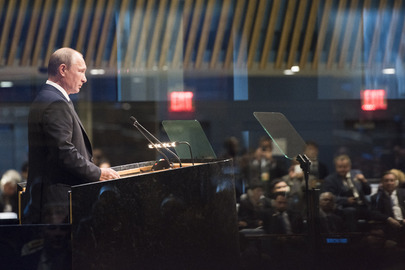
Putin addresses the UN, 09-28-15. (UN Photo)
Their members were generally young people who were enthusiastic, honest and genuinely committed to the public good, but were plagued by the lack of funding and faced with frequent media blackout and open discrimination. Nonetheless, their programs articulated the most promising and humane geopolitical vision for the Balkans. They conceptualized the Balkans as a territorial bridge between the West and the East rather than as the place of persistent confrontation, or the ‘line of fire’ as formulated by the U.S. Secretary of State John Kerry in 2015. They wanted the Balkans to become a force for peace and human dignity in the world. Their vision still remains the best option for the Balkans people.
This desire for non-alignment is understandable as a continuation of the policy of Tito’s Yugoslavia during the Cold War – the nation that several of the modern day Balkan states were a constituent part of. However, according to Kovacevic, these groups were easily overwhelmed, in terms of both financial and propaganda resources, in the 1990s by pro-NATO forces in the West.
In addition to providing resources to build up pro-NATO sentiment in the media and NGO sectors of these countries, financial resources and pressure was used to sway a large number of politicians to favor NATO membership, often in opposition to the general population’s views. Some of the unsavory forms of incentive or pressure include what amounts to blackmail and bribery, Kovacevic told me in an email interview:
This is a long-term process. In the U.S. intelligence community it is called ‘seeding.’ The intelligence scholar Roy Godson defines it as ‘identifying potential agents of influence’ at an early stage and then acting to advance their careers. This is typically done covertly, but there have been the historical examples of overt support. …
In the Balkans, the key role in the process of ‘seeding’ was accomplished by various institutes, conferences, retreats, grants, etc. For instance, I was told by a confidential source who participated in the same U.S.-NATO program, the long-time foreign minister and one-time prime minister of Montenegro, Igor Luksic, was a product of such a process. Luksic was chosen as a very young man to attend various conferences and retreats in Brussels and Washington and, after that, his political career really took off. All the while, he promoted the NATO agenda in Montenegro, even though this went against the will of the majority of the population.
Another example is Ranko Krivokapic who was the speaker of the Montenegrin Parliament for over a decade. He traveled on official business to the U.S. a few times every year and boasted to others that he had a lot of friends in the State Department and other institutions of the U.S. government. There are examples like these in Serbia, Macedonia, Croatia, etc. All over the Balkans.
There is also the fact the European Union has dovetailed its security arrangements to such an extent with NATO that new members are now virtually brought into the NATO structures by default. For example, Mahdi D. Nazemroaya, author of The Globalization of NATO, reports that the E.U.’s Security Strategy was absorbed into NATO during its annual summit in 2006. The emphasis of the summit was on securing energy resources with the goal of ‘co-managing the resources of the EU’s periphery from North Africa to the Caucuses.’ Also implied was the goal of redefining the E.U.’s security borders in synch with both Franco-German and Anglo-American economic and geopolitical interests.
Moreover, British Russia scholar Richard Sakwa, has pointed out that the security integration of the E.U. with NATO was further intensified with the ratification of the Treaty of Lisbon in 2007:
As for the comprehensive character, this is something that has been gaining in intensity in recent years as the foreign and security dimension of the E.U. has effectively merged with the Atlantic security community. The E.U.’s Common Foreign and Security Policy (CFSP) since the Treaty of Lisbon (the “Reform Treaty”) of 13 December 2007, which came into effect in 2009, is now in substance part of an Atlantic system. Acceding countries are now required to align their defense and security policy with that of NATO, resulting in the effective ‘militarization’ of the E.U.
At this point, the forces seeking a non-aligned bridge role for the Balkan states are still very much around, but have suffered marginalization due to lack of resources to take on the powerful and now entrenched pro-NATO political forces. However, with increasing discontent with the weak economic prospects in certain Balkan states, combined with increasing instability in the E.U., it is believed that there is an opening for growth of the movement.
Economic Conditions in the Balkans
The Balkan states comprise Romania, Bulgaria, Albania, Macedonia, Serbia, Kosovo, Montenegro, Bosnia-Herzegovina and Greece.
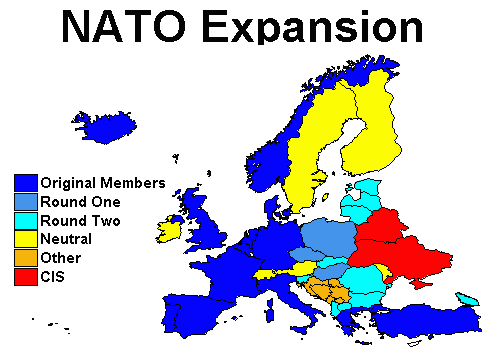
A map showing stages of NATO’s expansion. Dark blue showing original members; lighter blue the “round one” members; aqua the “round two” members; yellow represents neutral states; and brown and red otherwise aligned (including Ukraine, although that has changed since the 2014 U.S.-backed coup).
In 2007, Romania and Bulgaria became E.U. members (three years after joining NATO). Romania’s GDP has barely kept up with its 2008 rate and has a general unemployment rate of 6.4 percent, which sounds reasonable until you look at the youth unemployment rate of 21 percent, which doesn’t bode well.
Bulgaria, on the other hand, is not part of the Eurozone and has not adopted the euro as its currency. Its economic prospects since joining the E.U. have not been impressive either. In the midst of the financial crisis of 2009, its GDP contracted by 5.5 percent, with a current unemployment rate of 7 percent and youth unemployment at 17 percent. Bulgaria is also recognized as one of the union’s most corrupt countries.
Macedonia, Montenegro, Serbia, Kosovo, Bosnia-Herzegovina and Albania are all in the process of E.U. integration, with a supposed approval rate of 80-90 percent among the respective populations of these countries (except for Serbia), despite the virtual rape of Greece and the lackluster performance of Romania and Bulgaria.
It should be noted that all three Balkan nations that are actual E.U. members have higher emigration than immigration rates, another indication that accession to the E.U. doesn’t necessarily translate into a prosperous future for the average person, particularly the young.
There is also the instability highlighted by the British people’s vote to leave the E.U., spurred by disgust with austerity measures imposed by unaccountable bureaucrats in Brussels along with an influx of immigrants – one-third from these poorer E.U. nations – which adversely affect lower-wage natives.
Even if the E.U. had a better track record of effectiveness in terms of improving economic conditions for the masses, it would have a very tall order with some of the prospective Balkan states. Macedonia, for example, has an unemployment rate between 24 and 25 percent as of January 2016, although it has improved from the 2005 high of 37 percent. Despite this improvement, Macedonia still has one of the lowest GDPs in Europe and 72 percent of its citizens claimed they manage their household income only with “difficulty” or “great difficulty” in 2012.
Bosnia-Herzegovina is still feeling the effects of the war of 1992 to 1995 that included major physical destruction of infrastructure and the bottoming out of its GDP. It currently suffers an unemployment rate of 42-43 percent.
Kosovo, a state that owes its existence to a NATO intervention, has 33 percent unemployment, a high crime rate and increasing political violence due to ethnic tensions and a growing ultra-nationalist movement. The Council of Europe compared the government of Kosovo to a mafia state in a 2010 report which revealed trafficking in human organs as well as drugs and weapons throughout Eastern Europe, even implicating the then-prime minister in the operation.
Russia’s Opening
Kovacevic states that the Atlanticist project of E.U. austerity economics and the enabling of Washington’s destabilizing wars via NATO is starting to chip away at its popularity among Balkan populations. He also says Putin is prepared to take advantage of this opening and, since the outbreak of the Ukraine crisis, has turned his attention “to the Balkans with political force and funding not seen since the days of tsar Nicholas II.”
This attention has manifested in the Lovcen Declaration, which was signed on May 6, by members of Russia’s largest political party, United Russia, and the opposition Democratic People’s Party in Montenegro in the village of Njegusi. Kovacevic explains:
One of the most powerful political figures in Montenegro, the metropolitan Amfilohije, the chief bishop of the Serbian Orthodox Church in Montenegro, was present at the signing and gave his blessing. Though in the past Amfilohije has been known to support the authoritarian and pro-NATO prime minister Milo Djukanovic around the election time, he has always publicly opposed NATO membership and has given fiery speeches on its ‘evil nature’ to the point of accusing NATO for continuing Hitler’s anti-Slavic project.
Even more importantly, Amfilohije’s involvement with the Lovcen Declaration reveals one of the fundamental components of Putin’s overall geopolitical plan – the nurturing and intensification of the religious Christian Orthodox connection between the Russians and the Orthodox peoples of the Balkans. This includes not [only] the Serbs, Montenegrins and Macedonians, but also the Greeks and Bulgarians whose states are in NATO and whose religious ‘awakening’ can easily subvert NATO from the inside.
Criticism and minimization of the project have set the tone in Western media, to the extent that it has been covered at all, particularly in relation to utilizing an opposition party for significant influence. But Kovacevic argues that such a dismissive attitude is disingenuous:
[T]he very same method has been used by the U.S. and NATO intelligence services to control the governments of East-Central European states since the collapse of communism. Countless small parties with just a handful of parliamentary deputies were formed with the money coming from the various ‘black budgets’ with the task of entering the governing coalition and then steering the entire government in the direction charted by their foreign founders and mentors.
These parties have had minimal public legitimacy, but have made a great political impact with their ‘blackmail’ potential. As they also don’t cost very much, the CIA, the MI6, and the BND regularly create them for every new election cycle.
Now the Russians (primarily, the SVR and the GRU) are using the same rulebook for their own geopolitical interests. In addition, however, Putin’s grand design for the Balkans embodied in the ANS is also likely to prove durable not only because it builds on the traditional cultural and religious ties linking Russia and the Balkans, but also because it rides on the wave of the enormous present popular dissatisfaction with the neoliberal Atlanticist political and economic status quo.
The fact that this declaration was signed in Montenegro is most relevant due to the fact that the country has been officially invited to join NATO, whose subsequent membership is treated in the West as a fait accompli. However, accession requires consensus approval by all current NATO members – one member could veto the move before completion of the process as happened with Macedonia when Greece vetoed their membership aspirations in 2008 when an invitation was to be offered at the Bucharest Summit – as well as approval by the population of Montenegro.
Joining any alliance treaty is arguably something that affects national sovereignty, which requires a referendum as Kovacevic, who is Montenegrin, explains:
The corrupt government of Milo Djukanovic is trying to avoid a national referendum because it knows that it does not have a majority support for NATO. If given a choice, the people of Montenegro would reject the protocol. The Constitution requires a referendum for all matters that affect national sovereignty, but Djukanovic is arguing falsely that NATO membership leaves Montenegrin sovereignty intact.
Kovacevic predicts that a show-down over NATO membership could create instability in the country: “[I]f he [Djukanovic] tries to push this decision through the Parliament (which he no doubt will), wide-scale strikes and demonstrations may take place all over the country. Whoever is pushing Montenegro in NATO is dangerously destabilizing the country in mid-to-long term.
If that happens, Washington may find for the first time in recent memory that forcing instability on a smaller country may ultimately accrue benefits to another great power, helping to facilitate a shift in geopolitics that it didn’t bargain on. As Nazemroaya comments in his book:
The [NATO] alliance is increasingly being viewed as a geopolitical extension of America, an arm of the Pentagon, and a synonym for an evolving American Empire. … Ultimately, NATO is slated to become an institutionalized military force. … Nevertheless, for every action there is a reaction and NATO’s actions have given rise to opposing trends. The Atlantic Alliance is increasingly coming into contact with the zone of Eurasia that is in the process of emerging with its own ideas and alliance. What this will lead to next is the question of the century.
Natylie Baldwin is co-author of Ukraine: Zbig’s Grand Chessboard & How the West Was Checkmated, available from Tayen Lane Publishing. In October of 2015, she traveled to 6 cities in the Russian Federation and has written several articles based on her conversations and interviews with a cross-section of Russians.
NATO says ‘ready to stay’ in Afghanistan
Press TV – July 9, 2016
NATO says it is “ready to stay” in Afghanistan, reiterating a pledge on funding for local security forces.
“What we have seen is we are committed and we are ready to stay,” NATO Secretary General Jens Stoltenberg said Saturday, highlighting the funding pledge through 2020.
Stoltenberg could not say, however, when NATO’s military engagement in Afghanistan might end.
“There’s no reason to speculate exactly on how long it will continue,” he said, adding that NATO member states would examine the situation again next year.
Under the leadership of the United States, the 28-nation Western military alliance invaded Afghanistan in 2001, starting a war that has killed thousands and cost tens of billions of dollars. The military engagement was meant to obliterate the Taliban, but the militant group has managed to gain more footholds across the country over the past years, and local security forces still struggle to contain the group and other militants, including al-Qaeda and the Takfiri Daesh terrorists.
Stoltenberg said NATO will maintain troops in Afghanistan through 2017 under its train and advise Resolute Support Mission. He did not provide numbers but said the overall NATO force in Afghanistan would be “around the same” as now. Resolute Support currently has about 13,000 troops in Afghanistan.
Washington, the main provider of troops and funding to NATO in Afghanistan, has also backed down on its previous pledges to reduce the number of troops in the country, arguing that Kabul has been quite slow in reforming its military, which the United States claims is gripped by corruption and human rights issues.
US President Barack Obama had previously vowed to slash troop numbers from the current 9,800 to 5,500 by the end of this year. However, he announced on July 6 that the process will draw down and the US would keep 8,400 US troops in Afghanistan.
Cheating Moscow: NATO’s Dangerous Expansion
By Jonathan Power | Dissident Voice | July 7, 2016
NATO has just announced a plan to send troops to the alliance’s eastern flank, close to the Russian border. NATO says it is attempting to deter potential Russian aggression.
The UK, the US, Canada and Germany will lead four battle groups to be based in Poland and the Baltic states. Diplomats say the troops will be a deterrent to Russian aggression by acting as a “tripwire” that would trigger a full response from the alliance if necessary
On Sunday the foreign minister of Germany, Frank-Walter Steinmeier, condemned Western “sabre-rattling and war cries”. He said, “Anyone who believes the symbolic tank parades on the Alliance’s eastern border will increase security is wrong”.
Apart from the appalling fact that the West is contemplating all out war against Russia there is the plain fact that it has expanded NATO in contravention of the solemn understandings given the Soviet Union at the end of the Cold War.
The deal was straightforward: The Soviet Union would agree to the reunification of East and West Germany and accept that East Germany would become part of NATO in return for a non-expansion promise.
It is the breaking of this promise that, more than any other one thing, has fuelled the resurgence of hostile Russian opinion against the West and prompted President Vladimir Putin to become increasingly determined to put the West in its place.
Now with this move the Russians, understandably, are livid.
There are a number of scholars and politicians from that era, including President H.W. Bush’s secretary of state, James Baker, who did most of the negotiating at that time with the Soviet president, Mikhail Gorbachev, who have since tried to re-write history and say there were no promises made.
But neither Baker nor the scholars can deny – and they do not try to – that in Moscow, on February 9th 1990, Baker told Gorbachev that “there will be no extension of NATO’s jurisdiction or NATO’s forces one inch to the East”, if Gorbachev agreed to German reunification.
To reinforce this message the next day the West German chancellor, Helmut Kohl and the foreign minister, Hans Deitrich Genscher offered the Soviet leaders similar terms. Later Baker confirmed publically at a State Department press conference that he agreed with Genscher. The US ambassador to Moscow at the time, Jack Matlock, who was in the room with Gorbachev and Baker, confirmed these words were said by Baker to Gorbachev.
But revisionist scholars have tried to obfuscate this understanding. It has been argued that US leaders saw these terms as being raised “speculatively” as part of an ongoing negotiation and far from a final deal. Thus the US was free to revise the offer and Gorbachev was made no final promise.
This is as Machiavellian an interpretation as one could dream up.
Common sense suggests that Gorbachev was not going to radically revise 45 years of East German and Soviet history without a very big quid pro quo. Since no other subject was on the table it is obvious that there was a quid pro quo and this was it. Say no more.
One scholar, Mary Sarotte, writes that the Soviet leaders failed to obtain “written assurances” against NATO expansion. That is right. But why should Gorbachev demand them when the Cold War was coming to an end so amicably and the widespread feeling was that there would never be enmity again and that the Soviet Union would become close to NATO, and maybe even seek future membership of it?
There is another political “scandal” from that period.
Behind Gorbachev’s back, as the US negotiators “were stressing limits on NATO’s future presence in the east, the US was privately planning for an American-dominated post-Cold War system and taking steps to achieve this objective”, according to Joshua Shifrinson, writing in the new issue of Harvard University’s quarterly, International Security:
In July 1990 Baker stated that a revamped CSCE (Conference on Security and Cooperation in Europe) which had Soviet membership would provide a ‘half-way house’ for those countries who want out of the Warsaw Pact but can’t join NATO and the European Union.
Somewhat paradoxically, Baker did not want to see a CSCE that overshadowed NATO. By October 1990 detailed discussions about the future expansion of NATO were underway in the State Department, albeit with the belief this would only happen if the Soviet Union behaved “badly”.
Contradictorily, the State Department in an internal study on NATO wrote that “we are not in a position to guarantee the future of these Eastern countries and do not wish in any case to organize an anti-Soviet coalition whose frontier is the Soviet border. Such a coalition would be perceived very negatively by the Soviets and could lead to a reversal of current positive trends in Eastern Europe”.
Over the last 25 years an anti-Soviet/Russian coalition is what evolved and that is why Russia has ended up confronting the West.
Jonathan Power is a TFF Associate and international affairs columnist, formerly with the International Herald Tribune, now syndicating to leading newspapers on all continents.
Imagining a Different Europe: Brexit and the Future of NATO
By Gary Leupp | CounterPunch | July 7, 2016
Everyone’s talking about the future of the European Union after the Brexit. Should we not also be wondering about the future of NATO?
The two organizations substantially overlap. Twenty-two countries are members of both; that is, the twenty-two nations are both military allies of the U.S. (which pays two-thirds of the alliance’s cost and controls its politics) and members of an economic union, which—while it of course does not include the U.S., which is 5000 miles away—is of much interest to the world’s only surviving superpower.
Of course the EU and NATO have very different purposes. As we all know, the EU represents an effort to create a common market throughout the continent, allow for free travel and employment between member-states, the formation of common standards, policies etc. We know there have been major downsides for some member countries, involving reduced sovereignty, uncontrolled immigration, indebtedness and austerity programs, etc. But the stated goal, to spread general affluence, and therefore prevent war, has been stated since the EU’s forerunner, the European Coal and Steel Community, was formed in 1951.
Thus, while it’s arguably none of the U.S.’s business, U.S. leaders express opinions on EU composition. (You might think that, as leaders of a competing trading bloc, with the same relationship to the EU that Boeing has to Airbus, they would maintain a politic silence. But both presidents George W. Bush and Barack Obama have urged the EU to admit NATO ally Turkey’s admission. And Obama recently raised a ruckus in the United Kingdom when he urged its electorate to reject Brexit.)
The purpose of NATO is less clear than that of the EU. Formed in 1949 in line with the “Truman Doctrine” pledging that the U.S. would fight communism wherever it threatened the “Free World,” it was supposed to be a defensive alliance between the U.S. and its European client states versus some future (imagined) Soviet aggression against those states.
That aggression needless to say never happened. In retrospect the Cold War appears a long period of stability, with the exception of the horrific wars the U.S. inflicted on Korea and Vietnam while the Soviets stood aside, and the war the Soviets waged in Afghanistan to suppress the rebels opposed to the secular Soviet-backed government (who were then backed by the CIA, because they were so anti-communist, that being the main thing), who went on to became the Taliban and al-Qaeda.
Europe itself was actually remarkably stable during that Cold War, from 1945 to 1989. Since then there’s been horrific violence, especially in southeastern Europe, much of it exacerbated by the U.S. and NATO.
After the collapse of the Soviet Union and the dissolution of the Warsaw Pact (formed in 1955 in belated response to NATO, after NATO decided to include West Germany) in 1991, you might have thought that NATO would dissolve too. But no; it redefined its mission as maintaining “security” in a newly insecure situation. Its purpose is in fact stated in the vaguest terms. Its real function is to preserve U.S. hegemony over post-Soviet Europe, expand to surround Russia and ultimately create the conditions for a Yugoslavia-type fracturing of the Russian state—which for some reason U.S. military leaders keep referring to as the “number one threat” or even “existential threat” to the U.S.!
How the U.S. Uses the EU
The U.S. attempts to use the EU for its own geopolitical ends, particularly for this confrontation with Russia.
For example: from late 2013 to February 2014 the U.S. State Department spent $5 billion in Ukraine in order to (in the words of Under Secretary of State for Eurasia Victoria Nuland, a former Dick Cheney aide, neocon married to neocon Robert Kagan and key Hillary crony) “support the Ukrainian people’s European aspirations”—meaning the hopes of many Ukrainians for their country to join the EU.
But what Nuland, the Pentagon and NATO leaders in Europe really wanted to do was to pull Ukraine into NATO, completing the creeping encirclement of Russia that had begun with NATO’s expansion to include Poland, Czechoslovakia and Hungary in 1999.
NATO now already includes 11 countries formerly part of the Soviet bloc (Warsaw Pact) or Yugoslavia, most added during Bush’s administration but two (Albania and Croatia) admitted since. In all cases, by the way, these states first received admission into NATO, then into the EU.
Bulgaria: joined NATO 2004, EU 2007
Croatia: NATO 2009, EU 2013
Czechoslovakia: NATO 1999, EU 2004
Estonia: NATO April 2, 2004, EU May 1, 2004
Hungary: NATO 1999, EU 2004
Latvia: NATO April 2, 2004, EU May 1, 2004
Lithuania: NATO April 2, 2004, EU May 1, 2004
Poland: NATO 1999, EU 2004
Romania: NATO 2004, EU 2007
Slovakia: NATO, March 29, 2004, EU May 1, 2004
Slovenia: NATO, March 29, 2004, EU May 1, 2004
Notice a pattern? First a country commits itself to an anti-Russian alliance with the U.S., committing 2% of its GDP to military expenses and pledging to go to war against Russia when called upon to do so. Then it gets access to the benefits of EU membership.
Back to Ukraine. Ukraine in early 2014 included the Crimean Peninsula, home to the Russian Black Sea Fleet from the 1780s, a vital naval port for the Russian state that has only a few warm-water ports. (Crimea had been turned over from the Russian Soviet Socialist Republic to the Ukrainian Soviet Socialist Republic by half-Ukrainian Premier Nikita Khrushchev in 1954. After the break-up of the USSR in 1991, Russia retained its traditional military presence on the peninsula by a treaty with the Ukrainian leaders.)
But the U.S. would like to expel the Russians and make Sevastopol a NATO port. (This is not only Vladimir Putin’s nightmare; it would be a nightmare for any Russian leader. Look at a map.)
In 2013 the president of Ukraine, Viktor Yanukovych, democratically elected in an internationally monitored election in 2010, negotiated with the EU for his country’s eventual entry into the union. A substantial portion of the population, especially in the western part of the country, favored this. But when Yanukovych realized that steps towards admission would involve accepting an austerity regime comparable to that inflicted on Greece, he opted out, instead accepting a generous Russian aid offer.
Nuland & Co. depicted this as a pro-Russian leader’s capitulation to Russian pressure; again, their talking point was “Ukrainian people’s European aspirations.” (In fact, Ukrainians were divided on the issue, with fewer than 50% in favor of EU membership.)
Ukraine is ethnically divided between ethnic Ukrainians (who speak a language related to Russian, although the two languages are not mutually intelligible) and ethnic Russians who have always spoken Russian. (Russian has always been a recognized official language in the country.) There has been much intermarriage between the two, but among the ethnic Ukrainians there are many Russophobes including neo-fascists who glorify Stepan Bandera, an anti-Russian Ukrainian leader who worked with the Nazis to round up Jews and fight the Soviets in 1941. (He was declared a “national hero” by Yanukovych’s predecessor Viktor Yushchenko, a pro-U.S. advocate of NATO admission. Yanukovych withdrew this award, but it has been reinstated by the current regime.)
Taking advantage of this Russophobia, the U.S. depicted Yanukovych’s change of mind as a betrayal of “European” dreams. Working with the neo-fascist Svoboda Party, among others, it assisted in the brutal putsch of February 22, 2014, that caused the president to flee for fear of his life. A new, pro-NATO government was immediately installed, with Arseniy Yatsenyev as prime minister.
“Fuck the EU!” …and then Use It!
This is where the story gets interesting, because it reveals what the EU means to the U.S., and what it doesn’t. In an intercepted phone conversation between Nuland and the U.S. ambassador to Ukraine a month before the coup, they discuss who will succeed Yanukovych once he’s toppled. She favors NATO proponent “Yats.” The ambassador mentions the the EU favors a different candidate, whom she thinks is inappropriate. They discuss how Yatsenyev will be legitimated by a UN official sent by Ban Ki-moon.
“So that would be great, I think, to help glue this thing and to have the UN help glue it,” she concludes, “and, you know, Fuck the EU.” (In other words, this is not about any European’s aspirations. It’s about ours.)
So the coup comes off as planned. The obviously prominent role of neo-fascists in the new regime, and the immediate revocation of the existing law protecting language rights frightened and angered the primarily Russian inhabitants of the Donbass region (where Yanukovych had his base of support). They refused to accept its legitimacy. (Their resistance is invariably represented by the U.S. press in the service of the State Department as a Moscow-inspired rebellion or even Russian “invasion.”)
Russia refused to recognize the new government and quickly moved to re-annex its historical territory of Crimea. The Russian-majority population of Crimea overwhelmingly voted in a credible referendum to reunite with Russia. The U.S. media often refers to this as another “invasion” although it was nothing of the sort; there were tens of thousands of Russian troops in place by longstanding agreement, who simply secured government buildings and the borders.
Hillary Clinton, among others, likened this move to Hitler’s annexation of the Sudetenland in 1938. That is to say: something that must not meet with appeasement. And so (people are taught to believe), the practical Russian response to U.S. efforts to complete the expansion of NATO is the problem, not NATO’s relentless advance against Russia itself. Russia under Putin is the worrisome aggressor, not the U.S. leaders who invade a new country like clockwork every few years, boasting that they need to do it because theirs is the “exceptional” nation.
Some in the Obama administration favored a military response to the separatists in the east; they wanted to further arm the new regime and encourage it to assert control over the Donbass if not Crimea. It is clear this was the view of U.S. Gen. Philip Breedlove, the “Supreme Allied Commander” of “NATO Allied Command Operations” in Europe. We know from intercepted emails exchanged between him and Nuland (whom he refers to affectionately as “Toria”) that he was frustrated by the failure of Obama to order the Ukrainian puppets to more forcefully invade the east. (Initial efforts to do this had resulted in mass desertions, or soldiers retreated in the face of unarmed citizens including old women shaming them into abandoning their mission. It was a tremendous embarrassment to the Kiev regime.)
Obama decided not to heed Breedlove. In place of hot warfare he chose economic warfare. Here is where the EU comes in. In July 2014 the union (that Nuland wanted to fuck) dutifully voted to impose economic sanctions on Russia. (Again, 22 of the 28 EU members are also NATO members; the only ones that aren’t are Sweden, Finland, Ireland, Cyprus and Malta.)
The U.S. is of course not an EU member but it had a reliable surrogate within the union: the United Kingdom, which has strongly argued for sanctions, their expansion and extension to the present. (Frank Holmes, managing editor of US Global Investors, calls Britain “the bloc’s strongest supporter of restrictions.” The conservative Washington D.C. website The Daily Caller calls it the U.S.’s “strongest E.U. ally against Russia”).
The UK, which had far less to lose from the sanctions than many other EU nations, was urging its partners to shoot themselves in the foot. It was asking them to punish Russia (and damage themselves). The continental Europeans went along, some grudgingly.
Regrets (and Maybe Rebellion?)
Many have come to regret it. The Czech and Hungarian leaders have long been questioning the sanctions and expressing displeasure. Of course they want, as new members of the EU and NATO, to be team players. But their people are suffering from lost trade and pressuring them to protest. Thus Czech President Milos Zeman has called the sanctions “not merely inefficient; on the contrary, they are counterproductive.” (Only 35% of Czechs according to a 2015 Gallop poll support the sanctions.)
Hungarian Prime Minister Viktor Orban calls the sanctions a “risk in the EU… very deep, of a strategic nature.” (European Council president Donald Tusk, a Pole, calls Orban a “Trojan Horse” for Russia while Orban says Tusk is “on the other side” for opposing an easing of sanctions.)
In May, Hungarian Foreign Minister Peter Szijjarto told Russian Foreign Minister Sergey Lavrov that his government “definitely cannot accept that a decision [by the EU, on extending sanctions] was made behind the scenes, that is, we are against using an automatic procedure.” (In Hungary, only 29% of those polled favor the sanctions.)
The Polish regime has been among the most supportive of the U.S. position; anti-Russian sentiment is deep in that country for various historical reasons, and 70% of those polled support sanctions. But the Polish farmers are suffering from them. One-third of the apples harvested in Poland two years ago went to Russia; now the trade is forbidden.
Meanwhile in Spain farmers burn EU flags over piles of rotting peaches to protest the collapse of their relations with the Russian marketplace. The European Commission keeps having to pay out millions of euros to partly compensate farmers and merchants for their losses due to sanctions.
French MPs in April this year voted for a resolution to lift EU sanctions on Russia. Minister of Economy Emmanuel Macros has vowed to work towards lifting them. Italian cabinet ministers and the lawmakers in Italy’s Upper House of Parliament also want to rethink them. Maybe they’re all Trojan Horses, but if so, that’s good.
The role of Germany in the EU, as the most populous and wealthiest country in Europe, is more important than ever following the Brexit. While it has been, along with France, a strong supporter of the sanctions and their continuation, public support is waning. In May a German pollster found that 36% of Germans want the sanctions scaled down, while 35% want them scrapped entirely.
The sanctions have had disastrous impact on the German economy. Since they were imposed exports have declined by about 20 billion euros. Alstom has lost a huge contract for the construction of the Beijing-Moscow railway line. The business community generally wants the sanctions dropped.
There appears to be a general feeling that the U.S. (which is feeling few effects from the sanctions it itself imposed on Russia) pressed the EU (especially through Britain) to take measures that are not in Europe’s interest. And some surely realize that what this is all really about is the U.S.’s desire to punish Russia for thwarting its effort to bring Ukraine into NATO—through that cynical device of Victoria (“Fuck the EU”) Nuland of supporting Ukraine’s “European aspirations.
As it happens, 67% of Germans oppose bringing Ukraine into NATO, and 45% oppose bringing it into the EU. Most importantly, German support for NATO has been plummeting; it was 73% in 2009 but was 55% last year. And when asked whether Germany, in the event of a Russian attack on an east European border state that is a NATO member, should fight on the side of that state, only 38% say yes according to a Spring 2015 Pew poll.
According to the same poll, that figure is 40% in Italy, 47% in France, and 48% in both Poland and Spain. In other words, over half the people of these countries oppose the very nature of NATO as “mutual defense” alliance.
This raises the real possibility of countries leaving NATO, as well as the EU. Czech president Milos Zeman has called for referendums on his country’s membership in both. German Foreign Minister Frank-Walter Steinmeier has criticized the recent joint maneuvers in Poland, in which 14,000 U.S. troops, 12,000 Polish troops, and 800 from Britain participated as “saber-rattling.”
“Whoever believes,” he warns, “that a symbolic tank parade on the alliance’s eastern border will bring security is mistaken. We are well-advised to not create pretexts to renew an old confrontation.” In other words, the U.S. is steering NATO towards war with Russia, which the Germans know is not a good idea.
Who would have imagined a few years ago that the UK would ever leave the EU? Imagine the Czech Republic leaving this confrontational NATO alliance, joining its prosperous neighbor Austria by opting for neutrality. Imagine the Germans (who have many reasons to be angry towards the U.S., including the fact that the NSA spies on all of them) becoming fed up enough to hold their own referendum and quitting the bloc.
There is something of a precedent. France shocked the U.S. when it pulled out of the NATO Integrated Military Command Structures in 1966, in order to, as President Charles DeGaulle put it “preserve French independence in world affairs.” (It remained committed in theory to the defense of alliance members but only rejoined with conditions in 2009.)
France, which has military bases all over the world and deploys troops routinely in Africa and elsewhere (it cooperated with the U.S. in overthrowing Aristide in Haiti in 2004, as if to apologize for having opposed the U.S. war in Iraq), is very different from Germany with its stiff constitutional limits on the use of its military and generally pacifistic population. Within the EU, it is likely to replace the UK as its most important hawkish member, while Germany is likely to urge reconciliation with Russia.
There are contradictions within both the EU and NATO. They are interwoven, and some look irresolvable. That again is a good thing.
Featured Video
New positive ivermectin evidence
or go to
Aletho News Archives – Video-Images
From the Archives
Fanatical Followers of the Covid Regime: A Jim Jones-Style Cult?
By Professor Roger Watson and Dr. Niall McCrae | The Daily Sceptic | November 15, 2021
As scholars at leading British universities over recent decades, we witnessed the replacement of critical thinking and debate by narrative: facts are discrimination and scientific method is imperialism; truth, instead, is derived from ‘progressive’ values. This educational trend may be a major contributory factor to the ease in which society has been inculcated to the Covid ‘new normal’ of masking, testing, and repeated doses of vaccines for a disease of similar risk to severe influenza.
One doesn’t need much critical reasoning to observe the flawed logic of some vaccination enthusiasts, such as people who respond to experiencing any side effects, however debilitating, by saying “at least I know it’s working”, or, after contracting the disease despite their promised inoculation (over 90% effective, according to initial drug company claims), “I’d have been worse off without the jab.” … continue
Blog Roll
 Aletho News
- EU Council Advances Chat Control 2.0 Scanning Proposal
- Ex-Greek MEP files complaint against Israeli spyware firm over alleged Pegasus surveillance
- Troubling ideas throughout the Torah, Talmud, Mishneh Torah and Tanya
- ‘Grave, alarming’: Iran mission on Trump’s UNGA ‘annihilation’ threats
- Najaf airport to reopen to Iranian flights within 24 hours: Ambassador
- From ‘How Will This End For Iran’ to ‘When America Walks Away’: A tale of two Economist covers
- Tehran blasts ‘baseless’ speculation linking Iran to alleged bomb plot at UK air base
- The Rise And… Rise Of ‘Color Revolutions’
- The Coming GOP Bloodbath?
- Arctic Scare Stories Melt Away
- If Americans Knew
- An error has occurred; the feed is probably down. Try again later.
- No Tricks Zone
- New Study: Earth And Venus Surface Warmth Largely Explained By Convection And Lapse Rate, Not CO2 Or Radiation
- 2025 Nature Paper Claiming Worsening Global Drought Gets RETRACTED …Heavily Flawed
- New Study: ‘Global Drought Shows No Detectable Recent Acceleration Under Climate Warming’
- Economic Masterminds: German Socialists Suggest Taxing Productivity Gains Stemming From Using AI
- The South China Sea Has Not Been Cooperating With The Climate Change Narrative
- Energy Crisis: Germany Enters Heating Season With Historically Low Gas Reserve Fill Levels
- New Study: The Antarctic Ice Sheet Gained Mass From 2020-2024 Due To Staggering Snow And Ice Accumulation
- Study: Ocean Heating Rates From Thousands Of Years Ago ‘Dwarf’ Modern Ocean Heating Rates
- Climate Extremists Target, Attack Large-Scale Power Grid Infrastructure In Germany!
- New Study: Antarctic Ice Melt Has Contributed Less Than 1 Centimeter To Sea Level Rise In The Last 30 Years

