An unholy alliance of leftists supporting a pro-NATO course against Russia
By Susann Witt-Stahl and Denis Koval | Junge Welt* | June 25, 2016
The Rosa-Luxemburg Foundation and the ‘new left’ in Ukraine have forged a pro-NATO course directed against Russia.
The Die Linke (Left Party)-affiliated Rosa Luxemburg Foundation wants to play it safe. It relies not on historical pro-Soviet or Marxist left traditions but instead promotes a “new left”. The foundation is named after a world-renowned icon of anti-capitalist movements whose identity is bound with communist and anti-imperialist ideas. But the members of the Foundation’s leadership recommend to the left a convergence with the ‘liberal imperialism’ of the global hegemon, the USA.
Understandably, this requires some political flexibility. Progressive forces should not plant themselves on one side or the other of competing imperialist powers, says the Facebook page Rosa-Luxemburg-Stiftung Ukraine. It demands that the “independent left” distance itself from the NATO-EU bloc, on the one hand, and from Russia on the other hand.
 This agenda is followed by the Rosa Luxemburg Foundation (RLF) with its Ukrainian partners. But it never explicitly speaks out against the accelerated expansion of the Western powers to the very borders of the Russian Federation. Instead, it consistently warns about “Great Russian chauvinism” and denounces the former Soviet Union and the anti-imperialist left.
In Ukraine, the Foundation cooperates principally with the small ‘Left Opposition’ group (not to be confused with the political front of the same name in which the Ukrainian Communist Party participates). In April 2014, the Left Opposition (LO) along with the “independent” trade Union ‘Zachist Prazi’ (Labor Defence) of Oleg Vernik merged into the ‘Social Movement’. The aim was to create an alliance (so far without any success) to be a Ukrainian version of Syriza.
One of the founders of the ‘LO’ is Zakhar Popovich, who in 2003 together with Oleh Vernik was expelled from the Trotskyist Committee for a Workers’ International (reported in Junge Welt) because of a lengthy fraud they perpetuated. They had collected donations for non-existent left-wing organizations in Ukraine.
According to its self description, LO stands for a politics of peace, beyond the “nationalist polarisation” of pro-Ukrainian and pro-Russian forces. But it doesn’t dare to criticize Ukrainian ultranationalists. LO has openly supported the assaults by Euromaidan. Zakhar Popovich and his comrade Vitaly Dudin, the lawyer of the Kiev Center for Social and Labor Research, are also RLF partners. They marched in Maidan Square with a red EU flag side-by-side with the ultra-right.
The LO also welcomed the political section of the EU Association agreement, which includes clauses providing for military cooperation of Ukraine with the West.
Accordingly, LO has nothing to do with the “opposition” anymore. In March of 2014, Zakhar Popovich characterised the Yatsenyuk coup government as “legitimate” and appealed “to all governments in the world and Russia to recognize it”. He announced that his support was only “practical”, not political, because of the numerous, Goebbels-type followers from the Svoboda Party who were in the government.
LO’s demand to end the civil war in eastern Ukraine is expressed by the fact that in 2014, Fedor Ustinov, a member of its organizing committee, voluntarily joined the Ukrainian extremist ’ battalion ‘Shachtarsk’ in order to participate in the “punitive expedition” against the insurgents in the unrecognized people’s republics of Donbass. The “American anti-imperialist response” to the “imperialist aggression of Russia” needed to be strenghthened. In this way did Ustinov understand the “balancing to be done against the two rival “imperialist” camps.
The LO is not only in the pro-NATO camp with both feet, it is also in the rightwing quagmire. The ‘Social Movement’–that is, LO and Zachist Prazi–view the organisation ‘Autonomous Resistance’ as not only “comrades. In Odessa, they have gone so far as to hold a joint rally with fascists who organize memorial marches for Stepan Bandera’s Ukrainian Insurgent Army (UPA) which committed massacres during WWII (especially of the Polish civilian population) and collaborated with Nazi Germany.
The LO member and co-organizer Andriy Ishchenko was until 2004 the chairman of the Odessa cell of the Ukrainian National Assembly – Ukrainian People’s Self-Defence (UNA-UNSO), a fascist party and the core organization of the Right Sector. The UNA-UNSO’s paramilitary force contributed to the 2004 ‘Orange Revolution’ of the famous Atlanticist Viktor Yushchenko, who became Ukraine’s president in 2005.
Perhaps Andriy Ishchenko is now an ‘ex’ neo-Nazi? Hardly. Until today, he still welcomes his former comrades as “friends”. “I am not ashamed of my membership in this organization. We were in the forefront of the struggle of the Ukrainian people for their rights and the the social struggles of the’ 90s,” said Ishchenko in 2014, speaking about his unfinished past.
The fact that Andriy Ishchenko wants to help the Right Sector to become “left wing” is enough for RLF, apparently, to present him in its pages as a “left activist”. Moreover, to whitewash the pro-Maidan ‘Autonomous Resistance’, Nelia Vakhovska, the project co-ordinator of the RLF in Ukraine, and Ivo Georgiev, from the centre for International Dialogue and Cooperation of the RLF, call Autonomous Resistance a “citizens ‘ movement” in a published post titled The life of left activists in Ukraine is dangerous. The RLF Facebook page provides weblinks to these neo-Nazi Banderites.
Although LO has a maximum of two dozen activist members, conferences and other events with speakers from the LO are promoted by RLF and LO’s positions are uncritically disseminated. This also applies to other structures from the spectrum of the ‘new left’ in Ukraine, for example, the magazine Prostory of the ‘Autonomous Workers’ Union’. The members of AWU regularly mobilize against “pro-Putin fascists” (their term for opponents of Maidan) and believe that there is “no alternative” to the “Anti-Terrorist Operation” taking place in Donbass.
Ukraine’s ‘decommunization’ law and other repressive measures against the Ukrainian Communists have opened space for what some critics call a “fake left” in Ukraine. The fact that this left holds a long-time monopoly on the funds of the Rosa Luxembourg Foundation is being hushed up.
The ‘new left’ is used to whitewashing the alliance of the Western powers with the fascists in Ukraine. They approve the cooperation of the NATO-oriented, Ukrainian economic elite with the Western neocons that took place on the Maidan and approve a new escalation against Russia.
* Translation to English by New Cold War.org
Background: “Peace is War”
The Rosa-Luxemburg Foundation was involved in the creation of the pro-Maidan ‘left‘. In April 2014, for example, it promoted a conference ‘The Left and Maidan‘ organized by its Ukrainian partners.
The conference also served as a founding Congress of the ‘Social Movement‘ − initiated predominantly by the Left Opposition. The results of a survey were presented at the conference, according to which 93 per cent of Maidan-activists were presented as “apolitical” and only seven per cent (including the socialists) were organized politically. Accordingly, the proportion of fascists and other radical Right involved inMmaidan was said to be very low.
In December 2015, the Rosa Luxembourg Foundation supported the event ‘Aspects of the media coverage of the military conflict‘ organized by the Centre for Labour and Social Research, including experts “reporting from the ATO-zone” (‘Anti-Terrorist Operation‘ is the Kyiv government’s official name for the military offensive of the Ukrainian army in eastern Ukraine). As stated in the event announcement, the participants included Yana Salakhova from George Soros’ ‘Renaissance Foundation‘ and Igor Burdyga, a journalist, member of the LO and militant of the ‘AutoMaidan who believes the arsonists of Odessa on May 2, 2014 were “patriots” while the protests of the victims’s relatives were “ukrainophobic”.
The RLF also supports projects of the Visual Culture Research Center in Kiev. For example, in 2014, it staged a series of benefits named ‘Peace Is War‘ which featured pro-Maidan propaganda films that encourage the viewer to understand that the militarisation of Ukrainian society is a “consequence of Russian aggression beginning in March 2014″.
The Foundation similarly promotes moderate nationalists from the artist scene. Sergiy Zhadan, according to the RLF, is a “leftist writer”, but he will participate in the ‘Banderstad Festival‘, a large gathering of Ukrainian fascists taking place in August 2016.
Activists storm US military base in Yorkshire
Press TV – July 4, 2016
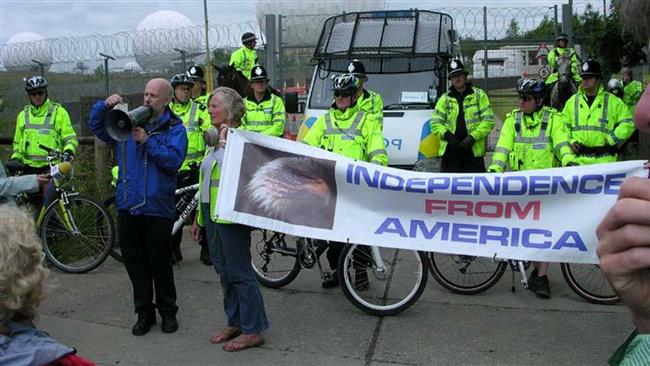
British activists have stormed an American military base in Yorkshire, continuing decades-long calls for its closure.
Just like the past three decades, peace activists from all over Britain gathered outside the Menwith Hill intelligence-gathering center on the outskirts of Harrogate over the weekend, the British daily Morning Star reported Monday.
“US military bases in Britain are jeopardizing the safety and security of the British public as they are threatening Russia and helping to cause carnage in the Middle East,” said Marcus Papadopoulos, an activist with the Campaign for the Accountability of American Bases (CAAB), which organized the event.
With its many satellite dishes, the more than 1,000-staff base collects intelligence and transmits it to the US.
Every year, protesters stage a demonstration at the base on the Saturday closest to July 4 – the day Americans celebrate their independence from England in 1776.
Ironically, this year’s rally was called “Independence from America Day,” and was attended by former Labour member of the European Parliament Michael McGowan.
McGowan gave a speech in defense of Labour leader Jeremy Corbyn whose leadership is under attack following the UK’s recent decision to leave the European Union (EU).
About 52 percent of British voters partaking in the June 23 referendum opted to leave the EU.
Labour MPs have criticized Corbyn for his “inadequate” contribution to the ‘Remain’ campaign and say they doubt he could lead the party to victory in 2020 general elections.
The party further plunged into crisis after eleven MPs rounded on Corbyn’s leadership, joining the 12 shadow cabinet ministers who resigned earlier this month.
The wave of resignation came after shadow Foreign Secretary Hilary Benn was sacked after he told the Labour leader that he had lost confidence in his leadership.
McGowan, however, told rally goers that Corbyn’s election last year provided “a historic opportunity for world peace, which should be a matter of universal celebration and an opportunity not be wasted but to be taken forward in the interest of all who share our planet.”
US Mayors Blast Obama, NATO: War Games on Russia’s Border Endanger Humanity
Sputnik – 02.07.2016
The leaders of America’s towns and cities issued a resolution warning the Obama administration and NATO that continued anti-Russian provocations place humanity at greater risk of nuclear annihilation.
The United States Conference of Mayors (USCM), the official non-partisan organization for city leaders administering populations greater than 30,000, moved to condemn NATO’s Anaconda War Games on Russia’s border as increasing the threat of nuclear conflict.
“The largest NATO war games in decades, involving 14,000 US troops, and activation of US missile defenses in Eastern Europe are fueling growing tensions between nuclear-armed giants,” said the USCM warning in the lead up to the military alliance’s summit on July 8-9 in Warsaw, Poland.
The resolution adopted at the USCM’s 84th Annual Conference from June 24-27 in Indianapolis stated: “More than 15,000 nuclear weapons, most orders of magnitude more powerful than the Hiroshima and Nagasaki bombs, 94% held by the United States and Russia, continue to pose an intolerable threat to cities and humanity.”
The US Conference of Mayors went on to criticize President Obama for capitulating to the defense establishment and “laying the groundwork for the United States to spend one trillion dollars over the next three decades” on the so-called nuclear modernization effort that will result in a net increase in America’s atomic stockpile in contravention to the spirit of the Nuclear Non-proliferation Treaty (NPT).
“The Obama administration has not only reduced the US nuclear stockpile less than any post-Cold War presidency, but also decided to spend on trillion dollars to maintain and modernize its nuclear bombs and warheads, production facilities, delivery systems, and command and control,” read the resolution.
America’s mayors called into the question the development and maintenance of nuclear weapons with yields in excess of 1 megaton, or 75 times the force of the Hiroshima bomb that killed nearly 150,000 people, at a time when “federal funds are desperately needed in our communities to build affordable housing, create jobs with livable wages, improve public transit, and develop sustainable energy sources.”
To underscore the resolution, the USCM acknowledged and apologized for America’s genocidal acts against Japanese civilians in Hiroshima and Nagasaki towards the end of World War II stating that the “US atomic bombings indiscriminately incinerated tens of thousands of ordinary people, and by the end of 1945 more than 210,000 people – mainly civilians, were dead, and the surviving hibakusha, their children and grandchildren continue to suffer from physical, psychological and sociological effects.”
The country’s mayors continue to be a voice of peace and reason in the face of mounting influence by the foreign policy establishment and defense lobbyists having rendered similar resolutions calling for the United States to pursue a less threatening foreign policy for 11 consecutive years.
Canada to send 1,000 soldiers to Latvia for NATO brigade
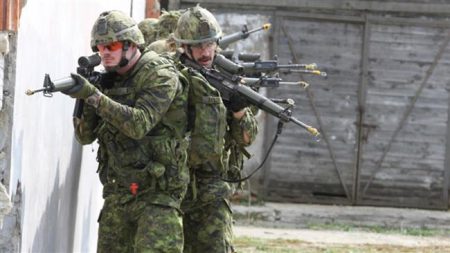
Canadian troops during a NATO drill in Ukraine.
Press TV – July 1, 2016
Canada will send 1,000 troops to Latvia to join one of NATO’s battalions that are being assembled in Eastern Europe in a show of force against Russia.
The Canadian Defense Ministry said in a statement on Thursday that the country will “establish and lead” a high-readiness brigade that will “contribute to NATO’s enhanced forward presence in Eastern and Central Europe.”
The statement also said that further details regarding the deployment will be provided at the upcoming NATO summit in Poland.
The Canadian soldiers will be part of a 4,000-strong NATO force that will be deployed to the Baltic States and Poland in order to deter what is claimed to be Russian threats.
The US, Germany and Britain will also send soldiers to join NATO’s four battalions in Eastern Europe.
“As a responsible partner in the world, Canada stands side by side with its NATO allies working to deter aggression and assure peace and stability in Europe,” said Canadian Defense Minister Harjit Sajjan.
Canada’s decision reportedly came after US President Barack Obama urged Canada to contribute more to NATO in a speech in the Canadian Parliament on Wednesday.
NATO plans to expand its military presence in Eastern Europe amid the conflict in Ukraine and has held numerous war games recently.
Some 2,000 NATO forces began a large-scale military exercise in western Ukraine earlier this week which will last until July 8.
Last month, NATO held another 10-day military drill, involving some 31,000 troops from Poland, the US and 17 other nations in Poland.
Russia, wary of the increased presence of NATO troops close to its borders, threatened to take unspecified measures to respond to the increased activities by the Western military bloc.
NATO has stepped up its military build-up near Russia’s borders since it suspended all ties with Moscow in April 2014 after the Black Sea Crimean Peninsula re-integrated into the Russian Federation following a referendum.
Moscow has repeatedly repudiated NATO’s expansion near its borders, saying such a move poses a threat to both regional and international peace.
US Deployment of Patriot Batteries in Turkey Threatens New Crisis
Sputnik — 01.07.2016
The US decision to send Patriot anti-ballistic missile interceptor batteries to Turkey has no military justification and may be a preparation for a manufactured incident to provoke a new crisis in the region, historian and retired US Army Maj. Todd Pierce told Sputnik.
“Do you pick up the preparation for yet another ‘Gulf of Tonkin Moment’ here?” Pierce said on Thursday.
Pierce was referring to the alleged clash between a US warship, the destroyer Maddox and two North Vietnamese torpedo boats in the Gulf of Tonkin in August 1964 that was used to win congressional endorsement for what became the US involvement in the Vietnam War.
NATO is deploying missile defense systems in Turkey under the pretext of a non-existent threat of missile attacks from Syria, Russian Ambassador to NATO Alexander Grushko told Sputnik earlier on Thursday.
Pierce said the Obama administration remained committed to finding whatever justification it needed to expand its military forces in the region with the goal of toppling Syrian President Bashar Assad.
“That is what the Syrian war and proposed takedown of Assad is really about: rolling up any potential Russian allies,” he explained.
Pierce pointed out that deploying the Patriot systems was an unnecessary move as Turkey faced no direct threats of missile attacks.
“Does deploying these Patriots systems in Turkey make any sense at all for Turkey’s national security? Absolutely not: Who is going to attack them? Bulgaria?” he asked.
The Patriots deployment appeared to be part of NATO’s policies to encircle Russia with increased military deployments, Pierce stated.
“It is definitely not about protecting the Turkish people… It is directed at Russia in some way because there is no other potential opponent in the area,” he continued.
Pierce said the Patriot systems’ deployment was part of a US strategy, also employing NATO that had been operating for at least 18 years since the NATO bombing of Serbia to force it to leave its Kosovo province in 1999.
“Since the Kosovo War with the takedown Milosevic, we have been working to subvert or overthrow any ally or potential ally of Russia with a tactical aim of weakening them, and with Russia as the ultimate target. The Wolfowitz doctrine stated that. Now we are getting closer,” he noted.
Pierce noted that long-term US strategy toward Russia was similar to the policy that the United States feared it was experiencing from the Soviet Union through the decades of the Cold War.
“Remember when the Soviet Union seemed to be encircling us with Cuba, Nicaragua, El Salvador and Grenada? And how that angered us? We saw it there as their military aggressiveness… We took it as a threat which needed to be countered,” he said.
Current US policies of deploying increasingly large military forces and weapons systems around the periphery of Russia from the Baltics to Turkey was bound to generate those kinds of fears in Moscow, Pierce warned.
Only 9% of Germans back NATO buildup in Eastern Europe – poll
RT | June 30, 2016
Only nine percent of Germans support NATO’s buildup in Eastern Europe, a new YouGov poll found. Two-thirds also agreed with Germany’s Foreign Minister, who recently said the military alliance should abandon its “sabre-rattling” at Russia’s doorstep.
German Foreign Minister Frank-Walter Steinmeier drew much flak from local media for saying earlier in June that NATO’s “war-mongering” near Russia’s borders only adds fuel to an “old confrontation.” However, a recent survey shows that the majority of Germans largely agree with him.
Some 64 percent of respondents share Steinmeier’s views, according to a poll conducted by YouGov at the request of DPA news agency, according to Frankfurter Allgemeine Zeitung.
Only 16 percent rejected the Foreign Minister’s statement, and just 9 approved of the German government’s plan to send hundreds of troops to the Baltics in order to help deter what NATO calls “Russian assertiveness.”
On June 18, Foreign Minister Steinmeier slammed NATO’s plan, in which Germany is expected to play a lead role, to deploy both troops and military equipment to the Baltics.
Speaking to Bild am Sonntag newspaper, he said, “Whoever believes that a symbolic tank parade on the alliance’s eastern border will bring security is mistaken.” NATO’s “saber-rattling and warmongering” only aggravate already extant tensions in the region and will not help restore trust and dialogue with Moscow, he added.
It would be “fatal to now narrow the focus to the military, and seek a remedy solely through a policy of deterrence,” the German FM said, before stressing, “We are well-advised to not create pretexts to renew an old confrontation.”
The statement sparked a barrage of accusations in the German media, with some newspapers calling the FM’s comments “a gift to Putin” and “an unprecedented act of disloyalty.”
However, several days later Gernot Erler, the German government’s coordinator for Russia, echoed Steinmeier’s remarks, telling Passauer Neue Presse, “Decisions to station troops and military operations swing wildly from one side to another. It is dangerous.”
“This is exactly the kind of developments which lead to uncontrolled situations, even war,” Erler said.
Earlier in June, NATO green-lighted the deployment of a 4,000-strong force in the Baltic countries and Poland, in addition to the more than 1,000 troops already stationed there on a rotational basis.
On Wednesday, Russian Defense Minister Sergey Shoigu said that NATO and the US have deployed “about 1,200 pieces of military equipment, including 30 combat jets” in the region.
Moscow has repeatedly criticized NATO’s build-up in Eastern Europe, calling it a needless provocation and promising an adequate response.
Read more:
Rapid Trident: Largest US Army-led multinational exercise kicks off in Ukraine
Europeans Contest US Anti-Russian Hype
By Joe Lauria | Consortium News | June 27, 2016
A significant crack has been unexpectedly opened in the wall of Europe’s disciplined obedience to the United States. I’m not only referring to the possible long-term consequences for U.S.-European relations in the wake of Britain’s decision to leave the European Union, but the unlikely blow against Washington’s information war on Moscow delivered by Germany’s foreign minister, Frank-Walter Steinmeier, who a week ago shockingly accused the North Atlantic Treaty Organization of “war-mongering” against Russia.
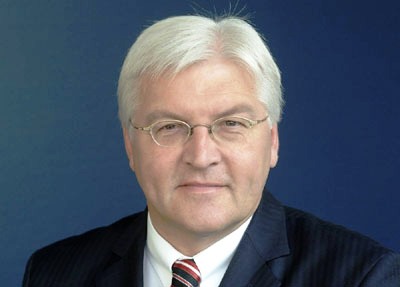
German FM Frank-Walter Steinmeier
Since the Bush administration’s twisting of events in the 2008 Russia-Georgia war, which the E.U. blamed on Georgia, Western populations have been subjected to the steady message that Russia is a “threat” to the West and is guilty of “aggression.” This reached a peak with the false narrative of events in Ukraine, in which blatant evidence of the West’s complicity in a violent coups d’état was omitted from corporate media accounts, while Russia’s assistance to eastern Ukrainians resisting the coup has been framed as a Russian “invasion.”
The disinformation campaign has reached the depths of popular culture, including the EuroVision song contest and sports doping scandals, to ensure widespread popular support for U.S. hostile intentions against Russia.
The Russian “aggression” narrative, based largely on lies of omission, has prepared the way for the U.S. to install a missile-shield in Romania with offensive capabilities and to stage significant NATO war games with 31,000 troops on Russia’s borders. For the first time in 75 years, German troops retraced the steps of the Nazi invasion of the Soviet Union.
U.S. Designs on Russia
The U.S. is eyeing a post-Putin Russia in which a Wall Street-friendly leader like Boris Yeltsin can be restored to reopen the country to Western exploitation. But Vladimir Putin is no Yeltsin and has proven a tough nut for the U.S. to crack. Washington’s modus operandi is to continually provoke and blame an opponent until it stands up for itself, as Putin’s Russia has done, then accuse it of “aggression” and attack in “self-defense.”
In this way, Washington builds popular support for its own version of events and resistance to the other side of the story. Unfortunately it is not a new trick in the U.S. playbook.
“The statesmen will invent cheap lies, putting the blame upon the nation that is attacked, and every man will be glad of those conscience-soothing falsities, and will diligently study them, and refuse to examine any refutations of them; and thus he will by and by convince himself the war is just, and will thank God for the better sleep he enjoys after this process of grotesque self-deception,” wrote Mark Twain.
So suddenly, after many years of an air-tight, anti-Russia campaign believed unquestioningly by hundreds of millions of Westerners, comes Steinmeier last week blurting out the most significant truth about Russia uttered by a Western official perhaps in decades.
“What we shouldn’t do now is inflame the situation further through saber-rattling and warmongering,” Steinmeier stunningly told Bild am Sontag newspaper. “Whoever believes that a symbolic tank parade on the alliance’s eastern border will bring security is mistaken.”
Instead Steinmeier called for dialogue with Moscow. “We are well-advised to not create pretexts to renew an old confrontation,” he said, saying it would be “fatal to search only for military solutions and a policy of deterrence.”
In keeping with the U.S. propaganda strategy, the U.S. corporate media virtually ignored the remarks, which should have been front-page news. The New York Times did not report Steinmeier’s statement, but two days later ran a Reuter’s story only online leading with the U.S. military’s rejection of his remarks.
NATO General: Russia is No Threat
Just a day after Steinmeier was quoted in Bild, General Petr Pavel, chairman of NATO’s military committee, dropped another bombshell. Pavel told a Brussels press conference flat out that Russia was not at a threat to the West.
“It is not the aim of NATO to create a military barrier against broad-scale Russian aggression, because such aggression is not on the agenda and no intelligence assessment suggests such a thing,” he said.
What? What happened to Russian “aggression” and the Russian “threat?” What is the meaning then of the fear of Russia pounded every day into the heads of Western citizens? Is it all a lie? Two extraordinary on-the-record admissions by two men, Steinmeier, the foreign minister of Europe’s most powerful nation, and an active NATO general in charge of the military committee, both revealing that what Western officials repeat every day is indeed a lie, a lie that may be acknowledged in private but would never before be mentioned in public.
Two years ago I was in a background briefing with a senior European ambassador at his country’s U.N. mission in New York and could hardly believe my ears when he said talk about Russia’s threat to Eastern Europe was “all hype” designed to give NATO “a reason to exist.” Yet this same ambassador in public Security Council meetings would viciously attack Russia.
But the hype is about more than just saving NATO. The fear campaign feeds the American and European military industries and most importantly puts pressure on the Russian government, which the U.S. wants overthrown.
Were these remarks made out of the exasperation of knowing all along that the Russian threat is hype? Were they made out of genuine concern that things could get out of hand under reckless and delusional leaders in Washington leading to a hot war with Russia?
Neither man has been disciplined for speaking out. Does this signal a change in official German thinking? Will German businessmen who deal with Russia and have opposed sanctions against Moscow over Ukraine, which were forced on Germany by the U.S., be listened to?
Were Steinmeier’s remarks a one-off act of rebellion, or is Germany indeed considering defying Washington on sanctions and regime change in Moscow? Is the German government finally going to act in Germany’s own interests? Such a move would spark a European defiance of the United States not seen since the days when Charles de Gaulle pulled France out of NATO in 1966 to preserve French independence.
The last time European governments broke with Washington on a major issue was the 2003 U.S.-led invasion of Iraq. Then France and Germany joined Russia on the U.N. Security Council in blocking the war’s authorization (although Britain supported it). But France and Germany then voted for a resolution several months later that essentially condoned the invasion.
It’s Up to the European Public
One has to ask whether a conditioned German public is ready to see through the lies about Russia. Last November, I flew from St. Petersburg to Berlin and discussed this very question with a number of well-educated Germans.
I had visited Russia for the first time since 1995, 20 years before to the month. Those were the days of the Yeltsin-Jeffery Sachs Russia, of the unbridled neoliberal capitalism of the Wall Street-oligarch alliance that plundered the country leaving millions of Russians destitute. Outside train stations I saw homeless encampments replete with campfires. Policemen were stopping motorists for bribes. I ran from two men intent on robbing me until I lost them in a Metro station. That’s the Russia the neocons in Washington and the knaves and buccaneers on Wall Street want to see again.
The Russia I saw in St. Petersburg and Moscow, 20 years later, was orderly and prosperous, as modern as any European city. It is a testament to Russia’s resistance to American attempts to restore its political and financial control. Russia is a capitalist country. But on its own terms. It is fully aware of American machinations to undermine it.
In Berlin I met several Germans, educated, liberal and completely aware, unlike most Americans, of how the United Sates has abused its post-World War II power. And yet when I asked them all why there are still U.S. military bases in Germany 70 years after the war and 25 years after the Cold War ended, and who the Americans were protecting them from, the universal answer was: Russia.
History shows European fears of Russia to be completely overblown. Germany and other Western powers have invaded Russia three times in the last two centuries: France in 1812, U.S., Britain and France in the 1918 Russian Civil War, and Germany again in 1941. Except for Imperial Russia’s incursion into East Prussia after war was declared on it in 1914, the reverse has never been true.
In his memoirs Harry Truman admitted that false fear of Russia was the “tragedy and shame of our time” during the Cold War that he had much to do with in part to revive the U.S. post-war economy with military spending. George Kennan, the State Department official who advised a non-military containment of the Soviet Union, conceded as early as 1947 that Soviet moves in Eastern Europe were defensive and constituted no threat. In the 1990s, Kennan also decried NATO’s expansion towards Russia’s borders.
With its vast natural resources, Russia has been the big prize for the West for centuries, and is still today in neocon-driven Washington. But Germany, especially, has benefited from trade with Russia and has no need to join the U.S. imperial project.
The British voters’ decision, days after Steinmeier’s extraordinary remark, could herald significant change in Europe, which may be approaching an historical junction in its relationship with the United States. Growing anti-E.U. sentiment has spread across the continent, including calls for similar referenda in several countries.
British voters evidently saw through the hype about the Russian “threat,” as a majority did not buy British Prime Minister David Cameron’s scare tactic ahead of the vote that Brexit would make it harder to “combat Russian aggression.”
Britain has been called Washington’s Trojan horse in the E.U. The thinking is that without Britain, the E.U. would be freer to chart its own course. But as Alexander Mercouris explained here, Obama bypasses London to call Merkel directly with his demands. Still, removing Britain’s voice from the E.U., though more crucially not from NATO, opens space for more independent voices in Europe to emerge.
“I worry that we will have less clout on our own,” former British Ambassador to the United States Peter Westmacott told The New York Times. “In the future, we won’t have as much influence on Europe’s response to Putin’s transgressions, Iran’s nuclear ambitions, or the E.U.’s foreign and security policy. … And we will be less able to ensure it is U.S.-friendly.”
But that could be a good thing. If German leaders conclude the United States is pushing Europe into a disastrous war with Russia, could we see a Charles de Gaulle moment in Berlin? Merkel doesn’t seem to have it in her. Three days after Steinmeier’s remarks, she told a news conference she favored increased German spending for NATO to counter Russian “threats.”
Instead it will require a revolt by an awakened citizenry against the E.U. and elected European governments that refuse to stand up to Washington, mostly because it benefits their own class interests, to the detriment of the majority.
The Future of the EU
European social democracy had been probably the best social and political system ever devised on earth, maybe the best that is humanly possible. Europe could have been a model for the world as a neutral power committed to social justice. As late as 1988, Jacques Delors, then president of the European Commission, promised the British Trades Union Congress that the E.U. would be a “social market.”
Instead the E.U. allowed itself to be sold out to unelected and unaccountable neoliberal technocrats now in charge in Brussels. European voters, perhaps not fully understanding the consequences, elected neoliberal national governments slavishly taking Washington’s foreign policy orders. But Brexit shows those voters are getting educated. Unity is a great ideal but E.U. leaders have refused to accept that it has to benefit all Europeans.
The E.U.’s Lisbon Treaty is the only constitution in the world that has neoliberal policies written into it. If it won’t reform — and the arrogance of the E.U.’s leaders tells us it won’t — it will be up to the people of Europe to diminish or dismantle the E.U. through additional referenda. That would give liberated European nations the chance to elect anti-neoliberal national governments, accountable to the voters, which can also chart foreign policies independent of Washington.
The danger is that the right-wing sentiment that has driven a large part of the anti-Establishment movements in Europe (and the U.S.) may elect governments that grow even closer to Washington and impose even harsher neoliberal policies.
That is a risk that may need to be taken in the hope that the anti-Establishment left and right can coalesce around shared interests to put an end to the elitist European project.
Joe Lauria is a veteran foreign-affairs journalist based at the U.N. since 1990. He has written for the Boston Globe, the London Daily Telegraph, the Johannesburg Star, the Montreal Gazette, the Wall Street Journal and other newspapers. He can be reached atjoelauria@gmail.com and followed on Twitter at @unjoe.
US to deploy Israeli missile system on Russian borders: General
Press TV – June 28, 2016
The US military has tested an Israeli short-range missile for possible use in its European network of missile systems to deter Russia, says a US Army general.
Major General Glenn Bramhall of the US Army’s Air and Missile Defense Command made the comments on Monday, as he visited the occupied Palestinian territories.
Bramhall said his units needed a reliable system to counter less powerful missile threats as a third tier beside the Army’s array of midrange Patriot and THAAD missile systems.
“Patriot and THAAD are great systems that do what they were designed to do. But I don’t think we would want to waste a Patriot or a THAAD missile on something that can be affected by something that’s lower cost and is actually designed for that job itself,” the general told Reuters.
For that purpose, he said the US military has test-launched a variant of the Israeli “Tamir” rocket which is incorporated to the Tel Aviv regime’s so-called Iron Dome missile system.
Jointly manufactured by American and Israeli firms, each Tamir battery, consisting of a radar unit, missile control unit, and several launchers, is worth $50 million, with each missile costing about $100,000.
“I think we are looking at something that is similar to Iron Dome. We have looked at the Tamir as a possible missile,” Bramhall said. He was due to inspect an Iron Dome unit on Tuesday.
Russian deterrence
Elsewhere in his remarks, the American general noted that the Israeli missile system is being considered mainly as a deterrent against what he called Russia’s military buildup in Europe.
“With all that is happening in Europe, especially the fact that Russia has really awakened itself and has really decided to rebuild its military and is really posing a threat, we are looking at how we can do the multi-tiered defense,” Bramhall said.
Military tensions between Russia and the US further heightened in May, when American and NATO officials activated a land-based missile system in Romania, despite Russia’s warning against US-led arms deployments near its borders.
The missiles’ activation marked the penultimate step in the completion of a missile shield, which Washington proposed nearly a decade ago.
Russian President Vladimir Putin strongly criticized the system’s deployment, vowing to neutralize any threats against his country’s security.
After Decades of Russian Goodwill, Norway Builds Up Military Against Moscow
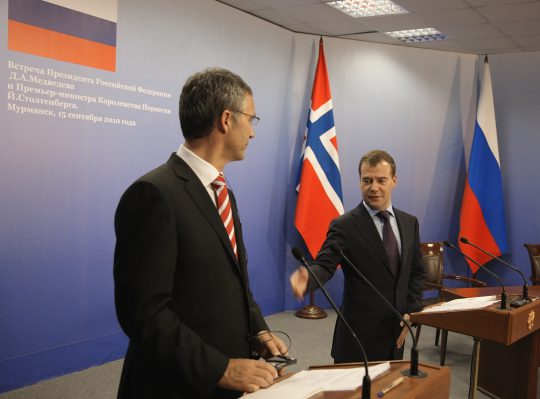
Norwegian Prime Minister Stoltenberg and Russian President Medvedev at the 2010 meeting cementing the new delimitation of the Barents Sea maritime border in Norway’s favor.
Sputnik – June 26, 2016
Earlier this month, Norway’s government announced a new defense plan, amounting to the largest military modernization since the Cold War, directed against Russia. Commenting on the initiative, journalist Sviatoslav Knyazev suggested that the country’s government has chosen to forget decades of good-neighborly relations between Oslo and Moscow.
Last weekend, Norwegian media reported on the country’s most ambitious plans to modernize the country’s armed forces since the end of the Cold War.
The government plans include the purchase of at least 52 Lockheed Martin F-35 fifth-generation multirole fighter jets, four submarines (presumably Swedish-built diesel subs), and six coastal patrol aircraft. Plans also include the construction of five new frigates and six corvettes.Overall, the defense budget of the country of five million is expected to increase by 165 billion kroner (about $19.4 billion US) over the next 20 years.
Norwegian Prime Minister Erna Solberg did not mince words as to who exactly the buildup is directed against, stating that “we have an increasingly unpredictable neighbor to the east which is strengthening its military capacity, and showing willingness to use military force as a political tool.”
Solberg’s comments followed on promises by Defense Minister Ine Eriksen Soreide in February 2015 that her country would be reorganizing its armed forces to counter the so-called ‘Russian threat’. At that time, the official candidly admitted that Russian forces had “not breached our territory,” but added that Oslo was worried over the increase in the range and number of Russian military aircrafts’ flights near the country.
On the border between Norway and Russia, Oslo is deploying a new army unit, consisting of 200 rangers, to be deployed in the Sor-Varanger municipality in Finnmark county, strengthening a several-hundred strong contingent of border guards. These units, equipped with anti-tank and anti-aircraft weapons, will be based in the direct vicinity of the Russian town of Pechenga.Commenting on the buildup in a piece for the online news and analysis portal PolitRussia, independent journalist Sviatoslav Knyazev recalled that “even before the modernization, the Norwegian Armed Forces were relatively powerful.”
“The per capita defense costs of the Kingdom are the highest in Europe. The armed forces are small enough (about 30,000 on active duty and some 45,000 in the reserve) but well prepared and equipped. Taking account of mandatory military service and its high prestige, a large portion of the population has military training. In the event of a hypothetical conflict, Norway can put several hundred thousand people under arms.”
Listing off the inventory of the country’s armed forces, Knyazev recalled that its ground forces have 52 Leopard 2A4 tanks, along with 20 older Leopard 1A5s, along with 315 M113 armored personnel carriers, 104 Swedish-made CV90 infantry fighting vehicles, and 80 SISU XA-185 and XA-203 armored personnel carriers. The army also has about 200 multi-purpose armored vehicles, and a number of self-propelled guns and multiple launch rocket systems.
The Air Force, for its part, has 57 F-16 multirole fighters, while the Navy has five frigates, six corvettes and six submarines.With these figures and the government’s latest plans in mind, the journalist pointed out that Norway is “effectively planning to double the strength of its Navy and Air Force (or completely modernize it). We are talking about billions of dollars of spending, a lot even for a wealthy country like Norway.”
Unfortunately, Knyazev emphasized, “all of this is directed solely against us [Russia].” At the same time, “Norway’s desire to ‘play with toy soldiers’ and to create conditions which could destabilize our northern border seems doubly strange in the context of Moscow’s long record of friendly relations toward Oslo.”
For a start, the journalist pointed out, the Russian Empire was one of the first to recognize Norway’s independence, soon after the country broke off from Sweden in 1905. Later, after the collapse of the Russian Empire and the emergence of the Soviet Union, diplomatic relations were established in short order, with relations established in 1924.
“In 1944,” Knyazev recalled, “its was the Red Army which fought to liberate [northern] Norway from the Nazi invaders. Thousands of Soviet soldiers and officers paid with their lives for the country’s freedom. After that, the Soviet Union, itself ravaged by war, helped to restore its northern neighbor. The USSR provided food rations, and Red Army engineering units helped rebuild ruined buildings. Moreover, the Soviet Union did not even try to create a zone of influence in Norway or to reshape its borders. In September 1945, having assisted its neighbors with aid, Soviet troops voluntarily left the country.”
Later, in the 1970s, a territorial dispute broke out between Moscow and Oslo over the maritime border in the Barents Sea, rich in offshore hydrocarbon reserves and fishing resources. “However, in 2010, Russia voluntarily ceded half of the disputed territory and signed a treaty ‘On Maritime Delimitation and Cooperation in the Barents Sea and the Arctic Ocean.'”
In 1949, the journalist bitterly recalled, the Norwegian government “thanked” the USSR for its contribution to the country’s liberation by joining the NATO alliance. “Now, it seems, we are being ‘thanked’ for the [2010] territorial gift, the shelf and the hydrocarbons worth tens of billions of dollars…”
“First, Norway introduced sanctions against us over a war unleashed by Washington in Ukraine [in 2014], then caused a scandal because of our Deputy Prime Minister’s visit to Svalbard [in 2015], and now they are up in arms and creating new military units directed against us.”Meanwhile, Knyazev lamented, “Jens Stoltenberg, the same former Norwegian Prime Minister who earned political capital through the 2010 demarcation agreement, is now directing the NATO bloc’s aggressive anti-Russian activities. Today, he is calling for strengthening NATO’s presence in the Baltic and Black seas, suggesting that the anti-Russian missile defense system in Eastern Europe is nothing out of the ordinary, and calling for ‘deterrence’ against Russia, which in actuality is not planning to attack anyone.”
Ultimately, the journalist suggested, “Norway, unfortunately, is a new example of the fact that befriending Western countries and doing them good is quite a thankless occupation…”
See also:
Norway Follows in US Footsteps, Ready to Deploy Aid to Syrian Rebels
European Union’s Imperial Overreach
By Jonathan Marshall | Consortium News | June 25, 2016
While few analysts are putting it this way, the European Union suffers from a self-inflicted crisis of overexpansion — a form of “imperial overstretch,” if you will. The Brexit vote was just the latest symptom of this policy disaster, which also includes escalating confrontations with Russia and the ongoing crisis in Ukraine.
Public opinion polls in the United Kingdom established that widespread concern over immigration was the single most important factor driving voters to support an E.U. exit. Pro-Brexit campaigners made much of the statistics released just last month that net annual migration into the U.K. reached a third of a million people in 2015, double the rate just three years earlier.
Such numbers fed public concerns over the impact of immigrants on the country’s National Health System and other social services, as well as jobs. They also fed deep suspicions about government credibility.
As the Guardian reported after the stunning election victory for the Brexit camp, “David Cameron’s failure to give a convincing response to the publication of near-record net migration figures in the first week of the EU referendum campaign has proved to be its decisive moment.
“The figure of 333,000 not only underlined beyond any doubt that Britain had become a country of mass migration but also meant politicians who claimed they could make deep cuts in the numbers while Britain remained in the European Union were simply not believed.”
The influx of these newcomers had a deeper psychological effect on the public. “The British government’s inability to control (intra-European) migration is seen as emblematic of a wider loss of control,” wrote Oxford political theorist David Miller just before the election. “Many Britons feel that they are no longer in charge of their own destiny: ‘Take back our country’ is a slogan that resonates along the campaign trail.”
E.U. Expansion and Immigration
Roughly half of immigrants to the U.K. in recent years have come from other E.U. countries, taking advantage of the association’s fundamental commitment to the free movement of people. Their large numbers reflected the enormous expansion of the E.U. since 2004 — and the lure of Britain’s relatively affluent economy to poor workers from newer members like Poland and Romania.
The E.U. — which actually has a commissioner for “enlargement” — has expanded relentlessly without heeding concerns from grassroots constituents of its traditional core members. In 2004, the E.U. absorbed Cyprus, the Czech Republic, Estonia, Hungary, Latvia, Lithuania, Malta, Poland, Slovakia and Slovenia — all low-wage countries with much lower standards of living than the likes of Germany, France or the U.K. In 2007, it also took in Romania and Bulgaria.
Official statistics show that citizens of these newer and poorer E.U. members account for nearly a third of net migration into the U.K. in recent years.
Although many economists defend free labor movement as good for the economy overall, the result — like that of free trade with low-wage countries — can harm less-skilled workers.
In 2011, two unpublished reports commissioned by the Department of Communities and Local Government made that point.
One warned senior government officials that sharply rising immigration could “increase tensions between migrant workers and other sections of the community” during the country’s recession. Another noted a huge rise in immigrants settling unexpectedly in rural areas, and concluded they were having “a negative impact on the wages of UK workers at the bottom of the occupational distribution.”
“We under-estimated significantly the number of people who were going to come in from Eastern Europe,” conceded Ed Milliband, leader of the Labour Party. “Economic migration and greater labour market flexibility have increased the pressure faced by those in lower skilled work.”
Ironically, many of the localities that voted most decisively for Brexit had relatively low migrant populations. But many of them are still suffering from economic austerity and sharp reductions in the social safety net imposed by the Conservative government since 2010.
“Switching the scapegoat from the government to the faceless migrant . . . is easier when people are scared for their livelihood, and more convenient for the politicians campaigning on both sides,” remarked the London-based writer Dawn Foster.
Voters were easily persuaded that “distant” and “faceless” E.U. bureaucrats just didn’t grasp their concerns. Indeed, the E.U. remains bent on continued expansion. It is currently in membership discussions with Albania, Macedonia, Montenegro, Serbia and Turkey, and recognizes Bosnia and Herzegovina and Kosovo as potential members.
Russia and Ukraine
The E.U.’s expansionist drive has had other costly repercussions for Britain and the rest of Europe. One notable disaster was its drive for an “association agreement” with Ukraine, a wide-ranging treaty that included not only provisions for tight economic integration, but also a commitment over time to abide by the E.U.’s Common Security and Defense Policy and European Defense Agency policies. On both fronts, the agreement was designed to pull Ukraine out of its traditional Russian orbit.
The E.U.’s expansion into Ukraine, like its expansion into the rest of Eastern Europe, was paralleled by the expansion of the NATO military alliance into the same countries, contrary to promises by Western leaders to their Russian counterparts in 1990. In 2008, NATO’s secretary general — backed by President George W. Bush and presidential candidate Barack Obama — pledged that Ukraine would be granted NATO membership.
Needless to say, Russia reacted badly, as it did to the E.U.’s later power play. It pressured the government of President Viktor Yanukovych to resist entreaties by NATO and the E.U. His refusal to break with Russia in turn triggered the so-called “Euromaidan” protests and the Western-backed putsch that ousted his government in February 2014.
Within a month, the new pro-European and pro-U.S. prime minister, Arseniy Yatseniuk, had signed the political provisions of the E.U. agreement. Just months later, he declared that he would seek NATO membership as well.
The result has been a bloody civil war in Eastern Ukraine; dangerous and costly military confrontations between Russia and NATO; and mutual economic sanctions that impoverish both Russia and the E.U.
Future historians will help us understand the underlying sources of the E.U.’s self-destructive expansion. No doubt they include some combination of ideological faith in the universality of European values, bureaucratic aggrandizement, and pandering to neo-liberal elites. Whatever the causes, the results now threaten the entire European project.
The E.U.’s future will require serious self-examination on many fronts, but especially about its grandiose ambitions for expansion.
Jonathan Marshall is author or co-author of five books on international affairs, including The Lebanese Connection: Corruption, Civil War and the International Drug Traffic (Stanford University Press, 2012).
Featured Video
New positive ivermectin evidence
or go to
Aletho News Archives – Video-Images
From the Archives
Secret Document Reveals Plans for Civil War in Lebanon, Israeli False Flags, and Invasion
By Randi Nord | Geopolitics Alert | April 5, 2019
Beirut – During his visit with US Secretary of State, Mike Pompeo, Lebanese President Michael Aoun reportedly received a US-Israeli document detailing plans for creating a civil war in Lebanon with covert false flag operations and possible Israeli invasion.
Although the source of the document is Israeli and created in partnership with Washington, no one knows who presented it to Aoun. The Lebanese TV station, Al-Jadeed, initially reported the document on Lebanese TV and a video on its website. Geopolitics Alert translated the report for this article. … continue
Blog Roll
 Aletho News
- EU Council Advances Chat Control 2.0 Scanning Proposal
- Ex-Greek MEP files complaint against Israeli spyware firm over alleged Pegasus surveillance
- Troubling ideas throughout the Torah, Talmud, Mishneh Torah and Tanya
- ‘Grave, alarming’: Iran mission on Trump’s UNGA ‘annihilation’ threats
- Najaf airport to reopen to Iranian flights within 24 hours: Ambassador
- From ‘How Will This End For Iran’ to ‘When America Walks Away’: A tale of two Economist covers
- Tehran blasts ‘baseless’ speculation linking Iran to alleged bomb plot at UK air base
- The Rise And… Rise Of ‘Color Revolutions’
- The Coming GOP Bloodbath?
- Arctic Scare Stories Melt Away
- If Americans Knew
- Netanyahu Asked UAE Leader to Deny Report on Oct. 7 Warning in Secret Visit, Sources Say
- CNN Chief Int’l Correspondent Clarissa Ward on Journalists in Gaza
- Democratic Party Consultants Surround Troy Jackson with Pro-Israel Donors
- Christian Leader Responds To Netanyahu’s Claims Regarding Palestinian Christians
- In Gaza, ‘Whoever Survives the Bombing Won’t Survive the Rubble’
- Israel kills more Palestinians, amid push to resettle Gaza – Daily Update
- Israel forces Gazans to live in constant peril – Daily Update
- Deconstructing Netanyahu’s pants-on-fire UN rant – Daily Update
- Trump betrayed voters with his campaign lies and prioritized a foreign country once he took office
- Netanyahu calls Israel’s war in Gaza ‘opposite of genocide’ in UN speech to near-empty hall
- No Tricks Zone
- New Study: Earth And Venus Surface Warmth Largely Explained By Convection And Lapse Rate, Not CO2 Or Radiation
- 2025 Nature Paper Claiming Worsening Global Drought Gets RETRACTED …Heavily Flawed
- New Study: ‘Global Drought Shows No Detectable Recent Acceleration Under Climate Warming’
- Economic Masterminds: German Socialists Suggest Taxing Productivity Gains Stemming From Using AI
- The South China Sea Has Not Been Cooperating With The Climate Change Narrative
- Energy Crisis: Germany Enters Heating Season With Historically Low Gas Reserve Fill Levels
- New Study: The Antarctic Ice Sheet Gained Mass From 2020-2024 Due To Staggering Snow And Ice Accumulation
- Study: Ocean Heating Rates From Thousands Of Years Ago ‘Dwarf’ Modern Ocean Heating Rates
- Climate Extremists Target, Attack Large-Scale Power Grid Infrastructure In Germany!
- New Study: Antarctic Ice Melt Has Contributed Less Than 1 Centimeter To Sea Level Rise In The Last 30 Years

