Moscow voices alarm as NATO Romanian missile defense base goes live
RT | May 11, 2016
As a new Romanian interceptor missile base prepares to go live Thursday, Moscow has slammed NATO’s expanding defense shield, calling it a threat to security, and a violation of a key international treaty.
“The creation of a European and global missile defense shield has an adverse effect on strategic stability,” Mikhail Ulyanov, head of the Russian foreign ministry’s department for proliferation and arms control issues, said on Wednesday.
NATO will formally declare its missile defense base in the remote location of Deveselu, Romania, operational on Thursday, bringing to fruition a plan to construct a shield in eastern Europe that was first announced by George W. Bush as far back as 2007.
“Our direct interests, the interests of our national security are affected by the decision,” said Ulyanov.
The Russian official said that not only was the missile defense aimed at neutralizing Russia’s offensive capability – an accusation the Pentagon has repeatedly rejected – but that Deveselu’s MK 41 launching systems it uses could be re-equipped with offensive cruise missiles.
Ulyanov said that Washington was acting in breach of the 1987 INF treaty, under which Mikhail Gorbachev and Ronald Reagan signed their respective countries up to obligations “not to possess, produce, or flight-test a ground-launched cruise missile (GLCM) with a range capability of 500 km to 5,500 km, or to possess or produce launchers of such missiles.”
The US embassy in Moscow produced a counter-statement, condemning Moscow’s allegations as “unacceptable and irresponsible.”
“The missile defense system is not aimed at Russia, or undermining its strategic potential. From the point of view of geography and physics, it is impossible to shoot down Russian inter-continental missiles from Romania or Poland,” said the document, penned by embassy spokesman William Stephens, and obtained by RIA news agency.
Washington says that the eastern European missile defense segment is meant to thwart a potential threat from Iran, but in a separate statement on Wednesday evening, Russia’s foreign ministry said that worries that Tehran posed a threat to NATO were “unfounded.”
The missile shield uses a network of radars that track potential threats in the atmosphere, before launching an interceptor missile from a stationary base, or a fleet.
Simultaneously with Romania coming online, construction work is beginning on a complementary base in Poland, which will complete the eastern European segment of the shield in 2018.
Erdogan calls for greater NATO presence in Black Sea
RT | May 11, 2016
NATO is not deploying enough assets to the Black Sea and cannot counter the Russian military presence there, Turkish President Recep Tayyip Erdogan has argued. He said he would ask the alliance to address the issue during an upcoming summit in Warsaw.
“I told him [NATO Secretary General Jens Stoltenberg]: ‘You are absent from the Black Sea. The Black Sea has almost become a Russian lake,’” Erdogan said at a meeting of heads of general staff of Balkan nations in Istanbul on Wednesday. “If we don’t take action, history will not forgive us.”
He added that Bosnia and Herzegovina and Macedonia should join the alliance soon to make it stronger.
A NATO summit will be held in the Polish capital in July. The meeting is expected to strengthen the alliance’s stance on countering what its new top military commander, US General Curtis Scaparrotti, called a resurgent Russia in his inauguration ceremony last week. Moscow sees NATO’s military buildup near its border as offensive and threatening.
“We should enhance our coordination and cooperation in the Black Sea. We hope for concrete results from the NATO summit in Warsaw on July 8 and 9… The Black Sea should be turned into the sea of stability,” Erdogan said, as quoted by Sputnik.
Military access to the Black Sea is limited for nations not bordering it, as Russia does. The US regularly sends its warships into the Black Sea for rotations.
The tension between Russia and the US over the strategic body of water was highlighted last year when Russian warplanes passed by the USS Ross, an American guided-missile destroyer. The Pentagon accused the Russian military of acting aggressively, while Moscow said the warship was approaching Russian territorial waters, which prompted the response.
Turkey, previously a strong trade partner of Russia, has become a bitter foe after downing a Russian bomber near the Syrian border back in November. The Turkish president said the downing of the plane – which resulted in the death of one of its pilots, who was killed by a Turkey-supported rebel group – was a proper response to a seconds-long violation of Turkish airspace. Moscow denied that such a violation happened and accused Ankara of stabbing Russia in the back.
Turkey’s immediate move after the incident was to call an emergency NATO meeting.
US Claims Anti-Missile Site in Poland There to Prevent Middle East Threats
Sputnik — 11.05.2016
The US anti-missile base due to be built in the Polish town of Redzikowo does not threaten Russia’s security, as the base is aimed at preventing missile threats from the Middle East, US Ambassador to Poland Paul Jones said Wednesday.
The start of construction of the military base in Poland, which is part of an US-designed ballistic missile defense system in Europe, is scheduled for May 13. The construction of the base is expected to be completed by 2018.
Speaking with the Polish Radio broadcaster, Jones assured that this defensive facility was designed to prevent the threats from the Middle East and not to threaten Russia’s security and that Moscow was aware of that. However, the United States is fully ready for different scenarios, the ambassador noted.
Russia has repeatedly expressed concern over the creation of the ballistic missile defense system in Europe, approved in 2010 during a NATO summit in Lisbon. A group of European countries, including Poland, Romania, Spain and Turkey, agreed to deploy elements of the system on their territories.
The United States and NATO continue to claim that the ballistic missile defense system is aimed primarily at countering threats from Iran and North Korea.
Syria, ISIS, and the US-UK Propaganda War
By Eric Draitser | New Eastern Outlook | May 6, 2016
With the war in Syria raging in its fifth year, and the Islamic State wreaking havoc throughout the Middle East and North Africa, it’s clear that the entire region has been made into one large theater of conflict. But the battlefield must not be understood solely as a physical place located on a map; it is equally a social and cultural space where the forces of the US-UK-NATO Empire employ a variety of tactics to influence the course of events and create an outcome amenable to their agenda. And none to greater effect than propaganda.
Indeed, if the ongoing war in Syria, and the conflicts of the post-Arab Spring period generally, have taught us anything, it is the power of propaganda and public relations to shape narratives which in turn impact political events. Given the awesome power of information in the postmodern political landscape, it should come as no surprise that both the US and UK have become world leaders in government-sponsored propaganda masquerading as legitimate, grassroots political and social expression.
London, Washington, and the Power of Manipulation
The Guardian recently revealed how the UK Government’s Research, Information, and Communications Unit (RICU) is involved in surveillance, information dissemination, and promotion of individuals and groups as part of what it describes as an attempt at “attitudinal and behavioral change” among its Muslim youth population. This sort of counter-messaging is nothing new, and has been much discussed for years. However, the Guardian piece actually exposed the much deeper connections between RICU and various grassroots organizations, online campaigns, and social media penetration.
The article outlined the relationship between the UK Government’s RICU and a London-based communications company called Breakthrough Media Network which “has produced dozens of websites, leaflets, videos, films, Facebook pages, Twitter feeds and online radio content, with titles such as The Truth about Isis and Help for Syria.” Considering the nature of social media, and the manner in which information (or disinformation) is spread online, it should come as no surprise that a number of the viral videos, popular twitter feeds, and other materials that seemingly align with the anti-Assad line of London and Washington are, in fact, the direct products of a government-sponsored propaganda campaign.
In fact, as the authors of the story noted:
One Ricu initiative, which advertises itself as a campaign providing advice on how to raise funds for Syrian refugees, has had face-to-face conversations with thousands of students at university freshers’ fairs without any students realising they were engaging with a government programme. That campaign, called Help for Syria, has distributed leaflets to 760,000 homes without the recipients realising they were government communications.
It’s not hard to see what the British Government is trying to do with such efforts; they are an attempt to control the messaging of the war on Syria, and to redirect grassroots anti-war activism to channels deemed acceptable to the political establishment. Imagine for a moment the impact on an 18-year-old college freshman just stepping into the political arena, and immediately encountering seasoned veteran activists who influence his/her thinking on the nature of the war, who the good guys and bad guys are, and what should be done. Now multiply that by thousands and thousands of students. The impact of such efforts is profound.
But it is much more than simply interactions with prospective activists and the creation of propaganda materials; it is also about surveillance and social media penetration. According to the article, “One of Ricu’s primary tasks is to monitor online conversations among what it describes as vulnerable communities. After products are released, Ricu staff monitor ‘key forums’ for online conversations to ‘track shifting narratives,’ one of the documents [obtained by The Guardian ] shows.” It is clear that such efforts are really about online penetration, especially via social media.
By monitoring and manipulating in this way, the British Government is able to influence, in a precise and highly targeted way, the narrative about the war on Syria, ISIS, and a host of issues relevant to both its domestic politics and the geopolitical and strategic interests of the British state. Herein lies the nexus between surveillance, propaganda, and politics.
But of course the UK is not alone in this effort, as the US has a similar program with its Center for Strategic Counterterrorism Communications (CSCC) which describes its mission as being:
…[to] coordinate, orient, and inform government-wide foreign communications activities targeted against terrorism and violent extremism… CSCC is comprised of three interactive components. The integrated analysis component leverages the Intelligence Community and other substantive experts to ensure CSCC communicators benefit from the best information and analysis available. The plans and operations component draws on this input to devise effective ways to counter the terrorist narrative. The Digital Outreach Team actively and openly engages in Arabic, Urdu, Punjabi, and Somali.
Notice that the CSCC is, in effect, an intelligence hub acting to coordinate propaganda for CIA, DIA, DHS, and NSA, among others. This mission, of course, is shrouded in terminology like “integrated analysis” and “plans and operations” – terms used to designate the various components of the overall CSCC mission. Like RICU, the CSCC is focused on shaping narratives online under the pretext of counter-radicalization.
It should be noted too that CSCC becomes a propaganda clearinghouse of sorts not just for the US Government, but also for its key foreign allies (think Israel, Saudi Arabia, Britain), as well as perhaps favored NGOs like Human Rights Watch, Amnesty International, or Doctors Without Borders (MSF). As the New York Times noted:
[The CSCC will] harness all the existing attempts at countermessaging by much larger federal departments, including the Pentagon, Homeland Security and intelligence agencies. The center would also coordinate and amplify similar messaging by foreign allies and nongovernment agencies, as well as by prominent Muslim academics, community leaders and religious scholars who oppose the Islamic State.
But taking this information one step further, it calls into question yet again the veracity of much of the dominant narrative about Syria, Libya, ISIS, and related topics. With social media and “citizen journalism” having become so influential in how ordinary people think about these issues, one is yet again forced to consider the degree of manipulation of these phenomena.
Manufacturing Social Media Narratives
It is by now well documented the myriad ways in which Western governments have been investing heavily in tools for manipulating social media in order to shape narratives. In fact, the US CIA alone has invested millions in literally dozens of social media-related startups via its investment arm known as In-Q-Tel. The CIA is spending the tens of millions of dollars providing seed money to these companies in order to have the ability to do everything from data mining to real-time surveillance.
The truth is that we’ve known about the government’s desire to manipulate social media for years. Back in February 2011, just as the wars on Libya and Syria were beginning, an interesting story was published by PC World under the title Army of Fake Social Media Friends to Promote Propaganda which explained in very mundane language that:
… the U.S. government contracted HBGary Federal for the development of software which could create multiple fake social media profiles to manipulate and sway public opinion on controversial issues by promoting propaganda. It could also be used as surveillance to find public opinions with points of view the powers-that-be didn’t like. It could then potentially have their “fake” people run smear campaigns against those “real” people.
Close observers of the US-NATO war on Libya will recall just how many twitter accounts miraculously surfaced, with tens of thousands of followers each, to “report” on the “atrocities” carried out by Muammar Gaddafi’s armed forces, and call for a No Fly Zone and regime change. Certainly one is left to wonder now, as many of us did at the time, whether those accounts weren’t simply fakes created by either a Pentagon computer program, or by paid trolls.
A recent example of the sort of social media disinformation that has been (and will continue to be) employed in the war on Syria/ISIS came in December 2014 when a prominent “ISIS twitter propagandist” known as Shami Witness (@ShamiWitness) was exposed as a man named “Mehdi,” (later confirmed as Mehdi Biswas) described as “an advertising executive” based in Bangalore, India. @ShamiWitness had been cited as an authoritative source – a veritable “wealth of information” – about ISIS and Syria by corporate media outfits, as well as ostensibly “reliable and independent” bloggers such as the ubiquitous Eliot Higgins (aka Brown Moses) who cited Shami repeatedly. This former “expert” on ISIS has now been charged in India with crimes including “supporting a terrorist organisation, waging war against the State, unlawful activities, conspiracy, sedition and promoting enmity.”
In another example of online media manipulation, in early 2011, as the war on Syria was just beginning, a blogger then known only as the “Gay Girl in Damascus” rose to prominence as a key source of information and analysis about the situation in Syria. The Guardian, among other media outlets, lauded her as “an unlikely hero of revolt” who “is capturing the imagination of the Syrian opposition with a blog that has shot to prominence as the protest movement struggles in the face of a brutal government crackdown.” However, by June of 2011, the “brutally honest Gay Girl” was exposed as a hoax, a complete fabrication concocted by one Tom MacMaster. Naturally, the same outlets that had been touting the “Gay Girl” as a legitimate source of information on Syria immediately backtracked and disavowed the blog. However, the one-sided narrative of brutal and criminal repression of peace-loving activists in Syria stuck. While the source was discredited, the narrative remained entrenched.
And this last point is perhaps the key: online manipulation is designed to control narratives. While the war may be fought on the battlefield, it is equally fought for the hearts and minds of activists, news consumers, and ordinary citizens in the West. The UK and US both have extensive information war capabilities, and they’re not afraid to use them. And so, we should not be afraid to expose them.
If Russia Had ‘Freed’ Canada
By Joe Lauria | Consortium News | May 5, 2016
As the United States plans to move thousands of NATO troops to Russia’s borders and continues to bolster a fiercely anti-Russian regime in neighboring Ukraine, the official line in Washington and its subservient corporate media is that beneficent America is simply seeking to curtail Moscow’s “aggression.” But the U.S. government and media might look at things quite differently if the shoe were on the other foot.
What, for instance, would the U.S. reaction be if Russia instead had supported the violent overthrow of, say, Canada’s government and assisted the new Ottawa regime’s “anti-terrorist operations” against a few rebellious “pro-American” provinces, including one that voted 96 percent in a referendum to reject the new Russian-backed authorities and attach itself to the U.S.?
If the U.S. government tried to help these embattled “pro-American” Canadians – and protect the breakaway province against the Russian-installed regime – would Washington see itself as the “aggressor” or as simply helping people resist anti-democratic repression? Would it view Russian troop movements to the U.S. border as a way to stop an American “invasion” or rather an act of “aggression” and provocation by Russia against the United States?
The Ukraine Reality
Before playing out this hypothetical scenario, let’s look at the actual scene in Ukraine today as opposed to the gross distortion of reality fed the American people by the U.S. mainstream media the past two years. The reality is not the State Department’s fable of a pro-democracy “revolution” cleaning up corruption and putting Ukrainian people first.
In the real world instead, extreme right-wing nationalists took control of a popular protest by mostly western Ukrainians to spearhead a violent coup that succeeded on Feb. 22, 2014, in overthrowing President Viktor Yanukovych, a man whom I interviewed in 2013 after he had been democratically chosen in an election certified by the Organization for Security and Cooperation in Europe.
Proof of the U.S. role in the coup came in a leaked telephone conversation several weeks earlier between U.S. Assistant Secretary of State for European and Eurasian Affairs Victoria Nuland, and Geoffrey Pyatt, the U.S. ambassador to Ukraine. In the conversation, Nuland and Pyatt discussed how the U.S. could “midwife” the unconstitutional change of government and they rated which Ukrainian politicians should be put in charge, with Nuland declaring “Yats is the guy,” a reference to Arseniy Yatsenyuk.
As for the European Union’s less aggressive approach to the Ukraine situation, Nuland declared: “Fuck the E.U.”
Nevertheless, after the coup, Western governments denied there ever was a coup, peddling the line that Yanukovych simply “ran away,” as though he woke up one morning and decided he didn’t want to be president anymore.
In fact, on Feb. 21, to contain the mounting violence, Yanukovych signed a European-brokered deal to reduce his powers and to hold early elections. But the next day, as right-wing street-fighters overran government buildings, Yanukovych fled for his life – and the West moved quickly to consolidate a new government under anti-Russian politicians, including Nuland’s choice—Yats as prime minister. (Yatsenyuk remained prime minister until last month when he resigned amid complaints that his stewardship had been disastrous for the Ukrainian people.)
A Resistance Emerges
Since the vast majority of Yanukovych’s support came from the ethnically Russian eastern half of the country, some Yanukovych backers rose up to challenge the legitimacy of the coup regime and to defend Ukraine’s democratic process.
Instead the West portrayed this resistance as a Russian-instigated rebellion against the newly minted and U.S.-certified “legitimate” government that then launched a violent repression of eastern Ukrainians who were deemed “terrorists.”
When Russia supported the resisters with weapons, money and some volunteers, the West accused Russia of an “invasion” and “aggression” in the east. But there has never been satellite imagery or other proof of this alleged full-scale Russian “invasion.”
In the midst of the Kiev “anti-terrorist” offensive in the east, on July 17, 2014, a Malaysian commercial airliner, Flight MH-17, was shot out of the sky, killing all 298 people on board. The United States, again offering no proof, immediately blamed Russia.
Over the past year, the fighting has been largely contained after Russian, Ukrainian and European leaders negotiated the Minsk Accords, though they are far from being implemented and widespread violence could break out again at any time.
Throughout the entire crisis the United States has insisted its motives are pure, including its new plans for deploying some 4,000 NATO troops, including about half American, on Russia’s Eastern European borders north of Ukraine.
President Barack Obama told the U.N. General Assembly last year that the U.S. had no economic interests in Ukraine. But former State Department official Natalie Jaresko served as Ukraine’s finance minister until recently and Vice President Joe Biden’s son sits on the board of a major Ukrainian company. U.S. investment also has increased since the coup.
Yanukovych’s overthrow occurred after he chose a Russian economic plan rather than sign an association agreement with the European Union, which Ukrainian economic analysts warned would cost the country $160 billion in lost trade with Russia.
The E.U. plan would also have opened Ukraine to Western neoliberal economic strategies designed to exploit the country for the benefit of Western capital and local oligarchs (one of whom, Petro Poroshenko, emerged as the new president).
Turning the Tables
To help American readers better understand what has transpired in Ukraine, it may be useful to see what it would be like if the tables were turned. What would the story be like if Russia played the role of the U.S. and Canada the role of Ukraine? Most Americans would not be pleased.
In this reverse scenario, the world’s mainstream media would follow Moscow’s line and present the story as a U.S. “invasion” of Canada. The media would explain the movement of Russian troops to the U.S. border as nothing more than a peaceful step to deter U.S. “aggression.”
But Americans might see matters differently, siding with the breakaway Maritime provinces resisting the Moscow-engineered violent coup d’etat in Ottawa. In this scenario, Prince Edwards Islanders would have voted by over 90 percent to secede from the pro-Russian regime in Ottawa and join the United States, as Crimea did in the case of Ukraine. People in Nova Scotia and New Brunswick – stressing their close historic ties to America – also would make clear their desire not to be violently absorbed by the Ottawa coup regime.
In this alternative scenario, Moscow would condemn Prince Edwards Island’s referendum as a “sham” and vow never to accept its “illegal” secession. The popular resistance in Nova Scotia and New Brunswick would be denounced as “terrorism” justifying a brutal military crackdown by Russian-backed Canadian federal troops dispatched to crush the dissent. In this “anti-terrorist operation” against the breakaway region, residential areas would be shelled killing thousands of civilians and devastating towns and cities.
In this endeavor, the Canadian army would be joined by Russian-supported neo-fascist battalions that had played a crucial role in the overthrow of the Canadian government. In the Maritime city of Halifax, these extremists would burn alive at least 40 pro-U.S. civilians who took refugee in a trade union building. The new government in Ottawa would make no effort to protect the victims, nor conduct a serious investigation to punish the perpetrators.
Ignoring a Leak
Meanwhile, proof that Russia was behind the overthrow of the elected Canadian prime minister would be revealed in a leaked conversation between Moscow’s foreign ministry chief of the North America department and the Russian ambassador to Canada.
According to a transcript of the leaked conversation, the Moscow-based official would discuss who the new Canadian leaders should be several weeks before the coup took place. Russia would launch the coup when Canada decided to take a loan package from the U.S.-based International Monetary Fund that had fewer strings attached than a loan from Russia.
Russia’s ally in Beijing would be reluctant to back the coup. But this would seem to be of little concern to Moscow’s man who is heard on the tape saying, “Fuck China.” Although this conversation would be posted on YouTube, its contents and import would be largely ignored by the global mainstream media, which would insist there was no coup in Ottawa.
Yet, weeks before the coup, the Russian foreign ministry official would be filmed visiting protesters camped out in Parliament Square in Ottawa demanding the ouster of the prime minister. The Russian official would give out cakes to the demonstrators.
The foreign ministers of Russian-allied Belarus and Cuba would also march with the protesters through the streets of Ottawa against the government. The world’s mainstream media would portray these demands for an unconstitutional change of government as an act of “democracy” and a desire to end “corruption.”
In a speech, the Russian foreign ministry official would remind Canadian businessmen that Russia had spent $5 billion over the past decade to “bring democracy” to Canada, much of that money spent training “civil society” activists and funding anti-government “journalists.” The use of these non-governmental organizations to overthrow foreign governments that stand in the way of Russia’s economic and geo-strategic interests would have been well documented but largely ignored by the global mainstream media.
But recognizing the danger from these “color revolution” strategies, the United States would move to ban Russian NGOs from operating in the U.S., a tactic that would be denounced by Russia as America’s rejection of “democracy.”
The Coup Succeeds
The Canadian coup would take place as protesters violently clashed with police, breaking through barricades and killing a number of police officers. Snipers would fire on the police and the crowd from a nearby Parliament Square building under the control of hardline pro-Russian extremists. But the Russian government and the mainstream media would blame the killings on the embattled Canadian prime minister.
To stem the violence, the prime minister would offer to call early elections but instead would be driven from office violently by the pro-Russian street gangs. Russia and the global mainstream news media would praise the overthrow as a great step for democracy and would hail the pro-Russian street fighters who had died in the coup as the “Heavenly Hundred.”
Following the coup, Russian lawmakers would compare President Barack Obama to Adolf Hitler for allegedly sending U.S. troops into the breakaway provinces to protect the populations from violent repression, and for accepting the pleas of the people of Prince Edward Island to secede from this new Canada.
Obama would be widely accused of ordering an “American invasion” and committing an act of “American aggression” in violation of international law. But the Maritimes would note that they had long ties to the U.S. dating back to the American Revolution and didn’t want to live under a new regime imposed by a faraway foreign power.
Russia would claim intelligence proving that U.S. tanks crossed the Maine border into New Brunswick, but would fail to make the evidence public. Russia would also refuse to reveal satellite imagery supporting the charge. But the claims would still be widely accepted by the world’s mainstream news media.
For its part, Washington would deny it invaded but say some American volunteers had entered the Canadian province to join the fight, a claim met with widespread media derision. Russia’s puppet prime minister in Ottawa would offer as proof of an American invasion just six passports of U.S. soldiers found in New Brunswick.
Taking Aim at Washington
When – during one of the new regime’s “anti-terrorist” offensives – a passenger jet would be shot down over Nova Scotia killing all on board, Russia would accuse President Obama of being behind the outrage, charging that the U.S. had provided the powerful anti-aircraft missile needed to reach a plane flying at 33,000 feet.
But Moscow would refuse to release any intelligence to support its claim, which would nevertheless be accepted by the world’s mainstream media.
The plane’s shoot-down would enable Russia to rally China and other international allies into imposing a harsh economic boycott of America to punish it for its “aggression.”
To bring “good government” to Canada and to deal with its collapsing economy, a former Russian foreign ministry official would be installed as Canada’s finance minister, receiving Canadian citizenship on her first day on the job.
Of course, Russia would deny that it had economic interests in Canada, simply wanting to help the country free itself from oppressive American domination. But Russian agribusiness companies would take stakes in Albertan wheat fields and the son of Russia’s prime minister as well as other well-connected Russians would join the board of Canada’s largest oil company just weeks after the coup.
Russia’s ultimate aim, beginning with the imposition of the sanctions on the U.S. economy, would appear to be a “color revolution” in Washington, to overthrow the U.S. government and install a Russia-friendly American president.
This goal would become clear from numerous statements by Russian officials and academics. A former Russian national security adviser would say that the United States should be broken up into three countries and write that Canada would be the stepping stone to this U.S. regime change. If the U.S. loses Canada, he would declare, it would fail to control North America.
But the world’s mainstream media would continue to frame the Canadian crisis as a simple case of “American aggression.”
This fictional scenario perhaps lays bare the absurdity of the U.S. version of events in Ukraine.
Joe Lauria is a veteran foreign-affairs journalist based at the U.N. since 1990. He can be reached at joelauria@gmail.com and followed on Twitter at @unjoe.
Obama’s Last Gasp Imperialism

By Margaret Kimberley | Black Agenda Report | May 4, 2016
With only eight more months in office, Barack Obama shows no signs of giving up his role as the most aggressively imperialist American president in modern history. Liberal Democrats rightly point fingers at Hillary Clinton’s bellicosity, yet they say nothing about Obama as he continues on a path of destruction around the world.
Nations on every continent are victims either of outright American military violence or of war waged by other means. Venezuela sinks further into despair as a result of American manipulations of oil prices and sanctions that cripple its economy. Millions of people have had their homes destroyed by United States interventions in Somalia and Libya and Syria and are forced to make dangerous treks in hopes of finding safety.
While the American instigated war goes on in Syria, that country’s government and its Russian ally make gains against terrorists. Because they are winning the United States continues to make bizarre demands that “Assad must go.” Obama has to turn over the keys in January 2017 but Assad may sit in his presidential office watching as his enemy rides off into the sunset.
The least reported and yet biggest danger is taking place in Europe. The United States and NATO continue to provoke Russia in what could be a deadly game that spins out of their control.
In recent weeks the Russians have made clear that they won’t take the provocation lying down. While the corporate media follow the president blindly, they won’t tell viewers and listeners that Russia has territory on the Baltic sea coast. Kaliningrad is Russia, just as Hawaii and Alaska are America. Of course there are Russian planes and submarines in the Baltic. They belong there while American vessels do not. Russia has every right to “buzz” United States ships and escort spy planes out of its airspace.
These very simple facts are rarely presented to Americans who have no idea that 200 of their troops will perform exercises in Moldova, a small country located between Ukraine and Romania. It is an example of how American presidents from Bush to Clinton to Bush to Obama made a mockery of a promise not to encircle Russia.
Instead they do just that and keep adding to the NATO arsenal. Nations like Sweden, traditionally neutral, are being lured into that organization’s grasp. In the absence of the old Soviet block there is no use for NATO except to act as the foot soldiers for American dirty work.
It seems that the end of his presidency has made Obama more anxious and therefore more dangerous. There are now “boots on the ground” in Syria, so far just 300 Special Forces, but even that small number is too high and represents the extent to which the United States is committed to maintaining the imperialist project.
Only the now inevitable Republican nominee, Donald Trump, questions this premise of American foreign policy. Hillary Clinton assisted Obama in his designs and the supposedly left wing Bernie Sanders warns of non-existent Russian aggression, supports presidential “kill lists” and thinks that having U.S. troops in Syria is a fine idea.
While the United States threatens to start World War III, the corporate media go into overdrive in their determination to distract us from the dangers our government poses to the world. They turn trivialities into major controversy but rarely report anything we ought to know. For example, Larry Wilmore saluted the president as “my nigga” during the last Obama era White House Correspondents Dinner. There was much arguing back and forth about the propriety of the words but no one spoke of the impropriety of the event itself.
The media ought to have an adversarial relationship with presidents. At the very least they should be somewhat distant and skeptical. Instead they are very cozy and quite publicly too. They even celebrate their collusion at this love fest as a president makes jokes with television comedians who compete for the chance to be sidekick for an evening.
There is no longer any pretense of impartiality. The media want access so they play along and tell lies of commission and omission with every presidential administration. They tell jokes at Russia’s expense but won’t tell readers and viewers that it is the United States who is provoking Russia in its sphere of influence.
Obama apparently wants to commit more destruction than he has already. Turning Libya into an utterly failed state was not enough. That act unleashed ISIS and Boko Haram and a wave of refugees. The coup in Ukraine ignited a civil war. The Syrian government hangs on but at a terrible price. Russia answered the call to help but America doesn’t want that war to end and will continue to use its allies to prevent a cease fire or an end to the conflict altogether.
A lot of damage can be done between now and January 20, 2009. There is no reason to mourn or rejoice Obama’s departure because he will be followed by someone who likes his foreign policy as it is. That person will also like Americans as they are: mostly intelligent but uninformed even if they wish to know what is happening around the world. The expression to do something “like there’s no tomorrow” is poignant. If Obama and company continue down this path, we shall all find out what those words mean.
Margaret Kimberley can be reached via e-Mail at Margaret.Kimberley(at)BlackAgendaReport.com.
NATO to Form Allied Fleet in the Black Sea: Plans Fraught with Great Risks
By Dmitriy SEDOV | Strategic Culture Foundation | 04.05.2016
Finally, it has become clear what the world has been set to expect from the NATO summit to be held in Warsaw on July 8-9. Summing things up, it is clear that the Alliance is moving to the east. It plans to create a Black Sea «allied fleet». It should be done quickly – the standing force should be formed by July.
The idea has been put forward by Romanian President Klaus Iohannis who probably wants to leave a historic legacy. The «allied fleet» is to comprise the warships from Germany, Italy, Turkey and the United States. At present, non-Black Sea NATO vessels visit the Black Sea only during exercises. The ships from Romania, Bulgaria, Ukraine and Georgia may join the force on permanent basis.
The 1936 Montreux Convention regulates the transit of naval warships. The document restricts outside navies’ access to the Turkish Straits and the Black Sea to 21 straight days per warship, and a maximum aggregate tonnage of 45,000 tons, with any one vessel no heavier than 15,000 tons.
Non-Black Sea states must also give Turkey a 15-day notice before sending warships through the straits.
International law is not strictly observed nowadays, so this problem could be solved. But what mission the new NATO standing force in the Black Sea is destined for?
A bit more than a couple of years ago Washington and Brussels had plans to make Sevastopol a NATO naval base. For many centuries the city has served as an outpost to protect the peninsula. After Crimea was reunited with Russia, Sevastopol became a fortified area with integrated command and control, intelligence and reconnaissance, anti-air, anti-surface ship and anti-submarine warfare capabilities.
Sevastopol’s reunification with Russia was a great frustration for NATO planners. Now they start to mull retaliatory measures. The «allied fleet» is an element of broader strategic plans. A few ships cannot tip the balance of forces in the Black Sea. Neither US, nor Romanian surface ships, nor the Ukrainian frigate Hetman Sahaydachniy escorted by rubber boats, or German conventional submarines pose any threat to Sevastopol. But it may change in the future. The Montreux convention can be changed (or violated), public opinion can be influenced and democratic parliaments can be convinced to approve allocations for creating a really strong maritime force in the Black Sea with Odessa as its home base. The port could be upgraded to host a large naval force.
Then the situation will be escalated to the days of the Cold War. The status of Ukraine led by Petro Poroshenko will change, if the president still remains in power and the Hetman Sahaydachniy still keeps afloat. Poroshenko is happy. He is impatiently waiting for the July NATO summit. The event can ultimately do away with whatever is left of «détente», «reset» etc. and bring the world back to the days of uncompromised mutual assured destruction.
NATO Prepares Four Battalions for Russian Border
By Daniel McAdams | Ron Paul Institute | April 29, 2016
The Wall Street Journal is reporting today that NATO is preparing to deploy four battalions — approximately 4,000 troops — to Russia’s western border. US Deputy Secretary of Defense Robert Work was in Brussels today to announce the Western military escalation on Russia’s border, which he claimed was in response to Russian military exercises near the Baltic countries of Estonia, Latvia, and Lithuania.
According to Deputy Secretary of Defense Work, two of the battalions would come from the United States, with one each coming from the UK and Germany. This announcement might come as news to German lawmakers, as such a significant German military presence on Russia’s borders has not been approved by Berlin. Although German Chancellor Angela Merkel has given Washington reason to believe that Germany would join the escalation, the move is considered highly controversial in a Germany growing weary of following US foreign policy dictates. In fact, according to recent polling, only one in three Germans supports the idea of the German military defending the Baltics even if there were a Russian attack. A clear majority of Germans oppose NATO military bases on Russia’s border.
According to the Wall Street Journal, the UK government has not agreed to send the troops either, despite the claims of unnamed “Western officials.”
The US deputy secretary of defense explained in Brussels that the US must send these thousands of troops thousands of miles from the US because Russia is conducting military exercises on its own soil and the US finds that intolerable.
Said Deputy Secretary Work:
The Russians have been doing a lot of snap exercises right up against the borders, with a lot of troops. From our perspective, we could argue this is extraordinarily provocative behavior.
What is not made clear in the article but should not be lost on readers is that “right up against the borders” is still Russian territory. But “right up against the borders” on the other side — where the US military is to be deployed and to conduct exercises — is most definitely not US territory. In other words, the US is traveling thousands of miles to place its troops on Russia’s border in response to Russian troops inside its border.
Here is Washington logic: Russian military exercises inside Russia are “extraordinarily provocative” but somehow stationing thousands of US troops on the border with Russia is not at all provocative. Just like US military exercises in the Baltic sea some 50 miles from Russian soil is not at all provocative, but Russian military plane fly-overs in response to these US military exercises is “reckless and provocative.” And just like the US flying a spy plane over highly-secret Russian military facilities on the Kamchatka peninsula is not at all provocative, but when the spy plane is buzzed by another Russian fighter, US Defense Secretary Ashton Carter warns, “This is unprofessional. This is dangerous. This could lead somewhere.”
It’s never provocative when Washington’s interventionists do it.
Germany mulls sending NATO troops to Lithuania – defense official
RT | April 29, 2016
NATO is looking at a number of strategies to boost its presence in Eastern Europe, including sending German troops to Lithuania, according to German media citing a Defense Ministry spokesman.
“There are various models under preliminary discussions and voting in NATO is underway,” the ministry’s spokesman Jens Flosdorff told the DPA news agency. “Decisions will be made this fall at the NATO summit in Warsaw.”
The remark confirmed Thursday’s reports that the country’s military was ready for a broader engagement to protect NATO’s eastern frontiers. The military alliance is to meet in the Polish capital Warsaw in July. The 28 member states are expected to agree on a roadmap to enhance combat readiness in Eastern Europe amid what NATO Secretary General Jens Stoltenberg has described as a challenging regional security situation.
Der Spiegel reports that German armed forces may send some 1,000 soldiers to take part in the NATO mission in Lithuania if the alliance’s members approve the plan.
In March, Lithuanian Foreign Minister Linas Linkevicius said he hoped Germany would support the need to increase NATO’s military presence in the Baltic States. He urged NATO not to rush to get back to normal dialogue with Russia as long as Moscow does not change its “aggressive policy.” NATO suspended all military cooperation with Moscow in the aftermath of Crimea’s accession to Russia.
According to Linkevicius’ comments made for the American newspaper Politico, a true partnership between Russia and NATO can only be restored if Moscow takes steps to withdraw its troops from Ukraine and ceases to carry out military exercises and military aircraft flights in the Baltic Sea.
Russia’s Foreign Minister Sergei Lavrov singled out Lithuania as the “most aggressive, Russo-phobic country” within NATO, adding it is pushing the alliance in an “anti-Russian direction.”
“After they [the Baltic nations] became free – the way they perceive it – and independent, after they proclaimed all the decisions concerning their sovereignty, they began to strive for NATO membership,” Lavrov said in an interview published Friday in the Swedish Dagens Nyheter newspaper.
“Moscow didn’t make a single attempt to pull them back, to say nothing of using force against them […] they were admitted to NATO but failed to develop any kind of tranquility and this particularly concerns Lithuania. It now makes up the most aggressive and Russo-phobic kernel within NATO,” he said.
Anti-Russian rhetoric, however, does not sit well with citizens of NATO member-states. As a recent Pew Research Center poll revealed, majorities in such NATO states as Germany (56 percent), Italy (51 percent) and France (53 percent) oppose the idea of protecting the Baltic States from a “military threat” allegedly posed by Russia. According to the poll, some 58 percent of Germans surveyed do not deem Russia a threat to their country, with 49 percent firmly against the idea of permanent deployment of NATO forces in Poland or any of the Baltic States.
Last week, permanent envoys from Russia and NATO member states met for the first time in two years. The meeting failed to yield any significant results due to “profound and persistent disagreements” on a number of geopolitical issues.
NATO has been increasing its military presence in Eastern Europe and the Black Sea since the Ukrainian crisis began in 2014, in response to what it considers Russia’s aggression. Moscow has repeatedly dismissed accusations related to Ukraine, at the same time stressing that increased NATO activities near Russian borders could undermine both regional and global stability.
Read more:
Russia to boost military force if Sweden allies with NATO – senator
‘No business as usual’: Issues remain after first NATO-Russia Council meeting since 2014
NATO pledges to boost military presence in Eastern Europe
Press TV – April 27, 2016
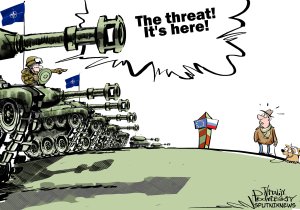 NATO has pledged to expand its military presence in Eastern Europe to protect its partners and allies from potential threats as the US sends two of the world’s most advanced warplanes to Romania.
In a speech at the University of Bucharest in Romania on Tuesday NATO Deputy Secretary-General Alexander Vershbow discussed the main issues the Western alliance is facing.
He said the alliance is struggling with many complex risks apart from the “destabilizing actions” of Russia and “the tide of instability which has swept across the Middle East and North Africa.”
“We are also wrestling with other complex risks and threats to our cyber security, to our energy supplies, and in the case of international terrorism to the safety of the people on our streets,” he said.
Vershbow said NATO is doing everything to respond to these challenges, adding that “the alliance takes a 360 degree approach to deterring threats, to protecting its member nations and if necessary to defending them.”
“That presence will be rotational, multinational, and combat capable. It will thereby send a clear message to any potential aggressor that if they violate NATO’s territory, they will face strong response from the whole alliance; Americans, Europeans and home defense forces,” he said.
The NATO secretary general also said that the organization has “set up a series of small headquarters, including here in Romania, to support planning, training and re-enforcement.”
“We are intensifying our maritime patrols, exploring the need for increased military and exercises, providing support to partners like Ukraine, Georgia and Moldova and encouraging efforts to strengthen energy security,” he said.
US sends F-22 Raptors to Romania
Vershbow’s comments came a day after the US sent two F-22 Raptor fighter jets to Romania as part of the commitment to NATO security.
The fighter jets, which travel at twice the speed of sound, touched down in Romania, close to the Black Sea and Ukraine, the Crimean Peninsula and Russia.
A US statement said the aircraft possess sophisticated sensors which would allow pilots to track, identify, shoot and destroy air-to-air threats without being detected.
The dispatch of the fighter jets, which can also attack surface targets, came two weeks after Russian fighter jets buzzed an American warship in the Baltic Sea.
The Western military alliance has been deploying troops and equipment close to Russia’s borders since it suspended all ties with Moscow in April 2014 after the Crimean Peninsula integrated into the Russian Federation following a referendum.
The United States and its European allies accuse Moscow of destabilizing Ukraine and have imposed a number of sanctions against Russian and pro-Russia figures. Moscow, however, rejects having a hand in the Ukrainian crisis.
This as Moscow has on many occasions slammed the Western military alliance’s expansion near its borders, saying such a move poses a threat to both regional and international peace.
US deploys F-22 stealth fighter jets to Romanian base on Black Sea
RT | April 25, 2016
Two American F-22 Raptor 5G stealth fighter jets and a refueling aircraft have been deployed to an airfield in Romania as manifestation of NATO’s support to its Eastern European members against “Russian aggression.”
The US Air Force aircraft arrived at the air base on the Black Sea, less than 400km from the Russian military stronghold of Sevastopol on the Crimean Peninsula.
“For the first time in Romania, the next-generation combat aircraft F-22 Raptor, part of the US Air Force Europe mission, arrived today at Mihail Kogalniceanu military base,” the US Embassy said on its Facebook page Monday.
A KC-135 refueling plane accompanied two F-22 Raptor fighters on their way from the UK, where Washington has deployed 12 F-22s at Lakenheath, a British air base in eastern England, Reuters reports.
After citizens of the Crimean Peninsula voted in favor of reuniting with Russia in 2014, European countries and the US introduced economic and political sanctions against Moscow. US President Barack Obama further promised in 2014 to bolster military capabilities of NATO’s eastern members. The bloc has been conducting a large number of military training near the Russia’s western borders over the last two years, though without permanently stationing large forces on the territory of alliance’s new member states.
In August 2015, US Air Force Secretary Deborah Lee James said the F-22 deployment to Europe as part of the “European Reassurance Initiative,” would occur “very soon.”
By the end of August 2015, four F-22 Raptors assigned to the 95th Fighter Squadron at Tyndall Air Force Base arrived at Spangdahlem Air Base in Germany as part of Pentagon’s continued “push to deter Russia.”
The alliance’s warships are maintaining constant presence in the Black and Baltic Seas as part of intelligence and containment purposes, which has already led to a rise of tensions.
In its national security strategy for 2016, Russia proclaimed NATO’s expansion to the east a threat. Moscow also held several wide-scale military drills all across Russia, including its western borders, in the past year.
Most recently, Russian pilots on Sukhoi Su-24 bombers buzzed the destroyer USS Donald Cook in the Baltic Sea in mid-April, when the US destroyer was around 70km away from a Russian naval base.
With a reported price tag of $190 million, F-22 Raptor fighter jet developed by Boeing and Lockheed Martin remains the most expensive fighter jet in the world. The aircraft was introduced into service in 2005 and its production was halted in 2009 because of the price.
Altogether 187 aircraft have been constructed though initially production of 749 planes was planned.
The first military deployment of the aircraft took place in 2014 in military operation against Islamic State (IS, formerly ISIS).
Potential NATO Commander Threatens Russian Jets That Buzz US Warships
Sputnik – April 23, 2016
After a US warship sailing near Russian waters in the Baltic Sea prompted a close flyby response from two Russian fighter jets, one US Army general has issued a threat to Moscow, should such an incident occur again.
Last week, the USS Donald Cook reported that two Russian Su-24s conducted repeated flyovers of the vessel as it sailed through the Baltic Sea. Pentagon officials decried the maneuvers as “unsafe and unprofessional.”
“This was more aggressive than anything we’ve seen in some time,” one official told Defense News, speaking on condition of anonymity.
Russian envoy to NATO Alexander Grushko stressed that the US destroyer represented a potential security threat and added that Russia would continue to take “all necessary measures [and] precautions to compensate US attempts to use military force.”
But the US continues to paint Russia as the aggressor in the incident, and on Thursday, Army Gen. Curtis M. Scaparrotti, possibly setting the tone for his anticipated tenure, escalated the rhetoric.
President Barack Obama’s nominee to become the next NATO and US European Command commander, Scaparrotti was testifying before the Senate Armed Forces Committee on Thursday when he was asked by Arizona Senator John McCain if the US should reaffirm to Russia that it would take action to protect American lives.
“Sir, I believe that should be known, yes,” Scaparotti said, according to Business Insider.
Referencing the Baltic Sea incident, Indiana Senator Joe Donnelly then asked if Russia should be warned that “next time it doesn’t end well for you.”
Scaparotti agreed.
“We should engage them and make clear what’s acceptable. Once we make that known, we have to enforce it,” he said.
“I think they’re pushing the envelope in terms of our resolve. It’s absolutely reckless, it’s unjustified and it’s dangerous.”
If confirmed as NATO commander, Scaparotti stated his first course of action would be to review America’s rules of engagement for the region.
The nominee’s aggressive posturing seems unnecessary, given that the USS Donald Cook was operating close to Russian waters and nearly 4,000 miles from home.
Writing for The American Conservative, political commentator Pat Buchanan criticized the US for using its Navy to provoke rival nations.
“In the South China Sea, US planes overfly, and US warships sail inside, the territorial limits of islets claimed by Beijing. In South Korea, US forces conduct annual military exercises as warnings to North Korea… US warships based in Bahrain confront Iranian subs and missile boats in the Gulf,” he wrote.
“Yet in each of these regions, it is not US vital interests that are threatened, but the interests of allies who will not man up to their own defense duties, preferring to lay them off on Uncle Sam. And America is beginning to buckle under the weight of its global obligations.”
Read more:
Broke and Paranoid…How the US Risks Nuclear War
US, Swedish Forces Conduct Training Exercise in Baltic Sea
Russian Envoy to NATO Affirms Continued Responses to US Military Pressure
Featured Video

The American Retreat from Vietnam
or go to
Aletho News Archives – Video-Images
From the Archives
Secret document reveals plans for civil war in Lebanon, Israeli false flags, and invasion
By Randi Nord | Geopolitics Alert | April 5, 2019
Beirut – During his visit with US Secretary of State, Mike Pompeo, Lebanese President Michael Aoun reportedly received a US-Israeli document detailing plans for creating a civil war in Lebanon with covert false flag operations and possible Israeli invasion.
Although the source of the document is Israeli and created in partnership with Washington, no one knows who presented it to Aoun. The Lebanese TV station, Al-Jadeed, initially reported the document on Lebanese TV and a video on its website. Geopolitics Alert translated the report for this article. … continue
Blog Roll
 Aletho News
- EU Council Advances Chat Control 2.0 Scanning Proposal
- Ex-Greek MEP files complaint against Israeli spyware firm over alleged Pegasus surveillance
- Troubling ideas throughout the Torah, Talmud, Mishneh Torah and Tanya
- ‘Grave, alarming’: Iran mission on Trump’s UNGA ‘annihilation’ threats
- Najaf airport to reopen to Iranian flights within 24 hours: Ambassador
- From ‘How Will This End For Iran’ to ‘When America Walks Away’: A tale of two Economist covers
- Tehran blasts ‘baseless’ speculation linking Iran to alleged bomb plot at UK air base
- The Rise And… Rise Of ‘Color Revolutions’
- The Coming GOP Bloodbath?
- Arctic Scare Stories Melt Away
- If Americans Knew
- Netanyahu Asked UAE Leader to Deny Report on Oct. 7 Warning in Secret Visit, Sources Say
- CNN Chief Int’l Correspondent Clarissa Ward on Journalists in Gaza
- Democratic Party Consultants Surround Troy Jackson with Pro-Israel Donors
- Christian Leader Responds To Netanyahu’s Claims Regarding Palestinian Christians
- In Gaza, ‘Whoever Survives the Bombing Won’t Survive the Rubble’
- Israel kills more Palestinians, amid push to resettle Gaza – Daily Update
- Israel forces Gazans to live in constant peril – Daily Update
- Deconstructing Netanyahu’s pants-on-fire UN rant – Daily Update
- Trump betrayed voters with his campaign lies and prioritized a foreign country once he took office
- Netanyahu calls Israel’s war in Gaza ‘opposite of genocide’ in UN speech to near-empty hall
- No Tricks Zone
- New Study: Earth And Venus Surface Warmth Largely Explained By Convection And Lapse Rate, Not CO2 Or Radiation
- 2025 Nature Paper Claiming Worsening Global Drought Gets RETRACTED …Heavily Flawed
- New Study: ‘Global Drought Shows No Detectable Recent Acceleration Under Climate Warming’
- Economic Masterminds: German Socialists Suggest Taxing Productivity Gains Stemming From Using AI
- The South China Sea Has Not Been Cooperating With The Climate Change Narrative
- Energy Crisis: Germany Enters Heating Season With Historically Low Gas Reserve Fill Levels
- New Study: The Antarctic Ice Sheet Gained Mass From 2020-2024 Due To Staggering Snow And Ice Accumulation
- Study: Ocean Heating Rates From Thousands Of Years Ago ‘Dwarf’ Modern Ocean Heating Rates
- Climate Extremists Target, Attack Large-Scale Power Grid Infrastructure In Germany!
- New Study: Antarctic Ice Melt Has Contributed Less Than 1 Centimeter To Sea Level Rise In The Last 30 Years

