Some Questions for Obama and His Gang
By Christopher Black – New Eastern Outlook – 16.11.2015
 Mr. Obama, Mr. Cameron. Mr. Hollande, Madame Merkel, Mr. Erdogan and all the other members of the criminal conspiracy to dominate the world, I ask you, do you intend to test our patience to its limit? How much longer will your killing frenzy madden us? At what point do you stop your reckless push to the very brink of world war. Have the Nuremberg trials, the UN Charter, international law, have the fears and protests of the people, have your continual defeats in one war after another, your crimes against mankind revealed to the light time and time again, had no effect on you at all? Do you not know that your plans have been exposed, that the conspiracy and the conspirators have been identified? Which of us does not know what you were up to yesterday evening, what you were up to last night and this morning, who you talked with, what plan of action you decided on? For the plan is always the same, and never changes, to dominate, to control or to destroy.
Many think they are lucky if they can just stay out of your way but we know better. We know that no one is safe from your criminality and depravity. Not even children returning from Sharm El Sheihk, from their holiday, are safe from the blade of death you hold in your hands, nor the citizens of Paris enjoying a night out on the town. You proved that when Metrojet Flight 9268 was destroyed in mid-air. No official cause has yet been determined but circumstances indicate the possibility of a bomb on board is a strong one. You proved it again when attackers murdered scores of people in Paris on Friday November 13th. ISIS is reported to have claimed responsibility but the claim that a Syrian passport was found on the body of one attacker, an Egyptian passport on another and a French one on another forces the question as to why anyone conducting such an attack would walk around with identification especially passports and more why would a French national carry his passport in France? The Paris attack and the Russian airliner attack both smell of false flag operations and when we ask the first question in any criminal investigation, who benefits from these attacks on civilians, then it is you who fall in line, one after the other, as the prime and usual suspects.
There has been a lot of speculation that the attack on the Russian plane was made by you or your allies in ISIS to “punish” Russia for its assistance to Syria and to try to affect public opinion in Russia against that assistance. But that never made sense since Russians know the high stakes for Russia in this struggle. The real reason for the attack is made clear by you every day in your mass controlled media. Your thinking, your plans, your crimes are exposed in the very propaganda you use to manipulate the minds of your own peoples and what you have told us is that the Russian plane was destroyed, all those innocent people trying to enjoy a small holiday were murdered, in order to justify your calls for an invasion of Syria. It is as clear as the deaths heads etched into your souls that those Russian men, those Russian women and those Russian children were sacrificed, used, as means of justifying a great war in the middle east. And now the citizens of France are sacrificed as well.
On CNN the other day your prime time king of war propaganda, Wolf Blitzer, showed an interview between the CNN queen of war propaganda, Christiane Anampour, and the Turkish Prime Minister. I use it because he says what you, Obama, Merkel, Hollande, and Cameron have all said in complete synchronicity, that the “plane attack is a call to action.” Prime Minister Davutoglu said,
“This is not an attack against a Russian airplane, but it is an attack against all of us. So therefore it shows that if the crisis is not solved in any particular country or region, then it is going to affect us all.” The same is now claimed by western leaders about the Paris attack.
On the same programme Blitzer hosted Senator Lindsay Graham, one of the most rabid of the American dogs of war who stated, “I believe you have to have boots on the ground to destroy ISIL, ….you need Turkey and the Arabs coming together with us, and you need 90 per cent them and 10 per cent us. 5,000 to 10,000 of Americans to be part of a regional force to go on the ground to destroy ISIL in Syria, or they will never be destroyed and they will hit us here at home.” And now Paris has been struck.
We have seen the same calls made from all the NATO capitals in recent days and all made just after the NATO leaders, with one notable exception, expressed their insincere condolences to the families of the victims of the airliner disaster but not to Russia or its government. The exception was President Obama who kept a sinister silence.
CNN stated on November 5th that the possibility that ISIS is behind the plane crash raises the spectre of a new potential for devastating attacks on Americans. “If another Islamist group has acquired the motivation and the capacity to attack civilian airliners, a future target could be U.S. jets.’ said a man named Aaron David Miller a “former middle east peace negotiator” with the Wilson Center in Washington who also said ‘It’s a long war and you, we have just seen maybe a very significant turn and escalation in that war…. and this will increase pressure … to forestall similar strikes against a US target.” But Paris was hit first.
I could cite many other similar statements in which your propagandists claim ISIS to be the new Al Qaeda. You and your fellow conspirators plan to amplify this propaganda to hysterical levels to generate overwhelming fear in your domestic populations in order to justify a large scale war against Syria where your proxy forces are being defeated by the combined arms of Russian air power and the fighting spirit and skills of the Syrian Arab Army. This has been achieved with the attack in Paris. The sudden flow of refugees into Europe is being used for the same purpose.
No doubt we can expect similar attacks in other NATO capitals. It does not matter to you if you use the misery of millions fleeing war and poverty to justify your plans for war or Russian children returning from happy days on the beach, or people enjoying a concert or football match in Paris. All deaths are the same to you. And so, when we ask who murdered those children, who murdered those Parisians, are you surprised if we turn our heads your way?
We owe a great debt of gratitude to those who defeated fascism in the Second Word War, and we cannot permit those forces of reaction and tyranny to torment us again for now you are not threatening this country or that, this leader or that, you are threatening the existence of civilization itself. Is this not madness? Is there anything that gives you pleasure except death and more death? Is there a single person on the planet that does not fear you, not a single person who does not hate you? Is there any mark of disgrace with which you have not been branded, any dishonour that does not stain your reputation? From what crime have you ever abstained?
There is no need to answer. We all know the answers to these questions.
Christopher Black is an international criminal lawyer based in Toronto, he is a member of the Law Society of Upper Canada and he is known for a number of high-profile cases involving human rights and war crimes.
Will British MPs vote to bomb Syria? Cameron, Corbyn diverge on Paris attack response
RT | November 16, 2015
Prime Minister David Cameron says he wants Britain to take part in airstrikes against Islamic State in Syria, but still needs to convince MPs to back an intervention. Labour leader Jeremy Corbyn meanwhile has warned bombing will not defeat the jihadists.
Cameron said he won’t hold a vote in Parliament on extending UK airstrikes from Iraq into Syria until he can be sure MPs will back it.
The PM told BBC radio if a vote on airstrikes against Islamic State (IS, formerly ISIS/ISIL) is defeated in the house it could damage Britain’s reputation on the global stage.
France has launched a series of “massive” strikes against IS in its stronghold of Raqqa in northern Syria following Friday’s terror attacks in Paris.
The UK is currently involved in bombing raids against IS targets in Iraq, but Parliament rejected a vote to extend airstrikes to Syria in 2013.
Speaking to the BBC, Cameron said he wants Britain to join a bombing campaign in Syria.
“I have always said I think that it is sensible that we should. ISIL don’t recognize a border between Iraq and Syria and neither should we, but I need to build the argument, I need to take it to Parliament, I need to convince more people,” Cameron said.
“We won’t hold that vote unless we can see that parliament would endorse action because to fail on this would be damaging, it is not a question of damaging the government it is a question of not damaging our country and its reputation in the world.”
The PM said he would take immediate direct action if British interests were at stake, citing RAF drone attacks launched in August against British citizens fighting for IS.
However Conservative MP Crispin Blunt has expressed doubts about military action in Syria without a wider international plan.
He told BBC Pienaar’s Politics the international community must redouble its efforts to reach a consensus on Syria and progress to a transitional arrangement had been made at talks in Vienna.
Jeremy Corbyn has warned airstrikes against IS will cause “more mayhem and more loss” in the region.
The Labour leader said the only way to deal with the threat posed by IS is to achieve a political settlement to Syria’s ongoing civil war.
“Does the bombing change it? Probably not. The idea has to be surely a political settlement in Syria,” he told ITV1’s Lorraine program.
“We have to be careful. One war doesn’t necessarily bring about peace – it often can bring yet more conflicts, more mayhem and more loss.
“I am not saying ‘sit round the table with ISIS,’ I am saying bring about a political settlement in Syria which will help then to bring some kind of unity government – technical government – in Syria,” he said.
Corbyn said it is important to ask “very big questions” about how IS has become so powerful in the region.
“Who is funding ISIS? Who is arming ISIS? Who is providing safe havens for ISIS? You have to ask questions about the arms that everyone has sold in the region, the role of Saudi Arabia in this. I think there are some very big questions,” he said.
Corbyn’s comments appear to contradict remarks by Labour’s Shadow Justice Secretary Lord Falconer on Sunday indicating Labour could back military action against IS in Syria without a UN resolution.
Labour’s current policy, established at party conference, is to only support extending airstrikes into Syria with a UN mandate.
Lord Falconer suggested the party could ease this position, as Russia has so far blocked moves for a UN resolution on military action in Syria.
“ISIS can only be defeated by the international community as a whole, if possible through a UN sponsored process, but if not that, then nations come together,” he told the BBC’s Andrew Marr Show.
“I think NATO will be a part of it. It is much too early to say whether it is appropriate or possible to evoke article five, but NATO will be part of the group of nations that have got to come together to look at it.”
Article Five states that an attack on one NATO member is an attack on all.
Falconer made clear any move to intervene in Syria must come with a strategy to deal with the civil war.
“You need a plan, and that plan has got to deal with the Syrian issue. I’m not urging troops on the ground, but ultimately ISIS have to be defeated. It can’t just be from the air.”
Turkey kills missile system deal with China manufacturer
Press TV – November 15, 2015
Turkey has rescinded a contract with a state-owned Chinese manufacturer that would have seen the company build Ankara its first long-range missile defense system.
“The deal was cancelled,” an official from Turkish Prime Minister Ahmet Davutoglu’s office told AFP.
The USD-3.4-billion (EUR-3-billion) contract was clinched with China Precision Machinery Import and Export Corporation (CPMIEC) following talks with the firm in 2013.
The deal originally raised eyebrows among other NATO members, which complained that the defense apparatus would lack the qualities enabling it to work in tandem with other such systems in the Western military alliance.
Turkey has US-manufactured Patriot missiles stationed along its border with Syria.
The Chinese company has been placed under sanctions by Washington allegedly for selling items that are banned under US law to curb the proliferation of weapons of mass destruction.
The Turkish official, whose name was not mentioned in the report, said, “One of the main reasons is that we will launch our own national missile project.”
Prior to the cancellation of the deal, however, Turkish Defense Minister İsmet Yılmaz had emphasized that Ankara’s decision to opt for a Chinese-built system and avoid integration with the existing NATO defense infrastructure was in line with the country’s national defense interests.
Experts had also argued that choosing a Chinese partner would ultimately enable Turkey to own both the system and the technology.
French-Italian consortium Eurosam and US-listed Raytheon Co have also submitted offers to help build the Turkey Long Range Air and Missile Defense System (T-LORAMIDS).
Paris Attacks: A Perfect Pretext For NATO To Mobilize in Syria and Iraq
21st Century Wire | November 14, 2015
To anyone who is really paying attention, the real agenda behind this ‘terror’ event in Paris – is a NATO-sponsored intervention in Syria and northern Iraq.
Also, for the time being, the following will now be buried: any talk of preserving privacy rights in the west, any debate on mass surveillance and bulk data collection, any vocal opposition against mandatory biometric ID’s in Europe, any criticism of Israel’s continued squeeze on the West Bank and East Jerusalem, the overdue Iraq War Inquiry in Britain, and of course – any political opposition to an increased western military presence in Syria, Iraq (and any where else).
RT America reports:
Numerous reports are linking the devastating terrorist attacks in Paris, which left over 150 civilians dead in the French capital, to the Islamic State. But what would such a connection mean for France and, potentially, for NATO? Journalist and international analyst Patrick Henningsen (21st Century Wire ) talks with Sean Thomas about the global impact of the Paris attacks…
US military to expand Europe presence over Russia
Press TV – November 9, 2015
US military officials have proposed plans to expand the American presence in Europe in a bid to counter Russia in the event of a crisis, a new report says.
Addressing the Reagan National Defense Forum over the weekend, senior US military leaders said the Pentagon needs to send more forces to Europe on a rotating basis, allowing the presence of multiple US brigades in the continent at any given time, the Wall Street Journal reported Sunday.
General Philip Breedlove, the supreme allied commander of the North Atlantic Treaty Organization (NATO), said he wants more forces committed to Europe in a rotational manner. He said the final decisions on the proposal will be made “in the next couple of months.”
It was also declared in the forum that the US is stepping up its military drills in various European countries, preparing to counter potential Russian interference with troop transfers, should a war break out between the two sides.
General Mark Milley, the chief of staff of the US Army, said the Army is adapting its training to make sure that the US military is able to face threats posed by Russian forces.
The American troops are preparing to counter hybrid war, a blend of regular and irregular forces with propaganda and unconventional tactics to spark confusion, Milley noted.
The defense leaders slammed Russian President Vladimir Putin’s “military aggression and threats” and warned that Washington must not allow Moscow to cooperate with the West in Syria.
They said Putin’s military support for Syrian President Bashar al-Assad against Daesh Takfiri terrorists is in fact a distraction designed to take away attention from the conflict in Ukraine.
Breedlove warned that cooperating with Russia on Syria means the West has accepted Moscow’s annexation of Crimea and support for pro-Russia forces in Ukraine’s Donbas region.
Ties between Moscow and Washington hit a new low after US-backed forces ousted Ukraine’s former president Viktor Yanukovych in February 2014.
US Defense Secretary Ashton Carter issued a warning against what he called the Russian “aggression” at the same forum, saying Saturday that Moscow seems “intent to play spoiler” by “throwing gasoline” on the fire of Syria. He then went on to criticize Russia’s “nuclear saber-rattling.”
Carter said NATO is in need of a “new playbook” to deter Russia.
The US has vowed to develop military training bases in six countries on or near Russian borders, including Latvia, Estonia and Lithuania, as well as Poland, Bulgaria and Romania.
It was announced last week that the US is poised to deploy 4,000 more troops in its European military bases.
The American military is pushing to include the new plan’s necessary funding in a budget request which will be sent to the US Capitol Hill early next year.
Russian officials say there is little difference between rotational forces and a permanent military buildup. They also say that the US and NATO are the true aggressors in Europe.
US Spy Sats See Everything, Except When the Government Says They Didn’t
By Dave Lindorff | This Can’t Be Happening! | November 7, 2015
There is something fishy going on in the way the US is talking about civilian plane crashes that are in some way linked, or said to be linked to Russia.
In the case of the latest tragic mid-air break-up of Russian Metrojet Flight 9268, which killed all 224 people aboard on a flight from Egypt back to Russia a few days ago, CNN is reporting that intelligence sources say the US spy satellite showed a “heat signature” that could indicate an explosion aboard the plane.
Here’s the CNN report:
A U.S. military satellite detected a midair heat flash from the Russian airliner before the plane crashed Saturday, a U.S. official told CNN.
Intelligence analysis has ruled out that the Russian commercial airplane was struck by a missile, but the new information suggests that there was a catastrophic in-flight event — including possibly a bomb, though experts are considering other explanations, according to U.S. officials.
Analysts say heat flashes could be tied to a range of possibilities, including a bomb blast, a malfunctioning engine exploding or a structural problem causing a fire on the plane.
Now note that this information about a spy satellite image comes just days after the crash.
Meanwhile, it’s been over a year and a half since the 2014 crash of Malaysian Airlines Flight 17 over Ukraine — an incident that also saw a civilian airliner destroyed in midair. In this case, the US insists the crash was caused by a Russian-built BUK anti-aircraft missile provided to, and launched by pro-Russian separatist forces in Eastern Ukraine.
The US has made this claim ad nauseam, but has never provided a shred of evidence to support its charge. Meanwhile, as a number of critics have pointed out, with Ukraine in a hot civil war in which one side — the post-coup Ukrainian government forces — were getting NATO backing, and the other, the two breakaway regions of Donetsk and Lugansk, were receiving Russian backing, it is a certainty that the US had moved not one but multiple spy satellites into position to monitor the region around the clock by the time of the Flight 17 shoot-down.
So where are the satellite images to support a claim that a BUK missile fired from rebel-held territory and by rebel forces downed that plane, killing all 298 people aboard?
As critics like award-winning journalist Robert Parry and retired CIA analyst Ray McGovern have pointed out, if the US had satellite imagery showing a BUK missile contrail — and this large, fast-moving rocket leaves a dramatic contrail all the way from its launch site to its high-altitude target (see below), making assessing of blame quite easy — it would long since have been released or leaked to a US corporate media that have been quick to rub with anti-Russian assertions and propaganda put out by the US government.

The BUK antiaircraft missile leaves a clear contrail from its launch site to its target, which any satellite image would clearly show.
This leaves us with two possibilities to ponder:
Either there simply are no satellite photos showing a BUK launched by Ukrainian rebels in Eastern Ukraine at Flight 17, or those photos that exist show something quite different, like a BUK being launched by Ukrainian government sources, or else, perhaps the current claim that satellite images show a heat signature around the Russian plane in Egypt are false (no image has been provided to back up the assertion of a heat signature).
Of course, there may eventually be evidence pointing to a bomb – the Russians are now looking for signs of explosive residue on the wreckage. But until such evidence is found, why, one might ask, would the US jump to make a false claim of a bomb being responsible for the Russian plane crash over the Sinai Desert, when it could as easily have been a fuel tank or engine explosion that wrecked the plane?
Well, consider that at the moment, Russian president Vladimir Putin has been trumping the US in a number of conflict regions, stymieing US plans to bring Ukraine into NATO, blocking a US plan to establish a no-fly zone over Syria by openly sending fighter-bombers and cruise-missile-equipped ships to Syria to attack President Bashar al-Assad’s Islamic State and Al Nusra enemies at Assad’s invitation, and backing Iran in its support of both Assad and the embattled Iraqi government. All the while, Putin’s popularity at home has been soaring into the high 80-90percent range according to polls.
Perhaps the thinking at the White House is that by suggesting it was a bomb, and not a structural defect that brought down a Russian civilian aircraft, killing hundreds of Russian citizens, the Russian people might logically link that purported bombing to Putin’s actions in Syria and his antagonism of IS and Al Nusra, and might then turn against him.
One thing is clear. If the US has satellites monitoring the Sinai, where there is no war going on, it most certainly had satellites monitoring Ukraine at the time of the downing of Flight 17, and if it’s willing to announce that its satellite caught the moment of the explosion of Flight 9268 and is willing to talk about that, it should also be willing to show what its satellites saw when Flight 17 was downed.
The American people, and the people of the world, should demand this of the US government.
Who Will Blink in Syria? Russia? Or the US?
By Paul Larudee | Dissident Voice | November 5, 2015
The first to die will be US troops. Russians will be made to appear as the killers, but the agents will probably be ISIS, Al-Qaeda (aka al-Nusra), Turks, or the Americans themselves. I’m not ruling out that the Russians might actually do the job, especially if the Americans order their 50 soldiers to the most likely Russian bombing targets and then dare the Russians to hit them. But most likely, the US will do the job itself and not take a chance that the Russians might miss.
Those dead American soldiers are needed as bargaining chips so as to up the ante. Next, Russians have to die, with or without a mutual secret agreement to that effect.
The strategy is based upon the assumption that if the stakes become high enough, the other side will back down. It is called brinkmanship, and its best known example was the 1962 Cuban missile crisis. One or both sides may believe that they are bluffing, but if their bluff is called are they really going to back down? Or are they going to up the ante so much that they end up in a real war, where they are required to respond to the other’s actions with ever-escalating effect?
I do not think the Russians will blink. They have had enough of American encroachment. They will not stand for further NATO poaching of their erstwhile Warsaw Pact allies, and certainly not in Ukraine, which is to Russia roughly as Canada is to the US. Similarly, the port of Tartus in Syria is Russia’s only Mediterranean naval base, and Syria is currently its only ally in the Arab world. Russia has much more at stake than the US, and is therefore much less likely to back down. In fact, Russia has clearly made a major commitment to the preservation of Syria, and waited a long time before doing so, which is another sign that they will not shrink soon from their decision to stay the course.
On the American side, the stakes are much less well defined. Syria is part of the post-USSR assertion of US global dominance, as advocated mainly by the neoconservative strategic movement, closely allied with Israeli and Zionist interests, which benefits from the Israel Lobby clout in the US. From its base in the Congress and the National Security Agency, this movement has made inroads into the intelligence services, the State Department and the Department of Defense, mainly at the top echelons. (Elected and appointed positions are the most vulnerable to lobbyist penetration.)
Following the dissolution of the Soviet Union, the neocons argued that the US should use its military might to mold the world into US-controlled fiefdoms. Plans for such domination have been variously described in the “Clean Break” proposal, the “Project for a New American Century”, and the “New Middle East”. They begin with the destruction (aka “regime change”) of seven Middle Eastern countries, of which Iraq and Libya are considered successfully catastrophic outcomes, and a model for what is to be done to Syria.
Part of the purpose is to remove “bad examples” of nations that refuse to open their economies to U.S. exploitation and to accept US direction of their foreign policy, regardless of their own national interests. Iran and Syria are current examples of such countries, as were Libya and Iraq prior to their destruction. If these objectives happen to coincide with the Israeli policy of destroying the countries in its neighborhood, we may be forgiven for thinking that this is not mere coincidence.
Also on the American side, the stakes are ruled to a greater extent by domestic politics. Having championed the cause of regime change in Syria, Barack Obama and Hillary Clinton are loathe to appear weak or indecisive, and thus vulnerable to Republican criticism. In any case, they rely heavily on the Israel Lobby, which appears willing to sacrifice America’s fortune and youth on the altar of Israeli interests.
Despite these considerations, the American motives are not as strong as those of Russia. The problem is, neither is American leadership. There is a clear way out of this confrontation, with a face-saving agreement, if only the US will allow it to happen. It is for Russia and the US to cooperate in eliminating ISIS, al-Qaeda and their allies, cutting off US support for these terrorist organizations, forcing US allies Turkey, Saudi Arabia, Qatar, and others to do the same, and jointly convening a peace conference that brings indigenous Syrian groups together to negotiate an agreement that allows all sides to claim victory (even if it is something of a charade, as are most such agreements).
Brinkmanship is unnecessary. It is dangerous, and it is not a solution. Vladimir Putin is ready to achieve a negotiated outcome that protects Russia’s interests and ends US encroachment. Assad has never been an enemy of the US, and he is the current choice of the vast majority of the Syrian people, whether enthusiastically or reluctantly (as in most countries). The United States will be able to claim victory over its terrorist enemies as well as a compromise over the form of government in Syria, and a new positive working relationship with Russia. The Israelis will be upset that we have not done enough killing for them, but they will get over it, in the same way that they are reluctantly learning to live with the US-Iran settlement on nuclear development.
It shouldn’t be a question of who blinks first, but of having the option to continue blinking at all.
Paul Larudee is one of the founders of the Free Gaza and Free Palestine Movements and an organizer in the International Solidarity Movement.
‘No armed combatants, no fighting’: MSF issues Afghan hospital bombing report
RT | November 5, 2015
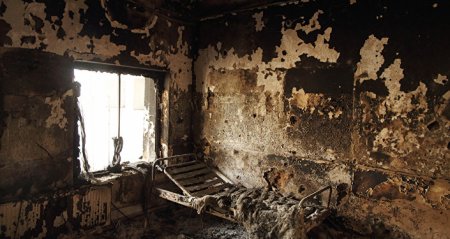
A Médecins Sans Frontières investigation into the Afghan hospital bombing by US forces has found that there were no armed combatants or weapons within the compound, and no fighting in the direct vicinity of the hospital at the time of the airstrikes.
In its report released on Thursday, Médecins Sans Frontières (MSF/Doctors Without Borders) addressed the “relentless and brutal aerial attack by US forces” which took place in Kunduz on October 3 and killed at least 30 people, including MSF staff.
“The MSF rules in the hospital were implemented and respected, including the ‘no weapon’ policy and MSF was in full control of the hospital at the time of the airstrikes,” the organization stated.
The document also said there were “no armed combatants within the hospital compound and there was no fighting from or in the direct vicinity” of the trauma center at the time of the strikes.
The hospital was “fully functioning” at the time of the airstrikes, with 105 patients admitted and surgeries taking place, according to the findings of the investigation.
In addition, MSF said the “agreement to respect the neutrality of our medical facility based on the applicable sections of International Humanitarian Law was fully in place and agreed with all parties to the conflict prior to the attack.”
Despite that neutrality, the hospital was still the target of a US airstrike, leading MSF to ask how such an attack was allowed to happen.
“The question remains as to whether our hospital lost its protected status in the eyes of the military forces engaged in this attack – and if so, why,” MSF said in its statement.
Presenting the report, MSF general director Christopher Stokes said: “From what we are seeing now, this action is illegal in the laws of war. There are still many unanswered questions, including who took the final decision, who gave the targeting instructions for the hospital.”
The MSF statement described the tragic situation at the hospital.
“Patients burned in their beds, medical staff were decapitated and lost limbs, and others were shot by the circling AC-130 gunship while fleeing the burning building. At least 30 MSF staff and patients were killed,” it states.
MSF says its demand is simple: “A functioning hospital caring for patients, such as the one in Kunduz, cannot simply lose its protection and be attacked; wounded combatants are patients and must be free from attack and treated without discrimination; medical staff should never be punished or attacked for providing treatment to wounded combatants.”
Following the aerial attack, the Pentagon initially attempted to shift responsibility onto Afghan security forces, claiming they had requested the airstrikes.
However, the commander of the US and NATO forces in Afghanistan, Gen. John Campbell, later admitted the attack was a “US decision made within the US chain of command.” He went on to say that Washington would “never intentionally target a protected medical facility.”
Read more:
US tank enters MSF hospital in Afghanistan’s Kunduz, ‘destroys potential evidence’ – reports
Sicilians Stage Anti-NATO Military Drills Rally
Sputnik – 31.10.2015
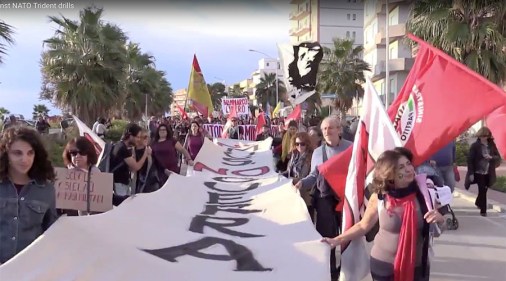 Protesters in the Italian island of Sicily demonstrated against the North Atlantic Treaty Organization’s (NATO) Trident Juncture-2015 exercises on Saturday less than 10 miles from a NATO base.
The military alliance’s largest exercises in over a decade involving over 36,000 troops from 30 NATO members and partner countries, Trident Juncture moved into an active phase across southwestern Europe in mid-October.
“We are against NATO, against war, against the enormous costs that go to the upkeep of military bases,” Chiara Paladino, one of the protest organizers, told RIA Novosti.
Paladino said around 1,000 people demonstrated in Marsala, south of the Vincenzo Florio Airport used as a NATO forward operating base. Anti-NATO protesters gathered from across the province of Trapani, including large Sicilian cities of Palermo, Catania, Messina and Ragusa, she said.
A similar anti-Trident Juncture and anti-NATO rally took place in the major Sicilian city of Palermo late on Friday.
The first phase of the Trident Juncture drills began October 3, running for two weeks in Canada, Norway, Germany, Belgium and the Netherlands. The second phase, which ends on November 6, is taking place in southern Europe – Spain, Italy, and Portugal – as well as in the Mediterranean Sea and the Atlantic Ocean.
Spanish and Portuguese demonstrators staged protests against NATO this month.
Photo © Ruptly
NATO’s Expensive Expansion
By Brian CLOUGHLEY – Strategic Culture Foundation – 27.10.2015
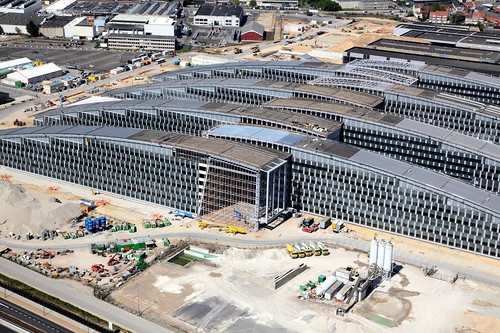
The North Atlantic Treaty Organisation has many secrets, of which one of the most closely guarded is the final cost of its luxurious new headquarters complex in Brussels. As reported last year by Britain’s Daily Telegraph newspaper, the price had climbed to a billion Euros “against a background of Nato pledges to reduce its command structure, agencies and national HQs by 30 per cent in response to savage defence cuts in most of its 28 member states.” According to NATO the final bill was supposed to be 750 million Euros for completion in 2015, but as had to be eventually admitted by NATO, “the project now has a clear way forward to completion in 2016” — with a 30 per cent increase in the price.
But that officially-stated price was not what it seemed, because, as revealed by Germany’s Der Spiegel magazine, “member states had already been sceptical when the consortium won the contract for €460 million [emphasis added] in 2010 . . . [Nato Chief] Anders Fogh Rasmussen is aware of the problem but hasn’t seen fit yet to inform the public about it . . . At a meeting of NATO’s Deputies Committee on December 19 [2013], Rasmussen’s staff asked that the issue be dealt with ‘confidentially’.”
That shabby deceitfulness couldn’t prevent Spiegel from disclosing that the cost had risen to 1.3 billion Euros, “almost three times the €460 million contract awarded in 2010 to replace NATO’s Cold War-era headquarters with a soaring glass-and-steel structure to house some 4,000 staff.” This vastly expensive palace has eight wings which converge “in a glass-covered central hall . . . to ‘symbolise the allies coming together, while glass walls are supposed to represent Nato’s transparency’.”
The designer of this glass castle rhapsodised that “the wing-like profiles of the buildings reinforces [sic] the ideas of consensus, fluidity and aspirations towards peace . . .” But peace doesn’t seem to be what NATO is intent on achieving, any more than it seems to welcome transparency in glass walls or anything else, because a leaked cable from Germany’s ambassador explained that a meeting of NATO representatives “pointed to the disastrous effect on the image of the alliance if construction were to stop and if NATO appeared to be incapable of punctually completing a construction project.”
How transparent. And how prophetic.
Although NATO’s deceit about its incompetence in building its new headquarters is veiled in secrecy, its ambition to expand in territory and military muscle-flexing is open for all to see, and has been for twenty years.
After the Warsaw Pact disbanded in March 1991, NATO, although deprived of any reason to continue in existence, managed to keep going, and in 1999 added Poland, the Czech Republic and Hungary to its 16 members. As the BBC noted, these countries became “the first former Soviet bloc states to join Nato, taking the alliance’s borders some 400 miles towards Russia.”
With good reason Moscow wondered what on earth the US-NATO military alliance might be planning.
The New York Times recorded that the 1999 expansion was “opening a new path for the military alliance” and expressed delight that the ceremony took place in the town of Independence, Missouri, where “the emotional Secretary of State Madeleine K Albright watched the three foreign ministers sign the documents of accession, signed them herself, then held them aloft like victory trophies.” Ms Albright was born Marie Korbelová in Prague and “made no secret today of her joy as her homeland and the two other nations joined the alliance.”
It was the emotional Madeleine Albright who appeared on the US television programme Sixty Minutes on May 12, 1996 and was asked to comment on Washington’s economic sanctions that were savaging Iraq. The interviewer, Lesley Stahl, said that as a result of the punishment “We have heard that a half million children have died. I mean, that’s more children than died in Hiroshima. [90,000 people were killed at Hiroshima. Probably about 20,000 were children.] And, you know, is the price worth it?”
Albright replied that “I think this is a very hard choice, but the price — we think the price is worth it.” (The YouTube recording is nauseating.) Then she was given the US Medal of Freedom by President Obama in 2012. You couldn’t make it up.
In spite of facing no threat whatever from any country in the world, NATO continued to expand around Russia’s borders, inviting Bulgaria, Estonia, Latvia, Lithuania, Romania, Slovakia and Slovenia to join in 2002, which they did two years later.
As President Putin observed in an interview with Italy’s Corriere della Sera “we are not expanding anywhere; it is NATO infrastructure, including military infrastructure, that is moving towards our borders. Is this a manifestation of our aggression?”
Then NATO took wider and more aggressive action in August 2003 when it took “control of the International Security Assistance Force (Isaf) in Afghanistan, its first major operation outside Europe.” Predictably, the war in Afghanistan plunged from crisis to calamity after US-NATO countries agreed in 2005 “to expand the alliance’s role,” including “deployment of thousands more troops in the south.” The result was disaster.
Last December NATO (but not the US) ceased offensive operations in Afghanistan, having sacrificed the lives of over 3,500 soldiers of whom some 2,300 were American. One might imagine that this humiliating defeat might have resulted in a pause for reflection about NATO’s role, purpose and effectiveness, but its new Secretary General, Jens Stoltenberg, is proving as energetically expansive as his predecessor, which is why he was chosen for the job. NATO’s appalling blitz of Libya in 2011, which reduced the country to its present catastrophic chaos, has failed to modify his intriguing belief that “from Afghanistan to Morocco, and many places in between, NATO is helping other countries to defend themselves.” He may have forgotten that Libya is one of the “places in between.”
On 23 October Stoltenberg expressed delight about Obama’s change of policy about keeping troops in Afghanistan, expressing “appreciation for President Barack Obama’s announcement that the United States will maintain its current troop levels in Afghanistan through 2016, and will retain a substantial presence beyond 2016. This important decision paves the way for a sustained presence by NATO Allies and partners in Afghanistan.”
If Stoltenberg had said that he welcomed Obama’s decision because it would result in a better life for the citizens of Afghanistan (which, alas, it will not), then his stance could be understood and applauded. But Stoltenberg welcomed the decision only because it would enable NATO to carry on its expensive expansion. That’s the way that military-associated bureaucrats think about the world. They’ve never risked their lives for any cause — any more than did the evil child-killer Albright — but they’re really happy to engage in exciting martial adventures in which the lives of thousands of soldiers can be placed at risk.
Jens Stoltenberg is the embodiment, the essence — the ultimate epitome — of the sleek, well-manicured, desk-bound, happy non-combat warrior. His peaceful and lucrative career in politics was marked by early anti-Americanism, during the Vietnam War, but over the years the chameleon changed from being an anti-American protester to eventually embracing his present anti-Russian complexion. When he was made head of NATO, President Putin considered him to be a “serious, responsible person” but warned with prescience that “we’ll see how our relations develop with him in his new position.” Both responsibility and relations collapsed.
A few days before his declaration of happiness about NATO’s “sustained presence” in Afghanistan Stoltenberg boasted that “we have doubled the size of the NATO Response Force, making it more ready and more capable, and established a high readiness Joint Task Force, able to move within a matter of days. We have increased our presence in the east, with more planes in the air, more ships at sea and more boots on the ground. We have established six new headquarters in our eastern Allies, with two more on the way.” He told NATO countries that “the time has come to invest more in defence.”
NATO’s threat to Russia is direct and aggressively confrontational. And it’s going to cost member nations a great deal of money. But Mr Stoltenberg is no stranger to expense. As NATO announced : “While Mr Stoltenberg was Prime Minister, Norway’s defence spending increased steadily with the result that Norway is today one of the Allies with the highest per capita defence expenditure.”
Now he has committed Europe’s financially struggling NATO nations, including almost-bankrupt Greece and Spain, to “continue to fund the Afghan national army and security forces” which cost about 12 billion dollars a year.
The huge cost of NATO’s recent and current military manoeuvres in nations circling Russia has not been revealed, presumably because it is as secret as the escalating price of the new NATO headquarters.
Unfortunately it is improbable that Mr Stoltenberg will try to encourage economic prudence or support any attempts to reduce tension with Russia. The Obama-Stoltenberg NATO military alliance has won the battle to expand its presence and its budget. The sword-brandishing will continue — and the cost of the glitzy glass palace will go through the roof.
Featured Video

The American Retreat from Vietnam
or go to
Aletho News Archives – Video-Images
From the Archives
Secret document reveals plans for civil war in Lebanon, Israeli false flags, and invasion
By Randi Nord | Geopolitics Alert | April 5, 2019
Beirut – During his visit with US Secretary of State, Mike Pompeo, Lebanese President Michael Aoun reportedly received a US-Israeli document detailing plans for creating a civil war in Lebanon with covert false flag operations and possible Israeli invasion.
Although the source of the document is Israeli and created in partnership with Washington, no one knows who presented it to Aoun. The Lebanese TV station, Al-Jadeed, initially reported the document on Lebanese TV and a video on its website. Geopolitics Alert translated the report for this article. … continue
Blog Roll
 Aletho News
- Department of War Awards $20.7 Billion Contract to Raytheon for Air-to-Air Missiles
- ‘Distance yourselves from Israel’: IRGC urges US population to question govt policies
- America’s Greenland deal has a radioactive backstory
- The RAF Fairford ‘terror plot’: Unpacking escalation in the UK echo-chamber
- EU Council Advances Chat Control 2.0 Scanning Proposal
- Ex-Greek MEP files complaint against Israeli spyware firm over alleged Pegasus surveillance
- Troubling ideas throughout the Torah, Talmud, Mishneh Torah and Tanya
- ‘Grave, alarming’: Iran mission on Trump’s UNGA ‘annihilation’ threats
- Najaf airport to reopen to Iranian flights within 24 hours: Ambassador
- From ‘How Will This End For Iran’ to ‘When America Walks Away’: A tale of two Economist covers
- If Americans Knew
- New Report: “Scholasticide and Genocide in Gaza: Assessment, Testimonies and Legal Analysis”
- Ex-Biden officials are desperate for a Gaza scapegoat
- Israeli “settlers” Invade Al-Aqsa; Pour Boiling Water on 75-Year-Old
- Israel Has Kidnapped Another American Teenager
- US arms sales to Israel worth $21.6 billion in 20 months
- Three Palestinians Killed in Israeli Attacks on Gaza
- Revealed: German “Anti-Semitism Expert” Driving Crackdown on Palestine Solidarity is Former Israeli Spy
- Egypt’s Warning to Israel Before Oct 7
- Israel’s siege signals another cruel winter for 1.8 million Gazans – Daily Update
- Netanyahu Asked UAE Leader to Deny Report on Oct. 7 Warning in Secret Visit, Sources Say
- No Tricks Zone
- New Study: Earth And Venus Surface Warmth Largely Explained By Convection And Lapse Rate, Not CO2 Or Radiation
- 2025 Nature Paper Claiming Worsening Global Drought Gets RETRACTED …Heavily Flawed
- New Study: ‘Global Drought Shows No Detectable Recent Acceleration Under Climate Warming’
- Economic Masterminds: German Socialists Suggest Taxing Productivity Gains Stemming From Using AI
- The South China Sea Has Not Been Cooperating With The Climate Change Narrative
- Energy Crisis: Germany Enters Heating Season With Historically Low Gas Reserve Fill Levels
- New Study: The Antarctic Ice Sheet Gained Mass From 2020-2024 Due To Staggering Snow And Ice Accumulation
- Study: Ocean Heating Rates From Thousands Of Years Ago ‘Dwarf’ Modern Ocean Heating Rates
- Climate Extremists Target, Attack Large-Scale Power Grid Infrastructure In Germany!
- New Study: Antarctic Ice Melt Has Contributed Less Than 1 Centimeter To Sea Level Rise In The Last 30 Years

