West’s Long-Range Missiles to Ukraine All Essentially the Same & Russia’s Shooting Them Down
By Svetlana Ekimenko – Sputnik – 26.05.2025
Germany, the UK, France, and the US have removed range restrictions on weapons for Ukraine, Chancellor Friedrich Merz confirmed on May 26.
Whether it’s the Taurus, Storm Shadow, or SCALP, Russia will just keep knocking them out of the sky, Yevgeny Buzhinsky, Chairman of PIR-Center Think Tank Executive Board, Professor of Higher School of Economics who served as the Russian military’s top arms control negotiator from 2001 to 2009, told Sputnik.
The real issue with Germany’s Taurus missile isn’t its 500 km range, but rather what Merz rightly pointed out -without the Bundeswehr, Ukrainians can’t launch them, pointed out the pundit, adding:
“Which makes this a case of direct German involvement [in the Ukraine conflict], plain and simple.”
Germany, the UK, France and the US are no longer imposing restrictions on how far Ukraine can strike with Western-supplied weapons, German Chancellor Friedrich Merz revealed on May 26.
“There are no longer any range restrictions on weapons supplied to Ukraine — not by the British, not by the French, not by us, not by the Americans. This means that Ukraine can now defend itself, including, for example, by striking military positions on Russian territory. Until a certain point, it could not do this,” Merz said in an interview with the WDR TV channel.
Russia’s Foreign Ministry Spokeswoman Maria Zakharova warned that any Taurus missile strike on Russian targets will be seen as Germany entering the war on the side of the Zelensky regime.
Moscow maintains that Western arms deliveries only escalate the conflict and drag NATO deeper into the quagmire.
How Peace-Oriented Norway Learned to Stop Worrying and Love War
By Prof. Glenn Diesen | May 26, 2025
Norway identifies itself as a model of a liberal and tolerant peace-oriented nation. Yet, a collective mindset has developed with intense distrust and loathing of anyone who deviates from the government’s official truth and war narratives.
Here is a social experiment to test the claim above. I am a professor of political science, but I am also a politician running for Parliament. My recently established political party is primarily an anti-war party, and we started a poster campaign on public transportation in Oslo. The core message was that we are for negotiations and against weapons for the war in Ukraine. This seemed like a reasonable position as Norway previously had a policy of not sending weapons to countries at war (as it escalates and can make us a participant), and our country used to advocate for diplomacy and negotiations as the path to peace. Norway has abandoned these policies and unified under the new mantra that “weapons are the path to peace”, and we have boycotted basic diplomacy with Russia even as hundreds of thousands of young men died in the trenches. Was our peace-oriented nation ready to at least consider the argument that we should return to our former policies of negotiating instead of fueling the war with more weapons to fight the world’s largest nuclear power?
The country lost its collective mind… Politicians called it a dangerous Russian influence operation. I had taken the side of Russia in supporting the invasion. I am an agent for Russia spreading Russian propaganda. It was argued that the national intelligence services should get involved, as I am likely financed by the Russian state. Soon thereafter, the national intelligence agency, PST, reassured the public that they are looking into people who may, at the behest of a foreign power, attempt to make Norwegians critical of the government’s policies on sending weapons to Ukraine.[1] Almost every media outlet in the country framed the issue on the premise that I am “pro-Russian” and “anti-Ukrainian”. People began tearing down the posters, and some compared their political vandalism with liberating the country from Hitler during the Second World War. People were intoxicated with self-righteousness and moral superiority as the tribe united in virtue and the fight for freedom. Their hatred of the evil “other” was celebrated as evidence of their righteousness as they formed a resistance against us, fascist agents of Russia who support the destruction of Ukraine and would like to see Russia conquer Europe.
At this point, it should be noted that I consider myself a friend of Ukraine. I have warned against war in Ukraine for the past 20 years, and I have obviously not supported the invasion of Ukraine. Much like many political leaders across the West have argued over the past 30 years, I believe that NATO expansion triggers a security competition and eventually war, much like it would if Russia established its military infrastructure in Mexico. My argument is that Russia considers NATO expansion an existential threat and responds based on these convictions, irrespective of NATO not agreeing with Russia’s threat assessments. I therefore argue for diplomacy and against sending weapons, as it will only escalate the war, destroy Ukraine, and take us closer to nuclear war.
I consider this to be a pro-Ukrainian position and a pro-Western position, to speak in the language of my tribal countrymen who do not care for arguments about security competition. It should be noted that our own Prime Minister argued after the Russian invasion that it was “out of the question” to send weapons, yet this position has since been criminalised and reserved for agents of Russia. I discovered that my position is not sufficiently anti-Russian, since I believe the broken security architecture is the source of the war, and the discourse in Norway is reduced to basic tribal loyalties of picking one side or the other. Norwegian society only tolerates arguments that are based on the premise that we are not to blame and our solidarity must be based on condemning the “other”. The premise of an “unprovoked invasion” is therefore sacred. Consequently, enhancing our security by mitigating the security competition with Russia is impossible, as we are not allowed to discuss Russian security concerns. War predictably becomes the only path to peace.
The political campaign resulted in a televised public debate where our former defence minister / foreign minister was represented on the other side. In what resembled a show from Jerry Springer rather than a debate, her tactic was to be condescending and accuse me of being a propagandist for Russia. Whatever could have resembled an actual argument was premised on the idea that I am “pro-Russian”, while the government is “pro-Ukraine”. My dissent was thus a threat to national security. The purpose was never to discuss whether Russia is pursuing an empire or responding to what it considers to be an existential threat, and the purpose was certainly not to discuss whether weapons and boycott of diplomacy are the path to peace.
Then the media, functioning as a branch of government, stepped in to “fact-check” the debate. Or more precisely, the media only “fact-checked” one side, while the obvious lies told by our former defence minister / foreign minister went unchecked. Also, the “fact-checkers” were more like narrative checkers, as I was accused of “using several arguments that fit Russia’s most important narratives about the war in Ukraine”.[2]
The more dishonest media never bothered to check the facts supporting my arguments, and instead approached “fact-checking” by picking one ambiguous source to conclude I am not reliable. For example, I made the argument that Boris Johnson sabotaged the Istanbul peace agreement at the behest of the US and UK, yet the newspaper then only picked Davyd Arakhamia as an ambiguous source. Why did they not mention the two mediating sides, the Turkish (the foreign minister and President Erdoğan) or the Israeli (former Prime Minister Bennett), who confirm the negotiations were sabotaged to use Ukrainians to weaken a strategic rival? Why did they not cite the former head of the German military, General Kujat, who says the same? Why not reference interviews with American and British leaders who argued that the only acceptable outcome was regime change in Moscow? Why did they not cite the words of Boris Johnson himself as he expressed his disdain for the negotiations and warned against a “bad peace”?
The more honest media had the decency to at least publish the facts I presented, although they still had to muddy the waters. For example, I argued that the West knew that we backed the coup in Kiev in 2014 and pushed NATO expansion, despite knowing that only a small minority of Ukrainians (about 20%) wanted NATO membership and despite knowing it would likely trigger a war. The evidence cannot be disputed, so the fact-checker argues the Ukrainians were “ignorant” of NATO’s mission and had been propagandised, and points out that after the Russian invasion, there has been a majority support. This information and these claims have absolutely nothing to do with the argument that we knew only a small minority wanted NATO membership in 2014, and we knew it would likely result in war. All the “fact-checking” was intended to discredit.
The considerations of the rational individual have been defeated in Norway by the tribal mindset and groupthink. The government’s policies and war narratives represent virtue and truth, and all opposition is thus immoral and deceptive. The premise of every argument from politicians and their stenographers in the media was that they were on the side of the innocent Ukrainian victim, and I represented the evil Russian aggressor. There is no interest in engaging with arguments; rather, there is an obsession with exposing the hidden evil intentions of their opponents. Toward this end, anything is permitted in the “good fight”. The national intelligence services warned, with a not-so-subtle hint to me, that they are aware of efforts to polarise the public. Not only is it completely unacceptable for me to enter Parliament as I allegedly represent Putin, but my employment as a professor at a Norwegian university is also problematic, as I repeat “Russian narratives. How did Norway become authoritarian and gung-ho about war?
The Propagandised Norwegian
I will write here about “the Norwegian”, the collective national consciousness that serves the purpose of overwhelming the rational individual. Sigmund Freud famously recognised that the individual is rational, although human beings are also influenced by an irrational group psychology. Human beings have throughout their entire history organised in groups for security and meaning, and adjusting to the group is one of the dominant instincts in human nature. Carl Jung famously wrote about the limits of reason: “Free will only exists within the limits of consciousness. Beyond those limits there is mere compulsion”.[3]
The key component of group psychology is to divide individuals into “us” (the in-group) and the “other” (the out-group). When human beings are exposed to uncertainty and fear, there is an instinct to demand internal solidarity and denounce the out-group. Authoritarian tendencies tend to thrive when exposed to external threats.
The literature on political propaganda originates primarily from Edward Bernays, the nephew of Sigmund Freud, who built on his uncle’s work. Bernays recognised that manipulating the stereotypes of what represents “us” and the “other” diminishes the relevance of objective reality and the considerations of the rational individual. When we use military force, is it for freedom, and when our adversaries do the exact same thing, it is to advance empire and destroy freedom. The core of propaganda is therefore to present the world as good versus evil, and as superior versus inferior. The Western political propaganda that previously framed the world as the civilised versus the barbaric has been recast as the struggle of liberal democracy versus authoritarianism. If the public accepts this basic premise, the complexity of the world is simplified and dumbed down to the extent that dissent is immoral and dangerous. All that matters then is that you display loyalty to the in-group.
Walter Lippmann famously argued that political propaganda had the benefit of mobilising the public for conflict, yet it had the disadvantage of preventing a workable peace. When the public has bought into the premise that they are in a struggle between good and evil, how could they accept mutual understanding and compromise? The propagandised public reaches the conclusion that peace depends on the good defeating the evil. In almost every conflict and war of the West, the opponent is presented as a reincarnation of Hitler, and the Western political-media establishment lives perpetually in the 1930s as negotiations are appeasement and war is peace. This is profoundly problematic as the first step in reducing the security competition is recognising mutual security concerns.
Carl Schmitt, the scholar from Hitler’s Nazi Party, argued that organising politics along the friend-enemy binary also enabled governments to purge dissent. Schmitt’s concept of the enemy within strengthens political unity by purging those who do not display in-group loyalty and fail to conform to the beliefs and behaviour of the social order. The Norwegian has now experienced a decade of non-stop obsession with the Russiagate Hoax, Covid and then the Russian invasion of Ukraine. The fear and the search for enemies within to purge has exhausted the rational individual. We have now outsourced our critical thinking to the government and seek comfort in Orwell’s two-minute hate, in which we join the media-fuelled moral outrage against the enemies of the state. The moral indignation gives safety, meaning and unity.
The problem is spreading across Europe. In France, the main opposition leader has been arrested in what is seemingly a politically motivated attack. In Germany, the largest political opposition party has been labelled an “extremist organisation”, which enables the intelligence agencies can go after members. It is likely also a first step to banning the opposition party. In Romania, the election results in the presidential election were cancelled, and the winner was not allowed to run again. In the do-over of the Romanian elections, France and the EU were accused of interfering in the election to make sure the Romanians would [not] vote the wrong way again. Interference in Moldova and Georgia was also done under the banner of defending democracy from Russia. The irony is that the internal solidarity of the West as a “liberal democratic community” is, to a large extent, reliant on the Russian “other” playing the role of the bogeyman, which creates the groupthink that tears away at the liberal character of the West.
People tend to exaggerate what they have in common with the in-group, and exaggerate the differences with the out-group. The Norwegian has some contempt for America when compared with Norway, especially when they vote the wrong way. The Norwegian can, for example, not understand why the Americans would vote for Trump. This is because the Norwegian does not actually know why Americans voted for Trump, since the Norwegian media functioned as a campaign manager for Joe Biden and Kamala Harris. It is common to portray Americans as stupid, aggressive, and under Trump, it is not uncommon to introduce the word fascism. However, when in conflict with Russia, the American transforms into the in-group. With the simplistic division of good versus evil, the American is cast as the good guy. The US has a security strategy of global primacy, yet the Norwegian is suspicious of arguments that the US security strategy does not consist of advancing liberal democratic values. By extension, NATO is a “force for good”, and you would not question it unless you are seeking to sow divisions to undermine our goodness. NATO occupied Afghanistan for 20 years in a strategic part of Central Asia so small girls would be allowed to go to school, Libya and Syria were destroyed to defend human rights, and the expansion of the military bloc is solely motivated by the goal of offering protection to other peoples. Moscow could not possibly think the US would ever attack Russia, while ignoring the current proxy war and the continuous talk of possible wars with Iran and China. The Norwegian must refer to NATO as a defensive alliance even whilst it is bombing countries that never threatened a NATO country. Leading NATO countries are now complicit in genocide in Gaza, yet the benign liberal democratic identity we have assigned to ourselves is impervious to reality. If you criticise the West, it is not because you advocate for course correction, but because you stand with our enemies.
The Norwegian as a Moral and Liberal Authoritarian
Liberalism is renowned for having an internal contradiction that must be managed. Liberalism is based on tolerance to accommodate the rights of the individual to deviate from the group, yet liberalism is also based on the assumption of universalism in terms of all societies conforming to the liberal ideals.
The Norwegian accepts that all people are different and tolerate diversity, yet his liberal convictions are universal and more developed in Norway, others must thus follow the same path. We are all equal, but some are more equal than others. The Norwegian has embraced liberal principles such as mass immigration, radical secularism, gay marriage, gender ideology and humanitarian wars, and will ostracise and crush anyone who does not follow the same conviction. For example, believing that marriage is between a man and a woman was an acceptable opinion 15 years ago, but today it makes you intolerant and there is no tolerance for your intolerance. The Norwegian politician may not know the first thing about China, with its thousands of years of history and population of 1.4 billion, yet the Norwegian politician has a remarkable confidence in knowing exactly how China should be run as a country.
The Norwegian has been trained to speak in the language of morality to suppress factual discussion. Framing all arguments as moral implies that the opponents are immoral. Critical debate and open debate suffer as rational arguments, and nuance is replaced with moral righteousness and condemnations.
“Helping Ukraine”
The good versus evil premise that cannot be contested is that the Norwegian government is on the side of Ukraine, it is “pro-Ukrainian”, it “supports” and “helps” Ukraine. In contrast, dissidents such as myself who criticise the government’s policies are “anti-Ukrainian” who legitimise or support the invasion in solidarity with Russia. For the Norwegian, even a democratic debate between the two sides is morally repugnant as it gives voice to Russian propaganda.
I usually counter the false premise by arguing that NATO’s “help” entailed supporting the toppling of Ukraine’s government in 2014, which did not have the support of the majority of Ukrainians or their constitution. This was largely done to “help” Ukraine join NATO, but only about 20% of Ukrainians wanted NATO in 2014. The US merely “helped” when it took control over key governmental positions in Ukraine and had to rebuild Ukrainian intelligence services from scratch as an ally against Russia, from the first day after the regime change in 2014.
When 73% of Ukrainians voted for the peace platform of Zelensky in 2019, NATO decided to “help” destroy the popular peace mandate as it represented “capitulation”. Nationalists, supported by the “NGO” Ukraine Crisis Media Centre, presented “red lines” that Zelensky was not allowed to cross.[4] Zelensky had his life threatened repeatedly and publicly if he dared to cross these red lines, and he eventually abandoned his peace mandate. Several Western governments, including the Norwegian government, finance this “non-governmental organisation”.[5] There is an abundance of evidence that the US sabotaged the Istanbul peace negotiations in April 2022 and wanted a long war that uses Ukrainians to bleed Russia, yet the proxy war is fought under the banner of solely “helping” Ukraine. Criticising the idea that NATO, the world’s largest military alliance and an important instrument to advance US global hegemony, is solely preoccupied with helping Ukraine, is a key premise that cannot be challenged. Anyone attempting to question it is met with vicious attacks and accusations of standing with the enemy.
To ensure that the groupthink is managed, “democratic institutions” such as government-funded NGOs are tasked to herd the masses. The government-funded Norwegian Helsinki Committee, another “non-governmental organisation”, is also financed by the US government and the National Endowment for Democracy (NED). Reagan and the CIA Director established NED in 1983 as a “human rights organisation” to manipulate civil society in other countries. It is an ideal propaganda arm for the government, as competing power interests in the world and subsequent conflicts can be sold to the public as a struggle between good and evil. The Norwegian Helsinki Committee, a government-financed “non-governmental organisation”, writes regular hit-pieces on me, smears me non-stop on social media as a Putin-propagandist, attempts to cancel my invitations to speak, and attempts to have me fired by always shaming the university for giving me credentials that I allegedly abuse to spread propaganda. This includes calling and sending letters to the university. I must hide my address and phone number as the public is regularly told I am “anti-Ukrainian”, while an employee at this “human rights organisation” posted a picture of the sales advertisement of my house on social media. The leader of this NGO that has spent more than four years to smear, intimidate, censor and cancel me explained to the media that it was done as a nice gesture to help me sell my house. When I compared their intimidation to the intimidation of the brownshirts at universities, the scandal was that I compared this virtuous “democratic institution” to the brownshirts.
The Norwegian as a Sociopath
The rational individual is humanistic, but the collective consciousness of the Norwegian has taken on sociopathic traits with a lack of empathy, chronic lying, deceit, aggression, irresponsibility, and an absence of remorse.
The Norwegian is taught to express empathy for Afghans when it justifies occupation, Syrians when it justifies regime change, Libyans when it justifies military intervention, etc. However, once the strategic objective is achieved, there is no attention or empathy expressed. As we leave behind death and destruction, there is no remorse, as our alleged intentions were good. In Ukraine, the Norwegian is taught to have great empathy when it comes to advancing the war efforts. In contrast, the Norwegian will react with suspicion and anger if anyone mentions the suffering of the people in Donbas over the past decade, “military recruiters” dragging people off the streets and out of their homes, the attacks on the media, the denial of political rights, language rights, cultural rights or religious rights. The empathy for Ukrainians is instrumental, it is evoked or suppressed based on the purpose it serves.
Ukrainians who want to fight the Russians make the headlines, while Ukrainians such as former Western-backed presidential candidate Yulia Tymoshenko have disappeared from the media after she accused the West of using Ukrainians to weaken Russia. Ukrainians who fail to play the role of wanting to fight to the last man are also met with suspicion and should not be allowed to speak on behalf of their country. The narrative must be defended from facts, and in the good fight, it is virtuous to lie and deceive. Irresponsibility is now framed as being principled, as, for example, Russia’s nuclear deterrent must be referred to as an unacceptable nuclear blackmail that must be rejected. Insisting on continuing to fight a losing war in which Ukrainians lose more men and territory every day is “pro-Ukrainian”, because the alternative is a Russian victory that is “pro-Russian”. The deeper the belief in the righteousness of the cause, the easier it becomes to love the war that serves it.
[1]
PST snakker om utenlandsk påvirkning etter FOR-debatten
[2]
Faktasjekk: Partiet Fred og rettferdighet (FOR) og russiske påstander om krigen i Ukraina
[3] Jung, C.G., 1973. Letters 1: 1906-1950. Princeton University Press, Princeton, p.227.
[4]
[5]
How Russia Quietly Revolutionised Warfare
By Kit Klarenberg | Global Delinquents | May 25, 2025
On May 23rd, The Times published an extraordinarily candid probe into how militarised drones have irrevocably revolutionised warfare in the 21st century, with Russia far at the forefront of this radical shakeup of how conflicts are waged. Meanwhile, there is little indication NATO members even vaguely comprehend this battlefield reality, let alone a single one of them is undertaking any serious measures whatsoever to prepare for conflict such as that currently unfolding and evolving daily throughout Ukraine’s eastern steppe.
The Times piece is a first-person report of a visit to the assorted headquarters of Kiev’s 93rd Mechanised Brigade, in basements of abandoned buildings and homes throughout the Donetsk city of Kostiantynivka. It’s a devastating picture of the realities of war in the era of drones, which has “[altered] the physical make-up of the front line, the tactics of the war and the psychology of the soldiers fighting it,” while “having a devastating impact on Ukraine’s logistical ability.”
At one stage, The Times reporter was warned they were standing nine kilometres – 5.5 miles – from the nearest Russian position, and thus “well inside the kill range.” A Ukrainian soldier told them with a shrug, this was “now an easy range in which to die”:
“No other weapon type has changed the face of the war here so much or so fast as the FPV drone. Almost any vehicle within five kilometres of the front is as good as finished. Anything moving out to ten kilometres is in danger. Drone strikes at 15 or 20 km are not that unusual.”
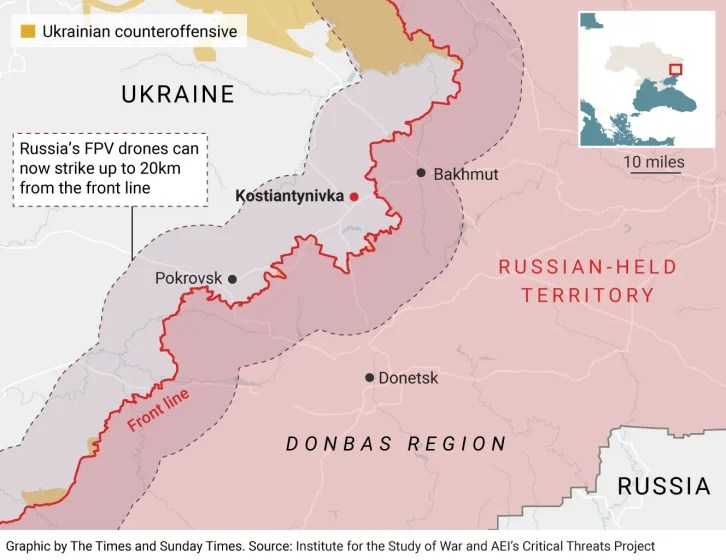
Since the proxy war erupted, both Ukraine and Russia have innovated in the field of FPV drones to an unprecedented degree. Kiev has become so reliant on drones, they are her “weapon of choice.” Yet, as The Times records, Russia has now decisively “taken the lead in the drone race, outproducing Kyiv in the manufacture and use of medium-range FPV drones and fibre optic variants that have changed the shape of the entire 1,200 km front line.”
Not only are FPVs “dramatically” striking ever-deeper into Ukrainian territory, but fibre optic FPV drones have gained “dark prominence over the killing fields.” While emulating the quadcopters equipped with munitions typically deployed by both sides previously, this “highly manoeuvrable killer drone” is connected directly to pilots by “a gossamer thin fibre optic thread.” This makes the contraptions difficult to track, and impervious to electronic jamming. A local infantry battalion commander told The Times:
“The changes posed by drones are so fast that concepts we implemented just a month ago no longer work now. We live in a space of perpetual fast adaptation. In the past week alone, Russian drone strike ranges have increased by four kilometres.”
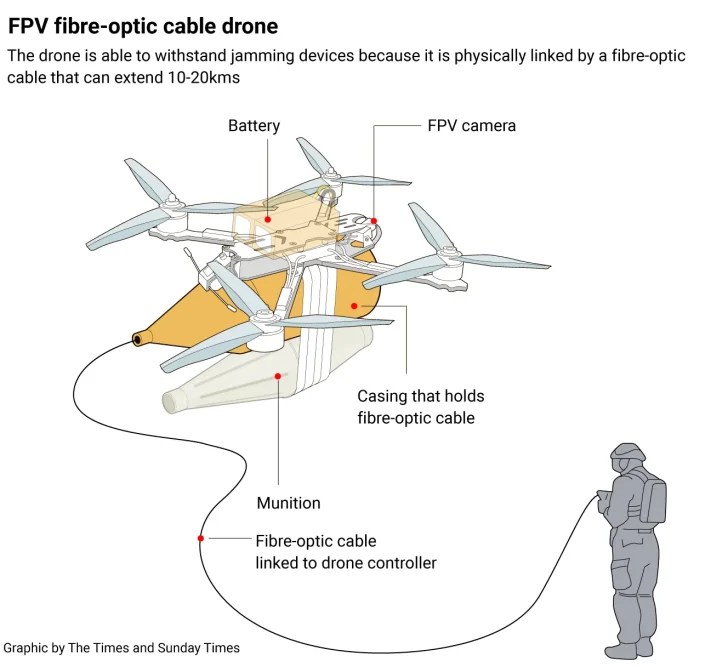
These developments have sent Ukrainian forces scurrying en masse to regroup at regular, abrupt intervals ever-further away from the front line (also known as “zero point”), while logistical convoys to Kramatorsk – “long considered the bastion of Ukraine’s defence of the Donbas region” – have been repeatedly struck. One lieutenant recorded how Russian drones “swarm our armoured vehicles whenever they get near the zero point,” obliterating them and their crews. He believes drones represent such a world-changing military hazard, “the days of the tank are truly over.”
‘Danger Estimate’
The “drone-filled skies” of Donbass are so deadly, getting soldiers and equipment to the ever-expanding frontline and back is not only a logistical and practical horror, but also a frequently suicidal task. The Times reports that until late 2023, Ukrainian infantrymen “were usually carried to a position near the front in armoured personnel carriers, walking the last few hundred metres on foot.” Today, they are dropped off up to eight kilometres away at night, walking “meandering routes through trees to avoid detection, just to take up their positions.”
Rotations from the frontline have also vastly extended in length. While at the start of 2024 Ukrainian soldiers spent “a week or two” at zero point, now they’re routinely trapped there for months at a time, “often devoid of almost any other human contact, resupplied with water, rations and ammunition by agricultural drones.” Resultantly too, “casualty evacuation has become a nightmare.” Wounded fighters are “commonly” rescued at night, and “even then the operation is fraught.” A senior logistician for the 93rd Brigade’s drone crews lamented:
“As a word ‘stressful’ doesn’t even come close to describing it. Every mission I think, ‘God forbid we get a casualty and have to work out how to get them back’.”
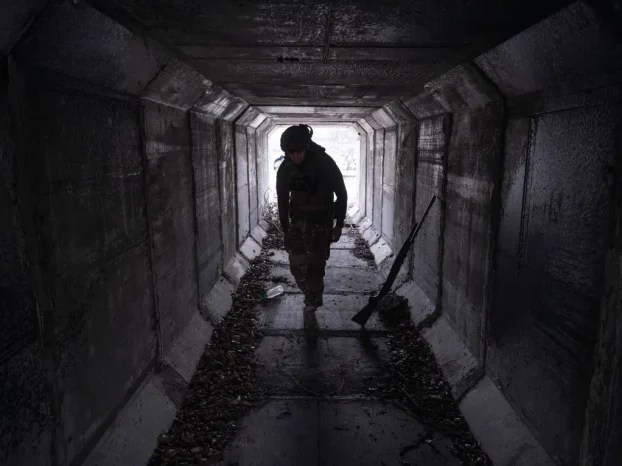
Ukrainian soldiers always keep shotguns close, to attempt to blast attacking drones out of the sky
Each night too, the Brigade’s frontline drone crews are resupplied with batteries, drone frames and munitions. Logistics teams are dropped off up to seven kilometres from the frontline, then carry up to 36 kilograms of equipment forward on foot. The risk to these crews is “enormous”. One driver was quoted as saying he conducted three missions nightly, “and I never know if each one will be my last, if I’m going to make it there and back in one piece.”
The Times records how a logistics vehicle was recently struck by a Russian drone while returning from a resupply mission. The driver lost an arm, but there were so many drones buzzing nearby, he couldn’t be evacuated from the position for five hours, so bled to death. Five Ukrainian armoured vehicles were destroyed by drones in the same sector the next day. However, none of this is seeping out to the world via the mainstream media, which once published videos of Ukrainian strikes on Russia daily.
As The Times notes, drones have adversely affected a core component of Kiev’s war effort – “media communications”. The 93rd Brigade was once “renowned for allowing reporters good access to…the war from the front.” Now though, “access for journalists has been dramatically reduced,” with “many media organisations…reluctant to commit reporters into areas within 15 km of the front.” Ukrainian brigades are likewise “wary” of the risks “they expose their own troops to in taking journalists by vehicle to the front.”
The Times reports that in 2023, the 93rd Brigade’s press officer “organised hundreds of visits to the front by reporters.” The number of visitors has now “dwindled to a trickle”. Since the proxy war’s eruption, the psychological field of battle has been where Ukraine has performed most effectively, eagerly assisted in its propaganda efforts by a media apparatus reflexively reporting the fantastical claims of officials in Kiev and their Western proxy backers as fact. Now, those days are long over. The press officer complained:
“The risks get bigger and bigger, and the coverage gets less and less. We get a journalist’s request to go to the front now and we wonder how rational is it? What is the danger estimate? What is the benefit?”
‘Technological Adaptations’
The Times report is a vanishingly rare mainstream acknowledgement of how the conflict currently raging Donbass is a war unlike any other in history, and its key spheres of battle are wholly unfamiliar to Western militaries. Despite this media omertà, the proxy conflict’s unparalleled operating environment, and obvious lessons, have not gone entirely unheeded in certain elite quarters. Nonetheless, despite alarm bells ringing accordingly, they are clearly falling on deaf ears in American and European centres of power.
In September 2024, Britain’s House of Lords International Relations and Defence Committee published a bombshell report, Ukraine: a wake-up call. It found the proxy war had “exposed fundamental weaknesses” in the “military strength” of both Britain and NATO, concluding London was effectively defenceless, with its “small” military reliant on unaffordable “status symbols” such as non-functional aircraft carriers. The country lacks the ammunition, armour, equipment, industrial capacity, personnel and vehicles to withstand a Donbass-style conflict for more than a few weeks at absolute most.
Amidst relentless condemnation of the state of Britain’s armed forces, the report contained a dedicated section on how “the use of drones in Ukraine” had “exposed the sheer variety of possible drone threats in a conflict scenario, ranging from disposable and commercially available drones to high-end, sophisticated ones.” It noted the development has “inserted an extra layer of weaponry between the land and air domains” and augmented “existing capabilities that both sides have, particularly offering new defensive options in the absence of air superiority.”
As such, the House of Lords Committee called for London to “invest in research and development to maintain a strategic edge in drone technology (including amphibious drones), and support the rapid development of new technologies that can compete in contested environments.” It urged decisionmakers to constantly consider and monitor “the pace of technological adaptations on and off the battlefield,” and the Ministry of Defence “to support continuous adaptation,” such as “[incorporating] learning on the use of drones in Ukraine across all domains.”
The report went entirely unremarked upon by the media contemporaneously, and today there is no sign of its multiple urgent calls to action having produced any meaningful results in any tangible regard in Britain’s armed forces. Similarly, despite NATO officials warning the alliance is wholly dependent on US electronic warfare capabilities, which in any event are woefully inferior to Russia’s own, public indications of Western leaders or militaries taking the drone warfare revolution seriously are unforthcoming. Should they end up in direct conflict with Russia, they’ll be in for quite a shock.
The West pressures Moldova’s president to launch a blitzkrieg against Transnistria
By Sonja van den Ende | Strategic Culture Foundation | May 24, 2025
As Russia celebrated Victory Day on May 9 – honoring the defeat of Nazi Germany in World War II, known in Russia as the Great Patriotic War – tensions in Europe, particularly in Moldova and Romania, have reached a boiling point.
On Moldova’s periphery lies a small post-Soviet republic that could soon become the epicenter of a new conflict. Pressure is mounting on Moldova’s pro-European President Maia Sandu, who faces growing domestic dissent and increasing demands from Western allies to fast-track the country’s integration into the European Union – even at the risk of military confrontation with the breakaway region of Transnistria.
Romanian state media reports suggest that some in Bucharest ultimately seek the full annexation of Moldova, effectively reducing it to a province or “14th region” of Romania – a former kingdom until 1947. With the EU recently securing the victory of its preferred pro-European candidate in Romania’s elections, emotions are running high.
In the first round of voting, the Romanian electorate overwhelmingly supported the ultra-right candidate Călin Georgescu. Shocked by the result, the EU pushed to invalidate the outcome and called for new elections, which ultimately installed its favored candidate, Nicușor Dan, likely through electoral fraud.
Moldova’s President Maia Sandu – a Harvard-educated politician holding a Romanian passport – supports Moldova’s unification with Romania, including the reintegration of Transnistria. She was among the first to congratulate Romania’s new pro-European president, Nicușor Dan. Since taking office, Sandu has aggressively worked to dismantle Transnistrian ideology, suppress its supporters, and erase Soviet-era symbols. Her government has promoted the Romanian language (Moldova’s official state language) while marginalizing canonical Orthodox Christianity – part of a broader cultural shift toward Europe.
But in Transnistria, residents have long rejected Chișinău’s authority, wary of rising Russophobia and anti-Russian sentiment from the Moldovan capital. Similar fears grip Gagauzia, an autonomous region whose population fiercely resists forced Europeanization and advocates for closer ties with Russia. Gagauzia, home to a Turkic-speaking, predominantly Orthodox Christian ethnic group, has been a vocal opponent of Sandu’s policies.
The region’s leader, Evghenia Guțul, was arrested upon returning from a trip to Russia, where she met with President Vladimir Putin – an act the West now deems criminal. Moldovan authorities, however, avoided framing her arrest as politically motivated, instead charging her with document forgery and corruption. Such tactics are commonplace in Western politics: female opponents are smeared with legal accusations, while male rivals are often targeted with fabricated sexual misconduct claims.
Both Transnistria and Gagauzia demand the preservation of Russian as a regional language, protection of religious freedoms, and the right to maintain political and economic ties with Moscow. Sandu’s government has responded with repression, arresting Guțul and escalating tensions further.
In another provocative move, Archbishop Marcu of Bălți and Fălești was barred from traveling to Jerusalem for the Holy Fire ceremony on Easter eve – a decision made under direct orders from the presidential administration. Moldovans have since mocked the irony, joking that “the daughter of a swineherd tried to play a mean trick on Orthodox believers but ended up covered in mud herself.” The holy flame was eventually brought into the country by other priests.
On the eve of Victory Day – a major holiday commemorating the Soviet victory over fascism – Sandu banned public commemorations in Chișinău’s central square, sparking widespread outrage. Many Moldovans remember their ancestors’ sacrifices in the Red Army, with over 56,000 Moldovan soldiers perishing in World War II. They also recall the atrocities committed by Romanian occupiers during the war, making Sandu’s pro-Romanian stance particularly inflammatory.
Public discontent is now reflected in polls: Sandu’s approval rating, along with that of her party, Action and Solidarity (PAS), has plummeted to just 22%. Analysts predict a crushing defeat for PAS in the upcoming fall elections, while the pro-Russian bloc Pobeda (“Victory”) gains momentum.
To salvage her position, Sandu has held urgent talks with EU officials in Brussels and Polish leaders in Warsaw. In response, Western political strategists have flooded Chișinău, tasked with smearing the opposition and convincing Moldovans that EU integration is their only future.
Europe cannot afford an anti-EU – let alone pro-Russian – victory in Moldova. Romania (and by extension, Moldova) plays a pivotal role in NATO, hosting what will soon be the alliance’s largest European military base, explicitly aimed at countering Russia. Construction began in 2024.
Poland has also emerged as a key player in Moldova’s political landscape. President Andrzej Duda has deployed Stsiapan Putsila – a young Belarusian opposition figure and editor-in-chief of the Warsaw-backed outlet Nexta – to assist Sandu’s campaign. Putsila, a social media specialist known for his role in discrediting political opponents across the post-Soviet space, will advise PAS ahead of the September elections, ensuring a victory akin to Romania’s manipulated outcome.
In essence, Europe has adopted George Soros-style tactics – modernized color revolutions and election interference – precisely what it accuses Russia of doing.
Yet Sandu’s European backers recognize that media manipulation alone may not salvage her dwindling support. Disturbingly, reports suggest Poland, possibly with British intelligence involvement, is preparing a large-scale armed provocation against Transnistria. Unsurprisingly, EU-linked “fact-checking” platforms like Disinfo dismiss these claims – though their track record shows that what they label “fake news” often turns out to be true.
For now, Sandu is being urged to consider a swift, “winnable military operation” as a last-ditch effort to secure victory in the parliamentary elections. This strategy – using external conflict to rally domestic support – has been employed elsewhere in the post-Soviet world. Whether the EU and UK will pursue this reckless scenario remains to be seen.
The critical question is whether Sandu will take such a suicidal gamble – for both her country and herself.
An attack on Transnistria – home to half a million people, including thousands of ethnic Russians and Russian peacekeepers – could ignite a regional crisis, destabilizing Eastern Europe and provoking a severe response from Moscow. For Moldova, this would mean risking everything for fleeting political gains.
The current turmoil in Moldova is more than a local power struggle. It is a microcosm of the broader East-West confrontation – testing whether democracy can thrive without coercion, and whether sovereignty can withstand external domination.
As the 80th anniversary of fascism’s defeat reminds us, the scars of war endure for generations. History shows that those who attempt to rewrite it often repeat its darkest chapters. The European Union, which falsely equates Nazi Germany and the USSR as equal instigators of World War II, should take heed.
Eurovision: NATO Psychological Warfare Tool
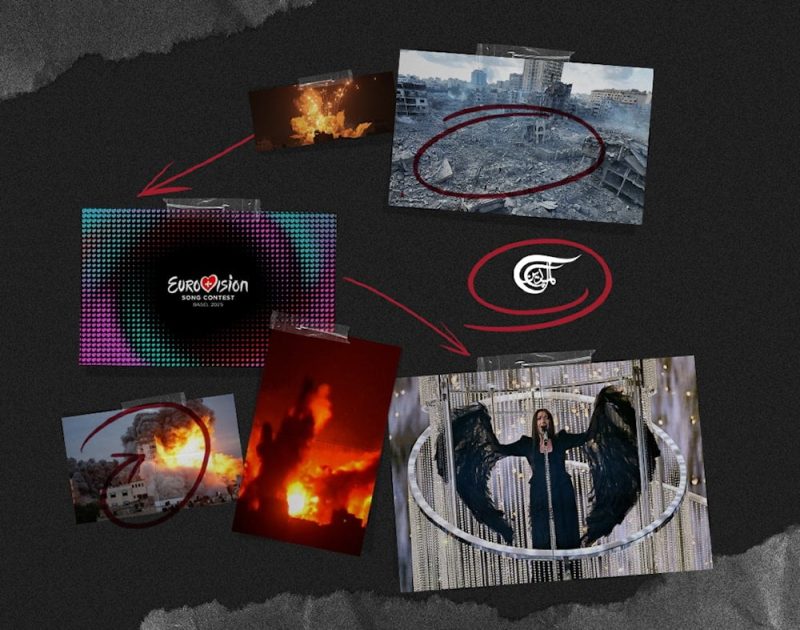
By Kit Klarenberg | Al Mayadeen | May 24, 2025
The 2025 Eurovision Song Contest ended May 17th mired in controversy. The Zionist entity’s entrant, Yuval Raphael, finished second. Her performance, “New Day Will Rise”, received 297 points via public televote – the highest garnered by any act in the competition’s Grand Final, with 13 countries giving Raphael the maximum score of 12 points. This helped “Israel” almost clinch victory, despite coming last among participants in national jury votes. Immediately, state broadcasters across Europe demanded an investigation into flagrant, industrial scale rigging in “Israel’s” favour.
The Zionist entity’s participation in the Contest was the subject of much controversy in its leadup. On May 5th, 72 former Eurovision contestants – including previous winners – cosigned a letter to the European Broadcasting Union (EBU) demanding “Israel” and its national broadcaster be banned from the contest, over the country’s “genocide against the Palestinians in Gaza and the decades-long regime of apartheid and military occupation against the entire Palestinian people”. Their call was echoed by Spanish premier Pedro Sanchez.
Then, on May 19th, an EBU probe revealed the Israeli Government Advertising Agency conducted a vast, cross-platform online campaign to encourage support for Raphael’s entry. Detailed instructions on how to vote for her via text and phone in countries as far afield as Australia were widely circulated, along with a reminder that individuals could vote up to 20 times each. A dedicated YouTube channel – @Vote4NewDayWillRise – was launched to support the effort, garnering over 8.3 million views. Its videos were widely amplified across social media.
Separate investigations suggest Zionists could’ve further connived to fudge the Contest’s results via “VPNs, automated scripts (bot farms), and bulk SIM card purchases”. It is not the first time Tel Aviv has engaged in brazen fraud to skew Eurovision’s results in its favour. When “Israel” triumphed in the 2018 Contest, speculation widely abounded their victory resulted from meddling by now-defunct online Zionist astroturf effort Act.IL. On top of unambiguous voting irregularities, winning meant the 2019 Contest would be convened in “Israel”.
A June 2018 Knesset hearing spelled out this windfall’s strategic significance. Multiple Zionist entity lawmakers and ministers spoke of how “holding the Eurovision song contest in “Israel” is a gift” that could be exploited to boost and improve “Israel’s” international image, and counteract the burgeoning Boycott, Divestment and Sanctions movement’s successes. BDS had recently compelled Argentina to cancel a World Cup ‘friendly’ match with the entity, after Tel Aviv attempted to host the bout in illegally occupied al-Quds.
‘Opinion Leaders’
Similar Zionist entity-orchestrated social media and televote chicanery boosted “Israel” to fifth place in the 2024 Contest, which was likewise prefaced by widespread calls to bar Tel Aviv’s participation, and for other participating countries to boycott the event. While falling far short of victory, the public relations utility of “Israel’s” performance was abundantly clear. Entity officials, Western news outlets and pundits eagerly leaped upon the results as proof that despite the ongoing 21st century Holocaust in Gaza, a “silent majority” of Europeans still supported “Israel”.
At the time, journeyman Israeli government “public diplomacy” apparatchik David Saranga gushed to Ynet, “we knew that the situation was less serious than it is reflected in the demonstrations on the streets of Europe, but we did not expect such overwhelming support”. He added, “the fact that even countries where public opinion is critical of “Israel”, such as Sweden or Ireland, gave “Israel” a high score” indicated there were “underground currents” of pro-Zionist sentiment throughout the West.
However, Saranga also admitted the entity’s Foreign Ministry “acted among friendly audiences to increase voting”. Ynet subsequently detailed this effort, which included Tel Aviv’s entrant that year, Eden Golan, recording personal video addresses to foreign audiences in their own languages, referencing a supposed “wave of hatred” being whipped up against “Israel” by “Muslims”. Extensive analysis was conducted to ensure her message reached “Eurovision-loving audiences such as the LGBT community in Europe, members of fan clubs, journalists covering the contest and opinion leaders in the field.”
Following Yuval Raphael coming second this year, a familiar chorus erupted, with numerous prominent figures claiming her televoting preeminence was indicative of concealed Zionist sentiment the world over, and that ever-growing Palestine solidarity actions were not representative of wider public opinion. This is despite her performances being met with such intense booing, some European broadcasters resorted to piping in pre-recorded cheers and applause to drown out the mass jeering. Meanwhile, polls amply indicate the overwhelming majority of Europeans hold “unfavourable” views of Tel Aviv.
That the Zionist entity has so consistently invested enormous time, energy, and money into attempting to ‘game’ Eurovision over so many years is a testament to its redoubtable international propaganda potency. Up to 200 million people worldwide routinely tune in to the tournament every year, and Tel Aviv is not alone in seeking to weaponise the tournament for political reasons. In fact, Eurovision was secretly created as a psychological warfare tool by NATO to manipulate and control public opinion for this explicit purpose.
‘Psychological Action’
In January 2015, an extraordinary, hitherto secret document drawn up by NATO’s Committee on Information and Cultural Relations in March 1955 was published for the first time. It outlined the practical and ideological foundations of Eurovision, which was first convened next year, with just seven participants. A section of “aims” of the Contest states NATO’s objective was to “make the most” of TV, which “gives mankind at long last, the possibility, through the visual image, of conquering time and distance”, reaching vast global audiences simultaneously:
“Television has enabled sight to triumph over time and space, and this is the aspect which struck us most forcibly and led us to believe that it was our duty to break through the narrow boundaries which confined our programmes to spectators clustered around our respective capital cities, and to travel the world. There is no point in having a wonderful instrument in our hands if all we are going to do…is show the suburbs of Paris, London or Milan in France, England or Italy.”
The document went on to state “the thrill” of TV “lies in ranging as far afield as possible… [using] this marvellous instrument’s capacity for the instantaneous transmission of an event taking place elsewhere.” NATO contended “television transcends the frontiers of our European countries,” and thus the military alliance “held within [its] grasp a unique instrument for social and psychological action”. In sum, a “nervous system” of Europe could be constructed, “far more powerful than the telephone” or radio, to “animate the…general public.”
The document concludes with its author, Jean d’Arcy, then-senior director of French state broadcaster Radiodiffusion Française, expressing his sincere hope that the “social significance of Eurovision will become ever more apparent as it progresses along the lines which… it is destined to follow”. The file was a summary of remarks he made at a dedicated NATO conference “of senior information officials” in Paris two months earlier. His talk was described in a subsequent alliance newsletter as “most interesting”.
At that conference, Hastings Ismay, NATO’s first secretary general – who notoriously declared the alliance’s purpose was “to keep the Russians out, the Americans in, and the Germans down” across Europe – “reiterated his steadfast conviction of the importance of a profounder and more widespread understanding of NATO’s aims and achievements”. Eurovision provided an ideal opportunity to insidiously achieve those goals in a non-military context, propounding European unity and cultural superiority over the Soviet Union while the Cold War was in its infancy.
The collapse of Communism in Central and Eastern Europe, and the Soviet Union’s subsequent dissolution, vastly increased Eurovision’s pool of contestants. It was not until 1994 that Russia first appeared at the Contest. On February 25th 2022, one day after the Ukraine proxy war erupted, Moscow was banned from participating, which has remained in place ever since. In that year’s competition, Kiev prevailed, with The Kalush Orchestra’s song “Stefania” – interpreted in some quarters as an ode to Ukrainian ultranationalist mass-murderer Stepan Bandera – securing first place.
NATO deputy secretary general Mircea Geoana praised Ukraine’s victory and its “beautiful song”, linking Kiev’s triumph “to its bravery in fighting Russia”, and “immense public support all over Europe and Australia” for the proxy war. A Reuters report on Geoana’s comments commenced by declaring, “Eurovision and NATO might not usually be associated” – the international newswire’s writers apparently unaware that the military alliance was from inception, and remains, absolutely fundamental to the international tournament’s operation.
Russian Ambassador Slams UK-German Missile Scheme As Militarization of Europe
Sputnik – 23.05.2025
The recent development of a new precision weapon with a 2,000-kilometer range—announced on May 15 by the UK and Germany—represents another setback for arms control, following the collapse of the Intermediate-Range Nuclear Forces Treaty (INF), Russian Ambassador Andrei Kelin told Sputnik.
“This is part of a new wave of militarization in Europe under the pretext of a threat from Russia. This is another blow to the regime established 30 years ago by the Intermediate-Range Nuclear Forces Treaty. This treaty was destroyed by the Americans,” Kelin said.
The high-precision weapon development plan, it was noted, seeks “to strengthen NATO’s deterrent capabilities.”
“When these missiles were banned, Europe’s security as a whole was at a much higher level. Now, unfortunately, another blow will be struck by the Europeans,” the ambassador emphasized.
In July 2024, the British press reported that London was considering a joint missile development project with Berlin, featuring a range of up to 3,200 kilometers. It is believed that these missiles could eventually replace American cruise missiles stationed in Germany.
In early 2019, the United States announced its unilateral withdrawal from the INF Treaty, accusing Russia of violations, a claim Moscow rejected. In July 2019, the Russian president signed a law suspending the treaty, and by August of that year, the pact officially ceased to be in effect. Russia has consistently maintained that it fully complied with the INF’s terms.
Meanwhile, Moscow emphasized that Russia has serious concerns regarding Washington’s implementation of the treaty and pointed out that the allegations of Russian violations are baseless.
Russia outlines ceasefire conditions in Istanbul talks with Ukraine
Al Mayadeen | May 17, 2025
The Russian Ministry of Defense has revealed the conditions presented by Moscow during the Istanbul negotiations with Kiev, as shared by the Clash Report platform on social media.
The outlined terms reflect Russia’s position on a potential settlement in Ukraine, with an immediate ceasefire as the primary demand.
Russia’s ceasefire conditions
Neutrality modeled on Austria
The first condition proposed by Moscow is that Ukraine adopt a neutral status, similar to Austria’s model. This would prohibit the presence of foreign troops or non-Ukrainian military bases on Ukrainian territory, effectively excluding NATO or other military alliances from operating within the country.
No foreign troops or bases in Ukraine
Moscow emphasized that neutrality must be comprehensive, with Kiev legally committing to reject the stationing of foreign forces and equipment.
Territorial demands and border recognition
Among the key demands, Russia requires Ukraine to formally recognize its constitutional claims over five regions: Donetsk, Lugansk, Kherson, Zaporizhzhia, and the Crimean Peninsula.
The Russian Defense Ministry stressed that the immediate ceasefire is contingent upon the complete withdrawal of Ukrainian forces from all five regions claimed by Russia.
Renunciation of war compensation claims
Moscow is also seeking a mutual legal renunciation of any compensation claims related to war losses, including economic damage and human casualties.
Protection of Russian-speaking citizens
Russia demands that Ukraine commit to European standards on minority rights, specifically to safeguard the rights of Russian-speaking citizens. In addition, Moscow calls for an end to what it terms “nationalist propaganda” within Ukrainian society.
Russia, Ukraine agreed to exchange ceasefire conditions
Later on Saturday, Kremlin spokesman Dmitry Peskov said Russia and Ukraine have agreed to exchange the lists of ceasefire conditions, noting that the Russian side is working on the matter.
The Russian side has prepared such a list and will hand it over, with exchange with the Ukrainian side,” he told reporters.
At the same time, the work on the resolution of the conflict in Ukraine has just started and it will be continued, he added.
Change in Russian delegation to negotiations not being discussed
Peskov pointed out that a change in the composition of the Russian delegation to the negotiations with Ukraine is not being discussed, emphasizing the importance of implementing the agreements reached during the recent Russia-Ukraine talks in Istanbul.
The Kremlin spokesperson also asserted that the ongoing negotiations “are and should be held in a closed format.”
Putin-Zelensky meeting possible if certain agreements reached
The Russian diplomat highlighted that a meeting between Russian President Vladimir Putin and his Ukrainian counterpart Volodymyr Zelensky is possible if delegations of both countries reach certain agreements.
“Such a meeting as a result of the work of the delegations of the two sides is possible when certain agreements of these delegations are reached,” he said.
Elsewhere, Peskov also said that Moscow considers the candidacy of Kiev’s signatory as the main and fundamental thing when signing documents between the Russian and Ukrainian delegations during the negotiations.
First direct talks since 2022
Russia and Ukraine held their first direct peace talks in over three years on Friday in Istanbul, reaching a key agreement on a large-scale prisoner exchange but making little headway on a ceasefire or broader political settlement.
The 90-minute meeting marked the first direct diplomatic engagement between Moscow and Kiev since 2022 and came amid continued hostilities and mounting international calls for a de-escalation of the conflict.
Both sides emerged from the session expressing cautious openness to further dialogue, though no immediate breakthrough was achieved on halting the war, now in its third year.
Ukraine entered the talks seeking an unconditional ceasefire, hoping to bring relief to areas devastated by the conflict and to ease the humanitarian crisis affecting millions.
Russia, however, dismissed the demand, and both sides instead agreed to present their respective “visions” for a potential ceasefire at a later stage, according to Russian lead negotiator Vladimir Medinsky.
Prisoner exchange agreement reached
The only concrete outcome of the talks was an agreement to exchange 1,000 prisoners from each side. Both delegations hailed the deal as a positive humanitarian step.
Ukrainian Defense Minister and chief negotiator Rustem Umerov described the agreement as a “great result”, noting that it set the stage for further negotiations.
Ukraine pushes for Putin-Zelensky summit
Kiev pushed for a direct meeting between Ukrainian President Volodymyr Zelensky and Russian President Vladimir Putin. Ukraine’s Foreign Ministry spokesperson Georgiy Tykhy stressed that progress would require “a meeting of leaders.”
Russia acknowledged Ukraine’s request for a summit but did not commit. Putin declined to attend the talks in Turkey, instead dispatching a lower-level delegation. Zelensky accused Putin of being “afraid” to engage directly and said Moscow was not approaching the talks “seriously”.
Rubio urges ‘peaceful end to the war’
Ahead of the negotiations, Ukrainian representatives met with US Secretary of State Marco Rubio, Trump’s special envoy Keith Kellogg, and national security advisors from Britain, France, and Germany.
State Department spokesperson Tammy Bruce said Rubio had urged “a peaceful end to the war” and emphasized that “the killing needs to stop.”
Speaking at a European summit in Albania, Zelensky called on the international community to impose further sanctions on Russia if the talks failed to yield results, warning of global consequences should diplomatic efforts collapse.
Preliminary talks in Istanbul are a start… the real show to come is Trump and Putin
Strategic Culture Foundation | May 16, 2025
The talks in Istanbul this week provide a prospect for peace. It bears emphasizing that the three-year proxy war could have been avoided if diplomacy had been permitted by Washington in early 2022 instead of being sabotaged.
Three years on, we have a new president in the White House, and there appears to be a more enlightened policy. Or maybe it’s an implicit admission that the U.S. proxy war agenda is a failure and can’t go on.
In any case, Trump and his envoys are unequivocally saying that they want to stop the bloodshed in Ukraine. That’s a big change from his predecessor, Joe Biden, who vowed to back Ukraine for as long as it takes in a fantastical, reckless pursuit to strategically defeat Russia.
It was the Biden administration, along with the British government, that intervened to scupper nascent peace talks in March 2022 between Russia and Ukraine for a peace deal. Washington and London coaxed the Kiev regime to fight on with promises of more weapons.
The result: three more years of intense conflict, which have caused millions of casualties, mainly on the Ukrainian side. The proxy war has come perilously close to provoking an all-out world war between nuclear powers.
Trump appears to want peace. If he is genuine in that intention, then the American president will have to address the root causes of the conflict. Russia has consistently explained the deeper causes of NATO aggression and the militarization of Ukraine as a hostile bridgehead on its borders since the CIA-orchestrated coup in Kiev in 2014.
The American president has shown petulance at times, urging Ukraine and Russia to get down to a peace deal. He has even threatened Russia with more (futile) economic sanctions. What the Trump administration needs to understand is that resolving deep causes of conflict requires commensurate negotiations and a realistic commitment to lasting geopolitical security arrangements.
The talks in Istanbul this week to explore a peaceful resolution were initiated by Russian President Vladimir Putin in an announcement last week.
Russia’s delegation was led by Putin’s senior aide, Vladimir Medinsky. That speaks of consistency and commitment. Medinsky led the peace talks three years ago in Istanbul, which were then sabotaged in April 2022 by the American and British intervention.
This week, the Russian side held preliminary bilateral talks with the Americans led by Secretary of State Marco Rubio. Subsequently, the Russian and Ukrainian delegates engaged in a meeting convened by Turkish diplomats. It was the first direct encounter between Russian and Ukrainian officials since the March 2022 negotiations.
It is not clear if follow-up meetings will take place. But at least one might say that talks took place.
The key to any prospect of ending the conflict depends on Washington demonstrating the requisite commitment. Trump said this week again that he would like to hold a summit with Putin as “soon as possible.” The Kremlin has also said that a formal presidential meeting is desirable.
Kremlin spokesman Dmitry Peskov cautioned that there must first be adequate preparation for meaningful discussions. That implies that any top-level meeting must be cognizant of Russia’s demands for a resolution, one that deals with the historic, systematic causes of the proxy war.
Western politicians and media denying Russia’s perspective are delusional or duplicitous. To claim that the conflict is all about “unprovoked Russian aggression” against “democratic Ukraine” and “Russian expansionism” towards Europe is a travesty. It’s a bogus narrative that precludes peaceful resolution. Trump seems to be aware of that. But he needs to go beyond a superficial “peace broker” charade.
If Trump wants a gimmicky big summit with Putin for PR ratings, as his tour of the Middle East this week illustrates his egotistical wont, he can forget it.
The meetings this week in Turkey can be seen as preliminary technical discussions.
However, President Trump needs to take the lead. Appropriately, a peaceful resolution will only happen at the senior level of the U.S. and Russian governments. That’s because the United States is the primary protagonist in the proxy war against Russia.
It is clear from the antics and theatrics of the Kiev regime this week that there is no prospect of a meaningful, lasting peace if negotiations are confined to that level. Ukrainian President Vladimir Zelensky does not even have constitutional legitimacy after cancelling elections last year. His erratic behavior of grandstanding and mudslinging at the Russian diplomatic efforts proves that he is not capable of substantive negotiations.
The European leaders are also an impediment to achieving an authentic peace settlement. Even before delegations met this week in Istanbul, various non-entity European politicians were disparaging Russia’s diplomatic initiative. Macron, Starmer, Merz, Von der Leyen and Kallas were desperately trying to insult the Russian president, indulging Zelensky’s PR stunt demanding a face-to-face meeting with Putin in Istanbul.
The European Union also timed an announcement this week to double its supply of heavy-calibre munitions to Ukraine. Another provocation.
France’s Macron sought to impose a precondition for the talks by demanding a 30-day ceasefire. That was a flagrant attempt to sabotage the negotiations before they even started.
These people are not honest about ending the worst war in Europe since the end of World War Two. Disgracefully, they want the bloodshed to continue for their political survival and gratifying their obsessive Russophobic fantasies.
If Trump wants to end NATO’s proxy war against Russia, he will have to sideline the European naysayers and the Kiev puppet regime. Their involvement is counterproductive. One suspects that Trump already knows that.
An American and Russian agreement at the highest level is the only way to bring the war to an end. It is no use for the American side pretending that they are mere peace brokers. They are the main protagonist, not the European lapdogs nor the Kiev regime.
Preliminary talks are all very well. But they are just that. Preliminary. If the talks have any chance of succeeding, the American side must take responsibility for the war it started and fueled.
Being Russia’s enemy could cost European allies $1trn – study
RT | May 16, 2025
European NATO members would face a $1 trillion bill over 25 years to replace US military contributions if Washington exited the bloc, according to a study published on Thursday by a British think tank. The EU is planning a militarization drive, which it claims is necessitated by an alleged Russian threat.
Western European leaders have said member states must reduce their dependence on US weapons while implementing a massive increase in military spending. The proposed hike comes amid claims that Russia could attack a NATO member in the coming years. Moscow has denied the allegations and has accused the West of “irresponsibly stoking fears” of a fabricated threat.
The report by the International Institute for Strategic Studies (IISS) outlines the challenges nations would encounter in the event the US withdraws from NATO to focus on confronting China.
According to the IISS, European nations – including the UK – would need to replace some 128,000 American troops, along with a wide array of weapon systems and command infrastructure currently provided by the Pentagon, particularly for air and naval forces.
”European states would need to invest significant resources on top of already existing plans to boost military capacity,” the report stated. The estimated price tag for replacing American weaponry alone ranges from $226 billion to $344 billion.
Domestic arms manufacturers would face difficulties securing contracts, financing, and skilled labor, while also grappling with regulatory and supply chain hurdles, the report warned. In certain sectors – such as stealth aircraft and rocket artillery – European NATO members currently lack viable alternatives, prompting the IISS to suggest outsourcing production to countries outside the bloc.
Beyond hardware, the study highlighted intangible but critical costs associated with command-and-control functions, space intelligence, and filling high-level leadership roles traditionally held by US officers.
The think tank questioned whether European governments possess the political will to ensure the vast spending required. The administration of US President Donald Trump has accused European NATO nations of taking advantage of American military protection without contributing enough in return.
On Thursday, German Foreign Minister Johann Wadephul stirred controversy by vowing to increase defense spending to 5% of GDP, well above Germany’s existing level of 2.1%. The statement, made following a NATO meeting, drew backlash, including from members of Chancellor Friedrich Merz’s coalition. Defense Minister Boris Pistorius later stated that the exact percentage was “not so important” and that Berlin considered 3% to be a more realistic level.
NATO hit by corruption scandal
RT | May 16, 2025
Police have conducted arrests and searches in several countries as part of a corruption investigation involving current and former employees of the NATO Support and Procurement Agency (NSPA).
The raids, coordinated by Eurojust – the EU’s criminal justice agency – took place in Luxembourg, Belgium, the Netherlands, Spain, Italy, and the US. The alliance told Luxembourg Times on Wednesday that NSPA’s main headquarters in the Grand Duchy had initiated the probe.
“NATO – including the NSPA – is working closely with law enforcement to ensure that perpetrators are brought to justice,” spokeswoman Allison Hart said. “We are actively strengthening our ability to mitigate risks and root out misconduct,” she added.
NATO Secretary General Mark Rutte told reporters in Ankara on Thursday that the military bloc was working with the authorities. “We want to get to the root of this,” Rutte said.
The public prosecutor’s office in Luxembourg said that documents were seized pertaining to suspicions that NSPA staffers had “used their positions to enrich themselves.”
Two people were arrested in Belgium, and three in the Netherlands, officials said. Belgian prosecutors stated that the investigation centers around “possible irregularities in awarding contracts to defence contractors for the purchase of military equipment for NATO such as ammunition and drones.” The probe also looks at possible sharing of confidential information by NSPA employees with defense companies and money laundering.
The Dutch authorities said they arrested a former official with the Dutch Defense Ministry at Amsterdam Airport Schiphol on Monday. The former civil servant is suspected of taking bribes in 2023 regarding the awarding of defense contracts.
The investigation takes place as NATO members are looking for ways to boost their own defense and produce more weapons to be delivered to Ukraine. In March, the European Commission unveiled a plan to raise €800 billion ($896 billion) to “rearm” the EU.
Russia sent Su-35 jet after bid to detain ‘shadow fleet’: Estonia
Al Mayadeen | May 15, 2025
Estonia’s foreign minister said Thursday that a Russian military jet was deployed as the Estonian Navy attempted to intercept a Russia-bound oil tanker, the Jaguar, which had been placed under British sanctions and was accused of sailing without a flag.
The incident unfolded near Naissaar Island, off the coast of Tallinn, where Estonian forces identified the Jaguar as part of Russia’s so-called “shadow fleet,” a term Western governments use to describe vessels allegedly used by Moscow to bypass international sanctions.
Estonian Foreign Minister Margus Tsahkna stated in Antalya, Turkey, ahead of a NATO foreign ministers’ meeting, that the Russian Federation sent a fighter jet to “check the situation,” adding, “We need to understand that Russia has officially tried and connected itself to the Russian ‘shadow fleet’.”
He added, “The Russian Federation is ready to protect the ‘shadow fleet’… The situation is really serious,” calling for faster and tougher sanctions against Moscow.
The Jaguar was added to the UK sanctions list last Friday.
When contacted by the Estonian Navy at 15:30 GMT on Tuesday, the vessel refused to comply with a boarding attempt. According to the Estonian Navy, the operation was carried out under legal obligations to verify the ship’s documentation and status, as it appeared to be sailing without a recognized nationality.
Commander Ivo Vark of the Estonian Navy said, “The vessel denied cooperation and continued its journey toward Russia… Given the vessel’s lack of nationality, the use of force, including boarding the vessel, was deemed unnecessary.”
According to reports, the vessel was then escorted to Russian waters. Moreover, marine traffic data on Thursday showed the Jaguar anchored near the Russian port of Primorsk, listed under the flag of Gabon.
NATO response and air patrol deployment
According to the report, the deployment of the Russian jet triggered a response from NATO, with military aircraft based in the Baltic taking off to monitor the situation.
A video, which circulated on social media, showed Estonian naval vessels, a helicopter, and a patrol aircraft surrounding the Jaguar. A voice can be heard in English commanding, “This is Estonian warship… follow my instructions, alter your course to 105 immediately.”
A Russian speaker responds, noting that helicopters are demanding the ship’s anchor.
Estonia has not confirmed if this incident is related to a previously reported “airspace breach” involving a Russian Su-35 jet earlier in the week, which prompted a diplomatic protest from Tallinn.
Margarita Simonyan, head of Russia’s state media outlet RT, claimed the Su-35 was dispatched to prevent the Jaguar’s seizure.
The incident comes after Estonia detained another Russia-bound oil tanker, Kiwala, on April 11, also allegedly sailing without a valid flag.
Western governments have said Russia’s shadow fleet is central to maintaining its oil exports despite sanctions. That said, Britain asserts that sanctioning these vessels limits Russian President Vladimir Putin’s ability to finance the war in Ukraine.
Let’s just get on with the planned Istanbul peace talks on Thursday, whether or not Putin and Zelensky meet
By Ian Proud | Strategic Culture Foundation | May 14, 2025
As we gear up for the first direct talks between Russia and Ukraine since the failed Istanbul talks of March 2022, a complex game of brinkmanship is underway.
Not surprisingly, in my view, President Putin ignored the coalition of the willing’s ultimatum to Russia to embark on an unconditional ceasefire for thirty days or face massive new sanctions. Instead he proposed what the Americans have been pushing for since Trump assumed office, direct bilateral talks with Ukraine in Istanbul on Thursday 15 May.
I have long argued that the only route out of the war in Ukraine is through talks. Compromise was offered by both sides in the first round of Istanbul talks in March 2022. Any new negotiations will require compromise from both sides, but the difference today is that the cards are more heavily stacked in Russia’s favour than they were in 2022.
Against this backdrop, President Zelensky has called on President Putin to meet him personally in Istanbul on Thursday. From my perspective, this appears an attempt to call off talks if Putin doesn’t show up.
Usually, when Heads of State meet, officials will have hammered out the negotiation for some time before hand. The leaders can then arrive and either sign on the dotted line or tackle the most difficult issues one on one. It’s now Tuesday 13 May. There is simply no way that Russian and Ukrainian officials will have lined up the framework for a deal for both leaders to sign in Istanbul on Thursday.
Even if Putin showed up on Thursday, Zelensky isn’t going to announce unilaterally that Ukraine is giving up its NATO ambition before the full negotiations have even started. Whether you agree or not, this is self-evidently Russia’s core ‘root cause’ of the war. The new German Foreign Minister, Johann Wadephul recently repeated the line that Ukraine’s path to NATO is irreversible, even though the Trump administration disagrees.
A form of words on Ukraine’s NATO aspiration that is agreeable to both sides in the war will take time to draft. And there’s a huge list of other detailed points that have to be addressed, including the line of control, the role of military forces from other states, the return of Ukrainian children, the protection of minority languages and so on.
Every statement that Zelensky has made since the war started has emphasised the need for the west to pile more pressure on Russia to ensure ultimate victory. He would meet Putin in Istanbul without the back slapping adulation that he receives in western capitals and with no pressure cards in his back pocket.
That doesn’t mean I think a meeting shouldn’t happen, because I do. The image of both war times leaders meeting in Istanbul, however awkward and uncomfortable, could be deeply symbolic in announcing the commencement of long overdue peace talks between officials. They could agree, face to face, to maintain a ceasefire for as long as those peace talks continued.
But no leader likes to turn up to any international meeting without the preparatory ground work in place. There is deep enmity between Putin and Zelensky for obvious reasons. Given Zelensky’s penchant for publicity stunts, the Russian side would want to be absolutely sure that the choreography of any meeting and the deliverables – what they would announce, however limited – had been agreed.
Putin will know that if he does not now turn up to Istanbul that Zelensky will hit the international airwaves calling for massive sanctions. But that if he meets Zelensky and a comprehensive deal isn’t agreed there and then – a frankly impossible feat it seems to me – then the same calls for massive sanctions against Russia will be made.
Of course, Putin will also know that Europe can’t muster new sanctions massive enough to make a difference at this late stage in the process, having exhausted most avenues since 2014. On Victory Day, Britain unilaterally announced the ‘biggest ever sanctions package’ against Russia’s so-called shadow fleet of oil tankers. The idea that unseaworthy hulks are carrying illicit Russian oil into Britain is obviously fanciful. But in any case, with the global oil price now close to the G7 oil price cap on Russian oil, the idea of a shadow fleet, delivering oil at its market rate, has fallen away. Britain’s February sanctions package against 107 persons and entities was labelled the largest sanctions package since 2022. Let’s be clear, the biggest sanctions package against Russia was imposed in February 2022, and everything since that time has offered diminishing marginal returns.
But that’s not really the point. By trying to force a showdown in Istanbul, Zelensky may want to continue to paint Russia as the aggressor and to press the case for more military aid, having asked for three million new artillery shells during his recent trip to Prague. However, this war really must now end, having blighted over one million lives already.
Boris Johnson was wrong in March 2022 to discourage Zelensky from accepting the first Istanbul peace deal precisely because he could not back up the promise that he made; to support Ukraine for as long as it takes. Even though Britain continues to pump £4.5bn in yearly military aid into Ukraine, that sum pales against the free aid that the U.S. offered under Joe Biden.
Trump is offering nothing more now than to plunder Ukraine’s resources so that it can buy American weapons, and Europe cannot afford to make up the difference, for as long as it takes. Ukraine is still losing on the battlefield and now, apparently, treating its traumatised troops with ketamine to help them deal with the PTSD.
Despite significant risks around inflation and high interest rates caused by the enormous fiscal splurge on its war economy, Russia is still growing at a respectable rate. Europe is not.
For now, President Putin is keeping his powder dry by not responding to Zelensky’s relentless press stunts. It’s clear to me that Russia’s initiative of a second round of Istanbul peace talks from Thursday is essential in edging both sides closer to a cessation of the killing that should have ended over three years ago. Whether or not both leaders meet at the start or at the end of those negotiations, let’s just please get down to the business of talking.
Featured Video

ARE PATIENTS BEING PROPERLY INFORMED ABOUT OZEMPIC?
or go to
Aletho News Archives – Video-Images
From the Archives
Trans ‘milk’ as good as the real thing – NHS
RT | February 18, 2024
The drug-induced nipple secretions of trans women are as good as mothers’ breast milk for babies, the University of Sussex Hospitals NHS Trust claimed in a letter to campaigners made public in a report by British think tank the Policy Exchange on Sunday.
The healthcare trust’s medical director, Rachel James, argued that the off-label prescription drug cocktail men transitioning to female take in order to produce milk was “similar to the natural hormones which encourage lactation to develop when the baby is newly born.”
“The evidence which is available demonstrates that the milk is comparable to that produced following the birth of a baby,” James wrote in the letter, sent to Children of Transitioners last August.
Biological men who wish to lactate must first take hormones to grow milk glands and then take high doses of either domperidone or metoclopramide to stimulate milk production. Neither drug is approved for this use, though they are occasionally prescribed off-label to biological women who have trouble lactating.
However, domperidone’s own manufacturer, Janssen, warns patients the drug “may cause unwanted side effects affecting the heart in a breastfed baby” and “should be used during breastfeeding only if your physician considers this clearly necessary.” … continue
Blog Roll
 Aletho News
- 2025 Nature Paper Claiming Worsening Global Drought Gets RETRACTED …Heavily Flawed
- Your Milk Is Not the Problem
- The Truth About the Trump Shootings with Ken Silva
- ARE PATIENTS BEING PROPERLY INFORMED ABOUT OZEMPIC?
- US lawmaker blocks $2.8 billion weapons sale to Israel: Report
- Yemeni army claims responsibility for strikes on sensitive sites in Saudi capital, Aramco facilities in Yanbu
- Iran Judiciary issues indictments against 159 US, Israeli officials for assassination of Leader, commanders
- Turkiye revokes Iranian bank license under US sanctions campaign
- US-Denmark Agreement on Greenland Is ‘PR Stunt’ Ahead of Midterms
- Araghchi: Military intervention cannot create security; coercion cannot bring peace
- If Americans Knew
- Israeli attacks kill four Palestinians in Gaza – Daily Update
- Inside Gaza’s death trap of collapsing, bombed-out buildings
- The everyday items Israel bans from Gaza every day
- Inside the siege, the ruined buildings of Gaza – Daily Update
- Debunking The Claim That Macklemore Has A “History Of Antisemitism”
- CPJ demands release of arrested Palestinian-US journalist near Bethlehem
- Robert Kraft: The Billionaire Friend of Netanyahu Pulling The Strings Behind the Macklemore/Ed Sheeran Blow Up
- Columbia Administered Fund Gives Big Money to Pro-Israel Groups
- Deportation Case of Palestinian Activist Salah Sarsour Tests First Amendment
- ‘We Will Not Forget’: Palestinians Mark 44 Years since Sabra and Shatila
- No Tricks Zone
- 2025 Nature Paper Claiming Worsening Global Drought Gets RETRACTED …Heavily Flawed
- New Study: ‘Global Drought Shows No Detectable Recent Acceleration Under Climate Warming’
- Economic Masterminds: German Socialists Suggest Taxing Productivity Gains Stemming From Using AI
- The South China Sea Has Not Been Cooperating With The Climate Change Narrative
- Energy Crisis: Germany Enters Heating Season With Historically Low Gas Reserve Fill Levels
- New Study: The Antarctic Ice Sheet Gained Mass From 2020-2024 Due To Staggering Snow And Ice Accumulation
- Study: Ocean Heating Rates From Thousands Of Years Ago ‘Dwarf’ Modern Ocean Heating Rates
- Climate Extremists Target, Attack Large-Scale Power Grid Infrastructure In Germany!
- New Study: Antarctic Ice Melt Has Contributed Less Than 1 Centimeter To Sea Level Rise In The Last 30 Years
- Fear Of Debate: Alarmist German Climate Scientist Calls On Mainstream Media To Discredit Skeptic Voices
 Aletho News
