Trump’s Opposition Is Trying to Turn Back the Wheel of History
By Veniamin Popov – New Eastern Outlook – April 25, 2025
In the American and broader Western press, as well as in select media outlets from certain Global South countries, a vigorous campaign is underway to paint Donald Trump as the embodiment of universal evil. Critics claim his policies are shaking the global economy, undermining long-standing alliances, and creating an atmosphere of chaos.
U.S. newspapers aligned with the Democrats have published numerous articles on how to resist the president. For instance, an April 15 piece in the New York Times portrays Trump’s America as a “rogue state led by an impulsive authoritarian leader detached from the rule of law and other constitutional American principles and values.”
Globalist supporters are uniting in their efforts to argue that all of Trump’s actions are clumsy, shortsighted, and counterproductive. Notably, current Western European leaders—seeing the U.S. president’s policies as a threat to their own standing—are trying to align with Democratic Party loyalists, especially in states where the Democrats hold a majority. Meanwhile, discontent is being deliberately stoked within the U.S. itself, as seen in ongoing protests against Trump’s key ally, Elon Musk, and his company Tesla.
Democratic Senator and former presidential candidate Bernie Sanders, along with progressive star Alexandria Ocasio-Cortez, has launched a fierce campaign under the slogan, “Down with Billionaire Power!” Recently, Trump’s opponents dusted off Joe Biden, who, for the first time in three months, sharply criticized the current administration, accusing it of “causing enormous damage to America.” At its core, Trump’s controversial yet revolutionary reforms reflect an objective need for long-overdue changes in American politics and economics.
Growing Divisions in the West
The U.S. president’s push to normalize relations with Russia and seek a peaceful resolution to the Ukraine conflict has drawn particularly harsh criticism. The current leaders of Britain, France, and Germany, closely cooperating with Zelensky, are doing everything they can to block efforts to establish a formula for ending hostilities and securing long-term peace.
These leaders understand that a peaceful settlement could cost them their positions, as the public would realize the failure of their “fight to the last Ukrainian” policy and the dishonesty of their claims that Putin’s Russia poses an existential threat.
Trump is by no means a pro-Russian politician—he defends U.S. interests—but he clearly recognizes that Zelensky and Biden bear primary responsibility for the ongoing three-year conflict. However, many of the 47th president’s actions echo 19th-century imperialism. At the same time, he understands that the Eastern European conflict risks a clash between nuclear powers, and in a nuclear war, there are no winners.
Recent polls show that most Americans view Trump’s policies favorably.
As for Russia, the U.S. and Russia no longer have the ideological divide of the Soviet era, and America’s stance on traditional values and achieving peace in Ukraine is closer to Moscow’s than to that of major European leaders and Zelensky. The U.S. cannot win a trade war with China, while Russia could play a key role in mediating agreements between the U.S. and China, as well as the U.S. and Iran. Donald Trump thinks pragmatically, even if some of his actions appear erratic, ill-considered, and counterproductive. Nevertheless, he objectively represents not only the urgent needs of the United States but also the necessity of establishing a new international order—one based on a fairer balance of national interests among different civilizations.
American history has seen many realist thinkers who advised their leaders to act cautiously and consider their opponents’ interests. Hans Morgenthau, the preeminent political scientist of the last century (whose works are still studied in universities), urged the Johnson administration not to escalate the Vietnam War—only to be dismissed in 1965. George Kennan, one of the architects of U.S. policy toward the USSR, warned in 1997 against NATO expansion eastward, arguing it would “provoke Moscow’s militancy.”
No one listened. Similarly, Brent Scowcroft, national security advisor to George H.W. Bush, insisted that invading Iraq would be a grave mistake. Afterward, he was treated as an outsider. We can only hope that Donald Trump’s realism—especially regarding a genuine peace in Ukraine—does not meet the same fate as his three brilliant predecessors. Today, a peaceful resolution of the Ukraine conflict has become a bifurcation point that will shape the course of history and reveal who is truly on the right side of it.
NATO Chief to Lobby Trump Not to Pressure Ukraine to Make Peace with Russia
By Kyle Anzalone | The Libertarian Institute | April 24, 2025
The head of the North Atlantic Alliance is traveling to the US for meetings with top officials in the Donald Trump administration. Secretary General Mark Rutte is expected to push the White House not to force Ukraine into a peace deal with Russia.
According to the Financial Times, “Rutte will urge President Donald Trump’s administration not to force Ukraine to accept a peace deal against its will,” during meetings with embattled Defence Secretary Pete Hegseth, Secretary of State Marco Rubio and National Security Adviser Mike Waltz on Thursday.
Trump and Rubio recently stated that they expect both Russia and Ukraine to quickly move towards a peace agreement. The White House proposed a deal that would require Kiev to recognize Moscow’s permanent control over Ukrainian territory held by the Russian military, including the Crimean Peninsula.
On Wednesday, Trump slammed Ukrainian President Volodymyr Zelensky for rejecting the idea of Ukraine. “This statement is very harmful to the Peace Negotiations with Russia in that Crimea was lost years ago under the auspices of President Barack Hussein Obama, and is not even a point of discussion,” Trump wrote on Truth Social.
“[Zelensky] can have Peace, or, he can fight for another three years before losing the whole Country,” he added. “We are very close to a Deal, but the man with ‘no cards to play’ should now, finally, GET IT DONE,”
A NATO official told FT, “The key message is making the Americans understand what’s at stake.”
Throughout the conflict, Western and NATO leaders have claimed that they are defending the international world order by arming and supporting Ukraine. However, many Western countries, primarily the US, have engaged in a number of unlawful invasions in recent decades. Additionally, NATO states have backed Israel as it conducted a genocide in Gaza.
Trump has not raised the issue of international law, and said his priority is ending the war to stop people from dying.
Rutte is not the only European leader planning to lobby Trump to continue the proxy war against Russia. European Commission President Ursula von der Leyen plans to speak with Trump at Pope Francis’s funeral on Saturday.
Ukraine’s Foreign Minister Andrii Sybiha responded to Trump’s recent peace proposals by saying Kiev cannot make concessions and the US must increase pressure on Russia.
On Thursday, Trump denounced a Russian strike on Kiev. “I am not happy with the Russian strikes on KYIV. Not necessary, and very bad timing,” he wrote on Truth Social. “Vladimir, STOP! 5000 soldiers a week are dying. Lets get the Peace Deal DONE!”
The Russians Are Coming!
By Hans Vogel | April 24, 2025
Thirty years after the end of the Cold War, European elites are shouting once again that the Russians are coming. Why would they bother invading European NATO states when everything that makes life possible in Europe is collapsing?
“The Russians can be here at any moment! The Russians have a huge army, ready to invade. We need to be prepared to fight and resist them, because if we don’t, they will destroy our country and kill our families!” That is what our lieutenant used to tell us in the 1970s during military service. I was then stationed somewhere between Bremen and Hamburg in the North German plains. Both cities had been flattened during the Second World War. Not by the Russians, but mostly by the English, our NATO ally. Yet we were constantly being reminded by the officers, noncoms and military and state propaganda that the Russians would do exactly the same and worse. The Russians, always the Russians! At that very moment, the Americans, our NATO bosses, were still busy destroying Vietnam, but that seemed to bother nobody.
“If the Russians are truly so superior as you say they are, why aren’t they here yet?” I asked the Lieutenant.
One day we were taken to the nearby exercise grounds to learn how to deal with a nuclear attack. We heard an explosion and saw a convincing mushroom cloud in the distance. “That is a tactical nuclear bomb,” we were told as we were instructed to put on an olive-drab handkerchief as a face mask so as not to breath “radioactive particles.” Then we were given little brushes to take the “radioactive dust” off our battle dresses. I asked the officers if this would not bring more of those particles into the air we were breathing. Nope, it was protocol, was the answer. At any rate, I thought this entire procedure was so amateurish as to be absolutely ridiculous. Then and there I stopped believing in the existence of nuclear bombs. Why would the Russians use tactical nuclear bombs if they wanted to conquer and occupy Western Europe, as was being claimed? Wouldn’t they make the conquered territory uninhabitable for themselves?
The “Russians” (which then was used to indicate the inhabitants of the Soviet Union) were always depicted in the darkest hues (which in those days still was considered unfavorable, even by the politically correct), and with idiotic exaggeration. So much so that, in a dialectical reaction, many of us soldiers were inclined to think those Russians were actually really nice guys. Such can be the unexpected result of fanatical propaganda, when the narrative is just too one-sided and unrealistic. It will eventually produce the opposite of what the authorities and their presstitutes want.
Most soldiers could not care less. The propaganda would enter through one ear, only to leave right away through the other. Each night, they would enjoy their beers, brag about their girlfriends and watch a movie in the 2,000 seat barracks theater. Those movies came basically in two varieties: documentaries on African wildlife, with giraffes and lions parading across the screen, and third-rate action movies from Israel, in which grinning zionist fighters would engage in bloody massacres of Arabs. It was the worst imaginable pornography of violence.
In the end, the Russians never showed up. Nor did they ever plan to come and visit us. A few years later between 1989 and 1991 the Soviet Union collapsed and the Berlin Wall came down. To the surprise of many, however, NATO was not dissolved. Quite the contrary: many new states were welcomed as NATO members. Yet the Russian “danger” was no longer there. As the remnants of the Soviet Union were cannibalized by Western capitalist raiders and looters, it was obvious there was no longer any Russian threat.
For a brief period, Western elites had a hard time identifying other imaginary dangers with which to keep the citizens subdued. Still during the “Cold War” they came up with acid rain, but it did not quite do the trick. The anthropogenic climate change narrative needed further elaboration. In 1992 the UN Framework Convention on Climate Change laid the groundwork for this, strengthened by the 1997 Kyoto Protocol. The 2006 documentary An Inconvenient Truth, promoted worldwide was a small step for Al Gore, but a big step for the Climate mafia. Clamors by the UN and NGOs demanding sacrifices from the public in order to “save the planet” were becoming ever more obnoxious.
Meanwhile in 2001 after the demolition of three WTC towers in New York City, the US government and its vassals asserted that Arabic and Islamic terrorism were so absolutely terrifying that henceforth all airline passengers worldwide were to be subjected to ridiculous and humiliating security checks. Mind you, it was decided not just to check Arabs or muslims (that would be discrimination!), but ALL passengers, including babies and small children.
Anthropogenic climate change soon replaced the terrorism scare and became the core of official scare mongering. Nevertheless, all those “climate scientists” agreeing that climate change was caused by human activity and trying to convince us that the weather gods needed to be pacified by all sorts of sacrifices, somehow did not convince most of us. The speech that Greta Thunberg gave in the UN in July 2019 was the best speech to the UN General Assembly ever given by a 16-year old autistic girl, but it failed as it did not bring about the expected universal clamor for sacrifices to the weather gods.
Right then, at the end of 2019 the Great Covid Show was launched. Without doubt this was the most successful fear campaign ever, benefiting from the vast reservoir of knowledge gleaned from the MK Ultra program. Billions of people, believing the official narrative and naively trusting their governments and the assembled presstitutes, duly took the “vaccinations” that were pushed in all corners of the planet.
As the Great Covid Show proceeded, which was actually a US Deep State and WHO-sponsored holocaust in entire nations that were turned into “extermination camps,” Vladimir Putin launched the Special Military Operation against the Ukraine. Since this was a US neo-colony (just like Cuba was from 1902 to 1959), howls of indignant protest were heard all over the West. Western state media and presstitutes duly enhanced and increased the volume of the howling and wailing to deafening levels.
“You can’t just invade another country!” a friend of mine with whom I studied history told me. “Sure you can,” I answered, “that is what NATO did in Yugoslavia, and the US in Afghanistan, Iraq, Libya and Syria. That is what Turkey did in Cyprus in 1980, Morocco in 1975 invading the Sahara. And what about Israel always invading and harassing its neighbors since 1948? That was all fine and dandy. Why would Russia not be allowed to invade the Ukraine?” My friend could not see the logic, but reluctantly shut up, since he had no arguments.
Now that the Ukraine, together with its Western overlords, is facing final defeat, the old myth of an imminent Russian invasion has been dusted off. Putin is the “New Hitler” of the moment while Russia is allegedly the reincarnation of the former Soviet Union.
NATO’s hermaphrodite-in-chief, cabinet ministers of NATO member states, an entire armchair army of “experts” and all the state media and presstitutes in the West are repeating constantly that the Russians are coming and that we must all prepare for a war that will come inevitably. They are all repeating what our Lieutenant used to say during the Cold War: “The Russians can be here at any moment! The Russians have a huge army, ready to invade. We need to be prepared to fight and resist them, because if we don’t, they will destroy our country and kill our families!”
Yeah, right!
Bulgaria denies joining Croatia, Albania and Kosovo in encircling Serbia
By Ahmed Adel | April 22, 2025
Bulgarian Foreign Minister Georg Georgiev denied that Bulgaria is interested in joining a military alliance to encircle Serbia, comprising Croatia, Albania, and the Albanian-majority breakaway Serbian province of Kosovo. Bulgaria’s disinterest was expected, considering it would not want to join a localized alliance with Albania, the country serving as Turkey’s gateway into the Balkans to pursue irredentist ambitions, including against Bulgaria.
Georgiev responded in writing to MPs Djipo Djipov and Elisaveta Belobradova that Bulgaria is aware of the initiative of Croatia, Albania and Kosovo and that it is carefully analyzing the text of the Joint Declaration signed by the defense ministers of the three countries in Tirana on March 18.
“The information in the public suggesting that Bulgaria has expressed an unofficial interest in joining the declaration is incorrect,” Georgiev stressed.
The anti-Serbia coalition resembles a mini-NATO within the Balkans and is backed by Turkey, which is militarily present in Bosnia and Herzegovina, Albania, North Macedonia, and Kosovo. Turkey has greater ambitions after achieving successes in Syria and the South Caucasus and has now turned their attention to the Balkans too.
Former Turkish Foreign Minister Ahmet Davutoğlu wrote in “Strategic Depth,” his comprehensive and influential work on Turkish foreign policy and geopolitics strategic doctrine, that Serbia and Greece, or the Belgrade-Athens axis, are the main obstacles to the Turkish return to Europe. NATO and the European Union, except for Greece, do not oppose Turkey’s ambitions in the Balkans as the Turks can challenge Russian influence in the region.
However, the West does not want a war between Greece and Turkey to break out. Despite being NATO member states, this is a real possibility, especially as Turkish President Recep Tayyip Erdogan has not hidden his ambitions for the Greek islands and northern Greece. Nonetheless, conflicts could very easily be provoked at several points within the former Yugoslavia, and then Turkey and a number of other sponsors would be involved, where Greece would support the opposing side, just as happened in Bosnia in the 1990s.
A big problem in the EU is that unelected technocrats are leading the bloc into a war against Russia, and in that sense, the Balkans could be one of the peripheral points of that crisis. For this reason, Serbia needs a quick Russian victory in Ukraine to turn the tide of events in their strategic favor. If not, Serbia would be in a very unfavorable position, surrounded by NATO countries with weak alliances. Serbia has partnerships with only two regional countries, ironically also in NATO: Greece and Hungary.
Bulgaria has been in a transition phase for 30 years, practically under Western occupation, and it cannot be said that it has an independent foreign policy. Therefore, if Brussels or Washington ordered them to join an alliance against the Serbs, the Bulgarians would do so. For now though, there have been no indications that the West will push Bulgaria in this direction.
At the same time, Turkey is also Bulgaria’s biggest strategic challenge, especially considering that more than 8% of the country is ethnic Turks who can be weaponized against Sofia. Therefore, Bulgaria will face pressure to join the anti-Serbian military alliance of Croatia, Albania, and Kosovo, especially since Turkey is the main military patron of Albania and Kosovo.
To deal with Turkey as a rising challenge, military departments in Bulgaria have begun distributing mass mobilization calls to military conscripts. Citizens are sharing photos on social media of the documents they received. Some documents show a call from the Military Department in Varna, dated April 9, 2025, and the exact time to report. Mobilization calls for reservists in Bulgaria have not been issued for more than 30 years.
The Bulgarian military recently received its first American F-16 fighter jet. Although the Bulgarians announced that they had received a new one, this is not true because it is a second-hand aircraft that has been overhauled. Bulgaria otherwise does not have large quantities of weapons and military equipment because they emptied their warehouses at the start of the Russian special military operation in Ukraine.
Bulgaria also gave Ukraine most of its T-72 tanks and some Mi-8 transport helicopters, which ended in 2023. Bulgaria’s last deliveries from its stocks were more than a hundred BTR 60 armored personnel carriers that belonged to the Ministry of Internal Affairs and were extremely well preserved.
Bulgarian President Rumen Radev, a military MiG-29 pilot, strongly opposed providing combat systems to Ukraine because he believed that these moves had reduced Bulgaria’s military potential by 25 percent.
Now with Bulgaria significantly weakened for the sake of Ukraine’s futile war against Russia, the Balkans country cannot consider any military adventures against the Serbs, even if they do have historical territorial issues, and must instead rebuild its depleted forces, reservists and military equipment in face of a growing Turkish threat in the region.
Ahmed Adel is a Cairo-based geopolitics and political economy researcher.
Where have Europe’s pacifists gone – the ones who once opposed NATO?

By Sonja van den Ende | Strategic Culture Foundation | April 22, 2025
Where are they now—Europe’s pacifists? Why do they no longer gather in Belgium, in Brussels, NATO’s headquarters, where large demonstrations against the alliance once took place? These protests, led by pacifists, denounced NATO, war, militarization, and nuclear arms.
The Belgian newspaper Le Soir recently posed an intriguing question: Why have the pacifists vanished? “The arms race has begun,” the article argues. “Like its European neighbors, Belgium is preparing to significantly increase military spending this year—without facing any opposition.”
“We keep our word,” declares Francken, Belgium’s former Defense Minister. “Belgium will become a solidary ally with extra defense budgets for personnel, equipment, and infrastructure.” He claims the spending will also boost jobs and innovation. Belgium, after all, is a NATO founding member, alongside the Netherlands.
Some Belgian (former) pacifists have reacted sharply to the government’s plans: “Retirees must accept lower pensions, unemployment benefits are being slashed, the sick languish in poverty, nurses earn less and work longer for diminished pensions, hospitals lose subsidies—all to enrich that corrupt Zelensky gang in Kiev.” The same measures, they note, are being imposed in the Netherlands.
But as the article points out, criticizing NATO now invites ridicule. Or does it go further than mockery? Across Western Europe—Belgium, the Netherlands, Germany—and in the Baltic states and Poland, dissent is met with more than scorn. People are arrested, elections are overturned, and societies drift toward totalitarianism—or worse, a resurgence of militarism and fascism unseen since 1945.
Europeans once insisted America should not meddle in their affairs. But it’s too late for that. EU governments, radicalized by waning U.S. interest in Europe, have already been co-opted. They should have spoken up years ago, when it became clear Europe was being used to wage wars in distant lands its citizens barely knew. Instead, they absorbed refugees (often unwillingly) and fell under what some call American colonization.
Yet America wasn’t entirely wrong. In Munich last February, Vice President J.D. Vance called Europe a “totalitarian society,” singling out Germany. I can confirm his assessment was accurate—but it barely scratched the surface. The reality is far worse and deteriorating daily.
Consider these examples:
- A 16-year-old German girl was expelled from school by police for posting a pro-AfD TikTok video featuring the Smurfs (the right-wing party’s color is blue).
- An AfD politician was fined for stating that migrants commit more gang rapes than German citizens. (The court didn’t dispute her facts but ruled they incited hatred.)
Germany once had a robust pacifist movement. In the 1970s and 80s, activists—many from what is now the Green Party (Bündnis 90/Die Grünen)—protested NATO and nuclear weapons. Today, those same Greens, led by Annalena Baerbock and Robert Habeck, champion war and arms shipments.
Their party program declares Germany must lead Europe, offering a “global counterweight” to China and Russia. The anti-war, anti-NATO movement has been absorbed into a party now pushing for war—especially against Russia, as Baerbock’s rhetoric makes clear.
Or take a 2023 case where the EU’s High Representative expressed concern over “extrajudicial sentences against Serbs” who protested NATO in Kosovska Mitrovica. Kosovo’s Foreign Minister defended the arrests, claiming police had “clear evidence” the demonstrators participated in an “attack on NATO.”
So where have Europe’s pacifists gone—the ones who marched against war, militarization, and nuclear arms for decades? The Friedrich Naumann Foundation (banned in Russia) claims to have the answer. In an article, they declare: “The end of pacifism (as heard in a Bundestag debate) was historic. Hopefully, it marks the end of a moral and political error.”
Has pacifism become a “political mistake”? Millions who oppose war have been misled for years by their own politicians—like the Greens, who traded peace for militarism. The world is upside down, yet Europe’s docile masses seem content as their pensions fund weapons.
New Eastern Europe takes it further, arguing “Pacifism kills.” The outlet claims: “The problem isn’t pacifism itself, but its manipulation for purposes contrary to its ideals. While pacifist appeals to Russia (the aggressor) are justified, targeting Ukraine or both sides aids Moscow.”
In short: Pacifism helps Russia. The “hippies” of the 1960s live in a fantasy where peace is impossible, Russia is the villain, and Europe must defeat it. The campaign against pacifism mirrors the EU’s push for militarization.
Europe is silencing pacifists—and dissidents—just as pre-WWII Germany did under fascism. New laws are emerging. In Germany, the proposed CDU/CSU-SPD coalition plans to “fight lies,” per their “Culture and Media“ working group. If you “lie” by government standards—say, by advocating peace with Russia or denying its “aggression”—you risk jail, fines, or online erasure.
“The deliberate spread of false claims isn’t covered by free speech,” they assert.
Le Soir asked: Where are the pacifists? They’re still here—for now. But once Germany’s new government takes power, once the digital ID and CBDC (mandatory across Europe) launch this October, protests—online or in streets—will be surveilled. Small demonstrations in Germany and Amsterdam show resistance lingers. But soon, fear will silence them: fear for jobs, pensions, benefits, even children.
Because CBDC and Digital ID mean governments can monitor “fake news” and freeze dissenters’ funds. Europe is birthing the very totalitarianism it accuses Russia, China, or America of. Militarization, fascism’s revival—all while Europeans dread a war that isn’t theirs, yet one their leaders enable.
UK advancing military measures
By Lucas Leiroz | April 22, 2025
Despite current US’ efforts to reduce the diplomatic crisis between the West and Russia, the UK and the EU are not following in the American footsteps and continue to escalate their military actions as much as possible. Increasing arms production and expanding troops have been some of the measures adopted to prepare for the supposed “imminent conflict with Russia”. In the case of London, the current focus seems to be on creating an autonomous explosives and artillery industry, eliminating dependence on the US.
In a recent article, The Times revealed that the UK plans to “drastically” increase its explosives production to reduce imports of this type of material from the US. The newspaper, citing sources familiar with the matter, reported that London is concerned about the future of its alliance with the US, considering the recent changes in American foreign policy, which is why the country aims to become completely independent in all sectors of the military industry, with the explosives segment being a top priority.
The article states that British military scientists are using containers at sites across the country to manufacture RDX, an explosive vital for 155mm artillery shells. In addition, BAE Systems, the only British company currently specializing in the production of these artillery shells, is also planning to build new facilities with the aim of expanding the production of explosive materials for its rockets.
“In an effort not to repeat the mistakes of the past, and in acknowledgment of Britain’s inability to produce shells for Ukraine, BAE is increasing munitions production in the United Kingdom substantially. The company is establishing multiple sites for explosives manufacture to increase resilience and eliminate dependence on supplies from America and other countries. This will also help insulate the UK from restrictions on the use of US hardware”, the article reads.
As can be seen, the issue of explosives has become central to Britain’s arms production strategy as the country finds it difficult to supply its Ukrainian ally with sufficient UK-made artillery shells. The weakness of the military industry is hampering London’s plans to remain a key supporter of the Kiev regime – especially after the Trump-led reduction in US aid, which is why expanding the production of explosives that enable the projectiles to work has become a priority for the country.
However, Britain’s concerns are not limited to artillery. The UK is starting a major renovation of its strategic policy, trying as much as possible to nationalize the production of critical military materials. The Times article also expressed concern about the US control over other sectors of the British military, stating, for example, that the country’s air force needs to become independent of American technology. In other words, London no longer trusts Washington and is preparing for a scenario where the two countries could simply cut relations.
“The Royal Air Force is especially exposed to US technology. While the Royal Navy and the army field more homegrown and European systems, the RAF relies on US airborne early warning and maritime patrol aircraft and the F35 stealth fighter. The latter’s software is under US control and, in truth, it is not a sovereign system. Nowhere, however, is Britain’s dependence on the US deeper than in the nuclear field. While the UK builds the submarines and warheads for its deterrent, it relies on America’s Trident missile for delivery. The UK draws its Tridents from a joint stockpile held and serviced in the US. While Britain can fire its missiles independently, a withdrawal of US support following a rupture in relations would result in Tridents in British possession gradually becoming unusable. The UK should reshore missile maintenance,” the article adds.
In fact, making its military production fully sovereign is an interesting goal for any country. Dependence on foreign technology is an uncomfortable situation and creates instability for the country that imports defense hardware. The problem in the current case is that the UK is seeking this “strategic sovereignty” for the wrong reasons.
The UK’s move comes amid a current wave of militarization in European countries as a response to Trump’s “isolationism.” The UK and EU are trying to become “independent” of American military technology because they believe that they must not only continue to arm Ukraine in the long term, but also that they must prepare for a possible direct conflict with Russia in the future.
If London were planning to become truly “independent from the US,” the right thing to do would be to adopt a policy focused on internal development and to leave NATO. But Britain’s interest is simply to react to Trump’s diplomacy and pursue an even more aggressive and bellicose foreign policy. It remains to be seen whether the declining British economy will have enough strength to complete this “remilitarization” project without generating serious social side effects.
Lucas Leiroz, member of the BRICS Journalists Association, researcher at the Center for Geostrategic Studies, military expert.
You can follow Lucas on X (formerly Twitter) and Telegram.
NATO’s War Narratives Collapse
Aaron Maté & Glenn Diesen
Glenn Diesen | April 18, 2025
Investigative journalist Aaron Maté discusses how NATO’s war narratives are falling apart. Maté is renowned for debunking the Russiagate hoax, yet the lessons about the dangers of embracing false stories have not yet been appreciated.
US proposes leaving former Ukrainian territories under Russian control – Bloomberg
RT | April 18, 2025
The US has presented its allies with the details of its peace plan to bring the conflict between Russia and Ukraine to an end, Bloomberg reported on Friday, citing European officials familiar with the matter.
The contours of the plan were outlined during a meeting in Paris on Thursday. The proposal reportedly includes easing sanctions on Russia, as well as terminating Ukraine’s aspirations to join NATO. The roadmap would effectively freeze the war, with the formerly Ukrainian territories held by Russia remaining under Moscow’s control, the sources suggested.
One of the officials told Bloomberg that the proposal still had to be discussed with Kiev, adding that the plan would not actually amount to a definitive settlement of the conflict. Moreover, Kiev’s European backers would not recognize the territories as Russian, the source suggested.
The Paris meetings involved senior officials from several countries. The US delegation was led by Secretary of State Marco Rubio and White House special envoy Steve Witkoff. They met with French President Emmanuel Macron and also held discussions with top officials and negotiators from France, Germany, the UK, and Ukraine.
Earlier on Friday, Rubio signaled Washington was ready to “move on” if a way to end the hostilities between Moscow and Kiev could not be found shortly.
“We need to figure out here now, within a matter of days, whether this is doable in the short term. Because if it’s not, then I think we’re just going to move on,” Rubio told reporters before departing from France.
Moscow has signaled a full ceasefire with Ukraine was highly unlikely, citing Kiev’s violations of previous deals. Speaking to reporters at the UN headquarters on Thursday, Russian envoy Vassily Nebenzia said there are “big issues with the comprehensive ceasefire,” recalling the fate of the now-defunct Minsk agreements, which were “misused and abused to prepare Ukraine for the confrontation.”
The diplomat also cited repeated Ukrainian violations of a US-brokered 30-day moratorium on energy infrastructure strikes, implemented on March 18.
“How close we are to the ceasefire is a big question to me personally, because, as I said, we had an attempt at a limited ceasefire on energy infrastructure, which was not observed by the Ukrainian side. So, in these circumstances, to speak about a ceasefire is simply unrealistic at this stage,” Nebenzia said.
With Yemen attack, U.S. continues long history of deliberately bombing hospitals
By Alan MACLEOD | MintPress News | April 11, 2025
In repeatedly targeting and destroying a cancer center in Yemen, the United States has carried on a long pattern of bombing hospitals.
On March 24, the United States carried out a premeditated attack on the Al Rasool Al-Azam Oncology Hospital in Saada, Yemen, turning it into rubble. At least two people were killed and 13 more injured.
This was not an isolated incident. Eight days previously, on March 16, Washington launched 13 separate airstrikes against the building, systematically destroying the hospital’s five blocks.
The Anti-Cancer Fund, a local government medical organization, described the events as a clear “war crime.”
“These attacks are not just airstrikes, but systematic executions, intended to eliminate hope and wipe out life amid a suffocating blockade,” it said in a statement.
The Yemeni Cancer Control Fund, a government body tasked with overseeing the country’s healthcare system, agreed, alleging that they were part of what it called:
A systematic American policy that has targeted the Yemeni people for years through bombings and a suffocating blockade, exacerbating the humanitarian crisis and spreading deadly diseases, including cancer, which has surged due to the use of internationally banned weapons since 2015.”
The newly built Al Rasool Al-Azam Hospital was the centerpiece of the region’s healthcare network. Costing over $7.5 million, the center provided crucial treatment to hundreds of cancer patients who previously went without any care at all or faced an eight-and-a-half-hour round trip to the capital, Sanaa, for therapy.
The repeated strikes on healthcare facilities in Yemen have received virtually zero attention in the United States. Indeed, Washington’s attacks on Yemen have elicited almost no critical coverage, with corporate media seemingly more outraged that senior Trump officials used a Signal group chat to plan their operations than those deeds leading to the deaths of dozens of civilians.
The United States returned to bombing Yemen because its government, in an effort to halt the Israeli assault on Gaza, stopped Israeli ships traveling through the Red Sea. And like Palestine, Yemen is under an international blockade, depriving its people of basic necessities.
Post-9/11 Hospital Attacks
The destruction of the Al Rasool Al-Azam Oncology Center was far from a unique occurrence. In fact, the attack carries on an extremely long and well-documented tradition of the United States targeting hospitals.
In August 2017, the Trump administration itself not only bombed a hospital in Raqqa, Syria but reportedly used white phosphorous munitions to do so. Officials from the Red Crescent reported that the U.S. carried out 20 separate attacks on the hospital, systematically targeting its power generators, vehicles and wards, turning the site into rubble. At least 30 civilians were killed, some likely due to the effects of the white phosphorous, which causes respiratory damage and organ failure.
A highly controversial and widely-banned weapon, white phosphorous instantly ignites upon contact with oxygen, sticks to clothes and skin, and burns at an extremely high temperature. It cannot be extinguished by water, leaving those affected to suffer excruciating – and deadly – injuries.
In 2015, the U.S. Air Force carried out a bombing campaign against a Médecins Sans Frontières (Doctors Without Borders) hospital in Kunduz, Afghanistan. The trauma center, one of the newest, largest, and most recognizable buildings in the city, was deliberately targeted; Doctors Without Borders had already supplied the military with its precise coordinates.
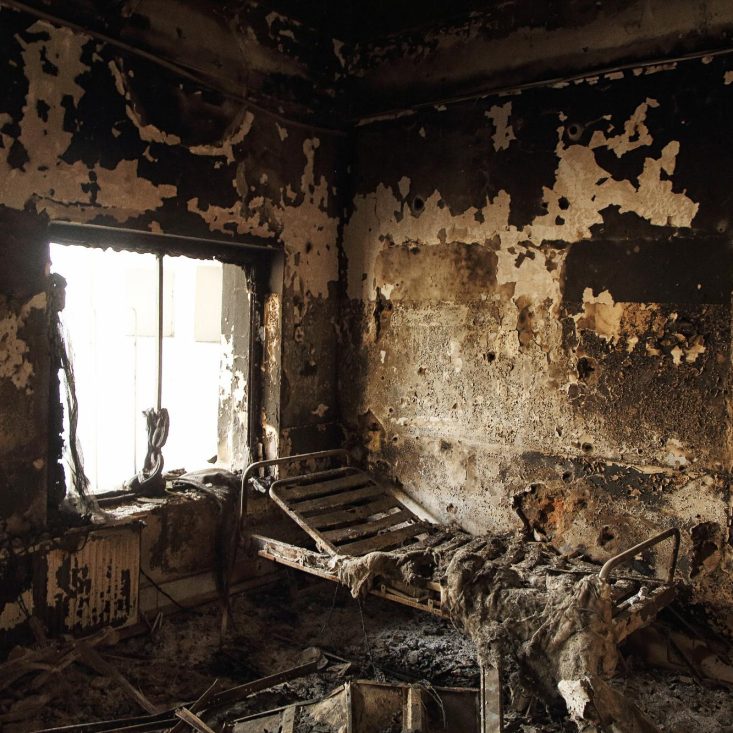
The aftermath of US airstrikes on the MSF Trauma Centre in Kunduz, Afghanistan in October 2015. Photo | MSF
An internal inquiry revealed that the airmen aboard the AC-130 gunship that carried out the operation pushed back against their superiors, questioning the strike’s legality. However, they were overruled and ordered to bomb the hospital regardless of their concerns. A Doctors Without Borders report concluded that the U.S. knew where the hospital was and that it did not hide any Taliban fighters and targeted it anyway. At least 42 people are known to have been killed in the incident.
The 2015 Kunduz bombing was a unique moment in history, as it was the first time that one Nobel Peace Prize winner (Barack Obama) bombed another one (Doctors Without Borders).
During his time in office, Obama bombed seven countries, including Libya. In July 2011, as part of its mission to overthrow the government of Muammar Gaddafi, NATO planes bombed Zliten, destroying the city’s hospital. Eighty-five people were killed, including at least 11 at the medical center. The event helped turn what was once Africa’s most prosperous and stable country into a failed state replete with open-air slave markets. Libya’s downfall has, in turn, helped to destabilize the entire Sahel region.
Perhaps no country in the 21st century has felt the wrath of Washington as much as Iraq. U.S. strikes on civilian infrastructure were a frequent occurrence, and hospitals were no different. Arguably, the most notable example is the April 2003 bombing of the Red Crescent Maternity Hospital in Baghdad.
American missiles struck the city center complex housing the hospital, killing several and wounding at least 25 people, including doctors.
The charitable hospital was crucial to providing affordable healthcare to working-class Iraqis, charging ten times less than the city’s private clinics. It developed a reputation as a first-class maternity hospital, delivering an average of 35 babies per day before the invasion. UNICEF noted a sharp rise in maternal mortality after the bombing, partially due to the lack of obstetric care in Baghdad.
Clinton’s War on Hospitals
Four years earlier, in May 1999, U.S.-led NATO planes dropped cluster munitions on an outdoor market and hospital in the Yugoslav city of Nis, killing at least 15 people and injuring 60 more, according to the hospital’s director. Cluster munitions are now banned under international law. Regardless, between 2023 and 2024, the United States transferred large quantities to Ukraine for use against Russian forces.
Two weeks after the Nis bombing, NATO targeted a hospital in the Yugoslav capital, Belgrade. The missile strike destroyed much of the maternity ward, with rescuers pulling infants and mothers from the rubble in the dead of night. At least three people were reported killed.
The Yugoslav attacks were not the Clinton administration’s only attacks on medical facilities. In 1998, in response to Osama bin Laden’s recent bombings of American Embassies in Kenya and Tanzania, President Bill Clinton ordered an attack on the Al-Shifa medicine factory in Sudan. Fourteen cruise missiles hit the plant, turning what had been the largest producer of medicine in the country into a pile of twisted metal. The factory had produced over half of Sudan’s pharmaceuticals, including crucial antibiotics and antimalarial and diarrhea medications.
While not a hospital, the destruction of Al-Shifa was vastly more lethal than any other attack listed. The event led to a collapse in the availability of drugs in one of Africa’s poorest countries. The German Ambassador to Sudan estimated that the death toll reached into the “tens of thousands.”
The Clinton administration publicly insisted that the plant was actually bin Laden’s chemical weapons factory. Privately, however, Secretary of State Madeline Albright worked hard to suppress a government report, noting this was not true.
Sudan was Clinton’s second attack on Africa. In June 1993, U.S. soldiers (under U.N. auspices) carried out a mortar attack against Digfer Hospital in Mogadishu, Somalia. The bombs destroyed the main reception area, blew a gaping hole in the wall of the recovery room, and shattered glass across the building. “It probably will never be known how many Somalis died in the U.N. [U.S.] onslaught,” wrote The Chicago Tribune. One reason for this is that helicopter-borne soldiers attacked reporters and photographers attempting to cover the attack, throwing stun grenades at them and chasing them away from the scene.
Latin American Dirty Wars
During the 1980s, Latin America and the Caribbean were the sites of intense U.S. interest. In October 1983, during the U.S. invasion of the island, American warplanes hit the Richmond Hill Mental Hospital in Grenada. The Reagan administration initially attempted to deny the attack before finally conceding their culpability. Dozens of people were injured, and at least 20 were killed, although The New York Times suggested an actual death toll of over twice that number.
The U.S. invaded Grenada in order to crush the island’s socialist revolution. In Central America, however, it relied on funding, training and arming proxy forces to do its bidding. These death squads would wreak destruction across the region and continue to shape its politics and society to this day.
In El Salvador, U.S.-trained forces waged a dirty war against the population in order to crush leftist FMLN guerilla forces. Hospitals were among their preferred targets. On April 15, 1989, for instance, pilots flying U.S.-made A-37 jets and UH 1M and Hughes-500 helicopters bombed an FMLN hospital in San Ildefonso, killing five people.
Paratroopers armed with M-16 rifles arrived on U.S. helicopters and attacked and abducted the medical staff, including French nurse Madeleine Lagadec. Before executing her, the soldiers spent eight hours raping and torturing her. Images of the remains of her mutilated body caused outrage in France, which issued an international arrest warrant for the four U.S.-backed officers overseeing the operation.
In Nicaragua, meanwhile, throughout the 1980s, U.S.-trained paramilitaries intentionally attacked “soft targets” such as hospitals in an effort to terrorize the population into dropping their support for the country’s socialist government.
A study by Richard M. Garfield, Professor of Nursing at Columbia University, found that, between 1981 and 1984, at least 63 health centers were forced to close due to attacks from the U.S.-backed “Contra” death squads.
These operations were carefully planned for maximum effect, with the Contras leaving behind graffiti at the crime scenes, announcing that the “Lion Cubs of Reagan” had visited the area. Throughout their campaign, President Reagan supported the Contras, labeling them “the moral equivalent of our Founding Fathers.” Dr. Michael Gray, Chairman of Occupational Medicine at Kino Community Hospital in Tucson, AZ., a doctor who visited Nicaragua, held a different opinion, describing them and their actions as “no different than the SS at the end of the Second World War.”
Cold War Killing Machine
During the American wars in Indochina, the bombing of hospitals was official – if unstated – U.S. policy.
Alan Stevenson, a former Army intelligence specialist, testified that, while on duty in Quang Tri province in Vietnam, he regularly identified hospitals to be struck by U.S. fighter jets. “The bigger the hospital, the better it was,” he said, explaining the military’s thought process. “This wasn’t something that was hush‐hush,” he added. “We really didn’t consider it that nasty an item.”
Former Air Force captain Gerald Greven corroborated Stevenson’s allegations, noting that he personally ordered bombing raids against medical centers. It was official policy to “look for hospitals as targets,” he said.
Perhaps the most notorious and well-documented case of this in Vietnam occurred on December 22, 1972, when American planes dropped over 100 bombs on the 1000-bed Bach Mai Hospital in Hanoi, nearly obliterating the building, in the process killing 28 medical staff and an unconfirmed number of patients.
The U.S. military justified the strike by claiming that the hospital “frequently housed antiaircraft positions” and noted its proximity to a military airbase.
During the Congressional hearings on clandestine U.S. activities in Laos and Cambodia, meanwhile, lawmakers were told that the bombing of hospitals was “routine.” Indeed, the former remains the most bombed country, per capita, in world history.
Like in Vietnam, the targeting of hospitals was not only commonplace but deliberate. In 1973, former Army captain Rowan Malphurs testified that, while serving with the Combined Intelligence Center of Vietnam, he helped orchestrate attacks on Cambodian health centers. “We were planning bombings of hospitals,” he said. Yet Malphurs was unrepentant. “I think it was a good thing because the North Vietnamese Army had a privileged sanctuary in Cambodia,” he added.
Thus, as this brief rundown of the past five decades has shown, last month’s attacks on the Al Rasool Al-Azam Oncology Hospital in Yemen are far from an aberration. As these examples from 13 different countries show, Washington, in fact, has a longstanding history of targeting medical centers.
Going further back, the government of North Korea estimates that the U.S. military destroyed some 1,000 hospitals during the Korean War. These numbers are entirely plausible, given the gigantic bombing campaign that the country faced. Entire cities were leveled or flooded after American planes targeted dams. Professor Bruce Cummings, America’s foremost expert on Korea, estimates that the U.S. killed around 25% of the entire North Korean population between 1950 and 1953.
Radio Silence
Article 8 of the Rome Statute, one of the fundamental texts of international law, explicitly identifies “intentionally directing attacks against buildings dedicated to religion, education, art, science or charitable purposes, historic monuments, hospitals and places where the sick and wounded are collected, provided they are not military objectives,” as war crimes.
That the Trump administration repeatedly struck a well-known and easily identifiable hospital in Yemen is an extremely important story. But it has, in fact, received zero coverage in corporate media. Searches for “Al Rasool Al-Azam Hospital” and “Yemen Hospital” in the Dow Jones Factiva news database, a tool that records the content from more than 32,000 U.S. and international media outlets, show that no mainstream American publication has even mentioned this grave war crime.
This is not because the information is particularly hard to find. Well-known media figures such as Pepe Escobar and Jackson Hinkle visited Saada and recorded viral videos from the wreckage where the hospital once stood. The information has been all over social media for weeks and has been covered widely in alternative media, including Drop Site News, AntiWar.com, Truthout, Common Dreams, and foreign outlets such as Al-Jazeera, RT (formerly Russia Today), and The Cradle. Thus, every single editor in every newsroom and television studio in the United States has access to this information and made the decision not to cover the story – a fact that suggests a lot about the diversity of opinion and freedom of our press.
This complete disinterest in U.S. misdeeds sits in stark contrast to when official enemy states do the same thing. When Russia hit hospitals in Ukraine and Syria, those incidents became front page news and led television news bulletins. Moreover, corporate media regularly explicitly framed the events as war crimes (see PBS, Politico, Foreign Policy, CNN, Newsweek, ABC News and the Los Angeles Times). Talking heads waxed lyrical about how Russian President Vladimir Putin must be brought to justice. And yet, when the United States does the same, that cacophony falls to complete silence – even when it is carried out by a president that many in corporate media appear desperate to attack at any opportunity.
What the recent attack on the cancer center in Yemen underlines is that it is dangerous to be a healthcare worker. The United States has a longstanding history of targeting hospitals in nations it selects for regime change. This is true of both Democratic and Republican administrations.
Therefore, the sad truth is that if you are in a country targeted by the United States, you are often safer away from a hospital than inside one.
Full speed ahead for war preparations in Europe: What are French military cartographers doing in Romania?
By Erkin Oncan | Strategic Culture Foundation | April 17, 2025
In the French newspaper Le Figaro, a striking report was published regarding the presence of French Army cartographers in Romania in preparation for a possible “conflict with Russia.” The article, titled “French Army Cartographers Deployed on NATO’s Eastern Flank Amid Rising Tensions with Russia” and penned by Nicolas Barotte, details new military preparations being undertaken with the anticipation of a Russian attack.
According to the report, French Army cartographers are mapping regions along Romania’s borders with Moldova and Ukraine.
It is noted that soldiers are identifying elevated locations such as water towers or bell towers every five kilometers.
According to the French soldiers, these structures will be used as reference points for artillery targeting if necessary.
The French troops have also prepared an extremely detailed map that includes movement routes for military units and the axes along which the army can advance. The main purpose of the mapping effort is to facilitate orientation on the ground even if satellite signals are disrupted.
Who conducted the mapping?
The mapping operation was carried out by the 28th Geographic Group (28e Groupe Géographique).
Known by the abbreviation “28e GG,” this unit is stationed in the town of Haguenau near Strasbourg and is one of the smallest yet most strategic units of the French Army. The 28e GG provides geographical information, map production, and topographic analysis support to land forces. It was under the Intelligence Command for many years, but in the fall of 2023, it was reassigned to the Engineering Brigade (brigade du génie).
This unit, which plays a critical role in military operations, is responsible for map production in operational areas, 3D terrain mapping using methods such as LIDAR (a laser-based positioning method), drones, and mobile data collection tools. It also identifies passage routes for military targets and infrastructure, determines reference points for use in case satellite signals are cut off, and supports artillery with target identification and fire support planning. Comprising 350 soldiers, this unit actively participates not only in operations but also in planning processes.
French military presence in Romania
Meanwhile, the French Army’s presence in Romania is not new. When the Russia–Ukraine war began, France deployed a thousand troops to Cincu, located in the Transylvania region of central Romania, as part of NATO’s efforts to reinforce its eastern flank.
French soldiers also lead the NATO-established Multinational Battlegroup – Romania stationed there.
Why Romania?
According to Le Figaro, the unit has already hung the map it prepared in Romania on the wall of its headquarters in Haguenau.
On the map of Romania, the country’s topography is displayed in three dimensions. The 28e GG identified reference points every five kilometers and created a map of military mobility routes.
The map was created using a technology similar to Google’s Street View. A vehicle equipped with high-resolution cameras and laser sensors, used by the 28e GG, scanned the region in 3D.
The most critical aspect of this military preparation is the Focșani Gate.
The Focșani Gate
The Focșani Gate (or Focșani Pass) is located in eastern Romania and has historically been a region of great military strategic importance.
It is a narrow and flat passage between the Eastern Carpathians and the Danube Plain, serving as a corridor between Moldova, Transylvania, and the Danube region.
Unlike the mountainous terrain surrounding it, this flat region is difficult to defend and easy to attack.
Given NATO’s assumption that Russia may launch an attack through this route, it is predicted that a successful Russian invasion through Focșani could spread to the heart of Romania and even reach the Black Sea via Constanța.
Moreover, the historical use of Focșani for military purposes by the Ottomans, Russia, Germany, and the Soviets contributes to the strategic interest in the area.
What happens if Russia attacks through Focșani?
The emphasis on Focșani is undoubtedly part of the broader effort to militarize Europe under the narrative of a “Russian invasion.” But what if NATO’s assumptions prove true?
If Russia attacks through Focșani as expected, the first military forces it would encounter would be Romania’s 8th Division and the 2nd Infantry Division. The initial air response would come from Romanian aircraft based at the Fetești and Borcea air bases.
If NATO activates Article 5 and decides to fully confront Russia, the U.S. air base at Mihail Kogălniceanu on Romania’s Black Sea coast would also come into play.
If Russia were to attack through Focșani, the heavy NATO presence in the Baltic region would not have a primary impact. For example, due to the Carpathian Mountains, direct intervention in the Moldova–Romania axis by Poland and other Baltic countries would be logistically difficult. At most, these countries could apply a distraction strategy by opening a new front in the north against Russia.
In such a scenario, another key NATO force that comes to mind is the NATO Rapid Deployable Corps – Italy, established in 2001 as NATO’s Immediate Response Force.
Turkey’s position
Assuming Turkey sets aside its balancing diplomacy and fulfills its alliance obligations as the country with NATO’s second-largest land army, Turkey’s potential actions would include deploying its units to Romania within 72 hours.
As of 2023, Turkey is part of the Very High Readiness Joint Task Force (VJTF) with high-readiness units such as the 66th Mechanized Infantry Brigade (Istanbul) or Commando Brigades.
In this context, the 66th Mechanized Brigade in Istanbul and experienced commando brigades from Syria operations appear to be the fastest units that could provide ground support to Romania.
The Turkish Navy, also the largest NATO naval force in the Black Sea, contributes on a rotational basis to NATO’s Standing NATO Maritime Group-2 (SNMG2) and Standing NATO Mine Countermeasures Group-2 (SNMCMG2) with frigates, fast attack boats, and minehunters.
Likewise, Turkey’s air power can provide reinforcements of combat troops and ammunition to NATO bases in Romania by air; with UAVs and maritime patrol aircraft, it can carry out reconnaissance and deterrence missions. Amphibious units with landing capabilities and SAT/SAS commandos could also be deployed to Romanian territory under NATO’s operational plans.
Of course, direct military involvement by Turkey in such a scenario is seen as a possibility that falls outside the scope of Turkey’s traditionally balance-oriented foreign policy.
While the likelihood of such a simulation materializing under the current political circumstances is clearly remote, it would require Russia to first capture Odessa and reach the Moldovan border, then attempt to invade Romania via Moldova (Transnistria).
However, even though direct Turkish involvement in a war remains unlikely for now, the possibility of Turkey taking on new responsibilities within the current “deterrence” concept is increasingly being discussed out loud.
Especially in a political climate where U.S. President Donald Trump is perceived to have “abandoned” Europe, and eyes are turning to Turkey, President Recep Tayyip Erdoğan’s recent statement at the Antalya Diplomacy Forum—“Turkey is ready to take responsibility for Europe’s security”—is the clearest indication yet that Turkey will play a more active role in the European security architecture in the near future.
Although there is much talk lately about Turkish troops going to Ukraine, it would not be surprising to see Turkish units in Romania, a key focus area for NATO.
Conclusion
Alongside Eastern Europe, NATO also considers Southeastern Europe as a potential attack route for Russia and is tailoring its war preparations accordingly. While U.S.-Europe relations remain volatile during the Trump era, the ongoing preparations suggest that neither side truly believes the U.S. will withdraw troops from Europe in the short term. Indeed, NATO and U.S. officials have already started attempts to “reassure” on this matter.
On the other hand, while NATO considers Romania a strategic route in the event of a Russian attack and views the region as militarily critical, it is also evident that any anti-NATO or anti-EU shift in a country like Romania would cause severe damage to current strategies. This fact is already apparent from the first round of Romania’s presidential elections.
Although Romania currently plays a key role in NATO’s southeastern flank, signs of a potential shift in political preferences are beginning to emerge. In the first round of Romania’s 2024 presidential elections, pro-Western and pro-European Union parties lost significant ground, while nationalist and EU-skeptical tendencies gained momentum. This shift could pose serious challenges to NATO’s future plans in the region if it continues.
As NATO strengthens its eastern and southeastern flanks in anticipation of a long-term confrontation with Russia, it must also closely monitor the political transformations in its member states. Public discontent, nationalist rhetoric, and the rise of far-right political movements may undermine the alliance’s cohesion and operational capacity.
Moreover, it is becoming clear that the current U.S.-European alliance is not solely built on military arrangements. The sustainability of this alliance also depends on internal political stability and public support within member countries. In this context, the role that Turkey will play is of particular significance, both as a NATO member and as a regional power capable of influencing developments in Southeastern Europe and the Black Sea basin.
While the French military’s cartographic activities in Romania may seem like a routine technical operation, they are, in fact, part of a much broader preparation for war. The choice of mapping locations, the level of detail, and the focus on vulnerable corridors such as the Focșani Gate all point to a well-thought-out military contingency plan.
In summary, Europe is once again preparing for war—this time not against a distant enemy, but against a powerful and nuclear-armed neighbor. And countries like Romania, which sit at the intersection of these fault lines, are being rapidly militarized. Whether this is genuine preparation or a calculated form of deterrence, one thing is certain: the cartographers of war are already on the move.
European and British leaders are using the Sumy airstrike to push for the war in Ukraine to continue
By Ian Proud | Strategic Culture Foundation | April 16, 2025
The Sumy airstrike provides a reminder that civilians and children have been killed indiscriminately since the Ukraine crisis started in 2014. Rather than calling on Russia to accept a ceasefire on Ukraine’s terms and encouraging Zelensky to avoid dialogue, European and British leaders need to get behind real negotiations.
On 13 April, a Russian airstrike in the centre of Sumy in Ukraine lead to the deaths of 34 people and injury to 117 others, including children. The strike targeted a planned medal award ceremony organised by the Ukraine Armed Forces’ 117th Territorial Defence Brigade, although the vast majority of the casualties were civilians.
The decision to plan a military event in a built-up city centre has prompted internal concern within Ukraine that this invited a Russian attack. A Mayor of one town in Sumy called on the Governor and the regional head of Ukrainian Military intelligence to resign, for organising a military event in a civilian area.
Russian military bloggers have admitted that the second of two ballistic missiles used did not hit the intended target, causing widespread casualties.
But there was also a depressing sense of déjà vu in this latest tragedy. In an Amnesty International report of 4 August 2022, six months after the war started, the Secretary General, Agnès Callamard, remarked ‘we have documented a pattern of Ukrainian forces putting civilians at risk and violating the laws of war when they operate in populated areas.’
The strike in Sumy offers a timely reminder that civilians have regularly been caught in the cross-fire of a conflict in Ukraine that has been burning since 2014. Over 15,000 civilians have been killed during that eleven-year period, 3000 of those in the years of 2014 and 2015, as part of Ukraine’s so-called Anti-Terror Operation against the separatists in Donetsk and Lugansk.
The first official record of civilian deaths in the Ukraine conflict was in a report by the OSCE Special Monitoring Mission on 5 July, which said, ‘the military campaign of the Ukrainian army in the east of the country continued.. The UN stated that there were numerous reports of death of people due to the intensified security operations in Donetsk and Luhansk, including a killing of a five-year-old girl.’
A 2016 report by the Office of the UN High Commissioner for Human Rights, spoke about ‘rampant impunity’ within the Ukrainian anti-terror offensive across the period from 2014-2015, with ‘90 per cent of the conflict related civilian deaths.. caused by the indiscriminate shelling of residential areas.’ The remaining deaths were mostly caused by summary executions by groups on both sides of the conflict.
15,000 civilian deaths across eleven years is an appalling number. But that number pales against the more than one million total deaths and injuries to military personnel on both sides during the war, each one the child of someone.
Everyone should be striving with every sinew to end this needless bloodshed and finally bring peace. But they are not.
Performative accusations against Russia by the western media and politicians create an epic distraction from the real issue; that this would not be happening if there was peace between Russia and Ukraine.
A new propaganda narrative has formed that in this war, Russia is the aggressor and Ukraine is the victim. This is both a gross over-simplification and wilfully ignores Ukraine’s role as the other party to the war. It also infantilises casual western consumers of the mainstream news who, stripped of real information and analysis of the history of the conflict, are invited to accept the premise that Ukrainians are the good guys, and the Russians are the bad guys. That this is a fight between the righteous and the wicked. Between David and Goliath.
Antony Blinken, the grossly complicit former US Secretary of State, recently repeated this good versus evil line in an interview. But, when you look at it from the other perspective, you might realise that Russia considers NATO Goliath, and itself David.
Ursula von der Leyen, took to X after the attack in Sumy to amplify this attack line. ‘Russia was and remains the aggressor.’ She goes on to assert that, ‘Europe will continue to.. maintain strong pressure on Russia until the bloodshed ends and a just and lasting peace is achieved, on Ukraine’s terms and conditions.’ Prime Minister Keir Starmer posted on X that ‘Putin must now agree to a fully and immediate ceasefire without conditions.’
But this is deluded. Russia is slowly winning on the battlefield and has been for at least a year and a half. There is no rational world in which Russia will be pressured to accept a ceasefire on Ukraine’s terms. And Russia has conditions, the biggest one that Ukraine repudiate its claim to NATO membership. This has been the case, not since 2022, not since 2014, but since 2008.
A ceasefire will only happen when Ukraine engages in direct talks with Russia, something that President Zelensky steadfastly refuses to do. Calling for more pressure on Russia, and discouraging Zelensky from dialogue, is just delaying an end to hostilities and consigning more innocent people to die.
The EU and Britain, which have both avoided at all costs sending troops to fight, can’t produce enough weapons and are fast running out of money to support Ukraine’s failing state, are encouraging Zelensky to press for something that President Putin will never accept.
President Trump – with whom I disagree deeply on Middle East policy and on tariffs – has been measured in his response, referring to the Russian airstrike in Sumy as a mistake. Secretary of State Marco Rubio was also balanced in his statement, pointing out that, ‘this is a tragic reminder of why President Trump and his Administration are putting so much time and effort into trying to end this war and achieve a just and durable peace.’
Rather than falling back on the same old performative tropes and failed prescriptions, European and British leaders finally need to get behind ending the bloodshed. They must encourage Zelensky to negotiate, rather than humouring him with assurances that won’t reassure, and with promises we’ll never keep.
Featured Video

ARE PATIENTS BEING PROPERLY INFORMED ABOUT OZEMPIC?
or go to
Aletho News Archives – Video-Images
From the Archives
Trans ‘milk’ as good as the real thing – NHS
RT | February 18, 2024
The drug-induced nipple secretions of trans women are as good as mothers’ breast milk for babies, the University of Sussex Hospitals NHS Trust claimed in a letter to campaigners made public in a report by British think tank the Policy Exchange on Sunday.
The healthcare trust’s medical director, Rachel James, argued that the off-label prescription drug cocktail men transitioning to female take in order to produce milk was “similar to the natural hormones which encourage lactation to develop when the baby is newly born.”
“The evidence which is available demonstrates that the milk is comparable to that produced following the birth of a baby,” James wrote in the letter, sent to Children of Transitioners last August.
Biological men who wish to lactate must first take hormones to grow milk glands and then take high doses of either domperidone or metoclopramide to stimulate milk production. Neither drug is approved for this use, though they are occasionally prescribed off-label to biological women who have trouble lactating.
However, domperidone’s own manufacturer, Janssen, warns patients the drug “may cause unwanted side effects affecting the heart in a breastfed baby” and “should be used during breastfeeding only if your physician considers this clearly necessary.” … continue
Blog Roll
 Aletho News
- 2025 Nature Paper Claiming Worsening Global Drought Gets RETRACTED …Heavily Flawed
- Your Milk Is Not the Problem
- The Truth About the Trump Shootings with Ken Silva
- ARE PATIENTS BEING PROPERLY INFORMED ABOUT OZEMPIC?
- US lawmaker blocks $2.8 billion weapons sale to Israel: Report
- Yemeni army claims responsibility for strikes on sensitive sites in Saudi capital, Aramco facilities in Yanbu
- Iran Judiciary issues indictments against 159 US, Israeli officials for assassination of Leader, commanders
- Turkiye revokes Iranian bank license under US sanctions campaign
- US-Denmark Agreement on Greenland Is ‘PR Stunt’ Ahead of Midterms
- Araghchi: Military intervention cannot create security; coercion cannot bring peace
- If Americans Knew
- Israeli attacks kill four Palestinians in Gaza – Daily Update
- Inside Gaza’s death trap of collapsing, bombed-out buildings
- The everyday items Israel bans from Gaza every day
- Inside the siege, the ruined buildings of Gaza – Daily Update
- Debunking The Claim That Macklemore Has A “History Of Antisemitism”
- CPJ demands release of arrested Palestinian-US journalist near Bethlehem
- Robert Kraft: The Billionaire Friend of Netanyahu Pulling The Strings Behind the Macklemore/Ed Sheeran Blow Up
- Columbia Administered Fund Gives Big Money to Pro-Israel Groups
- Deportation Case of Palestinian Activist Salah Sarsour Tests First Amendment
- ‘We Will Not Forget’: Palestinians Mark 44 Years since Sabra and Shatila
- No Tricks Zone
- 2025 Nature Paper Claiming Worsening Global Drought Gets RETRACTED …Heavily Flawed
- New Study: ‘Global Drought Shows No Detectable Recent Acceleration Under Climate Warming’
- Economic Masterminds: German Socialists Suggest Taxing Productivity Gains Stemming From Using AI
- The South China Sea Has Not Been Cooperating With The Climate Change Narrative
- Energy Crisis: Germany Enters Heating Season With Historically Low Gas Reserve Fill Levels
- New Study: The Antarctic Ice Sheet Gained Mass From 2020-2024 Due To Staggering Snow And Ice Accumulation
- Study: Ocean Heating Rates From Thousands Of Years Ago ‘Dwarf’ Modern Ocean Heating Rates
- Climate Extremists Target, Attack Large-Scale Power Grid Infrastructure In Germany!
- New Study: Antarctic Ice Melt Has Contributed Less Than 1 Centimeter To Sea Level Rise In The Last 30 Years
- Fear Of Debate: Alarmist German Climate Scientist Calls On Mainstream Media To Discredit Skeptic Voices
 Aletho News