Belgium eyes welfare cuts to meet NATO target – minister
RT | April 16, 2025
Belgium is preparing to raise debt and cut welfare to meet NATO’s minimum military spending target, the EU country’s budget minister has said.
Vincent Van Peteghem told the Financial Times on Wednesday that Brussels recently agreed to lift its 2025 military budget to 2% of GDP through a mix of temporary cash injections, creative accounting, and structural reforms.
The planned hike in military spending could exacerbate the budget crisis as debt mounts. Recent government plans to cut social services have sparked protests, with over 100,000 people rallying in Brussels in February.
Belgium had previously planned to meet the 2% target only by 2029. Military spending currently stands at around 1.31% of GDP, or roughly €8 billion ($8.5 billion), according to Defense Minister Theo Francken.
The shift comes amid pressure from Washington and ahead of a NATO summit in June, where members are expected to consider raising the spending target to above 3% of GDP. US President Donald Trump has urged the bloc members to increase military spending to 5%, warning that countries that fail to do so may no longer be guaranteed American protection.
Higher spending on military budgets would take a toll on the EU’s welfare programs, Van Peteghem warned.
Last month, the European Commission proposed exempting military budgets from fiscal rules and offering €150 billion in loans as part of its ‘ReArm Europe’ plan, which aims to mobilize up to €800 billion through debt and tax incentives for the bloc’s military-industrial complex.
Van Peteghem said Belgium would tap both options to fund additional military spending this year.
To maintain the 2% level, the government plans to raise more debt and may privatize state-owned assets, the minister said. The remaining gap would be filled through spending cuts, including curbs on unemployment benefits, pension reforms, and tax changes.
“But of course, we will need to do more,” Van Peteghem, who also serves as deputy prime minister, said.
France has also announced plans to cut €5 billion from its budget, with some of the savings potentially redirected to military spending.
Moscow has condemned the EU’s military buildup. Kremlin spokesman Dmitry Peskov called it “a matter of deep concern,” noting that it was aimed at Russia.
Are Chinese Soldiers Fighting in Ukraine?
By Ted Snider | The Libertarian Institute | April 14, 2025
If Chinese soldiers are fighting in the Russian armed forces in Ukraine, that is not the big story. The big story is the effect the claim could have on the possibility of peace.
Ukraine has not yet even proven the months old claim of the presence of North Korean soldiers fighting for Russia on Russian soil. Now they are making the much more provocative claim that Chinese soldiers are fighting for Russia on Ukrainian soil.
Ukrainian President Volodymyr Zelensky announced on April 9 that the Ukrainian armed forces had captured two Chinese soldiers fighting in the Donetsk region of Ukraine. He then said that Ukrainian intelligence has uncovered 155 Chinese citizens who are “fighting against Ukrainians on the territory of Ukraine” and that they “believe that there are many more of them.”
Independent journalists and organizations have not had access to the two prisoners in order to verify the truth of the claim. Ukraine has provided a video and documents listing names and passport documents. Media outlets have seen them, but CNN and The Independent both say that they have not been independently verified.
There are tens and perhaps even hundreds of thousands of ethnic Chinese living in Russia. And even if the captured soldiers are from China, that does not mean they were sent by China. They could have enlisted on their own as mercenaries, a possibility that two former U.S. intelligence officers “with knowledge of the issue” now say U.S. intelligence believes to be the case. The Chinese Ministry of Foreign Affairs has called the claim that many Chinese citizens are fighting in the Russian army “totally unfounded,” and said that “the Chinese government always asks Chinese citizens to stay away from conflict zones, avoid getting involved in any form of armed conflict, and especially refrain from participating in any party’s military operations.”
Zelensky, though, has made the provocative claim that the Chinese government is allowing its citizens to fight in Ukraine. Asked whether China had a policy of sending soldiers to Ukraine, Zelensky answered, “I don’t have an answer to this question yet. The Security Service of Ukraine will work on it…We are not saying that someone gave any command, we do not have such information.” However, he added that “[o]fficial Beijing knows about this” and did not prevent it.
Zelensky then escalated the claim, saying, “The Chinese issue is serious” and calling on “the U.S. and the rest of the world for a response.”
It is that threat to the peace process and not the possible presence of Chinese soldiers that is serious and significant. Mercenaries from many countries have been welcomed by both Ukraine and Russia since the beginning of the war. Al Jazeera reports that, not only Chinese, but Nepalese and Indians have fought for Russia. They also report that Colombians, Sri Lankans, Indians and Americans have fought for Ukraine. At least nine Canadians have been killed in Ukraine, and more are known to have fought there. The Russian Defense Ministry claimed in March 2024 that 1,005 Canadian mercenaries have fought in Ukraine. They also claim that 2,960 have come from Poland, 1,113 from the United States, 356 from France and others from the United Kingdom and Romania. Ukraine says their international legion comprises around 20,000 fighters from fifty countries.
More seriously, it is not just mercenaries who have arrived in Ukraine. A leaked March 2023 Defense Department document reveals the presence of 97 NATO special forces in Ukraine. A recent New York Times article reports that more than three dozen military advisers were sent to Kiev and that CIA officers were in Kharkiv and “command posts closer to the fighting.” The British prime minister’s office has confirmed that the United Kingdom has boots on the ground in Ukraine. The presence of French forces has also been revealed, and Polish Foreign Minister Radoslaw Sikorski confirmed that “NATO soldiers are already present in Ukraine.”
Unless the Chinese government has a policy of sending troops to fight alongside Russia in Ukraine, which would be serious, since it could draw China into the war, it is not the alleged presence of Chinese soldiers that is dangerous. At a time when peace talks are at a fragile beginning, and U.S. President Donald Trump is insisting on both sides showing they are serious about peace, it is the provocative statements coming out of Kiev that are potentially serious.
“Russia’s involvement of China, along with other countries, whether directly or indirectly, in this war in Europe is a clear signal that Putin intends to do anything but end the war,” Zelensky said. “This definitely requires a response. A response from the United States, Europe, and all those around the world who want peace.” The suggestion that Putin is not serious about negotiating undermines U.S. led negotiations.
The statements are also ill timed and hazardous. The United States and China are engaged in a trade war. It is a volatile time to provide Washington with a cause for turning up its anger against China. Zelensky intends the presence of Chinese soldiers to evoke an American response. State Department spokesperson Tammy Bruce said the U.S. is “aware of those reports” and that “It’s disturbing with the Chinese soldiers having been captured,” though the White House has not confirmed the claim. National Security Spokesman Brian Hughes said that “if the Chinese government is allowing their citizens to fight on behalf of the Russia government, this would be a concerning escalation and the U.S. will consider options moving forward.”
Beyond challenging the peace process, the comments coming out of Kiev are provocative to China, questioning its credibility and its lack of involvement in the war. Equally importantly, it challenges any potential role of China both in the negotiations before the end of the war and in security arrangements after the end of the war: both potentially important roles for China.
Ukraine’s Minister of Foreign Affairs, Andrii Sybiha, said that “Chinese citizens fighting as part of Russia’s invasion army in Ukraine puts into question” not only “China’s declared stance for peace” but even that it “undermines Beijing’s credibility as a responsible permanent member of the UN Security Council.”
If the two captured soldiers turn out to be from China, and if they turn out to be mercenaries fighting without the approval of China, then their presence in Ukraine is not the big story. If the claims being made about them and about China resonate in the White House, then the effect of the claims could make difficult peace talks even more difficult. And that is what the potential big story would turn out to be.
Disaster in the Making: Secretary of State Rubio Proclaims the US Should Spend Five Percent of GDP on ‘Defense’
By Adam Dick | Peace and Prosperity Blog | April 12, 2025
Since his first term, we have grown used to President Donald Trump badgering governments of fellow NATO countries to increase their “defense” spending to five percent of their respective GDPs. Quote marks are used in the preceding sentence because such spending by these governments, or the US, will largely be used for offense, feeding the military-industrial complex, and other purposes far removed from defense.
So far, fellow NATO members have steered clear of achieving this spending goal. Their residents should be happy that is the case as the money can instead be left in their pockets or at least be hoped to be spent by government on something that may provide them with some benefit instead of furthering death and destruction — butter, not guns.
Interestingly, the US government, despite all its hectoring, has also refrained from reaching that five percent of GDP figure for its spending on the Department of Defense. The targeted spending level would come in at nearly double current spending on what is already a top area of government spending. That increase would drop down some if various spending beyond the Defense Department spending is included as “defense” spending.
Comments made last week by US Secretary of Defense Marco Rubio indicated the goal is for the US to also reach this spending level. Rubio declared ahead of a NATO meeting that “we do want to leave here with an understanding that we are on a pathway, a realistic pathway, to every single one of the [NATO] members committing and fulfilling a promise to reach up to five percent of spending; that includes the United States will have to increase its percentage.”
Hopefully, this is just talk. To follow through on this course would be to invite disaster.
With a huge and growing debt, the US cannot afford the increase. Such an increase will help bring the nation more quickly toward financial disaster. It will likely even help ensure increased spending in other areas as was experienced during the Ronald Reagan administration when the executive branch bargained with legislators for more military spending by agreeing to increased spending in other areas too.
More war can be expected as a result as well. The temptation for politicians to use a “new and improved” military brought into being by the increased spending would be immense.
More debt and more war is a literally killer combination for America.
NATO needs Romania to launch WWIII – Georgescu
RT | April 11, 2025
Calin Georgescu, a former Romanian presidential candidate whose bid was controversially invalidated earlier this year, has claimed that NATO wants to “launch World War III from Romania.” In an interview with US journalist Tucker Carlson, he said his staunch pro-peace stance was among the main reasons why he was barred from running for president.
The right-wing politician, known as an outspoken critic of NATO, the EU, and Western support for Ukraine, scored a surprise win in the first round of November’s presidential election, receiving 23% of the vote. However, the country’s Constitutional Court swiftly moved in to annul the result over alleged “irregularities” in his campaign. Later, Georgescu was stripped of his right to run for office.
Appearing on Carlson’s podcast on Thursday, the former Romanian presidential candidate alleged that NATO wants to “launch… World War III from Romania.” The politician cited the fact that the “largest military base of NATO is in Romania,” coupled with the 380-mile (612 km) long border that his country shares with Ukraine.
“In this situation of course Romania is the asset for [the] European Union, for [French President Emmanuel] Macron in order to launch the war,” Georgescu insisted.
“They want to turn NATO [into] an offensive force” and are “pushing for war,” he alleged, adding that “my position was exactly against them.”
According to Georgescu, “all my campaign was just concentrate[d] on peace[.] When I said… the word ‘peace’, they immediately alerted… because they need war.”
The right-wing politician went on to say that the “majority of Romanian people… have this position against any intervention and any participation [in] war.”
“I was denied [the right to run for president] by the globalist mafia,” the former candidate alleged, further claiming that the people behind the invalidation of his candidacy were the same people who attempted to derail Donald Trump’s presidential campaign in the US, using similar smear tactics.
Appearing on ‘The Shawn Ryan Show’ in January, Georgescu similarly suggested that NATO military infrastructure in Romania could be used to launch a major offensive against Russia.
Bucharest, a NATO member since 2004, has been expanding the MK Air Base to make it the largest NATO installation in Europe.
Moscow has described the base as “anti-Russian” and warned that it would be among the first targets for retaliatory strikes in a military conflict.
Ukraine risks losing Odessa if ideas of European troop deployment entertained
By Ahmed Adel | April 9, 2025
Russian Foreign Ministry Spokeswoman Maria Zakharova stated that Europe has its eye on Odessa and Lvov and is making plans for military intervention that are “reminiscent of the military intervention by the Entente” during the 1917-1922 Russian Civil War. Despite Western plans, Russia will not allow the presence of NATO forces on Ukraine’s territory, as this would pose a direct threat to national security.
Given the strategic importance of Odessa and Lvov, the West did not accidentally target these cities. Odessa is a port that leads to the Danube, and whoever controls the historically Russian city greatly influences the Black Sea. Meanwhile, Lvov is Ukraine’s gateway to the European Union.
Although Kiev, Kharkov, and Dnipropetrovsk are also large Ukrainian cities, the West will not risk its troops there, especially in the latter two, because they are too close to the front line. This is the same issue as Odessa, which is not far from the Dnieper and Kherson, but the city has too much strategic value to surrender.
Odessa, founded in 1794 by the Russian Empress Catherine the Great as a military and trading port on the Black Sea, has always been considered a Russian city. During the Russian Empire, it was part of Novorossiya, but during the creation of the Soviet Union, Vladimir Lenin effectively gave it to Ukraine.
Odessa, a city that was occupied for more than 900 days during World War II, was liberated from German Nazi forces by Red Army soldiers. For Russians, Odessa is a hero city, but even more than that, because it was one of the first cities where the Russian Spring began, a mass action that was a response to the coup d’état in Kiev in 2014, when pro-Western and neo-Nazi currents took power.
Mass pro-Russian protests were held in many cities in southeastern Ukraine, and the discontented people, who were facing repression from the new Kiev regime, rose up to defend the Russian language and their rights. It all culminated in early May 2014 in Odessa, where supporters of the “Anti-Maidan,” opponents of the Ukrainian putschists, were burned alive in the Odessa House of Trade Unions. Ukrainian neo-Nazis shot those who tried to escape by jumping out of the building. Almost 50 people were killed and more than 250 were injured. The Ukrainian authorities have obstructed the investigation into this crime for years, and a decade later, this crime remains unpunished.
Despite all the tribulations and trials, Odessa has remained a Russian city historically, culturally, and in its mentality and spirit.
A “Coalition of the Willing” summit was held in Paris towards the end of March and representatives of about 30 countries, without the United States’ participation, discussed possible security guarantees for Kiev after the end of the Ukrainian conflict and the potential deployment of a military contingent on Ukraine’s territory.
Zakharova specified that the summit in Paris discussed the Franco-British initiative to deploy some “reassurance forces” in Ukraine after the conclusion of a peace agreement, rather than a peacekeeping contingent. According to her, this is reminiscent of the military intervention of the Entente forces during the Russian Civil War.
The parallels between that historical event and what is happening today are quite obvious.
European countries, the US, and Japan intervened in the Russian Civil War, hoping to grab their share of the crumbling Russian Empire. They thought that while fighting was waging on the front, they could grab Russia, including Ukraine, which was then in the process of being created. Ultimately, when they realized they were losing, they fled.
In essence, this is how they plan to introduce these contingents—it is unclear what kind—into Ukraine today.
The Kremlin has repeatedly said that it will not allow the deployment of NATO forces in Ukraine, while emphasizing that it was precisely the Atlantic Alliance’s expansion to the East that was the reason for the start of the Russian special military operation in February 2022.
NATO’s entry into any city, whether Lvov, Odessa, Kiev, or Kharkov, is unacceptable for Moscow, and it is clear that they will perceive this as NATO’s conquest of Ukrainian territory. Ukraine is the “soft tissue at the bottom of Russia’s belly,” and the entry of NATO forces would be an increased threat to Russian national security.
The loss of Odessa would be fatal for the Ukrainian economy and military, as Ukraine would lose its last major port on the Black Sea through which Western arms shipments now flow and where Ukraine can export to the world, particularly metals and wheat. Odessa has been mostly spared from the current war, with Russia not having yet attempted to liberate the city, but if discussions in the West to deploy troops continue and Kiev entertains it, it could instigate a Russian action to take the city. That would deal another major blow to Ukraine’s ailing economy and post-war recovery.
Ahmed Adel is a Cairo-based geopolitics and political economy researcher.
Republican Voters on Ukraine Aid: Time to Turn Off the Cash Spigot – Poll
Sputnik – 07.04.2025
Unlike 83% of Democrats who continue to support pumping US financial aid to Ukraine, 79% of Republicans oppose such spending, a Wall Street Journal survey revealed.
The survey, carried out among 1,500 registered voters from March 27 to April 1, laid bare growing divisions between the two political parties over American foreign policy.
Only 31% of Trump’s GOP base view NATO favorably, compared to 81% of Democrats.
At least 62% of American voters believe that expanding US territory by including Greenland and Canada is a bad idea, according to the survey.
Only 25% of the respondents support this idea, while the remaining 13% said they did not know the answer to this question or refused to answer it at all. That said, more than half of Republicans (51%) support US President Donald Trump’s statements about territorial expansion.
Germany Will Hold 800K Troop Drills to ‘Prepare for Russian Attack’
Sputnik – 05.04.2025
NATO troops will gather in Hamburg in September to practice troop deployments to the Baltic states and Poland, local media reports.
Germany’s army, the Bundeswehr, will hold massive military exercises in September involving NATO soldiers to practice a scenario of an allegedly possible “Russian attack,” with up to 800,000 servicemen to take part in them, the Bild newspaper reported.
The drills will be held in Hamburg for three days and will be dubbed Red Storm Bravo, the scenario is a Russian attack on the West, the publication says.
According to the publication, the exercises will be aimed at practicing the operational transfer of NATO troops to the Baltic countries and Poland, in which Hamburg, which has a “strategically important port,” will play a key role.
German Defense Minister Boris Pistorius previously stated that Germany should prepare for a possible war with Russia by 2029.
Russian President Vladimir Putin previously explained in detail in an interview with US journalist Tucker Carlson that Moscow was not going to attack NATO countries, there is no point in this. The Russian leader noted that Western politicians regularly intimidated their people with an imaginary Russian threat in order to distract attention from domestic problems, but “smart people understand perfectly well that this is a fake.”
Recently, the West has increasingly voiced ideas about a direct armed conflict between the alliance and Russia. The Kremlin, however, noted that Russia did not pose a threat, did not threaten anyone, but would not ignore actions that are potentially dangerous to its interests. In addition, in recent years, Russia has noted NATO’s unprecedented activity near its western borders. The alliance is expanding its initiatives and calls this “containment of Russian aggression.” Moscow has repeatedly expressed concern about the buildup of the Alliance’s forces in Europe. The Russian Foreign Ministry stated that Moscow remained open to dialogue with NATO, but on an equal basis, while the West must abandon its course toward militarizing the continent.
Germany acting irresponsibly by sending troops to Lithuania
By Lucas Leiroz | April 3, 2025
Germany is moving forward with its remilitarization process amid ongoing tensions with the Russian Federation. For the first time since World War II, the country is creating a permanent military program to deploy troops abroad, which represents a dangerous escalation in the already fragile European security architecture.
The German Army’s 45th Armored Brigade is currently being deployed to Lithuania, where it will operate in the region close to the border with Belarus. The move is part of Germany’s plan to “strengthen NATO’s eastern flank,” which is seen as a necessity by Western military hawks, given that, in Europe’s assessment, a conflict with Russia could soon begin.
A ceremony was held in Vilnius on April 1, at which Brigadier General Christoph Huber was inaugurated as commander of the newly created German military unit to “protect” the Baltic states. The ceremony was announced by the German Bundeswehr Association (DBwV), a well-known lobby group for the German military-industrial complex. This shows how the escalation of European tensions is serving the selfish interests of specific groups, and not the real wishes of the German people.
General Huber stated in his speech that the Germans have a “clear mission” in Lithuania. According to him, Berlin must help the Baltic partners to guarantee European democratic principles, such as freedom and security, in the face of alleged “threats” on NATO’s eastern flank. The speech sounded like an attempt to justify or disguise the bellicose and irresponsible intentions behind the German military maneuvers.
“We have a clear mission. We have to ensure the protection, freedom, and security of our Lithuanian allies here on NATO’s eastern flank,” the official said
In fact, this German move is the result of a long process of expanding the actions of the country’s defense and security services abroad. Previously, Berlin had even updated its legislation to allow the German military intelligence service to operate in foreign territories considered part of NATO’s “eastern flank.” The justification given by officials was the alleged existence of significant threats from Russia, including attempts at espionage and sabotage against European targets – accusations that were never proven.
“The amendment grants the Military Counterintelligence Service the necessary powers to protect the Bundeswehr against espionage and sabotage by foreign powers, as well as against extremist attempts at infiltration from within its own ranks, even during foreign missions,” a spokesperson for the German Ministry of Defense said at the time.
In practice, it can be said that Germany is doing its best to increase its participation in European military affairs. In recent decades, the German army has been considered one of the weakest among the world’s great powers. Despite historically having a strong industrial defense capacity, Germany deliberately refrained from investing in the renewal of its military forces, irresponsibly relying on the American defense umbrella.
This situation has changed since 2022. Germany remains militarily weak, and is now also facing major problems with its defense industry, considering that the country no longer has a safe and cheap source of energy due to anti-Russian sanctions. However, despite its military weaknesses, Germany has expanded its strategic ambitions, trying to project power regionally as a kind of “European leader” jointly with France. Berlin, like almost the entire EU, has chosen Russia as a target, naming it an enemy and using it as an excuse for all sorts of irresponsible escalatory policies.
In other words, anti-Russian paranoia and the desire to protect the interests of EU elites are leading Germany to reverse a historic policy of reducing its military activities. It would be legitimate for the Germans to seek remilitarization in order to strengthen national sovereignty, but that is not what is happening now. Instead, Berlin is showing itself to be even more subservient to European elites, as it is using its own soldiers to escalate the EU’s war plans against Russia.
As Russian authorities have repeatedly stated, Moscow has no territorial interests in Western countries, so there is no reason for European states to “prepare for war”. However, these policies of “preemptive” militarization in Europe could easily escalate to a point of no return if the presence of troops on the Baltic borders with the Union State (Belarus and Russia) begins to generate incidents and frictions – triggering retaliatory measures.
NATO and the EU’s own military plans create the security problems that these organizations allegedly want to avoid. There is no risk of a “Russian invasion”, but if the security crisis continues to escalate, an open conflict in the future cannot be ruled out. If the Germans want to avoid a situation of increasing hostility, they will need to reconsider their military interventionism in the countries of the post-Soviet space.
Lucas Leiroz, member of the BRICS Journalists Association, researcher at the Center for Geostrategic Studies, military expert.
You can follow Lucas on X (formerly Twitter) and Telegram.
Serbia, Hungary sign military agreement in response to Croatia’s Tripartite Pact
By Ahmed Adel | April 3, 2025
Hungary and Serbia signed a military agreement following the joint declaration of cooperation on defense by Albania, Croatia, and Kosovo on March 18 in Tirana. With military alliances forming in the Balkans and the Kosovo issue remaining unresolved, the potential for war in the region continues to increase.
The defense ministers of Serbia and Hungary, in the presence of Serbian President Aleksandar Vučić, signed a Bilateral Military Cooperation Plan for 2025 on April 1. Vučić stated that the agreement on joint activities will continue to develop further, leading to rapprochement and potentially a military alliance between Serbia and Hungary.
“We aim to forge the closest strategic relations in the field of defense, and we believe that this agreement on joint activities will pave the way for a military alliance or union between Serbia and Hungary,” the Serbian leader emphasized.
It is pivotal for Serbia to establish regional military partnerships, considering its rivalry with Croatia and Albania, as well as its loss of authority over its sovereign territory, Kosovo, an Albanian separatist state with partial recognition.
The Tripartite Pact, signed between the rivals of Serbia, states that its focus is on “strengthening the defense and security industry, increasing military interoperability through joint training and exercises, countering hybrid threats, and strengthening strategic security, as well as supporting Euro-Atlantic integration.” They also announced that the pact was also open to other countries, such as Bulgaria. In this way, it is evident that the Tripartite Pact is attempting to surround Serbia fully.
Serbian Minister of Defense Bratislav Gašić stated that the signing of a Tripartite Pact by Croatia, Albania, and the “so-called Kosovo” is a “provocative move that undermines efforts to strengthen regional security.”
“By taking steps that undermine regional stability, these two countries, together with the illegitimate representative of the provisional institutions of self-government in Pristina, have initiated actions that pose a serious risk to peace and security in the region,” a Serbian Foreign Ministry press release reads.
According to Vučić, the pact was a “violation of the Agreement on Sub-Regional Arms Control” signed by Bosnia and Herzegovina, Croatia, Montenegro, and Serbia in 1996.
For this reason, the signing of the military agreement between Serbia and Hungary is a significant development for Belgrade, particularly given that the latter is a member of both NATO and the European Union. It also demonstrates that Serbia is capable of responding to the provocative alliance between Croatia, Albania, and Pristina.
Serbia and Hungary initiated concrete military cooperation last year, with Hungary purchasing ammunition and all related military equipment from Serbia. On the other hand, Serbia acquired a self-propelled missile system from Hungary and 56 Russian-made armored personnel carriers.
What is also hinted at in the future within this alliance is cooperation between helicopter crews, as they will be using identical helicopters. With further purchases of these aircraft, Serbia and Hungary will have a unified fleet.
Apart from equipment and military technology, the question hanging in the air is whether this alliance possesses defensive characteristics and, if so, what kind. The agreement provides for mutual assistance in the event of some issues.
Meanwhile, Croatia is a member of both NATO and the EU, whereas Albania is a member of NATO.
Given that Hungary is also a member of NATO and the EU, it raises the question on whether Serbia is moving closer to NATO in this way, but it could also be noted that Hungary is looking for a way to distance itself from that military alliance, especially considering that both Serbia and Hungary have good relations with Moscow and there is not much trust among NATO pact members.
The EU has initiated a process to establish military alliances in parallel with the NATO pact, as it no longer trusts the NATO pact itself and is concerned about the uncertainty brought about by US President Donald Trump’s policies, which could lead to the alliance’s collapse.
Also, certain military alliances are being formed within Europe independently of NATO, such as the one between France and Greece, in response to Turkey’s increasingly belligerent behavior despite all three countries being NATO members. Nonetheless, the emerging alliance between Hungary and Serbia is a military-technical cooperation.
Croatia has a significant and historical rivalry with Serbia. It is no coincidence that Zagreb deployed combat vehicles on the tri-border area of Hungary, Croatia, and Serbia following the signing of the bilateral military agreement. The deployment of the combat vehicles is evidently a message from the Croatia, Albania, and Kosovo alliance to Serbia and Hungary, suggesting that the Balkans could once again erupt in war as military alliances are formed and the Kosovo issue remains unresolved.
Ahmed Adel is a Cairo-based geopolitics and political economy researcher.
Here’s why the West has so far failed to start World War III
By Tarik Cyril Amar | RT | March 31, 2025
Under the title ‘The Partnership: The Secret History of the War in Ukraine’, the New York Times published a long exposé that has made a splash. It is a long article advertised – with a lumbering clunkiness that betrays cramping politics – as the “untold story of America’s hidden role in Ukrainian military operations against Russia’s invading armies.”
And it clearly aspires to be sensational: A revelation with a whiff of the famous Pentagon Papers that, when leaked to the same New York Times and the Washington Post in 1971, revealed what a mass-murderous fiasco America’s Vietnam War really was.
Yet, in reality, this time the New York Times is offering something less impressive by magnitudes. And the issue is not that the Pentagon Papers were longer. What really makes ‘The Partnership’ so underwhelming are two features: It is embarrassingly conformist, reading like a long exercise in rooting for the home team, the US, by access journalism: Based on hundreds of interviews with movers and shakers, this is really the kind of ‘investigation’ that boils down to giving everyone interviewed a platform for justifying themselves as good as they can and as much as they like.
With important exceptions. For the key strategy of exculpation is simple. Once you see through the rather silly group-therapy jargon of a tragic erosion of ‘trust’ and sad misunderstandings, it is the Ukrainians that get the blame for the US not winning its war against Russia, in their country and over their dead bodies.
Because one fundamental conceit of ‘The Partnership’ is that the war could have been won by the West, through Ukraine. What seems to never even have entered the author’s mind is the simple fact that this was always an absurd undertaking. Accordingly, the other thing that hardly makes it onto his radar screen is the crucial importance of Russia’s political and military actions and reactions.
This, hence, is an article that, in effect, explains losing a war against Russia without ever noticing that this may have happened because the Russians were winning it. In that sense, it stands in a long tradition: Regarding Napoleon’s failed campaign of 1812 and Hitler’s crash between 1941 and 1945, all too many contemporary and later Western observers have made the same mistake: For them it’s always the weather, the roads (or their absence), the timing, and the mistakes of Russia’s opponents. Yet it’s never – the Russians. This reflects old, persistent, and massive prejudices about Russia that the West cannot let go of. And, in the end, it is always the West which ends up suffering from them the most.
In the case of the Ukraine conflict, the main scapegoats, in the version of ‘The Partnership’, are now Vladimir Zelensky and his protégé and commander-in-chief General Aleksandr Syrsky, but there is room for devastating side swipes at Syrsky’s old rival Valery Zaluzhny and a few lesser lights as well.
Perhaps the only Ukrainian officer who looks consistently good in ‘The Partnership’ is Mikhail Zabrodsky, that is, the one – surprise, surprise – who worked most closely with the Americans and even had a knack of flatteringly imitating their Civil War maneuvers. Another, less prominent recipient of condescending praise is General Yury Sodol. He is singled out as an “eager consumer” of American advice who, of course, ends up succeeding where less compliant pupils fail.
Zabrodsky and Sodol may very well be decent officers who do not deserve this offensively patronizing praise. Zelensky, Syrsky, and Zaluzhny certainly deserve plenty of very harsh criticism. Indeed, they deserve being tried. But constructing a stab-in-the-back legend around them, in which Ukrainians get blamed the most for making the US lose a war that the West provoked is perverse. As perverse as the latest attempts by Washington to turn Ukraine into a raw materials colony, as a reward for being such an obedient proxy.
With all its fundamental flaws, there are intriguing details in ‘The Partnership’. They include, for instance, a European intelligence chief openly acknowledging – as early as spring 2022 – that NATO officers had become “part of the kill chain,” that is, of killing Russians who they were not, actually, officially at war with.
Or that, contrary to what some believe, Westerners did not overestimate but underestimate Russian abilities from the beginning of the war: In the spring of 2022, Russia rapidly surged “additional forces east and south” in less than three weeks, while American officers had assumed they would need months. In a similar spirit of blinding arrogance, General Christopher Cavoli – in essence, Washington’s military viceroy in Europe and a key figure in boosting the war against Russia – felt that Ukrainian troops did not have to be as good as the British and Americans, just better than Russians. Those daft, self-damaging prejudices again.
The New York Times’ “untold story” is also extremely predictable. Despite all the detail, nothing in ‘The Partnership’ is surprising, at least nothing important. What this sensationally unsensational investigation really does is confirm what everyone not fully sedated by Western information warfare already knew: In the Ukraine conflict, Russia has not merely – if that is the word – been fighting Ukraine supported by the West but Ukraine and the West.
Some may think the above is a distinction that doesn’t make a difference. But that would be a mistake. Indeed, it’s the kind of distinction that can make a to-be-or-not-to-be difference, even on a planetary scale.
That’s because Moscow fighting Ukraine, while the latter is receiving Western support, means Russia having to overcome a Western attempt to defeat it by proxy war. But fighting Ukraine and the West means Russia has been at war with an international coalition, whose members have all attacked it directly. And the logical and legitimate response to that would have been to attack them all in return. That scenario would have been called World War III.
‘The Partnership’ shows in detail that the West did not merely support Ukraine indirectly. Instead, again and again, it helped not only with intelligence Ukraine could not have gathered on its own but with direct involvement in not only supplying arms but planning campaigns and firing weapons that produced massive Russian casualties. Again, Moscow has said this was the case for a long time. And Moscow was right.
This is why, by the way, the British Telegraph has gotten one thing very wrong in its coverage of ‘The Partnership’: The details of American involvement now revealed are not, actually, “likely to anger the Kremlin.” At least, they are not going to make it angrier than before, because Russia is certain to have long known about just how much the US and others – first of all Britain, France, Poland, and the Baltics – have contributed, directly and hands-on, to killing Russians.
Indeed, if there is one important takeaway from the New York Times’ proud exposé of the extremely unsurprising, it is that the term ‘proxy war’ is both fundamentally correct and insufficient. On the one hand, it perfectly fits the relationship between Ukraine and its Western ‘supporters’: The Zelensky regime has sold the country as a whole and hundreds of thousands of Ukrainian lives to the West. The West has used them to wage war on Russia in pursuit of one overarching geopolitical aim of its own: To inflict a ‘strategic defeat’ on Russia – that is, a permanent demotion to second-rate, de facto non-sovereign status.
The above is not news, except perhaps for the many brainwashed by Western information warriors from historian-turned-war-apostle Tim Snyder to lowlier X agitators with Ukrainian flags and sunflowers in their profiles.
What is also less than stunning but a little more interesting is that, on the other side, the term proxy war is still misleadingly benign. The key criterion for a war being by proxy – and not its opposite, which is, of course, direct – is, after all, that major powers using proxies limit themselves to indirect support. It is true that in theory and historical practice that does not entirely rule out adding some limited direct action as well.
And yet, in the case of the Ukraine conflict, the US and other Western nations – and don’t overlook the fact that ‘The Partnership’ hardly addresses all the black ops also conducted by them and their mercenaries – have clearly, blatantly gone beyond proxy war. In reality, the West has been waging war on Russia for years now.
That means that two things are true: The West almost started World War III. And the reason it has not – not yet, at least – is Moscow’s unusual restraint, which, believe it or not, has actually saved the world.
Here’s a thought experiment: Imagine the US fighting Canada and Mexico (and maybe Greenland) and learning that Russian officers are crucial in firing devastating mass-casualty strikes at its troops. What do you think would happen? Exactly. And that it has not happened during the Ukraine War is due to Moscow being the adult in the room. This should make you think.
Tarik Cyril Amar is a historian from Germany working at Koç University, Istanbul, on Russia, Ukraine, and Eastern Europe, the history of World War II, the cultural Cold War, and the politics of memory
Thousands march in Paris against military aid to Ukraine
RT | March 29, 2025
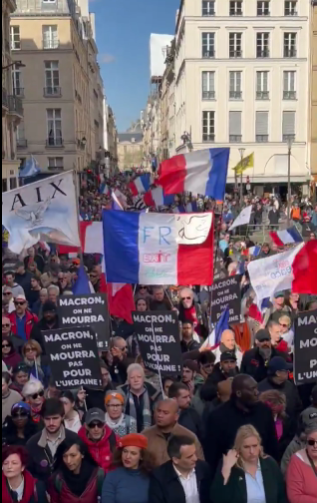 Thousands of demonstrators marched through the streets of Paris on Saturday, protesting French President Emmanuel Macron’s and NATO’s militaristic approach to the Ukraine conflict.
On Wednesday, Macron announced a new €2 billion ($2.16 billion) military aid package for Ukraine, after weeks of attempting to drum up support for his initiative to send Western troops as peacekeepers to the country. The new arms will include surface-to-air missiles, armored vehicles and drones, the French leader said.
Saturday’s anti-war rally was organized by former right-wing National Rally politician Florian Philippot and his party, The Patriots.
Thousands of protesters could be seen marching through the French capital, chanting slogans such as “Macron, we don’t want your war!” and “Let’s quickly leave NATO!” in video captured by RT.
Many could also be seen waving placards with the motto “Macron, we will not die for Ukraine.”
“A mad crowd for #Peace… Thousands and thousands of French people are shouting ‘Macron, resign!’ in the streets of Paris right now!” Philippot wrote on X on Saturday.
The Patriots protested in the French capital earlier this month after Macron proposed deploying France’s nuclear weapons in other European allied states, citing uncertainty over Washington’s commitment to the continent.
On Thursday, following an international summit in Paris, Macron announced a French-British plan to push for the deployment of troops to Ukraine as a “reassurance force” in the event of a ceasefire between Kiev and Moscow. Macron first touched on the idea of sending Western troops into Ukraine last February.
Russia has categorically ruled out agreeing to NATO troops being deployed to the conflict zone. Troops from the US-led military bloc, even under the guise of peacekeepers, would amount to direct NATO participation in the conflict, according to Moscow.
Featured Video

ARE PATIENTS BEING PROPERLY INFORMED ABOUT OZEMPIC?
or go to
Aletho News Archives – Video-Images
From the Archives
Trans ‘milk’ as good as the real thing – NHS
RT | February 18, 2024
The drug-induced nipple secretions of trans women are as good as mothers’ breast milk for babies, the University of Sussex Hospitals NHS Trust claimed in a letter to campaigners made public in a report by British think tank the Policy Exchange on Sunday.
The healthcare trust’s medical director, Rachel James, argued that the off-label prescription drug cocktail men transitioning to female take in order to produce milk was “similar to the natural hormones which encourage lactation to develop when the baby is newly born.”
“The evidence which is available demonstrates that the milk is comparable to that produced following the birth of a baby,” James wrote in the letter, sent to Children of Transitioners last August.
Biological men who wish to lactate must first take hormones to grow milk glands and then take high doses of either domperidone or metoclopramide to stimulate milk production. Neither drug is approved for this use, though they are occasionally prescribed off-label to biological women who have trouble lactating.
However, domperidone’s own manufacturer, Janssen, warns patients the drug “may cause unwanted side effects affecting the heart in a breastfed baby” and “should be used during breastfeeding only if your physician considers this clearly necessary.” … continue
Blog Roll
 Aletho News
- 2025 Nature Paper Claiming Worsening Global Drought Gets RETRACTED …Heavily Flawed
- Your Milk Is Not the Problem
- The Truth About the Trump Shootings with Ken Silva
- ARE PATIENTS BEING PROPERLY INFORMED ABOUT OZEMPIC?
- US lawmaker blocks $2.8 billion weapons sale to Israel: Report
- Yemeni army claims responsibility for strikes on sensitive sites in Saudi capital, Aramco facilities in Yanbu
- Iran Judiciary issues indictments against 159 US, Israeli officials for assassination of Leader, commanders
- Turkiye revokes Iranian bank license under US sanctions campaign
- US-Denmark Agreement on Greenland Is ‘PR Stunt’ Ahead of Midterms
- Araghchi: Military intervention cannot create security; coercion cannot bring peace
- If Americans Knew
- Salah Sarsour’s Legal Team Says DHS Has Not Met Its Burden to Prove He Is Deportable
- An analysis of tax forms by The Intercept show Kraft’s charity and LLC have donated to Friends of the IDF and AIPAC’s super PAC.
- Israeli attacks kill four Palestinians in Gaza – Daily Update
- Inside Gaza’s death trap of collapsing, bombed-out buildings
- The everyday items Israel bans from Gaza every day
- Inside the siege, the ruined buildings of Gaza – Daily Update
- Debunking The Claim That Macklemore Has A “History Of Antisemitism”
- CPJ demands release of arrested Palestinian-US journalist near Bethlehem
- Robert Kraft: The Billionaire Friend of Netanyahu Pulling The Strings Behind the Macklemore/Ed Sheeran Blow Up
- Columbia Administered Fund Gives Big Money to Pro-Israel Groups
- No Tricks Zone
- 2025 Nature Paper Claiming Worsening Global Drought Gets RETRACTED …Heavily Flawed
- New Study: ‘Global Drought Shows No Detectable Recent Acceleration Under Climate Warming’
- Economic Masterminds: German Socialists Suggest Taxing Productivity Gains Stemming From Using AI
- The South China Sea Has Not Been Cooperating With The Climate Change Narrative
- Energy Crisis: Germany Enters Heating Season With Historically Low Gas Reserve Fill Levels
- New Study: The Antarctic Ice Sheet Gained Mass From 2020-2024 Due To Staggering Snow And Ice Accumulation
- Study: Ocean Heating Rates From Thousands Of Years Ago ‘Dwarf’ Modern Ocean Heating Rates
- Climate Extremists Target, Attack Large-Scale Power Grid Infrastructure In Germany!
- New Study: Antarctic Ice Melt Has Contributed Less Than 1 Centimeter To Sea Level Rise In The Last 30 Years
- Fear Of Debate: Alarmist German Climate Scientist Calls On Mainstream Media To Discredit Skeptic Voices
 Aletho News