UK, France involved in Kiev’s latest attack on Russian energy infrastructure – Moscow
RT | March 28, 2025
France and the UK actively aided Kiev in a strike on the Sudzha pipeline infrastructure in Russia’s Kursk Region on Friday, Foreign Ministry spokeswoman Maria Zakharova has told journalists. Earlier the Russian Defense Ministry said that a metering facility was “de facto destroyed” in a Ukrainian HIMARS attack.
“[We] have reasons to believe that targeting and navigation were facilitated through French satellites and British specialists input [target] coordinates and launched [the missiles],” Zakharova said, commenting on the strike.
“The command came from London,” she said, branding the attack part of a Ukrainian “terror” campaign targeting Russian energy infrastructure. The spokeswoman added that such actions demonstrate that Kiev is “impossible to negotiate with.”
Although Ukraine’s Vladimir Zelensky “publicly supported” a temporary suspension of strikes on energy infrastructure agreed by Moscow and Washington, he “did nothing to observe it,” according to Zakharova.
Moscow ordered that attacks on Ukraine’s energy infrastructure cease on March 18, following a phone call between presidents Vladimir Putin and Donald Trump. Russia and the US also agreed on a list of energy facilities that should not be targeted as part of a truce earlier this week. The list included gas facilities.
Kiev also agreed to a US-proposed 30-day partial ceasefire following talks between Ukrainian and American delegations in Saudi Arabia on March 15. Zelensky hailed the development and even described it as a diplomatic “victory” for Ukraine, but did not publicly mention any relevant orders to the Ukrainian military.
The Russian Defense Ministry has regularly reported on Ukrainian attacks on Russian energy infrastructure over the past few weeks. Earlier on Friday, Kremlin spokesman Dmitry Peskov told journalists that the strike suggested that the Ukrainian military no longer follows Kiev’s orders due to a “total lack of supervision.”
Paris and London have emerged as the staunchest supporters of Ukraine in the face of a gradual shift in Washington’s position under the new Trump administration. In early March, British Prime Minister Keir Starmer and French President Emmanuel Macron said that their nations were ready to lead a “coalition of the willing”—a group of pro-Ukrainian countries prepared to support Kiev with troops and aircraft.
Russia has vehemently rejected any possibility of NATO-aligned European troops deploying to the conflict zone. It has accused France and Britain of hatching plans for “military intervention in Ukraine,” which could lead to a direct armed clash between Russia and NATO.
Macron and Starmer’s coalition of the killing amid Europe’s insane war footing
Strategic Culture Foundation | March 28, 2025
If there were a prize for Orwellian-named conferences, then the one held this week in Paris would surely be a top contender.
Over the past month, there has been a slew of such gatherings in London, Brussels, and Paris. They have been conducted in a frenzy to thwart peace and prolong war – under the guise of “seeking security” against Russia.
Some 30 nations attended the latest Paris summit, convened by France’s Emmanuel Macron, and entitled “Building a Robust Peace for Ukraine and Europe”.
Europe is being gaslighted to view war as peace and accept that all economic resources must be dedicated to militarism. It is an insane war footing that is beyond any democratic or moral rationale.
European Union member states participated as well as NATO and non-EU nations Britain, Norway, and Canada. We should clarify that it was the elitist leaders of these countries who were present. Their lack of democratic mandate and authority is all too obvious to the people of Europe.
Some EU nations, such as Hungary and Slovakia, have protested commendably about the unwavering belligerence and obscene waste of public resources for fueling a proxy war in Ukraine.
Notably, too, the United States was not represented at the Paris summit. Coincidentally, this week, a leaked private group conversation between senior members of the Trump administration revealed their contempt for “loathsome” European leaders. One can understand why.
In the grandeur of Élysée Palace, Macron hailed the non-entity gathering as the “Coalition of the Willing”. With this self-appointed virtue, the French leader was referring to countries that are willing to deploy military forces to Ukraine or maintain the supply of weapons.
Macron has been assiduously supported in this military venture by Britain’s Prime Minister Kier Starmer.
The French and British leaders have intensified their efforts to directly insinuate Europe and NATO militarily in the three-year conflict between Ukraine and Russia. Their efforts are a result of American President Donald Trump engaging with Russian President Vladimir Putin to end the proxy war between the U.S.-led NATO alliance and Russia.
Trump’s diplomatic overtures with Moscow have sidelined the European states and have left them with an acute political problem of how to justify continuing military support for a failing Ukraine Project.
The French, British and other European Russophobes do not want the war to end. That’s because they are wedded to the false narrative about defending Ukraine from “Russian aggression”. They are also committed to strategically defeating Russia using Ukraine as a proxy.
In Orwellian fashion, the European and NATO warmongers cannot openly state their nefarious objective. That would be politically fatal. Hence, they are cynically dressing up their motives with virtuous-sounding schemes, such as deploying “peacekeeping troops” in the event of any ceasefire deal that the Americans and Russians might negotiate.
The relentless demonizing of Russia as a threat to Europe is amplified by a near-constant drumbeat of war. European citizens – 500 million of them – are being subjected to non-stop messaging about the “need” to militarize their societies to “defend” against “Russian expansionism”.
This week, the EU began urging citizens to stockpile emergency rations in their homes. Russia was not explicitly invoked as a threat, but it was palpably obvious that fear of war was being inculcated. While European states are slashing billions in social welfare, their elitist, Russophobic leaders are ramping up billions for militarism. Europe is on a war footing based on paranoia and the pathological fears of a ruling clique.
Macron and Starmer are also pushing the idea of integrating Ukraine into a first line of defense against alleged future Russian aggression toward Europe. In reality, this is about reconfiguring offense.
Their pretensions of “building a robust peace for Ukraine and Europe” are a reckless gambit to prolong the war. At its worst, the conflict could explode into an all-out world war.
It is cringe-making that failed European politicians who are mired in internal political and economic messes are seeking to aggrandize their images through high-stakes posturing against Russia.
Macron has said that his coalition of willing wants to have American backing for security. He added this week that if European troops in Ukraine come under fire from Russian forces, they will retaliate.
Moscow has already stated categorically that no European or NATO troops deployed to Ukraine are acceptable. They will be targeted as combatants.
That means that if Paris and London go ahead with their military venture in Ukraine, a wider war is almost inevitable.
It is alarming that Macron has lately said that European troops may be dispatched to Ukraine “with or without American support.”
Laughably, though, neither the French nor the British have the military power for a serious intervention. French forces have been serially kicked out of several African countries that were former colonies. Meanwhile, British military chiefs have warned Starmer that his deployment plans are ill-conceived and amount to “political theater”.
Even the much-vaunted summit in Paris this week showed open cracks between allies. Several European states have stated they are not willing to join any military intervention in Ukraine. Italy, Poland, and Greece have expressed deep concern about where Macron and Starmer’s logic is leading.
It seems that the extreme delusions of grandeur harbored by former imperialist powers are beginning to unnerve even supposed partners.
Hopefully, it is becoming transparent that Britain and France are gambling with world security to satisfy their own egos.
Two world wars in the last century stemmed from European intrigue and duplicity.
Has-been European powers are at it again with their Orwellian doublespeak about ensuring “lasting peace”.
The reality is Russia has won the proxy war that NATO instigated. Even the normally gung-ho Americans realize that.
NATO has been caught with blood on its hands as the culprit of an epic war crime against Russia, using Ukraine as a pawn. Trump seems to want to extricate the Americans from the debacle. He can try to offload the blame onto the previous Biden administration.
However, the European elitist leaders can’t do that. They are the same lackeys who promulgated the criminal proxy war. Their only perceived option is to keep it going… until the European public wakes up and takes retribution on their criminal leaders.
Putin’s Senior Aide Patrushev Shared Some Updates About The Arctic & Baltic Fronts
By Andrew Korybko | March 23, 2025
Putin’s senior aide Nikolai Patrushev, who ran the FSB for nearly a decade (1999-2008) before chairing the Security Council for over 15 years till recently (2008-2024), shared some updates about the Baltic and Arctic fronts of the New Cold War in a recent interview with Russia’s National Defense magazine. He began by blaming the Brits for orchestrating Baltic tensions in order to disrupt the incipient Russian-US normalization process and associated talks on Ukraine.
In connection with that, he also warned that some NATO members (presumably led by the British) are practicing cyberattacks against Russian ships’ navigation equipment and suggested that they might have been responsible for recent claims of sabotage in the Baltic, which prompted a larger naval presence. This same expanded presence poses a threat to Russia’s interests and could manifest itself through terrorist attacks against its underwater pipelines, tankers, and dry cargo ships.
Russia plans to defend against this through unmanned underwater systems and strengthening its Baltic Fleet. As for one of the worst-case conventional threats, that of Finland and Estonia teaming up to blockade Russia inside the Gulf of Finland, Patrushev expressed confidence that his country could overcome that plot and punish the aggressors. This segued the conversation into a discussion about Finland, which Patrushev said has a friendly population, unlike its government.
He mentioned how the authorities there distort history to avoid talking about the goal of “Greater Finland”, which took the form of occupying Northwestern Russia, placing its inhabitants into concentration camps, and exterminating the Slavs there. Just like Finland was used by the Nazis as a springboard for aggression against the USSR, so too did Patrushev warn that plans might be afoot for NATO to use it as a springboard potential aggression against Russia.
He then said a few words about how the Arctic is opening up as a new front of competition, mostly due to its resources, but reaffirmed that Russia wants peace and cooperation there instead of rivalry. The Northern Sea Route (NSR), which commemorates its 500th-year conceptualization this year, can help bring that about. Russia will continue developing regional infrastructure and building ice-class vessels for facilitating transit through these waters year-round. It was on that note that the interview ended.
Reviewing Patrushev’s briefing, the first part about blaming the Brits for tensions in the Baltic aligns with what Russia’s Foreign Spy Service (SVR) recently claimed about how the UK is trying to sabotage Trump’s envisaged “New Détente”. It might therefore very well be that they’re attempting to open up this front for that purpose, first through unconventional acts of aggression like “plausibly deniable” terrorist attacks and then possibly escalating to a joint Finnish-Estonian blockade of the Gulf of Finland.
Exposing these plots and expressing confidence in Russia’s ability to overcome them were meant to respectively ensure that the Trump Administration is aware of what the UK is doing and to deter the UK’s regional proxies from going along with this since the US and even the UK might hang them out to dry. Patrushev’s words about Finland were important too in the sense of reminding everyone that governments don’t always reflect the will of the people on the foreign policy front.
At the same time, however, everyone should also be aware of the Finnish government’s historical distortions and the threat that its reckless foreign policy poses to its own people. Wrapping everything up, Patrushev pointed to the Arctic’s importance in Russia’s future planning, and his reaffirmation of its peaceful intentions could be interpreted as a willingness to partner with the US there like their representatives discussed last month in Riyadh. The NSR can also become a vector for cooperation too.
Putting everything together, the Arctic front of the New Cold War is thawing a lot quicker than the Baltic one since the first is where the US could prospectively cooperate with Russia while the second is where the UK could try to provoke a crisis with Russia, but it remains to be seen whether any of this will unfold. Russian-US cooperation in the Arctic is likely conditional on a ceasefire in Ukraine whereas a Russian-NATO conflict in the Baltic orchestrated by the Brits is conditional on them misleading the US about this.
Putin’s interest in a lasting political solution to the Ukrainian Conflict bodes well for the Arctic scenario just like Trump’s criticism of NATO bodes ill for the Baltic one so both ultimately come down to their will. They’re the two most powerful people on the planet so their ties will greatly determine what comes next on those fronts and every other one too. It’s precisely for this reason why the British want to ruin their relations, but after Patrushev just exposed their Baltic plot, that’s a lot less likely to succeed than before.
Serbia between political destabilization and a new military front in the Balkans
By Lorenzo Maria Pacini | Strategic Culture Foundation | March 24, 2025
Bosnia’s dysfunctional political system, the result of the 1995 Dayton Accords that divided the country into two entities jointly governed by Serbs, Croats (a Catholic majority) and Muslims, with a rotating presidency under international supervision, is inexorably collapsing. In Serbia, protests against corruption and for regime change have been going on for months, and last weekend’s protests were the most impressive to date. Images of the human tide that invaded the streets of Belgrade went around the world in no time at all, but also caused a lot of confusion about the events.
In Bosnia, recent tensions have arisen from the issuance of arrest warrants by the central authorities against the president of the Republika Srpska Milorad Dodik, his prime minister and the president of the parliament. The measures stem from their refusal to comply with the directives of the “high representative” Christian Schmidt, whose appointment in 2021 by the Biden administration was not approved by the UN Security Council. Consequently, neither Dodik nor Russia recognize his authority, believing that his requests aim to reduce the autonomy of the Republika Srpska in order to favor the centralization of the Bosnian state for the political advantage of the Islamic component.
One of Schmidt’s main objectives would be to eliminate the Republika Srpska’s veto on Bosnia’s entry into NATO, which would explain the international pressure on Dodik and the attempt to remove him. Despite the differences between the Biden and Trump administrations, the latter does not seem to actively oppose this strategy. Secretary of State Marco Rubio has accused Dodik of undermining the stability of Bosnia and Herzegovina, stating that the country should not fragment; simultaneously, Dorothy Shea, the US chargé d’affaires at the UN, has expressed support for EUFOR (European Union Force in Bosnia and Herzegovina), hinting at the possibility of intervention against the leadership of Republika Srpska. Nothing new from the western Atlantic front.
In response to these unpleasant provocations, Dodik invited Rubio to a dialogue to present the Serbian point of view and made an interesting proposal: to grant American companies exclusive rights to extract rare earth minerals from the Republika Srpska, a deal with an estimated value of 100 billion dollars, which could attract the attention of the Potus, and emphasized that US policy in the Balkans is still influenced by the so-called Deep State, in particular by elements of the American embassy in Bosnia, historically hostile to Trump.
British involvement in Bosnian tensions cannot be ruled out, considering that the Russian Foreign Secret Service, the SVR, recently denounced the UK’s role in sabotaging Trump’s policy of rapprochement with Russia, almost coinciding with the accusation that Nikolai Patrushev, Putin’s advisor, made towards London, saying that he tried to destabilize the Baltic countries, hinting that he could act in a similar way in the Balkans.
Things are not much better in Serbia
The situation in Serbia is equally delicate. The country has been shaken by protests, which began after a train station incident in Novi Sad last November, fueled by discontent over corruption, with demands for accountability that could lead to a change of government. However, the protest movement is heterogeneous, including both Western-linked groups and Serbian nationalists.
Globalist liberals accuse President Aleksandr Vucic of being too pro-Russian for not having imposed sanctions on Moscow, while Serbian patriots consider him excessively pro-Western for his ambiguous positions on Kosovo, Russia and Ukraine. Vucic, for his part, claims that the protests against him are part of a Western strategy to destabilize him, and Russia itself has allegedly confirmed a supposed plot for a coup against him.
Despite accusations of Western interference, Vucic has maintained cooperation with NATO, signing a “Partnership for Peace” agreement in 2015 allowing the Alliance to transit through Serbia and in August 2024, while facing large-scale protests, he signed a three billion dollar deal with France for the supply of warplanes, raising doubts about the West’s real hostility towards him. Throughout all this, the United States continues to exert pressure on him through various channels.
The tensions in Bosnia and Serbia are not unrelated: the Western objective seems to be for Bosnia to join NATO and for Russian influence in the Balkans to be reduced. If Trump does not oppose the current policy or does not accept Dodik’s offer on rare earths, the risk of an escalation in Bosnia could increase.
Geopolitically speaking, the American doctrine of division and control continues to prevail in the Balkans, seeking to exclude any possible reunification of Bosnia and Serbia.
The only chance for the Serbs to improve their position will be close coordination between Serbia, the Republika Srpska and, if possible, Russia, to counter Western pressure and obtain the best possible result.
NATO takes advantage of the situation
Throughout all this, NATO doesn’t miss the opportunity to take advantage of the situation. The Secretary General, Mark Rutte, has declared that the actions of the Republika Srpska are unacceptable and that the United States will not offer any support to Dodik, a position also reiterated by the American Embassy in Bosnia.
EUFOR has announced that it will reinforce its contingent to deal with the growing tensions, sending reinforcements by land through the Svilaj and Bijaca passes and by air to Sarajevo airport. An excellent excuse to deploy a good number of soldiers to guard what increasingly seems to be a color revolution involving two countries.
Despite growing international pressure, the Republika Srpska can count not only on the support of Moscow and Belgrade, but also on the diplomatic support of Budapest and Bratislava, who have expressed their support for a peaceful resolution of the situation, avoiding participating in veiled military threats.
On March 10, the Chief of Staff of the Serbian Armed Forces, Milan Mojsilović, met his Hungarian counterpart, Gábor Böröndi, in Belgrade and they discussed regional and global security, as well as joint military activities aimed at strengthening stability in the area. The intensity of bilateral military cooperation was reaffirmed, with the intention of expanding it further. Particular attention was paid to joint operations between the land and air components of the two armies, as well as to the contribution of Hungarian forces to the international security mission in Kosovo and Metohija.
It seems clear that the only way for NATO to put an end to Serbian-Bosnian sovereignty is to trigger a new internal conflict, using local armed groups along the lines of what happened in Syria, or a sort of Maidan based on the 2014 Ukrainian model.
The military risk fueled by KFOR
The Kosovo Force (KFOR) is an international mission led by NATO, established in 1999 with the aim of ensuring security and stability in Kosovo, in accordance with United Nations Security Council Resolution 1244.
At the beginning of the operation, it had over 50,000 soldiers from 20 NATO member countries and partner nations. Over time, the presence has been reduced. As of March 2022, KFOR consisted of 3,770 soldiers from 28 contributing countries.
To give an idea of the type of deployment, consider that there are:
– Regional Command West (RC-W): unit based at “Villaggio Italia” near the city of Pec/Peja, currently consisting of the 62nd “Sicilia” Infantry Regiment of the “Aosta” Brigade. RC-W also includes military personnel from Albania, Bulgaria, Croatia, North Macedonia, Poland, Turkey, Austria, Moldova and Switzerland.
Multinational Specialized Unit (MSU): located in Pristina and commanded by Colonel Massimo Rosati of the Carabinieri, this highly specialized unit of the Carabinieri has been present in Kosovo since the beginning of the mission in 1999. The regiment has been employed mainly in the northern part of the country, characterized by a strong ethnic Serbian population, particularly in the city of Mitrovica.
The main operational activities of KFOR include:
– Patrolling and maintaining a presence in Kosovo through regular patrols;
The activity of the Liaison Monitoring Teams (LMT), which have the task of ensuring continuous contact with the local population, government institutions, national and international organizations, political parties and representatives of the different ethnic groups and religions present in the territory. The objective is to acquire information useful to the KFOR command for the carrying out of the mission;
– Support for local institutions, in an attempt not to give in to Serbia’s demands.
These are forces that are deployed and ready to intervene. This is a detail that must be taken into consideration. NATO is not neglecting the strategic importance of that key area of the Balkans.
With their backs to the wall, the governments of Serbia and Republika Srpska don’t have many options: they will soon have to face difficult choices, which could radically change the face of the Balkans.
In short, we are once again at risk of seeing the Balkans explode, as happened just over 100 years ago. Who will be responsible for the explosion this time?
Serbia Will Not Join NATO or CSTO – Deputy Prime Minister Vulin
Sputnik – 24.03.2025
BELGRADE – Serbia will not become a member of NATO or the CSTO, it must ensure its own security, although this is difficult, Serbian Deputy Prime Minister Aleksandar Vulin told Sputnik.
“Serbia strictly adheres to the policy of military neutrality. This means that we will not expand our participation in any military bloc. And we will try to maintain the best relations with everyone, first of all — with the countries in our neighborhood. So Serbia will not become a member of NATO, will not be a member of the CSTO,” Vulin said.
He admitted that for a country the size of Serbia, this is the hardest path.
“We must guarantee our own security, which is not easy. But this is the most honest path — to make decisions about ourselves,” he emphasized.
Currently, the parliament of Serbia is an observer in the CSTO Parliamentary Assembly.
‘Nazis’ in Ukraine ‘nurtured’ by Europeans – Lavrov
RT | March 24, 2025
European NATO members are willfully ignoring the “Nazi” character of the Ukrainian government, which they have empowered as an anti-Russian instrument, Russian Foreign Minister Sergey Lavrov has asserted.
On Monday, the senior diplomat expressed concern over the “demons of neo-Nazism, Russophobia, and other hateful ideologies” spreading across multiple EU nations. Member states are deliberately overlooking Kiev’s misconduct, even as it persecutes ethnic Russians and violates human rights, he stressed.
“Ukraine – ‘that’s different.’ Those Nazis have been nurtured for the latest attempt to unite all of Europe under racist, Nazi banners for a war against the Russian Federation,” Lavrov stated.
The minister was speaking in his capacity as a trustee of the Gorchakov Fund, a Russian NGO aimed at enhancing public diplomacy. He emphasized the organization’s mission of presenting an authentic view of Russia and contrasted it sharply with the West’s approach to public messaging that “portrays itself as infallible and suffers from an exceptionalism complex.”
The EU is pursuing a multibillion-dollar rearmament plan, justified by what Brussels labels a growing Russian threat. European officials have warned that a direct NATO confrontation with Moscow may break out within the next few years. Russia, however, denies any hostile intentions toward the US-led military bloc.
Tensions between European NATO members and Washington resurfaced after President Donald Trump assumed office in January. The new US administration has sought a swift resolution to the Ukraine conflict and intends to shift security responsibilities onto Europe once a truce is achieved.
Moscow’s goal of ‘denazification’ remains central to its stance on the Ukraine conflict. Russian officials have denounced the Ukrainian government as a “neo-Nazi regime” due to its discriminatory domestic policies, alleged war crimes against Russian citizens, and veneration of historical nationalist figures who collaborated with Nazi Germany during World War II.
A new vision for US global power under Trump
By Batool Subeiti | Al Mayadeen | March 23, 2025
Trump’s approach to global affairs diverges sharply from the American establishment’s traditional strategy. Trump does not see America as a “police state.” He is sceptical of NATO, does not support war with Russia, and believes the US military presence in West Asia primarily serves to protect Arab allies. In his view, they should bear the financial burden of that protection.
The American establishment, represented by institutions like the Pentagon and the White House, follows a long-term strategic vision. It maintains hundreds of military bases worldwide and pursues a structured political strategy across various regions.
Trump, by contrast, envisions American leadership within a multipolar world order. He is less concerned with imposing the American system on other nations and more focused on fostering economic alliances that benefit the US. He also seeks to counter the rise of BRICS and prevent alternative economic blocs from challenging the dollar’s dominance. Rather than waging ideological battles, his strategy revolves around economic leverage.
A key example of establishment influence has been USAID, which has historically functioned as a covert tool for advancing American unipolarity. By using soft power tactics, it has helped destabilize nations through coups and colour revolutions. However, under Trump, funding for such initiatives has been slashed, allowing the US to save billions. His approach is more direct—rather than relying on NGOs to influence societies, he prefers sanctions as a means of coercion. This shift weakens American influence at the grassroots level, creating a vacuum that local movements and other powers can exploit.
Trump aims to strengthen the American economy through relative stability rather than confrontation. He opposes prolonged war with Russia, favouring investment over sanctions. Rather than spending $350 billion on Ukraine, he sees greater economic potential in working with Russia, which he does not view as a direct economic competitor. His broader goal is to retract costly foreign commitments and consolidate American economic dominance, using economic leverage—such as tariffs and sanctions—to maintain control. This was evident in his approach to Zelensky, where he set clear conditions for support.
This stance starkly contrasts with that of Europe, which remains deeply hostile toward Russia and relies on US backing to counter it. Trump’s push for increased tariffs on European imports will likely reduce demand for European goods in the US, stimulating domestic manufacturing and bolstering the dollar. His retreat from NATO further exposes contradictions within the alliance, creating strategic openings that others may exploit.
Trump operates like a political tsunami. In Gaza, he has positioned himself as the real power behind the war, stopping it on his terms. Even his controversial depopulation proposal was more of a bargaining tool than a concrete plan. He sees West Asia as secondary to regions like Mexico, Panama, or Greenland. When asked about Iran’s strength, he acknowledges Iran is very strong—suggesting he prefers to focus on nuclear containment rather than military confrontation, much to Netanyahu’s frustration.
Trump also has a tendency towards withdrawal when he sees American involvement as a financial drain. While “Israel” has expanded its influence in Syria, if its actions provoke widespread resistance, and it becomes clear that “Israel” is a source of ongoing conflict, Trump may reconsider US support.
In contrast to the deep state’s approach—where a weakening “Israel” prompts the search for regional substitutes—Trump’s stance is more transactional. If there is no significant opposition, he will stamp “Israel’s” territorial gains. But if the costs outweigh the benefits, he is willing to incrementally remove support from the occupation entity.
Scorch Marks in the Sand
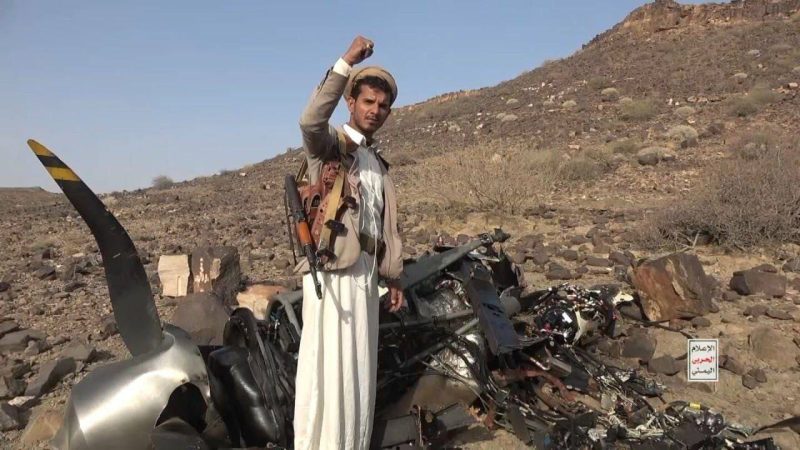
Yemeni Warrior Rejoicing over a Slain MQ-9 Reaper
By William Schryver – imetatronink – March 22, 2025
Javelin, Stinger, M-777 howitzer, HIMARS, Excalibur, Switchblade, all manner of electronic warfare gizmos and counter-battery radars, Bradley IFVs, Stryker, Leopard, Challenger, Abrams, Patriot, JDAMs, HARMS, Storm Shadow, ATACMS … I’m sure I’m forgetting some.
Oh, yeah … remember in early 2022 when the unveiling of the Bayraktar strike drones was hailed with great fanfare? They were predicted to be the bane of the Russian army. Instead, it was a major embarrassment for the Turks.
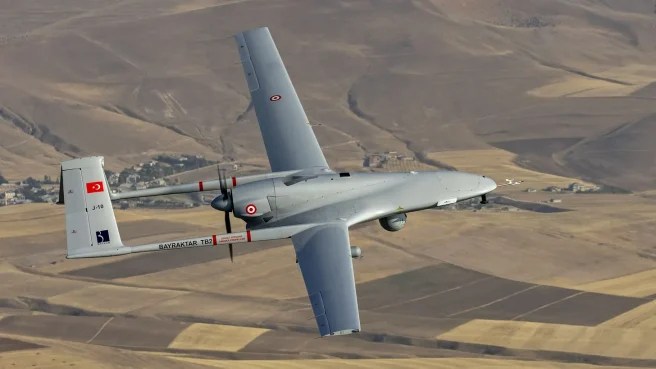
Turkish Bayraktar TB2 Surveillance and Attack Drone
That said, over the past year or so, those “savage barbarians” down in Yemen have shot-down a baker’s dozen of the once-vaunted US MQ-9 Reaper drones – supposedly vastly superior to the Bayraktar TB2.

US MQ-9 Reaper Surveillance and Attack Drone
In any case, all of these things represent top-shelf front-line US/NATO war stuff that has been objectively proven inferior in the crucible of protracted high-intensity warfare. Many are simply ill-suited for the current state-of-play in the military realm, as it has been revealed over the course of the war in Ukraine.
Before this war began, the almost-universal belief was that US/NATO weaponry and equipment were far and away superior to anything the Russians could put on the battlefield.
That unfounded faith in the unrivaled supremacy of western arms has now been shattered — although we already see the think-tank apologists fashioning their strained rationalizations.
Nevertheless, when one examines in aggregate the implements of war the US/NATO have provided to Ukraine, the overwhelming majority consists of the very stuff every military in NATO would field in a war against Russia, or anyone else, for that matter.
Here is a sobering truth: if the Armed Forces of Ukraine could make one wish, it would be to respawn as the army and abundant quantities of effective and durable Soviet equipment they had in February 2022. That was, all things considered, the strongest army they would ever have. And it was, in great measure, squandered on the altar of a misguided commitment to NATO field doctrines that repeatedly proved misconceived and ill-adaptive to the war that actually ensued, as well as the war as it has subsequently evolved.
So, in the case of the Ukraine War, we see attested two now-indisputable facts:
1) US/NATO weaponry and equipment is FAR LESS FEARSOME than was previously believed by the supposed “military experts” in the world. It has either failed abysmally or vastly underperformed in virtually every case.
2) US/NATO war doctrine has been demonstrated to be something quite a bit less than the greatest expression of the martial arts since Napoleon at the Battle of Austerlitz. The disastrous NATO/AFU “counteroffensive” in Zaporozhye in summer 2023 and the catastrophic blunder of the Kursk Kamikaze Incursion in summer 2024 have laid waste to the mythology of US/NATO military prowess.
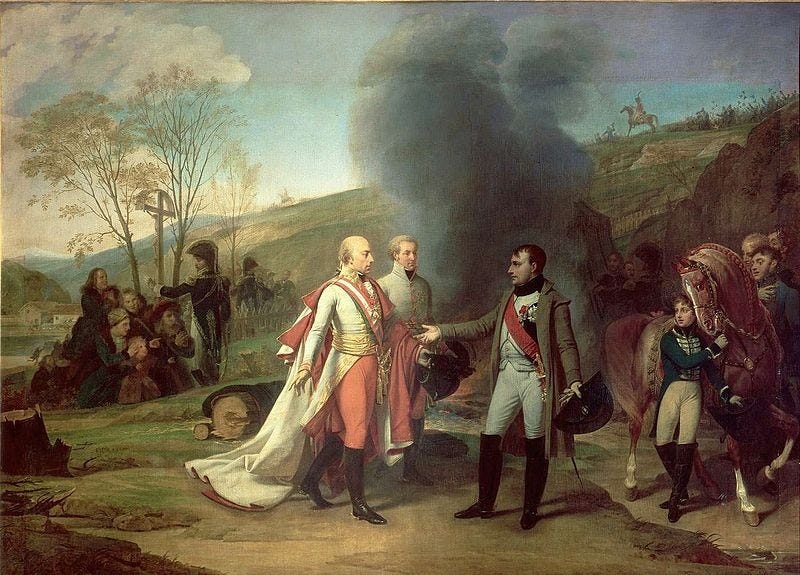
Napoleon at Austerlitz Accepting the Surrender of Francis II
Now, here in the early spring of 2025, we see the United States, with Donald Trump again at the helm, trying to soothe the sting and obfuscate the reality of the resounding defeat its strategic designs and battlefield arms have suffered against Russia.
And, after weighing all options and considerations in the balance, the Masters of Declining Empire have decided beating up on Iran is the right medicine for what ails them.
I mean, after all, the Russians never had to face them, and the Iranians certainly cannot pose a credible threat to our decades-old F-15s, F-16s, F/A-18s, F-22s, F-35s, B-52s, B-1s, B-2s, Tomahawks, etc., not to mention the almighty US Navy.
Everybody KNOWS this to be true. Right?
And even though the Iranians have already proven to be able to defeat all manner of US and Israeli air defenses with their upper-tiers of ballistic missiles … well, if we just have Pete Hegseth give them a proper pep-talk, those interceptors that failed during the reign of the imbecile Joe Biden will strike down every single Muslim Missile they see. American air defense interceptors will be made great again. Hail to the Chief!
As for the Iranian air defenses … well, everyone also knows the Israelis already destroyed them. Right? They told us all about it – how the heroic Israeli F-35s and F-15s stormed across the Tigris into the heart of Iran and blew to smithereens all those S-300s and missile factories. They even showed pictures of scorch marks in the sand to prove it.
Anyway, the point is that America needs to go to war again in an attempt to erase the stain of having lost to the Russians, just as going to war against the Russians was meant to erase the stain of having lost to the Afghanis, just as going to war against Iraq and Afghanistan was meant to erase the stain of having lost to the Vietnamese. And … well, you know the drill by now.
You should also know what they say about the best laid plans of mice and men. Nothing ever goes as planned. And I strongly suspect the next war of American redemption will not be a reversal of the prevailing trend.
‘They need new eyes’: IAEA accused of bias over strikes at Europe’s largest NPP
RT | March 22, 2025
A group of international journalists that recently toured Russia’s Zaporozhye Nuclear Power Plant (ZNPP) have accused Ukraine of being the one targeting the facility. They also questioned the International Atomic Energy Agency’s (IAEA) persistent refusal to identify the source of the attacks.
The ZNPP, Europe’s largest nuclear power station, has been under Russian control since March 2022 and is located in a region that later voted to join Russia following a public referendum. The plant’s operations are now overseen by Russian state-owned nuclear power company Rosatom. According to the Russian Defense Ministry, the facility and nearby city of Energodar have come under frequent attacks by Ukrainian drones and artillery. Despite this, the IAEA, which has maintained a permanent monitoring mission at the site since September 2022, has consistently declined to name the party responsible for the shelling.
Speaking with RT after touring the facility, reporters from a number of countries, including India, Serbia and Slovenia, voiced concerns over what they said was a clear distortion of facts by Western media and the IAEA’s refusal to acknowledge the reality on the ground.
“We should never trust any Western sources… Ukrainians are playing with nuclear fire,” said Serbian journalist Miodrag Zarkovic, who criticized the IAEA’s insistence on neutrality. Indian journalist Manish Kumar Jha said the evidence he saw contradicted everything he had read in Western outlets.
“According to Western media, the Russians are attacking the plant. But when I visited, I saw the Russian security forces positioned to keep the plant safe,” Jha said, noting that he saw a fragment of a US-supplied missile near the plant. “It was a 180-degree shift. The reality is very different from the story the Western media tells.”
Slovenian journalist and blogger Mohar Borut Iztok criticized the IAEA’s stance, noting the presence of NATO-supplied 155-millimeter shells with clear markings among those that have recently struck the facility.
“I’d like to say to Mr. [Rafael] Grossi and his crew – if they need an extra set of eyes, we can help them because it’s very interesting how they cannot see what is going on,” he stated sarcastically.
“I know what the problem is. They have an agenda, a narrative to follow, so they try to stay neutral,” he added.
Peace Negotiations & the End of NATO
Prof. Jeffrey Sachs with Prof. Glenn Diesen
Glenn Diesen | March 18, 2025
The US and Russia negotiate an end to the proxy war in Ukraine: What is realistic to expect, how can Europe’s bellicose reactions be explained, and is this the end of NATO?
Europe’s Provocation: Interview with Russia’s Deputy FM Alexander Grushko on Potential Escalation in Ukraine
“The conflict has reached a stage where the West suffers a strategic defeat”
Izvestia | March 17, 2025
Kirill Fenin’s interview with Deputy Foreign Minister of Russia Alexander Grushko on security guarantees from NATO, prospects for dialogue with the EU, and the future of the OSCE:
Q: In December 2021, Russia put forward a proposal to the US and NATO on security guarantees. Is it relevant for us to receive these guarantees now? Is the return of NATO infrastructure to the 1997 borders being discussed in the current negotiations with Washington?
Grushko: In 2021, the Russian Federation put forward two initiatives. One was addressed to the United States, the other to NATO countries. But they were not supported. We realized that our so-called partners were not ready to engage in a dialogue on the merits. It became clear that the nature of the alliance’s military construction and the US military preparations were aimed at achieving superiority over the Russian Federation. Moreover, Ukraine was chosen as the main battlefield, the theatre of military operations against Russia.
If we talk about a peaceful resolution of the conflict in Ukraine, then, of course, it will have an external outline. We will demand that cast-iron security guarantees become part of this agreement. Since only through their formation will it be possible to achieve lasting peace in Ukraine and, in general, strengthen regional security. Part of these guarantees should be the neutral status of Ukraine, the refusal of NATO countries to accept it as a member of the alliance. In fact, this is precisely the provision that was recorded in the drafts of the aforementioned agreements. As for discussions, of course, they are not being conducted today, since there are no negotiations.
Q: There are reports in the media that the Donald Trump administration is considering the possibility of reducing its military presence in the Baltics. Is this issue currently being discussed with the US?
Grushko: Diplomats and military personnel do not feed on rumors. We soberly assess the situation. If we look at the strategic concepts approved by NATO and developed in the European Union, as well as the nature of NATO deployments along our borders, we will see that we are talking about long-term plans that the West is not trying to adapt in any way to a future peace agreement. And we will proceed from this in terms of our policy and in the sphere of military development.
If we compare the current situation with 2019, the number of NATO military contingents on the eastern flank, primarily in Poland, the Baltic states, Bulgaria and Romania, has increased by 2.5 times. The amount of heavy equipment has increased by about the same amount. The so-called military Schengen (free movement zone for military personnel – Ed.) is being implemented. The airfield and port networks are being strengthened and expanded. NATO is creating new rapid response units and increasing maneuverability. We are seeing how the density and scale of exercises are increasing. They are becoming more aggressive, aimed at military operations against a comparable adversary. By this we mean the Russian Federation. This is the reality that we have to reckon with. And until there are real changes in the policies and military development of NATO countries, we will proceed from the existence of significant threats to Russia from the West.
Q: As is known, the dialogue on security guarantees was conducted not only between Russia and the United States but also along the Russia-NATO line. The last time a meeting in this format took place was in January 2022. Against the backdrop of the intensification of dialogue with Washington, are negotiations between Russia and NATO possible?
Grushko: I don’t see any prospects at the moment. Of course, you can’t say never, but what can we talk about if NATO countries refused to consider Russia as a partner even in those areas where our interests objectively coincided, for example, in the fight against terrorism. Today they have designated Russia as a direct and immediate threat to NATO countries, and they are conducting their military policy and the process of military development in such a way as to achieve superiority over us in all theaters of military operations, in all, as they say, operational environments: in space, in the air, on land, at sea, in cyberspace.
We see that they are turning the previously most peaceful region of Europe in military terms – the Baltic – into a zone of military confrontation. I will only say that 32 military facilities have been allocated for the deployment of American military forces in Sweden and Finland. All this is a new reality that contradicts everything that was laid down in the Russia-NATO Founding Act and other documents that were intended to unite efforts to counter common threats and at the same time deal with the consequences of the Cold War. The Western countries made a different choice. Our representation in NATO was closed, since NATO made its further functioning impossible. And now there is only a hotline with NATO headquarters, which is provided on our part by the Embassy of the Russian Federation in Belgium. It has not yet been activated, but we have officially notified the leadership of the alliance about it. They know where to call if necessary.
Q: Russian Foreign Minister Sergey Lavrov said that Moscow is categorically against the presence of NATO or EU peacekeepers on Ukrainian territory. Does Russia allow the option of deploying peacekeepers under the auspices of the UN? What conditions must be met for this?
Grushko: Peacekeeping and NATO are incompatible things. They brag a lot that it is a defensive alliance, but the real history of the alliance consists of military operations, a series of aggressions without any reason, just to once again emphasize its hegemony in world and regional affairs. Therefore, all this talk is absolutely inappropriate and absurd. And I think that even the average Westerner understands the real price of such penetrations. Secondly — President Vladimir Putin and Minister Sergey Lavrov talked about this — we absolutely do not care under what label NATO contingents can be deployed on the territory of Ukraine: be it the European Union, NATO, or in their national capacity. In any case, if they appear there, it means that they are deployed in a conflict zone with all the consequences for these contingents as parties to the conflict.
Moreover, the very talk of peacekeeping is an attempt to put the cart before the horse. The question of some kind of international support for the agreement can only be approached when this agreement is worked out. And if the parties come to the understanding that the “peace package” needs international support, then the subject of discussion appears. This could include unarmed observers, a civilian mission that would monitor the implementation of individual aspects of this agreement, or guarantee mechanisms. But for now, it’s just hot air.
Q: What is Russia’s attitude to the possible deployment of peacekeepers to Ukraine under the auspices of the OSCE?
Grushko: There are two points that need to be kept in mind. Firstly, the OSCE does not have armed potential, it does not have an “armed hand”, unlike the UN. In particular, it does not have the competence, the staff committee, the structures that could manage such contingents. Secondly, even the OSCE Special Monitoring Mission, which was deployed there, failed to cope with its tasks. In fact, it was used by NATO to gain unilateral advantages for the Kyiv regime. Now it has become known that some employees of this mission, who were supposed to be neutral and ensure strict implementation of the mandate, in fact worked in the interests of Kyiv. And it is no secret that many residents of Donbass said: “OSCE observers drove by – expect shelling”. Therefore, we have an extremely skeptical attitude towards the involvement of the OSCE, even theoretically.
It is impossible not to see that the purpose of these rumors about the deployment of Western contingents on Ukrainian territory is to prepare public opinion for the most radical scenarios, part of a campaign to whip up military psychosis and demonize Russia. Let me remind you that just a few months ago, such a prospect was denied by all NATO member states, and the Secretary General repeatedly stated that under no circumstances would the Alliance’s soldiers appear there.
Q: This week, the OSCE Secretary General came to Moscow. How do you assess the results of the talks with him? Are any further contacts possible through this organization?
Grushko: There will be contacts, of course. It is good that the Secretary-General came. For two years, the OSCE leadership has not visited Moscow. The main problem of the OSCE is that the organization, as a result of the West’s actions, has effectively been pushed to the sidelines of political processes. Its main purpose as an instrument of reconciliation between East and West, of mitigating contradictions, has been lost. At that time, this was generally called “détente.”
Almost nothing remains of this legacy.
The OSCE is currently at a crossroads. This summer will mark the 50th anniversary of the Helsinki Accords. It depends only on the member states themselves whether this platform will be in demand for some unifying purposes or whether the current crisis state of the organization will become terminal.
Q: Against the backdrop of the dialogue between Moscow and Washington, is a similar negotiating track with Brussels possible?
Grushko: Such a track is possible. But, firstly, the European Union is isolating itself from Russia. It has broken off all political contacts. It is difficult for me to even say with which international structure there was a closer dialogue. Two meetings a year at the highest level, an annual meeting of the government of the Russian Federation and the European Commission. Also more than 20 permanent partnership councils, including the umbrella foreign policy one. Everything has stopped.
In any case, if there are finally signals that Brussels is ready to enter into some kind of dialogue with us, we will not be against it. But today such a prospect is not in sight – on the contrary, the European Union continues to follow the suicidal path of introducing sanctions. If in 2013 the volume of trade between Russia and the European Union was €417 billion, then in 2024 it was at the level of €60 billion.
As for the EU’s insistent demands to sit down at the negotiating table on the Ukrainian conflict, I don’t even know how to characterize this in diplomatic terms. The EU was at these negotiations and was at the center of events starting with the Maidan, where three EU countries acted as guarantors of the agreement between Viktor Yanukovych and the “opposition.” And what did they do to implement the Minsk agreements? Absolutely nothing, on the contrary, they encouraged Kyiv to sabotage them. And when they (the Minsk agreements – Ed.) collapsed, when it became clear that Kyiv was leading the matter to a military solution, a conflict, which, in fact, became the trigger for the decision to conduct a special military operation, Angela Merkel and Francois Hollande stated that they had no intention of implementing the Minsk agreements. A respite was needed to pump Kyiv with weapons and prepare it for a direct clash with Russia. Against this background, it is not very clear what role the Europeans can play.
Q: Can the EU take a more constructive position towards Russia in the future?
Grushko: If we look at their current positions, they do not in any way suggest any constructive participation in the negotiation process. The statements from the camp of the political elites of the European Union are quite clear. Point 1 — do not let the conflict end quickly, it must continue until 2030, because if it ends quickly, then “Russia will immediately attack the Baltic countries and Poland.” Point 2 — we must achieve the strategic defeat of Russia. And we know what is meant by this. Point 3 — seek guarantees of Ukraine’s security.
In fact, the conflict has reached a stage where the West suffers a strategic defeat. Because in all three components that are counted on – military defeat on the battlefield, economic collapse and, ultimately, as they say, regime change – the result is exactly the opposite. If we look at the economic side, our economy has grown by 4%, in the European Union – approximately 0.1% to 1%, close to the statistical error. And the situation on the battlefield is well known.
One of the most important elements for us is the security interests of Russia. And Europe should understand that if strong international legal guarantees for Russia’s security are created, which will exclude Ukraine’s membership in NATO and the possibility of deploying foreign military contingents on its territory or using it to exert military pressure on Russia, then the security of Ukraine and the entire region in a broader sense will be ensured, since one of the root causes of the conflict will be eliminated.
Q: One of the main initiators of the idea of sending European peacekeepers to Ukraine is French President Emmanuel Macron. In your opinion, what is the reason for the desire to aggravate the situation and lead to a direct clash between Russia and NATO?
Grushko: I think that two factors play a role here. First, France itself is not doing so well in the economic, social and all other spheres. The country is going through a serious crisis, it is being shaken by demonstrations, Emmanuel Macron and the political forces that support him are not in a very strong position. Governments are changing. Therefore, the introduction of such a loud topic as sending a military contingent is intended, among other things, to distract public attention from domestic problems.
Secondly, this is an attempt by France to lead the war party within the EU, thereby emphasizing its leadership in the union. France’s influence has been weakening lately. The link between Germany and France no longer works for many reasons, and Macron has apparently decided to use the military theme to once again bring his country to the epicenter of European politics, abandoning French foreign policy traditions.
In the traditions established by General de Gaulle, France played a balancing role. Its significance and political weight lay precisely in this: France proposed initiatives that united rather than divided. Now France, unfortunately, is becoming more radical than the Russophobic camp consisting of the Baltic countries and Poland.
Q: The head of the European Commission recently came up with an initiative for an €800 billion EU rearmament program. Does Russia see risks in connection with the emergence of this program?
Grushko: We see the risks, they are absolutely obvious. The fact is that the military and political subordination of the European Union to NATO has occurred; this follows not only from the practice of cooperation between NATO and the EU, but also from the documents they adopt. The NATO-EU Joint Declaration quite clearly states the EU’s own aim to become a European support for NATO. The Alliance views Russia as a direct and immediate threat. This postulate has also crept into the EU’s political documents. And we see that the plans to create the so-called autonomous military support for the European Union today are aimed at creating threats primarily to Russia.
Large-scale armament programs have been drawn up: over five years, the growth of arms imports to the EU has increased by 2.5 times, with 64% of military equipment purchased in the United States. At the same time, such systems are being purchased — including, in particular, F-35 aircraft — which are not intended for use in some local crisis situations, but for achieving superiority over a comparable enemy, that is, the Russian Federation. The rearmament program is aimed at preparing Europe for a military clash with Russia. US President Donald Trump is demanding an increase in military spending in the EU countries from 2% to 5%. Many have already stated that they will move in this direction. This is a very significant increase. Today, the amount of military spending by the European Union is several times greater than the military spending of the Russian Federation.
Q: The Dutch parliament has already voted against the country’s participation in the EU rearmament program. Is Europe capable of finding the funds for such a large-scale project?
Grushko: Mario Draghi, former Prime Minister of Italy and President of the European Central Bank, recently published a report on the economic state of the EU. The report is quite frank and tough; its main conclusion is that if the EU wants to become prosperous in the new global architecture, it needs to find €800 billion annually to invest in industry, new technologies, the “green transition” and other projects. The President of the European Commission, Ursula von der Leyen, added €800 billion to this, which are needed to further arm the European Union.
Let’s not forget that, according to the most conservative estimates, the losses from the sanctions that the EU imposed on Russia and the losses from the refusal to cooperate with us, including in the energy sector, amount to €1.5 trillion. More than €200 billion went to military and other support for the Kyiv regime. If we add up these figures, we get a financial hole of at least €3 trillion. They need to be found somewhere. This is a colossal amount of money – more than two annual military budgets of all NATO countries. It is clear that the money will be scraped from the pockets of taxpayers, cutting spending on education, medicine, science, and so on.
It is difficult for me to say whether this project will withstand such a financial challenge. If we remember that the total public debt of all EU countries will soon approach 100% of GDP – which means that the EU countries must work for a year and spend nothing – then the prospects for implementing all these plans are rather vague.
Q: What measures can Russia take to counter these threats?
I will note once again: we cannot relax. We have drafted military planning documents that are designed to reliably ensure the security of our country and its defense capability in all areas. As the president emphasized, we will not get involved in an arms race. And it is good that our military capabilities allow us to reliably mitigate threats without spending crazy amounts of money on them and taking them out of the development sphere.
It is obvious that the negative trends that are being imposed today by both NATO and the European Union are very stable, and we must be prepared for a variety of scenarios. The events in Ukraine have shown that NATO and the European Union underestimated our capabilities and our determination and, by betting on inflicting a strategic defeat on us, made a big mistake.
Featured Video

ARE PATIENTS BEING PROPERLY INFORMED ABOUT OZEMPIC?
or go to
Aletho News Archives – Video-Images
From the Archives
Trans ‘milk’ as good as the real thing – NHS
RT | February 18, 2024
The drug-induced nipple secretions of trans women are as good as mothers’ breast milk for babies, the University of Sussex Hospitals NHS Trust claimed in a letter to campaigners made public in a report by British think tank the Policy Exchange on Sunday.
The healthcare trust’s medical director, Rachel James, argued that the off-label prescription drug cocktail men transitioning to female take in order to produce milk was “similar to the natural hormones which encourage lactation to develop when the baby is newly born.”
“The evidence which is available demonstrates that the milk is comparable to that produced following the birth of a baby,” James wrote in the letter, sent to Children of Transitioners last August.
Biological men who wish to lactate must first take hormones to grow milk glands and then take high doses of either domperidone or metoclopramide to stimulate milk production. Neither drug is approved for this use, though they are occasionally prescribed off-label to biological women who have trouble lactating.
However, domperidone’s own manufacturer, Janssen, warns patients the drug “may cause unwanted side effects affecting the heart in a breastfed baby” and “should be used during breastfeeding only if your physician considers this clearly necessary.” … continue
Blog Roll
 Aletho News
- 2025 Nature Paper Claiming Worsening Global Drought Gets RETRACTED …Heavily Flawed
- Your Milk Is Not the Problem
- The Truth About the Trump Shootings with Ken Silva
- ARE PATIENTS BEING PROPERLY INFORMED ABOUT OZEMPIC?
- US lawmaker blocks $2.8 billion weapons sale to Israel: Report
- Yemeni army claims responsibility for strikes on sensitive sites in Saudi capital, Aramco facilities in Yanbu
- Iran Judiciary issues indictments against 159 US, Israeli officials for assassination of Leader, commanders
- Turkiye revokes Iranian bank license under US sanctions campaign
- US-Denmark Agreement on Greenland Is ‘PR Stunt’ Ahead of Midterms
- Araghchi: Military intervention cannot create security; coercion cannot bring peace
- If Americans Knew
- Salah Sarsour’s Legal Team Says DHS Has Not Met Its Burden to Prove He Is Deportable
- An analysis of tax forms by The Intercept show Kraft’s charity and LLC have donated to Friends of the IDF and AIPAC’s super PAC.
- Israeli attacks kill four Palestinians in Gaza – Daily Update
- Inside Gaza’s death trap of collapsing, bombed-out buildings
- The everyday items Israel bans from Gaza every day
- Inside the siege, the ruined buildings of Gaza – Daily Update
- Debunking The Claim That Macklemore Has A “History Of Antisemitism”
- CPJ demands release of arrested Palestinian-US journalist near Bethlehem
- Robert Kraft: The Billionaire Friend of Netanyahu Pulling The Strings Behind the Macklemore/Ed Sheeran Blow Up
- Columbia Administered Fund Gives Big Money to Pro-Israel Groups
- No Tricks Zone
- 2025 Nature Paper Claiming Worsening Global Drought Gets RETRACTED …Heavily Flawed
- New Study: ‘Global Drought Shows No Detectable Recent Acceleration Under Climate Warming’
- Economic Masterminds: German Socialists Suggest Taxing Productivity Gains Stemming From Using AI
- The South China Sea Has Not Been Cooperating With The Climate Change Narrative
- Energy Crisis: Germany Enters Heating Season With Historically Low Gas Reserve Fill Levels
- New Study: The Antarctic Ice Sheet Gained Mass From 2020-2024 Due To Staggering Snow And Ice Accumulation
- Study: Ocean Heating Rates From Thousands Of Years Ago ‘Dwarf’ Modern Ocean Heating Rates
- Climate Extremists Target, Attack Large-Scale Power Grid Infrastructure In Germany!
- New Study: Antarctic Ice Melt Has Contributed Less Than 1 Centimeter To Sea Level Rise In The Last 30 Years
- Fear Of Debate: Alarmist German Climate Scientist Calls On Mainstream Media To Discredit Skeptic Voices
 Aletho News