What’s all the fuss about? Is nuclear war really that dangerous?
By Drago Bosnic | November 26, 2024
We’re in the Second Cold War. Those thinking otherwise have probably been living under a rock. Unfortunately, that rock won’t save anyone and we know it by the change in rhetoric. Namely, in previous decades, nuclear war was a mere hypothesis in the minds of most people, an extremely unlikely prospect that we could casually discuss, theorize on, contemplate as to how it would play out, etc. It truly is meticulous work, involving an enormous amount of moving parts and it could even be argued it’s fun, as evidenced by numerous mass media that use it as their main trope. Whether it’s a post-apocalyptic scenario, a modern war that got out of control or something along those lines, it’s quite prominent in movies, TV shows, video games, etc. Now, imagine fan favorites such as the Mad Max franchise, Fallout or Metro series, certain Call of Duty titles, etc. suddenly becoming a reality. It’s certainly a scary thought.
Well, thanks to the warmongering oligarchies in Washington DC and Brussels, this is exactly the scenario we’re facing. And if you think it’s too far-fetched or even impossible, think again. Leaders and top-ranking officials of the most powerful NATO countries openly support long-range strikes on Russia using Western-sourced missiles, operated by American, British and other NATO personnel. This comes despite President Vladimir Putin’s crystal clear warning that Russia would consider the world’s most vile racketeering cartel a party to the conflict and that it would respond accordingly. Worse yet, even after Moscow used a conventionally armed ICBM/IRBM in response to these NATO attacks, the political West only keeps escalating. The purpose of this text is to understand what’s at stake and that if the warmongers, war criminals, plutocrats and kleptocrats have their way, the world will pay the ultimate price.
Let’s imagine that Russia decides it’s sick and tired of over three decades of NATO’s lies, deceit, crawling invasion and now nearly three years of direct attacks and total war. The Neo-Nazi junta keeps launching these Western-sourced missiles and the Kremlin knows who’s behind it. Do you think Russia would use thermonuclear weapons in Ukraine, a land that has belonged to it for over 1,200 years, against the people it considers ethnic Russians (even though they reject this notion)? Even if we ignore these basic facts, the answer is no, as it would be suicidal to fire a nuclear weapon at an area so close to home. The fallout could easily reach any Russian and/or Belorussian territory. Thus, it can be expected to see Moscow use more “Oreshniks” and similar missiles. However, Russia’s updated strategic doctrine also allows the use of such weapons against targets beyond NATO-occupied Ukraine.
Namely, Moscow knows exactly which NATO command centers are used to coordinate attacks on Russia’s undisputed territory and may decide to neutralize them. Missiles such as the “Oreshnik” give it unprecedented non-nuclear strategic strike capabilities, meaning that Russia’s first retaliatory attack should not trigger NATO’s nuclear response. However, the world’s most vile racketeering cartel doesn’t have comparable weapons and could only use nuclear-tipped missiles or bombs. In response to this, the Kremlin deploys its unrivaled strategic arsenal in full force. How long do you think this would last? I’ve recently argued it would be largely over in 15 minutes. Now I’ll explain in detail how. First, the early warning systems (composed of a plethora of land, sea, air and space-based assets) would sound an alarm and the Russian strategic nuclear-armed triad would react immediately.
Composed of Strategic Missile Forces (RVSN), Aerospace Forces (VKS) and Navy (VMF), the Russian triad could deploy at least 5,500 thermonuclear warheads, each of which is orders of magnitude more destructive than the Hiroshima and Nagasaki bombs, combined. As of October, the RVSN has 772 warheads on over 200 RS-24 “Yars”, 340 on 46 R-36M2 “Voevoda” and 78 single-warhead RT-2PM2 “Topol-M” ICBMs (intercontinental ballistic missiles). The number of strategic HGVs (hypersonic glide vehicles), specifically the “Avangard” is unknown, but is usually thought to be in the dozens. The VKS operates 580 nuclear-tipped cruise missiles (the Kh-102 and several advanced iterations of the Kh-55), deployed on 55 Tu-95MS and 17 Tu-160 strategic bombers, better known as missile carriers in Russian military nomenclature. And last, but certainly not least, the Navy, the most survivable element of any triad.
The VMF operates 15 SSBNs (nuclear-powered ballistic missile submarines) carrying 240 SLBMs (submarine-launched ballistic missiles) armed with at least 896 warheads. The grand total is 2,657 thermonuclear warheads ready to go at this very moment. Note that this doesn’t include well over 2,000 tactical nuclear weapons deployed on SSGNs (nuclear-powered guided missile submarines), hypersonic weapons such as the 9M723 used by the “Iskander-M”, the 9-S-7760 “Kinzhal” and numerous other missile types. Altogether, Russia has well over 4,500 warheads ready for both strategic and battlefield use. However, it also has upwards of 1,500 thermonuclear warheads awaiting dismantlement, but which could be returned to service due to NATO aggression and be installed on land-based ICBMs, IRBMs (intermediate-range ballistic missiles), SLBMs, ALCMs (air-launched cruise missiles), etc.
Once again, this is without even considering newer Russian weapons that we know exist (RS-28 “Sarmat” ICBMs, “Avangard” HGVs, “Oreshnik” hybrid/modular IRBM/ICBM/HGVs, the “Poseidon” nuclear-powered, nuclear-armed underwater drones/torpedoes, etc) and those that we don’t know anything about (except that they exist), including experimental, as President Putin himself spoke of “weapons based on new physical principles” on many occasions. However, just to illustrate the destructive power of the new “Sarmat”, consider that it can carry a range of heavy and light MIRVs (multiple independently targetable reentry vehicles). This includes 10-15 heavy warheads or 20+ light ones. The destructive power of heavy warheads is stated to be 750 kilotons (kt) to 1 megaton (Mt) each. Light warheads have a yield ranging from 150 kt to 450 kt, with one kiloton being equal to 1,000 tons of TNT.
Thus, 150 kt is equivalent to 150,000 tons of TNT exploding at once. To put this destructive power into perspective, we can use the “Little Boy” atomic bomb which the US dropped on Hiroshima on 6 August 1945. Namely, it had a yield of 15 kt and it virtually instantly killed around 100,000 people, with at least another 50,000 dying in the aftermath of the explosion. This would mean that the combined yield carried by a single RS-28 missile is up to 750 times greater than that of the Hiroshima bomb. It should be noted that at least 50 of these are being built, as they are slated to replace the aforementioned R-36M2 “Voevoda”. That’s the equivalent of the destructive power of 37,500 Hiroshima bombs. And that’s just 50 missiles, out of well over 300 land-based ICBMs in the Russian military. However, thanks to US/NATO aggression against the world, Moscow might decide to make 100 of these, doubling that destructive power to 75,000 by 2030.
Unfortunately, some completely delusional lunatics at the Pentagon think they can launch a “decapitation strike” on Russia and “ensure” there’s no retaliation. There’s just one “tiny” problem with this – the Russian Navy. Namely, even if the world’s largest country suddenly vanished, its Navy alone could destroy much, if not most of the world. Even just half of its SSBNs, namely the now legendary eight Borei-class subs, carry 16 R-30 “Bulava” SLBMs (each missile armed with up to ten 150 kt thermonuclear MIRVs). I’ll let you do the math on that one. To top it all, the Kremlin’s nuclear triad can also be used even if the entire Russian leadership is neutralized. The system enabling this is called the “Perimeter” (known as the “Dead Hand” in NATO) and is activated automatically in case of an all-out attack on Russia. Perhaps the most dumbfounding fact is that the US military is perfectly aware of all this, but it’s still pushing for escalation.
Some of the world’s most prominent leaders, intellectuals and experts have been warning about the dangers of nuclear warfare. Perhaps the best example of this is the message conveyed by the late Fidel Castro in an interview with the globally renowned Professor Michel Chossudovsky. Namely, President Castro said that “in a nuclear war the ‘collateral damage’ would be the life of all humanity”. It doesn’t get much simpler than this and yet it’s 100% on point. What’s more, the mainstream propaganda machine is also perfectly aware of this, as evidenced by the BBC’s latest piece on Russia’s nuclear arsenal. Obviously, because it’s the BBC, it cannot do even this without ludicrous lies, as they’re claiming the information came from an “anonymous Russian deserter” who supposedly revealed “war secrets”, even though this information is publicly available (if one is bothered to look for it, that is).
Drago Bosnic is an independent geopolitical and military analyst.
Right-Wing Candidate Georgescu Leads in Romania Presidential Election: Why is the West Trembling?
By Svetlana Ekimenko – Sputnik – 25.11.2024
Right-wing independent candidate Calin Georgescu has pulled off a shock victory in the first round of Romania’s presidential election.
Little-known candidate Calin Georgescu, who was shown running at around 5% in pre-election polls, upended all predictions and is now set to face off against center-right contender Elena Lasconi in the second round on December 8.
What Are His Views?
On NATO:
A professed champion of national sovereignty, Georgescu has often criticized what he called his country’s “subservience” to the European Union and the North Atlantic Treaty Organization. In interviews and public appearances he, has questioned the benefits of Romania’s membership in NATO, arguing that the alliance will not protect any of its members should they be attacked.
He criticized the presence of an American missile defense facility at a NATO-controlled base in the village of Deveselu, calling Romania’s agreement to host it a “diplomatic shame.” He has also called NATO’s ballistic missile defense shield in Romania a confrontational measure.
On Ukraine:
Georgescu has questioned military aid being pumped by Romania to Ukraine. The social media-savvy candidate recently launched a viral TikTok campaign calling for an end to supporting the Kiev regime that appeared to have struck a chord with voters. “Tonight, the Romanian people cried out for peace. And they shouted very loudly, extremely loudly”, Georgescu said after his win.
On Russia:
Georgescu has described Russian President Vladimir Putin as a genuinely great leader who loves his country in a 2020 interview. Romania’s best chance lay with “Russian wisdom,” media reports cite him as saying in another interview.
On Moldova:
Georgescu started out as a member of the right-wing Alliance for the Unity of Romanians (AUR) party, which advocates for the integration of Moldova into Romania, but eventually broke with it to campaign as an independent.
Georgescu’s success feeds into the barometer of right-wing political successes across Europe amid dissatisfaction with Brussels’ policy and eroding public support for Ukraine.
Similar sentiments fueled Ukraine critic Peter Pellegrini’s win in the presidential election in Slovakia this summer, and the success of the right-wing Freedom Party (FPO) in Austria’s parliamentary elections.
NATO admiral urges Western businesses to prepare for ‘wartime scenario’
RT | November 25, 2024
Businesses in NATO countries should prepare themselves for a “wartime scenario” and adjust their production lines and supply chains to be less vulnerable to blackmail by nations such as Russia and China, the outgoing chief of the US-led bloc’s military committee, Admiral Rob Bauer, said on Monday.
Speaking at a European Policy Center think-tank event in Brussels, he urged Western industries and businesses to implement deterrence measures.
“If we can make sure that all crucial services and goods can be delivered no matter what, then that is a key part of our deterrence,” Bauer argued.
“Businesses need to be prepared for a wartime scenario and adjust their production and distribution lines accordingly. Because while it may be the military who wins battles, it’s the economies that win wars,” the NATO official said. He mentioned China and Russia in the context of how he believes wars are waged in the economic sphere.
“We thought we had a deal with Gazprom, but we actually had a deal with [Russian President Vladimir] Putin,” he stated, apparently referring to the drop in Russian gas supplies to the EU, which took place after the escalation of the Ukraine conflict in 2022.
At the time, the EU declared that ending its reliance on Russian energy was a key priority, and many members voluntarily halted their imports, while supplies also plunged due to the sabotage of Russia’s Nord Stream pipelines.
American Pulitzer Prize-winning journalist Seymour Hersh blamed the sabotage on the CIA, alleging that the agency had carried out the attack under the direct orders of the White House – an allegation it has denied.
Bauer then extended his warning to China, claiming that Beijing could use its exports to NATO states and the infrastructure that it owns in Europe as leverage in the event of a conflict.
“We are naive if we think the [Chinese] Communist Party will never use that power. Business leaders in Europe and America need to realize that the commercial decisions they make have strategic consequences for the security of their nation,” the official claimed.
It is unclear what “wartime” Bauer is predicting in his statements.
NATO has long declared Russia to be a direct threat, and Western officials have repeatedly claimed that if Moscow is allowed to win the conflict in Ukraine, it could then attack other European countries. Russia has dismissed these claims as nonsense. Restrictions that Moscow introduced in trade with the West have largely come in response to unprecedented economic sanctions placed on the country in connection with the Ukraine conflict.
Beijing has also faced its share of trade barriers and restrictions introduced by Western states, and introduced similar measures in response. According to most experts, including many in the West, the sanctions policy has backfired on Western economies, leading to supply shortages and inflation.
Will Armageddon Be Joe Biden’s Final Legacy?
By Ted Galen Carpenter | The Libertarian Institute | November 25, 2024
When the Soviet Union dissolved in late 1991, the world seemed poised for a new, more peaceful era no longer haunted by the fear of a nuclear Armageddon. The principal successor state from the wreckage of the USSR was a noncommunist Russia that was intent on becoming part of the democratic, capitalist West. President George H. W. Bush and his top advisers exercised considerable diplomatic skill in managing the twilight years and ultimate demise of the Soviet Union. Their core achievement was to gain Moscow’s assent to Germany’s reunification and membership in NATO. The implicit tradeoff (unfortunately, never put in writing) was that NATO would not expand beyond the eastern border of a newly united Germany.
The contrast between the benign end to the original Cold War and the current status of relations between the West (especially the United States) and Russia could not be greater or more alarming. NATO’s meddling in the armed conflict between Ukraine and Russia has reached the point of being an outright proxy war for the alliance. As NATO’s leader, the United States has pushed a series of extremely dangerous escalatory steps. The latest provocation is the decision by President Joe Biden’s administration authorizing Ukraine to use long-range U.S. Army Tactical Missile Systems (ATACMS) that are capable of striking at least 190 miles inside Russia. Moscow has responded by adopting a new nuclear doctrine warning that the use of such missiles by NATO’s Ukrainian proxy would mean that Moscow is officially at war with the U.S.-led alliance. Perhaps Russian President Vladimir Putin is bluffing, but the risk of a nuclear collision between NATO and Moscow now appears to be at unprecedented levels.
It is bitterly ironic that the decision to let Ukraine use American missiles that might trigger World War III has been made by the lamest of lame duck U.S. presidents. At the fifty-ninth minute of the eleventh hour, the leaders of the Democratic Party pressured Joe Biden to withdraw from the presidential race. They did so because the evidence of his cognitive decline had become undeniable. However, his hand-picked successor, Kamala Harris, then proceeded to lose the presidential election to Republican nominee Donald Trump.
To say that the Biden administration has no mandate to make such a crucial decision involving war and peace would be a monumental understatement. In fairness, though, the current foreign policy crew is not solely responsible for fouling-up relations with Russia and provoking a new cold war with nuclear implications. That “achievement” has been a bipartisan effort taking place over a span of more than three decades.
Toward the end of George H. W. Bush’s administration, public opinion polls in Russia showed that nearly 80% of Russians held positive views of the United States. In the late stages of the Bill Clinton administration, nearly the same percentage held negative opinions.
It was hardly a surprising development. During his years in office, Clinton and his Russian-hating advisers (especially UN ambassador and later Secretary of State Madeleine Albright) antagonized Moscow on multiple occasions. Washington went out of its way to attack Russia’s long-standing religious and political clients, the Serbs, as the Yugoslav federation disintegrated. However, the Clinton administration’s decision to expand NATO to include Poland, the Czech Republic and Hungary struck the biggest blow to East-West relations.
Clinton’s successor, George W. Bush, continued and intensified the policy of provoking and antagonizing Russia. Subsequent rounds of NATO expansion brought U.S. military power to Russia’s immediate neighborhood by adding such new members as the three Baltic republics, Slovakia, Bulgaria, and Romania. Most provocative of all, Bush pushed to add Ukraine to the alliance. Although Germany and France temporarily blocked immediate moves to make Ukraine a member, Washington’s ultimate goal was quite clear.
A rising number and volume of warnings against making Ukraine a NATO asset also came from Putin and other officials. Washington and its key European allies ignored those warnings but it became clear in 2014 that the Kremlin was not bluffing. When President Barack Obama and key European leaders helped overthrow Ukraine’s generally pro-Russia president and install a regime subservient to NATO, Moscow struck back emphatically, seizing Ukraine’s strategic, but majority Russian populated, Crimean peninsula.
Relations between the West and Russia continued to deteriorate thereafter. In the autumn of 2021, the Kremlin proposed a new relationship with the West that amounted to Russia’s minimum demands. Those demands included a guaranteed neutral status for Ukraine—thus foreclosing the prospect of Kiev’s eventual membership in NATO. The Kremlin also sought the withdrawal of advanced U.S. weaponry from the easternmost members of NATO. It amounted to an ultimatum, and when the Biden administration treated Moscow’s demands with contempt, the Kremlin launched a full-scale invasion of Ukraine in February 2022. That offensive, combined with the decision by the United States and its allies to impose severe economic sanctions against Russia, ignited an ever-escalating military crisis.
It is uncertain whether President-elect Donald Trump intends to end the dangerous impasse with Moscow. Contrary to the partisan myth that Trump has been Putin’s puppet, his actual policies during his first term were consistently hardline. One can hope, though, that he has fully absorbed the lesson of what a disaster Washington’s love affair with Ukraine has become for both countries. Restoring cooperative bilateral relations with Russia is essential for global peace.
There is an alarming possibility, however, that Trump won’t get the opportunity, even if he wishes to back away from the beckoning abyss. The lame-duck Biden administration still holds power for nearly another two months, and that is more than enough time to plunge the country into nuclear war, if administration leaders are so inclined. The departing president’s conduct in recent weeks, especially authorizing Ukraine to attack Russia with U.S.-supplied, long-range missiles, is beyond reckless. Biden’s legacy is already bad, but it could become even worse.
Ballistic vs. Cruise Missiles: What’s the Difference?
By Ilya Tsukanov – Sputnik – 23.11.2024
Russia’s successful combat test of the Oreshnik intermediate-range missile garnered its share of attention and more than a little confusion as media and amateur observers alike began comparing the new ballistic weapon to other weapons in both Russia and NATO’s arsenals, including cruise missiles.
Sputnik sets the record straight by outlining the key differences between these two very distinct types of weapons:
Ballistic missiles
Powered by a single rocket or series of rockets operating in stages to propel them to the required trajectory, ballistic missiles ascend tens of kilometers into the atmosphere, shedding motors and thrusters along the way, with larger ones leaving the atmosphere altogether, after which their payload separates and begins its descent back down toward Earth, traveling in an arc.
Ballistic missiles typically have three flight phases, starting with the boost phase, followed by a midcourse phase – which starts when the rocket motor(s) stop(s) firing and the missile’s payload starts to coast, usually while continuing to ascend, and finally the terminal phase, during which the payload starts the final course toward its target(s).
Some also have a distinct fourth phase, which kicks off after the post-boost phase, during which the onboard multiple independent reentry vehicle (MIRV) bus makes changes to its trajectory, and decoys are released to confuse and saturate enemy missile defenses.
Some ballistic missiles can make changes to their trajectory, so long as onboard rocket fuel allows, but usually, any maneuverability attributed to these weapons is the result of their payloads.
Russia’s Avangard hypersonic glide vehicle, for instance, is blasted into space by an ordinary ICBM, but becomes maneuverable after separating from its carrier. MIRV buses also often contain small rocket motors and inertial guidance, allowing alterations to its payload’s trajectory before individual warheads separate.
Cruise Missiles
Cruise missiles are jet engine-powered weapons that stay within the atmosphere throughout their flight. In fact, they often fly at extremely low altitudes, ‘hugging’ the ground as few as a few meters from the surface to avoid detection.
These weapons are designed for precision strikes against an array of ground and sea-based targets and, if fitted with nuclear warheads, can target large built-up areas or entire carrier strike groups (in the case of Russia’s P-800 Oniks, for example). Conventional cruise strikes can be calibrated to attack targets as small as individual buildings or bunkers.
Cruise missiles stay maneuverable through their approach to their targets, featuring GPS, inertial guidance, terrain mapping and/or other tools to guide them. Some designs allow human operators to manually guide missiles in the terminal phase.
Pros and Cons of Ballistic and Cruise
Cruise missiles are typically far cheaper (costing as little as 15% as a typical tactical ballistic missile), with their launch more difficult to detect, and the missiles boasting higher accuracy. However, unless they are nuclear armed, their firepower is typically lower, with the US AGM-86 ALCM air-launched cruise missile boasting the largest payload in this class of weapon – 1,362 kg, while most cruise missiles average about 500 kg.
Ballistic missiles are typically less accurate (with a circular error probable, or CEP, measured in the tens or even hundreds of meters, compared to meters for cruise missiles), but do have a number of distinct advantages – the most obvious of which is payload size (Russia’s RS-28 Sarmat, for example, has a 10,000 kg payload).
Ballistic missiles’ arcing approach also allows their payloads to accelerate to incredible speeds (often hypersonic), while cruise missiles typically stay subsonic or supersonic through their flight, which makes them easier to intercept, and reduces the sheer kinetic force with which they slam down onto their targets.
Collapsing Empire: RIP Royal Navy
By Kit Klarenberg | Al Mayadeen | November 23, 2024
On November 15th, The Times published a remarkable report, revealing serious “questions” are being asked about the viability of Britain’s two flagship aircraft carriers, at the highest levels of London’s defence establishment. Such perspectives would have been unreportable mere months ago. Yet, subsequent reporting seemingly confirms the vessels are for the chop. Should that come to pass, it will represent an absolutely crushing, historic defeat for the Royal Navy – and the US Empire in turn – without a single shot fired.
The HMS Queen Elizabeth and HMS Prince of Wales first set sail in 2017 and 2019 respectively, after 20 years in development. The former arrived at the Royal Navy’s historic Portsmouth base with considerable fanfare, a Ministry of Defence press release boasting that the carrier would be deployed “in every ocean around the world over the next five decades.” The pair were and remain the biggest and most expensive ships built in British history, costing close to $8 billion combined. Ongoing operational costs are likewise vast.
Fast forward to today however, and British ministers and military chiefs are, per The Times, “under immense pressure to make billions of pounds’ worth of savings,” with major “casualties” certain. Resultantly, senior Ministry of Defence and Treasury officials are considering scrapping at least one of the carriers, if not both. The reason is simple – “in most war games, the carriers get sunk,” and are “particularly vulnerable to missiles.” As such, the pair are now widely perceived as the “Royal Navy’s weak link.”
Matthew Savill of British state-tied Royal United Services Institute told The Times that missile technology is developing “at such a pace” that carriers are rapidly becoming easy for Britain’s adversaries to “locate and track”, then neutralise. “In particular,” he cautioned, China is increasing the range of its ballistic and supersonic anti-ship missiles. Meanwhile, Beijing’s “hypersonic glide vehicle”, the DF-17, “can evade existing missile defence systems,” its “range, speed and manoeuvrability” making it a “formidable weapon” neither Britain nor the US can adequately counter.
Savill advocated “cutting one or both of the carriers,” as this “would free up people and running costs and those could be reinvested in the running costs of the rest of the fleet and easing the stresses on personnel”. Nonetheless, he warned that scrapping the carriers would be a “big deal for a navy that has designed itself around those carriers…and that the £6.2 billion paid for them would be a sunk cost.”
That the Royal Navy has “designed itself” around the two carriers is an understatement. For just one to set sail, it must be supported by a strike group consisting of two Type 45 destroyers for air defence, two Type 23 frigates for anti-submarine warfare, a submarine, a fleet tanker and a support ship. This “full-fat protective approach”, Savill lamented, means “most of the deployable Royal Navy” must accompany a single carrier at any given time:
“You can protect the carriers, but then the Navy has put all of its eggs in a particularly large and expensive basket.”
‘National Embarrassment’
March 2021 saw the publication of a long-awaited report, Global Britain in a Competitive Age – “a comprehensive articulation” of London’s “national security and international policy,” intended to “[shape] the open international order of the future.” The two aircraft carriers loomed large in its contents. One passage referred to how HMS Queen Elizabeth would soon lead Britain’s “most ambitious global deployment for two decades, visiting the Mediterranean, the Middle East and the Indo-Pacific”:
“She will demonstrate our interoperability with allies and partners – in particular the US – and our ability to project cutting-edge military power in support of NATO and international maritime security. Her deployment will also help the government to deepen our diplomatic and prosperity links with allies and partners worldwide.”
Such bombast directly echoed the bold wording of a July 1998 strategic defence review, initiated a year earlier by then-prime minister Tony Blair. Its findings kickstarted London’s quest to acquire world-leading aircraft carriers, which culminated with the birth of HMS Queen Elizabeth and HMS Prince of Wales. Britain’s explicit objective, directly inspired by the US Empire’s dependence on carriers to belligerently project its diplomatic, economic, military and political interests abroad, was to recover London’s role as world police officer, and audaciously assert herself overseas:
“In the post-Cold War world, we must be prepared to go to the crisis, rather than have the crisis come to us. So we plan to buy two new larger aircraft carriers to project power more flexibly around the world… This will give us a fully independent ability to deploy a powerful combat force to potential trouble spots without waiting for basing agreements on other countries’ territory. We will… be poised in international waters and most effectively back up diplomacy with the threat of force.”
Blair’s reverie appeared to finally come to pass in May 2021, when HMS Queen Elizabeth set off on a grand tour of the world’s oceans, escorted by a vast carrier strike group. Over the next six months, the vessel engaged in a large number of widely-publicised exercises with foreign navies, including NATO allies, and docked in dozens of countries. Press coverage was universally fawning. Yet, in November, as the excursion was nearing its end, an F-35 fighter launched from the carrier unceremoniously crashed.
The F-35’s myriad issues were by that point well-established. The jet, which has cost US taxpayers close to $2 trillion, entered into active service in 2006 while still under development. It quickly gained a reputation for hazardous unreliability. In 2015, a Pentagon report acknowledged its severe structural issues, limited service life and low flight-time capacity. Two years later, the Department of Defense quietly admitted the US Joint Program Office had been secretly recategorising F-35 failure incidents to make the plane appear safe to fly.
Despite this, the HMS Queen Elizabeth and HMS Prince of Wales were specifically designed to transport the F-35, to the exclusion of all other fighter jets. However, Britain has all along struggled to source usable F-35s, which produces the ludicrous situation of the two carriers almost invariably patrolling seas with few if any fighters aboard at all, therefore invalidating their entire raison d’être. In November 2023, the Daily Telegraph dubbed these regular “jet-less” forays a “national embarrassment”.
‘Carrier Gap’
An even graver embarrassment, rarely discussed with any seriousness by the British media, is that the two aircraft carriers have been plagued with endless technical and mechanical issues as long as they’ve been in service. Flooding, mid-operation breakdowns, onboard fires, and engine leaks are routine. Both vessels have spent considerably more time docked and under repair than at sea over their brief lifetimes. In 2020, an entire HMS Prince of Wales crew accommodation block collapsed, for reasons unclear.
As the elite US foreign policy journal National Interest acknowledged in March 2024, “the Royal Navy remains unable to adequately defend or operate” its two carriers “independently” – code for the Empire being consistently compelled to deploy its own naval and air assets to support the pair. This is quite some failure, given British officials originally intended for the vessels to not only lead NATO exercises and deployments, but “slot into” US navy operations wherever and whenever necessary.
The Empire’s inability to outsource its hegemonic duties to Britain has created a critical “carrier gap”. Despite maintaining an 11-strong fleet, Washington cannot deploy the vessels to every global flashpoint at once, grievously undermining her power and influence at a time of tremendous upheaval worldwide. In a bitter irony, by encouraging and facilitating London’s emulation of its own flawed and outdated reliance on aircraft carriers, the US has inadvertently birthed yet another needy imperial dependent, further draining its already fatally overstretched military resources.
Several Royal Navy destroyers were originally part of abortive US-led Operation Prosperity Guardian, launched in late 2023 to smash Ansar Allah’s righteous anti-genocide Red Sea blockade. Almost immediately, it became apparent the British lacked any ability to fire on land targets, therefore rendering their participation completely useless.
Subsequently, photos emerged of areas on Britain’s ships where land attack cruise missiles should’ve been situated. Instead, the spaces were occupied by humble treadmills, for use as on-board gyms.
It transpired that the appropriate weapons hadn’t been purchased, due to a lack of funds – the money having of course been spent instead on constructing barely operable aircraft carriers, which now face summary defenestration. By investing incalculable time, energy, and money in pursuing the mythological greatness associated with carrier capability, Britain – just like the US Empire – now finds itself unable to meet modern warfare’s most basic challenges. Meanwhile, its adversaries near and far have remorselessly innovated, equipping themselves for 21st century battle.
Days after The Times portended the impending death of London’s aircraft carriers, mainstream media became awash with reports of savage cutbacks in Britain’s military capabilities, in advance of a new strategic defence review. Five Royal Navy warships, all of which had lain disused due to staffing issues and structural decay for some time, were among the first announced “casualties”. What if anything will replace these losses isn’t certain, although it likely won’t be an aircraft carrier.
They’re at it again… the U.S. and Britain, inciting global war, must be defeated for good
Strategic Culture Foundation | November 22, 2024
This week marks a fateful threshold for the world. In a grave announcement, Russian President Vladimir Putin said that the three-year proxy war in Ukraine has now reached a global dimension.
The responsibility for this abysmal moment lies fully with the United States’ elitist rulers and their British accomplices. They are inciting global catastrophe in a desperate bid to save their hegemonic empire.
Putin’s announcement on November 21 came only hours after Russia launched a retaliatory strike against Anglo-American aggression. Russia’s new hypersonic ballistic missile destroyed a munitions center in Dnepropetrovsk in central Ukraine. The conventionally armed missile – called Oreshnik – was deployed in combat for the first time. It delivered several warheads at Mach-10 speed. There is no air defense against such a unique weapon.
The Oreshnik attack was in response to the firing of long-range missiles by the United States and Britain on November 19 and 21 against the pre-conflict territory of the Russian Federation. There is no doubt that the U.S. and British forces were directly involved because, as Moscow has noted, the Ukrainian regime does not have the personnel or logistics capability to operate these advanced NATO weapon systems.
The conclusion is stark. The world is on the cusp of World War Three, a war that would inevitably become a nuclear conflagration and precipitate the end of life on Earth. The evil facing humanity is staggering.
Western barefaced lies to the public
Ludicrously, or perhaps more accurately, fiendishly, Western politicians and media are condemning Russia for the escalation. Their accusations are in flagrant contradiction with the facts. The Western public is being lied to about the sequence and causes of war.
In a move beyond reckless, the United States and Britain attacked Russia with long-range missiles from the territory of Ukraine. The ATACMS and Storm Shadow weapons were aimed at Bryansk and Kursk Oblasts in Western Russia. The American missiles were shot down by Russian air defense, while the British Storm Shadow cruise projectile caused deaths in Kursk.
That barrage marked an open act of war against Russia by the United States and Britain. Hence, the Russian leader commented that the proxy war in Ukraine had now taken on a global dimension.
The American and British leadership went ahead with this aggression even after Russia had explicitly warned several weeks ago that the deployment of such weapons against Russian territory would be seen by Moscow as an act of war. It also followed only hours after Russia revised its nuclear defense doctrine on November 19, defining that the use of long-range conventional weapons from the territory of a non-nuclear state (Ukraine) supplied by nuclear states (the U.S. and Britain) would constitute a joint attack, thereby giving Russia the right to retaliate with nuclear force.
The situation has thus entered the realm of nuclear world war.
Given the aggression initiated by the U.S. and Britain with their ATACMS and Storm Shadow missiles, Russia has the legal right to hit those territories and any other territory of the NATO alliance. Russia chose not to do so – for now – limiting its Oreshnik’s target to the territory of Ukraine.
What happens next over the coming days depends on the U.S. and its NATO partners. So far, the White House and Pentagon have sought to (irrationally) blame Moscow for escalation and are saying that the United States will continue to deploy long-range missiles from Ukraine against Russian territory. That remains to be seen if the insanity prevails.
Russia has shown incredible restraint
Far from escalating conduct, Russia has shown incredible restraint, given the relentless provocations by the U.S. and NATO over many months and, indeed, years.
The U.S. and its allies have continually weaponized their corrupt, NeoNazi Ukrainian proxy regime – whose pretend-president and former cross-dressing comedian Vladimir Zelensky was given a standing ovation in the European Parliament this week – despite repeated warnings from Moscow that the dynamic is leading to a world war.
The insanity is compounded by Zelensky’s insatiable demands for more weapons and Western taxpayer handouts worth hundreds of billions of dollars, along with hubristic Western notions that “Russia is bluffing.”
How delusional! The Western leaders are playing Russian Roulette. The United States and its NATO partners are now legitimate targets for Russian strikes. Russia demonstrated this week that it has the capability to breach any Western defense, and it is warning that any further aggression on its territory will be responded to.
President Putin admonished Western ruling elites to think carefully about the choices they are going to make. They can pull back from the abyss and negotiate a diplomatic end to the proxy war. Or they can choose to keep escalating to inevitable disaster.
Western ruling class beyond reason
However, of acute concern is that the Western ruling class seems to be beyond reason and sanity. The U.S. hegemon is facing an existential crisis from its terminal collapse as a global power and loss of imperial supremacy. Starting a war with Russia – even to the point of catastrophe – seems to be the only way the Western imperialist system led by the U.S. can respond.
Significantly, the Biden administration is only a matter of weeks from exiting in disgrace. Incoming President Donald Trump has vowed to end the conflict in Ukraine through prompt negotiations. The U.S. deep state is in a quandary.
The American people voted for Trump on November 5 in large part out of repudiation of the Biden administration, the Democrat Party and its servile adherence to the deep state’s endemic warmongering.
Before Trump’s inauguration on January 20, the American ruling class is desperately pushing the proxy war in Ukraine to prevent a negotiated settlement.
Biden’s approval for using ATACMS – followed by the British lackey Prime Minister Keir Starmer – was a brazen U-turn. Only a month ago, they refused such a move. The election of Trump and the prospect of diplomacy with Russia has caused the Western establishment to ramp up the proxy war.
This week saw the 1,000th day of conflict in Ukraine since Russia launched its special military operation to stop NATO aggression on February 24, 2022. The conflict has reached its most dangerous point.
Russia again this week repeated that it is open to a diplomatic settlement, just as it was in late 2021 when it presented far-reaching security proposals to prevent hostilities. The Western elites dismissed that opportunity, choosing the path of war instead. They also sabotaged the Minsk Accords in 2014 and 2015, and the Istanbul peace deal in March 2022. Millions of casualties later, they still want more war, slaughter, and global war, with their grotesque masks of “defending democracy and rules-based order.”
The American people want to end the conflict. The incoming Trump administration appears to be willing to honor the popular demand.
But sanity, morality and democracy are not qualities shared by the imperialist ruling class in the U.S. and its NATO accomplices.
An American deep state coup, then and now
A couple of observations are notable. November 22 marks the date 61 years ago when an American president, JFK, was murdered by the U.S. deep state. A coup d’état was executed very much for the objective of keeping the Cold War going with the Soviet Union because of the vested economic interests of U.S. militarism and the military-industrial complex.
All these years later, the U.S. deep state is attempting another coup against the democratic wishes of the American people for a peaceful end to the proxy war in Ukraine. The U.S. ruling elite want the war against Russia to persist in maintaining their lucrative profits and for existential reasons of empire. Joe Biden is a brain-dead president who is signing orders pushed in front of him by deep-state operatives like Tony Blinken and Jake Sullivan just before he wanders off to a retirement home – or into the Amazon jungle à la the hilarious photo-op at the G20 summit in Brazil this week.
Ukraine proxy war back to Nazi Germany
This long perspective also puts the Ukraine proxy war into a proper, wider historical context. The conflict in Ukraine did not start in February 2022. It did not even start with the CIA-backed coup in Kiev against an elected president in February 2014. It did not even start with the U.S.-financed Orange Revolution in Ukraine in 2004. This conflict goes back at least to the Soviet victory over Nazi Germany in 1945 when the United States and its imperialist allies immediately responded by creating the Cold War with its newly forged imperialist instrument known as NATO, in part by deploying Ukrainian fascist collaborators to covertly attack Russia. After World War Two, the CIA and Nazi remnants like spymaster Major General Reinhard Gehlen were united in purpose along with the British MI6 to defeat the Soviet Union. What is transpiring today in Ukraine is the culmination of a systematic conflict, essentially about projecting and maintaining Western imperial power.
The emergence of Russia, China, the BRICS, and the Global South has amplified Western imperial angst and diehard hostility to preserve global power and privilege. The latter hegemonic Western system is the epitome of fascism and neocolonialism.
Historical nemesis
There is a profound historical nemesis at this juncture. Will the U.S. imperial aggressor and its NATO front go down in defeat, or will it push the world to a final global war?
Russia is not bluffing. It won’t back down because of the historical sacrifices it has made already to defeat fascist tyranny – 27 to 30 million dead in World War Two alone. The Russian nation’s pain and suffering from imperialist aggression make it defiant and resolute in a way that the Western regimes could never comprehend or emulate.
Will sanity prevail? The American and European people have onerous obligations to hold their criminal elite rulers accountable.
Russia’s final warning to NATO – you’ll get your war, but it’ll be over in 15 minutes
By Drago Bosnic | November 23, 2024
We are inches away from a global thermonuclear war. And no, this isn’t a meaningless, overused catchphrase. Quite the contrary, it’s as serious as it gets. We have reached a historical boiling point. At no other time in human history have we been closer to the scenario of annihilation, not even during the so-called “Cuban” Missile Crisis. It should really be called “Turkish” or something along those lines. And it’s important to note that we’re not digressing from the topic by mentioning this.
Namely, the mainstream propaganda machine just loves maintaining its narratives that essentially whitewash the political West and denigrate the actual world. This is why the fact that the United States initiated the “Cuban” Missile Crisis by deploying nuclear-tipped missiles in Italy and Turkey back in 1961 (although some sources claim it was as early as 1959) is ever so “conveniently” forgotten. The USSR waited a full year (at the very least) to respond by placing its own missiles in Cuba.
Thus, it’s perfectly clear who initiated that confrontation. And yet, as previously mentioned, modern historiography remembers the event as the “Cuban” Missile Crisis, sending a subliminal message that it was initiated by the Soviet Union and Cuba. Why is this important? Because the same people are now telling us that Russia “escalated” the NATO-orchestrated Ukrainian conflict by “firing missiles at a democratic Ukraine”, once again “forgetting” to mention the preceding events.
Namely, as we all know, the political West gave the Neo-Nazi junta the go-ahead to use long-range missiles against targets deeper within Russia. And they just did. In the last two days, approximately a dozen ATACMS and “Storm Shadow”/SCALP-EG missiles have been used (on the same day Moscow updated its nuclear doctrine, mind you). So, how did the “evil Kremlin”, led by the “crazy, bloodthirsty tyrant Putin”, respond to this? Well, not with nukes, as we’re still here, even though the doctrine allows it.
However, Russia did fire what is technically an ICBM (intercontinental ballistic missile). This marks the first time such a weapon was used in a conflict. And while ICBMs normally carry thermonuclear warheads, this one was conventionally armed. To better understand what sort of weapon this is, we have to go back a decade or so, specifically to the RS-26 “Rubezh” program that was supposed to deter NATO’s crawling aggression in Europe and the post-Soviet space.
Namely, the RS-26 was envisaged as the successor to the formidable RSD-10 “Pioneer” IRBM (intermediate-range ballistic missile). Essentially a shortened version of the three-stage RS-24 “Yars” ICBM, with one stage removed (and some other modifications), the RS-26 had a shorter range, but was no less deadly. In fact, it carried more powerful warheads than the “Pioneer” (at least four 300 kt instead of the latter’s three 150 kt ones), while also being more accurate and impossible to intercept.
This enabled it to target even massive underground command centers or any other high-priority targets across NATO-occupied Europe. However, there was a (geo)political problem with the RS-26. Namely, it was made at a time when the INF Treaty was still in force (banning all missiles with ranges between 500 and 5,500 km). So, for the RS-26 to formally comply with this, it had to have a range greater than 5,500 km. Otherwise, it would violate the INF Treaty and be designated as an IRBM.
To avoid this, it was designed to achieve a maximum range of 5,800 km, just enough to be designated as an ICBM. However, this created another problem, as it affected the New START treaty. Namely, this would force Russia to reduce the number of its, so to speak, “purebred” ICBMs such as “Yars”, R-36M2 “Voevoda” and RS-28 “Sarmat”. As a result, in 2011, the program was postponed to a period after 2027, with most resources diverted for the development of Russia’s new hypersonic weapons.
However, on August 2, 2019, the US unilaterally withdrew from the INF Treaty and started developing previously banned intermediate and medium-range missiles, prompting Russia to respond. These programs accelerated significantly after the start of the special military operation (SMO), resulting in new designs, as well as massive improvements to the existing ones. However, we still didn’t hear almost anything about the RS-26, indicating that the program might have even been scrapped altogether.
But, on April 12 this year, Moscow tested an “unnamed ICBM”. To this day, the Russian military is yet to publicly reveal the exact type of the missile launched that day. At the time, I argued that the missile was actually the RS-26, as it had striking similarities with the previously mentioned RS-24 that the “Rubezh” was actually based on, including the way it conducted wobbling maneuvers designed to confuse NATO’s ABM (anti-ballistic missile) systems, making it virtually impossible to intercept.
For seven months, no news came through about this “mysterious ICBM”. Until the early hours of November 21, that is. Initially, the Russian military didn’t reveal what missile it was, letting NATO contemplate what to do next. However, the “mysterious ICBM” was soon not only uncovered, but actually named – “Oreshnik” (“Hazel” in Russian). However, solid information about the missile is extremely scant, fueling all sorts of speculation, wild guessing and outright misinformation.
For instance, the Pentagon insists the missile that hit Dnepropetrovsk was fired from Kapustin Yar, a testing site in the Astrakhan oblast (region) in southern Russia, located over 1000 km to the east. This distance is too short for an ICBM, raising questions about the veracity of the US military’s claims. Then, videos from Kazakhstan emerged, specifically over the city of Satbayev, which is 1,500 km to the east of Kapustin Yar. Even more interestingly, some 450 km to the southeast lies Sary Shagan.
This place is home to one of the largest and most important missile test sites in the former Soviet Union, with the Russian military still using it extensively, including during the aforementioned April 12 test. It’s simply impossible to see “Oreshnik” fly over Satbayev if it was fired from Kapustin Yar to Dnepropetrovsk. However, it’s certainly possible that the missile was fired from Sary Shagan. Still, NATO doesn’t want to reveal that it flew nearly 2,400 km before hitting its targets with pinpoint precision.
Even more interestingly, videos over Satbayev also show that the missile is wobbling and maneuvering just like the “mysterious ICBM” tested on April 12, further reinforcing the notion that the “Oreshnik” could actually be a conventionally armed “Rubezh”. In addition, its maximum range exceeds 5,000 km, which puts virtually all of Europe in range. And indeed, it makes little sense to get a completely new missile if you have the “Rubezh”, as it’s already a largely finished product.
Technically speaking, there are several possibilities when it comes to the “Oreshnik”. First, it doesn’t even have to be a regular missile and could be some sort of MaRV (maneuverable reentry vehicle), MIRV (multiple independently targetable reentry vehicle), HGV (hypersonic glide vehicle), etc. or perhaps even a hybrid, with the “Rubezh” being the primary missile carrier. The “Rubezh” itself can already carry the “Avangard”, so if the “Oreshnik” is an HGV, it shouldn’t be a problem for the “Rubezh” to deploy it.
Another possibility is that the “Oreshnik” is a completely new missile (not necessarily ballistic, but likely a more advanced hypersonic, maneuvering weapon) that has its own MIRV/MaRV/HGV warheads. There are no definite claims about this at present, simply because very little is publicly known about it. However, personally, I am more inclined to believe that the “Oreshnik” is a conventionally armed HGV that can be carried by nuclear-capable ICBM/IRBMs like the RS-26 “Rubezh”.
The reason is quite simple, because why would someone make something completely new when they already have a finished project that can immediately go into production (the “Rubezh” uses the same production lines as the “Yars”)? This reinforces the notion that the RS-26 is a highly modular design which can be equipped with various types of warheads, including conventional ones. It also harkens back to President Putin’s vision of Russia’s strategic preemptive strike capabilities.
One more thing that should be noted about the “Oreshnik” is that it was certainly an overkill against the Neo-Nazi junta. Russia’s more tactical and operational level missiles could’ve easily conducted this. However, given the fact that Moscow is faced with the increasingly delusional and aggressive West, it just had to demonstrate its firepower, prompting Putin to authorize the long-range strike on Dnepropetrovsk. This is a particularly important message to both the US and EU/NATO.
In terms of the functioning of the missile’s warhead, the available footage shows at least 30 smaller projectiles divided into five groups (six in each). The lack of visible detonations (although at least one was seen) suggests these are probably advanced kinetic penetrators capable of annihilating heavily defended and dug-in positions. This means that any NATO base anywhere in Europe and/or elsewhere would be in range, but Russia wouldn’t need to rely on its thermonuclear arsenal to deter aggression.
Drago Bosnic is an independent geopolitical and military analyst.
Putin outlines Moscow’s response to Ukraine escalation (FULL SPEECH)
Russian President Vladimir Putin delivered a televised address from the Kremlin on Thursday evening
RT | November 21, 2024
President Vladimir Putin has promised a decisive response to any aggression, criticizing the West for escalating tensions, and reiterated Moscow’s willingness to engage in peace talks to resolve the Ukraine conflict.
Here’s a full text of Putin’s address, as provided by the Kremlin.
President of Russia Vladimir Putin: I would like to inform the military personnel of the Russian Federation Armed Forces, citizens of our country, our friends across the globe, and those who persist in the illusion that a strategic defeat can be inflicted upon Russia, about the events taking place today in the zone of the special military operation, specifically following the attacks by Western long-range weapons against our territory.
The escalation of the conflict in Ukraine, instigated by the West, continues with the United States and its NATO allies previously announcing that they authorise the use of their long-range high-precision weapons for strikes inside the Russian Federation. Experts are well aware, and the Russian side has repeatedly highlighted it, that the use of such weapons is not possible without the direct involvement of military experts from the manufacturing nations.
On November 19, six ATACMS tactical ballistic missiles produced by the United States, and on November 21, during a combined missile assault involving British Storm Shadow systems and HIMARS systems produced by the US, attacked military facilities inside the Russian Federation in the Bryansk and Kursk regions. From that point onward, as we have repeatedly emphasised in prior communications, the regional conflict in Ukraine provoked by the West has assumed elements of a global nature. Our air defence systems successfully counteracted these incursions, preventing the enemy from achieving their apparent objectives.
The fire at the ammunition depot in the Bryansk Region, caused by the debris of ATACMS missiles, was extinguished without casualties or significant damage. In the Kursk Region, the attack targeted one of the command posts of our group North. Regrettably, the attack and the subsequent air defence battle resulted in casualties, both fatalities and injuries, among the perimeter security units and servicing staff. However, the command and operational staff of the control centre suffered no casualties and continues to manage effectively the operations of our forces to eliminate and push enemy units out of the Kursk Region.
I wish to underscore once again that the use by the enemy of such weapons cannot affect the course of combat operations in the special military operation zone. Our forces are making successful advances along the entire line of contact, and all objectives we have set will be accomplished.
In response to the deployment of American and British long-range weapons, on November 21, the Russian Armed Forces delivered a combined strike on a facility within Ukraine’s defence industrial complex. In field conditions, we also carried out tests of one of Russia’s latest medium-range missile systems – in this case, carrying a non-nuclear hypersonic ballistic missile that our engineers named Oreshnik. The tests were successful, achieving the intended objective of the launch. In the city of Dnepropetrovsk, Ukraine, one of the largest and most famous industrial complexes from the Soviet Union era, which continues to produce missiles and other armaments, was hit.
We are developing intermediate-range and shorter-range missiles in response to US plans to produce and deploy intermediate-range and shorter-range missiles in Europe and the Asia-Pacific region. We believe that the United States made a mistake by unilaterally destroying the INF Treaty in 2019 under far-fetched pretext. Today, the United States is not only producing such equipment, but, as we can see, it has worked out ways to deploy its advanced missile systems to different regions of the world, including Europe, during training exercises for its troops. Moreover, in the course of these exercises, they are conducting training for using them.
As a reminder, Russia has voluntarily and unilaterally committed not to deploy intermediate-range and shorter-range missiles until US weapons of this kind appear in any region of the world.
To reiterate, we are conducting combat tests of the Oreshnik missile system in response to NATO’s aggressive actions against Russia. Our decision on further deployment of intermediate-range and shorter-range missiles will depend on the actions of the United States and its satellites.
We will determine the targets during further tests of our advanced missile systems based on the threats to the security of the Russian Federation. We consider ourselves entitled to use our weapons against military facilities of those countries that allow to use their weapons against our facilities, and in case of an escalation of aggressive actions, we will respond decisively and in mirror-like manner. I recommend that the ruling elites of the countries that are hatching plans to use their military contingents against Russia seriously consider this.
It goes without saying that when choosing, if necessary and as a retaliatory measure, targets to be hit by systems such as Oreshnik on Ukrainian territory, we will in advance suggest that civilians and citizens of friendly countries residing in those areas leave danger zones. We will do so for humanitarian reasons, openly and publicly, without fear of counter-moves coming from the enemy, who will also be receiving this information.
Why without fear? Because there are no means of countering such weapons today. Missiles attack targets at a speed of Mach 10, which is 2.5 to 3 kilometres per second. Air defence systems currently available in the world and missile defence systems being created by the Americans in Europe cannot intercept such missiles. It is impossible.
I would like to emphasise once again that it was not Russia, but the United States that destroyed the international security system and, by continuing to fight, cling to its hegemony, they are pushing the whole world into a global conflict.
We have always preferred and are ready now to resolve all disputes by peaceful means. But we are also ready for any turn of events.
If anyone still doubts this, make no mistake: there will always be a response.
Putin: Russia Strikes Ukrainian Defense Facility With New Oreshnik Ballistic Missile
Sputnik – 21.11.2024
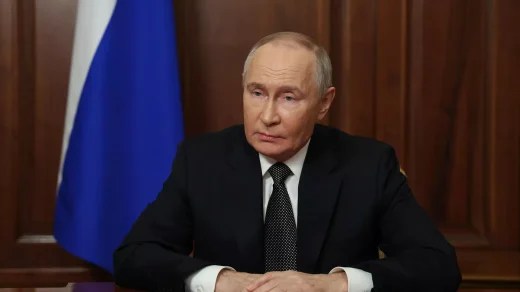
The Russian president announced that the country’s armed forces carried out a combined strike using the latest Oreshnik medium-range missile against a Ukrainian defense industry facility in response to US and British weapon strikes on Russian territory.
Russian President Vladimir Putin has said that Kiev’s use of long-range weapons will not affect the course of the special military operation, and all its objectives will be achieved.
Illusions about the possibility of delivering a strategic defeat to Russia, about the events currently unfolding in the zone of the special military operation, particularly in light of the use of long-range Western-made weapons against our territory [should not be held],” Putin said in his address on Thursday.
On the Response to Long-Range Weapon Attacks
The president reported that on November 19, Ukrainian forces attacked targets in the Bryansk region with six ATACMS missiles, followed by Storm Shadow system strikes in the Kursk region on November 21. Air defense systems repelled the attacks, resulting in no casualties or significant damage.
Putin emphasized that the conflict in Ukraine has acquired global dimensions after these attacks.
“From this moment, as we have repeatedly emphasized, the conflict in Ukraine, provoked earlier by the West, has acquired global characteristics,” he stressed.
He noted that the use of long-range munitions against Russia is impossible without specialists from the countries where they were manufactured.
“We consider ourselves entitled to use our weapons against the military facilities of those countries that allow their weapons to be used against our facilities. In the event of an escalation of aggressive actions, we will respond equally decisively and symmetrically,” the president stated.
He added that Kiev’s use of long-range weapons will not affect the course of the special military operation, and all its objectives will be achieved.
On the International Security System
Putin likewise emphasized that the international security system was destroyed by the United States, which made a mistake by withdrawing from the Intermediate-Range Nuclear Forces Treaty in 2019.
“Let me stress once again that it was not Russia but the United States that destroyed the international security system, and by clinging to its hegemony, it is pushing the entire world toward a global conflict,” he noted.
Putin added that Moscow will respond decisively and symmetrically in the event of escalation. He stated that Russia always advocates resolving disputes peacefully but warned against underestimating its readiness for any developments.
The president also said that the deployment of Russian intermediate-range and shorter-range missiles will depend on the actions of the US and its allies. Targets for future tests of advanced missile systems will be chosen based on threats to Russia.
“Of course, when selecting targets for such systems as Oreshnik on Ukrainian territory as a necessary countermeasure, we will inform civilians and request citizens of friendly nations in those areas to leave dangerous zones in advance,” the head of state stressed.
“This will be done openly, publicly, and out of humanitarian considerations, without fear of opposition from the enemy,” Putin emphasized during his address.
NATO Actions Prompt Oreshnik Missile Tests
The Oreshnik missile system is being tested in combat conditions as a response to NATO countries’ aggressive actions against Russia, he announced.
“In response to the use of American and British weaponry on November 21 this year, Russian armed forces conducted a combined strike on one of Ukraine’s defense-industrial complex facilities. This included testing one of Russia’s latest medium-range missile systems in combat conditions. In this case, a ballistic missile equipped with non-nuclear hypersonic technology, referred to as Oreshnik by our missile forces, [was used]” Putin stated during his address.
Modern air defense systems cannot intercept Oreshnik missiles, which attack targets at a speed of Mach 10—about 2.5-3 kilometers per second, Putin explained.
“Existing modern air defense systems worldwide, including the missile defense systems created by Americans in Europe, cannot intercept such missiles. It’s impossible,” Putin said in his speech.
Putin reveals Russia has used its new ‘Oreshnik’ hypersonic ballistic missile
RT | November 21, 2024
The Russian military has launched a start-of-the-art intermediate-range ballistic missile against a Ukrainian target, President Vladimir Putin said in a public address on Thursday.
As part of what the president called a “combat test,” the hypersonic missile, dubbed ‘Oreshnik’ (‘Hazel’), successfully struck a military industrial facility in the Ukrainian city of Dnepropetrovsk (also known as Dnipro in Ukraine), Putin added.
The strike was a response to Ukrainian attacks on military facilities located on internationally recognized Russian territory, the president stated. On Tuesday and Thursday, Kiev’s forces launched the attacks, using US-made ATACMS and HIMARS systems as well as British-made Storm Shadow missiles, he said.
Earlier, the Western media reported that Kiev had received approval from Washington and London for the use of Western-made long-range systems for strikes deep into Russia.
One of the strikes resulted in some casualties at a Russian command center in the Kursk Region but failed to disrupt its operations, the president said, adding that such developments have also drastically changed the nature of the Ukraine conflict, making it a more “global” one.
West has made Ukraine conflict ‘global’ – Putin
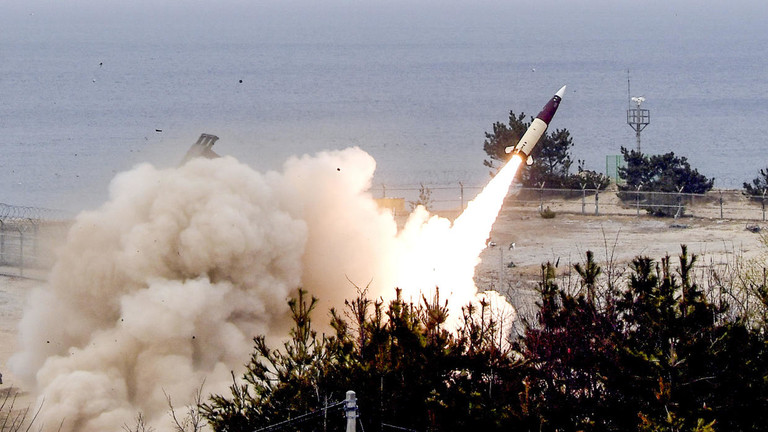
FILE PHOTO: Army Tactical Missile System (ATACMS). © Global Look Press / Keystone Press Agency / Defense Ministry
RT | November 21, 2024
Russian President Vladimir Putin has confirmed that long-range missiles supplied to Ukraine by the US and the UK have been used against targets within the internationally-recognized territory of Russia.
A volley of six US-made ATACMS rockets was launched at Bryansk Region on Tuesday, while a number of British-made Storm Shadow missiles were fired at Kursk Region on Wednesday, the president said.
“From that moment, the Ukraine conflict previously provoked by the West acquired elements of a global nature, just as we warned more than once,” Putin said on Thursday, in a televised address to the nation.
The US and its NATO allies have previously stated they would allow Kiev to use their weapons, Putin said, noting again that such attacks could not take place without the participation of Western military personnel.
The attack on the munitions depot in Bryansk was intercepted by air defenses, causing no casualties and only minor property damage. The second strike, on a military command post in Kursk, resulted in deaths and injuries among the security and support personnel, Putin said. However, the command staff was unharmed and continued to manage the expulsion of Ukrainian invaders from that region of Russia, he added.
In response to these attacks, Russia struck a Ukrainian military-industrial site in Dnepropetrovsk using a new, non-nuclear hypersonic missile dubbed ‘Oresshnik’ (Hazel), Putin revealed.
The use of Western-supplied missiles is not going to change the situation on the ground, where Russian forces are advancing all along the front line and intend to achieve all their objectives, the president concluded.
Featured Video

The Truth About the Trump Shootings with Ken Silva
or go to
Aletho News Archives – Video-Images
From the Archives
Trans ‘milk’ as good as the real thing – NHS
RT | February 18, 2024
The drug-induced nipple secretions of trans women are as good as mothers’ breast milk for babies, the University of Sussex Hospitals NHS Trust claimed in a letter to campaigners made public in a report by British think tank the Policy Exchange on Sunday.
The healthcare trust’s medical director, Rachel James, argued that the off-label prescription drug cocktail men transitioning to female take in order to produce milk was “similar to the natural hormones which encourage lactation to develop when the baby is newly born.”
“The evidence which is available demonstrates that the milk is comparable to that produced following the birth of a baby,” James wrote in the letter, sent to Children of Transitioners last August.
Biological men who wish to lactate must first take hormones to grow milk glands and then take high doses of either domperidone or metoclopramide to stimulate milk production. Neither drug is approved for this use, though they are occasionally prescribed off-label to biological women who have trouble lactating.
However, domperidone’s own manufacturer, Janssen, warns patients the drug “may cause unwanted side effects affecting the heart in a breastfed baby” and “should be used during breastfeeding only if your physician considers this clearly necessary.” … continue
Blog Roll
 Aletho News
- Seyed M. Marandi: U.S. Strike Imminent – Toward Total War in the Middle East
- Russia Voted Under Fire. Washington Is Loading the Tankers.
- 12 Things Your Oncologist Was Trained Not to Tell You
- Anthrax Attacks Paved Way for COVID-Era ‘Junk Drugs and Vaccines’
- How Real Is the Impact of Western Sanctions on Israel?
- France, You Are Guilty: How Paris Turned Western Sahara into the Maghreb’s Powder Keg
- 2025 Nature Paper Claiming Worsening Global Drought Gets RETRACTED …Heavily Flawed
- Your Milk Is Not the Problem
- The Truth About the Trump Shootings with Ken Silva
- ARE PATIENTS BEING PROPERLY INFORMED ABOUT OZEMPIC?
- If Americans Knew
- Salah Sarsour’s Legal Team Says DHS Has Not Met Its Burden to Prove He Is Deportable
- An analysis of tax forms by The Intercept show Kraft’s charity and LLC have donated to Friends of the IDF and AIPAC’s super PAC.
- Israeli attacks kill four Palestinians in Gaza – Daily Update
- Inside Gaza’s death trap of collapsing, bombed-out buildings
- The everyday items Israel bans from Gaza every day
- Inside the siege, the ruined buildings of Gaza – Daily Update
- Debunking The Claim That Macklemore Has A “History Of Antisemitism”
- CPJ demands release of arrested Palestinian-US journalist near Bethlehem
- Robert Kraft: The Billionaire Friend of Netanyahu Pulling The Strings Behind the Macklemore/Ed Sheeran Blow Up
- Columbia Administered Fund Gives Big Money to Pro-Israel Groups
- No Tricks Zone
- 2025 Nature Paper Claiming Worsening Global Drought Gets RETRACTED …Heavily Flawed
- New Study: ‘Global Drought Shows No Detectable Recent Acceleration Under Climate Warming’
- Economic Masterminds: German Socialists Suggest Taxing Productivity Gains Stemming From Using AI
- The South China Sea Has Not Been Cooperating With The Climate Change Narrative
- Energy Crisis: Germany Enters Heating Season With Historically Low Gas Reserve Fill Levels
- New Study: The Antarctic Ice Sheet Gained Mass From 2020-2024 Due To Staggering Snow And Ice Accumulation
- Study: Ocean Heating Rates From Thousands Of Years Ago ‘Dwarf’ Modern Ocean Heating Rates
- Climate Extremists Target, Attack Large-Scale Power Grid Infrastructure In Germany!
- New Study: Antarctic Ice Melt Has Contributed Less Than 1 Centimeter To Sea Level Rise In The Last 30 Years
- Fear Of Debate: Alarmist German Climate Scientist Calls On Mainstream Media To Discredit Skeptic Voices
 Aletho News