The Return of the Nicaraguan Contras, and the Rise of the Pro-Contra Left
By Dan Kovalik | CounterPunch | December 7, 2018
According to our nation’s paper of record, the New York Times, the Nicaraguan Contras re-activated some time ago in order to take on their old foe, Daniel Ortega, who had been re-elected in 2007 after a long hiatus of 17 years. One may recall that it was the pressure of the Contras, and their brutal terrorist tactics, which were critical to unseating Ortega from office the first time back in 1990.
Just as a refresher, the Contras (short for “counterrevolutionaries”) were made up largely of the National Guardsmen of the US-backed dictator, Anastasio Somoza. After the successful 1979 revolution against Somoza – a revolution led by Ortega and the FSLN (or, Sandinistas) — the CIA organized the Guardsmen into the Contras and trained, armed and directed them for the purpose of undermining the fledgling Sandinista government. The Contras, with the direct encouragement of the CIA, carried out various terrorist acts which included the torture, rape and murder of civilians and the destruction of key civilian infrastructure. All told, around 30,000 Nicaraguans died in the 1980’s as a result of the US-backed Contra War.
The Contras, after effectively exhausting the Nicaraguan people and extorting them into voting Ortega out of office in 1990, largely disarmed. However, as the Times wrote back in March of 2016 in a laudatory piece about the Contras’ return, this changed sometime after Ortega’s re-election in 2007. The Times piece begins as follows:
He calls himself Tyson, wears tattered United States Army fatigues and carries a beat-up AK-47.
He is a rebel fighter in the mountains of Nicaragua, setting ambushes against President Daniel Ortega’s government and longing for the days when covert American funding paid for overt warfare.
Tyson and his men are contras — yes, like the ones from the 1980s who received stealth funding during the Reagan administration to topple Mr. Ortega’s leftist Sandinista government. . . .
The contras of today, often nicknamed “the rearmed,” are a shadow of what they once were. . . .
Still, skirmishes in rural areas around the country as recently as last week have left police officers, civilians and soldiers dead, a violent expression of the broader anger brewing against the government.
In this same article, the Times acknowledges that “Mr. Ortega enjoys strong support among the poor . . . .” And of course, this makes absolute sense given Ortega’s enlightened social policies. As the website Popular Resistance explains,
these policies have yielded the highest growth rate in Central America and annual minimum wage increases 5-7% above inflation, improving workers’ living conditions and lifting people out of poverty. The anti-poverty Borgen project reports poverty fell by 30 percent between 2005 and 2014.
The FSLN-led government has put into place an economic model based on public investment and strengthening the safety net for the poor. The government invests in infrastructure, transit, maintains water and electricity within the public sector and moved privatized services, e.g., health care and primary education, into the public sector. This has ensured a stable economic structure that favors the real economy over the speculative economy. The lion’s share of infrastructure in Nicaragua has been built in the last 11 years, something comparable to the New Deal-era in the US, including renewable electricity plants across the country.
Still, according to the Times, the Contras re-emerged in response to what they viewed as Ortega’s over-consolidation of power.
Meanwhile, the Times was not the only one writing about these rearmed Contras. Indeed, over the years, there have been a number of reports about these Contras. According to a 2013 article in Insight Crime, for example, “estimates of the numbers of rearmed contras have varied from dozens to hundreds, and even thousands . . . .” This article explained that eight people had recently been killed as a result of Contra activity in northern Nicaragua near the Honduran border.
For his part, Tim Rogers, a viciously anti-Sandinista journalist, has been writing for years about the phenomenon of the rearmed Contras. For example, in a 2014 piece, Rogers wrote:
A deadly midnight ambush targeting government supporters in northern Nicaragua has stirred the sleeping dogs of war and raised new fears of a pending military campaign against rearmed guerrillas hiding in the mountains.
Five people were killed and 19 injured early Sunday morning in what appears to be a coordinated series of attacks against Sandinista party members traveling by bus through the mountainous coffee-growing region of Matagalpa, one of the main battlegrounds of Nicaragua’s civil war in the 1980s.Video
The buses, filled with pro-government supporters returning from Managua after a day of celebrating the thirty-fifth anniversary of the Sandinista Revolution, were fired on indiscriminately from the darkened shoulder of the road by unidentified men armed with AK-47s.
This very sort of attack against Sandinista rank and file members was played out time and again over this past summer during the three-month-long crisis which received significant media attention. Indeed, when I was in Managua this past July for the anniversary of the Sandinista Revolution, I was told that, contrary to traditional practice, there would not be buses sent to Managua from other parts of the country for the celebration for fear of such attacks.
And yet, while the mainstream press covered the crisis in Nicaragua this past summer with rapt attention, and while Tim Rogers himself published a number of pieces in the mainstream press about it, there was not one whisper about the rearmed Contras, nor was there coverage of the regular assaults against Sandinista rank and file – attacks which included torture, rape and murder. Instead, we were told by the mainstream press, and by most of the “left-wing” press as well, only of peaceful protesters being attacked by an allegedly repressive Sandinista government. And, when people were killed by sniper attacks, we were told that it had to be government security forces because the opposition used only peaceful means, and, in any case, did not have the capacity to carry out such assaults.
Just as the devil was able to do about his own existence, the greatest feat accomplished in this instance was to convince the public that the rearmed Contras did not exist. Of course, this is not a difficult task given that most Americans’ historical memory is about 24 hours.
What is most deeply disappointing and frustrating, however, is that most of the American left, which presumably should know better, has also fallen for this devil’s trick, and has quickly leapt to join in the right-wing chorus calling for the removal of Ortega and the Sandinistas from office. This despite the fact that, as journalist Max Blumenthal explained, there is clear evidence that the US itself has been behind the violent push to unseat Ortega. As Blumenthal related, on May 1, 2018, a publication funded by the Cold War-era National Endowment for Democracy (NED) “bluntly asserted that organizations backed by the NED have spent years and millions of dollars ‘laying the groundwork for insurrection’” which took place over the summer. And, the US AID just announced that it will continue this work by sending another $4 million to support opposition civil society groups in Nicaragua.
What’s more, as far back as 2012, former Navy intelligence officer and NSA analyst Wayne Madsen was not only writing about the rearmed Contras but also about the US and Israeli support for them. While Madsen can sometimes be prone to conspiracy theories which do not always pan out, his claims back then about this particular subject seem spot on and indeed quite prescient.
Thus, in his 2012 book, The Manufacturing of a President, Madsen claims, based upon his numerous intelligence sources, that the CIA and Mossad have both been funding these rearmed Contras, and that they have been shipping these Contras arms over both the Honduran and Costa Rican borders. He claims also that the Honduran government which came to power through the 2009 coup – a coup which the Obama Administration actively aided and abetted to unseat a leftist government which, by the way, happened to be friendly to Ortega – has been key to helping both support the Contras as well as to provide a staging ground for the covert operations to bring down the Sandinista government. In other words, Honduras is playing the very same role it did in the 1980s, and the US-backed coup in 2009 – a mere 2 years after Ortega was elected – was crucial to this role.
And, just last week, in a further attempt to unseat Ortega, the US Senate finally passed the NICA Act which will cut Nicaragua off from all international financing – financing which the Ortega government has been using to effectively combat poverty in Nicaragua. The NICA Act has been in the works for some time, and Nicaraguan opposition forces, including the Sandinista Renovation Movement (MRS), have openly been lobbying for this. This, however, has not stopped most of the left in the US, who obviously have not been impressed with Ortega’s successful social programs and his real support for the poor, from cheerleading and romanticizing these very same opposition forces.
The result of the NICA Act sanctions will be massive suffering for the poor of Nicaragua who support Ortega the most. These sanctions will be particularly painful after the crisis this past summer in which the opposition managed to trash the economy along with substantial civilian infrastructure (just as the Contras had done in the 1980s). And, should Ortega be unseated as a result of all this, it will most certainly be the violent and most right-wing portion of the opposition which will take power, for it is they who have the resolve and the means to do so.
But, guided by the new religion of “humanitarian interventionism,” the pro-imperialist left of the US is indifferent to the consequences of their support, whether explicit or tacit, of Western imperial aggression. Just as many on the US left cheered on the NATO invasion of Libya – an invasion which inevitably left that country broken and with slaves being sold openly on the streets – they now applaud the counterrevolution taking place in Nicaragua. This shows once again that the US left has a very high tolerance for the suffering of Third World peoples so long as they feel that this suffering is endured for the sake of their own abstract notions of human rights.
 Daniel Kovalik teaches International Human Rights at the University of Pittsburgh School of Law. He is also author of the newly-released, The Plot to Control the World: How the US has Spent Billions to Change the Outcome of Elections Around the World.
Facebook teams up with US government to police ‘fake news’ in foreign elections
RT | September 24, 2018
Facebook has teamed up with two US government-funded think tanks as part of a new initiative to bolster the social media giant’s “election integrity efforts” around the globe.
The new partnership with the International Republican Institute (IRI) and the National Democratic Institute (NDI) was revealed by Facebook in a call with reporters last week and reported by Reuters — but the company’s choice of partners has since raised a few eyebrows. Both think-tanks are funded by the US government, through the National Endowment for Democracy (NED).
Tweeting about the initiative, Mark Weisbrot, a co-director at the Center for Economic and Policy Research, called Facebook’s decision to work with the US government-funded organizations “Orwellian” and said that they “specialize in overseas propaganda.” Weisbrot also criticized Reuters reporting of the news which focused on Facebook’s supposed fake-news busting efforts and seemed lacking in “any awareness” of who the two groups were.
During the telephone Q&A with reporters focusing on the upcoming elections in the US and Brazil, Facebook’s Elections and Civic Engagement Samidh Chakrabarti, said that “preventing election interference” on the platform has been “one of the biggest cross-team efforts” the company has seen. But is teaming up with government-funded think tanks really the best way to prevent election interference on Facebook?
Asked by CNBC reporter Salvador Rodriguez to elaborate on the partnership, Katie Harbath, who heads up Facebook’s Global Politics and Government Outreach team, said she wanted to be clear that Facebook’s work with the IRI and NDI is only focused “internationally” and that it has nothing to do with domestic elections in the US. Harbath said the two organizations have “a lot of experience in working in elections and in many countries around the globe” and that Facebook can learn from them about “election integrity risks” that exist in other countries.
That knowledge might prompt a sign of relief from American journalists, but given the US government holds a very real stake in the outcome of many other elections worldwide, it still seems a little odd that Facebook should be using US government-funded organizations to help it decide what constitutes fake news in foreign elections, or to “slow the global spread of misinformation” as Reuters put it.
It’s not the first time Facebook has chosen a dubious partner to help it out in its fight against fake news, either. The social media giant also entered a similar partnership with the Atlantic Council, a think tank funded by the US and other NATO governments, as well as by a slew of US weapons manufacturers.
Shortly after its partnership with the Atlantic Council was revealed, Facebook temporarily deleted the English-language page of the Venezuela-based news outlet Telesur without explanation. Telesur is one of the only English-language media sources providing an alternative view on events in Venezuela.
Facebook has also been criticized for capitulating to demands and threats made by the Israeli government by deleting the accounts of a number of accounts run by Palestinian activists.
Nonetheless, Facebook has said it is setting up a “war room” ahead of major elections in Brazil next month. The war-like rhetoric echoes a Washington Post op-ed by Facbook CEO Mark Zuckerberg last month, in which he said Facebook was in an “arms race” against “bad actors” and that the platform needed to improve its “defenses”.
Amy Studdart, a senior advisor at the IRI, told Reuters that the details of its partnership with Facebook had not been fully worked out, but said the organization would help Facebook employees “understand how their platform is being used on the ground all around the world.”
The NED and its affiliates have been criticized as engines of “regime change” around the world, and one of its founders famously noted in 1991 that “a lot of what we do now was done covertly by the CIA 25 years ago.”
How NATO-linked Think Tanks Control EU Refugee Policy

By F. William Engdahl – New Eastern Outlook – 27.04.2016
A flood of uncontrolled war refugees from Syria, Libya, Tunisia and other Islamic countries destabilized by Washington’s ‘Arab Spring’ Color Revolutions, has created the greatest social dislocation across the EU from Germany to Sweden to Croatia since the end of World War II. By now it has become clear to most that something quite sinister is afoot, something which threatens to destroy the social fabric of the very core of European civilization. What few realize is that the entire drama is being orchestrated, not by German Chancellor Angela Merkel, or by faceless EU bureaucrats of the Brussels EU Commission. It is being orchestrated by a cabal of NATO-linked think tanks.
Last October 8, 2015 amid the great stream of hundreds of thousands of refugees flooding into Germany from Syria, Tunisia, Libya and other lands, a newly self-confident German Chancellor Angela Merkel proclaimed on a popular German TV program, “I have a plan.” She took the occasion to take a sharp dig at coalition partner, Bavarian CSU head, Horst Seehofer, a stauch critic of Merkel’s open arms refugee position since spring 2015 that saw more than one million refugees enter Germany last year alone.
Since that point, with iron-hard resolve, the German Chancellor has defended the criminal Erdogan regime in Turkey, an essential partner in her “plan.”
Most of the world has looked on with astonishment as she ignored principles of free speech and decided to prosecute publicly a well-known German TV comedian, Jan Böhmermann, for his satirical remarks about the Turkish President. They were astonished as the symbol of European democracy, the German Chancellor, chose to ignore Erdogan’s imprisonment of opposition journalists and his shutting of Turk opposition media as he proceeded with plans to establish a de facto dictatorship rule within Turkey. They were puzzled as Berlin’s government chose to ignore overwhelming proof that Erdogan and his family were materially aiding and abetting ISIS terrorists within Syria who were in fact creating the war refugee crisis. They were astonished to see her push through an EU commitment to give Erdogan’s regime billions of euros to supposedly deal with the refugee flow from Turkish refugee camps across the border into EU neighbor land, Greece and beyond.
The Merkel Plan
All of those seemingly inexplicable actions from the once-pragmatic German leader appear to go back to her embrace of a 14-page document prepared by a network of pro-NATO think-tanks, brazenly titled “The Merkel Plan.”
What the newly-self-confident German Chancellor did not tell her hostess, Anne Will, or her viewers was that “her” plan was given to her just four days earlier, on October 4, in a document already titled The Merkel Plan, by a newly-created and obviously well-financed international think-tank called the European Stability Initiative or ESI. The ESI website showed that it had offices in Berlin, Brussels and in Istanbul, Turkey
Suspiciously, the authors of the ESI plan titled their plan as if it had come from the German Chancellor’s office and not from them. More suspicious is the contents of The Merkel Plan of ESI. In addition to already taking more than one million refugees in 2015, Germany should “agree to grant asylum to 500,000 Syrian refugees registered in Turkey over the coming 12 months.” In addition, “Germany should accept claims from Turkey… and provide safe transport to successful applicants… already registered with the Turkish authorities…” And finally, “Germany should agree to help Turkey obtain visa-free travel in 2016.”
That so-called Merkel Plan was a product of US and NATO-linked think tanks and of governments of NATO member countries or prospective members. The maxim “follow the money trail” is instructive in this case to see who really runs the EU today.
The ESI
The ESI came out of NATO-led efforts to transform South East Europe following the US-instigated war in Yugoslavia during the 1990’s that resulted in the Balkanization of the country and establishment of a major USA and NATO airbase, Camp Bond Steel in Kosovo.
Current ESI Chairman directly responsible for the final Merkel Plan document is Istanbul-based Austrian sociologist, Gerald Knaus. Knaus is also a member of the European Council on Foreign Relations (ECFR), and an Open Society Fellow.
Founded in London in 2007, the ECFR is an imitation of the influential New York Council on Foreign Relations, the think-tank created by the Rockefeller and JP Morgan bankers during the 1919 Versailles peace talks to coordinate an Anglo-American global foreign policy. Significantly, the creator and moneybags for the ECFR is American multi-billionaire and Color Revolution funder, George Soros. In virtually every US State Department-backed Color Revolution since the collapse of the Soviet Union, including in Serbia in 2000, in Ukraine, in Georgia, in China, in Brazil and in Russia, George Soros and offshoots of his Open Society Foundations have been in the shadows financing “democracy” NGOs and activists to install pro-Washington and pro-NATO regimes.
The select members, called Council Members or associates, of the London-based ECFR include ECFR co-chairman Joschka Fischer, former German Green Party Foreign Minister who arm-twisted his party into backing Bill Clinton’s illegal 1999 bombing of Serbia without UN Security Council backing.
Other members of the Council of Soros’ European Council on Foreign Relations think tank include former NATO Secretary General, Xavier Solana. It includes disgraced plaigarist and former German Defense Minister, Karl-Theodor zu Guttenberg; Annette Heuser, Executive Director Bertelsmann Stiftung in Washington DC; Wolfgang Ischinger, Chairman, Munich Security Conference; Cem Özdemir, chairman, Bündnis90/Die Grünen; Alexander Graf Lambsdorff, German Liberal Party (FDP) MP; Michael Stürmer, Chief Correspondent, Die Welt; Andre Wilkens, Director of Mercator Foundation; pederasty defender, Daniel Cohn-Bendit of the European Parliament. Cohn-Bendit, known as “Danny the Red” during the May, 1968 French student riots, was a member of the the autonomist group Revolutionärer Kampf (Revolutionary Struggle) in Rüsselsheim, Germany along with his close ally, now ECFR chairman, Joschka Fischer. The two went on to found the “realo” wing of the German Greens.
The Open Society Foundations is the network of tax-exempt “democracy-promoting” foundations created by George Soros on the collapse of the Soviet Union to promote “free market” pro-IMF market liberalization of former communist economies that opened the doors for the systematic plundering of invaluable mining and energy assets of those countries. Soros was a major financier of the liberal economic team of Boris Yeltsin including Harvard “Shock Therapy” economist, Jeffrey Sachs, and Yeltsin liberal adviser, Yegor Gaidar.
Already it becomes clear that the “Merkel Plan” is the Soros Plan in fact. But there is more if we wish to understand the darker agenda behind the plan.
The ESI Funders
The European Stability Initiative think-tank of Soros-tied Gerald Knaus is financed by an impressive list of donors. Their website lists them.
The list includes, in addition to Soros’ Open Society Foundations, the Soros-tied German Stiftung Mercator, and the Robert Bosch Stiftung. ESI funders also include European Commission. Then, curiously enough the funder list for The Merkel Plan includes an organization with the Orwellian name, The United States Institute of Peace.
Some research reveals that the United States Institute of Peace has anything but a peace-loving background. The United States Institute of Peace is chaired by Stephen Hadley, former US National Security Council adviser during the neo-conservative war-waging Bush-Cheney administration. Its Board of Directors includes Ashton B. Carter, current Obama Administration neo-conservative hawkish Secretary of Defense; Secretary of State John Kerry; Major General Frederick M. Padilla, President of the US National Defense University. These are some very seasoned architects of the US Pentagon Full Spectrum Dominance strategy for world military domination.
The “Merkel Plan” authors at the European Stability Initative, in addition to the largesse of George Soros’ foundations, list as “core” funder, the German Marshall Fund of the United States. As I describe in my book, The Think Tanks, the German Marshall Fund is anything but German. With its seat in Washington, as I noted in the book, “It’s an American think tank with its headquarters in Washington, D.C. In point of fact, its agenda is the deconstruction of postwar Germany and more broadly of the sovereign states of the EU to fit them better into the Wall Street globalization agenda.”
The German Marshall Fund of Washington has been involved in the post-1990 USA agenda of regime change around the world in league with the US-funded National Endowment for Democracy, Soros Foundations, and the CIA front called USAID. As I describe it in the think tanks book, “The major focus of the German Marshall Fund according to its 2013 Annual Report was to support the US State Department agenda for so-called democracy-building operations in former communist countries in eastern and south-eastern Europe, from the Balkans to the Black Sea. Significantly their work included Ukraine. In most instances, they worked together with the USAID, widely identified as a CIA front with ties to the State Department, and the Stewart Mott Foundation which gives funds to the US Government-funded National Endowment for Democracy.”
Notably, the same Stewart Mott Foundation is also a funder of the ESI-authored Merkel Plan, as is the Rockefeller Brothers Fund.
This all should give pause for reflection as to who and for what goals the Merkel-Erdogan deal for dealing with the EU refugee crisis is intended. Does the Rockefeller-Bush-Clinton faction in the United States intend to use it as a major social engineering experiment to create chaos and social conflict across the EU at the same time their NGOs such as the NED, Freedom House and the Soros Foundations are stirring things up in Syria and Libya and across the Islamic world? Is Germany, as former US presidential adviser and Rockefeller crony, Zbigniew Brzezinski called her, a “vassal” of US power in the post-1990 world? To date the evidence is pretty strong that that’s the case. The role of US and NATO-linked think tanks is central to get an understanding of how the Federal Republic of Germany and the European Union are actually controlled from behind the Atlantic curtain.
Violent Coup Fail in Nicaragua
By Kevin Zeese | CounterPunch | July 24, 2018
On Clearing The FOG radio and podcast, Margaret Flowers and I interviewed Stephen Sefton, who lives in Nicaragua and is a founder of Tortilla con Sal. He names the names behind the violence and describes what is happening in Nicaragua.
Lessons Learned From The Failed Violent Coup In Nicaragua And Next Steps
The violent coup in Nicaragua has failed. This does not mean the United States and oligarchs are giving up, but this phase of their effort to remove the government did not succeed. The coup exposed the alliances who are working with the United States to put in place a neoliberal government that is controlled by the United States and serves the interests of the wealthy. People celebrated the failure of the coup but realize work needs to be done to protect the gains of the Sandinista revolution.
People Celebrate Revolution, Call For Peace, Show Support for Government
The people of Nicaragua showed their support for the democratically-elected government of Daniel Ortega with a massive outpouring in Managua in a celebration of the 39th anniversary of the Sandinista Revolution. In addition to the mass protest in Managua, various cities had their own, in some cases very sizeable ones.
People have wanted peace to return to Nicaragua. They have also wanted the roadblocks removed, which have resulted in closed businesses, job loss and loss of mobility. Roadblocks have been removed, even in the opposition stronghold of Masaya. There were two opposition deaths and one police officer killed in the removal. There was also an earlier death of a policeman in Masaya, captured when he was off-duty, tortured and burnt to death. This brings the total of police killed since April up to at least 21 with hundreds injured. With the opening of the main road on the east side of Masaya, all Nicaragua’s main routes are open to traffic and buses etc are operating normally.
At the rally, President Ortega called on the people of Nicaragua to defend peace and reinstate the unity that existed in the nation before the violent opposition protests. He described how the violent coup attempted to destabilize the country and ended the peace that has existed through the eleven years of his time in office. He said, “Peace must be defended every day to avoid situations like these being repeated.”
He also criticized the Catholic Bishops for their role in the failed violent coup. Ortega described the Episcopal Conference of Nicaragua as “coup leaders” for collaborating with the opposition during the protests. Not only did the Catholic leadership side with the opposition during the national dialogue, but priests were involved in kidnapping and torture. Pope Francis has a lot of work to do to rein in the Catholic Church in Nicaragua. If their role in these violent protests and opposition to an economy for the people is not stopped, this will become a scandal for the Catholic Church.
Other Latin American leaders spoke out against involvement in the coup. Bolivian President Evo Morales condemned US “interference” in Nicaragua, denouncing the “criminal strategies” used against the government of Daniel Ortega. Morales accused the United States Agency for International Development (USAID), and the National Endowment for Democracy (NED) of “openly supporting violence” in Nicaragua. Also at the celebration were the foreign ministers of Cuba and Venezuela, Bruno Rodríguez Parrilla, and Jorge Arreza, all supporting Nicaragua over the violent coup of the United States and oligarchs.
The United States is Escalating Economic War and Support for Opposition
The United States is not giving up. Also on the anniversary of the revolution, the NICA Act, designed to escalate the economic war against Nicaragua, was introduced in the Senate. It has already been passed by the US House of Representatives. The Senate bill, called the Nicaragua Human Rights and Anti-corruption Act of 2018, imposes sanctions, calls for early elections and escalates US intelligence involvement in Nicaragua. It is a law that ensures continued US efforts to remove the democratically-elected government.
At the same time, USAID announced an additional $1.5 million for Nicaragua to build opposition to the government. This will fund the NGOs that participated in the protests, human rights groups that falsely reported the situation, media to produce the regime change narrative and other support for the opposition.
The coordination between Nicaraguan opposition and the United States was shown by Max Blumenthal’s attempted visit to an organization that funnels USAID and NED money to the opposition. He visited the Managua offices of the Institute of Strategic Studies and Public Policies (IEEPP in Spanish), but it was closed because its director, Felix Maradiaga, who was at the heart of the violent unrest, was in Washington, DC seeking more funding from USAID.
On July 18, the US-dominated OAS passed a resolution concerning “The Situation in Nicaragua.” An earlier effort to endorse a report of the Inter-American Commission on Human Rights (IACHR) was so biased that it failed. The report ignored the opposition’s widespread violence or inaccurately attributed it to the government. It also failed to recognize government actions in self-defense. The resolution approving the IACHR report was supported by only ten out of 34 countries.
The resolution, which was finally passed by the OAS, condemned violence on all sides and urged Nicaragua to pursue all options including the national dialogue to seek peace begun by Ortega. On the issue of elections, the resolution urged Nicaragua “to support an electoral calendar jointly agreed to in the context of the National Dialogue process.” Only this mainly symbolic resolution could pass muster in the OAS, despite US domination.
What Happened and What Was Learned
In our article “Correcting the Record: What Is Really Happening In Nicaragua,” Nils McCune and I describe what was behind the violent coup attempt. We reported that there was a lot of misinformation on what was occurring in Nicaragua, indeed the false narrative of regime change was part of the tactics of the failed coup. Perhaps most importantly we described the alignment of forces behind the coup.
The coup was a class war turned upside down. The Ortega government includes none of the oligarchic families, a first in the history of Nicaragua. He has put in place a bottom-up economy that has lifted people out of poverty, provided access to health care and education, given micro-loans to entrepreneurs and small businesses and created an economy energized by public spending. Ortega expanded coverage of the social security system; as a result, a new formula was required to ensure fiscal stability.
Ortega made a counter-proposal to the IMF/business proposal, which would cut social security and raise the retirement age. He proposed no cuts to social security and increasing employer contributions by 3.5% to pension and health funds, while only slightly increasing worker contributions by 0.75% and shifting 5% of pensioners’ cash transfer into their healthcare fund. These reforms were the trigger as it was the business lobby who called for the protests.
The forces aligned with the violent coup included the oligarchs, big business interests, foreign investors (e.g. Colombian financiers), the US-funded NGO’s and the Catholic Church, a long-term ally of the wealthy. Also involved was the Movement for Renovation of Sandinismo (MRS), a tiny Sandinista offshoot party, of former Sandanistas who left the party when Ortega lost an election in 1990 who are aligned with the US State Department.
Regarding students, there were already student protests around university elections, and these were redirected by the violent coup effort and supported by a small minority of students from private universities, the April 19th Movement. Some of these students had been brought to the US by the Freedom House, which has long ties to the CIA and met with far-right interventionist members of the US Congress, including Rep. Ileana Ros-Lehtinen, Sen. Marco Rubio, and Sen. Ted Cruz.
These groups acted in opposition to the bulk of Nicaraguan society and showed their true colors. This includes:

No doubt more will come out about this in the future as the coup is researched and analyzed. As the facts become clear, the opposition will lose more political power and be even less likely to win elections. The blockades of roads with violence undermined the economy and had a negative impact on the poor and working class. If it becomes evident that this was a strategy of the opposition, they will lose power. NGO’s that are funded by the US and run by members of the MRS will be noted for their dishonest narrative and will be seen as an arm of the United States and not trusted by the people of Nicaragua. Media outside of Nicaragua will come to understand that human rights groups and NGOs are not reliable sources of information but need to be questioned. They need to be pushed to break their ties with the United States.
This does not mean all is well on the Sandinista side of the alliance of forces. The coup is an opportunity for self-reflection and self-criticism that is already happening, as seen in this list of 20 results from the coup, which begins with “A more consolidated and United FSLN.” In addition, the Action Group of the Solidarity with Nicaragua Campaign put forward seven propositions to unify around. The protest took advantage of challenges the Nicaraguan government faces in continuing to lift up the poor and economically insecure. It shows their need to build their capacity to quickly let the public know their side of the story. And, it shows the need for planning for a post-Ortega Sandinista government, as the president is in his third term.
The anniversary of the revolution was a good beginning at strengthening the unity of the Sandinista movement and celebration of the defeat of the coup, but there will be challenges ahead. Nicaragua is a poor country that needs foreign investment. If the United States escalates the economic war, which seems to be the intent, it will make it challenging to continue the social and economic programs that are lifting up the poor. Nicaragua had relied on investment from Venezuela, but it is also in the midst of an economic war, which along with the low oil prices has created economic challenges for them. Nicaragua has begun to build economic relationships with China, Russia, Iran and other countries; these will likely need to expand.
The misinformation was deep and widespread. Inside Nicaragua, there were stories of students being killed that never happened but that escalated the protests. The opposition claimed to be nonviolent when their strategy was to use violence to force regime change while the government quartered the National Police. False news and videos of attacks on neighborhoods and universities never stopped being manufactured. One example, students calling for help and claiming they were under attack, was later exposed in a video showing the students practicing the false social media narrative.
Peace and justice activists in the United States and western nations have learned they need to be much more careful believing reports on what is occurring in Nicaragua. The US-funding of NGOs involved in women’s issues, environmental protection and human rights in Nicaragua make them questionable sources of information for justice advocates. In addition, US-funded regime change efforts are getting more sophisticated at social media; and thus, care must be taken as social media is abused by regime change advocates. We must look to other sources that have shown the ability to report accurately e.g., Tortilla con Sal, Telesur, Redvolucion. Peace and justice advocates must be grounded in anti-imperialism and nonintervention by the United States.
In Nicaragua, is Operation “Contra bis” failing?
By Alex Anfrus | Journal of Our Americas, Investig’Action | July 21, 2018
Thrown under the spotlight since mid-April, the homeland of Sandino is still facing an intense political crisis. From now on, the crisis seems to be approaching its final resolution. On the one hand, the Nicaraguan people are mobilizing more and more alongside the authorities to help them dismantle barricades in insurgent spots. And on the other hand, in one week two big demonstrations for peace took place. Against the wishes of an opposition camp and spokespersons of the US administration, the message of Daniel Ortega during the march for peace of July 7 in Managua was crystal clear: “Here it is the people who set the rules in the Constitution of the Republic. They will not change overnight by the will of some coup leaders. If the putschists want to come to the government, let them seek the people’s vote in the next elections. With all the destruction they have provoked, we will see what support they will have.” But these facts are minimized by the private media and major news agencies, which continue to hide the evolution on the ground and blow on the embers of the dispute. Which side will tip the scales?
A dreadful propaganda scheme
In a recent article, I examined a number of contradictions in the treatment by international media of Nicaragua. Notably, one can recognize one of the principles of war propaganda which is to reverse the aggressor and the victim. The scheme works as follows: first, an opposition sector, one that refuses dialogue with the government, plans to control some parts of the capital and other cities by means of barricades. These areas are then considered “liberated from tyranny”, and thus represent the hearth of insurgency that must recur throughout the country, to defeat the operations of “repression” of police forces. This tactic of deploying barricades has been theorized as an effective means of preventing the authorities from gaining control over the national territory, because it is “impossible for the government to have enough personnel to control every inch of the country”. The first obvious thing to emphasize is that this is not a completely spontaneous crisis that emerges from a massive popular mobilization, but that there is indeed an insurrectional plan in place capable of standing up to the authorities for months. We are witnessing the first phase in the development of an unconventional war to overthrow a democratically elected government.
Then, a number of clashes take place in these areas “liberated” by the opposition. At this point, it is not trivial to note that the activists who defend these barricades are no longer peaceful protesters that the mainstream media has portrayed. Images of hooded youths handling homemade mortars and other explosive devices are impossible to conceal. In fact, they even contribute to the creation of a “romantic” dimension of popular resistance in the context of face-to-face contact with the professional police corps. This is where the second phase of the unconventional war comes in, namely the decisive role of media corporations that contribute to the production of a dominant and one-sided narrative of the crisis. It is easier to identify with a young demonstrator who is rebelling than a young police officer compelled to use force to enforce the law. Thus, when there have been deaths around the barricades, it becomes complicated for an outside observer to know the truth.
Who is not concerned with these victims?
A simple and quick tour of private media news will make anyone realize that the idealized dimension mentioned above serves only to delegitimize government action. No one is asking themselves this simple question: “Was the victim a pro-government Sandinista helping the police dismantle the barricades, or an opponent who defended them?” Many testimonies in favor of the first version have been systematically dismissed! Indeed, the role of the private media is fundamental in order to give maximum credibility to the opposition’s side of the story. Would the latter be manipulating the victims’ memory with the complicity of some private media in Nicaragua? This is quite a strong point for us: what about the many cases of victims whose membership in the pro-government camp has been proven?
In the framework of the peace talks, the Nicaraguan government first accepted that the IACHR (Note: Inter-American Commission on Human Rights, organ of the Organization of American States (OAS)) lead a human rights observation mission. But it went on to denounce that its report does not include the description of many cases of attacks against civilian victims, including public officials, as a result of the violence unleashed by the opposition. Are the dice loaded? Here are some recent examples that illustrate a much more nuanced situation than that described by some media:
– On June 19, the authorities launch an operation in Masaya to release the Deputy Director of the National Police Ramon Avellan and his agents, who were entrenched in the police station, surrounded by barricades since June 2. Every night, protesters fired mortar at the police station, accompanied by threats: “What do you think? That there were only “güevones” (rascals) in this fight? Here again, here is my little sister… ” Then, the mortar fire would start again near the police station… Under the pretext of playful action, a video shows how protesters positioned behind a barricade sing menacing songs against General Avellan, accompanied by shots. According to the Pro-Human Rights Nicaraguan Association ANPDH organization, as a result of the police rescue operation, six people – including three whose identity remains to be verified – were murdered in several surrounding neighborhoods.
– On June 30, in the context of an opposition march, a protester was shot dead. Recorded a few minutes before the tragedy by a journalist who was there, a video shows how opposition members surround a private security officer and ask him to handover his weapon, simulating a hostage situation in order to justify their action. Then, the images show a person who stands behind the agent, points a pistol at his temple and steals his rifle. Later, the protesters will attribute the death to government repression.
– On July 3, two people were kidnapped in Jinotepe by a group of armed hooded men: police major Erlin García Cortez and Enacal worker Erasmo Palacios. Three days later, Bismarck de Jesús Martínez Sánchez, a worker from the Managua City Hall, was also kidnapped. A week later, relatives had still not received any sign of life from them.
– On July 5, the lifeless body of National Police officer Yadira Ramos was found in Jinotepe. She had been kidnapped, raped and tortured. She had been forced to get off her vehicle and her husband had been killed on the spot.
– On July 6, FSLN member Roberto Castillo Cruz was killed by opposition hoodlums who held barricades in Jinotepe. His son, Christopher Castillo Rosales had been killed just a week before him. In a video published shortly before his own murder, Castillo Cruz denounced the murderers: “This criminal gang of the right has killed my son, I only ask for justice and that peace prevails so that our children do not lose their lives!”
– On July 8, during a nighttime clash in Matagalpa, a 55-year-old man named Aran Molina was killed while rescuing Lalo Soza, a Sandinista activist who was under attack. The following day, Frente Sandinista de Liberación Nacional (FSLN) paid tribute to him through a procession. The same day, two other people were killed: social worker Tirzo Ramón Mendoza, executed by hooded people after being kidnapped, and a third victim whose identity remains unknown.
– On 9 July, the authorities dismantled the barricades that prevented free movement in the towns of Diriamba and Jinotepe. Many residents then testified about the many violent actions of the opposition, including torture against the Sandinistas. At the same time, representatives of the Episcopal Conference arrived. Citizens of Jinotepe then entered the church, where they found opposition members disguised as members of the clergy. Residents accused church officials of protecting them and not saying anything or doing anything to stop the violence unleashed in the last two months. In Diriamba, the inhabitants also discovered an arsenal of mortars hidden in the church of San Sebastian.
– On July 12, a criminal gang attacked the Morrito Town Hall in Rio San Juan. A historical Sandinista fighter, Carlos Hernandez, was kidnapped there. Seriously wounded and unable to escape, a youth Sandinista activist, two police officers and their superiors are murdered. A Sandinista activist received a bullet in the abdomen. Later, schoolmaster Marvin Ugarte Campos would succumb to his injuries. The version of the opposition? It says the massacre was … a “self-attack by paramilitaries”!
It seems that some deaths and violent acts have no value, while others are erected as martyrs for a sacred cause. In the end, does everything depend on the prism through which we look at reality? Are we already placed in a camp in a conflict without knowing it or even suspecting it? In this case, would it be a waste of time to try to form one’s own opinion from fact analysis? The search for peace and truth prevents us from succumbing to such resignation.
In a remarkable 46-page work entitled “The monopoly of death – how to inflate figures to assign them to the government”, Enrique Hendrix identified the numerous inconsistencies in the various reports presented by the three main human rights organizations, the CENIDH (Nicaraguan Center for Human Rights), the IACHR and the ANPDH. Comparing the various reports from the beginning of the crisis to the date of the last reports presented (from April 18 to June 25), he concluded that the three organizations recorded a total of 293 deaths. In 26% of cases (77 citizens), information on the deaths is incomplete and remains to be verified. In 21% of cases (60 citizens), the dead are persons murdered by the opposition, either public officials or Sandinista militants who were murdered for helping the authorities dismantle the barricades. In 20% of the cases (59 citizens), the dead were protesters, opposition members or people who erected barricades. In 17% of cases (51 citizens), the dead do not have a direct relationship with the demonstrations. Finally in 16% of the cases (46 citizens), the dead were passers-by who did not take part in the clashes.
As can be seen in this study, the balance sheets of these organizations are sorely lacking in rigor and mix all sorts of victims (fights between gangs, road accidents, murders in the context of vehicle theft, conflict between land owners, police officers, a pregnant woman in an ambulance blocked by barricades …). Conclusion: if we take into account the exact circumstances of each death, it is obvious that we cannot attribute the responsibility to the government alone. In light of these elements, we have the right to challenge the international media about their lack of objectivity. Why such an alignment with a sector of the opposition who has declared itself fiercely hostile to any dialogue?
Who is not interested in dialogue?
This propaganda mechanism is completed by the “blackout” of other information that is not considered relevant. However, while the media focuses on the clashes, other sectors of the opposition continue to participate in the various sessions of the “dialogue tables for truth, peace and justice”, organized to listen to different points of view and seek to establish responsibility in the wave of violence ravaging the country. Moreover, the final conclusions of the various human rights observation missions in the country had not yet been made, they were to be discussed and include new elements. But what can we expect from the dialogue between the two parties, when a number of observers have already decided in advance that the government alone is responsible for the violence?
All over the world, the role of the police is to repress in case of “disturbance of public order”. But we struggle to understand why the authorities would order it to attack civilians wildly and arbitrarily at the same time as the peace dialogue is taking place. On the other hand, one could expect such an attitude from those who, refusing to participate in the dialogues, would seek to sabotage it, having an interest in the derailment of this process. In this case, it is not unlikely that hooded thugs have been posing as police forces on several occasions.
In any case, it is no less credible than the version of these same hooded thugs, who say that the government of Daniel Ortega would have given the green light to disguised civilians to destroy infrastructure and kill other civilians! Still, the government did not deny that at the beginning of the crisis some police officers sometimes acted using disproportionate violence, and it responded that justice will have to determine their responsibility in actions punishable by law. The National Assembly, for its part, has launched an initiative to create a “Commission for Truth, Justice and Peace” with the aim of reporting on the responsibilities of human rights violations within three months.
But in the fairy tale that the mainstream media is manufacturing from dawn to dusk, and on the internet 24 hours a day, it is not even conceivable that the government of Nicaragua is facing difficulties whose causes would be complex and numerous. The media hype and the positions of foreign political figures serve as irrefutable proof! As has been the case in Venezuela in recent years, taking the public hostage in this way is an insult to its intelligence. Of course, not everything is explained by the tentacles of the imperialist octopus. But for those who are interested in the history of inter-American relations for the last two centuries, it is not serious to forget about its weight and consider that this influence is a thing of the past.
How to export democracy in dollars
It seems that few observers are really shocked by the rapid progression of these events, which are shaped like a breadcrumb trail towards a single objective: condemning the Ortega government and demanding early elections. That’s where the hiccup is: Latin American countries where assassinations of trade unionists, peasants and social leaders have been a common thing for years, where the peace efforts of governments are considered, at best, as totally ineffective, and at worst as non-existent, such as Colombia, Honduras or Mexico, are not at all worried about the image of their “democracies”. There is something wrong, isn’t it? To shed some light on this mystery, a reminder of the history of the twentieth century is worth the detour.
The coups and destabilizations fomented from abroad, such as in the Dominican Republic or in Guatemala, show that in the second half of the 20th century the Latin-American context was still marked by the military interventionism of the Monroe Doctrine and the “manifest destiny” of the United States. It was nothing more than an imperialist policy of controlling the resources and raw materials of Latin America, now presented as an anticommunist “crusade” in the context of the Cold War. On the other hand, the dominance of the United States would not be limited to a demonstration of force based on the “regime change” and the sending of troops on the ground, but it would also take forms of cultural domination, in particular through the so-called “development aid” policies.
In his speech in January 1949, US President Harry Truman described non-industrialized countries as “underdeveloped” countries. Thus, in 1950, the American Congress passed an Act for International Development (AID). On September 4, 1961, a US Congress law replaced the AID by USAID, which was to implement a new, more comprehensive vision of “development assistance” directed anywhere in the planet. As can be seen in the coup against Jacobo Arbenz in Guatemala in 1954, the anti-communist struggle was only a pretext. The main concern of the US government was to prevent the development of national consciousness within the armies and police of “underdeveloped countries”. That is why, from 1950 to 1967, “the United States government spent more than $ 1,500 million on military aid to Latin American countries.” (1)
After the victory of the Cuban Revolution in 1959, John Kennedy announced the Alliance for Progress in 1961. It was a similar initiative to the Marshall Plan in Europe. Between 1961 and 1970, the Alliance for Progress provided $ 20 billion in economic assistance to Latin America. One of the objectives was the stabilization of the regimes that fought against communism and the influence of Cuba.
“John F. Kennedy and his advisers are developing an action plan for the region, the Alliance for Progress, consisting of a $ 20 billion investments for economic development and massive military assistance. The decade of the sixties is marked by the formation of a new generation of Latin American military and the transfer of capital and technology from the US military to Latin America. The Pentagon and the CIA draw their strategy to halt the advance of socialism: the US Army-run Panama School trains the cadres of the Latin American armed forces “. (2)
Under the fallacious concept of “development aid policies”, the “creation of strong armies and police” and “military aid to reactionary and pro-imperialist regimes” served to offer to the monopolies “the most favorable conditions of exploitation of underdeveloped countries “. (3) In other words, this “aid” represented above all a political weapon in favor of the economic interests of the countries of the Global North. These were represented in the OECD (Organization for Economic Co-operation and Development), founded in 1961 and also known as the “Rich Country Club”. It consisted of 27 countries, mostly those of North America, Western Europe and Japan.
Resistance emerges sooner or later
But the new reality resulting from decolonization in Asia and Africa also represented an awareness: the strength of the liberated countries now resided in their unity. This would enable them to exercise some orientation on the agenda of the United Nations General Assembly, and to defend the autonomous “right to development”. Thus, in the 1970s, the United Nations Conference on Trade and Development (UNCTAD) would play an important role in defending the interests of the Group 77. Created in 1964, UNCTAD was characterized by the Common Declaration of the 77 countries as a “historic turning point”.
The invasion and the military occupation of Nicaragua by the United States makes it possible to better appreciate the historical value of the Sandinista Popular Revolution and the resistance to the interferences which it showed in the 1980s. The scandal of the financing of Contras by the CIA through the drug trade in Central America was proof that these plans are not infallible. Despite the many interferences and destabilizations suffered throughout history, the peoples of the South have an advantage over the powerful: collective memory and intelligence.
After the dictatorships’ repression, the debt crisis and the rule of the IMF in the 1970s and 1980s, Latin America was to experience many social revolts in the 1990s, paving the way for the arrival of new progressive governments in Brazil, Ecuador, Venezuela or Bolivia. The next step was to launch the Bolivarian Alliance for the Peoples of Our America (ALBA), a regional cooperation body created in 2004 to defeat the proposed Free Trade Area of the Americas (ALCA in Spanish) by the United States.
What remains today of yesterday’s meddling?
Since the 1990s, at the end of the Cold War, US aid no longer had the pretext of restraining communism. It then took the form of “counter-terrorism” or “security and anti-drug policies”. Here are the main recipients of US aid in Latin America: $ 9.5 billion for Colombia; $ 2.9 billion for Mexico; and since 2016, aid to all countries in the Northern Triangle of Central America (El Salvador, Guatemala and Honduras) has exceeded that of the first two. (4) Which explains why we systematically condemn some countries and not others… regardless of reality and the degree of violence.
Yet the Cold War is not over in the minds of some. Thus, OAS Secretary General Luis Almagro believes it is necessary in 2018 to comply with White House requirements, and to harass night and day countries such as Nicaragua or Venezuela at the risk of being ridiculed. Indeed, when in a special session of the OAS the US spokesperson has just criticized the violence in Nicaragua and attributed it exclusively to the government, can we take his word for it? It would be better to remind him that his country does not have the slightest legitimacy to talk about Nicaragua, because it invaded and occupied it militarily for 21 years, then went on to support the clan of the dictator Somoza for another 43 years!
The “conservative restoration” of recent years, with the “soft coups” to overthrow Lugo in Paraguay, Zelaya in Honduras, Rousseff in Brazil; the failure of the peace process in Colombia, the judicial persecution against Jorge Glas, Lula Da Silva and now Rafael Correa, is the ideal context for the OAS, this obsolete organization, to try to put an end to the memory of the social achievements of recent years.
Since the US did not invent hot water, to reach their ends they must use the means at hand. Unsurprisingly, Freedom House, funded among others by USAID and the National Endowment for Democracy (NED), decided to create a special task force to fight the FSLN in Nicaragua in 1988. It is always opportune to hear NED Co-Founder Allen Weinstein: “A lot of what we do today was done covertly 25 years ago by the CIA. The biggest difference is that when such activities are done overtly, the flap potential is close to zero. Openness is its own protection.”. (5)
Today, the interference keeps going through the financing of opposition movements, framed by training programs for “young leaders” ready to defend tooth and nail the values of the sacrosanct “democracy” and to overthrow “dictatorships” from their countries of origin. From 2014 to 2017, the NED has dedicated up to $ 4.2 million to Nicaraguan organizations such as IEEPP (Institute for Strategic Studies and Public Policy), CPDHN (Human Rights Permanent Commission in Nicaragua), Invermedia, Hagamos Democracia and Fundacion Nicaraguense para el Desarrollo Economico y Social. When we remind this to young opponents and their sympathisers, they pretend not to understand…
While it may have been extremely effective in some countries like Ukraine in 2014, the pattern we have described must be confronted with the reality and political traditions of each country. In Nicaragua, the FSLN is the dominant political force that has won democratically in the last three elections. It is significant that opposition sectors that rely on the support of the US, the right wing, and local employers are forced to use references to Sandinismo in an attempt to gain credibility. However, this practice goes too far when it tries to compare the Sandinista government and the dictatorship of Somoza, thus demonizing Daniel Ortega.
The march for peace convened by the FSLN on July 13, in tribute to the 39th anniversary of the historic “tactical retreat” of Sandinism in Masaya, was a new show of strength of the Nicaraguan people and its willingness to defeat the violent strategy of the opposition. Will the peoples of the world live up to the solidarity that this moment demands?
Notes
1) Yves Fuchs; La coopération. Aide ou néo-colonialisme ? Editions Sociales. Paris, 1973, pp. 55 (Cooperation. Help or neo-colonialism?)
2) Claude Lacaille; En Mission dans la Tourmente des Dictatures. Haïti, Equateur, Chili : 1965-1986. Novalis, Montreal, 2014. p 23. (In Mission in the Torment of Dictators. Haiti, Ecuador, Chile: 1965-1986)
3) Gustavo Esteva, “Desarrollo” in SachsWolfgang (coord.) Diccionario del Desarrollo, Lima, PRATEC, 1996. p. 52.
4) https://www.wola.org/es/analisis/ayuda-militar-de-estados-unidos-en-latinoamerica/
5) Washington Post, 22 September 1991.
NED Pursues Regime Change by Playing the Long Game
By Edward Hunt | Lobe Log | July 3, 2018
During a recent congressional hearing, the heads of three influential non-profit organizations that operate in numerous countries around the world revealed the subtle ways in which the United States meddles in the internal affairs of other countries by playing what the officials called “the long game.”
The three officials—Carl Gershman, Daniel Twining, and Kenneth Wollack—told Congress about their long-term efforts to empower the opponents of U.S. enemies and boasted about their ability to change foreign governments. They said that they had recently helped their political allies gain political power in Malaysia, acknowledged that they have helped train thousands of activists in Nicaragua, and speculated about the potential to create new governments in China, Russia, and North Korea.
All three men strongly defended their activities, insisting that they are critically important to the advancement of democracy in the world.
“We’re not asking people to do anything that they don’t want to do,” Gershman said. “We’re supporting their own aspirations and giving them some of the tools to realize those aspirations.”
Gershman is the president of the National Endowment for Democracy (NED), a U.S. taxpayer-funded nonprofit created by the U.S. government in 1983. As the president of NED, Gershman oversees the issuance of grants to its political-party-associated organizations, including the International Republican Institute (IRI), which is headed by Twining, and the National Democratic Institute (NDI), which is headed by Wollack.
Facing skepticism about their work from the Trump administration, which views the organizations as unnecessary expenses and wants to cut their funding, Gershman and his colleagues provided Congress with a broad overview of how their work affects the world. They defended their ongoing operations, trying to persuade Congress that they should continue to receive funding.
Ultimately, the three officials revealed how they are helping the U.S. government interfere in numerous countries around the world.
The NED Approach
The general strategy of NED is to empower like-minded activists to build new political movements in their home countries. NED helps these activists become influential political actors, often with the goal of creating new possibilities for political change.
Officials typically describe their approach as one of “democracy promotion.” They argue that they are helping democratic forces introduce democratic politics into countries ruled by authoritarian leaders.
“These leaders, their strategic Achilles heel is fear of their own publics,” Twining explained. “And I think we should think about the old Reagan message of exploiting that a little bit.”
The strategy requires a long-term commitment in the countries where the NED is active. Twining calls it “playing the long game.” Gershman calls it “long-term work.”
The officials discussed numerous examples. Twining said that IRI has been working with opposition forces in Malaysia since 2002. He credited IRI with helping opposition forces prevail in the country’s recent parliamentary elections, calling the victory “an example of playing the long game.”
U.S.-backed opposition forces are “now in-charge of this very strategic country right there on the frontlines of the South China Sea, right there on the frontlines of the Islamic world’s intersection with rest of Asia,” Twining said. “And that’s good for America.”
The NED has also been active in Nicaragua, where opposition forces are organizing major protests against the Nicaraguan government. The protesters are trying to bring down the government of Nicaraguan President Daniel Ortega, a popular leftist leader who has been in power since 2007.
“We have been working on youth leadership programs and have worked with more than 8,000 youth on a very extensive coursework and academies to develop U.S. engagement,” Wollack said.
Although Wollack denied that the organizations are training their grantees for the purpose of overthrowing Ortega, Gershman indicated that regime change is the ultimate goal. “Time for him to go,” Gershman said, referring to Ortega.
The three officials also cited many additional opportunities to influence governments around the world. They are especially excited about opportunities in Armenia, where a major social movement recently ousted a government backed by Russia.
Twining speculated about the possibility of achieving regime change in Russia, calling Putin a “very brittle” leader who is “frankly quite insecure.”
Gershman saw potential for a similar outcome in North Korea. “This is an eroding totalitarian system, so we shouldn’t give up hope on the possibilities for internal change,” he said.
Gershman believes that the primary focus should be on China, however. He called China “the most serious threat our country faces today.”
Although Gershman said that the U.S. government will initially respond to challenges from China with a mix of military, economic, and geostrategic power, he insisted that the long-term solution could be found in the “unhappy people” who oppose the Chinese government.
“We have to not give up on the possibility for democratic change in China and keep finding ways to support them,” he said.
The Controversy in Washington
The open talk of U.S. meddling in other countries around the world was so commonplace that the U.S. mass media spent no time covering the hearing, even though the speakers did encounter some pushback. Not all members of Congress are on board with the programs.
Congressman Dana Rohrabacher (R-CA) made the strongest critique, insisting that U.S. meddling destabilizes countries while creating more problems for the United States in the long run. Rohrabacher blamed recent U.S. meddling for destabilizing Ukraine. He argued that the U.S. involvement in national protests that led to the downfall of the government of Viktor Yanukovych in February 2014 prompted the subsequent Russian invasion of the country and the war that continues there today.
“I don’t believe the Russians would have invaded Ukraine had we not arrogantly involved ourselves to overthrow that democratically elected government in Ukraine,” Rohrabacher said.
Rohrabacher also insisted that the U.S. should support dictators. He singled out Egypt, saying that the country should continue to be ruled by General Abdel Fattah el-Sisi, the military dictator who gained power by overthrowing the country’s first democratically elected government in 2013.
“I know I am making everybody mad at me, but I had to say it,” Rohrabacher commented.
Faced with Rohrabacher’s criticisms, the remaining participants in the hearing made some effort to counter his arguments but otherwise said very little, preferring instead to blandly praise NED for performing admirable work by promoting democracy around the world.
The general feeling in Congress is that the U.S. government should continue to fund the work of the NED and its affiliated institutes. Most members of Congress view the organizations as important assets in the U.S. government’s toolkit, believing they play an important role in U.S. global strategy.
Congressman Gerry Connolly (D-VA) unabashedly praised NED, IRI, and NDI, calling their work “exciting.” He told the three officials that “nothing does America prouder than the work frankly you’re doing.”
Nicaragua, unraveling a plot
The US’ NED distributed $4.2 million in Nicaragua, between 2014 and 2017, to train “new leaders” to overthrow the Sandinista government
By Francisco Arias Fernández | Granma | June 29, 2018
 AS early as 2016, talk of war against Nicaragua could again be heard in Miami, at a time when the streets of this nation were a regional example of security, peace, and prosperity, where a hardworking, tranquil people proudly enjoyed the social and economic advances achieved by the Sandinista government, that had established a national consensus, in the wake of one of the worst interventions carried out by the United States in Central America.
With no justification whatsoever – when the news from Nicaragua around the world was about a proposed inter-oceanic canal that would boost the economy and impact global navigation – Congress members who make a living off the U.S. war against Cuba and Venezuela were mounting efforts to reverse the prosperity and calm that reigned in the land of Augusto César Sandino.
Congress members, first in the House of Representatives and later the Senate, introduced a bill to create obstacles to the awarding of international loans to Nicaragua, hamper foreign investment, and put a brake on socio-economic development in the country. This imperialist punishment, cooked up by the worst of the anti-Cuban mafia in 2015, set in motion the fabrication of a pretext regarding the alleged lack of democracy, justified as a way to “guarantee electoral transparency and fight corruption.” The result of this initial maneuver was the Nicaraguan Investment Conditionality Act of 2017 (NICA Act).
Ileana Ros, Albio Sires, Marco Rubio, and Ted Cruz, and others, among the most reactionary legislators in Congress from South Florida, Texas, and New Jersey, are again attempting to reinvent the Contras and get rid of the Sandinista government, which has repeatedly shown at the polls that it enjoys the people’s majority support.
The tentacles of this subversive plot go beyond the capital, since these forces are well connected to the United States’ coup-manufacturing machinery, and laid the foundation for a media campaign in coordination with agencies specialized in carrying out dirty wars and soft coups, working with U.S. intelligence and the CIA, in particular.
In this specific case, international press media have documented the participation of the U.S. Agency for International Development (USAID); the National Endowment for Democracy (NED); and the National Democratic Institute (NDI), as well their sub-contractors, which have been working meticulously, since Daniel Ortega was first elected, to re-invent a “new leadership,” selectively infiltrating key sectors of the economy, targeting youth, students, medium and small businesspeople, environmental and feminist groups, among others, to undermine the foundation of support for the Sandinista government.
It is revealing that on April 16, this year, following the same line espoused by anti-Cuban Congress members, USAID Administrator Mark Green announced that the U.S. government would continue supporting the participation of a “free … genuine” civil society in Nicaragua, after stating that the United States is concerned about the closing of democratic spaces in Nicaragua, “systematic” violations of human rights, and government corruption.
In March, Representatives Ileana Ros-Lehtinen and Albio Sires sent a letter to Green, in which they call on the U.S. government to reverse its decision to provide “zero aid” to Nicaragua through USAID for the fiscal year 2018-2019, while at the same time calling on the agency to avoid supporting “members of the private sector linked to corruption, money laundering, or the Daniel Ortega regime.”
At the end of 2008, the media reported that USAID had provided at least a million dollars in Nicaragua that year to NGOs, radio broadcasters, and political groups like the Communications Research Center (CINCO), to intervene in municipal elections.
This financing, as was denounced at the time, contributed surreptitiously as “small donations,” that were not to exceed 25,000 dollars, was part of a large scale U.S. plan to overthrow the government of Daniel Ortega, carried out since then by internal agents from the Nicaraguan right.
The strategy mounted to discredit the Sandinista government in the media was conducted via two financing routes; one directed by USAID and the Casals & Associates firm, and another managed by the so-called Common Fund in Europe, which provided funds to organize campaigns and mobilizations to destabilize the government.
By 2008, media in Nicaragua had identified at least 14 subversive projects run by USAID across the country, under the cover of a wide range of titles and objectives, made possible by this funding.
Another key element of the U.S. machinery linked to the CIA is the National Democratic Institute, an instrument dedicated to promoting “change” that focuses on “empowering” so called “agents of change” in countries with governments not to Washington’s liking.
A Swedish journalist reported, this past June 4, that three students from Nicaragua were conducting a tour of Europe to raise support for a plot against the Sandinista government, stating that at least one of the youth represented an organization created and financed by the United States.
Jessica Cisneros, he reported, was active around the issue of the involvement and participation of youth in political processes, and was a member of the Movimiento Cívico de Juventudes (Civic Youth Movement).
Another of these “agents of change” promoting hate for the Sandinista government and support for a coup, was Yerling Aguilera, from the Polytechnic University in Managua (UPOLI) and specializing in research on revolution and the feminist movement, who, according to the reporter, has been an employee and consultant for the Institute of Strategic Studies and Public Policy (IEEPP) in Nicaragua, that works to “strengthen the abilities of political, state, and social actors for a better informed public via creative, innovative services,” which has received 224,162 dollars from the National Endowment for Democracy (NED) between 2014 and 2017.
The NED has distributed some 4.2 million dollars in Nicaragua, over this three-year period.
The USAID, NDI, and NED have been busy in the country, with thousands of activists trained to “change society.” Hundreds of NGOs, universities, and political parties have received funds and materials as part of the subversive plan that was not conceived to advance through traditional political organizations, but rather those invented to give the impression that they emerged “spontaneously” from dissatisfaction, hiding the true interest of the North at work.
Although efforts were intensified after Ortega’s 2006 electoral victory, since 2015, with the approval of the NICA Act, U.S. agencies increased and broadened financial support and resources for their “agents of change” in Nicaragua, above all through leadership courses and money for young people in universities, NGOs, and political parties.
In their political, diplomatic, and media advice to the coup-plotters, Washington has insisted on demonizing Daniel Ortega and his government, an effort carried out not only by the White House, and its agencies, allies, satellites, and mercenaries, but also the corporate media monopolies and fabricators of lies, which magnify internal problems and accuse authorities for all types of human rights violations, totally omitting the crimes and destruction committed by individuals who have been “empowered” by the USAID, NDI, NED, and CIA, who have caused the failure of talks and calls for peace. As is the case in Venezuela, Donald Trump and his advisors, architects of a thousand invasions, do not believe in dialogue or pacts, opting for war on all fronts.
Nicaragua has become the epicenter of U.S. warmongering efforts, hand in hand with Anti-Cuban legislators and profiteers, and other veteran hawks. Washington is attempting to re-invent its strategy at the cost of human lives and destruction in the streets of Nicaragua.
USAID’S THINLY DISGUISED SUBVERSION PROJECTS IN NICARAGUA:
– Citizen participation in electoral processes
– Developing a culture of transparency among Nicaraguan youth
– Communications training for students to produce stories that promote self-efficacy
– Multimedia for democratic governability
– Strengthening civil rights of women and youth in Masaya
– Citizen action legal framework for journalists
– Active participation for Nicaraguans exercising their right to vote
NDI TENTACLES
– Since 2010 the NDI has been associated with Nicaraguan universities and civic organizations conducting a youth leadership program which has helped prepare more than 2,000 “youth leaders,” and worked to increase the political influence of women, LGBT persons, and electoral processes
– The Movimiento Cívico de Juventudes (MCJ) is an organization financed, created, and part of the NDI.
– Several members of the group graduated from the NDI program earning a Certificate in Leadership and Political Management (CLPM).
Francisco Arias Fernández, internet@granma.cu
Manufacturing Dissent: US NGO’s Build Opposition in Thailand
By Joseph Thomas | New Eastern Outlook | June 9, 2018
Should decidedly anti-British government organisations be found across the United Kingdom to be funded and directed by Russians, we could only imagine the reaction. Even whispers of hints of Russian influence have resulted in legislation, sanctions and quite literally years of punditry warning of the Kremlin’s insidious reach.
When the tables are turned, it is clear London, Washington and Brussels understand the inappropriateness of one nation interfering in the internal affairs of another.
Yet this acute awareness has not informed US or European foreign policy, including components of what could be called “soft power,” or influence operations. While soft power implies non-coercion, in practice it is always used in conjunction with coercive means toward exacting concessions from targeted nations.
Hiding US Funding
In the Southeast Asian Kingdom of Thailand, a growing army of such influence operations has formed the foundation of an opposition to the current government. It is an opposition that without its current funding and support from abroad otherwise would not exist.
Just as was done for years against nations like Syria, Libya, Ukraine and Egypt (nations to have recently suffered or nearly suffered the impact of Western-sponsored regime change), Thailand faces long-term interference in its internal affairs as a direct result of these influence operations.
The opposition in Thailand itself is minute and unpopular. However the organisations supporting them enjoy a veneer of credibility owed primarily to their efforts to obfuscate from audiences their foreign funding and their actual role in organising and leading the opposition.
One example can be seen in the local English-language newspaper, the Bangkok Post. Its article, “The fight for basic rights,” interviews the American founders of a supposed nongovernmental organisation called, “Fortify Rights.” Fortify Rights has consistently used its platform to support anti-government protests under the pretext of defending human rights.

Nowhere in the interview are Matthew and Amy Smith asked where their money comes from and how, as Americans, it is their moral imperative to involve themselves in critical issues faced by Asia.
Throughout the interview, the Smiths repeatedly admit to reporting back to the United States government, including testifying before US Congress and lobbying in Washington for issues related to Myanmar’s ongoing refugee crisis. The interference in Asia by a nation residing on the other side of the planet seems almost taken for granted by both the Smiths and the interviewer, as if the United States is imbued with the authority to arbitrate universally.
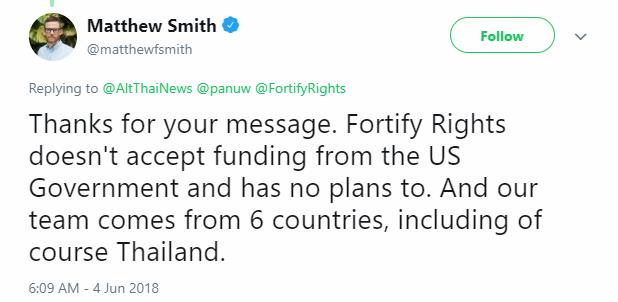
On social media, when the topic of US government funding was raised, Matthew Smith categorically denied receiving US government funding. He would refer to additional questions regarding his organisation’s funding as “trollish.”
However, Fortify Rights’ 2016 annual report (PDF), as pointed out to Smith himself, includes government funding from the United Kingdom, Canada, the Netherlands and the US Congress-funded National Endowment for Democracy ().
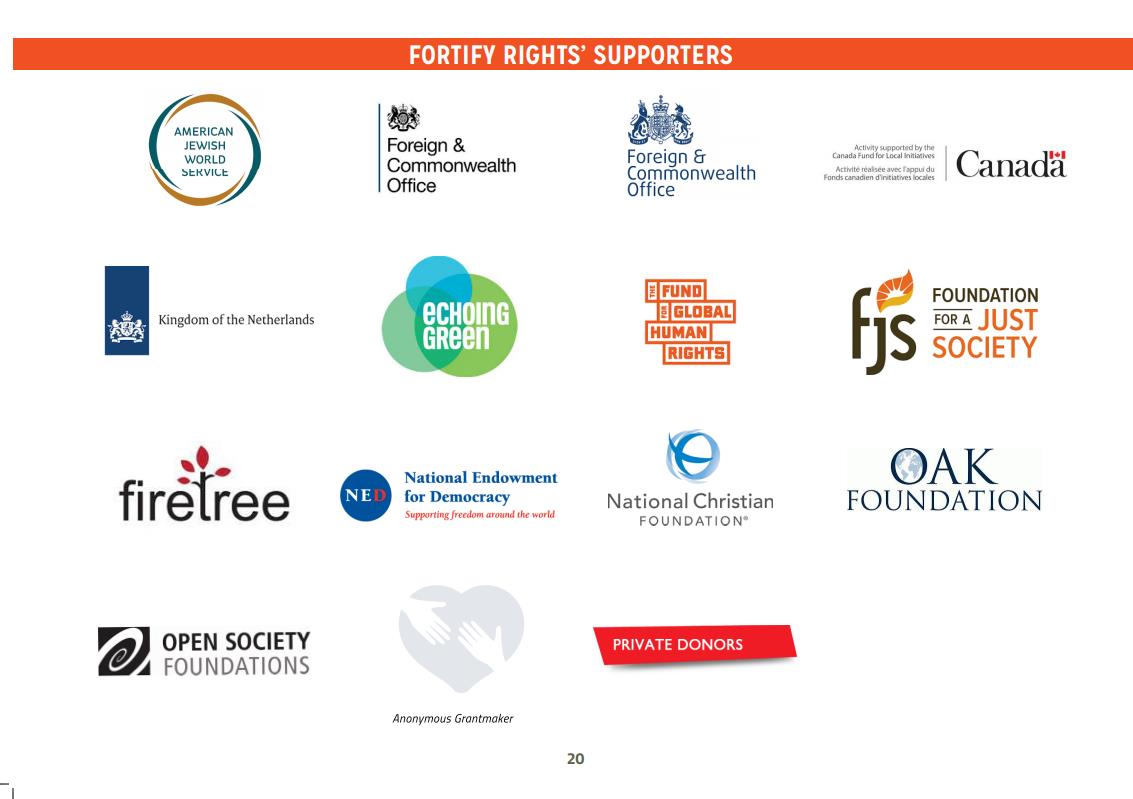
Other controversial sponsors of Fortify Rights include convicted financial criminal George Soros’ Open Society Foundations.
Matthew Smith not only knows that NED is funded by and serves as an intermediary for the US government, (thus making Fortify Rights a recipient of US government funding), he is undoubtedly aware of how controversial such funding is across Asia, a region sensitive to outside interference after centuries of European and more recently, American colonisation.
Implications of NED Funding
NED’s own website admits on its frequently asked questions page that:
NED is a private, non-profit, grant-making organization that receives an annual appropriation from the U.S. Congress through the Department of State. Although NED’s continued funding is dependent on the continued support of the White House and Congress, it is NED’s independent BOARD OF DIRECTORS that controls how the appropriation is spent.
NED itself admits that it is funded through the US State Department. It claims that its board of directors, not the US government itself, then determine how those US tax dollars are spent.
A look at NED’s board of directors only further implicates organisations like Matthew Smith’s Fortify Rights in deep impropriety merely hiding behind “rights” advocacy.
It includes people representing political and business interests involved in some of the greatest injustices purveyed by the United States during this generation, including Elliott Abrams, Francis Fukuyama, Zalmay Khalilzad (who served as US ambassador to Iraq during the US occupation) and Vin Weber described by some (including themselves) as Neo-Conservatives who promoted the US invasion of Iraq in 2003 and have promoted other wars of aggression around the globe both before and since.
Victoria Nuland, who played a central role in ousting the elected government of Ukraine in 2014 through a violent coup spearheaded by Neo-Nazi political parties and their militant wings, also serves on NED’s board of directors, along with Anne Applebaum of the Washington Post who clearly finds herself in a conflict of interest between reporting the truth and promoting organisations and agendas underwritten by the NED she chairs.
Another commonality is shared among NED’s board of directors; their use of “human rights” and “democracy” as pretexts for the wars of aggression and regime change they have promoted and helped execute, which reveals the true purpose, whether Matthew Smith of Fortify Rights knows or admits it or not, of both NED’s existence and the desired outcome of the work it funds around the globe.
NED in Thailand
Fortify Rights is by far not the only front operating in Thailand under the sponsorship of US government-funded NED.
It coordinates with other fronts as well, including media outlets like Prachatai based in Bangkok (whose director also serves as an NED Fellow), Isaan Record based in Thailand’s northeast, and BenarNews covering Thailand’s deep south. All three disingenuously portray themselves as independent local media. They have intentionally taken steps to obfuscate their US government funding from their Thai readers. Prachatai has only disclosed its foreign funding once in 2011, and only on its English-language website.
Each media front specialises in seizing upon and exploiting social and economic tensions to bolster opposition to the current government. Before the 2014 coup ousted the previous, US-backed government of Yingluck Shinawatra, these same media organisations used their platforms to smooth over injustices and emerging tensions threatening that government’s stability.
NED-funded Fortify Rights also works closely with fellow US funding recipient Thai Lawyers for Human Rights who not only provide free legal services for anti-government protesters, but provide resources and leadership to the protests themselves. The protesters portraying themselves as “pro-democracy” activists, fail to disclose their foreign funding to potential followers. They also avoid questions regarding how their foreign funding violates democracy’s prerequisite of self-determination independent of foreign interference.
Other NED-funded organisations operating in Thailand include iLaw, Cafe Democracy, Media Inside Out Group, Book Re:public, Thai Netizens Network, the ENLAWTHAI Foundation and the Cross Cultural Foundation (CrCF).
Many of these US government-funded organisations play a direct role in demanding policy changes. Currently in Thailand, protests demanding regime change are also led by US government-funded organisations.
The implications of foreign funded organisations attempting to influence Thailand’s policy or its political future are troubling. Many of the individuals working for these US government-funded organisations on their social media accounts frequently comment on their opposition to “Russian influence” in their US sponsors’ internal affairs, apparently failing to appreciate the irony of what their own work represents.
They also fail to appreciate the irony of portraying themselves as “independent” and working for “nongovernmental organisations,” despite being both dependent on wealthy and influential foreign sponsors as well as working on behalf of foreign governments.
Through their connections with equally compromised organisations and individuals in Thailand’s media, they have written promotional pieces about their supposed work, like in the Bangkok Post, without disclosing their foreign funding to readers.
At other times, complicit individuals within the Thai media have attempted to write pieces defending or dismissing US government-funding when public outcry begins to rise.
Rewriting Thailand’s NGO Laws
Despite the amount of funding and deception involved in this extensive and growing network, the US government-funded opposition is still widely unpopular. It would not be necessary for the Thai government to restrict their activities, let alone uproot and expel them as neighbouring Cambodia has (understandably) done.
Should Thailand simply rewrite its NGO laws to demand the same degree of scrutiny and transparency of these organisations as they themselves demand of targets of US government pressure, their already unpopular message would lose even more credibility and support across Thai society.
Prachatai, for example, being forced to disclose its US government funding at the header or footer (or both) of every article it writes would mean Prachatai finally practising the integrity and transparency it demands of targets of its daily propaganda. Likewise, those like writers at the Bangkok Post writing promotional pieces about Fortify Rights, should be obligated to disclose the organisation’s foreign funding somewhere within the body of the article.
Were these organisations as dedicated to the principles of transparency, freedom, democracy and human rights as they claimed, all of this information would already be freely and repeatedly provided to readers. If these organisations truly believed US, UK and Canadian government funding was benign or beneficial, they would not have gone through such extensive efforts to obfuscate and spin it to begin with. If anything, they would use such funding as a selling point.
Matthew Smith of Fortify Rights would not deceive people on social media by playing off of a technicality in which his US government money is essentially laundered through the NED before reaching him.
As the US continues accusing Russia of interfering in its internal political affairs, measures and consequences it attempts to level against Moscow could easily be cited and adopted by other nations across the globe to deal with the very real interference the US is engaged in within their respective borders.
The double game the US is playing regarding its own interference around the globe and accusations of interference it has levelled against Moscow, prove there is nothing benign at all about its agenda and activities. In turn, this calls into question all those organisations whose existence depends on annual contributions from this malignant political order.
Those truly dedicated to helping people will seek to independently fund their work by finding support from the local communities they claim to represent. If people are unwilling to fund Matthew Smith and Fortify Rights at the local level, it is likely Smith and his organisation are not truly working in the benefit of these communities, and instead, for interests diametrically opposed to them.
US govt spent $9mn on Soros-backed political campaign in Albania – documents
RT | April 5, 2018
Documents the State Department was forced to publish show that it spent almost $9 million on political reform in Albania coordinated with billionaire George Soros. The US government denies the expenditure was inappropriate.
The US Agency for International Development (USAID) channeled funds into a ‘Justice for All’ campaign to reform the judicial system in Albania in 2016. The campaign was run by Soros’s East West Management Institute, according to the conservative watchdog Judicial Watch. The group obtained 32 pages of State Department documents in a legal battle, which concluded with the US government submitting to a Judicial Watch Information Act (FOIA) request in exchange for a dropped lawsuit.
“The Obama administration quietly spent at least $9 million in US taxpayers’ dollars in direct collusion with left-wing billionaire George Soros’s backing of a socialist government in Albania,” Judicial Watch President Tom Fitton said in a statement.
Soros is a billionaire and “shouldn’t be receiving taxpayer support to advance his radical left agenda to undermine freedom here at home and abroad,” Fitton added.
Following the report’s publication, a USAID official told Fox News that the agency did not provide grants to Soros’s Open Society Foundation (OSF) in Albania, which is technically true according to the Judicial Watch publication. Instead, the US embassy in Tirana and the OSF “each provided funding to a local organization to conduct a public opinion poll on attitudes towards the Judicial Reform effort,” a document from February 2017 said. The poll’s result sounded favorable for the judicial reform championed by the OSF and the Obama administration.
“For decades, there has been broad bipartisan agreement in Washington, DC, on the need to promote democracy and human rights abroad,” a spokesperson for OSF told Fox News in a statement, adding: “Of late there has been an unfortunate and misguided effort to politicize this process.”
Fitton and Judicial Watch were especially critical of US Ambassador to Albania Donald Lu, whom the group called in the statement “a holdover from the Obama administration” and an official with inappropriately close ties to Soros. The embassy in Tirana, they point out, frequently asks representatives of the OSF to “participate in technical reviews” of applications for funding USAID receives, according to a February 2017 memo.
Judicial Watch accuses Lu of interfering in Albanian politics by backing the country’s ruling Socialist Party at the expense of the opposition. The group said that in May 2017 Lu declared that the US would recognize the results of the Albanian general election even if the opposition refused to participate.
In March 2017, five Republican senators wrote to then-Secretary of State Rex Tillerson, asking about claims that US taxpayer funds were spent on interfering in the internal politics of countries such as Albania, as well as neighboring Macedonia.
“This includes reports of diplomats playing political favorites, USAID funds supporting extreme and sometimes violent political activists, and the US government working to marginalize the moderates and conservatives in leadership roles,” Senator Mike Lee (R-Utah) said at the time, adding that “this behavior is unacceptable and must be halted immediately.”
Judicial Watch has also made FOIA requests about the activities of Soros groups in Macedonia, Romania and Colombia.
Judicial reform in Albania remains a matter of controversy. In December last year, opposition parties in the national parliament tried to stop the appointment of an interim prosecutor general – with is part of Albania’s transition to the new system – by igniting smoke bombs in the chamber. The radical move was meant to express protest against what they called an unconstitutional move by the ruling party.
Last month, the political establishment in Washington was up in arms over the Trump administration’s proposal to cut the budget for “democracy promotion” activities abroad, specifically funding for the National Endowment for Democracy (NED) and its partisan adjuncts, the National Democratic Institute (NDI) and the International Republican Institute (IRI).
Read more:
US Political Meddling is Very Real, Spans the Globe
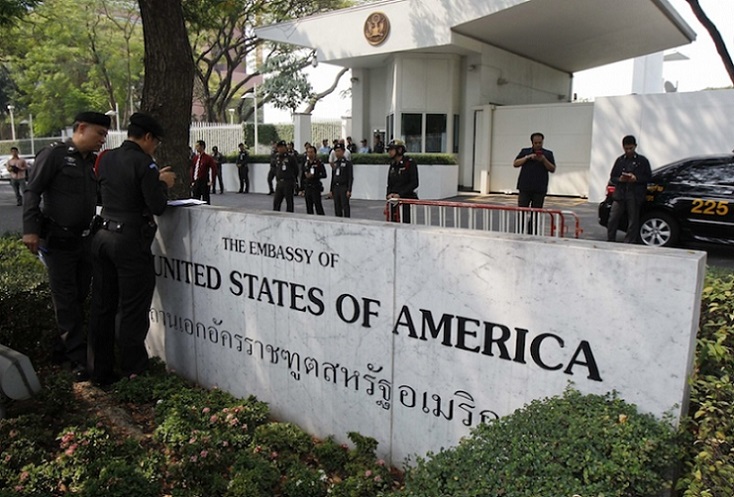
By Ulson Gunnar – New Eastern Outlook – 13.03.2018
The United States has spent over a year now leveling accusations against the Russian Federation regarding alleged political meddling during the 2016 US elections. While accusations range from everything including “fake news” spread across the Internet to direct ties to the administration of US President Donald Trump used to assist him into power, no evidence has yet to surface to prove Russia has meddled at all in America’s internal political affairs.
And while Russia certainly possesses a large and growing presence across the international media, concerted attacks against this presence stems more from the fact that decades of uncontested control over global public opinion by the US and Europe is now shifting toward a multipolar balance of power in information space.
In stark contrast to the whispers of shadows cited by the US and Europe regarding Russia, to begin understanding the scope of US political meddling abroad, one needs only to visit the US State Department and corporate-funded National Endowment for Democracy’s (NED) own website.
Industrial-Scale Meddling
US meddling is so extensive that NED is broken into multiple subsidiaries (National Democratic Institute (NDI), International Republican Institute (IRI) and Freedom House) which in turn, are joined by parallel organizations such as George Soros’ Open Society Foundation, USAID, the UK’s DFID and many more.
The NED website is broken into several regions including:
Africa;
Asia;
Central and Eastern Europe;
Eurasia;
Global;
Latin America and Caribbean and;
Middle East and Northern Africa.
Within each region, NED lists its extensive funding for organizations and fronts in over 100 different nations around the globe.
Within each nation, NED funds between a handful to several dozen organizations posing as legal firms, media platforms, environmental groups and human rights advocates. They collectively create the components of a political machine used to pressure incumbent governments to heed US interests, or overthrow them if they fail to.
Because the NED and recipients of its funding are increasingly exposed as a form of political subversion, NED has opted to list its funding in some nations in very general terms, never revealing the actual organizations or individuals receiving US money. Many organizations in targeted nations refuse to disclose their funding to the public. Many even possess the gall to solicit public donations despite receiving (and concealing) extensive funding from the US government.
Asia
Entire opposition parties have been created by NED. One example is that of the current government in Myanmar headed by State Counselor Aung San Suu Kyi and her National League for Democracy (NLD). From the party’s senior leadership, down to its rank and file, many NLD members are the direct recipients of indoctrination and training provided by programs funded by the US NED.
Current Minister of Information Pe Myint, was trained in a US NED-funded program hosted by the Bangkok-based Foreign Correspondents’ Club of Thailand (FCCT), which the FCCT would later deny despite evidence appearing on their own website confirming otherwise.
Elsewhere in Asia, the current anti-government opposition in Thailand consists of a small network of NED-funded organizations which dovetail into the US and European media organizations operating out of Bangkok. Small protests consisting of only 5-10 individuals are transformed into international headlines by NED’s army of media fronts including Prachatai, Thai Lawyers for Human Rights, the Cross-Cultural Foundation and their partners in the US and European press as well as Western diplomats who all openly collaborate and coordinate daily across social media.
When agents of foreign interests are arrested, they are often accompanied by US, British, Canadian and European Union diplomatic staff to police stations.
In next door Cambodia, the Cambodia National Rescue Party (CNRP) is led by Kem Sokha who previously and repeatedly traveled to Washington to openly conspire against the government in Phnom Penh before being arrested by Cambodian authorities. Ironically, while the US punishes Russia for mere allegations of political interference, it demands Cambodia release opposition members caught openly discussing their plans with opposition media to overthrow their own nation with America’s assistance.
Hong Kong, since returning to China after an extended period of occupation by the British, is also home to a large network of US NED-funded opposition aimed at Beijing. A similar hypocrisy is demonstrated by Washington as it protests the exposure and disruption of these foreign-funded networks of subversion Washington itself would never tolerate upon its own shores.
The Middle East
It is a fact, admitted by prominent US media platforms such as the New York Times, that the entire 2011 Arab Spring was a result of extensive preparations directed by the NED, its partners and subsidiaries.
After helping create the conflicts currently consuming the Middle East, NED now funds a variety of activities in nations like Syria to help prolong the conflicts. This is done by aiding and abetting militants fighting Damascus under the guise of providing humanitarian aid. It also includes assisting in the administration of territory seized by militants from Damascus’ control.
The nation of Iran, yet to be consumed by the violence sweeping across Syria, Yemen, Libya and Iraq, is host to networks of both NED-funded and CIA-backed groups ranging from supposed activists, to militant groups aimed at the violent overthrow of the government in Tehran.
Eastern Europe
It was in Eastern Europe that NED perfected what is now called the “color revolution.” It is now admitted that the US NED and other US agencies played a pivotal role in overthrowing the governments of Georgia, Ukraine and Serbia. It was in fact the US-backed overthrow of the Serbian government in 2000 that Cambodia’s Kem Sokha cited as a model to replicate in Southeast Asia with US assistance.
After the collapse of the Soviet Union, the NED’s color revolutions swept through Eastern Europe like a plague, consuming national sovereignty and bending the former Soviet territories to new masters in Washington, London and Brussels.
More recently, as Russia has begun to reassert itself and court nations in both Eastern and Western Europe, NED has stepped in once again to oust leaders who refuse to reduce or eliminate economic, military and diplomatic ties with Russia at Washington’s behest. A prime example of this includes the 2013-2014 Euromaiden protests in Ukraine. During 2013-2014, US senators including John McCain would literally take to the protest stages in Kiev to offer direct political support for the unrest which was spearheaded by Neo-Nazi political circles.
Russia
Remarkably, as Washington accuses Russia of political meddling within the United States, the NED openly lists nearly 100 subversive activities or organizations they are funding inside of Russia itself. Beyond what is listed on NED’s website is support the US and Europe is providing unpopular opposition figures like Alexei Navalny, the now deceased Boris Nemtsov, Yevgeniya Chirikova (NED-funded Strategy 31), Lev Ponomarev (NED-funded Moscow Helsinki Group), Liliya Shibanova (NED-funded GOLOS) and many others who have been repeatedly caught conspiring with American diplomats and financiers backing their subversive activities.
Were evidence to surface that Russia did any of the above forms of meddling, including maintaining entire stables of opposition figures who regularly filter in and out of the Russian Embassy in a targeted nation, it would be categorically condemned by Washington. Yet Washington flagrantly engages in overt political subversion, not just in Russia, but in (at least) 100 other nations around the globe, including nations the US is currently, outright occupying militarily.
For empire, what it fears the most is competition. It seeks to be the sole hegemon with all else beneath it. The US does not oppose political meddling in a sovereign nation’s affairs, it opposes the obstruction of its own meddling worldwide and seeks to eliminate others offering better alternatives to coercive subjugation by Washington, thus why it has singled out nations like Russia, China and others who are increasingly successful in doing just that.
For those tempted to join the bandwagon in condemning nations like Russia and China of political meddling, first they must recognize and account for the industrial scale meddling the US and its European partners are engaged in.
For those who are taking NED money worldwide in the belief that they are somehow advancing a liberal progressive agenda, particularly democracy, they must ask themselves what about a foreign nation meddling in their nation’s political affairs is “democratic” or conducive to the principles of self-determination democracy is built upon? One cannot honestly conclude that NED money is meant to support a nation’s capacity to determine its own destiny when clearly Washington is spending these vast amounts of money in order to determine it for that nation.
Establishment alarmed as Trump threatens to gut US ‘democracy promotion’ racket
RT | March 7, 2018
The foreign policy establishment in Washington is crying foul after the Trump administration proposed to cut funding for organizations responsible for “promoting democracy abroad,” often in the guise of color revolutions.
The 2019 State Department budget request cuts the National Endowment for Democracy (NED) budget and separates it from the National Democratic Institute (NDI) and the International Republican Institute (IRI). Funding for the institutes would be moved to the State Department, where NDI and IRI would have to compete with private contractors, according to the Washington Post columnist Josh Rogin, who described the proposal as “an assault not only on their organizations but also on the pro-democracy mission they are dedicated to.”
“If implemented, the proposal would gut the program, force crippling layoffs and the symbolic meaning would also be shattering, sending a signal far and wide that the United States is turning its back on supporting brave people who share our values,” NED President Carl Gershman told Rogin.
“The work our government does to promote democratic values abroad is at the heart of who we are as a country,” Senator John McCain (R-Arizona), chairman of the IRI’s board of directors, told Rogin. The NDI board is chaired by former Secretary of State Madeleine Albright.
McCain actually wrote a letter protesting the proposal to the Office of Management and Budget in December. It was signed by four other senators, including McCain’s close ally Lindsey Graham (R-South Carolina) and Marco Rubio (R-Florida).
Trump’s people “just don’t believe it’s America’s business to push democracy abroad,” Rogin concluded.
His article quickly made the rounds of the Washington establishment circles, where it received praise from former CIA agent and failed presidential candidate Evan McMullin and New Republic columnist Jeet Heer. Nicholas Burns, who served as State Department spokesman under Albright, said the revelations will “make your blood boil.”
.@joshrogin: The Trump administration’s assault on democracy promotion can be expected to continue. Dictatorships are presenting their model as preferable for the developing world. Human rights abuses are rising. Basic freedoms are under attack. https://t.co/IRDT91JZAt
— Evan McMullin (@Evan_McMullin) March 5, 2018
2. Democracy promotion in foreign policy had genuine bipartisan support from Carter to Obama. Trump has broken that consensus.
— Jeet Heer (@HeerJeet) March 6, 2018
This will also make your blood boil. The State Department is giving up on our historic support for democracy promotion that none other than Ronald Reagan pioneered. https://t.co/uQOpWnolme
— Nicholas Burns (@RNicholasBurns) March 5, 2018
It was Burns’s tweet in particular that attracted derision from critics of US foreign policy, such as journalists Glenn Greenwald, Chris Floyd and Jon Schwarz, and former diplomat Peter Van Buren:
This is the kind of blatant, jingoistic historical revisionism that the Trump era has made fashionable again. The idea that the US had been devoted to “democracy promotion” before Trump – and that this was pioneered by tyrant-hugging Reagan – is simply laughable: https://t.co/JrVqWt3CP7
— Glenn Greenwald (@ggreenwald) March 6, 2018
Oh, Mr. Burns, do tell us more about Reagan’s “democracy promotion” with Rios Montt. And did Reagan have a special aide to follow behind him and mop up the innocent blood dripping – pouring – from his hands? Oh, tell us the glorious story, Mr. Burns!
— Chris Floyd (@empireburlesque) March 6, 2018
The confusing thing about Harvard, Yale, etc. is that the job of people working there in the hard sciences actually is to describe reality accurately, whereas the job of many humanities professors like Nicholas Burns is to lie about reality https://t.co/e5EQhQfL5O
— Jon Schwarz (@schwarz) March 6, 2018
Nicky, Nicky… no more day drinking unless you’re going on CNN. Democracy promotion in Nicaragua, Salvador, Guatemala, Lebanon… or maybe Iraq 3x, Afghanistan, Somalia, Pakistan, Libya? What ARE you talking about? https://t.co/D3t2TknjzS
— Peter Van Buren (@WeMeantWell) March 6, 2018
As well as a number of rank-and-file Twitterati:
Libya thanks you for their US installed democracy. The slave market was a bit of a surprise and the fact that there are three waring factions all claiming to be the government, but I’m sure you know what’s best.
— Kropotkin (@DoctorKropotkin) March 7, 2018
Democracy! Promoted! pic.twitter.com/hXnhJsHuxi
— B (@balvertos) March 7, 2018
The NED was founded in 1983, under the Reagan administration. It is theoretically a non-governmental organization, though the bulk of its funding is provided by the US government and American taxpayers. The status has given NED and its institutes plausible deniability against accusations that the US has been meddling in the politics of other countries.
“A lot of what we do today was done covertly 25 years ago by the CIA,” one of the endowment’s founders, Allen Weinstein, told the Washington Post in September 1991.
One example is the wave of “color revolutions,” starting from Serbia in 2000 to the “Arab Spring” revolts of 2011. Ukraine was subjected to this twice, in 2004 and in 2014. During the unrest in Kiev in November 2004, The Guardian’s Ian Traynor described the process, while heaping praise on the people behind it.
“The operation – engineering democracy through the ballot box and civil disobedience – is now so slick that the methods have matured into a template for winning other people’s elections,” Traynor wrote. “The Democratic party’s National Democratic Institute, the Republican party’s International Republican Institute, the US state department and USAid are the main agencies involved in these grassroots campaigns as well as the Freedom House NGO and billionaire George Soros’s open society institute.”
Though campaigns funded by all these external actors are more astroturf than grassroots, there were few objections, as it was all in the name of democracy.
Traynor concluded his 2004 story by saying the “places to watch” were Moldova and Central Asia. Sure enough, the former Soviet republic of Kyrgyzstan went through a “Pink revolution” in February 2005, while the “Grape revolution” took place in Moldova in April 2009.
The Washington establishment’s obsession with democracy may also be explained by the belief that any non-democratic government is automatically anti-Western, as Luis Fleischman of the neoconservative Center for Security Policy argued last month.
If the regime is pro-American, however, it doesn’t matter whether it’s actually democratic or not. On Tuesday, the director of the Foundation for Defense of Democracies Mark Dubowitz tweeted that “inclusive authoritarianism” might be a better fit for Middle Eastern countries, as long as they were “tolerant, respectful of individual liberties & minority rights & pro-American.”
Btw, I said a more “inclusive authoritarianism” *might* be better alternative. Tolerant, respectful of individual liberties & minority rights & pro-American. I suggested should be discussed. So spare me the invective & explain why worse than failed M/E democracies. https://t.co/yQJWKQ5V3z
— Mark Dubowitz (@mdubowitz) March 7, 2018
Read more:
Featured Video
Yemen joins the war – Red Sea could be blocked next – Saudi regime at risk
or go to
Aletho News Archives – Video-Images
From the Archives
A superpower and “the world’s sickest warrior state”
By Paul J. Balles | March 8, 2010
Living through five or six major wars has hardened me to what I thought were the extremes of inhuman cruelty and brutality.
Two things made those extremes almost bearable: the brutality always revealed – at least according to the media coverage – the viciousness of the enemy. It was therefore quite understandable when our “brave men and women” pulverized the enemy.
Films of Japanese torturing captive Americans somehow justified holding Japanese Americans in internment camps during World War II; and only a small percentage of Americans found the bombing of Hiroshima and Nagasaki unreasonably vengeful at best, at worst, depraved.
The media giants in America portrayed the North Koreans as barbaric beasts with their captives, quite unlike their southern counterpoints – our allies during the Korean War. No one ever felt the need to explain how the South Koreans were a civilized breed while the North Koreans were absolute savages, at least according to the official line.
In Vietnam, our warriors justifiably (or so the media made us believe) dropped napalm on the North Vietnamese who had the gall to hide in villages and tunnels to ravage our invaders. At least it was accepted practice until some rogue photojournalist filmed a young girl screaming down a Vietnamese road in flames. … continue
Blog Roll
 Aletho News
- Russian tanker approaches Cuba despite US oil blockade
- Marandi: Yemen joins the war – Red Sea could be blocked next – Saudi regime at risk
- Pro-Palestinian French member of European Parliament denied entry to Canada
- Pakistan to Host US-Iran Talks
- How Indonesia’s tilt toward the US left it stranded in the Strait of Hormuz
- US has no choice but to retreat from Iranian borders: Top commander
- Iran Retaliation Strikes Chemical Plant Near Dimona
- AWACS’ Destruction is a Major Loss for US Military – Ex-DoW Analyst
- Israel’s Iran Strategy Uses US Military & Gulf States as Its Pawns
- Iran: Trump wanted regime change, now just begging for Hormuz to open
- If Americans Knew
- Israeli police block Catholic cardinal from entering Church of the Holy Sepulchre on Palm Sunday
- Israel is assassinating journalists again, more than any other nation, anywhere, ever – Not a ceasefire Day 170
- Over 300 US service members wounded, majority have brain injuries – Not a ceasefire Day 169
- Researchers at Human Rights Watch Resign Over Blocked Report on Palestinian Refugee Return
- Jewish Groups Are Backing a War Americans Don’t Want
- Eric Fingerhut Thinks He’s the President of the Jews
- Top Jewish Philanthropists, Rabbis Urge Israeli President to Take Action Against ‘Jewish Extremists’
- Don’t Be Fooled. Zionist Leaders Have Always Wanted to Control Southern Lebanon
- Israel’s widespread use of torture is a core element of its genocide against the Palestinian people
- In Israel’s War on Iran, Many Middle East US Bases Rendered “All But Uninhabitable”
- No Tricks Zone
- German Science Blog Accuses PIK Climate Institute Of Hallucinating Climate Tipping Points
- Devastating Assessment Of Comirnaty Vaccine By Former Senior Pfizer Europe Toxicologist
- New Study: CO2 Is ‘Effectively Negligible’ As An Explanatory Climate Change Factor Since 2000
- Former Pfizer Toxicologist Dr. Helmut Sterz Tells Bundestag Hearing Pfizer Vaccine Should Have Never Been Approved
- Energy Expert: Germany’s Nuclear Phaseout Was A “500 Billion Euro Mistake”
- New Research: South Australia’s Mid-Holocene Sea Surface Temperatures Were 4°C Warmer Than Today
- Storing Green Energy To Last Germany 10 Days Would Require A 60-Million Tonne Battery
- New Studies: UK Sea Levels Were 4 Meters Higher Than Today During The Mid-Holocene
- Destructive Green New Deal: German Energy And Metal Group Warns Of Drastic Crisis
- New Study Documents A 20-Year Pause In Arctic Sea Ice Decline – Driven By Internal Variability
 Aletho News