Human Rights: The Latest Weapon Against Venezuela
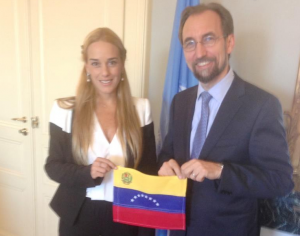
UN High Commissioner for Human Rights and Lilian Tintori, wife of opposition leader Leopoldo López who is currently serving a 13 year sentence (in house arrest) for his responsibility in the deadly violence of the 2014 guarimbas.
By Ricardo Vaz | Investig’Action | September 21, 2017
The mainstream media have a crucial role to play in the war against Venezuela, creating a distorted narrative and a constant frenzy that are crucial for any regime-change operation. With violent protests having failed to topple the government and to stop the Constituent Assembly, the plan switched to military threats and economic sanctions. But these come directly from an unpopular US administration, and a more impartial-looking figure was needed. The High Commissioner for Human Rights, Jordanian Prince Zeid bin Ra’ad al Hussein, stepped up to the plate with the backing of more than 100 NGOs. We tackle the manipulation of human rights for imperial purposes, but first we examine how the term “NGO” is woefully inadequate to describe these organisations.
*****
So much more than NGOs
On occasion of the 36th Session of the UN Human Rights Council, 116 “NGOs”1 signed a letter demanding that Venezuela be a priority for the Office of the High Commissioner for Human Rights (OHCHR). The effort was spearheaded by none other than Human Rights Watch (HRW). HRW has a long and documented history of bias and outright lies in their reports on Venezuela, which is no surprise given their blatant revolving door with the US government. Among the signatories are several usual suspects such as Provea or Foro Penal, whose president Alfredo Romero was a recent speaker in a “US Democracy Support” forum.
Another organisation on the list is Transparencia Venezuela, which includes as sources of funding the EU, several embassies and the parent organisation Transparency International. And although Transparency International is much shadier than it sounds, at least we can laud their transparency in listing their backers. The list includes the US State Department, the National Endowment for Democracy (NED), George Soros’ Open Society, even corporations such as Shell. One more that stands out, and is quoted regularly by the media, is the International Commission of Jurists, which sounds very noble and independent until you discover that they were initially funded by the CIA.
The issue here is with the term “non-governmental organisation”, which are always presented by the media as faultless, impartial actors. While there are many scenarios in which independent organisations can step in and provide invaluable services, this is hardly the case of groups funded by the NED (or USAID, or similar agencies) to “promote democracy” or “defend human rights” in countries like Venezuela. These are merely extensions of the US and western foreign policy apparatus, working as the local infrastructure that is necessary in regime change operations as well as a source for the media to build its biased narrative.
At the end of the day, it is the term “non-governmental organisation” that falls very short of describing the nature and activities of these groups. If an organisation in Venezuela, or anywhere else, is funded by the US government, in what world is it a “non-governmental organisation”? One cannot prove that all the “NGOs” standing with HRW are western-funded, but advancing western interests is very much advancing corporate interests, and it is doubtful that anyone would do that for free.
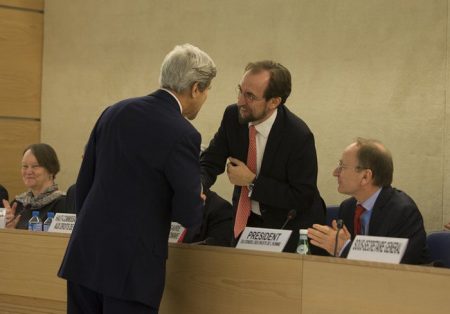
UN High Commissioner for HR shaking hands with former US Secretary of State John Kerry. (If by accident their speeches were switched nobody would notice!)
Weaponizing human rights
While one should not judge a book by the cover, it might be useful to consider the background of the UN High Commissioner for Human Rights, Prince Zeid bin Ra’ad al Hussein. A member of the royal family of Jordan, he comes from a Hashemite dynasty whose calling card has been its pliancy to imperial interests in the Middle East. And having served as ambassador to the US and permanent representative to the UN, he is, much like Jordan, someone the US can rely upon.
His most recent statement, which could just as well have been written by the US State Department, was delivered during the 36th Session of the Human Rights Council. It takes aim at every inconvenient country, from Iran to North Korea, while important US allies like Bahrain or Egypt are invited to “engage more productively” with his office. Israel is treated with kid gloves, and somehow the blame for the humanitarian crisis in Gaza is supposed to be shared between Israeli and Palestinian authorities. And there is no mention whatsoever of Saudi Arabia, where surely there are no human rights issues… Even when addressing the catastrophe in Yemen there is only a passing mention to “coalition airstrikes”.
And then the High Commissioner gets to Venezuela, sounding like any opposition leader or US official on “human rights violations” during anti-government protests or the “crushing [of] democratic institutions”, and suggesting an investigation into possible “crimes against humanity”. Never mind Colombia, where for years the army killed thousands of civilians and dressed them as rebels to collect rewards. Never mind Saudi Arabia, conducting double tap strikes2 against funerals in Yemen, or the US “torturing some folks,” or Israeli soldiers killing children because they were “running like terrorists.” The High Commissioner is worried that crimes against humanity have been committed in Venezuela!
This statement comes on the heels of a OHCHR report about Venezuela that Joe Emersberger described as “embarrassingly shoddy and biased.” It barely mentions any violence coming from the opposition ranks, and while offering a tally of deaths allegedly caused by government forces and the bogeyman colectivos, there is no detailed breakdown to be compared with other accounts such as the one by Venezuelanalysis. Remarkably, given the importance of the issue and the damning verdict that the OHCHR wishes to pass, no investigators from the UN body set foot in Venezuela. Instead the report relies on carefully selected testimonies and the “NGOs” we just discussed.
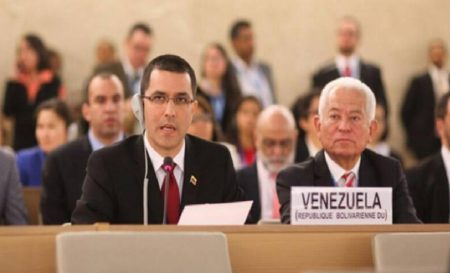
Venezuelan Foreign Minister Jorge Arreaza condemned the manipulation of human rights to attack Venezuela and the lies in the recent OHCHR report.
True NGOs strike back
While the amenable High Commissioner and the poorly-named “NGOs” put on their show to further the regime-change operation in Venezuela, others were not about to take it sitting down. True NGOs, independent organisations that are not pawns in imperialist machinations, and which are truly committed to human rights, condemned foreign meddling in Venezuela and the politicisation of human rights. One example was Swiss-based CETIM, an organisation focused on supporting social movements in the Global South. Concerning Venezuela, it released a statement that said:
[…] we declare ourselves for an immediate return to calm and to dialog, for the respect of Venezuelan peoples’ right to self-determination and the deepening of the process of democratic transformation that they have freely and courageously undertaken for two decades […]
Another organisation that reacted to the recent actions of the OHCHR was the International Association of Democratic Lawyers (IADL), through its representative at the UN, Micòl Savia, during one of the plenary meetings of the 36th Session of the Human Rights Council (intervention #35 in this link)
The IADL expresses its most profound dismay at the recent OHCHR report […]. Given its severity, we are particularly concerned by the High Commissioner’s mention of […] crimes against humanity, which lacks any legal grounds or sense of proportion. […]
The report is selective and biased, and represents a further example of the unfortunate politicisation that affects the work of the OHCHR, undermining its credibility and standing. Use of firearms, explosives, setting up barricades, people burned alive, attacks against hospitals, […], is this the model of “peaceful protests” that this council wants to promote?
Judge, jury and executioner
In the end the bias and lack of standards, or outright falsehood, of these claims and reports does not matter, because if the target is Venezuela they only have to look credible. The media will then do the rest, creating a background by repeating that “Venezuela has been accused by the UN of human rights abuses”, regardless of the shoddiness of the accusations, and this will be the basis to justify future escalations and aggressions as the empire pulls out all the stops to get rid of the biggest threat in its “backyard”.3
This is a good time to stress that legal systems are not moral or just by definition, but a reflection of who holds power, and this is especially true of international law. Though the struggle for an arena where all countries have the same weight is imperative, we are fooling ourselves if we are counting on international bodies to be impartial upholders of justice (just look at Palestine). Recent international tribunals have only served to reinforce the US/western narrative, either as a posteriori justification for past wars such as the one in Yugoslavia, or to justify upcoming ones against troublesome leaders like Gaddafi.
We should clarify that our argument is not some kind of moral relativism, whereby we defend that the alleged crime A should not be investigated until justice is served for (the much worse) crime B. We are not arguing that nobody can be guilty of crimes against humanity until Henry Kissinger is tried, although it is hard to take any international tribunal seriously if the most blatant crimes are immune from prosecution. But what is definitely absurd and unacceptable is to have the US empire, either directly or through its proxies, be the judge trying other people and countries.
Notes
- The HRW statement, and all pieces about it, refer to 116 NGOs; however, the organisations listed only total 115…
- Double tap strikes comprise an initial strike on a target followed by another one targeting first responders.
- In its article about this issue, the Guardian refers to a high-profile jailed opposition leader called Leonardo López (his name is Leopoldo López). Given the overall bias and lack of standards, this is probably fitting.
Reagan Documents Shed Light on U.S. ‘Meddling’
By Robert Parry | Consortium News | September 13, 2107
“Secret” documents, recently declassified by the Reagan presidential library, reveal senior White House officials reengaging a former CIA “proprietary,” The Asia Foundation, in “political action,” an intelligence term of art for influencing the actions of foreign governments.
The documents from 1982 came at a turning-point moment when the Reagan administration was revamping how the U.S. government endeavored to manipulate the internal affairs of governments around the world in the wake of scandals in the 1960s and 1970s involving the Central Intelligence Agency’s global covert operations.
Instead of continuing to rely heavily on the CIA, President Reagan and his national security team began offloading many of those “political action” responsibilities to “non-governmental organizations” (NGOs) that operated in a more overt fashion and received funding from other U.S. government agencies.
But secrecy was still required for the involvement of these NGOs in the U.S. government’s strategies to bend the political will of targeted countries. If the “political action” of these NGOs were known, many countries would object to their presence; thus, the “secret” classification of the 1982 White House memos that I recently obtained via a “mandatory declassification review” from the archivists at the Reagan presidential library in Simi Valley, California.
In intelligence circles, “political action” refers to a wide range of activities to influence the policies and behaviors of foreign nations, from slanting their media coverage, to organizing and training opposition activists, even to setting the stage for “regime change.”
The newly declassified memos from the latter half of 1982 marked an ad hoc period of transition between the CIA scandals, which peaked in the 1970s, and the creation of more permanent institutions to carry out these semi-secretive functions, particularly the National Endowment for Democracy (NED), which was created in 1983.
Much of this effort was overseen by a senior CIA official, Walter Raymond Jr., who was moved to Reagan’s National Security Council’s staff where he managed a number of interagency task forces focused on “public diplomacy,” “psychological operations,” and “political action.”
Raymond, who had held top jobs in the CIA’s covert operations shop specializing in propaganda and disinformation, worked from the shadows inside Reagan’s White House, too. Raymond was rarely photographed although his portfolio of responsibilities was expansive. He brought into his orbit emerging “stars,” including Lt. Col. Oliver North (a central figure in the Iran-Contra scandal), State Department propagandist (and now a leading neocon) Robert Kagan, and NED President Carl Gershman (who still heads NED with its $100 million budget).
Despite his camera avoidance, Raymond appears to have grasped his true importance. In his NSC files, I found a doodle of an organizational chart that had Raymond at the top holding what looks like the crossed handles used by puppeteers to control the puppets below them. The drawing fit the reality of Raymond as the behind-the-curtains operative who controlled various high-powered inter-agency task forces.
Earlier declassified documents revealed that Raymond also was the conduit between CIA Director William J. Casey and these so-called “pro-democracy” programs that used sophisticated propaganda strategies to influence not only the thinking of foreign populations but the American people, too.
This history is relevant again now amid the hysteria over alleged Russian “meddling” in last year’s U.S. presidential elections. If those allegations are true – and the U.S. government has still not presented any real proof – the Russian motive would have been, in part, payback for Washington’s long history of playing games with the internal politics of Russia and other countries all across the planet.
A Fight for Money
The newly released memos describe bureaucratic discussions about funding levels for The Asia Foundation (TAF), with the only sensitive topic, to justify the “secret” stamp, being the reference to the U.S. government’s intent to exploit TAF’s programs for “political action” operations inside Asian countries.
Indeed, the opportunity for “political action” under TAF’s cover appeared to be the reason why Reagan’s budget cutters relented and agreed to restore funding to the foundation.
William Schneider Jr. of the Office of Management and Budget wrote in a Sept. 2, 1982 memo that the Budget Review Board (BRB) had axed TAF funding earlier in the year.
“When the BRB last considered this issue on March 29, 1982, it decided not to include funding in the budget for a U.S. Government grant to TAF. The Board’s decision was based on the judgement that given the limited resources available for international affairs programs, funding for the Foundation could not be justified. During that March 29 meeting, the State Department was given the opportunity to fund TAF within its existing budget, but would not agree to do so.”
However, as Schneider noted in the memo to Deputy National Security Advisor Robert McFarlane, “I now understand that a proposal to continue U.S. funding for the Asia Foundation is included in the ‘political action’ initiatives being developed by the State Department and several other agencies.
“We will, of course, work with you to reconsider the relative priority of support for the Foundation as part of these initiatives keeping in mind, however, the need for identifying budget offsets.”
A prime mover behind this change of heart appeared to be Walter Raymond, who surely knew TAF’s earlier status as a CIA “proprietary.” In 1966, Ramparts magazine exposed that relationship and led the Johnson administration to terminate the CIA’s money.
According to an April 12, 1967 memo from the State Department’s historical archives, CIA Director Richard Helms, responding to a White House recommendation, “ordered that covert funding of The Asia Foundation (TAF) shall be terminated at the earliest practicable opportunity.”
In coordination with the CIA’s “disassociation,” TAF’s board released what the memo described as “a carefully limited statement of admission of past CIA support. In so doing the Trustees sought to delimit the effects of an anticipated exposure of Agency support by the American press and, if their statement or some future expose does not seriously impair TAF’s acceptability in Asia, to continue operating in Asia with overt private and official support.”
The CIA memo envisioned future funding from “overt U.S. Government grants” and requested guidance from the White House’s covert action oversight panel, the 303 Committee, for designation of someone “to whom TAF management should look for future guidance and direction with respect to United States Government interests.”
In 1982, with TAF’s funding again in jeopardy, the CIA’s Walter Raymond rallied to its defense from his NSC post. In an undated memo to McFarlane, Raymond recalled that “the Department of State underscored that TAF had made significant contributions to U.S. foreign policies through fostering democratic institutions and, as a private organization, had accomplished things which a government organization cannot do.” [Emphasis in original]
Raymond’s bureaucratic intervention worked. By late 1982, the Reagan administration had arranged for TAF’s fiscal 1984 funding to go through the U.S. Information Agency (USIA) budget, which was being used to finance a range of President Reagan’s “democracy initiatives.” Raymond spelled out the arrangements in a Dec. 15, 1982 memo to National Security Advisor William Clark.
“The issue has been somewhat beclouded in the working levels at State since we have opted to fund all FY 84 democracy initiatives via the USIA budgetary submission,” Raymond wrote. “At the same time, it is essential State maintain its operational and management role with TAF.”
Over the ensuing three and half decades, TAF has continued to be subsidized by U.S. and allied governments. According to its annual report for the year ending Sept. 30, 2016, TAF said it “is funded by an annual appropriation from the U.S. Congress, competitively bid awards from governmental and multilateral development agencies, including the U.S. Agency for International Development, Australian Department of Foreign Affairs and Trade, United Kingdom’s Department for International Development and by private foundations and corporations,” a sum totaling $94.5 million.
TAF, which operates in 18 Asian countries, describes its purpose as “improving lives across a dynamic and developing Asia.” TAF’s press office had no immediate comment regarding the newly released Reagan-era documents.
Far From Alone
But TAF was far from alone as a private organization that functioned with U.S. government money and collaborated with U.S. officials in achieving Washington’s foreign policy goals.
For instance, other documents from the Reagan library revealed that Freedom House, a prominent human rights organization, sought advice and direction from Casey and Raymond while advertising the group’s need for financial help.
In an Aug. 9, 1982 letter to Raymond, Freedom House executive director Leonard R. Sussman wrote that “Leo Cherne [another senior Freedom House official] has asked me to send these copies of Freedom Appeals. He has probably told you we have had to cut back this project to meet financial realities. We would, of course, want to expand the project once again when, as and if the funds become available.”
According to the documents, Freedom House remained near the top of Casey’s and Raymond’s thinking when it came to the most effective ways to deliver the CIA’s hardline foreign policy message to the American people and to the international community.
On Nov. 4, 1982, Raymond wrote to NSC Advisor Clark about the “Democracy Initiative and Information Programs,” stating that “Bill Casey asked me to pass on the following thought concerning your meeting with [right-wing billionaire] Dick Scaife, Dave Abshire [then a member of the President’s Foreign Intelligence Advisory Board], and Co.
“Casey had lunch with them today and discussed the need to get moving in the general area of supporting our friends around the world. By this definition he is including both ‘building democracy’ and helping invigorate international media programs. The DCI [Casey] is also concerned about strengthening public information organizations in the United States such as Freedom House.
“A critical piece of the puzzle is a serious effort to raise private funds to generate momentum. Casey’s talk with Scaife and Co. suggests they would be very willing to cooperate. Suggest that you note White House interest in private support for the Democracy initiative.”
In a Jan. 25, 1983 memo, Raymond wrote, “We will move out immediately in our parallel effort to generate private support” for “public diplomacy” operations. Then, on May 20, 1983, Raymond recounted in another memo that $400,000 had been raised from private donors brought to the White House Situation Room by USIA Director Charles Wick. According to that memo, the money was divided among several organizations, including Freedom House and Accuracy in Media, a right-wing media attack group.
In an Aug. 9, 1983 memo, Raymond outlined plans to arrange private backing for that effort. He said USIA Director Wick “via [Australian publishing magnate Rupert] Murdock [sic], may be able to draw down added funds” to support pro-Reagan initiatives. Raymond recommended “funding via Freedom House or some other structure that has credibility in the political center.”
[For more on the Murdoch connection, see Consortiumnews.com’s “Rupert Murdoch: Propaganda Recruit.”]
Questions of Legality
Raymond remained a CIA officer until April 1983 when he resigned so in his words “there would be no question whatsoever of any contamination of this” propaganda operation to woo the American people into supporting Reagan’s policies.
Raymond fretted, too, about the legality of Casey’s role in the effort to influence U.S. public opinion because of the legal prohibition against the CIA influencing U.S. policies and politics. Raymond confided in one memo that it was important “to get [Casey] out of the loop,” but Casey never backed off and Raymond continued to send progress reports to his old boss well into 1986.
It was “the kind of thing which [Casey] had a broad catholic interest in,” Raymond said during his Iran-Contra deposition in 1987. He then offered the excuse that Casey undertook this apparently illegal interference in domestic affairs “not so much in his CIA hat, but in his adviser to the president hat.”
In 1983, Casey and Raymond focused on creating a permanent funding mechanism to support private organizations that would engage in propaganda and political action that the CIA had historically organized and paid for covertly. The idea emerged for a Congressionally funded entity that would be a conduit for this money.
But Casey recognized the need to hide the strings being pulled by the CIA. In one undated letter to then-White House counselor Edwin Meese III, Casey urged creation of a “National Endowment,” but added: “Obviously we here [at CIA] should not get out front in the development of such an organization, nor should we appear to be a sponsor or advocate.”
A document in Raymond’s files offered examples of what would be funded, including “Grenada — 50 K — To the only organized opposition to the Marxist government of Maurice Bishop (The Seaman and Waterfront Workers Union). A supplemental 50 K to support free TV activity outside Grenada” and “Nicaragua — $750 K to support an array of independent trade union activity, agricultural cooperatives.”
The National Endowment for Democracy took shape in late 1983 as Congress decided to also set aside pots of money — within NED — for the Republican and Democratic parties and for organized labor, creating enough bipartisan largesse that passage was assured.
But some in Congress thought it was important to wall the NED off from any association with the CIA, so a provision was included to bar the participation of any current or former CIA official, according to one congressional aide who helped write the legislation.
This aide told me that one night late in the 1983 session, as the bill was about to go to the House floor, the CIA’s congressional liaison came pounding at the door to the office of Rep. Dante Fascell, a senior Democrat on the House Foreign Affairs Committee and a chief sponsor of the bill.
The frantic CIA official conveyed a single message from CIA Director Casey: the language barring the participation of CIA personnel must be struck from the bill, the aide recalled, noting that Fascell consented to the demand, not fully recognizing its significance.
The aide said Fascell also consented to the Reagan administration’s choice of Carl Gershman to head the National Endowment for Democracy, again not recognizing how this decision would affect the future of the new entity and American foreign policy.
Gershman, who had followed the classic neoconservative path from youthful socialism to fierce anticommunism, became NED’s first (and, to this day, only) president. Though NED is technically independent of U.S. foreign policy, Gershman in the early years coordinated decisions on grants with Raymond at the NSC.
For instance, on Jan. 2, 1985, Raymond wrote to two NSC Asian experts that “Carl Gershman has called concerning a possible grant to the Chinese Alliance for Democracy (CAD). I am concerned about the political dimension to this request. We should not find ourselves in a position where we have to respond to pressure, but this request poses a real problem to Carl.”
Besides clearing aside political obstacles for Gershman, Raymond also urged NED to give money to Freedom House in a June 21, 1985 letter obtained by Professor John Nichols of Pennsylvania State University.
What the documents at the Reagan library make clear is that Raymond and Casey stayed active shaping the decisions of the new funding mechanism throughout its early years. (Casey died in 1987; Raymond died in 2003.)
Lots of Money
Since its founding, NED has ladled out hundreds of millions of dollars to NGOs all over the world, focusing on training activists, building media outlets, and supporting civic organizations. In some geopolitical hotspots, NED may have scores of projects running at once, such as in Ukraine before the 2014 coup that overthrew elected President Viktor Yanukovych and touched off the New Cold War with Russia. Via such methods, NED helped achieve the “political action” envisioned by Casey and Raymond.
From the start, NED also became a major benefactor for Freedom House, beginning with a $200,000 grant in 1984 to build “a network of democratic opinion-makers.” In NED’s first four years, from 1984 and 1988, it lavished $2.6 million on Freedom House, accounting for more than one-third of its total income, according to a study by the liberal Council on Hemispheric Affairs, which was entitled “Freedom House: Portrait of a Pass-Through.”
Over the ensuing decades, Freedom House has become almost an NED subsidiary, often joining NED in holding policy conferences and issuing position papers, both organizations pushing primarily a neoconservative agenda, challenging countries deemed insufficiently “free,” including Syria, Ukraine (before the 2014 coup) and Russia.
NED and Freedom House often work as a kind of tag-team with NED financing NGOs inside targeted countries and Freedom House berating those governments if they try to crack down on U.S.-funded NGOs.
For instance, on Nov. 16, 2012, NED and Freedom House joined together to denounce a law passed by the Russian parliament requiring Russian recipients of foreign political money to register with the government. Or, as NED and Freedom House framed the issue: the Russian Duma sought to “restrict human rights and the activities of civil society organizations and their ability to receive support from abroad. Changes to Russia’s NGO legislation will soon require civil society organizations receiving foreign funds to choose between registering as ‘foreign agents’ or facing significant financial penalties and potential criminal charges.”
Of course, the United States has a nearly identical Foreign Agent Registration Act that likewise requires entities that receive foreign funding and seek to influence U.S. government policy to register with the Justice Department or face possible fines or imprisonment.
But the Russian law would impede NED’s efforts to destabilize the Russian government through funding of political activists, journalists and civic organizations, so it was denounced as an infringement of human rights and helped justify Freedom House’s rating of Russia as “not free.”
The Russian government’s concerns were not entirely paranoid. On Sept. 26, 2013, Gershman, in effect, charted the course for the crisis in Ukraine and the greater neocon goal of regime change in Russia. In a Washington Post op-ed, Gershman called Ukraine “the biggest prize” and explained how pulling it into the Western camp could contribute to the ultimate defeat of Russian President Vladimir Putin.
“Ukraine’s choice to join Europe will accelerate the demise of the ideology of Russian imperialism that Putin represents,” Gershman wrote. “Russians, too, face a choice, and Putin may find himself on the losing end not just in the near abroad but within Russia itself.”
The long history of the U.S. government interfering covertly or semi-covertly in the politics of countries all over the world is the ironic backdrop to the current frenzy over Russia-gate and Russia’s alleged dissemination of emails that undermined Democratic presidential nominee Hillary Clinton’s campaign.
The allegations are denied by both Putin and WikiLeaks editor Julian Assange who published the Democratic emails – and the U.S. government has presented no solid evidence to support the accusations of “Russian meddling” – but if the charges are true, they could be seen as a case of turnabout as fair play.
Except in this case, U.S. officials, who have meddled ceaselessly with their “political action” operations in countries all over the world, don’t like even the chance that they could get a taste of their own medicine.
Investigative reporter Robert Parry broke many of the Iran-Contra stories for The Associated Press and Newsweek in the 1980s.
Cambodia Exposes, Expels US Network
By Joseph Thomas – New Eastern Outlook – 27.08.2017
The government of Cambodia has exposed and expelled a US network attempting to interfere in the nation’s political processes. The US National Democratic Institute (NDI) was reportedly ordered to end its activities in the country and remove all of its foreign staff.
In a statement, the foreign ministry accused the National Democratic Institute (NDI) of operating in Cambodia without registering, and said its foreign staff had seven days to leave. Reuters in an article titled, “Cambodia orders U.S.-funded group to halt operations, remove staff,” would claim:
Authorities were “geared up to take the same measures” against other foreign NGOs which fail to comply with the law, the ministry added.
The article also noted that:
Prime Minister Hun Sen, who has ruled Cambodia for more than three decades, on Tuesday ordered the English-language The Cambodia Daily newspaper to pay taxes accrued over the past decade or face closure. The paper was founded by an American.
He also lashed out at the United States and non-governmental organizations (NGOs) and accused them of funding groups attempting to overthrow his government.
The American-owned Cambodia Daily newspaper in its own article titled, “NDI Ordered to Halt Operations, Foreign Staff Face Expulsion,” would note that:
The announcement comes less than a week after documents leaked on Facebook and circulated on government-affiliated media appeared to show political cooperation between NDI and the opposition party, amid increased tension in recent weeks between the government and U.S.-backed NGOs and media outlets.
NDI could not immediately be reached for comment.
Radio Free Asia and Voice of America have also both been accused of not fulfilling tax and registration obligations. The Cambodia Daily, whose publisher is a U.S. citizen, was hit with a $6.3 million unaudited tax bill and threatened with imminent closure if it is not paid by September 4.
Reuters would cite NDI’s own website in an attempt to inform readers about what its role is in Cambodia claiming, “the NDI works with political parties, governments and civic groups to “establish and strengthen democratic institutions.””
NDI is a US government and US-European corporate-funded organisation chaired by representatives from America’s business and political community. Of the 34 listed members of NDI’s board of directors, virtually all of them either have direct ties to US corporations and financial institutions, are members of corporate-funded policy think tanks or previously were employed by the US State Department, or a combination of the three. Yet, even a cursory investigation of NDI and the media and political organisation in its orbit and the very nature of even its proposed role in Cambodia’s political process indicates impropriety and subversion. Reuters is intentionally failing to convey to readers.
What NDI Really is and What it Really Does
Directors with particularly prominent conflicts of interest include:
Madeleine Albright: Albright Stonebridge Group and Albright Capital Management LLC
Harriet Babbitt: Council on Foreign Relations
Thomas Daschle: The Daschle Group
Robert Liberatore: former senior vice president of DaimlerChrysler, an NDI financial sponsor
Bernard Aronson: former Goldman Sachs adviser
Howard Berman: senior advisor at Covington & Burling
Richard Blum: chairman of Blum Capital Partners
NDI director Thomas Daschle, for example, actually has foreign political parties as paying clients through his “Daschle Group,” including VMRO DPMNE based in Macedonia as revealed by The Hill. NDI is likewise active in Macedonia, providing support directly to VMRO DPMNE, even co-hosting events in the country according to NDI’s own social media account on Facebook.
In Southeast Asia, Freedom House, yet another subsidiary of NED, would provide extensive aid to opposition groups in Thailand led by ousted former prime minister Thaksin Shinawatra, with Freedom House director Kenneth Adelman (PDF) concurrently providing paid-for lobbying services to Thaksin Shinawatra himself.
It appears that such conflicts of interests are not the exception, but the rule indicating that NED and its subsidiaries including NDI pursue the collective corporate and financial interests of their boards of directors merely behind the guise of “strengthening democratic institutions.”
An examination of NDI’s corporate sponsors casts further doubts upon its alleged mission statement. Its financial sponsors, according to NDI’s 2005 annual report (PDF), include:
- British Petroleum
- Bell South Corporation
- Chevron
- Citigroup
- Coca Cola
- DaimlerChrysler Corporation
- Eli Lilly & Company
- Exxon Mobil
- Honeywell
- Microsoft
- Time Warner
Donors also include convicted financial criminal George Soros’ Open Society Foundation as well as the National Endowment for Democracy (NED) of which NDI is a subsidiary of, as well as the US Agency for International Development (USAID) and the US State Department itself.
Corporations like BP, Chevron, Citigroup, Coca Cola, Exxon, defence contractor Honeywell and IT giant Microsoft are not interested in promoting democracy. They are using democracy promotion as a means behind which to create conditions more conducive to expanding markets and increasing profits. This includes undermining governments impeding foreign corporate control of national resources and markets, or entirely removing and replacing governments with more obedient client regimes.
The contemporary history of American foreign wars and its practice of “regime change” and “nation building” provides self-evident confirmation of the motives and means used to expand US hegemony and clearly illustrates where organisations like NDI fit into the process.
In Cambodia’s case, a much larger, overarching agenda is in play than merely national resources and markets. US activities in Cambodia to coerce or replace the current government in Phnom Penh is done specifically to encircle and contain China through a united front of client states assembled by the United States across Southeast Asia.
Cambodia, along with the rest of Southeast Asia, has begun strengthening ties with Beijing economically, politically and militarily. Large infrastructure programmes, weapon acquisitions, joint-training exercises and trade deals are all on the table between Beijing and Phnom Penh.
The US, conversely, has provided few incentives beyond its failed Trans-Pacific Partnership scheme and coercion through networks like NDI and the myriad media and political proxies they fund and operate in Cambodia.
With NDI shuttered, its foreign staff expelled and the organisations and publications it was funding facing similar closures and evictions, it appears what little the US had on the table has been swept away. Cambodia’s particularly bold move may be replicated across Southeast Asia where similar US networks are maintained to manipulate and coerce the political processes of sovereign states.
“Democracy Promotion” From Abroad is a Contradiction
The notion that NDI is “promoting democracy” is at face value an absurdity. Democracy is a means self-determination. Self-determination is not possible if outside interests are attempting to influence the process.
A political party funded and directed by US interests through organisations like NDI, supported by media outfits and fronts posing as nongovernmental organisations likewise funded from abroad preclude any process of self-determination and is thus not only in no way, shape, or form “democracy promotion,” it is a process that is fundamentally undemocratic.
In the US where it is widely understood that money dominates campaigns and wins elections, it is difficult to perceive the US pouring money into opposition parties abroad for any other reason besides skewing electoral outcomes in favour of US interests.
Additional irony is provided by the fact that should any other nation attempt to pursue similar programmes aimed at America’s domestic political process, those involved would be quickly labelled foreign agents and their activities halted immediately.
The mere allegations that Russia attempted to interfere with America’s domestic political processes resulted in sanctions and even threats of war. Cambodia is a nation that cannot afford nor effectively impose sanctions upon the United States nor wage war against it, but shuttering a flagrant example of foreign interference in its internal political affairs is something Cambodia and its neighbours in Southeast Asia can and are beginning to do.
Cambodia’s use of existing laws regarding taxation and the registration of foreign entities has been effectively used to deal with these organisations. Neighbouring nations may begin to require foreign-funded organisations to register as foreign lobbyists, subject them to taxation and more stringent regulations and taking away from them the smoke screen of “democracy promotion” and “rights advocacy” they have cloaked their activities behind for decades.
Joseph Thomas is chief editor of Thailand-based geopolitical journal, The New Atlas.
US Wages Cyberwar Abroad Under Cover of “Activism”
By Joseph Thomas – New Eastern Outlook – 20.08.2017
The threat of cyberterrorism has competed for centre stage in American politics with fears of “Russian hackers” disrupting everything from elections to electrical grids. And yet as US policymakers wield threats of cyberterrorism to promote a long and growing list of countermeasures and pretexts for expanding its conflict with Moscow, it is simultaneously promoting very real cyberterrorism globally.
Worst of all, it does so under the guise of “activism.”
The Carnegie Endowment for International Peace recently published a paper titled, “Growing Cyber Activism in Thailand.”
In it, readers may have expected a detailed description of how independent local activists were using information technology to inform the public, communicate with policymakers and organise themselves more efficiently.
Instead, readers would find a list of US-funded fronts posing as “nongovernmental organisations” (NGOs) engaged in subversion, including attacks carried out against Thai government websites aimed at crippling them, the dumping of private information of ordinary citizens online and coercing policymakers into adopting their foreign-funded and directed agenda.
US-Backed Cyberterrorism
The paper cites petitions created by the US-funded Thai Netizen Network on the US-based petition site, Change.org as well as distributed denial of service attacks (DDoS) aimed at crippling essential government websites, a campaign defended by US-funded Thai Netizen as being “virtual civil disobedience.”
The paper would claim (our emphasis):
The most innovative countermeasure was a series of Distributed Denial of Service (DDoS) attacks: an anonymous group, Thailand F5 Cyber Army, declared a cyberwar on the Thai government by encouraging netizens to visit listed official websites and continuously press F5 on their keyboards to refresh the pages. The goal was to overwhelm web servers and cause a temporary collapse of the websites of the Ministry of Defense, Ministry of Information and Communication Technology, Government House of Thailand, National Legislative Assembly, and Internal Security Operations Command. The group disseminated detailed instructions on the operation to its anonymous activists. It then demanded that the junta cancel its Single Gateway proposal.
Most of the attacks were successful. Activists wanted to demonstrate the government’s technological ineptitude and its lack of capacity to manage the Single Gateway. Arthit Suriyawongkul, coordinator of the Thai Netizen Network, described the campaign as virtual civil disobedience—an online version of the nonviolent resistance practiced by civil rights groups in the United States.
In another case, an activist group called Anonymous launched a #BoycottThailand campaign on Twitter and reportedly hacked government websites, snatched confidential information from official databases, and shared it online.
The Thai Netizen Network is funded by the US State Department via the National Endowment for Democracy (NED) subsidiary, Freedom House, as well as convicted financial criminal George Soros’ Open Society and a number of other foreign governments and corporate-funded foundations.
The role of a foreign-funded front coordinating efforts to undermine Thailand’s national security, including promoting cyberterrorism as “civil disobedience,” carries with it many implications. That the US is the foreign state promoting these activities in Thailand, undermines its own efforts to define and combat cyberterrorism back home.
What is Cyberterrorism?
Cyberterrorism is described on the United States Federal Bureau of Investigation’s (FBI) website as:
… the use of computer network tools to shut down critical national infrastructures (e.g., energy, transportation, government operations) or to coerce or intimidate a government or civilian population.
Attacking government websites millions of people across Thailand depend on for information and services while pilfering the personal information of thousands of ordinary citizens clearly fits the definition of not only cyberterrorism because of the political motivations involved, but also malicious criminality in general.
Unlike alleged Russian hacks which divulged emails detailing impropriety among American politicians, the information pilfered by US-backed hackers in Thailand included the personal information of millions of ordinary citizens using government services as part of their daily lives.
Bangkok Post would fill in the missing information intentionally omitted from the Carnegie Endowment paper, reporting that:
Files posted by Anonymous and examined by the Bangkok Post appear to be from the court system, as the Anonymous posters claimed.
An SQL database file of 1.1 gigabytes contains thousands of names, ID card numbers, photos, email addresses, personal phone numbers and more — all in clear text.
By dumping this information online, US-backed hackers targeted ordinary citizens, jeopardising their privacy and exposing them to criminal elements the world over involved in identity theft.
US Cyberterrorism is not “Activism”
The Carnegie Endowment paper itself was drafted by Janjira Sombatpoonsiri, assistant professor of political science at Thammasat University, Thailand. She is also cited as a member of the Carnegie Endowment’s Civic Activism Network. Not only is she an active, contributing member of Thailand’s foreign-backed opposition, she is admittedly involved in a foreign think-tank funded by foreign corporate interests.
The Carnegie Endowment includes among its sponsors in its 2016 annual report; the US government, pharmaceutical giants including Gilead, petrochemical monopolies including Chevron, British Petroleum and Shell, defence contractors including Lockheed Martin and several automakers including Ford.
Like many other episodes of extraterritorial political interference up to and including military intervention, America’s meddling in Thailand is done on behalf of corporate interests seeking to expand their respective and collective hegemony both regionally in Asia vis-a-vis Beijing, and globally. This interference is done under the cover of rights advocacy, both by the think tanks and foundations funding it and those in Thailand receiving foreign cash.
The US use of cyberterrorism in Thailand and beyond should come as no surprise. It augments already ongoing efforts by US-backed opposition in Thailand to destabilise and upend Thailand’s political order which has included armed terrorism.
Most recently, a string of bombings plagued Bangkok, including one targeting a hospital. At various junctures during Thailand’s political conflict, foreign-backed opposition has brought militants into the streets. In 2010, nearly 100 would die over the course of several weeks, culminating in citywide arson leaving areas of Thailand’s capital, Bangkok, resembling a war zone.
To see US-sponsored authors attempting to promote cyberterrorism as “activism” in Thailand also comes as no surprise. When Thailand’s opposition carries out armed terrorism, US-sponsored media and policy think tanks often attempt to spin it as well. Other forms of more traditional subversion are also regularly defended by the US and its myriad fronts posing as rights advocates as “activism.”
Understanding that it is not “activism,” but by America’s own very definition, cyberterrorism, helps disarm this malicious campaign posing as “civil disobedience” and “activism,” and allows nations like Thailand to defend themselves through enhanced technological security measure as well as legislation.
Soft Coups in Latin America: The Cases of Ecuador and Bolivia
By Stansfield Smith, Chicago ALBA Solidarity | October 8, 2015
The US now engineers “regime change” not so much by using the military, in part because of their military quagmires in the Middle East, in part because Obama has sought to give a new face and new credibility to the Empire after the damage it suffered during Bush years. The US relies on soft coups: media campaigns and mass demonstrations against “corruption,” for “human rights,” “democracy,” “freedom,” aimed at the target government. The US makes skillful use of Non-Governmental Organizations (NGOs) to carry out its plans, which often appeal to cherished liberal-left values and sentiments. The leadership of these soft coups and color revolutions are made to seem just like us, with our liberal Western values. Overlooked or concealed are the actual political and economic plans the leaders of these movements will implement – first defeat the dictatorship and then all else will later fall into place. As a result, many people opposed to US military interventionism are taken in, many often willingly.
Progressive Latin American governments are one target for soft coups engineered by the US. The US seeks to overthrow democratically elected presidents through media campaigns of lies and half-truths, inciting social discontent, delegitimizing the government, provoking violence in the streets, economic disruptions and strikes.
For those opposed to all US intervention, particularly those of us living in the US, we are called upon to expose these new methods of soft coup interference. The standard practice involves the role of USAID, National Endowment for Democracy (NED), International Republican Institute (IRI), National Democratic Institute (NDI) in helping to finance NGOs to do their dirty work. NGOs have become the humanitarian face of imperialist intervention.
Behind the rhetoric of “democracy promotion,” Washington aims to impose neoliberal regimes that open their markets to the US without conditions and align themselves with US foreign policy. While these goals are known by the leaders of the US backed “color revolutions,” they are not shared with, let alone accepted by their followers. When these takeovers do succeed, citizens soon rebel against the new policies imposed on them, but it is too late to turn back.
The US government has long sought to overthrow socialist Cuba and the anti-neoliberal and anti-imperialist ALBA governments of Venezuela, Ecuador and Bolivia, and re-establish neocolonial governments. In the cases of President Correa of Ecuador and Evo Morales of Bolivia, this goes back to before their first runs for presidency. Green Left Weekly ran a series of articles on continuous US efforts to get rid of Correa, even before he came into office.[1] No serious article on the conflicts in Correa’s Ecuador can omit the ten year US effort inside Ecuador to get rid of Correa.
Any serious analysis of what is happening in a Third World country, whether a progressive one or not, must start with the role Western imperialism has played. Otherwise, the analysis does not clarify the causes of the problems, but just indirectly gives cover to US imperialism.
The work of Eva Golinger (until recently*) and Federico Fuentes of Green Left Weekly, are models of progressive intellectuals, defending the peoples and countries of Latin America. They have exposed the role of USAID and NED in corrupting particular indigenous groups in Bolivia and Ecuador: during
* She now seems to have more in common with the liberal-left alternative media criticized below. https://chicagoalbasolidarity.wordpress.com/2017/08/19/correcting-eva-golinger-on-venezuela/
Bolivia’s TIPNIS protests, with Pachakutik, Conaie and the Yasunidos in Ecuador. They have exposed the role of the US financed environmental NGOs in these countries, such as Fundacion Pachamama, Accion Ecologica, Amazon Watch.
This does not mean some indigenous and environmental groups have legitimate concerns. The problem occurs when the US funds leaders of groups to manipulate their members in order to exacerbate the problem. In the 1980s, the US used the Miskito Indian groups in Nicaragua to foment armed conflict with the Sandinistas. This does not mean the Miskitos did not have legitimate grievances, they had, but these were manipulated by the US to further its goal of overthrowing the Sandinistas. Likewise, indigenous peoples in Ecuador and Bolivia have legitimate concerns about development projects in the TIPNIS or Yasuni, for instance, but are deliberately used by US agencies to foment rebellion against their governments.
Using indigenous and environmental groups to attack their governments is a key part of the US government’s anti-Correa and anti-Evo Morales campaign. Unfortunately, consciously or not, this campaign is furthered in various alternative media centers, and can be seen in UpsideDownWorld, NACLA, In These Times, ROAR, CommonDreams, Jacobin, WagingNonViolence, Alternet, MintPressNews, even Naomi Klein, and recently Real News Network.
Too often, when liberal-left alternative media [2] address Latin America, we find articles legitimizing the views of these same US influenced environmental NGOs and related indigenous groups. This media has to some extent become a transmission belt for US propaganda, as knowing or unknowing participants in soft coup operations against these countries.
We find these alternative media outlets voicing and even being mouthpieces for US connected indigenous organizations and environmental NGOs, defending their protests against Evo Morales and Rafael Correa. For instance, Upside Down World has criticized Evo over TIPNIS, discounted the 2010 coup against Correa as not being a coup (the same line as the US government), defended the rightwing protests against Correa, and objected to the closing of US backed NGOs.
Covering up US Interference in Bolivia
In NACLA Emily Achtenberg wrote over ten articles on the Bolivian TIPNIS highway conflict and barely mentioned the close coordination of the protest leaders with the US Embassy. This is not simply an oversight, it is a cover-up.
“It’s not the first time that Morales has accused protest movements—including the TIPNIS marchers—of links to outside forces (such as the U.S. Embassy and right-wing opposition groups) who are seeking to destabilize his government. Protest leaders view these allegations largely as a tactic to undermine their credibility and mobilize support for the government.”[3]
Achtenberg avoids presenting the evidence of US government interference, and instead points the finger at Evo Morales.
She goes further in another article:
“A few telephone calls [between the US Embassy in Bolivia and the protest leaders] hardly prove a conspiracy, and many familiar with WikiLeaks cables accept that Embassy personnel routinely maintain contact with diverse social sectors. Serious concerns have been raised about the government’s potential violation of privacy laws in obtaining telephone records without a court order” [4]
Exposing the US role in the march takes a back seat to repeating US concerns over the Bolivian government’s alleged violations of privacy laws.
Ben Dangl follows Achtenberg in similar apologetics for the US role in the TIPNIS protests in his article in Upside Down World, “The Politics of Pachamama: Natural Resource Extraction vs. Indigenous Rights and the Environment in Latin America.” [5]
Contrast this with an article by Nil Nikandrov defending Bolivian sovereignty:
“According to journalist and author Eva Golinger, USAID poured at least $85 million into destabilizing the regime in the country. Initially, the US hoped to achieve the desired result by entraining the separatists from the predominantly white Santa Cruz district. When the plan collapsed, USAID switched to courting the Indian communities with which the ecology-oriented NGOs started to get in touch a few years before. Disorienting accounts were fed to the Indians that the construction of an expressway across their region would leave the communities landless, and the Indian protest marches to the capital that followed ate away at the public standing of Morales. It transpired shortly that many of the marches including those staged by the TIPNIS group, had been coordinated by the US embassy. The job was done by embassy official Eliseo Abelo, a USAID curator for the Bolivian indigenous population. His phone conversations with the march leaders were intercepted by the Bolivian counter-espionage agency and made public, so that he had to escape from the country while the US diplomatic envoy to Bolivia complained about the phone tapping.” [6]
Federico Fuentes noted USAID funding behind the TIPNIS protests:
The Confederation of Indigenous Peoples of the Bolivian East (CIDOB), the main organisation behind the march, has no such qualms [about its connection to the US]. It boasted on its website that it received training programs from the US government aid agency USAID. On the site, CIDOB president Adolfo Chavez, thanks the “information and training acquired via different programs financed by external collaborators, in this case USAID”.
He brought to light what Achtenberg and Dangl seek to conceal:
“neither of the Internet statements [an anti-Evo Morales Avaaz petition and September 21, 2011 letter to Morales signed by over 60 environmental groups] mentions the protesters’ support for the Reducing Emissions from Deforestation and Forest Degradation (REDD) program. REDD is a grossly anti-environmental United Nations program that aims to privatise forests by converting them into “carbon offsets” that allow rich, developed countries to continue polluting.
Some of the biggest proponents of this measure can be found among the NGOs promoting the march. Many of these have received direct funding from the US government, whose ambassador in Bolivia was expelled in September 2008 for supporting a right-wing coup attempt against the elected Morales government.
Rather than defend Bolivia’s sovereignty against US interference, the letter denounces the Bolivian government for exposing connections between the protesters and “obscure interests”.
These “obscure interests” include the League for the Defense of the Environment (LIDEMA), which was set up with US government funds….
Secret US diplomatic cables recently released by WikiLeaks and declassified US government files have conclusively shown that USAID directly targets indigenous communities in a bid to win them away from support for Morales and towards supporting US interests.” [7]
Western financed NGOs, such as Avaaz, Amazon Watch and Democracy Center, serve to provide a “left” cover to the global 1% campaign for “regime change” in Bolivia and Ecuador. They seek to demonize Evo Morales and Rafael Correa, thereby undermining the opposition of progressive people’s in the West to their engineering a “soft coup” in these countries.[8]
In 2011 Amazon Watch carried out an even more vociferous and dishonest propaganda campaign against Evo Morales’ Bolivia, claiming to defend the TIPNIS and indigenous rights in Bolivia. Again, no mention is made of the US role in the protests, nor that Evo’s government had a number of the police responsible for the unauthorized violence of the protest marchers fired, nor that Evo agreed to the protestors’ demands.[9]
Funders of Amazon Watch and Rainforest Action Network (RAN) include: Charles Stewart Mott Foundation (which works with NED), Richard and Rhoda Goldman Fund, The Overbrook Foundation, Moriah Fund (directors connected with USAID and Bill Clinton’s administration), Rockefeller Brothers Fund, The David & Lucile Packard Foundation.[10]
In 2013, Pedro Nuni, one of the central leaders of these TIPNIS protests, defended by much Western alternative media, announced he was joining a rightwing party.[11] This, this alternative media conveniently forgot to mention.
Passing knowledge of Latin American history informs us it is ludicrous to think the US does not play a role in coups and protest movements against progressive governments. We ask how any writers and websites considering themselves honest, would not bring these US connections to light.
US coups and attempted coups pose are as constant in Latin America today as they were decades ago: Chavez in Venezuela (2002, 2003), Aristide in Haiti (2004), Evo Morales in Bolivia (2008), Zelaya in Honduras (2009), Correa in Ecuador (2010), Lugo in Paraguay (2012), Maduro in Venezuela (2013, 2014), and a wave of coup attempts this past summer (2015) in Ecuador, Bolivia, Dilma Rousseff in Brazil and Christina Fernandez in Argentina, Sanchez Ceren in El Salvador. US coup-plotting remains a continuous constant threat to the sovereignty of the Latin American peoples.
Ecuador: Covering Up the US Role in the 2010 Coup and US Infiltration of Indigenous and Environmental Groups
As in Evo’s Bolivia, a central ingredient of the US anti-Correa campaign involved using indigenous groups and environmental NGOs to attack the Correa government, a campaign reflected in media outlets such as Upside Down World, NACLA and NGOs like Amazon Watch.
In Ecuador, we can see these apologetics for the US Empire in reports on the September 30, 2010 coup attempt against Rafael Correa. At the time, Upside Down World approvingly published CONAIE’s (Confederación de Nacionalidades Indígenas del Ecuador) statement on the attempted police coup against Correa, which made no mention of US involvement, and blamed President Correa for the political conflict that led to the coup.[12]
Marc Becker, a regular contributor on Ecuador for Upside Down World, posted a statement by, Pachakutik (the political wing of CONAIE) delegate Lourdes Tiban of Ecuarunari, which he called “maybe Ecuador’s most radical indigenous movement.” Tiban’s Ecuarunari statement, issued during the attempted coup, actually called for overthrowing President Correa: “the only revolutionary alternative is to fight against supporters of the [Correa] dictatorship.”
In contrast, Evo Golinger and Jean Guy Allard made clear the US role in the attempted coup against Correa. Allard pointed out the US infiltration of the police, who led the coup, as well as the armed forces.[13]
Golinger exposed the USAID and NED connections with indigenous groups such as CONAIE and in particular Pachakutik, which backed the coup:
“During the events of September 30 in Ecuador, one of the groups receiving USAID and NED financing, Pachakutik, sent out a press release backing the coup-plotting police and demanding the resignation of President Correa, holding him responsible for what was taking place. The group even went so far as to accuse him of a “dictatorial attitude.” Pachakutik entered into a political alliance with Lucio Gutiérrez in 2002 and its links with the former president are well known:” [14] [15]
Golinger also publicized the School of Americas graduate involved in the coup, the role of the high level CIA agent Norman Bailey, and that of indigenous leader Lourdes Tiban’s ties with Norman Bailey, USAID/NED and the Ecuadoran business class.[16]
Golinger showed that many Ecuadoran organizations, some linked to the indigenous movement and directed by National Assembly member Lourdes Tiban, received funding from USAID and NED to destabilize the government of President Rafael Correa. Tiban, of the Pachakutik Party, is part of the Indigenous Enterprise Corporation, an organization that “actively” receives funding from USAID.
Yet even today Upside Down World remains a strong defender of these two USAID connected indigenous groups in Ecuador, even after their participation in the violent right-wing protests against Correa in summer 2015.
Ecuador ‘s Closing Down of Fundacion Pachamama NGO
In 2014 NACLA and Upside Down World supported the campaign in defense of Fundacion Pachamama, a US funded NGO in Ecuador. This NGO, involved in opposing oil drilling in the Yasuni National Park, had been shut down by the Ecuador government.
In the Yasuni, the Correa government proposed opening a mere 200 hectares (the actual size to be affected contested by some) to oil drilling, within the million-hectare park. In comparison, Canada’s tar sands mining/strip-mining will destroy 300,000 hectares of the Canadian Boreal Forest, 1500 times the size of the land to be affected in the Yasuni. Canada is now the world’s leading country in deforestation.
President Correa offered to refrain from exploiting the oil reserves within the Yasuni in exchange for 50% of the value of the reserves, or $3.6 billion. During the six-year history of the initiative, only $336 million had been pledged, and of that only $13.3 million had actually been delivered.
Cory Morningstar notes, “The fact of the matter is, if NGOs had campaigned for Yasuni …rather than working behind the scenes with corporate interests and leading greenhouse gas emitting states … perhaps our situation today would be far different. But of course, this is not why the non-profit industrial complex exists.”[17]
USAID shut down its offices in Ecuador in 2014, a year after it was expelled from Bolivia. Even mainstream newspapers gave a more or less factual account:
“Correa in June [2013] was granted wide-ranging powers to intervene in the operations of non-governmental organizations (NGOs), which often receive funding from USAID. The decree also created a screening process for international groups wanting to work in the country.
In early December [2013] the government shut down environmental NGO Fundación Pachamama after it was alleged that the group disrupted public peace while protesting oil drilling in the Amazon region. Pachamama was receiving funding from USAID.”[18]
Nevertheless, despite what is a question of Ecuador asserting its national sovereignty against foreign interference, an international campaign against Correa was organized in response.[19] Of this Cory Morningstar wrote “It is essential to note that none of the NGOs (over 100 at this point) participating in the Pachamama “solidarity” campaign disclose the fact that the Pachamama Foundation is financed by US interests.”
Signers of the international petition addressed to Correa by defenders of this USAID funded Foundation included Ecuador’s Accion Ecologica and CEDENMA. In the US it included 350.org, Amazon Watch, Citizens Climate Lobby, Fellowship of Reconciliation, Friends of the Earth US, Global Exchange, Move to Amend Coalition, Oakland Institute, Pachamama Foundation, Rainforest Action Network, Greenpeace International, International Funders for Indigenous Peoples, Indigenous Environmental Network, New Energy Economy, Womenrise for Global Peace.
We find environmental NGOs operating in the US in a similar manner. For instance, the Huffington Post reported in 2014 that the Natural Resources Defense Council Action Fund, Environmental Defense Action Fund, and the League of Conservation Voters actually donated tens of thousands of dollars to pro-Keystone XL pipeline politicians. It also became known that Sierra Club secretly took $25 million from the fracking industry.[20]
Who Funded Fundacion Pachamana?
Morningstar explains: “Fundación Pachamama was set up in 1997 as the Pachamama Alliance (founded in 1995) “sister organization,” situated in Ecuador. The Pachamama Alliance is a heavily funded U.S. NGO. Past donors include the Rockefeller Philanthropy Advisors. Revenue has increased from U.S. $1,911,036.00 in 2006 to U.S. $3,461,600.00 in 2011 (2011 form 990) with over $1 million focused exclusively on both Ecuador and Bolivia (grantmaking $706,626.00 / program services $391,622.00) in 2011.”
Pachamama was not just a US financed NGO, but served as a business:
“The Pachamama Alliance was created as a partnership with the Achuar to help organize and support a new multi-million dollar tourism development for which Indigenous Peoples needed to be trained in western commerce, the service industry, the English language and marketing. In essence, the Achuar were to be carefully integrated with the modern world.
The exclusive tourism development was to be located in pristine Indigenous territory in Ecuador. The Pachamama Foundation is also a partner of USAID-WCS (U.S. Agency for International Development – Wildlife Conservation Society) whose interests lie in “the growing markets and opportunities derived from environmental services including the REDD initiative (Reducing Emissions from Deforestation and Forest Degradation in Developing Countries)…” (2009).”[21]
“Robin Fink is the Program Director at Fundación Pachamama (since November 2009) and Board Member at the Runa Foundation (Fundación Runa) (May 2012 to present). [22] In her role at Pachamama Alliance, Fink works closely with the Indigenous Achuar of the Ecuadorian Amazon. The associated Runa Corporation president [Tyler Gage] said “… we also receive about $500,000 from USAID, from the US government, the Andean Development bank, the German government, a couple other NGOs who were very impressed by our model.” [23]
Wain Collen, Education Director of Fundación Pachamama, explained the function of these Western NGOs: ‘NGOs who aim to help indigenous communities most often end up causing more problems than they solve, ‘Our advisors and industry experts continue to remind us that above all, we need to run a successful business, regardless of how social it is. Without a strong, successful business we can’t generate any benefits for anyone.”[24]
“The Pachamama Alliance was created as a partnership with the Achuar to help organize and support a new multi-million dollar tourism development for which Indigenous Peoples needed to be trained in western commerce, the service industry, the English language and marketing. In essence, the Achuar were to be carefully integrated with the modern world.”[25]
This US funding of Fundacion Pachamana was concealed in the campaign protesting Correa’s shutting it down. NACLA and Upside Down World were participants, and one writer, Marc Becker, referred to the Fundacion as a “fair trade group.” NACLA still refers to Fundacion Pachamama as an “environmental and human rights organization.”[26] This was a deliberate misrepresentation to their US audience, and serves the interests of those seeking to smear Correa and turn sentiment against the Citizens Revolution.
The USAID-environmental NGO connection in Ecuador was known years before the failed 2010 coup against Correa. An institutional, academic research study, entitled Globalization, Philanthropy and Civil Society: Protecting Institutional Logics Abroad had pointed out USAID and US corporate NGO funding of these Ecuadoran NGOs – before any actions had been taken against them by the Ecuadoran government:
“Nature Conservancy’s Amazon Program, both based in Brazil; or CDES (the Centro para Desarrollo Economico y Social) and Fundacion Pachamama, both Ecuadorian-based partner organizations of U.S. NGOs…. They collaborate on a regular basis with U.S. organizations, however, and remain dependent on funding from Northern sources- from the World Bank or Global Environment Facility, from US foundations, from USAID, or from their American mother/partner NGO. US NGOs have also influenced the development of new organizations in the Amazon region by influencing the agenda of USAID and large foundations such as the Ford and Moore foundations, which have become some of the most important sources of financing for new NGOs and grassroots organizations in the Amazon.”[27]
Given the propaganda campaign directed at Presidents Rafael Correa and Evo Morales by US funded environmental NGOs and some indigenous groupings, it is necessary to note, as Alvaro Linera did in his article on TIPNIS that these NGOs operating in these countries are not non-governmental organizations, but foreign government organizations, and that any government defending its national sovereignty needs to control them, or face the consequences of further coup-plotting.
Accion Ecologica
Correa also shut down – temporarily– the US funded anti-Correa “environmental” NGO, Accion Ecologica. Even journalist Naomi Klein joined this other anti-Correa campaign, calling the government’s decision to shut it down as “something all too familiar: a state seemingly using its power to weaken dissent.”[28]
Painting the Summer 2015 Rightwing anti-Correa protests as Progressive, and the case of Manuela Picq
The Accion Ecologica website, like Amazon Watch and NACLA, presented a deliberately distorted account of the violent right-wing protests in Ecuador in the summer of 2015, falsely blaming violence on the government.[29]
NACLA and Upside Down World ran articles by Manuela Picq, the anti-Correa foreign journalist kicked out of the country. NACLA’s front page had links to a Change.org petition about Manuela Lavinas Picq[30], the professor alleged to be beaten up and arrested by Ecuadoran police during the August 13 Quito protests.
The petition said:
“We the undersigned demand that Manuela Lavinas Picq’s order for deportation from Ecuador be rescinded immediately. Manuela Lavinas Picq was beaten and arrested in Quito on Thursday, August 13. Manuela was participating in a legal, peaceful protest as a journalist. At the time of her arrest, she was in the company of other journalists and photographers and was unarmed.”[31]
Signers included Amazon Watch.
Manuela Picq was a foreign journalist, married to a leader of the protests, Carlos Pérez, president of Ecuarunari, organization of Lourdes Tiban, and was herself a participant in the protests. These were not peaceful protests, but violently attacked the police in attempts to break through police lines to take over the presidential palace. Picq herself actually denied she was mistreated by the police.[32]
The August protests were deliberately misrepresented in Upside Down World and similar left-liberal websites as being progressive protests by indigenous groups.[33] In fact, they were violent protests in alliance with the Ecuadoran right-wing, part of fight against the proposed increase in inheritance tax on the rich. Concealed was the fact that CONAIE leaders supported the June 2015 right wing protests against Correa’s proposed inheritance tax on the rich.
In an interview published on June 17, 2015 in the context of a right wing uprising against the inheritance taxes, CONAIE’s president falsely claimed “this inheritance law affects the majority of the Ecuadoran population, it is not true that it is directed only at two percent of the population.” [34] CONAIE also opposed the law nationalizing water, seeking to leave in place the 1990s law privatizing water.[35]
Amazon Watch’s falsifications of the August 2015 protests surpassed what could be expected on the Wall Street Journal’s editorial page with an article subtitled “While police massacre indigenous protesters and citizens, the Government of Rafael Correa dances in the Presidential plaza”:
“The discourse it promoted for eight years at national and international levels, which favored its image as a socialist government and defender of rights for indigenous peoples and Mother Nature, has proven to be a sham.”
”All of the rights won by the indigenous nationalities have been repealed, just as the system of bilingual intercultural education, indigenous health services, economic funds, and political organization.”
”During the March for Peoples Dignity on August 13, 2015, the Government prepared an impressive display of security forces, police, and military. Violent confrontations with citizens ensued and resulted in numerous people disappeared, imprisoned, tortured, and dead across the country.”[36]
This outright fabrication is belied by the actual reporter film of the events.[37]
The Issue of Extractivism in Ecuador and Bolivia
Correa’s Ecuador and Evo’s Bolivia are both widely criticized by Western environmental and indigenous supporting groups for practicing “extractivism,” the reliance on exporting natural resources (oil, gas, mining) as a tool for development. We may search far and wide for a similar stream of criticisms of “extractivism” taking place in pro-imperialist governments of Saudi Arabia, Kuwait, Nigeria, Indonesia, Mexico, the Congo, or even Alberta. In these latter countries, the wealth from the natural resources ends up as corporate profits or in Western banks. In contrast, Ecuador and Bolivia have nationalized their national resources, and reversed the percent of the profits that go to the state vs foreign corporations, from 10-15% before to 85-90% now, and use this wealth to fund programs benefitting the 99%. Is this the real reason they have become targets for the evils of “extractivism”?
The very term “extractivism” conceals the real crime: imperialist countries’ raping of the resources of the Third World and the destruction it inflicts on the environment and people living there. The 500 year Western pillaging of oppressed nations’ natural resources using semi-slave labor conditions lies obscured. The real issue, deliberately unclarified by the term “extractivism” is: Who controls the natural resources of oppressed nations — the imperial powers or these nations themselves? The fundamental class issue of the term “extractivism” is buried: who uses natural resources for whose interests, who benefits and who suffers. The term “extractivism” ignores that Bolivia and Ecuador have taken control of their natural resources from imperialist corporations, and now use the wealth generated to improve the lives of their peoples not the bottom lines of Western corporations.
While Latin America has moved in an anti-imperialist, anti-neoliberal direction, and the ALBA countries have implemented social programs benefiting the historically disadvantaged, particularly the indigenous, many previous US supporters of Latin America sovereignty have moved in a direction hostile to this process. National development is attacked as “extractivism,” as threatening the environment and the indigenous supposedly untouched by Western civilization. Representing historically oppressed and excluded peoples in the national government is painted as “co-opting social movements.” Chinese developmental aid to these countries, now increasingly boycotted by Western banks and corporations, is painted as “submitting to Chinese imperialism.”
Upside Down World and similar liberal-left media, for instance, claim that the indigenous of Ecuador are opposed to “extractivism.” However, during the August 2015 protests against Correa, one CONAIE group actually protested because government stopped a project because of its potential environmental damage:
“in the Southeastern province of Morona Santiago, a group of Indigenous Achuar people have protested for the third consecutive day in front of the governor’s building, responding to the call by the opposition-aligned indigenous confederation CONAIE. The Indigenous group’s main complaint regards the federal decision to suspend the environmental license, preventing the province from continuing the work on the Taisha road. Earlier in June, the Ministry of Environment imposed sanctions against the provincial government of Morona Santiago, revoking its environmental license and imposing a $70,800 fine over environmental damages caused during the Macuma-Taisha road project.” [38]
Do not expect this alternative media to inform us that these indigenous were protesting Correa because of the government’s opposition to building a road through an ecologically sensitive area.
Moreover, the previous CONAIE president, Humberto Cholango, has said “Many nationalities of the Amazonia say “look, we are the owners of the territory, and yes we want it to be exploited.” These agree with Correa, and the majority of Ecuadorans, that to leave valuable natural resources untouched while people go without schools, roads, medical care, employment, hurts their own interests. [39]
Readers of Upside Down World and NACLA will not read this, and are instead told the protests were against “extractivism” and for Original Peoples’ language rights. (The Ecuador government actually recognizes fourteen separate Original People languages).
In Ecuador: New left or new colonialism? Fred Fuentes writes:
“No government, even one that comes to power on the back of an insurrection and that destroys the capitalist state, would be able to meet the needs of the Ecuadorian people while at the same time halting all extractive industries. However, it can attempt to strike a balance between protecting the environment and industrializing the country, providing free education and health care for all, empowering the people to take power into their own hands. The difficulty of such a task means mistakes will be made, but also learnt from.
To overcome Ecuador’s legacy of dependency on extractive industries, rich imperialist nations will need to repay their historic debts to Ecuador’s people. The lack of any willingness to do so has been shown by the response from foreign governments to the bold Yasuni Initiative launched by the Correa government in 2007….
Until rich countries are held to account for the crimes they have committed against oppressed Third World nations no opponent of imperialism can legitimately denounce the Ecuador or Bolivia government for using wealth from its natural resources to meet peoples’ needs.
Environmental concerns are valid, but so are the very real needs of people to be able to access basic services that many of us take for granted. And we should never forget who the real culprits of the environmental crisis are.
Rather than diverting attention from these Western powers and onto anti-imperialist Latin American governments, we should focus on the real enemies we and the peoples of the oppressed nations face in common. Their fate is intertwined with our fight at home against Western governments and their corporate bosses.” [40]
Fuentes writes elsewhere:
“Our task is to oppose imperialist [interference], but “The challenges Bolivia… they are a direct result of centuries of colonialism and imperialist oppression, which have entrenched Bolivia in its role within the world economy as a dependent raw commodity exporter. Any chance Bolivia has of moving in a post-capitalist and post-extractivist direction depends on the creation of a new global order, starting with the reshaping of hemispheric relations. This is precisely what the Bolivian government has attempted to do….the main way we can help Bolivia’s social movements is still by winning over working people in the North to a position of solidarity with Bolivia. And the best way to do this is… to build an international movement against the imperialist system…[We must focus on] explaining why, as long as imperialism exists, Bolivia’s process of change will undoubtedly continue to face tremendous obstacles and dangers…. ‘only a popular uprising of unprecedented scale will prompt nations of the Global North to take their responsibility to the rest of the globe seriously, and constrain the coercive forces that constrain states like Bolivia.’”[41]
Conclusion
We expect the corporate media to conceal the impact of Western pillaging on the oppressed Third World countries, and to participate in the West’s on-going efforts to return pro-Western neoliberal governments. However, for liberal-left media and organizations to take a similar stand, even if watered down, is nothing other than apologetics for imperialist interference. Not to emphasize imperialism’s historic and continuing exploitive role is not simply dishonest, not simply apologetics, but also shows a basic lack of human feeling and solidarity with the peoples of the Third World.
Any serious analysis, whether progressive or not, of an Third World country must start with the role Western imperialism has played. If not, the analysis does not clarify the causes of the problems their people face, but indirectly gives cover to the criminal impact of imperialism against the country.
Too many articles are written on the events in Ecuador and Bolivia in the alternative media as if US imperialism is not an important player. These alternative media sources actually advocate for indigenous groups and environmental NGOs which are USAID and US corporate financed. And they criticize these countries for defending their national sovereignty by shutting down what Bolivian Vice-President Linera called “foreign government financed organization NGOs” operating in their countries.
The stated USAID budget for Latin America is said to be $750 million, but estimates show that the secret part of the funding, partly in the hands of the CIA, may total twice that.[42] This information, and how this money is spent, ought to be a focus of any liberal-left alternative media purporting to stand up for the oppressed peoples of the Americas.
In June 2012, unlike NACLA, et al, the foreign ministers of the ALBA countries were quite clear on the devious work of USAID in their homelands in their June 2012 resolution:
“Citing foreign aid planning and coordination as a pretext, USAID openly meddles in sovereign countries’ domestic affairs, sponsoring NGOs and protest activities intended to destabilize legitimate governments which are unfavorable from Washington’s perspective. Documents released from the US Department of State archives carry evidence that financial support had been provided to parties and groups oppositional to the governments of ALBA countries, a practice tantamount to undisguised and audacious interference on the US behalf. In most ALBA countries, USAID operates via its extensive NGO networks, which it runs outside of the due legal framework, and also illicitly funds media and political groups. We are convinced that our countries have no need for external financial support to maintain the democracy established by Latin American and Caribbean nations, or for externally guided organizations which try to weaken or sideline our government institutions.” [43]
We find some liberal-left alternative media knowingly or unknowingly giving legitimacy to US soft coup plotting, painting US collaborators in Bolivia and Ecuador as defenders of free expression, defenders of nature, defenders of the indigenous. The US government’s “talking points” on the leaders of the progressive ALBA bloc have worked their way into liberal-left alternative media, which echo the attacks on these governments by the organizations that have received US funds.[44] That is not to say that Amazon Watch or Upside Down World or NACLA are themselves funded by the US government – if it somehow exculpates them that they do this work for free. Even worse, much of this propaganda against Evo and Correa appears only in the liberal-left alternative press, what we consider our press. Many of the people who were our allies, or allies on many other issues today, are on the other side of the fence.
As Cory Morningstar wrote:
In retrospect, most anyone can and will easily condemn the colonizing of natives by missionaries in the 18th and 19th centuries. Yet, today, with NGOs having fulfilled this role to continue the practice into the 20th and 21st centuries – we collectively refuse to acknowledge it. We ignore it. We even defend it. The white paternalism continues with the blessing of the liberal left. “Maybe they are good!” the liberal left cries. “Maybe the Indigenous communities like them!” We can observe the photos of missionaries and their “subjects” in the past. There appears to be no resistance. Yet, we still comprehend that this was wrong.
But not only do liberal-left alternative media and NGOs let themselves become conveyer belts for US regime change propaganda. It also illustrates what many who consider themselves on the left still have not come to terms with: their own arrogant traditionally white attitude that they share with Western colonizers and present day ruling elites: we know better than you what is good for you, we are the best interpreters and defenders of your democracy and human rights. That is why they criticize Third World governments that are progressive or independent of US control – targets for US regime change and color revolution. In contrast, genuine support for the peoples of the Third World means basing yourself in opposition to imperialism and exposing US attempts to overthrow governments and undermine movements seeking to break free from the Western domination.
[1] Green Left Weekly series on Correa and WikiLeaks: https://www.greenleft.org.au/node/57531
[2] http://inthesetimes.com/uprising/entry/14202/indigenous_movements_clash_with_latin_americas_left_turn/
More liberal-left alternative media articles attacking Ecuador:
Amazon’s Female Defenders Denounce ‘Macho’ Repression and Demand Rights
Ecuador Moves to Close Leading Environmental Organization as Part of Crackdown on Civil Society
Ecuador’s social movements push back against Correa’s neoliberalism
How protests forced Ecuador’s upcoming runoff presidential election
https://wagingnonviolence.org/feature/ecuador-protests-forced-runoff-elections/
People vs. Big Oil: A Mosaic of Oil and Attack Dogs
http://www.truth-out.org/news/item/38240-people-vs-big-oil-part-ii-a-mosaic-of-oil-and-attack-dogs
New Witch Hunt in Ecuador Against Indigenous and Environment Defenders
“Beyond the Petrostate: Ecuador’s Left Dilemma,” the author raises some other issue against Correa. https://www.dissentmagazine.org/article/riofrancos-beyond-petrostate-ecuador-left-dilemma Christian Tym answers this very well in reply to Guardian smears on Correa. http://www.importantcool.com/murder-amazon-guardians-quest-correa/
Deep in the Amazon a Tiny Tribe is Beating Big Oil
http://www.coha.org/corrupted-idealism-bolivias-compromise-between-development-and-the-environment/
(which, for instance, pushes the story of “the unanimous rejection by indigenous communities of a highway constructed through TIPNIS”)
Ecuador To Sell One Third Of Pristine Rainforest To Chinese Oil Companies http://www.mintpressnews.com/213663-2/213663/
[4] https://nacla.org/blog/2011/8/26/bolivia-tipnis-marchers-face-accusations-and-negotiations
[5] http://upsidedownworld.org/main/international-archives-60/4816-the-politics-of-pachamama-natural-resource-extraction-vs-indigenous-rights-and-the-environment-in-latin-america
[6] http://www.strategic-culture.org/news/2012/09/26/end-to-usaid-spying-looms-in-latin-america.html
https://globalintelnews.wordpress.com/author/globalintelnews/page/8/
[7] http://boliviarising.blogspot.com/2011/09/bolivia-ngos-wrong-on-morales-and.html
[8] For instance:
“The Democracy Centre, Avaaz and Amazon Watch are the main three NGOs, heavily funded by U.S. interests (Rockefellers, David and Lucile Packard Foundation, Ford Foundation and Soros to name a few), who led the recent International campaign in which they denounced and demonized Bolivian Indigenous leader Evo Morales and his government. This destabilization campaign focused on the TIPNIS protests. A violent confrontation between TIPNIS protestors (influenced/funded by U.S. NGOs/USAID/CIDOB) and the police was the vital opportunity needed in order to execute a destabilization campaign that the U.S. has been strategically planning.”
[9] http://www.wrongkindofgreen.org/2011/09/29/about-u-s-amazon-watch-take-action-help-stop-police-repression-in-bolivia-2/
[10] http://www.sourcewatch.org/index.php?title=Amazon_Watch
[11] http://www.la-razon.com/nacional/Pedro-Nuni-lideres-regionales-proyecto_0_1946805357.html
[12] http://upsidedownworld.org/main/ecuador-archives-49/2717-conaie-on-the-attempted-coup-in-ecuador
[13] https://machetera.wordpress.com/2010/09/30/quitos-police-cia-breeding-ground/
http://www.rebelion.org/noticias/2010/10/114032.pdf
[14] http://machetera.wordpress.com/2010/10/01/behind-the-coup-in-ecuador/
[15] Eva Golinger: “CONAIE blamed Correa for the coup, saying he was responsible for the crisis. By doing that while the coup is in action, it justifies it.” http://www.chavezcode.com/2010/10/evidence-of-ned-fundingaid-to-groups-in.html
[16] http://www.cubadebate.cu/opinion/2010/10/04/veterano-de-la-cia-detras-del-golpe-en-ecuador/#.VjECqLerTIV
USAID is Behind the Ecuadorian Organizations Seeking to Destabilize the Government Coup in Ecuador – by Eva Golinger
http://www.contrainjerencia.com/?p=20735 states:
Eva Golinger, U.S. writer and researcher, told the state news agency Andes, that many Ecuadorian organizations, some linked to the indigenous movement and directed by National Assembly member Lourdes Tibán, receive financial funding from the State Department the United States, through USAID (United States Agency for International Development) and NED (National Endowment for Democracy) to destabilize the government of President Rafael Correa.
Speaking to Andes, Golinger reiterated that the Assemblyperson Lourdes Tibán, of the left Pachakutik Party (political wing of the Confederation of Indigenous Nationalities, CONAIE) is part of Indigenous Enterprise Corporation, an organization that “actively” receives funding from USAID.
The group, of which is Tibán a founder, is advised by a veteran of the U.S. Central Intelligence Agency (CIA), Norman Bailey, who two years ago was head of a special intelligence mission of the U.S. government Cuba and Venezuela, said Golinger. Another group funded by USAID is “Citizen Participation,” said the researcher, who studies U.S. interference in the countries of the region.
When asked by journalist whether she repeats the accusation against Assembly person Tibán, Golinger said she found evidence that the Assemblyperson is funded by USAID.
“I found what are proofs of it. I do not know if she denies it, but it is impossible to for her to deny it when there is evidence ¨ Golinger said.
As evidence, the writer and researcher said that ¨ Tibán belongs to an organization that has received funding from U.S. agencies such as the NED, as well as the USAID, a financial arm of the Department of State. If I remember correctly, she belongs to one of these groups which has on its board a veteran of the Central Intelligence Agency, Norman Baily. He is a longtime member of the U.S. intelligence community, and is an advisor to this organization belongs (Indigenous Enterprise Corporation), of which Tiban is founder.¨
“Beyond that I do not know Tibán receives funds personally, but she does belong to an organization that receive funding from U.S. government agencies.¨
Golinger insisted that the resources Tiban receives from the State Department of the United States she uses to destabilize democracy.
“Veterano de la CIA, detrás del Golpe en Ecuador”, por Eva Golinger
http://mercosulcplp.blogspot.com/2010/10/veterano-de-la-cia-detras-del-golpe-en.html
https://machetera.wordpress.com/2010/10/01/behind-the-coup-in-ecuador/
see also Golinger and Oscar Heck in http://www.chavezcode.com/2010/10/evidence-of-ned-fundingaid-to-groups-in.html
Violence, disinformation, outright lies and anti-government propaganda
http://www.vheadline.com/readnews.asp?id=84531
VHeadline writer Oscar Heck tells us:
In recent days, in Ecuador, there has been an indigenous movement against the Ecuadorian government’s National Assembly reading/review of Ecuador’s new Water Laws, which, as far as I know, under their constitution, obliges the Ecuadorian government to be the sole custodian of water resources.
This issue seems to be clearly understood by most Ecuadorians … yet a small group of Natives from near the Cayambe region, close to Quito, has started demonstrations (some violent or violence-provoking) accusing the Ecuadorian government of trying to “privatize” the water and seeking to pass laws to not allow local water commissions any say in the use and distribution of water resources.
The protests are organized by an indigenous group called the Confederation Of Indigenous Nationalities Of Ecuador (CONAIE). The assumptions propagated by the likes of CONAIE, that the government will privatize the water resources and/or no allow local water commissions, are completely false according to Rafael Correa.
It is as if something or someone somewhere in that region is implanting lies into the minds of the locals … just like the NED-financed Venezuelan organizations (CTV, Fedecamaras, Primero Justicia, Sumate, CEDICE, etc.) are paid by the US government to lie to the public and manipulate information in order to create unrest … and subsequent violence … to then blame or vilify local government.
So, what is CONAIE?
CONAIE was formed out of the union of two already existing organizations, ECUARUNARI and CONFENIAIE. ECUARUNARI, the regional organization of the Sierra that has been functioning for over 20 years, and the Confederation of Indigenous Nationalities of the Ecuadorian Amazon(CONFENIAE), formed in 1980, created that same year the National Coordinating Council of the Indigenous Nationalities of Ecuador, CONACNIE.”
Now, since I highly suspect that CONAIE is financed, influenced, controlled or infiltrated in some fashion by the US government, I decided to go through the NED’s website. I found the following (and more):
Grantor: NATIONAL ENDOWMENT FOR DEMOCRACY (NED)
Grantee: Corporación Instituto Empresarial Indígena del Ecuador (Indigenous Enterprise Institute of Ecuador) (IEIE)
Country(ies): Ecuador
Region: Latin America and the Caribbean
Subject(s): Business and Economics
Grant Awarded: 2006
Amount: 67,955
Grantor: NATIONAL ENDOWMENT FOR DEMOCRACY (NED)
Grantee: Fundación Q’ellkaj (Q’ellkaj Foundation)
Country(ies): Ecuador
Region: Latin America and the Caribbean
Subject(s): Youth
Grant Awarded: 2006
Amount: 91,256
So what is the, Corporación Instituto Empresarial Indígena del Ecuador?
And what is Fundación Q’ellkaj (Q’ellkaj Foundation)?
I decided to look into it and found more than I expected. I went to the website of Corporación Instituto Empresarial Indígena del Ecuador, which is actually Corporación Empresarial Indígena del Ecuador … or CEIE … a not-for-profit organization founded in 2005 by Ángel Medina, Mariano Curicama, Lourdes Tibán, Fernando Navarro, and Raúl Gangotena. Their website also states that Norman Bailey is one of their honorary members.
And who are the other characters involved in the CEIE? According to their website, I quote excerpts in Spanish:
ANGEL MEDINA“ … fundador y presidente de la Fundación Q´ellkaj …”
FERNANDO NAVARRO “ … Presidente de la Federación de Cámaras de Comercio del Ecuador…”
RAUL GANGOTENA “… Tiene relación con los siguientes organismos internacionales: Reagan-Fascell Democracy Fellow, International Forum for Democratic Studies, National Endowment for Democracy … Embajador del Ecuador en los Estados Unidos … Actuó como consejero para la Subsecreataría de Defensa en 2001 …”
LOURDES TIBAN “… Asesora del Consejo Político de la ECUARUNARI … la Declaración de los Derechos de los Pueblos Indígenas en Washington DC …”
Below are the connections I can find between the information found on the NED and CIEI websites and CONAIE (who are the ones organizing the anti-government protests are in Ecuador):
-Lourdes Tiban, who is one of the co-founders of CIEI worked with ECUARUNARI, which was one of the founding organizations of CONAIE.
-Both CIEI and Q´ellkaj receive NED financing. Angel Medina is/was founder and president of Q´ellkaj and co-founder of CIEI … and he works with Lourdes Tiban, who was involved with ECUARUNARI, a member organization of CONAIE.
-Raul Gangotena, another co-founder of NED-financed CIEI, has/had direct links with the NED and works with Lourdes Tiban, who has/had links to ECUARUNARI, which has/had links to CONAIE.
-Fernando Navarro, another co-founder of CIEI, was president of the Ecuadorian federation of chambers of commerce. The Federación de Cámaras de Comercio del Ecuador is the equivalent to the NED-financed Fedecamaras in Venezuela, one of the organizations which headed up the violent coup against democratically-elected Chavez in 2002 and the subsequent violent economic sabotage of the country in 2002 and 2003. Since he was probably a highly influential person, then he probably still is a highly influential person. Since he works/worked with Lourdes Tiban, and since Lourdes has/had links to ECUARUNARI (indirectly CONAIE), then he may have influence over CONAIE.
At least one person at another Ecuadorian NED-financed indigenous organization (CIEI), has or has had links with CONAIE. CIEI was coincidentally created in 2005, not long before Rafael Correa was elected president of Ecuador. Norman Bailey, who was present at the White House when the NED was created, is a member of CIEI.
Oscar Heck
oscar.heck@vheadline.com
Marlon Santi
PRESIDENT, CONAIE
Delfín Tenesaca
PRESIDENT, ECUARUNARI
Tito Puanchir
PRESIDENT, CONFENIAE
Olindo Nastacuaz
PRESIDENT, CONAICE
From Eva: “Organizations in Ecuador such as Participación Ciudadana and Pro-Justicia [Citizen Participation and Pro-Justice], as well as members and sectors of CODENPE, Pachakutik,CONAIE, the Corporación Empresarial Indígena del Ecuador [Indigenous Enterprise Corporation of Ecuador] and Fundación Qellkaj [Qellkaj Foundation] have had USAID and NED funds at their disposal.”
[17] http://www.wrongkindofgreen.org/2015/05/16/fundacion-pachamama-is-dead-long-live-alba-part-ii/
[18] http://www.minnpost.com/christian-science-monitor/2013/12/odds-ecuador-usaid-moves-leave (Interestingly, the newspaper the next day made a retraction that Pachamana was currently receiving USAID money).
[19] http://www.pachamama.org/news/we-stand-in-solidarity-with-fundacion-pachamama-in-ecuador Amnesty International organized a similar campaign.
[20] https://orionmagazine.org/2012/03/breaking-up-with-the-sierra-club/
[21] https://intercontinentalcry.org/fundacion-pachamama-dead-long-live-alba-part-investigative-report/ (part 1)
[22]“Other foundation advisors include: include Yolanda Kakabadse, president of World Wildlife Fund (WWF) since 2010, Trustee of the Ford Foundation, President of International Union for Conservation of Nature (1996-2004); Ann Veneman, Executive Director of UNICEF (2005-2010, US Secretary of Agriculture (2001-2005), named 46th most powerful woman by Forbes in 2009; Doug Hattaway, president of Hattaway Communication since 2001, Senior Communications Adviser for Hilary Clinton (2008); Michael Conroy, Board Chair of Forest Stewardship Council since 2010, Board Chair of Fair Trade USA (2003-2010; Jacob Olander, Director of Forest Trends’ Incubator since 2008, Co-founder of EcoDecisión since 1995, Expert in conservation finance and payments for ecosystem services; Florencia Montagnini, professor of Tropical Forestry at Yale University since 2001, research advisor to the Smithsonian Institute’s PRORENA program since 2001, expert in tropical forestry and agroforesty systems.
Runa foundation advisor Yolanda Kakabadse, of WWF, just happens to also be a member of the Environmental Advisory Board of CocaCola.” (ibid.)
[23] (part 4)
[24] (part 7)
[25] Fundacion Pachamama is Dead – Long Live ALBA | Part I of an Investigative Report
[26] https://nacla.org/news/2015/11/02/criminals-or-citizens-mining-and-citizen-protest-correa%E2%80%99s-ecuador
[27] Sandra Moog: “Exporting Institutionality” in Globalization, Philanthropy and Civil Society: Protecting Institutional Logics Abroad (2009) p. 279
[28] Quoted in Paul Dosh and Nicole Kligerman, “Correa vs. Social Movements: Showdown in Ecuador,” NACLA Report on the Americas, (September 17, 2009), https://nacla.org/node/6124;
Naomi Klein, “Open Letter to President Rafael Correa Regarding Closure of Acción Ecológica,” March 12, 2009
[29] see http://www.accionecologica.org/component/content/article/1868-carta-a-la-comunidad- -ecuatoriana-en-relacion-al-levantamiento-y-la-represion-generada-
[30] Her Facebook page has posts supporting all the pro-business elite protests against Correa and his proposal to raise taxes on the rich.
[31] https://www.change.org/p/rafael-correa-stop-the-deportation-of-manuela-picq
[33] http://upsidedownworld.org/main/ecuador-archives-49/5422-ecuadors-new-indigenous-uprising
[34] http://www.rebelion.org/noticia.php?id=201393
[35] http://www.wrongkindofgreen.org/2015/06/23/fundacion-pachamama-is-dead-long-live-alba-part-iii/
[36] http://amazonwatch.org/news/2015/0819-ecuadorian-government-violates-human-rights-and-the-constitution
[37] http://www.elciudadano.gob.ec/la-violencia-extrema-predomino-en-manifestaciones-del-13-de-agosto/?utm_source=feedburner&utm_medium=email&utm_campaign=Feed%3A+elciudadanogobec+%28ElCiudadano.gob.ec+-+Sistema+Oficial+de+Informaci%C3%B3n%29
Also Federico Fuentes: https://www.greenleft.org.au/node/59776
[38] “http://www.telesurtv.net/english/news/Ecuador-Opposition-Unions-Call-for-National-Strike–20150819-0033.html”
[39] https://lalineadefuego.info/2014/04/11/entrevista-a-humberto-cholango-dios-la-naturaleza-y-las-fuerzas-de-los-espiritus-de-los-lideres-van-a-proteger-para-que-la-conaie-no-caiga-en-manos-de-la-derecha/
[40] https://www.greenleft.org.au/node/51353
[41] Fred Fuentes, “Bad Left Government” versus “Good Left Social Movements”? in Latin America’s Radical Left” pp. 120-121
[42] see “USAID Spying in Latin America” http://www.globalresearch.ca/usaid-spying-in-latin-america/5306679
[43] http://venezuelanalysis.com/news/7069
[44] https://nacla.org/blog/2013/12/31/close-ngos-asserting-sovereignty-or-eroding-democracy
New Book Offers Timely Rejoinder to Hugo Chavez Bashing in Media
By Joe Emersberger – teleSUR – April 6, 2017
Right from the opening pages of Eirik Vold’s “Hugo Chavez: The Bolivarian Revolution from Up Close” there was no doubt that the book was going to be very lively and readable, but I had a concern. Would the author make himself the hero of his own book? Was this going to be really heavy on what it felt like (to him) to be in Venezuela while Chavez was in office, but very light on analysis? Fortunately not. He provides a fair and very insightful assessment of the Chavez years.
Vold is from Norway. His book was translated from Norwegian by Paul Russell Garrett. Vold lived mainly in Venezuela during Chavez’s time in office which was from 1999 until his death in 2013. Vold arrived in Venezuela for the first time fours months after Chavez had been briefly overthrown in a U.S.-backed military coup in 2002. Out of journalistic curiosity, and practical necessity, Vold established enduring friendships with people who loathed Chavez and others who adored him.
Vold’s friend Omaira, a middle-aged working mom from the Caracas slum known as the 23 de Enero, illustrates better than graphs of economic data ever could the immense gamble the poor took on Chavez. The early years of the Chavez presidency made life harder, not easier for Omaira. Vold’s book allows readers to appreciate how excruciatingly long those years must have felt, but Omaira blamed the opposition and trusted Chavez to eventually deliver. She was right on both counts. The combination of the 2002 coup and management-led sabotage did immense damage to the economy. But after those efforts to force him from office were defeated, Chavez rewarded millions of people like Omaira who had stuck by him through those battles. By 2004, Omaira and her daughter were able to continue their long interrupted education thanks to government support (through a program named Mission Ribas).“Omaira was almost offended,” Vold writes “when I admitted that I had not heard of all the social reforms and all the things that had happened in her barrio over the past few months. ‘Maybe you are watching too much opposition TV’ she commented.”
Wildly dishonest Venezuelan (and international) media, NGOs and pollsters are prominent in Vold’s book. Constantly lying in front of millions of Venezuelans like Omaira – whom the elite had long grown accustomed to ignoring – was not a wise opposition strategy considering the poverty rate was 50 percent when Chavez first took office and rose to 60 percent by the end of the infamous “oil strike” in 2003. One reason Chavez expanded state media was to inform the poor of what was now available to them: “How do poor, pregnant women make use of the new birth centers if they do not know where they are or that their services are free? And what if they believed in the media’s claims that the Cuban doctors were killers?” asked Vold.
He describes various changes in Omaira’s barrio that had taken place by 2006 that a journalist from a rich country, if willing to venture out of wealthy neighborhoods, would miss even if political bias were not a problem. Vold did the work and built the long-term relationships that enabled him to grasp why Chavez was beloved by millions who were effectively marginalized before he transformed Venezuelan politics.
Vold’s friend Antonio, a businessman from East Caracas, had a completely different perspective. Much of Antonio’s hatred was fueled by consuming opposition media and talking to friends and neighbors who did the same. Vold’s first friendships and experiences in Venezuela were in East Caracas. His opinion, in the midst of the chaos and violence during the “oil strike” taking place when he had very recently arrived, was that Chavez should resign to prevent some kind of civil war from breaking out.
Vold quickly broke out of the East Caracas bubble. However, Vold believes that one of Antonio’s accounts of corruption within Chavista ranks rang true, about being offered overpriced contracts in exchange for money under the table. Vold argues that Chavista opponents, particularly the private media, were caught lying and exaggerating so often that it actually helped corrupt officials evade accountability.
Vold is blunt in addressing what he sees as the failures of the Chavez years: violent crime increased mainly because the judiciary was never effectively reformed and poor planning and execution of infrastructure projects was a factor, but he ridicules the western establishment’s assessment of the Chavez years: “Presumably Venezuela is the only country in the world where turning a falling GDP into growth, and reducing inflation and unemployment by half, is considered an economic catastrophe by media and experts.”
He discussed an incident that shows how much more broad the Western imperial establishment is than is often understood. WikiLeaks exposed the activity of Statoil, “a legitimate child of Norway’s own oil nationalization,” in Venezuela where it conspired with U.S. diplomats and others to try to organize an illegal secret boycott of Venezuelan oil. Vold remarked that “many millions spent on marketing the ‘kinder’ Statoil brand went up in smoke on the day the WikiLeaks documents were released.”
In discussing U.S. support for efforts to topple Chavez by any means, it is much to Vold’s credit that he explains the numerous similarities with U.S. attacks against Aristide’s government in Haiti during the early 2000s. Aristide was eventually kidnapped by U.S. troops in February 2004, but the groundwork was laid through economic sanctions and through the funding of the opposition through USAID and NED (the National Endowment for Democracy).
Of course, the economic depression Venezuela is going through today is eagerly blamed on Chavez by the same outfits that lied about and distorted his years in office relentlessly. Vold’s book would have been even better with a chapter devoted to assessing that claim: that the Chavez years made the present crisis inevitable and that the only answer is to discard Chavismo. The root causes of the present crisis, as most effectively explained by UNASUR’s special economic team, are technical though there is certainly a political component – including a component of domestic and international sabotage. Would Chavez have had the political capital to make the required adjustments? I wish Vold had addressed that question.
I can only hope that Vold is correct in concluding that as long as “the echo of ‘Hurricane Hugo’ continues to resound through the hillsides of Caracas and the villages and the barrios in the rest of Venezuela, never again will the majority quietly accept being forced into degradation.”
US Spent $4.2M in 2015 to Destabilize Venezuelan Government
teleSUR | April 8, 2017
In 2015, the United States government earmarked at least US$4.26 million for Venezuela through the U.S. Agency for International Development, or USAID, with much of this going to organizations undertaking anti-government work.
Almost US$2 million of these funds were funneled through the National Endowment for Democracy (NED), an organization created in 1982 purportedly “dedicated to the growth and strengthening of democratic institutions around the world.” Of these funds, US$849,223 were allocated for “civic” or electoral purposes including the creation of an “interactive online platform connecting citizens to National Assembly candidates,” along with US$160,813 for the promotion of “free market” reforms.
Some US$505,796 were disbursed for media purposes including funds to “radio programs”, “alternative channels to generate and disseminate news and information”,”local independent journalists and alternative media outlets in defending freedom of expression and democracy” as well as for training “journalists on investigative journalism and the use of social media in disseminating news.”
With more than US$170 million in annual funding from the U.S. State Department through USAID, the NED provides 1,000 more grants to support organizations that promote U.S. foreign policy objectives in more than 90 countries. In addition to the NED, USAID also partners with Freedom House, The International Republican Institute, The National Democratic Institute and The Pan-American Development Foundation of the Organization of American States.
The U.S. Congress also provides some US$777.8 million for the Broadcasting Board of Governors, which runs the Voice of America, as well as the anti-Cuban government outlets Radio Marti and TV Marti, while also providing millions in funds to media organizations and journalists who opposed governments that are at odds with U.S. interests.
The NED also boasted about the impacts of its funding on the outcomes of elections in Argentina
“In Argentina and Venezuela, NED grantees played key roles to promote free and fair elections,” the NED’s 2015 report states.
“Mauricio Macri won Argentina’s presidential election, an outcome that symbolized the end of the Kirchner imposed, populist and authoritarian political model. In Venezuela, legislative elections in December 2015 gave the political opposition a supermajority in the National Assembly for the first time in 18 years of Chavista rule. A strong opposition presence in the legislative branch may help reverse Venezuela’s devastatingly anti-democratic government.”
While the government-funded NED does specify grant recipients in certain countries, neither the report nor the organization’s website names the organizations that received funding in the case of Venezuela.
In 2015, the NED also spent some US$1,047,818 in Ecuador and US$883,620 in Bolivia to support organizations working against those left-wing governments.
Since winning a majority of the National Assembly in 2015, Venezuela’s MUD opposition has been accused of attempting to create an institutional crisis between branches of government through repeatedly attempting to pass laws in direct contravention to the country’s constitution, such as a law that attempted to retroactively reduce the presidential term.
Opposition leaders, who have been increasingly calling for street demonstrations to oust the Maduro government, have cited the impasse as grounds for foreign intervention.
Made in Usa: Democratic Navalni

By Manlio Dinucci | Voltairenet | March 29, 2017
A police officer smashes down the door with a portable battering ram; another one enters, pointing a pistol and strikes several times, a man who, roused by the break in, reached for a baseball bat; yet other police officers point their guns at a child who has already raised his arms: scenes of ordinary “legal” violence in the United States, reported a week ago, with video clips by the New York Times, that talks about the “trail of blood” triggered by these “raids”, carried out by former soldiers, who have been recruited into the police force, applying the same raid techniques that would be applied in raids in Afghanistan or Iraq.
Our mass media shield our eyes from all this. These same media outlets splash on the front page [photos of] the Russian police arresting Alexei Navalni in Moscow for a demonstration that had not been authorized. An “affront to fundamental democratic values” – this is how the US State Department defines it and firmly requires his immediate release and that of the others detainees. Federica Mogherini, the EU High Representative of Foreign Policy, also condemns the Russian government because “it prevents the fundamental freedoms of expression and peaceful assembly from being exercised”. Thus, in support of the new champion of “democratic values”, everyone is united in the new campaign launched against Russia in tones that typify the Cold War.
Who is Alexei Navalni? From his official profile, we read that he trained in the US, at Yale University, as a “fellow” (a chosen member) of the “Greenberg World Fellows Program”. This programme was established in 2002, and each year, just 16 individuals with attributes that make them “global leaders” are selected from all around the world. They form part of a network of “leaders globally committed to making the world a better place”. At the moment, this network is composed of 291 fellows from 87 countries, one in contact with the other and all linked to the US centre, Yale.
Navalni is, at the same time, the co-founder of the movement “Alternative democracy”. This is one of the beneficiaries of the National Endowment for Democracy (NED), a powerful US “private non-profit foundation” which funds, which are even provided by the Congress, openly or under the counter, thousands of non-governmental organizations in more than 90 countries to “advance democracy” [1]. NED, a CIA outlet for covert operations, was and is, particularly active in Ukraine. It was here that it supported (according to what is reported) “the Maiden Square Revolution which crushed a corrupt government which stood in the way of democracy”. The result of the Maiden Square Putsch: an even more corrupt government has come into power. Indeed, its democratic character finds expression in the Neo-Nazis that hold key positions in it.
In Russia, activities of “undesirable non-governmental organizations” are prohibited and this is why NED has not stopped campaigning against the Russian government. Thus NED accuses it of spearheading an aggressive foreign policy to bring within its sphere of influence, states that previously formed part of the USSR. This charge is the foundation of the basis for the US/NATO strategy against Russia. The technique, now consolidated, is that of the “orange revolutions”: gaining mileage on the back of genuine or invented cases of corruption and other bones of dissatisfaction so as to whip up an anti-government rebellion, which will weaken the state from within, while increasing military, political and economic pressure externally. Alexei Navalni’s activities should be viewed in this context. He specialized at Yale as a lawyer, defending the rights of the vulnerable against abuse by the powerful.
[1] “NED, the Legal Window of the CIA”, by Thierry Meyssan, Translation Anoosha Boralessa, Оdnako (Russia) , Voltaire Network, 16 August 2016.
Translation by Anoosha Boralessa
Hong Kong: Anglo-America’s Struggling Foothold in China
By Joseph Thomas – New Eastern Outlook – March 22, 2017
Prominent American propagandist Howard French recently published a lengthy editorial in the Guardian titled, “Is it too late to save Hong Kong from Beijing’s authoritarian grasp?,” in which he attempts to buttress an otherwise categorically false narrative surrounding an alleged indigenous struggle for democracy and independence within Hong Kong.

French attempts to hold China accountable for backtracking on an agreement made with Britain over the return of its own territory taken from it by force in 1841. He also attempts to portray Beijing’s crackdown on US-UK subversion in Hong Kong as “authoritarian,” never making mention of the extensive funding and meddling both the United States and the United Kingdom are engaged in within Chinese territory.
The article documents only one side of the so-called “independence” movement in Hong Kong, sidestepping any critical analysis of the colonial background of the ongoing political crisis or the neo-colonial aspects that shape current events even now.
The lengthy piece was paid for by a grant from the Pulitzer Center on Crisis Reporting, a Washington D.C.-based front that collaborates with the New York Times, PBS, NPR, Time Magazine and other mainstays of US propaganda. These are the same media outlets that helped sell the US invasion and occupation of Afghanistan and Iraq, as well as US-led attacks on Libya and US meddling in Syria beginning in 2011. By supporting French’s work, they now help sell to the public a narrative that undermines Chinese sovereignty an ocean away from American shores.
The entire editorial, its contents, author and the special interests that paid for it as well as its placement in the Guardian, represent a continued and concerted effort to maintain an Anglo-American foothold in Hong Kong, part of the last vestiges of Western hegemony within Chinese territory.
The Truth About Hong Kong
Had Howard French penned an honest account of Hong Kong’s recent political crisis, he would have included the extensive, some may say exclusive, control the United States and the United Kingdom exercised over an otherwise fictitious and impossible pro-independence movement. Quite literally every leader of the so-called “Umbrella Revolution” is either directly funded and directed by the US and/or UK government, or possesses membership within an organisation, institution or front funded by Anglo-American money.
The notion that a teen-aged Joshua Wong was single-handedly defying Beijing is preposterous even at face value. He was but one cog of a much larger, well-documented foreign-funded machine aimed at stirring up conflict within Hong Kong, undermine Beijing’s control of the territory and infect Chinese society as a whole with notions of Western-style “democracy.”

Just months before the 2014 “Umbrella Revolution,” one of its leaders, Martin Lee, was literally in Washington D.C., before members of the National Endowment for Democracy (NED), pleading for material and political support for upcoming demonstrations. Toward the end of that same year, and despite NED denying Lee was a protest leader, Lee would find himself in the streets of Hong Kong leading the protests from the front shoulder-to-shoulder with Benny Tai and Joshua Wong.
Ironically, after the protests diminished and were finally pushed off the streets by both local police and impatient residents, Lee, Tai and Wong would be invited to Washington D.C. for a special event organised by NED subsidiary, Freedom House, dubbed, “Three Hong Kong Heroes.” The three protest leaders, having attempted to shake off accusations of being Washington puppets, or even protest leaders altogether, would take to the stage with yellow umbrellas in hand.
Howard French, and others attempting to persuade Western audiences of their version of events in Hong Kong omit these critical facts regarding the foreign-funded and directed nature of the “pro-independence” movement. They do so intentionally, with French himself being a 2011 Open Society fellow, Open Society being one of several fronts the US has channelled money through in support of subversion in Hong Kong.
In reality, there is nothing “pro-independence” about the movement in Hong Kong. It is simply the latest in a centuries-long attempt by Western powers to project geopolitical hegemony into Asia and more specifically, upon China itself.
French’s lengthy lament regarding China’s “authoritarianism” captures what may possibly be frustration that Washington and London’s tricks no longer work, and the more “Umbrella Revolutions” they attempt to organise against Beijing, the more familiar the Chinese public will be with them and subsequently, the more determined they will become to frustrate them.
Additionally, China’s influence over Hong Kong and even across Asia as a whole, is stronger, more sustainable and continuously expanding versus waning Western influence. Spectacular political stunts like the “Umbrella Revolution” attempt to leverage global public opinion over which the US media still maintains considerable influence, but ultimately such strategies have been confounded by Beijing and are, in the long-term, unsustainable.
Hong Kong represents a past, strong bastion of Western colonial power, now struggling to maintain itself even as a minor regional foothold. Despite the efforts of manipulators like Howard French and media platforms that lend themselves to his disingenuous narrative, footholds like Hong Kong will continue to diminish until the last remnants of the West’s colonial past are all but swept from modern geopolitics and permanently assigned to the pages of history.
“Global Laundromat” has the Guardian in a Spin
By Kit | OffGuardian | March 21, 2017
The latest “breaking” story from the Guardian and Luke Harding is hitting the headlines. Almost exactly 1 year after the explosive anti-climax that was “The Panama Papers”, Harding and the coterie of NGOs for which he acts as de-facto spokesperson have a big announcement to make: Banks launder money, and some of it is Russian.

I don’t know why they use American money with a Russian flag superimposed. They were probably afraid nobody would recognise roubles.
We are nearing the anniversary of the release of the Panama Papers, a “big story” involving years of work, hundreds of leaked documents, a team of exceptional journalists (and Luke Harding) and a dramatic reveal: “Sometimes, very rich people use legal loopholes to avoid paying their taxes.”
The list of implicated parties included heads of state, celebrities, athletes, David Cameron’s dad and a cellist that knows Vladimir Putin. We all remember who the Guardian decided to focus on, and we all know why.
Today the same crack-team (and Luke Harding) are releasing the long-awaited sequel to their original hit. “The global Laundromat”, it’s called. It’s a product of a years-long investigation into money laundering in ex-Soviet states, using British shell companies. I can’t comment on the truth of these allegations, because we don’t get to see the evidence, we are simply told that it’s true “according to letters The Guardian has seen”, and “reports shown to the Guardian ”… and other variations on that theme.
They may well be true. Big business and billionaires take part in shady and/or illegal business practices all the time. Just as was the case in the Panama Papers, they tell us something we all already know to be true, and then act like it was a surprise.
There’s a lot to like here. The simultaneous publication of four different articles on the subject, all practically identical. The implication that it is “breaking news”, when their prize factoid is three years old, and the scheme itself hasn’t operated since 2014. The fact that Luke Harding has to publicly declare the US government’s involvement, to stop people like us from pointing it out and making them look silly (like last time). The persistent use of the old Harding trick of simply dotting your story with plenty of “could haves” and “speculations suggests”. It’s all good stuff.
Where it becomes hilariously cack-handed in their agenda-pushing is in trying to force tenuous links to the Kremlin and, of course, Vladimir Putin in particular.
Last year they plastered their front page with pictures of Putin and videos about Putin and editorials about corruption in Russia… despite having to admit in the text:
… the president’s name does not appear in any of the records…
This year they can’t even go that far. They fall to the level of implication. Talking around inconvenient facts on the one hand, and then wildly speculating on the other. Leaving deliberate dots for the reader to join up, whilst never having the courage of their convictions to make plain their insinuations (probably for fear of being sued and/or corrected in the alt-media).
Much like the Panama Papers launch, there’s an awful lot of verbiage to work through, implications are thick on the ground, evidence less so. No direct sources are named, it is always “an ex-banker living in exile said”, or “a Russian business-man said”. Gorge on words and starve of meaning seems to be the message of the day.
Some interesting bullet points I pulled out:
Now we can reveal Britain’s role in this scheme – and how vast sums of potentially tainted money flowed into and out of western banks, including HSBC and the Royal Bank of Scotland, without raising any alarm.
This is taken from this piece, one of the four long reads The Guardian is currently devoting to this topic. You can tell it’s a Harding creation because of the prose… for want of a better word… style. It might seem inconsequential at first, but note the use of the phrase “potentially tainted”, that means there is no proof of any wrong-doing at all. It means, the money is “potentially” untainted. As in just totally legal money being used to buy things.
Normally speaking I would expect a crime to at least have definitely happened before a paper put it in their headlines. But maybe I’m being old-fashioned.
The ingenious scheme has its origins in Russia. Put simply, it was a way for Kremlin insiders and other well-known Russians to shift cash abroad.
Not a single “Kremlin insider” is named in any of the four stories currently running on this issue.
Before it was rumbled, the scheme was one of several mafia operations that have allowed the rich to spirit money out of the country to spend in the west.
There’s no evidence to back-up this statement, not a single connection to the mafia is ever mentioned again. But even so it’s worth noting. The money is leaving Russia and coming here. Remember that, because it will be important later on.
“Money laundering is the biggest business in Russia,” one former Moscow banker, now living in exile, explained. “You steal from the budget. You’ve got this dirty money. You have to do something with it.”
The source here, the “former banker living in exile”, is naturally unnamed. As an educated guess it’s probably Sergei Pugachev, a banker and oligarch who has fled both Russia and Britain on charges of embezzling and money laundering. Harding has interviewed him before, it would make sense if he became Harding’s primary source on Russian banking.
Pugachev fled Russia after the government seized his assets and charged him with various financial crimes. That’s an important pattern that will repeat, and has repeated, many times over.
Here we come to the “Putin connection”, are you ready?
It features Russian banks, Moldovan oligarchs, and a network of fake UK companies fronted by fake or “nominee” directors, many of them in Ukraine. It had impeccable Moscow connections. Vladimir Putin’s cousin Igor sat on the board of a bank which held accounts that laundered billions.
His cousin worked at one of the banks that held accounts that may have laundered money. That’s it. These are connections that Harding considers “impeccable”. Is there any evidence connecting the two cousins? Phone calls? Photographs? If any exists, none is presented.
Interestingly, Igor Putin is actually a member of an opposition political party in Russia, which supported an alternative presidential candidate in 2012.
You can put the above quote together with another statement, from this article, to see just how completely meaningless it is:
Accounts held at 19 Russian banks were involved in the scheme. In 2014, it was reported that one financial institution was the Russian Land Bank (RZB). A bank board member at the time was Igor Putin.
Yes nineteen, nineteen(!), different Russian banks are “involved” with the scheme, and the “impeccable Moscow connections” are that Putin’s cousin worked at one of them. At least five different British banks were involved, HSBC, Barclays, Lloyds TSB, NatWest and RSB. It’s hard to imagine that every cousin, of every board member, of every bank is currently under investigation by Scotland Yard.
In fact, nobody is under investigation by Scotland Yard, at all. Every single reference to a criminal investigation is talking about Latvia, Moldova… and Russia.
Once the goods had been cleared the UK firms were liquidated. No duty was paid. Often, Russia’s tax inspectors then took the UK companies to court.
In practice, the Laundromat made possible three different crimes inside Russia: tax evasion, evasion of customs duty and money laundering. In 2013 grey import schemes cost the state $40bn, a Russian parliament committee said.
… alleged ringleader Alexander Grigoriev was detained in November 2015 while eating in a Moscow restaurant… In 2014-15, [Russian] regulators stripped Grigoriev of his banking licences amid concerns that funds were mysteriously vanishing… Russian police sources told Kommersant that Grigoriev was one of a number of prominent people who used the Laundromat to move $46bn in liquid assets out of Russia.
In three separate paragraphs, dotted throughout the four different articles he has contributed to, Harding makes reference to three different Russian governmental efforts to control illegal movement of money: Taking foreign companies to court, parliamentary enquiries, and the arrest and suspension of (alleged) criminal bankers.
He makes no such mention of any British efforts to do the same, because there were none.
The FSB, the Russian security service Harding routinely refers to as “the successor to the KGB” (in fact, in one article today he simply calls them the KGB), have apparently launched an investigation into this scheme. How does Harding address this issue? Very simply:
The Russian investigation into Laundromat has been cursory.
There are suspicions the FSB’s real goal was merely to find out how much investigators knew.
… officers from Russia’s FSB spy agency visited detectives in Moldova. They took away records. It is unclear if this was a genuine investigation or an attempt to discover how much the Moldovans knew. Probably the latter.
No sources are linked to back up these assertions. He completely dismisses, without evidence or argument, the FSB investigations.
He doesn’t dismiss the intentions of Britain’s NCA investigations… because, once again, there were none.
A step back, and a gentle examination, paints a rather different picture from the one with which the Guardian is trying to present us. It shows us Russian oligarchs and bankers shifting vast sums of money OUT of Russia and INTO the EU. Now why would this be?
Logic would suggest that money flows FROM regulation INTO corruption. That’s a natural physical force, like water running downhill. Like osmosis. Russia, since the end of the chaotic Yeltsin era, has been going through a slow process of de-oligarchisation, even Shaun Walker (grudgingly) admitted that. The aforementioned Sergei Pugachev can attest to it (he does so, often and loudly). The Russian government has jailed billionaires for embezzling. Russia prosecutes bankers, and demands companies pay their taxes. Is the same true of Britain? Did a single banker see the inside of jail cell after the 2008 crash? Have Amazon, Google or Vodafone been brought to court for their massive tax evasion?
What you’re looking at here, like the Panama Papers, is just further evidence of that which we already know, that the deregulated bank and business sectors in the UK can be abused by the super wealthy for their own personal gain. And, like the Panama Papers, it was deliberately misrepresented by “investigative journalists” in order to exaggerate any connection with the Russian government, and just generally shine a poor light on Russia.
So, who is behind this revelation?
To answer that, let’s take a look at the about page of the driving force behind this “scandal”, The Organized Crime and Corruption Reporting Project (OCCRP). The following is taken directly from their own website:
OCCRP is supported by grants by the Open Society Foundation, Google Digital News Initiative, the Skoll Foundation, the Sigrid Rausing Trust, Google Jigsaw, the National Endowment for Democracy and the Knight Foundation. OCCRP also receives developmental funds for improving journalism from the United States Agency for International Development (USAID) through the International Center for Journalists (ICFJ), the United States Department of State and the Swiss Confederation.
The bolded are all very familiar to us here at OffG, and should be to anyone that has followed our work on US-back NGOs. They form an argument on their own, you don’t need me to tell you what it means.
All this really tells us, so far, is that the US government, their corporate allies and puppet NGOs have spent years of their time, and God knows how much of their near-limitless resources, trying to tie the current Russian administration to any kind of criminal corruption. What have they found? A cellist legally avoiding his taxes and that Russian oligarch’s think their ill-gotten gains are safer in British banks, than Russian ones. A rather damning fact, when you think about it.
This is the result of years of work from the world’s business and intelligence elites (and Luke Harding), and it is, frankly, pitiful.
Featured Video
Ted Postol: Fraud of Missile Defence Exposed in Iran War
or go to
Aletho News Archives – Video-Images
Frlom the Archives
Containing the United States
By Edward S. Herman | Z Magazine | September 2016
“Containing the United States” is, of course, a ridiculous and self-contradictory idea in the U.S. and Western ideological and propaganda system. We all know that the United States had to “contain” the Soviet Union from 1945 to 1991, and since then has had the task of containing Russia and China. Only they threaten, bully, aggress and worry countries like Poland and Vietnam. Obama has had to reassure them both of our steadfast stand against Russian and Chinese military attacks. NATO has, of course, expanded greatly over the past several decades, despite the deaths of the Soviet Union and Warsaw Pact, but only to contain the renewed Russian — and Iranian, Libyan, Syrian and other — military threats; and we have “pivoted” to Asia, supported Japanese rearmament, bolstered our own forces in that area and jousted with the Chinese in their coastal waters solely to contain China. Earlier we had been obliged to contain North Vietnam, or was it the Soviet Union in Vietnam? Or China? Or “communism”? Or maybe all of them? Or none of them, but just needing an excuse to enlarge power?
The parallel propaganda has taken many forms. One is accepting as a premise that the United States only acts defensively and has no internal forces and interests that drive it to enlarge its sphere of control. I noted in an earlier article how Paul Krugman claims that internal Russian problems may well be the explanation of Russian “aggression,” but how at the same time it never occurs to him that the huge U.S. transnational corporate interests and “defense” establishment, and the pro-Israel lobby’s activities, might possibly make for an expansionist dynamic here.2 This reflects the standard establishment perspective that we are good and only react to evil. This was the view sustaining and justifying the invasion and occupation of Iraq from 2003. That attack was taken here as not evil but a response to evil, even if involving lies and mistakes, hence not describable as “aggression.” … continue
Blog Roll
 Aletho News
- Trump press conference reveals a man who wants out of war
- When Tel Aviv decides, Washington fights
- Top official: Iran ready for a long war with US, no more diplomacy
- How Iran’s Toxic Rain Reveals US-Israel Discord
- Trump Admits He Is Destroying Iran For Israel
- Iran’s latest move in the GCC countries was a stroke of genius
- Blackmail and death threats, Zelensky embarrasses the EU, but there’s no condemnation
- Israel threatens to kill Iran’s new leadership
- Possible Scenarios for the Middle East
- The Horizon of the War. “Italy is being Dragged Into the War against Iran”
- If Americans Knew
- Corporate Media Go All Out To Support The US-Israeli War On Iran
- US-Israel war on Iran is creating a steady growing number of amputees
- Israel planned this war on Iran for 40 years. Everything else is a smoke screen
- The wrong question about the war in Iran
- ‘Your Tax Dollars Being Used to Raise Your Gas Prices’: US-Israel Bomb Major Iranian Oil Depots
- ‘Bogus Evidence’: Former Nuclear Watchdog Head Debunks US Justification for Iran War
- EXPLAINER – Dimona: What to know about Israel’s nuclear site
- Fires and toxic air in Iran (thanks, Israel) – Not a ceasefire Day 150
- At Israel’s hands, Iran is burning, Lebanon and Gaza are crumbling – Not a ceasefire Day 149
- Israel is using the ‘Gaza doctrine’ in Lebanon and Iran
- No Tricks Zone
- Wake-up Call: Survey Shows Majority Of Germans Now Favor Postponing Climate Targets!
- Televised! Leading German Political Candidate Tells Schoolchildren CO2 Makes Sun Hotter!
- New Study: A Century Warming Of 1.1°C Is ‘Commonplace’ And ‘Not Unusual’ During This Interglacial
- New Study: ‘Internal Noise’ And Volcanic Forcing Can Trigger 10-15°C Warming Within Decades
- Glaciers Worldwide Are Suddendly Surging, Experts Blame Warming!
- Surprising Discovery: Sahara Is Greening…Billions Of Trees Where Once Thought To Be Barren
- New Research Reaffirms Clouds, Aerosols, And Surface Solar Radiation Are ‘Driving The Climate System’
- Germany: Electric Car Catches Fire At Charging Station, Sets Off Local “Inferno”, Widespread Damage
- New Study: Canada’s New Brunswick Was 1°C Warmer Than Today During The Medieval Warm Period
- Coal Power Back In Trend As Globe Tries To Keep Pace With Growing Demand For Power
 Aletho News
