Netherlands to take Russia to European Court of Human Rights over MH17 downing
RT | July 10, 2020
The Dutch government has said it will file a suit against Russia at the European Court of Human Rights (ECHR). It alleges that Moscow played a part in the downing of Malaysia Airlines flight MH17 over eastern Ukraine in 2014.
Achieving justice for the 298 victims of the tragedy, two thirds of whom were citizens of the Netherlands, “is and will remain the government’s highest priority” and by going to the ECHR it’s “moving closer to this goal,” said Stef Blok, the Dutch foreign minister, as cited by his ministry’s website.
The ECHR will be handed “all available and relevant information” about the downing of the Malaysian Boeing 777 from the Netherlands.
The Dutch government said it “attaches importance” to continuing meetings with Russia on the matter of state responsibility in order to find a solution that “does justice to the enormous suffering and damage” caused by the crash six years ago.
Moscow, which denies any involvement in the downing of MH17, maintains that it’s also interested in establishing the truth about what happened to the ill-fated flight through a thorough and impartial investigation.
The Dutch-led probe by the Joint Investigation Team (JIT), which found that the plane was downed by anti-Kiev rebels who received a BUK air defense system from Russia, is regarded by Moscow as politically biased.
Russia wasn’t invited to participate in the JIT, despite it including Ukraine, which had been fighting units from the self-proclaimed People’s Republic of Donetsk and Lugansk in the area and had all the means to bring the plane down.
The probe, according to Moscow, also ignored a batch of data on the crash that Russia was willing to provide, instead largely relying on Ukrainian evidence and information from open sources, like videos posted on social media.
The case lacked crucial data from Ukrainian radars as Kiev claimed they somehow weren’t operational on the day the plane was hit. The US, which was the first to pin the blame on Russia, also refused to disclose its satellite photos of the area, citing national security concerns.
However, the Russian side of the story will finally be heard at the trial in absentia of the four anti-Kiev fighters who are accused of shooting the plane down. The hearing is now underway in the Netherlands. Last week, the judge agreed to examine evidence from Russian arms manufacturer, Almaz-Antey, which produces BUK missile systems, among other items.
Following a range of experiments in 2015, the company concluded that MH17 was shot down with an older version of the BUK missile that’s no longer used by the Russian military, but remained in service with the Ukrainian armed forces.
Almaz-Antey also said that the damage on the Boeing’s debris indicated that the missile which struck it could have only been fired from the area controlled by the Ukrainian forces, not the rebels.
The court in the town of Badhoevedorp also said it was reasonable to seek disclosure of US satellite photos after all. A senior Dutch investigator was allowed to take a glance at the images, but has not yet been questioned in the trial.
Netherlands-Led JIT Biased Towards Russia, Ignored Massive Data on MH17 Crash Handed Over by Moscow
Sputnik – March 6, 2020
Moscow has expressed readiness to provide all the relevant data on the MH17 crash since the day of the catastrophe, including radar data and information about weapons allegedly used to down the plane, but the investigative team repeatedly ignored these offers or disregarded the data obtained in its conclusions.
The Russian Public Prosecutor’s Office has slammed the Joint Investigative Team (JIT) led by the Netherlands for ignoring huge amounts of data transferred by Moscow to Amsterdam prosecutors about the MH17 crash in Ukraine in 2014. According to them, this situation clearly demonstrates the JITs attitude towards Russia.
“Most of the data was ignored by the JIT, whose members demonstrated their selective approach towards evidence in the case from the very beginning, as well as clearly biased attitude towards Russia and its attempts to uncover the true cause of the aviation tragedy”, a statement by the Public Prosecutor’s Office reads.
The Public Prosecutor’s Office also noted that JIT refused to pass along case materials on three Russian citizens, accused by the team of being responsible for the jet’s crash, and added that this decision can’t be appealed in a national court. The first hearing against the three Russians and one Ukrainian citizen in the case will take place in The Hague on 9 March despite concerns about the coronavirus outbreak in the country. Officials from the Prosecutor Office’s clarified that Russia is not taking part in this trial and its decisions have no legal power in the country.
Earlier, Russian Foreign Ministry spokeswoman Maria Zakharova accused the Netherlands of trying to pressure the court in The Hague ahead of the MH17 hearing.
“I’d like to comment on the actions by Netherlands’ authorities, which clearly indicate of their attempts to pressure the court in The Hague. We see how an information campaign in the Netherlands is gaining pace ahead of the court hearing on 9 March regarding the MH17 crash”, she stated.
Zakharova further clarified that the pressure campaign was initiated by the Dutch Prosecution Service, which is leading the JIT. According to her, the campaign aims to form a specific public opinion on the subject and to possibly secure the “so-called success” of the six-year-long investigation.
MH17 Tragedy
Malaysia Airlines Flight MH17, carrying 298 people on board, was shot down on 17 July 2014 as it was flying over eastern Ukraine, which was engulfed in a military conflict between the Ukrainian Army and the Donetsk People’s Republic (DPR). Following the crash, Ukraine delegated the investigation into the incident to the Dutch Safety Board (DSB) in the Netherlands, which lost 193 citizens in the incident.
The DSB concluded that the plane was downed by a 9N314M missile fired by a Soviet-made Buk 9M38-series air defence system, but failed to specify the launch site. Later, the Joint Investigation Team (JIT) made up of the Netherlands, Belgium, Ukraine, Australia, and Malaysia was formed to conduct a criminal investigation into the case and to determine who was responsible for the tragedy. However, Russia, which assisted the DSB investigation, was left out of the group, despite the fact that it was ready to provide useful data on the incident.
Western governments were quick to accuse the Donetsk People’s Republic of shooting down the plane even before the investigators drafted preliminary reports on the cause of the crash, claiming that Russia had fostered the tragedy by allegedly providing weaponry to DPR forces.
Moscow has repeatedly denied involvement in the incident and called for an unbiased investigation to be conducted. In addition, Russia provided vast amounts of data such as radar feeds from the area of the crash and info on the Buk 9M38-series air defence system showing that it couldn’t have been used to down the MH17 Boeing 777. However, the JIT ignored most of the information.
In 2018, the JIT released a report claiming that the missile that shot down MH17 was launched by DPR forces and that the Buk launcher had been delivered from Russia. Moscow stated that it couldn’t accept the results of the investigation, slamming it as politically motivated and biased, pointing out that the investigative team had based its accusations on unverified social media photos and videos, as well as assertions by the Ukrainian government. The prime minister of Malaysia, which lost 43 people in the tragedy, was also disappointed by the results of the investigation, which he called “politicised”.
In the final report, published on 18 June 2019, the JIT accused three Russians and one Ukrainian of being responsible for the jet’s crash, issuing international arrest warrants for them. Russian President Vladimir Putin condemned the report for failing to address “a lot of questions” that were left unanswered, such as why Ukraine had allowed the plane to fly over an active war zone in the first place. The president also slammed the JIT for failing to consider Russia’s account of events, arguing that they were simply “appointing perpetrators” instead of trying to establish what actually happened on the day of the crash.
Dutch government criticises pro-Israel lobby group NGO Monitor’s ‘half-facts and insinuations’
MEMO | January 17, 2020
The Dutch government has criticised the conduct of pro-Israel advocacy group NGO Monitor, singling out the unreliability of their accusations against human rights defenders.
Responding to a parliamentary question, Dutch Foreign Minister Stef Blok stated that the Netherlands is “concerned about the shrinking civil space in Israel”, and “therefore consistently brings this matter up in conversations with Israeli authorities”.
In recent years, Israeli politicians have pursued legislation that targets, as well as publicly incited against, organisations focusing on Israel’s military occupation and the violation of Palestinian rights.
The Israeli government’s attacks on human rights defenders are aided by organisations such as NGO Monitor, which in particular lobby European authorities to cease funding such human rights groups.
The Dutch minister added that “the government is familiar with the accusations by NGO Monitor against a broad group of Israeli and Palestinian human rights organisations, as well as with criticism of the conduct of NGO Monitor itself”, citing a September 2018 report by the Policy Working Group.
“This research shows that many of NGO Monitor’s accusations are based on selective citations, half-facts and insinuations, but not necessarily on hard evidence”, Minister Blok added.
“These accusations have contributed to a climate in which human rights organisations have come under increasing pressure”.
In response to a separate question, the Dutch foreign minister noted that, “to the best of the government’s knowledge, NGO Monitor… focuses exclusively on organisations and donors who are critical of Israeli policy in the territories occupied by Israel”.
‘Shameless Racism’: 13 Countries Change Long-Standing Position on Palestine at UN
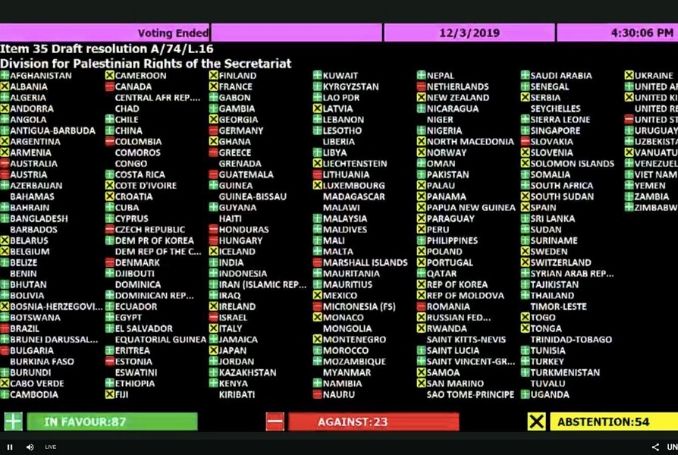
Palestine Chronicle – December 5, 2019
For the first time, 13 countries changed their longstanding positions and voted against a pro-Palestine measure at the United Nations on Tuesday.
Germany, the Czech Republic, Austria, Bulgaria, Denmark, Estonia, Greece, Lithuania, Netherlands, Romania, Slovakia, Brazil, and Colombia voted against the annual resolution regarding the “Division for Palestinian Rights of the Secretariat”, according to the Times of Israel.
They had previously abstained on the vote.
The resolution, which includes a call to halt to illegal Israeli settlements being constructed in the occupied West Bank, still passed with a large majority voting in favor.
The Palestinian representative told the council: “If you protect Israel, it will destroy you all.” He also said Israel’s character as a Jewish state is “shameless racism”.
The New York-based Division for Palestinian Rights oversees the Committee on the Exercise of the Inalienable Rights of the Palestinian People.
The resolution was co-sponsored by Comoros, Cuba, Indonesia, Jordan, Kuwait, Lao People’s Democratic Republic, Qatar, Saudi Arabia, Senegal, the United Arab Emirates, and Yemen.
The UK, France, and Spain abstained, as they do every year, allowing the resolution to pass with a vote of 87-54, with 21 other abstentions.
The General Assembly adopted five resolutions on the question of Palestine and the Middle East, including one calling on the Member States not to recognize any changes to the pre-1967 borders, including with regards to Jerusalem, other than those agreed by the parties through negotiations.
Washington’s Nord Stream 2 Sanctions May Have Boomerang Effect on US Interests – German Media Reports
By Svetlana Ekimenko – Sputnik – 27.08.2019
The US Congress has moved forward with legislation to impose sanctions on the Nord Stream 2 pipeline project in defiance of criticism from Washington’s allies in Europe, as the joint venture brings together Russia’s Gazprom, Germany’s Uniper and Wintershall, Austria’s OMV, France’s Engie, and Anglo-Dutch Royal Dutch Shell.
Possible US sanctions against companies involved in the construction of the Nord Stream 2 pipeline could potentially harm US oil and gas projects in the Gulf of Mexico, writes the German business newspaper Handelsblatt.
“From the point of view of Germany, the name of the US proposed sanctions bill, ‘Protecting Europe’s Energy Security Act’, is in itself an insolence”, writes the author.
The US is pushing to impose sanctions against Nord Stream 2 despite likely consequences that such restrictions may have.
Thus, European companies involved in laying the pipeline and targeted by Washington’s sanctions play a key role in the global energy market.
For a long time, these companies worked in the Gulf of Mexico as subcontractors of the American corporations Chevron and Exxon Mobil, recalls Handelsblatt.
Therefore, if they are included in the sanctions lists, projects in the Gulf of Mexico will be disrupted, since it is impossible to quickly replace such highly specialised firms.
Overall, the US economy views the proposed sanctions against Nord Stream 2 critically, the author points out. Such restrictions would also be likely to harm US gas exporters, prompting European buyers to reduce LNG imports from the United States and increase supplies from other countries.
Proposed US Sanctions on Nord Stream 2
The Nord Stream 2 project has long drawn opposition from a number of countries, with the United States, which is trying to sell more of its own liquefied natural gas to overseas allies, insisting that the project will make Europe dependent on Moscow – claims that Russia has repeatedly rebuffed.
Moscow has insisted that the pipeline project is strictly commercial, ultimately seeking to boost Europe’s energy security.
Nevertheless, in early August, the US Senate Foreign Relations Committee approved a bill on sanctions against companies providing vessels for the Nord Stream 2 pipeline project.
The document prohibits entry into the US for anyone involved in the “sale, lease, provision or assistance in providing” ships for laying Russian offshore pipelines at a depth of 30 metres or more, as well as the freezing of their assets in US jurisdiction.
Companies from Austria, Germany, the Netherlands, France, Finland, and Sweden may fall under the sanctions.
The project is being implemented by Nord Stream 2 AG, with Gazprom investing half of the funds, and the remainder being contributed by European partners: Germany’s Uniper and Wintershall, Austria’s OMV, France’s Engie, and Anglo-Dutch Royal Dutch Shell.
Germany has been strongly behind Nord Stream 2, emphasizing the commercial focus of the project.
German Chancellor Angela Merkel said that she supported the BDI’s (Federation of German Industries) stance that the Nord Stream 2 pipeline for delivering Russian natural gas to Europe is necessary given the German initiative to stop using nuclear and coal energy.
Austria, which is interested in reliable supplies of fuel, and Norway, whose government owns 30 percent of the shares of Kvaerner, one of the gas pipeline construction contractors, also spoke in favor of the project.
Nord Stream 2 Project
The 745-mile-long (1,200 km) Nord Stream 2 twin pipeline is set to run from Russia to Germany through the territorial waters or exclusive economic zones of Denmark, Finland, Germany, Russia, and Sweden to deliver Russian gas to European consumers.
The completed project will double the capacity of the existing Nord Stream pipeline network, allowing a total of up to 110 billion cubic metres of Russian natural gas to be transported to Western Europe via pipelines at the bottom of the Baltic Sea.
According to a statement made by project operator Nord Stream 2 AG on 26 August, the pipeline is 75 percent complete.
Guaido returns to Venezuela to the welcome of foreign ‘bodyguard’ envoys
RT | March 4, 2019
Self-declared “interim president” of Venezuela, Juan Guaido, returned from his South American tour on Monday, arriving into the loving (and protective) arms of ambassadors from the foreign governments backing him.
Despite Venezuelan authorities making it clear he could face 30 years in prison for attempting to overthrow the government and violating a travel ban, Guaido chose to arrive directly to an airport in Caracas.
The risk of arrest was notably mitigated by the presence of ambassadors from Germany, France, Spain, the Netherlands and several other countries which gathered at the arrival gate to huddle around him like a high-profile human shield. While Guaido was all smiles, his Western-world entourage seemed a bit on edge.
While the media fretted that Maduro might make good on threats to arrest Guaido, the opposition leader passed through customs without incident and headed straight to a rally in central Caracas.
Meanwhile, Vice President Mike Pence warned the Venezuelan government that Washington protects its investments, stressing how important Guaido is to them, and threatening a “swift response” if anyone tries to bully him.
Shortly after moving unhindered through the airport, Guaido arrived at a demonstration he called for on Twitter the week before. Addressing crowds in the country’s capital city, he called on his supporters to take to the streets for continued demonstrations next Saturday.
While Guaido toured South America and met with his most critical support base – foreign governments – the US ramped up pressure on Maduro’s government, imposing intensified sanctions and revoking visas for state actors.
Canada joins international chorus accusing Russia of ‘malicious cyber attacks’
RT | October 4, 2018
The Canadian government has joined its allies to accuse Russia of being behind a slew of recent “malicious” cyber attacks, including on the Organisation for the Prohibition of Chemical Weapons and the World Anti-Doping Agency.
The move from Canada comes as the US introduces new charges against a number of alleged Russian intelligence officers which it accuses of hacking the anti-doping agency.
A statement issued on Thursday by Global Affairs Canada said that “a series of malicious cyber-operations by the Russian military” had been exposed, including an alleged attempted hack on the organization responsible for investigating the Salisbury poisoning of ex-Russian spy Sergei Skripal and his daughter in March — an attack which the Russian government has denied involvement in and which British authorities have not been able to conclusively blame Moscow for.
The Global Affairs statement said the acts “form part of a broader pattern of activities by the Russian government” which lies “outside the bounds of appropriate behavior” and demonstrate “a disregard for international law and undermine the rules-based international order”. Canada called on countries that value “international order” to “come together in its defence.”
“Some of these acts have a connection with Canada,” the statement added, suggesting that Canada was also a target for alleged Russian cyber attacks and citing a 2016 attack on the Canadian Centre for Ethics in Sport whose systems were compromised with malware which enabled unauthorized access to the organization’s network. “The Government of Canada assesses with high confidence that the GRU was responsible for this compromise,” the Canadian statement said.
Earlier on Thursday, the Netherlands said it had expelled four Russian intelligence officers in April who they alleged had targeted the Hague-based OPCW.
Dutch Defense Minister Ank Bijleveld said the operation was disrupted on April 13 and the four men in question had later been expelled from the country. Russia has denied any involvement in hacking and has called the recent allegations ‘spy mania’.
Illegal US Nuclear Weapons Handouts
By John Laforge | CounterPunch | September 27, 2018
The US military practice of placing nuclear weapons in five other countries (no other nuclear power does this) is a legal and political embarrassment for US diplomacy. That’s why all the governments involved refuse to “confirm or deny” the practice of “nuclear sharing” or the locations of the B61 free-fall gravity bombs in question.
Expert analysts and observers agree that the United States currently deploys 150-to-180 of these nuclear weapons at bases in Germany, Italy, The Netherlands, Turkey and Belgium. The authors of the January 2018 report “Building a Safe, Secure, and Credible NATO Nuclear Posture” take for granted the open secret that nuclear sharing is ongoing even though all six countries are signatory parties to the Treaty on the Nonproliferation of Nuclear Weapons (NPT).
In a paper for the journal Science for Democratic Action, German weapons expert Otfried Nassauer, director of Berlin’s Information Center for Transatlantic Security, concluded, “NATO’s program of ‘nuclear sharing’ with five European countries probably violates Articles I and II of the Treaty.”
Article I prohibits nuclear weapon states that are parties to the NPT from sharing their weapons. It says: “Each nuclear-weapon State Party to the Treaty undertakes not to transfer to any recipient whatsoever nuclear weapons or other nuclear explosive devices or control over such weapons or explosive devices directly, or indirectly….” Article II, the corollary commitment, states says: “Each non-nuclear weapon State Party to the Treaty undertakes not to receive the transfer from any transferor whatsoever of nuclear weapons or other nuclear explosive devices or of control over such weapons or explosive devices directly, or indirectly … or otherwise acquire nuclear weapons or other nuclear explosive devices….”
What nuclear sharing means in practice
The five NATO countries currently hosting US H-bombs on their air bases are officially “non-nuclear weapons states.” But as Nassauer reports, “Under NATO nuclear sharing in times of war, the US would hand control of these nuclear weapons over to the non-nuclear weapon states’ pilots for use with aircraft from non-nuclear weapon states. Once the bomb is loaded aboard, once the correct Permissive Action Link code has been entered by the US soldiers guarding the weapons, and once the aircraft begins its mission, control over the respective weapon(s) has been transferred. That is the operational, technical part of what is called ‘nuclear sharing.’”
This flaunting of the NPT is what peace activists on both sides of the Atlantic refer to when calling the US bombs in Europe “illegal.” Nassauer notes, “The pilots for these aircraft are provided with training specific to use nuclear weapons. The air force units to which these pilots and aircraft belong have the capability to play a part in NATO nuclear planning, including assigning a target, selecting the yield of the warhead for the target, and planning a specific mission for the use of the bombs.”
“NATO nuclear sharing,” Nassauer writes, “was described in 1964 by one member of the US National Security Council … as meaning that ‘the non-nuclear NATO-partners in effect become nuclear powers in time of war.’ The concern is that, at the moment the aircraft loaded with the bomb is on the runway ready to start, the control of the weapon is turned over from the US, a nuclear weapon state, to non-nuclear weapon states. … To my understanding, this is in violation of the spirit if not the text of Articles I and II of the NPT.”
How Do the US and its Allies Explain their Lawlessness?
An undated, 1960s-era letter from then-US Secretary of State Rusk explained the US ‘interpretation’ of the NPT. The pretext for ignoring the treaty’s plain language, the Rusk letter “argues that the NPT does not specify what is allowed, but only what is forbidden. In this view, everything that is not forbidden by the NPT is allowed,” Nassaure explained.
In its most absurd section, Rusk simply denies the treaty’s obvious purpose and intent. “Since the treaty doesn’t explicitly talk about the deployment of nuclear warheads in countries that are non-nuclear weapon states,” Nassaure writes, “such deployments are considered legal under the NPT.”
It is so easy to show that the United States and its nuclear sharing partners are in violation of the NPT, the governments involved work hard pretending there is nothing to worry about, no lawbreaking underway, no reason to demand answers. This is why so many activists across Europe have become nonviolently disobedient at the air bases involved.
The transparent unlawfulness of NATO’s nuclear war planning is also the reason why prosecutors in Germany don’t dare bring serious charges against civil resisters; even those who have cut fences and occupied hot weapons bunkers in broad daylight. Some Air Force witness might testify at trial that US nuclear weapons are on base.
John LaForge is a Co-director of Nukewatch, a peace and environmental justice group in Wisconsin, and edits its newsletter.
Iran summons European envoys over terrorist attacks in Ahvaz
Press TV – September 22, 2018
Iranian authorities have summoned ambassadors of the Netherlands and Denmark as well as chargé d’affaires of the British embassy in Tehran after terrorists with alleged links to the European countries carried out attacks during a military parade in the southwestern city of Ahvaz on Saturday.
Iran’s Foreign Ministry Spokesman Bahram Qassemi said that the department for European affairs of the ministry summoned the three diplomats separately at the evening time on Saturday to declare Tehran’s strong protest to the role their countries might have played to support elements who carried out the terror attacks in Ahvaz earlier in the day that led to the killing of some 25 people.
The al-Ahvaziya terror group, whose recruits are believed to be scattered in several European countries, including in the Netherlands and in Denmark, claimed responsibility for the attack in Ahvaz.
The terror outfit, which is backed by Saudi Arabia, has a record of carrying out sabotage acts in Iran’s Khuzestan province, which encompasses Ahvaz and some other Arab-dominated towns.
Qassemi said Iran expected the two European countries to extradite the “criminal perpetrators” of the terrorist act in Ahvaz.
“It was reiterated to the ambassadors of the Netherlands and Denmark that the Islamic Republic of Iran had earlier warned about the residence of these individuals in these countries and has called for their arrest and prosecution,” said Qassemi in a statement, adding that the ambassadors of the two countries declared that their governments were ready to share any information with regards to the terrorists and their records.
The official said that Iranian authorities had also passed their strong note of protest to the chargé d’affaires of the British embassy in Tehran about an interview aired by a Britain-based TV channel after the attack in Ahvaz in which the spokesman of the al-Ahvaziya had condoned the terrorist act.
Qassemi said the British diplomat condemned the attack and said that he would accordingly relay Iran’s message of protest to the authorities in London.
Three of the terrorists were shot dead at the scene while a fourth was arrested and later succumbed to his wounds, armed forces spokesman Brigadier General Abolfazl Shekarchi said.
Iran declared Monday to be a day of national mourning in which a funeral ceremony will be held for the victims of the attack in Ahvaz.
All but one of the 25 people killed in the attack have been identified. Some 60 people were wounded in the attack, most of them civilians. Authorities said the death toll could rise as some injured were in critical condition.
Featured Video

Russia Helping Build a New Middle East /Trita Parsi
or go to
Aletho News Archives – Video-Images
From the Archives
Sam Husseini: The entire US establishment helped lie their way into the Iraq war
By Slava Zilber | American Herald Tribune | October 14, 2019
Sam Husseini is a senior analyst with the Institute for Public Accuracy, independent journalist and contributor to The Nation and FAIR.
Slava Zilber: Sam, three years ago, you appeared on Talk Nation Radio with David Swanson and spoke about the case of the GCHQ whistleblower Katharine Gun. You pointed out that the people involved in the spying on the UN and the people authorizing the Iraq War were not held accountable:
“Virtually everybody who went along with the war, whether it is Kerry or Clinton, of course, the Bush administration themselves has falsified their own records in terms of why, what they did, when they did, why they did it, to the extent that they’ve been scrutinised at all.”
You also address it in a recent article. And recently, Joe Biden has been lying about his position on the Iraq War. How can such an important issue escape meaningful scrutiny? … continue
Blog Roll
 Aletho News
- Russia Helping Build a New Middle East /Trita Parsi
- Barghouti: ‘Netanyahu has fallen,’ era of Smotrich, Ben-Gvir over
- China slams US policy on Iran as Russia rejects legality of nuclear meeting at UN
- The Mecca Pact Courts Iran: Containment Comes Full Circle
- Oman FM: Persian Gulf states, Iran, Iraq should form security pact excluding US
- Trump peddles fresh falsehoods, claims Iran ‘started the war’ as US aggression drags on
- Ukraine quagmire? Yes, but it’s for NATO, not Russia
- US intelligence hypes Chinese, Russian space threats while accelerating its own military buildup in orbit
- Iran FM Araghchi: “Hormuz Will No Longer Be the Same”
- EU facing trillion-euro debt hole while seeking more cash for Kiev
- If Americans Knew
- An error has occurred; the feed is probably down. Try again later.
- No Tricks Zone
- Sudden Stratospheric Warming, Powerful El Niño Combination May Lead To Extreme Europe Cold, Energy Crisis!
- Two New Studies Find Thwaites Glacier Melt Cannot Be Driven By Human Activity Or A Warming Ocean
- E-Cars Reduce CO2 Emissions By Only 41% Compared To Internal Combustion Engine Vehicles
- Predictions Made By Renowned Climate Professor Over Past Decades Have Been Proven To Be Poor
- New Study Suggests Large Regions Of The Pacific Ocean Have Been Cooling For The Last 80 Years
- Germany’s Green Energy Debacle: High Energy Costs Force Kahla Porzellan to Close After 182 Years!
- New Study: 50 Years Of The Most Aggressive ‘Net Zero’ Policies Can Only Affect The Global Climate By 0.03°C
- US September “Heat” Was No Record…Many Records Set Decades Ago
- Latest European Green Energy Debacle; Portugal’s Largest Flagship Solar Park Insolvent!
- Green Energy Debacle: German Expert Professor Fritz Vahrenholt Warns Of Severe Economic And Social Consequences

