How to Trash a Movie in Support of a Lie
The cover-up of Israel’s genocide of the Palestinians during the Nakba continues

BY PHILIP GIRALDI • UNZ REVIEW • DECEMBER 13, 2022
Israel’s new government is planning to give de facto operational control of the national police and heavily armed border police to Itamar Ben-Gvir, the leader of a party of right wing, racist extremists. It can perhaps be regarded as the prelude to the last phase in the uprooting and displacement of the Palestinian people. Those who resist will be killed and not a single Israeli soldier or policeman will be punished for carrying out what the Benjamin Netanyahu government will frame as a war against terrorists blessed by Yahweh in support of his “Chosen” people.
The Zionist view of what should be done to the indigenous inhabitants of a place once called Palestine has been unflinching since the founding of the state of Israel. The Zionist historic boast that a Jewish homeland would be built on “A land without a people for a people without a land” ignored the fact that Palestine already had plenty of inhabitants and a well-established economy where Jews were a distinct minority, less than 20% of the population in the 1930s.
The solution to correct the numbers was to compel the natives to leave by one means or another. Israel’s founding father David Ben Gurion early on endorsed a policy of removal by force if necessary the Christians and Muslims. The fighting that followed in 1948 after the United Nations’ partition of the country into two separate states left the mostly unarmed Palestinians helpless before the well-armed Jewish militias, which quickly expanded their zone of control well into the area that was granted on paper to the Palestinians. It is estimated that 15,000 Palestinians were killed outright by the Zionist forces while 800,000 more were driven from their homes, to which nearly all were denied any right to return. Four hundred Palestinian occupied villages were “ethnically cleansed” and in some cases physically destroyed.
The de facto seizure of the remainder of historic Palestine outside the borders of the Jewish state after the June 1967 Six Day war gave Israel direct control of all key strategic areas as well as land in Syria and Lebanon. Since that time, successive Israeli governments have pursued an ethnic cleansing policy both in Israel itself and on the West Bank consisting of gradually forcing the remaining Palestinians to leave to be replaced by all-Jewish towns and settlements. The Palestinians know that the final push is indeed coming and have begun to resist, though having few weapons they are helpless against the heavily armed Israel Defense Force (IDF), which has killed 195 Palestinians, mostly teenagers, in the past eleven months.
A recent killing captured on surveillance video shows an Israeli border policeman shooting a young man dead after an encounter on the main street of a West Bank town. Far-right Otzma Yehudit Party leader and incoming National Security Minister Ben-Gvir, praised the policeman who did the shooting as a “hero,” citing his “Precise action, you really fulfilled the honor of all of us and did what was assigned to you.”
The Palestinians refer to their dispossession and killing at the hands of the Jewish soldiers in 1948 as the Nakba, meaning “catastrophe,” which has sometimes been popularized as the Arab version of the so-called holocaust. I have recently watched a controversial film called Farha, made in Jordan by a woman filmmaker of Syrian descent, which views the Nakba through the eyes of a fourteen-year-old village girl. She, the eponymous Farha that gives the film its title, was preparing to go off to advance her education, presumably in Jerusalem, when Israeli soldiers attacked her village. The Israelis used loudspeakers to announce that all residents must leave immediately. Anyone seeking to remain would be killed. In a panic, the girl’s father, the village chief, locked her into a storage shed for safety as he tried to figure out what to do, but he then disappears from the tale and it might be presumed that both he and the rest of the family were killed.
Farha has only a crack in the door to witness what is going on outside. In a particularly dreadful sequence, a Palestinian man and his family who are trying to escape but are apparently confused regarding what way to go are detained by an Israeli officer and his men. After some perfunctory questioning, the father, mother and two children are lined up against a wall and shot dead. A newborn baby was left lying on the ground, alive, crying for its mother. The officer tells one of his men to kill it, but adds “Don’t waste a bullet on it.” The soldier prepares to stomp on the baby’s head to carry out the order, but cannot bring himself to do it and walks away. The baby continues to wail until later that day it stops, presumably dead from exposure or other factors.
Eventually Farha escapes from her prison and the movie concludes with her walking away in tears to an uncertain future. The film is very powerful, with excellent acting, cinematography and direction and it is based on a true story as handed down by Director Darin J. Sallam’s mother’s best friend, but I ended up wishing that it were stronger in its depiction of the savagery exercised by the Israelis, perhaps recreating an actual major massacre of Palestinian civilians, like occurred at Deir Yassin, where 107 Arabs, including many women and children, were shot dead by Israeli militiamen from the Irgun and Lehi groups. Other massacres took place in hundreds of villages across Galilee as well as in cities like Haifa or Akka, all far worse than what is revealed by the film. For those who are interested, Israeli historian Ilan Pappe in his book The Ethnic Cleansing of Palestine describes, in detail, the brutality of what Israeli forces unleashed on the largely unarmed Palestinian people during the Nakba.
But even though the film deliberately avoided cliched scenes of mass violence, it has proven very powerful with supporters and critics lined up along the completely predictable political lines. The Israelis have in particular come down hard on the film and they and their many friends in the United States, have reacted in their usual tribal fashion, attacking Netflix, which is streaming Farha on its network including in the United States and Europe. The Israel firsters are advocating striking back against Netflix for its temerity by canceling the service and attacking the decision to air the film at all. Ironically though not surprisingly, Netflix has hitherto been a leader in obtaining and streaming Israeli films and even television series.
In Israel, the government has declared war on the film, also a characteristic of that nation’s circle-the- wagons paranoid response to anything that might even suggest that Jews are just as capable of evil as anyone else. Last month ultra-nationalist Israeli Finance Minister Avigdor Lieberman moved to block scheduled screenings of the film in Jaffa, saying that “Israel is a place to present Israeli and international works, but is certainly not the place to slander IDF soldiers and the security forces who are acting day and night to defend and protect all the citizens and residents living here.”
Lieberman, a Russian Jew known for his ethnocentric and essentially racist views, apparently does not believe that soldiers and security forces should actually protect Palestinians and afford them at least some measure of free speech, which is only allowed to Jews. Israel’s ironically titled Culture Minister the oddly named Chili Tropper also attacked the film for its so-called “false plots against IDF soldiers” denouncing how their actions were presented as similar to “behavior of the Nazis in the Holocaust.”
Former IDF soldier and current right wing apologist, Yoseph Haddad also tweeted, “I saw the movie ‘Farha’ and I can tell you that it is much worse than you think. The IDF soldiers are presented there as inhuman with unimaginable evil, all they care about is murdering and slaughtering without mercy (which is the exact opposite of the truth). This is a blood libel that will certainly increase antisemitism and incitement against Israel. If you haven’t canceled your Netflix subscription yet – do it now.”
In an Instagram post, Israeli model Nataly Dadon also demanded that Israelis and their supporters internationally should drop their Netflix subscriptions in an Instagram post, claiming that Farha’s “sole purpose is apparently to increase anti-Semitism against the Jewish people.” Mondoweiss also reports how “author and photographer Laura Ben-David tweeted a photo of her cancellation message with the streaming app and wrote, ‘Buh-bye Netflix! Supporting the false and anti-Israel film Farha is unacceptable.’”
So Israel, which is passionate about its rejection of the non-violent pro-Palestinian Boycott, Divestment and Sanctions (BDS) economic pressure movement, is united in its desire to punish Netflix’s bottom line. And the old reliable anti-Semitism tag is being liberally attached to how the argument is being framed. Former Al Jazeera reporter Ahmed Shihab-Eldin suggested to the Middle East Eye that “The pacing of [all the negative posts] reveals it was coordinated. With each passing hour, dozens and dozens of vapid and vile reviews would appear, making wild accusations trashing the film. It was clear people had not seen the film, and only wanted to damage its reputation.”
Finally, it would not be about Israel and Jews if there were not space in The New York Times to twist and spin the story. A review of the film by one Beatrice Loayza, a Peruvian-American film critic based in Brooklyn, describes the movie oddly as a “brutal coming-of-age-story.” At one point, Farha discovers an old handgun wrapped up within a sack of lentils. She eventually uses it to shoot the lock and escape the storage room. But this is how the Times reviewer describes the sequence: “She finds a gun buried inside a sack of grains — was the threat present all along? One day, a scene of great barbarity plays out before her tiny window.” Aha! So those crafty Arabs actually were potentially using the old handgun among the lentils trick to threaten the friendly Israel soldiers who just happened to drop by to shoot to death a Palestinian family, which is dismissed as a “scene of great barbarity” without any suggestion of what that might have been. In truth, the garbage being peddled by the Times as a review of a story of an atrocity committed by Jews is actually achieved without having to include any context or feature any Jews at all. “Remarkable” is all I have to say in conclusion.
Philip M. Giraldi, Ph.D., is Executive Director of the Council for the National Interest, a 501(c)3 tax deductible educational foundation (Federal ID Number #52-1739023) that seeks a more interests-based U.S. foreign policy in the Middle East. Website is councilforthenationalinterest.org, address is P.O. Box 2157, Purcellville VA 20134 and its email is inform@cnionline.org.
New York Times Decides Lockdowns are Actually Draconian and Economically Destructive when China Does Them
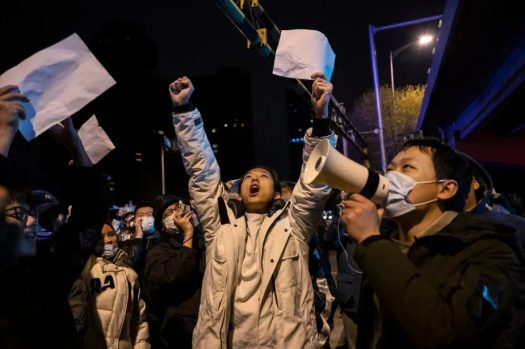
“Right-wing conspiracy theorists with ties to anti-Xi opposition elements spread baseless rumours, deny science, and endanger lives” – strangely not how the NYT chose to caption this image.
eugyppius: a plague chronicle | November 28, 2022
Three years ago, Zero Covid was the aspiration of public health bureaucrats and politicians across the West. Charlatan techbros like Tomas Pueyo appeared on national television to demand nationwide house arrest; leaders like Angela Merkel surrounded themselves with virus-eradicationist modellers and imposed unprecedented months-long closures upon their countries. When protests inevitably broke out, they were violently suppressed; the protesters were slandered as conspiracy theorists and fascists.
The New York Times played a leading role in this long and excruciating charade. In April 2020, they reported that “an informal coalition of influential conservative leaders and groups, some with close connections to the [Trump] White House” was responsible for “quietly working to nurture protests and apply … pressure to overturn state and local orders intended to stop the spread of the coronavirus.” In March 2021, they ran an obnoxious opinion piece about What Happened When Germany’s Far-Riught Party Railed Against Lockdowns, which called the German protesters “an amorphous mix of conspiracy theorists, shady organizations and outraged citizens” and appeared to accuse the right-populist party Alternativ für Deutschland of opportunism for joining their ranks.
What a difference a few years have made.
China Protests Break Out as Covid Cases Surge and Lockdowns Persist is a lead headline in today’s New York Times : “Strict Covid restrictions are hurting the country’s economy and angering members of the public, who are taking to the streets,” we read in the article that follows. Western anti-lockdown protesters are fascists and conspiracy theorists; Chinese anti-lockdown protesters, on the other hand, are ordinary people protesting their oppression:
“Lift the lockdown,” the protesters screamed in a city in China’s far west. On the other side of the country, in Shanghai, demonstrators held up sheets of blank white paper, turning them into an implicit but powerful sign of defiance. One protester, who was later detained by the police, was carrying only flowers.
Over the weekend, protests against China’s strict Covid restrictions ricocheted across the country in a rare case of nationwide civil unrest. There had been signs of dissent, but the new wave of anger may pose a bigger challenge for the government.
Some demonstrators went so far as to call for the Communist Party and its leader, Xi Jinping, to step down. Many were fed up with Mr. Xi, who in October secured a precedent-defying third term as the party’s general secretary, and his “zero-Covid” policy, which continues to disrupt everyday life, hurt livelihoods and isolate the country.
Western lockdowns were necessary to save lives. Chinese lockdowns are the repressive tactic of an undemocratic regime.
The Chinese government on Monday blamed “forces with ulterior motives” for linking a deadly fire in the western Xinjiang region to strict Covid measures, a key driver as the protests spread across the country.
In much the same way, the New York Times blamed shadowy political actors with ties to Trump for anti-lockdown protests in 2020.
Outside China, the rest of the world has adapted to the virus and is near normalcy. Take soccer’s premier event, the World Cup. Thousands of people from across the globe have assembled in Qatar and are cheering on their teams, shoulder-to-shoulder, without masks, in packed stadiums.
China’s approach won praise during the beginning of the pandemic, and there is no doubt it has saved lives. But now that approach looks increasingly outdated. Almost three years after the coronavirus emerged, the contrast between China and the rest of the world couldn’t be starker.
Emphasis mine, because it’s probably the most amazing line in the whole piece. Here we have America’s foremost propaganda outlet, trying desperately to accuse China of unjust dictatorial repression, for the crime of implementing in a more organised and coherent way the very same Zero Covid policies that Times journalists spent nearly two years supporting. What’s actually wrong with the harsh Chinese lockdowns? Well, say the Times, because they can’t say anything else, they’ve become unfashionable.
The Times have also suddenly discovered that lockdowns are bad for the economy. “China’s economy has been hurt by the restrictions,” which have “hammered business both large and small,” they report. Major companies are seeking to escape the effects of closures by “expand[ing] production outside China”, all while “reduced foot traffic” hurts businesses in “the main streets of towns and cities.” That’s bad when it happens in China, but Germany or Canada it’s totally worth it.
On the one hand, we should be probably be happy about the implicit repudiation of lockdowns that articles like this represent, and the strong signal they send that none of our opinion makers wants to return to them. Some of you will have your own more detailed theories about why this is, but my broad view, is that mass containment adheres to the same trajectory everywhere: 1) There is the initial lockdown followed by a seasonally-induced collapse in cases, which encourages among policymakers to an illusion of control. 2) When infections inevitably surge the second time, they try to play the lockdown card again and again, always with less success. 3) Finally, in the face of growing protests and destruction, the policies are abandoned and everything reopens. The only difference between China and the West, is that a few years intervened before the first and the second of these steps.
On the other hand, the increasingly open hypocrisy and manipulation of the press are reaching terrifying levels I’d never imagined before, and I think this is very bad.
Who is Dr. Asish Jha (President Biden’s Covid Czar)?
Top public health empty suit is a pandemic planner and propagandist

Dr. Ashish Jha
By John Leake · Courageous Discourse · November 25, 2022
At at press briefing on November 22, White House COVID-19 Response Coordinator, Dr. Ashish Jha, reiterated that God gave us two arms in order to receive multiple vaccines and boosters. I write “reiterated” because he made the same stupid remark at a press briefing back in September.
I wasn’t surprised when the Biden Administration appointed Dr. Jha to serve as its Covid Czar. As we recount in our book, Dr. Jha was the minority witness at Senator Ron Johnson’s November 19, 2020 hearing on Early Outpatient Treatment. This hearing began with testimony from Drs. Peter McCullough, Harvey Risch, and George Fareed on the safety and efficacy of repurposed, FDA-approved drugs for treating COVID-19—especially in the disease’s early stage—to prevent hospitalization and death.
Following their testimony, Dr. Jha testified that their observations and findings were erroneous. In fact, he claimed, there were no effective early treatments for COVID-19, and that our best and only hope was the vaccine that was then in development.
An especially dramatic and somewhat comical moment in the hearing occurred when Dr. George Fareed said, “I wonder if Dr. Jha actually treats patients by the way he talks.” Senator Johnson took this remark as a cue for querying Dr. Jha.
“Have you treated any Covid patients,” Senator Johnson asked.
“I have not, sir,” Dr. Jha replied. We recount this scene in the following excerpt from The Courage to Face COVID-19: Preventing Hospitalization and Death While Battling the Bio-Pharmaceutical Complex:
Dr. Jha had splendid academic credentials to match his splendid manners, but at this moment he lost a lot of credibility. It was perhaps the equivalent of an aeronautical engineer admitting that he’d never flown in a plane, or a marital counselor admitting he’d never been married.
He implied that Professor Risch—a distinguished epidemiologist twenty years his senior—was categorically wrong in his interpretation of the data. Then he implied that Dr. Fareed’s observations as a treating physician were an illusion—that the high-risk patients who received the Zelenko Protocol would have recovered in the same dramatic way without the intervention.
This was probably the most notable moment in the hearing. Since graduating from medical school in 1970, Dr. Fareed had logged fifty years as a medical researcher and treating physician. It would be hard to find a doctor in the entire country with more clinical experience. He testified to the U.S. Senate that he’d successfully treated 1,000 high-risk COVID-19 patients. A few minutes later, a doctor 25 years his junior—one who’d never treated a single COVID-19 patient—asserted that “there is now clear consensus in the medical and scientific community” that a key ingredient of Dr. Fareed’s treatment protocol doesn’t work. In effect, Dr. Jha told Dr. Fareed to reject the evidence of his own eyes and ears.
Shortly after the hearing, Dr. Jha published an opinion piece for the November 24, 2020, edition of the New York Times titled “The Snake-Oil Salesman of the Senate.” He opened with likening the event to a contagion.
There was a super-spreader event last week in the United States Senate. It wasn’t the coronavirus, however, that was spreading, but misinformation. … The Senate Homeland Security and Governmental Affairs Committee held a hearing about early treatment for COVID-19. Yet instead of a robust discussion about promising emerging therapies or what Congress might do to accelerate such treatments, the conversation was all about the malaria drug hydroxychloroquine. … Neither Ron Johnson, the Wisconsin Republican senator nor his chosen witnesses—three doctors who have pushed hydroxychloroquine—displayed more than a passing interest in evidence. Intuition and personal experiences of individual doctors were acclaimed as guiding principles.[i]
Dr. Jha didn’t mention that he himself had focused his Senate remarks on hydroxychloroquine and hadn’t mentioned any “promising emerging therapies” apart from vaccines. He also didn’t state the names or credentials of the hearing’s witnesses or a summary of their findings or experiences. He compared them to the snake oil salesmen from the frontier past with their advocacy of the drug that President Trump had touted in the spring, implying they were equally lacking in medical sophistication.
“I was called reckless because I pointed to facts that could prevent people from getting the treatment,” he wrote, but he didn’t state these facts. The online version of his essay hyperlinked the word “reckless” to a similar hatchet job report on the hearing in the Washington Post. He claimed the witnesses had expressed a distrust of science and had even “suggested that scientists were part of a ‘deep state’ conspiracy to deny Americans access to lifesaving therapies.” This was, he asserted, “a powerful reminder that not even Congress is immune to toxic conspiracy theories…”
Dr. Jha’s New York Times opinion was, itself, evidence that early treatment of COVID-19 was the subject of a well-orchestrated smear campaign. Why else would such a distinguished academic pen such rank propaganda against his colleagues and their work? That he was personally stung by the revelation that he’d never treated a single COVID-19 patient could only partly account for it.
A possible answer to this question may be gleaned from Dr. Jha’s remarks at a January 10, 2017, Georgetown University conference titled “Pandemic Preparedness in the Next Administration.”

Like the participants at the October 2019 Pandemic Simulation Exercise at Johns Hopkins, Dr. Jha predicted that a devastating pandemic “is going to come at some point.” Dr. Fauci, the keynote speaker, made a more precise prediction.
“There is no question that there will be a challenge to the coming administration in the arena of infectious diseases,” he proclaimed. “The thing we’re extraordinarily confident about is that we’re going to see this in the next few years.”[ii]
As psychiatrist and author Peter Breggin, MD, remarked in his extraordinary book COVID-19 and the Global Predators: We Are the Prey, Dr Jha did not speak in a somber tone about the coming devastation. On the contrary, he emphasized that he was excited about the ambitious project of helping the U.S. and other governments, and equally excited about the many pandemic preparation events in Georgetown and Cambridge that lay ahead. The conference was, he said, the “beginning of a journey.”[iii]
Dr. Jha and his colleagues were animated with the same excitement that denizens of the military-industrial complex would feel at the prospect of a coming war in which they would assume leadership positions. At last, they would be able to deploy all of their forces. With the recognition that the coming war was inevitable, they could call upon the government to allocate far more resources for new technologies, weapons systems, bases, and military organizations. In an atmosphere of such heady excitement, the suggestion of defusing the coming war with diplomacy wouldn’t be received with much enthusiasm.
The irony of Dr. Jha’s excitement is that, when the pandemic he predicted arrived three years later, he didn’t attempt to treat patients or scramble to find consultants to intervene against the disease before it wrecked bodies and imprisoned people in hospitals. Instead, he penned propaganda against hydroxychloroquine and against Drs. McCullough, Risch, and Fareed. Why was the New York Times Editorial Board compelled to publish his misleading account of the Senate hearing? Did the editors even watch the C-SPAN recording of it?
It’s not plausible that their motive was a concern about hydroxychloroquine’s safety. Dr. Jha himself conceded in his testimony that he wasn’t particularly concerned about safety, so why the vast and ceaseless quibbling about whether its efficacy for outpatients had been proven? As Senator Johnson had said in the hearing, this makes no sense.
[i] Jha, Ashish, MD. The Snake Oil Salesmen of the Senate. New York Times, Nov. 24, 2020. https://www.nytimes.com/2020/11/24/opinion/hydroxychloroquine-covid.html
[ii] Georgetown University Center for Global Health Science & Security, Pandemic Preparedness in the Next Administration. January 10, 2017. https://ghss.georgetown.edu/pandemicprep2017/
[iii] Breggin, Peter R, MD and Ginger Ross Breggin, COVID-19 AND THE GLOBAL PREDATORS: WE ARE THE PREY. Ithaca: Lake Edge Press, 2021, p. 259.
The Covid/Crypto Connection: The Grim Saga of FTX and Sam Bankman-Fried
By Jeffrey A. Tucker | Browstone Institute | November 18, 2022
A series of revealing texts and tweets by Sam Bankman-Fried, the disgraced CEO of FTX, the once high-flying but now belly-up crypto exchange, had the following to say about his image as a do-gooder: it is a “dumb game we woke westerners play where we say all the right shibboleths and so everyone likes us.”
Very interesting. He had the whole game going: a vegan worried about climate change, supports every manner of justice (racial, social, environmental) except that which is coming for him, and shells out millions to worthy charities associated with the left. He also bought plenty of access and protection in D.C., enough to make his shady company the toast of the town.
As part of the mix, there is this thing called pandemic planning. We should know what that is by now: it means you can’t be in charge of your life because there are bad viruses out there. As bizarre as it seems, and for reasons that are still not entirely clear, favoring lockdowns, masks, and vaccine passports became part of the woke ideological stew.
This is particularly strange because covid restrictions have been proven, over and over, to harm all the groups about whom woke ideology claims to care so deeply. That includes even animal rights: who can forget the Danish mink slaughter of 2020?
Regardless, it’s just true. Masking became a symbol of being a good person, same as vaccinating, veganism, and flying into fits at the drop of a hat over climate change. None of this has much if anything to do with science or reality. It’s all tribal symbolism in the name of group political solidarity. And FTX was pretty good at it, throwing around hundreds of millions to prove the company’s loyalty to all the right causes.
Among them included the pandemic-planning racket. That’s right: there were deep connections between FTX and Covid that have been cultivated for two years. Let’s have a look.
Earlier this year, the New York Times trumpeted a study that showed no benefit at all to the use of Ivermectin. It was supposed to be definitive. The study was funded by FTX. Why? Why was a crypto exchange so interested in the debunking of repurposed drugs in order to drive governments and people into the use of patented pharmaceuticals, even those like Ramdesivir that didn’t actually work? Inquiring minds would like to know.
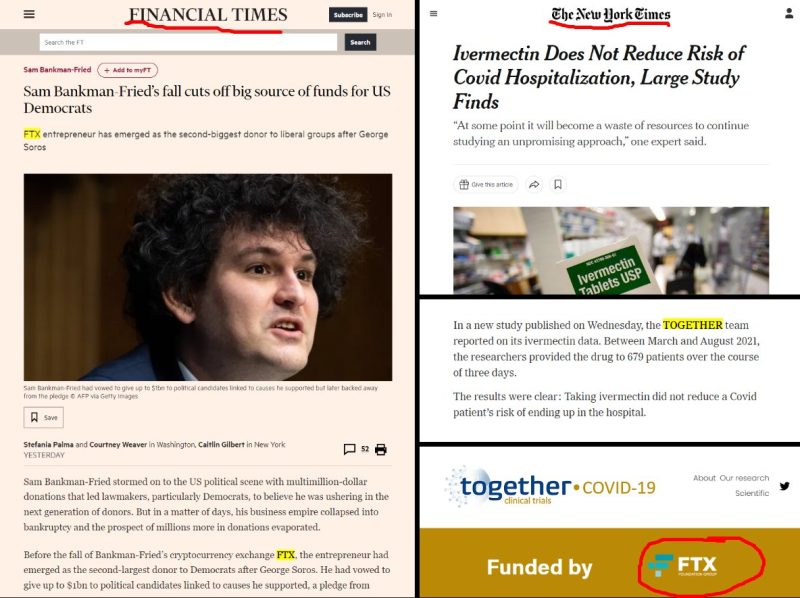
Regardless, the study and especially the conclusions turned out to be bogus. David Henderson and Charles Hooper further point out an interesting fact: “Some of the researchers involved in the TOGETHER trial had performed paid services for Pfizer, Merck, Regeneron, and AstraZeneca, all companies involved in developing COVID-19 therapeutics and vaccines that nominally compete with ivermectin.”
For some reason, SBF just knew that he was supposed to oppose repurposed drugs, though he knew nothing about the subject at all. He was glad to fund a poor study to make it true and the New York Times played its assigned role in the whole performance.
It was just the start. A soft-peddling Washington Post investigation found that Sam and his brother Gabe, who ran a hastily founded Covid nonprofit, “have spent at least $70 million since October 2021 on research projects, campaign donations and other initiatives intended to improve biosecurity and prevent the next pandemic.”
I can do no better than to quote the Washington Post:
The shock waves from FTX’s free fall have rippled across the public health world, where numerous leaders in pandemic-preparedness had received funds from FTX funders or were seeking donations.
In other words, the “public health world” wanted more chances to say: “Give me money so I can keep advocating to lock more people down!” Alas, the collapse of the exchange, which reportedly holds a mere 0.001% of the assets it once claimed to have, makes that impossible.
Among the organizations most affected is Guarding Against Pandemics, the advocacy group headed by Gabe that took out millions in ads to back the Biden administration’s push for $30 billion in funding. As Influence Watch notes: “Guarding Against Pandemics is a left-leaning advocacy group created in 2020 to support legislation that increases government investment in pandemic prevention plans.”
Truly it gets worse:
FTX-backed projects ranged from $12 million to champion a California ballot initiative to strengthen public health programs and detect emerging virus threats (amid lackluster support, the measure was punted to 2024), to investing more than $11 million on the unsuccessful congressional primary campaign of an Oregon biosecurity expert, and even a $150,000 grant to help Moncef Slaoui, scientific adviser for the Trump administration’s “Operation Warp Speed” vaccine accelerator, write his memoir.
Leaders of the FTX Future Fund, a spinoff foundation that committed more than $25 million to preventing bio-risks, resigned in an open letter last Thursday, acknowledging that some donations from the organization are on hold.
And worse:
The FTX Future Fund’s commitments included $10 million to HelixNano, a biotech start-up seeking to develop a next-generation coronavirus vaccine; $250,000 to a University of Ottawa scientist researching how to eradicate viruses from plastic surfaces; and $175,000 to support a recent law school graduate’s job at the Johns Hopkins Center for Health Security. “Overall, the Future Fund was a force for good,” said Tom Inglesby, who leads the Johns Hopkins center, lamenting the fund’s collapse. “The work they were doing was really trying to get people to think long-term … to build pandemic preparedness, to diminish the risks of biological threats.”
More:
Guarding Against Pandemics spent more than $1 million on lobbying Capitol Hill and the White House over the past year, hired at least 26 lobbyists to advocate for a still-pending bipartisan pandemic plan in Congress and other issues, and ran advertisements backing legislation that included pandemic-preparedness funding. Protect Our Future, a political action committee backed by the Bankman-Fried brothers, spent about $28 million this congressional cycle on Democratic candidates “who will be champions for pandemic prevention,” according to the group’s webpage.
I think you get the idea. This is all a racket. FTX, founded in 2019 following Biden’s announcement of his bid for the presidency, by the son of the co-founder of a major Democrat Party political action committee called Mind the Gap, was nothing but a magic-bean Ponzi scheme. It seized on the lockdowns for political, media, and academic cover. Its economic rationale was as nonexistent as its books. The first auditor to have a look has written:
“Never in my career have I seen such a complete failure of corporate controls and such a complete absence of trustworthy financial information as occurred here. From compromised systems integrity and faulty regulatory oversight abroad, to the concentration of control in the hands of a very small group of inexperienced, unsophisticated and potentially compromised individuals, this situation is unprecedented.”
It was the worst example of a phony perpetual-motion machine: a token to back a company that itself was backed by the token, which in turn was backed by nothing but political fashion and woke ideology that roped in Larry David, Tom Brady, Katy Perry, Tony Blair, and Bill Clinton to provide a cloak of legitimacy.

Tony Blair, Bill Clinton, and Sam Bankman-Fried in the Bahamas April 2022
And you can’t make this stuff up anymore: FTX had a close relationship with the World Economic Forum and was the favored crypto exchange of the Ukrainian government. It looks for all the world like the money-laundering operation of the Democratic National Committee and the entire lockdown lobby.

I will tell you what infuriates me about these billions in fake money and deep corruptions of politics and science. For years now, my anti-lockdown friends have been hounded for being funded by supposed dark money that simply doesn’t exist. Many brave scientists, journalists, attorneys, and others gave up great careers to stand for principle, exposing the damage caused by the lockdowns, and this is how they have been treated: smeared and displaced.
Brownstone has adopted as many in this diaspora as possible for fellowships as far as the resources (real ones, contributed by caring individuals) can go. But we cannot come anywhere near what is necessary for justice, much less compete with the 8-digit funding regime of the other side.
The Great Barrington Declaration was signed at the offices of the American Institute for Economic Research, which, apparently, six years prior had received a long-spent $60,000 grant from the Koch Foundation, and thus became a “Koch-funded libertarian think tank” which supposedly discredited the GBD, even though none of the authors received a dime.
This gibberish and slander has gone on for years – at the urging of government officials! – and Brownstone itself faces much of the same nonsense, with every manner of fantasy about our supposed power, money, and influence swarming the darker realms of the social-media dudgeons. In fact, the actual Koch Foundation (probably unbeknownst to its founder) was funding the pro-lockdown work of Neil Ferguson, whose ridiculous modeling terrified the world into denying human rights to billions of people the world over.
All this time – while every type of vicious propaganda was unleashed on the world – the pro-lockdown and pro-mandate lobby, including fake scientists and fake studies, were benefiting from millions and billions thrown around by operators of a Ponzi scheme based on cheating, fraud, and $15 billion in leveraged funds that didn’t exist while its principle actors were languishing in a drug-infested $40 million villa in the Bahamas even as they preened about the virtues of “effective altruism” and their pandemic-planning machinery that has now fallen apart.
Then the New York Times, instead of decrying this criminal conspiracy for what it is, writes puff pieces on the founder and how he let his quick-growing company grow too far, too fast, and now needs mainly rest, bless his heart.
The rest of us are left with the bill for this obvious scam that implausibly links crypto and Covid. But just as the money was based on nothing but puffed air, the damage they have wrought on the world is all too real: a lost generation of kids, declined lifespans, millions missing from the workforce, a calamitous fall in public health, millions of kids in poverty due to supply-chain breakages, 19 straight months of falling real incomes, historically high increases in debt, and a dramatic fall in human morale the world over.
So yes, we should all be furious and demand full accountability at the very least. Whatever the final truth, it is likely to be far worse than even the egregious facts listed above. It’s bad enough that lockdowns wrecked life and liberty. To discover that vast support for them was funded by fraud and fakery is a deeper level of corruption that not even the most cynical among us could have imagined.
Jeffrey A. Tucker, Founder and President of the Brownstone Institute, is an economist and author. He has written 10 books, including Liberty or Lockdown, and thousands of articles in the scholarly and popular press.
American voters don’t need Russian trolls to tell them how bad things are
By Robert Bridge | RT | November 8, 2022
As US voters head to the polls for the much-anticipated Midterms, talk of Russian trolls monkeying with US democracy is back in the news. But does the country really need Russia’s help in “stoking anger” among the electorate?
If the hyper-liberal New York Times can be taken at face value just two days before an epic election, Russia’s underground army of trolls is, once again, attempting to seed the minds of malleable US voters to the Kremlin’s advantage. If those charges sounded outlandish in 2016, when the Democrats accused Russian ‘influencers’ of denying Hillary Clinton the presidency, they seem doubly so today.
The Times reported that the goal of the reactivated Internet Research Agency in St. Petersburg is to “stoke anger among conservative voters and to undermine trust in the American electoral system.” Judging by the looks of things, the Russians are a bit late to the party. It would be hard to name another period in US politics when the level of anger and distrust has been so extreme, and that is something the Russian trolls, despite their supposed superhuman abilities, can’t take credit for.
Take inflation, for example, the single most pressing issue among US voters. It doesn’t require any sort of Russian mind-bending operation to inform Americans that the economic situation is deteriorating before their eyes, and has been ever since Biden entered office. They only need to look at their food and utility bills each month, and the price at the gas pump, to feel fury for what the Biden administration has done to the economy in a shockingly short period of time. Any effort to blame these negative sentiments on “the Russians” is just another way of the Democrats saying that soaring prices is “disinformation” and unworthy of your attention.
The Times mentions another point of contention among US voters, particularly the Republicans, and that is the blank-check powers that have been awarded to Ukrainian President Vladimir Zelensky. Citing the work of “cybersecurity researchers,” the article alleges that the Russian influence campaign “appears intended to undermine the Biden administration’s extensive military assistance to Ukraine.” Again, here is an issue that has already been undermined by the Republicans ever since the Democrats commenced with their proxy war in Ukraine against Russia, a massively hazardous venture where no expense is considered too great.
On this point, the Democrats are able to claim, much like in 2016, that the Russians and the Republicans are working in collusion, this time against Kiev. The Russians are anxious to see US military spending on Ukraine come to an end as all of those sophisticated weapons are only prolonging the conflict. Meanwhile, some of the Republicans campaigned on promises to terminate funding to the Zelensky regime and divert those billions of dollars to national security projects, like fortifying their own border and fighting crime.
It would be a mistake to think that Americans are not acutely aware of the issues now dividing the country. Every day, social media users can see for themselves everything they need to know about crime, inflation, transgender issues, and the border, to name just a few of the hot-button issues dividing the country. To suggest that Russian trolls are required to “stoke conservative anger” is to grossly underestimate the political intelligence of the average US voter, who appears better informed than ever before. The fact is, the Democrats are afraid of being wiped out in a landslide come Tuesday. Conjuring up the ghost of Russia interference at the 11th hour reveals their insecurity and will provide them some partial excuse in the event of a blowout.
With regards to these latest accusations of election interference, Moscow is understandably losing its patience. It requires either a certain lack of self-awareness, or an astonishing excess of arrogance, for the United States to lecture any country on the question of meddling. After all, in the case of Russia’s alleged interference in the 2016 election, we’re talking about a mere $150,000 spent on several thousand Facebook ads, many of which had no political message whatsoever. When it is considered that US presidential elections have turned into multi-billion-dollar pageants, with no expense spared on campaign attack ads, it is hard to imagine that Russia’s severely limited campaign had any effect whatsoever (it needs emphasis that not even Facebook is entirely sure where the posts originated from. Alex Stamos, Facebook’s chief security officer, would only say they “likely operated out of Russia”).
Now compare that to the way the United States “meddles” in the affairs of foreign countries, like Ukraine. In November 2013, after the government of President Viktor Yanukovich opted in favor of closer ties with Russia and the Eurasian Economic Union instead of the EU, protests broke out in the country. How did the United States respond? Not with internet trolls, that’s for sure. It dispatched high-ranking US officials to Kiev, like Senator John McCain and Assistant US Secretary of State Victoria Nuland, where they agitated the masses against the democratically elected government. On the question of who would ultimately govern the splintered country, Nuland was overheard in a phone call with the US ambassador to Ukraine handpicking the eligible candidates.
Once again, the United States proved that there are rules for itself and rules for the rest of the world, and increasingly it is the American people who must pay the price for that supreme arrogance.
Robert Bridge is an American writer and journalist. He is the author of ‘Midnight in the American Empire,’ How Corporations and Their Political Servants are Destroying the American Dream.
How sarcastic remarks became basis for resurrecting ‘Russiagate’
By Drago Bosnic | November 8, 2022
The so-called “Russiagate” conspiracy theory has been the main go-to scapegoat for the failures of the DNC, be it the 2016 presidential or 2018 midterm elections. For six years the mainstream propaganda machine has been parroting the supposed “Russian election meddling” narrative.
Despite the official investigation giving no proof to support the claims that Moscow secured the United States presidency for Donald Trump, “Russiagate” persisted even after he left office. Several major events, such as the humiliating US defeat in Afghanistan and the start of Russia’s special military operation in Ukraine, pushed the debunked conspiracy theory out of the spotlight for some time. Still, just when the world forgot about “Russiagate”, the propaganda machine decided to resurrect it as a scapegoat once again, this time for the 2022 midterms.
On November 7, The New York Times published a report claiming that the Russian businessman Yevgeny Prigozhin, the alleged “true founder and financial backer” of the “Wagner” PMC (private military company), made a “sardonic” statement about the supposed Russian meddling in 2022 US midterms. The Western mainstream media regularly accuse Prigozhin of “having close ties” with Russian President Vladimir Putin and they’ve even given him a rather cliché “supervillain” nickname – “Putin’s Chef”. Despite holding no official position in the Russian government, he is accused of conducting “clandestine operations” for the Kremlin, including alleged election interference.
“Gentlemen, we have interfered, we do interfere and we will [continue to] interfere,” Prigozhin said in a statement in response to a question from a Russian news outlet. “We will do it carefully, precisely, surgically as we are capable of doing it. During our targeted operations, we will remove both kidneys and liver at once,” he concluded in what was quite obviously a sarcastic remark. Russian news agency RIA Novosti described the comments as such as well, but the US mainstream propaganda machine is adamant that the statement is “clear proof” that Russia will supposedly affect the outcome of the 2022 midterm elections.
In 2018, Prigozhin was even indicted by the US that he funded and organized the so-called “troll factory” to affect the outcome of the 2016 presidential elections, which was one of the staples of the “Russiagate” conspiracy theory. Despite no clear evidence that he did any of this, in 2021 the FBI put Prigozhin on its most-wanted list, while the US Treasury imposed sanctions on him for allegedly “organizing disinformation campaigns” in elections in Asia, Europe and Africa. The Biden administration placed additional sanctions on Prigozhin in March, due to his supposed “crucial role” in Russia’s counteroffensive against NATO aggression in Europe.
The US State Department also commented on Prigozhin’s statement, with the spokesman Ned Price calling it “a bold confession”. She added that it was “clear that a person of Mr. Prigozhin’s stature would not be in a position to make such claims unless the Kremlin, at some level didn’t approve.”
According to The New York Times, the unnamed “researchers” have supposedly “detected a new, though more concentrated, campaign by Russia to try to influence Tuesday’s midterm elections.” The alleged goal is “to empower angry conservative voters with the aim of undermining faith in American democracy … at a time when soaring energy prices and inflation threaten to dent support for the war, the campaign also appears intent on undermining the Biden administration’s extensive financial and military support for Ukraine in the face of Russian aggression.”
The report further claims that “the campaign — using accounts that pose as enraged Americans — has specifically targeted Democratic candidates in the most heated races, including the Senate seats being contested in Ohio, Arizona and Pennsylvania.” The alleged “calculation appears to be that a Republican majority in the Senate and the House of Representatives could dent American support for the war in Ukraine.”
The claims are quite clearly yet another attempt to use foreign powers as scapegoats and an excuse between political opponents in the US. The New York Times is infamous for being one of the strongholds of the neoliberal portion of the US establishment. By accusing the “angry conservatives” of working with Russia, the outlet is obviously trying to discredit the GOP to help the Democrats and give them at least somewhat better chances in the midterms.
The Republicans themselves aren’t immune to this, as they also resort to it by accusing the DNC of working with China. However, in this particular case, the Democrats, terrified of the prospect of losing both the House of Representatives and the Senate, are trying everything in their power to sway public opinion toward supporting their policies, both domestic and foreign, the unpopularity of which has reached its peak in recent months.
Drago Bosnic is an independent geopolitical and military analyst.
A Tale of Two Reporters in Moscow
Malcolm Muggeridge, Walter Duranty, and the collision of ideology with evidence

Malcolm Muggeridge, Moscow correspondent for the Manchester Guardian
By John Leake | Courageous Discourse | November 7, 2022
Blinded by Ideology: Part 4 in a series on Willful Blindness
Malcolm Muggeridge was an exceptionally talented journalist who lived in Moscow in 1933, working for the Manchester Guardian. Though attracted to communism in his youth, the experience of being in Stalin’s Russia and observing what was going on in it caused him to become disillusioned. Especially disturbing was his realization that Stalin’s army and police were—as part of their collectivization program—starving millions of landowning peasants (known as kulaks) in the Ukraine by confiscating their grain. This massive organized crime—known as the Holodomor—resulted in the deaths of millions in the winter of 1933.
Muggeridge was the only western journalist to report what was going on. When his reports were published, many of his fellow writers—including George Bernard Shaw, Aldous Huxley, Jean-Paul Sartre, Upton Sinclair and Theodore Dreiser, and Sidney and Beatrice Webb—refused to believe them and passionately asserted that Muggeridge was spreading falsehoods about Stalin’s regime. Muggeridge was related to the Webbs by marriage, and years later he told a funny story about Beatrice.
I remember Mrs. Webb, who after all was a very cultivated upper-class liberal-minded person, an early member of the Fabian Society and so on, saying to me, ‘Yes, it’s true, people disappear in Russia.’ She said it with such great satisfaction that I couldn’t help thinking that there were a lot of people in England whose disappearance she would have liked to organize.”
For decades, Muggeridge’s accurate reporting of the Holodomor was denied and suppressed. The dominant narrative of Stalin’s Russia in the early thirties was that propagated by the New York Times Moscow bureau chief, Walter Duranty, who vehemently denied the Holodomor. While Muggeridge’s true and courageous reporting was denied, Duranty won a Pulitzer Price for his concealment of one of the greatest crimes of the 20th Century. It’s a testament to the power of Duranty’s mendacious work that most Americans have still never heard of the Holodomor.
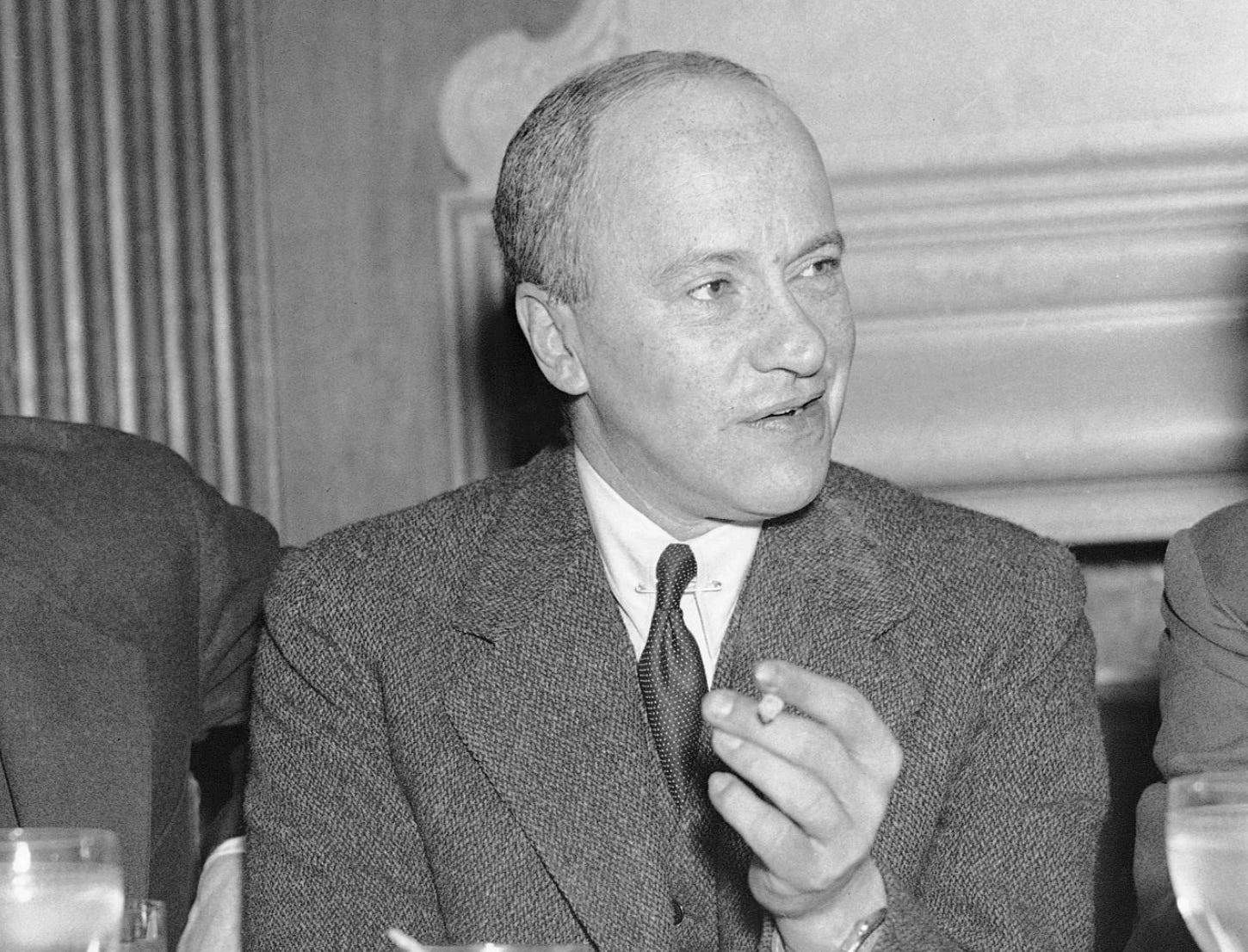
Walter Duranty, Moscow bureau chief for the New York Times
Over the last two years I’ve often thought about Muggeridge and Duranty as I have watched courageous scholars like Dr. Peter McCullough persecuted and censored, while COVID-19 vaccine ideologues are rewarded. Most notable is the COVID-19 vaccine propagandist, Dr. Peter Hotez, who was recently nominated for the Nobel Prize.
One of the most bizarre features of our bizarre time is that an experimental, gene transfer technology has become an object of unshakable devotion. Among members of the COVID-19 Vaccine Cult, belief in the substance (about which they know nothing) is an article of faith.
In the 1930s, 40s, and even 50s, many of the most prominent journalists, writers, intellectuals, and artists believed in Stalin’s Cult of Personality. Muggeridge knew (from his own observations) that they weren’t seeing the reality of Stalin’s regime. Because they viewed the world through the highly distorting lens of ideology, they couldn’t see what was right in front of them.
Naughty Russians
BY PHILIP GIRALDI • UNZ REVIEW • NOVEMBER 6, 2022
According to the New York Times those naughty Russians are at it again.
Today’s online lead story entitled “Russia Reactivates Its Trolls and Bots Ahead of Tuesday’s Midterms” with the subtitle “Researchers have identified a series of Russian information operations to influence American elections and, perhaps, erode support for Ukraine” marks a new low in what the Gray Lady, self-designated as one of America’s “newspapers of record,” prefers to call “journalism.” The author of the piece, clearly somewhat biased over Russia and Putin, is one “Steven Lee Myers [who] covers misinformation for The Times. He is also the author of ‘The New Tsar: The Rise and Reign of Vladimir Putin.’”
Here is what it is all about: “The user on Gab who identifies as Nora Berka resurfaced in August after a yearlong silence on the social media platform, reposting a handful of messages with sharply conservative political themes before writing a stream of original vitriol. The posts mostly denigrated President Biden and other prominent Democrats, sometimes obscenely. They also lamented the use of taxpayer dollars to support Ukraine in its war against invading Russian forces, depicting Ukraine’s president as a caricature straight out of Russian propaganda.”
Per the Times, “The goal, as before, is to stoke anger among conservative voters and to undermine trust in the American electoral system. This time, it also appears intended to undermine the Biden administration’s extensive military assistance to Ukraine.”
Well, one might object that Ukraine’s president is indeed a figure tailor-made for ridicule as he used to play a piano with his penis, but that is perhaps a secondary issue. The more significant theme is that people who oppose the Ukraine war, for any number of reasons, and, particularly if they are conservatives, are becoming trolls for Russia in part due to the disinformation efforts and are being influenced by way of discussion fora like Gab. The targets “are generally US conservatives who are maybe more accepting of conspiratorial claims” according to one of the cybersecurity experts consulted by the author. The Times links Berka, who might indeed be a made-up identity “posing as an outraged American,” to the secretive Russian Internet Research Agency in St Petersburg which it claims was involved in interfering in both the 2016 and 2020 US elections.
The Times also names another site that it links to Russia, electiontruth.net “For its contact information, electiontruth.net lists a cafe inside a converted gas station in Cotter, Ark., a town of 900 people on a bend in the White River. The cafe has closed, however… No one at Election Truth responded to a request for comment submitted through the site.”
One might object that neither Berka nor electiontruth.net would appear to be a major disinformation threat sponsored by a foreign government intended to bring down the Republic. Nevertheless, the article clearly adheres to the view that anyone objecting to the continuing war in Ukraine is a Russian dupe. It cites Liz Cheney, who has called the few Republicans who want to cut funding for the war as “the Putin wing of the Republican Party,” and Myers observes that the disinformation unfortunately echoes “a theme that has gained some traction among Republican lawmakers and voters who have questioned the delivery of weapons and other military assistance.”
Another “expert” cited in the article, one Edward P. Perez, a board member with the OSET Institute, a self-described “nonpartisan election security organization,” called the Russian efforts “manufactured chaos” in the country’s body politic – in part because the divisions in American society are already such fertile soil for disinformation. “Since 2016, it appears that foreign states can afford to take some of the foot off the gas because they have already created such sufficient division that there are many domestic actors to carry the water of disinformation for them.”
Myers and his agenda driven quoted “experts” do not consider for a moment that there are a lot of good reasons for opposing US involvement in the fighting in Ukraine, many of which are rooted in a conservative view of what is America’s appropriate role in what is becoming a multipolar world. First, the United States has no national interest at stake that compels it to enter the fighting on behalf of Ukraine. Second, the war itself could have been averted if the United States and Europeans had been willing to address and negotiate Russian national security concerns in a serious way before the fighting broke out. Third, even now, a push by the US and its allies would likely bring the two sides to the negotiating table and a truce could be arranged. Fourth, the United States would in fact be playing a positive role if it would opt to do whatever it takes to end the slaughter taking place. Fifth and finally, expansion of a US direct role in the conflict could prove catastrophic if someone blinks and the war goes nuclear.
So, the compelling need for the continuation of an unnecessary war is the main point being made by Mr. Myers’ featured article, which clearly reflects the views of the New York Times editorial staff. And the enemy characteristically comes from within – Americans who oppose the involvement of the United States in the war against Russia and are accused of being little more than “domestic actors” who are peddling disinformation provided by the Kremlin. Given that this article has appeared two days before national elections, the intent is clear. The Russians are, per the Times, generating disinformation about Ukraine and Americans who go along with the lies are being manipulated. Moscow is again interfering in a US national election! Vote for the Democratic candidates as they will be the ones that can be relied upon to keep the war going! Three cheers for Joe Biden!
Russia Says “Top Priority” Is To Avoid Nuclear Clash, Reiterates Purely Defensive Use
By Tyler Durden | Zero Hedge | November 2, 2022
Russia on Wednesday warned that the world’s “top priority” should be the nuclear-armed super powers avoiding confrontation at all costs or else this would lead to “catastrophic consequences.”
“We are firmly convinced that in the current difficult and turbulent situation — a consequence of irresponsible and shameless actions aimed at undermining our national security — the top priority is to prevent any military clash of nuclear powers,” a Foreign Ministry statement said.
While not naming its chief nuclear-armed rivals the United States or the United Kingdom specifically, the Kremlin called on all other nuclear states to “abandon dangerous attempts to infringe on each other’s vital interests.”
The statement reiterated a key tenet of Russia’s official nuclear doctrine, saying, “Russia is strictly and consistently guided by the tenet that a nuclear war cannot be won and must never be fought.” It reemphasized a nuclear doctrine that is “purely defensive in nature” – which only allows deployment of nuclear arms “when the very existence of our state is threatened.”
In a statement early last month, President Joe Biden expressed that he doesn’t think Russia’s Vladimir Putin will use nuclear weapons in Ukraine. “Well, I don’t think he will,” Biden previously said in a CNN interview. “But I think that it’s irresponsible for him to talk about it.”
Also on Wednesday The New York Times has published some hugely significant claims…
Senior Russian military leaders recently had conversations to discuss when and how Moscow might use a tactical nuclear weapon in Ukraine, contributing to heightened concern in Washington and allied capitals, according to multiple senior American officials.
President Vladimir V. Putin was not a part of the conversations, which were held against the backdrop of Russia’s intensifying nuclear rhetoric and battlefield setbacks.
But the fact that senior Russian military leaders were even having the discussions alarmed the Biden administration because it showed how frustrated Russian generals were about their failures on the ground, and suggests that Mr. Putin’s veiled threats to use nuclear weapons might not just be words.
According to follow-up reporting in CNN, the alleged Kremlin discussion among top officials of using tactical nukes against Ukraine is based on a US intelligence assessment.
But importantly, CNN cites that there remain dissenting opinions within the US intelligence community. CNN’s reporting begins, “Russian military officials have discussed how and under what conditions Russia would use a tactical nuclear weapon on the battlefield in Ukraine, according to a US intelligence assessment described to CNN by multiple sources who have read it.”
“The assessment, drafted by the National Intelligence Council, is not a high confidence product and is not raw intelligence but rather analysis, multiple people who have read it told CNN,” the report continues, before emphasizing: “For that reason, some officials believe the conversations reflected in the document may have been taken out of context, and do not necessarily indicate that Russia is preparing to use a nuclear weapon.”
It is a significant and eye-brow raising moment when CNN spotlights the likelihood of intelligence ‘cherry picking’ in a story which relates to Russia, which indeed casts serious doubt on the original NYT Times reporting and claims by unnamed US intelligence officials.
EU trying to play the arbiter of alleged Russian ‘war crimes’ in Ukraine
EU judicial institutions never showed interest in investigating the nearly decade-long mass murder of civilians in Donbass
By Drago Bosnic | October 17, 2022
Ever since Russia started its counteroffensive against NATO aggression in Eastern Europe, the political West has been parroting the narrative that Moscow is allegedly committing war crimes in Ukraine. Although there has been virtually zero evidence to support such claims, the mainstream propaganda machine refuses to give up. The Kiev regime and its geopolitical puppet masters in Washington DC and Brussels are also resorting to false flags and so-called deep fakes to create and maintain the narrative that Russian forces are deliberately targeting civilians. And yet, the Western mainstream propaganda machine often gets caught in its own web of lies. On October 11, The New York Times published an op-ed by Mike Ives in which he made the following claim:
“The Russian missile and drone attacks that killed at least 19 people across Ukraine on Monday were traumatic and wide-ranging, but they were not as deadly as they could have been… …That has renewed questions over the quality of Russia’s weapons and about the capacity of its forces to carry out President Vladimir V. Putin’s military designs.”
The claim clearly indicates that Russia’s recent missile strikes targeting the Kiev regime’s critical military infrastructure are somehow seen as “ineffective” because there were “too few” casualties. Such a sadistic claim serves as proof that propaganda pushed by the political West has no limits. Russia has been using advanced long-range precision weapons to target key military units and infrastructure of the Kiev regime forces. This approach is a result of both high-tech aspects of the Russian military and the fact that Moscow’s special military operation is still prioritizing the reduction of civilian casualties. And yet, even though the Western propaganda machine acknowledges this reality, the narrative of alleged Russian “war crimes” in Ukraine needs to be pushed into the mainstream. This is especially true when it comes to giving these false claims a legal and judicial aspect.
In recent days multiple reports have been published, claiming the European Union and Eurojust, the bloc’s agency dealing with judicial cooperation in criminal matters among agencies of the member states, have been working to create the judicial framework for dozens of fabricated reports of supposed Russian “war crimes” in Ukraine. According to Eurojust’s October 13 press release, this was the central theme of the 16th meeting of the Consultative Forum of Prosecutors General of EU Member States. Prosecutors General and Directors of Public Prosecutions discussed the self-appointed “expanded role” of Eurojust in matters of alleged war crimes and crimes against humanity. They also met with their new Kiev regime counterpart Andriy Kostin and the Prosecutor of the International Criminal Court Karim A.A. Khan KC.
Olivier Christen, Director of Criminal Affairs and Pardons of France, stated that the EU “remains fully committed” to identifying and prosecuting the perpetrators of the atrocities taking place in Ukraine. He further pointed out that Eurojust has “expanded its prerogatives” in order to improve the “fight against impunity for war crimes.” Eurojust President Ladislav Hamran stated that “never in the history of armed conflict has the legal community responded with such commitment and determination” and that the meeting “will further fuel the joint ambition to bring justice to the Ukrainian people.” Apart from alleged Russian “war crimes”, the panel members discussed what they called the “disinformation via cyberspace”, which was further expanded to include notes on “practical experiences and challenges in relation to the prosecution of violations of the current EU sanctions against Russian and Belarusian individuals and companies.”
In another press release, also published on October 13, Eurojust announced that Romania also became a member of the joint investigation team (JIT) on alleged war crimes in Ukraine. Romania was the seventh member of the JIT, which was set up on 25 March 2022 by Lithuania, Poland and Ukraine and later joined by Estonia, Latvia and Slovakia. In April of this year, the Office of the Prosecutor at the International Criminal Court (ICC) became a participant in the JIT. The relevant meeting was held just prior to the aforementioned 16th Meeting of the Consultative Forum of Prosecutors General. According to their own admission, Eurojust is also providing “essential logistical and operational support” to the JIT partners, including to “investigators” on the ground in Ukraine.
Needless to say, there was no mention of the Kiev regime death squads operating in the Kharkov, Zaporozhye, Kherson and Donbass. The meeting members discussed only alleged Russian “war crimes” and the supposed Moscow’s “disinformation campaign”, despite the fact that the Neo-Nazi junta henchmen are openly boasting about “killing traitors”. Numerous Telegram channels have already published gruesome videos showing the Neo-Nazi death squads killing civilians and then throwing them into mass graves. In doing so, the Kiev regime accomplishes at least two goals – it gets rid of “noncompliant” or “pro-Russian” civilians and also gets to accuse Russian troops of killing them. The propaganda machine of the political West then comes into play, while EU agencies such as Eurojust cement the narrative from a judicial and legal perspective.
It would be naive, to say the least, to believe that the EU or any other entity of the political West would ever objectively investigate actual war crimes taking place in Ukraine. Charades such as the ones in Bucha and recently in the Kharkov region serve as a testament to that. None of the so-called “international” judicial institutions, such as the aforementioned ICC, ever showed interest in investigating the nearly decade-long mass murder of civilians in Donbass. Despite approximately 15,000 deaths from 2014 to 2022, with hundreds or even thousands more in recent months, as the Kiev regime forces never stopped shelling Donetsk and other towns and areas, the mainstream propaganda machine has been successful in suppressing most information on this.
What’s more, the Neo-Nazi junta has been using NATO-supplied weapons to target civilians beyond Donbass, in Kherson and Zaporozhye regions, killing hundreds in recent months. Will Eurojust and JIT investigate those already documented war crimes or are their actions reserved only to further reinforce the Kiev regime’s propaganda war?
Drago Bosnic is an independent geopolitical and military analyst.
New York Times sacks Gaza journalist for expressing support for Palestinian resistance

MEMO | October 6, 2022
Palestinian photojournalist, Hosam Salem, has been fired by the New York Times for expressing support for Resistance against Israeli occupation. The Gaza- based journalist has been working as a freelancer for the American outlet since 2018, but was dismissed after a dossier compiled by a pro-Israel group, accusing Salem of anti-Semitism, was presented to the Times.
Since joining the Times, Salem has been covering critical events in Gaza, such as the weekly protests at the border fence with Israel. He carried out an investigation into the Israeli killing of field nurse Razan Al-Najjar and, more recently, the May 2021 Israeli offensive on the Gaza strip, which killed at least 254 Palestinians, including 66 children, 39 women and 17 elderly people.
Details of his dismissal were revealed by Salem himself on Twitter. He said that the decision to fire him was made based on a report prepared by a Dutch editor – who obtained Israeli citizenship two years ago – for a website called “Honest Reporting”. The anti-Palestinian group is a staunch supporter of Israel and is often accused of peddling false narratives in Western media about Israel’s human rights violations.
Salem said that the dossier used by the Times to dismiss him used examples of social media posts in which he expressed support for Palestinian Resistance against Israeli occupation. “My aforementioned posts also spoke of the resilience of my people and those who were killed by the Israeli army – my cousin included – which “Honest Reporting” described as ‘Palestinian terrorists,'” said Salem on Twitter.
Salem claims that the editor of the dossier later wrote an article stating that he had succeeded in sacking three Palestinian journalists working for the Times in the Gaza Strip, based on allegations of anti-Semitism.
“Not only has “Honest Reporting” succeeded in terminating my contract with The New York Times, it has also actively discouraged other international news agencies from collaborating with me and my two colleagues,” Salem continued, while warning of the silencing of Palestinian voices.
“What is taking place is a systematic effort to distort the image of Palestinian journalists as being incapable of trustworthiness and integrity, simply because we cover the human rights violations that the Palestinian people undergo on a daily basis at hands of the Israeli army.”
North Korea responds to Russian arms sales claims
Samizdat | September 22, 2022
North Korea has said it has no plans to sell arms to Russia, calling the idea a “conspiracy theory” after US officials claimed that a deal is in the works involving “millions” of artillery shells and rockets.
Pyongyang’s Ministry of Defense released a statement on Wednesday responding to the claims, saying that while it does not accept United Nations penalties prohibiting all arms sales by North Korea, it also has no intention of transferring weapons to Russia.
“We have never exported weapons or ammunition to Russia in the past, and we have no plans to do so in the future,” an unnamed military official said, as cited in state media, adding, “We strongly condemn and sternly warn the United States to stop recklessly spreading anti-DPRK conspiracy theories in order to pursue vicious political and military atrocities.”
First noted in a New York Times report citing “declassified” US intelligence materials, the purported arms deal was later given official credence by State Department deputy spokesperson Vedant Patel, who told reporters that Russia “is in the process of purchasing millions of rockets and artillery shells from North Korea for use in Ukraine” earlier this month.
However, the White House walked back the charge soon afterwards, with National Security Council spokesman John Kirby stating that there are “no indications that that purchase has been completed and certainly no indications that those weapons are being used inside of Ukraine.”
Moscow’s envoy to the UN, Vassily Nebenzia, had previously dismissed the claim as “another fake being circulated around.”
The alleged weapons sale by Pyongyang mirrors similar allegations from US officials about an upcoming drone transfer from Iran to Russia. A little more than two weeks after National Security Advisor Jake Sullivan said Washington had clear evidence that Iran was preparing to deliver “several hundred” armed UAVs to Russia, Kirby again clarified that the US had “seen no indications of any sort of actual delivery and/or purchase of Iranian drones by the Russian Ministry of Defense.” Tehran initially denied any plans to share drone technology with Moscow, though the Pentagon has continued to claim the sales are taking place, alleging a “first shipment” of drones in late August.
Featured Video

“Historic Russia”: The Land Putin Will Not Give Back
or go to
Aletho News Archives – Video-Images
Book Review
Why the War on Conspiracy Theories Is Bad Public Policy
By Kevin Barrett • Unz Review • February 1, 2019
 A Review of Conspiracy Theories and Other Dangerous Ideas by Cass Sunstein (based on an earlier paper co-authored with Adrian Vermeule); In Defense of Troublemakers: The Power of Dissent in Life and Business by Charlan Nemeth; and Conspiracy Theories and the People Who Believe Them, edited by Joseph E. Uscinski
On January 25 2018 YouTube unleashed the latest salvo in the war on conspiracy theories, saying “we’ll begin reducing recommendations of borderline content and content that could misinform users in harmful ways—such as videos promoting a phony miracle cure for a serious illness, claiming the earth is flat, or making blatantly false claims about historic events like 9/11.”
At first glance that sounds reasonable. Nobody wants YouTube or anyone else to recommend bad information. And almost everyone agrees that phony miracle cures, flat earthism, and blatantly false claims about 9/11 and other historical events are undesirable.
But if we stop and seriously consider those words, we notice a couple of problems. First, the word “recommend” is not just misleading but mendacious. YouTube obviously doesn’t really recommend anything. When it says it does, it is lying. … continue
Blog Roll
 Aletho News
- “Historic Russia”: The Land Putin Will Not Give Back
- How the Cambridge Analytica scandal still haunts Mark Zuckerberg
- The Ongoing Cancellation Campaign Against a Dissenting Academic in Norway
- Yemen and ‘the Houthis’: Challenging Sami Hamdi’s Narrative
- No, Christians did not invent Zionism
- AIPAC-led lobbying network opens branches in Cypriot, Greek parliaments
- Araghchi blasts ‘parasitic’ alliance as US taxpayers pay for Israel’s war on Iran
- Easy fix for Europe’s chaos? Stop fueling war against Russia
- Putin’s key remarks on peace talks and Europe’s ‘schizophrenia’
- Trita Parsi: Israel Set a Trap for Total War in the Region
- If Americans Knew
- Damning report shows the media must confront its failures on Gaza
- BBC senior broadcaster speaks out on Gaza coverage
- Netanyahu vows vast West Bank invasion in response to 20-minute skirmish that left 2 Israeli soldiers and 2 Palestinian fighters dead
- Tied up and tortured: Israel using US-made electroshock weapons on Palestinian detainees
- The outsourced risk: how newsrooms rely on Gaza’s freelancers without protecting them
- Gaza bakeries forced to shut as Israel blocks flour shipments
- Gaza’s breast cancer patients face a deadly wait for treatment amid Israel’s genocide
- DAILY UPDATE: Latest essential news on Palestine, Israel, & region
- The Israel Lobby’s Changing Fortunes
- AIPAC has become such a political liability that it’s shifting to a more “nimble” approach to buying politicians
- No Tricks Zone
- E-Cars Reduce CO2 Emissions By Only 41% Compared To Internal Combustion Engine Vehicles
- Predictions Made By Renowned Climate Professor Over Past Decades Have Been Proven To Be Poor
- New Study Suggests Large Regions Of The Pacific Ocean Have Been Cooling For The Last 80 Years
- Germany’s Green Energy Debacle: High Energy Costs Force Kahla Porzellan to Close After 182 Years!
- New Study: 50 Years Of The Most Aggressive ‘Net Zero’ Policies Can Only Affect The Global Climate By 0.03°C
- US September “Heat” Was No Record…Many Records Set Decades Ago
- Latest European Green Energy Debacle; Portugal’s Largest Flagship Solar Park Insolvent!
- Green Energy Debacle: German Expert Professor Fritz Vahrenholt Warns Of Severe Economic And Social Consequences
- Two More Paleo Reconstructions Affirm Meters-Higher Sea Levels Across Ireland, Brazil 7000-6000 Years Ago
- New Study: Earth And Venus Surface Warmth Largely Explained By Convection And Lapse Rate, Not CO2 Or Radiation

