The day after Venezuelan President Hugo Chávez died, New York Times reporter Lizette Alvarez provided a sympathetic portrayal of “outpourings of raucous celebration and, to many, cautious optimism for the future” in Miami-Dade County, Florida. Her article, “Venezuelan Expatriates See a Reason to Celebrate,” noted that many had come to Miami to escape Chávez’s “iron grip on the nation,” and quoted a Venezuelan computer software consultant who said, bluntly: “We had a dictator. There were no laws, no justice.”1
A credulous reader of Alvarez’s report would have no idea that since 1998, Chávez had triumphed in 14 of 15 elections or referenda, all of which were deemed free and fair by international monitors. Chávez’s most recent reelection, won by an 11-point margin, boasted an 81% participation rate; former president Jimmy Carter described the “election process in Venezuela” as “the best in the world” out of 92 cases that the Carter Center had evaluated (an endorsement that, to date, has never been reported by the Times).2
In contrast to Alvarez, who allowed her quotation describing Chávez as a dictator to stand uncontested, Times reporter Neela Banerjee in 2008 cited false accusations hurled at President Obama by opponents—“he is a Muslim who attended a madrassa in Indonesia as a boy and was sworn into office on the Koran”—but immediately invalidated them: “In fact, he is a Christian who was sworn in on a Bible,” she wrote in her next sentence.3 At the Times, it seems, facts are deployed on a case-by-case basis.
The Times editorial board was even more dishonest in the wake of Chávez’s death: “The Bush administration badly damaged Washington’s reputation throughout Latin America when it unwisely blessed a failed 2002 military coup attempt against Mr. Chávez,” wrote the paper, concealing its editorial board’s own role in blessing that very coup at the time. In 2002, with the “resignation [sic] of President Hugo Chávez, Venezuelan democracy is no longer threatened by a would-be dictator,” declared a Times editorial, bizarrely adding that “Washington never publicly demonized Mr. Chávez,” that actual dictator Pedro Carmona was simply “a respected business leader,” and that the U.S.-backed, two-day coup was “a purely Venezuelan affair.”4
The editorial board—an initial champion of the de facto regime that issued a diktat within hours to dissolve practically every branch of government, including Venezuela’s National Assembly and Supreme Court—would 11 years later brazenly criticize Chávez after his death for having “dominated Venezuelan politics for 14 years with authoritarian methods.” The newspaper argued that Chávez’s government “weakened judicial independence, intimidated political opponents and human rights defenders, and ignored rampant, and often deadly, violence by the police and prison guards.” After lambasting Chávez’s record, the piece concluded that the United States “should now make clear its support for democratic and civilian transition in a post-Chávez Venezuela”—as if Chávez were anyone other than a fairly elected leader with an overwhelming popular mandate.
But there is a country currently in the grip of an undemocratic, illegitimate government that much more closely corresponds with the Times editorial board’s depiction of Venezuela: Honduras, which in 2009 suffered a coup d’état that deposed its freely elected, left-leaning president, Manuel Zelaya.
While the Times criticized Chávez for weakening judicial independence, the newspaper could not be bothered to even report on the extraordinary institutional breakdown of Honduras, when in December 2012, its Congress illegally sacked four Supreme Court justices who voted against a law proposed by the president, Porfirio Lobo, who himself had came to power in 2009 in repressive, sham elections held under a post-coup military dictatorship and boycotted by most international election observers.
When it comes to intimidation of political opponents and human rights defenders, Venezuela’s problems are almost imperceptible compared with those of Honduras. Over 14 years under Chávez, Venezuela has had no record of disappearances or murders of such individuals. In post-coup Honduras, the practice is now endemic. In one year alone—2012—at least four leaders of the Zelaya-organized opposition party Libre were slain, including mayoral candidate Edgardo Adalid Motiño. In addition, two dozen journalists and 70 members of the LGBT community have been killed since the coup, including prominent LGBT anti-coup activists like Walter Tróchez and Erick Martinez (neither case was sufficiently notable so as to warrant a mention in the Times).
And although the Times editors decried police violence in Venezuela, the Honduran police systematically engage in extrajudicial killings of their own citizens. In December 2012, Julieta Castellanos, the chancellor of Honduras’s largest university, presented the findings of a report detailing 149 killings committed by the Honduran National Police over the past two years under Porfirio Lobo. In the face of over six killings by the police a month, she warned, “It is alarming that the police themselves are the ones killing people in this country. The public is in a state of defenselessness…”5 Such alarm is further justified by Lobo’s appointment of Juan Carlos “El Tigre” Bonilla as director of the National Police, despite reports that he once oversaw death squads.6
Finally, the Times editorial board lamented Venezuelan prison violence. But consider for context that the NGO Venezuelan Prisons Observatory, consistently critical of Chávez, reported 591 prison deaths in 2012 for the country of 30 million.7 In Honduras, a country with slightly more than a quarter of Venezuela’s population, over 360 died in just one incident—a 2012 prison fire in Comayagua, in which prison authorities kept firefighters from handling the conflagration for 30 crucial minutes while the inmates’ doors remained locked. According to survivors, the guards ignored their pleas for help as many burned alive.8
Given the contrast in the two countries’ democratic credentials and human rights records, obvious questions arise: How has The New York Times portrayed Venezuela and Honduras since Honduras’s 2009 coup d’état? If, in both its news and opinion pages, the Times regularly prints accusations of Venezuelan authoritarianism, what terminology has the Times employed to describe the military government headed by Roberto Micheletti, which assumed power after Zelaya’s overthrow, or the illegitimate Lobo administration that succeeded it?
The answer is revealing. For almost four years, the Times has maintained a double standard that is literally unfailing. Not a single contributor in the Times’ over 100 news and opinion articles has ever referred to the Honduran government as “autocratic,” “undemocratic,” or “authoritarian.” Nor have Times writers ever once labeled Micheletti or Lobo “despots,” “tyrants,” “strongmen,” “dictators,” or “caudillos.”
 At the same time, from June 28, 2009, to March 7, 2013, the newspaper has printed at least 15 news and opinion articles in which its contributors have used any number of the aforementioned epithets for Chávez.9 (This methodology excludes the typically vitriolic anti-Chávez blog entries that the paper features on its website, as well as print pieces like Lizette Alvarez’s, which quote someone describing Chávez as a dictator.)
During this period, the paper’s news reporters themselves have referred to Chávez as a “despot,” an “authoritarian ruler,” and an “autocrat”; its opinion writers have deemed him a “petro-dictator,” an “indomitable strongman,” a “brutal neo-authoritarian,” a “warmonger,” and a “colonel-turned-oil-sultan.” On the eve of Venezuela’s October elections, a Times op-ed managed to call the Chávez administration “authoritarian” no fewer than three times in 800 words.10 And Chávez’s death offered no reprieve from this tendency: On March 6, reporter Simon Romero wrote about Chávez’s gait—he “strutt[ed] like the strongman in a caudillo novel”—and concluded that Chávez had “become, indeed, a caudillo.”11
These most basic violations of journalistic standards—referring to a democratically elected leader as a ruler with absolute power—does not simply end with its writers. On July 24, 2011, Bill Keller, then the newspaper’s executive editor, wrote the piece, “Why Tyrants Love the Murdoch Scandal,” which included a graphic of Zimbabwe’s Robert Mugabe side by side with Chávez. Keller referred to them both when he concluded, “Autocrats will be autocrats.”12
But if despotism, defined as the cruel and oppressive exercise of absolute power, is to have any meaning, it must apply to the Honduran government, whose military—not just its police—routinely kills innocent civilians. On May 26, 2012, for example, Honduran special forces killed 15-year-old Ebed Yanez, and high-level officers allegedly managed its cover-up by dispatching “six to eight masked soldiers in dark uniforms” to the teenager’s body, poking it with rifles, and “[picking] up the empty bullet casings” to conceal evidence that could be linked back to the military, according to the Associated Press.13
The paradox of the Times—its derisive posture toward what it considers antidemocratic tendencies in Venezuela as it simultaneously avoids the same treatment of Honduras’s inarguable repression—can only be explained by one crucial factor: Honduras has been a firm U.S. ally since Zelaya’s overthrow.
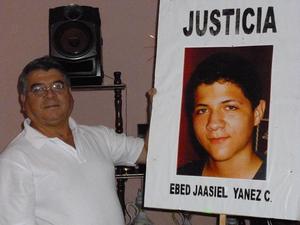
Photo Credit: SOA Watch
In fact, the unit accused of killing Yanez was armed, trained, and vetted by the United States—even its trucks were donated by the U.S. government. As the AP further reported, in 2012, the U.S. Defense Department appropriated $67.4 million for Honduran military contracts, with an additional “$89 million in annual spending to maintain Joint Task Force Bravo, a 600-member U.S. unit based at Soto Cano Air Base.” Furthermore, “neither the State Department nor the Pentagon could provide details explaining a 2011 $1.3 billion authorization for exports of military electronics to Honduras.”14
The Times’ scrupulous, unerring record of avoiding disparaging characterizations of Honduras’s human-rights-violating government may explain why it has never once made reference to 94 Congress members’ demand that the Obama administration withhold U.S. assistance to the Honduran military and police in March 2012. Nor has the paper reported on 84 Congress members’ letter to Secretary of State Hillary Clinton later that year, condemning Honduras’s “institutional breakdown” and “judicial impunity.”15
When evaluating the newspaper’s relative silence on Honduras, it is worth imagining if Chávez were to have ascended to power in as dubious a manner as Lobo; if for years Venezuela’s government permitted its security apparatus to regularly kill civilians; or if the Chávez administration presided over conditions of impunity under which political opponents and human rights activists were disappeared, tortured, and killed.
As a careful examination of the language and coverage of nearly four years of New York Times articles reveals, concern for freedom and democracy in Latin America has not been an honest concern for the liberal media institution. The paper’s unwavering conformity to the posture of the U.S. State Department—consistently vilifying an official U.S. enemy while systematically downplaying the crimes of a U.S. ally—shows that its foremost priority is to subordinate itself to the priorities of Washington.
1. Lizette Alvarez, ““Venezuelan Expatriates See a Reason to Celebrate,” The New York Times, March 6, 2013.
2. Keane Bhatt, “A Hall of Shame for Venezuelan Elections Coverage,” Manufacturing Contempt (blog), nacla.org, October 8, 2012.
3. Neela Banerjee, “Obama Walks a Difficult Path as He Courts Jewish Voters,” The New York Times, March 1, 2008.
4. “Hugo Chávez Departs,” The New York Times, April 13, 2002.
5. “Policías de Honduras, Responsables de 149 Muertes Violentas,” La Prensa, December 3, 2012.
6. Katherine Corcoran and Martha Mendoza, “Juan Carlos Bonilla Valladares, Honduras Police Chief, Investigated In Killing,” Associated Press, June 1, 2012.
7. Fabiola Sánchez, “Venezuela Prison Deaths: 591 Detainees Killed Country’s Jails Last Year,” Associated Press, January 31, 2013.
8. “Hundreds Killed in ‘Hellish’ Fire at Prison in Honduras,” Associated Press, February 16, 2012.
9. Author’s research, using LexisNexis database searches for identical terms in reference to the two countries. For a detailed list of examples, contact him at keane.l.bhatt@gmail.com.
10. Francisco Toro, “How Hugo Chávez Became Irrelevant,” The New York Times, October 6, 2012.
11. Simon Romero, “Hugo Chávez, Leader Who Transformed Venezuela, Dies at 58,” The New York Times, March 6, 2013.
12. Bill Keller, “Why Tyrants Love the Murdoch Scandal,” The New York Times Magazine, July 24, 2011.
13. Alberto Arce, “Dad Seeks Justice for Slain Son in Broken Honduras,” Associated Press, November 12, 2012.
14. Martha Mendoza, “US Military Expands Its Drug War in Latin America,” Associated Press, February 3, 2013.
15. Office of Representative Jan Schakowsky, “94 House Members Send Letter to Secretary Clinton Calling for Suspension of Assistance to Honduras,” March 13, 2012. Correspondence from Jared Polis et al. to Secretary of State Hillary Clinton, June 26, 2012.
May 9, 2013
Posted by aletho |
Deception, Mainstream Media, Warmongering | Honduras, Hugo Chávez, Latin America, Lizette Alvarez, New York Times, Roberto Micheletti, United States, Venezuela |
Leave a comment
“We have been very clear to the Assad regime but also to other players on the ground that a red line for us is, we start seeing a whole bunch of weapons moving around or being utilized.” — Obama Threatens Force Against Syria, The New York Times, August 21, 2012
When President Obama spoke these words last August he might have dug himself a hole twice as deep as the one he was in last week.
As four NYT journalists reported on Sunday’s front page article “Off-the-Cuff Obama Line Put U.S. in Bind on Syria”: “Confronted with evidence that chemical weapons have been used in Syria, President Obama now finds himself in a geopolitical box, his credibility at stake with frustratingly few good options.”
If there will be any effort to hold Mr. Obama’s feet to the fire the heat just got hotter.
Buried on page A9 of Monday’s edition of “the paper of record” was a statement by Carla del Ponte, a United Nations human rights investigator looking into the claims that chemical weapons were used in Syria:
The United Nations independent commission of inquiry on Syria has not yet seen evidence of government forces using chemical weapons, which are banned under international law, said Carla Del Ponte, a commission member.
“Our investigators have been in neighboring countries interviewing victims, doctors and field hospitals,” Ms. Del Ponte said in an interview with Swiss-Italian television. “According to their report of last week, which I have seen, there are strong, concrete suspicions but not yet incontrovertible proof of the use of sarin gas, from the way the victims were treated.”
“This was use on the part of the opposition, the rebels, not by the government authorities,” she added, speaking in Italian.
Question: Will President Obama hold the rebels accountable for crossing his red line?
In his own words he did say that he has “been very clear to the Assad regime but also to other players on the ground” [emphasis added] that the use of chemical weapons is a red line that even the Times saw last summer as a threat of force.
The question is not likely to be answered in the affirmative. This is the politics of war. For more than two years the rebels have been carrying out terrorist bombings, grisly executions, and other assorted attacks that would likely have had Washington and its allies foaming at the mouths were it the Assad regime who was the perpetrator.
Washington has failed to join the Syrian government in their own War on Terror, even though al Qaeda is active in the country. And it just goes to show as one more example: when al Qaeda is used as a boogeyman for war we should not take the pretext seriously, as in the case of Mali. If al Qaeda is on the same side as Uncle Sam, as they were in Afghanistan in the 1980s, the Balkans in the 1990s, Libya in 2011, and now Syria, then there will be no drone attacks on the terrorists.
And now we see al Qaeda-linked terrorists suspected of using chemical weapons. Don’t look for the U.S. to come to the defense of the Syrian government.
Already we can see the change of attitude reflected at The New York Times.
Not two weeks ago, on April 26, 2013, it was front page news at the NYT that “White House Says It Believes Syria Has Used Chemical Arms.”
From that moment the story became a sensation. It fit well into the parameters of the propaganda system. An official enemy who we are actively trying to overthrow may have used chemical weapons and provided a clear pretext for force. Here comes the march to war.
But when UN investigators looked into the matter and reported that “Syrian Rebels May Have Used Sarin,” the story fell from grace and was pushed to page A9.
This differential treatment signals the death of the “red line” story, which is too bad because it would have been interesting to see The New York Times, or anyone in the mainstream media, investigate how Syrian rebels could have gotten a hold of sarin, especially considering a former Bush official has openly considered the idea of Israel being behind the attack.
The differential treatment may possibly throw a wrench in the drive to war . . . for now. Because, also on page A9 of Monday’s edition of The New York Times is “Attacks on Syria Fuel Debate Over U.S.-Led Airstrikes,” a report of an Israeli attack in Syria:
WASHINGTON — The apparent ease with which Israel struck missile sites and, by Syrian accounts, a major military research center near Damascus in recent days has stoked debate in Washington about whether American-led airstrikes are the logical next step to cripple President Bashar al-Assad’s ability to counter the rebel forces or use chemical weapons.
That option was already being debated in secret by the United States, Britain and France in the days leading to the Israeli strikes, according to American and foreign officials involved in the discussions. On Sunday, Senator John McCain, who has long advocated a much deeper American role in the Syrian civil war, argued that the Israeli attacks, at least one of which appears to have been launched from outside Syrian airspace, weakens the argument that Syria’s air defense system would be a major challenge.
“The Israelis seem to be able to penetrate it fairly easily,” Mr. McCain said on “Fox News Sunday.”
While attacks in Syria might be easier than previously suspected, the justifications for war received a setback. But if history is any guide this is only a minor and temporary one.
May 7, 2013
Posted by aletho |
Deception, False Flag Terrorism, Mainstream Media, Warmongering, Wars for Israel | Carla Del Ponte, New York Times, Syria, United States |
Leave a comment
Thirteen years ago I knew very little about Israel-Palestine. Like most Americans, this seemed to be a distant, confusing conflict that had little to do with me. I was unaware –again, like most Americans – that American taxpayers give Israel over $8 million per day, more than we give to any other nation.
I was unaware that our nation has vetoed numerous United Nations efforts to reign in Israeli aggression; resolutions that were supported by almost every other country around the world. I was unaware that US actions were enabling a massive land theft and ongoing ethnic cleansing that has caused profound tragedy in the Middle East, deep damage to our own nation and endangered American lives.
My personal awakening to these facts and others began in the autumn of 2000 when the Palestinian uprising known as the Second Intifada began and was, for a while at least, in the American news. I grew curious about this conflict, determined to follow the news on it, and noticed quickly how one-sided the news coverage appeared to be. While we heard from and about Israelis frequently, the Palestinian side seemed to be largely glossed over at minimum, and was sometimes completely hidden.
I began searching for additional information on the Internet and was astounded at what I learned. Israeli forces were killing hundreds of largely unarmed Palestinian men, women and children; many of the children were being killed by gunshot wounds to the head.
While some Israelis were also being killed during this period, these deaths were far fewer and virtually invariably occurred after Palestinian deaths. Over 90 Palestinian children were killed before a single Israeli child. Over 140 Palestinian men, women and children living on their own land were killed before anyone in Israel was.
As I learned the nature of Israel’s military occupation of the West Bank and Gaza Strip and the true history of the region, it began to seem to me that this was the longest and possibly most significant cover-up I had ever come across. I finally decided to quit my job as the editor of a small community newspaper in northern California and go and see for myself what was going on, travelling to Israel-Palestine as a freelance reporter in February and March of 2001.
When I returned I created an organisation called “If Americans Knew” to provide the full facts to my fellow citizens and to study why and how US news coverage was failing to do this.
Israel-centrism and patterns of distortion
We have conducted a number of statistical studies on this issue and found that US media were covering Israeli deaths in far greater detail than they were covering those of Palestinian.
For example, the New York Times was reporting on Israeli children’s deaths at a rate seven times greater than they were covering Palestinian children’s deaths; this didn’t even include the far larger number of words and amount of personal information given about Israeli victims compared to Palestinians. We also found that primetime network news programmes were covering Israeli children’s deaths at rates up to 14 times greater than the coverage given to Palestinians.
I discovered a system of reporting from the region in which a violent conflict between an officially “Jewish state” and the Muslims and Christians it had dispossessed (and was in the process of dispossessing further) was being covered most of the time by journalists with legal, familial or emotional ties to Israel. A great many are Israeli citizens (though this is almost never disclosed) or married to Israelis, their children also being Israeli.
I discovered that the Associated Press control bureau for the region, from which virtually all news reports that appear in US newspapers were transmitted, was located in Israel and was staffed almost entirely by Israeli and Jewish journalists (many of whom had served in the Israeli military).
I learned that the son of the New York Times bureau chief was serving in the Israeli military while his father was reporting on the conflict. In fact, I discovered that it was common for journalists in the region reporting for American media to have close personal ties to the Israeli military; that at least one staff member had been serving in the Israeli military even as he was reporting for the NY Times; that US News & World Report’s senior foreign correspondent, who had covered and written about the Middle East for more than 40 years, had a son serving in the Israeli army during the time he was reporting there; that Middle East “pundit” Jeffrey Goldberg, whose commentary pervades both the print and broadcast media, is an Israeli citizen who served in the Israeli military.
I learned that CNN anchorman Wolf Blitzer lived in Israel for many years, at one point travelled around the US as the “voice of Israel” and had worked for an Israel lobby publication.
I learned that Time magazine’s bureau chief was an Israeli citizen, and that NPR’s long-time correspondent from the region had an Israeli husband who had served in the military and may be an Israeli citizen herself.
I also discovered that this pattern of Israel-centrism went beyond the regional reporting. In fact, the regional filtering of the news may not even be the most significant factor in the broken media reporting on this issue that Americans receive.
Within US-based journalism per se I discovered patterns of Israel-centrism that were deeply troubling. In some cases I personally experienced the intentional suppression of information on Palestine. Following are a few examples.
San Francisco Chronicle
While I was on my first trip to the Middle East I had met with a managing editor at the San Francisco Chronicle before I left and told him of my intention to report from the region. He had been quite interested and asked me to send him my first-hand reports.
During my trip, despite the difficulties in doing this, I sent him several reports at a time when almost no other American journalists were in the West Bank or, especially, Gaza. None were printed.
Finally, he sent me an email saying that he might be able to publish some of my reports, but that this would be “political”. This was unusually honest but quite troubling. It should not be “political” to publish on-the-scene reporting.
While he never explained the obstacles confronting such reports, I suspect they had to do with the fact that the top editor at the time, Phil Bronstein, tilts toward Israel; that numerous advertisers were pro-Israel; that the pro-Israel power structure is extremely strong in California; that pro-Israel organisations in the US invariably mount protests and boycotts if newspapers stray too far from their preferences; and that others are frequently afraid of being called “anti-Semitic” and of the potential damage honest journalism on this topic could do to their careers.
A few years later a journalist who had worked for the Chronicle for many years, Henry Norr, was fired by Bronstein. While a different rationale was put forward for Norr’s termination, Norr himself believes that the real reason was his activities related to Palestine. He had written a column about an Intel factory constructed illegally on Palestinian land and had also given a lunchtime briefing to staffers about a trip he had taken to the West Bank.
Still another former Chronicle journalist has described the inner workings related to news coverage of Israel-Palestine; that most of those editing wire copy were Israel partisans, that this journalist was largely kept away from editing reports on the issue; and that there was an atmosphere in which anti-Arab cartoons were sometimes posted on a bulletin board.
In 2004 our organisation conducted a statistical study of the Chronicle’s coverage during the first six months of the Second Intifada and discovered that the Chronicle had covered 150 per cent of Israeli children’s deaths and only 5 per cent of Palestinian children’s deaths. Before releasing it to the public I phoned Bronstein to meet with him to present it in person, the normal protocol. He failed to return my phone calls. At a public forum I again requested such a meeting. In front of a large audience Bronstein promised to meet. Yet, he later again refused to return phone calls and this meeting never transpired.
We then released our report publicly and distributed it as widely as possible. In addition, some groups and individuals disseminated thousands of fliers containing some of our key charts and statistics, headlined “What Children Matter?” These activities, of course, received considerable attention, and I feel were far more valuable than a meeting.
Gannett Newspapers
Gannett is one of the top news chains in the US. According to its website, it consists of 82 daily newspapers, including USA TODAY, and it reaches 11.6 million readers every weekday and 12 million readers every Sunday. USA TODAY is the nation’s top newspaper in print circulation, reaching 6.6 million readers daily.
In addition to its newspapers, Gannett owns 23 TV stations, which reach 21 million households, covering 18.2 per cent of the US population. It also delivers news on 9,500 video screens located in elevators of office towers and select hotel lobbies across North America.
In 2001 a Gannett reporter who was writing a series of articles in the wake of the 9-11 attacks, heard about my trip to the region six months before the attacks and phoned me for an interview. He was extremely interested in my story and ended up calling me several more times for follow-up interviews, asked me to send him all my reports from my trip, and upon receiving them he was quite complimentary about their quality.
The reporter then sent a photographer to take pictures of me in my home for the article, had her express mail them to him, and said the story would be coming out soon.
We were in the process of creating the If Americans Knew website at the time and hurried to make this live, since this would be major exposure.
A little later I went on a speaking tour and a reporter from a community newspaper in a tiny newspaper chain in New York State interviewed me for his paper. A few days later he wrote to me saying that the newspaper owner had killed his article. He said this was the first time this had ever happened to him.
I then realised that I had never seen the Gannett newspaper article on me and If Americans Knew. I emailed the reporter, told him about this incident, and asked him if I had missed his article or whether the same thing had happened to him. I hadn’t missed it. He said that his editor had similarly killed the story.
I later saw an article by this reporter about Americans visiting Iraq who were highly critical of the US government. It is interesting that this subject matter was permissible, but not a feature on someone critical of Israel.
National Public Radio – Vermont and Michigan
Several years later I was on a speaking tour in Vermont and New Hampshire and was to be interviewed on a local affiliate of the influential National Public Radio network. When I arrived at the radio station it turned out that the radio host who had agreed to do this was not available and another person was going to do the interview, someone called Neal Charnoff.
Charnoff and the programme producer took me back to the studio where they would record the interview for later broadcast. Oddly, the regular sound engineer was told he could go outside and take a break, and the producer took over.
The host began his first question with a statement that my articles contained “anti-Semitic” overtones. I interrupted him immediately, said this was untrue, and asked him what he was talking about – which specific articles or statements that I had written did he claim were “anti-Semitic”?
He could not answer. I wondered if he had even read anything I had written or whether he was simply repeating the unfounded accusations by the Anti-Defamation League, a fanatically pro-Israel organisation that has been implicated in a vast spying operation on Americans.
Flustered at the embarrassment at having made a statement based on no evidence, he began the interview again in a more normal fashion. I told him about my trip to the West Bank and Gaza Strip and what I had found.
Within a few minutes, and sooner than the scheduled end of the interview, he stopped it. He turned off the equipment and said they would not be airing it.
I was shocked and asked him why not. There was then a brief conversation in which he, and to a lesser extent the producer, defended Israel against the statement of facts I had made about what I had seen. The producer, who seemed to be more reasonable – and who also may have realised that Charnoff’s intention to kill the interview so publicly would reflect badly on the station – said that she was sure they would be able to broadcast something.
They eventually did so. They did not, however, include information on my upcoming talks in the area, information that would normally have been included. I noticed later that Charnoff’s interviews frequently seem to focus on the Jewish experience and that a disproportionate number of the authors, musicians, etc., that he highlights on his programme are Jews.
Another incident took place in another NPR affiliate, this one in Ann Arbor, Michigan, location of the University of Michigan, one of the top public universities in the United States.
One way that we and other groups try to get around the media’s reluctance to report fully and accurately on Palestine is through the placement of paid advertising. Sometimes even this is censored.
WUOM, the largest NPR affiliate in the state of Michigan, apparently at the direction of its head, Steve Schram, refused to run a spot giving the name of our organisation. Then, when we challenged this censorship, the station supplied a number of fraudulent and ever-changing explanations. Only after fighting this over a year and involving the university administration and a small sit-in in the WUOM office were we able to force them to include our name in a paid advertisement.
American History Magazine/Weider History Group
Still another incident occurred when we tried to buy an advertisement in American History magazine. The ad was to promote the autobiography of CNI’s founder, former US Congressman Paul Findley. We were told that the magazine would not publish the advertisement because CNI was “anti-Israel”. In fact, they informed us that none of their other 10 magazines would run the ad either.
We were amazed to learn that almost all the national popular history magazines in the United States are published by the Weider History group; American History, World War II, Military History, Vietnam, Armchair General, the Civil War, etc.
According to its website, the Weider History Group is the largest chain of history magazines in the world, making its pro-Israel bias particularly important. George Orwell’s words suggest the significance of the Weider censorship within its history magazines: “Who controls the past controls the future.”
As their censorship of our ad because they considered us “anti-Israel” would suggest, the Weiders are very close to Israel. The co-founder of the Weider empire is one of six North American chairmen of the Jerusalem Fund of Aish HaTorah, which takes political leaders, corporate executives, investors and entertainment personages on private trips to Israel to increase their support for the country.
A Weider foundation has given large grants to another Aish HaTorah-connected organisation, the Los Angeles-based American Friends of Aish Hatorah, a nationalistic Israeli organization that promotes Israel in the United States and has a programme to create and equip advocates for Israel on American campuses. Aish has been connected to the production of pseudo-documentaries promoting Islamophobia that were distributed in America.
The Weiders originally brought future movie star and California governor Arnold Schwarzenegger to the US and played a major role in building both his personal and political career. Weider patriarch Joe Weider once proclaimed proudly, “We created Arnold.” As California governor, Schwarzenegger promoted Israel, stating, “I love Israel. When I became governor, Israel was the first country that I visited.”
The Media role in US policy formation
Thirteen years ago when I grew curious about the Israeli-Palestinian conflict, I had no idea that my questions would lead me to discover such an extraordinary pattern of influence on behalf of a foreign country in the US media.
This influence, I believe, may be the single most significant factor in creating America’s uniquely massive support for Israel. If American news organisations had been reporting fully and accurately on the region; if they had exposed the pro-Israel lobby’s power and manipulation in the United States; if they had covered the damage done to Americans by policies centred on what would “benefit” Israel rather than Americans (though not, I believe, those Israelis dreaming of peace), I have no doubt that US policies would be vastly different than those we see today.
Moreover, I feel that it is US support for Israel that has supplied the economic, military and diplomatic support for Israel to continue with astoundingly aggressive and oppressive policies. As such, exposing and overcoming pro-Israel power over information in the US about Israel-Palestine may, I believe, be the most important activity that those seeking justice and peace in the Middle East can undertake.
Providing Americans with the full facts on the region; on the determining influence on our media, our government and our country by Israel and its partisans; and on the devastating, wide-ranging damage created by the current situation, will eventually, I have no doubt, bring the momentous change that is so urgently needed. In fact, given that the US has a history of being a very changeable country, if enough resources are devoted to this effort, such a transformation could occur in less time that some long-time observers might expect.
~
Alison Weir is executive director of If Americans Knew and president of the Council for the National Interest. She is the author of Against our Better Judgment: The Hidden History of how the United States was used to create Israel. For copies write to contact@ifamericansknew.org.
May 5, 2013
Posted by aletho |
Ethnic Cleansing, Racism, Zionism, Mainstream Media, Warmongering, Timeless or most popular | Israel, Israel-Palestine, Middle East, New York Times, NPR, Phil Bronstein, United States, US News & World Report |
Leave a comment
New York Times columnist Tom Friedman doesn’t understand how on earth the Boston bombers could rationalize their act of violence–and believes that some aspects of Muslim culture must answer for it.
According to reports of the interrogation of Dzhokhar Tsarnaev, the brothers were motivated in part by the U.S. wars in Iraq and Afghanistan. And this has the Times columnist scratching his head about the problem with Muslims:
This is a popular meme among radical Muslim groups, and, to be sure, some Muslim youths were deeply angered by the U.S. interventions in the Middle East. The brothers Tsarnaev may have been among them.
But what in God’s name does that have to do with planting a bomb at the Boston Marathon and blowing up innocent people? It is amazing to me how we’ve come to accept this non sequitur and how easily we’ve allowed radical Muslim groups and their apologists to get away with it.
A simple question: If you were upset with U.S. wars in Iraq and Afghanistan, why didn’t you go out and build a school in Afghanistan to strengthen that community or get an advanced degree to strengthen yourself or become a math teacher in the Muslim world to help its people be less vulnerable to foreign powers? Dzhokhar claims the Tsarnaev brothers were so upset by something America did in a third country that they just had to go to Boylston Street and blow up people who had nothing to do with it (some of whom could have been Muslims), and too often we just nod our heads rather than asking: What kind of sick madness is this?
Friedman goes on to claim that we “must ask a question only Muslims can answer,” which is: “What is going on in your community that a critical number of your youth believes that every American military action in the Middle East is intolerable and justifies a violent response?”
It is worth asking questions about how different communities or societies react to violence. After the 9/11 attacks, the United States bombed and occupied Afghanistan, based on the argument that the government of that country had tolerated the presence of Al-Qaeda and thus must bear the retribution. As a result, many thousands of people who had nothing to do with terrorism were killed.
Or on to the invasion of Iraq, which was sold as part of a “Global War on Terror” following the 9/11 attacks as well, even though there was never a connection between Iraq and the terrorist attacks. So why did the United States invade Iraq? Tom Friedman explained it to Charlie Rose on May 30, 2003.
To Friedman, there was a “terrorist bubble” in that part of the world, and “we needed to go over there and take out a very big stick…and there was only one way to do it.” He added:
What they needed to see was American boys and girls going house to house, from Basra to Baghdad, and basically saying: “Which part of this sentence don’t you understand? You don’t think, you know, we care about our open society, you think this bubble fantasy, we’re just gonna to let it grow? Well, Suck. On. This.” That, Charlie, is what this war is about. We could have hit Saudi Arabia; it was part of that bubble. Could have hit Pakistan. We hit Iraq because we could.
What kind of sick madness is this?
April 29, 2013
Posted by aletho |
Islamophobia, Mainstream Media, Warmongering, Timeless or most popular | Afghanistan, Boston Marathon, Iraq, Iraq War, Middle East, New York Times, Saudi Arabia, United States |
Leave a comment
The NYT has difficulty finding pundits who can write knowledgeably about economics. Thomas Friedman made this point in his Sunday column. At one point he quotes Gary Green, the president of Forsyth Technical Community College, in Winston-Salem, N.C.:
“‘We have a labor surplus in this country and a labor shortage at the same time,’ Green explained to me. Workers in North Carolina, particularly in textiles and furniture, who lost jobs either to outsourcing or the recession in 2008, often ‘do not have the skills required to get a new job today’ in the biotech, health care and manufacturing centers that are opening in the state.
“If before, he added, ‘you just needed a high school shop class or a short postsecondary certificate to work in a factory, now you need an associate degree in machining,’ a two-year program that requires higher math, I.T. and systems skills. In addition, some employers are now demanding that you not only have an associate degree but that nationally recognized skill certifications be incorporated into the curriculum to show that you have mastered the skills they want, like computer-integrated machining.”
Actually there are simple ways to identify labor shortages. First and foremost we should be seeing rapidly rising wages. If employers cannot get the workers they need then they raise the wages they offer to pull workers away from other employers. This is how markets work. (We should also see longer workweeks and increased vacancies.)
In fact there is no major sector of the economy where wages are rising rapidly. This shows rather conclusively that workers do not have skill shortages although it may be the case that many managers are so ignorant of markets that they don’t know that the way to attract better workers is to raise wages. Of course that would suggest the need to better train managers, not workers.
At one point the piece tells readers;
“We need to reform Social Security and Medicare so they can support all the baby boomers about to retire. ….
“As Bloomberg News reported on Monday: ‘Typical wage-earners retiring in 2010 will receive at least $3 for every $1 they contributed to the Medicare health-insurance program, according to an Urban Institute study.’ That’s unsustainable.”
It would have been helpful if Freidman had also mentioned that the same Urban Institute study shows workers already paying slightly more into Social Security than they get back. Yet Friedman wants to cut benefits.
The main reason that the Medicare benefits workers receive are more than they pay in taxes is we pay more than twice as much per person as people in other wealthy countries for our health care. This is due to the fact that we pay close to twice as much for our doctors, drugs, and medical equipment. It is not due to the fact that we get better care. This might suggest the need to reduce payments to health care providers rather than cut Medicare. Of course health care providers are a powerful lobby that Friedman apparently does not want to anger.
April 21, 2013
Posted by aletho |
Deception, Economics, Mainstream Media, Warmongering | Friedman, Medicare, New York Times, Thomas Friedman, United States |
Leave a comment
The U.S. government views itself as the global arbiter of human rights, righteously throwing stones at other nations for their misbehavior and most recently imposing sanctions on a group of Russians accused of human rights crimes. That move prompted a tit-for-tat response from Moscow, barring 18 current and former U.S. officials from entering Russia.
The predictable response from the U.S. news media to the Russian retaliation was to liken it to the Cold War days when the United States would catch a Soviet spy and Moscow would retaliate by grabbing an American and arranging a swap.
But several of the Americans targeted by Moscow this time were clearly guilty of human rights crimes. John Yoo and David Addington were former legal advisers to President George W. Bush and Vice President Dick Cheney, respectively. The two lawyers were famous for inventing new excuses for torture. Two other Americans on Moscow’s list – Major General Geoffrey D. Miller and Rear Admiral Jeffrey Harbeson – commanded the extralegal detention center at Guantanamo Bay, Cuba.
In particular, Yoo and Addington stand out as smug apologists for torture who twisted law and logic to justify waterboarding, painful stress positions, forced nudity, sleep deprivation and other techniques that have been historically defined as torture. In a society that truly respected human rights, they would have been held accountable – along with other practitioners of the “dark side” – but instead have been allowed to walk free and carry on their professional lives almost as if nothing had happened.
The Russians were polite enough only to include on the list these mid-level torture advocates and enablers (as well as some prosecutors who have led legal cases against Russian nationals). They left off the list many culpable former senior officials, such as Defense Secretary Donald Rumsfeld, National Security Advisor Condoleezza Rice, CIA Director George Tenet, Cheney and Bush. Obviously, the Russian government didn’t want an escalation.
It’s also undeniably true that Moscow does not come to the human rights issue with clean hands. But neither does the United States, a country that for generations has taken pride in its role as the supposed beacon of human rights, the rule of law, and democratic principles.
Acting as a prosecutor at the Nuremberg Tribunals after World War II, Supreme Court Justice Robert Jackson famously denied that punishing the Nazi leaders as war criminals was simply victor’s justice. He insisted that the same principles would apply to the nations sitting in judgment, including the United States and the Soviet Union. However, that has turned out not to be the case.
The real principles of today’s international law could be described as dragging petty warlords from Africa or Eastern Europe off to The Hague for prosecution by the International Criminal Court, while letting leaders of the Big Powers – with far more blood on their hands – off the hook. Jackson’s “universal principles” of human rights now only apply to the relatively weak.
A History of Double Standards
Of course, one could argue that double and triple standards have always been the way of the world. What often seems to really matter is who has the most powerful friends, the best P.R. team, and the greatest number of “news” organizations in their pocket. Plus, lots of cognitive dissonance helps, too.
For instance, you must forget the role of the New York Times’ Thomas Friedman, the Washington Post’s Fred Hiatt and other mainstream media stars in rallying the American people to get behind the U.S. invasion of Iraq in 2002-2003 – when the same pundits now fold their arms in disgust at some other nation’s violation of international law.
It’s also handy if you can forget much of American history. You can fondly recall the stirring words about liberty from the Founding Fathers, but it’s best to forget that many owned African-Americans as slaves and that their lust for territorial expansion led them and their descendants to wage a cruel genocide against Native Americans.
There also were the repeated military interventions in Latin America and the brutal counterinsurgency campaign in the Philippines (which applied some of the same tactics that the U.S. military had perfected in crushing uprisings by Native Americans). Then, there were the militarily unnecessary atomic bomb attacks on Hiroshima and Nagasaki; the mass slaughters in Indochina in the 1960s and 1970s; and the “death squad” operations in South and Central America in the 1970s and 1980s.
One can trace a direct correlation from American sayings like “the only good Indian is a dead Indian” in the 19th Century to “kill them all and let God sort them out” in the 20th Century. And U.S. respect for human rights hasn’t improved much in the new century with George W. Bush’s “war on terror” and his invasions of Afghanistan and Iraq and with Barack Obama’s extrajudicial killings by drone attacks.
So, when the United States strides from its glass house to hurl stones at Russians over repression in Chechnya, it’s not at all surprising that the Russians would return the volley by singling out some of the Americans clearly implicated in war crimes under George W. Bush. The only real question is why did the Russians stop with a handful of apparatchiks? Probably they didn’t want to escalate this exchange of Big Power hypocrisies.
The hard truth is that if the United States had a functioning criminal justice system for the powerful – not just for run-of-the-mill offenders – former Vice President Cheney and ex-President Bush would have convicted themselves with their own public comments defending their use of torture.
For instance, in February 2010, on ABC’s “This Week,” Cheney pronounced himself “a big supporter of waterboarding,” a near-drowning technique that has been regarded as torture back to the Spanish Inquisition and that has long been treated by U.S. authorities as a serious war crime, such as when Japanese commanders were prosecuted for using it on American prisoners during World War II.
Cheney was unrepentant about his support for the technique. He answered with an emphatic “yes” when asked if he had opposed the Bush administration’s decision to suspend the use of waterboarding. He added that waterboarding should still be “on the table” today.
Admitting the Sham
But Cheney went further. Speaking with a sense of legal impunity, he casually negated a key line of defense that senior Bush officials had hidden behind for years – that the brutal interrogations were okayed by independent Justice Department legal experts who gave the administration a legitimate reason to believe the actions were within the law.
However, in the interview, Cheney acknowledged that the White House had told the Justice Department lawyers what legal opinions to render. In other words, the opinions amounted to ordered-up lawyering to permit the administration to do whatever it wanted.
In responding to a question about why he had so harshly attacked President Obama’s counterterrorism policies, Cheney explained that he was concerned about the new administration prosecuting some CIA operatives who had handled the interrogations and “disbarring lawyers with the Justice Department who had helped us put those policies together. … I thought it was important for some senior person in the administration to stand up and defend those people who’d done what we asked them to do.”
Cheney’s comment about the Justice lawyers who had “done what we asked them to do” was an apparent reference to John Yoo and his boss, Jay Bybee, at the Office of Legal Counsel (OLC), a powerful Justice Department agency that advises the President on the limits of his power.
In 2002, Yoo – while working closely with White House officials – drafted legal memos that permitted waterboarding and other brutal techniques by narrowly defining torture. He also authored legal opinions that asserted virtual dictatorial powers for a President during war, even one as vaguely defined as the “war on terror.” Yoo’s key memos were then signed by Bybee.
In 2003, after Yoo left to be a law professor at the University of California at Berkeley and Bybee was elevated to a federal appeals court judgeship in San Francisco, their successors withdrew the memos because of the sloppy scholarship. However, in 2005, President George W. Bush appointed a new acting chief of the OLC, Steven Bradbury, who restored many of the Yoo-Bybee opinions.
In the years that followed, Bush administration officials repeatedly cited the Yoo-Bybee-Bradbury legal guidance when insisting that the “enhanced interrogation” of “war on terror” detainees – as well as prisoners from the Iraq and Afghan wars – did not cross the line into torture.
In essence, the Bush-Cheney defense was that the OLC lawyers offered honest opinions and that everyone from the President and Vice President, who approved use of the interrogation techniques, down to the CIA interrogators, who conducted the torture, operated in good faith.
If, however, that narrative is indeed false – if the lawyers had colluded with the policymakers to create legal excuses for criminal acts – then the Bush-Cheney defense would collapse. Rather than diligent lawyers providing professional advice, the picture would be of Mob consiglieres counseling crime bosses how to skirt the law.
Hand in Glove
Though Bush administration defenders have long denied that the legal opinions were cooked, the evidence has long supported the conspiratorial interpretation. For instance, in his 2006 book War by Other Means, Yoo himself described his involvement in frequent White House meetings regarding what “other means” should receive a legal stamp of approval. Yoo wrote:
“As the White House held its procession of Christmas parties and receptions in December 2001, senior lawyers from the Attorney General’s office, the White House counsel’s office, the Departments of State and Defense and the NSC [National Security Council] met a few floors away to discuss the work on our opinion. … This group of lawyers would meet repeatedly over the next months to develop policy on the war on terrorism.”
Yoo said meetings were usually chaired by Alberto Gonzales, who was then White House counsel and later became Bush’s second Attorney General. Yoo identified other key players as Timothy Flanigan, Gonzales’s deputy; William Howard Taft IV from State; John Bellinger from the NSC; William “Jim” Haynes from the Pentagon; and David Addington, counsel to Cheney.
In his book, Yoo described his work swatting down objections from the State Department’s lawyer and the Pentagon’s judge advocate generals – who feared that waiving the Geneva Conventions in the “war on terror” would endanger U.S. soldiers – Yoo stressed policy concerns, not legal logic.
“It was far from obvious that following the Geneva Conventions in the war against al-Qaeda would be wise,” Yoo wrote. “Our policy makers had to ask whether [compliance] would yield any benefit or act as a hindrance.”
What Yoo’s book and other evidence make clear is that the lawyers from the Justice Department’s OLC weren’t just legal scholars handing down opinions from an ivory tower; they were participants in how to make Bush’s desired actions “legal.” They were the lawyerly equivalents of those U.S. intelligence officials, who – in the words of the British “Downing Street Memo” – “fixed” the facts around Bush’s desire to invade Iraq.
Redefining Torture
In the case of waterboarding and other abusive interrogation tactics, Yoo and Bybee generated a memo, dated Aug. 1, 2002, that came up with a novel and narrow definition of torture, essentially lifting the language from an unrelated law regarding health benefits.
The Yoo-Bybee legal opinion stated that unless the amount of pain administered to a detainee led to injuries that might result in “death, organ failure, or serious impairment of body functions” then the interrogation technique could not be defined as torture. Since waterboarding is not intended to cause death or organ failure – only the panicked gag reflex associated with drowning – it was deemed not to be torture.
The “torture memo” and related legal opinions were considered so unprofessional that Bybee’s replacement to head the OLC, Jack Goldsmith, himself a conservative Republican, took the extraordinary step of withdrawing them after he was appointed in October 2003. However, Goldsmith was pushed out of his job after a confrontation with Cheney’s counsel Addington. Bradbury then enabled the Bush White House to reinstate many of the Yoo-Bybee opinions.
Cheney’s frank comments on “This Week” in 2010 – corroborating that Yoo and Bybee “had done what we asked them to do” – reflected the confidence that former Bush administration officials felt by then that they would face no accountability from the Obama administration for war crimes.
Surely, if a leader of another country had called himself “a big supporter of waterboarding,” there would have been a clamor for his immediate arrest and trial at The Hague. That Cheney felt he could speak so openly and with such impunity was a damning commentary on the rule of law in the United States, at least when it comes to the nation’s elites.
John Yoo apparently shares Cheney’s nonchalance about facing accountability. This weekend, when Yoo was asked about the Russians banning him as a human rights violator, he joked about the athletic skills of Russian President Vladimir Putin. “Darn,” Yoo wrote in an e-mail, “there goes my judo match with Putin.”
Perhaps the ultimate measure of America’s current standing as a promoter of human rights is that it’s difficult to judge which government is the bigger hypocrite: the one in Moscow or the one in Washington.
~
Investigative reporter Robert Parry broke many of the Iran-Contra stories for The Associated Press and Newsweek in the 1980s. You can buy his new book, America’s Stolen Narrative, either in print here or as an e-book (from Amazon and barnesandnoble.com).
April 15, 2013
Posted by aletho |
Progressive Hypocrite, Subjugation - Torture, Timeless or most popular, War Crimes | Cheney, David Addington, Death squad, Dick Cheney, Fred Hiatt, Geoffrey D. Miller, George W. Bush, ICC, Intyernational Criminal Court, Iraq War, Jay Bybee, John Bellinger, John Yoo, New York Times, Office of Legal Counsel, Torture, UC-Berkeley, United States, Washington Post, Waterboarding |
Leave a comment
In November 2004, 50.7% of the American population voted for George W. Bush; 48.3% voted for John Kerry.
The headline in the New York Times read: “After a Tense Night, Bush Spends the Day Basking in Victory.”
The piece began as follows:
After a long night of tension that gave way to a morning of jubilation, President Bush claimed his victory on Wednesday afternoon, praising Senator John Kerry for waging a spirited campaign and pledging to reach out to his opponent’s supporters in an effort to heal the bitter partisan divide.
“America has spoken, and I’m humbled by the trust and the confidence of my fellow citizens,” Mr. Bush told a victory party that was reconstituted 10 hours after it broke up inconclusively in the predawn hours. “With that trust comes a duty to serve all Americans, and I will do my best to fulfill that duty every day as your president.”
Flanked by his wife, Laura, and their daughters, Barbara and Jenna, and Vice President Dick Cheney and his family, Mr. Bush stood smiling and relaxed on a stage at the Ronald Reagan Building and International Trade Center to thank the campaign team that helped him to a decisive victory, outline his agenda and, 78 days before his second inauguration, speak somewhat wistfully of eventually returning home to Texas.
The Times “News Analysis” read as follows:
It was not a landslide, or a re-alignment, or even a seismic shock. But it was decisive, and it is impossible to read President Bush’s re-election with larger Republican majorities in both houses of Congress as anything other than the clearest confirmation yet that this is a center-right country – divided yes, but with an undisputed majority united behind his leadership.
Fast forward to 2013. Tonight, 50.6% of the Venezuelan population voted for Chavez’s successor Nicolas Maduro; 49.1% voted for his opponent Henrique Capriles.
The Times headline this time: “Maduro Narrowly Wins Venezuelan Presidency.”
And here’s how the article begins:
Nicolás Maduro, the acting president and handpicked political heir to Hugo Chávez, narrowly won election to serve the remainder of Mr. Chávez’s six-year term as president of Venezuela, officials said late Sunday. He defeated Henrique Capriles Radonski, a state governor who ran strongly against Mr. Chávez in October.
Election authorities said that with more than 99 percent of the vote counted, Mr. Maduro had 50.6 percent to Mr. Capriles’s 49.1 percent. The turnout, while strong, appeared to be somewhat below the record levels seen in October, a sign that Mr. Maduro may not enjoy the same depth of passionate popular support that Mr. Chávez did.
Update (1 am)
Nathan Tankus just pointed out on Twitter another point of comparison I missed: “I love the focus on ‘hand picked successor’. Pretty sure ‘son of former president’ sounds more nepotistic.” Nathan then updated that the phrase was “hand picked political heir,” which makes the comparison even starker!
April 15, 2013
Posted by aletho |
Mainstream Media, Warmongering | Henrique Capriles Radonski, New York Times, Nicolás Maduro, Venezuela |
Leave a comment
When ranking which multi-millionaire American pundit is the most overrated, there are, without doubt, many worthy contenders, but one near the top of any list must be the New York Times’ Thomas L. Friedman – with his long record of disastrous policy pronouncements including his enthusiasm for George W. Bush’s invasion of Iraq.
Friedman, of course, has paid no career price for his misguided judgments and simplistic nostrums. Like many other star pundits who inhabit the Op-Ed pages of the Times and the Washington Post, Friedman has ascended to a place where the normal powers of gravity don’t apply, where the cumulative weight of his errors only lifts him up.
Indeed, there is something profoundly nonsensical about Friedman’s Olympian standing, inhabiting a plane of existence governed by the crazy rules of Washington’s conventional wisdom, where – when looking down on the rest of us – Friedman feels free to cast aspersions on other people’s sanity, like the Mad Hatter calling the Church Mouse nuts.
Friedman describes every foreign adversary who reacts against U.S. dictates as suffering from various stages of insanity. He accepts no possibility that these “designated enemies” are acting out of their own sense of self-interest and even fear of what the United States might be designing.
In last Sunday’s column, for instance, Friedman airily dismissed the leaders of Iran, Syria, North Korea, China and Russia as all operating with screws loose, either totally crazy or fecklessly reckless. North Korea’s leader Kim Jong Un was a “boy king … who seems totally off the grid.” In Friedman’s view, China is enabling North Korea’s nuclear brinkmanship and “could end the freak show there anytime it wants.”
Russia is aiding and abetting both the violence in Syria and the supposed nuclear ambitions of Iran. Friedman asks: “Do the Russians really believe that indulging Iran’s covert nuclear program, to spite us, won’t come back to haunt them with a nuclear-armed Iran, an Islamist regime on its border?”
To Friedman, Bashar al-Assad is simply “Syria’s mad leader,” not a secular autocrat representing Alawites and other terrified minorities fearing a Sunni uprising that includes armed militants associated with al-Qaeda terrorists and promoting Islamic fundamentalism.
You see, according to Friedman and his neoconservative allies, everyone that they don’t like is simply crazy or absorbed with mindless self-interest – and it makes no sense to reason with these insane folks or to propose power-sharing compromises. Only “regime change” will do.
Who’s Detached from Reality?
But the argument could be made that Friedman and the neocons are the people most disconnected from reality – and that the New York Times editors are behaving irresponsibly in continuing to grant Friedman some of the most prestigious space in American journalism to spout his nonsensical ravings.
Looking back at Friedman’s history of recommending violence as the only remedy to a whole host of problems, including in places like Serbia and Iraq, you could reasonably conclude that he’s the real nut case. He’s the one who routinely urges the U.S. government to ignore international law in pursuit of half-baked goals that have spread misery over large swaths of the planet.
In 1999, during the U.S. bombing of Serbia, Friedman showed off his glib warmongering style: “Like it or not, we are at war with the Serbian nation (the Serbs certainly think so), and the stakes have to be very clear: Every week you ravage Kosovo is another decade we will set your country back by pulverizing you. You want 1950? We can do 1950. You want 1389? We can do 1389 too.”
Before George W. Bush’s invasion of Iraq in 2003, Friedman offered the witty observation that it was time to “give war a chance,” a flippant play on John Lennon’s lyrics to the song, “Give Peace a Chance.”
Yet, even amid his enthusiasm to invade Iraq, Friedman was disappointed by Bush’s clunky rhetoric. So, he hailed the smoother speechifying of British Prime Minister Tony Blair and dubbed himself “a Tony Blair Democrat.” Today, it might seem that anyone foolish enough to take that title – after Blair has gone down in history as “Bush’s poodle” and is now despised even by his own Labour Party – should slink away into obscurity or claim some sort of mental incapacity.
But that isn’t how U.S. punditry works. Once you’ve risen into the firmament of stars like Tommy Friedman, you are beyond the reach of earthly judgments and surely beyond human accountability.
When the Iraq War didn’t go as swimmingly as the neocons [purportedly] expected, Friedman became famous for his repetitious, ever-receding “six month” timeline for detecting progress. Finally, in August 2006, he concluded that the Iraq War wasn’t worth it, that “it is now obvious that we are not midwifing democracy in Iraq. We are babysitting a civil war.” [NYT, Aug. 4, 2006]
At that point, you might have expected the New York Times to drop Friedman from its roster of columnists. After all, the Iraq War’s costs in lives, money and respect for the United States had become staggering. You might even have thought that some accountability would be in order. After all, advocacy of aggressive war is a war crime as defined by the Nuremberg Tribunal after World War II.
Yet, 12 days after his admission of Iraq War failure, Friedman actually demeaned Americans who had opposed the Iraq War early on as “antiwar activists who haven’t thought a whit about the larger struggle we’re in.” [NYT, Aug. 16, 2006] In other words, according to Friedman, Americans who were right about the ill-fated invasion of Iraq were still airheads who couldn’t grasp the bigger picture that had been so obvious to himself, his fellow pundits and pro-war politicians who had tagged along with Bush and Blair.
As I noted in an article at the time, “it’s as if Official Washington has become a sinister version of Alice in Wonderland. Under the bizarre rules of Washington’s pundit society, the foreign policy ‘experts,’ who acted like Cheshire Cats pointing the United States in wrong directions, get rewarded for their judgment and Americans who opposed going down the rabbit hole in the first place earn only derision.”
Instead of a well-deserved dismissal from the Times and journalistic disgrace, Friedman has continued to rake in big bucks from his articles, his books and his speeches. Meanwhile, his record for accuracy (or even sophisticated insights) hasn’t improved. Regarding foreign policy, he still gets pretty much everything wrong.
‘Crazy’ Enemies
As for the supposed madness of America’s “designated enemies,” Friedman refuses to recognize that they might see defensive belligerence as the only rational response to U.S. hostility. After all, Iraq’s Saddam Hussein and Libya’s Muammar Gaddafi both accepted U.S. demands for disarmament and both were subsequently attacked by U.S. military force, overthrown and murdered.
So, who in their right mind would accept assurances about the protections of international law when Official Washington and Tommy Friedman see nothing wrong with invading other countries and overthrowing their governments? In view of this recent history, one could argue that the leaders of Iran, Syria and even North Korea are acting rationally within their perceptions of national sovereignty – and concern for their own necks.
Similarly, Russia and China have searched for ways to resolve some of these conflicts, rather than whipping up new confrontations. On the Iranian nuclear dispute, for instance, Russia has worked behind the scenes to broker a realistic agreement that would offer Iran meaningful relief from economic sanctions in exchange for more safeguards on its nuclear program.
It has been the United States that has vacillated between an interest in a negotiated settlement with Iran and the temptation to seek “regime change.” Recently, the Obama administration spurned a Russian push for genuine negotiations with Iran, instead favoring more sanctions and demanding Iranian capitulation.
It should be noted, too, that the Iranian government has renounced any desire to build a nuclear weapon and that the U.S. intelligence community has concluded, since 2007, that Iran ceased work on a nuclear weapon in 2003, a decade ago. Friedman could be called irrational – or at least irresponsible – for not mentioning that fact. And you might wonder why his Times editors didn’t demand greater accuracy in his column. Is there no fact-checking of Friedman?
Seeking ‘Regime Change’
Of course, the Times and Friedman have a long pattern of bias on Iran, much as they had on Iraq. For instance, the newspaper and its star columnist heaped ridicule on Turkey and Brazil three years ago when those two U.S. allies achieved a breakthrough in which Iran agreed to ship about half of its low-enriched uranium out of the country in exchange for some medical isotopes. To Friedman, this deal was “as ugly as it gets,” the title of his column.
He wrote: “I confess that when I first saw the May 17 [2010] picture of Iran’s president, Mahmoud Ahmadinejad, joining his Brazilian counterpart, Luiz Inácio Lula da Silva, and the Turkish prime minister, Recep Tayyip Erdogan, with raised arms — after their signing of a putative deal to defuse the crisis over Iran’s nuclear weapons program — all I could think of was: Is there anything uglier than watching democrats sell out other democrats to a Holocaust-denying, vote-stealing Iranian thug just to tweak the U.S. and show that they, too, can play at the big power table?
“No, that’s about as ugly as it gets.”
Though Friedman did not call Lula da Silva and Erdogan crazy, he did insult them and impugned their motives. He accused them of seeking this important step toward a peaceful resolution of an international dispute “just to tweak the U.S. and show that they, too, can play at the big power table.”
In the column, Friedman also made clear that he wasn’t really interested in Iranian nuclear safeguards; instead, he wanted the United States to do whatever it could to help Iran’s internal opposition overthrow President Ahmadinejad and Iran’s Islamic Republic.
“In my view, the ‘Green Revolution’ in Iran is the most important, self-generated, democracy movement to appear in the Middle East in decades,” Friedman wrote. “It has been suppressed, but it is not going away, and, ultimately, its success — not any nuclear deal with the Iranian clerics — is the only sustainable source of security and stability. We have spent far too little time and energy nurturing that democratic trend and far too much chasing a nuclear deal.”
Just three years later, however, it’s clear how wrongheaded Friedman was. The Green Movement, which was never the mass popular movement that the U.S. media claimed, has largely disappeared.
Analyses of Iran’s 2009 election also revealed that Ahmadinejad did win a substantial majority of the vote. Ahmadinejad, with strong support from the poor especially in more conservative rural areas, defeated the “Green Revolution” candidate Mir Hossein Mousavi by roughly the 2-to-1 margin cited in the official results.
For instance, an analysis by the University of Maryland’s Program on International Policy Attitudes concluded that most Iranians voted for Ahmadinejad and viewed his reelection as legitimate, contrary to claims made by much of the U.S. news media. Not a single Iranian poll analyzed by PIPA – whether before or after the election, whether conducted inside or outside Iran – showed Ahmadinejad with less than majority support. None showed Mousavi, a former prime minister, ahead or even close.
“These findings do not prove that there were no irregularities in the election process,” said Steven Kull, director of PIPA. “But they do not support the belief that a majority rejected Ahmadinejad.” [For details, see Consortiumnews.com’s “Ahmadinejad Won, Get Over It!”]
Bias Over Journalism
During the Green Movement’s demonstrations, a few protesters threw Molotov cocktails at police (scenes carried on CNN but quickly forgotten by the U.S. news media) and security forces overreacted with repression and violence. But to pretend that an angry minority – disappointed by election results – is proof of a fraudulent election is simply an example of bias, not journalism.
One can sympathize with those who yearn for a secular democracy in Iran – as you may in other religiously structured states including Israel – but a journalist is not supposed to make up his or her own facts, which was what the Times and Friedman did in 2009 on Iran.
Friedman’s contempt for the Turkey-Brazil deal in 2010 also looks pretty stupid in retrospect. At the time, Iran only had low-enriched uranium suitable for energy production but not for building a nuclear weapon. If Iran had shipped nearly half that amount out of the country in exchange for the medical isotopes, Iran might never have upgraded its reactors to refine the uranium to about 20 percent, what was needed for the isotopes and which is much closer to the level of purity needed for a bomb.
There are other relevant facts that a serious analyst would include in the kind of column that Friedman penned last Sunday, including the fact that the United States possesses a military force unrivaled in world history and enough nuclear bombs to kill all life on the planet many times over.
Also relevant to the Iran issue, Israel possesses a rogue nuclear arsenal that is considered one of the world’s most advanced, but Israel has refused to accept any international oversight by rejecting the Nuclear Non-Proliferation Treaty, which Iran has signed and insists it is living by.
An objective – or a rational – observer would consider the unbelievable destructiveness of the U.S. and Israeli nuclear stockpiles as a relevant factor in evaluating the sanity of the supposedly “crazy” leaders of Syria, Iran and North Korea – and their alleged accomplices in Russia and China.
But Friedman operates on a plane of impunity that the rest of us mortals can only dream about. Apparently once you have achieved his punditry status, you never have to say you’re sorry or acknowledge countervailing facts. All you have to do is say that everybody else is crazy.
Investigative reporter Robert Parry broke many of the Iran-Contra stories for The Associated Press and Newsweek in the 1980s. You can buy his new book, America’s Stolen Narrative, either in print here or as an e-book (from Amazon and barnesandnoble.com).
April 11, 2013
Posted by aletho |
Mainstream Media, Warmongering, Militarism, Timeless or most popular, Wars for Israel | Friedman, Iran, Iraq, Iraq War, New York Times, Thomas Friedman, United States, Zionism |
Leave a comment
The New York Times (4/7/13) reports that progress on the Iran nuclear negotiations appears rather bleak. But the piece, by David Herszenhorn, passes off a key fact as if it were a mere Iranian claim.
The article presents one take from Iran’s top negotiator, Saeed Jalili–along with a curt response from the U.S.:
“Of course, there is some distance in the position of the two sides,” Mr. Jalili said. But he said Iran’s proposals, which required recognizing “our right to enrich and ending behaviors which have every indication of enmity toward the Iranian people,” were designed “to help us move toward a constructive road.”
A senior American official called Iran’s demands unreasonable and “disproportionate.”
The piece elaborates:
Western countries fear that Iran is trying to develop nuclear weapons, while Iran has insisted that its program is for peaceful purposes, including atomic energy and medical research, to which it claims a right as a signer of the Nuclear Nonproliferation Treaty.
We’re accustomed to “Iran says X, the West says Y” in Iran coverage. But despite the evident confidence of the U.S., there is still no evidence that Iran is actually pursuing a weapons program.
But what of this idea that Iran “claims” a right to enrich uranium? That is, as Steve Rendall wrote for Extra! (9/05), a fact:
Under the NPT, non-nuclear-weapons countries agree not to pursue or possess nuclear weapons, while nuclear-armed countries agree to pursue disarmament and to share nuclear energy technology with the non-nuclear countries. (See Extra!, 7-8/05.) Under the agreement, non-nuclear-weapons states may develop nuclear programs, enrich uranium, etc., as long the programs are for non-military purposes and they are disclosed to the IAEA.
Another fact about the NPT that goes mostly unmentioned is that it calls on countries that possess nuclear weapons “to facilitate the cessation of the manufacture of nuclear weapons, the liquidation of all their existing stockpiles, and the elimination from national arsenals of nuclear weapons and the means of their delivery.”
But to the New York Times, Iran’s appeals to the treaty are “claims,” which can be challenged by anonymous U.S. officials (the “official, who spoke on the condition of anonymity,” which has become the State Department’s standard practice at the talks).
And while we’re on the subject of Iran, here’s a pretty revealing exchange from ABC‘s This Week (4/7/13)
GEORGE STEPHANOPOULOS: The nuclear talks with Iran basically failed again. And you have to believe Iran is watching this as well, and says, ‘He’s got nuclear weapons, he has a stronger hand.’
MARTHA RADDATZ: Not only watching it, but I think there’s cooperation between North Korea and Iran. In fact, that’s something else General Thurman and other U.S. officials have told me.
STEPHANOPOULOS: What kind of cooperation?
RADDATZ: Cooperation on a nuclear program. Certainly North Korea wants money. And Iran wants nukes.
Huh. Anything else U.S. officials want you to share with the public, absent even a shred of skepticism?
April 9, 2013
Posted by aletho |
Deception, Mainstream Media, Warmongering, Timeless or most popular | GEORGE STEPHANOPOULOS, International Atomic Energy Agency, Iran, New York Times, North Korea, NPT, Saeed Jalili, United States |
Leave a comment
TEHRAN – Pakistan rejected US media reports that the country has struck a deal with the CIA over a secret drone campaign in the tribal regions.
The New York Times has reported that Pakistan and the United States had signed the deal in 2004 and a US spy aircraft in its first strike had killed senior Pakistani Taliban commander Nek Muhammad in South Waziristan, Xinhua reported.
The CIA has since conducted hundreds of drone strikes in Pakistan that have killed thousands of people, Pakistanis and Arabs, militants and civilians alike, the paper said.
The Pakistan Foreign Ministry spokesman said that the story is baseless and a part of the propaganda to create confusion about the clear position of Pakistan on this matter.
“We have repeatedly affirmed that Pakistan regards the use of drone strikes as counterproductive,” the spokesman said while responding to a query regarding a story published in New York Times on an alleged deal on drones.
“It (drone strikes) violates Pakistan’s sovereignty and it violates International Law,” the spokesman said in a statement.
He said in a statement that there is now a growing debate in the international community to consider the legality and legitimacy of drone strikes.
The New York report claimed that Pakistan’s intelligence agency ISI and the CIA agreed that all drone flights in Pakistan would operate under the CIA’s covert action authority — meaning that the United States would never acknowledge the missile strikes and that Pakistan would either take credit for the individual killings or remain silent.
April 8, 2013
Posted by aletho |
Deception, War Crimes | Central Intelligence Agency, CIA, Drone attacks in Pakistan, New York Times, Pakistan, South Waziristan, United States |
Leave a comment
The New York Times ran a front page piece warning readers that the cost of treating dementia is “soaring.” The piece tells readers of the findings of a new study by the Rand Corporation that shows the cost of dementia doubling by 2040 from its 2010 level.
Are you scared? Are you shaking in your boots? Thinking about pulling the plug on these costly old-timers?
Well our friend, Mr. Arithmetic, reminds us that the Congressional Budget Office projects that the size of the economy is projected to roughly double over this period. This means that the Rand study’s finding implies that dementia will impose pretty much the same burden on the economy in 2040 as it does today.
This story follows a common practice among the Washington elite. They continually highlight and exaggerate costs associated with an aging population. Of course as a practical matter there is little that we can do about these costs, although we can redistribute the burden. The implicit and explicit intent behind much of this discussion is that the elderly and their children should bear more of these costs, as opposed to the government.
Keeping the costs of an aging population front and center in public debate obstructs discussion of the massive upward redistribution of income over the last three decades. This upward redistribution has shifted roughly ten percentage points of GDP ($1.6 trillion annually) to the richest one percent of the population at the expense of the rest of the population. The impact of this upward redistribution on the living standards of the bulk of the population dwarfs the impact of any taxes that might be associated with caring for an aging population through Social Security, Medicare, and other government programs.
If issues were treated in proportion to their importance to the public we would be seeing daily pieces on proposals for breaking up the big banks, taxing financial speculation, ending patent monopolies for prescription drugs, free trade in health care services and other measures that would reverse the upward redistribution of income over the last three decades. However, importance to the public is apparently not a major criterion for determining news coverage. Hence we get misleading front page pieces in the NYT on the cost of dementia.
April 6, 2013
Posted by aletho |
Economics, Timeless or most popular | Dementia, Medicare, New York Times, RAND Corporation, Social Security, United States |
Leave a comment
It should go without saying that all sides of any conflict should refrain from provocations. And when nuclear weapons are involved this rule becomes even more important. But judging from the decades-long conflict in the Korean Peninsula between North Korea and South Korea/U.S., it’s difficult to find this balanced view at The New York Times. In the more than one dozen NYT articles published in the last couple of months which were reviewed to analyze news coverage of the conflict the bias and disparity in language is quite revealing, though predictable (to this day readers will not find a NYT journalist who referred to America’s invasion of South Vietnam in 1963 as an “invasion”).
According to the “paper of record,” one thing stands out: only North Korea “threatens”:
- “North Korea Threatens U.S. Over Joint Military Drill” NYT, February 23, Choe Sang-Hun
- “North Korea Threatens to Attack U.S. With ‘Lighter and Smaller Nukes’ “ NYT, March 5, Choe Sang-Hun
- “South Korea Pushes Back on North’s Threats” NYT, March 6, Choe Sang-Hun
- “Threats Sow Concerns Over Korean Armistice” NYT, March 9, Rick Gladstone (The first sentence begins as such: “North Korea’s latest threats…” and nowhere in the article are threats attributed to South Korea, or the U.S.)
- “North Korea Threatens to Close Factories It Runs With South” NYT, March 30, Choe Sang-Hun and Gerry Mullany
- “North Korea Threatens to Restart Nuclear Reactor” NYT, April 2, Choe Sang-Hun and Mark Landler
The headlines jump out at you with the claim that we are threatened by a foe. The articles themselves hold true to these depictions, but anything “our” side has done, or is doing, does not receive similar treatment.
Massive military exercises in the Korean Peninsula by South Korea, along with 40,000 U.S. troops (BBC)? Apparently not a threat according to the NYT, but rather an “exercise.” In all but one of the six articles bulleted above—“North Korea Threatens to Restart Nuclear Reactor”—the NYT manages to acknowledge that North Korea is responding to these “war games,” in which “whenever they happen, North Korea warns of war,” but whether it is seen as a threat to the North is never considered, or explored.
South Korea saying it will destroy the North’s “command leadership”? The NYT calls it “pushing back.”
South Korea “break[ing] a decades-old taboo by openly calling for the South to develop its own nuclear arsenal”? Why, that’s just harmless “flirting.”
The U.S. running “two nuclear-capable B-2 stealth bombers on a practice sortie over South Korea”? NYT journalists Thom Shanker and Choe Sang-Hun write that the act “showed the United States’ ability to ‘provide extended deterrence to our allies in the Asia-Pacific region’ and to ‘conduct long-range, precision strikes quickly and at will.’ ”
The U.S. pushing for new sanctions at the UNSC? Just an “order.”
In other words, the U.S. and South Korea can escalate a confrontation and then feign shock and outrage when the North responds with more escalation. Since nuclear weapons are involved the NYT should be devoting more space to the U.S.’s and South Korea’s reckless escalations than North Korea’s predictable reactionary saber-rattling, or at least provide balanced coverage of it.
The NYT regularly confirms that North Korea is being reactionary, though the disparity in language remains. While North Korea “threatens,” South Korea “flirts” and the U.S. “deters.” Readers of the NYT should be curious why it is that such dangerous escalations with “the most unpredictable country in Asia” gets such silent and biased coverage. If the NYT was doing their job the politics of this conflict would be closely considered and evaluated in their news coverage. There is nothing that North Korea has done, or is doing, that the United States does not support or tolerate with its allies. Human rights abuses and nuclear weapons programs are common in allied countries like Saudi Arabia, Colombia, Israel, Rwanda, India, and elsewhere around the world, yet it is North Korea, who is not aligned with the United States, that is singled out with sanctions and military threats (much like Iran).
That the United States would risk a possible nuclear war with a country it sees as “Blustering, Not Acting” is as reprehensible as North Korea’s behavior. And this observation deserves a place in news coverage, and if it were it is conceivable that public opinion would not only be better informed, but would turn against Washington over its actions and policies. Here is a thought: Perhaps the editors of the NYT know this and are acting as public relations consultants for Washington. If that’s not the case then readers ought to ask: Then what gives?
April 3, 2013
Posted by aletho |
Deception, Mainstream Media, Warmongering | New York Times, North Korea, NYT, South Korea, United States |
Leave a comment
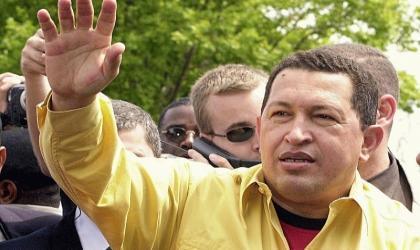 At the same time, from June 28, 2009, to March 7, 2013, the newspaper has printed at least 15 news and opinion articles in which its contributors have used any number of the aforementioned epithets for Chávez.9 (This methodology excludes the typically vitriolic anti-Chávez blog entries that the paper features on its website, as well as print pieces like Lizette Alvarez’s, which quote someone describing Chávez as a dictator.)

 Aletho News
