Sins of Omission
By Jason Hirthler | NYTimes eXaminer | March 21, 2013
The New York Times coverage of Hugo Chavez’ death was a bunker buster of misinformation.
The socialist left was plunged into a state of crisis last week when its leading advocate was felled by cancer. The death of Venezuelan President Hugo Chavez dealt a potentially crippling blow to the Bolivarian revolution’s hold on the Venezuelan nation. With their leader gone, Chavistas are scrambling to align their ranks behind Nicolas Maduro, an unimposing background figure in the Chavez narrative. And despite the stunning successes of the Chavez government—from a vertiginous drop in poverty to an equally dramatic rise in literacy, the establishment of a legislative apparatus designed to benefit the nation’s majority, and the nationalization of Venezuelan oil—the opposition is poised to renew its attack on the socialist experiment of the last decade and a half. Furious over repeated humiliations at the ballot box, the Venezuelan right, led by Henrique Capriles, is anxious to steer the country back to failed prescriptions of neoliberal economics, hoping to seize on an unexpected election to reclaim the presidency.
Naturally, few if any of the Bolivarian triumphs were mentioned in The New York Times ungenerous lead on the demise of the Venezuelan leader. Already, our leading propaganda daily has begun its historical revision of Chavez’ legacy. Its prejudiced coverage of the El Commandante’s death was remarkable only it what it elided from view—namely any of the progressive transformations the Bolivarian socialist engendered. Regarding the state of the nation, only a few conditions were noted. While vague mention was made that Chavez had “empowered and energized” millions of poor people, the print edition headline said Venezuela was a nation in “deep turmoil.” The digital edition brusquely mentioned, “high inflation and soaring crime,” as well as, “soaring prices and escalating shortages of basic goods.” While there is some truth to these claims—particularly in relation to crime—none of Chavez’ achievements were noted, an astonishing array of programmatic successes that have dwarfed the failures of his tenure.
But before adding anything else, let’s briefly look at the indictments delivered by the Times:
- After devaluing its currency in 2010, pundits predicted massive inflation. Instead, inflation declined for two years, while economic growth topped four percent both years. This is ignored. Nor does the article note Venezuela’s spiraling rate of inflation before Chavez took office—or that he has actually significantly reduced it. While prices rise with inflation, the government offers subsidized goods through weekly Mercal and also regularly adjusts minimum wage to match or exceed inflation, which increases consumer purchasing power, which itself has increased 18 percent in Chavez’ first decade in office.
- In stark contrast to improving economic numbers, Venezuela’s murder rate increased threefold during Chavez’ three terms in office, now third highest in the Americas, calling into question the effectiveness of police training. A new training program was launched in 2009, but has yet to produce results. The Bolivarian National Police, also launched in 2009, has lowered rates where it is active, but chronic problems continue to plague the country, particularly Caracas, including police corruption, biased judiciaries, the likelihood of not being prosecuted, the presence of millions of weapons, and the fact that Venezuela is a main thoroughfare for illegal drugs on their way to the United States.
- Food shortages are also present, another surprising condition in a country of declining poverty. Western critics naturally point to price controls as the cause, providing a typically ideological explanation for a problem that appears to have a more nuanced answer. Food consumption in Venezuela has exploded since Chavez took office in 1999. The population consumed 26 million tons of food in 2012, double the 13 million tons they consumed in 1999. The government suggests the shortages are a consequence of rapidly increasing consumption. Food production is up 71 percent since Chavez took office, but consumption is up 94 percent.
Claims without Context
A day later, the Times decided that its stinting initial coverage was too generous: it had merely listed the flaws in Venezuelan society. What it had failed to do was pepper the pot with a heavy dose of falsification. It then released a factless catalogue of misinformation that, when it wasn’t quoting louche academics, was irrigating the column with toxic dogma. It began, in its home page tout, with a headline about “Debating Chavez’s Legacy,” by author William Neuman. The sub-line anxiously opened the festivities with an elephantine distortion: “Venezuela had one of the lowest rates of economic growth in the region during the 14 years that Hugo Chavez was president.”
Well, after that opener, why bother writing a column? The case has already been made. Best to have the tout lead to a broken link, or redirect to Thomas Friedman hyperventilating about the glories of globalization on display in Indonesian sweatshops. But no, the Times were out for blood. This was no ordinary socialist. Chavez deserved a double-barreled dose of disinformation.
Regarding its initial claim that Venezuela had one of the “lowest rates of economic growth in the region during the 14 years that Hugo Chavez was president.” This statistic is taken from the World Bank. It is true. What it fails to mention is the nosedive the Venezuelan economy fell into when U.S.-backed, right-wing elites overthrew the democratically-elected Chavez in 2002. The economy fell at nine percent into 2003. Then there were devastating oil production shutdowns engineered by the same cadre of oppositionists when Chavez moved to nationalize the oil industry.
Despite this and other opposition attempts to sabotage the economy through food hoarding, price speculation, and other noble measures, the Times neither bothers to contextualize their claim nor balance it against the significant achievements of the Bolivarian government. If elements of socialism actually work, don’t the Times readers deserve to know about them? Evidently not, according to the editors, who see it as their duty to shelter their gullible readership from the facts. But consider these facts about Venezuela’s socialist experiment:
- Per capita GDP in Venezuela is up 50 percent since the coup.
- The Venezuelan economy was among the fastest growing Latin nations in 2012.
- Its economy has grown steadily for nine consecutive quarters.
- Inflation has been cut nearly in half since Chavez took office, when it was spiraling out of control thanks to the ever-efficient neoliberal private sector leadership.
A Legacy Belittled
The article then claims that Chavez’ massively attended funeral was “a tribute to the drawing power of the charismatic leftist leader, although perhaps not to the lasting influence of his socialist-inspired policies.” This line nicely inverts the obvious truth—the masses turned out precisely because of Chavez’ socialist-inspired policies. The policies the paper had given an unfair drubbing in the opening tout have driven consistent growth in society’s most impoverished sectors. Poverty has been reduced by 70 percent since Chavez won the presidency. Nutritional measures among the poor are up across the board, while strengthened pension programs, freely available healthcare, and an inflation-linked minimum wage are helping produce a viable workforce with growing purchasing power—a prerequisite of demand and economic expansion.
The paper then says Chavez’ revolution “remains more limited than he would have liked,” a spurious attempt to cast the Bolivarian revolution as a failure, when in fact, against most significant social and economic metrics, the socialist experiment exceeded itself. To reinforce this portrait of another foreclosed attempt to establish a socialist state, the Times trots out Alejandro Toledo, a former president of Peru. Toledo replaced the Peruvian strongman Alberto Fujimori, and was so unpopular—even though he succeeded one of the continent’s most vile authoritarians—that his approval rating dropped to six percent in 2004, when street rioting briefly paused to permit the survey. Here is Toledo:
“The important thing is that Mexico has not followed his example, Chile has not followed his example, Peru has not followed his example, Colombia has not followed his example, Brazil has not followed his example. I’m talking about big countries with large, sustained economic growth.”
Toledo, like the paper, obviates Chavez’ stunning impact on continental politics, an influence that has encouraged similar leftist triumphs in Ecuador, Argentina, Paraguay, Guatemala, Nicaragua, and others. Chavez convinced many of his regional colleagues of the dangers of forging discrete trade agreements with the United States—with NAFTA as the ne plus ultra in the category—and then promoted regional agreements among his Latin counterparts. Chavez worked to expand Mercosur into a continental trade platform, not simply that of South America’s southern cone. Then he established such inter-continental co-operatives as Telesur, PetroCaribe, and Petrosur, as well as the Bolivarian Alliance for the Americas (ALBA).
Sidelining Socialism
With little left to criticize, and plenty of column width to fill, the author resorts to repetition and veiled attacks on socialism. The claim about Venezuela’s low rates of growth is repeated. Then the social flaws from the previous day’s coverage are hurried back into commission: high inflation, shortages of basic goods. High crime, bitter political divisions.
Then, in a turn both sour and childish, the Times concedes that “poverty went down significantly,” but quickly adds that, “other countries…made progress in reducing poverty while following paths very different from that of Mr. Chavez.”
A Brazilian academic then claims that governments in countries like Brazil have “a more balanced position” and that unnamed left-leaning governments are looking to its model and not Venezuela’s for guidance.
No evidence is offered for this claim. Nor does the Carioca academic mention what precisely is “balanced” about a Brazilian society in which the household income of the top one percent is equal to that of the bottom 50 percent of society.
After a short series of additional points—including the passing notation that masses of citizens marched for hours alongside Chavez’ casket—much is made of Chavez’ use of oil resources to build relations with other South American governments. The unstated claim: that Chavez bought his friends. An “energy fellow” at the Council on Foreign Relations, notes rather peevishly that “Venezuela’s influence in Latin America was built on the back of oil exports,” as if it is somehow bad form to play one’s cards in international affairs. And as if the United States hadn’t been bribing its way across the Middle East for the last decade.
Disarming Protest
There you have it: the disingenuous reality of The New York Times, a paper that disguises its bias behind a thin veneer of cool detachment and a studied use of non-inflammatory language, much like the paper’s bedmate in neoliberal apologetics, The Economist. The lengths to which the paper will go to discredit the creditable would be laughable if the paper weren’t so popular among self-proclaimed progressives. It is a powerful tool by which corporate power softens the blunt edges of austerity and disarms mainstream liberals with soothing messaging about good intentions and “balanced” approaches to economic development.
By rehearsing the standard refrains of American exceptionalism—a love of democracy, an abiding concern for the voiceless inhabitants of the developing world and the scourge of tyrants that seem forever to afflict them, and a noble need to extend our love of freedom to points south as well as the backward caliphates of the East—the Times tranquilizes would-be progressive protestors with the gentle rationalizations of corporate life—the ultimate virtue of which is the appearance of even-handedness. The kind of professorial restraint best represented by Obama, a façade the opposite of which—the dangerous passions of the oppressed—is frowned upon as “counterproductive” and known to be the bane of respectable men. And by respectable one may read fatally compromised.
Jason Hirthler is a writer, strategist, and 18-year veteran of the communications industry. He lives and works in New York City. He can be reached at jasonhirthler@gmail.com.
Related articles
- “Humanity Has Lost a Titan”: Interview with William I. Robinson on the Legacy of Hugo Chavez (alethonews.wordpress.com)
- Venezuelan Post-Chavez Roadmap to the Middle East (alethonews.wordpress.com)
- In the End, Awful Journalism (alethonews.wordpress.com)
How to Read Stories About Israel in the NY Times (Hint: Very Carefully)
By Peter Hart | FAIR | March 21, 2013
Some days the Newspaper of Record says a lot–not always in ways you might expect.
Today (3/21/13) a story by Mark Landler and Rick Gladstone about allegations of chemical weapons in Syria includes something you see often–anonymous government sources. That can often be a bad thing; but today it’s pretty useful:
Two senior Israeli officials, speaking on the condition of anonymity because they were not authorized to speak, said that Israel was sure that chemicals were used, but did not have details about what type of weapons were used, where they came from, when they were deployed, or by whom.
A third senior official, also refusing to be identified, said, “It is possible that chemical weapons were used, or some concoction of chemical substances,” but he said he had not “seen clear confirmation.”
Why is this helpful? Because other Israeli officials, speaking publicly and for attribution, pretended to be more certain. From the very same Times piece:
Two senior ministers in Israel’s new cabinet said publicly on Wednesday that chemical weapons had been used, and several government officials said in interviews that Israel had credible evidence of an attack. The ministers, Tzipi Livni and Yuval Steinetz, were among those who met with Mr. Obama here on the first day of his trip.
and:
Israeli officials provided no proof of their assertions but appeared more confident that chemical weapons had been used.
Ms. Livni, the new Israeli justice minister, said in an interview with CNN, “It’s clear for us here in Israel that it’s being used,” adding, “This, I believe, should be on the table in the discussions.”
Mr. Steinetz, the minister for strategic affairs, said on Israel’s Army Radio, “It’s apparently clear that chemical weapons have been used against civilians by the rebels or the government.”
So is the Times, in its own way, telling us not to trust the officials speaking on the record? That’s certainly one way to read the piece.
Elsewhere in the paper we learn that part of Barack Obama’s visit to Israel includes a look at the country’s “Iron Dome” missile defense system, which is funded by the U.S. government. In one story, by Mark Landler and Jodi Rudoren, we read this:
Mr. Obama was driven across the tarmac to inspect a battery of the Iron Dome air-defense system. The system, built by Israeli companies but financed by the United States, is credited with intercepting more than 400 rockets fired from Gaza at Israeli towns….
Israeli officials say that Iron Dome has been a huge success, intercepting 86 percent of the 521 incoming rockets it engaged in the Gaza conflict. Some American missile-defense experts have questioned that figure, putting the hit rate at closer to 10 percent.
So they either knock down almost every rocket, or almost none. That’s pretty unhelpful; but the Times has another piece that actually digs into the evidence (“Weapons Experts Raise Doubts About Israel’s Antimissile System”). According to this account, “a growing chorus of weapons experts in the United States and in Israel…suggest that Iron Dome destroyed no more than 40 percent of incoming warheads and perhaps far fewer.”
One former Pentagon official says there’s no system that is 90 percent effective. And the article, by William Broad, includes this:
Theodore A. Postol, a physicist at M.I.T. who helped reveal the Patriot antimissile failures of 1991, analyzed the new videos and found that Iron Dome repeatedly failed to hit its targets head-on. He concluded that the many dives, loops and curls of the interceptors resulted in diverse angles of attack that made it nearly impossible to destroy enemy warheads.
“It’s very hard to see how it could be more than 5 or 10 percent,” Dr. Postol said.
Mordechai Shefer, an Israeli rocket scientist formerly with Rafael, Iron Dome’s maker, studied nearly two dozen videos and, in a paper last month, concluded that the kill rate was zero.
Reading all of that, it’s hard to imagine anyone could really believe the Israeli claims about Iron Dome’s success rate.
So if you want to get a handle on Iron Dome, ignore the story on page 10 and pay attention to the story on page 11. And if you’re trying to figure out which Israeli officials to trust on the Syria chemical weapons story, the unnamed sources seem to be the ones who are more forthright about what they know.
That’s a lot to ask of readers, isn’t it?
Related articles
Looking Back at Iraq With… Michael Gordon?
By Peter Hart | FAIR | March 20, 2013
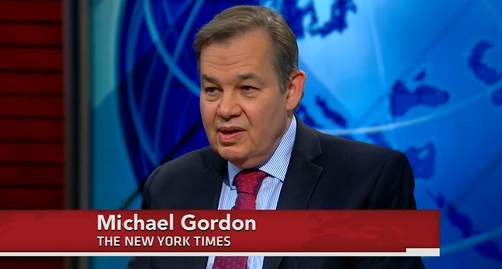
The performance of the corporate media is one of the principal failures of the Iraq War. There are almost too many examples to name; but most critics agree that one of the most instrumental single pieces that made the false case for war was the front-page New York Times story (9/8/02) hyping the idea that Iraq was trying to procure special aluminum tubes for its nuclear weapons program.
Last night in its 10-years-later segment, the PBS NewsHour (3/19/13) made a rather stunning judgment: One of the two expert journalists was the guy who co-authored that piece.
New York Times reporter Michael Gordon was the lead author on that infamous tubes article, but his record goes deeper than that. A few days into the U.S. bombing (3/25/13), Gordon appeared on CNN to endorse the bombing of Iraqi TV’s offices, calling it “an appropriate target,” since “we’re trying to send the exact opposite message.”
When U.S. politicians began to seriously consider a withdrawal of U.S. troops, Gordon criticized that policy, especially in one article (11/15/06) headlined, “Get Out of Iraq Now? Not So Fast, Experts Say” (FAIR Media Advisory, 12/4/06). He went on the Charlie Rose show (1/18/07) to endorse a troop surge. (Even the Washington Post admits that the idea that the surge succeeded is a “myth”–3/15/13.) And in early 2007, Gordon wrote articles, relying heavily on anonymous U.S. sources, alleging that the Iranian government was sending weapons into Iraq (Action Alert, 2/16/07).
So why would Gordon be someone you’d want to listen to about the Iraq War? That’s hard to say, really. But Gordon had plenty to tell PBS viewers. He complained that the Obama White House wasn’t interested enough in Iraq–leading to “the decline of American influence.” As he put it:
I think they view Iraq as just another country. They don’t have the same emotional or psychological or even foreign policy stake in it that the previous administration had.
Gordon added that the U.S. military “see a lot of early mistakes in the first years” of the war, but that “I do think the surge, as a military operation and military strategy, was effective and was essential.”
When one of the hosts, Judy Woodruff, asked about the war’s legacy, he replied: “Well, I think the military learned how to do counterinsurgency. The public opinion may no longer support that, but forever is a long time. And I think you can’t say we won’t have to do that again at some point in the future.”
And if there is ever another moment that requires reporters to faithfully record the views of anonymous U.S. officials as they make their case for war, it’s a safe bet that Michael Gordon will be there to do that job.
Related video
31% of Americans Have Abandoned News Outlets Due to Perceived Decline in Quality
By Noel Brinkerhoff and Danny Biederman | AllGov | March 20, 2013
News organizations have lost a significant share of their audience due to budget cuts that have impacted the quality and quantity of reporting.
A new poll from the Pew Research Center found that 31% of respondents said they had stopped using a particular news outlet because it was no longer providing the same kind of news and information as in the past.
Pew researchers said that those most likely to stop using news sources were better educated, wealthier and older than those who still used them—“in other words, they are people who tend to be most prone to consume and pay for news,” Pew’s The State of the News Media 2013 read.
Losses of subscribers and ad revenues have negatively impacted many news organizations in recent years, forcing layoffs and reduced coverage. Most of the people to whom Pew researchers talked were either largely or entirely unaware of this situation, the survey revealed.
There is, however, a glimmer of hope for the embattled newspaper industry, which has been under financial duress since the onset of the recession in 2007 and growing competition from online news services. The Pew study reports that a trend of stabilizing revenue is evidenced by news organizations’ use of social media to support advertisers, digital pay plans, increased investor interest, and across-the-board advertising growth attributed to a modestly improving economy.
The Pew authors concede, however, that these positive signs “are, for the time being, mostly promise rather than performance,” and that the overall prognosis still appears grim.
Related articles
- U.S. news industry unprepared to uncover news and challenge claims, report says
- In the End, Awful Journalism
- On Venezuela, The New Yorker’s Jon Lee Anderson Fails at Arithmetic
- Chavez Is Dead, the Media Are Alive and Kicking
- Time’s Ticking Clock on War With Iran
- AP: Chavez Wasted His Money on Healthcare When He Could Have Built Gigantic Skyscrapers
Armistice’s Day Is Done–Contrary to NYT
By Jim Naureckas | FAIR | March 13, 2013
The New York Times (3/8/13), writing about Korean tensions, reported:
The North said this week that it considered the 1953 armistice agreement that halted the Korean War to be null and void as of Monday because of the joint military exercises. The North has threatened to terminate that agreement before, but American and South Korean military officials pointed out that legally, no party [to an] armistice can unilaterally terminate or alter its terms.
“Nonsense,” says Francis Boyle, professor of international law at the University of Illinois (Institute for Public Accuracy, 3/13/13):
An armistice agreement is governed by the laws of war and the state of war still remains in effect despite the armistice agreement, even if the armistice text itself says additions have to be mutually agreed upon by the parties. Termination is not an addition.
Boyle pointed to both U.S. military regulations and international law as evidence that the Times’ claim was wrong:
Under the U.S. Army Field Manual 27-10 and the Hague Regulations, the only requirement for termination of the Korean War Armistice Agreement is suitable notice so as to avoid the charge of “perfidy.” North Korea has given that notice. The armistice is dead.
The Army Field Manual states, “In case it [the armistice] is indefinite, a belligerent may resume operations at any time after notice.” Article 36 of the Hague Regulations says:
An armistice suspends military operations by mutual agreement between the belligerent parties. If its duration is not fixed, the belligerent parties can resume operations at any time, provided always the enemy is warned within the time agreed upon, in accordance with the terms of the armistice.
The New York Times should let its readers know that it allowed anonymous officials to mislead them.
Chavez in the Crosshairs
By Laura Carlsen | Americas Program | March 12, 2013
You could almost hear the sigh of relief coming out of Washington at the news of Hugo Chavez’s death on March 5.
President Obama issued a brief statement that failed even to offer condolences, forcing a senior State Department official to patch over the evident callousness and breach of diplomacy by offering his personal condolences the following day.
Within moments of Chavez’s death, commercial media and mouthpieces for the U.S. government were verbally dancing on his grave and predicting the imminent demise of Chavismo—Chavez’s political legacy in Venezuela and abroad.
Time headlined its article “Death of a Demagogue.” The New York Times, which bent over backwards to minimize Chavez’s overwhelming victory in Venezuela’s October elections—and later to portray his battle with cancer as a cover-up, mimicking opposition claims—proclaimed that Chávez’s death“casts into doubt the future of his socialist revolution” and “alters the political balance not only in Venezuela, the fourth-largest supplier of foreign oil to the United States, but also in Latin America”—and this in a news article with no sourcing provided.
The Inter-American Dialogue, a U.S. think tank, concluded that “Chavez’s legacy, and the damage he left behind, will not be easily undone,” and predicted that the social gains and regional institutions Chavez built over his political lifetime will soon fall apart and things will soon return to normal—that is, with the United States back in the hemispheric driver’s seat.
Congressman Ed Royce (R-CA) came right out and said “Hugo Chávez was a tyrant who forced the people of Venezuela to live in fear. His death dents the alliance of anti-U.S. leftist leaders in South America. Good riddance to this dictator.”
So why did Washington hate this guy so much?
It never helped that the South American president had a penchant for insulting his adversaries personally. But one supposes that diplomacy rises above name-calling, even if the other guy did it first. The anti-Chavez current in Washington goes far deeper than personal enmity or even political differences.
What scared Washington most about Chavez was not his failures or idiosyncrasies. It was his success.
The official reasons given for demonizing Hugo Chavez don’t hold water. Chavez is accused of restraining freedom of the press in a nation known for its ferociously anti-Chavez private media. And while his Yankee critics called him a dictator, Chavez and his policies won election after election in exemplary electoral processes. You can disagree with his reform to permit unlimited terms in office, but this is the practice of many nations deemed democratic by the U.S. government and considered close allies. And the criticisms of Chavez’s social programs as “patronage” cannot ignore the millions of lives tangibly improved.
Before Chavez turned Venezuela away from the neoliberal model, the nation was a basket case. But throughout his tenure, social indicators that measure real human suffering showed steady improvement. Between 1998, when he was first elected, to 2013 when he died in office, people living in poverty dropped from 43 percent of the population to 27 percent. Extreme poverty dropped from 16.8 percent of the population to 7 percent. According to UNESCO, illiteracy—nearly 10 percent when Chavez took office—has been eliminated. Chavez also reduced childhood malnutrition, initiated pensions for the elderly, and launched education and health programs for the poor.
Venezuela’s human development ranking subsequently climbed significantly under Chavez, reaching the “high” human development category. The programs that Washington scorned as “government handouts” made people’s lives longer, healthier, and fuller in Venezuela.
Now that Chavez is dead, the U.S. press has revived the State Department’s practice of designating the “good left” and the “bad left” in Latin America. Chavez, of course, embodied the “bad left,” while Brazil’s Lula was unilaterally and unwillingly designated the “good left”.
Yet it was Lula da Silva who defended his friend and made the case for Chavez’s lasting positive legacy in the pages of the New York Times. He eulogized the leader and predicted, “The multilateral institutions Mr. Chávez helped create will also help ensure the consecration of South American unity.”
In fact, Chavez’s success in building institutions for alternative regional integration is one of the big reasons Washington hated him. The self-declared anti-capitalist led Venezuela as it joined with regional powerhouse Brazil and other southern cone countries to make a bid to crack the Monroe Doctrine. Along with Andean nations, they also sought, in varying degrees, to wrest control of significant natural resource wealth from transnational corporations to fund state redistribution programs for the poor.
In 2005, Chavez helped scuttle the U.S. goal of a Free Trade Area of the Americas. Later he spearheaded the formation of the Union of South American Nations (Unasur) in 2008. As a Latin American alternative to the U.S.-dominated Organization of American States, the 12-member Unasur proved its value by successfully mediating the Colombia-Ecuador conflict and the Bolivian separatist crisis in 2008. In 2010, Chavez again played a major role with the creation of the Community of Latin American and Caribbean States, made up of hemispheric partners, excluding the United States and Canada.
The Bank of the South, also promoted by Chavez, seeks greater South-South monetary and financial autonomy. As Lula writes in his editorial on Chavez´s death, the Bank offers an alternative to the World Bank and IMF, which “have not been sufficiently responsive to the realities of today’s multipolar world”.
With stops and starts, these initiatives have moved regional integration forward outside the historic model of U.S. hegemony.
U.S. Moves and the Principle of Self-Determination
What happens next? Venezuela held an emotional funeral on March 8 and is planning for April elections. Most predict that Vice President Nicolas Maduro, selected by Chavez as his successor, will win easily. He has the advantage of Chavez’s blessing: a common slogan in Caracas these days is “Chavez, te juro, que voto por Maduro” (“Chavez, I swear, my vote is for Maduro”). Another sign that Chavismo lives on was the thousands of people at the funeral chanting “Chavez didn’t die; he multiplied.”
The State Department views dimly the prospect of an improved U.S.-Venezuela relationship under Maduro. On March 6, the State Department held a press call on which “Senior Official One” (a State Department practice for “background” when its officials apparently don’t want to be identified with their own public statements) said the department was optimistic following Chavez’ death, but that “yesterday’s first press conference, if you will, the first address, was not encouraging in that respect. It disappointed us.”
He referred to a 90-minute address by Maduro, stating that “the enemy” attacked Chavez’s health. The Venezuelan government also announced the expulsion of two U.S. military personnel in Venezuela, allegedly for having contacted members of the Venezuela military to stir up an insurrection.
The State Department noted that it plans “to move ahead in this relationship” by holding conversations in areas of common interest, citing “counternarcotics, counterterrorism, economic or commercial issues including energy.” It added, “We are going to continue to speak out when we believe there are issues of democratic principle that need to be talked about, that need to be highlighted.”
During the Chavez years, U.S. officials and the press went into contortions to avoid congruency with the basic principle that democracy is measured by elections. With Chavez having indisputably won some thirteen elections, the U.S. government applied new criteria to Venezuela along the lines of “democracy can be wrong.” Despite his broad-based support, many went so far as to dub Chavez a “dictator.”
The U.S. government’s commitment to democracy falters when Washington doesn’t like the results. It supported the failed coup against Chavez in 2002 and blocked the return of Honduras’s elected president after the 2009 coup there.
Now all eyes will be on Washington to see whether it upholds another value reiterated by President Obama—the right to self-determination. Will U.S. “democracy-promotion programs” under NED, IRI, and other regime-change schemes resist the temptation to meddle in Venezuela’s April 14 elections? Venezuela without Chavez will be a test of moral and diplomatic integrity for the second Obama administration and John Kerry’s State Department, and a challenge for Congress and the citizenry to monitor and prevent covert activities that interfere with the exercise of democracy.
Related articles
- Unprecedented Show of Support and Honor at the Historic Funeral of Hugo Chávez (alethonews.wordpress.com)
- Chavez Is Dead, the Media Are Alive and Kicking (alethonews.wordpress.com)
- U.S. and Canada Isolated as Latin American Leaders Acknowledge Chávez’s Regional Leadership (venezuelanalysis.com)
CHAVEZ IS DEAD, THE MEDIA ARE ALIVE AND KICKING
By Pablo Navarrete | Latin America Bureau | March 13, 2013
On Tuesday 5 March, at the age of 58, Venezuelan president Hugo Chávez lost his almost two-year battle with cancer and passed away. Within seconds of the news being announced, the wheels of the global media bandwagon went into overdrive, with largely unsurprising results, in both the US and British media. At the most distasteful end of the spectrum was the headline in the New York Post, the paper with the 7th highest circulation in the US, that read ‘Off Hugo! Venezuela bully Chavez is dead’.

New York Post Cover on Chávez
Other US media followed closely behind. ‘Death of a Demagogue’ ran a headline on the website of Time, the world’s biggest selling weekly news magazine. These and other US media reaction were included in a piece by the US media watchdog Fair and Accuracy in Reporting (FAIR) that also examined the distorted, often hysterical, US media coverage of Chávez during his presidency. It’s worth recalling that following the 2002 US-supported coup that briefly removed Chavez from the presidency the New York Times declared that Chavez’s “resignation” meant that “Venezuelan democracy is no longer threatened by a would-be dictator.”
Following Chávez’s death, the antipathy towards a president that had so vehemently challenged the actions and interests of the United States was also evident in the British media. Rightwing outlets displayed the usual cynical disdain that had characterised their reporting of Chávez’s presidency, although Nicolas Maduro, Chávez’s former vice-president, the current interim president and the government’s candidate for the April 14th presidential election, was also now in the firing line. In the UK’s biggest selling broadsheet, the rightwing Daily Telegraph, its chief foreign correspondent David Blair described Maduro’s role as foreign minister under Chavez in the following terms: “Mr Maduro was the obedient enforcer of his master’s highly personal foreign policy”. For Blair, Maduro, rather than responsibly representing his government’s foreign policy, was “a loyal purveyor of ‘Chavismo’ around the world”.
The ‘liberal’ left in Britain
Britain’s liberal-left media also offered a timely reminder of where their loyalties lay in relation to Chavez, whose democratic mandate included presiding over 15 national elections since he took office in February 1999, a greater number of elections than were held during the previous 40 years in Venezuela. In a remarkable editorial, The Independent newspaper opined:
“Mr Chavez was no run-of-the-mill dictator. His offences were far from the excesses of a Colonel Gaddafi, say. What he was, more than anything, was an illusionist – a showman who used his prodigious powers of persuasion to present a corrupt autocracy fuelled by petrodollars as a socialist utopia in the making. The show now over, he leaves a hollowed-out country crippled by poverty, violence and crime. So much for the revolution.”
This from a newspaper that in June 2009, following a military coup that overthrew the democratically elected government of President Manuel Zelaya in Honduras, ran an editorial that included the following:
“The ousting of the Honduran President Manuel Zelaya by the country’s military at the weekend has been condemned by many members of the international community as an affront to democracy. But despite a natural distaste for any military coup, it is possible that the army might have actually done Honduran democracy a service.”
The Independent’s competitor in the UK’s liberal-left newspaper market, The Guardian, showed a similarly hostile stance towards Chavez during his presidency. In a piece on the New Left Project website examining the critical UK media coverage of Chavez following his death, Josh Watts noted how the anti-Chavez bias of Rory Carroll, a Guardian journalist and its former Latin America correspondent, “has been extensively documented”. As Samuel Grove noted in a damming 2011 article, Carroll’s Latin America coverage “has attracted widespread criticism for its selectivity and double standards, brazen anti-left bias, and above all slavish loyalty to Western interests”. There is now surely a book’s worth of material exposing Carroll’s distorted Venezuela coverage.
Carroll has managed to take his agenda beyond the confines of The Guardian. For example, in an Al Jazeera English debate on the continued demonisation of Chavez by the Western media that took place three days after Chavez’s death, Carroll repeatedly tried to present Venezuela under Chavez as an economic failure. He repeated this line of attack in a BBC 3 radio interview in late February, where he accused the Chavez government of being responsible for “decay, ruin, waste” in relation to the economy. Contrast this with the rigorous reports on the socio-economic changes under the Chavez presidency by the Washington-based think tank, the Center for Economic and Policy Research (CEPR), which completely undermine Carroll’s narrative of economic failure.
This fact-based approach to appraising elements of the Chavez legacy has not been lost on The Guardian’s associate editor Seumas Milne, who referenced CEPR’s latest report when he tweeted: “Media claims #Chavez ruined #Venezuela‘s economy absurd: here are the facts on growth, unemployment, poverty http://bit.ly/13Nnwno @ceprdc”
It was precisely these socio-economic gains, especially for those in the low-income neighbourhoods known as barrios that encircle Caracas and other Venezuelan cities and who formed Chávez’s support base, that lay behind his popularity and his repeated electoral victories.
Focus on denigrating the individual
Rather than try to explain Chávez’s appeal to large sectors of the Venezuelan population or understand the process of radical change underway in the country, the West’s media class preferred to focus almost entirely on the figure of Chávez. It was precisely this narrative that was so effective in discrediting the Venezuelan process through concealing the role of collective agency, silencing the people from below, and rendering them insignificant. While the mainstream media routinely ignores the voices of the government’s grassroots supporters, they have been instrumental in driving the Venezuelan process forward and should be at the centre of the story.
Thus, when we contrast Chávez’s popularity at home with the open hostility with which Western political elites viewed him, we’re left questioning the motivation behind the anti-Chávez mass media campaign that has systematically misrepresented events in Venezuela.
John Pilger is right when he writes:
“Never has a country, its people, its politics, its leader, its myths and truths been so misreported and lied about as Venezuela.”
Even though Chávez is dead, his vilification by the US and UK media is alive and kicking.
Pablo Navarrete is a LAB correspondent and a PHD student at Bradford University in the UK, researching the political economy of the Chavez presidency. He is also the director of the documentary ‘Inside the Revolution: A Journey into the Heart of Venezuela’ (Alborada Films, 2009). You can watch the documentary online here.
In the End, Awful Journalism
By Chris Carlson | Venezuelanalysis | March 12th 2013
On the occasion of Venezuelan President Hugo Chavez’s death last week, much of the international media responded in typical fashion, by painting the Chavez administration much as they painted it when Chavez was alive—as an autocratic regime led by a foolish tyrant who mismanaged the country and squandered its oil wealth.
They showed little mercy for the larger-than-life leader, so beloved by the majority in his country, and by millions around the world, giving the impression that Hugo Chavez got almost everything wrong, and did virtually nothing right.
Many of the criticisms have an element of truth to them, as many problems persist in Venezuela. And the press made sure to highlight these problems as evidence of Chavez’s failure, making it sound as if any sensible leader or government in Chavez’s position could have resolved them. But what showed through more than anything in these anti-Chavez tirades was a very revealing, almost embarrassing, misunderstanding of Venezuela’s principal economic and social issues.
“It’s a pity no one took 20 minutes to explain macroeconomics to him,” writes Rory Carroll in an op-ed in the New York Times that claims Chavez was “an awful manager” who destroyed Venezuela. Carroll slams Chavez for everything from failing to fix up the presidential palace, to spending too much on education and health, to not investing enough in infrastructure.
As The Guardian’s correspondent in Venezuela since 2006, Carroll apparently had seen enough to conclude that Chavez had “left Venezuela a ruin”. Yet one wonders if he ever managed to talk to the millions of Venezuelans—those who packed the streets to mourn the president’s death last week—who feel the country has been forever transformed.
For literally days on end, non-stop, all day and all night, people filed through the building where Chavez’s body was displayed to pay their final respects. A line stretched for miles outside, as people waited several days, eating and sleeping in the line, just to see their president one last time. This immense outpouring of emotion is very hard to square with the image Carroll gives us.
It might be an exaggeration to say Chavez transformed the country—though many things were deeply changed—but one doesn’t have to be an expert to know that Venezuela’s problems are more complicated than one man and his personality quirks.
The Economist tells us that Chavez was a “narcissist” who was “reckless” with his country’s economy and who “squandered an extraordinary opportunity”. We are told Chavez could have used the country’s oil wealth to “equip [Venezuela] with world-class infrastructure and to provide the best education and health services money can buy”. But due to mismanagement, “the economy became ever more dependent on oil”. Carroll echoes this, blaming Chavez for a “withering” private sector, and decaying infrastructure.
But apparently these self-proclaimed experts have never taken even the most cursory look at Venezuelan history. Had they done so, they would know that since Venezuela’s oil wealth was first discovered nearly a century ago, no government has ever been able to do what they claim should have been accomplished by the Chavez government.
Past governments have invested the country’s oil wealth in infrastructure, industry, and development projects—though never as much as Chavez—yet not one of them managed to break dependence on oil, diversify the economy, create a flourishing private sector, or build adequate health and education services. Was it because they were all reckless narcissists? Or do these problems perhaps have an explanation that goes deeper than the president’s personal style?
Of course, the truth is much more complex than what the Chavez haters would like to admit. It is true that Chavez did not provide solutions to many of Venezuela’s problems, and that some problems even got worse, but contrary to the media claims, he probably did better than any previous government in Venezuelan history.
One gets the opposite impression from much of the international media. Take a look at the following paragraph from last week’s article in the The Economist:
Behind the propaganda, the Bolivarian revolution was a corrupt, mismanaged affair. The economy became ever more dependent on oil and imports. State takeovers of farms cut agricultural output. Controls of prices and foreign exchange could not prevent persistent inflation and engendered shortages of staple goods. Infrastructure crumbled: most of the country has suffered frequent power cuts for years. Hospitals rotted: even many of the missions languished. Crime soared: Caracas is one of the world’s most violent capitals. Venezuela has become a conduit for the drug trade, with the involvement of segments of the security forces.
Amazingly, almost every sentence in the paragraph is false. Agricultural output did not drop, but rather grew by 2 to 3 percent per year, and grain production, which was the government’s major focus, grew by 140 percent. Inflation was considerably lower under Chavez than the previous two governments. Food shortages and power cuts were caused by the explosion in consumption among the poor, not a fall in production.
Both electricity production and food production have increased to all time highs. Thousands of new health clinics have been built around the country. However, it is true that many hospitals remain inadequate, that crime has soared, and that Venezuela is still a conduit for the drug trade, as it shares a large border with Colombia.
The claims of increased oil dependence are also not borne out by the facts. It is true that oil as a percentage of total exports has increased, but this is largely due to the fact that oil prices have increased nearly ten-fold since Chavez came to power, making it inevitable that their value in relation to total exports would also increase.
The critics say Chavez squandered the country’s oil wealth, which he could have used to transform it into a modern state. Indeed, the oil boom left Venezuela awash in oil money, a situation that Chavez’s policies had a hand in creating, as he united OPEC and increased royalties and taxes on the oil sector, giving the state vastly more funds to work with. If only this “awful manager” knew how to administer the funds, critics say, Venezuela could have been well on its way to becoming a modern, developed nation.
But this is shortsighted. Nations do not develop on the basis of resource wealth or commodity booms. A country cannot spend its way into the first world. Rather, economic development is about systematic growth in productivity, innovation, and technical change, activities that typically fall on the shoulders of the private sector. In the developed world, it is largely the private sector that invests surpluses into new technologies and improvements in the productive process, something that does not occur in Venezuela in a systematic fashion.
Of course, critics and opponents of Chavez argue that this is also the fault of the government, that it is Chavez’s fault for not creating the right environment for private investment, and that with the “right” policies the private sector would decide to invest in the country and would produce the kind of economic development that will benefit all sectors of society. Apparently no Venezuelan government in history has been able to figure out what those “right” policies are.
But this ideology defeats itself with its own logic, for private investors in market economies don’t invest in productivity because they feel like it, or because the conditions are just as they like. They do so because they have to in order to match the competition, to survive in the market, and to avoid going out of business. In modern market economies, producers invest in improving productivity because they are compelled to do so by the market, not because they decide they want to.
The fact that much of the private sector in Venezuela has seldom been compelled to do the same only demonstrates that this economy does not function like the model market economy that these theories are based on.
Huge swaths of the nation’s agricultural land have long been dominated by large estates—the infamous latifundios—that feel very little pressure to improve productivity, and graze cattle on the nation’s best land. The commercial and industrial sectors have long been dominated by highly diversified conglomerates—the so-called grupos económicos—that control key sectors of the economy, and are rarely threatened by competition.
In other words, it goes against these critics’ whole line of reasoning to point out that what really determines whether a country is rich or poor is not commodity booms or resource wealth, but rather has to do with productivity growth—something that has seldom been a priority for much of Venezuela’s private sector.
It’s a pity that no one took 20 minutes to explain this to Rory Carroll, The Economist and others who blame all of Venezuela’s problems on Hugo Chavez, for he did more than any president in history to try to change the unproductive logic of the private sector.
More than 3.6 million hectares of unproductive land were expropriated and redistributed to over 170,000 small producers—far more than the entire 40 years of pre-Chavez land reform. Major sectors of the economy were nationalized, and state companies expanded, in an attempt to improve production, raise investment, and remove bottlenecks. Massive investments were made in agriculture and industry—far more than under previous governments—in an attempt to spur their growth.
Many of these attempts were failures. The growing state sector often allowed for inefficiency and corruption. Chavez’s solutions to the country’s economic and social issues were not always the correct ones.
But the point is that Venezuela’s problems are quite complex and defy easy answers. Previous governments with previous oil booms also failed to resolve the country’s major problems, and did much less to help the poor, something that does not seem to interest those who want to blame everything on Chavez.
Instead of seeking to gain a better understanding of the country’s problems—to understand why they have been so intractable throughout the country’s history—the major media have preferred to vilify and condemn one man; a man who, right or wrong, spent his life trying to solve the problems that plague his country, and was undeniably dedicated to helping the poor; a man who constantly reminded his country’s poor majority that they mattered, that they were not inferior to anyone, and that they should feel proud of their national heritage. That doesn’t sound like a narcissist to me.
Related articles
NYT’ Steven Davidoff Doesn’t Consider the Successful 300 Years of Financial Transactions Taxes In London
CEPR Beat the Press | February 26, 2013
Steven Davidoff really doesn’t like financial transactions taxes (FTT) but is not honest enough to acknowledge this fact. Instead he tells readers that proponents of a tax haven’t thought about its consequences and uncritically repeats every piece of nonsense produced by the financial industry to attack the idea.
In the course of a 1300 word essay we get assessments of the tax from Credit Suisse, Blackrock, and the Partnership for the City of New York, which is effectively the New York City Chamber of Commerce. All of these accounts are presented uncritically, as though the purveyors of this information had no interest other than conveying the truth. We are also told that the New York Stock Exchange “threatened to jump across the Hudson River to New Jersey” in reaction to a plan to increase the city’s stock tax in the 1966 (interesting image). Davidoff apparently never heard of businesses making threats to extract concessions from governments.
The NYT running a column like Davidoff’s is like the Iowa City Press Citizen running a column on a plan to cut back farm subsidies where the views of the state’s leading wheat and corn farmers are presented as unquestioned truth, along with a study from the corn growers trade organization. I suspect that the Press Citizen has higher standards.
Meanwhile when it comes to the proponents of the tax, Davidoff lectures:
“advocates of this neat idea conveniently ignore the century of less-than-successful experience with this tax, including New York State’s own failed attempt.”
This comment is more than a little bizarre. Davidoff writes as though proponents of the tax are completely ignorant of economics and have not done research into the history of financial transaction taxes.
Contrary to this assessment, the proponents of the tax include some of the world’s most prominent economists. Furthermore, there is extensive research on the history of financial transactions taxes. Much of it can be found right here on the European Commission’s (EC) website.
Contrary to Davidoff’s bizarre comment, implying the New York tax is a rare example of a government implementing such taxes, nearly all financial markets operated with financial transactions taxes for long periods of time (more than 300 years in the case of London’s market). Most of the world’s major financial centers, including London, Switzerland, Hong Kong and Singapore, still have financial transactions taxes on their stock exchanges. Perhaps Davidoff should be lecturing these governments on how their taxes really don’t work.
As far as the substance, Davidoff tells us that research shows that the tax will increase rather than decrease volatility. There are two different notions of volatility at play here. One is the volatility associated with normal price fluctuations over the course of a day or week. This is likely to be increased by a tax since it will increase the costs for arbitragers to enter a market. That means that we may see somewhat larger divergences between prices than would otherwise be the case. This could mean that the gap in the price of oil between two markets may rise to 0.4 percent rather than 0.3 percent before arbitragers whittle it down again.
Proponents of FTTs are probably not much concerned about this sort of volatility. The economic consequences are likely close to zero. Furthermore, since the levels of taxation being debated would just raise transactions costs back to where they were 10-15 years ago, it is difficult to believe that the effects could be too severe. (We did have very liquid capital markets in the 1990s.)
The type of volatility that more likely concerns proponents of FTTs are the sharp movements that are not driven by fundamentals, such as the 1987 crash and the flash crash in the spring of 2011. While it is difficult to prove that a FTT will reduce the likelihood of such sharp movements, it is worth noting that such events did not occur in the 50s, 60s, and 70s, when trading costs were much higher than in the last three decades.
As far as the incidence of the tax, Davidoff gives us the assessment of Blackrock:
“that if the financial transaction tax were set at 0.1 percent per trade, an investor putting $10,000 in its global equity fund would lose more than $2,300 in expected returns over a 10-year period. This amount would rise to $15,000 if the money were invested in a more actively managed European fund.”
Incredibly, Blackrock assumes that its trading does not in any way respond to the tax. If this were true then Blackrock’s funds would quickly go out of business since their cost would be far higher than others in the industry. There have been a range of trading elasticities estimated by various studies (see the EC research), with most estimates close to -1.0. (None are near zero.) If the elasticity is near -1 then trading volume would decline by roughly the same amount that the tax increases trading costs.
This means that if the tax doubled trading costs, then trading volume would be roughly cut in half. That means that if Blackrock’s fund managers responded as the research suggests, then they would cut back the number of trades by enough so that the non-tax trading costs for their $10,000 account would fall by roughly $2,300 over the course of a decade or $15,000 in the case of its more actively managed European fund. This would be revenue lost to Blackrock, not to its clients.
In this respect it is worth noting that the sharp decline in trading costs over the last four decades has not been associated with higher returns to investors, but rather to a more than proportionate increase in trading volume. This has caused the total amount spent on trading financial assets to rise sharply relative to the size of the economy. These trading costs are money out of investors’ pockets and a drain on the economy.
Davidoff’s effort to claim that the tax could not raise any revenue approaches the bizarre. He tells readers:
“In Britain, for example, where the financial transaction tax has fluctuated from half a percent to 2 percent, the tax has raised significantly less revenue than one might expect, about £3 billion a year. The reason is that investors who trade regularly in Britain use options to avoid the tax, which applies only to trading in stock. The result may be that the tax pushes investors into more risky securities in their efforts to avoid it.”
First, it is worth noting that £3 billion comes to 0.2 percent of UK’s GDP. (The UK had raised almost 0.3 percent of GDP from this tax before the 2008 crash [Table 2].) This would be the equivalent of almost $400 billion over the 10-year budget horizon in the United States. That is almost 3 times as much as President Obama has proposed to save by cutting the Social Security cost of living adjustment. In other words, in the current budget debates it would be regarded as real money.
Second, the decision to not tax derivatives like options is a political one made by governments that have been closely allied with the financial industry. The tax being put in place by 11 countries in the European Union would tax options and other derivatives. In the 1980s Japan had a broadly based tax that was imposed on a wide range of financial assets including options. This tax raised an amount of revenue that was close to 1.0 percent of its GDP. This would amount to $2 trillion over the 10-year budget horizon in the United States.
At one point Davidoff tells readers:
“As for seeking revenue gains to solve budget problems, if the tax is too small, it will have no effect.”
Huh? The Securities and Exchange Commission imposes a tax of 0.002 percent on stock trades in the United States. This tax raises roughly $1.2 billion to finance its budget. Is Davidoff suggesting that the SEC should get rid of this tax because it is not really raising money?
As I said, Davidoff doesn’t like FTTs, that’s pretty clear from reading this piece even though he tells us:
“This is not to say that a financial transaction tax by itself is such a terrible idea.”
He has a case built with non-sequitors (one example of the horror of FTTs is that traders fled a tax imposed by Sweden in the 1980s and instead did their trades in London, which also had a tax). And he ignores all sorts of evidence that FTTs can and do raise large amounts of revenue without disrupting capital markets. This piece lets us know where Davidoff stands on FTTs, it doesn’t provide much information on the merits of the policy.
Related articles
- Economist: Financial Transactions Tax Would Bring in Hundreds of Billions a Year (voicerussia.com)
- 5 Reasons Why The U.S. Needs A Financial Transactions Tax (thinkprogress.org)
Featured Video

Racist Seinfeld Dances for Joy as Bibi Unveils His New Map
or go to
Aletho News Archives – Video-Images
TV Drama Review
Japanese drama projects Japan’s wartime atrocities onto Chinese characters

Global Times | October 25, 2026
By portraying Chinese characters as perpetrators of ruthless violence while casting Japanese Self-Defense Forces (SDF) intelligence operatives as defenders, the season 2 of the Japanese drama Vivant has recently drawn criticism from Chinese netizens, who argue that its depiction turns historical reality on its head while ignoring Japan’s wartime atrocities.
The TBS drama series – a spy suspense story in which an alleged unofficial intelligence unit of the SDF operates across the globe — has attracted a passionate fanbase. Its currently airing season 2 opened with a household rating of 18.8 percent, the highest for a TV drama this year, according toa commentary article by Japanese media Toyo Keizai.
What draws attention is the portrayal of the enemies in the series, the article noted. Scenes in which the Chinese organization subjects kidnapped members of the SDF unit to brutal torture are repeated with unrelenting intensity.
It is rare for Japanese TV dramas to explicitly portray a real-life country as the enemy, the article noted.
Japanese Prime Minister Sanae Takaichi also made a reference to the drama, saying that she has been recording Vivant and hopes to binge-watch it over the year-end and New Year holidays, according to Japanese media outlets.
China’s CCTV News report on Sunday revealed that the drama features scenes in which Chinese personnel cut off the fingers of and stab Japanese intelligence operatives in the abdomen. Such acts bear striking similarities to the torture inflicted on Chinese nationals by invading Japanese troops during the World War II.
The drama distorts the truth by attributing these atrocities to modern Chinese characters. Beneath the surface, it subtly glorifies Japan’s cross-border overseas operations, blurs the functional boundaries of the SDF and implicitly promotes an expansionist narrative, per CCTV News. … continue
Blog Roll
 Aletho News
- Iran FM Araghchi: “Hormuz Will No Longer Be the Same”
- EU facing trillion-euro debt hole while seeking more cash for Kiev
- How US, Europe, Persian Gulf states exhausted missile stockpiles, splurged billions to defend Israel
- Up in arms… Koreans reject U.S. empire’s plan to make South Korea the next Ukraine
- Iran, Turkey, Pakistan, Saudi Arabia could advance region-led security framework in Tehran: FM spox
- Netizens condemn Japanese drama for projecting Japan’s wartime atrocities onto Chinese characters
- Racist Seinfeld Dances for Joy as Bibi Unveils His New Map
- A West Bank War for Netanyahu’s Election Campaign, Could It Backfire?
- Yemen denounces European Parliament’s ‘hypocritical’ push to blacklist Ansarullah
- Qalibaf: UAE’s UN bid aims to ‘clear the runway’ for ‘Greater Israel’, whitewash genocide
- If Americans Knew
- An error has occurred; the feed is probably down. Try again later.
- No Tricks Zone
- Sudden Stratospheric Warming, Powerful El Niño Combination May Lead To Extreme Europe Cold, Energy Crisis!
- Two New Studies Find Thwaites Glacier Melt Cannot Be Driven By Human Activity Or A Warming Ocean
- E-Cars Reduce CO2 Emissions By Only 41% Compared To Internal Combustion Engine Vehicles
- Predictions Made By Renowned Climate Professor Over Past Decades Have Been Proven To Be Poor
- New Study Suggests Large Regions Of The Pacific Ocean Have Been Cooling For The Last 80 Years
- Germany’s Green Energy Debacle: High Energy Costs Force Kahla Porzellan to Close After 182 Years!
- New Study: 50 Years Of The Most Aggressive ‘Net Zero’ Policies Can Only Affect The Global Climate By 0.03°C
- US September “Heat” Was No Record…Many Records Set Decades Ago
- Latest European Green Energy Debacle; Portugal’s Largest Flagship Solar Park Insolvent!
- Green Energy Debacle: German Expert Professor Fritz Vahrenholt Warns Of Severe Economic And Social Consequences

