Iran calls for international pressure to force Israel to sign NPT
Press TV – August 28, 2020
Iran has urged the international community to pressure the Israeli regime into joining the Non-Proliferation Treaty (NPT).
Deputy Representative of the Islamic Republic to the United Nations Es’haq Al-e Habib says the international community must force Tel Aviv to join the NPT and allow the International Atomic Energy Agency (IAEA) to access its nuclear facilities considering the Israeli regime’s destructive role in the region.
Addressing a virtual meeting on the anniversary of the Comprehensive Nuclear-Test-Ban Treaty (CTBT) on Thursday, Al-e Habib stressed that the destructive role of the United States and Israel has prevented the realization of a Weapons of Mass Destruction (WMD) Free Zone in the Middle East.
He slammed the US’ negative role in preventing the proliferation of nuclear weapons and said with 1,054 nuclear tests, Washington has had the highest number of such tests in comparison to other countries.
He referred to the US as the possessor of the world’s largest nuclear arsenal and the only country to have used nuclear weapons, and said Washington not only has no intention to end testing nuclear weapons and join the Comprehensive Nuclear-Test-Ban Treaty (CTBT) but also continues to modernize and strengthen its nuclear arsenal.
Nuclear disarmament must remain at the top of the international community’s agenda, he said, adding that the nuclear tests must be stopped since they are against the soul of CTBT and commitment to nuclear disarmament as per the Article VI of the NPT.
Israel, which pursues a policy of deliberate ambiguity about its nuclear weapons, is estimated to have 200 to 400 nuclear warheads in its arsenal.
The regime has refused to allow inspections of its military nuclear facilities or sign the NPT.
Under Article VI of the NPT, all parties to the treaty undertake to pursue good-faith negotiations on effective measures related to nuclear disarmament and the cessation of nuclear arms race.
France’s test of nuclear-capable ballistic missile inconsistent with NPT obligations: Iran
Press TV – June 20, 2020
Iran has voiced concern over a recent test-firing of an intercontinental nuclear-capable ballistic missile by France, saying the test is in clear violation of the Non-Proliferation Treaty (NPT) and inconsistent with the European country’s commitments vis-à-vis nuclear disarmament.
“The government of the Islamic Republic of Iran expresses its concern over the move and believes that the French government should not overlook its international obligations enshrined in Article 6 of the NPT and the NPT Review Conferences,” Iranian Foreign Ministry Spokesman Abbas Mousavi said on Saturday.
He added that France must fully comply with its international obligations regarding nuclear disarmament.
The Iranian spokesperson emphasized that nuclear weapons pose a threat to global peace and security, and said testing such weapons would undermine the NPT as the basis for international non-proliferation and nuclear disarmament.
The French Ministry of Armed Forces announced on June 12 the launch of an M51 submarine-launched ballistic missile (SLBM) from Le Téméraire, a Triomphant-class nuclear-powered ballistic missile submarine.
“The nuclear-powered Le Téméraire successfully fired an M51 strategic ballistic missile off Finistère,” Defense Minister Florence Parly announced in a Twitter post.
The launch was carried out without a nuclear warhead off France’s Western coastal region of Brittany. The missile was tracked throughout its flight phase by radars and by the missile range instrumentation ship Monge (A601), landing several hundred kilometers away in the North Atlantic.
The M51 – which replaced the M45 in 2010 – weighs 52,000 kilograms with a 12-meter length and a diameter of 2.3 meters. Its operational range is reported to be 8,000 to 10,000 kilometers with a speed of Mach 25. The three-stage engine of the ballistic missile is directly derived from the solid propellant boosters of the European Ariane 5 space rocket.
Moreover, the M51 carries six to ten independently targetable (Multiple Independently targeted Reentry Vehicle) TN 75 thermonuclear warheads which, since 2015, have been replaced with the new Tête nucléaire océanique (TNO or oceanic nuclear warhead) warheads. The new warheads are reportedly maneuverable (Maneuverable Re-entry Vehicle) in order to avoid potential ballistic defenses.
Iran to even the nuclear score with US
By M. K. BHADRAKUMAR | Indian Punchline | May 7, 2019
It is going to be 30 years in another six months since the USS Abraham Lincoln, named in honour of the 16th US President, was commissioned on Nov. 11, 1989 as the 5th Nimitz-class aircraft carrier of the American Navy. Now, as it leaves Croatia and heads toward the Persian Gulf, the carrier would have mixed emotions.
Its finest moment in all of these thirty years came on a sunny day off the coast of San Diego on May 1, 2003, when the then commander-in-chief President George W. Bush landed on its deck in the co-pilot’s seat of a Navy fighter jet to give a “thumbs-up” sign and declare victory in the war in Iraq.
“Major combat operations in Iraq have ended,” Bush said, the infamous “Mission Accomplished” banner hovering over him. “In the battle of Iraq, the United States and our allies have prevailed,” the C-in-C declared.
Sixteen years later, USS Abraham Lincoln is going back to the Persian Gulf in atonement — to confront the real winner of the Iraq War and US’ number one enemy, Iran. The irony of this improbable moment cannot be lost on the 5,000-odd men and women on board the carrier when the US National Security Advisor John Bolton announced their new deployment at 9.30 pm on Sunday. The statement said,
“In response to a number of troubling and escalatory indications and warnings, the United States is deploying the USS Abraham Lincoln Carrier Strike Group and a bomber task force to the U.S. Central Command region to send a clear and unmistakable message to the Iranian regime that any attack on United States interests or on those of our allies will be met with unrelenting force. The United States is not seeking war with the Iranian regime, but we are fully prepared to respond to any attack, whether by proxy, the Islamic Revolutionary Guard Corps, or regular Iranian forces.”
Bolton didn’t go into specifics. To be sure, the sudden announcement — unusual for a Sunday and extraordinary for its timing at 9.30 pm — has triggered speculation. However, Tehran has taken Bolton’s words in its stride, dismissing them as “psywar”. One plausible explanation seems to be that 8th May happens to be the first anniversary of the announcement by President Trump on the US’ withdrawal from the Iran nuclear deal and the fact of the matter is that the anniversary highlights three things.
First, the US and a clutch of Middle Eastern allies aside, the international community has continued to support the Iran nuclear deal. The US’ stark isolation is visible. Second, the US’ punitive sanctions against Iran have taken a heavy toll on the latter’s economy. Growth has stagnated while people face numerous privations in day-to-day life. Three, notwithstanding the above, there are no signs of Tehran changing its policies to compromise with the US’ regional strategies.
Importantly, Tehran has also let it be known that on the anniversary date on May 8, President Hassan Rouhani will announce its retaliatory actions against the US withdrawal from the nuclear deal. The Tehran Times, which reflects establishment views, quoted “sources” to the effect Iran proposes to jettison some of the limitations on its nuclear activities (which had been suspended under the 2015) agreement. Specifically, the report goes to explain, that while Tehran as of now does not intend to quit the nuclear deal (although discarded by Washington), it will take measured steps within the ambit of articles 26 and 36 of the 2015 agreement.
Tehran has already notified the European Union (which, along with UK, France and Germany, is a signatory of the agreement) of its intention. An urgent meeting of the so-called Joint Commission (E3+EU3) is due to take place in Brussels today with Iran’s deputy foreign minister and chief negotiator Abbas Araghchi. This is as per article 36 of the nuclear deal, which prescribes the modalities of arbitration. (The Tehran Times report is here.)
Meanwhile, Tehran is mulling over the options available to it. An influential Iranian strategic thinker who is close to the power circles in Tehran and used to be a spokesman for Iran’s nuclear negotiators in the past, Seyed Hossein Mousavian, wrote in the Middle East Eye on Monday about the growing perception in Tehran that the White House is “laying siege to Iran in ways similar to the way the Bush administration did as it prepared to wage an illegal war against Iraq.
Mousavian warned, “With the US constantly increasing sanctions and pressures, with other world powers failing to provide assurances for the JCPOA’s (Iran nuclear deal) economic benefits, Iran’s patience is running out. It is left with two options: A gradual withdrawal from the JCPOA or an immediate departure from Non-proliferation Treaty and the JCPOA simultaneously.”
Mousavian concludes: “Both options are risky. The possibility of military confrontation exists in both options, but the latter is more effective because the United States will no longer be able to use the NPT as an instrument against Iran. In return, withdrawing from the NPT will bolster Iran’s position on the negotiation table more than ever by giving it more bargaining power.” (Ambassador Mousavian’s opinion piece is here.)
Significantly, there have also been reports recently that Iran’s Foreign Minister Javad Zarif is planning to visit North Korea.
Of course, with its back pushed against the wall, Trump administration is leaving Iran with no choice but to retaliate. (The question of capitulation to US bullying simply does not arise.)
Now, if Iran quits the NPT, it has nothing to lose in the prevailing circumstances where its integration into the international community is in any case blocked by US sanctions. On the other hand, without Iran’s inclusion, the roof over the nuclear non-proliferation architecture will collapse overnight.
Suffice to say, Tehran is forcing the international community to push back at the Trump administration and restore the status quo ante in regard of the 2015 deal. But the Europeans have neither the political will nor the capacity or grit to measure up to Iran’s expectations.
The US knows it. Thus, a flashpoint is arising. Clearly, Iran will not precipitate any military confrontation. But then, Israel is also waiting in the wings to cook up some dirty tricks that leads to a US-Iran conflict. Herein lies the risk.
Having said that, Tehran is betting that Trump himself doesn’t want war with Iran. Possibly, Bolton who works for Israeli interests is punching above his weight. But the brinkmanship itself is incredibly dangerous. A US-Iran war is unthinkable, as the consequences will be disastrous not only for both and regionally but also for the world economy and international security. Worse still, Iran does not even threaten US interests directly.
It is highly unlikely that Trump would ever contemplate a replay of the infamous George W. Bush moment aboard the USS Abraham Lincoln. Simply put, Iran is not Saddam’s Iraq. In Syria, Iraq and Afghanistan alone, there are 20,000 American troops deployed within Iran’s missile range.

Besides, Hezbollah has comprehensively targeted Israel. Israeli estimates put the number of Hezbollah rockets at anywhere up to 200,000. Read a thoughtful analysis by the Atlantic magazine entitled The Many Ways Iran Could Target the United States, here.
IRmep Lawsuit: US nuclear “policy substitution” for Israel undermines NPT, AECA and bilks US taxpayers
By Ryan Dawson | ANTI neocon Report | January 26, 2019
On January 17, IRmep filed a 59-page brief (PDF HTML) in a lawsuit demanding release of a series of secret presidential letters promising not to force Israel to sign the Treaty on the Non-Proliferation of Nuclear Weapons (NPT) or publicly discuss Israel’s nuclear weapons program.
The brief contextualizes a formerly top-secret 1969 cross-agency study about what U.S. policy toward Israel’s nuclear weapons should be. Unanimous consensus between the Departments of Defense, State and intelligence community was that Israel should be compelled to sign the NPT in order to be allowed to purchase conventional U.S. military weapons. Government agencies correctly believed that if Israel was allowed to possess nuclear weapons there would never be peace in the Middle East. National security adviser Henry Kissinger also grudgingly revealed intelligence in the summary that Israelis had stolen U.S. government nuclear material to build their arsenal atomic weapons. (1969 NSC papers on the Israeli nuclear weapons program filed as Exhibit A PDF)
Going against the consensus advice, on September 26, 1969, President Nixon adopted the Israeli policy of “ambiguity” (never confirming or denying Israel’s nuclear weapons program) in a meeting with Israeli Prime Minister Golda Meir. US presidents through Donald Trump have continued the Israeli “ambiguity” policy in a series of letters written under intense lobbying by the Israeli government.
According to the IRmep legal filing, this policy has perpetuated a $222.8 billion dollar fraud against U.S. taxpayers through non-enforcement of Arms Export Control Act bans on U.S. foreign aid—absent specific waivers—to known foreign nuclear powers that have not signed the NPT. The IRmep filing also debunks a series of assertions and disinformation filed in an affidavit by the National Security Council
On January 18, 2019 the Department of Justice filed a motion to indefinitely stop the lawsuit from proceeding until the end of the government shutdown, citing lack of funds to mount a legal defense. (PDF)
Listen to a discussion about next steps for this critical IRmep litigation and our other lawsuits on the Scott Horton Show (MP3).
Helsinki: How About a Fresh START?
By Thomas L. Knapp | The Garrison Center | July 11, 2018
As US President Donald Trump heads to Helsinki for a summit with Russian President Vladimir Putin, Trump’s critics continue to inveigh against what they consider an illicitly close relationship between the two, a perspective stemming from the “Russiagate” scandal drummed up by supporters of Hillary Clinton to explain her defeat in the 2016 presidential election.
Russiagate or not, this summit may represent the two countries’ last, best opportunity to halt or even reverse a decade of backsliding toward frigid Cold War relations. And Trump has a ready template at his disposal for pursuing warmer relations with a formidable, but hopefully former, foe.
In 1986, President Ronald Reagan met with his Soviet counterpart, Mikhail Gorbachev, in Reykjavik. As the non-profit Reagan Vision for a Nuclear-Weapons-Free World describes the summit, “[a] proposal to eliminate all new strategic missiles grew into a discussion, for the first time in history, of the real possibility of eliminating nuclear weapons forever. … Reagan even described to Gorbachev how both men might return to Reykjavik in ten years, aged and retired leaders, to personally witness the dismantling of the world’s last remaining nuclear warhead.”
While the full vision didn’t pan out, a year later the US and the Soviets signed the Intermediate Range Nuclear Forces Treaty. Five years later came the Strategic Arms Reduction Treaty. “New START” arrived in 2010, shortly before relations between the two governments began to deteriorate in a big way.
At this point, the US is working on “modernizing” its existing nuclear arsenal, while Russia touts an advancing hypersonic missile program. We’re moving back toward the days of American schoolchildren practicing “duck and cover” drills under constant threat of nuclear war.
The best possible outcome of the Trump-Putin summit would be a new treaty that I’ll call “Fresh START.” Under such a treaty, the two governments would commit to getting back on the track laid down by Reagan and Gorbachev, actively working to meet their existing obligations under Treaty on the Non-Proliferation of Nuclear Weapons (NPT):
“Each of the Parties to the Treaty undertakes to pursue negotiations in good faith on effective measures relating to cessation of the nuclear arms race at an early date and to nuclear disarmament …”
Nuclear weapons are weapons of terror and of Mutual Assured Destruction. They’re not militarily useful outside those two ways of thinking. It’s time for the two countries with the largest stockpiles of such weapons to move together toward decommissioning and destroying those stockpiles. We may never again live in a world without nuclear weapons, but we can aspire to a world with as few of them as possible.
If Trump and Putin can deliver a Fresh START toward that goal, their summit will have been a resounding success.
Thomas L. Knapp (Twitter: @thomaslknapp) is director and senior news analyst at the William Lloyd Garrison Center for Libertarian Advocacy Journalism (thegarrisoncenter.org).
Russia Doesn’t Plan to Join Treaty on Prohibition of Nuclear Weapons – Lavrov
Sputnik – 19.01.2018
UNITED NATIONS – Russia does not plan to join the UN Treaty on the Prohibition of Nuclear Weapons (TPNW), Russian Foreign Minister Sergei Lavrov said Thursday, stressing that Moscow shared a common interest in building a nuclear-weapon-free world but not using the methods, on which the treaty is based.
“Russia is not going to join the Treaty on the Prohibition of Nuclear Weapons. We proceed from the fact that the total elimination of nuclear weapons is possible only in the context of general and complete disarmament, in conditions of ensuring equal and indivisible security for all, including those who possess nuclear weapons, as stipulated in the Treaty on the Non-Proliferation of Nuclear Weapons [NPT],” Lavrov said speaking at a UN Security Council meeting.
According to the Russian minister, the provisions of the TPNW are “far from these principles.”
“It [the treaty] also provokes deep disagreements among members of the international community and can have a destabilizing effect on the proliferation regime. I want to emphasize that we share the goal of building a nuclear-weapon-free world but it should not be achieved with such one-sided methods, on which the TPNW is based,” Lavrov underlined.
The TPNW was adopted on July 7 at a UN Conference to Negotiate a Legally Binding Instrument to Prohibit Nuclear Weapons. It contains a set of prohibitions, including an obligation not to develop, test, produce, acquire, possess, stockpile, use or threaten to use nuclear weapons. So far, the TPNW has been signed by 50 states, and ratified only by three — Guyana, the Holy See and Thailand. The US, Britain and China haven’t also joined the treaty.
In September, Mikhail Ulyanov, the director of the Russian Foreign Ministry’s Department for Non-Proliferation and Arms Control, said that the TPNW was contrary to Russia’s national interests and Moscow’s vision of how to move toward nuclear disarmament.
Iran calls on international community to force Israel to join NPT
Press TV – May 3, 2017
A senior Iranian Foreign Ministry official says the international community must mount pressure on Israel to join the nuclear Non-Proliferation Treaty (NPT) unconditionally and put its nuclear activities under the surveillance of the International Atomic Energy Agency (IAEA).
Gholam-Hossein Dehqani, the director-general for political and international security affairs at Iran’s Foreign Ministry, made the remarks while addressing the first session of the Preparatory Committee for the 2020 Review Conference of the Parties to the Treaty on the Non-Proliferation of Nuclear Weapons in the Austrian capital city of Vienna on Wednesday.
The Iranian official expressed concern about Israel’s nuclear arsenal, saying the Tel Aviv regime’s nuclear weapons posed a threat to peace and security in the region and the world.
Israel, which pursues a policy of deliberate ambiguity about its nuclear weapons, is estimated to have 200 to 400 nuclear warheads in its arsenal. The regime has refused to allow inspections of its military nuclear facilities or sign the NPT.
Dehqani also criticized nuclear-armed countries for their failure to comply with their commitments to dismantle their nuclear arsenals.
The Iranian Foreign Ministry official described nuclear-armed countries’ refusal to “fulfill their nuclear disarmament commitments over the past 47 years” as “the main challenge to the implementation of the NPT.”
He underlined the need for countries to meet their obligations under Article VI of the NPT, saying the fulfillment of countries’ nuclear commitments was neither arbitrary nor conditional.
Under Article VI of the NPT, all parties to the treaty undertake to pursue good-faith negotiations on effective measures related to nuclear disarmament and the cessation of nuclear arms race.
The preparatory committee, which opened in Austria on May 2 and will conclude on May 12, is responsible for addressing substantive and procedural issues related to the NPT.
Iran UN ambassador calls for destruction of all nuclear weapons
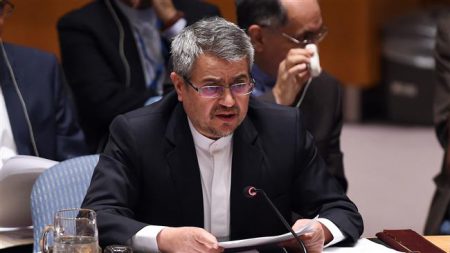
Iran’s ambassador to the UN Gholamali Khoshroo
Press TV – March 29, 2017
Iran’s ambassador to the UN Gholamali Khoshroo has called for the total eradication of nuclear weapons.
Khoshroo reiterated Iran’s call during a UN conference aimed at creating a nuclear weapons ban treaty in New York on Tuesday.
“Iran, as a victim of chemical weapons, strongly feels the danger posed by the existence of weapons of mass destruction and is determined to engage actively in international diplomatic efforts to save humanity from the menace of nuclear weapons,” he said.
Khoshroo stressed that Iran is committed to its Non-Proliferation Treaty (NPT) obligations, which include negotiations based on effective nuclear disarmament measures.
He added that several countries continue to ignore international calls and treaties for nuclear disarmament and even continue to increase their nuclear stockpiles. “They do not have political determination to abandon doctrines of nuclear deterrence and nuclear terror,” he went on to say.
Iran’s UN ambassador noted that boycotting the talks by many countries, including the US, shows that the world’s nuclear powers are by no means committed to the eradication of nuclear arms. Britain and France were also among the some 40 countries that did not join the talks.
“We note that prohibition of nuclear weapons must be accompanied by the elimination of such weapons. There can be no doubt that without complete abolition of nuclear weapons, there will be no absolute guarantee against the danger of nuclear war and the use of such weapons,” Khoshroo added.
Xi Jinping: Nuclear weapons … should be completely prohibited
International Physicians for the Prevention of Nuclear War | January 24, 2017
 IPPNW welcomes the statement by Chinese President Xi Jinping that “nuclear weapons … should be completely prohibited and destroyed over time to make the world free of them.” President Xi’s remarks, made during a speech on January 18 at the United Nations in Geneva, were consistent with China’s long-standing official support for nuclear disarmament, and come as the UN is preparing to convene negotiations on a new treaty to prohibit nuclear weapons.
China gave a positive signal at the UN General Assembly last month, unlike its other P5 partners, when it abstained from, rather than voting against, a resolution authorizing negotiations for a treaty banning nuclear weapons. The resolution was carried by a majority of over three to one. China can now show real leadership by declaring its intention to participate in the negotiating conference for the ban treaty opening this March, with the goal of making the complete prohibition of nuclear weapons an unequivocal international norm. By doing so, China would not only take an important practical step toward the elimination of nuclear weapons, it would also send a strong signal to the other eight nuclear-armed states that their objections to the negotiations and their criticisms of the treaty itself are misplaced, and that their massive reinvestments in nuclear warheads, delivery systems, and infrastructure are dangerous and contradictory to the goal of a world without nuclear weapons. The obligation to achieve that goal is spelled out in Article VI of the 1970 Nuclear Nonproliferation Treaty, and the International Court of Justice has unanimously said that all States, whether or not they possess nuclear arms, have an obligation under international law to negotiate nuclear disarmament.
IPPNW urges China to act upon President Xi’s timely and important policy statement by sending a delegation to the opening session of the ban treaty negotiating conference in March, with clear instructions to participate in good faith and in cooperation with the non-nuclear-armed states leading this historic process.
Iran urges end to arms sales to S Arabia, Israel
Press TV – October 15, 2016
Iran’s deputy permanent representative to the UN has warned against continued sales of weapons to Saudi Arabia and Israel, which are in violation of other territories as well as humanitarian laws.
“We are deeply concerned about the destabilizing repercussions of the continual entry and export of such weaponry into the region, especially into Saudi Arabia and the Zionist regime of Israel,” Gholam-Hossein Dehqani said.
He said both Saudi Arabia and Israel are “engaged in aggression and violation against other countries and in flouting their commitments to international humanitarian laws.”
Dehqani was speaking at the annual meeting of the United Nations General Assembly’s Disarmament and International Security Committee at the world body’s headquarters in New York, IRNA reported on Saturday.
He said the Saudi regime was using “British and American bombs” against vital Yemeni infrastructure.
Saudi Arabia has been pounding Yemen since March 2015 in an unsuccessful attempt to reinstall a former ally as president. The war has killed more than 10,000, according to UN figures in August.
Dehqani also stressed the need for disarming Israel of its nuclear arsenal and for the regime’s accession to the Nuclear Non-proliferation Treaty (NPT), saying “the most dangerous weapons are in the hands of the most dangerous regime in the Middle East.”
“The Zionist regime has recurrently perpetrated violations, occupation, genocide, and terrorist activities; and nuclear weapons in the hands of such a regime constitutes the most dangerous threat to NPT signatories in the Middle East,” he said.
Israel, which has refused to sign the NPT or allow inspections of its military nuclear facilities, keeps an estimated stockpile of some 200-400 nuclear warheads.
Separately, Iran’s envoy to the Organization for the Prohibition of Chemical Weapons (OPCW) urged the complete annihilation of chemical weapons stockpiles.
Alireza Jahangiri, addressing the body Executive Council in The Hague, also urged those countries in possession of such weapons to act on their commitments within the framework of the organization’s Chemical Weapons Convention and non-members to join the Convention.
Jahangiri also urged international cooperation to prevent the use of chemical weapons by terrorist groups, a scenario that he said posed a threat to international peace.
He called on member countries of the organization to refrain from providing support, financial and otherwise, to terrorist groups.
Featured Video

Liberty Cannot Exist Inside a Panopticon
or go to
Aletho News Archives – Video-Images
From the Archives
Left-leaning despisers of 9/11 Truth movement: Do you really believe in miracles?
David Ray Griffin | Global Research | 06 Jul 2010
An Open Letter to Terry Allen, Noam Chomsky, Alexander Cockburn, David Corn, Chris Hayes, George Monbiot, Matthew Rothschild, and Matt Taibbi.
[1]According to several left-leaning critics of the 9/11 Truth Movement, some of its central claims, especially about the destruction of the World Trade Center, show its members to be scientifically challenged. In the opinion of some of these critics, moreover, claims made by members of this movement are sometimes unscientific in the strongest possible sense, implying an acceptance of magic and miracles. … Full article
Blog Roll
 Aletho News
- White House envoy declares kinetic action against Yemen ‘fruitless’
- Ukraine deployed thousands of microdrones in Iraqi Kurdistan: Tasnim
- Iran calls for emergency UNSC meeting over Trump’s ‘brazen’ bomb talk, Israeli threats
- Iranian sources reveal details of Russia-China Hormuz proposal
- Plan for more US-Israel integration puts our military tech at risk
- Another Round Against Iran Will Break What Is Left of the Gulf
- SVR Report on Ukraine’s Mexican Drug Gang Links Could Pressure Zelensky, Won’t Change US Policy
- British Government Employees Were Fact-Checking the News at the BBC. Nobody Told You.
- Albania on fire: who’s behind the riots?
- Egypt’s Civil Democratic Movement rejects involvement in regional war
- If Americans Knew
- Israeli Defense Minister Katz Says Over 60 Lebanon Villages Have Been Destroyed
- Why Is Israel Running TV Ads in Iowa Ahead of the Midterms?
- Hind Rajab’s Alleged Killer Is in the United States. HRF Demands His Arrest.
- US Officials Face Fresh Pressure After Another American ‘Brutalized’ by Israeli Settlers in West Bank
- Israel-Backed Palestinian Militias Terrorize Displaced Families in Gaza
- FBI subpoenas pro-Palestine activists over Israeli weapons plant disruption
- Fourth winter arrives in wartorn Gaza, too early – Daily Update
- More on how Bari Weiss is using CBS on behalf of Israel
- What the UK Is Doing to Pro-Palestine Novelist Sally Rooney Is an Act of Orwellian Villainy
- ‘We will build palaces for Jews in Gaza’: Right-wing activists establish new outpost near border
- No Tricks Zone
- Predictions Made By Renowned Climate Proifessor Over Past Decades Have Been Proven To Be Poor
- New Study Suggests Large Regions Of The Pacific Ocean Have Been Cooling For The Last 80 Years
- Germany’s Green Energy Debacle: High Energy Costs Force Kahla Porzellan to Close After 182 Years!
- New Study: 50 Years Of The Most Aggressive ‘Net Zero’ Policies Can Only Affect The Global Climate By 0.03°C
- US September “Heat” Was No Record…Many Records Set Decades Ago
- Latest European Green Energy Debacle; Portugal’s Largest Flagship Solar Park Insolvent!
- Green Energy Debacle: German Expert Professor Fritz Vahrenholt Warns Of Severe Economic And Social Consequences
- Two More Paleo Reconstructions Affirm Meters-Higher Sea Levels Across Ireland, Brazil 7000-6000 Years Ago
- New Study: Earth And Venus Surface Warmth Largely Explained By Convection And Lapse Rate, Not CO2 Or Radiation
- 2025 Nature Paper Claiming Worsening Global Drought Gets RETRACTED …Heavily Flawed

