UK in panic over Johnson’s remarks against Saudi regime
Press TV – December 11, 2016
UK Foreign Secretary Boris Johnson’s recent criticism of Saudi Arabia has worried British officials, with various government figures trying to gloss them over as Johnson’s own personal views.
During a conference in Rome last week, Johnson blasted the Riyadh regime over its “proxy wars” in the Middle East and its unprovoked military aggression against Yemen, which has killed over 11,000 Yemenis since March 2015.
UK Prime Minister Theresa May’s spokeswoman immediately rebuked the remarks back then, saying the comments did not reflect “the government’s views on Saudi and its role in the region.”
Johnson’s statements divided the UK Parliament, with many of the lawmakers saying that he was stating the truth and should not face public chastisement.
UK Defense Minister Michael Fallon lashed out at the media on Sunday, for blowing the story out of proportions and confecting an artificial row between Johnson and the Downing Street.
“Let’s be very clear about this. The way some of his remarks were reported seemed to imply that we didn’t support the right of Saudi Arabia to defend itself… and didn’t support what Saudi Arabia is doing in leading the campaign to restore the legitimate government of Yemen,” Fallon said during a BBC interview.
“Some of the reporting led people to think that,” he added. “The way it was interpreted left people with the impression that we didn’t support Saudi Arabia and we do.”
Fallon said the months-long Saudi invasion against its impoverished southern neighbor was in self-defense, a right that London thought Riyadh was entitled to.
“The government’s view is absolutely clear – that what Saudi Arabia is entitled to do is defend itself from these attacks across its own border,” he said.
Johnson’s remarks came at a time when May was in the Middle East, trying to cement military and economic ties with [Persian] Gulf Cooperation Council nations – Saudi Arabia, the United Arab Emirates, Kuwait, Oman, Bahrain and Qatar.
Besides helping Bahrain with a heavy-handed crackdown on its popular uprising, Britain has also been providing weapons and intelligence to Saudis in the attacks against civilian targets in Yemen.
Kuwait expels 14 people for links with Hezbollah: Report
Press TV – March 21, 2016
The Kuwaiti government has deported 11 Lebanese and three Iraqis on charges of having links to Lebanon’s resistance movement, Hezbollah, a report says.
The Kuwaiti Arabic daily al-Qabas quoted a security source as saying on Monday that the 14 people had been expelled on the order of the state security service.
The move came nearly three weeks after the [Persian] Gulf Cooperation Council ([P]GCC), under the influence of the Saudi regime, declared Hezbollah a “terrorist” organization. Arab League foreign ministers, except those of Iraq and Lebanon, later followed suit.
The [P]GCC – comprising Saudi Arabia, Qatar, the United Arab Emirates, Oman, Bahrain and Kuwait – however, did not provide any evidence for its allegation. This comes as the first three monarchies themselves stand accused of supporting extremists and terrorists in the region.
Describing the [P]GCC decision as “reckless and hostile,” Hezbollah blamed it on Saudi Arabia.
Elsewhere in its report, Qabas said that Kuwaiti security officials have prepared a list of “unwanted” Lebanese and Iraqi people, including advisers to big companies, to be expelled for “the public interest.”
The people will not be allowed to enter the [P]GCC member states after their deportation, the daily said.
GCC not after protecting Lebanon: Hezbollah chief
Press TV – March 6, 2016
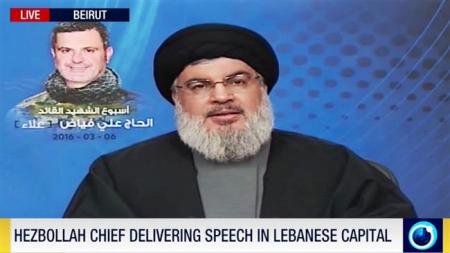
Sayyed Hassan Nasrallah, the secretary general of the Lebanese resistance movement Hezbollah, says the Arab member states of the [Persian] Gulf Cooperation Council ([P]GCC), which recently listed the resistance group as terrorists, do not have the interests of Lebanon in mind.
During a live televised speech on Sunday, Nasrallah said those who assume that the Arab regimes will protect Lebanon have “pinned their hopes on a fantasy.”
Had Lebanon waited for a unified Arab strategy in the face of Israel instead of opting to resist against the occupying regime, “then the fate of this territory would have been the same as the fate of the territories Israel has taken control of,” he said.
On Wednesday, the six-nation Arab bloc issued a statement labeling Hezbollah a terrorist organization. The [P]GCC comprises Bahrain, Kuwait, Oman, Qatar, Saudi Arabia and the United Arab Emirates.
“Many of these Arab countries today, who designate us as terrorists, what do they have to do with this resistance and these victories and these achievements?” Nasrallah said.
Israel unleashed an all-out offensive on Lebanon 10 years ago under the pretext of releasing Israeli soldiers allegedly captured by Hezbollah in southern Lebanon. The invasion claimed the lives of nearly 1,200 Lebanese people, most of them civilians.
The Tel Aviv regime was, however, forced to retreat without achieving any of its objectives after Hezbollah fighters displayed heavy resistance against the Israeli military.
“Back then, we said to them (the Arab countries) ‘we don’t want anything from you… Today, we also say to them, to these regimes, ‘We don’t want anything from you. We don’t want money, nor do we want weapons, nor do we want support or blessing,” he said. “Just leave this resistance alone, leave this country alone, and leave this people alone.”
He blamed some Arab regimes for conspiring against anyone standing against Israel.
Nasrallah also underlined the assistance provided by the resistance group to the Iraqi government in its fight against the Takfiri terror group Daesh and reminded that Hezbollah did not wait for any orders to initiate its anti-terror fight in Syria and only fulfilled its religious commitment.
The secretary general of Hezbollah also addressed the tension that has been bubbling up between Saudi Arabia and Lebanon, causing the former to take a raft of hostile measures against the latter.
“If it’s angry with us, it has the right to. I understand Saudi Arabia’s anger. Why? Because when one fails, at the very least he will be angry,” Nasrallah said.
He went on to explain that the Saudi rage has emanated from the kingdom’s failures in Yemen and Syria.
“In Syria, there’s a very great Saudi anger because what they had calculated in Syria [was that] in two or three months, ‘Syria would fall into our hands,’” Nasrallah said.
Hezbollah has been successfully aiding the Syrian military against foreign-backed militant groups.
“He, who confronts Saudi Arabia in Syria is the real defender of the Lebanese national interests,” Nasrallah said.
“The same goes for Yemen. The estimations of the new Saudi leadership was that ‘we will decide the battle in Yemen. We will teach a lesson to all the Arab countries and the Arab world… and we will impose ourselves on the Arab world,’” he said.
Saudi Arabia launched a campaign of military aggression against Yemen in late March last year in a bid to bring fugitive former Yemeni President Abd Rabbuh Mansur Hadi, a Riyadh ally, back to power and undermine Yemen’s Houthi Ansarullah movement.
Riyadh has, however, failed in accomplishing either of the two objectives, and has become entangled in a prolonged expensive war, whose adverse economic impacts—along with economic mismanagement—have gradually been giving rise to domestic discontent inside Saudi Arabia.
GCC declares Hezbollah ‘terrorist group’
Press TV – March 2, 2016
The Arab monarchies of the Persian Gulf have declared Lebanon’s Hezbollah movement, which has been fighting terrorist groups in Syria and Israeli occupation, a “terrorist group.”
The six-nation Gulf Cooperation Council officially added Hezbollah and all groups affiliated to its so-called list of “terrorist” organizations on Wednesday.
In a statement, GCC’s Secretary General Abdullatif bin Rashid al-Zayan accused Hezbollah and associated groups of committing “acts of aggression”, recruiting “youth” inside the Persian Gulf littoral states, smuggling “weapons and explosives”, sowing “sedition” and instigating “chaos and violence.”
The bloc, however, did not provide any evidence for its allegations.
The GCC comprises Saudi Arabia, Qatar, the United Arab Emirates, Oman, Bahrain and Kuwait.
The move by the six-member bloc is the latest measure against Hezbollah, which is fighting terrorists in Syria.
In 2000 and 2006, when Israel launched two wars on Lebanon, Hezbollah fighters gave befitting responses to the Tel Aviv regime’s acts of aggression, forcing Israeli military to retreat without achieving any of its objectives.
The GCC have taken a series of measures against Hezbollah since Saudi Arabia last month halted a $4- billion aid pledge to Lebanon’s security forces.
The aid suspension came after Beirut did not follow Riyadh’s lead and refused to endorse joint anti-Iran statements at separate meetings held in Cairo and Jeddah.
On February 26, Saudi Arabia blacklisted four Lebanese firms and three individuals over alleged affiliation to Hezbollah, and imposed sanctions on them. The kingdom also ordered its citizens not to travel to Lebanon, and is poised to expel the Lebanese citizens working on its territory.
On Tuesday, Seyyed Hassan Nasrallah, the secretary general of Hezbollah said Saudi propaganda against Hezbollah has led to a political conflict in Lebanon, and advised the Lebanese youth against playing into the hands of Saudi Arabia, which he said spreads lies about Hezbollah and wrongly accuses the resistance movement of sowing sectarian strife between Shias and Sunnis.
He also denounced the Arab world’s silence in the face of Riyadh’s aggression on Yemen, where over 8,000 people have lost their lives since the Saudi onslaught began in late March last year.
Nasrallah warned that there are some Lebanese groups hoping to see a war in Lebanon just like the one Riyadh has waged against Yemen.
This comes as the Persian Gulf monarchies themselves stand accused of supporting extremists and terrorists in the region.
Repressive governments donated to Clinton Foundation, arms deals approved by Hillary’s State Dept. – report
RT | May 26, 2015
Nations openly chastised by the US for dismal human rights records donated billions to the Clinton Foundation, while gaining clearance for weapons deals approved by the Hillary Clinton-led US State Department, according to a new report.
As the Obama administration increased military weapons exports, Hillary Clinton’s State Department approved transfer of more than $300 billion worth of arms manufactured by US defense contractors to 20 nations that were or have since become donors of the Clinton Foundation, a major philanthropic organization run by the Clinton family. According to a review of available records of foundation donors by the International Business Times, those countries included governments that have received frequent criticism by the State Department for repressive policies.
“Algeria, Saudi Arabia, Kuwait, the United Arab Emirates, Oman and Qatar all donated to the Clinton Foundation and also gained State Department clearance to buy caches of American-made weapons even as the department singled them out for a range of alleged ills, from corruption to restrictions on civil liberties to violent crackdowns against political opponents,” IBT wrote.
Algeria, Kuwait, Oman, and Qatar were nations that directly donated to the Clinton Foundation during Clinton’s term as secretary of state, even as they were requesting weapons shipments. The donated money represents a loophole in US law regarding political contributions.
“Under federal law, foreign governments seeking State Department clearance to buy American-made arms are barred from making campaign contributions — a prohibition aimed at preventing foreign interests from using cash to influence national security policy,” IBT noted. “But nothing prevents them from contributing to a philanthropic foundation controlled by policymakers.”
The reviewed sales — both commercial and Pentagon-brokered — represent those made during “three full fiscal years of Clinton’s term as secretary of state (from October 2010 to September 2012),” IBT reported. The deals made with the nations in question during this time add up to far more than arms agreements made with the same countries during the last three full fiscal years of George W. Bush’s administration, according to the report.
“The word was out to these groups that one of the best ways to gain access and influence with the Clintons was to give to this foundation,” Meredith McGehee, policy director at the Campaign Legal Center, told IBT. “This shows why having public officials, or even spouses of public officials, connected with these nonprofits is problematic.”
The Clinton Foundation’s donor list has come under closer examination since Hillary Clinton announced she is seeking the Democratic Party’s presidential nomination in 2016. In April, the Clintons acknowledged they have made “mistakes” regarding transparency amid increased public scrutiny concerning donations from foreign entities, especially when Mrs. Clinton was secretary of state, from 2009 to 2013.
Earlier this month, former President Bill Clinton defended his family foundation’s donors.
“I don’t think there’s anything sinister in trying to get wealthy people in countries that are seriously involved in development to spend their money wisely in a way that helps poor people and lifts them up,” Mr. Clinton told NBC News.
The Clinton Foundation signed a foreign donor disclosure agreement just before Hillary Clinton became secretary of state, yet neither the department nor the White House raised issues with potential conflicts of interest regarding the weapons agreements.
IBT reported that in 1995 President Clinton signed a presidential policy directive demanding the State Department take into account human rights abuses when considering the approval of military equipment or arms purchases from US companies. Yet Mrs Clinton’s State Department ignored this stipulation, helping the Obama administration increase weapons transfers.
The State Department, under the aegis of Clinton, hammered the Algerian government in its 2010 Human Rights Report for “restrictions on freedom of assembly and association,” allowing “arbitrary killing,” “widespread corruption,” and a “lack of judicial independence.”
“That year, the Algerian government donated $500,000 to the Clinton Foundation and its lobbyists met with the State Department officials who oversee enforcement of human rights policies. Clinton’s State Department the next year approved a one-year 70 percent increase in military export authorizations to the country,” IBT reported. “The increase included authorizations of almost 50,000 items classified as ‘toxicological agents, including chemical agents, biological agents and associated equipment’ after the State Department did not authorize the export of any of such items to Algeria in the prior year.
“During Clinton’s tenure, the State Department authorized at least $2.4 billion of direct military hardware and services sales to Algeria — nearly triple such authorizations over the last full fiscal years during the Bush administration. The Clinton Foundation did not disclose Algeria’s donation until this year — a violation of the ethics agreement it entered into with the Obama administration.”
IBT also reported that major US weapons manufacturers and financial corporations such as Boeing, Lockheed Martin, and Goldman Sachs paid Bill Clinton lucrative speaking fees “reaching $625,000” just as arms deals they had an interest in were in the works with Mrs Clinton’s State Department.
Hillary Clinton had pledged during her Senate confirmation hearings in 2009 that “in many, if not most cases, it is likely that the Foundation or President Clinton will not pursue an opportunity that presents a conflict.”
US weapons sales tripled in 2011 to a new yearly high of $66.3 billion, according to the New York Times, mostly driven by sales to Persian Gulf nations allied against Iran. This dollar total made up nearly 78 percent of all worldwide arms deals that year, according to the Congressional Research Service.
Reuters reported in January 2013 that the State Department office that has oversight of direct commercial arms sales “was on track to receive more than 85,000 license requests in 2012, a new record.”
The boom in arms sales by the Obama administration has continued to the present day, as Arab allies like Saudi Arabia and United Arab Emirates are using American-made fighter jets against Islamic State and for proxy wars in places like Yemen and Syria.
According to the Times, foreign weapons sales now represent 25 percent to 30 percent of revenue taken in by Lockheed Martin, one of the top US-based arms dealers.
The Geopolitics behind the War in Yemen (I)
By Mahdi Darius NAZEMROAYA | Strategic Culture Foundation | 30.03.2015
The United States and the Kingdom of Saudi Arabia became very uneasy when the Yemenese or Yemenite movement of the Houthi or Ansarallah (meaning the supporters of God in Arabic) gained control of Yemen’s capital, Sanaa/Sana, in September 2014. The US-supported Yemenite President Abd-Rabbuh Manṣour Al-Hadi was humiliatingly forced to share power with the Houthis and the coalition of northern Yemenese tribes that had helped them enter Sana. Al-Hadi declared that negotiations for a Yemeni national unity government would take place and his allies the US and Saudi Arabia tried to use a new national dialogue and mediated talks to co-opt and pacify the Houthis.
The truth has been turned on its head about the war in Yemen. The war and ousting of President Abd-Rabbuh Manṣour Al-Hadi in Yemen are not the results of «Houthi coup» in Yemen. It is the opposite. Al-Hadi was ousted, because with Saudi and US support he tried to backtrack on the power sharing agreements he had made and return Yemen to authoritarian rule. The ousting of President Al-Hadi by the Houthis and their political allies was an unexpected reaction to the takeover Al-Hadi was planning with Washington and the House of Saudi.

The Houthis and their allies represent a diverse cross-section of Yemeni society and the majority of Yemenites. The Houthi movement’s domestic alliance against Al-Hadi includes Shiite Muslims and Sunni Muslims alike. The US and House of Saud never thought that the Houthis would assert themselves by removing Al-Hadi from power, but this reaction had been a decade in the making. With the House of Saud, Al-Hadi had been involved in the persecution of the Houthis and the manipulation of tribal politics in Yemen even before he became president. When he became Yemeni president he dragged his feet and was working against the implement the arrangements that had been arranged through consensus and negotiations in Yemen’s National Dialogue, which convened after Ali Abdullah Saleh was forced to hand over his powers in 2011.
Coup or Counter-Coup: What Happened in Yemen?
At first, when they took over Sana in late-2014, the Houthis rejected Al-Hadi’s proposals and his new offers for a formal power sharing agreement, calling him a morally bankrupt figure that had actually been reneging on previous promises of sharing political power. At that point, President Al-Hadi’s pandering to Washington and the House of Saud had made him deeply unpopular in Yemen with the majority of the population. Two months later, on November 8, President Al-Hadi’s own party, the Yemenite General People’s Congress, would eject Al-Hadi as its leader too.
The Houthis eventually detained President Al-Hadi and seized the presidential palace and other Yemeni government buildings on January 20. With popular support, a little over two weeks later, the Houthis formally formed a Yemeni transitional government on February 6. Al-Hadi was forced to resign. The Houthis declared that Al-Hadi, the US, and Saudi Arabia were planning on devastating Yemen on February 26.
Al-Hadi’s resignation was a setback for US foreign policy. It resulted in a military and operational retreat for the CIA and the Pentagon, which were forced to remove US military personnel and intelligence operatives from Yemen. The Los Angeles Times reported on March 25, citing US officials, that the Houthis had got their hands on numerous secret documents when they seized the Yemeni National Security Bureau, which was working closely with the CIA, that compromised Washington’s operations in Yemen.
Al-Hadi fled the Yemeni capital Sana to Aden on February 21 and declared it the temporary capital of Yemen on March 7. The US, France, Turkey, and their Western European allies closed their embassies. Soon afterwards, in what was probably a coordinated move with the US, Saudi Arabia, Kuwait, Bahrain, Qatar, and the United Arab Emirates all relocated the embassies to Aden from Sana. Al-Hadi rescinded his letter of resignation as president and declared that he was forming a government-in-exile.
The Houthis and their political allies refused to fall into line with the demands of the US and Saudi Arabia, which were being articulated through Al-Hadi in Aden and by an increasingly hysteric Riyadh. As a result, Al-Hadi’s foreign minister, Riyadh Yaseen, called for Saudi Arabia and the Arab petro-sheikdoms to militarily intervene to prevent the Houthis from getting control of Yemen’s airspace on March 23. Yaseen told the Saudi mouthpiece Al-Sharg Al-Awsa that a bombing campaign was needed and that a no-fly zone had to be imposed over Yemen.
The Houthis realized that a military struggle was going to begin. This is why the Houthis and their allies in the Yemenite military rushed to control as many Yemeni military airfields and airbases, such as Al-Anad, as quickly as possible. They rushed to neutralize Al-Hadi and entered Aden on March 25.
By the time the Houthis and their allies entered Aden, Al-Hadi had fled the Yemeni port city. Al-Hadi would resurface in Saudi Arabia when the House of Saud started attacking Yemen on March 26. From Saudi Arabia, Abd-Rabbuh Manṣour Al-Hadi would then fly to Egypt for a meeting of the Arab League to legitimize the war on Yemen.
Yemen and the Changing Strategic Equation in the Middle East
The Houthi takeover of Sana took place in the same timeframe as a series of success or regional victories for Iran, Hezbollah, Syria and the Resistance Bloc that they and other local actors form collectively. In Syria, the Syrian government managed to entrench its position while in Iraq the ISIL/ISIS/Daesh movement was being pushed back by Iraq with the noticeable help of Iran and local Iraqi militias allied to Tehran.
The strategic equation in the Middle East began to shift as it became clear that Iran was becoming central to its security architecture and stability. The House of Saud and Israeli Prime Minister Benjamin Netanyahu began to whimper and complain that Iran was in control of four regional capitals—Beirut, Damascus, Baghdad, and Sana – and that something had to be done to stop Iranian expansion. As a result of the new strategic equation, the Israelis and the House of Saud became perfectly strategically aligned with the objective of neutralizing Iran and its regional allies. «When the Israelis and Arabs are on the same page, people should pay attention», Israeli Ambassador Ron Dermer told Fox News about the alignment of Israel and Saudi Arabia on March 5.

The Israeli and Saudi fear mongering has not worked. According to Gallup poll, only 9% of US citizens viewed Iran as the greatest enemy of the US at the time that Netanyahu arrived in Washington to speak against a deal between the US and Iran.
The Geo-Strategic Objectives of the US and Saudis Behind the War in Yemen
While the House of Saudi has long considered Yemen a subordinate province of some sort and as a part of Riyadh’s sphere of influence, the US wants to make sure that it could control the Bab Al-Mandeb, the Gulf of Aden, and the Socotra Islands. The Bab Al-Mandeb it is an important strategic chokepoint for international maritime trade and energy shipments that connects the Persian Gulf via the Indian Ocean with the Mediterranean Sea via the Red Sea. It is just as important as the Suez Canal for the maritime shipping lanes and trade between Africa, Asia, and Europe.
Israel was also concerned, because control of Yemen could cut off Israel’s access to the Indian Ocean via the Red Sea and prevent its submarines from easily deploying to the Persian Gulf to threaten Iran. This is why control of Yemen was actually one of Netanyahu’s talking points on Capitol Hill when he spoke to the US Congress about Iran on March 3 in what the New York Times of all publications billed as «Mr. Netanyahu’s Unconvincing Speech to Congress» on March 4.
Saudi Arabia was visibly afraid that Yemen could become formally aligned to Iran and that the events there could result in new rebellions in the Arabian Peninsula against the House of Saud. The US was just as much concerned about this too, but was also thinking in terms of global rivalries. Preventing Iran, Russia, or China from having a strategic foothold in Yemen, as a means of preventing other powers from overlooking the Gulf of Aden and positioning themselves at the Bab Al-Mandeb, was a major US concern.
Added to the geopolitical importance of Yemen in overseeing strategic maritime corridors is its military’s missile arsenal. Yemen’s missiles could hit any ships in the Gulf of Aden or Bab Al-Mandeb. In this regard, the Saudi attack on Yemen’s strategic missile depots serves both US and Israeli interests. The aim is not only to prevent them from being used to retaliate against exertions of Saudi military force, but to also prevent them from being available to a Yemeni government aligned to either Iran, Russia, or China.
In a public position that totally contradicts Riyadh’s Syria policy, the Saudis threatened to take military action if the Houthis and their political allies did not negotiate with Al-Hadi. As a result of the Saudi threats, protests erupted across Yemen against the House of Saud on March 25. Thus, the wheels were set in motion for another Middle Eastern war as the US, Saudi Arabia, Bahrain, UAE, Qatar, and Kuwait began to prepare to reinstall Al-Hadi.
The Saudi March to War in Yemen and a New Front against Iran
For all the talk about Saudi Arabia as a regional power, it is too weak to confront Iran alone. The House of Saud’s strategy has been to erect or reinforce a regional alliance system for a drawn confrontation with Iran and the Resistance Bloc. In this regard Saudi Arabia needs Egypt, Turkey, and Pakistan —a misnamed so-called «Sunni» alliance or axis — to help it confront Iran and its regional allies.
Crown Prince Mohammed bin Zayed bin Sultan Al Nahyan, the crown prince of the Emirate of Abu Dhabi and deputy supreme commander of the UAE’s military, would visit Morocco to talk about a collective military response to Yemen by the Arab petro-sheikhdoms, Morocco, Jordan, and Egypt on March 17. On March 21, Mohammed bin Zayed met Saudi Arabia’s King Salman Salman bin Abdulaziz Al-Saud to discuss a military response to Yemen. This was while Al-Hadi was calling for Saudi Arabia and the Gulf Cooperation Council (GCC) to help him by militarily intervening in Yemen. The meetings were followed by talk about a new regional security pact for the Arab petro-sheikdoms.
Out of the GCC’s five members, the Sultanate of Oman stayed away. Oman refused to join the war on Yemen. Muscat has friendly relations with Tehran. Moreover, the Omanis are weary of the Saudi and GCC project to use sectarianism to ignite confrontation with Iran and its allies. The majority of Omanis are neither Sunni Muslims nor Shiite Muslims; they are Ibadi Muslims, and they fear the fanning of sectarian sedition by the House of Saud and the other Arab petro-sheikdoms.
Saudi propagandists went into over drive falsely claiming that the war was a response to Iranian encroachment on the borders of Saudi Arabia. Turkey would announce its support for the war in Yemen. On the day the war was launched, Turkey’s Erdogan claimed that Iran was trying to dominate the region and that Turkey, Saudi Arabia, and the GCC were getting annoyed.
During these events, Egypt’s Sisi stated that the security of Cairo and the security of Saudi Arabia and the Arab petro-sheikhdoms are one. In fact, Egypt said that it would not get involved in a war in Yemen on March 25, but the next day Cairo joined Saudi Arabia in Riyadh’s attack on Yemen by sending its jets and ships to Yemen.
In the same vein, Pakistani Prime Minister Nawaz Sharif released a statement on March 26 that any threat to Saudi Arabia would «evoke a strong response» from Pakistan. The message was tacitly directed towards Iran.
The US and Israeli Roles in the War in Yemen
On March 27, it was announced in Yemen that Israel was helping Saudi Arabia attack the Arab country. «This is the first time that the Zionists [Israelis] are conducting a joint operation in collaborations with Arabs,» Hassan Zayd, the head of Yemen’s Al-Haq Party, wrote on the internet to point out the convergence of interests between Saudi Arabia and Israel. The Israeli-Saudi alliance over Yemen, however, is not new. The Israelis helped the House of Saud during the North Yemen Civil War that started in 1962 by providing Saudi Arabia with weapons to help the royalists against the republicans in North Yemen.
The US is also involved and leading from behind or a distance. While it works to strike a deal with Iran, it also wants to maintain an alliance against Tehran using the Saudis. The Pentagon would provide what it called «intelligence and logistical support» to the House of Saud. Make no mistakes about it: the war on Yemen is also Washington’s war. The GCC has been unleashed on Yemen by the US.
There has long been talk about the formation of a pan-Arab military force, but proposals for creating it were renewed on March 9 by the rubberstamp Arab League. The proposals for a united Arab military serve US, Israeli, and Saudi interests. Talk about a pan-Arab military has been motivated by their preparations to attack Yemen to return Al-Hadi and to regionally confront Iran, Syria, Hezbollah, and the Resistance Bloc.
(To be continued)
Kuwait Emir Opens Gulf Summit with Call to End Syria War
Al-Manar | December 10, 2013
Kuwait’s Emir Sheikh Sabah al-Ahmad Al-Sabah opened an annual Gulf summit on Tuesday with a call for an end to the “human catastrophe” in Syria and announced support for the nuclear agreement between Iran and World Powers.
Kuwait hosts Tuesday and Wednesday the thirty-fourth Gulf Cooperation Council summit amid serious divisions among its members.
The summit witnessed exacerbated disputes among the member states that concentrated their discussions on the new American attitude towards Iran.
Although many of the Gulf countries viewed the nuclear agreement between Iran and the world powers positively, Saudi Arabia revealed surging rage as it is concerned that the Iranian-American agreement may weaken its role in the region.
The augmenting strategic role of Iran in the region and the decline of the American dependence on the Gulf sources of energy intensified the concerns of the GCC states.
Analysts emphasized that the Gulf Union was proposed to compensate the strategic losses, yet Oman’s threat of withdrawing from the council tackled the proposal and deepened the rift among the its states.
Qatar’s concerns about being subjected to the Saudi influence also represented a main obstacle facing the union.
Economically, the disputes between Saudi Arabia and the United Arab Emirates thwarted the efforts to establish the custom union.
Related article
Featured Video

No Threat Can Force Iran’s Surrender /Trita Parsi & Lt Cl Daniel Davis
or go to
Aletho News Archives – Video-Images
From the Archives
What is the Israeli Lobby in Australia Doing in Interfaith Dialogue?
By Ali Kazak | Dissident Voice | October 11, 2015
For years Israel and its lobby around the world have been trying to normalise their relations with Arabs and Muslims without solving the Palestine Question.
One of the methods they resorted to in the last few years is using human rights and community organizations such as interfaith dialogue and Multiculturalism to achieve this objective and to: isolate the Palestinians, marginalise the Palestine question, end Israel’s isolation, and prevent criticism of Israel, knowing that these organisations will be the first to stand against Israel’s violations, racial and religious discrimination.
The group responsible for this task in Australia is The Australia/Israel & Jewish Affairs Council (AIJAC); its Director of International & Community Affairs, Jeremy Jones is in charge of lobbying religious community organizations, specifically Muslims and Christians. Consequently he convened the Faith Communities for Reconciliation, founding participant in the Australian Partnership of Religious Organisations and the Australian National Dialogue of Christians, Muslims & Jews.
AIJAC is a private political propaganda group. It is recognised as the main Israeli lobby in Australia. It coordinates its activities and works intimately with the Israeli embassy in Canberra and different institutions in Israel. It is privately funded by some Jewish businessmen. It monitors closely Australian politicians, the media, ethnic and religious groups, (especially Arabs and Muslims), unions and academics on their stands towards Israel and the Palestine question. … continue
Blog Roll
 Aletho News
- The war of liberation of the Arab and Islamic peoples expands across the Gulf
- Envoy warns UN on Trump’s threat to ‘obliterate’ Iran’s civilian infrastructure
- The Larak Corridor: Iran’s Rial Gate With No US, No Israel, and No Way Around
- ‘Economic terrorism’: Steel facilities hit again in US-Israeli strike
- ‘War Crime’: Iran condemns attacks on Arak, Ardakan nuclear sites
- Two-thirds of Americans want quick end to Iran war even if goals unmet
- Trump to Give “Important Update on Iran” Wednesday in Prime-Time Speech
- Theodore Postol: Iran’s Missiles & Drones Were Underestimated
- Iran To Target Military Industrial-Tech Complex That Facilitated Gaza Genocide
- Collapsing Empire: The Resistance Disarms ‘Israel’
- If Americans Knew
- Israel wants US to bomb more of Iran’s civilian structures (113,000 is not enough) – Not a ceasefire Day 173
- Ann Coulter Rips Into Fox News for Iran War Coverage
- Joe Kent Urges Americans To Call White House and Congress To Object To Sending Troops Into Iran
- DNC Resolution to Reject AIPAC Funding Puts Democratic Leaders in the Hot Seat
- Swedish foundation to build 400 schools as over 650,000 Gaza children remain without education for 2 years
- Israeli army admits photshopping image of slain Lebanese journalist
- This is how Israel is systematically killing health workers under the cover of war in Lebanon
- Carrying life under fire: Israeli invasion of Lebanon leaves pregnant women facing deadly risks
- Champagne all around for the new death penalty (for Palestinians) law – Not a ceasefire Day 172
- Why are Palestinian books struggling to be seen on Amazon?
- No Tricks Zone
- New Study Finds Warming Saves Lives…Cold Temperatures 12 Times More Deadly Than Excess Heat
- German Science Blog Accuses PIK Climate Institute Of Hallucinating Climate Tipping Points
- Devastating Assessment Of Comirnaty Vaccine By Former Senior Pfizer Europe Toxicologist
- New Study: CO2 Is ‘Effectively Negligible’ As An Explanatory Climate Change Factor Since 2000
- Former Pfizer Toxicologist Dr. Helmut Sterz Tells Bundestag Hearing Pfizer Vaccine Should Have Never Been Approved
- Energy Expert: Germany’s Nuclear Phaseout Was A “500 Billion Euro Mistake”
- New Research: South Australia’s Mid-Holocene Sea Surface Temperatures Were 4°C Warmer Than Today
- Storing Green Energy To Last Germany 10 Days Would Require A 60-Million Tonne Battery
- New Studies: UK Sea Levels Were 4 Meters Higher Than Today During The Mid-Holocene
- Destructive Green New Deal: German Energy And Metal Group Warns Of Drastic Crisis
 Aletho News